




Abstract
The advent of automated driving is a global trend. It is likely that views on what will make an automated vehicle trustworthy, comfortable, usable, and enhance passengers’ well-being while driving will differ between markets. Therefore, we conducted an expert survey (n = 28) to identify cultural-specific design requirements of Level 4 automated vehicles for China, Germany, and the United States. Our results indicate a tendency toward hedonic vehicle design in China and pragmatic design in Germany. United States lies between these two markets. The results imply that car manufacturers can influence passengers’ well-being through vehicle design and, in turn, increase acceptance of automated vehicles.
Keywords
Vehicle automation has become a ubiquitous global trend affecting not only the international automotive industry but also societies with regard to infrastructure, legislation, and user acceptance. Especially the latter aspect of user acceptance will likely affect the design of automated vehicles. One approach to emphasize the user perspective in the development of automated vehicles is to consider passenger well-being, that is, the “positive self-evaluation of one’s current affective state triggered by the travel experience” (Sauer, Mertens, Heitland et al., 2019, p. 240). Passenger well-being is gaining importance as cars evolve from a means of transportation to an additional living space through high and full automation (SAE, 2016; Sauer, Mertens, Heitland et al., 2019). In a similar vein, the interior of an automated vehicle may be of particular importance, as it contributes largely to creating a living space.
As automated driving is likely to be available in multiple markets, this raises the question to what extent cultural aspects need to be considered in a user-centered design of automated vehicle interiors. In this study, we investigate cultural differences in user requirements for the interiors of level 4 (SAE, 2016) automated vehicles affecting passenger well-being and related user needs in the markets China, Germany, and the United States.
Cultural Differences Shape Users’ View of Automated Vehicles
In general, culture influences how products are perceived and evaluated (Bloch, 1995; Creusen & Schoormans, 2005). In terms of automated vehicles, a similar relationship is found. The public view of and readiness for automated vehicles differ between countries and cultures. Differences exist in China, Germany, and the United States between the readiness for automated vehicles (Threlfall, 2018), usefulness perceived by users (Continental, 2018), and users’ interest and associated emotions with this technology (AUDI AG, 2019). Chinese respondents displayed a very high curiosity and optimism toward automation, while German and U.S. respondents had stronger feelings of mistrust and anxiety in comparison.
Cultural differences are also evident in the evaluation of vehicle design. For example, a study in the United Kingdom and India shows different design preferences for in-vehicle human–machine interfaces (Khan et al., 2016). Cultural differences are also evident for external human–machine interfaces that facilitate communication between automated vehicles and other road users (Weber et al., 2019). Furthermore, culture also plays a role in the evaluation of center stack design (Mohamed et al., 2013) or exterior design of the vehicle (Purucker, 2012).
Based on these findings, our study aims to combine the evolving topic of passenger well-being in automated driving with cross-cultural design requirements for automated vehicle interiors by conducting an expert survey. To cover a diverse set of cultures, we consider China, Germany, and the United States. These markets are expected to be leading in automated driving (Frost & Sullivan, 2018) and driving behavior differs between all three countries (Färber, 2016). In addition to passenger well-being, we consider the additional user needs trust, usability, and comfort that can contribute to passenger well-being in automated driving (Sauer, Mertens, Heitland et al., 2019) and investigate their requirements and relationship with well-being. To address the raised research questions, we extend the data and analysis from our prior expert survey (Sauer, Mertens, Groß et al., 2019) to include insights from the United States in addition to the former results from China and Germany.
Method
Participants
To extend the existing data basis, we invited experts for the U.S. market with knowledge in the development of automated vehicles and verified industry expertise to participate in the survey. In total, we collected additional data from eight experts for the U.S. market, extending the overall database to 28 experts across all markets (see Table 1).
Details on the Sample of Experts Participating in the Survey
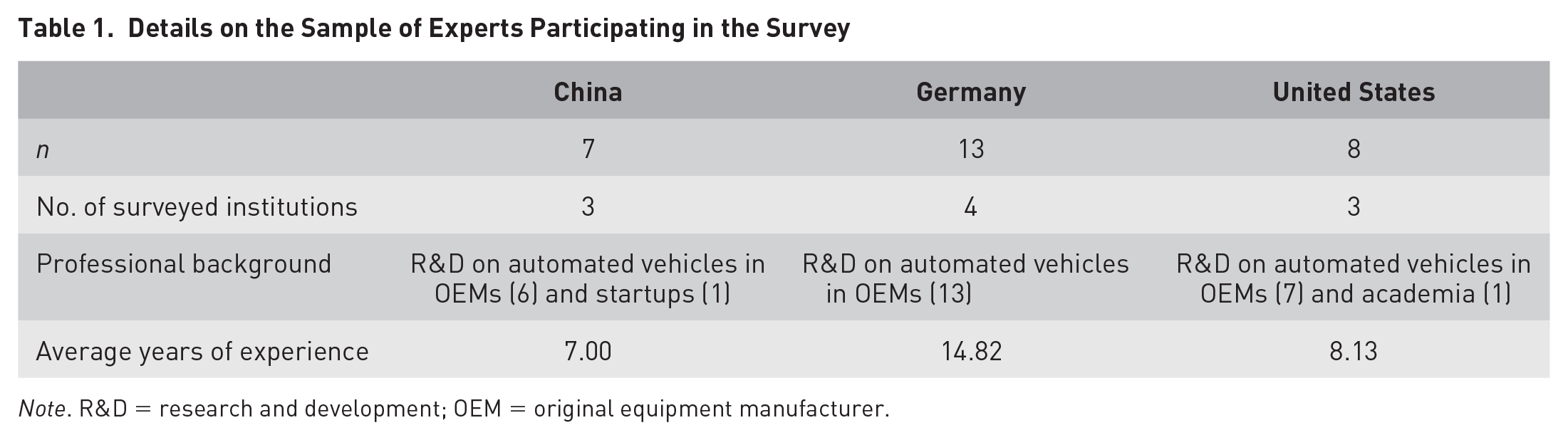
Note. R&D = research and development; OEM = original equipment manufacturer.
Study Materials
For the data collection in the United States, we used a qualitative questionnaire identical to the questionnaire used for a prior survey in China and Germany (Sauer, Mertens, Groß et al., 2019). The questionnaire was developed in German and used by the German experts. An English translation was used in China and the United States. In total, the survey consists of three parts.
Part 1
The level of experienced passenger well-being in an automated vehicle depends, among other aspects, on the features of the travel experience. The travel experience is likely to include features of the physical vehicle itself (dynamic, ambient, spatial features) and features of the travel experience (situational, passenger, social, travel time–related features, and nondriving-related tasks [NDRTs]; Richards, 1980). With increasing automation, technical features specific to automation may play a role as well. We asked experts to evaluate the role of these nine features as determinants of passenger well-being by ranking them in order of importance for passenger well-being.
Part 2
To gain further understanding of how passenger well-being may relate to the acceptance of automated vehicles in different markets, we asked the experts to rate the importance of passenger well-being on a scale of 1 to 7 (1 = very unimportant, 7 = very important).
Part 3
In a third section, we ascertained the experts’ assessment of which interior features of an automated vehicle contribute to passenger well-being and related needs in their respective markets. We asked the experts to name the Top 3 to Top 5 features that contribute the strongest to building a sense of passenger well-being in their order of importance (Top 1 feature most important, Top 5 feature least important). Additionally, we extended the questionnaire to investigate how the user needs trust, comfort, and usability may be fulfilled by an automated vehicle interior.
Data Analysis
We analyzed quantitative data with descriptive statistics. Two researchers analyzed the qualitative data on the top features relevant for passenger well-being and related passenger needs provided by the experts. Both researchers clustered the responses independently to derive feature groups that contribute to well-being and the respective needs. Categories with two or fewer mentions across all markets were excluded. Based on the rank of the features (Top 1 to Top 5) provided by each expert, we calculated the average rank of importance for each feature category.
Results
A General View on the Determinants and Consequences of Passenger Well-Being
Experts from all three markets are in agreement that spatial features (e.g., seat or vehicle dimensions) are most important to passenger well-being, followed by technical features (e.g., system behavior or transparency; see Figure 1). The remaining features of the physical vehicle play a slightly less important role across all markets. In China and the United States, ambient features (e.g., lighting or air conditioning) are more important than dynamic features (e.g., driving characteristics), while the importance is reversed in the view of German experts. Interestingly, the importance of accompanying features of the travel experience is viewed differently in the three markets. While experts agree that the type of NDRTs passengers can engage in has comparatively high importance, there is less unison regarding the other features. For example, the time spent traveling in an automated vehicle plays a stronger role in Germany than in the United States or China.
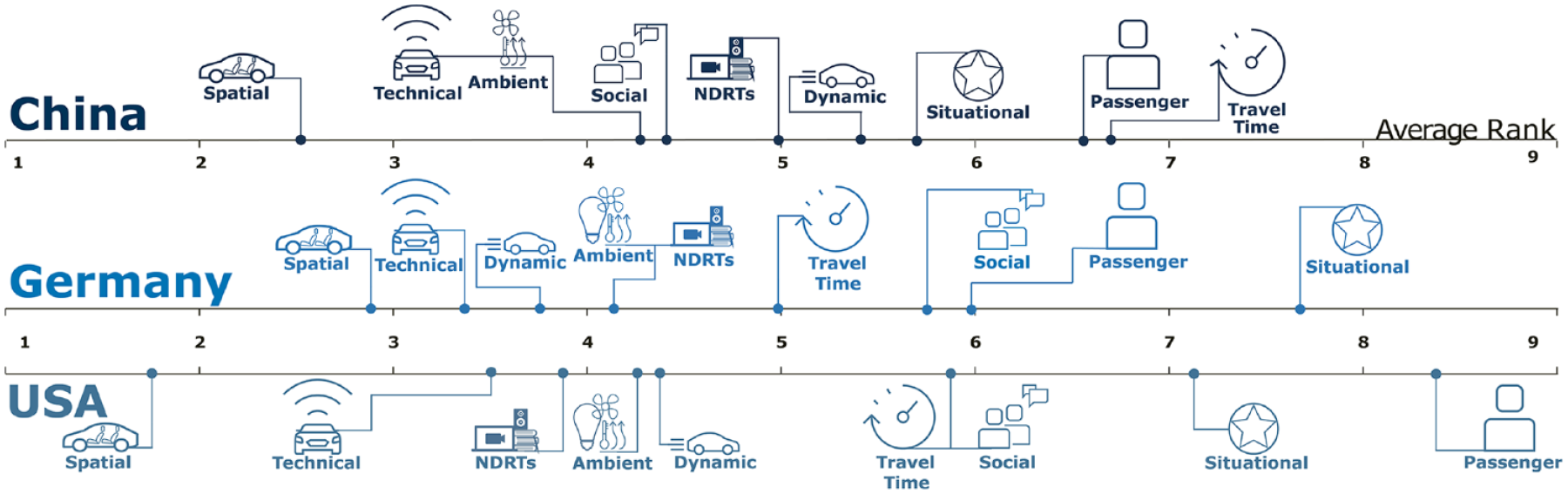
Average ranking of the importance of features of the automated driving experience for passenger well-being.
In terms of automated driving acceptance as a possible consequence of passenger well-being, differences in the importance rating of well-being are evident. Experts for the U.S. market view passenger well-being on average (M = 6.12, standard deviation [SD] = 0.99) as more important than Chinese experts (M = 5.57, SD = 1.40) or German experts (M = 4.77, SD = 1.96).
Features Fostering Passenger Well-Being and Related User Needs
Passenger Well-Being
Having established that physical features of the automated vehicle interior contribute to passenger well-being in general, we now turn to the question of which features are explicitly suggested by experts in the three markets to foster passenger well-being. We identified seven feature groups across all three markets (see Figure 2).
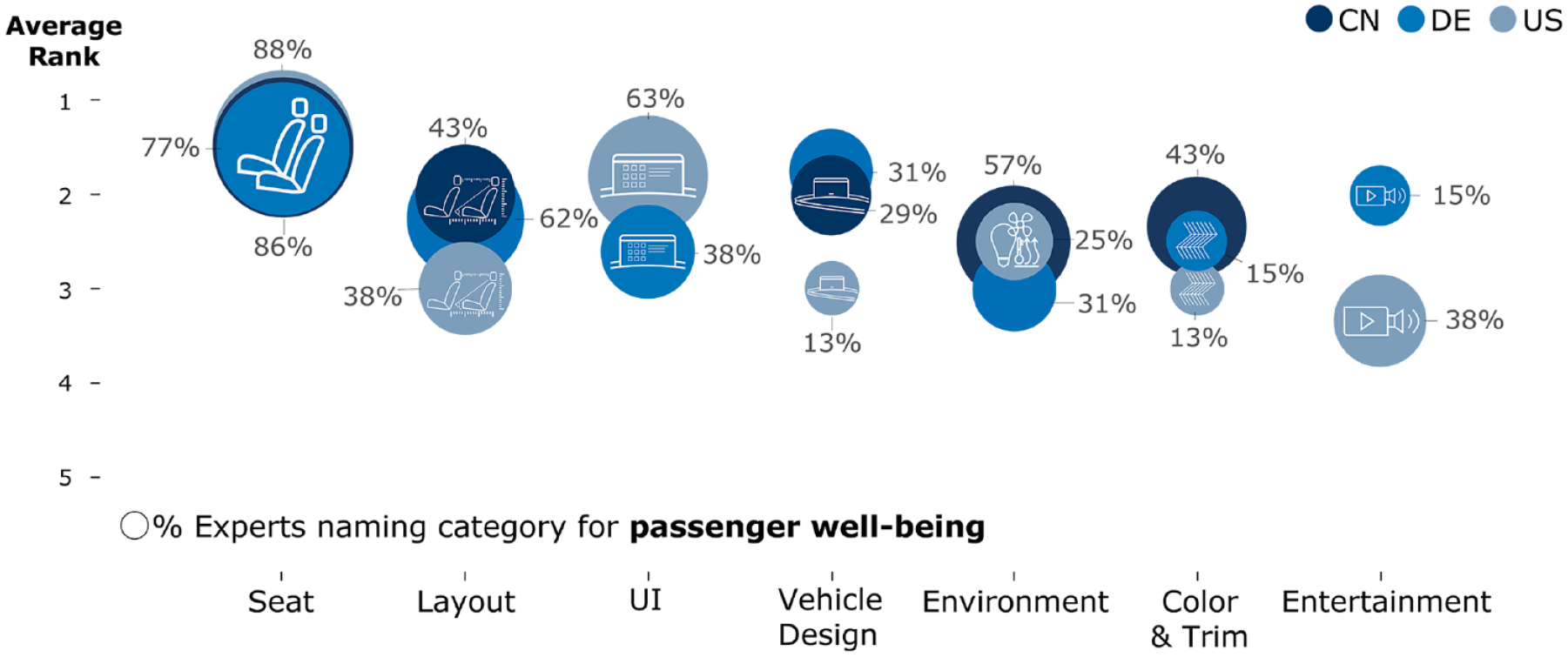
Experts suggestions of interior features that foster passenger well-being in China (CN), Germany (DE), and the United States (US).
Experts in all three markets agree that the seat is the most important interior feature to create passenger well-being. The experts recommend the seat to be comfortable and adjustable. German experts emphasize adjustability, especially with regard to enabling NDRTs. Vehicle layout and color and trim are categories with the same agreement across markets, but slightly less important. To enhance well-being, the layout should be spacious and provide the freedom to move. Furthermore, materials used for color and trim should be of high quality and have pleasant haptics. Color and trim appears to be especially important for the Chinese market.
In the remaining four categories, experts are in less unison. Another major category for United States and German experts are user interfaces (UIs). UIs are viewed as more important in the U.S. market than in Germany, but the functionality is comparable. UIs are expected to foster well-being if they provide feedback on the vehicle, connectivity, and infotainment. Entertainment is another category that is important for the United States and Germany. Not only should entertainment be facilitated in general (Germany) but also sound systems and displays may contribute (United States). A well-being enhancing design is viewed differently in the markets. The Chinese market is expected to prefer a well-designed premium interior. In Germany, a functional design that emphasizes safety and the adaptability to different NDRTs is considered to be important. In the United States, a vehicle design that allows privacy may contribute to well-being. Finally, the control of the environment within the interior is especially important in the Chinese market. Here, well-being may be fostered if the environmental influences on the interior can be extensively controlled. This includes the adjustment of climate, sounds, smells, lighting, privacy glazing, and low levels of noise and vibration. In Germany and the United States only the control of climate, light, and noise are suggested to affect well-being.
We additionally considered features that impact and foster additional user needs trust, comfort, and usability to paint a more differentiated picture of the cross-cultural differences in user requirements for automated vehicle interiors.
Trust
In the case of trust, cultural differences are visible (see Figure 3). While there is an agreement that the UI (providing feedback and transparency), color and trim (trust through high-quality materials), automated driving design (reliable and robust), and the option for manual control (pedals, steering wheel, or emergency off) are important for trust by providing feedback, the other features are viewed differently across the markets. In China and Germany, traditional safety elements are important for trust. For example, passive safety features such as seat belts or airbags and the vehicle seat (safe position and seat comfort) contribute to a sense of trust. For the U.S. market, approaches to create more familiarity, for example, with a demo mode of automated driving capabilities, may be more appropriate.
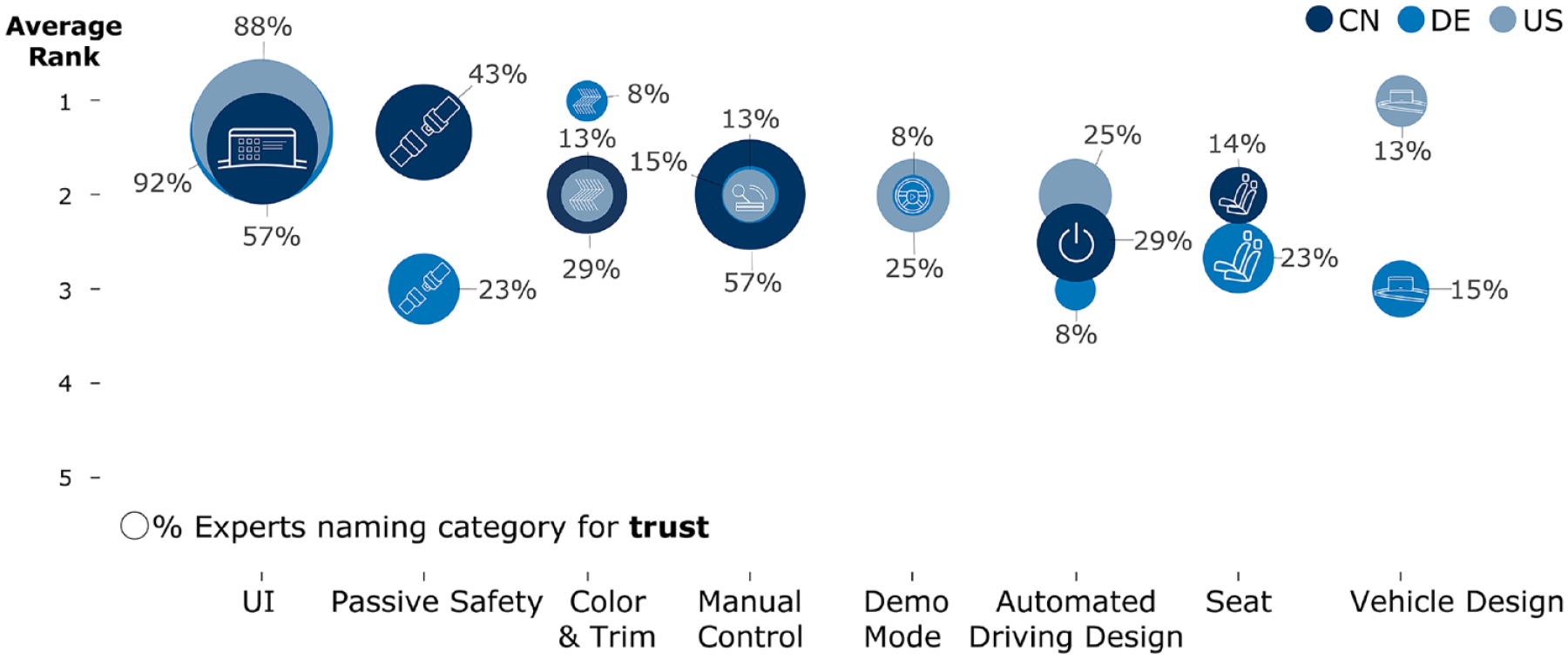
Experts suggestions of interior features that foster trust in China (CN), Germany (DE), and the United States (US).
Comfort
Comfort is largely influenced by the seat and its attributes in all three markets. Apart from seat comfort, the position and adjustability (China) and ergonomics of the seat (Germany) are emphasized (see Figure 4). A spacious layout that allows movement and the engagement in NDRTs is believed to contribute to comfort in all markets. A controlled environment is not only considered to foster well-being but comfort as well. Similar to the observations made for well-being, Chinese experts call for more extensive control of the environment than experts for the other two markets. In Germany and the United States, control of the environment emphasizes climate control, but little control of other environmental aspects. Additionally, noise management is an aspect of environment control that is especially important for comfort in all markets. Finally, unison is evident with regard to the UI, which should also allow connectivity of personal devices.
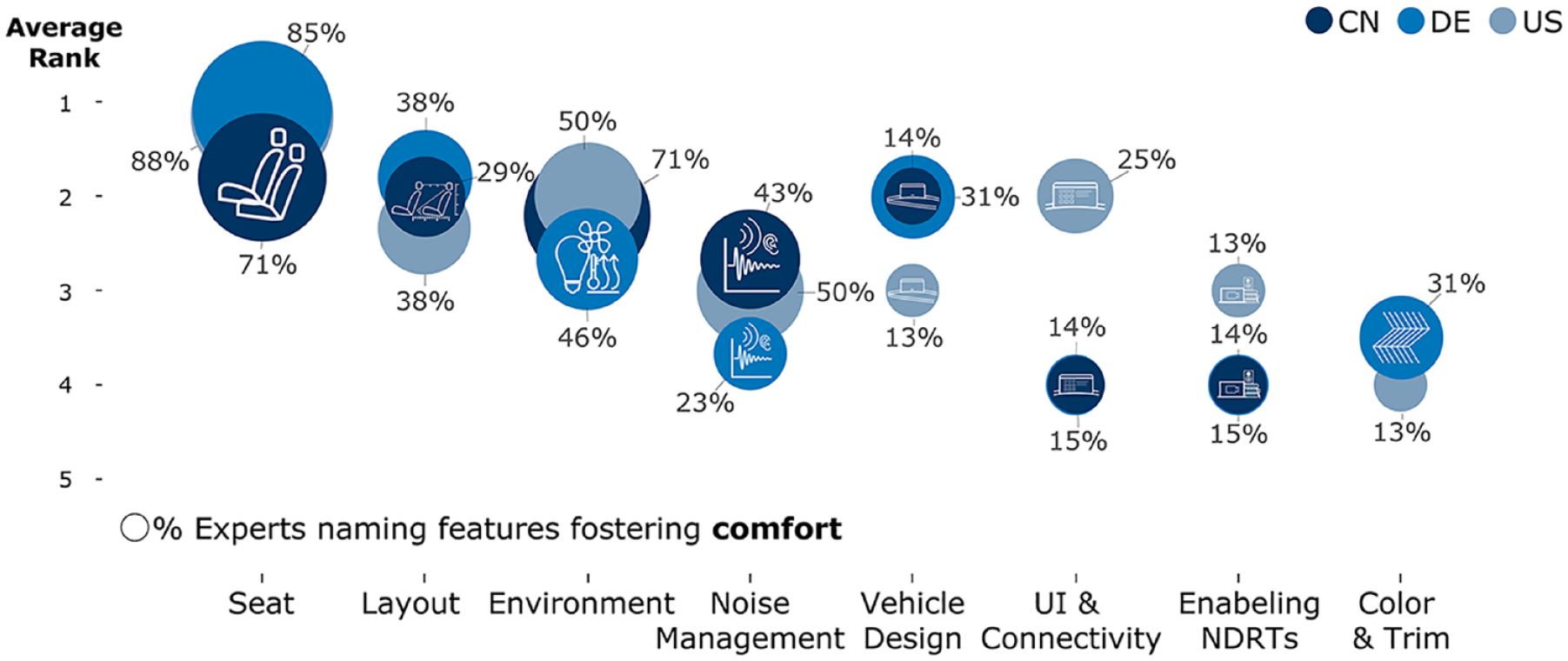
Experts suggestions of interior features that foster comfort in China (CN), Germany (DE), and the United States (US).
To foster comfort, the vehicle design has to be adapted to each market. For China, a hedonic, sensory design is suggested, while Germany and the United States may profit from a pragmatic, functional design with good ergonomics. In China and the United States, the enablement of NDRTs should be emphasized. Interestingly, color and trim is only mentioned by experts for the German and U.S. market as a factor in comfort.
Usability
With regard to usability, experts across all markets suggest both features of the interior and overarching design principles (see Figure 5). In terms of design principles, usability is strongly driven by ease of use (easy, understandable, and intuitive system), flexibility (adjustable, flexible, and practical), and personalization (automatic settings, individual adjustments). Furthermore, ergonomics play a strong role in Germany. For the German market, the vehicle interior should consider reachability and space. U.S. experts add the advantages of tactile feedback.
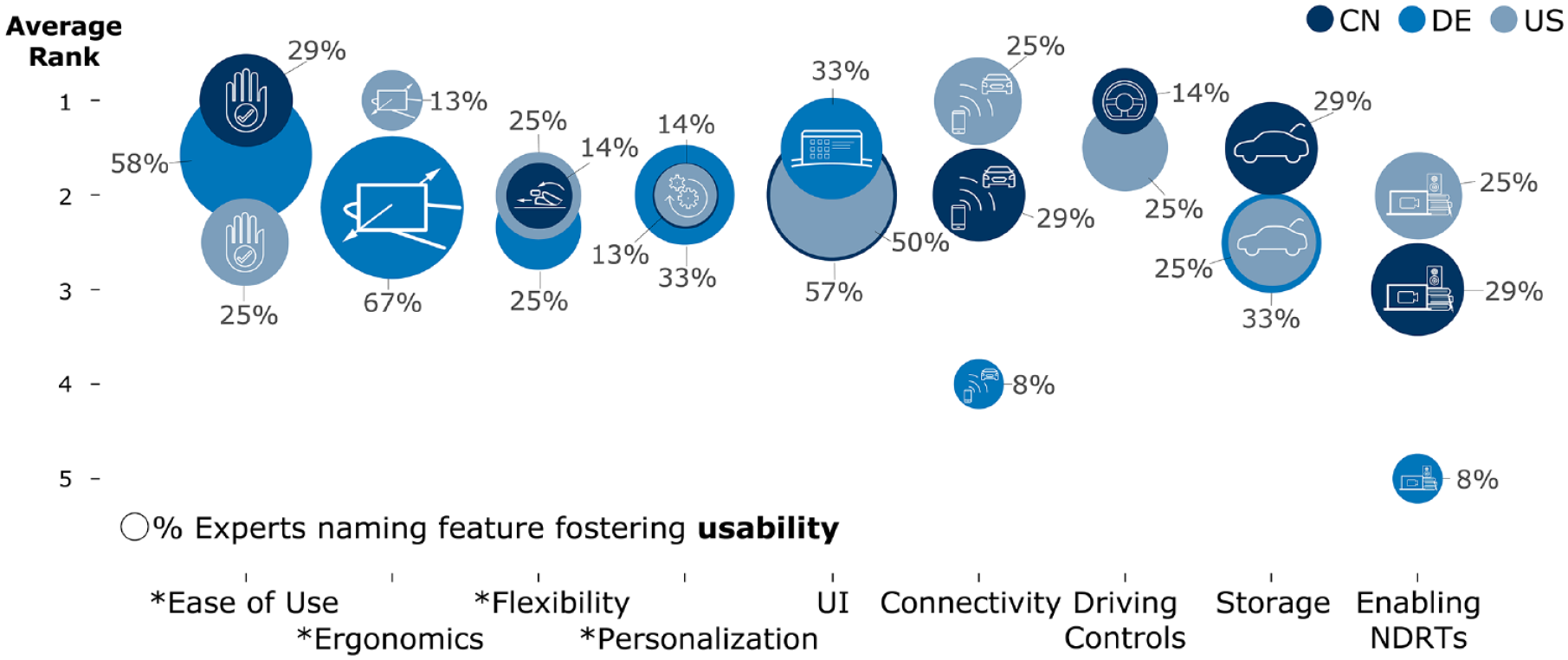
Experts suggestions of interior features and design principles (*) that foster usability in China (CN), Germany (DE), and the United States (US).
When we consider the features that contribute to the usability of an automated vehicle, a large agreement across the markets is visible. The UI plays an important role in providing feedback. The channel of feedback differs between countries. Chinese experts suggest voice and visual feedback on displays. While German and U.S. experts only suggest large displays to be important for usability. Furthermore, the vehicle should offer sufficient connectivity for the passengers’ own devices and enough storage for these devices and other personal items. Moreover, usability increases with the enablement of NDRTs. Chinese experts suggest entertainment specifically, while German experts give a general indication, and U.S. experts add that NDRTs should be supported by providing gadgets to facilitate different activities. According to the expert suggestions, usability is only influenced by driving controls in China and the United States.
Conclusions and Implications for Cross-Cultural User Requirements
In terms of determinants of passenger well-being in automated driving, we observe a high importance of physical and technical features across all markets compared to the importance of the context of the automated driving experience (see Figure 1). This may indicate that car manufacturers have options to increase the level of well-being actively through a user-centered design of automated vehicles. Interestingly, ambient features are rated as more important in the United States and China than in Germany. This can indicate the market-specific need for control of the interior environment, which is also reflected by the features contributing to passenger well-being and comfort suggested by the experts in the United States and China. Furthermore, we find that passenger well-being is relevant in all markets to build acceptance of automated vehicles. This presents an additional design option for car manufacturers to consider, especially in the first generations of automated vehicles.
To provide more specific design recommendations based on cross-cultural user requirements, we asked experts from all markets to indicate the Top 3 to Top 5 features that foster passenger well-being, trust, comfort, and usability. While the strength of cultural differences depends on the user need, indications of cultural-specific preferences have been detected. Viewing the answers from Chinese experts across all needs, a preference for hedonic design of automated vehicles becomes evident (see also Sauer, Mertens, Groß et al., 2019). Chinese experts stress the importance of a comfortable, premium automated vehicle that cocoons the passengers by sealing off any influences from the outside through detailed control of the interior. Trust in China may be built with traditional approaches such as visible passive safety features.
In contrast, the suggestions by German experts indicate a stronger tendency toward pragmatic design (Sauer, Mertens, Groß et al., 2019), which is also found by other vehicle design studies (Sudarshan et al., 2015). This is, for example, evident in the minimal and ergonomic design that is called for and the focus on design principles for usability in automated vehicles.
Based on our results, the U.S. market appears to lie between China and Germany regarding the continuum between pragmatic and hedonic design. Pragmatic aspects are evident from the focus on clear and simple feedback from UIs or a spacious, simple design. Hedonic tendencies are visible from the wish to disengage from the outside world or for playful elements such as conversational UIs or anthropomorphic agents.
When considering our findings, readers should bear in mind that this study utilizes an expert survey. Although the experts participating in our study had industry experience and knowledge on requirements for automated driving in their respective markets, their assessment may not necessarily match users’ expectations and preferences in their respective markets. In addition, a limited number of experts from selected institutions participated in the study. This number may not suffice to reflect the cultural diversity within one country fully. Furthermore, recruiting experts from a more diverse set of companies, including startups, may also paint a more detailed picture of what requirements may become relevant for automated vehicle interiors with regard to passenger well-being and related needs. The investigation of cross-cultural requirements for other vehicle features than the interior, such as driving dynamics and behavior, may pose an additional avenue for further research.
In sum, we find a broad agreement of what feature categories are relevant to create passenger well-being and related user needs. However, the importance and the specific design of the features differ between the markets. This offers the potential to use a user-centered approach to the design of automated vehicles and adapt selected features to cater to specific cultural preferences. The results of our study and the resulting user requirements may be viewed as a recommendation for the early phase of the product development process of automated vehicles. The market-specific designs should be validated with user studies in the respective markets to ensure the validity of our recommendations based on the expert survey.
Footnotes
Acknowledgements
The authors would like to thank all experts who participated in the study. Furthermore, the authors would like to thank AUDI AG, Germany, for their contribution to this research. The contents of this article are solely the responsibility of the authors and do not necessarily represent the views of AUDI AG, Germany.
