



Abstract
Disproportionality persists with regard to the labeling of students with emotional and behavioral disorders (EBD). A blending of critical race theory and disability studies, or DisCrit, provides a framework to examine disproportionality. In this article, a DisCrit mindset is applied to examine how racism and ableism intersect to disproportionately marginalize children of color. A critique of assessment practices, as well as the EBD definition, from a DisCrit perspective is offered to strengthen approaches for equity. We end with recommendations for educational practices and policies and suggest areas for future research.
Regardless of gender, U.S. African American and Latinx individuals are over three times as likely to receive a label of emotional disturbance (hereafter referred to as emotional and behavioral disorder [EBD]) than non-Hispanic White individuals (Schwartz & Blankenship, 2014). In addition, African American students are disproportionately placed in special education (U.S. Department of Education, Office of Special Education and Rehabilitative Services, Office of Special Education Programs, 2014) and restrictive learning environments (e.g., self-contained classrooms or separate facilities) under the label of EBD (Lane et al., 2005), which is associated with stigma and exclusion, particularly for children of color (CoC; Reid & Knight, 2006). Research details the poor academic and social outcomes of students with or at risk for EBD (Bal et al., 2019). Importantly, students with or at risk of EBD have higher rates of suspension and dropout, lower rates of high school completion, and a lower likelihood of enrollment in postsecondary education when compared with special education students across all other dis/ability categories (Bradley et al., 2008; Newman et al., 2011; U.S. Department of Education National Center for Education Statistics, 2012). Racial bias may influence identification, so it is critical to question the costs and validity of the label itself for CoC, particularly for Black students (Gold & Richards, 2012). The purpose of this article is to provide a general overview of DisCrit theory, critique several current school practices (e.g., screening and identification processes, referrals for discipline) that contribute to disproportionately negative outcomes among multiply marginalized students with or at risk of EBD, and then offer recommendations for practice, policy, and research.
DisCrit Analysis: A Theoretical Frame
A blending of critical race theory (CRT) and disability studies (DS) has produced a relatively new framework—DisCrit—through which disproportionality can be examined (Annamma et al., 2013). This framework allows for a deeper analysis of how systems operate to shape the experiences of CoC, particularly those with dis/abilities. It exposes the ways in which race and dis/ability intersect to maintain the status quo of segregating multiply-marginalized students (Migliarini & Annamma, 2019). In a system where difference from the “norm” (i.e., White, male, cisgender, heterosexual) is seen as needing to be “cured” or “rehabilitated,” dis/abled CoC face additional barriers to an equitable education. Vital to DisCrit is the understanding that race and ability are socially constructed, interdependent, and normalizing processes. It provides an explanation for how the disproportionate representation of CoC with dis/abilities may reinforce racial hierarchies in both special and general education and recognizes how racism perpetuates the false binaries between normal and abnormal and between abled and dis/abled.
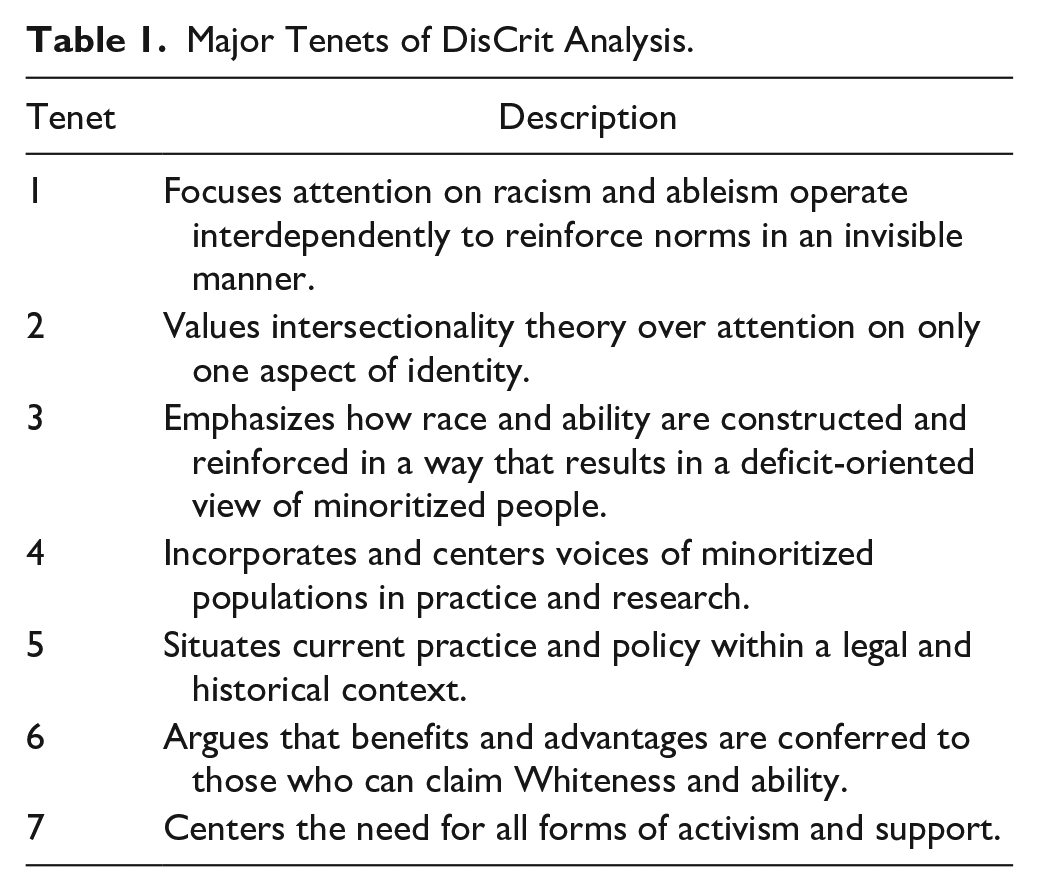
There are seven major tenets of DisCrit (Annamma et al., 2013; see Table 1). First, DisCrit focuses on ways that racism and ableism operate interdependently to reinforce “normalcy” in an often neutral or invisible manner, such as how Black and Brown youth have historically been labeled as less intelligent (Gould, 1981). Second, DisCrit utilizes intersectionality theory (Crenshaw, 1991) to reinforce how intersecting identities may play a role in labeling CoC with dis/abilities (Annamma et al., 2013). For example, in addition to being labeled with a dis/ability, Black female youth may experience labeling differently as the intersection of race and gender creates additional layers of stereotyping. Third, DisCrit describes how race and ability are social constructs informed by dominant Western norms that influence how multiply marginalized students are funneled into low-paid or low-skilled jobs, despite their interests in pursuing higher education or professional careers (Annamma et al., 2013). Fourth, DisCrit elevates the voices of marginalized populations by attending to counternarratives, revealing micro- and macro-level exclusionary practices, and engaging in participatory research designs. Fifth, DisCrit considers how legal and historical backgrounds of dis/ability and race are intertwined yet operate separately to multiply marginalize certain groups of individuals. For instance, CoC have been harmed by school policy and disinvestment in urban, low-income neighborhood schools (Annamma et al., 2013). Sixth, DisCrit recognizes that norms associated with Whiteness and ability have operated as property. For example, students are often praised according to Western, normative standards of “goodness” (Broderick & Leonardo, 2016). Finally, DisCrit recognizes that activism and multiple forms of resistance are needed to disrupt the interlocking systems of racism and ableism. Specifically, DisCrit utilizes intellectual activism to amplify the knowledge and experiences of marginalized CoC and critique the normative micro- and macro-level policies and practices that reinforce White supremacy (Annamma et al., 2013).
Major Tenets of DisCrit Analysis.
DisCrit Critique of EBD Definition and Assessment Practices
The federal definition of EBD written into legislation (see U.S. Department of Education, 2017) and the assessment practices that are used alongside it have remained consistent since the passage of the 1975 Education for All Handicapped Children Act (Algozzine, 2017). The 1997 reauthorization of the Individuals with Disabilities Education Act (IDEA) resulted in a shift in terminology from serious emotional disturbance (SED) to emotional disturbance (ED), but no change was made in the assessment criteria. There have been no further changes to the definition other than this revised terminology, despite much critique within the field.
Given the disproportionate labeling of Black and Latinx students in the EBD category, which some socially view as a “low-status” disability (Skrtic et al., 2021), and the higher likelihood of White students categorized with “high-status” disabilities (e.g., Other Health Impairments, Autism Spectrum Disorders, Speech/Language; Fish, 2019), the eligibility criteria of EBD lends itself to critique from a DisCrit perspective. First, the criteria present in IDEA’s definition include markers that may be applied in excessive ways to label and stigmatize CoC. Namely, behaviors or feelings exhibited and identified as “inappropriate” may be the result of environmental factors (e.g., poverty, family in crisis, school-level racial composition); therefore, it is vital for educators to consider context when discussing a student’s possible eligibility for EBD and/or being identified as “emotionally disturbed.”
Second, the criteria ignore the role of environmental variables. Specifically, the first, fourth, and fifth eligibility criteria for EBD, “an inability to learn that cannot be explained by intellectual, sensory, or health factors,” “a general pervasive mood of unhappiness or depression,” and “tendency to develop physical symptoms or fears associated with personal or school problems” fail to emphasize the importance of environmental factors. As an example, the current criteria may minimize the extent to which a student’s response to adverse childhood experiences (ACEs) impedes their ability to relate to others or learn. Critically, Black and Latinx youth experience greater exposure to family-based ACEs as well as community-based ACEs (Cronholm et al., 2015). Black students, who are at greater risk of experiencing trauma (Roberts et al., 2011), may in this way be perceived as having an inability to learn rather than being in need of mental health support. Behavioral and emotional responses of youth to ACEs, including experiences of racism, should not be encoded by educators as indicative of an “inability to learn,” “pervasive mood disturbance,” or “tendency to develop physical symptoms or fears.”
In addition, the criteria require interpretation and, therefore, are prone to bias. The second IDEA criteria for EBD, “an inability to build or maintain satisfactory interpersonal relationships with peers and teachers,” is subject to interpretation, is vulnerable to unconscious biases against multiply minoritized students and requires an understanding of how racism may operate for youth. For instance, unconscious biases may affect the quality of teacher and peer relationships for CoC and how students’ moods and physical symptoms are interpreted by others. As an example, Warikoo and colleagues (2016) argued that interactions between non-Black teachers and Black students are most prominently impacted by implicit bias, resulting in Black students being treated with less warmth and responsiveness.
Finally, the criteria apply White able-bodied standards. For instance, the third criteria of EBD under the IDEA, “inappropriate types of behavior or feelings under normal circumstances,” is based on judgment. From a DisCrit mindset, this criterion is problematic because it relies on a “false binary between normal and abnormal, between ability and dis/ability, and between general and special education” and highlights the influence of “unmarked norms of White and able-bodied-ness” on what is perceived as normal (Annamma et al., 2014, p. 56). Using this logic, the labeling of behavior and feelings as inappropriate may be due to cultural hierarchies that do not recognize the experiences of multiply marginalized people. Indeed, some research indicates that teachers perceive identical behaviors of students in different ways depending on the student’s race (Fish, 2017). Thus, the construction of normality through unconscious racist and ableist mindsets may result in the assignment of labels to CoC.
Assessment: Social, Emotional, and Behavior Screeners
The IDEA requires that school districts have procedures in place to identify, locate, and refer students for dis/ability evaluations; these procedures can be executed through a variety of means (e.g., by teachers, parents, and relevant school personnel) that are not outlined in IDEA itself at the federal level, although they may be defined under state-specific regulations (Rothstein & Johnson, 2021). Of specific concern from the DisCrit mindset is the subjective conceptualization of behavior problems by educators that is detrimental to multiply marginalized CoC (Skiba et al., 2002). The lack of ethnic diversity among educators (La Salle et al., 2020) and critical awareness of racial and/or dis/ability biases may lead to misattributing problem behaviors to individual-level deficits as opposed to symptoms of larger-scale inequities.
Frequently used measures such as the Behavior Assessment System For Children 3rd Edition (BASC-3: Kamphaus & Reynolds, 2015); The Emotional Behavioral Screener (Cullinan & Epstein, 2013); Social, Academic, and Emotional Behavior Risk Screener (SAEBRS; Kilgus et al., 2013); Social Skills Improvement System-Social Emotional Learning (Gresham & Elliott, 2017); Strengths and Difficulties Questionnaire (Goodman, 1997); and Student Risk Screening Scale-Internalizing and Externalizing (SRSS-IE; Lane & Menzies, 2009; Drummond, 1994) provide data-driven approaches to rating internalizing and externalizing behavior as part of a multi-tiered system of support. Researchers report that the instruments perform without bias based on race (Barger et al., 2022; Harrell-Williams et al., 2015; Lambert et al., 2018).
A detailed overview of social and emotional behavioral risk screeners is beyond the scope of this article. However, detailed summaries of these measures can be found in the primary sources (Basting et al., 2022; Houri & Miller, 2020; Jenkins et al., 2014) as well as a general overview of best practices in Behavioral, Social, and Emotional Assessment of Children and Adolescents (Whitcomb, 2018). Understanding the potential ramifications of their misapplication and the misinterpretation of their results is relevant to the issue of overidentification of CoC as having an EBD. The quick and easy administration procedures of most screeners for social, emotional, and behavioral problems (SEB) have made them one of the most frequently used assessment methods in decision-making processes (Anthony et al., 2022). Yet, these advantages can be offset when educators use them as the only source of evidence for the presence of a dis/ability. Such indirect methods of assessment are subject to “rater effects,” or score variance that is due to the rater rather than the target of measurement (Anthony et al., 2022). Ideally, screeners should be used as either the first or the second gate in the assessment process, followed by measures that provide actual observational data from multiple sources (Whitcomb, 2018). It is also the responsibility of the assessment team to vet screening measures for their validity with diverse populations. However, this is difficult when many commonly used SEB screeners do not provide adequate evidence of validity with diverse populations nor do they provide a thorough evaluation of potential biases in administration and scoring procedures (Houri & Miller, 2020).
In addition, even when a screener has been established as psychometrically sound, this does not ensure equitable data interpretation, decision-making, and resource allocation across racial and ethnic groups (Chafouleas et al., 2010). Even if CoC are accurately identified as having an EBD, if the resulting special education services are ineffective or harmful, then the utility of SEB screeners for programming purposes must be scrutinized. A central issue with SEB screeners is that they do not account for the unique and various contexts within which students exist from a person-centered approach, nor do they parcel out the role that environmental factors play in a student’s internalizing and externalizing behavior SSB screeners are unable to provide the insight required to understand causes of behavior, or what interventions may be useful in supporting students. For instance, a student flagged in the screening process as exhibiting challenging behaviors may be struggling academically, in which case the behavior is logical and not indicative of an EBD. When students are rated as “at-risk,” they are seen as being potentially dis/abled as opposed to existing in an environment that is dis/abling. CoC are particularly vulnerable to this type of conclusion because they disproportionately exist within educational contexts in which environmental actions, such as having less close student-teacher relationships and being frequently over-disciplined, increase the risk of maladaptive behavioral responses (Sullivan, 2017).
An additional complication of SEB screeners is the role race plays in educator perception of student behavior. For decades, research has shown that White teachers—who currently account for about 80% of all teachers (National Center for Education Statistics [NCES], 2021)—tend to view and evaluate Black students’ behavior more negatively than White students’ behavior (Warren, 2015). Whitford and Emerson (2019) suggested that these biased perceptions may be the result of educators not knowing or understanding the challenges faced by CoC at school and in their daily lives. In turn, they argued, White educators are less likely to empathize with their students of color. Some of the common stereotypes that White educators hold about Black students are directly related to the items found on common SEB screeners. Thus, although the use of psychometrically sound instruments is an improvement over purely subjective means of assessment, there are still concerns related to poor student outcomes, lack of contextual validity, and sensitivity to educator biases and stereotypes.
Examination of Behavioral Interactions From a DisCrit Perspective
A DisCrit mindset can be used to examine specific behavioral interactions and/or approaches that are applied to multiple marginalized students. The focus of this section is to provide a critique of some common issues concerning zero-tolerance policies and exclusionary practices and restraint and seclusion practices as well as how students enter and exit the systems intended to support them.
Zero-Tolerance Policies and Exclusionary Practices
Zero-tolerance, or predetermined exclusionary consequences for specific offenses, was developed in response to perceptions of increased crime in the 1980s, despite evidence that school violence had in fact remained relatively stable (U.S. Commission on Civil Rights, 2019). Exclusionary practices are widely used to address student behavior concerns despite clear evidence that they lead to poor student outcomes with respect to school climate, student behavior, student achievement, and dropout (Hemez et al., 2020). As a result, multiply marginalized students are disproportionately incarcerated through the school-to-prison pipeline (Annamma et al., 2014; Skiba, Arredondo, & Williams, 2014; Skiba, Chung, et al., 2014; U.S. Department of Education’s Office of Civil Rights, 2018). Evidence suggests that Black, Latinx, and Native American students are more likely to face harsher penalties and be excluded from school than their White counterparts for similar behavioral infractions (U.S. Department of Education’s Office of Civil Rights, 2018). These discrepancies may be related to differences in how students of color are perceived. For instance, Black female youth are often assumed to be older and more responsible for their behavior (Morris, 2016), imagined as less innocent or childlike (Epstein et al., 2017), and experience discipline for reasons that align with negative stereotypes of Black women (Annamma et al., 2016). Exclusionary practices rest on the premise that sufficient punishment will “fix” individual student behavior, but this approach fails to address the broader context in which the behavior is occurring.
Restraint and Seclusion
The use of restraint and seclusion are yet other examples of highly restrictive disciplinary practices that are disproportionately applied to CoC with dis/abilities. The forms of restraint most commonly used in schools are physical restraint, which involves immobilizing or reducing a student’s ability to move freely, and mechanical restraint, defined as the use of a device (e.g., straps, tape, and tie downs) to restrict freedom of movement (Office for Civil Rights, 2012). There are many adverse effects of the use of these procedures, ranging from trauma to injury and death, not to mention ethical and human rights violations (Council for Children with Behavioral Disorders [CCBD], 2020). In addition, such procedures usually exacerbate existing emotional and behavioral problems. Furthermore, while subjected to these procedures, students are unable to participate in educational programming, further marginalizing students by denying them the right to instruction to address skill deficits that first rendered them eligible for disability status.
Although data are known to be unreliable due primarily to inaccurate reporting (CCBD, 2020), the available data nonetheless raise important concerns regarding bias. Among all students with a disability in 2017–2018, 18% were Black/African American; however, 26% of students who received a physical restraint and 34% who received a mechanical restraint were Black/African American. Furthermore, among students who received seclusionary disciplinary procedures, 22% were Black/African American. With respect to students labeled with a disability during the 2017–2018 school year, 13% of the school-age population was identified and received services under the IDEA. However, 80% of students who were physically restrained and 59% who were mechanically restrained had a disability. Similar disproportionality can be seen with the use of seclusion, as 77% of students who were secluded had a disability (https://www2.ed.gov/about/offices/list/ocr/data.html).
Finally, although the Office of Civil Rights data reports that the public school student population is almost equally divided by sex (51% male and 49% female), males (66%) are overrepresented among those labeled with a dis/ability. Further bias can be seen in the application of the highly restrictive procedures of restraint and seclusion. Among students who received physical or mechanical restraint, 83% and 82%, respectively, were male. Similarly, 84% of students who were placed in seclusion were male (https://www2.ed.gov/about/offices/list/ocr/data.html). These data underscore the intersectionality of disability, race/ethnicity, and sex. Specifically, Black male students with a disability are disproportionately impacted by these procedures with well-established adverse consequences and no data to support any therapeutic effect (CCBD, 2020). Although legislation has been proposed in the U.S. House and Senate to reduce and eliminate the use of restraint and seclusion in schools (Preventing Harmful Restraint and Seclusion in Schools Act) that particularly harms multiply marginalized students, to date it has not become law.
Least Restrictive Environment and Exiting Systems of Support
For students who would benefit from the supports afforded by a special education label under the EBD category, the manner in which these services are provided merits further analysis. IDEA defines the least restrictive environment as the general curriculum classroom (Rothstein & Johnson, 2021); however, African American students with EBD labels are more likely to be placed in restrictive learning environments, such as self-contained classrooms or in separate facilities, than are their White peers (Lane et al., 2005). If the physical location of special education services disproportionately isolates CoC with the EBD dis/ability label from their peers, this undermines the benefit of receiving services given that they come at the high costs of exclusion, stigma, ostracization, and other lasting consequences as they move into post-secondary settings.
In addition, students who receive special education services with an Individualized Education Program for EBD are not likely to be declassified to exit the system. Although dated, a large-scale study reported that of 11,000 students who received special education services in the 1999–2000 school year, only 17% were declassified by Spring 2002 (U.S. Department of Education, 2002). Upon disaggregating by disability category, only 10% of those declassified had been labeled with EBD. There is a low probability of declassification by the high school years, particularly for Black students who receive an EBD label in the early elementary school years (Bradley et al., 2008); additionally, rates of declassification are historically lower for CoC than for White students in urban school districts (Connor et al., 2016).
Finally, identification, placement, and outcomes among students labeled with EBD are widely variant by state (Villarreal, 2015). In their analysis of 2010 data for 388,023 U.S. students labeled with EBD, Villarreal (2015) found that labeling rates for this dis/ability category varied by a factor of five across states, ranging from a low of 2.6% to a high of 13.2% of a state’s special education population. Data from 2008 also indicated that state averages of primary placements for EBD students in general education settings ranged from as low as 12% to as high as 69% (U.S. Department of Education, 2011). Finally, the rates of exiting high school with a regular diploma for students with EBD had an interstate range of 15.7% to 77.7% (Villarreal, 2015). The percentage of White students was significantly and positively related to this outcome. Such interstate variability underscores the subjectivity in EBD assessment practices and state policies that have real material consequences for students, particularly for CoC.
Recommendations
Building an inclusive educational environment that addresses the needs of youth with EBD and other dis/ability labels will require systems-level changes (Freeman et al., 2019), the alignment of culturally and ecologically relevant Tier 1 evidence-based practices with the specific needs and strengths of individual students (Farmer et al., 2022), as well as the collective effort and collaboration of educators, families, and communities. While there is no single solution to remove the hurdles that impede progress, engaging in conversations centered around the topics of racism and ableism offers an opportunity to strengthen current policies and practices being enacted in schools (Ellis-Robinson, 2021). Utilizing a DisCrit mindset allows for a more in-depth analysis of the beliefs that may contribute to equitable practice and policy.
Advocate for Changing Federal Definition
States’ individual definitions, criteria, and procedures regarding EBD assessment are derived from the existing federal definition; therefore, consistent with DisCrit tenets 4, 5, and 7, educators, counselors, psychologists, and community members may engage in action to change definitions, criteria, and procedures at the federal level. This effort would have a far-reaching impact on practices and supports for multiply marginalized students (Freeman et al., 2019). One recommended change to the federal EBD definition is the addition of a criterion stating that the child’s behavior is “. . . more than a temporary, expected response to stressors and would persist even with individualized (prereferral) interventions” (Forness & Kavale, 2000, p. 266). Educators should take great care not to label students with EBD when the behavior may be a function of household- or community-level trauma. Adding this criterion may further encourage decision makers to obtain a more comprehensive understanding of a child’s trauma history, which would allow for a more personalized system of supports and more thorough considerations as to whether the child should be labeled with an EBD.
Adopt a Culturally Responsive Mindset and Practice
An ecological framework (Bronfenbrenner, 1977) considers not just the child and their behavior but also how the individual is situated within many nested and interacting environments, including but not limited to the school microsystem. Classroom ecology, which includes implicit teacher biases and the quality of student-teacher relationships, is bidirectionally related to student behavior (Farmer et al., 2022). Therefore, consistent with DisCrit tenets 1, 2, 3, and 6, the role of culture, race, and ethnicity should be considered as well as whether the behavior occurs across multiple contexts (e.g., home, community, and school). It is important that schools employ culturally responsive individual and school-wide interventions (Voulgarides et al., 2017). Furthermore, consistent with DisCrit tenet 4, educators should strive to consult with leaders and stakeholders from a child’s community to determine whether their emotional responses are within or beyond the expected range in that child’s culture, setting, or situation (Forness & Knitzer, 1992). This multisource data gathering may encourage decision-makers to cease upholding racist and ableist frameworks of normality.
Focus on Developing Relationally Oriented Classrooms
Consistent with previous calls as well as DisCrit tenets 5 and 6, educators are strongly encouraged to shift away from zero-tolerance policies, exclusionary discipline, and the use of restraints and seclusion. Instead of focusing on correction and consequences of behavior that often lead to disproportionality, educators are encouraged to understand how behavior is a form of communication and to focus on building relationships in solidarity with multiply marginalized CoC who are person-centered (Migliarini & Annamma, 2019). A focus on relationship building may decrease the disparity of CoC receiving more referrals and suspensions compared with their White peers (Office of Civil Rights, 2012). Rather than employing practices rooted in coercion and correction, DisCrit advocates for a shift from simply managing behavior to building solidarity with multiply marginalized students (Migliarini & Annamma, 2019). At the core of effective classroom management practices are preventive strategies such as supportive relationships, culturally relevant teaching, and multiple opportunities for learning and improving behavior (Gregory & Fergus, 2017).
Challenge Biases and Assumptions
Consistent with DisCrit tenets 1, 2, 3, and 6, it is critical to address teachers’ perceptions of student behaviors. Students may exhibit and develop fears of school or radiate a sense of unhappiness or depression due to trauma, including racial trauma that can be exacerbated by teachers, faculty, and peers. It is essential for educators to develop an awareness of environmental factors, including multiple marginalization, so that they might recognize their own biases when making attributions of behavior.
Although emotional and behavioral risk screeners may be an effective data-driven approach to assessment, research cautions against the belief that these data are entirely objective. From a DisCrit perspective, there is subjectivity in whatever an educator perceives as “normal” versus “inappropriate” classroom behaviors. To address the racial and social hierarchies that are maintained and perpetuated within practices and policies for students labeled with EBD, educators must recognize that racial biases shape how behaviors are viewed. Additional measures, such as the Cumulative Trauma Scale-Short Form (CTS-SF; Kira et al., 2008), which provides the context of the child’s experience by expanding the assessment of trauma from the conventional ACEs to include the following trauma types: (a) collective identity (e.g., discrimination), (b) family trauma (e.g., divorce), (c) personal (e.g., assault), (d) secondary (e.g., death of a loved one), (e) survival (e.g., natural disaster), and (f) developmental (e.g., childhood abandonment), should be considered alongside screeners to reduce educator subjectivity and to rule out the influence of trauma on behavior.
Engage in Race Talk
Making systemic changes to improve the outcomes of multiply marginalized students relies on the prerequisite ability of educators to proactively and openly engage in challenging conversations regarding ableism and racism. Consistent with DisCrit tenets 1 and 6, conversations among educators are recommended. Such conversations encourage educators to question how the norms and practices they are accustomed to may harm multiply marginalized students (Carter et al., 2017; Welton et al., 2018). To disrupt inequity, such conversations should take place among educators and between educators and students as well.
Develop Preservice Teachers
Teacher education is a vital component to addressing systemic inequalities that multiply-marginalized students face. Annamma and Morrison (2018) recommended that preservice educator programs “commit to developing educators’ critical consciousness throughout their curriculum” as opposed to offering “a single course (or few classes) that emphasize(s) diversity” (p. 123). Consistent with DisCrit tenet 7, educators would enter the workforce envisioning themselves as agents of change in the active resistance against racism and ableism (Friedman et al., 2020). The DisCrit mindset should also be applied to in-service professional learning through strategies such as peer mentoring and coaching, as this would provide teachers with personalized support and an ongoing opportunity in which to disrupt inequities and challenge detrimental policies and mindsets.
Educators, despite receiving minimal training in classroom management (Cooper et al., 2018), are responsible for creating classroom environments that are academically engaging and nurturing (Jennings & Greenberg, 2009). Educators risk acting out their biases (Gregory et al., 2010) and making decisions that negatively affect classroom environments when they experience high levels of occupational stress (Haydon et al., 2018), have limited training in the area of dis/ability and/or racial biases (Migliarini & Annamma, 2019), and/or a lack of understanding of how ACEs operate in the lives of children (Liang & Rivera, 2017). Educators’ implicit biases negatively impact academic performance, academic self-concept, and positive identification with the school for Black students (Perry et al., 2003; Steele & Aronson, 1995).
Beyond the calls for antiracism and anti-ableism to be centered within culturally responsive pre- and in-service teacher training, another recommendation is to recruit, support, and prepare teachers that are more racially diverse. Since 2014, White students no longer comprise the majority of the U.S. public school population, yet only one in every five educators is a person of color (La Salle et al., 2020). Increasing teacher workforce diversity so that more educators are representative of their students is an important means to improve the school experiences of multiply marginalized CoC, particularly before EBD labels are applied.
Engage Families and Youth
Educators should elevate family voice so that the flow of information between families and school personnel is multidirectional (Weingarten et al., 2020). Whenever feasible, it is recommended that the student be invited to participate as a partner in the decision-making process. Amassing a wider array of input in partnership with families will better inform decisions. In addition, these recommendations can provide critical opportunities for school staff to consider variables that were previously unexamined, such as student/family strength and resilience, as well as potential exposure to household and community-based trauma. In addition, involving students allows them to voice their own strengths and challenges, builds student agency, and can also have positive effects on the student’s self-esteem, life skills, social status, and student–adult relationships within the school (Mager & Nowak, 2012). Incorporating student and family voice is aligned with the fourth tenet of DisCrit, which advocates for the elevation of the voices of marginalized populations to disrupt the historical silencing of counternarratives.
Adopt Positive Behavior Interventions and Supports
The Every Student Succeeds Act of 2015 (ESSA, 2015) requires that schools reduce the use of exclusionary discipline. Positive Behavior Interventions and Supports (PBIS), a multi-tiered framework for the implementation of classroom management policies and practices that are both preventive and responsive, is one way of meeting the goals of DisCrit. As an example, a DisCrit-minded educator might ask if school- or classroom-wide behavioral expectations disadvantage multiply marginalized students and/or are predicated on socially constructed archetypes of White, non-dis/abled behavior as the “norm.” The importance of such adjustments cannot be understated, as Noltemeyer and colleagues (2019) have suggested that implementing Tier 1 supports alone can result in significant improvements in behavioral outcomes, such as reducing the number of out-of-school suspensions. Application of PBIS may be more effective at supporting the success of multiply-marginalized youth when contextually and culturally relevant adaptations based on the strengths of each individual child can be made on a day-to-day basis (Farmer et al., 2022).
Tier 2 can be expanded so that students who would benefit from more support are able to receive this help prior to being referred for special education. Systems-level barriers that affect the implementation of Tier 2 interventions (e.g., lack of training and/or resources) should not impact the future trajectories of CoC (Schwartz & Blankenship, 2014). Scrutinizing educational procedures and structures in this way aligns with the seventh tenet of DisCrit, which promotes intellectual activism through the critique of policies and practices (Annamma et al., 2013).
Future Research
Special education should be regarded “not as a permanent placement, but as a system of support which some students are able to outgrow” (Carlson & Parshall, 1996, p. 99). Unfortunately, the process of declassification has received scant attention in the professional literature and legislation. The current federal law (Individuals with Disabilities Education Improvement Act [IDEIA], 2004) does not specifically present a clear path to change a student’s designation from eligible to ineligible for special education services; rather, the legislation redirects readers back to eligibility criteria (Willis, 2019). For CoC mislabeled with EBD, this ambiguity is problematic in that the necessary steps to be declassified are not clearly defined. Further research on how to best outline the declassification process, with specific attention to EBD declassification, and subsequent enhancements to legislation are needed moving forward. In addition, the research literature on declassification is sparse. Increased attention to this topic, including an updated longitudinal declassification study to replace the Special Elementary Education Longitudinal Study (Blackorby et al., 2002) with data disaggregated by dis/ability category and race, is a critical area of future research.
Investigating the effectiveness of utilizing a DisCrit analysis, including an examination of implicit biases, within preservice and in-service training programs is a possible direction. Outcome measures could include teachers’ attitudes regarding student behavior, teacher willingness and/or perceived ability to engage in conversations about racism and ableism with staff and students, and rates of office discipline referrals compared against a group of educators in a similar school setting without said training. Researchers could examine whether there are student outcome improvements associated with educator training on DisCrit’s application to teaching practices (e.g., increased time spent in general education classroom and decreased receipt of exclusionary discipline measures). In addition, applying a DisCrit mindset to the functional behavioral assessment (FBA) process will generate areas for research, such as whether a DisCrit-informed FBA impacts the types of future plans that are developed for students and whether there are differential student outcomes resulting from this process.
Conclusion
Although existing practice and policy may be grounded in good intentions, evidence of disproportionality suggests that there is a need for educators to examine their practices, particularly those employed with multiply-marginalized students. Using a DisCrit framework, a critique of practices and policies aimed at supporting multiply-marginalized students was provided. The recommendations for policy, practice, and research were offered with the aim of improving conditions and outcomes for multiply marginalized students.
Footnotes
Declaration of Conflicting Interests
The author(s) declared no potential conflicts of interest with respect to the research, authorship, and/or publication of this article.
Funding
This work was supported by the Institute of Education Science, U.S. Department of Education, through Grant R324A200097. The opinions expressed are those of the authors and do not represent views of the Institute or the U.S. Department of Education.
