




Abstract
Innovation, open innovation, and collaborative platforms are concepts in effervescence in the last few years. Innovation’s future will observe a growing number of collaborations. The links between collaboration and collaborative platforms are known in the transport and accommodation sector (such as Uber) however are less used in manufacturing. This paper aims to identify the main challenges between manufacturing firms which intend to collaborate enabled by a prototype platform. A collaborative business model was designed using the business model canvas and tested using a real case to generate valuable collaboration. Collaboration experimentation was monitored over 21 weeks between two firms of the Quebec aerospace cluster and ended with a semi-structured interview. Six challenges were identified: partner selection, commitment and trust, intellectual property management, collaboration evaluation, collaboration symmetry and terminology difficulties. Suggested solutions included, compatibility criteria between the partners, creating a vocabulary lexicon, and establishing collaboration expectations prior to collaboration.
Introduction
In a constantly evolving environment, collaboration is crucial to firms’ survival (Caridà et al., 2015). Collaboration represents the future of innovation and involves a growing number of firms (Chesbrough, 2017). Digital platforms are a collaborative tool and are emerging in various industries. Accommodation and transport, for example, are industries where collaboration and platforms are used, and plenty of examples exist. However, it seems that collaboration among manufacturing firms seems more difficult. Adding SMEs’ specificity and ability to operate in the same cluster makes collaboration more complex, as they still regularly compete.
The Quebec aerospace cluster is an example of a manufacturing sector that includes SMEs within a cluster. The literature presents little information on manufacturing firms using a platform to collaborate. Although the technology required to collaborate may slow the collaboration, it becomes more complicated when manufacturing SMEs are part of a cluster as they may also be competitors, which puts them in a situation where they have the same customers. Collaboration can also be hampered by the fact that SMEs operate with limited financial and human resources. On the other hand, lacking resources can be a motivation for SMEs to collaborate and gain some benefits. The question to be answered in this paper is: what are the challenges manufacturing SMEs face when collaborating through a digital platform? The originality of this paper lies in the identification of the challenges faced by two manufacturing SMEs operating in the same cluster and collaborating through a platform.
Using design research methodology, and the design of a collaborative business model as a foundation for fostering collaboration, this paper will first present the state of the art of the business model in a collaboration area and the use of a collaborative platform to foster open innovation. The second section will present the methodology. The following section will explain the challenges and proposed solutions, followed by the conclusion.
State of the art
The business model in collaboration needs area
The business model concept has evolved since its creation. Chesbrough was one of the first to describe it in a simple scheme. The scheme included the technical inputs in a bidirectional relationship with the business model, which is bidirectionally related to the economic outputs (Chesbrough and Rosenbloom, 2002). Years later, Christensen extended the business model concept further to include essential resources and critical processes: the result is that the profit formula, essential resources, and critical processes are all related. The grouping of these three elements is directly related to the customer value proposition (Johnson et al., 2006). In early 2010, Osterwalder and Pigneur defined the business model as an item to describe how an organization creates, delivers, and captures values (Osterwalder and Pigneur, 2010). Authors derive it into the business model canvas, allowing the tool to present it on one page. The value proposition is the core of the business model canvas, a mix of the Chesbrough and Christensen model, including key partners, essential resources, and presenting the economic aspect such as the cost structure and the revenue streams (Osterwalder and Pigneur, 2010).
In recent years, business models have evolved from being applied to a single firm to a more open application where collaboration is essential. For the purposes of this paper, collaboration as defined by Sonnenwald is “the interaction that takes place within a social context between two or more scientists that facilitates the sharing of meaning and completion of tasks with respect to a mutually shared, superordinate goal” (Sonnenwald, 2007). As an effect, business-as-service models increased in the accommodation and transportation sector (Sundararajan, 2013). The collaborative economy, which aims to match suppliers and consumers through a technological platform, has also been gaining momentum recently (Laamanen et al., 2016). Examples of firms using the collaborative economy are multiples. One of them is Airbnb in the accommodation industry, which connects homeowners with visitors (Laamanen et al., 2016). In the transport industry, Lyft and Uber are other examples of connecting car owners with people who want to get from one point to another (Laamanen et al., 2016; Sundararajan, 2014). The success of this model has prompted other firms to replicate and implement it in other industries. For example, for food experiences, BonAppetour and Eatwith are similar models to Airbnb (Sundararajan, 2014; Täuscher and Laudien, 2018). However, it seems difficult to find this model applied in the manufacturing industry. Formabilio is one example. Its objective is to connect Italian furniture manufacturers, designers, and customers to create ethical product meeting customer needs (Caridà et al., 2015).
Collaboration within the manufacturing industry can be difficult and unfamiliar. A competitive mindset deeply ingrained in manufacturing SMEs, which makes collaboration difficult, can explain this (Jarillo, 1988). Competition rules are evolving quickly, innovation cycles are shortening, and firms must collaborate more efficiently to ensure long-term survival (Fawcett et al., 2008). Companies operating in a cluster can benefit from several advantages, including new knowledge creation and resource sharing (Delgado et al., 2016). SMEs, an essential part of a cluster, often have the characteristics to solve problems or react to a changing situation quicker (Lee et al., 2010). However, they often encounter the issue of a resource shortage (Van de Vrande et al., 2009). Human resources are increasingly difficult to find and retain, putting pressure on firms to retain knowledge (Van de Vrande et al., 2009). Consequently, this resource deficit can make SMEs more open to collaboration (Van de Vrande et al., 2009). An important aspect to bear in mind is that a group's ability to solve a problem is more significant than a firm alone (Maithili et al., 2012). Collaboration is currently a strong trend, but it is hardly found between manufacturing firms. Manufacturing, especially aerospace, was hit by the recent pandemic. People travelling less leads to fewer aircraft orders, which affects the supply chain and causes workers to leave the aerospace industry. In addition, many aerospace machine shop owners are aging, which would lead to an intense merger and acquisition market. The above points increase the pressure on SMEs to collaborate if they want to survive. They are numerous benefits for firms when they collaborate. Highlighting the challenges of manufacturing firms to collaborate will be the aim of this paper.
A collaborative platform to apply the open innovation concept
Collaborative platforms have become increasingly popular in recent years. They can be found in different industries, such as accommodation and transport, under various categories: borrowing, donating, sharing items, or buying new ones (Hamari et al., 2016). Platforms can also make collaboration between firms easier by providing a standard interface for users to interact (Hamari et al., 2016; Kathan et al., 2014). These users’ interactions can be translated into firms’ interactions, leading to new knowledge creation or external knowledge use (Kathan et al., 2014). This concept, called open innovation, was first introduced by Chesbrough. It is defined by two types of knowledge exchange (Chesbrough, 2017). 1. Inside-out: firms open up and make the knowledge developed internally accessible to the outside. 2. Outside-in: firms bring knowledge developed outside of their boundaries to the inside to use it.
The future of open innovation will include more collaborations between an increasing number of firms (Chesbrough, 2017). The firms studied in this study are SMEs, which, according to the literature, have difficulties using open innovation. These challenges could include cultural differences, resource availability or intellectual property management (Kathan et al., 2014). The literature suggests that for firms to thrive in the future, they must acquire external knowledge (Lichtenthaler, 2008). The combination of a platform and open innovation is promising. However, it is not readily applicable in the manufacturing context of regrouping SMEs.
Methodology
The methodology used in this study is design research. Design research can be used for both prescriptive and descriptive studies (Blessing and Chakrabarti, 2009). To highlight the challenges of collaboration between SMEs, the results presented in this study will be prescriptive. Design research aims to learn knowledge through the act of building and experimenting (Kuechler and Vaishnavi, 2008). Design research involves the creation of artifacts that can be tested to solve to a problem (Kuechler and Vaishnavi, 2008). The design research cycle, a part of the design research, suggests five steps to create an artifact. Only one solution can be found by iterating through the design cycle. In some cases, new problems may arise during the execution of the cycle, which will need to be solved by executing a new cycle (Takeda et al., 1990). Carstensen and Bernhard added the design science research model from the design research method, which can help researchers learn about complex concepts (Carstensen and Bernhard, 2019). The design science research cycle’s five steps are presented below (Carstensen and Bernhard, 2019; Kuechler and Vaishnavi, 2008; Takeda et al., 1990). 1. Awareness of the problem: Select a problem to solve. 2. Suggestion: Suggest the key elements that will be necessary to solve the problem. 3. Development: Build potential solutions to the problem from the available knowledge and the critical elements defined in the suggestion phase. 4. Evaluation: Evaluate the solution developed in the previous phase according to specific criteria. An iterative process between development and evaluation to converge toward a solution may occur. 5. Conclusion: Select the solution to be implemented to solve the problem according to the development and evaluation phase.
Several knowledge contributions from the development, evaluation and conclusion phases can result from using the design science research cycle (Carstensen and Bernhard, 2019). Next, the description of the five steps is presented.
Awareness of the problem
As presented earlier, the selected problem identifying the main collaboration challenges manufacturing SMEs face when harnessing a prototype platform. The selection of this problem was motivated by several points. Collaboration seems difficult to achieve among manufacturing SMEs, the future of open innovation and collaboration will involve more firms, and collaboration will be necessary for firms if they want to be sustainable (Chesbrough, 2017; Fawcett et al., 2008; Jarillo, 1988).
Suggestion
To solve the problem several elements can be included in the solution. First, a new business model needs to be developed to create valuable collaborations for the companies involved. The potential solution must include a tool that materializes the value proposition of the collaborative business model being developed. Finally, several criteria must be applied to select the better tool for the experiment.
Development
The business model canvas was used to design the collaborative business model. The central point of this tool is the value proposition of the business model. Through these value propositions, the collaborative business model aims to create a collaboration that delivers value to those involved. Value can take several forms, including creating new knowledge, optimizing resources utilization and accessing further information. The project team used an iterative process of four iterations to design this collaborative business model. The team consisted of three people with different profiles. One professor doing research on knowledge management and innovation, one manufacturing company owner who researched on open innovation, and the last is doing research on collaboration and open innovation. Two conclusions emerged from the iterative design process: a focal company will have to put more effort into the model to make it work, and one of the key activities of this model will be to match supply and demand via a platform (Proulx and Gardoni, 2020). Using a digital platform has proven to be an effective tool for promoting collaboration between users across industries. The collaborative model is presented in Figure 1. Each building block of the model will be explained below. Collaborative business model (adapted from Proulx and Gardoni, 2020).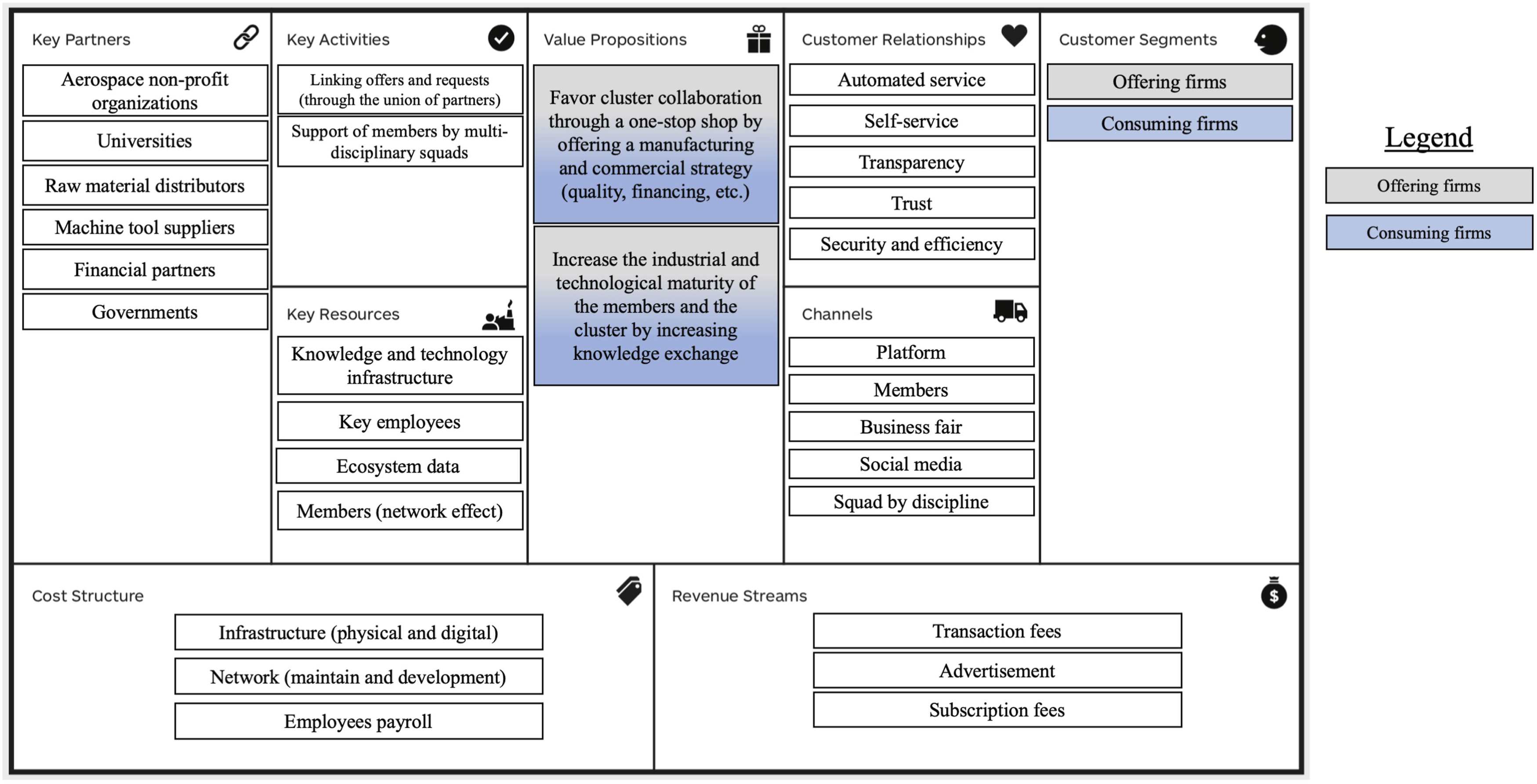
The first value proposition of the collaborative model is to facilitate cluster collaboration by giving members access to information on a centralized basis. Centralizing data in one place makes it easier for members to access information and improves collaboration. The data can take the form of quality requirements, financial opportunities or specific tools for manufacturing efficiency. The second value proposition is to increase the members’ and the cluster’s industrial and technological maturity by increasing knowledge exchange. In this case, maturity and exchanging knowledge are related. As members acquire more knowledge, they become more mature. Both value propositions are related to the two customer segments: the offering firms and the consuming firms. The platform allows the two customer segments to offer, research and wishes for different concepts or items. The various potential collaboration opportunities will take the form of cards that users can place on the platform. The customer segment includes the aerospace value chain from the Original Equipment Manufacturer, OEM, to tier four.
Customer relationships would be self-service, meaning customer segments would consult the platform themselves. The service has to be secure, efficient and transparent. For partners to share confidential information and gain valuable knowledge, they have to develop a level of trust in each other and in using the platform. Ultimately, the service of matching supply and demand cards would be automated. The platform will be the primary communication and transaction channel to promote the value propositions where customer segments, offering and consuming firms, will collaborate to increase their knowledge. Members themselves, social media, and squad by discipline will also be a part of the channels.
Matching offers and requests are the main critical activity of the platform. Squad by discipline will also be a key activity, which will consist of supporting the members. Regarding key resources, the employees and the members will be central to this model’s success. Knowledge structure and technology infrastructure will be essential to maximizing the potential of the knowledge exchanges. Collecting more data through the platform will lead to a more efficient model, better partner suggestions, better knowledge exchange and maturity growth, representing some of the benefits.
Many key partners will be needed to make this model functional. Specialized aerospace non-profit organizations and governments will be the primary vital partners of this model. Universities and research centres will also be key partners in creating new knowledge. Raw material distributors and machine tool suppliers could also be included among the partners, whose contribution could be materialized through product discounts.
As previously stated, this collaborative business model will be supported by a platform. The platform will act as a facilitator to gather collaboration opportunities and promote knowledge exchanges between members. Platforms like ERP, PLM, CRM, MES or DMS exist but mainly facilitate internal collaboration. In most cases, making these tools accessible to people outside of the organization is challenging, time-consuming, and resource-intensive, excluding them from the initial platform selection. The research was conducted to find a tool to be used as the proposed platform. This research selected four tools for evaluation: an Excel spreadsheet, the development of a web portal, a Trello spreadsheet and a Smartsheet. Six criteria: user experience, communication, availability, content management, administration and accessibility were used to evaluate each of the tools. They have been adapted because they were initially used to access e-learning platforms. For example, content management was described as the management of e-learning content including visual presentation, which was not helpful in this study. Accessibility was initially defined as tools and technology, which would confuse the evaluation of tools. Each tool was scored on a Likert scale across the six criteria, where strongly disagree equals 1 and strongly agree equals 5. Each tool evaluated has its advantages, for example, developing a web portal is flexible for content management, and Trello provides a better user experience. Each of the tools also has its disadvantages, for example, Excel sheet and Smartsheet table have fewer communication options, and the cost of implementing a web portal is high. With a score of 23 out of 30, Trello was the highest scoring of the preselected tools and it will be used for this experiment due to its availability, ease of use and content management capabilities (Proulx et al., 2023). The Excel and Smartsheet spreadsheet scores 21 and the web portal scores 19 (Proulx et al., 2023). The main feature to support collaboration was the use of tiles called opportunity cards. The cards contain the title of the collaboration opportunity and its description presenting the challenge encountered, the question to be answered or the hypothesis available, owner’s names, the date added and a label presenting the category of the card such as production, human resource or knowledge. Cards can be added by collaborators directly on the platform. Figure 2 shows the platform with the cards divided into four types. Challenges encountered may relate to specific collaboration topics, such as implementing lean management, whether certain equipment has available capacity, or how to implement a knowledge management system. Trello platform.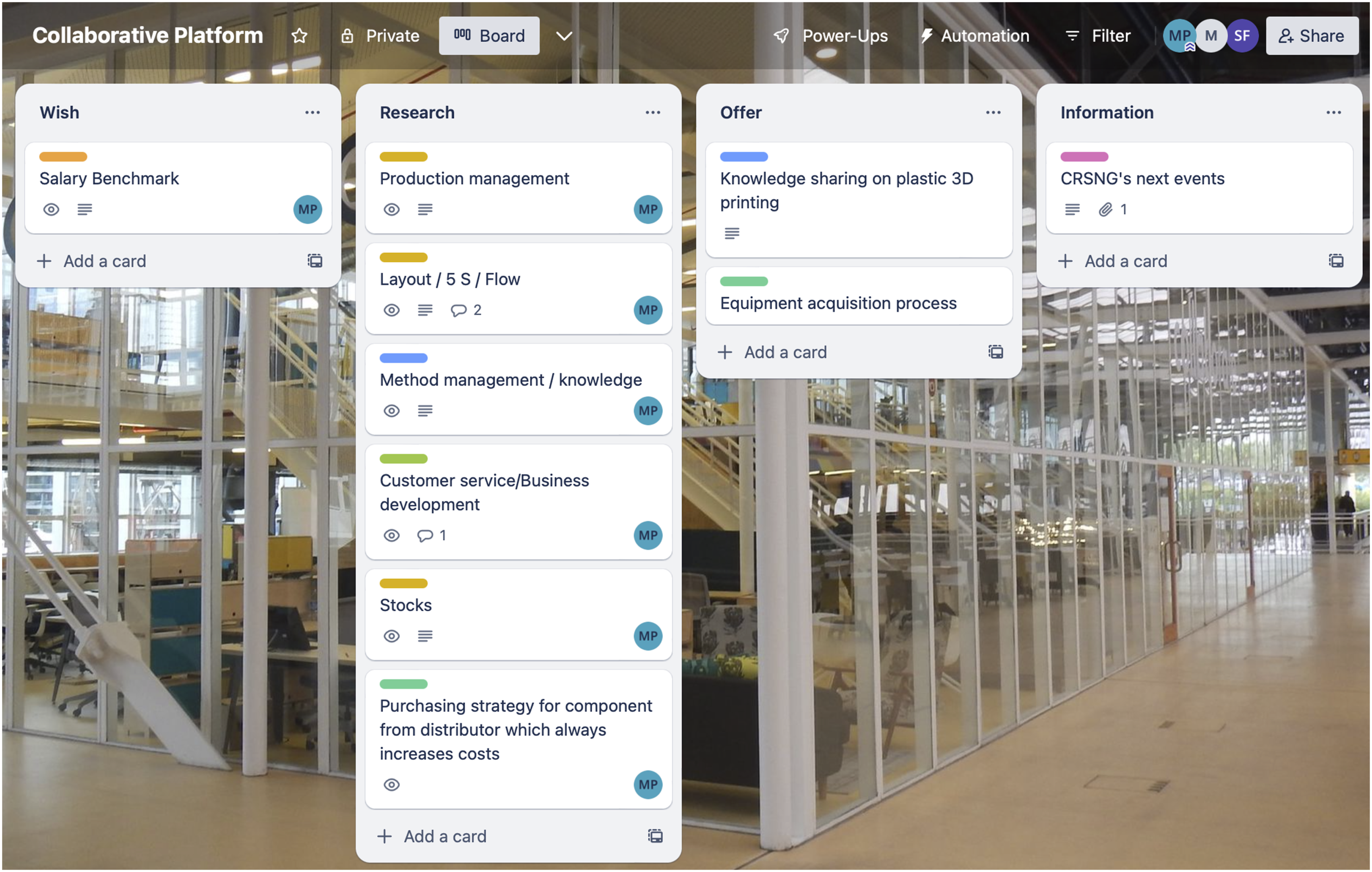
Evaluation
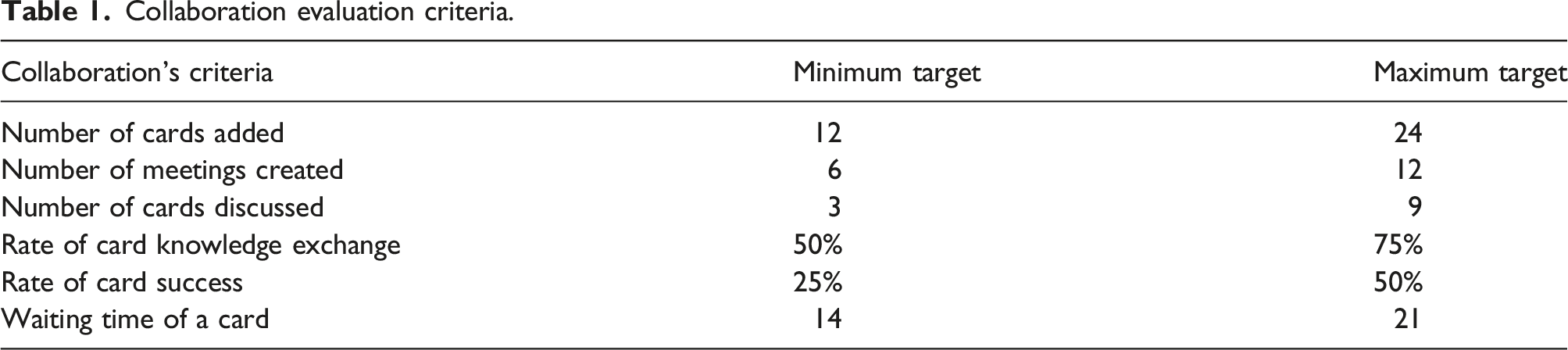
Collaboration evaluation criteria.
Four types of opportunity cards are available to promote collaboration and identify challenges during collaboration: information, offer, research and wish. These four types of cards resulted from a brainstorming session by the project team on the categorization of opportunity cards. Information and offer type refer to a member who supplies opportunities on the platform for other members. Research and wish type refer to a member who demands opportunities from the platform member.
Qualitative data collection will also be used in this experiment to collect data on the collaboration and the challenges experienced. First, meetings were held every 2 weeks to observe and monitor collaboration among partners. All active cards were reviewed and discussed at each meeting. Blocking points were also discussed during these meetings to ensure that challenges were identified. The experiment ended with a group semi-structured interview to identify challenges and potential solutions. The group interview allows participants to share and create knowledge or ideas that would not have been possible in individual interviews (Algozzine and Hancock, 2006). As for the interview guideline, the steps proposed by Hancock and Algozzine were followed: identification of the participants, selection of the questions, location of the interview, method of recording and legal requirements (Algozzine and Hancock, 2006). The three members of the project team participated in the semi-structured interview. The semi-structured interview consisted of four open-ended questions presented as follows. What needs to be improved to make it easier for firms to collaborate? What helped firms to collaborate? What could be the potential benefits for the industry? What are the potential academic benefits? The interview was conducted in a virtual meeting. Interview data were collected using Microsoft OneNote. All participants agreed to be interviewed.
Data has been gathered over five months. The sample used for this experiment is not representatitve of the entire population as a whole and is therefore non-probabilistic. The collaboration took place between two of Quebec’s 200 aerospace cluster firms. In addition, firms were “tier 2” in the aerospace supply chain, meaning that “OEM,” “tier 1”, “tier 3” and “tier 4” are yet not covered in this study. Including the other tiers and OEM in this experiment would probably have made it more challenging to monitor collaboration due to their size and corporate structure. Two research philosophies will be used for this experiment: - First is the positivist philosophy; thus, quantitative data will be used to test the collaborative model and evaluate the collaboration. – Secondly, interpretivism; thus, qualitative data will be used to identify challenges and proposed solutions.
A mixed method of data analysis was used. First, discourse analysis was used by examining partner’s interactions during the experiment. For each meeting, items such as what the partner’s discourse was, when the discourse took place, who was present and what it meant for the collaboration were collected. The narrative analysis method analyzed how the partners talked about their experiment. Analyzing the different words used by the partners to answer the four questions and looking at their redundancy helped to identify the challenges. Finally, descriptive statistics were used to analyze the collaboration symmetry. This was done by taking the total number of cards of each type held by each partner and multiplying them by their weight. Looking at the symmetry of collaboration over the project's duration provided another indicator to identify challenges.
Conclusion
Several challenges have been identified from the collaborative business model designed, the selection of Trello as the prototype platform, and the evaluation of the collaboration. Six challenges were identified: partner selection, partner commitment and trust, intellectual property management, collaboration evaluation, collaboration symmetry and terminology difficulties. These challenges are discussed next.
Challenges and solutions
Partner’s selection
Selecting the right partner for collaboration can be a challenge. Each partner has its own agenda and objectives, confusing collaboration. If one partner is involved for the wrong reason, the other may be confused about the outcome of the collaboration. In addition, collaboration between firms takes place through human interactions. Each person also has their own temperament and personality, which can hinder collaboration. Therefore, humans remain an essential component of the collaboration’s result. The fact that the two companies knew each other from previous business relationships certainly helped the collaboration. Collaboration between two partners is one case in point, but three or more firms collaborating could lead to exponential problems if the partners are not chosen wisely.
As for the solutions suggested by the semi-structured interview, one solution could be to establish specific criteria and tests to verify the compatibility between the partners before the collaboration. The criteria could include business objectives, soft skills, or the direction of new technology development. In the longer term, artificial intelligence algorithms could match firms according to their objectives or complementary skills. For instance, a company that wants to add new technology such as 3D printing to its product could partner with a company that already owns and uses the technology. Similarly, when adding a new skill, a company that wants to add design or research skills to its portfolio would be matched with a company that already has them. A better partner selection could lead to more sensible or core knowledge exchanges and create a successful and meaningful collaboration.
Partner’s commitment and trust
For collaboration to be successful, partners need to be committed, and they have to trust in each other. Trustful relationships will lead to more valuable information exchanged and knowledge creation. In this experiment, the partners shared their strengths and weaknesses. Based on mutual trust, involving more partners with different backgrounds and having other objectives could impact trust and knowledge exchanges. This study wanted to promote collaboration between firms, but ultimately, humans are behind collaboration’s success. This project involved two Quebec aerospace supply chain firms, considered SMEs. Larger firms, such as OEM, may find it more difficult to collaborate in this environment, perhaps because they are less agile and often have a complex corporate structure. In addition, due to the size of a company, it can be difficult for one person to have full knowledge of the company’s knowledge.
Regarding the proposed solutions from the semi-structured interview, setting clear objectives at the beginning of the collaboration could be helpful. As mentioned above, humans interact together to collaborate and setting up tests to verify compatibility between firms could be a proposed solution. The partners could carry out these tests prior to the start of the collaboration. They could cover both hard and soft skills to ensure a good match between human personalities. Larger firms wishing to participate in this type of platform may need to adapt their corporate structure to be able to promote collaboration more efficiently (Delgado et al., 2016). One possible solution is to appoint a dedicated person to support collaboration and join this platform. This person would act as an open innovation leader, creating connections between firms and creating knowledge. Therefore, this person would apply internal knowledge externally and external knowledge internally, where appropriate. Involving more firms and addressing commitment and trust issues could increase new knowledge creation and platform value (Isckia, 2011).
Intellectual property management
Collaborations or knowledge exchanges sometimes involve the exchange or creation of intellectual property (IP). Although the exchanged information in the experiment was not considered to be core IP for the firms, managing these rights seems to be a problem. The exchange of core IP would act as a catalyst for higher-quality collaborations. In counterpart, exchanging core IP would lead to IP being managed in a more structured way. For example, setting a confidentiality level for specific information in the Trello tool was impossible. As only two firms were involved in the project, this was a minor problem. Again, the involvement of larger companies, such as OEMs, could highlight the issues of IP management, as OEMs have their own legal departments and SMEs often have to look outside for help. However, this could become an issue as more firms were involved in the platform.
Among the solutions proposed, a model for managing IP rights between firms might be a good start. Gassmann and Bader (2006) present a model to address IP rights that can be applied to mitigate this challenge. Their model separates background IP, defined by the partner’s IP before collaboration. Side-ground IP is defined as the one owned by the partner but not related to the subject. Post-ground IP is defined as IP developed through the evolution of collaboration (Gassmann and Bader, 2006). Post-ground IP can take the form of a patent, promoting collaboration between firms (Attour and Ayerbe, 2015). Adding a confidentiality level to the tool used for the collaboration seems inevitable. This would ensure that only those authorized to access the information would see it. This could also be addressed by adding different filtered views. Finally, tracking the card modification’s history and visitors could add users’ trust in the tool.
Collaboration symmetry
The firms involved in the experiment significantly increased their business and technical knowledge. The gain in knowledge was mainly due to the companies’ access to new knowledge that would not have been available without their involvement in the study. Knowledge was shared on best manufacturing practices, business development or knowledge management, which enhanced partners’ expertise. One firm was more in the position of a donor, and the other one in the position of a receiver, as expected. It can be quite a challenge to have an equal collaboration. Failing to establish the estimated symmetry level of collaboration when starting to collaborate can damage the collaboration. This phenomenon can somewhat slow down or stop collaboration if a firm shares a lot of its knowledge and only have a few gains in return. On the other hand, firms could deliberately choose asymmetric collaboration and be satisfied with it.
From the semi-structured interview, it would be beneficial for partners to establish their expectations at the beginning of the collaboration. Collaborators can establish quantitative objectives such as revenue growth or new technology development. They can also answer the question of symmetry in the collaboration: would this collaboration be equal, or would it favour one partner over the other? They can also assess the collaboration periodically to address any changes in the collaboration. Communicating clear collaboration expectations would increase the chances of a successful collaboration.
Collaboration’s evaluation
Evaluating the collaboration was a challenge identified in the semi-structured interview, as it was only monitored using the six criteria. Beyond these criteria, there were no clear outcomes defined by the partners for the collaboration at the beginning of the study. For the collaboration to be considered a success, the criterion results had to be within the minimum and maximum targets. The waiting time for a card was the least suitable criterion as there were only two members, and each card was discussed at every meeting. The evaluation criteria did not include anything about the collaboration’s outcomes. Partner investment in the collaboration was neither a part of the criteria nor a financial or in-kind investment. The collaboration evaluation did not include economic outcomes such as revenue growth or expense decrease. Although the collaboration evaluation was mainly quantitative, it did not cover qualitative aspects such as culture fit, trust and quality of communication quality.
The collaboration evaluation could be monitored by a composite index, including the six criteria mentioned above. Among them are the number of cards added, the number of meetings created, the number of cards discussed, the rate of card knowledge exchange, the rate of card success and the waiting time of a card. Including more partners in the platform would make the waiting time criteria useful. Intellectual property created or a partner’s network expanded could be used to measure the collaboration outcome. The evaluation of the collaboration could include the partner’s financial or in-kind investment in the collaboration. As mentioned above, collaboration economic outcomes, including sales or revenue growth or expense decrease, could be included in the criteria. Including qualitative criteria could be beneficial, but the question remains: how to evaluate these criteria, such as culture fit and trust? They are primarily human perceptions. Ultimately, all the criteria could be weighted by the partners at the beginning of the collaboration to ensure a fair evaluation of the collaboration.
Terminology difficulties
Although the model is designed to promote collaboration between firms, human interaction makes collaboration successful. Through these interactions, communication is critical to improving collaboration quality (Kratzer et al., 2004). The main communication channels during the experiment were emails and meetings. However, the content of emails can be misinterpreted by those receiving them, as the exact tone of the sender may not be reflected. Terminological difficulties arose on some occasions when looking at the interaction between the partners during the project and the semi-structured interviews. For the partners, terms such as knowledge management and lean management meant various things which affected collaboration. Vocabulary used by partners also differs. With different backgrounds and experiences, partners may have other terms to describe the same object or concept.
One proposed solution to alleviate these terminology difficulties is to include a dictionary of commonly used terms and their definitions based on the Design Rationale Capture System (Klein, 1993). Partners need to use a common terminology between them when collaborating (Conijn et al., 2022). This could help to clarify a term or concept and ensure a common understanding. Adding a card template with a specific question to answer would also help. A contact list could be added, bringing together experts from different firms to ensure efficient communication. This was impossible with the tool used during the experiment, but adding live chat or video calling could make communication more efficient. However, if partners overuse communication, the result will be the opposite; thus, the partner’s communication and creativity will decrease (Kratzer et al., 2004). For instance, if a new card or additional information is added to the platform, the partner will receive an email notification on their mobile phone and the platform. Adding a weekly newsletter to the communication channel would drown information partners and discourage them from consulting the platform.
Conclusion
This article aimed to identify the main challenges of collaboration faced by manufacturing SMEs when harnessing the proposed prototype platform. Data was gathered through an experiment between two SMEs from the Quebec aerospace cluster. Six challenges were identified through semi-structured interviews. Some of the main challenges were partner selection, collaboration symmetry, collaboration evaluation, and terminology difficulties. Possible solutions were also suggested, such as using criteria to select partners. The establishment of collaboration criteria and expectations could be a factor in the reduction of collaboration challenges. Adding a lexicon to address terminology issues could also be a suggested solution.
Regarding limitations, the number of firms studied reduced the possibility of identifying a larger number of challenges. Their similar size also limits the scalability of the challenges. Including larger firms would probably lead to other findings. The Quebec aerospace cluster environment also limits the data gathered. Studying firms in different clusters may have revealed other challenges and solutions. The collaborative prototype platform also limits the collection of challenges, as another platform may have reduced or increased the challenges encountered. For example, another collaborative platform may have different communication or confidentiality features, bringing other challenges.
Developing a more dedicated collaborative platform to make communication more efficient between partners operating in the same cluster is a future perspective, as well as creating a model of intellectual property management between firms collaborating on a platform.
Footnotes
Declaration of conflicting interests
The author(s) declared no potential conflicts of interest with respect to the research, authorship, and/or publication of this article.
Funding
The author(s) received no financial support for the research, authorship, and/or publication of this article.

Author biographies