



Abstract
Increasing pressure and activism for social equality and justice is challenging the primacy of heteronormativity. Masculinities signified by stereotypically feminine traits and men who embody them are argued to be accruing power. Considering these developments, this study investigates the extent to which male athletes support inclusive perceptions and expressions of masculinity and the concordance between beliefs and behaviors. Results from correspondence analysis of survey data indicate masculinity is conflicted amongst the 456 athletes in the sample, signified by a disparity between beliefs and behaviors. Using these findings, I argue that although progressive social developments are gaining traction, there is still much support for orthodox masculinity in sport.
Until recently, traditional western masculinity was argued by many in the literature to be defined by physical strength, toughness, domination, and other characteristics contributing to the subordination of women, racial minorities, LGBTQ people, and men who do not embody so-called heteronormative traits (Cheng, 1999; Connell, 2005; Connell & Messerschmidt, 2005; Messner, 1992, 2002). Progressive social change has brought new theoretical developments. Anderson (2005) terms the above typology orthodox masculinity, in opposition to inclusive masculinity distinguished by a deprioritizing of homophobia and antifemininity. Orthodox masculine norms are implicated in crime, gendered health inequality, emotional repression, racism, and other social problems (Bird, 1996; Cheng, 1999; Courtenay, 2000; Rios, 2011). However, in recent years the promotion of gay rights, women’s rights and increasing pressure and activism for social justice and equality is redefining social norms, including definitions of masculinity, the primacy of heteronormativity, and gender-based power relations (Andersen & Fetner, 2008; Bolzendahl & Myers, 2004; Kimmel, 2012; Messner, 2007). Although it was once commonplace for men to gain dominance through the overt marginalization of others, explicit public discrimination based on race, gender, and sexual orientation is increasingly unacceptable (Kian et al., 2015). Some argue progressive gains signify a movement away from traditional and restrictive gender norms, with power accruing to men embodying previously stigmatized stereotypically “feminine” traits (Anderson, 2009; McCormack, 2012). Others argue oppressive norms continue to be concretized in subversive, subtler forms (Arxer, 2011; Schwalbe, 2014).
Sport is argued to reflect these societal developments. Sport is generally theorized as a homosocial environment and primary site for the reproduction and normalization of orthodox masculinity (Connell, 2005; Connell & Messerschmidt, 2005; Messner, 1992). Many professional sports leagues are beginning to employ women coaches and referees and be receptive to having gay men on teams, paralleling progressive cultural shifts (Chiari, 2014; Glor, 2019; Kian et al., 2015). Yet recurring and revealing incidents of sexism, racism, and homophobia, perpetrated by players, fans, and team owners, persist (see Armstrong, 2017; Babb, 2014; Corbett, 2013). Overall, there appears to be a discrepancy between inclusive gains and ongoing oppressiveness. The purpose of this study is to examine the extent to which non-professional Canadian male athletes support inclusive perceptions and expressions of masculinity and the concordance between their beliefs and behaviors. To meet these objectives, two questions are investigated utilizing correspondence analysis of online survey data. First, to what extent do Canadian male athletes support and act on (a) inclusive and (b) oppressive orthodox beliefs and behaviors? Second, do oppressive and inclusive beliefs align with oppressive and inclusive behaviors?
This study makes several contributions to men’s studies literature. First, as most masculinities research examining the associations between belief and behavior is qualitative and based on smaller-scale samples, this study permits more generalizable findings for a larger population. Second, by focusing on Canadians, it addresses the call for studies in diverse regions (Anderson, 2015). Lastly, it builds on previous research by exploring the extent to which male athletes adhere to oppressive ideologies and/or engage in oppressive behaviors, investigating support for orthodox masculinity despite social change (see Bridges, 2014; Heath, 2003; Scheibling & Lafrance, 2019; Schmitz & Haltom, 2017). This study begins with an overview of the literature on masculinity and sport, and an outline of the research methodology. An examination of survey data using tabular and correspondence analysis follows. The article concludes with remarks on the relationship between orthodox masculine norms and emerging contemporary progressive social norms, and their significance for the study of masculinities.
Masculinities Theory
Most masculinities research draws on Connell’s (2005) concept of hegemonic masculinity. Hegemonic masculinity is a term and a theory explicating the superiority of some groups of men and the legitimization of their dominance (Carrigan et al., 1985). It denotes the masculinity occupying the preeminent position against which all other masculinities are measured and evaluated (Connell, 2005; Connell & Messerschmidt, 2005). Scholars generally agree that hegemonic masculinity requires the negation of male behaviors commonly attributed to women (Anderson, 2009). This is opposed to what Connell calls emphasized femininity, demonstrated through fragility and sociability, whereas hegemonic masculinity is signified by toughness, competitiveness, emotional stoicism, and independence through self-reliance (Connell, 1987, 2005; Smith et al., 2007). As such, hegemonic masculinity is traditionally associated with the undervaluation of traits deemed feminine, such as emotionality, sensitivity, passivity, gentleness, vulnerability, and decreased physicality; and the overvaluation of traits traditionally distanced from femininity, such as aggression, power, control, authoritarianism, physicality, and success in masculine arenas such as sport (Connell, 2005). For years, White, middle-class, early middle-aged heterosexual men have been commonly equated as the embodiment of hegemonic masculinity (Cheng, 1999). Despite these traits being attributed to men, women can still pass as hegemonically masculine by subsuming hegemonic postures (Cheng, 1999). Critically, Kimmel (1993) also notes that early hegemonic masculinity was contingent on three core components: sexism, racism, and homophobia privileging men, whiteness, and heterosexuality through the subordination of women, minorities, and LGBTQ+ people.
Since Connell’s writings on hegemonic masculinity, there have been numerous critiques and extensions of her theory, as well as the emergence of new perspectives on masculinity. With nearly all representative surveys evidencing declines in sexual prejudice (Diefendorf & Bridges, 2020), some contend that liberalization is facilitating a genuine reconfiguration of gender norms and a restructuration of the gender hierarchy (Anderson, 2009; McCormack, 2012). Inclusive masculinity theory offers an alternative to Connell’s theorizing, suggesting that in an environment of decreasing homophobia, men are freer to express manhood in ways that were once stigmatized as feminine—such as showing emotion and being supportive of others (Anderson, 2009; Anderson & McCormack, 2018). The original contribution of inclusive masculinity theory is that it offers explanations for the increasing social acceptance of homosexuality, thereby moving into terrain Connell had yet to address (McCormack, 2012). Supporters of inclusive masculinity theory assert that as men feel less inclined to champion heteronormativity, esteemed orthodox male attributes such as control and domination are devalued, contributing to the disruption, and dismantling of the entire system of gendered oppression (Anderson, 2009; Heasley, 2005; McCormack, 2012). Inclusive masculinity theory is applied in the explication of progressive shifts among professional and college athletes (Adams, 2011; Anderson & Kian, 2012; Kian et al., 2015), sports fans (Cashmore & Cleland, 2012), fraternities (Anderson, 2009), high schools peer groups (McCormack, 2012), and in fathering practices (Gottzén & Kremer-Sadlik, 2012), and Facebook profiles (Scoats, 2017).
While inclusive masculinity theory has garnered much support, it is also contested (Bridges & Pascoe, 2014; de Boise, 2015; Diefendorf & Bridges, 2020; O’Neill, 2015). Scholars use the term masculinity crisis to describe a misalignment between men’s internal expectations and societal norms, occurring when previously held norms are superseded by new standards—particularly when change is precipitous (Levant, 1997; Faludi, 2000). Messner (2007) suggests that progressive social change has worked to problematize many facets of orthodox masculinity. In an analysis of Super Bowl commercials, Green & Van Ort (2013) find commercials often draw on fear of a masculinity crisis, framing the marketing strategies of products such as trucks as symbols of resistance. Moreover, many believe that progressive social change in support of immigration, feminism, and LGBTQ+ rights, and activism for racial equality, is prompting a resurgence of orthodox masculinity. For instance, rather than a reduction of gendered oppression, some posit progressiveness is igniting renewed backlash against the perceived or real loss of male privilege and identity (Allain, 2015; Kimmel, 2013; Flood et al. 2018). Sailofsky and Orr (2020) document this backlash within hockey culture. In an examination of tweets of a high-profile NHL hockey fight, they find that users blame increasing progressiveness for the decline in fighting, perceiving this shift as an attack on orthodox masculine hockey culture.
In further opposition to inclusive masculinity theory, several theoretical paradigms collectivity understood as hybrid masculinities provide alternative explanations for contemporary shifts in masculine identities. Hybrid masculinities contend the incorporation of once-stigmatized masculinities into mainstream male identities is a new strategy for the preservation of patriarchy and sexism, rather than their amelioration (Bridges & Pascoe, 2014; also see Arxer, 2011; Demetriou, 2001; Messner, 1993; Schwalbe, 2014). Similarly, flexible masculinity incorporates traditional masculine traits with more inclusive forms of masculinity. This provides men with malleable identities to secure dominance in a variety of contexts in response to shifting gender norms (Gee, 2014). Overall, this literature contends men may appear inclusive in public while discreetly upholding gendered control and unequal power relationships, exemplified in what Demetriou (2001) terms dialectical pragmatism—a process by which hegemonic masculinities adopt and unite features of “inferior” masculinities to recuperate existing power and ensure the reproduction of patriarchy against threats to its dominance.
These contrasting bodies of literature document dissonance between contemporary masculinities and ongoing oppressiveness, particularly as it concerns to homophobia (McCormack, 2020). Many studies focus on attitudinal and interpersonal dynamics amongst men, with a specific focus on how individuals explicitly showcase they are not homophobic (Diefendorf & Bridges, 2020). There is also substantive literature documenting how shifts in attitudes toward homophobia coincide with social and generational change (McCormack, 2020). However, homophobia and sexual prejudice can occur insidiously and unconsciously. Similar to the social stigma surrounding racism, sexism and homophobia have become less visible, tasking researchers to consider new ways to locate and explore continued oppression (Diefendorf & Bridges, 2020).
Masculinity in Beliefs and Behaviors
The debate outlined above has led many to question whether the proliferation of once- stigmatized masculinities represents a real change to sexual and gender oppression (Bridges, 2014; Bridges & Pascoe, 2014; Eisen & Yamashita 2019; Scheibling & Lafrance, 2019; Schmitz & Haltom, 2017). Studies show some men posture an inclusive identity in ways maintaining gendered oppression. For instance, Bridges (2014) documents straight male co-option of gay aesthetics, disguising gender and sexual privilege in a reworked identity to distance from stigmatizing, out-of-vogue oppressive masculinity. Studies also document dissonance between what men say, and what they do. Brodyn & Ghaziani (2018) coin the term performative progressiveness to describe those who hold progressive attitudes toward gays and lesbians but whose actions work to (re)produce inequality. The dislocation of thought and action is witnessed in Lamont’s (2014) study of dating and relationships. She finds that many men support gender equality and describe themselves as progressive. In romantic relationships with women, however, these men fail to recognize how inequalities and unequal power dynamics permeate their own interactions with their partners.
The literature highlights contradictions between what men think they believe, or feel they should believe, and what they truly believe, which is often only revealed in their actions. The misalignment of purported beliefs and behaviors brings the authenticity of assertions and intent into question. These disconnects mandate an inquiry into the interrelationship between beliefs and behaviors toward a more comprehensive understanding of contemporary masculinities. For example, do individuals professing support for gay rights actually maintain this commitment in homosocial interactions and hypermasculine settings such as sport? Such examination will provide insight into contemporary manifestations of sexual prejudice among male athletes. The surveying of both beliefs and behavior has the potential to reveal the extent to which Canadian male athletes align with inclusive and/or orthodox masculinities; the degree to which their beliefs and behaviors are synchronized or conflicted; and the alignment of beliefs and behaviors with contemporary social norms.
Why Sport?
Connell and others contend sport is an emblematic site for the reproduction of oppressive, orthodox masculinity (Burstyn, 1999; Connell, 2005; Connell & Messerschmidt, 2005; Drummond, 2002; Messner, 1992). They argue sport cultivates oppressive and discriminatory beliefs and behaviors through a structure reinforcing a gendered division of labor and the celebration of violence, toughness, and physical power—epitomized and glorified by its athletes (Burstyn, 1999; Connell, 2005; Connell & Messerschmidt, 2005; Messner, 1992). This is particularly noteworthy in Canada. Hockey’s symbolic status in Canadian culture is central to the foundation of Canadian identity as White, masculine, middle-class, heterosexual, homophobic, and physical (Allain, 2008, 2015; Bridel & Clark, 2012; MacDonald, 2018).
Sport has historically fostered orthodox masculinity which remains its underpinning but is now leaning toward inclusivity (Anderson, 2009; Messner, 1992; Welch, 1997), encapsulating mainstream culture’s tension between belief and behavior. Mirroring progressive trends, professional sports cultures appear to be becoming more inclusive, evidenced by partnerships with social equality campaigns. For example, the National Hockey League collaborates with the You Can Play Project, an organization aimed at eradicating homophobia in sport; and the National Football League has united with No More, an anti-domestic violence group (No More, 2019; NHLPA, 2019). Similarly, others note how the athletes of these sports are beginning to devalue and disassociate from oppressive masculinity, citing examples such as the acceptance of the “coming out” of professional athletes Michael Sam, Jason Collins, and Robbie Rogers (Anderson, 2015). In particular, many studies document the increasing acceptance of homosexuality in sport. This is notable in Anderson’s (2011) comparative study of gay athletes who came out in 2000 and 2002 versus 2008 and 2010. He finds that those in the 2008 to 2010 sample were less fearful of coming out and teammates were generally more accepting of homosexuality. In another study, Michael (2015) examines wrestling at a high school in the U.S., finding that wrestlers were generally accepting of homosexuality among teammates and exhibited minimal levels of homophobia.
Despite progress, many sports leagues continue to project misogyny through the objectification of women as cheerleaders and persistent incidences of domestic violence, in addition to homophobia and racism perpetrated by players and the condoning of other oppressive norms (see Armstrong, 2017; Babb, 2014; Corbett, 2013). Donald Sterling, former owner of the Los Angeles Clippers, was forced to sell his team, receiving a lifetime ban from the NBA for making racist remarks (Zucker, 2014). Riley Cooper, an NFL player, was heavily criticized, alienated from his team and threatened for uttering racial slurs (Corbett, 2013); and Kevin Pillar, an MLB player, was caught using homophobic slurs during a game (Armstrong, 2017). These events suggest contemporary sport culture encapsulates the conflict occurring within the mainstream, a culture increasingly professing to value inclusivity while simultaneously practicing and advancing oppressive norms and behaviors.
While scholarship documents substantive attitudinal change toward homophobia in U.S. and UK sporting contexts, fewer studies examine the Canadian trend. One exception is MacDonald’s (2018) study of elite Canadian male hockey players. She finds although players suggest they would not mistreat a gay teammate if they had one, they often use homophobic slurs and hold negative attitudes toward homosexuality. To address the need for studies from diverse regions and cultures, this research examines the extent to which Canadian athletes align with inclusive masculine paradigms through an analysis of the concordance between beliefs and behaviors. More specifically, it assesses the proliferation of contemporary progressive masculinities among a group traditionally synonymous with orthodox masculinity yet currently demonstrating cultural shifts.
Methods
To examine the extent of support for inclusive and/or oppressive orthodox masculine beliefs and behaviors, I conducted a cross-sectional close-ended online survey and analyzed the responses using tabular and correspondence analysis. I recruited English-speaking adult Canadian male athletes by contacting provincial and territorial sport organizations (excluding Quebec, because of the French language barrier). In Canada, most localized sports associations are members of larger federated associations such as Sport4Ontario and Sport Nova Scotia. These larger associations provide online listings of member organizations. Using these online listings as a sampling frame, I contacted all listed organizations to request their assistance in forwarding a recruitment message to their member athletes. I also placed follow-up calls to non-responsive organizations to ensure my recruitment email was received. The final sample consisted of 456 adult Canadian male athletes. All participants voluntarily agreed to complete the survey.
The survey was designed to capture the distribution of men supporting inclusive beliefs, versus support for oppressive beliefs synonymous with orthodox masculine norms (Anderson, 2005) —in both theory and practice. Inclusiveness, measured on a continuum against oppressiveness, was operationalized as progressive support for gender and sexual equality; and by association with traits stereotypically associated with femininity. Oppressiveness was operationalized as ideologies aligning with orthodox masculinity including patriarchal norms of power, inequality, and discrimination. Drawing on masculinities literature I identified seven core components of orthodox masculinity: competition, physical toughness, restrictive emotionality, racism, homophobia, independence, and sexism. Survey questions were then developed for each of these core components. The intent was to assess whether participants supported inclusiveness, oppressiveness, or fell somewhere in between; and the concordance between respondents’ beliefs and behaviors.
Measures
The first section of the survey was designed to ascertain participant’s beliefs about masculine norms by asking respondents to rate their degree of support for seven statements encapsulating components of orthodox masculinity. All responses were measured using a five-point scale: (a) “Strongly Agree”; (b) “Agree”; (c) “Neither agree nor disagree”; (d) “Disagree”; and (e) “Strongly Disagree.” The first questions were dedicated to evaluating racism, sexism, and homophobia—discriminatory and exclusionary components of early conceptualizations of hegemonic masculinity (Kimmel, 1993). These measures were framed as contentious statements designed to provoke stereotypical belief patterns and gauge polarization of inclusive and orthodox beliefs. Specifically, questions asked respondents whether they believed Black athletes played specific positions in sport based on inherent physical capabilities; if current pressure to be politically correct on LGBTQ issues is over the top; and whether they believed innocent remarks are often deemed sexist. To determine conformity to stereotypical gender norms, toughness, restrictive emotionality, and independence were included as indicators of anti-femininity. Statements read “when guys are in pain it is fine to show it”; “teammates should avoid sharing their personal feelings, fears, and problems”; and “if something needs to be done right, you should do it yourself.” Finally, Connell (2005) professed a hierarchy of men and masculinities whereby men must compete against each other to attain superiority. For this reason, the final component was competition, assessed by asking participants about the importance of winning versus good sportsmanship.
In the second section, a corresponding behavior question was asked for each theme. These questions were directed at quantifying respondents’ behaviors, and the extent to which they adhere to inclusive or orthodox masculine ideologies in their daily lives. The response options were: (a) “All the time”; (b) “Often”; (c) “Sometimes”; (d) “Rarely”; and (e) “Never.” To assess racism and homophobia, individual questions asked how often respondents stereotyped others based on race and sexual orientation. To measure sexism, I asked about the prevalence of their use of the term “bitch.” To assess toughness, restrictive emotionality, and independence, questions probed how often respondents played through injuries, expressed emotions to others, and overcame challenges without seeking aid from others. The final component, competition, was assessed by asking participants whether they trash talk or haze other players. The survey also contained a series of sociodemographic questions on race (White; Non-White; Not Specified); sexual orientation (Heterosexual; Not Heterosexual; Not specified), age (18–25; 26–44; 45–64; 65+); education (High School/Equivalent or Less; College; University); and income (No Income; Under $34,999; $35,000–$74,999; More than $75,000).
Procedure
For ease of interpretation, the five-point Likert-scale responses for each of the seven belief and behavioral components of masculinity were recoded into three categories. Specifically, the first two and last two responses were combined, leaving the middle response category unaltered. These categories were labeled “inclusive”; “mixed”; and “oppressive.” To analyze the data, I first used tabular analysis to gauge the distribution of inclusive, mixed, and oppressive ideologies and behaviors.
Seeking a greater understanding of this association, I conducted correspondence analysis. “Correspondence analysis (CA) is a method of data visualization that is applicable to cross-tabular data such as counts, compositions, or any ratio-scale data where relative values are of interest” (Greenacre, 2010, p. 613). Correspondence analysis treats both variables as relational. As such, this method does not identify independent or dependent variables. Instead, it is used to determine dynamic relationships within sets of categorical variables through graphical representation (Greenacre & Blasius, 1994; Veenstra, 2010). It produces dimensions to explain variance within contingency tables and is particularly useful when such tables have a high volume of cells (Bendixen, 1996; Veenstra, 2007). These dimensions are then projected onto a “map.” The researcher must then interpret the dimensions of the map as a visual representation of phenomena and associations. Generally, only the first two dimensions are reported, although additional dimensions can be included when of benefit (Greenacre, 2007b). Additional dimensions often add only minor additional accuracy or information and are much more difficult to interpret—the ease of interpretation and clarity in low dimensional space is usually more valuable than added dimensions (Bendixen, 1996).
Correspondence analysis has both linear and spatial modes of interpretation (Bendixen, 1996; Greenacre, 2007a). Linear interpretation derives from the location of the variables relative to horizontal and vertical axes. Polar nodes define the axes and meaning stems from the variables distance or proximity to the poles (Bendixen, 1996). Spatial interpretation derives from the variables positioning and proximity to response categories and other variables around it. Variables with similar distributions are clustered together, while those with dissimilar distributions are distant (Greenacre, 2007b; Veenstra, 2007). Correspondence analysis therefore permits an examination of the extent and nature of the alignment of oppressive and inclusive ideologies with oppressive and inclusive behaviors, and other patterns in the data.
Analysis
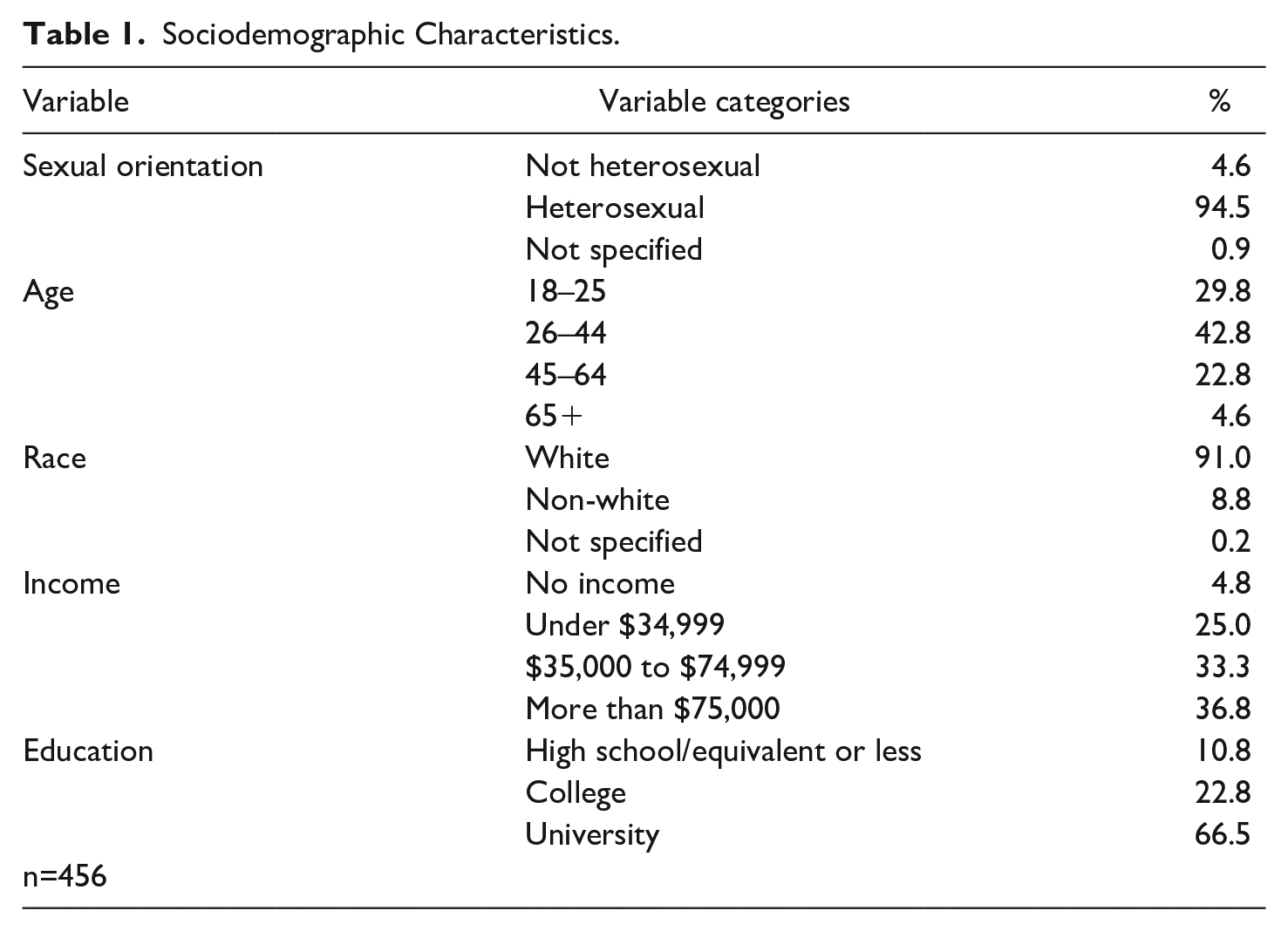
The socio-demographic characteristics of the sample are reported in Table 1. The majority of respondents were White and heterosexual. Nearly all were between ages 18 to 64, with only 4.6% of respondents aged 65 or older. In terms of education and income, most held a university degree and earned over $35,000.
Sociodemographic Characteristics.
To begin the analysis of beliefs and behaviors, I first examined the distributions of each belief and behavior variable. Table 2 reports the percentage of respondents holding and acting on inclusive, mixed, and oppressive beliefs and behaviors for each of the seven masculine components under study. An examination of Table 2 shows a disparity between beliefs and behaviors for every component, signifying dissonance between thought and action. The degree of discrepancy between beliefs and behaviors varies yet holds in all cases. At one extreme, for example, is the toughness variable. Specifically, 82.9% of men in the sample hold inclusive beliefs, 10.1% are mixed and 7% are oppressive. Whereas for behaviors, 5.9% are inclusive, 36.8% are mixed, and 57.2% are oppressive. In contrast, the distributions for the competition variables are more closely aligned. Competitive beliefs are distributed as 82.2% inclusive, 12.3% mixed, and 5.5% oppressive; while the behavior component is 63.4%, 20.4%, and 16.2%. While Table 2 is informative as it summarizes the distribution of responses, I wanted to discern overall patterns and trends in greater depth. To explore these relationships further, I conducted correspondence analysis to visualize this table and see the bigger picture.
Masculine Beliefs and Behaviors.
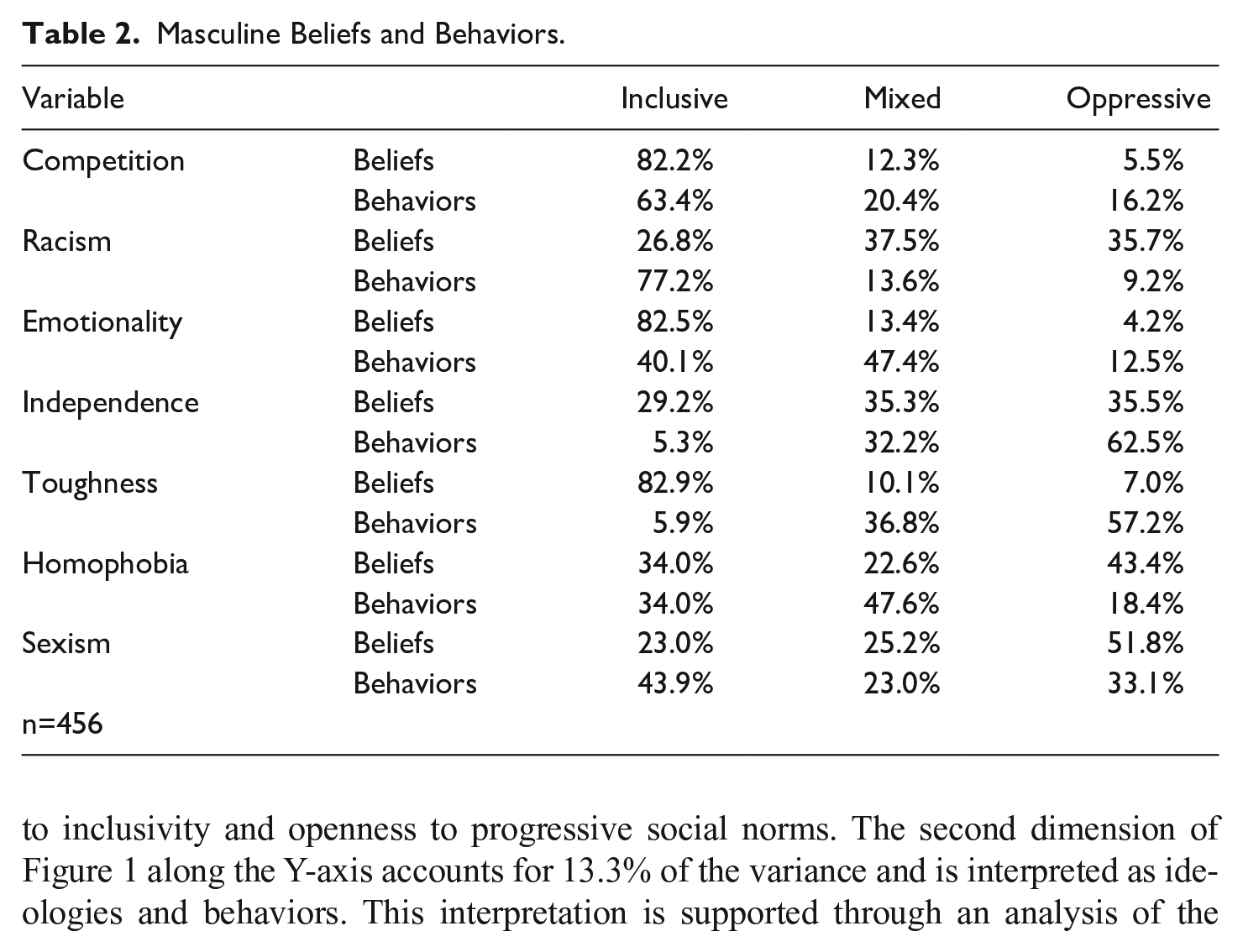
Figure 1 shows the results from the correspondence analysis, providing a two-dimensional map of the seven core components of masculinity (belief variables are abbreviated with the “bl.”; prefix and behavior variables are abbreviated with the “br.” prefix). The first dimension is displayed on the horizontal axis, accounting for 86.7% of the variance. A pattern emerges when analyzing the dispersion of the response categories indicated by the black triangles and font along the first dimension. The inclusive response category is positioned at the left side of the figure, with oppressive on the right and mixed in the middle. As such, the first dimension on the X-axis is interpreted as a depiction of social norms, with progressive social norms on the left and traditional hegemonic norms on the right. This pattern aligns with the literature, specifically, the alignment of orthodox masculinity with oppressiveness in juxtaposition to inclusivity and openness to progressive social norms. The second dimension of Figure 1 along the Y-axis accounts for 13.3% of the variance and is interpreted as ideologies and behaviors. This interpretation is supported through an analysis of the components, showing ideology variables predominantly populating the top of the figure and behavioral variables at the bottom.
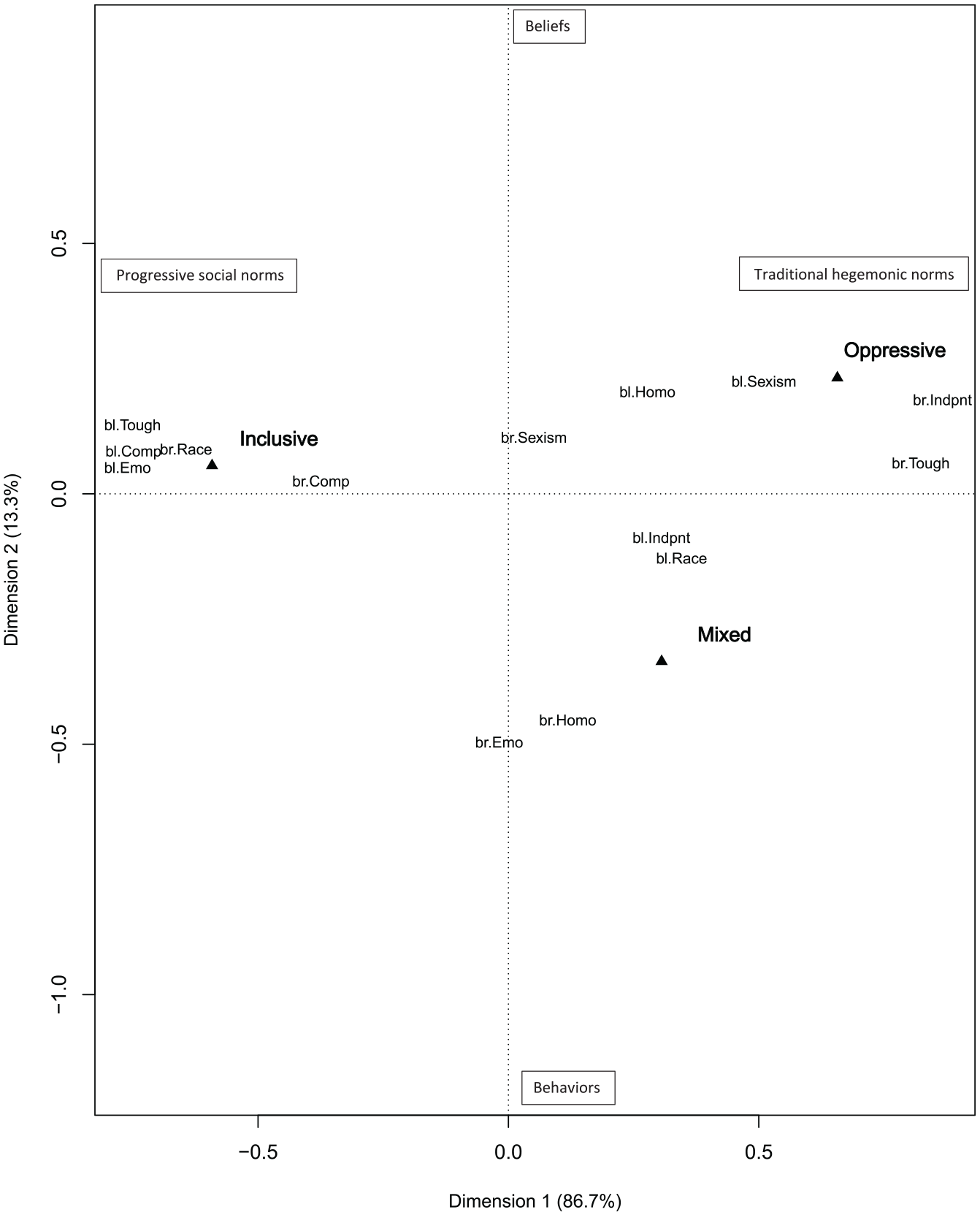
Masculine beliefs and behaviors.
Looking at the spatial positioning of response categories in Figure 1, we can establish that the inclusive, mixed, and oppressive responses occupy unique sectors of the map. The inclusive response is located in the upper left quadrant, the mixed in the lower right, and oppressive in the upper right. The belief and behavior variables positioned near inclusive, mixed, or oppressive labels or clusters indicate a close alignment with that response category; whereas variables located closer to the center of the map do not favor a specific response.
The inclusive cluster is defined by the belief variables of toughness, competition, and emotionality in addition to racist behaviors, and to a lesser extent, competition. The finding that three belief variables reside in the inclusive cluster implies that ideological support for progressive social norms is strong. However, the absence of corresponding behavior variables in inclusive space in the upper left quadrant is evidence progressive beliefs do not comport with progressive behaviors. The anomaly that the racist behavior variable is located in the inclusive cluster could signify athletes are genuinely becoming devoid of racist practices. An alternative, less optimistic interpretation is that as contemporary social norms do not condone overtly prejudicial behaviors, many athletes refrain from acting out prejudicial beliefs they still hold.
The mixed cluster is defined by beliefs of independence and racism, and behaviors of emotionality and homophobia. The positioning of the emotionality and homophobic ideologies in progressive space, relative to their behavioral variables in mixed space, suggests men’s reluctance to act on their beliefs. For this reason, the respondents are interpreted as especially conflicted on these two fronts. Expressing emotionality appears to be permissible as evidenced by its locale on the map. Yet, there remains dissonance between ideological and behavioral emotionality in that behavior is relatively more oppressive than its ideological counterpart.
The oppressive cluster also blends belief and behavior variables. It is characterized by sexist and homophobic belief variables, and by behavior variables of independence, and toughness. Taken together, the variables in the oppressive space underscore that many of the foundational, discriminatory, and exclusionary components of hegemonic masculinity as outlined by Kimmel (1993) remain stalwart among the athletes sampled. The beliefs of heteronormative sexuality are supported, alongside the highly endorsed expectations of toughness and independence.
Comparing Beliefs and Behaviors
The analysis of the clusters in Figure 1 suggests some components of masculinity are trending toward inclusiveness among the Canadian male athletes sampled. To explore this further, I examined the pairs of belief and behavior variables for each of the seven masculine components. A comparison of each belief variable to their behavior variable reveals that there are no instances in which both components are adjacent, except for the anomaly of competition where both are positioned in the inclusive cluster.
With the exception of competition, every pair of belief and behavior variables are conflicted in a contested discordant relationship, evidenced by their relative distance from each along the X-axis of the map. Inclusive beliefs pair with more oppressive behaviors, and oppressive beliefs with more inclusive acts. This finding indicates beliefs and behaviors are unsynchronized, and beliefs are not fully acted upon. In some cases, behavioral profiles positioned to the right of their ideologies indicate more oppressiveness relative to their ideological correlate. In other cases, behavioral profiles are to the left of a paired oppressive belief signifying a more inclusive leaning behavior relative to the ideology. For example, as discussed above, expressive emotionality is more oppressive than its ideology, positioned to the right on the horizontal axis.
This analysis reveals that respondents in my sample favor inclusive-leaning beliefs for the toughness, competition, restrictive emotionality, and independence variables as evidenced by the position of these variables in the inclusive space in the upper left quadrant of the map. However, the analysis also shows these inclusive beliefs are not fully practiced, indicating respondent’s behavior is at odds with their progressive ideas. Similarly, oppressive beliefs of sexism, racism, and homophobia are not completely acted upon, as shown in the more inclusive positioning of behavior variables in comparison to their corresponding belief counterparts. This suggests oppressive beliefs remain hidden behind a veil of relatively inclusive-leaning behaviors, and inclusive beliefs fail the test of authenticity within behavior using these measures.
Amid shifting gender expectations and an evolving social environment, this examination of paired profiles provides one of the most significant findings, indicative of conflicting beliefs and behaviors for both inclusive and oppressive leaning men. There is a critical distinction differentiating the above two groups of associations. In our current social context, overt acts of discrimination based on race, gender, and sexual orientation are increasingly socially unacceptable. This is perhaps more pronounced in sport with significant media and public shaming targeted against athletes caught being racist, sexist, or homophobic (Armstrong, 2017; Corbett, 2013; Zucker, 2014). This contention is suggested in Figure 1, as behaviors of homophobia, sexism, and racism are more moderate than their corresponding ideologies. In contrast, behaviors of toughness, competition, restrictive emotionality, and independence are more socially condoned, expressed in respondent’s behavior. There is evidence of conflict between thought and action, signified by dissonant paired belief and behavior variables on the map. Overall, beliefs and behaviors in this sample are unsynchronized, indicating that inclusivity and orthodox masculinity are contested among these men. Participants appear split in their beliefs and behaviors, portraying masculinity in conflict, and lacking cohesion.
Discussion
Recent developments for social equality and justice are encouraging a rethinking of masculinity, including what is and is not manly, and what is just unacceptable behavior (Connell, 2005, Faludi, 2000; Kimmel, 2012; Schwalbe, 2014). As many contend that hegemonic masculinity will adapt to the social environment to uphold male dominance, gender and masculinities scholars are tasked with uncovering whether increasing progressiveness is genuine or a remoulding of hegemonic masculinity, repackaged to maintain dominance in the current sociopolitical climate.
According to Messner (2007), men are responding with a masculinity that is caring yet tough. Men are integrating compassion, affection, and empathy with hard-nosed, tough masculinity to showcase they care for others while maintaining the capacity to be resilient, protective, and aggressive (Messner, 2007). The findings from the correspondence analysis offer support for Messner’s contention in that expressive emotional behavior is in mixed space while the frequency with which men engage in acts of toughness signifies the maintenance of orthodox masculine behaviors.
The finding that sexist, homophobic, and to a lesser extent racist beliefs remain oppressive, is evidence that many exclusionary ideologies upon which orthodox masculinity is founded remain endemic in this sample of Canadian male athletes. Progressive social norms could be argued to be constraining how men act, pushing them away from homophobic, sexist, and racist instincts toward more socially acceptable behaviors. As early scholarship suggests that racism, sexism, and homophobia are important characteristics of masculinity (Cheng, 1999; Kimmel, 1993), the finding that homophobic, sexist, and racist behaviors are tempered suggests that what are considered acceptable masculinities are shifting, and Canadian male athletes may be augmenting their behavior in response to progressive shifts. Conversely, traditional hegemonic norms may be suppressing progressive social beliefs, as the data can also be interpreted to mean that men in the sample, under pressure from orthodox masculine norms, enact oppressive behaviors contrary to their purported beliefs. Considered together, these data provide empirical support for hybrid and flexible masculinities and men’s incorporation of alternative expressions of masculinity into their own identities.
These results contribute to an understanding of the modern perceptions and expressions of masculinity. Some of the men in this sample may be reacting to shifting social norms in part by withholding discriminatory behaviors yet maintaining oppressive beliefs. While there has been a general shift in public attitudes toward homosexuality, with numerous social and legislative initiatives to promote gay marriage and LGBTQ+ rights, homophobia holds traction in the data. The absence of homophobic beliefs within inclusive space indicates the persistence of homophobia for some. The positioning of homophobic behaviors in mixed rather than inclusive or oppressive space reflects its controversial nature for these men. Figure 1 shows that many men in the sample engage in homophobic behaviors synonymous with orthodox masculinity and inconsistent with liberal social norms. Despite the presence of three belief variables in the inclusive cluster and many studies evidencing the proliferation of inclusivity and progressiveness, there is still significant progress to be made.
The continued assertion of orthodox masculinity posited by scholars and experienced by many on a day-to-day basis is witnessed empirically in this evaluation of the spatial distribution of beliefs and behaviors in the correspondence analysis. Despite gains, the analysis reveals oppressive male behaviors accompany more progressive social beliefs. Although progressive social norms may be tempering behaviors increasingly socially unacceptable, orthodox masculine norms are also suggested to restrict inclusive expression in that men with expressed progressive support do not commit to it in practice. In other words, some men admit attachment to and self-identification with male hegemony and its vehicles of power—sexism, homophobia, and racism—despite progressive-leaning actions.
The findings from Figure 1 depict men in conflict, with internal beliefs and external behaviors in tension. Men are encouraged by progressive social norms on the one hand and traditional hegemonic norms of identity and behavior on the other. Sociocultural expectations are inhibiting both positive (limiting homophobia, sexism, and racism) and negative (restricting feelings that are stereotypically considered feminine) masculine expression. Participants appear split and uncertain about how to navigate their identity, evidence of a masculinity crisis whereby emergent progressive social trends are simultaneously igniting orthodox masculinity. Regardless of the mechanisms at play and the explications, men appear conflicted with beliefs and behaviors lacking cohesion.
The findings from this study depict an instance where the reigning social imperative to not overtly discriminate based on sex, race, and sexual orientation may be suppressing racist, sexist, and homophobic behaviors among Canadian male athletes. This may only increase with the focus on Black Lives Matter and ongoing systemic racial injustice. Within the Canadian context, these findings argue for enhanced anti-discrimination initiatives to facilitate a more inclusive sporting environment.
In sum, through an examination of the disparity between ideologies and practices, this study further addresses a debate in the literature concerning the legacy of traditional hegemonic masculinity. According to Connell and her supporters, hegemonic masculinity transforms to fit current social norms to produce an acceptable form of masculinity solidifying the superiority of some men and the subordination of women and other men (Connell, 2005; Connell & Messerschmidt, 2005). The findings suggest progressive trends have not fundamentally altered the structuration of a gender hierarchy in which orthodox norms prevail within the context of sport among the men in my sample.
Limitations
It is necessary to acknowledge the limitations of this study. First, while this research largely explicates its findings in terms of the interaction between social norms and gender norms for the overall state of masculinity, it does not address or account for motivations behind individual behaviors. As is often the case with quantitative research designs, this study does not consider individual personal experience, a dimension that will be of interest for future study. This elicits the need for future research to elucidate the social impacts of transitioning and conflicted masculinity. Future research should address how and why men construct masculinity in unique ways, including how men rationalize their behaviors and the factors contributing to their beliefs. A second limitation arises from the exploratory nature of this research. The findings from this paper are intended as a macro investigation of shifting perceptions and manifestations of masculinity in Canada. Correspondence analysis is an exploratory statistical technique (Greenacre, 2007a). Therefore, the claims should not be considered confirmatory; rather, they should be used to direct future research in the area. Third, this research does not consider the effect of sociodemographic characteristics. As the majority of participants are White, middle-class, early middle-aged, heterosexual men, this research does little to enhance the frame of investigation to diverse populations; instead, it expands the scope to a larger Canadian population.
Conclusion
This study helps to reveal the dynamic interrelationship between shifting social norms and traditional masculine paradigms structuring contemporary gender relationships. It offers empirical data deciphering the current state of masculinity amongst Canadian male athletes, as well as theoretical insight into the intricate, contentious, and shifting perceptions and expressions of masculinity. Men appear torn between how they feel and how they behave, or how they think they should behave. The finding that masculinity operates through the resistance and cooperation between progressive social norms and oppressive orthodox masculine norms expands research on the construction of masculinity amidst recent social changes. In a shifting culture that no longer publicly approves nor venerates orthodox masculinity, men in my sample appear to be struggling to locate a socially acceptable gender identity construed as masculine. Evident is tension between orthodox masculinity and progressive social norms, shaping, supporting, and constraining each other. While attitudes surrounding homophobia and other oppressive beliefs have improved over the past several decades, there is still much progress to be made. The need to prove masculinity endures, but the socially sanctioned ways to do so are changing. Future studies should address how social change may be impacting expressions of masculinity for men in different settings and of different sociodemographic groups. Moreover, research should examine the ramifications of those who temper beliefs with actions inconsistent with their true feelings, including how, where, and to what extent men vent their frustrations in alternative spaces.
Footnotes
Declaration of Conflicting Interests
The author declared no potential conflicts of interest with respect to the research, authorship, and/or publication of this article.
Funding
The author received no financial support for the research, authorship, and/or publication of this article.
