



Abstract
Toluene-based inhalants found in some common products, such as paint thinner or glues, may be used to induce intoxication. Though addiction may be one of its most detrimental consequences, treatment options are insufficient or limited. Environmental enrichment (EE) refers to housing conditions that enhance sensory, cognitive, and motor stimulation. This paradigm induces beneficial effects in a variety of animal models of brain disorders, and also in animal models of drug addiction. Previous studies have shown that toluene induces behavioral sensitization and that EE treatment can reduce this response. Since EE comprises a variety of elements, the aim of the present study was to group mice into five different types of EE-shaping housing conditions (4 weeks) and to identify which of them are key elements in attenuating toluene-induced behavioral sensitization. The experimental groups were: Standard housing with conspecifics; EE with conspecifics; Toys stimulation with conspecifics; Exercise wheels with conspecifics; and Wheel and toy isolated. Mice in Standard housing and previously exposed to toluene exhibited high locomotor activity, suggesting behavioral sensitization. When animals were exposed to toluene and then housed in EE with conspecifics or Exercise wheels with conspecifics conditions an attenuation of behavioral sensitization was observed (p < 0.001; 100% and 75% effectiveness, respectively). Toy with conspecifics housing also reduced behavioral sensitization, but in a less proportion than the two previous mentioned treatments (p < 0.002; 33.5% effectiveness). Mice in the Wheel and toy isolated housing did not show significant changes in the assessed behavior (p = 0.061; 12.4% effectiveness). We suggest that exercise and social interaction are the key enriched main elements to attenuate toluene-induced behavioral sensitization. Our results advise preclinical strategies for inhalant abuse interventions based on social interactions and physical exercise. Also, they provide guidelines to develop experimental models with diverse environments and groups that lead us to understand the complexity of environmental enrichment.
1. Introduction
Inhalants are gases or volatile liquids at room temperature that are widely used for intoxication purposes (Balster et al., 2009). The 2018 European School Survey reported an average lifetime prevalence of inhalants use of 8% (European Monitoring Centre for Drugs and Drug Addiction, 2018), while 6.1% in the past year was reported among eighth graders students in the United States (NIDA, 2020a). In 2015, the Inter-American Observatory on Drugs of the Inter-American Drug Abuse Control Commission (CICAD, 2015) reported a great variability between 0.5% and 11% in the prevalence of inhalants use in the American countries, with an increasing trend among the school population. Particularly, toluene-based inhalants found in some common products, such as paint thinner, glues, and spray paints, are preferred by different inhalant users, such as youth working on the streets and high school students (Medina-Mora & Real, 2008; Villatoro et al., 2011). Though these substances may have various behavioral effects, addiction is the most detrimental consequence from clinical and social perspectives (Medina-Mora & Real, 2008). Chronic inhalants use can lead to memory impairment, anxiety, depression, visual and auditory hallucinations, and structural abnormalities in some brain areas; seizures, coma, and sudden death by inhalation have also been reported (Cruz & Bowen, 2021; Howard et al., 2011; NIDA, 2020b). From a social point of view, the continued use of inhalants may lead to failure to fulfill responsibilities at work, school, or home (NIDA, 2020b).
Studies in animal models have reported the addictive potential of toluene (Batis et al., 2010; Blokhina et al., 2004; Funada et al., 2002; Páez-Martínez et al., 2020). Short-term exposure to toluene vapor (700–3200 ppm) elicits conditioned place preference in mice (Funada et al., 2002) and self-administration in rats (Blokhina et al., 2004), whereas chronic exposure (2000–6000 ppm) induces behavioral sensitization in rats (Batis et al., 2010). Recently, our research group showed that mice progressively increase their locomotor activity expressing behavioral sensitization after being exposed to 2000 and 4000 ppm toluene (Páez-Martínez et al., 2020).
According to Steketee and Kalivas (2011), sensitization remains a useful preclinical model for studying addictive behavior. The incentive-sensitization theory posits that addictive behavior is due largely to progressive and persistent neuroadaptations caused by repeated drug use that results in pathological levels of incentive-salience (estimated value) being attributed to drugs and drug-associated cues (Robinson & Berridge, 1993; Stewart & Badiani, 1993). One of the behavioral manifestations of behavioral sensitization in rodents is a progressive and lasting enhancement of the stimulatory effects in the locomotor system (Robinson & Berridge, 1993). Thus, the reinforcing effects of drugs (i.e., they increase the likelihood of increased drug seeking), and their subsequent addiction liability can be predicted from their ability to induce locomotor activation (Wise & Bozarth, 1987). It has been described that seemingly disparate positive reinforcement and psychomotor activation are homologous, that is, they result from the activation of a common neural mechanism involving overlapping circuitry, neurotransmitters, and receptors systems. More detailed investigations have found that the mesocorticolimbic system, as well as associated brain areas, such as the hippocampus and amygdala, play a role in modulating both the addictive response and locomotor activation after repeated administration of drugs of abuse (Steketee & Kalivas, 2011; Vanderschuren & Kalivas, 2000; Wise & Bozarth, 1987). On these behavioral and neural bases, the enhancement and persistence of locomotor behavior induced by repeated administration of toluene suggests addictive behavior.
Studies on the addictive effects of inhalants are scarce compared to those of other drugs, so treatment alternatives for inhalant users are insufficient or limited. One preclinical option that has been explored refers to environmental enrichment (EE). EE refers to housing conditions that facilitate enhanced sensory, cognitive, and motor stimulation. This paradigm induces beneficial effects in a variety of animal models of brain disorders, such as Parkinson’s and Alzheimer’s disease, memory impairment, and also in animal models of drug addiction (Nithianantharajah & Hannan, 2006; Solinas et al., 2010; Van Praag et al., 1999). Concerning toluene, it is reported that EE reverses different cellular and behavioral consequences (Montes et al., 2017; 2019; Paez-Martinez et al., 2013), including behavioral sensitization (Páez-Martínez et al., 2020). Since EE involves a variety of components including exercise, cognitive stimulation, and social interactions, it is unclear which are the key elements that may attenuate addictive-like behaviors. Therefore, the aim of the present study was to group mice under five EE-shaping housing conditions and to identify which of them are most effective in attenuating behavioral sensitization induced by toluene.
2. Material and methods
2.1. Animals
A total of 100 Swiss-webster male mice (postnatal day 35–40 at the beginning of the study) were housed in groups of five in cages (18 x 28 x 15 cm3) under controlled temperature (23–26°C), humidity (40–60%), inverted 12h: 12h light-dark conditions (lights on at 8:00 a.m. and off at 8:00 p.m.), and with food and water ad libitum. The sample size was calculated using SigmaStat for Windows, version 3.5 (Systat Software, Inc. 2006), and applying the following values: Effect size = 47; Standard deviation = 25; Power = 0.8 and two-tailed test. Animal care and experimental procedures followed the guidelines approved by the Ethics Committee for the Care and Use of Laboratory Animals of the Instituto Nacional de Psiquiatría Ramón de la Fuente Muñiz and complied with the Official Mexican Standard (NOM-062-ZOO-1999, SAGARPA, México).
2.2. Experimental procedure
2.2.1. Toluene exposure
Pairs of animals were exposed to air (control animals) or to toluene vapors (experimental animals) (Sigma-Aldrich, Toluca, Mexico) inside an inhalation chamber for 30 min a day for 4 weeks following a procedure previously used and reported by our group to induce behavioral sensitization in mice (see Oros-González et al., 2022; Páez-Martínez et al., 2020). Toluene concentrations in the inhalation chamber were confirmed by using a photoionization detector (2020ComboPRO, Inficon, New York, USA). During this stage of exposure, the animals were housed under the controlled conditions described above.
2.2.2. Treatments
After the air/toluene exposure stage and for the treatment procedure, mice were kept toluene-free and were housed under one of five environmental conditions for 4 weeks (details previously reported in Mercadillo et al., 2019): 1. Standard housing. Housing five conspecifics in small cages (18 × 28 × 15cm3). 2. Environmental enrichment (EE). Housing five conspecifics with two running wheels and three toys (e.g., tunnels and objects of different textures, shapes, and colors) in large cages (34 × 44 × 20cm3). 3. Toys with conspecifics in large cages. Five animals housed in cages (34 × 44 × 20cm3) with five toys (e.g., tunnels and objects of different textures). 4. Exercise wheels with conspecifics in large cages. Five animals housed in cages (34 × 44 × 20cm3) with three running wheels. 5. Wheel and toy isolated mouse in small cages. Animals individually housed in cages (18 × 28 × 15cm3) with one running wheel and one toy.
2.2.3. Behavioral sensitization analyses
After the treatment procedure, behavioral sensitization was evaluated by placing animals into the inhalation chamber for a single 30 min toluene exposure (4000 ppm); lines were drawn on the chamber floor to divide it into four visible quadrants (9 cm × 9 cm). To assess the mouse’s locomotor activity expressing behavioral sensitization inside the chamber, the number of crossings among the four quadrants was recorded from minutes 25 to 30.
2.3. Statistical analysis
The number of crossings for each animal was listed in a database and categorized according to the housing condition or treatment they received after the exposure. Mean and standard deviation were obtained for each treatment and statistical analyses were done using Sigma Plot 12.0 (Systat Sofware Inc., San Jose, CA) to identify and contrast the effects between groups. A two-way ANOVA followed by Tukey tests were performed considering treatment as Factor A (Standard housing; EE; Toys with conspecifics; Exercise wheels with conspecifics; Wheel and toy isolated mouse) and kind of exposure as Factor B (air or toluene). For all cases, p-values ≤0.05 were considered significant. The linear regression analysis to measure the percentage of effect was performed using the Sigma Plot 12.0 program (Systat Software Inc., San Jose, CA).
3. Results
As displayed in Figure 1, control animals exposed to air exhibited low locomotor activity with no differences between treatments (gray bars). Comparisons between experimental (black bars) and control animals (gray bars) show that mice exposed to toluene displayed statistically higher locomotor activity for the Standard housing, Toys with conspecifics, Exercise wheels with conspecifics, and Wheel and toy isolated mouse, while no statistical differences were observed for the EE treatment. The comparison among treatments showed that, in animals with a previous exposure to toluene, EE (p < 0.001), Exercise wheels with conspecifics (p < 0.001), and Toys with conspecifics (p < 0.002) attenuated locomotor activity compared to Standard housing. The two-way ANOVA analyses showed a significant effect of housing conditions (A) F4,90 = 30.04, p < .001; kind of exposure (B; toluene vs. air) F1,90 = 168.14, p < 0.001; and interaction (A vs. B) F4,90 = 18.61, p < 0.001. These results suggest that for animals previously exposed to toluene, EE treatment attenuates locomotor sensitization and places behavior to a similar level to that observed in animals that were not exposed to toluene. Exercise wheels with conspecifics also produced a reduction in activity, but to a lesser extent, while Toys with conspecifics was the treatment producing the lowest attenuation. Thus, the type of housing condition modifies the locomotor response induced by toluene in different ways. Locomotor activity in mice repeatedly exposed to air or 4000 ppm toluene and then treated with five different housing conditions (n = 10 per group). On the test day, mice were submitted to a single 30 min exposure to toluene (4000 ppm). The number of crossings among the four quadrants drawn on the inhalation chamber floor was recorded from minutes 25 to 30. Bars represent mean ± SEM for the number of crossings in each group. Statistical significance was determined using a two-way ANOVA followed by a Tukey’s multiple comparison test. * represents differences at p < 0.05 when contrasting air and toluene groups in each equivalent housing condition. & represents differences at p < 0.05 when contrasting toluene-exposed mice in Standard Housing vs. other housing conditions.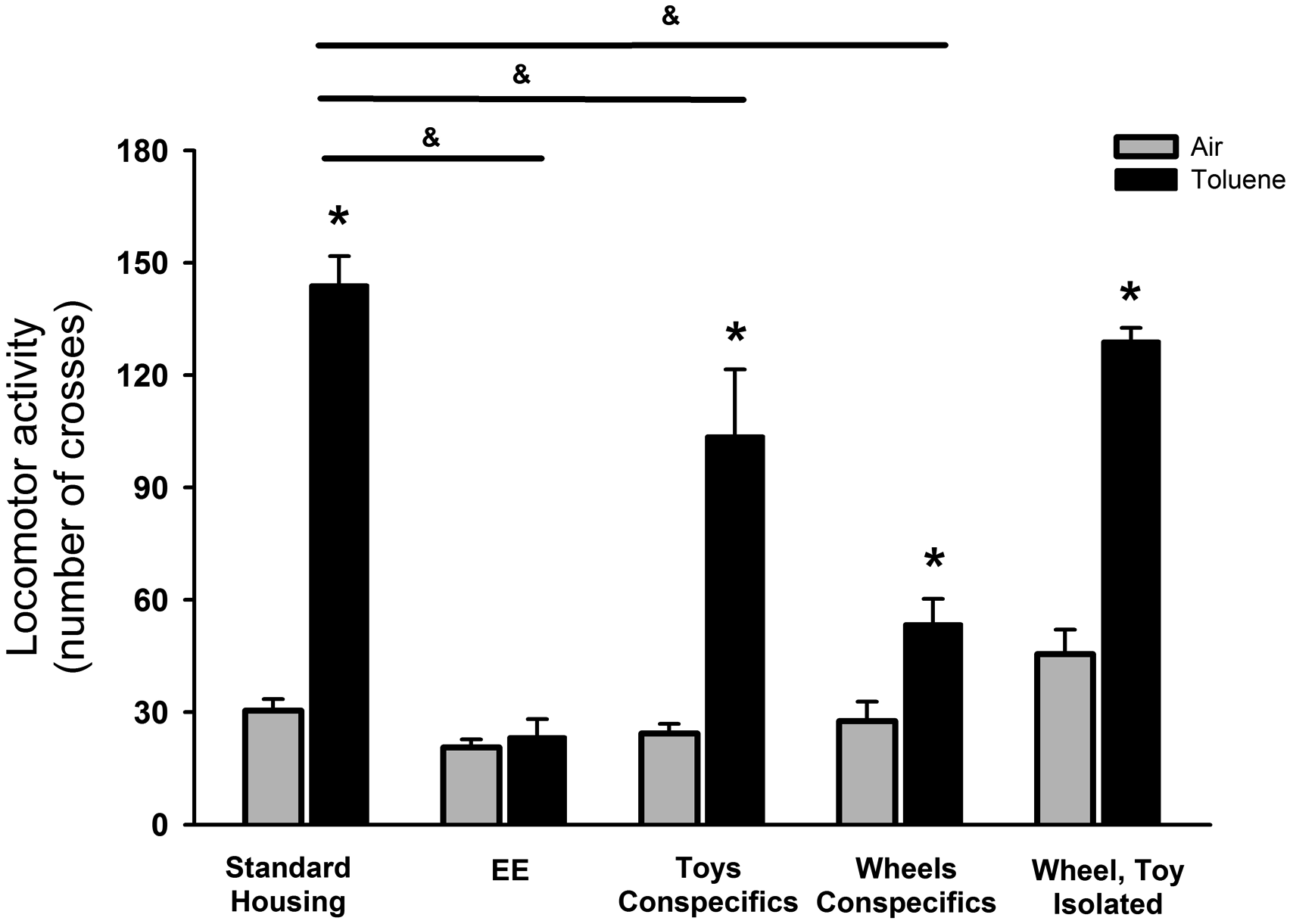
In an effort to get a clearer idea of how different the treatments were in attenuating locomotor sensitization and to try to give them a quantitative value, not just qualitative, data were analyzed in terms of the maximum and minimum response observed; accordingly, in Figure 2 results are shown as a percentage of effect. To measure these proportional effects, we proposed a mathematical approach based on a linear regression model, as we previously reported (Mercadillo et al., 2019). For this proposal, we provided an arbitrary 100% value for the EE treatment (the minimum value observed for the locomotor activity) and 0% value for the Standard Housing treatment (maximum value observed for the locomotor activity). The union of these two points results in a straight line; subsequently, the locomotor activity observed with each treatment was extrapolated to this line and thus a percentage value was obtained. The applied equation was: y = 119.3041 + (−0.8285 * X), where “X” indicates the locomotor activity (number of crossings), while “y” refers to the effect percentage. As presented in Figure 2 and according to this linear analysis, Exercise wheels with conspecifics elicited the most beneficial effect (75.0%), followed by Toys with conspecifics (33.5%) and Wheel and toy isolated mouse (12.4%) treatments. Percentage of effectiveness of the housing condition on the expression of behavioral sensitization induced by toluene. Exercise wheels with conspecifics treatment consisted of running wheels in a social coexistence. Toys with conspecifics treatment consisted of five toys (e.g., tunnels and objects of different textures) in social coexistence. Wheel and toy isolated mouse consisted of an individual environment with running wheels for voluntary exercise and tunnels and toys to be explored. An arbitrary 100% value (the minimum value expected for locomotor activity) was set for the EE treatment (involving exercise wheels, toy stimulation and social interaction with conspecifics), while a 0% value (maximum value expected for locomotor activity) was set for the Standard Housing treatment.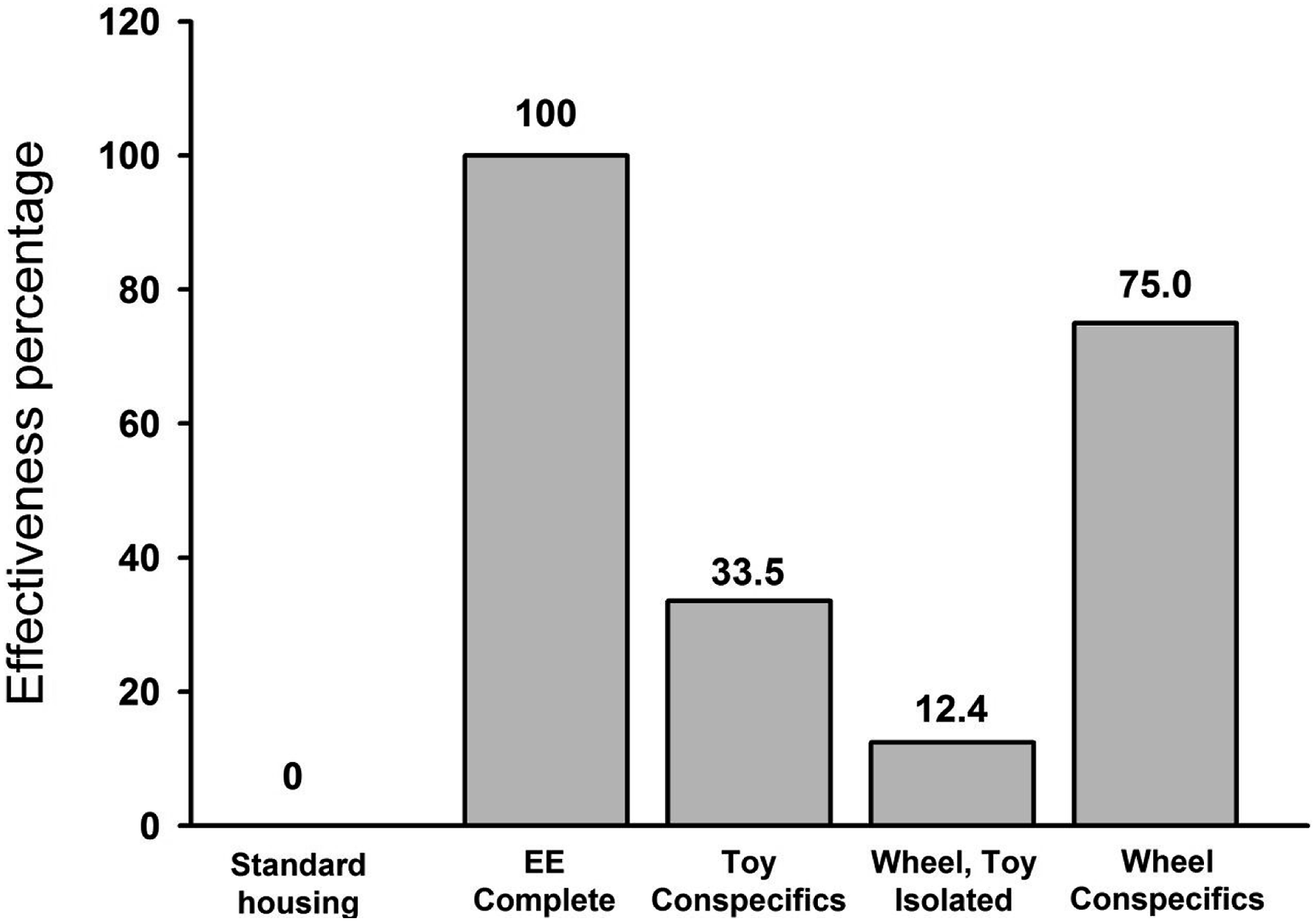
4. Discussion
Consistent with previous reports, our results show that chronic toluene exposure and posterior housing under standard conditions maintained high locomotor activity (Páez-Martínez et al., 2020) deducing toluene’s addictive-like properties (Páez-Martínez et al., 2020). Also, that housing in an enriched environment, involving exercise with running wheels, stimulation with toys, and social interaction with conspecifics, was able to reverse this expression (Páez-Martínez et al., 2020).
Our aim was to analyze the key elements of EE to attenuate behavioral sensitization. Accordingly, we found that the Exercise wheels with conspecifics group has the most beneficial effects, while mere stimulation with Toys with conspecifics has a minimal effect. The running wheels and toys did not provide benefits when they were presented without social interaction (isolation).
The effects of exercise on the addictive-like behavior produced by different drugs have been studied in animal models. Rats performing voluntary exercise decrease self-administration of cocaine (Smith et al., 2011), methamphetamines (Engelmann et al., 2014), and alcohol (Hammer et al., 2010) compared to sedentary rats. A possible explanation suggests that exercise may constitute a rewarding action that activates the brain’s dopamine (DA) pathway, which involves the reinforcement system (Foley & Fleshner, 2008; Greenwood et al., 2011). Repeated toluene exposure affects DA dynamics in the prefrontal cortex, nucleus accumbens, hippocampus and caudate (Páez-Martínez et al., 2020), and voluntary exercise requires the functions of those brain regions (Greenwood et al., 2011; Lynch et al., 2010; Van Praag et al., 1999). Therefore, exercise may imply reinforcement allowing the animal to match some rewarding processes to those elicited by toluene.
Regarding stimulation with Toys with conspecifics, findings in animal models are contradictory. For example, Venebra-Muñoz et al. (2014) reported a decline in nicotine consumption after toy stimulation in social housing, while Starosciak et al. (2012) reported no effects of toy stimulation on locomotor activity elicited by MDMA administration. Our results suggest that toy stimulation may be a complementary but not critical enriching element since behavioral sensitization is significantly decreased only when toy stimulation is combined with voluntary exercise options.
Though voluntary exercise provided beneficial effects, those must consider social coexistence as a crucial element. Our results show that exercise, and even exercise and stimulation with toys combined had no effects on behavioral sensitization in the isolated condition with no social interactions, that is, without conspecifics. It has been suggested that isolation may favor drug abuse by influencing the DA mesolimbic pathway. Methylphenidate and amphetamine administration inhibits DA uptake in a higher proportion in isolated rats than in grouped rats, while cocaine increases DA release in a larger proportion in isolated rats than in grouped rats (Yorgason et al., 2016). In addition, isolated rats consume larger quantities of morphine (Alexander et al., 1978), alcohol (Chappell et al., 2013), and cocaine (Ding et al., 2005) and exhibit greater locomotor activity associated to amphetamine consumption compared to socially housed rats (Herrmann et al., 2014). Conversely, some reports suggest that social contexts inhibit drug consumption. For example, it has been observed that rats are able to achieve conditioned place preference for social environments, which reverse conditioned place preference for cocaine and prevent reacquisition (El Rawas et al., 2012). Further, adolescent mice living under social conditions, either in a crowded environment or in cohabitation with a female, avoid cocaine reinstatement after extinction (Ribeiro Do Couto et al., 2009). Mammalian social interactions involve a variety of highly rewarding behaviors including socio-sexual selection, caring and protection, territorial and resources competition and sharing, hierarchical dynamics, or playful behaviors (Berridge & Kringelbach, 2008). Therefore, when a social environment complemented with exercise options is provided after previous standard housing, it may decrease the salience or rewarding effects elicited by certain drugs, such as toluene.
Knowledge about the neural mechanisms and behaviors underlying the effects of exercise and social interaction on rewarding processes is still incomplete. Hence, extensive research is required to fully understand how such rewarding processes inhibit addictive-like behaviors elicited by toluene exposure.
This study is a first approximation and proposal to understand the relevance of the different elements shaping an EE. A limitation of our work is the lack of experimental groups and conditions to assess the effect of isolation, such as exercise with wheels without conspecifics, stimulation with toys without conspecifics, or isolation without any object for stimulation. Precisely based on the results presented here, we have started different studies in our laboratory to understand the relevance of isolation, as well as to analyze the mechanisms that underlie the potentiation or attenuation of behavioral sensitization in different housing groups. Another limitation is the sample restricted to male mice; a challenge for future studies is to consider the behavioral response in females and perform contrasts between both sexes.
5. Conclusion
Our results confirmed that complete EE may constitute the best treatment to attenuate addictive-like behaviors induced by toluene. But, when not possible to apply it, exercise and social interaction may be considered as key elements.
Notwithstanding the limitations mentioned above, such conclusion may be useful to accurately research EE and provide strategies or guidelines to detail and adapt interventions based on social interactions and physical exercise explored in drug users. These environmental approaches have been suggested for ethanol abuse and in the reduction of substance use among high-risk adolescents (Thompson et al., 2018; Valente et al., 2007). Our proposal may be particularly significant for toluene-based inhalant users since clinical and psychosocial interventions are scarce.
Footnotes
Acknowledgements
The authors wish to thank to Psi. Beatriz Cruz López for her valuable technical assistant. The authors thank Jessica González Norris from Acento Traducciones for the revision of the text.
Declaration of Conflicting Interests
The authors declared no potential conflicts of interest with respect to the research, authorship, and/or publication of this article.
Funding
The author(s) disclosed receipt of the following financial support for the research, authorship, and/or publication of this article: This study was supported by projects SIP-Instituto Politécnico Nacional and Instituto Nacional de Psiquiatría Ramón de la Fuente Muñiz NC18098.0, México.

About the Authors