



Abstract
From 24 August 2022 to 27 August 2022, a group of interdisciplinary experts from psychiatry, psychology, philosophy, cognitive science, and other related fields met in Vancouver, Canada, for a roundtable event. The aim of the roundtable was to discuss the concept of the “self” as it pertains to the deliberate, habitual, and addicted interactions of the individual with the world, including with information technology, through the lens of an enactivist framework.
1. The Peter Wall Research Roundtable
The Peter Wall Institute for Advanced Studies International Research Roundtable, The addicted self in the age of information technology: Exploring the mind’s propensity for habitual and compulsive interactions, was organized by Christian Schütz, who leads the Behavioural Reward Affect and Impulsivity Neuroscience Lab (B.R.A.I.N. Lab) at the University of British Columbia (UBC), Tom Froese, who leads the Embodied Cognitive Science Unit (ECSU) at the Okinawa Institute of Science and Technology Graduate University (OIST), with then ECSU-OIST member Susana Ramírez-Vizcaya, and Evan Thompson, professor of philosophy at the University of British Columbia. The project successfully earned one of the International Research Roundtable Awards for scholars from UBC and the international community to foster excellence in interdisciplinary research on topics with a significant societal impact.
The multidisciplinary roundtable aimed to discuss the notion of self as it pertains to deliberate, habitual, and addictive interactions, exploring the relevance of an enactive approach as a comprehensive integrative framework. Specifically, the main research questions pertained to the conceptualization of the self that emerges from neurobiology, cognitive science, and philosophy of mind; the interactions between the self and information technology; and the role of embodied and enactive concepts in clarifying the aforementioned interactions. The roundtable was intended as a dialog to synthesize knowledge, identify open questions, and propose further research in this complex nexus of topics.
2. Roundtable themes across day 1–3
The first day started with presentations from Daniel Hutto (University of Wollongong, Australia) and Michelle Maiese (Emmanuel College, USA) who set the overall conceptual framework of the roundtable, discussing how the notions of self, mind, and habits can be understood within enactive cognitive science. In line with his self-shaping hypothesis (Hutto, 2016), Hutto argued that we should not characterize ourselves as fixed, mental essences, but instead should focus primarily, though not exclusively, on the role habits play in making us who we are. He defended a pragmatist-inspired account of habit, opposed to the widely held negative view of habit as the nemesis of the intellect (Hutto & Robertson, 2021). Hutto then considered evidence for the potential contribution of narrative therapy to addiction recovery. Narrative therapy seeks to help people re-author their lives through the construction of self-narratives that help them enact more desirable futures. Hutto proposed that narrative therapists would benefit from framing their practice as one in which they and their clients adopt a “fictive stance,” bracketing narratives from considerations of veracity and intersubjective validation. Hutto explained how this understanding of narrative therapy would address skepticism about its ends and methods.
Maiese, in turn, provided a comprehensive synthesis of the enactive approach to self and habits. In the view provided, the self emerges from the self-organization of habits, understood as self-sustaining and metastable behavioral and attentional patterns formed through the agent’s interaction with the environment (Maiese, 2015). In this regard, transforming the self involves dramatically changing one’s set of habits, which can be difficult when they lose their flexibility and become sedimented, as happens with addictions. Maiese also acknowledged the influence of the sociocultural environment in shaping habits and, in that way, shaping the mind (Maiese & Hanna, 2019). In particular, she addressed the role of social institutions, such as Twitter, in mindshaping, which could be either enabling or destructive for the individual, depending on the kinds of habits these “mental institutions” foster and reinforce.
The second session of Day 1 was focused on the topic of habits, addictions, and sociality, with presentations from Tom Froese (ESCU-OIST, Japan) and Susana Ramírez-Vizcaya (Autonomous University of the State of Morelos, Mexico). Froese began by introducing some problems with the social brain hypothesis, according to which the cognitive load resulting from increasing social complexity is the main driving force behind evolutionary encephalization in humans. Based on studies showing an evolutionary reduction in human and social insects’ brain volume, Froese defended the hypothesis that complex social life could have provided cognitive scaffolding so that smaller brains were able to produce at least equally complex behaviors than bigger brains. To support this hypothesis, he presented what he called “a computer-based thought experiment,” showing that smaller-brain agents evolved in interaction exhibited higher neural and behavioral complexity than larger-brain agents evolved in isolation (Reséndiz-Benhumea et al., 2021). Froese also presented ongoing research on brain-to-brain synchronization (Valencia & Froese, 2020) during digital technology-mediated social interactions using EEG hyperscanning.
The first day of the roundtable ended with a presentation from Ramírez-Vizcaya, who underscored the potential of an enactive approach as an integrative framework for addictive disorders (Schütz et al., 2018). She proposed considering addiction as a self-reinforcing habitual identity that, by taking control of the global identity, diminishes the metastability of the network of habits that constitute the self, thereby reducing the variety of relevant affordances available for the agent. Ramírez-Vizcaya also suggested psychedelic-assisted psychotherapy as a promising way to reconfigure an addict’s way of life through a process of self-optimization, in which repeated disruptions on brain activity facilitate transitions between attractors, allowing it to escape the suboptimal attractor configuration in which it was stuck (Ramírez-Vizcaya & Froese, 2019). She also emphasized the role of subjective experience in guiding this optimization process.
On Day 2 of the roundtable, Kalina Christoff (UBC, Canada) and Christian Schütz’s (UBC, Canada) presentations covered the topic of mental states and repetitive mental and behavioral patterns in health and disease. Christoff described the dimensionality of deliberate versus automatic constraints on thought (Christoff et al., 2016). Based on this, she mapped out where goal-directed, spontaneous, and ruminative and obsessive thought may fit on these dimensions. Christoff then presented the salience network and other neural mechanisms associated with different forms of thought, with a focus on spontaneous thought and mind-wandering as evidence for the brain as a dynamic and generative organ (Christoff et al., 2009). Christoff posed the question of whether mind-wandering might be reduced in people with substance use disorders, thereby limiting exploration of the self’s autobiographical space. Increasing mind-wandering, such as through mindfulness approaches, could offer the opportunity for people with addictions to observe their emerging thoughts and recondition their emotional responses to these thoughts.
Following Christoff’s presentation, Schütz reviewed the self, habits, and sociality in the clinical context of substance use disorders. He described the classification and diagnostic criteria of substance use disorders (e.g., DSM-5 and ICD-11; American Psychiatric Association, 2022; World Health Organization, 2019) and discussed some differences between disorder versus disease. Schütz presented the dual process hypothesis as a starting framework for understanding substance using behaviors and craving as a conflict between abstract, long-term goals and visceral, short-term urges (e.g., B.R.A.I.N. Lab, n. d; Rehme et al., 2018). He emphasized the automatic and unconscious or implicit aspects of habitual substance use (Schütz et al., 2018), reflected on a transdiagnostic phenomenon of insight deficits (difference between explicit comments and behavior) into one’s substance use related problems. Schütz presented potential therapeutic approaches that target the habitual nature of substance use disorders, including retraining of automatic behavior and virtual therapies that allow for enactment of behaviors.
On the afternoon of Day 2, the overall topic of the self, affectivity, and affordances in online spaces was discussed by Lucy Osler (Cardiff University, UK) and Erik Rietveld (University of Amsterdam, The Netherlands). Osler reviewed a brief history of the traditionally Manichean approach to framing the Internet (Osler & Zahavi, 2022). She suggested that a nuanced and robust analysis of the Internet’s sociality should be platform-sensitive, user-sensitive, and social interaction specific. Flowing from this, Osler spoke of the need to further elaborate the social and affective sides of how technology acts as a scaffolding from the viewpoint of digital social spaces’ affordances and niches (Krueger & Osler, 2019; Osler, 2020). Four key points were posited: different digital spaces afford different styles of social interaction; niches are not simply inhabited, but constructed, maintained, and manipulated by both users and developers; digital social spaces have porous boundaries in combining the affordances offered by different social spaces; and digital spaces might prime users for addiction given the potential hyper-individualization and overload of affordances and niches.
Rietveld, in turn, discussed how addiction is situated in the rich landscape of affordances, which includes the affordances of digital environments. Rietveld provided an overview of the Skilled Intentionality Framework (SIF; Rietveld et al., 2018) and highlighted corresponding interventions, such as deep brain stimulation in obsessive-compulsive disorder (de Haan et al., 2013). Rietveld illustrated how the SIF can apply to addiction through the notion of an illusion of grip, where the person with addiction has learned that substances can reliably and quickly restore felt attunement between agent and environment. However, substances restore grip only at a (suboptimal) local level, not as a global grip on ecological niche (Miller et al., 2020). He also argued that digital environments offer just more affordances in a person’s ecological niche and that digital affordances can be preselected and promoted by digital engineers as part of the landscape a person encounters.
On Day 3, the closing day of the roundtable, Schütz and Froese led an open discussion amongst speakers and attendees. The theme of a “blind spot” in addictions emerged as an integrative idea that tied together other intertwined ideas, including insight deficits, anosognosia, ego-syntonic versus ego-dystonic behaviors, and neurological phenomenon such as confabulation in Korsakoff syndrome and ego-syntonic versus ego-dystonic behaviors. Flowing from this theme, the Skilled Intentionality Framework was further fleshed out in its application to addictions, such as framing addictions as illusory grip and viewing existing clinical approaches like Motivational Interviewing in the context of better aligning local and global grips. The related theme of narrative emerged, such as in conceptualizing the role of self-narratives in addictions, and how these narratives may be targets of possible interventions. Also highlighted was the role of our society in priming addiction and the interconnected role of socially embedded emotions (e.g., shame). Relatedly, the discussion entailed the potential for technology, such as virtual reality, to model sociality in cognitive retraining or other types of virtual reality treatment interventions. The temporality of addictions was underscored, as it relates to disorder progression, as well as the felt negative emotional consequences of addictions compared to other psychiatric disorders, such as obsessive-compulsive disorder.
3. Public event
In conjunction with the roundtable, a public event was hosted at the end of Day 1. The event, titled Your self in cyberspace: Perils and promises, explored the ways in which digital reality reframes the notion of self-identity and other aspects of the mind. A key focus included how digital reality can support and/or harm mental health and sociality. An interdisciplinary panel of speakers, including Tom Froese (cognitive science and robotics), Lucy Osler (philosophy), Trisha Chakrabarty (clinician-researcher in psychiatry; UBC, Canada), and Ervin Cadiz (member of the UBC ESports Association), engaged in a series of facilitated discussions on topics such as the relationship between the digital universe and the mind, including our internal versus digital representations of ourselves and others; the sociality inherent in the physical and digital worlds; gaming addiction and its corresponding treatments; the use of technology for mental health treatment, such as through virtual reality and cognitive-behavioral retraining; and personal experiences of technology users. From these guiding topics, larger underlying questions emerged, such as whether and how technology can substitute, detract from, or add to one’s day-to-day experiences (Figure 1). A public event on the potential benefits and harms of technology in social and clinical contexts was hosted at the Telus World of Science in Vancouver, Canada. Panelists (seated L-R): Tom Froese, Ervin Cadiz, Lucy Osler, and Trisha Chakrabarty. Moderators (standing L-R): Jessica Booth and Avneet Brar.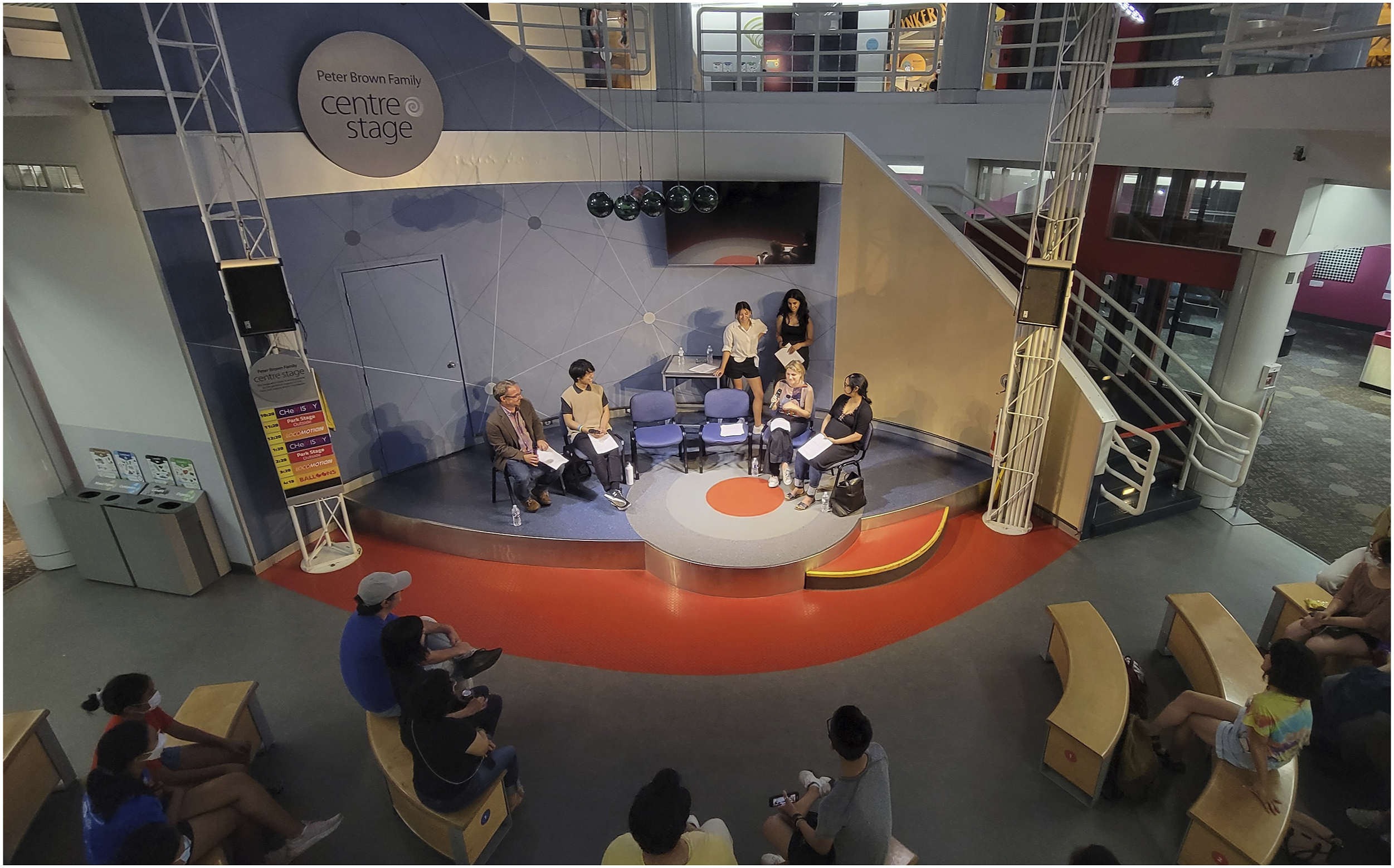
4. Open questions and outcome
A number of future directions materialized from the roundtable. These include explicating addictions through the lens of embodied habits and narrative practices, exploring insight deficits in substance use disorders through comparison with existing clinical concepts in other psychiatric disorders (e.g., double bookkeeping in schizophrenia literature), relating addiction to skilled coping and self-awareness, reconfiguring the addicted self through psychedelic-assisted therapy and other novel treatments, and considering addiction as an existential threat. A proposed themed series of papers will further elaborate on these ideas.
This interdisciplinary roundtable catalyzed key ideas within the larger enterprise of treating substance use disorders and technology addiction. Its aim was to allow for and inspire interdisciplinary, creative, and innovative exchanges of ideas. The endeavor now is to crystallize these ideas to improve conceptual clarity in the field of addictions, with the clinically oriented goal of generating new intervention targets and reframing or adjusting existing interventions, perhaps through more habitually oriented interventions or therapeutic approaches that enhance self-insight.
Footnotes
Acknowledgments
The authors would like to express thanks to all the presenters and attendees at the roundtable and public event. The authors would like to specifically acknowledge Avneet Brar, who coordinated the logistics of the roundtable, and Jessica Booth, who co-facilitated the public event with Avneet. We would also like to thank Anastasia Frank, Myriam Juda, and Nicole Esligar, previous B.R.A.I.N. Lab managers, all of whom were instrumental in the development and coordination of this roundtable.
Declaration of Conflicting Interests
The author(s) declared no potential conflicts of interest with respect to the research, authorship, and/or publication of this article.
Funding
The author(s) disclosed receipt of the following financial support for the research, authorship, and/or publication of this article: This work was supported by the Peter Wall Institute for Advanced Studies (NWWJ GR014675 UBCPWIAS 2019 Schütz).

About the Authors