



Abstract
The target article presents an alternative view on cognition through the lens of human practice, which is experienced from within by practitioners and through their course-of-experience. It pays specific heed to micro-phenomenological and semiotic aspects that the situated cognition literature has not in general attended to. However, the proposed framework can be read as reducing events to self-identical actors, organisms, environment, or signs, which impedes the goal of overcoming the body-mind Cartesian dualism. This commentary focuses on two issues. First, experiencing, as event, needs to be analyzed by means of categories that retain the its evental qualities. This cannot be done by attempting to breathe life into people and things through enaction. Second, human life and any of its parts, as irreducibly transactional phenomena, are essentially and originarily social.
Introduction
The target paper (Poizat et al., 2023) proposes a framework for the analysis of cognition in practice that attempts to incorporate the results of research with diverse, multi-disciplinary origins, including an enactive approach (Maturana & Varela), phenomenology (Varela, Petitmengin), and semiotics (Peirce). The paper describes refers to its content as an “original theoretical and methodological framework” (Poizat et al., 2023, p. 109) that is to provide “a new resolution of the mind-body problem.” (Poizat et al., 2023, p. 110) In my reading, the target paper exhibits a number of interesting aspects, but, covering a lot of ground very quickly, it makes itself vulnerable to many different aspects of critique, especially because its own choice of categories fails to capture the very aliveness of human practice that it had set out to theorize. Rather than pointing at the many possible issues that are apparent in the proposed framework, I focus on a few of these but in greater detail, doing better justice to the lead article and the limitations that come with the nature of a (brief) commentary.
The proposed approach contains some aspects—e.g., its (micro-) phenomenological aspects—that arose out of a “francophone world and traditions in the humanities and social sciences.” (Poizat et al., 2023, p. 109) But it clearly fits within the second of three types of approaches that appear in a recent WIREs Cognitive Science review of the literature on the situated nature of cognition (Roth & Jornet, 2013). The three categories of approaches are based on self-actional, interactional, and transactional perspectives (Dewey & Bentley, 1949/1999). In the self-actional approach, organisms are taken to act as a result of their own power; and in the interactional approach, the self-actors and objects (environment) are brought into relation, leading to a continuous back and forth of information (e.g., when the target article makes practice the interactionally established link between “brain and body with the world”). But in a transactional approach, “systems of description and naming are employed to deal with aspects and phases of action without final attribution to ‘elements’ or other presumptively detachable or independent ‘entities,’ ‘essences,’ or realities,’ and without isolation of presumptively detachable ‘relations’ from such detachable ‘elements’” (Dewey & Bentley, 1949/1999, p. 133). There is a lot of evidence that the proposed approach is interactional, as it focuses on “the interaction of brain and body,” “system-environment interactions,” “interactions between individual and environment,” etc. But there are also self-actional aspects, such as when the authors write about how the organism organizes itself in the process of autopoiesis, its “self-production” and “autonomy,” or “elements of distributed cultural-cognitive systems.” Entities such as organism, their environment, the objects the organism act up in practice, and so on, exist and can be described on their own (cf., in the methods, people are asked about what they have done in the past). In the transactional approach, on the other hand, agents (“autonomous systems”) and environment cannot be specified independently because each has aspects of the other so that even aptitudes are irreducible to the individual but manifest themselves in individual and environment (e.g., von Uexküll, 1928/1973). Characteristics are not internal to some autonomous system but are characteristics of relations (Bateson, 1979). In the hard (cognitive) sciences, this corresponds to sets of differential equations that cannot be simplified through a separation of variables (of dynamical systems) because the latter are interdependent (Van Gelder, 1998). In such a situation, the state of the dynamical system depends on the state of its parts, and the states of the parts depend on that of the system as a whole (and thus on the state of any and all of the other parts).
The self- and inter-actional nature of the proposed approach also is apparent, for example, in the notion of “enaction,” which, in substantive critiques from the perspective of movement-based and Spinozist ontologies, has been shown to be a vestige of Cartesianism and its separation of body and mind (Ilyenkov, 1977; Sheets-Johnstone, 2009). Enaction is required when human life is theorized in terms of things, which then need to be animated (“enaction”) and put into bodies (“embodiment”) to get life back into them. In the ontology that Sheets-Johnstone proposes, on the other hand, there is a primacy of movement (events) so that there is nothing that needs to be embodied and enacted. The target paper deals with many self-sufficient entities, including environment, autonomous system, mind, body, sign, and meaning—none of which are consistent with an ontology in which the event (or anything under way) is given primacy where even something apparently stable and material as the Great Pyramid has to be considered as a happening rather than a self-identical thing (e.g., Whitehead, 1919). Any circumscribable object is the result of an abstraction, and thus is a mere one-sided manifestation of the event. No combination of these manifestations, which are external (because abstracted from) to the phenomenon of interest—will take us to the phenomenon as a whole (Spinoza, 2002). Thus, theorizing human behavior specifically and life as a whole in terms of self-identical objects—autonomous system, environment, and their interaction—leads to the kind of contradictions (e.g., body–mind) that the framework proposed in the target paper is intended to overcome. Ethnomethodologically speaking, the object-perceived is the result and description of the living work (an event) required for the object to appear in the way it does.
One can actually find some contradictions in the target paper, for the proliferation of theoretical entities is accompanied by statements that give primacy to practice, which is to “become the core unit of analysis.” However, practice is not only unfolding in time, it is also making time. To theorize movement appropriately, the categories themselves need to reflect movement: they need to be events, the smallest part of which is itself an event irreducible to things. Instead of individuals and interacting groups doing something (engaging in practice), the event itself needs to be the minimal unit. Instead of saying that a child becomes an adult, with the person (child) as a self-identical entity doing/undergoing a process, we would have to focus on the event of becoming, as in “there is becoming from the child to the adult” (Bergson, 1908, p. 338). The target paper seeks to ground itself in the work of Peirce, emphasizing the entities and relations (e.g., the constitutive entities of a sign: representamen, object, interpretant). Dewey (1945) noted that such a view is contrary to the spirit of Peirce’s work. And Peirce himself stated that “when we come to study the great principle of continuity and see how all is fluid and every point directly partakes the being of every other, it will appear that individualism and falsity are one and the same” (1934, p. 259, CP 5.402). The self-identical things appearing in the target paper do not exist in a Peircean approach.
A typical event (dynamical system) in the context of cognition is that of speaking and thinking. There is not an interaction between the two forms of events but a transactional type of relation. Neither speaking nor thinking—in contrast to what the lead authors propose—is a “concatenation of signs.” Signs do not exist independently but, if at all, are interdependent, as each word-event arises from a previous word-event and the history of speaking as a whole (e.g., James, 1890). Take the example of speaking and thinking, two manifestations of a single encompassing event that mutually interpenetrate each other (Vygotsky, 1987). Thus, even speakers themselves do not know what they are thinking until the saying has come to an end, and, therefore, not until the said is available in a process of retrospective. In conversations, it becomes evident that any word is not that of a single person—as the self-actional and interactional approaches suggest—so that the kind of interviews suggested in the target paper do not yield anything that is of the person such as their individual and utterly personal experience. Instead, the nature of language is such that in dialogue, speakers not only communicate something to others but also speak to themselves; in communicating, speakers find out what they have been thinking (Merleau-Ponty, 1945). In monologues (personal notebooks), speakers (notebook writers) are the generalized other listening to (reading) themselves (Vygotsky, 1989).
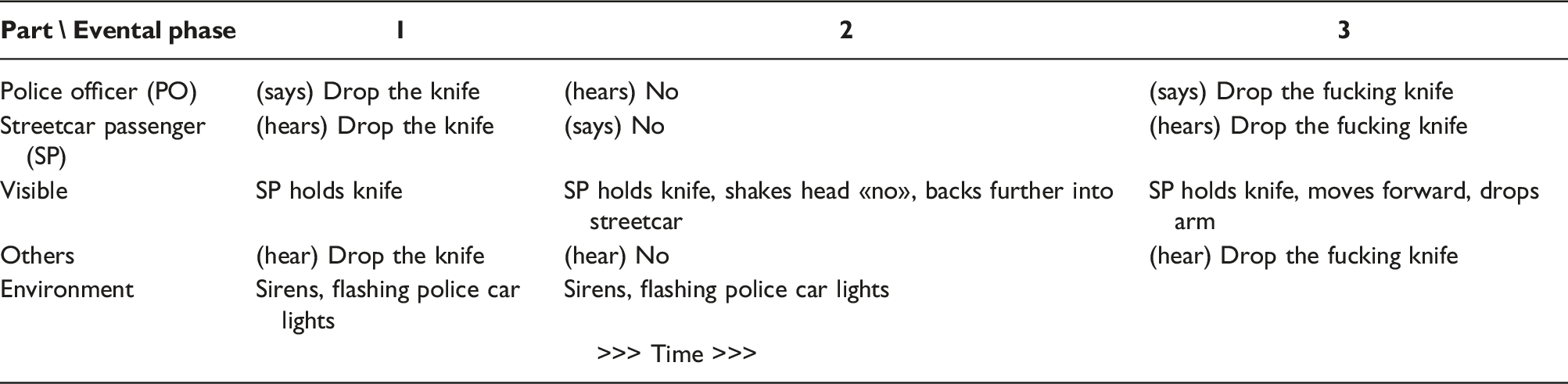
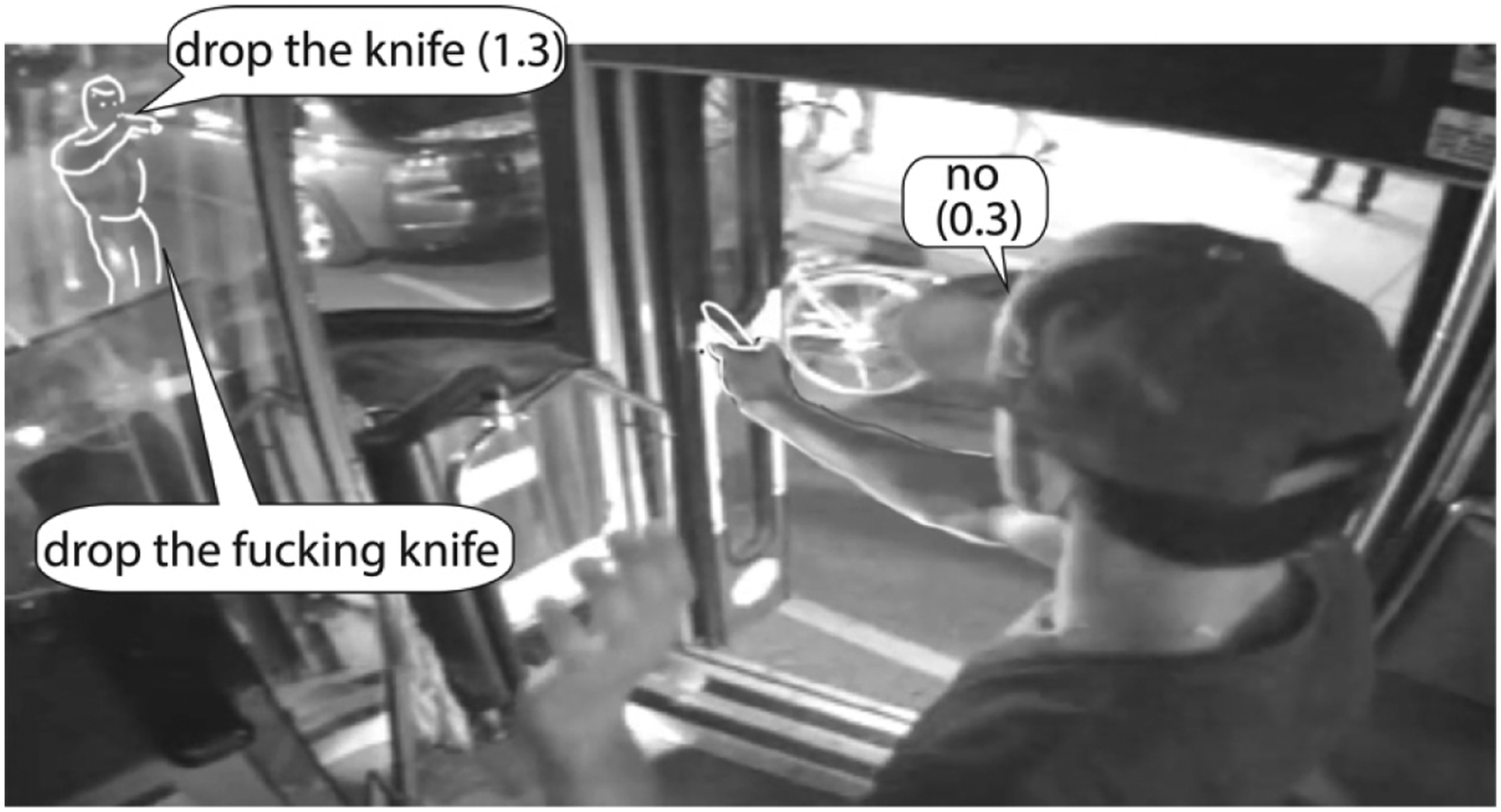
A moment in a stand-off involving a streetcar passenger (right) and a police officer (left). The scene is populated by others, including a cyclist (just above the knife-wielding hand), passersby (top of streetcar door), and police officers. Time indicated in seconds.
The transcriptions shows that any sound-word is common to both, involving resonances in both bodies. Thus, when the PO’s vocal cords ring to produce “Drop the knife,” parts of the listeners ears resonate as well, “Drop the knife.” At the same time, the ears of others resonate, such as those of nearby pedestrians, onlookers, and other members of the police force. In a transactional approach where there is a primacy of events (over objects), anything occurring simultaneously—not in a sequential relation with other parts of the unfolding universe (Whitehead, 1919)—is integral aspect of the same happening. These “parallel” events have pertinence to each other only when they intersect. This part-event may thus be called corresponding (e.g., Roth, 2020). The sound experiences of PO and FP intersect and are constitutive of each other. This is so not in the least because PO is not just saying something arbitrary, but he is speaking for the other (here FP). “Drop the knife” is not just the expression of the PO’s singularity but inherently something of the other and for the other. And, concerning FP, “Drop the knife” has come from the other, specially designed for him in the present situation. It would be inappropriate to model “Drop the knife” as pertaining to the PO alone, or to the FP, who “interprets” what is being said and then acts upon it. Thus, the target paper’s “individual processes” do not exist other than in inherently cultural-historical form.
To understand the dynamic of the situation in evental terms, it would be inappropriate to analyze the exchange in the target paper’s interactional manner, which would make FP “interpret” what the PO has said. FP was not just standing there waiting until the said (content) of the PO’s articulation was available in its entirety to then interpret it as a whole, as this is common in the analysis of texts. The dynamic of the event cannot be understood as some combination of the personal experiences of one or the other. Instead, listening to and receiving from the PO are two forms of events that occur while the latter is speaking. That is, responding on the part of FP does not begin when he is saying “No,” but instead commences with when the PO starts saying “Drop the knife” (see dark highlighted row related to the actions of SP). Responding reaches into the future to the point that SP is in a position to witness the effect of his actions—e.g., saying “No,” holding knife, backing into the streetcar. “No” has arisen out of “Drop the knife,” the latter being integral part of the former rather than independent entities (as cause and effect are).
This briefest of analysis is consistent with a non-reductionist philosophical analysis of the event of thinking in practice, which never is located inside the thinking body, as autopoiesis would have it, but always is a movement from outside to a phase inside and returning the outside (Ilyenkov, 1977). Indeed, this movement itself is the origin of any boundaries that are used to distinguish between self (“autonomous system”) and what is non-self (environment). It would therefore be wrong to say that the PO caused these actions: his saying was simultaneous with the stream of experience termed responding on the part of FP. We cannot even say that the bullet coming from the PO’s gun was the cause of the FP’s death (effect)—as an extended discussion of such a case in The Logic of Scientific Inquiry suggests (Dewey, 1938). The experience of what has been happening in the micro-episode presented here and in the episode as a whole cannot be reduced to individual actors (autonomous systems) interacting—as this would be the case in the methodology that the target article suggests. Instead, each occasion of experience is a an objective part of the situation as a whole: “‘occasions of experience’ are the really real things which in their collective unity compose the evolving universe, ever plunging into the creative advance” (Whitehead, 1934/1968, p. 26, emphasis added). Any personal experience thus is an irreducible part of the event as a whole, and can be appropriately theorized only as such.
The framework proposed in Poizat et al. (2023) assumes cognitive processes distributed over the boundaries of skin and skull, but methodologically does seek to find out what is in the individual mind to get at “individual processes.” This is an elusive goal, as the preceding example shows. In fact, even the most personal aspects of human life, to be recognized and articulated, are social. This is so because the very perception and understanding of an emotion, such as anger, is irreducible to self and social (Husserl, 1973). The target paper proposes to use after-the-fact accounts (e.g., in interviewing about what had been happening) to get at the individual aspects of experience. Interviewing the police officer or the streetcar passenger after the fact—if this were possible in the latter case—we only get individual accounts of experience through the lens of how the standoff has ended. That is, the participants would be talking about what has happened knowing that the PO had fired six shots and the SP was dead. Interviewing participants after the fact does yield “cognition in practice,” but only provides accounts of phenomena that are seen through the lens of the ultimate outcome of what has happened. Such accounts are different to what agents have and make available in the course of practice. A close look of what participants in events of interest actually do, on the shop floor of practical action, allows us to understand how the event unfolds. Social actors objectively produce and display their common-sense knowledge, circumstances of practice, and practical sociological reasoning (Garfinkel & Sacks, 1986). That is, participants in social life not only move, act, and speak but also make available resources for how their contributions are to be heard and seen (Livingston, 2008). People, even if alone, still act in ways such that they can say later and to someone else, “I did this because . .,” and, thereby use language and articulate reasons that are inherently intelligible generally. The PO was shouting “Drop the (fucking) knife” in the presence of others, and, subsequently, “take one step in this direction and I’m going to shoot you.” The fact that none of his several peers reacted or interfered can be perceived (but does not have to be) as a tacit support, evolving into a further escalation and subsequent death of FP, for which PO had to respond in the courts.
An important aspect of the target article is the concept of autopoiesis, the self-organization and construction of self-identity on the part of the organism (person). But did the police officer and the streetcar passenger construct themselves? Were they entirely responsible for the happening that they were experiencing and that shaped their lives? Were they not caught up in and integral part of the maelstrom of something far exceeding them, to which they were subject and subjected in addition to being an agential participant? There exists a considerable literature pointing out the non-viability of a constructivist, autopoietic account of human experience. For one, humans, in addition to being living agents, are subject and subjected to those events in which they are integral and irreducible part. They are subject to their own actions of which they do not yet know the outcome and have no way of knowing how these will turn out. When the PO shouts “drop the fucking knife,” he does not know, while articulating the phrase, what action it will have brought about once he can look back. He cannot know is own next action after saying “drop the knife,” for the situation is going to change in and with the response on the part of SP. The PO does not know at that time that some time later he would be charged with second degree murder, manslaughter, and attempted murder.
Footnotes
Declaration of Conflicting Interests
The author(s) declared no potential conflicts of interest with respect to the research, authorship, and/or publication of this article.
Funding
The author(s) received no financial support for the research, authorship, and/or publication of this article.

About the Authors