



Abstract
The article presents the course-of-experience framework and how it contributes to studying cognition in practice. The aim is twofold: (a) to argue for a phenomenologically and semiotically inspired enactivist approach to practice and cognition in practice and (b) to describe research methods that provide rigorous first-person data in relation to practice—in other words, a view “from within” of practice. Practice is considered to be a relevant unit of analysis for studying cognition-in-the-world and is defined as enacted, lived, situated, embodied, and enculturated. Practice is not viewed as a “context for” but as “constitutive” of the cognitive process itself. This article describes (a) the epistemological foundation and general assumptions of the course-of-experience framework, (b) the associated way of looking at pre-reflective self-consciousness and its relation to practice, (c) the analytical hypothesis derived from Peirce’s semeiotic, and (d) some methodological considerations related to data collection, data processing, and analysis. In the concluding section, we outline the added value of the course-of-experience framework for cognitive science, and we indicate possible directions for further research.
The aim of this article is twofold: (a) to argue for a phenomenological and semiotic approach to practice for studying cognition in the wild and from within, (b) to describe a method based on Peirce’s semeiotic for analyzing micro-phenomenological interviews.
Our article presents an original theoretical and methodological framework developed within the francophone world and traditions in the humanities and social sciences: the course-of-experience framework. This framework was built to analyze cognition-in-the-world in relation to the design of artifactual, organizational, and cultural systems. It was developed to focus on practice, which is assumed to be a relevant unit of analysis for studying cognition-in-the-world and is defined as enacted, lived, situated, embodied, and enculturated. Practice is not viewed as a “context for” but as constitutive and constituent of the cognitive process itself. It is a constitutive aspect of all forms of thinking, from the simplest to the most complex. Abstract, non-practical, and disembodied thinking is certainly an important kind of thinking, but it perhaps receives more attention than it should (Scribner, 1986). Notably, this form of reflection is also basically a practice that draws on and is enacted in coordination with rich social, cultural, and material resources. Indeed, practice is not constitutive of a kind of cognition but of all of cognition.
Cognitive phenomena are outcomes emerging from the orchestration of elements of distributed cultural-cognitive systems, embodied and embedded in practice. The brain has causal powers, but when it comes to human cognition, most of these causal powers derive from previous experience and practice. Choosing practice as a relevant unit of analysis means (a) not attributing solely to the individual those properties that belong to a larger distributed system, or, in other words, not attributing cognitive processes solely to the individual as these processes may be engaged in a complex cultural-cognitive ecosystem; (b) integrating all the accumulated or sedimented resources of the cultural-cognitive ecology into the study of cognitive processes; and c) studying how nervous system activity is linked to high-level cognitive processes by way of embodied interactions with culturally organized material and social worlds (Hutchins, 2008, 2010). The claim here is that, first and foremost, thinking is the interaction of brain and body with the world in and through practice. Practice is not evidence of, or reflections of, underlying thought processes. It is instead the thinking processes themselves. Increased attention to real-world practice will change our notions of what the canonical instances of cognitive processes are, and which ones are special cases of more general phenomena. According to this claim, it is essential (a) to study cognition in practice and through (or embedded and embodied in) practice and (b) to avoid adopting a strict sociocultural approach whereby individual processes are not fully considered. Practice therefore first needs to be clarified. Researchers often consider practice to be a socially constructed activity, in the sense of the theory of social practices (Reckwitz, 2002; Scribner, 1997). This theory takes the focus off individuals and turns attention toward socially organized activities. As noted by Giddens (1984), the basic domain of study here becomes neither the experience of the individual actor, nor the existence of any form of societal totality, but social practices that are routinized and ordered across space and time. Social practices themselves, rather than the individuals who perform them or the social structures that surround them, thus becomes the core unit of analysis. Our approach to practice thus follows a middle path between a social-oriented approach focused on socially organized activities and an individual-oriented approach focused on individual cognitive constructs. First, the lived experience of the individual actor is considered. Second, the consensual dimension of practice is viewed as never quite acquired but only as a potential (Baerveldt et al., 2001; Verheggen & Baerveldt, 2001). The aim is to avoid not only an undersocialized methodological individualism, but also an underindividualized methodological collectivism.
The theoretical and methodological framework presented here has rarely been presented in the anglophone literature. It is based on three decades of research and has undergone successive theoretical refinements coupled with empirical testing and practical validations (e.g., Donin & Theureau, 2007; Horcik et al., 2014; Leblanc et al., 2001; R’Kiouak et al., 2016; Rochat et al., 2018; Sève et al., 2002; Theureau et al., 2001; Theureau et al., 2000). Syntheses have been proposed in the past (Theureau, 2002, 2003), but our objectives here are to present a new one that describes the more recent advances in the course-of-experience framework, as well as those in progress, and to show its contribution to research at the intersection of phenomenology, pragmatics, and cognitive science. Our paper is structured into four parts: (a) the main ontological and epistemological assumptions of the course-of-experience framework (enaction and pre-reflective self-consciousness), (b) the analytical hypothesis derived from Peirce’s semeiotic (and the connections between enaction, phenomenology, and semiotics), (c) the methods of data collection and processing, and (d) the empirical applications and implications for cognitive science.
1. Enaction and pre-reflective self-consciousness: two main ontological and epistemological assumptions
The postulates of enaction (Varela, 1979; Varela et al., 1990) and pre-reflective self-consciousness (Sartre, 1943/2003) constitute the hard core of the course-of-experience framework and, more broadly, of our research program. Let us now add that the distinction between assumptions that are ontological (what things really are) and epistemological (the way to understand and explain them) is particularly useful to navigate the enactive literature (Aizawa, 2014). Although much research considers only a part of the ontological or epistemological assumptions, our approach is distinguished by the attempt to explicitly articulate the ontological and epistemological issues: formulating ontological assumptions about the nature of things and adopting—at the epistemological level—a framework of understanding and explanation.
1.1. Enaction and the course-of-experience framework
Enaction is a genuine and non-trivial proposal for a far-reaching renewal of cognitive science as a whole (Stewart et al., 2010). As a paradigm 1 , the ambition is to provide an encompassing framework for articulating the many domains and levels of organization involved in cognitive science (e.g., Di Paolo et al., 2010; Di Paolo & Thompson, 2014; Froese & Di Paolo, 2011; Gallagher, 2017; McGann et al., 2013; McGee, 2005, 2006). Enaction also meets three requirements for any paradigm in cognitive science: (a) it provides a new resolution of the mind-body problem, (b) it provides the basis for a genuine articulation between a multiplicity of disciplines, and (c) it provides a hard core of assumptions and has spurred the flourishing of a variety of empirical research programs, like ours (partly similar, complementary or alternative) (Stewart et al., 2010).
The most fundamental concept of the enactive paradigm is that of autonomy. This concept is derived from the earliest work of Maturana and Varela (1987), which was based on the metabolic self-production of single-cell organisms and described the minimal organization of living systems as autopoiesis: the authors assumed that all living organisms are autopoietic (Maturana & Varela, 1980). An autopoietic system is organized as a closed network of processes producing the system’s components—that is, the processes recursively produce the components and the very network that produced them, and the network specifies the boundary conditions (the topological domain) necessary for the system’s ongoing existence as a concrete unity in space and time. This network of processes, which is called organizational closure, implies that the operational results occur within the boundaries of the system itself. In other terms, for Varela (1979), closure is the circular mechanism defining the class of self-organizing systems in general, and autopoietic systems are a particular case of this larger class of systems that can be called organizationally closed. Closure does not mean that a system is closed and withdraws into itself. On the contrary, it is consistent with the idea of openness. It is a response to the attempt (a) to formalize and characterize the mechanism of “autonomy in general” as a self-organizing behavior and (b) to specify the circular organization or mechanism of a given autonomous system as it gives rise to its specific identity (Rudrauf et al., 2003). The notion of autopoiesis continues to be the core of the enactive paradigm, where it is typically associated with self-production and autonomy. The conception of autonomy as operational closure applies not only to various living systems such as single-cell and multicellular organisms, but also to a whole host of other systems such as the immune system, the nervous system, and even social systems. Based on the thesis of life-mind continuity, the enactive approach deals with cognition, social cognition, and sociality as phenomena of autopoiesis (e.g., Baerveldt & Verheggen, 1999; De Jaegher & Di Paolo, 2007; Froese & Di Paolo, 2011).
The self-reference inherent to the process of self-production, which forms the core of the enactive definition of autonomy, has important implications, as summarized by Froese and Di Paolo (2011). First, without the autonomy afforded by organizational closure, the system is incapable of defining its own identity as an individual system. An autonomous system brings forth its own identity by actively demarcating its boundaries during its ongoing self-production. Second, an autonomous system is organized in such a way that its activity is both the cause and the effect of its own autonomous organization; in other words, its activity depends on organizational constraints (i.e., the system-environment interactions are delimited by the system’s structure), which are in turn regenerated by the activity itself (i.e., the system-environment interactions are the source of disturbance that brings about transformations in the actor’s structure). This gives it an essentially self-constituted identity. The interactions between an individual and the environment are described as a structural coupling, specifying both the individual’s own structure and that of the environment with which it is interacting. Third, autonomous systems actively determine their domain of interaction—that is, the potential manners by which the system can interact with its environment without disintegrating. Due to its precariousness, it copes with the perturbations it encounters during its ongoing interactions with the environment from a perspective of significance, which is not intrinsic to the perturbations themselves. The meaning of an encounter is not fully determined by the encounter itself. For an autonomous system, significance emerges in relation to the ongoing need to realize and maintain its self-constituted identity. Meaning generation in relation to the concerned perspective of the autonomous system is called sense-making (Weber & Varela, 2002). In other words, meaning is not to be found in the external environment, nor entirely in the internal dynamics of the system. It is an aspect of the interactional domain established between both (and through the structural coupling). However, there is a fundamental asymmetry underlying this interactional domain since its very existence is continuously enacted by the endogenous activity of the autonomous system. The structural coupling is always asymmetrical, and meaning is first and foremost in-formare, that is formed “from within” 2 . In the enactive paradigm, the tendency is to refer to the meaningless physical aspects of things as the environment, whereas the domain of interaction of an autonomous system is the meaningful world that its interests have brought forth. Sense-making is then the enaction of a meaningful world by an autonomous system.
In summary, the course-of-experience framework is based on three principal assumptions that have given rise to an empirical phenomenology and a semiotics of cognition in practice in terms of enaction and experience (Theureau, 2015a). 1. Assumption 1. Practice is a mechanism of self-production and the expression of the structural coupling. It is considered to be a continuous asymmetrical interaction between actors and their environment. What individuals do when they are engaged in a social practice is not the adaptation (or reaction) of a pre-determined individual to a pre-determined world. Both the individual and the environment in the individual-environment coupling formula are as much the products or manifestations of the coupling as its source. Instead of taking the individual being as the starting point for individuation, an enactivist perspective begins with the individuation process accompanying structural coupling and seeks to discover the individual through the process (Simondon, 2009). 2. Assumption 2. Practice is always “accompanied by” and “gives rise to” first-person lived experience. This assumption is grounded in the phenomenological tradition, which has been revisited from the enactivist perspective. Experience refers here to what an individual “is subjected to at any given time and place, that to which s/he has access in the first person” (Depraz et al., 2003, p. 2). Lived experience means “first-hand acquaintance with” and the “account of” practice, with an emphasis on its immediateness, embodiment, and its individual nature. It is also useful to insist here on the inseparability of the individual’s physical living body (the body as Körper) and its lived body (a Leib). As pointed out by Thompson (2011), “many of the perceptual and motor abilities of one’s physical living body evidently depend on that body’s being a subjectively lived body” (p. 15). The result is that bodily experience, the tacit experience of one’s body, is constitutive of practice. 3. Assumption 3. Practice is a semiosis—that is, a permanent creation and appreciation of meaning: sense-making in short (Thompson & Stapleton, 2009). Practice is an actor’s interaction with those environmental elements that are relevant or meaningful for him/her—that is, that are sources of perturbation given his/her internal or endogenous organization. This assumption emphasizes the actor’s capacity to make the environment emerge as one’s own world—that is, individually meaningful and relevant and never pre-defined. Actors enact the worlds they live. Meaning constitutes a concern that is relative to the actor’s current situation and needs.
1.2. Pre-reflective self-consciousness and the course-of-experience framework
The course-of-experience framework refers to a particular form of consciousness: pre-reflective self-consciousness (or self-awareness). In order to study it, a reduction of lived experience to pre-reflective self-consciousness is posited. The course of experience, as a theoretical reduction, is thus defined as the history of one’s pre-reflective self-consciousness over a period, or more precisely as the history of what is “showable, tellable and commentable” at any moment.
Pre-reflective self-consciousness (or self-awareness) has been the subject of intense philosophical and scientific debate (e.g., Depraz et al., 2003; Gallagher & Zahavi, 2008; Legrand, 2007; Zahavi, 2005). It refers to a first-order consciousness, an implicit sense of self at a phenomenal level: a familiarity with oneself that accompanies living situations. Self-consciousness is pre-reflective in the sense that self-awareness does not imply any reflective act. According to Sartre (1943/2003), pre-reflective self-consciousness is not a quality added to an experience: it is the being of consciousness. Zahavi (1999) rightly adds that pre-reflective self-consciousness “must be conceived not as a simple, static, and self-sufficient self-presence, but as a dynamic and differentiated openness to alterity” (p. 137).
The notion of pre-reflective self-consciousness (or self-awareness) mobilized in the course-of-experience framework is articulated with the above-mentioned enactive assumptions and is considered as the permanent feeling of self-awareness that emerges from structural coupling. Pre-reflective self-consciousness is regarded as the cutting edge of the living process itself and as the surface effect of the structural coupling between the actor and the environment (Theureau, 2006). It gives access, however limited, to the whole of the in-formative interactions between an actor and his/her environment, whereas the observation of the actor’s behavior by an external observer is intended to miss or encounter only accidentally the asymmetry of these interactions.
In the course-of-experience framework, pre-reflective self-consciousness is defined as the part of one’s experience that each actor can “show (for example, by miming or gesturing), tell and comment on” to an observer-interlocutor at any instant under favorable conditions. “Pre-reflective” also indicates that showing, telling, or commenting on lived experience does not entail thinking about it, reflecting on it, or establishing causal reasons. It also indicates that pre-reflective self-consciousness “adds nothing” to cognitive activity.
2. Peirce’s semeiotic and extended thought-sign hypothesis
The analytical course-of-experience framework was inspired by Peirce’s semeiotic (despite its speculative and non-empirical nature) since (a) it is rooted in an extended view of the thought-sign hypothesis and (b) it proposes a generic model to describe cognition in the wild and from within—the hexadic sign—derived from Peirce’s fundamental categories.
Peirce produced an abundant body of work, but three elements constitute the core of his contribution – the thought-sign, the notion of triadic sign, and the three categories of firstness, secondness, and thirdness. Scholars have repeatedly tried to periodize Peirce’s work (Houser & Kloesel, 1992; The Peirce Edition Project, 1982-2010, 1998). It is possible to distinguish three periods (Peirce I, II, III) based on the author’s own changes to his method of constructing his fundamental categories (logic of representation, logic of relatives, and an ultimate relational movement). We draw here mainly from his latest works (Peirce III).
Peirce proposed many definitions of the sign, although each was based on a triadic and indecomposable relationship. A triadic sign therefore has three components 3 : the representamen, which refers to what “makes a sign”; the object, which refers to “something” that is already there but at the same time becomes present thanks to the representamen. It is also this “something” that allows the appearance of the representamen itself; and the interpretant, which is “something” that emerges from the relationship between the representamen and object and that has an effect on both these components.
Beyond the notion of the triadic sign, all of Peirce’s work consisted of clarifying the basic categories of the knowable by passing from logic to semiotics. His logic of categories ultimately found an extensive systematization in its relationship with phenomenology, which Peirce called a phaneroscopy. The object of the phaneroscopy is to describe all experience from the universal categories of firstness, secondness, and thirdness. These categories are both cumulative and incommensurable. Firstness is the category of experience as it simply is without reference to anything else. It is characterized as an immediate revelation of self in the world (e.g., the simple sensation of being wet without any other consideration). Secondness is the category of experience during the concretization of a fact. It reflects a particular interaction with the actor’s world (e.g., the sensation of being wet might be related to the fact that it is raining). Thirdness is the category of experience that gives rise to reasoning, to generalizations. It is the mode of knowledge construction. Thirdness enables the discovery of typicality in our relationships with the world from past and present experiences (e.g., the construction of the experience-type of being in a bad mood when it rains, confirming the regularity of the actor’s experience in similar situations; the actor constructed typical expectations and experienced typical emotions in relation with rainy conditions). These categories, without being confounded, are always co-present; they permeate all our experience, making an uncluttered idea of each—absolutely distinguished from the others—impossible. Lived experience is thus assumed to include: (a) components on the order of indeterminate possibilities (firstness) that are actualized or not; (b) components on the order of the actual (secondness), which are determined through a form-taking process against an undifferentiated background; and (c) components on the order of the virtual such as habits, principles of generalization and typicalization (thirdness). The three components of the triadic sign appear, respectively, from the phaneroscopic categories: the object comes from the category of firstness (possible), the representamen from the category of secondness (actual), and the interpretant from thirdness (virtual).
The extended analytical thought-sign hypothesis (developed within the course-of-experience framework) connects phenomenology and Peirce’s semeiotic, while remaining consistent with enactive assumptions. It assumes that practice (as cognition) is semiosis and that it can be described as a concatenation of signs and analyzed by means of an articulated and coherent set of components (or generic descriptive components) derived from Peirce’s semeiotic. While describing their past experience and practice, participants spontaneously break it down from a continuous stream into discrete units that have personal meaning. These discrete units of different sizes—called units of the course of experience (U)—are assumed to be the expression of a sign. The analytical concepts of the course-of-experience framework are therefore largely inspired by the triadic sign, the notion of the thought-sign, and the phaneroscopic categories, but with several adjustments: (a) relating them to practice, giving rise to pre-reflective self-consciousness; (b) specifying the object, representamen, and interpretant and adding some components; and (c) overcoming the static and closed attribute of the Peircean sign and making it possible to concatenate the signs.
The course-of-experience framework has resulted in two generations of analytical methods and notions: the basic analytical method (BaM) with the notion of tetradic sign (Theureau, 2004) and the extended analytical method (EaM) with the notion of hexadic sign (Theureau, 2006). It is useful to linger here over the BaM and the notion of tetradic sign but only for the purpose of clarifying the connections with Peirce’s semeiotic and categories. In the BaM, the tetradic sign is presented as an object-representamen-interpretant triad subjacent to the course of experience unit (Figure 1). The first alteration of Peirce’s semeiotic is to move up to a tetradic sign by adding a component: the course of experience unit (U). This unit refers to practical actions, communications, interpretations, emotions, feelings, and self-talk. The second alteration of Peirce’s semeiotic is the clarification and specification of the notions of object, representamen, and interpretant. The object (O) refers to the actor’s involvement in the situation and to the here-and-now circumscription of the actor’s field of possibles. The representamen (R) refers to perceptive, proprioceptive or mnemonic judgment, different from its anchoring in the environment (in coherence with Peirce’s last writings). The interpretant (I) refers to the activated (or established) knowledge that allows the actor to interpret the current situation and act in accordance with past experiences. In the extended analytical method, the notion of hexadic sign was developed by adding two additional components, again in an effort to refine the existing components. This development takes into account (a) the empirical limitations of the tetradic sign and (b) the need to redefine the interpretant (in particular with regard to the study of learning and/or development processes). Each sign is assumed to articulate six components derived from the degeneracy of Peirce’s categories (Peirce III): the involvement in the situation (E), the anticipation structure (A), the referential (S), the representamen (R), the course of experience unit (U), and the interpretant (I)
4
. For the moment, the hexadic sign offers a coherent system of descriptive components and opens up the possibility of the fine-grained empirical documentation of cognition in the wild and from within. The tetradic sign and its components.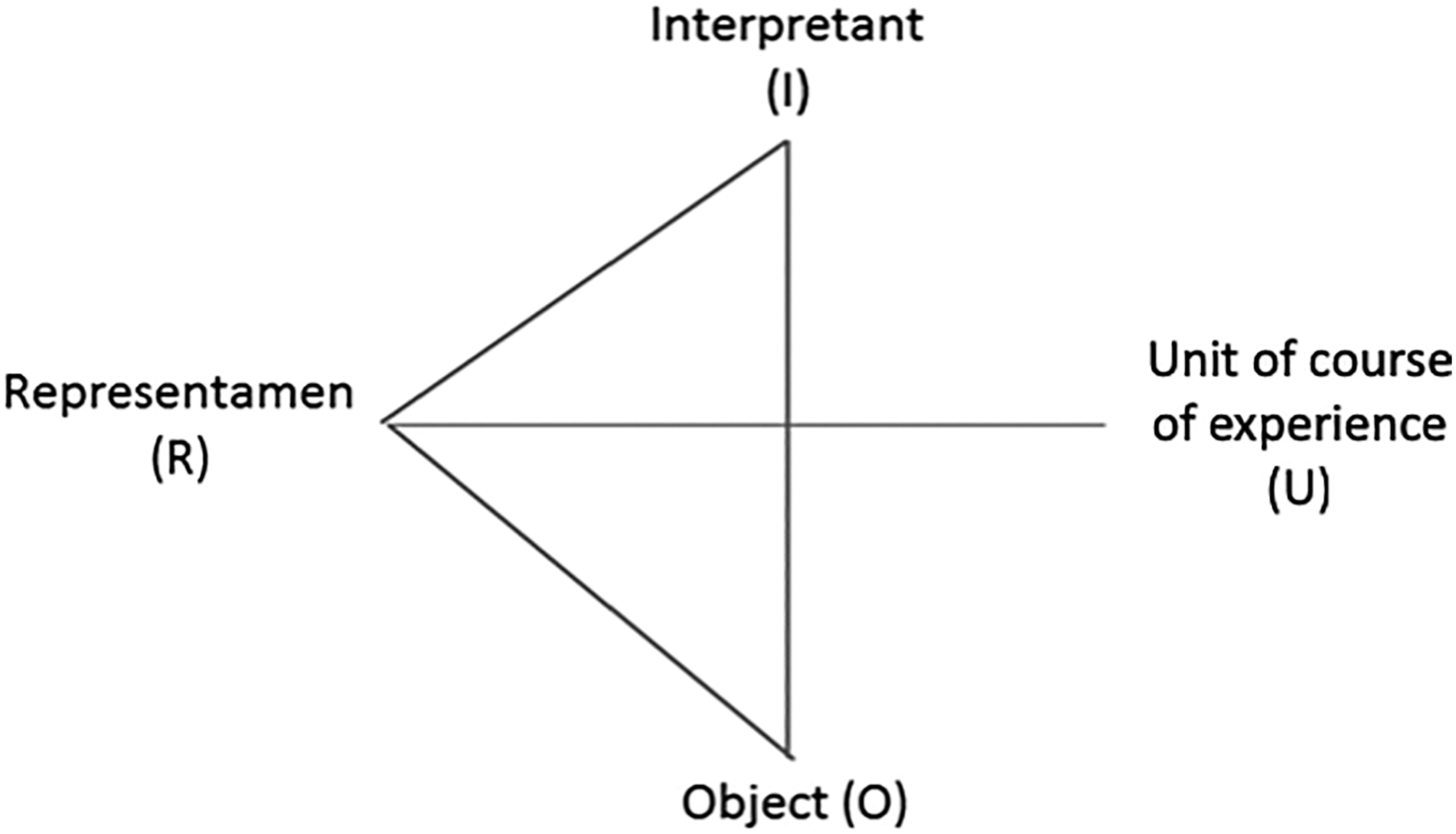
3. Data collecting and processing within the course-of-experience framework
This section describes (a) the data collecting method of the course-of-experience framework, particularly the self-confrontation micro-phenomenological interviews, and (b) the data processing method for analyzing a corpus made up of in situ behavioral observations and descriptions collected through the micro-phenomenological interviews (Petitmengin et al., 2019; Valenzuela-Moguillansky & Vásquez-Rosati, 2019).
3.1. Data collection
In this article, we describe the standard methods for collecting three types of data: (a) field notes, observations and preliminary interviews conducted with participants during a familiarization phase; (b) continuous and in situ observations and/or audiovisual recordings of participant behaviors and communications during the unfolding practice; and (c) verbalization data obtained by stimulating a re-enactment of the participants’ past situation during self-confrontation micro-phenomenological interviews.
3.1.1. Field notes, observations, and preliminary interviews
Field notes, observations and preliminary interviews usually occur during a familiarization phase that defines the contractual conditions of the collaboration between the researcher and the participants, taking into account their respective interests. This phase tends to ensure the sincerity and authenticity of the participants’ involvement in the study. It is the occasion for intensive notetaking on ethnographic observations and the collection of diverse details about practices. Crucial external data are also collected on settings (spatial, material, and temporal arrangements) and cultures (values, beliefs, legitimate attitudes, norms, and shared meanings). These data are used as critical support during the self-confrontation micro-phenomenological interviews and added to the participants’ verbalizations. Data collection may extend beyond the familiarization phase, particularly the ethnographic investigation, which may continue throughout the study.
Ethnographic methods, and more particularly cognitive ethnography (Hutchins, 1995), was gradually introduced into the research, along with modifications related to the particularities of documenting the course of experience (e.g., not limited to isolated episodes and selective focus). In the BaM, it was postulated that the particular methods of the course-of-experience framework (see below) made it possible to go beyond—and therefore do without—ethnographic methods. The EaM proposes to give full importance to the ethnographic method by developing cognitive ethnography to analyze dynamics broader than the local dynamics to which they are limited (in particular, cultural dynamics).
3.1.2. In situ video recording
The researcher makes in situ audiovisual recordings, filming the participants over varying amounts of time in various conditions, with shots and angles adapted to the practice under study (wide-angle, fixed cam, steady cam, subcam, tracking-shot, etc.). Precautions are taken (a) to avert camera interference with the unfolding practice and (b) to record as neutrally as possible to avoid influencing participants while they are commenting. The recorded data serve two purposes: (a) to provide behavioral and contextual information as an aid to identifying elements about the participants’ unfolding practice and (b) to provide traces for the individual self-confrontation micro-phenomenological interviews.
3.1.3. Self-confrontation micro-phenomenological interviews
The self-confrontation micro-phenomenological interview is designed to ensure that participants’ comments about their practice are the actualization of their pre-reflective self-conscious contents. This method consists of confronting them with the audiovisual traces of their past practice (in the field video recordings). As they view these traces, the researcher asks specific questions designed to encourage them toward the re-enactment of the experience inherent to the past practice and to facilitate the actualization of their pre-reflective self-consciousness. The participants thus express as naturally as possible what they aimed for, did, expected, felt, thought, and perceived during the past experience and practice. The self-confrontation micro-phenomenological interview is conducted as soon as possible after filming to facilitate the re-experience of the past experience. The participants and researchers view the recording, and the participants are invited to describe and comment on their experience and practice step-by-step, with both having the possibility to stop or rewind the film at any moment.
The researcher tries not to lose contact with the past experience and guides the participants toward an embodied speech position rather than an abstract, formal, and explicative one. This position is somewhat unique in that, while commenting on their past practice, the participants are “present” in the past experience. The past experience is thus re-experienced and is expected to be as “present” as their current experience of interacting with the researcher. When the self-confrontation micro-phenomenological interview begins, the researcher informs the participants that he/she expects them to try to “re-live” their past experience and describe their practice as it was experienced, without a posteriori analysis, rationalization or justification (as if they were ignoring the series of events). During this interview, the rhythm of questioning slows down to guide the participants toward the embodied speech position and to facilitate the actualization of their pre-reflective consciousness. Behavioral indicators are used to control the process of re-experiencing the past and ensure an embodied speech position; these include hesitations in the stream of language (decreased speech rhythm), use of metaphor, linguistic markers, and verbal and non-verbal congruence.
The researcher uses prompts to encourage the re-enactment of the past experience and to help the participants give a dense description of it. These prompts are designed to obtain information without bringing out the expressed content of the experience that accompanied the past practice: “What are you doing?” (actions), “How do you feel?” (sensations), “Are you perceiving something special?” (perceptions), “What are you paying attention to?” (attention), “Are you aiming at something particular?” (intentions), “Are you experiencing emotions?” (emotions), and “Are you thinking about something?” (thoughts and interpretations). Echoing or without-content prompts are given (e.g., “When you see that, what do you see exactly?”; “At that very moment, you are…?”). Other prompts are aimed at capturing more detail about what has already been expressed (e.g., “When you say ‘I don’t see exactly’ what do you mean…?”; “When you say ‘I like them’ what are you referring to?”) or facilitating verbalizations that respect the temporal dynamics. In this latter case, the researcher rephrases what the participants express or summarizes the previous sequence (e.g., “So there, you started to describe the beginning of the task… then you identified this weird stuff… and now what are you doing …?”). To discourage justifications and retrospective rationalizations, the researcher avoids questions that lead to judgments (typically beginning with “Why”). And when the participants seem to be engaged in a posteriori analysis, he/she clarifies whether the interpretations were made while viewing the video or during the past experience (“And now, are you telling yourself this as you watch the video or were you telling yourself this as it was happening?”).
With regard to the video recording and self-confrontation micro-phenomenological interview, there is no significant difference between BaM and EaM. The evolution concerned: (a) the refinement of the epistemological hypotheses, (b) the conditions for observing and recording behavior in situ, (c) the material conditions favorable for documenting pre-reflective self-consciousness, (d) the conditions to be achieved before and after the self-confrontation micro-phenomenological interview, (e) the criteria and indicators of a correct self-confrontation micro-phenomenological interview, and (f) the development of re-enactment through material traces (Theureau, 2010).
3.2. Data processing
Data processing is divided into three steps: (a) identifying the signs, their components, and their local dynamics (local analysis); (b) identifying the concatenations of the signs, the significant structures, and the dynamics of opening (global analysis); and (c) combining intrinsic description with extrinsic description.
3.2.1. Identifying signs, their components, and their local dynamics
Practice is a succession of discrete units that are meaningful to the actor. As mentioned earlier, when actors are asked to describe their past practice, they spontaneously break down the continuous stream of actions into these discrete units that are meaningful to them. The smallest units of meaning for the actor—that can be derived from empirical materials—are called elementary units of meaning (EUMs) and are assumed to be the expression of hexadic signs. For the researcher, documenting an actor’s course of experience consists of drawing up the chain of these EUMs over the period under study and informing the following six components for each EUM:
The involvement in the situation (E). The involvement is a nebula of openings that derive from the history of coupling up to an instant t. Openings are themes that orient/circumscribe a certain range of possibles for an actor among all the possibles for that actor at a given moment. These openings—individually abbreviated as oi—have diverse relations among themselves and make up the nebula of openings: (oi). At any given time, this nebula contains openings that were created in the past and have not yet been closed. The involvement in the situation can therefore be defined as a nebula of openings, (oi), at instant t, hierarchically organized by the opening oi as it is being determined by the representamen (R) at that instant oi => oR, against an undifferentiated background. The involvement is thus an open, indeterminate but circumscribed whole. Note here that openings (oi) should not be considered from a strictly utilitarian perspective but rather as non-utilitarian. They are not goals with the status of action prescriptors: at any moment, they orient practice by what makes sense to the actor in the situation.
The anticipation structure (A). The anticipation structure is the extension to an immediate future. It corresponds to the actor’s expected, situated, and enacted events and actions at a given moment. These expectations are delimited by the involvement (E). They can be passive, such as waiting for events, or they can be active, such as anticipating the events that make it possible to act in accordance with earlier plans. In the latter case, expectations arise from plans (more or less well-formulated, more or less long-term) that constitute resources for the actor even in the course of unfolding practice.
The referential (S). This component rehabilitates the notion of habits and consists of the set of types, relationships between types, and principles of interpretation that may symbolize belonging to the actor’s own culture that he/she can mobilize at a given moment, taking into account the involvement (E) and the anticipation structure (A). The invariants constructed during past interactions with the environment and being mobilized at a given instant in an unfolding interaction occur through both typicalization and typification. This implies the allocation of a standard value—a kind of “exemplary example”—to certain configurations of the actor-environment coupling.
The involvement (E), the anticipation structure (A), and the referential (S) circumscribe a field of possibles and constitute the actor’s structure of preparation, which comes down to a “potential.” The structure of preparation (E-A-S) also materializes the fact that at every instant in a course of experience, including the unfolding instant, actors are prepared by their past experience and practice (and namely, their past courses of experience).
The representamen (R). This component comprises those more or less undifferentiated elements (perceptive, proprioceptive or mnemonic) that are significant to actors in their interaction with the environment. These elements impose themselves more or less compulsively as perturbations (Varela, 1979) or shocks (Fichte, 1970). Practice in this sense is made up of a series of micro-perturbations, which are dependent on the domain of perturbation at a given instant, causing transitions in microworlds and microidentities. Actors are sensitive to perturbations in their relationship to the environment at every instant inasmuch as these perturbations are pertinent (i.e., coherent with their involvement) and relatively unexpected. The degree of surprise depends on where the expectations are situated on a continuum ranging from “completely unexpected” to “actualizing an expectation among other alternatives.” This component is somewhat related to attention or more precisely to the dynamics of attention windows (Theureau et al., 2001).
The unit of the course of experience (U). The unit of the course of experience is the fraction of pre-reflective self-consciousness, the portion that actors can show, tell, and comment on. It includes practical actions, communications, interpretations, emotions, feelings, self-talk, idea production, and forms of productive imagination. The following two components (R-U) are “actual”: the action and the situation that are realized for actors in a meaningful way.
The interpretant (I). This component refers to the hypothesis that actors construct invariants during their interactions with the environment. The interpretant corresponds more precisely to the validation, extension, or construction of types (Rosch, 1978) and relationships between types at a given instant (see Peirce’s theory of signs and the associated concept of habits). The interpretant operates the transformation of habits that accompanies all units of the course of experience (U) at instant t, according to our hypotheses. The interpretant is “virtual”: it allows for the continual transformation of the referential, which reveals learning over the course of experience.
Figure 2 summarizes the relationships among the components of the hexadic sign and describes the local dynamics of sign transformation. The hexadic sign components and their local dynamics. Note: The actor’s (A) expected outcomes are delimited by the involvement in the situation (E)—that is, the range of possibles itself delimited by the set of possibles. The actor mobilizes types and relationships between types (S) derived from these expectations at a given moment and constituting the anticipation structure (A). The meaningful elements for the actor (the representamen: R) emerge from the interaction with the environment in the shadow of the involvement (E)— regarding pertinence/coherence—and the anticipation structure (A)—regarding the degree of surprise. A form of action (the unit of the course of experience: U) follows from the elements that are meaningful for the actor (R). The unit of the course of experience (U) mobilizes invariants belonging to the referential (S) while also revealing differentiations within the elements of S. This leads to a transformation of types, relationships between types, and principles of interpretation (the interpretant: I). The interpretant (I) is in inseparable triadic relationship with the unit of the course of experience (U) and the referential (S). This figure also illustrates how the elements taken into account (the representamen: R); the unit of the course of experience (U); and the (in)validation, extension, or construction of “types” and relationships between “types” (the interpretant: I) modify the structure of preparation (E′-A′-S′) for the next sign.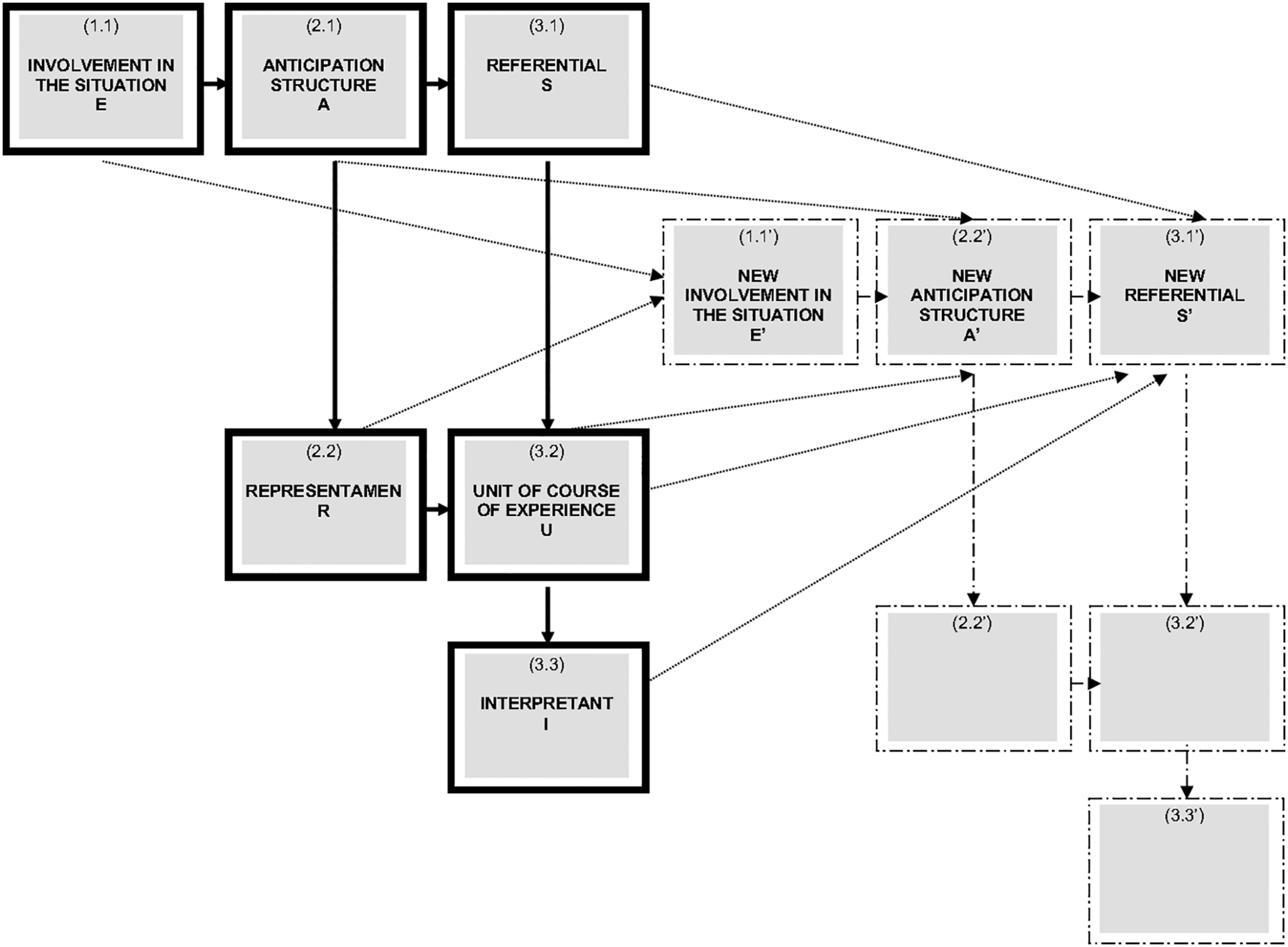
Methodologically, the components of the hexadic signs are documented step-by-step from the audiovideo recordings, verbalization transcripts, and the network of inferences that the researcher draws from the entire data corpus. The methodological construction of a course of experience cannot be mechanically done with pre-established contents of the categories of the hexadic signs. Constructing signs requires a constant back and forth between the signs already documented, those being documented, and the different types of data.
The tetradic sign can be mobilized retrospectively as an operative reduction of the hexadic sign with two principal prerequisites: (a) substitution of the notion of object (O) by the notion of openings (oi), and (b) substitution of the oldest notion of interpretant by the notion of referential apparatus incorporating both the types and the relationships between types constructed in the past and mobilized at a given instant in an unfolding practice, and the validation, extension, or construction of the types and the relationships between types here-and-now at each instant.
3.2.2. Identifying sign concatenations and significant structures of the course of experience
By hypothesis, the signs chain together and fit into larger and larger significant structures of the course of experience. Three kinds of significant structures are traditionally documented by researchers: sequences, series and synchrones. This step aims at identifying the structure of the singular experience that has been described through the course of experience, particularly its complex, synchronic and diachronic temporal organization.
In the BaM, the significant structures of the course of experience were constructed: (a) starting from actions (and communications as actions) and the coherence relationships between them and (b) first in terms of sequential relationships and second in terms of serial and synchronic relationships. Sequences were defined as groups of units of the course of experience (U) all pertaining to the same theme (or same interest) and related to each other in a sequentially coherent way. Units make up a sequence when they follow in close succession, each one determining the following one, and when they refer to the same theme. Sequences account for the degree of logical continuity between units of the course of experience (U). They may have a continuous or discontinuous character—that is, they can be interrupted by one or several units belonging to another sequence. Sequential relationships can be prospective (i.e., the expression of a planned episode or a strict chronology) or retrospective (i.e., the expression of a more improvised episode, but retrospectively presenting a sequential organization). Series were composed of units of the course of experience (U) or sequences all pertaining to the same theme but separated in time and not related by sequential coherence. Units or sequences make up a series to form a coherent chain, but without direct incidents or order effects among them. Synchrones were composed of units of the course of experience (U) or sequences appearing at the same time.
Despite their empirical fruitfulness, the definition and documentation of these meaningful structures have been revised and consolidated in the EaM such that: a) actions and their relationships are no longer limited, (b) the articulation with the documentation of hexadic signs—particularly the dynamics of opening—is improved, and (c) the empirical results indicating that experience and practice are synchronous and serial before being sequential are taken into account. Three types of relationships between two openings have been defined: (a) a diachronic or serial dyadic relationship (including sequential relationship as a particular case), (b) a dyadic relationship of subordination (making macro-structures of the different types), and (c) a synchronic or contextual dyadic relationship mediated by another opening. In a diachronic or serial dyadic relationship, openings oi and oj are identical from the actor’s viewpoint. In a dyadic relationship of subordination, oi is subordinated to oj if the closure of oi helps bring about the closure of oj (also from the actor’s viewpoint). In a synchronic or contextual dyadic relationship relative to a given opening, openings oi and oj are independent, but both are subordinated to an opening ok. In fact, all openings at a given moment have a synchronic dyadic relationship with the overall involvement of the actor in the situation (E), which means that experience and practice are first and foremost serial and synchronous before being sequential. This makes synchrones (when several independent openings between them are linked to a broader opening) basic significant structures to document.
In the EaM, significant structures of the course of experience account for the history of transformations in the dynamics of opening as constructed by actors at time t. They refer to the set of past openings that are not yet closed at t, accompanied by the retrospective story for the actors since that instant. The notion of a significant structure at instant t emphasizes that the significant structures that appear from the actor’s viewpoint at time t may be partially modified at time t + 1.
From a methodological viewpoint, the significant structures of the course of experience are documented in relation to the concatenation of signs in a process that goes from the local dynamics (i.e., hexadic signs) to global dynamics (i.e., identifying significant structures). This process consists of a back and forth at each instant t between a progressive analysis from (t) to (t + n) that is carried out in terms of signs, and a regressive analysis starting from (t) that returns to a past instant in the course of experience and determines the openings that are the result of the past and not closed from the actor’s viewpoint—that is, they remain open at (t) for the actor. In this process, the documentation of signs, significant structures at (t), and transformation of the set of openings recursively intervene with one another.
3.2.3. Combining intrinsic description and extrinsic description
In this step, the course of experience is analyzed in relation to the constraints/effects in an actor’s body, environment, and culture. The description of the course of experience could be coined an intrinsic description informing about the actor’s own enacted-world, enacted-body and enacted-culture. It is here combined with an extrinsic description, which is a description of the external factors/elements performed by an observer, who takes into account the intrinsic dynamics and who aims to describe constraints/effects affecting the course of experience. Extrinsic description is therefore all the external elements that are explanatory of the intrinsic dynamics (i.e., for the courses of experience). The data feeding the extrinsic description are quite varied and mainly derived from ethnographic observation: spatial, temporal, organizational and artifactual elements; norms and values; bodily involvement: postures, gaze, and gestures; performance determined by the execution/non-execution of certain important actions and the time taken to execute them; and so on.
3.2.4. Identification of generic pre-reflective structures of experience and experiential invariants through the course of experience(s)
Despite the micro-phenomenological perspective adopted in the course-of-experience framework, the aims are to discover essential and generic pre-reflective structures of experience and to identify experiential invariants through the course of experience(s). The focus of the course-of-experience framework (and the self-confrontation micro-phenomenological interview) on singular experiences does not mean that the method is restricted to singularity and limited to describing only individual tokens of experience (Petitmengin et al., 2019). It instead means that we cannot avoid the detour through the singular course of experience. The identification of typical occurrences in an actor’s course of experience is, among other things, how to make this possible.
Typicality has at least four aspects: descriptive (i.e., a typical occurrence has the highest number of attributes of the observed experience in the sample of actors and the studied situations), statistical (i.e., a typical occurrence is the most frequently observed in the studied sample), generative (i.e., a typical occurrence has the propensity to be actualized when conditions resembling those being observed are reproduced), and significant (i.e., actors express a feeling of typicality when they are questioned about it during the self-confrontation micro-phenomenological interview). Depending on the research, the typical occurrences identified may be a typical experience as a whole, a typical sequence, a typical situation, a typical emotion or action, typical concerns, a typical representamen…. These typical occurrences can be identified based on the comparison of (a) different instants in a single actor’s course of experience, (b) different courses of experiences of an actor involved in various similar situations, (c) different courses of experience of several actors involved in similar situations, (d) different courses of experience of several actors involved simultaneously in similar situations, and (e) different courses of experience of several actors involved in several different situations. Constructing a course of experience graph is particularly useful to identify the generic structure and invariants in the organization of the course of experience in relation to the constraints/effects on an actor’s body, environment, and culture. Such graphs facilitate comparisons between different moments in a course of experience, different courses of experience for a single actor, or different courses of experience for different actors.
Beyond identifying the infinitely varying contents of singular experiences, this method makes it possible to identify the experiential invariants that constitute the structure of the practice and the cognitive processes under study. The notion of typicality is an interesting way of generalizing because (a) it introduces a homology between the knowledge construction modes of actors engaged in usual activities (or under study) and the knowledge construction modes of actors engaged in research activities, and (b) it emphasizes the role of abduction as an early stage of scientific inquiry and its link with induction (Anderson, 1986).
4. Implications for cognitive science
This concluding section underlines: (a) how the course-of-experience framework contributes to cognitive science, (b) what its implications are for this research area, (c) how and why the insights of phenomenology and Peirce’s semeiotic should be associated in cognitive science, and (d) what the possible directions for further research might be.
It should first be emphasized that the studies conducted within the course-of-experience framework have produced empirical results on cognition-in-the-world and in-practice and through practice: everyday and workplace cognition, social and team cognition, and large temporal spans of cognition. They have also shed new light on learning, knowledge construction and abductive reasoning, creative cognition, metaphors and mimesis, appropriation, relationships between emotion and cognition, and shared understanding and intersubjectivity. Course-of-experience studies have confirmed the rich cultural-cognitive ecosystems within which human cognition is embedded and have highlighted the role of the body, tools, and cultural practices in cognition. This last point is crucial for cognitive science, which is strongly encouraged to situate embodied interaction (or brain-body-world) in the social and material world (Hutchins, 2008, 2010, 2011). One of the biggest challenges of the coming decades will undoubtedly be working out the implications of the observation that, for humans, the world (in the brain-body-world formulation) consists of “being” in a culturally constructed social and material world. Studies conducted within the course-of-experience framework have produced empirical results that confirm the hypothesis of the extended phenomenological-cognitive system proposed by Silberstein and Chemero (2012). These authors considered “phenomenology and cognition as inseparable and complementary aspects of coupled brain-body-environment systems (…) experience is cognition and cognition is experiential” (p. 6). Finally, the course-of-experience framework makes it possible to study the extended phenomenological-cognitive-cultural system in which human cognition is embedded.
Practically, and as an illustration, some empirical studies conducted within the course-of-experience framework have contributed to empirical advances on the issues of affordances (which can be considered as attributes of the brain-body-environment system) and have confirmed that the arrangement of an individual’s field of affordances (Rietveld, 2008) is dependent on the current concerns and abilities of that organism and the current situation (e.g., Seifert et al., 2014). As pointed out by Bruineberg and Rietveld (2014), the affordances that stand out as relevant for a particular individual in a particular situation change when either the landscape of affordances changes (i.e., when the sociomaterial environment changes or when the affordances available in an ecological niche—related to the whole spectrum of abilities available in our cultural practices—change), or the concerns change—or more precisely, the individual’s structure of preparation (E-A-S) changes (see also Rietveld, 2008).
In contemporary cognitive science, it is becoming increasingly clear that a “disciplined” description of experience, inspired by phenomenology and semiotics, is required, and the course-of-experience framework and methods could be useful. First, we assume here that this framework might produce front-loading phenomenological insights useful for the design of experimentation in cognitive science (Gallagher & Sørensen, 2006). This was the case in sports science, where several researchers built a phenomenologically—and more specifically, a course of experience-informed—experimental design (e.g., Bourbousson et al., 2014; Bourbousson et al., 2015; Seifert et al., 2015; Seifert, Cordier, et al., 2017). These studies did not necessarily involve phenomenological methods during the experiments themselves.
Second, we assume here that the course-of-experience framework can contribute to the refinement of neurophenomenology as an approach for studying human experience (or first-person experience). This assumption is based on the critical evaluation of the neurophenomenological methods proposed by Bockelman et al. (2013). The scientific research program, called neurophenomenology (Lutz, 2002; Lutz & Thompson, 2003; Varela, 1996; Varela & Shear, 1999) aims to pragmatically investigate the relationships between subjective experience and objective neurophysiological data by intertwining what has been called first- and third-person methods. This perspective holds great promise and opens onto both a naturalized phenomenology (Overgaard, 2004; Petitot et al., 1999), by taking into account biophysical embodiment, and a phenomenologized neuroscience, by introducing phenomenological methods into experimental design (Gallagher & Sørensen, 2006). Early neurophenomenological works (what we can call neurophenomenology I) used phenomenologically trained experimental subjects to report on their experiences. Notably, this method has been productively incorporated into the protocol of experiments on perception (e.g., Lutz et al., 2002) and epilepsy (e.g., Le Van Quyen et al., 2001), providing results that are not captured by typical cognitive science approaches. Bockelman et al. (2013) made several methodological recommendations to improve the reliability and productivity in handling phenomenological data. They particularly recommended that a new generation of neurophenomenology studies (what we can call neurophenomenology II) be developed based on phenomenological interviews and not on trained experimental subjects. They argued that these studies need to place the impetus for training on the interviewer, not the participant, so that the interviewer can act to support the participant in precise experiential reporting. They cited as an example the works of Petitmengin and Le Van Quyen (Le Van Quyen & Petitmengin, 2002; Petitmengin et al., 2007), who used the explicitation interview method (see Froese et al., 2011; Petitmengin, 2006; Petitmengin & Bitbol, 2009) in an investigation of epilepsy and seizure anticipation.
With regard to this specific point, the self-confrontation method—developed within the course-of-experience framework—is a micro-phenomenological interview method that may be particularly useful for cognitive science. This method is designed to stimulate the re-enactment and re-experience of a past dynamic situation, and it encourages the expression of the pre-reflective self-consciousness that accompanied the practice in the situation. Yet, the course-of-experience framework also proposes a rigorous and empirically fruitful use of Peirce’s semeiotic, which can then contribute to the theoretical core of cognitive science and have heuristic value for it, especially neurophenomenology. An acknowledged methodological challenge for neurophenomenology is to find a level of observation at which convergence is possible. This will require the development of methods for the collection of descriptions of neural and experiential dynamics at a fine level of granularity, which seems to be the right level to search for correlations (Petitmengin & Lachaux, 2013). The analytical hypothesis proposed by the course-of-experience framework allows for a very fine-grained description of experiential microdynamics and opens to a joint analysis of experiential and neuronal microdynamics. Obviously, the assumption here is that the sign may well be a pivotal notion in phenomenology and cognitive science (Theureau, 2015b). On this point, the course-of-experience framework underlines once again Peirce’s relevance for cognitive science (Caravà, 2019; Skagestad, 2004; Steiner, 2013; Tiercelin, 1995). Peirce’s pragmatism and semeiotic (revisited as in the course-of-experience framework) not only offers interesting insights on philosophical topics and contemporary research programs in cognitive science (Paolucci, 2011, 2021) 5 , but it also lays the foundations for a generic model for the description of experiential microdynamics. This implies going beyond the speculative and non-empirical nature of his semeiotic, as well as modifications and add-ons to Peircean categories and the notion of sign.
Many studies conducted within the course-of-experience framework have demonstrated a joint-analysis of the course of experience and third-person data (Gal-Petitfaux et al., 2013; Hauw et al., 2017; R’Kiouak et al., 2016; Seifert, Lardy, et al., 2017; Sève et al., 2013), but thus far have not included neuronal data. Yet, like other researchers, we assume that this combination of data would provide greater insight into cognitive and social phenomena (e.g., the role of tools and body in cognition, appropriation phenomena, intersubjectivity and shared understanding…) while preferring to keep the focus on external description (i.e., the observer’s description of external factors/elements that does not take into account the intrinsic dynamics in comparison to extrinsic description) rather than third-person data. The very existence of a third-person approach is ontologically questionable. Despite this, however, we are convinced of the advantages of completing intrinsic and extrinsic descriptions by an external description, which can sometimes be conducted using methods of collecting and processing data developed in other theoretical approaches. Of course, all this requires even greater precision and explicitness about the mutual constraints—that is, about the reciprocal influence and determination between levels of description. Theureau (2006) recently added new theoretical objects to the course-of-experience framework, including the course of in-formation. This proposal originated from the observation that, although the course of experience (as a theoretical object) makes it possible to apprehend “the level which is meaningful for the actor,” it leaves other levels aside, which, although they may not be shown, told or commented on, nevertheless play a part in the actor’s practice. The course of in-formation as a theoretical object is an ideal to strive for in documenting the entire dynamics of structural coupling or the whole set of in-formative interactions between an actor and the environment. It includes both in-formative interactions that give rise to pre-reflective self-consciousness and those that do not (to be documented by methods other than the direct or indirect documentation of pre-reflective self-consciousness). It is through this theoretical object that it becomes possible to go beyond the limits of describing the actor’s course of experience, as it offers a way to jointly analyze the course of experience and the external data on an actor’s body, environment, and culture that did not give rise to pre-reflective self-consciousness. However, describing the course of in-formation is considered suitable only if primacy is given to the course of experience. The course of in-formation, as a theoretical object, may be relevant to cognitive science as it gives a description of the whole brain-body-world system, as well as to the conceivable extended phenomenological-cognitive-cultural system.
We would like to conclude here by emphasizing that the relevance of Peirce’s semeiotic for empirical research in cognitive science, particularly in association with enactive assumptions, has also been demonstrated by research programs other than the course-of-experience framework. As an illustration, in cognitive archeology, Iliopoulos (2019, 2016) also developed a pragmatic and enactive theory of cognitive semiotics by assuming the complementarity of Malafouris’s enactivist approach to archeology, which calls for a radical reconceptualization of mind and material culture (Malafouris, 2007, 2013, 2018), and Peirce’s theory. This cognitive semiotic framework is seen as a pragmatic extension of material engagement theory that is suitably geared toward tracing the nature, emergence, and evolution of material signs. A systematic comparison of these two research programs and their complementarity would be particularly useful. A synergy between the semiotic framework developed within the course-of-experience framework and the semiotic framework proposed by Iliopoulos (2019, 2016) would make it possible to go beyond the human, to assume the plurality of beings (and modes of existence), to study the construction of meaning by interfacing human and non-human, and thus to empirically and better inform on the role of cultural practices and the material world in cognition (as outlined above).
In a broader context, the focus on practice adopted here for studying cognition-in-the-world (a) rejects the division of scientific work between the natural and cultural sciences, (b) defends new alliances between the cognitive and social sciences (through a renewed practice theory) far from the pitfalls and excessive reductionism of a certain form of social naturalism, (c) assumes that cognitive processes “spread beyond boundaries of skin and skull” (Michaelian & Sutton, 2013, p. 2), (d) shifts attention from local examples of extended mind to cultural-cognitive ecosystems (Hutchins, 2011), (e) takes the cultural constitution of cognition seriously (Bender & Beller, 2011), and (f) tries to extend, revive, and go beyond cognitive anthropology in the direction of an enactive anthropology (Beller et al., 2012; Bender et al., 2010).
Footnotes
Declaration of conflicting interests
The author(s) declared no potential conflicts of interest with respect to the research, authorship, and/or publication of this article.
Funding
The author(s) received no financial support for the research, authorship, and/or publication of this article.
