



Abstract
Robotic swarms and mobile sensor networks are used for environmental monitoring in various domains and areas of operation. Especially in otherwise inaccessible environments, decentralized robotic swarms can be advantageous due to their high spatial resolution of measurements and resilience to failure of individuals in the swarm. However, such robotic swarms might need to be able to compensate misplacement during deployment or adapt to dynamical changes in the environment. Reaching a collective decision in a swarm with limited communication abilities without a central entity serving as decision-maker can be a challenging task. Here, we present the CIMAX algorithm for collective decision-making for maximizing the information gathered by the swarm as a whole. Agents negotiate based on their individual sensor readings and ultimately make a decision for collectively moving in a particular direction so that the swarm as a whole increases the amount of relevant measurements and thus accessible information. We use both simulation and real robotic experiments for presenting, testing, and validating our algorithm. CIMAX is designed to be used in underwater swarm robots for troubleshooting an oxygen depletion phenomenon known as “anoxia.”
Keywords
1. Introduction
Swarms of various lifeforms have been observed to utilize emergent group dynamics (Eberhart et al., 2001) for various tasks such as foraging (Seeley, 1992), reproduction (Bonner, 1949; Durston, 1973), or escaping predators (Brock & Riffenburgh, 1960; Cavagna et al., 2010; Magurran & Pitcher, 1987). Seeley (1992) discovered how bees use waggle dances for foraging by pointing their hive to high-quality food sources. Bonner (1949) and Durston (1973) examined the communication behavior of slime mold cells which despite its simplicity enables self-organization with respect to foraging, reproduction, and so on. Cavagna et al. (2010) analyzed how starling flocks respond to external stimuli as a collective to evade predators. Due to the availability of many eyes in a swarm, each individual spends less time and energy on scanning the environment for predators. Magurran and Pitcher (1987) experimentally demonstrated various formations used by shoals of minnows when detecting predators. Decentralized intelligence of such kind is popularly known as swarm intelligence (Beni & Wang, 1989). Natural systems exhibiting this decentralized intelligence have inspired researchers due to their adaptability to the environment, resilience to perturbations, and underlying simplicity. Despite simple rules governing the behavior of individuals in a swarm, the resulting collective behavior often shows a stunning degree of complexity—as it can also be observed in the synchronized flashing of the fireflies lampyridae (Buck, 1988), predator evasion in fish (Magurran and Pitcher, 1987), and so on. Researchers in many emerging fields such as ubiquitous computing (Kim & Follmer, 2017), multi-robot systems (Kernbach et al., 2009; Zahadat & Schmickl, 2016), and traffic management (Renfrew & Yu, 2009) have recognized parallels between such multi-agent artificial systems and natural systems containing several actors (Fernandez-Marquez et al., 2013; Garnier et al., 2007). As a result, extensive research has been dedicated to self-organization and decentralization in complex systems (Dorigo et al., 2004). When designing swarms or sensor networks, one challenge that often needs to be addressed is the collective decision-making task (Kernbach et al., 2013).
In this article, we present an algorithm enabling a swarm of individuals with limited communication abilities to collectively maximize the amount of information available to the swarm as a whole. We use the variance in measurements of the swarm as a measure of information and use it in combination with a simple bioinspired communication mechanism to let the agents determine which direction yields the largest increase in information. In contrast to centralized swarms, individual agents use only local information and do not have access to a central entity. Hereafter, we refer to the algorithm as CIMAX.
2. Motivation
We initially designed CIMAX to address the task of documenting, examining, and ultimately forecasting the frequently but irregularly appearing anoxic waters phenomena (Runca et al., 1996) in the lagoon of Venice. During this phenomenon which is commonly referred to as “anoxia,” the oxygen content of a small part of the lagoon decreases dramatically resulting in the death of animal life in that specific area. Anoxia adversely affects the flora and fauna in the lagoon and consequently may cause difficulties for the living conditions of the inhabitants and tourists in Venice, for example, due to massive amounts of decomposing dead fish in canals. A strategy to examine and document this phenomenon is to utilize a swarm of underwater robots for monitoring a set of environmental parameters such as oxygen concentration levels. For determining dynamics and spatio-temporal evolution of anoxic areas in the water body, a swarm of robots allows monitoring at various underwater locations and thus high spatial resolution. One implementation of such an artificial swarm using the “aMussel” robots (Donati et al., 2017), used for autonomous long-term underwater monitoring, was developed and extensively tested in real-world marine environments within the project “subCULTron” (2015).
Due to problems such as expensive hardware (Akyildiz et al., 2005), high power consumption (Stojanovic & Preisig, 2009), and general complexity of communication underwater (Lanbo et al., 2008), the main approach for communication within members of a swarm of aMussels is based on using modulated light for local information transfer. Generally, when deploying a swarm at a target location, it is not guaranteed that the location is effectively covered. It is possible that only few robots are in contact with the anoxic area and the majority of the swarm is not. Moreover, even in case the swarm is optimally placed, the target area is dynamic and hence mobile. As we present in this work, the use of variance as a measure for information enables a swarm to navigate to the border of, for example, an anoxic area and thus monitor the transition where anoxic waters interact with the surrounding environment. The collected data potentially provide insight into the processes connected with the spreading of anoxic domains. Since variance is a relatively simple measure, independent of specific scenarios or environments, it does not restrain the application of this algorithm to various contexts.
3. Related work
The problem that CIMAX addresses in this article is a classical problem of collective decision-making in multi-agent systems where individual entities might make conflicting decisions based on local information. According to Trianni and Campo (2015), algorithms for collective decision-making in natural and artificial swarms can be categorized into three main mechanisms. In the first mechanism, the swarm waits for one entity to have enough information to make a decision and then propagate that decision within the swarm. Organizational structures following this mechanism can be found in form of hierarchies within animal and human societies (Ahl & Allen, 1996; Rabb et al., 1967). The second mechanism is called opinion averaging in which all individuals constantly adjust their own opinion based on their neighbors’ opinions until the entire swarm eventually converges to one opinion. This mechanism for collective decision-making in robotic swarms can also be found in groups of animals which use it for effectively navigating as a collective (Codling et al., 2007; Conradt & Roper, 2005; Simons, 2004). The third mechanism is based on amplification of a particular opinion to produce a collective decision. In this mechanism, each individual randomly starts with an opinion and then changes their opinion to the other opinions value (in contrast to averaging the opinions, as done in the second mechanism) depending on how often they hear the latter opinion. The amplification mechanism is also found within animals such as the pheromone trails selection in ants (Beckers et al., 1990; Dorigo et al., 2006), the temperature-based site selection of young bees (Garnier et al., 2009; Szopek et al., 2013), or consensus decisions in group of animals about timing of activities and travel destinations (Conradt & Roper, 2005). A version of this mechanism based on blockchain technology was used for enabling robots to reach collective decisions (Strobel et al., 2018).
Apart from those three main categories, there are more approaches to collective decision-making which are not necessarily observed in natural swarms but implemented on artificial swarms. Some decision-making processes in multi-agent systems, which are often applied to problems of distributed task allocation, rely on auction-based algorithms where agents make bids to an auctioneer (Dias et al., 2006; Koenig et al., 2010). Also decentralized approaches, where all agents constitute both bidder and auctioneer, have been proposed (Vail & Veloso, 2003). An entirely different direction to approach the problem of collective decision-making is the use of neural networks, or more precisely, distributed neural networks where each agent constitutes a slice of a “collective mind” (Otte, 2018).
The underlying mechanism of collective decision-making of the CIMAX algorithm relies on the averaging over opinions within the swarm which is associated with the second category of mechanisms presented in Trianni and Campo (2015).
Apart from collective decision-making in swarm robotics, our approach is broadly related to relocation of sensor nodes in mobile wireless sensor networks (“MWSN”) (Cui et al., 2004; Li et al., 2007; Wang et al., 2005). For example, when deploying a swarm in an otherwise inaccessible environment, the swarm is often not arranged properly for effective measurement and observation due to inaccurate knowledge of target area, of dynamic changes in local conditions, or of unforeseeable events. For optimizing parameters such as coverage, connectivity, or network longevity, it is necessary to determine how the network or individual members need to be relocated. A variety of approaches has been suggested to accomplish effective relocation.
While some approaches in sensor relocation rely on having access to global information of the position of sensors, often this problem is approached in a decentralized manner. In Wang et al. (2005), the exact position of the sensors is known by the base station or similar central entity. The area covered by the sensors is increased while minimizing the travel time and the distance traveled using genetic algorithms. Such a system is used to compensate for coverage loss when sensors fail in the field. In Cui et al. (2004) and Li et al. (2007), a more decentralized approach for relocation of sensors is followed to maintain coverage of a sensor network. The sensors periodically broadcast their locations and identifiers to their neighbors and construct a Voronoi diagram. Voronoi polygons are computed using the received information. Once a node finds a hole in the Voronoi diagram, that is, a relatively large polygon, the relocation of a sensor is initiated. In Cui et al. (2004), a simulation of an odor localization scenario with a group of mobile robots is presented. The authors focus on using fuzzy logic to decide which direction to move to to eventually localize the source. They assume that measurements from each agent are easily available to other agents in the swarm wherefore the agent-to-agent communication aspect is not adequately addressed.
In addition, there are numerous approaches in the field of exploration and information gathering through the utilization of multiple robots. In the following paragraph, we give a brief overview of the different approaches. Schwager et al. (2017) present an approach based on the fundamentals of information theory for information gathering under balancing expected information gain and risk of damage or failure due to local hazards. Erignac (2007) presents an approach for exploration in context of search strategies under constraints in communication. Their algorithm is designed for swarms of unmanned aircraft vehicles and is inspired by the pheromone map-based foraging strategies of some insects. Zarzhitsky et al. (2005) use small decentralized robot swarms for tracing chemical plumes. In their approach, all agents individually make a decision based on local information and information exchanged with neighbors. The swarm-wide decision-making process is implicitly done, since the individual decision results in an emergent collective movement. Smith et al. (2016) present an approach for adaptive tracking of an ocean front using autonomous underwater vehicles. This is closely related to the task the CIMAX algorithm is designed for; however, their approach involves long range communication and involves a heterogeneous team of robots. Marthaler and Bertozzi (2003) present an algorithm enabling autonomous swarms to determine static environmental boundaries using both local and/or global communication. Their algorithm is originally used in image processing and is based on energy minimizing curves.
The CIMAX algorithm differs from existing approaches in the following ways: (1) the swarm does not require access to global information—there is no need for a central entity knowing the positions of all sensors (2) nor are agents required to receive instructions or be organized by a central entity. The loss of individual agents generally does not affect the swarm’s functionality. (3) CIMAX maximizes the diversity or variance of measurements collected by the swarm as a whole and by that relies on a simple and robust measure. (4) Our approach utilizes not only the content of received signals but also their properties.
We present both numerical simulation and robotic experiments to validate the presented method. Furthermore, this algorithm can be embedded into the swarm design paradigm WOSP (Thenius et al., 2018), a framework for controlling swarms utilizing the communication mechanism we briefly introduce in section 4.1. In section 4.2., we present the algorithm and its implementation. The computational results and theoretical analysis of the algorithm are shown in section
4. The CIMAX algorithm
The CIMAX algorithm enables a swarm of individuals with limited communication abilities to collectively determine which direction yields the maximum increase in information accessible to the collective. The fundamental communication mechanism presented here is inspired by slime mold (dictyostelium discoideum) and fireflies (lampyridae) and has previously been used to design various algorithms (Thenius et al., 2018; Varughese et al., 2016).
4.1. Communication paradigm
In this communication paradigm, all agents can enter three different states similar to the behavior of slime mold (dictyostelium discoideum): an “inactive” state in which agents are receptive to incoming communication, an “active” state where they send or relay a signal, which is followed by a “refractory” state where agents are temporarily insensitive to incoming signals. From the inactive state, an incoming message or the decision to initiate a message lets an agent transition into the active state. In the active state, an agent either relays an incoming message or initiates a new message. Subsequently agents enter the refractory state, being insensitive to incoming messages for a finite time until transitioning to the inactive state again. This communication mechanism is schematically shown in Figure 1(a), as well as the conceptual operating structure in Figure 1(b). Agents initiate a signal randomly by initially setting a timer within
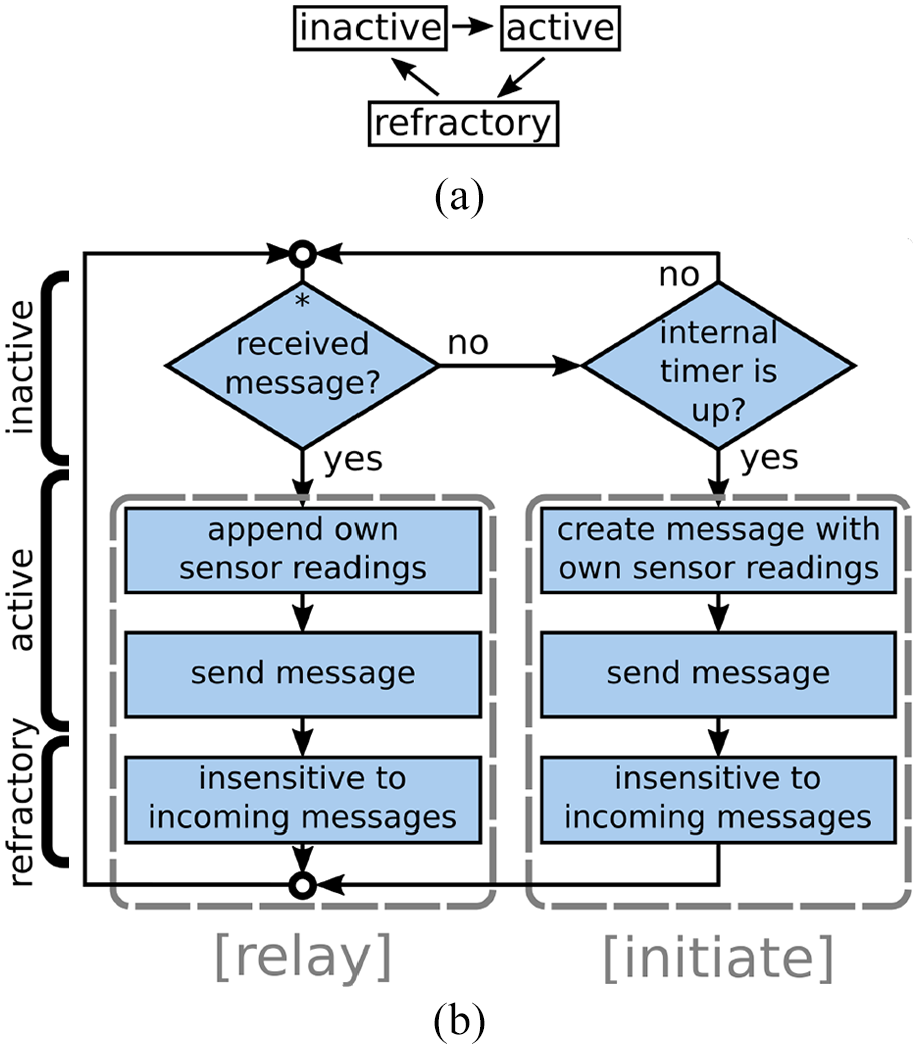
The WOSP communication mechanism. (a) The three-state agents can have. (b) The conceptual operating structure of an agent.
The three states of agents ultimately allow wave-like propagation of signals through the swarm as shown in Figure 2. In Figure 2(a), almost all agents are in the inactive state, shown in black, except one agent which broadcasts a message which is shown in red. Afterward, it transitions into the refractory state, shown in blue. Neighboring agents receive the signal and switch to the active state as shown in Figure 2(b) and (c). The signal spreads in a wave-like manner. In Figure 2(d), the initiating agent switches from the refractory state into the inactive state again. Due to a fixed duration of the refractory state, the transition to the inactive state as well spreads in a wave-like manner, shown in Figure 2(d) and (e). In Figure 2(f), several trajectories along which the signals were broadcast are shown as red lines. It shows how messages do not necessarily propagate in a straight line, that is, perfectly radially outward from the sender. However, given a well-connected and aggregated swarm, the propagation of signals exhibits a relatively directed trajectory since agents enter the refractory state after broadcasting a signal and thus prevent the occurrence of “sharp turns” of a propagating signal.
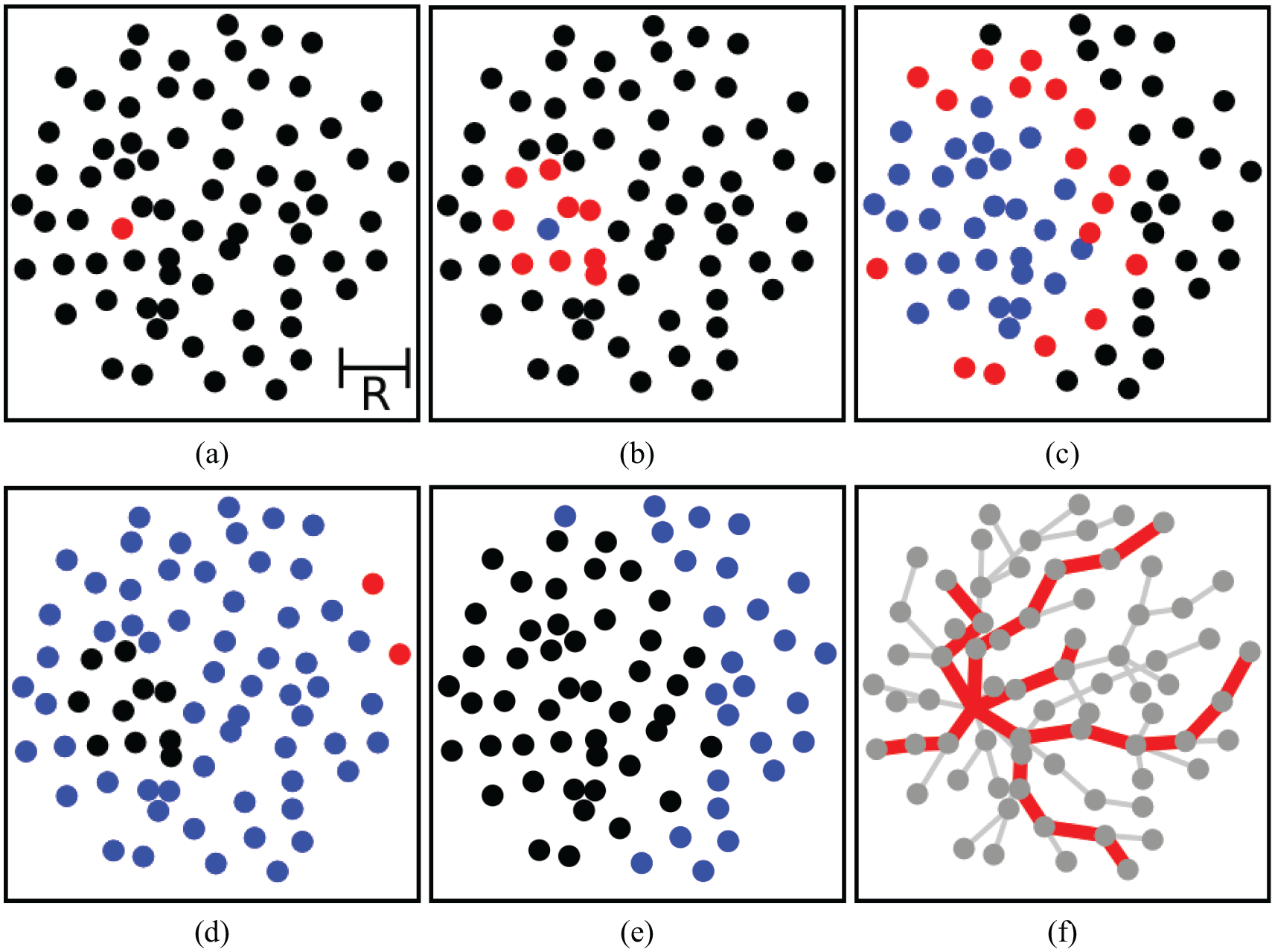
Illustration of wave-based communication. (a–e) A temporal sequence of a signal propagating through a swarm. (f) Several trajectories of signals during signal propagation in panels (a–e), indicated by red lines. Times (s): (a) 0, (b) 2, (c) 4, (d) 11, and (e) 16. Parameters: number of agents
Signals are solely received by agents in close neighborhood, that is, within perception range R of the sender (shown in the bottom right corner in Figure 2(a)) and subsequently relayed, thus propagating through the system. After receiving a signal, agents relay it with a delay of one timestep
The refractory state assures that a signal will neither “flood” a swarm, that is, signals will not (re)activate the initial sender, nor periodically propagate through the swarm, for example, as a spiraling wave. A more detailed discussion on the selection of parameters can be found in Varughese et al. (2020).
4.2. The algorithm
In this section, we present the algorithm for enabling swarms to collectively determine the direction which provides the maximum amount of accessible information. We define information as diversity in measurements throughout the swarm, quantified using the variance in measurements. The swarm ultimately detects and favors diverse domains, while it avoids uniform domains which are considered as providing less information. Agents solely need to be able to communicate with nearest neighbors and have a common sense of direction. Besides the direction of an incoming signal, agents do not require any other information about position, orientation, and so on of other agents.
Each agent in the swarm measures the same single quantity X which we use as a generic placeholder for any environmental parameter or quantity measured by swarms. When one agent initiates a message, it sends its own measurement value as a message. Neighboring agents receive the message, append their own measurements, and relay it. This way a message propagating through the system incrementally grows in size with every relay. With this in mind, for easier illustration of the algorithm, we divide the entire procedure into three parts: “information gathering,”“evaluation,” and “collective decision.”
The three parts of the algorithm are exemplary illustrated in Figure 3 for a swarm of N = 4 agents. The agents, represented by black circles, are arranged in a line. They are able to measure a quantity X of the environment which is represented by the background colors red and yellow.
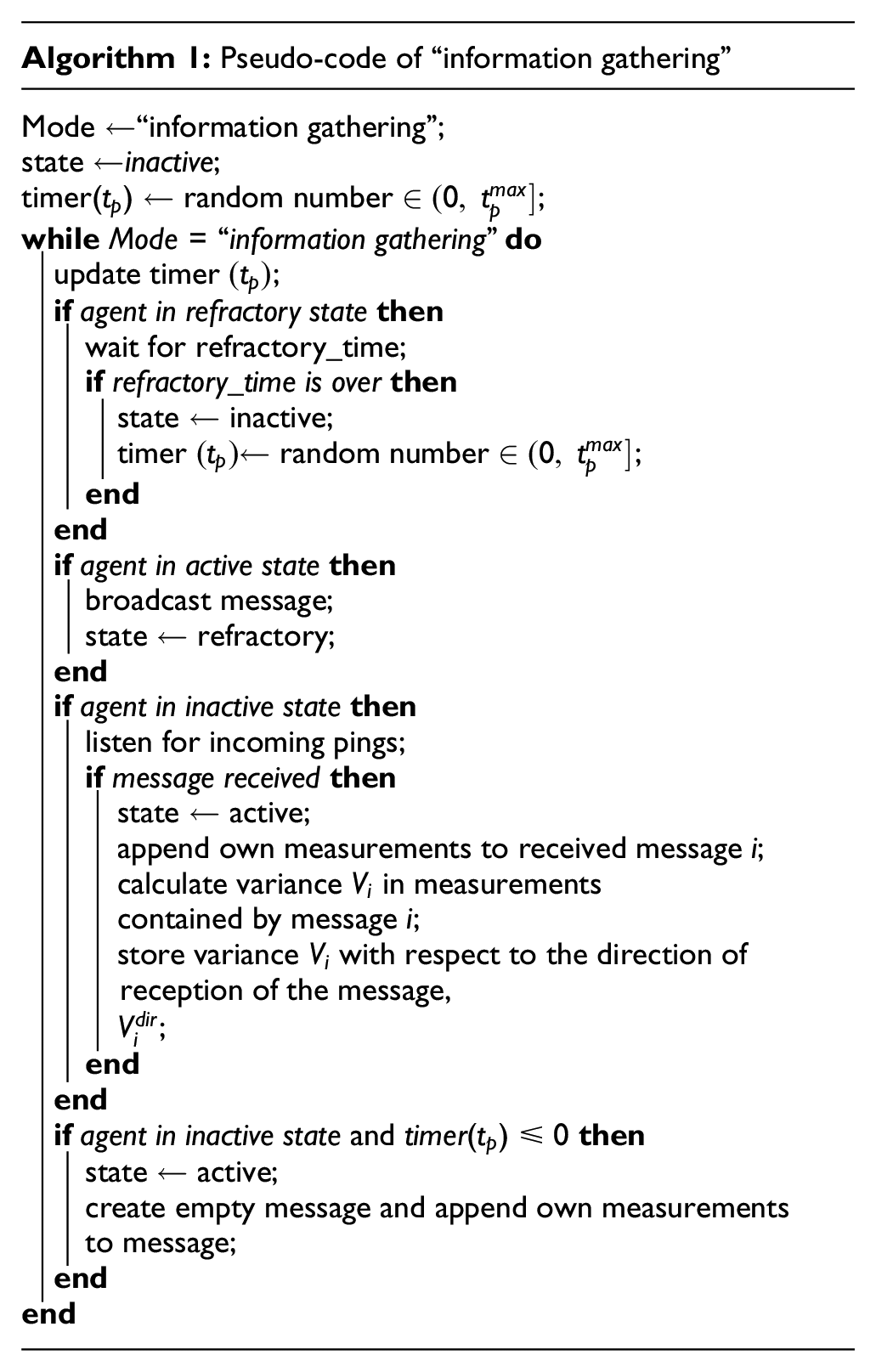
Information gathering. Agents randomly (in time) initiate sending a message containing their own sensor readings. Each agent which has received this message stores the received information as well as the direction from which it received the message. Finally, each agent appends its own sensor readings before then broadcasting it to its neighbors. This process is schematically shown in Figure 4, resulting in a dispersion of information about the sensor readings of agents throughout the whole swarm.
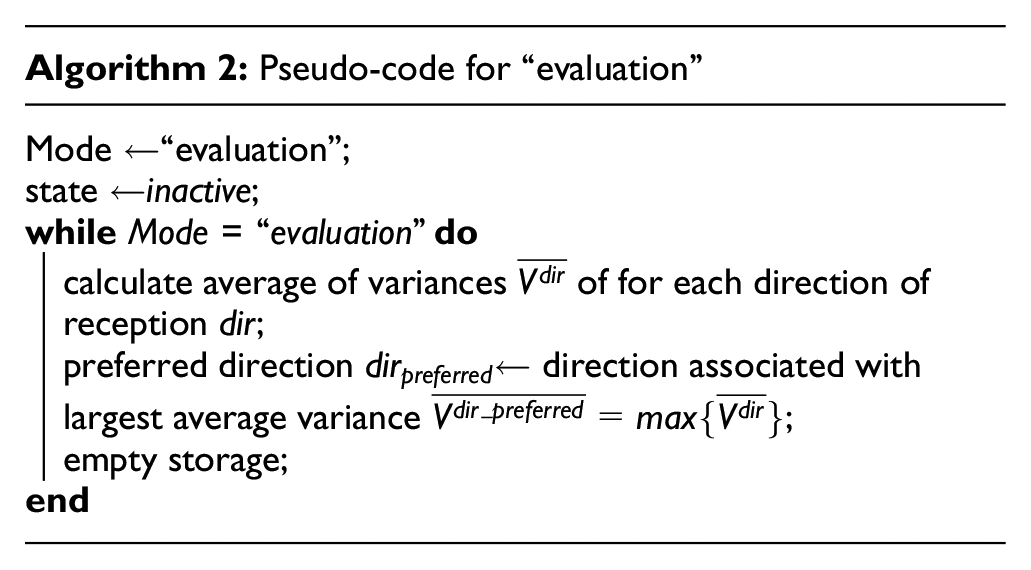
Evaluation. Agents evaluate the stored messages with respect to the direction from which they were received, respectively. Agents determine the diversity of the content of all messages associated with a certain direction. Depending on the systems characteristics this is practically done, for example, by calculating the variance of all elements contained by those messages. The calculated diversities serve as “weights” for each respective direction. Agents finally consider the direction associated with the largest weight (e.g. variance) as their preferred, that is, the direction toward where they expect the largest diversity in information. Figure 3(b) shows the evaluation of the two messages initiated in Figure 3(a).
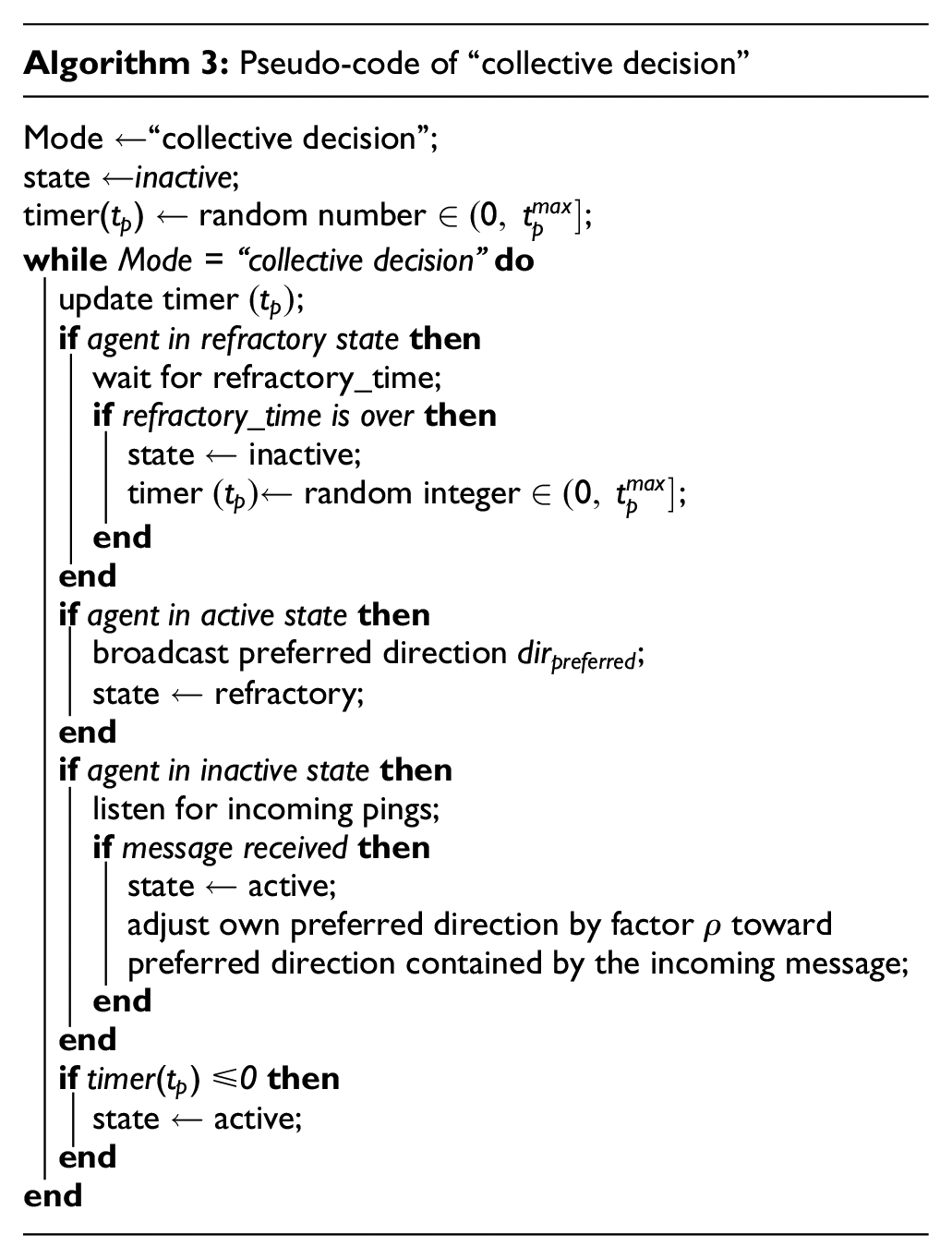
Collective decision. Agents agree on a common direction which yields the largest diversity in information on swarm level, based on the individual preferences of directions. One option is to let agents communicate their opinions on a preferred direction to their neighbors. Instead of relaying a message, the neighbors then simply change their own preferred direction by a small factor
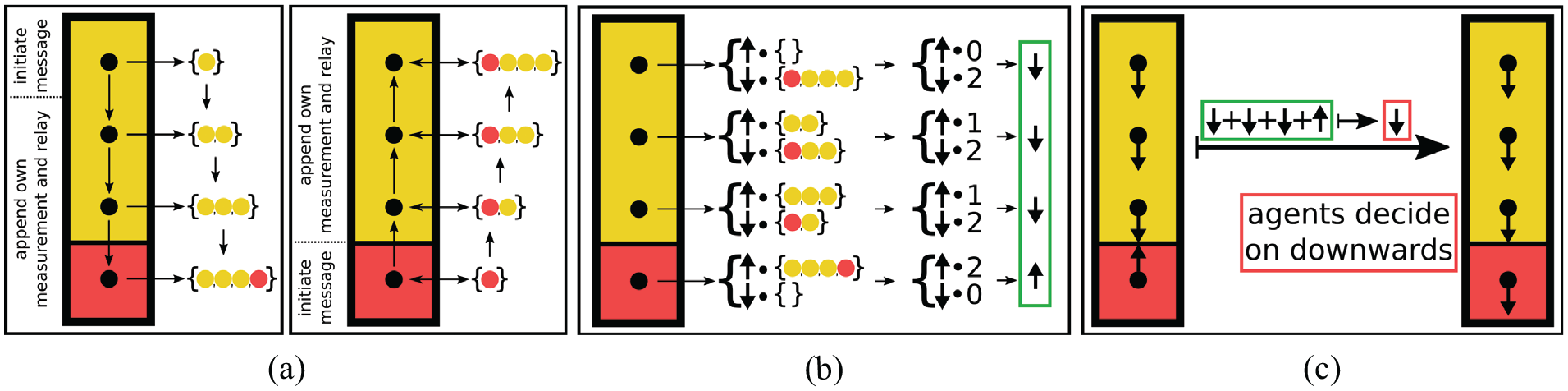
The three sub-parts of the algorithm can be divided. Four agents illustrated as black dots constitute a swarm in a system with two domains, yellow and red. The colors represent two different measurements of quantity X. (a) The dispersion of two independent messages. On the left hand side, the top agent (in the yellow domain) initiates a message with its own measurement, illustrated as a yellow dot in curly brackets next to the agent. The message propagates from agent to agent, each of which appends its own measurement (here depicted as color). On the right hand side, the same scenario is shown only this time the bottom agent, in the red domain, initiates the message which then propagates upward. (b) The evaluation of the two messages. The diversity of a message is illustrated as the number of different measured colors. The top agent received no messages from upward direction and thus considers a weight of
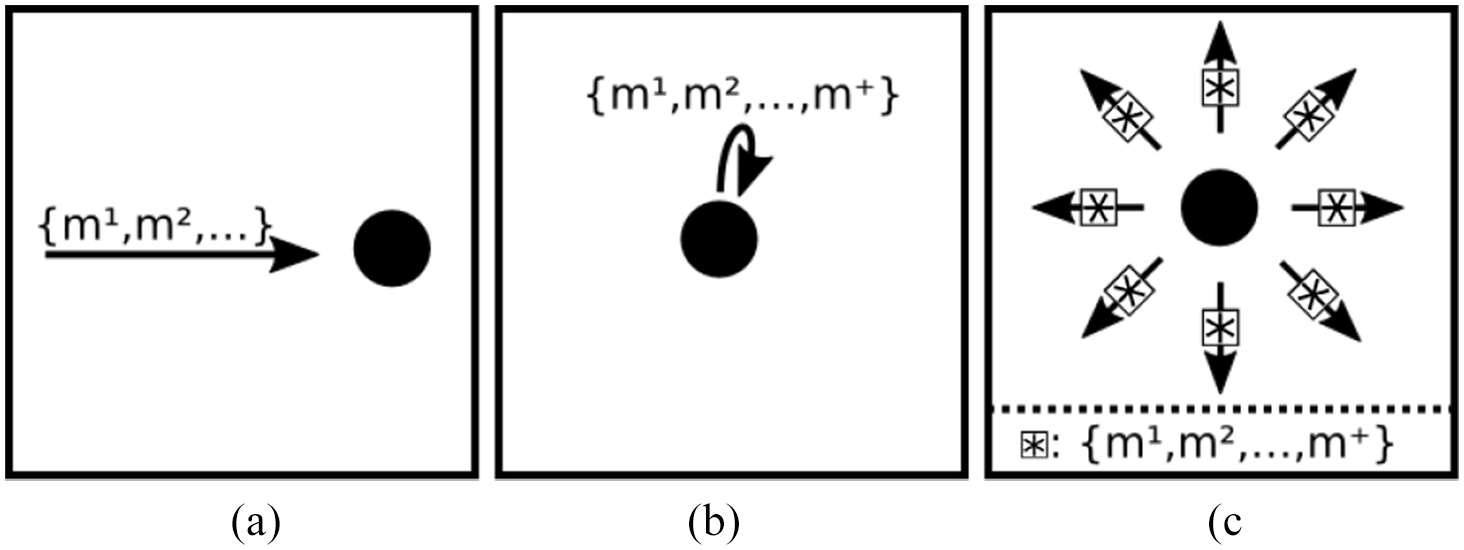
(a) An agent (black circle) receives an incoming message with measurements mi. (b) It then appends its own measurement m+ and stores the message before (c) it broadcasts this extended message.
Algorithms 1, 2, and 3 show the pseudo-code for the three parts “information gathering,”“evaluation,” and “collective decision,” respectively. Please note that the presented pseudo-code is just an exemplary implementation of the algorithm and that there are various alternative ways of implementing it. Namely, all three parts can be condensed into a single procedure where messages contain both measurements and preferred directions of agents; however, for easier understanding we chose to present the algorithm separated into parts.
5. Simulation
In this section, we first present the behavior of a swarm in systems consisting of a discrete and a smooth linear transition, respectively, to give an intuitive understanding of its behavioral dynamics. We then examine a computational scenario closer to a real application case. All simulations were conducted and visualized using Python. We consider a swarm of agents within a two-dimensional space. Each agent has a perception range R, within which it detects signals sent by neighboring agents. Agents in the swarm are distributed in a circular area of diameter
We illustrate the functionality of the algorithm for different positions of the swarm within an environment. Every time the swarm comes to a collective decision, we manually relocate the swarm along the direction the swarm decided on and effectively show a potential trajectory of the swarm. We relocate the swarm as a whole by a distance of
In the following we quantify diversity using the messages stored by agents. We define diversity

where
5.1. Discrete distribution of environmental factors
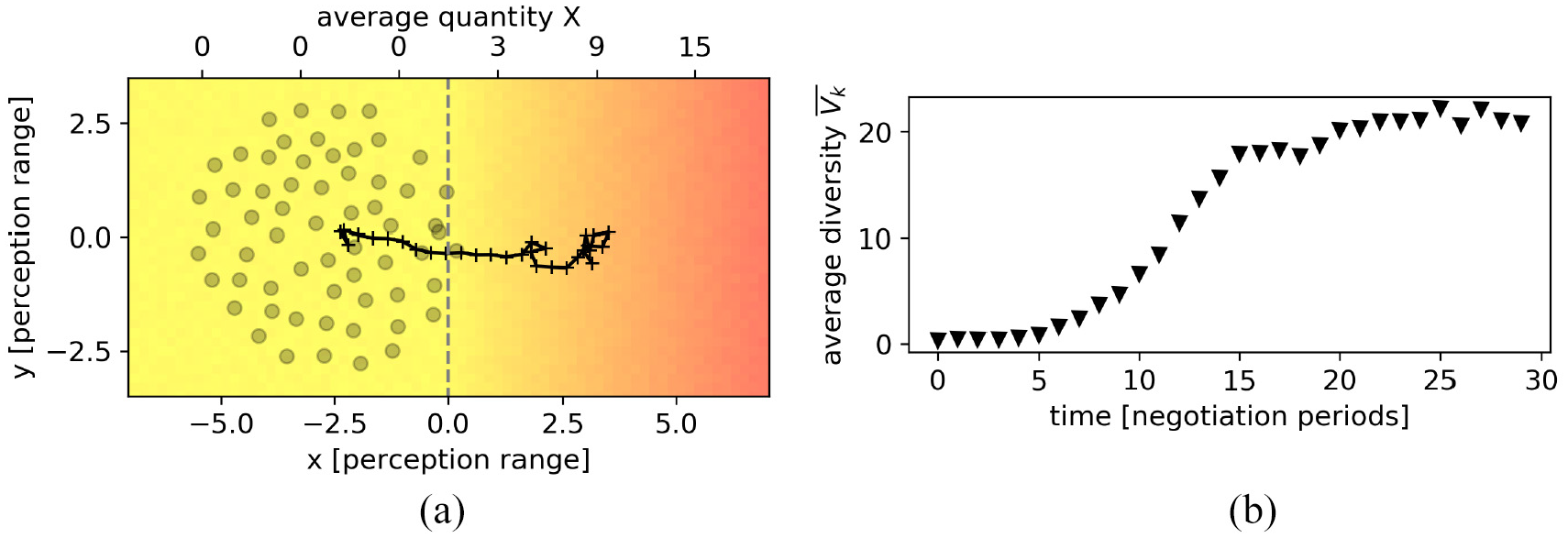
In Figure 5, the scenario of a swarm close to a sharp transition of a measured quantity X is shown, left hand side in yellow for low values (
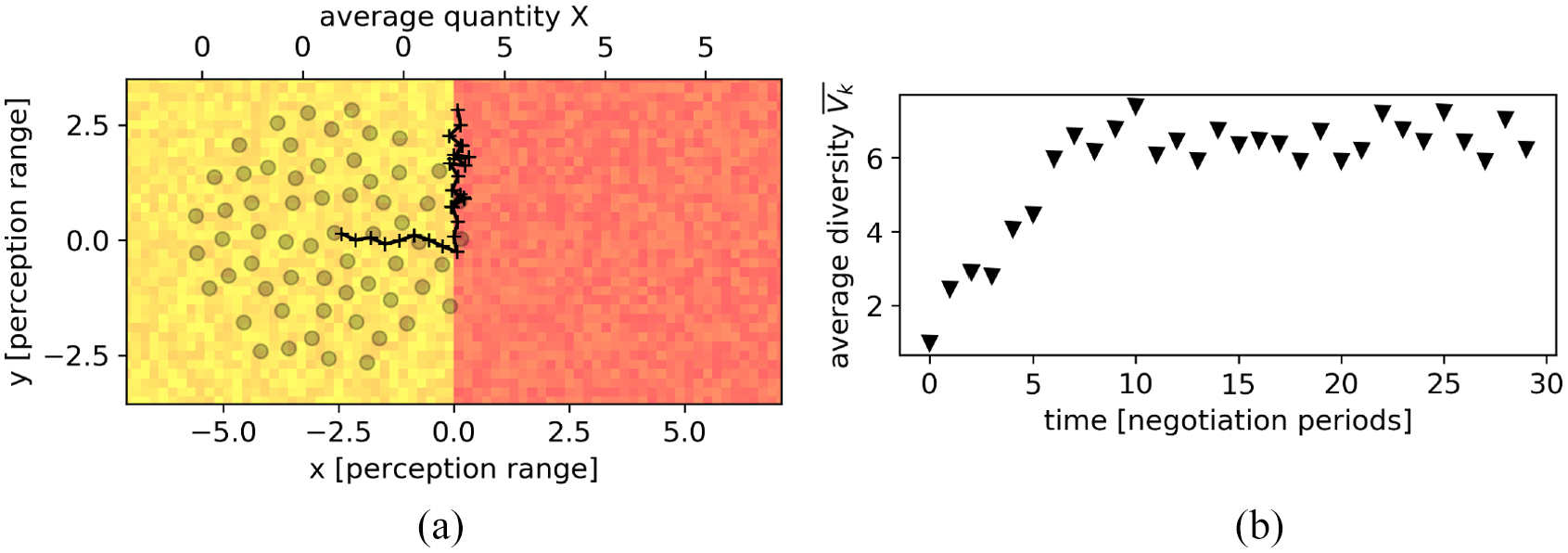
(a) The trajectory of the average position of the swarm (+) within a system with two domains, yellow with and red. In light gray circles, all
Figure 5(b) shows the average diversity
In Figure 6, we show the rate by which a swarm successfully reaches the border between the two domains. We count a simulation as successful if the position of the swarm reaches a distance to the border smaller than
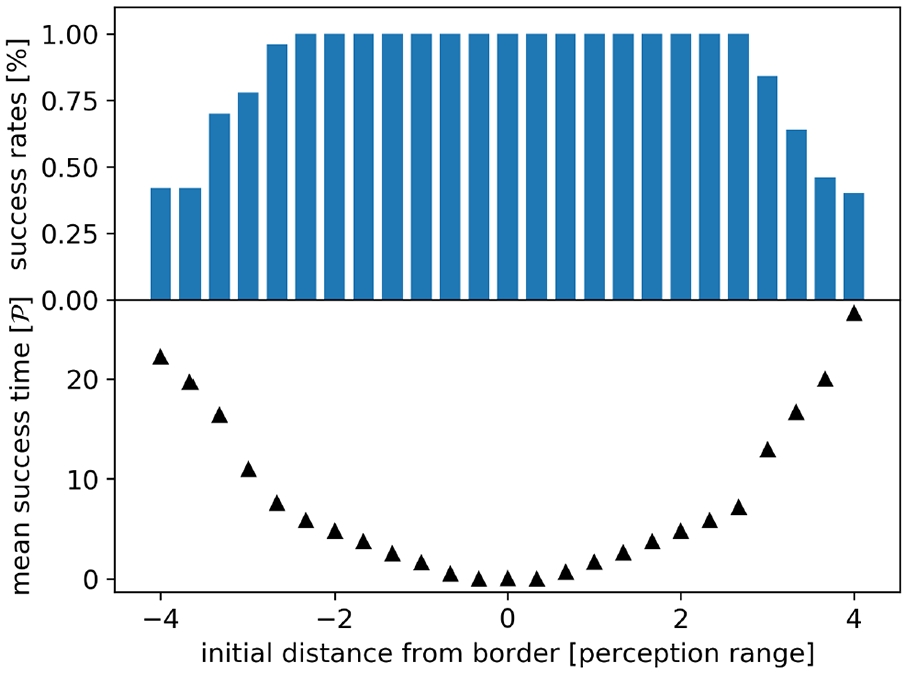
The top graph shows the success rates of the swarm reaching the border between the two domains versus its initial position relative to the border in our simulation experiment depicted in Figure 5. Each data point is the result of 50 independent simulations. After 50 negotiation periods, a simulation was stopped and counted as failed. The bottom graph shows the mean time for a swarm until it succeeds, only taking into account successful simulations.
This consistent behavior allows us to illustrate the expected collective decision of a swarm close to the border as shown in Figure 7. It shows the preferred direction of a swarm as arrows. Each arrow represents the preferred direction of a swarm with its center at the arrow’s location. For distances from the border
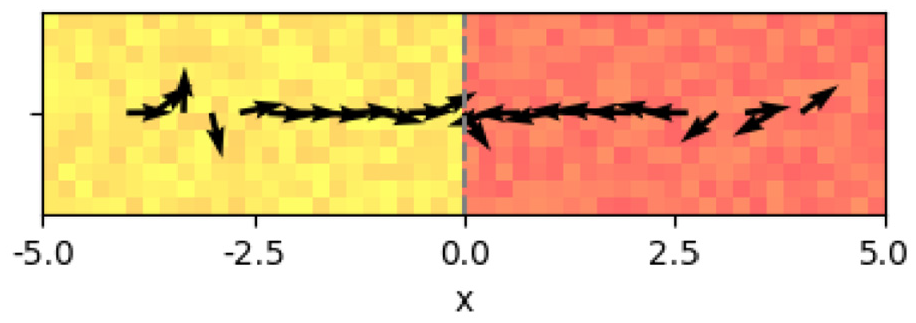
The preferred direction of a swarm in a system with two domains, yellow and red. Every arrow indicates the preferred direction of a swarm with its center at the arrow’s position. The arrows were calculated each with a single simulation and averaged over two negotiation periods.
5.2. Gradient distribution of environmental factors
Figure 8 shows a swarm close to a gradient in
(a) The trajectory of the position of the swarm (+) in a system with gradient distribution of environmental factors. In light gray circles, all
In Figure 9, we show the rate at which a swarm successfully maximizes its average diversity
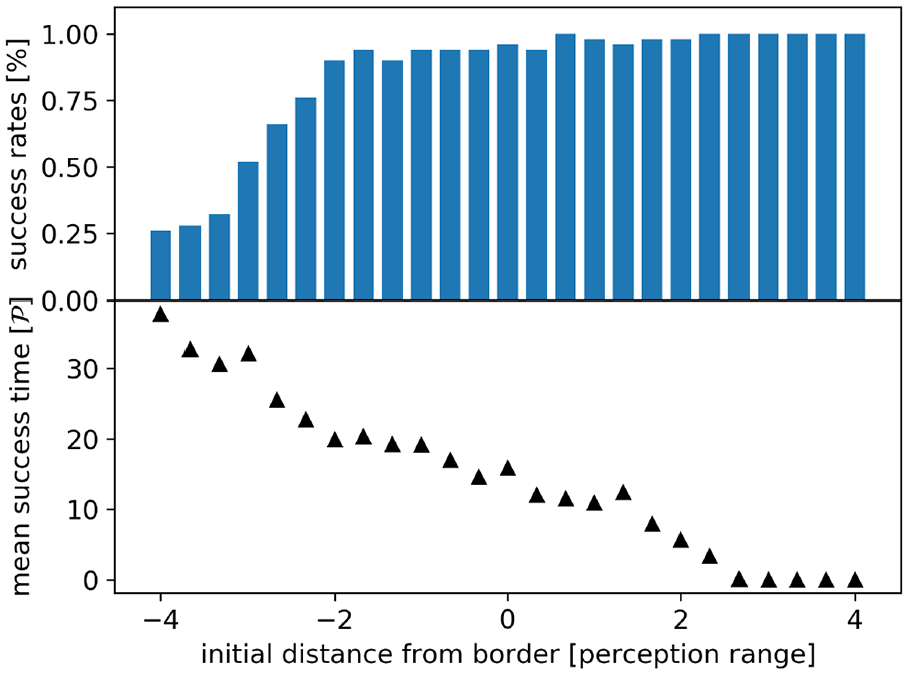
The top graph shows the success rates of the swarm reaching the border (as depicted in Figure 5) between the two domains versus the initial position of the swarm. For each distance, we conducted 50 independent simulations. After 50 negotiation periods, a simulation was stopped and counted as failed. The bottom graph shows the mean time for a swarm until it succeeds, only taking into account successful simulations.
As soon as the swarm is entirely on a linear gradient (for
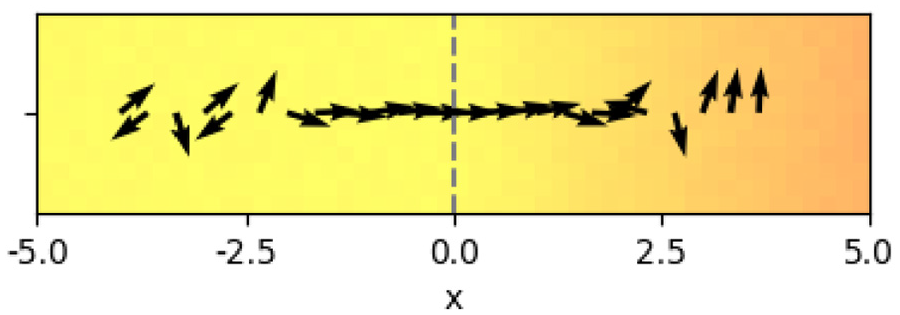
The preferred direction of a swarm in a system with (toward the right hand side) linearly increasing average levels of
5.3. Two-dimensional cloud
As a simple two-dimensional distribution of locally deviating environmental parameters, we consider an area of radially varying values of
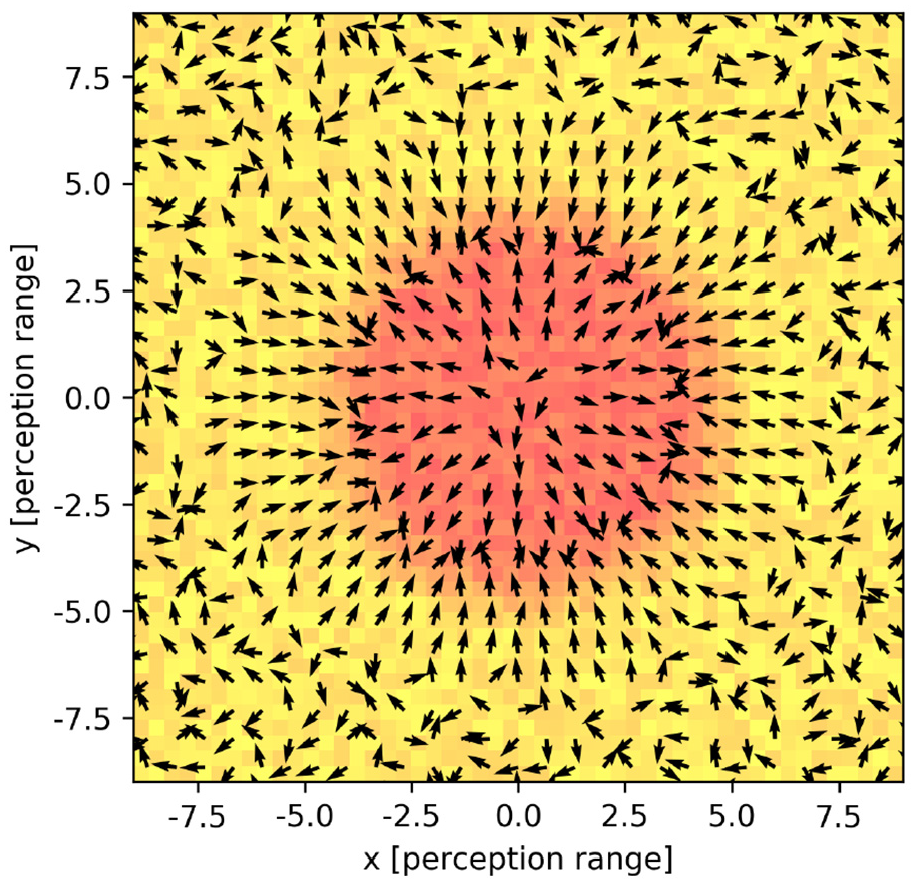
The preferred direction of a swarm within a system with a circular domain of levels of
5.4. Density of the swarm
A crucial parameter is the density of the swarm since connectivity among agents has to be ensured. If the number of agents
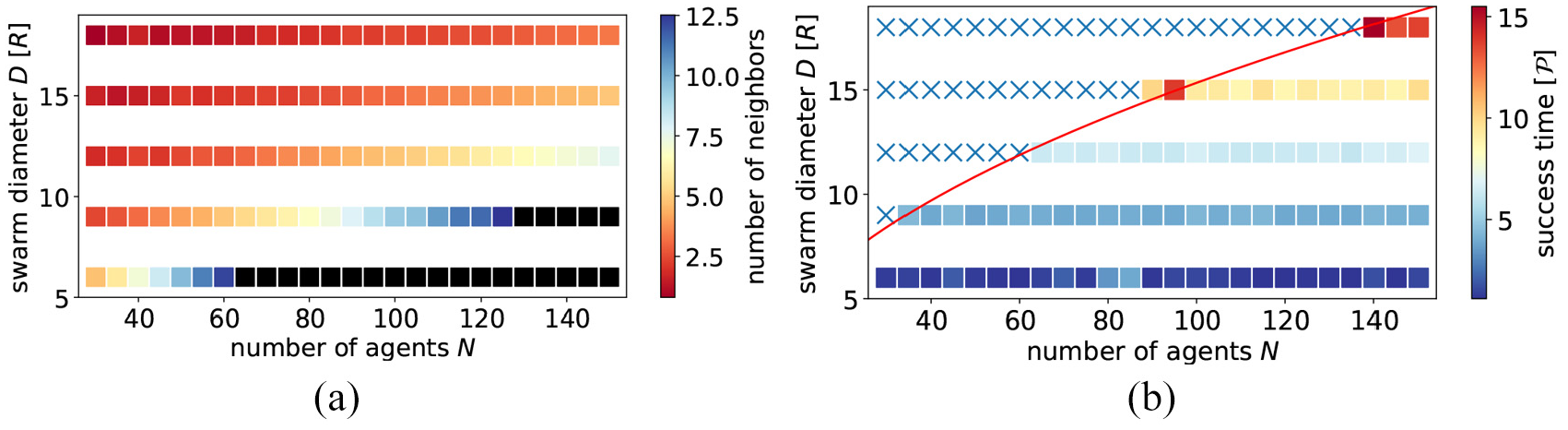
(a) The average number of neighbors of an agent with respect to the total number of agents
In Figure 12(b), we show the time (or number of negotiation periods) it took a swarm on average to reach the border between the two domains. If any of the 10 simulations per set of parameters were not counted as success, instead of the success time we plotted a cross. This is the case for most simulation in the top left of Figure 12(b), whereas all other sets of simulations were successful. The red line is a fit of shape
Given a sufficient connectivity within a swarm, the density does not influence functionality of the algorithm. The success times are relatively constant for each diameter of the swarm, respectively. With larger swarm diameter
6. Robotic experiments
In the following, we demonstrate the minimum feasibility of the presented algorithm on real robots. It is to be noted that while those minimal working experiments do not provide deeper inside into the performance or functionality of the algorithm, they serve as a proof of concept for the communication and decision-making process of the algorithm. The experiments therefore do not represent a fully functional swarm under real conditions.
For the robotic experiments, we used the aMussel robots, developed in the project subCULTron (Donati et al., 2017). They communicate via modulated light and are used, amongst others, for examining the anoxic waters phenomenon in the lagoon of Venice (Runca et al., 1996) by diving down to the floor of the lagoon. They are equipped with a variety of sensors and communication devices (Donati et al., 2017), including sensors for oxygen levels as well as ambient light. aMussels can only dive up to the water surface and down to the floor of a water body and have no other means of transportation of their own. In the field they are transported by a different type of robot, so-called “aPads,” which constitute a part of the heterogeneous robotic swarm within project subCULTron (Thenius et al., 2016). Accordingly, in the following experimental setup, aMussels can rather be viewed as stationary sensors.
6.1. Experimental setup
For testing the algorithm, we used aMussels under lab conditions outside water in an one-dimensional setup. Four aMussels were arranged in a linear manner in an arena as shown in Figure 13(a). As an emulation of oxygen gradients, we used an ambient light gradient which allowed us to perform the experiments in the lab outside of a water environment. We hence were able to establish precisely controlled environmental conditions and predictably changing environments. Two projectors were located above the arena and used for varying the light intensity on the arena floor as shown in Figure 13(b) and (c) where different parts of the floor are brightly illuminated and others dark. In this experiments, we considered two states of illumination: lights on or off. The setup of the system corresponds to the simulation of a swarm close to a sharp transition, presented in section
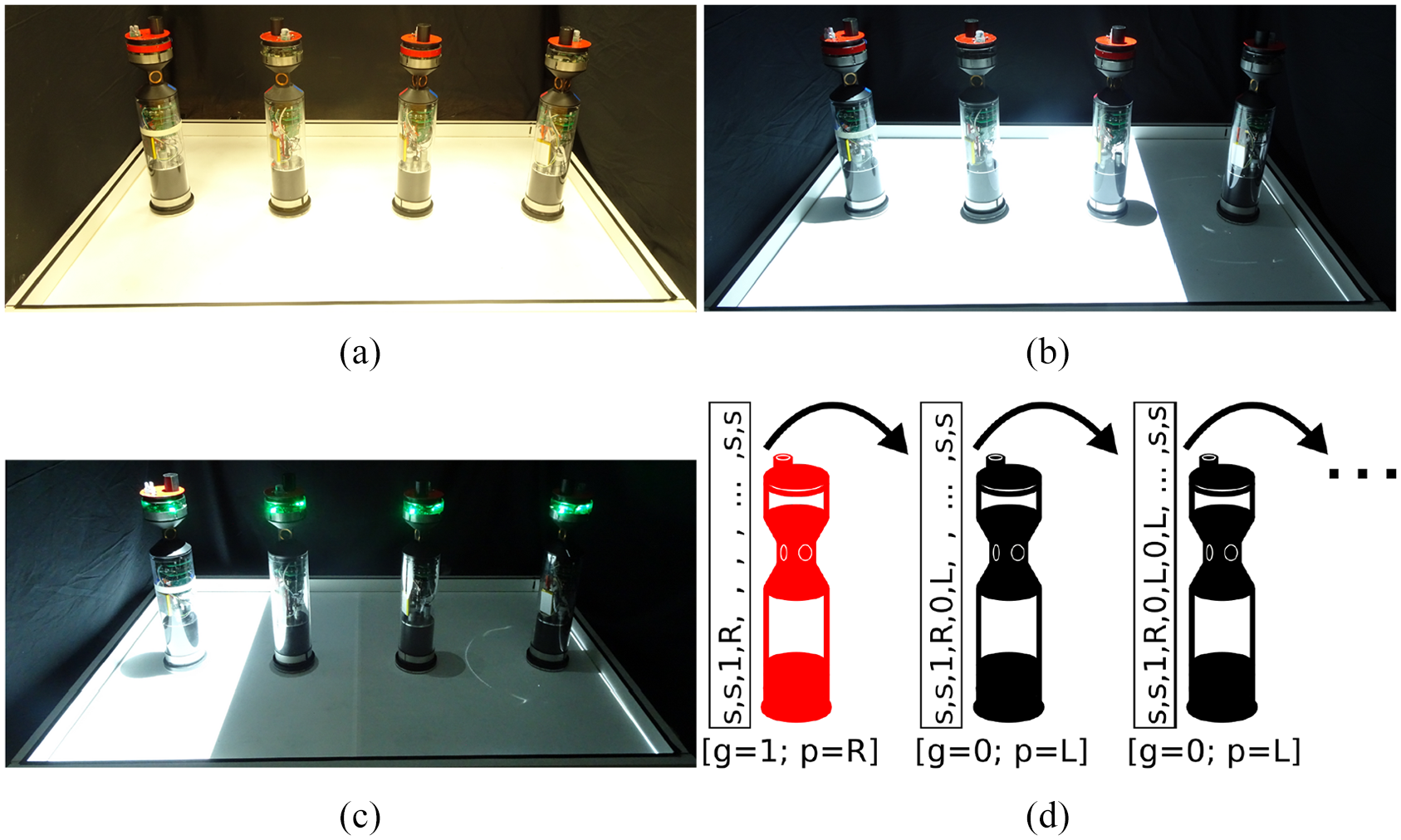
(a) Four aMussels in an arena used for the experiments. (b) The experimental setup with one of the six considered light configurations. The aMussels did not decide on a preferred direction yet as their top caps are not illuminated. (c) An experiment counted as successful with all aMussels agreeing on the common preferred direction toward the illuminated domain, indicated by the green LEDs in their top caps. (d) Schematic illustration of broadcasting and relaying messages.
The sensor for measuring ambient light values is located at the top cap of the aMussels. In this experiment, they communicated via modulated green light. We counted an experiment as successful as soon as the robots agreed on the direction toward the border between the two different domains. While lights for communication are located in the center of their body, the LED’s in their top caps (as visible in Figure 13(c) in green) indicated their preferred direction. From the perspective of the camera, green represents the preferred direction “left” and blue represents “right.”
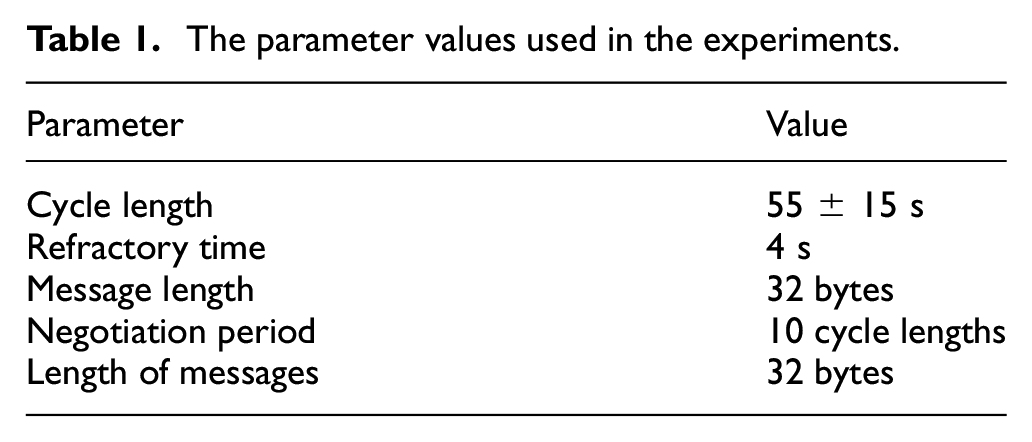
The algorithm introduced in section
The parameter values used in the experiments.
6.2. Experimental results
We conducted experiments for six different light configurations as schematically shown in Figure 14. The arrows shown below each configuration indicate the results of each set of experiments. The direction of the arrow indicates the collective decision of the swarm in which direction to move and its color denotes the color used by the aMussels to indicate the respective direction they decided on (e.g. see Figure 13(c)). For Figure 14(c), we counted an experiment as successful if the aMussels ultimately decided to move toward the border between the two domains of luminosity, that is, the two aMussels on the left choose to move toward the right and vice versa.
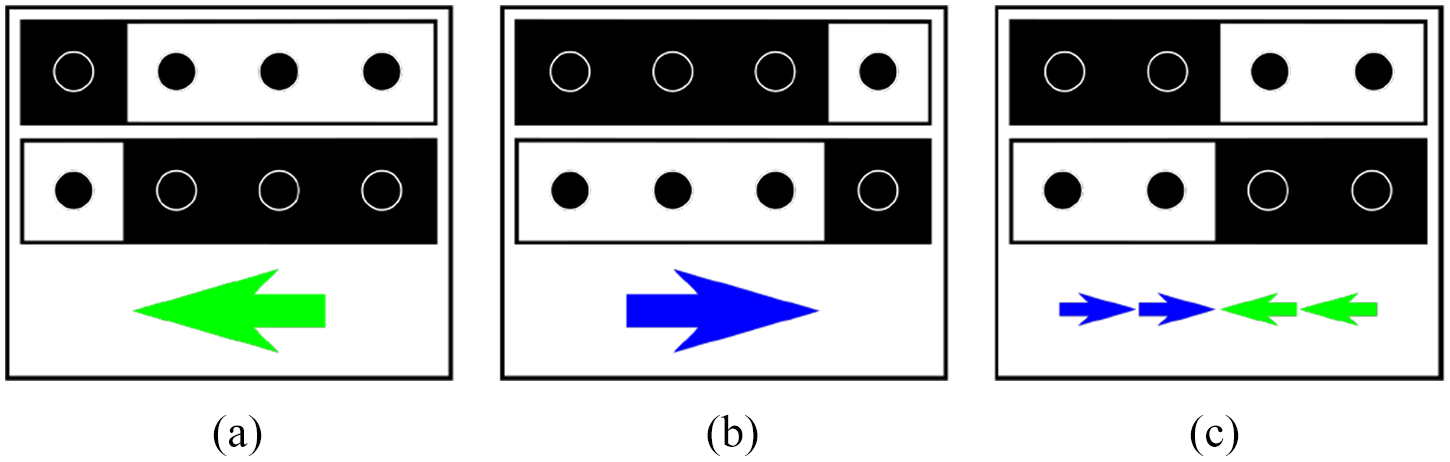
Six different light configurations which were tested in the experiments. (a, b) The configurations for which we expect aMussels to decide to move to the left and to the right, respectively. (c) The configurations for which we expect the aMussels to not agree on a common direction but to choose directions toward the border of the domains of different luminosity. The two aMussels left from the border decide to move to the right and vice versa.
For each light configuration, the experiment was independently repeated five times with a success rate of 100%. In order to test how well the aMussels adapt to changing light configurations, we conducted another set of experiments with alternating light configuration in which the robots need to change their previously reached consensus. After reaching consensus, the light configurations were changed such that the expected direction for the robots to decide on was inverted. The experiments were considered as successful if the robots correctly found consensus for the initial light configuration and then switched their opinion accordingly. We conducted this experiment five independent times with all experiments successful.
7. Discussion
In this article, we demonstrated how a simple bioinspired communication behavior can be used to reach a swarm-level decision of which direction to collectively relocate in order to maximize swarm-level information access. We also demonstrated how this algorithm works in robots of an underwater swarm with limited communication range and local information.
7.1. Simulations
We presented simulation results in section
7.2. Experiments
In section 6, we presented experimental results of a simplified laboratory demonstration of the algorithm implemented on robots using
While in the simulations messages were sent and received instantly, in experiments it is possible that several robots send a message quasi-simultaneously, thus potentially creating a corrupted message. However, in the unlikely event of robots perceiving such a message and accepting it as valid, this message quickly loses significance due to averaging over all incoming messages.
While in the simulations we consistently let the swarm come to a swarm-wide coherent decision where to move, in the experiments we considered an additional case. The decision result shown in Figure 14(c), where two aMussels decide to move left and two aMussels decide to move right, occurred for symmetric configurations of agents within the setup due to the way we implemented the algorithm on the aMussels. In the implementation of the algorithm on the aMussels, we intentionally left space for such a decision results due to two reasons: (1) it was more energy efficient, robust, and straightforward for the demonstration of CIMAX on the aMussels and (2) during field experiments aMussels are transported by a different species of robot, the aPads (Thenius et al., 2016), which will serve as an additional level to control for the case of such decision results. However, for increasing numbers of robots in the swarm, which are distributed in two dimensions, the probability of reaching such decision results becomes vanishingly small. Nonetheless, such cases need to be accounted for when implementing the algorithm on robotic swarms with respect to their specific abilities and target environments. Despite the implementation leaving space for the discussed decision results and the simplification of restricting the experiments to one dimension, they serve as a first proof of concept of the algorithm.
7.3. Swarm configuration and sizes of messages
It is also worth pointing out that the configuration of a swarm, for example, the spatial distribution of agents has a significant influence on the preferred direction. Let us consider a system of entirely random values in
7.4. Connectivity
For both simulations and experiments shown in this work, we assumed/ensured an interconnected swarm with every agent being connected to at least one neighbor at all times—in the presented simulations on average each agent was connected to five neighboring agents. This assumption allowed the demonstration of the conceptual functionality of the algorithm; however, it is not a feasible assumption in a real-world scenario. Although it could be shown in previous work how the presented underlying communication mechanism exhibits significant resilience to signal loss (Varughese et al., 2017), in practice a number of steps need to be taken in order to ensure connectivity of robots. In a real-world scenario, one has to account for possible occlusions, alignment problems, and other prospective challenges.
7.5. Simultaneous signaling and communication protocols
If two or more neighboring agents initiate sending of their preferred direction simultaneously, they do not receive any messages since they are insensitive during and briefly after sending. This algorithm is based on the statistical evaluation of large numbers of collected messages, wherefore this event generally does not affect the functionality of the algorithm.
In case
A more detailed analysis of such events within the type of presented swarm was carried out by Varughese et al. (2020). However, there are numerous approaches of implementing communication protocols compatible to the CIMAX algorithm. The presented communication mechanism is related to the family of gossip protocols, which comprises a large variety of different procedures and implementations for distributing information within a swarm or network (Birman, 2007; Shah et al., 2009).
7.6. Topology of target environment
In this work, we assumed an open environment and did not account for obstacles or physical hazards. This is a plausible assumption for parts of the lagoon of Venice, i.e., for the target environment of the robotic swarm this algorithm was originally designed for. However, for other types of swarms and in other types of environments, for instance environments containing domains which could lead to instant loss or failure of robots, one has to extend the algorithm to prevent the swarm from gradually losing members. One has to account for scenarios such as, when the majority of a swarm finds it favorable to move in a certain direction which, if moved along it, would lead to individual agents entering a hazardous domain and subsequently fail.
7.7. Measure for information
For evaluating incoming messages between robots, we used the variance of the received measurements. Although variance is a simple measure, it is effective with respect to functionality of the algorithm for a swarm measuring a single environmental parameter. Due to the statistical nature of variance, random noise in measurements does not affect the functionality of the algorithm, given that the amount of measurements used for calculating the variance needs to be sufficiently large to compensate the effects of random noise. In contrast to our approach, Cui et al. (2004) use a fuzzy logic–based evaluation. Such complex measures could be used in place of variance in the CIMAX algorithm when dealing with complex parameter spaces while following the same information gathering, evaluation, and collective decision phases. Furthermore, in this work, we only considered a single quantity being measured; however, this algorithm constitutes a general approach for collective decision-making in this particular class of swarms or networks. Multiple quantities can be considered, resulting in a swarm maximizing the data points within a phase space spanned by the number of considered quantities. This hence would enable such a swarm to autonomously explore an environment of high complexity in environmental parameters, taking into account previously collected data and adjusting to environmental changes and variations.
As the algorithm could be proven conceptually functional with respect to collective decision-making, it will be further implemented and tested in the future on larger swarms and in-field within the framework of subCULTron.
Footnotes
Handling Editor: Christoph Salge, University of Hertfordshire, United Kingdom
Declaration of Conflicting Interests
The author(s) declared no potential conflicts of interest with respect to the research, authorship, and/or publication of this article.
Funding
The author(s) disclosed receipt of the following financial support for the research, authorship, and/or publication of this article: This work was supported by EU-H2020 Project subCULTron, funded by the European Union’s Horizon 2020 research and innovation program under grant agreement no 640967. This work was supported by the University of Graz. Furthermore, this work was supported by the COLIBRI initiative at the University of Graz.
