



Abstract
Ambidextrous leaders, who can flexibly enact and alternate between seemingly contradictory behaviors (e.g., leader opening and closing behaviors), are widely believed to help teams navigate competing demands. Drawing on social information processing theory, we provide a more comprehensive and balanced understanding of the influence of ambidextrous leadership on team effectiveness. On the one hand, ambidextrous leaders encourage members to comprehensively consider different aspects of a task by implementing contradictory behaviors, which promotes more comprehensive decision-making to achieve team effectiveness. On the other hand, switching between contradictory behaviors places a burden on team members to interpret the leader’s intentions, which leads to heightened team role stress and ultimately undermines team effectiveness. We further theorize that leader instrumentality, the strategic capacity to identify contextual cues and align means with ends, moderates these effects. We conducted a multi-wave and multi-source field study of 169 policy analysis teams in southern China to test our model. The findings from our study provide support for an adverse indirect effect of ambidextrous leadership on team effectiveness, mediated by team role stress, which can be alleviated by high leader instrumentality. In addition, we find a positive indirect effect of ambidextrous leadership on team effectiveness through decision comprehensiveness, but only under a high level of leader instrumentality. These results provide a nuanced theoretical understanding of the complex nature of ambidextrous leadership and highlight the importance of boundary conditions associated with leader capabilities, which lead to mixed outcomes.
Keywords
In today’s fast-paced and uncertain business environment, teams are increasingly expected to balance competing demands, such as taking risks and exploring while adhering to rules and routines (e.g., Zhang et al., 2015, 2022). These contradictory expectations challenge traditional leadership approaches (e.g., transactional and transformational leadership), which largely lack the flexibility to respond to competing demands and tensions in dynamic team contexts (Raisch & Birkinshaw, 2008; Rosing et al., 2011; Zhang et al., 2015, 2022). In contrast, ambidextrous leaders, who can implement and alternate between seemingly opposing behaviors (e.g., encouraging experimentation with different ideas but establishing a work routine), can be particularly effective in navigating such tensions (Rosing et al., 2011). While emerging studies have linked ambidextrous leaders to desirable team outcomes, primarily learning and innovation performance, fundamental questions of how such leaders exert influence and under what conditions they are more effective remain largely underexplored (for reviews, see Gianzina & Paroutis, 2025; Rosing & Zacher, 2023). Therefore, we aim to provide a better understanding of the key mechanisms and boundary conditions through which ambidextrous leaders enable teams to improve their effectiveness.
Despite growing advancements in ambidextrous leadership research, two critical issues, largely ignored by existing literature, motivate this study. First, much of the literature remains anchored in linear innovation theories that assume that teams move sequentially through exploration and exploitation phases (e.g., Li et al., 2020; Mascareño et al., 2021; Reif et al., 2025). This perspective overlooks the dynamic, nonlinear realities of contemporary teams, particularly in contexts of continuous change, where leaders must flexibly and repeatedly switch between contrasting behaviors in complex and adaptive ways (e.g., Gianzina & Paroutis, 2025; Rosing & Zacher, 2023). Expanding the theoretical scope of ambidextrous leadership beyond innovation-centric settings is therefore essential. Second, limited attention has been given to the conditions under which ambidextrous leadership is (in)effective. Existing studies often assume that leaders can accurately time behavioral shifts and that team members consistently interpret these shifts as intended (e.g., Hou et al., 2023; Hu et al., 2020). However, in practice, such alignment is rarely guaranteed. Effective ambidextrous leadership requires not only sensitivity to strategic cues but also a good understanding of team members’ cognitive and emotional states. Addressing these gaps can yield a more nuanced and contextually grounded account of how ambidextrous leadership shapes team functioning in complex and dynamic business environments (O’Reilly & Tushman, 2011; Probst et al., 2011; Tushman et al., 2011).
To that end, we draw on social information processing (SIP) theory (Salancik & Pfeffer, 1978; Schnake & Dumler, 1987), which suggests that leader behaviors provide informational cues that shape how team members perceive task demands, interpret role expectations, and coordinate collective action. Through the lens of SIP, we propose that ambidextrous leadership exerts a double-edged influence on team effectiveness because leaders’ implementation of and alternation between distinct behaviors generate multiple and sometimes competing signals for team members (e.g., Ali et al., 2023; Liu et al., 2021; Wei et al., 2024; Zheng et al., 2023). On the positive side, the enactment of diverse leader behaviors may stimulate teams to broaden their perspective-taking and engage in deeper information processing (Jia et al., 2022; Rosing et al., 2011). Such processes can enhance team decision comprehensiveness, defined here as the extent to which a team systematically searches for, discusses, and integrates diverse information before making collective decisions. Greater comprehensiveness improves the quality of deliberation and increases the likelihood of effective outcomes. On the negative side, frequent behavioral alternation may produce inconsistent or ambiguous cues, thereby increasing the cognitive effort required for members to interpret expectations. This process can heighten team role stress, referring to the collective experience of role ambiguity regarding responsibilities or expectations within the team. Elevated role stress consumes psychological resources and undermines effective coordination. Furthermore, we introduce leader instrumentality as a boundary condition shaping these dual processes. Instrumental leaders demonstrate strong environmental monitoring and strategic formulation capabilities, enabling them to align ambidextrous behaviors with situational demands and team readiness (Antonakis & House, 2014). Under such leadership, team members are more likely to interpret behavioral diversity as purposeful guidance. Instrumental leaders also provide direction, support, and path–goal clarification, thereby reducing informational confusion associated with behavioral switching. In sum, leader instrumentality determines whether the informational benefits of ambidextrous leadership outweigh its psychological costs.
We make three key contributions to the literature on ambidextrous leadership and team effectiveness. First, by developing a conceptual framework (see Figure 1) that captures both the enhancing (e.g., decision comprehensiveness) and the constraining (e.g., role stress) effects of ambidextrous leadership, we move beyond its traditional innovation-centric framing and challenge the assumption of its uniformly positive impact (Klonek et al., 2023; Zacher & Rosing, 2015). This broader perspective provides a more nuanced understanding of its impact on team performance. Second, we identify leader instrumentality as a critical boundary condition that shapes the effectiveness of ambidextrous leadership. By clarifying the dual pathways through which ambidextrous leadership operates and highlighting the moderating role of leader instrumentality, we address a gap in understanding how individual leader characteristics influence the effectiveness of ambidextrous leadership (Gianzina & Paroutis, 2025; Mueller et al., 2020; Rosing & Zacher, 2023). Third, we extend SIP theory to encompass leadership behaviors that can shift rapidly and send mixed signals in team contexts. In doing so, we show how the clarity of these signals, shaped by leader characteristics, drives team dynamics (Schnake & Dumler, 1987). Our findings also offer practical guidance for organizations. For example, increased training relevant to ambidextrous leadership should be provided. Equipping leaders with instrumental skills enables them to provide goal-oriented direction, align tasks with members’ capabilities, and communicate effectively, thereby amplifying the benefits of ambidextrous leadership while minimizing its unintended costs. Theoretical model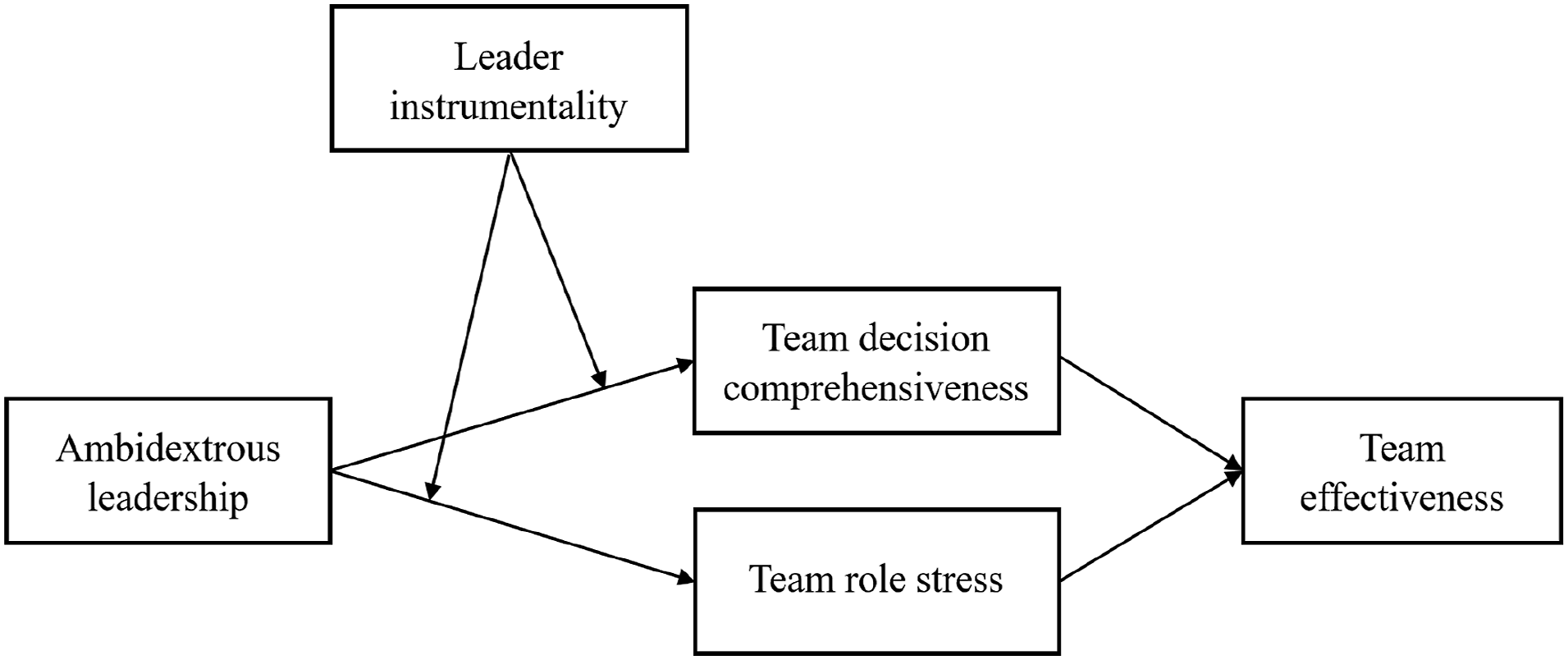
Theoretical Background and Hypothesis Development
Ambidextrous leadership, different from traditional leadership approaches that emphasize a single, stable behavioral style, involves dynamically alternating between two sets of contradictory leader behaviors (Gianzina & Paroutis, 2025; Rosing & Zacher, 2023). Scholars have recently deepened the conceptualization of ambidextrous leadership through three distinct perspectives: normative, power and cognitive (e.g., Jain et al., 2024). The normative perspective focuses on reconciling tension between established routines and adaptation, which is often reflected in the fusion of transformational and transactional leadership (e.g., Luo et al., 2018). The power perspective addresses the balance between participative (loose) and directive (tight) leadership, with the former enhancing adaptability and the latter ensuring efficient execution (e.g., Sanchez-Manzanares et al., 2020). The cognitive perspective highlights the contingency of leader behaviors, in which leaders oscillate between opening behaviors (e.g., fostering creativity and exploration) that aim to increase behavioral variation among members, and closing behaviors (e.g., enforcing structure and monitoring progress) that aim to reduce behavioral variation among members (e.g., Rosing et al., 2011; Sun et al., 2023). Since our ultimate goal is to explore how and when leaders affect team dynamics via their behavior enactment and switching, we anchor our theoretical reasoning in the cognitive perspective.
Recent studies have extended the ambidextrous leadership framework by incorporating temporal and spatial dimensions (Li et al., 2020), which has resulted in two distinct forms—simultaneous and punctuated ambidextrous leadership. Simultaneous ambidextrous leaders apply different leadership behaviors in distinct spaces (e.g., adopting distinct strategies for production and innovation teams). In contrast, punctuated ambidextrous leaders alternate their behaviors at different points in time (e.g., empowering team members in the early stages of a project but adopting a directive approach in later stages) (Li et al., 2020; Luo et al., 2018). Given that teams rely on concerted efforts to achieve common goals, leaders are unlikely to implement differentiated behaviors toward different members to achieve these goals. Instead, we suggest that punctuated ambidextrous leadership is more relevant in team studies, i.e., leaders conduct one type of behavior at a time and switch to the other type according to the situation (Harvey et al., 2023; Klonek et al., 2023). Furthermore, in the current study, we consider team ambidextrous leadership to reflect the case in which a leader implements two seemingly opposing behaviors (e.g., leader opening and closing behaviors) and switches between them to promote different team processes, activities, or actions (Rosing et al., 2011).
A conceptually distinct construct related to ambidextrous leadership is paradoxical leadership (Zhang et al., 2015, 2022). While both ambidextrous and paradoxical leadership are related to managing contradictory demands, they diverge in their theoretical foundations and approaches. Ambidextrous leadership, which is grounded in ambidexterity and contingency theories, emphasizes the flexible alternation between opposing behaviors (Gianzina & Paroutis, 2025; Rosing & Zacher, 2023). In contrast, paradoxical leadership, rooted in paradox theory, seeks to integrate competing goals simultaneously, highlighting their interdependence. Moreover, ambidextrous leadership typically involves reconciling non-inherently conflicting behaviors (e.g., transactional vs. transformational leadership), whereas paradoxical leadership confronts more incompatible tensions (e.g., maintaining control while showing empathy) (Zhang et al., 2015). Finally, ambidextrous leadership follows an “either-or” method, alternating between behaviors (Klonek et al., 2023), whereas paradoxical leadership adopts a “both-and” approach, aiming to concurrently enact opposing behaviors (Zhang et al., 2015, 2022).
Despite these differences, these two types of leaders also share commonalities. Since both types aim to address seemingly competing yet equally essential goals, they must keenly perceive and adapt to environmental changes to know when, where and how to implement two behaviors (Rosing et al., 2011; Zhang et al., 2022). Moreover, leaders of both types may have high-level cognitive complexity or flexibility that enables them to process and integrate conflicting viewpoints without becoming overwhelmed (Zhang et al., 2015). Moreover, since both types of leadership involve seemingly contradictory behavioral signals, leaders must ensure that followers understand the underlying rationale behind these behaviors, such as by providing a detailed vision (Fürstenberg et al., 2023; Zhang et al., 2022).
Although ambidextrous leadership has been explored extensively at the individual and organizational levels, its application at the team level remains underexamined (Gianzina & Paroutis, 2025; Jain et al., 2024; Rosing & Zacher, 2023). One reason for this is that few theories explain precisely why teams may require one type of leader behavior at certain times and another type at other times. Reflecting this gap, much of the current literature prioritizes team innovation outcomes, assuming a sequential move from idea generation to implementation and thus mapping neatly onto opening behaviors and closing behaviors (Klonek et al., 2023; Zacher & Rosing, 2015). However, this assumption oversimplifies real-world team functioning. In practice, teams may first need closing behaviors (e.g., tight cost control) before switching to opening behaviors (e.g., rapid innovation), or vice versa, depending on situational demands. To move beyond a strict focus on when each behavior is implemented, we require a broader framework with stronger explanatory power. Within this framework, we can explore the consequences of leaders engaging in different behaviors and continuously shifting between them.
To this end, we draw on SIP theory, which suggests that team members interpret leaders’ behaviors as social cues regarding values, expectations, and appropriateness, ultimately guiding their subsequent actions (Liu et al., 2021; Schnake & Dumler, 1987; Sun et al., 2023). By examining how and why leaders switch between different behavioral repertoires, we can better capture the dynamic and often contradictory nature of ambidextrous leadership within dynamic team contexts.
Leader Behavior and Team Dynamics: Social Information Processing Perspective
SIP theory suggests that individuals develop their perceptions and attitudes on the basis of salient social cues (from leaders or other members), including messages, behaviors, and feedback from those around them (Salancik & Pfeffer, 1978; Schnake & Dumler, 1987). Considering the central position of leaders in the team and their influence, SIP posits that they play a crucial role in guiding members to transform inputs or resources into shared outcomes through collective actions, processes, or states (Mathieu et al., 2008; Salancik & Pfeffer, 1978). Leaders’ actions (e.g., words, tone, and gestures) can be powerful signals shaping how team members interpret tasks, roles, and relational norms. Over time, these cues influence not only individual thoughts and feelings but also shared understandings and group norms within the team (Feng et al., 2025a; Hobfoll et al., 2018; Jabeen et al., 2022). Influenced by cues from different leader behaviors, team members may coordinate efforts or, conversely, disengage from tasks, which ultimately affects team effectiveness in different ways. Recent research on SIP has illustrated how specific leader behaviors (e.g., humble, servant, and ethical leadership) steer team processes (e.g., information exchange and conflict resolution) and shape psychological states (e.g., positive emotion and psychological safety), thereby influencing team outputs, such as decision-making, creativity, and performance (e.g., Ali et al., 2023; Liu et al., 2021; Wei et al., 2024; Zheng et al., 2023).
While traditional leadership approaches tend to provide consistent and unidimensional social cues, ambidextrous leadership presents more complex signals. By alternating between opening behaviors (e.g., promoting exploration, experimentation, and autonomy) and closing behaviors (e.g., emphasizing efficiency, discipline, and goal alignment), ambidextrous leaders send dual, and at times conflicting, social cues to team members. From the SIP perspective, we posit that these alternating behaviors may trigger two distinct team-level responses. On the one hand, such behavioral diversity may enhance the quality of team decision-making, as contrasting cues provide complementary information that helps address the blind spots inherent in singular leadership approaches and ultimately leads to greater decision comprehensiveness. On the other hand, frequent behavioral shifts may create informational ambiguity, which makes it difficult for team members to discern task expectations and role obligations and thereby increases role stress and undermines coordination. To capture these competing pathways, we conceptualize decision comprehensiveness and role stress as key mediators through which ambidextrous leadership influences team effectiveness.
Positive Effect of Ambidextrous Leadership
To achieve collective goals effectively, leaders usually need to encourage team members to gather extensive information from internal and external sources, generate and assess multiple alternatives, and evaluate various consequences before reaching a decision (Atuahene-Gima & Li, 2004; Feng et al., 2025a; Forbes, 2007; Harvey et al., 2023; Zheng et al., 2023). Team decision comprehensiveness reflects the extent to which team members engage in the above activities, and it can promote high-quality, well-aligned, and innovative solutions for achieving goals (e.g., Feng et al., 2025a; Souitaris & Maestro, 2010; Wei et al., 2024).
Drawing on SIP theory, we propose that ambidextrous leadership enhances team decision comprehensiveness by utilizing the interplay between opening behaviors and closing behaviors, which fosters both the breadth and depth of information processing. Leader opening behaviors, such as encouraging experimentation and supporting the open exchange of diverse viewpoints, create an environment where team members feel empowered to share diverse information and challenge assumptions (Edmondson, 1999). For example, a leader may begin a strategic planning meeting by explicitly inviting “wild” ideas or dissenting views, prompting the wide exploration of alternatives. In contrast, closing behaviors (e.g., emphasizing discipline, efficiency, and goal alignment) enable teams to critically evaluate, synthesize, and integrate the gathered information and converge on well-considered choices (Gianzina & Paroutis, 2025; Jia et al., 2022; Rosing et al., 2011). For example, a leader may direct the team to focus on feasibility, timelines, and integration after the initial brainstorming to ensure that the final decision is well grounded and actionable. Hence, by flexibly alternating between these two opposing yet complementary behavioral patterns, leaders guide teams in forming iterative cycles for information searching and activity implementation over time. As a result, teams can continually identify, refine and integrate new insights and thus maximize the completeness and quality of decision-making (e.g., Klonek et al., 2023; Rosing et al., 2011; Zacher & Rosing, 2015).
Comprehensive decision-making can strengthen team effectiveness through multiple ways. First, such decision-making increases decision quality by drawing on extensive information and mitigating cognitive biases, such as anchoring and confirmation bias (e.g., Frazier & Bowler, 2015; Stoverink et al., 2020). When teams systematically examine numerous alternatives and weigh them against various criteria, they develop more nuanced and optimal solutions (Souitaris & Maestro, 2010). Second, a comprehensive process fosters clear communication and coordination, as members collaborate on information gathering, deliberation, and task assignments. This collective engagement cultivates shared commitment (e.g., Frazier & Fainshmidt, 2012; Ng & Feldman, 2012) and instills confidence in the team’s ability to attain its goals (e.g., Feng et al., 2025b). Thus, ambidextrous leaders empower teams to achieve superior outcomes by promoting a thorough, iterative decision-making process. Hence, we propose the following hypothesis:
Ambidextrous leadership has a positive effect on team effectiveness through team decision comprehensiveness.
Negative Effect of Ambidextrous Leadership
Although ambidextrous leadership can increase decision comprehensiveness by providing diverse informational cues, its contradictory behaviors may also spark role stress within teams. From the SIP perspective, team members interpret leader actions, including goal setting, resource allocation, and feedback, as central signals of appropriate behaviors (Feng et al., 2025a; Wu et al., 2022; Zheng et al., 2023). When these signals are clear and consistent, members generally have little difficulty understanding their roles, conceptualized as the behavioral patterns that a leader expects from them (Kim et al., 2009; Savelsbergh et al., 2012). However, when cues become ambiguous or conflicting, team members struggle to meet the requisite expectations, which often results in role stress (Pearsall et al., 2009; Wu et al., 2022).
Ambidextrous leadership involves frequent shifts between opening behaviors (e.g., promoting exploration and autonomy) and closing behaviors (e.g., enforcing control and discipline). By alternating between these seemingly contradictory behavioral patterns, leaders may unintentionally send mixed signals about which tasks or priorities are most important (Rosing et al., 2011; Wu et al., 2022). This incongruence not only undermines the sense of structure but also heightens psychological discomfort (Fürstenberg et al., 2023). People typically seek predictability; thus, exposure to inconsistent or opposing cues can create anxiety (Zhang et al., 2022). Moreover, from a task-switching standpoint, members face cognitive switching costs, as they repeatedly recalibrate their actions to reconcile divergent (exploratory) and convergent (exploitative) demands (Fürstenberg et al., 2023; Rosing et al., 2011). As a result, the team is more likely to experience role stress, driven by uncertainty about how best to align with the leader’s shifting expectations.
Role stress is a harmful and depleting team experience that erodes members’ psychological and cognitive resources and often leads to negative emotional states, such as anxiety, frustration, and even depression (LePine et al., 2016). At the team level, high-level role stress impairs the group’s ability to coordinate actions toward shared goals, as members become uncertain about how to complete tasks or align their contributions effectively (Savelsbergh et al., 2012). This ambiguity can also trigger interpersonal tensions and result in debates, miscommunication, and conflict (Kim et al., 2009; Savelsbergh et al., 2012). Moreover, when teams fail to buffer this strain through clear role allocation or mutual support, members’ psychological contracts with the team are undermined (Razinskas et al., 2022). As a result, their investment in the task and commitment to team objectives may decline. To conserve depleted resources, individuals may withdraw mentally, reduce their effort, or disengage from collaboration. This downward spiral is further reinforced by diminished motivation and negative expectations, compounding the team’s emotional strain and dysfunction for team effectiveness (Pearsall et al., 2009; van Woerkom et al., 2016).
In sum, while ambidextrous leadership offers strategic adaptability through behavioral flexibility, it can also generate informational ambiguity that gives rise to team-level role stress. When left unaddressed, this stress erodes team coordination, strains interpersonal relationships, and undermines commitment to collective goals, which ultimately impairs team effectiveness. Thus, we propose the following hypothesis:
Ambidextrous leadership has a negative effect on team effectiveness through team role stress.
Thus far, we have clarified the double-edged sword effects of ambidextrous leadership. According to SIP theory, the degree to which members rely on social information to shape actions depends on their interpretation of the information, such as whether this information is coherent and in line with reality or whether the leader has sufficient influence (Salancik & Pfeffer, 1978). In this context, we posit that certain instrumental leader behaviors (i.e., providing clear goals, actionable guidance, and sufficient resources) can increase a leader’s situational awareness and enhance his or her capacity to offer coherent interpretive frames. These frames help team members better process and integrate the opposing signals displayed by ambidextrous leaders. Moreover, when leaders remain attuned to follower needs and tailor their support accordingly, they equip team members with the psychological and material resources necessary to cope with shifting demands. In summary, we propose that leader instrumentality is a boundary condition that affects whether team members can identify with, attach importance to, and actively follow the social cues conveyed by ambidextrous leaders.
Moderating Role of Leader Instrumentality
Leader instrumentality reflects leaders’ strategic and operational capabilities to ensure organizational goal attainment (Antonakis & House, 2014). Specifically, leader instrumentality involves the following four leader functions: (a) environmental monitoring, or scanning internal and external conditions to anticipate opportunities and risks; (b) strategy formulation and implementation, which involves translating vision into actionable goals and plans; (c) path–goal facilitation, whereby leaders offer direction, remove barriers, and allocate resources to enable progress; and (d) outcome monitoring, or the provision of timely feedback to reinforce or redirect team efforts (Antonakis & House, 2014; Durham et al., 1997). Although these four elements are related and mutually reinforcing, the first two relate to the leader’s ability to sensitively identify clues in the external environment to execute proper decisions (i.e., strategic leadership). In contrast, the latter two are related to the leader’s ability to perceive the states of subordinates and team members to provide support (i.e., follower work facilitation). Therefore, it can be speculated that the first two functions of leader instrumentality mainly amplify the positive effect of ambidextrous leadership, and the latter two functions mainly buffer its negative influence.
Instrumentality allows leaders to scan critical information in the environment, fully understand the current activities of the team, and be actively alert to various opportunities, which promotes efficient strategic planning and goal setting (Antonakis & House, 2014; Durham et al., 1997). In other words, the actions implemented by instrumental leaders are in line with both the external environment and the actual situation of the team. Therefore, team members perceive their environment as meaningful and manageable and invest greater cognitive effort into decision processes (Salancik & Pfeffer, 1978). The second dimension, strategy formulation and implementation, allows leaders to translate their visions into clear, actionable goals and plans (Antonakis & House, 2014). The provision of clear strategic structures channels team efforts toward comprehensive analysis rather than fragmented or biased decision-making (Thomas & McDaniel, 1990). In addition, attractive and practical strategic plans reinforce team members’ perception that the leader is competent and in control, thereby increasing team members’ trust in the leader’s judgment (Antonakis & House, 2014). Under the influence of the above factors, the team is more likely to effectively alternate between information search and integration according to the instructions of the leader to enhance comprehensive decision-making.
However, for ambidextrous leaders with low-level instrumentality, their information fails to align with and may even contradict a team’s current situation, and members may reject or ignore the leader’s cues (Zhang et al., 2022). Lacking strategic guidance, team members may default to favoring one side (e.g., innovation at the expense of efficiency) or engage in shallow information search. For example, if a leader shifts from encouraging exploration to demanding execution too soon, then it may signal to the team that the leader lacks strategic awareness, which may undermine trust and reduce the team’s willingness to follow signals from ambidextrous leaders.
Leader instrumentality moderates the positive relationship between ambidextrous leadership and team decision comprehensiveness such that the relationship is more positive under higher (vs. lower) leader instrumentality.
Notably, when ambidextrous leaders frequently switch between opening behaviors and closing behaviors, team members may struggle to interpret role expectations, which, in turn, may lead to heightened role stress. We propose that leader instrumentality can buffer this negative effect. Owing to their path–goal facilitation functions, ambidextrous leaders with high-level instrumentality provide explicit role requirements and clarify the rationale behind their behavioral shifts (Antonakis & House, 2014). Therefore, team members may find leaders’ ambidextrous behaviors to be reasonable and easier to follow, and they may ultimately spend less energy identifying, accepting, and integrating different expectations from leaders (Zhang et al., 2022). In addition, the outcome monitoring function of leader instrumentality offers timely and constructive feedback, which alleviates the cognitive load initially imposed by the behavioral complexity of ambidextrous leadership (Antonakis & House, 2014). Finally, SIP theory suggests that positive and actionable feedback reduces psychological uncertainty and enhances self-efficacy by reinforcing a sense of progress and competence (Wei et al., 2024; Yang et al., 2019). As such, team members are more likely to maintain motivation and confidence in interpreting leaders’ demands and experience less stress when they receive constructive feedback in due time.
In contrast, leaders with low-level instrumentality are less likely to provide structured guidance, timely feedback and a clear rationale underlying their different behaviors. Under such conditions, team members may spend many resources interpreting the inconsistent behavioral signals of ambidextrous leaders, which may lead to increased ambiguity, overload and conflict (i.e., role stress). Ultimately, teams may experience increased levels of role stress and, by extension, reduced overall effectiveness.
Leader instrumentality moderates the positive relationship between ambidextrous leadership and team role stress such that the relationship is less positive under higher (vs. lower) leader instrumentality.
The Integrated Model
Based on the above discussion and empirical evidence, it is logical to propose and test a moderated parallel mediation model. Ambidextrous leaders encourage teams to search for information more extensively and analyze and integrate knowledge more deeply, thereby enhancing the comprehensiveness of decision-making. However, frequent shifts between opening behaviors and closing behaviors may also introduce conflicting signals and ambiguous role expectations, thus increasing team role stress. Instrumentality allows leaders to scan internal and external conditions to identify emerging opportunities, threats, and trends while remaining sensitive to the status and progress of team members. As a result, team members are more motivated to accept the influence of their leaders to search for and integrate information. Moreover, team members can obtain necessary goal clarification and feedback to clearly understand their roles. In sum, leader instrumentality amplifies the positive impact of ambidextrous leadership on team decision comprehensiveness and weakens the linkage between ambidextrous leadership and role stress. Ultimately, these mechanisms strengthen the impact of ambidextrous leadership on team effectiveness when leader instrumentality is high (rather than low). Therefore, we propose the following:
Leader instrumentality moderates the indirect effect of ambidextrous leadership on team effectiveness through team decision comprehensiveness such that this influence is more positive under higher (vs. lower) leader instrumentality.
Leader instrumentality moderates the indirect effect of ambidextrous leadership on team effectiveness through team role stress such that this influence is less negative under higher (vs. lower) leader instrumentality.
Method
Study Background
We invited a large data center in southern China to participate in this study. The center’s primary mission is to support macro-level policy formulation and performance monitoring for local government bureaus. At the end of each year, the center organizes consulting teams to review the performance of various government bureaus (e.g., human resources, business, and financial bureaus) across different cities in China. In essence, the center serves as a watch dog for the local government(s). Each team is assigned to one bureau (hereinafter referred to as the client), for extended engagements (e.g., three months or above) to deliver consulting services. During this period, the teams conduct field investigations, review official document, and generate a comprehensive assessment report that includes quantitative ratings, diagnostic analyses, and actionable recommendations for improvement.
These teams are semi-permanent units with stable cores of senior analysts and long-tenured (two years or more) leaders who bring domain-specific experience and methodological depth. A smaller proportion of members are seconded temporarily from other center departments to support the annual performance evaluation process. Team size ranges from three to twenty members, and performance evaluation cycles last two to four months, depending on the client-bureau’s size and task complexity. The teams are demographically and professionally diverse, comprising professionals from various fields, including economics, data analytics, public policy, and management science.
The above setting is suitable for the present study’s purpose of examining ambidextrous leadership, as team leaders must continuously balance and integrate dual demands: encouraging members’ creativity and independent judgment while maintaining methodological consistency and compliance with institutional standards. Team tasks are highly interdependent, often nonlinear, and unfold under time pressure and bureaucratic scrutiny, requiring leaders to dynamically switch between opening (empowering, risk-taking) and closing (monitoring, control-oriented) behaviors. Consequently, this setting provides a naturally occurring context for observing how ambidextrous leadership behaviors operate and how they translate into team effectiveness. Our study covered one consulting cycle from October 2023 to March 2024. Prior to conducting the study, we obtained Institutional Review Board (IRB) approval from Monash University (ID: 40314).
Procedure and Sample
After receiving support from the senior managers of the data center, we invited a total of 1,114 team members and 183 leaders from 183 teams. We held a briefing to explain the survey procedure and informed participants about the survey’s voluntary nature and their freedom to withdraw at any time. To increase the response rate, we administered the surveys during monthly summary meetings, which all team leaders and members were required to attend. To ensure that all participants clearly understood the survey content, we presented each item on slides while providing verbal explanations of the instructions. Participants then recorded their responses on paper-based answer sheets using pencils. These answer sheets were designed for optical mark recognition, allowing responses to be automatically scanned and converted into data files, thereby minimizing manual entry errors. Each answer sheet contained a team identification code assigned by the researchers and an anonymous individual code generated by participants based on the combination of the last three digits of their national ID number and the last three digits of their phone number. This procedure allowed us to match responses across time points and within teams while maintaining participant anonymity.
We collected data from multiple sources (i.e., team members, leaders, and clients) and over three waves (one month as one interval). The human resources department provided us the demographic information of all participants, prior to the investigation. At Time 1, team members evaluated two types of leader behaviors (opening behaviors and closing behaviors). Team leaders evaluated their instrumentality. Given that we posit instrumentality as leaders’ ability, self-assessments can better capture their internalized beliefs about their role in promoting environmental monitoring, strategy formulation, path–goal facilitation, and outcome monitoring (e.g., Antonakis & House, 2014; Rus et al., 2010). At Time 2, team members provided information about decision comprehensiveness and role stress. At Time 3, the clients evaluated the overall effectiveness of each team.
We excluded responses from participants who requested withdrawal from the study during data collection (N = 105), as well as those showing patterned responses (e.g., 123456 or 151515) (N = 72). Data from fourteen teams (including 150 team members) was excluded from subsequent analysis due to clients canceling their tasks. Our final sample consisted of 787 team members and 169 team leaders from 169 teams (team member response rate = 70.64%; leader response rate = 92.34%). The response rate within the team (number of valid individual response/number of team member) ranged from 55.56 to 100% (M = 81.64%, SD = 0.39).
Among the final team samples, the size ranged from four to nine members (M = 4.67, SD = 1.09). The average proportion of male members was 50% (SD = 0.50), indicating that most teams were gender-balanced. The mean of team members’ ages was 33.70 years (SD = 4.66). The mean proportion of members with prior experience with such consulting project was 0.47 (SD = 0.50). The average team education level was 3.53 years (SD = 0.96), corresponding approximately to a college or bachelor’s degree. The average team tenure was 10.91 months (SD = 2.72), with a range from 5 to 32 months. Overall, the teams demonstrated moderate diversity in terms of age, tenure, and education, while maintaining a balanced gender composition. In the leader sample, the average age was 37.70 years (SD = 4.18); 59.80% were male with the majority of them having a bachelor’s degree or above (95.30%), and the average length of their tenure was 15.38 months (SD = 4.38).
Measures
All the scales were translated into Chinese via the back-translation method (Brislin, 1980; Klotz et al., 2023). Ambidextrous leadership and leader instrumentality were rated on a frequency scale (1 = never and 6 = always), whereas the remaining measures were rated on an agreement scale (1 = totally disagree, 6 = totally agree). The scales for focal variables are provided in Appendix A. For the data provided by team members, we calculated the intraclass correlations (ICCs) and within-group interrater agreement (R wg ) to assess the suitability of aggregating individual scores for team-level analysis. Specifically, R wg reflects interrater agreement, or the extent to which members within a team provide consistent ratings of a construct, indicating consensus among respondents (James et al., 1984). Intraclass correlations quantify the extent to which responses cluster within teams and the reliability of team means. Specifically, ICC(1) reflects the proportion of variance in individual responses attributable to team membership (i.e., the strength of the group effect), whereas ICC(2) indicates the reliability of the team-level mean scores (Bliese, 2000). High R wg values indicate sufficient within-team consensus, while satisfactory ICCs demonstrate that between-team variance is large enough to justify aggregation.
Ambidextrous Leadership
We used the eight-item scale developed by Zacher and Wilden (2014), which includes four items for leader opening behaviors (α = 0.92, R wg = 0.91, ICC (1) = 0.60, ICC(2) = 0.88) and four items for closing behaviors (α = 0.90, R wg = 0.92, ICC(1) = 0.61, ICC(2) = 0.88). A sample item is “Our team leader encourages experimentation with different ideas”. We confirm that leader opening and closing behaviors have good discrimination validity, as the two-factor model indicates a better fit (χ2[16] = 130.32, CFI = 0.98, TLI = 0.96, RMSEA = 0.09, SRMR = 0.03) than the one-factor model does (χ2[18] = 2086, CFI = 0.58, TLI = 0.36, RMSEA = 0.38, SRMR = 0.28). We operationalized ambidextrous leadership using a harmonic balance index, calculated as (opening behaviors × closing behaviors)/(opening behaviors + closing behaviors). This formulation captures the joint and mutually constraining nature of opening and closing behaviors, ensuring that high ambidexterity emerges only when both dimensions are simultaneously elevated (Cao et al., 2009; Shi et al., 2022; Wei et al., 2014).
Leader Instrumentality
We used the eight-item scale developed by Antonakis and House (2014) to assess this construct. A sample item is “I ensure that the team’s vision is understood in specific terms”. Cronbach’s α = 0.94. In line with the conceptualization proposed by Antonakis and House (2014), we treated leader instrumentality as a higher-order construct and confirmed that the higher-order model consisting of two dimensions yielded a good model fit (χ2[21] = 36.90, CFI = 0.99, TLI = 0.98, RMSEA = 0.07, SRMR = 0.04) than the lower-order, single-factor model with all items loaded on it (χ2[20] = 189.06, CFI = 0.86, TLI = 0.81, RMSEA = 0.22, SRMR = 0.08). Following Edwards (2001)’ work, and given that the higher-order factor structure showed excellent model fit and the two dimensions were highly correlated (r = 0.75, p < 0.001), we computed the mean of all items to represent leader instrumentality in subsequent analyses.
Team Effectiveness
We used the ten-item performance metric developed by Hoegl and Gemuenden (2001) to assess team performance from the client perspective. We made minor wording adjustments to reflect the characteristics of the research setting while preserving the original construct meaning. A sample item was “The final report provided by the team was of high quality”. Cronbach’s α = 0.87. The average score can represent overall team effectiveness (Hoegl & Gemuenden, 2001).
Team Role Stress
Numerous empirical studies (e.g., Kim et al., 2009; Pearsall et al., 2009) and meta-analyses (e.g., Jackson & Schuler, 1985; Tubre & Collins, 2000) have suggested that role ambiguity is the most typical and representative role stress. Therefore, we adopted the five-item role ambiguity scale from Savelsbergh et al. (2012) to measure team role stress. A sample item is “The team does not fully understand what is expected of it”. Cronbach’s α = 0.89, R wg = 0.93, ICC (1) = 0.62, and ICC (2) = 0.88.
Team Decision Comprehensiveness
We used the five-item scale from Wei et al. (2024) to assess team decision comprehensiveness. A sample item is “We consider many different criteria and issues when deciding the course of action to take”. Cronbach’s α = 0.87, R wg = 0.84, ICC (1) = 0.51, and ICC (2) = 0.83.
Control Variables
In line with prior research, we included several control variables that may confound the focal relationships. First, team size was controlled because it can affect the efficiency and coordination of group interactions. Larger teams often face more challenges in communication and integration, which can influence both leadership processes and team outcomes (Feng et al., 2025a, 2025b). Second, following Ni et al. (2022), we captured demographic diversity by calculating the within-team variance in members’ gender, age, education level, and years of work experience. Demographic diversity may influence how team members interpret and respond to leaders’ behaviors, as diverse teams tend to exhibit more divergent perspectives, cognitive styles, and expectations (van Knippenberg & Schippers, 2007). Third, we assessed project experience similarity, as prior shared experience can facilitate mutual understanding, transactive memory, and coordination efficiency within teams (Reagans et al., 2005). We asked whether team members had previously worked on similar projects (1 = yes, 0 = no) and then averaged the responses at the team level. Finally, because all teams were required to complete consulting projects within a fixed time frame, we controlled for their sense of urgency, which reflects perceived time pressure that may affect team dynamics and decision processes (Maruping et al., 2015). At Time 1, team leaders completed a four-item scale developed by Maruping et al. (2015) (Cronbach’s α = 0.87). A sample item is “The amount of time provided to complete our tasks is short.”
Analytical Approach
To ensure the conceptual distinctiveness of our key constructs, we first conducted a series of confirmatory factor analyses (CFAs) by AMOS to examine the measurement properties of each scale used in our model. We aggregated individual responses to the team level prior to conducting regressions. We tested the full model, which included two mediators and one moderator simultaneously, using PROCESS in SPSS software to calculate the regression coefficients (Hayes, 2012). We conducted bootstrapping with 5,000 resamples to generate bias-corrected confidence intervals (CIs) for the mediation effects. To examine moderation, we plotted interaction effects at high (+1 SD) and low (−1 SD) levels of the moderator and tested the significance of these slopes (Preacher et al., 2007). Finally, we tested the indirect effects through a bootstrapping approach and examined the CIs for the conditional indirect effects at high and low levels of leader instrumentality. Following the suggestion of Hayes (2015), we also reported the index of moderated mediation, a more robust indicator.
Results
Preliminary Analysis
CFA Results at the Team Level
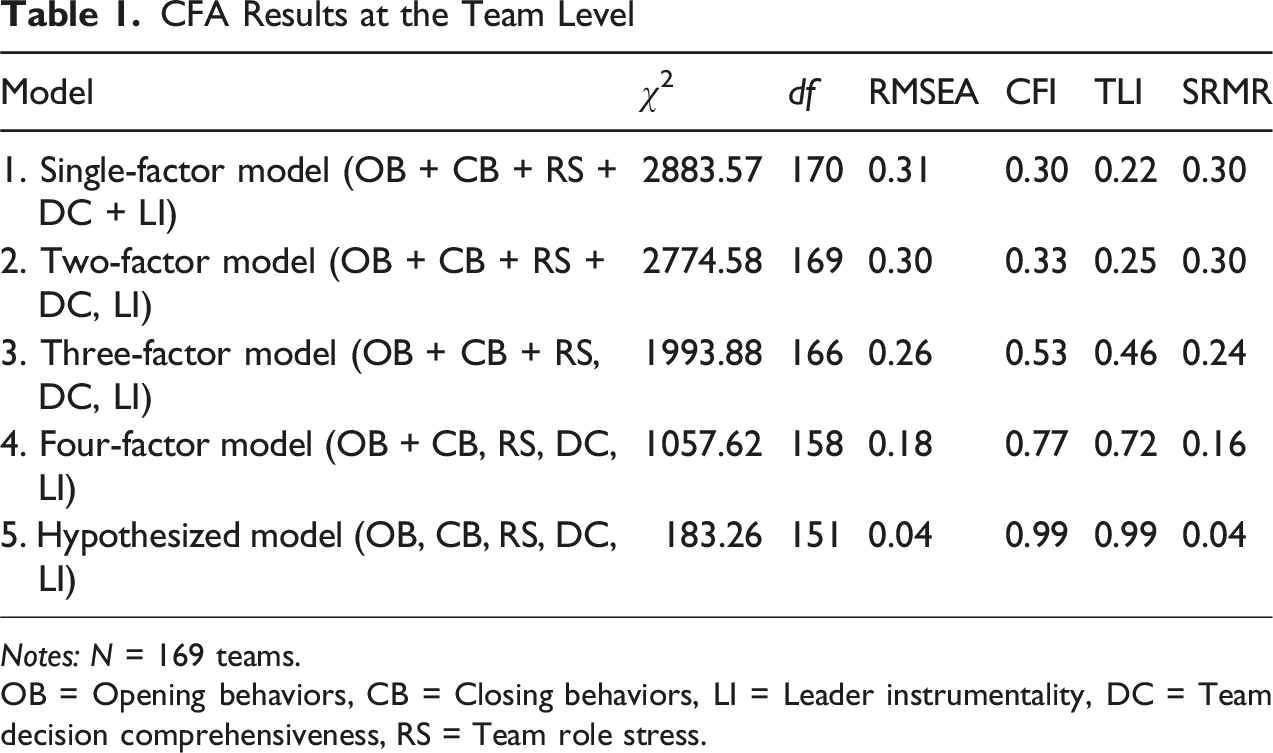
Notes: N = 169 teams.
OB = Opening behaviors, CB = Closing behaviors, LI = Leader instrumentality, DC = Team decision comprehensiveness, RS = Team role stress.
Means, Standard Deviations and Correlations
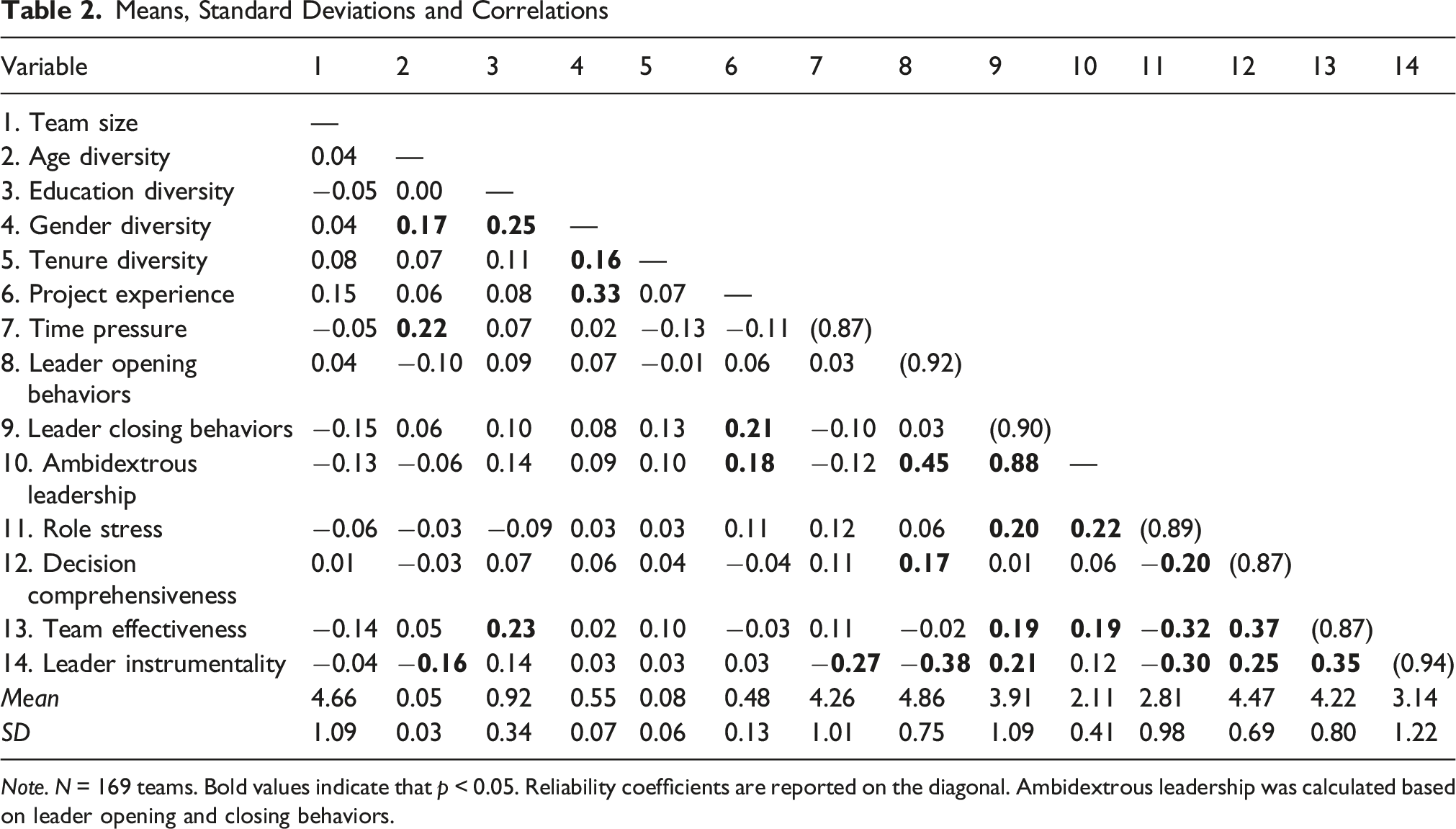
Note. N = 169 teams. Bold values indicate that p < 0.05. Reliability coefficients are reported on the diagonal. Ambidextrous leadership was calculated based on leader opening and closing behaviors.
Hypothesis Testing
Direct Effect
Regression Results
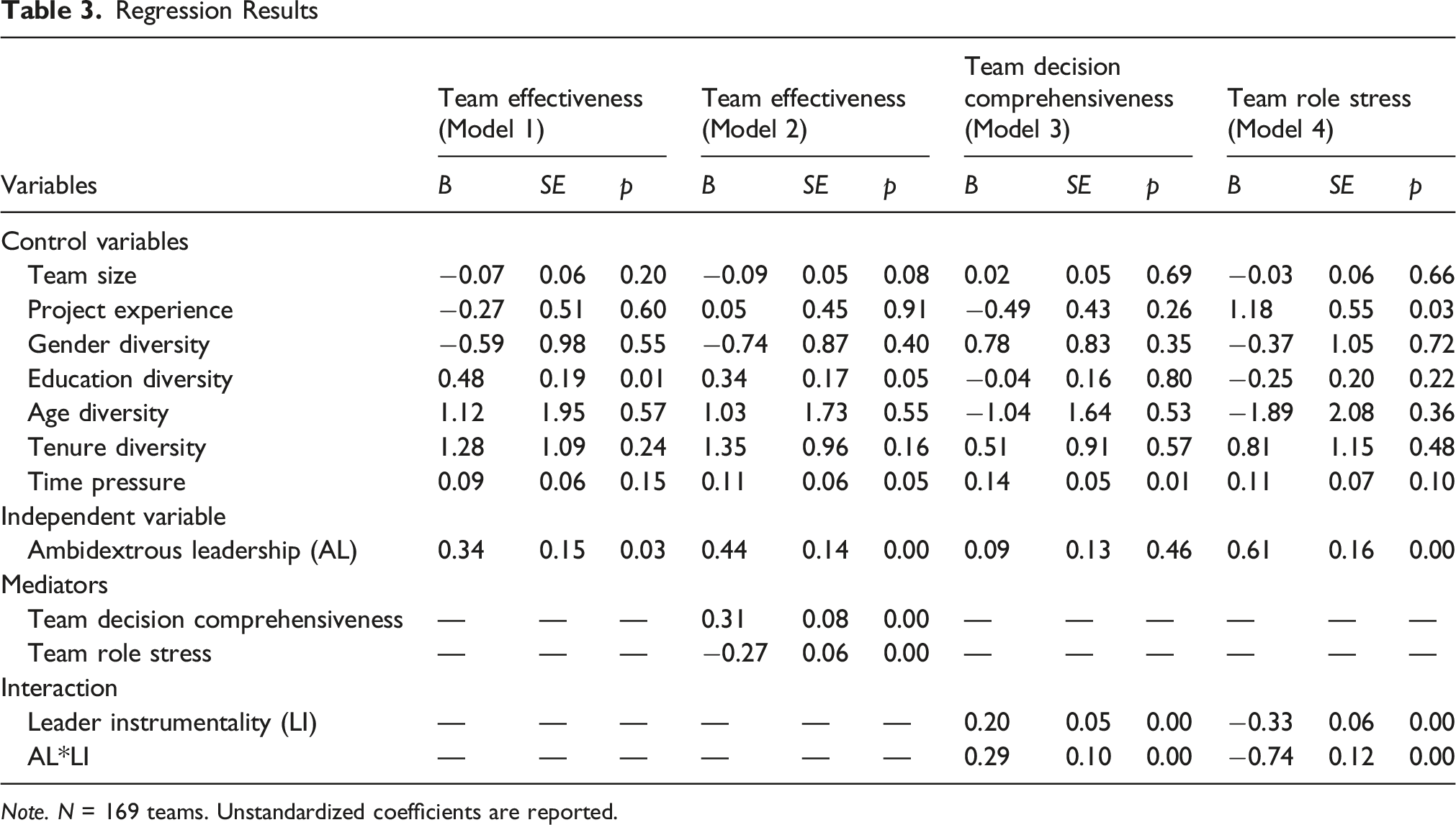
Note. N = 169 teams. Unstandardized coefficients are reported.
Mediation Effect
We test the mediating roles of team decision comprehensiveness and team role stress using bootstrapping with 5,000 resamples. In Table 3, according to the Model 1, the total effect model (excluding mediators), ambidextrous leadership is positively related to team effectiveness (b = 0.34, p = 0.03). When the mediators are included (Model 2), the direct effect of ambidextrous leadership remains positive and significant (b = 0.44, p < 0.01). The increase in magnitude of the direct effect suggests the presence of countervailing indirect effects. The specific indirect effect through team decision comprehensiveness is not significant (indirect effect = 0.04, 95% CI = [−0.08, 0.16]), accounting for approximately 12% of the total effect in magnitude. Thus, Hypothesis 1 is not supported. In contrast, the indirect effect through team role stress is negative and significant (indirect effect = −0.15, 95% CI = [−0.28, −0.05]), accounting for approximately 44% of the total effect in absolute magnitude. Therefore, Hypothesis 2 is supported. The total indirect effect is negative but not statistically significant (95% CI included zero), indicating that the positive and negative indirect mechanisms partially offset each other. Notably, the contrast between the two specific indirect effects is significant (contrast = 0.19, 95% CI = [0.06, 0.33]), demonstrating that the mediating effect of team role stress is significantly stronger than that of team decision comprehensiveness. Taken together, these results are consistent with an inconsistent (competitive) mediation pattern, in which ambidextrous leadership directly enhances team effectiveness while simultaneously exerting a countervailing indirect effect through increased team role stress.
Moderating Effect
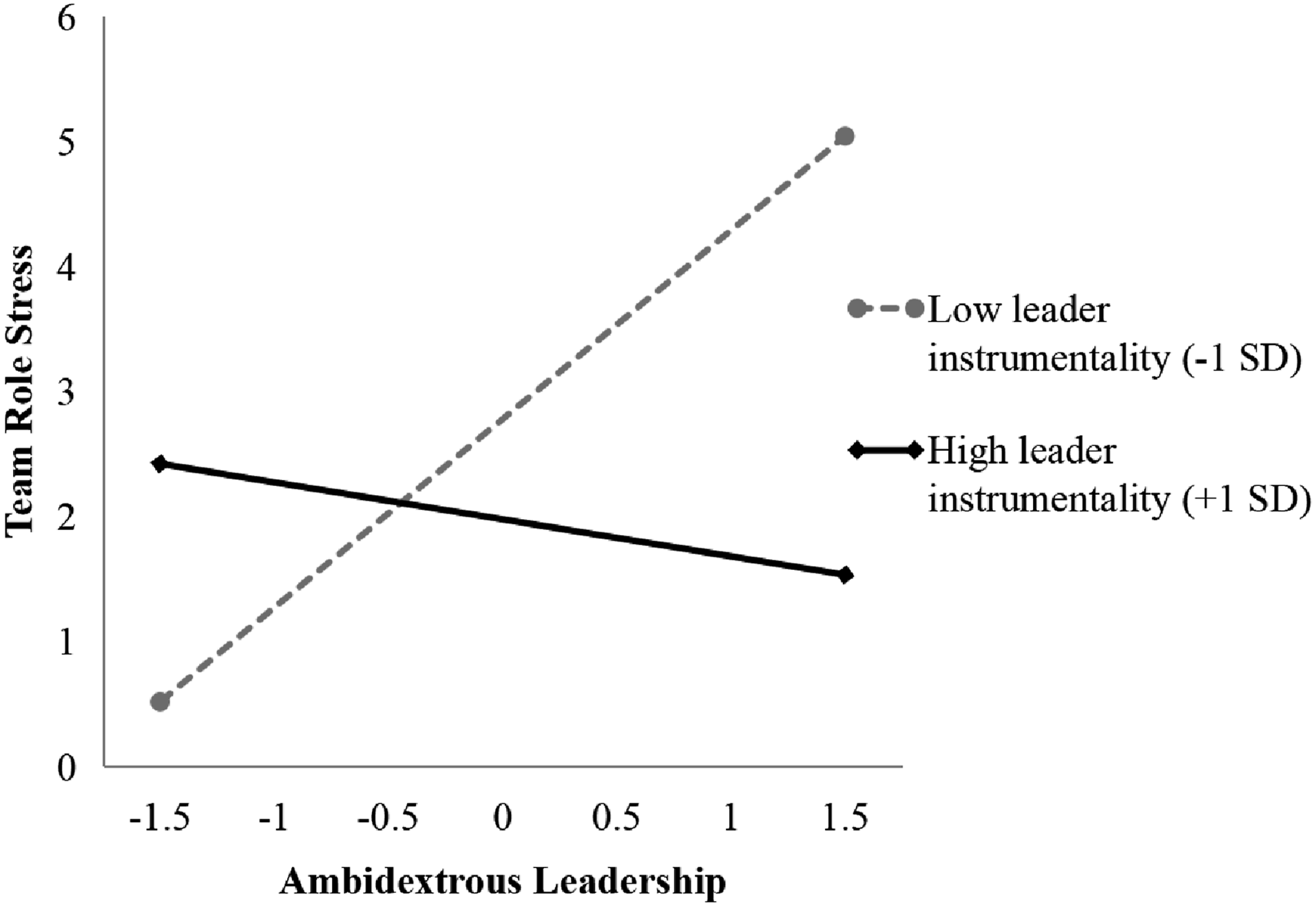
As indicated by Model 3 and Model 4, leader instrumentality moderates the positive impact of ambidextrous leadership on team decision comprehensiveness (β = 0.29, p < 0.01) and moderates its effect on team role stress (β = −0.74, p < 0.01), supporting Hypotheses 3a and 3b, respectively. As shown in Figure 2, when leader instrumentality is low, ambidextrous leadership is negatively but nonsignificantly related to team decision comprehensiveness (simple slope = −0.26, p = 0.136). In contrast, when leader instrumentality is high, ambidextrous leadership has a positive and significant effect on team decision comprehensiveness (simple slope = 0.45, p = 0.010). These findings indicate that leader instrumentality strengthens and reverses the relationship between ambidextrous leadership and team decision comprehensiveness, such that the effect becomes significantly positive at high levels of leader instrumentality. As depicted in Figure 3, ambidextrous leadership is positively related to team role stress when leader instrumentality is low (simple slope = 1.51, p < 0.001). However, when leader instrumentality is high, the relationship becomes negative and nonsignificant (simple slope = −0.30, p = 0.181). This cross-over interaction suggests that leader instrumentality fundamentally alters the effect of ambidextrous leadership on team role stress, attenuating and ultimately reversing its positive association. Interaction effect of ambidextrous leadership and leader instrumentality on team decision comprehensiveness Interaction effect of ambidextrous leadership and leader instrumentality on team role stress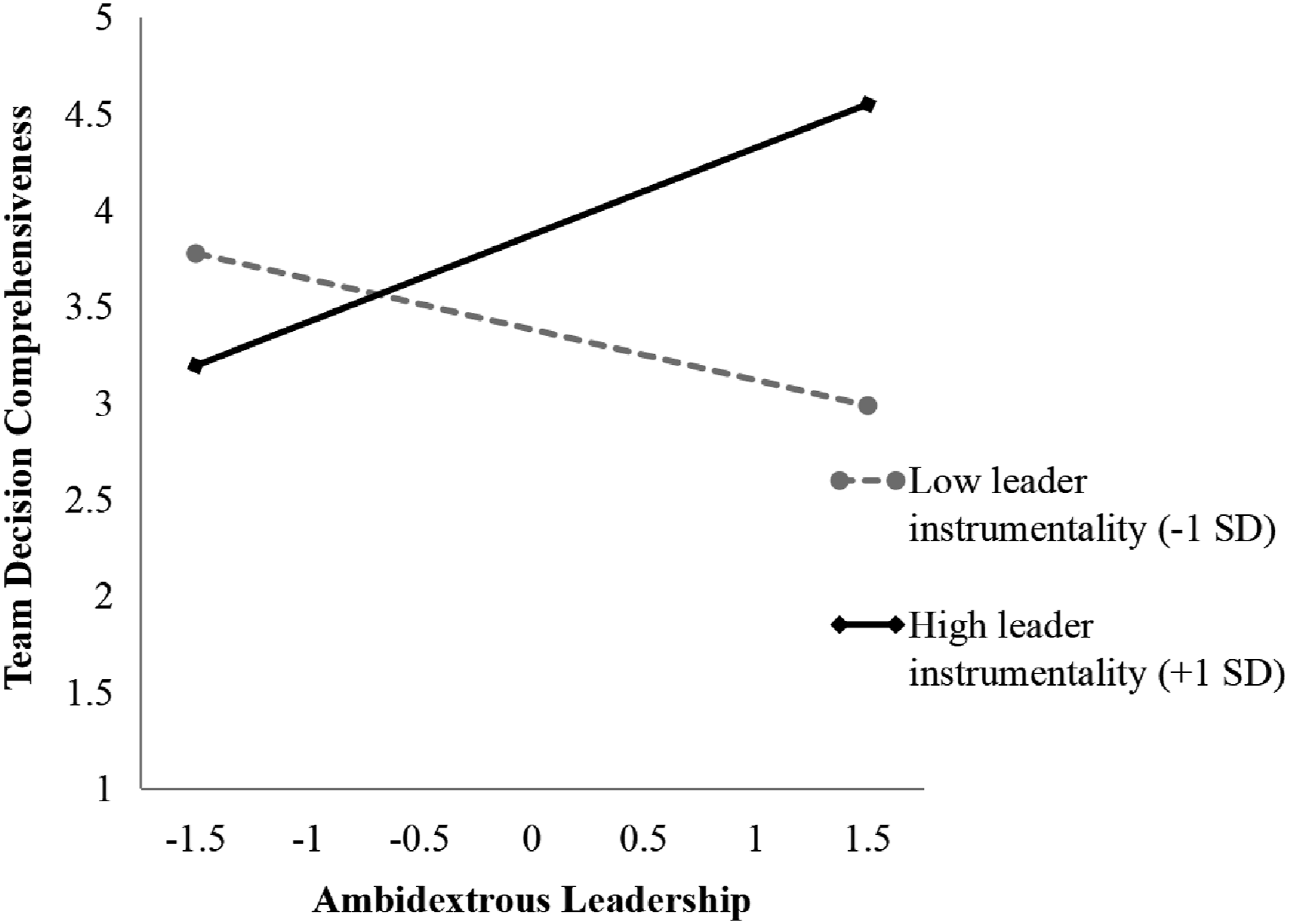
Moderated Mediation Effects
Results of Conditional Indirect Effects
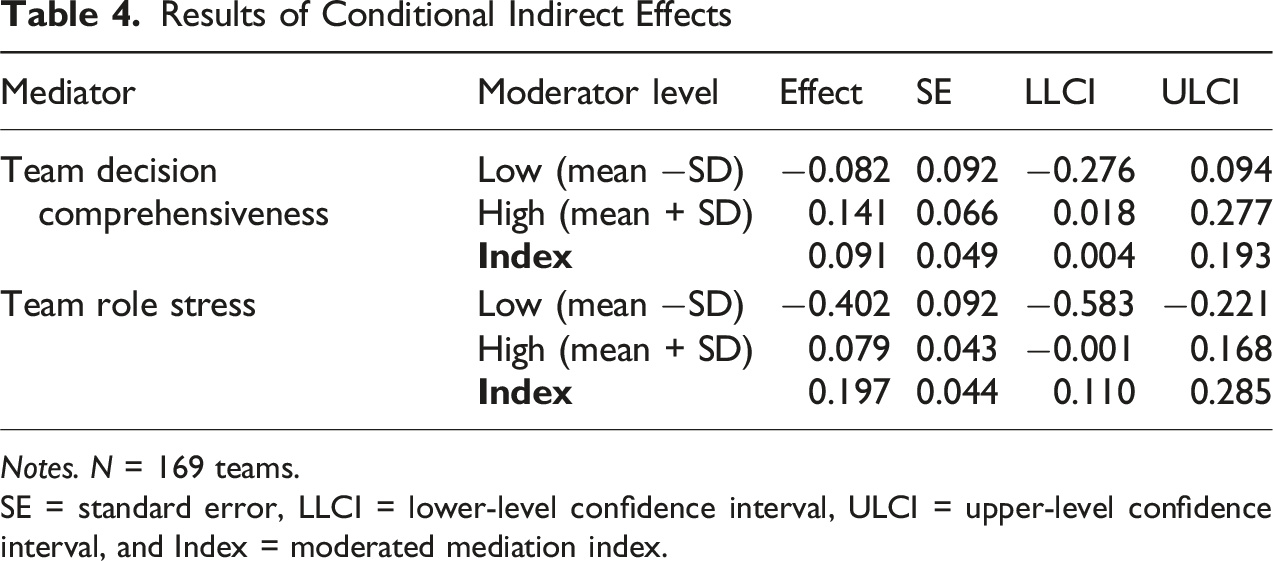
Notes. N = 169 teams.
SE = standard error, LLCI = lower-level confidence interval, ULCI = upper-level confidence interval, and Index = moderated mediation index.
Robustness Check
We conduct several supplementary analyses to enhance confidence in our findings. Detailed results are reported in Appendix B.
First, we compare model estimates with and without control variables. The exclusion of controls does not substantively alter the direction, magnitude, or significance of the focal relationships. The results also remain stable after incorporating leaders’ demographic characteristics (i.e., gender, age, education, and organizational tenure), suggesting that our findings are unlikely to be driven by these background factors.
Second, we examine a theoretically plausible alternative explanation. Prior research suggests that ambidextrous leadership may impose competing performance demands on followers: exploration-oriented behaviors increase task complexity and require experimentation, whereas exploitation-oriented behaviors emphasize efficiency and execution (Rosing et al., 2011). When enacted in tandem, such dual expectations may heighten quantitative workload, that is, the volume of work required within limited time frames, and require followers to switch across tasks and information-processing routines (Wu et al., 2022). Accordingly, one might argue that the observed effects on team decision comprehensiveness and role stress reflect elevated workload rather than the mechanisms proposed in our model. To evaluate this competing explanation, we measure team workload at Time 2 using the Quantitative Workload Inventory (Cronbach’s α = 0.87; Spector & Jex, 1998). The moderated mediation index associated with team workload is not significant (95% CI = [−0.060, 0.044]), providing no support for the alternative pathway. In contrast, the moderated mediation indices for our theorized mechanisms remain significant: for team decision comprehensiveness, the index is 0.091 (95% CI = [0.003, 0.191]), and for team role stress, the index is 0.185 (95% CI = [0.103, 0.265]). These results further reinforce the robustness of our proposed model.
Together, these results confirm that our findings are not driven by model specification, leader demographics, or elevated team workload, thereby strengthening the validity of our proposed theoretical model.
Discussion
Over the past decade, ambidextrous leaders, who are capable of flexibly enacting and switching between opposing behaviors, have been widely recognized as promising in helping teams address competing demands and goals to achieve effectiveness. This study offers a more balanced view, suggesting that such leadership exerts a double-edged sword effect on team effectiveness, contingent upon leader instrumentality. Data from 169 policy analysis teams supported our proposed negative pathway (i.e., ambidextrous leadership → team role stress → team effectiveness) but not the positive pathway (i.e., ambidextrous leadership → team decision comprehensiveness → team effectiveness). Furthermore, we found that leader instrumentality mitigates the negative effect by moderating the relationship between ambidextrous leadership and team role stress. However, the positive effect pathway emerges only when leaders demonstrate high levels of instrumentality. These unexpected findings, while partly attributable to research design, may also point to a key conclusion: the negative effects of ambidextrous leadership tend to persist, whereas its positive influence depends on whether leaders possess sufficient instrumentality.
Importantly, our findings suggest that the assumed benefits of ambidextrous leadership, such as fostering comprehensive decision-making processes, do not automatically materialize when leaders display behavioral flexibility. Instead, these benefits require a supportive interpretive and structural context. Without sufficient instrumentality to frame and stabilize their contradictory cues, ambidextrous leaders may inadvertently generate confusion rather than integration, thereby suppressing the very decision comprehensiveness they are theorized to enhance. Thus, our findings invite a theoretical re-evaluation of ambidextrous leadership: its dual-edged nature may be inherent, with the “positive edge” being contingent rather than universal. This insight contributes a critical nuance to the literature by showing that ambidexterity is not inherently effective but conditionally functional, depending on whether leaders can translate behavioral complexity into instrumental clarity.
Theoretical Implications
We make three theoretical contributions. First, we expand the understanding of how ambidextrous leadership influences team functioning. Previous studies have predominantly relied on linear stage models of innovation (e.g., Klonek et al., 2023; Rosing et al., 2011), assuming that engagement in contradictory behaviors is uniformly beneficial for progress through the innovation process. Such an approach almost exclusively adopts innovative linear stage models (e.g., Klonek et al., 2023; Rosing et al., 2011) under the assumption that leaders should engage in two contradictory behaviors to progress through the innovation stage. However, this perspective oversimplifies the complexity of team processes and phenomena, thereby limiting the exploration of non-innovation-related outcomes (Gianzina & Paroutis, 2025; Luo et al., 2018; Rosing et al., 2011). Drawing on SIP theory, we provide a broad, concrete, and testable framework to capture the double-edged sword impact of ambidextrous leadership on team performance. We demonstrate that while ambidextrous leadership can enhance team effectiveness by promoting decision comprehensiveness, it can simultaneously undermine this effectiveness by increasing role stress. In doing so, we respond to recent calls (e.g., Gianzina & Paroutis, 2025; Jia et al., 2024) to examine the “dark side” of ambidextrous leadership, providing a more balanced and nuanced understanding of its impact on teams and thus supplementing the previously biased understanding of its positive role.
Second, we advance research on when ambidextrous leadership is more effective by challenging the implicit assumption that it is uniformly beneficial. Prior theorization (e.g., Gianzina & Paroutis, 2025; Rosing et al., 2011; Rosing & Zacher, 2023) assumes that ambidextrous leaders can flexibly switch between opening and closing behaviors to match situational demands, thus yielding consistently positive outcomes. However, our findings reveal a more nuanced reality: ambidextrous leadership inherently imposes cognitive and role demands on team members, who must interpret and respond to contradictory behavioral cues. As a result, it tends to increase team role stress and undermine team effectiveness unless leaders possess high instrumentality. From a social information processing perspective, leader behaviors act as cues that shape followers’ sensemaking of task priorities (Liu et al., 2021; Sun et al., 2023). When these cues are inconsistent and lack instrumental structure, they heighten ambiguity and psychological strain (e.g., Fürstenberg et al., 2023). By contrast, highly instrumental leaders provide clear goals, structured processes, and tangible resources that make their paradoxical behaviors more interpretable and actionable. These instrumental cues enable team members to integrate conflicting demands into a coherent decision framework, thereby enhancing decision comprehensiveness and effectiveness. By incorporating leader instrumentality as an enabling boundary condition, we refine contingency perspectives on ambidextrous leadership and highlight that its positive edge materializes only when leaders can translate paradoxical demands into structured, goal-oriented guidance.
Third, we extend the application of social information processing (SIP) theory in leadership research by broadening its explanatory scope from followers’ sensemaking to leaders’ sensegiving. Traditional SIP-based studies emphasize how employees form cognitions and behaviors from the social cues conveyed by leadership behaviors (e.g., Wei et al., 2024; Yang et al., 2019), implicitly treating leaders as static sources of information. Our study demonstrates that leaders themselves also engage in information processing when deciding what cues to send and when to enact them. By introducing leader instrumentality—the strategic capacity to interpret contextual cues and align behavioral means with desired ends—we highlight the upstream information-processing processes through which leaders shape the social environment that followers later interpret. This reconceptualization positions leaders as both interpreters and transmitters of social information, thus enriching SIP’s micro-foundations. Furthermore, by examining the dynamic alternation between contradictory leader behaviors, we show that the variability and interplay of behavioral cues can themselves constitute potent informational signals. This insight opens new pathways for applying SIP to understand how fluctuating or paradoxical leader behaviors influence follower cognition and team functioning.
Managerial Implications
This study offers several practical implications for leadership development and organizational practice. First, our findings indicate that ambidextrous leadership is a double-edged sword. While combining opening and closing behaviors of ambidextrous leadership can help leaders address competing demands, it may also heighten team role stress and confusion if not properly managed. Therefore, when implementing ambidextrous practices, leaders should actively monitor whether team members experience role overload or ambiguity and provide timely guidance or emotional support (Fürstenberg et al., 2023). Organizations should also exercise caution in promoting ambidextrous leadership as a universal model. Without sufficient leader instrumentality, efforts to balance contradictory goals may lead to inefficiency or dysfunctional tension rather than synergy.
Second, we highlight leader instrumentality as a core competency in leader selection, development, and promotion. Instrumentality enables leaders to translate paradoxical goals into actionable strategies, clarify performance pathways, and align team efforts with broader objectives. Although instrumentality is often refined through accumulated experience, it can be intentionally cultivated through structured cross-training and strategic learning programs (Antonakis & House, 2014). For instance, leadership workshops can encourage experienced leaders to share practices for integrating internal and external information, setting clear milestones, and creating “goal enablement maps” that specify needed resources for achieving key performance indicators (KPIs). Continuous feedback and reflective reviews can further enhance leaders’ instrumental capability and help teams maintain focus and alignment with organizational priorities.
Finally, while ambidextrous leadership is not always the optimal solution, it remains an essential capability in today’s organizations, where competing goals and paradoxical demands are inevitable. Foundational elements such as cognitive and behavioral complexity, emotional intelligence, and comprehensive thinking can be strengthened through targeted training (Klonek et al., 2023; Rosing et al., 2011; Zhang et al., 2022). Thus, organizations may consider implementing integrated development programs that simultaneously enhance leaders’ ambidextrous skills and instrumental thinking. Such dual-focus initiatives can equip leaders to manage paradoxes productively, thereby transforming potential tension into coordinated team performance and adaptive organizational outcomes.
Limitations and Future Research Directions
While this study offers several contributions, it also has limitations that warrant careful consideration. First, our sample was drawn exclusively from mainland China, and participants were younger and more highly educated than those in prior studies (e.g., Wu et al., 2022). In addition, many East Asian workplaces are characterized by relatively high power distance, where leaders’ directives are more likely to be viewed as legitimate and authoritative (Zhang et al., 2015, 2022). Under such cultural conditions, teams may rely more heavily on leaders’ guidance and engage less in independent collective deliberation. This cultural context may have amplified the influence of ambidextrous leadership on team processes while simultaneously shaping how team members interpreted behavioral switching. Moreover, although our sample size (N = 169) was sufficient to detect moderate-to-large effects, it may not have provided adequate statistical power to identify smaller yet potentially meaningful positive associations. Consequently, the absence of a significant positive relationship between ambidextrous leadership and decision comprehensiveness should be interpreted cautiously. Future research should replicate these findings in non-East Asian cultural contexts and employ larger, multi-wave samples to determine whether the nonsignificant pathway reflects a true null effect or limited power to detect subtle but meaningful relationships.
Second, the research design imposes methodological constraints. Because the data are cross-sectional, causal inferences cannot be established (Taris & Kompier, 2014). Although we mitigated common method bias by collecting key variables from different sources (e.g., followers rated leader behaviors, whereas leaders reported their instrumentality), team assignments to clients were not necessarily random. Such assignments may have reflected prior client relationships or domain-specific expertise, potentially confounding observed associations. Furthermore, we did not examine whether the results differ depending on the source of leadership ratings (e.g., subordinate-rated versus supervisor-rated leadership). Future research could triangulate key constructs across multiple informants, including team members, leaders, supervisors, and external stakeholders, to enhance robustness and reduce single-source bias (Turner et al., 2017).
Third, the theoretical framework could be expanded by incorporating additional mechanisms and boundary conditions. Beyond the cognitive pathways emphasized in social information processing (SIP) theory, emotion-based processes may also play a central role. Switching between contradictory leader behaviors may evoke ambivalent emotional reactions that simultaneously enhance motivation and increase psychological strain among leaders and team members (Stollberger et al., 2023). Additionally, leader characteristics such as cognitive flexibility and growth mindset may facilitate effective behavioral switching, whereas excessive workload or toxic team climates may constrain leaders’ ability to enact ambidexterity (Klonek et al., 2023; Zhang et al., 2015). Integrating resource-based perspectives with SIP theory may further enrich the explanatory model. For instance, team decision comprehensiveness may facilitate resource acquisition through improved information processing, whereas team role stress may accelerate resource depletion. Examining these dynamics would yield a more differentiated understanding of both the benefits and costs associated with ambidextrous leadership.
Finally, our unexpected findings open promising avenues for future research. Although we proposed decision comprehensiveness as a mediator of the positive pathway grounded in SIP theory, alternative SIP-consistent mediators may operate under different conditions. For example, information sharing, knowledge integration, or collective attention allocation (e.g., Li et al., 2020) may better capture how leader behavioral switching translates into collective outcomes. Future studies may also examine additional moderators. Team-level trait epistemic motivation, for instance, may encourage members to deeply process and interpret leaders’ behavioral shifts (Nijstad & De Dreu, 2012), thereby increasing the likelihood that the positive effects of ambidextrous leadership will emerge. Such extensions would clarify when ambidextrous leadership enhances team functioning and when it produces strain, thereby refining the theoretical boundaries of this leadership approach.
Conclusion
While ambidextrous leadership has gained recognition as a promising approach for managing competing demands and fostering innovation, our findings reveal a more complex and conditional reality. This leadership style exerts a double-edged sword effect on team effectiveness, consistently increasing role stress while only enhancing decision comprehensiveness when leaders possess high levels of instrumentality. Leader instrumentality thus emerges as a critical boundary condition, capable of mitigating the negative effects and unlocking the potential benefits of ambidextrous leadership. These insights contribute to a more comprehensive understanding of ambidextrous leadership, emphasizing the importance of internal leader capabilities in shaping its outcomes. We hope that this research can serve as a springboard, encouraging scholars to further investigate the nuanced dynamics of ambidextrous leadership across diverse teams and organizational contexts, and to critically examine both its advantages and limitations.
Supplemental Material
Supplemental Material - The Double-Edged Sword of Ambidextrous Leadership in Teams: A Social Information Processing Perspective
Supplemental Material for The Double-Edged Sword of Ambidextrous Leadership in Teams: A Social Information Processing Perspective by Xingyu Feng, Jane Terpstra-Tong, Herman H. M. Tse, Hirra Pervez Butt in Group & Organization Management
Supplemental Material
Supplemental Material - The Double-Edged Sword of Ambidextrous Leadership in Teams: A Social Information Processing Perspective
Supplemental Material for The Double-Edged Sword of Ambidextrous Leadership in Teams: A Social Information Processing Perspective by Xingyu Feng, Jane Terpstra-Tong, Herman H. M. Tse, Hirra Pervez Butt in Group & Organization Management
Footnotes
Acknowledgement
We sincerely appreciate the extremely constructive and thorough guidance from our editor, Hannes Guenter, as well as the insightful comments from four reviewers. We gratefully acknowledge the research support and guidance provided by the (Future) Southeast Asian Centre for Workplace Wellbeing, Monash University Malaysia, during the preparation of this manuscript. This research was partly funded by Monash PhD Global Mobility program and partly by the first author’s doctoral program. Early version of this manuscript was presented at the 2025 Society for Industrial and Organizational Psychology Annual Conference (Denver, Colorado).

Ethical Considerations
The whole research was completed under the approval and supervision under Monash University (Project ID: 40314).
Consent to Participate
All procedures performed in studies involving human participants were in accordance with the ethical standards of the institutional and/or national research committee.
Funding
The authors disclosed receipt of the following financial support for the research, authorship, and/or publication of this article: This research was funded by Monash PhD Global Mobility program.
Declaration of Conflicting Interests
The authors declare that they have no conflict of interest.
Data Availability Statement
The datasets for the current study are available from the corresponding author upon reasonable request.
Data Disclosure
Data of the current submission have not been shared in other published articles and have not been used in other manuscripts that are under consideration in other publication outlets.
Supplemental Material
Supplemental material for this article is available online.
Author Biographies
References
Supplementary Material
Please find the following supplemental material available below.
For Open Access articles published under a Creative Commons License, all supplemental material carries the same license as the article it is associated with.
For non-Open Access articles published, all supplemental material carries a non-exclusive license, and permission requests for re-use of supplemental material or any part of supplemental material shall be sent directly to the copyright owner as specified in the copyright notice associated with the article.
