




Abstract
What makes a team culturally intelligent is under-studied. To address the gap in the literature and enhance the understanding of the dynamic nature of teams in multicultural contexts, we introduce a novel concept – team-level collective cultural intelligence – to explain how teams develop a collective property that helps them deal with cultural diversity more effectively. Integrating the literature on cultural intelligence, multicultural teams, and emergent states, we propose that collective cultural intelligence arises from the cultural intelligence of individual team members through their interactions, which involves team learning. This emergent process is contingent on the cultural diversity and power disparity within the team, as well as the specific characteristics of team learning that occurs. Collective cultural intelligence enhances team performance in multicultural contexts and members’ individual cultural intelligence.
Keywords
Introduction
Much of today’s work is done through teams, and in international contexts, these teams are increasingly multicultural or engaged in collaboration with culturally diverse partners, suppliers, or customers. Unfortunately, cross-border teams often fail to realize their full potential (Seo et al., 2020). To better understand how teams navigate cultural differences, some research has focused on the construct of cultural intelligence (e.g., Groves & Feyerherm, 2011; Richter et al., 2021). Although much is known about individual cross-cultural capabilities, how these individual capabilities combine to influence team success is still insufficiently understood. Moreover, despite the growing interest in multicultural teams, progress in understanding the internal dynamics and interactions that drive team performance in multicultural contexts has been limited. Addressing this gap is essential for advancing both theory and practice in global team performance.
In this paper, we draw on research on cultural intelligence and multicultural teams to propose a dynamic model of cultural intelligence at the team level – collective cultural intelligence. We characterize this new construct as a shared mental model, an emergent state that results from the interaction of team members with various levels of individual cultural intelligence. As such, it is more than simply the aggregate of the cultural intelligence of team members. This dynamic model is situated within the context of multicultural environments, including teams that manage cultural diversity within, outside, or both. We use the term “teams in multicultural contexts” to refer to the boundary condition of our model.
Cultural intelligence is broadly defined as the capability of individuals to be effective in intercultural interactions and has been found to improve cross-cultural adjustment, job satisfaction, and job performance of expatriates (Schlaegel et al., 2021). It has also been used to understand how cultural diversity might be channeled to enhance team performance (e.g., Adair et al., 2013; Rockstuhl & Ng, 2008; Shokef & Erez, 2008). Given its success in explaining individual outcomes in cross-cultural contexts, some researchers have extended the concept to the team level, attempting to explain team performance by aggregating cultural intelligence scores of individual members (e.g., Crotty & Brett, 2012; Iskhakova & Ott, 2020; Moon, 2013; Moynihan et al., 2006). However, as noted by Earley and Ang (2003, p. 6) in their introduction of the idea, “CQ as a group-level construct does not really make sense in the way we approach the construct, just as an individual level definition of intelligence or personality does not apply to groups or teams without significant redefinition or adaptation.” Therefore, a clear conceptual definition is an essential first step in considering the application of cultural intelligence to teams (see Podsakoff et al., 2016).
The literature on multicultural teams provides another perspective on how teams navigate cultural boundaries. Based on information processing and social categorization theories, multicultural teams generally benefit from greater creativity and idea generation and are impeded by inefficient communication and conflict (van Knippenberg et al., 2004). Recent work has advanced our understanding of the mediating mechanisms that explain the effect of cultural diversity on team performance as well as moderating contextual factors such as type of diversity, task complexity, team dispersion, and organizational diversity climates (e.g., Hajro et al., 2017; Stahl & Maznevski, 2021; Triana et al., 2021; Wang et al., 2019). Despite this progress, most existing studies in this stream view the process via a static lens (Einola & Alvesson, 2019) and analyze relationships either cross-sectionally or at a single point in time. Identifying this gap, Minbaeva and colleagues (2021) called for future research to use input-process-output logic to advance understanding of the dynamics of the teaming process and how it unfolds over time.
The concept of emergent states provides a useful lens for bridging the literature on cultural intelligence and multicultural teams and unpacking the dynamic processes in teams that operate in multicultural contexts. Emergent states have been defined as “constructs that characterize properties of the team that are typically dynamic in nature and vary as a function of team context, inputs, processes, and outcomes” (Marks et al., 2001, p. 357) and can be categorized as cognitive, affective, and motivational states. A recent review (Rapp et al., 2021) found that of the eight most-researched team emergent states, only team trust, team cohesion, and team identification have garnered attention in the context of cultural diversity (see reviews by Stahl & Maznevski, 2021; Stahl et al., 2010; Triana et al., 2021).
The dearth of research in emergent states suggests that the multicultural teams literature has largely neglected the dynamic nature of teamwork. In teams, members interact with one another to create a state, a structure, or behavioral patterns that will not otherwise exist (Marks et al., 2001). These emergent phenomena arise from low-level team member interactions and should be examined using a dynamic perspective (Waller et al., 2016). To better understand the dynamic nature of teams working in multicultural contexts, we propose a new emergent concept—team-level collective cultural intelligence. This concept explains how teams develop a collective capability from members’ individual cultural intelligence, enabling them to effectively navigate cultural diversity both within the team and in their external interactions with other stakeholders. In such contexts, cultural diversity poses unique challenges for teams, affecting their ability to accomplish tasks and manage internal dynamics, while also creating potential for team-level cultural intelligence to emerge.
In this conceptual paper, we make three key contributions. First, we highlight the challenges and opportunities associated with adopting a dynamic perspective for understanding teams operating in multicultural contexts. Building on this perspective, we introduce the novel concept of collective cultural intelligence that is developed from individual cultural intelligence. By focusing on the evolving nature of team interactions, we address how teams adapt to cultural dynamics, navigate complexities, and leverage diversity for improved performance. This perspective shifts the focus from the static lens (Einola & Alvesson, 2019) to a more nuanced understanding of how teams actively engage with and respond to cultural diversity over time. Moving away from conceptualizing team-level cultural intelligence as an aggregate helps capture the complexity of a multilevel phenomenon and generate new knowledge (see for example, conceptualizing voice as a multilevel construct, Brykman & O’Neill, 2021). Second, by conceptualizing collective cultural intelligence as an emergent state arising from individual cultural intelligence and interactions among team members, we offer insights into why certain teams excel in navigating their cultural environments compared to others. In practical terms, this understanding can assist organizations in team staffing, intervention design, and the establishment of conditions that enable teams to effectively handle challenges and capitalize on opportunities in an interconnected and multicultural workforce. Third, our approach opens a promising avenue for advancing the understanding of a diverse array of emergent processes and states that contribute to team success in managing cultural diversity. For example, future studies might focus specifically on the dynamic aspects of other processes such as team creativity (Li et al., 2019) or social integration (Richter et al., 2021) as opposed to the broader idea of team learning.
In the following, we first introduce the concept and background of cultural intelligence, define collective cultural intelligence, and explain its emergent process through team learning behaviors. Next, we discuss two factors influencing this emergent process and examine how collective cultural intelligence enhances team performance, along with a feedback loop that strengthens individual cultural intelligence.
Cultural Intelligence: Background
Cultural intelligence was introduced to the management literature as “a person’s capability to adapt effectively to a new cultural context (Earley, 2002, p. 274).” The subsequent conceptual development of cultural intelligence followed two paths. Ang and colleagues (e.g., Ang & Van Dyne, 2008) conceptualized cultural intelligence as comprising four sub-dimensions: cognitive, metacognitive, motivational, and behavioral, and represented the overall cultural intelligence as an aggregate measure, calculated as the average across these sub-dimensions. In contrast, Thomas and colleagues (e.g., Thomas et al., 2015) defined cultural intelligence through three sub-dimensions: cultural knowledge, skills, and behaviors, and viewed the overall cultural intelligence as a latent construct reflected in the three sub-dimensions. Importantly, both approaches share commonalities relevant to the development presented here. They both suggest that cultural intelligence involves cognitive (metacognitive) and behavioral capabilities and that cultural intelligence is independent of the specific culture in which it was developed. Based on the common characteristics of these two approaches, and consistent with contemporary views of intelligence (e.g., Gardner, 1983; Sternberg, 1977), we define cultural intelligence as an ability of individuals that allows them to interact effectively with culturally different others and in culturally challenging contexts.
Most team-level studies have operationalized team cultural intelligence in one of two ways. First, team cultural intelligence has been assessed by a single individual, usually the team leader, as the extent to which the team possesses cognitive, metacognitive, motivational, and behavioral cultural intelligence (e.g., Chen & Lin, 2013). This method assumes that team cultural intelligence and individual cultural intelligence share identical structures and can be measured using the same scale, with slight language adaptations to shift the focus from the individual to the team. The second, more commonly used method involves calculating team cultural intelligence by aggregating individual cultural intelligence scores (e.g., Crotty & Brett, 2012; Iskhakova & Ott, 2020; Moon, 2013; Moynihan et al., 2006). These studies have generally found that the aggregate level of cultural intelligence in teams has had both direct and moderating effects on aspects of team performance (see reviews by Davaei & Gunkel, 2024; Liao & Thomas, 2020). However, this additive type of model assumes that the higher-level construct is a summation of the lower-level units without regard for the variance of these lower-level units (Chan, 1998) and views cultural intelligence as essentially the same construct across levels (i.e., isomorphism; Kozlowski & Klein, 2000). Therefore, interactions among team members are not accounted for and the idea of cultural intelligence as a collective product is lost. According to Kozlowski and Klein (2000), the correct method of aggregation involves the conceptualization of the construct at both levels of analysis and the specification of the process through which the construct crosses levels (see also Chan, 1998; Klein et al., 1994). This failure to adequately specify the manner in which the individual level construct crosses levels and thus the definition of the construct at the team level suggests the need for an alternative approach.
Some scholars have suggested that the conceptualization of cultural intelligence must be modified at the higher level of analysis (Earley & Ang, 2003). For example, Janssens and Brett (2006) draw on the metaphor of fusion cooking to outline a model for global team collaboration that they say is more culturally intelligent, which does not rely on having culturally intelligent team members. Building on this idea, Bücker and Korzilius (2024) define team cultural intelligence as a capability to share and critically reflect on information for effective team decision-making and at the same time respect everyone’s unique background, values, and language. They propose five dimensions of team cultural intelligence – team cultural metacognition, coexistence, meaningful participation, openness to language diversity, and openness to value, visibility, and information diversity. Ang and Inkpen (2008) suggest a type of cultural intelligence at the firm level consisting of managerial, competitive and structural elements. Of the three elements, only the managerial element refers to the cultural intelligence levels of firm managers. Van Driel and Gabrenya (2013) examined the measurement of organizational cross-cultural competence (conceptually similar to cultural intelligence) using different conceptions of organizational-level competence and showed that the organizational cross-cultural competence was not isomorphic with the four components of cultural intelligence at the individual level. While these studies identify the need for a conceptually distinct specification of cultural intelligence at the higher level of analysis, they do not explain the underlying process that produces an emergent phenomenon. Our framework provides a new perspective and theorizes collective cultural intelligence as an emergent state, which is the functional parallel to individual cultural intelligence.
Definition of Collective Cultural Intelligence
While individual cultural intelligence makes a person more adaptive in a new cultural context, collective cultural intelligence functions to increase the effectiveness of a team in dealing with multicultural contexts. That is, the functions of individual and collective cultural intelligence are similar across levels of analysis. However, their structures are fundamentally different. Individual constructs occur at the intra-individual level, while collective constructs occur at the inter-individual level. Although the constructs may share some similarities, they are not similarities of underlying structure. That is, across levels the construct manifests itself in a distinctly different manner while having a similar function (see Morgeson & Hofmann, 1999). In this case, individual cultural intelligence is structured around the cognitive, metacognitive, and behavioral components that allow individuals to adapt psychologically and behaviorally. In contrast, collective cultural intelligence is structured at the level of interpersonal interactions – both among team members and between the team and external stakeholders. For example, members of a multicultural team may initially experience frustration in working together. Through team meetings, they discuss these challenges, identify the root cause as being different communication styles across cultures, and agree on how the team should communicate despite their differences. Through these interactions, team members learn about and form a shared understanding of how to deal with cultural differences effectively and develop behavioral norms or scripts accordingly to guide their interactions. Thus, collective cultural intelligence is a dynamic and evolving team-level construct, as opposed to a simple aggregation of individual cultural intelligence. It does not possess the individual-level metacognitive or behavioral component, however, team members engage in interactions that are analogous to these components at the team level. For example, interactions where team members reflect on their differences and discuss how culture influences the way they work together are analogous to the metacognitive component (Bücker & Korzilius, 2024), and the development of behavioral norms or scripts is analogous to the behavioral component. Collective cultural intelligence is characterized by a shared understanding of what the team collectively knows and how to navigate the cultural milieu inherent to its members and context. It captures the cognitive, shared understanding of what cultural differences exist within the team and/or between the team and external stakeholders, how culture influences the way team members and external stakeholders interact, and what actions should be taken to make such interactions effective. It represents an emergent state that evolves through the interactions among team members, enabling the team to effectively manage its processes (Carter et al., 2018; Marks et al., 2001). An emergent state is a phenomenon that “originates in the cognition, affect, behaviors, or other characteristics of individuals, is amplified by their interactions, and manifests as a higher-level, collective phenomenon” (Kozlowski & Klein, 2000, p. 55). Absent any interaction among team members, the emergent state does not exist. Therefore, we need to understand both the characteristics of team members and their interactions in order to describe the emergent construct of collective cultural intelligence. Key characteristics of an emergent state are that it cannot be perfectly reduced to its lower-level constituent parts and that its properties transcend its component parts (Coen & Schnackenberg, 2012).
The interaction of team members over time involves mutual adjustment (Weick & Roberts, 1993) with each interaction reducing variability until interaction patterns become routinized (see Gersick & Hackman, 1990). This occurs because of the cyclical pattern of interaction that Weick (1979) called a “double interact”, in which each individual behavior evokes a response from another person, which in turn serves as a stimulus to the original actor to react further. These interaction patterns result in a relatively permanent change in a team’s collective level of knowledge and skill, also known as team learning (Ellis et al., 2003). This social interaction produces uniform, but not necessarily perfectly homogeneous cognitions (Bliese, 2000).
Collective cultural intelligence is therefore an emergent state that involves a shared understanding (shared mental model - described ahead) about what the team knows and how it can and should function with regard to the cultural aspects of its members and its environment. It emerges from the interaction of team members as opposed to simply being an aggregate of the cultural intelligence of the individuals involved. It is the shared experience of interacting in a culturally intelligent manner that supports the development of collective cultural intelligence, through team learning. This team learning results in socially shared mental models in the team, which are reflected in norms for a team’s behavior (see Bettenhausen & Murnighan, 1991). Thus, indicators of collective cultural intelligence include an understanding of the roles of team members, team norms, and behavioral scripts for intercultural interaction.
Collective Cultural Intelligence as a Shared Mental Model
The best characterization of the emergent state of collective cultural intelligence is as a type of shared mental model in multicultural contexts. Mental models are organized knowledge structures that allow people to understand their environment, to recognize and remember relationships among its components, and to create expectations about future interactions (Mathieu et al., 2000). As individuals interact in a team, they develop similar interpretations and understanding of events or shared mental models (Rentsch & Klimoski, 2001). The function of a shared mental model is to allow the team members to draw on these knowledge structures as a basis for selecting behavior that is coordinated with team members (Cannon-Bowers et al., 1993). When time or overt communication is limited, shared mental models can especially helpful in assisting the accurate anticipation of other members’ responses and facilitate effective coordination (Mathieu et al., 2000).
Shared mental models contain both content and process elements (Mathieu et al., 2000). Content aspects of the shared model include information about team members, their knowledge (including task-related knowledge), skills, attitudes, strengths, weaknesses, and tendencies (Klimoski & Mohammed, 1994). Process aspects of these models include a shared conception of team interactions, including their roles, responsibilities, interaction patterns, and information flow. Team mental models include what is called transactive memory (Wegner, 1995) or metaknowledge (Mell et al., 2014), which is knowing who in the team has the relevant knowledge required in a particular situation. These models can also include a state called behavioral integration – the ability of individuals to coordinate their behavior, which results from previous collaboration (see Hambrick, 1994). We might characterize this aspect of the team mental model as a behavioral script for coordination (Gioia & Poole, 1984). Importantly, the interactions involved in creating this mental model are influenced by elements of the context in which they take place (Maloney et al., 2016). For example, the development of a team mental model regarding dealing with cultural differences might vary significantly with regard to the diversity climate of the organization in which it develops (Zellmer-Bruhn & Gibson, 2006).
Collective cultural intelligence is a shared mental model involving cross-cultural interactions. This team-level construct is composed of the shared expectations of how the team interacts with its members and its environment, which themselves are based on individual mental models. Collective cultural intelligence involves models of both taskwork and teamwork (Mathieu et al., 2000) that are relevant to cultural diversity. In the multicultural context, taskwork may involve activities such as designing marketing campaigns tailored to different markets, adapting a digital platform to meet the unique needs and preferences of a specific country, or negotiating with a supplier who is an ethnic minority or a first-generation immigrant. Teamwork, on the other hand, involves activities such as communicating and building connections effectively with team members from diverse cultural backgrounds. Teams with high levels of collective cultural intelligence know the skills, attitudes, strengths, weaknesses, and tendencies of team members with regard to cross-cultural interactions or business activities. They share knowledge of roles, responsibilities, interaction patterns, and information flow regarding cross-cultural interactions. As an emergent construct, collective cultural intelligence is dynamic, but endures over some period of time and has the potential to influence group member interactions after its emergence. That is, it is perceived and experienced by group members, so can influence their behavior, team processes, and outcomes (Waller et al., 2016). Collective cultural intelligence shares many similarities with other collective mental models. However, it is unique in the dynamic manner in which it develops through the influence of both the individual level of cultural intelligence of team members and team-level cultural diversity and power disparity.
Emergence of Collective Cultural Intelligence
Collective cultural intelligence emerges in multicultural contexts, such as when teams are composed of members from multiple cultures, interact with culturally diverse external stakeholders, or both. This context is essential for the emergence of collective cultural intelligence; without it, individual cultural intelligence or social interactions about cultural differences become irrelevant. When teams work in multicultural contexts, the cultural intelligence of team members is a key input (through different interaction patterns) that leads to the mediator of team learning behavior, which in turn forms the shared mental model that constitutes collective cultural intelligence. The team learning process is affected by the additional inputs of team cultural diversity and power disparity of the team. The process of collective cultural intelligence formation is presented in Figure 1. Theoretical model.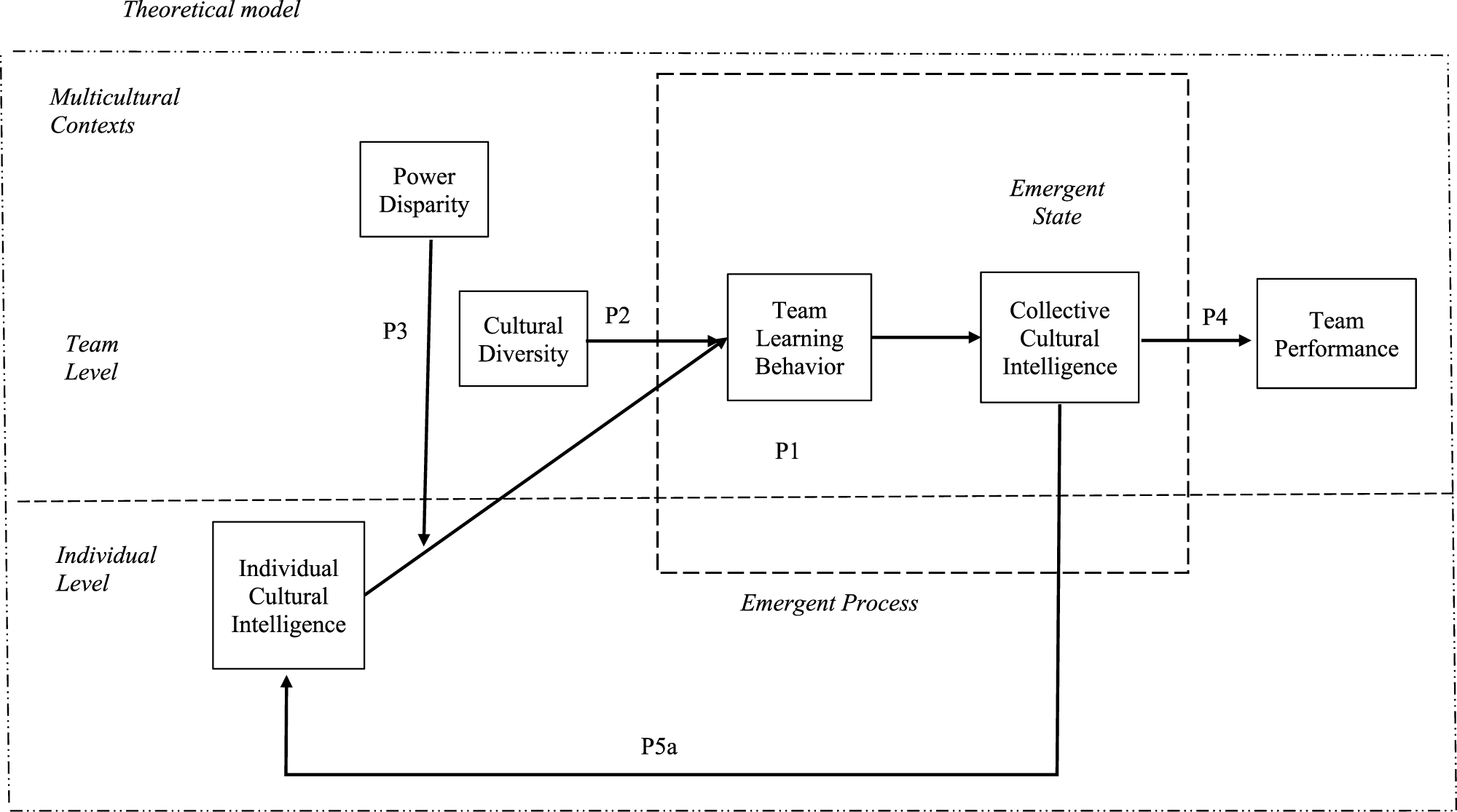
Individual Cultural Intelligence
Teams vary in the levels of cultural intelligence among members, which affects how collective cultural intelligence emerges. Individual cultural intelligence is a foundational input, but team compositions can differ significantly. For example, Team A has all five members with high levels of cultural intelligence (a dream team); Team B has three members with high cultural intelligence (a majority bloc) and two members with low cultural intelligence; Team C has one member with high cultural intelligence (a minority bloc) and four members with low cultural intelligence; and Team D has all five members with low levels of cultural intelligence (the unaware). The composition varies depending on the size of the team and the level of cultural intelligence of each member resulting in a wide range of possible compositions. Interaction patterns and the resultant team learning process may vary because of different compositions. That is, although collective cultural intelligence emerges from the interactions of team members, how team members interact and learn through the interactions depends on the initial levels of individual cultural intelligence. It is beyond the scope of this paper to cover all possible compositions and subsequent emergent processes of collective cultural intelligence. Ahead, we describe team learning behavior and use four representative scenarios (Teams A, B, C, and D) to discuss how the compositions of individual cultural intelligence create distinct paths through which collective cultural intelligence develops.
Team Learning Behavior
Team learning is a key mechanism in the development of collective cultural intelligence. The process of team learning consists of multiple interdependent actions that allow the team to process knowledge, to adapt, and to improve. According to Gibson and Vermeulen (2003), team learning behavior involves a cycle of experimentation, communication, and knowledge codification that complement each other. The idea is that in order to learn, the team must generate new ideas (experimentation), arrive at a common understanding (communication), and finally translate this knowledge into generalized concepts, decisions or actions (codification). This tacit knowledge is exchanged through interaction and communication as team members develop transactive memory (Fleishman & Zaccaro, 1992). Team learning is an ongoing team process of reflection and action through which the team acquires, combines, and shares knowledge (Argote et al., 1999), but it also includes embedding or codifying this knowledge within the team (Gibson & Vermeulen, 2003; also see fundamental and intrateam learning in Wiese et al., 2022). Thus, while cast here as an emergent process team learning also includes the state of knowledge that a team has at any one point in time (Cohendet & Steinmueller, 2000).
Team learning has been found to be influenced by cognitive ability (Ellis et al., 2003), socioemotional factors such as psychological safety (Edmondson, 1999), cooperative goals (Tjosvold et al., 2004), and structural factors such as workload distribution (Ellis et al., 2003). Empirical evidence supports the idea that team learning originates at the individual level, is amplified through interpretation and integration and exits at the team level as collective cognition and behavior (Kostopoulus et al., 2013). In the current context, team learning occurs when members observe and interpret others’ behaviors during intercultural interactions, enquire about, share and acquire relevant cultural knowledge, reflect on past actions, use appropriate behaviors to model their own, and discuss alternative solutions with one another.
In the dream team scenario (Team A), the high levels of cultural intelligence of every team member allow them to quickly identify the cultural clues in the environment, make them less likely to misinterpret others’ behavior, and more accurately analyze the situation to come up with proper solutions. Learning behavior such as observing, interpreting, reflecting, sharing, and acquiring happens almost automatically and probably implicitly. Team members do not necessarily need to openly discuss what should be done to achieve team learning. Team members would have expectations of the behavior of others in the team that are largely consistent with their own. That is, there is already a large overlap of individual mental models. Each team member would know the role(s) that others would play in an intercultural interaction, as well as the norms for behavior in that context. The “no look - behind the back pass” in basketball or rugby, where the passer “just knows” that the receiver will be in the correct position is a metaphor for the type of interpersonal interaction that would occur in teams with this structure. While the emergence of collective cultural intelligence even in a dream team might be influenced by other factors, discussed ahead, this configuration of individual cultural intelligence should (all else equal) produce high collective cultural intelligence.
In the majority bloc scenario (Team B), the team learning process is more explicit as the larger bloc of members with high levels of cultural intelligence sets the direction for the team. Majorities influence people through informational and normative mechanisms as people tend to conform to majorities to receive information about reality or social approval (Deutsch & Gerard, 1955). If the majority of group members are culturally intelligent, they are able to exert two types of influence on the rest of the group. First, they educate members with lower levels of cultural intelligence by sharing knowledge about cultural nuances, explaining the rationale behind decisions or adapted behaviors, modeling proper behaviors, and mediating conflicts that arise from cultural differences. Second, they motivate others to follow their exemplary behaviors. When other members conform, the team develops a shared understanding regarding how to deal with cultural aspects within and outside of the team. Based on empirical work on bridging faultlines in work groups (e.g., Homan et al., 2007), we expect that a good deal of information exchange across the faultline would be required for team learning to occur.
In the minority bloc scenario (Team C), a small bloc of individuals with high levels of cultural intelligence can facilitate the team learning process if they are able to demonstrate and explain culturally appropriate attitudes and behaviors through numerous interactions with other members. Minority members may stimulate deep and independent thinking instead of shallow and heuristic thinking in majority members (de Dreu & Beersma, 2001), which relates to single-loop and double-loop learning (Argyris, 1991). Single-loop learning involves treating learning as problem-solving with a focus on identifying and correcting errors. Double-loop learning involves looking inward to reflect critically on behavior, to identify how one might inadvertently contribute to the problem, and thus to change behavior (Argyris, 1991). Therefore, the minority bloc of members with high cultural intelligence may challenge the fundamental ways in which most members think and behave during intercultural interactions and promote the double-loop learning process. Different from the majority bloc scenario, a minority bloc may not have the status or influence over the team and thus may need to exert more effort to guide the team learning. Therefore, the minority bloc can facilitate team learning when the focal individual(s) have high interaction frequency with other members (e.g., Yu & Zellmer-Bruhn, 2018).
In the unaware scenario (Team D) where all team members have low levels of cultural intelligence, team learning is unlikely to occur naturally within the team as no one has the necessary capabilities to address cultural challenges effectively. For such a team to develop collective cultural intelligence, factors external to the team must be introduced to stimulate team learning. This external influence could come in the form of modeling the behavior of other teams that are successful at cross-cultural interactions, albeit without a conscious understanding of the underlying reasons or processes. This sort of naive learning is likely to be less stable over time and less malleable in its ability to adapt to new contexts. Team learning might also occur through the intervention of external sources such as management or consultants. Depending on the kind of intervention (management direction vs. cross-cultural training for example), a type of ceremonial adoption of behaviors, without understanding or commitment is a possible result. That is, the extent to which these behaviors become codified is questionable, particularly when there is a lack of genuine understanding or commitment. Thus, it is possible, although less likely, that teams whose members have initially low levels of individual cultural intelligence might develop collective cultural intelligence through the influence of external factors.
Team learning results in a sustained change in the team’s level of knowledge and skills (Ellis et al., 2003) and improves team performance (Edmondson, 1999) through shared mental models. According to a skill acquisition framework, learning – constructing skills through processes and interaction – is an essential stage in the development of a team mental model (Langan-Fox, 2003). Through the learning process, team members arrive at a consensus regarding what the team knows and what the team should do in intercultural contexts. Taken together, we propose that team learning behavior is a key mediating process that transforms individual cultural intelligence into collective cultural intelligence.
Team learning behavior will mediate the relationship between individual cultural intelligence and collective cultural intelligence.
It is important to note that we do not assume all teams in multicultural contexts will develop collective cultural intelligence, nor that they will do so in the same manner. Rather, we argue that the emergence of collective cultural intelligence requires teams to engage in learning behaviors, and the pattern of these behaviors is influenced by the levels and distribution of cultural intelligence among individual members. In some teams, learning may occur more naturally, while in others, it may encounter resistance and therefore require additional resources and support from external sources. It is also important to recognize that, like any team-level emergent state, collective cultural intelligence takes time to develop. In the early stages of teamwork, teams may not have had sufficient time or opportunities to learn from one another or the external environment to form a team mental model specifically suited for cross-cultural interactions. The absence of a shared mental model at this stage is often an indication of underdeveloped team learning in multicultural contexts.
Factors Influencing Team Learning
Team learning behavior is influenced by a number of factors (e.g., Ellis et al., 2003). We consider two critical input factors that affect the emergent process of team learning in the context of multicultural teams and teams interacting with culturally different others. These are the cultural diversity (number of different cultures represented) of the team and its power disparity.
Team Cultural Diversity
Cultural diversity has been shown to have both positive and negative effects on team processes and outcomes (Stahl et al., 2010; Stahl & Maznevski, 2021). Culturally diverse teams are likely to suffer from increased process losses resulting from different perceptions and communication patterns (Stahl & Maznevski, 2021). Alternatively, team cultural diversity has the potential to result in more creative and higher quality team decisions (Thomas et al., 1996; Wang et al., 2019). A complicating factor enters the picture when cultural subgroups form in teams with two non-overlapping cultural categories. When these faultlines form information flow across the subgroup boundaries is negatively affected (Lau & Murnighan, 2005; Thatcher & Patel, 2012).
A curvilinear effect of diversity in teams on processes and outcomes has been found for the effect of tenure diversity on team innovation (Chi et al., 2009), for task conflict on team innovation (de Dreu, 2006), and for the gender diversity of boards of directors on return on assets (Ali et al., 2014) among others. These results have in common that they all stem from the consideration of multiple channels of influence of diversity. Here, we propose that team cultural diversity may influence team learning through two main channels. First, aligning with the information-processing theory (van Knippenberg et al., 2004), cultural differences within the team provide sources for learning about cultural knowledge and culturally appropriate behavior. With higher levels of cultural diversity within the team, members will have more opportunities to experience the influence of cultural differences and thus to learn from them. For example, culturally different team members bring different scripts for how teams should function to the work group. By experiencing these different approaches, team members learn about them and how to better manage differences and coordinate within the team. When a team is culturally homogeneous members may have very similar scripts for teams, which provides fewer opportunities to experience cultural differences and subsequent learning. Therefore, higher levels of cultural diversity will facilitate team learning by providing more sources for such learning.
Second, cultural diversity within the team, as well as the existence and strength of cultural subgroups, affects how team members engage in team learning through socioemotional mechanisms. As noted previously, optimal team learning occurs through a cycle of experimentation, reflective communication, and codification (Gibson & Vermeulen, 2003). Homogeneous teams have several characteristics that are likely to foster team learning behavior. Similar backgrounds among team members create situations in which team members are comfortable expressing their ideas and collaborating during the experimentation and communication phase of the learning processes (Thomas, 1999; Williams & O’Reilly, 1998). Also, individuals with similar cultural backgrounds may share a common language that will increase the quality of communication (Marschan-Piekkari et al., 1999). Having people sharing their perspectives creates an environment in which team members feel their contribution is more likely to be valued and thus are more likely to contribute (Thomas et al., 1996).
In contrast to the effect of cultural homogeneity moderate levels of cultural diversity might prove detrimental to team learning behavior. While teams may have more information to incorporate into learning when heterogeneity is moderate, communication and agreement become more difficult (Stahl et al., 2010). Also, moderate levels of diversity have been shown to create significant interaction issues in teams if a faultline forms between discrete subgroups (Lau & Murnighan, 2005; Thatcher et al., 2003). A small number of cultures represented in a team can create a situation in which there is significant interaction within the subgroups, but little interaction across the subgroup boundaries. Thus, moderately heterogenous teams may have broader perspectives from which to draw, but their ability to share them is reduced.
In very heterogeneous teams everyone is different and has a unique perspective. Team members becoming aware of their differences may actively engage and put more effort into understanding each other (Thomas, 1999). They may in fact identify with the team as a whole as opposed to various subgroups. Research indicates that team members become increasingly aware of each other’s needs as the uncertainty about team processes increases (Clark et al., 1998). Team members’ diverse backgrounds motivate them to explore and understand their differences and foster open discussions of opposing views (Chen et al., 2017). Divergent opinions are thus likely to be accepted to foster experimentation, and attention to team process is enhanced and should positively affect communication and integration. Thus, very heterogeneous teams generate information in a manner similar to moderately heterogeneous teams, but their extreme diversity actually fosters an environment in which communication and integration of the ideas improve. Supporting the preceding arguments for a curvilinear effect of diversity on team learning behavior, Gibson and Vermeulen (2003), in a study of 156 teams, found that very demographically homogeneous and very demographically heterogeneous teams were more inclined to engage in learning behavior than were moderately heterogeneous teams.
Taking the arguments together, we expect the relationship between cultural diversity and team learning behavior to be curvilinear where a moderate level of team cultural diversity results in a lower level of team learning than low or high levels of cultural diversity. Therefore, we suggest the following effect of team cultural diversity.
The level of cultural diversity in the team will affect team learning behavior and subsequently the development of collective cultural intelligence, such that either high or low levels of cultural diversity will facilitate team learning behavior more than moderate levels of cultural diversity.
Power Disparity - Status and Power Inequality
Another important input to the team learning process is the power disparity of the team based on the distribution of status and power of individual team members. The notion of equal status as a key to effective intercultural interactions is based on the long-standing idea that equal status is one of the fundamental conditions for effective intergroup contact (Allport, 1954). Within teams, however, equal status among members is likely to be a rarity. In teams, the differences in power and status among team members can have a profound impact on the team learning process as they influence how and the extent to which members engage in learning behaviors (Bunderson & Reagans, 2011). A team member’s status is derived from the extent to which the individual is associated with a concept, object, or event that is perceived to have high quality or value in the team. The status hierarchy (rank order of individuals) in the team is a natural extension of the assignment status value to aspects of the individual team members (Ravlin & Thomas, 2005). Social power is one’s control over valued resources in social relations (Fiske, 1993; Keltner et al., 2003; Magee & Galinsky, 2008). As with status, a hierarchy of power can exist within teams. Harrison and Klein (2007) would classify the distribution of power or status as a type of diversity called disparity, in which individual members are arrayed from highest to lowest on the attribute, in this case, power or status. At the maximum amount of disparity one member would be at the highest level of power or status and others at the lowest. A moderate level of disparity exists when some members outrank others but the differences are limited. A low level of disparity occurs when everyone possesses relatively equal levels of power or status (Harrison & Klein, 2007). A vast body of research demonstrates the impact of power on cognition, emotion, motivation, and behavior during interpersonal interactions (see review by Galinsky et al., 2015). Power (control over resources by the individuals) and status (value as ascribed by team members) are related but distinct constructs (see Magee & Galinsky, 2008). However, the two constructs are reinforcing in that status can lead to power and power to status. In the following, we treat the terms as interchangeable.
Three theoretical perspectives are particularly relevant with regard to the influence of power on team learning (Bunderson & Reagans, 2011): pursuit of shared goals, knowledge sharing, and risk-taking and experimentation. First, power affects the pursuit of the goal of collective learning. According to the approach-inhibition theory of power (Keltner et al., 2003), individuals in high-power positions have more resources and freedom and thus are more likely to align their actions with their traits, desires and/or goals, whereas individuals in low-power positions have few resources and their behaviors are more likely to be inhibited by threat, punishment, and social constraint. Consistent with this argument, Guinote (2007) found that powerful individuals were more likely to act in a goal-consistent manner. This may be because powerful people tend to have an illusion of personal control (Fast & Chen, 2009) and feel overconfident (Fast et al., 2012), whereas powerless individuals are more aware of situational constraints or obstacles on their behavior, which in turn leads to difficulty in maintaining a focus on their goal (Smith et al., 2008) and inhibits actions to achieve their goal (Whitson et al., 2013). It is also because powerless individuals are oriented toward attending to the needs of those who are powerful, instead of what they themselves want (Keltner et al., 2003). Therefore, when the personal goal of a powerful member is aligned with the goal in a team to improve collective learning, the powerful person is able to utilize resources and engage in actions to promote that shared goal. Powerless members, although they may hold the same shared goal, have less capacity to direct their energy toward achieving that goal or regulate their behaviors accordingly, which in turn will impede the team learning process. On the other hand, when the personal goal of a powerful member is not aligned with the shared goal of collective learning, power becomes an obstacle to team learning because it increases the attention to and stimulates behaviors toward achieve self-interest instead of other (team)-interest (Dubois et al., 2015; Rucker et al., 2010). In summary, research indicates that power differences may influence collective learning by affecting the ability of individuals to focus on team goals.
Second, as discussed previously, team learning occurs when members share information, knowledge, and perspectives with one another and learn from them with an open attitude (Argote, 1999; Edmondson, 1999). Team learning is more likely to occur when team members develop a broad perspective from the different information and views held by team members (Bunderson & Reagans, 2011). However, power differences affect the extent to which people accept the shared information, perspectives and opinions. Powerful people tend to neglect others’ advice because they are more likely to rely on their own thinking (Brinol et al., 2007) and express their own opinion in a team (Anderson & Jennifer, 2002). Powerful people also express attitudes that conform less to what others have to say (Galinsky et al., 2008). As power decreases the ability of perspective-taking (Keltner & Robinson, 1997), powerful members are less likely to seek input from powerless members or consider the legitimacy of their opinions. Further, since the power hierarchy simplifies influence processes by indicating when to defer to others and which individual opinion carries the most weight (Cohen & Zhou, 1991), the opinions and insights from high ranking members receive more consideration, whereas the information from low ranking people may be neglected even when the contributions from them are critical to the learning and performance of the team. Therefore, when the high ranking members have low-levels of cultural intelligence, they are likely to ignore the input and suggestions from low ranking but high-cultural intelligence members, especially when those low ranking but high-cultural intelligence members express or demonstrate culturally intelligent behaviors that are inconsistent with the beliefs of those high ranking members. Such lack of acceptance of information and demonstration of appropriate intercultural interactions will hinder the team learning process. Under conditions of asymmetry, the knowledge and perspectives of those higher ranked individuals will have more influence than those of lower ranked members.
Third, successful team learning also requires members to accept different points of views, take risks to experiment new ways of doing things, and remain open to uncertainties and failures. Those behaviors are interpersonally risky and are usually encouraged by psychological safety (Edmondson, 1999). That is, when people feel the team a safe place to freely express themselves without being judged or rejected by other members, they are more likely to engage in those risk-taking behaviors. However, this is not the case for low ranking individuals, who tend to feel insecure and thus are less likely to take risks during social interaction (Anderson & Galinsky, 2006) or to take initiatives (Galinsky et al., 2003), which prevents them from engaging in those behaviors that facilitate team learning. The extant evidence supports the idea that power differences affect the willingness of low-ranking team members to engage in learning behavior because of perceived threats to psychological safety and their assessment of risks (Bunderson & Reagans, 2011). Therefore, when high-cultural intelligence members are lower ranked in the team, the likelihood that they will take actions that ultimately promote collective learning is diminished.
Power disparity typically disrupts team processes and performance by diverting members’ attention from critical tasks and obstructing the flow of information (Harrison & Klein, 2007). The impact of power disparity on team learning process has different implications for different team compositions. In the dream team scenario (Team A), power disparity may matter less since all members have high levels of cultural intelligence. In high or moderate disparity teams, high-ranking members are likely to promote the collective goal of team learning, share information and consider others’ input, and create a safe environment for the low-ranking members to express themselves and experiment with new ways of action. This can create interaction patterns similar to those in low disparity teams, where all members are likely to engage in learning behaviors naturally because of their high levels of cultural intelligence. In the majority bloc scenario (Team B), the capabilities of the majority bloc to set directions for the team will be attenuated if they lack power in a high disparity team. However, their influence is likely to be maintained if the team power disparity is low. Similarly, in the minority bloc scenario (Team C), the extent to which the minority bloc can influence the team is largely contingent on the team’s power disparity. Recall that minority influence is contingent on a high degree of interaction by the minority bloc members with others in the team, and their ability to interact effectively is significantly affected by the distribution of power, as unequal distribution of power tends to reduce member input and increase withdrawal behavior (Harrison & Klein, 2007). Thus, in high disparity teams, minority bloc members can have a positive impact on the team learning process only when they possess high power. For instance, research (Groves & Feyerherm, 2011) has shown that a team leader’s cultural intelligence enhances team performance when there is significant ethnic and nationality diversity within the team, highlighting the influence of a powerful person on team cultural dynamics. In contrast, when minority bloc members lack power or status, they may either withdraw their efforts or have their contributions neglected. When power is equally distributed in the team, minority bloc members are more likely to engage in meaningful interactions with others and thus promote team learning.
The power disparity of the team will moderate the relationship between individual cultural intelligence and team learning behavior such that high disparity hinders team learning behavior when members with high levels of cultural intelligence lack power.
Collective Cultural Intelligence and Team Performance
Collective cultural intelligence performs the same function for the team as cultural intelligence does for the individual (Morgeson & Hofmann, 1999). Cultural intelligent individuals are capable of doing their jobs in multicultural environments because they understand the differences in the way that others do their work and are flexible and adaptive when encountering those differences (Liao & Thomas, 2020). In its simplest form team performance is often described as an outcome of teams that meets expectations regarding some goal (Hackman, 1987). The relationship of shared mental models to team outcomes has been demonstrated in a variety of task domains (Mathieu et al., 2000; Mohammed et al., 2010). The critical factor with regard to these compatible mental models is that they lead to common expectations among the team members for the team and the performance of its tasks (Resnick, 1991). These mental models provide a common understanding of the team situation, which allows the team to effectively adjust strategies and resource allocation as required (Resnick, 1991). They also facilitate conflict resolution and enhance the ability of team members to integrate and synchronize task activities in part through efficient communication. For example, in a simulation task, teams with higher degrees of shared mental models about the task and teamwork demonstrated higher levels of strategy formation and coordination, cooperation, and communication, which in turn led to better team performance (Mathieu et al., 2000). The specific team level competencies identified here are consistent with the more general identification of the knowledge and skills that enable team collaboration – the ability of individuals to work with others toward a goal (e.g., Cannon-Bowers et al., 1995; Kozlowski & Bell, 2013). Recent meta-analyses have also supported relationships between team cognition – particularly shared mental models – and team processes, such as coordination and communication, as well as team performance (DeChurch & Mesmer-Magnus, 2010; Mohammed et al., 2010).
In addition, directly related to the development and outcomes of collective cultural intelligence is work in the area of collective general intelligence. For example, Woolley and colleagues (Woolley et al., 2010) found that collective general intelligence was only moderately correlated with the average intelligence of the team and the intelligence of the highest scoring team member. Consistent with our view that collective cultural intelligence emerges from the interaction of individual team members through the process of team leaning, they also found that collective general intelligence was significantly related to the average social sensitivity of the team and negatively related to the variance in the number of team member’s speaking turns. That is, teams in which there was a more equal distribution of conversation developed higher collective intelligence. And finally, in two studies they found that collective intelligence was a much better predictor of team performance than the average of team member’s intelligence or the maximum individual intelligence of any team member (Woolley et al., 2010). Consistent with research on shared mental models and collective general intelligence, we contend that teams with high levels of collective cultural intelligence will achieve higher performance in multicultural contexts.
Collective cultural intelligence will have a direct positive effect on team performance for teams in multicultural contexts.
Collective Cultural Intelligence and Team Member Development
Collective cultural intelligence not only has a positive effect on team performance but also acts to influence individual cultural intelligence. The development of cultural intelligence in individuals results from the experience of interacting with culturally different others and functioning in culturally challenging situations (Thomas & Inkson, 2003). The relationship between social experience in intercultural contexts and the development of cultural intelligence is supported by studies that have found a relationship between various intercultural experiences and cultural intelligence (e.g., Crowne, 2012; Eisenberg et al., 2013; Thomas et al., 2015) and more specifically between participation in multicultural teams and cultural intelligence (Erez et al., 2013). These effects are so well established that many contemporary business schools assign students to multicultural project teams to create an environment for experiential learning. Learning from social interactions requires attention to the elements of the interaction, retention of the knowledge gained, reproducing the behavior that was learned from the interaction and then reinforcement that the changed behavior was effective (Bandura, 1977; Kolb, 1984). When individuals engage extensively in novel cultural events such as integrating new information into their self-reflection, developing new perspectives, even changing their assumptions or behaviors, instead of merely observing, they develop higher levels of cultural competence (Reichard et al., 2015; Rosenblatt et al., 2013). This process at the individual level, of course, mirrors the team learning described previously. Thus, we expect that as individuals engage in teams with high collective cultural intelligence they will learn from the social situation and their own cultural intelligence will improve. The improved individual cultural intelligence in turn feeds back to the transforming processes of collective cultural intelligence. This kind of recursive relationship has been discussed in the literature. For example, Santos and Passos (2013) argue that when members share a team mental model they are likely to avoid relationship conflict. The low level of conflict creates a safe environment for members to share information and discuss ideas, which, in turn, facilitate the development of more convergence of mental models. The interrelationship between the development of individual cultural intelligence and collective cultural intelligence is reflected the following related propositions.
Over time, engaging in a team with high collective cultural intelligence will have a positive impact on the development of cultural intelligence in the individual team members.
The improvement of cultural intelligence in individual team members over time creates a virtuous cycle that feeds back into the level of collective cultural intelligence.
Assessing Collective Cultural Intelligence
Methods for assessing team mental models vary in how they elicit or capture the content and structure of the knowledge, and each method has its own set of advantages and limitations (Mohammed et al., 2010). Recent reviews on team mental models have found that the way in which team mental models are measured results in differences in their relationship to team processes and outcomes. Specifically, models that evaluate the structure of the mental model were shown to be superior in predicting team process, while team performance was predicted consistently across measurement techniques (DeChurch & Mesmer-Magnus, 2010).
Collective cultural intelligence, as a shared mental model in teams operating in multicultural contexts, has some features that suggest an approach to its assessment. First, building on team task analysis (Mohammed et al., 2010), teams in multicultural contexts often need to apply cultural knowledge to their tasks and collaborative processes. Therefore, the assessment should specifically measure the content of knowledge related to cultural differences. For example, a group of multicultural consultants providing strategic advice to a company entering a foreign market must apply their understanding of global business and strategy to evaluate the company’s strengths, weaknesses, and the competitive environment. Effective communication among consultants and with the client is also critical. Similarly, a product development team creating a new skincare product for the global market needs knowledge of customer preferences across various markets, as well as the ability to coordinate with colleagues across multiple subsidiaries. These tasks demand both general knowledge of how cultures shape cognition and behavior, and specific knowledge of the particular cultures involved. Since this knowledge is typically applied in concrete work settings rather than in abstract terms, commonly used techniques like paired comparison ratings, concept mapping, and card sorting are less suitable, because the content and structure of the knowledge being assessed are supplied by researchers. In contrast, qualitative methods, such as coding documents or analyzing videotaped team interactions, elicit content directly from participants and thus have a high degree of construct validity (see review Mohammed et al., 2010).
Second, as opposed to a simple aggregation of the cultural intelligence of team members, collective cultural intelligence is an emergent construct that results from the relational processes of team members. Collective cultural intelligence contains knowledge of roles, responsibilities, interaction patterns, and information flows related to cross-cultural interactions. The attributes that must be evaluated for consensus are conceptually distinct and are derived from the idea that the function of collective cultural intelligence at the team level is the same as that of individual cultural intelligence at the individual level. Collective cultural intelligence reflects a referent shift model (Chan, 1998) in which the team level construct is based on individual assessments of group activity. These individual assessments should produce uniform, if not perfectly homogeneous perceptions (Bliese, 2000). Thus, collective cultural intelligence is the shared understanding of the group activity and can be captured by a Likert-type survey questionnaire. This approach to measuring collective cultural intelligence is consistent with other research on team constructs (see Yu & Zellmer-Bruhn, 2018). Unlike other techniques that first capture individual mental models and then calculate their sharedness or similarities, survey questionnaires have the advantage of being easier to administer and analyze. Given that teams often openly discuss cultural impacts during the team learning process, members are likely to be aware of and accurately report their shared understanding of how tasks should be executed. The survey items should include an understanding of the roles and responsibilities of team members, how culture influences interactions within teams and/or between the team and external stakeholders, and behavioral scripts for effective intercultural interaction. For example, sample items may read “We have established expectations about how our team should engage with members from different cultures”, or “Our team demonstrates a shared understanding of the cultural norms that shape our interactions.”
Third, as we have theorized, collective cultural intelligence requires time to emerge and develop, indicating the need for a longitudinal approach to its measurement. For example, in the case of multicultural student groups working together in a class, a pre-survey should be administered at the beginning of the course to assess the individual cultural intelligence of each group member. Depending on the intensity and frequency of teamwork, researchers might choose to observe team dynamics periodically, such as every few days or weeks. A mixed-methods approach, combining qualitative methods (e.g., reflections and interviews) with survey questionnaires, can effectively capture the emergent processes of collective cultural intelligence and team learning behavior over time.
Concurrent with basic instruments being developed, consideration can be given to various methods for determining the extent to which the mental model is shared. Three characteristics define the extent to which the mental models of team members are shared. These are the elicitation, structure representation, and emergence representation. Elicitation refers to establishing the content of the mental model (Mohammed et al., 2010). Structural approaches attempt to capture the way in which the model is represented in mind using network-based methods that represent the degree of association between distinct elements of the model (Klimoski & Mohammed, 1994). Emergence representation involves the extent to which an individual’s mental models are constituents of a team mental model. A wide variety of methods are available to accomplish these approaches. The choice of approach may be based on the extent to which team processes or outcomes is of most interest (DeChurch & Mesmer-Magnus, 2010).
Discussion
Although cultural intelligence has been found to contribute to a variety of individual outcomes in intercultural contexts, research has not provided a compelling articulation of the concept at the team level (Liao & Thomas, 2020). The few empirical studies that have examined team-level cultural intelligence lack a theoretical foundation regarding how team cultural intelligence is formed and have relied on the simple aggregation of the cultural intelligence of team members. This static approach fails to recognize the reality of how teams function and the results of the interaction of team members over time (Cronin et al., 2011). Our theoretical framework recognizes the dynamic quality of teams and introduces collective cultural intelligence as an emergent construct. Based on the cultural intelligence of individual team members, as well as the cultural diversity and power disparity within the team, we outline the relational processes that result in collective cultural intelligence. In particular, we focus on the key mediating role of team learning behavior in the emergent processes. We also show how the team level construct of collective cultural intelligence relates to both individual development and team performance outcomes.
Theoretical Contributions
Cultural intelligence was originally theorized as an individual-level construct that allowed individuals to interact effectively with culturally different others and in culturally challenging contexts (Earley & Ang, 2003; Thomas & Inkson, 2003). To date, we know very little about the process through which team-level collective cultural intelligence is developed or how factors such as the cultural intelligence of individuals influence its formation. While some scholars have conceptualized cultural intelligence at the higher level of analysis (e.g., Ang & Inkpen, 2008; Bücker & Korzilius, 2024; Janssens & Brett, 2006; Van Driel & Gabrenya, 2013) and some share similarities with our conceptualization (e.g., team cultural metacognition in Bücker and Korzilius (2024)’s conceptualization is similar to team learning behavior in our model), they do not explain the underlying process that produces an emergent phenomenon. Our framework provides a new perspective and theorizes collective cultural intelligence as an emergent state, which is the functional parallel to individual cultural intelligence.
Disentangling the emergent process advances our knowledge about teams operating in multicultural contexts. Previous research has indicated that the composition of the team affects team performance. For example, the right mix of value orientations in a multicultural team increases performance over time (Cheng et al., 2012). However, focusing on composition limits our understanding of the influence of the dynamics of teams and the interactions of their members. Most teams research has relied on static aggregation of elements to approximate emergent constructs such as conflict and cohesion rather than specifying the dynamic interactions that produce them (Humphrey & Aime, 2014). The emergent constructs that result from these interactions are critical to understanding a signature characteristic of teams - that the whole is indeed more than the sum of its parts. An important aspect of the model we articulate in this paper is the specification of how lower-level abilities and interactions lead to an emergent construct that is then irreducible to its component elements, which is an approach that has rarely been adopted (Waller et al., 2016). In this case, understanding the cross-level process helps to better theorize the effect of individual cultural intelligence on a team-level construct (collective cultural intelligence) with its attendant influence on individual and team outcomes. Compared to individual cultural intelligence, collective cultural intelligence as a shared mental model has a more proximal and direct impact on outcomes such as team performance, team abilities and team member abilities (Mohammed et al., 2010).
In summary, this article makes three key contributions. First, we introduce the novel concept of collective cultural intelligence. Although originating from individual cultural intelligence, collective cultural intelligence is a new theoretical construct that more directly relates to team characteristics and outcomes. This new concept broadens the scope of cultural intelligence literature that currently focuses on individual-level phenomena and ignores complex interactions among individuals. Second, and in line with recent studies on team-level emergent constructs such as team mindfulness (Yu & Zellmer-Bruhn, 2018), psychological safety and collective affect (Marks et al., 2001), collective cultural intelligence offers more accurate theorizing in investigating the relationship between the input such as individual team members’ cultural intelligence and team diversity and team outcomes. More generally, we specify how lower-level interactions and abilities lead to an emergent construct that is then irreducible to its component elements. The specification of the interactions that underlie emergent constructs has received very limited research attention (Srikanth et al., 2016; Waller et al., 2016). For example, while the strong influence of the normative expectations of team members is generally accepted, the formation of these emergent constructs is rare (Kozlowski & Bell, 2013). Our approach promises an avenue through which the understanding of a wide variety of other emergent processes in teams can be advanced. Third, by specifying the emergent processes through which teams in multicultural contexts learn and develop collective cultural intelligence, we describe the process mechanisms along with moderating conditions. Thereby we advance the understanding of team interaction processes that relate to the process gains and process losses in the multicultural teams literature (Stahl et al., 2010; Stahl & Maznevski, 2021), and provide inferences about why some teams become more successful than others in dealing with their cultural environments. For example, for teams to function effectively they must minimize process losses related to lack of coordination (Srikanth et al., 2016). Since collective cultural intelligence is a shared mental model of the team’s knowledge and skills regarding the cultural aspects of its members and its environment, teams with high collective cultural intelligence are able to coordinate more effectively in a multicultural context and thus enhance team outcomes. Understanding the process through which collective cultural intelligence emerges can give insight as to why some teams develop the capacity to be effective in culturally challenging environments and others do not.
Future Directions and Extensions
A number of extensions for future research can be identified. First, in our model we propose team cultural diversity and power disparity will affect team learning behavior. Future research should explore other factors that facilitate or hinder the team learning process, such as psychological safety and speaking turn variance, which have been shown to influence team effectiveness (e.g., Edmondson, 1999; Woolley et al., 2010), and openness to diversity, which reflects a team’s positive attitude toward its heterogeneity (Bücker & Korzilius, 2024). In addition, other constructs that emerge because of individual interactions in the team, such as cohesion, may need to be considered. If team members do not develop sufficient cohesion they may come to question their relationship to the team and withdraw (Hackman, 1992). Cohesive teams are more likely to adopt the proactive problem solving strategies required to synchronize their activities in response to dynamic situations (Beal et al., 2003), which should facilitate knowledge sharing. In addition, while we have identified the fact that the broader organizational, industry and societal context can influence team learning, we have not developed this idea further (see Maloney et al., 2016). Future research should consider whether these moderators operate differently with different team compositions of individual cultural intelligence.
Second, with our focus on the capabilities of the team our model offers only limited insight into the effects of collective cultural intelligence on outcomes of team performance, and individual capabilities. While we proposed a direct relationship between collective cultural intelligence and team performance, there may also be indirect pathways through socioemotional mechanisms, such as team identification, social integration, and team affect (e.g., Kearney et al., 2009; Richter et al., 2021). We also referred to the benefits of collective cultural intelligence in reducing process losses associated with poor coordination. However, process losses might also result from poor cooperation and lack of commitment of the team (Srikanth et al., 2016). More than one “dream team” has failed to perform up to its potential because of the lack of commitment of one or more team members. A more complete perspective on the relationship between the team capability of collective cultural intelligence and team performance will require the consideration of numerous other factors that might mitigate the effect of collective cultural intelligence. We have also suggested that collective cultural intelligence will enhance the level of cultural intelligence of individual team members. There is potentially a wide range of factors that might inhibit individual development despite the improved capability of the team as a whole. The specifics of the influence of collective cultural intelligence on individual cultural intelligence require additional development.
Third, while we have considered how cultural diversity of the team influences the development of collective cultural intelligence, we have (for reasons of simplification) neglected the particular cultural characteristics of team members. We know that which cultures, as well as how many different cultures, matters in terms of team interaction processes (see Earley, 1989; Thomas, 1999). The consideration of the cultural characteristics of team members presents the opportunity for a more nuanced perspective, but also runs the risk of over complicating the theoretical model. Future research could focus on the influence of specific cultural characteristics on aspects of the collective cultural intelligence development process. For example, we can envision an evaluation of the influence of tight versus loose cultures (Gelfand et al., 2011) on team learning or the influence of power distance on the effect of power. Also, the specific cultures involved in a team may influence its social hierarchy through the historical development of the relationships among them, which can influence power relationships among team members (Primecz et al., 2016) resulting in a generally accepted hierarchy of cultures based on status (Sidanius & Pratto, 2004). For example, Leslie (2017) found that the presence of ethnic subgroups with large differences in status within a team was negatively related to work unit cohesion and performance. In addition, how the use of a specific corporate language can empower or disempower certain team members influencing the social hierarchy of the team deserves additional attention (Guzman & Reiche, 2024; Marschan-Piekkari et al., 1999). Finally, we acknowledge that the influence of power may be culturally bound as power is conceptualized in different ways between vertical individualistic versus horizontal collectivistic cultures (Torelli & Shavitt, 2010). Future research could explore how culturally constructed perceptions of power influence team learning and the development of collective cultural intelligence.
Practical Contributions
Organizations have realized the importance of cultural intelligence in dealing with challenges in an increasingly multicultural workforce. When assigning employees to teams, the ideal case is to select people with high levels of cultural intelligence and form what we call a “dream team.” However, this case might be very rare in practice. Instead of focusing on who should be on the team, organizations could consider how to influence the formation process of collective cultural intelligence. For example, when people with high levels of cultural intelligence are a minority bloc in the team, managers could create conditions that increase contact between the minority bloc and other members, for example by assigning them a role as the facilitator of the team. Practices such as creating a psychologically safe environment, building a common team identity, and fostering transformational or person-focused leadership behavior can all support team learning (e.g., Chiu et al., 2021; Edmondson, 1999; Koeslag-Kreunen et al., 2018). Managers may also design interventions, such as planning, training, and leader mentoring, to foster the formation of the shared mental model required for collective cultural intelligence (Cannon-Bowers, 2007; Marks et al., 2000). Managers can also use strategies that enhance the sharedness of mental models to promote collective cultural intelligence. For example, Mathieu et al. (2000) suggested that without developmental feedback that pointed out mistakes or provided suggestions, team members’ mental models did not converge significantly over time. Therefore, managers could provide timely and detailed feedback on how the team have performed and how they could improve, or organize a team meeting to have members reflect on their performance and learning in order to crystalize greater sharedness of the mental model of cultural intelligence.
Conclusion
As jobs become more complex, teams are called upon to accomplish more of the world’s work. The need to draw on all available employee skills and resources, combined with difficulties in fostering workforce commitment, has resulted in a strong trend toward the use of teams (Futrell, 1990; Mohrman et al., 1995). Because of globalization these teams are increasingly composed of culturally different members. Thus, whether or not the team can effectively manage the cultural aspects within and across teams becomes a critical factor of team performance. Collective cultural intelligence, as a team-level construct, is able to capture this capability. It is a new concept, different from individual cultural intelligence, which has been found to be critical for individuals to navigate across borders. However, little is known about its impact on team processes and outcomes. Proposed as an emergent construct, collective cultural intelligence is developed through members’ interactions and the team learning processes. Understanding the emergent processes through which teams transform individual cultural intelligence and cultural diversity into collective cultural intelligence advances knowledge about complex member interactions within teams and provides inferences about why some teams become more successful than others in dealing with their cultural environments. In practice, this knowledge about the development of collective cultural intelligence should help organizations staff teams, design interventions, and create conditions that facilitate teams as a whole to better manage challenges and opportunities as they navigate an increasingly connected and multicultural workforce.
Footnotes
Declaration of Conflicting Interests
The author(s) declared no potential conflicts of interest with respect to the research, authorship, and/or publication of this article.
Funding
The author(s) received no financial support for the research, authorship, and/or publication of this article.
