




Abstract
Although team processes are conceptualized as temporal phenomena, our theoretical understanding of their unfolding over time is underdeveloped, particularly when “zooming in and out” into their dynamics using different temporal lenses. Team processes might unfold differently over extended project cycles (i.e., macroscale time lens) versus over brief events (microscale time lens). Our goal was to better understand temporal changes of three critical higher-order team processes (i.e., transition, action, and interpersonal processes) over both extended periods (i.e., longer project cycles) and brief time spans (i.e., recurring stand-up meetings). Focusing on two agile software teams, we indexed team processes across these two time spans using computer-aided text analysis (CATA) of meeting transcripts. Macroscale time span processes were captured across 10 sprints (30-week project cycle). Microscale time spans were captured with data from brief stand-up meetings (i.e., using 10 equidistant time intervals from 40 meetings). From a macroscale time lens (i.e., project cycle), an increase in action processes in the early project phase was associated with increases in performance. From a microscale time lens, changes in transition and interpersonal processes around mid-meeting phases were associated with differences in performance. Qualitative analyses of meeting midpoints revealed key differences in proactive planning and interpersonal processes. We discuss how our results provide novel insights for team process dynamics in relation to micro- and macroscale time spans.
Keywords
Introduction
Organizations critically rely on teams to achieve complex work (Mathieu et al., 2019). Both theoretical frameworks and empirical research have pointed out the importance of team processes (i.e., interdependent acts that transform inputs into outputs) as a key concept that contributes to team effectiveness (LePine et al., 2008; Marks et al., 2001). Team processes involve planning and/or reviewing team activities (i.e., transition processes), teams working on task accomplishment (i.e., action processes), and team members regulating their relationships (i.e., interpersonal processes). Fundamentally, team processes are dynamic phenomena, that is, they change over time (Lehmann-Willenbrock, 2024; Kennedy & McComb, 2014; Marks et al., 2001; Salas et al., 2018).
Unfortunately, progress in understanding these three team processes as dynamic phenomena has been challenged (Kennedy & McComb, 2014; Larson et al., 2020; Mathieu et al., 2022). First, empirical research investigating the dynamic team process-performance relationships has unearthed results that are not well aligned with existing theories of these processes. In an attempt to study the team process-performance relationship using time-sensitive measures, Mathieu et al. (2022) concluded that their results “differed markedly from those observed in previous work using more traditional designs and analyses” (p. 22). Relatedly, temporal theories of team processes are often vague with respect to the question of when specific processes matter most (Leenders et al., 2016; Marks et al., 2001), leaving us with little guidance with respect to measurement resolutions or when to capture changes (Klonek et al., 2019; Kozlowski, 2015; Kozlowski et al., 2013).
Another problem preventing progress is the difficulty in capturing the unfolding of team processes over different time spans which existing theories have not integrated well. That is, a key complication is that teams engage in transition, action, and interpersonal processes both across brief transient episodes (Lei et al., 2015; Marks et al., 2001; Mathieu et al., 2022; Mathieu & Schulze, 2006; Schmutz et al., 2018; Uitdewilligen & Waller, 2018; Zijlstra et al., 2012) and across larger time spans such as project cycles (Collins et al., 2016; Cronin et al., 2011; Kozlowski et al., 2013; Larson et al., 2020; Quigley et al., 2018). For example, micro-dynamic team processes of software teams using Scrum methods unfold over brief stand-up meetings during which the teams plan, monitor, and execute their work. Beyond these meetings, team processes also unfold over performance sprints with the goal of producing a minimal viable product for their client (Junker et al., 2022). Thus, from a macroscale time lens, team processes also unfold over multiple weeks and are embedded within a team’s project cycle. Although these multiple time spans are recognized in the extant team literature (Ballard et al., 2008; Cronin et al., 2011; Mathieu et al., 2022; McGrath & Tschan, 2007), research that empirically investigates multiple temporal perspectives with respect to how team processes change and develop over both microscale and macroscale time spans has been limited.
Related to theoretical complications are methodological challenges in collecting team processes repeatedly and over extended time periods (Kennedy & McComb, 2014; Klonek et al., 2019; Luciano et al., 2018; Maynard, Conroy, et al., 2021, Maynard, Mathieu, et al., 2021; Quigley et al., 2018; Roe et al., 2012). Using survey-based approaches over multiple time points is often not feasible and/or highly invasive (Ballard et al., 2008; Klonek et al., 2019), which is why researchers have called to utilize more innovative and underutilized methods, particularly, computer-aided text analysis (CATA, Maynard, Conroy, et al., 2021, Maynard, Mathieu, et al., 2021; Mathieu et al., 2022).
Addressing these limitations is crucial to obtain a more precise understanding of how team processes change over time (Kennedy & McComb, 2014; Maynard, Conroy, et al., 2021; Maynard, Mathieu, et al., 2021). If researchers shy away from long-term empirical investigations due to methodological problems, our knowledge about how teams adapt will stay underdeveloped (Kennedy & Maynard, 2017; Maynard et al., 2015), which impedes theory development. There is also a lack of guidance available for practitioners as to how they can help teams better understand when to engage in coordination and planning within projects or tasks. This matters even more in the context of agile teamwork practices, which are gaining rising popularity in organisations. Industry reports suggest more than 80% of organisations use Agile methods (KGPM, 2019), with Scrum being one of the more popular approaches (almost one million professionals hold a Scrum certification, Scrum.org, 2024). Agile teamwork is characterised by stand-up meetings during which teams discuss the planning and strategizing of their work, monitor task progress, and coordinate their taskwork (Junker et al., 2022).
In light of these challenges, this study aims to investigate team process dynamics in agile scrum teams across two complementary time spans: macroscale and microscale. The former time span concerns team member interactions across project time spans covering 30 weeks, and the latter focuses on team member interactions during brief events covering 15-min standup meetings. We use an innovative CATA approach to capture team processes (Klonek et al., 2020; Mathieu et al., 2022). We also examine how changes in team processes relate to performance over these two contrasting time spans. That is, we “zoom in” and “zoom out” of the dynamic team process-performance relationship.
Since existing theories of team process dynamics are underspecified (Leenders et al., 2016), and empirical studies using time-based measurements have provided results that are different from research that has treated team processes as static phenomena (Mathieu et al., 2022, p. 22), we adopted a mixed-method approach using both quantitative and qualitative analyses to improve our understanding of the temporal change patterns of this important construct (Gibson et al., 2017; Klonek et al., 2020).
This study makes the following contributions to the literature. First, we highlight that understanding the dynamic team process-performance relationship involves both a long-term macro- and a short-term micro-dynamic lens. We show that early engagement in action processes is more important for performance from a macroscale time span (i.e., project cycle focusing on long-term development), while transition and interpersonal processes during midpoints are more critical for performance on a microscale time span (teams interacting over brief events). Second, our study challenges existing temporal frameworks, particularly the recurring phase model of team processes (Marks et al., 2001), by exploring team process temporal patterns and their relationship to performance using quantitative and qualitative analyses. The qualitative analyses further help to better understand when and why specific team processes help teams to be effective. Third, we use state-of-the-art CATA as a solution for measuring team processes longitudinally in a non-invasive way (Driskell et al., 2017; Mathieu et al., 2022). By leveraging CATA, we also make a methodological contribution by highlighting the potential of underutilized methods that help to index dynamic team processes without the need to burden team members with repeated surveys (Klonek et al., 2020).
In what follows, we discuss the current theories about team processes and their findings, to then introduce our research questions.
The Dynamic Nature of Team Processes
Our study builds on the taxonomy of team processes proposed by Marks et al. (2001) in their recurring phase model. At the highest and most abstract concept level, team processes are defined as “members’ interdependent acts that convert inputs to outcomes through cognitive, verbal, and behavioral activities directed toward organizing taskwork to achieve collective goals” (p. 357). Next, the taxonomy distinguishes three higher-order dimensions: transition processes (i.e., reflection and interpretation about previous accomplishments as well as preparation for future actions), action processes (i.e., behaviors that members engage in while working toward goal accomplishment), and interpersonal processes (i.e., behaviors focusing on the personal relationships between members). Each of the processes is further defined by specific behaviors operating at a more granular level. That is, transition processes involve mission analysis, goal specification, and strategy formulation. Action processes contain behaviors such as monitoring progress toward goals, systems monitoring, team monitoring and backup behavior, and coordination. Interpersonal processes are about behaviors related to conflict management, motivation and confidence building, and affect management.
Team processes are typically seen as a proxy for team functioning and have been shown to be critical for team effectiveness (LePine et al., 2008; Mathieu et al., 2008, 2019). Therefore, they occupy a central role in understanding how teams transform inputs into outputs and work towards shared goals (Marks et al., 2001; Mathieu et al., 2008, 2019).
The recurring phase model also makes key assumptions about the timing of transition and action processes (Marks et al., 2001). Specifically, it assumes that transition processes occur prior to or between performance episodes (i.e., when teams reflect on previous experiences and plan future actions). In contrast, action processes occur predominantly during performance episodes when teams are working toward goal accomplishment (e.g., Maynard, Conroy, et al., 2021; Maynard, Mathieu, et al., 2021). Interpersonal processes are theorized to take place throughout all performance episodes as they help to address conflicts, motivation, and confidence toward goal achievement. Overall, the recurring phase model has contributed to the view that team processes are inherently dynamic (Cronin et al., 2011; Kennedy & McComb, 2014; Mathieu et al., 2022; Cronin & Vancouver, 2019). The key argument is that teams engage in different processes at different times (Marks et al., 2001; Mathieu et al., 2022; Mathieu & Schulze, 2006).
While on the surface the model seems to suggest clear predictions concerning the timing of team processes, on closer examination, we note that the model predictions are rather vague. To illustrate our point, Mathieu et al. (2022) noted that “theory suggests that teams generally execute different processes at different times, it is also the case that such processes are ongoing and may occur at any given time”. In fact, this statement provides very little guidance on when researchers or practitioners can expect specific processes to occur; making it impossible to falsify the model with respect to the timing question. This theoretical under-specification of the timing may have also contributed to empirical confusion as to when these processes should occur. As a result, researchers and practitioners interested in using the recurring phase model are uncertain as to how much a team should engage in transition processes during a particular time point and when they should engage more in action processes (Woolley, 1998).
In an attempt to understand the temporal dynamics of transition and action processes in medical response teams, Mathieu et al. (2022) analysed their dynamic team process-performance relationships based on brief (about 25 min.) episodes from simulated live-actor scenarios. However, their results suggested that action processes are more strongly related to performance during initial team interactions and then become less critical over time, which is contrary to the predictions of the recurring phase model. Further, no temporal effects for transition processes on team performance were found. These results do not align with the recurring phase model, which is why a more in-depth analysis of team processes is required. Next, we introduce concepts relevant to time spans to highlight that fundamentally, team processes also unfold differently over micro- and macroscale time spans.
Time Spans: Project Cycles, Performance Episodes, and Events
It is important to acknowledge that phenomena like team processes can unfold over different time spans (Ancona et al., 2001; Klonek et al., 2019). One broad conceptual differentiation of time spans distinguishes between developmental time spans (focusing on longer time frames), episodic time (focusing on a task episode), and event time (focusing on brief events) (Ancona et al., 2001). A similar, but slightly simplified categorization (which we adopt here) is to distinguish between macroscale versus microscale time frames (Klonek et al., 2019). Using different time spans for a process phenomenon recognizes that a team process (e.g., coordination vs. strategizing) might be required at very different time points depending on whether we take a micro- or a macroscale time perspective.
Macroscale time perspectives (e.g., project cycles) adopt a long-term temporal lens and specify how teams mature over longer project phases and/or go through different qualitative stages, specifying how team phenomena change over larger periods. That is, these perspectives focus on the long-term trajectory of a team when working on a longer client project. This includes the notion that teams qualitatively evolve as they move through various stages toward maturity (cf. Gersick, 1988; Kozlowski et al., 1999; Tuckman, 1965). Episodic perspectives focus on short-term, transient activities in which teams engage to accomplish specific tasks that may be part of a larger project (Marks et al., 2001; McGrath, 1991; Waller, 1999). Events are another landmark on which temporal activities can be mapped. For example, COVID-19 has been considered a key event that changed the ‘how and where’ people accomplished work. While a global pandemic is an irregular event, we can also think about regular events. For example, Scrum teams have brief stand-up meetings that are happening every day (Stray et al., 2020). For these regular events, there is a broadly shared understanding and an expectation of how things are unfolding and roughly orchestrated, that is, team members inform each other of their work progress and daily goals.
Taken together, developmental project-cycle perspectives, episodic perspectives, and event time imply a time nesting of the phenomena, that is, team processes unfold both over brief events as well as over longer, developmental time spans, thus spanning from micro-to macroscale time spans (Klonek et al., 2019). To illustrate this with a real-world example: In agile Scrum teams, on which we focus in this study, a team’s project cycle requires a macroscale time lens as it involves a more long-term development view (i.e., 30 weeks in this study). Within the project cycle, teams engage in so-called “sprints”, that is 3-week episodes during which outputs (product increments) are produced in repeated iterative cycles (Junker et al., 2022; Nguyen-Duc et al., 2017). Outputs or prototypes from sprints are rapidly refined throughout each iteration (performance sprint) so that by the end of an iteration the team can deliver a potential working increment of a product (e.g., a new feature of an application). Team processes unfolding within a 3-week sprint require a mid-level or meso-temporal perspective. Finally, team processes unfolding over brief events like a 15-minute stand-up meeting are much more short-lived and require a microscale time lens of team dynamics.
Although the concept of team processes is mature and well-studied (LePine et al., 2008), research on the dynamic team process-performance relationship combining different time spans is still quite limited. Existing research has predominantly focused on a specific time span, mostly micro-(or mesoscale) time spans such as brief performance episodes (Mathieu et al., 2022; Schmutz et al., 2018; Uitdewilligen et al., 2018). In terms of insights from the microscale time span, research in healthcare teams using data from training simulations by Schmutz et al. (2018) suggests that team reflection, a transition process, grows during a 16 minute performance episode (the authors did not look into the dynamic process-performance relationship). Uitdewilligen et al.’s (2018) study of synchronized coordination (a recurring action pattern) in undergraduate teams working together in a computer-based firefighting simulation (over 2 days) suggests that a decrease in coordination is conducive to performance after a task change. Research from paramedic teams (during a 23-minute Live-actor simulation) highlighted the importance of early action processes for performance, but also showed that changes in transition processes were unrelated to performance (e.g., Mathieu et al., 2022). The seminal qualitative lab study from Gersick (1989) has highlighted the temporal midpoint (of a 60-minute task episode) as being important for changes in team action processes (she observed a sudden increase in statements monitoring time and goal progress in six of eight teams). Overall, these studies vary considerably in their conclusions (i.e., regarding which process subdimensions matters for performance and how performance-conducive team process change patterns actually look like), yet the variety in research designs, including what type of team is studied (student vs. medical action teams), methodological approaches (qualitative vs. quantitative methods; lab study vs. training context), the specific team process construct being measured, and different sampling rates (i.e., ranging from four to 23 repeated measurements) makes it challenging to consolidate existing knowledge. Finally, except for Mathieu et al. (2022), most research on team processes over micro-scale time frames has looked at isolated team process subdimensions.
In terms of perspectives on the macroscale time span, quantitative longitudinal research focusing on team process changes measured over a 13-week project cycle has shown that a steep increase in action processes (i.e., monitoring goal progress) and interpersonal processes (i.e., conflict management), but not an increase in transition processes (i.e., strategy and planning), to be associated with improved performance (Larson et al., 2020). Gersick’s (1988) qualitative field study (of eight groups across projects which ranged from one week to 6 months) also indicated that groups tend to show a burst of activities at the midpoint which is followed by an increase in task accomplishment activities. A key problem with existing quantitative research using a macroscale time span is typically the limited number of sampling points (mostly three, e.g., Larson et al., 2020; Knight, 2015), which bears the risk of misrepresenting the underlying nature of temporal process changes (Ployhart & Vandenberg, 2010). Further, Larson et al. (2020) only sampled team processes from the project mid-half to the end, which leaves a blind spot of how early team process changes could have affected performance. In contrast, the small-sample qualitative research from Gersick (1988) used more ‘sampling points’ (i.e., 4–25), but she only looked at an isolated team process with an inconsistent operationalization of project time spans (7 days–3 months).
In summary, more research is required that analyses the dynamic team processes-performance relationship both from a microscale and a macroscale time span with high-sampling rates. Because existing theory remains vague with respect to the timing of team processes and due to our limited understanding of how team processes develop over different time spans, we adopted an exploratory research approach. Our main goal is to understand how transition, action, and interpersonal processes change over micro- and macroscale time spans and how this relates to performance (Figure 1). Thus, our research questions (RQs) are: Overview of research questions and sampling design for the micro- and macroscale time lens of the team process phenomenon. Note. Both teams were observed over a 30-week project cycle; the macroscale time lens in our study. Each project was divided into 3-week sprints. Within each sprint, teams had daily stand-up meetings (i.e., events) and we sampled team transition, action and interpersonal processes using the first and final stand-up meeting from each sprint.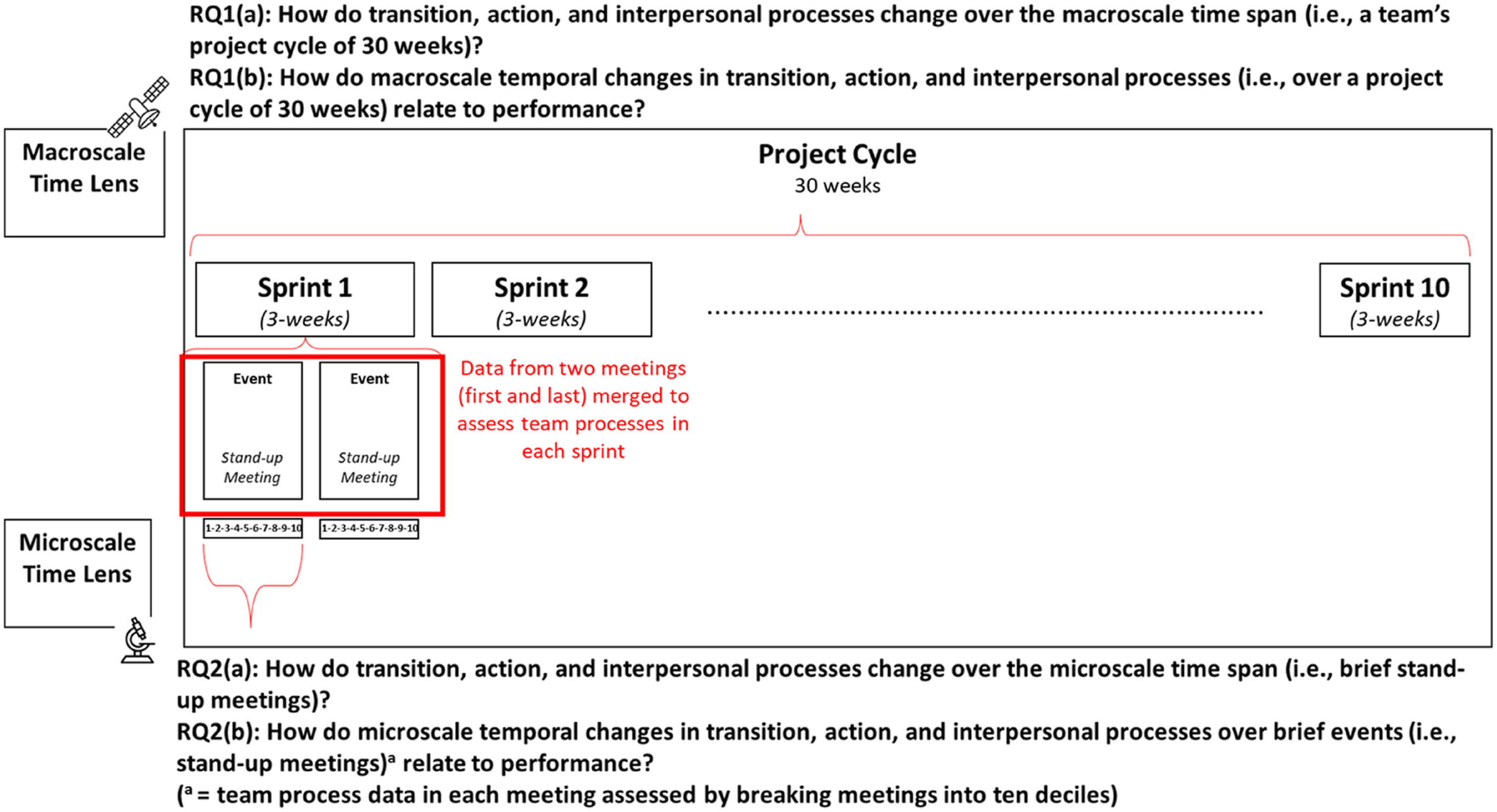
(a) How do transition, action, and interpersonal processes change over the macroscale time span (i.e., a team’s project cycle of 30 weeks)? (b) How do macroscale temporal changes in transition, action, and interpersonal processes (i.e., over a project cycle of 30-week) relate to performance?
(a) How do transition, action, and interpersonal processes change over the microscale time span (i.e., brief stand-up meetings)? (b) How do microscale temporal changes in transition, action, and interpersonal processes over brief events (i.e., stand-up meetings) relate to performance?
Finally, beyond quantifying how team processes change over time and link to performance, we also seek to explore the quality of different team process temporal change patterns. The goal of this qualitative exploratory analysis is to better understand why team processes are changing around a certain time point and how these specific temporal patterns are related to team performance. Thus, our goal is to provide an in-depth qualitative analysis of time points that we will identify as salient in the quantitative analyses and to unearth differences in the quality of team processes for team performance.
Methods
Research Context
We collected data from two Scrum teams in agile software development, with a size of 9 and 10 members, respectively. As part of the IT department of a multinational insurance firm, both Scrum teams independently worked on developing features for a mobile application to submit insurance claims. The team membership for both Scrum teams remained stable throughout the data collection period and each team was composed of software developers, a Scrum master, and a product owner. Except for one female participating in both teams, all team members were male, with an average age of 45 years (SD = 11.84), of which 90% had a vocational education degree. All team members worked between 36 and 38 hours per week and the average organizational tenure was 15 years (SD = 10.94).
Small Sample Rationale
The decision to employ a small sample size in this study was guided by theoretical, practical, and logistical aspects that align with the unique nature of the research context. First, our main study goal was to better understand the temporal aspects of team processes. Exploration of team processes over distinct time spans necessitated an in-depth and nuanced analysis, which is often only feasible within the context of small samples. By concentrating on two teams and their project cycles, we prioritized uncovering the temporal unfolding of team processes (project-cycle time span and brief stand-up meetings). That is, we prioritized depth (i.e., repeated measures over a period of 30 weeks resulting in 40 meetings to be analyzed) over breadth (i.e., many teams), to capture the fine-grained nuances and patterns that emerge within the dynamics of these teams over time. Second, our research of teams ‘in the wild’ involved logistical complexities and strong relationship building (Maynard, Conroy, et al., 2021; Maynard, Mathieu, et al., 2021). Studying team processes over extended periods requires a deep level of engagement with participants in the research context. In our case, we observed two agile software teams across multiple months, necessitating the establishment of robust relationships with the organization. This involved securing access to their regular meetings, obtaining recording permission, and building strong rapport and trust with the team. The resource-intensive nature of this process limits the feasibility of a large sample size. Instead, it allowed us to immerse ourselves in the teams’ working environment, enabling a holistic understanding of their dynamics, and enhancing the validity of our findings. Finally, our focus on teams operating within the Scrum framework introduces a novel and relevant research context. Although Scrum is increasingly popular in software development, it remains relatively underexplored in the organizational behavior literature. Studying Scrum teams is particularly relevant due to their unique characteristics, such as short iterative cycles, close collaboration, and adaptive problem-solving. The dynamic nature of Scrum teams aligns with the temporal focus of our study, as we analyse their interactions during stand-up meetings over different time spans. Through this exploration, we seek to uncover how the principles and practices of Scrum manifest in the temporal unfolding of team processes, thereby advancing our knowledge of this emergent work context.
Sampling Procedure
The sampling strategy to assess team processes over macro- and microscale time spans is depicted in Figure 1. Figure 1 also shows how the repeated measuring of team processes aligns with our research questions.
For all teams, we collected audiotaped team meetings. In total, we obtained 40 meetings from both teams that were equally distributed across their project cycle and the 3-weekly sprints. That is, to capture team processes at different time points, we collected data from these daily team meetings from both teams over 30 weeks. As can be seen in Figure 1, we sampled two meetings within each 3-week sprint, namely, the first meeting and the last meeting of each sprint. Since the project had a duration of 30 weeks (with each sprint being 3 weeks), we recorded 20 meetings for each team. Although this does not cover all team interactions that happened throughout the project cycle, we had to find terms with the partnering organization that only provided access to teams during specific time windows. We made this design decision also for reasons of not being too invasive. Using the first and last meeting per sprint allowed us to sample key time points within each sprint, while also allowing us to sample a relatively large number of meetings per team.
Each meeting was on average attended by eight team members from each team (SD = 1.19; Min = 6; Max = 10) and lasted for 13 minutes (SD = 3.30). One of the authors was physically present at each team meeting and gained ample insights about the teams, their tasks, and the work context to grasp the team interactions. All stand-up meetings were recorded and transcripts were created with the Communication Analysis Tool (CAT, Klonek et al., 2020). CAT is a browser-based software application that allows to play video or audio recordings, segment speaker utterances into discrete thought units with precise time stamps (i.e., brief timed events for which the software records the temporal onset and offset of the behaviors, e.g., team: 1, sprint: 3, meeting: 2, onset: 0:08:54.38, Transcript (Utterance): “Yes, it should all be in the test analysis.”), and export this process data as fine-grained moment-to-moment behaviors (Klonek et al., 2020).
Measures
Computer-Aided Text Analyses (CATA)
To obtain measures of transition, action, and interpersonal processes, we used a CATA (Short et al., 2018) for all transcribed meetings. CATA describes a class of different methods to analyse textual data in terms of their content and psycholinguistic properties (Driskell et al., 2017; Short et al., 2018). We applied CATA to the verbatim transcriptions of these team meetings. Using CATA, we calculated the proportion of words in a text file that matched established lexical dictionaries, generating objective, replicable, and comparable measures for our constructs of interest (Short et al., 2018). One advantage of the CATA method is that it explicitly captures verbal behavior, which taps into a more proximal and unobtrusive representation of actual behaviors rather than directly asking participants about their intentions using more traditional survey measurements (Klonek et al., 2019, 2023; Short et al., 2018). We adopted a deductive analysis focusing on the frequency of words occurring in validated lexical dictionaries for coding team transition, action, and interpersonal processes (i.e., measuring constructs of interest, cf., Mathieu et al., 2022). To operationalize focal measures, we used the lexica from Mathieu et al. (2022) and a software tool called ‘Basic Unit-Transposable Text Experimentation Resource’ (Boyd, 2021) that assists in the quantification of measures. We will explain the operationalization of our measures in more detail in the subsequent section.
Transition, Action, and Interpersonal Processes
Transition, action, and interpersonal processes were measured with validated lexica from Mathieu et al. (2022). In the first step, Mathieu et al. (2022) generated a list of words describing positive team processes at the lowest level of specificity (i.e., the 10 lowest-order dimensions) which resulted in a list of 2225 words (some words are repeated across lower-order dimensions). In a second step, the authors worked with seven different subject matter experts (SMEs) to categorize each word into any of the 10 lower-order dimensions where alignment was seen as the highest. After a process of content validation with SMEs, they retained 1912 words (reflecting positive team processes) that were considered generic across different team contexts (Mathieu et al., 2022).
The transition process dictionary contains words reflecting transition processes (e.g., big picture, agenda, budget, charting, end goal, envision, foresight, going to, idea, mission, objective, plan, scenario, wants, etc.), the action process dictionary contains words reflecting action processes (e.g., accomplish, assist, backup, collaborate, complete, doing, execute, facilitate, finish, help, job, move, obtain, orchestrate, proceed, request, work, material, realize, restock, take-over, supply, etc.), the interpersonal process dictionary contains words reflecting interpersonal processes (e.g., admire, agree, amity, adore, awesome, comfort, fabulous, funny, gentle, happy, interesting, polite, trust, sweet, yay, etc.). Mathieu et al. (2022) also provided convergent validity for these CATA measures with human hand-coded annotations of transition, action, and interpersonal processes (e.g., for transition processes, r = .59, p < .01, for action processes, r = .90, p < .01, for interpersonal processes, r = .80, p < .01).
Content Validity of CATA-Based Coding for Transition, Action, and Interpersonal Processes.
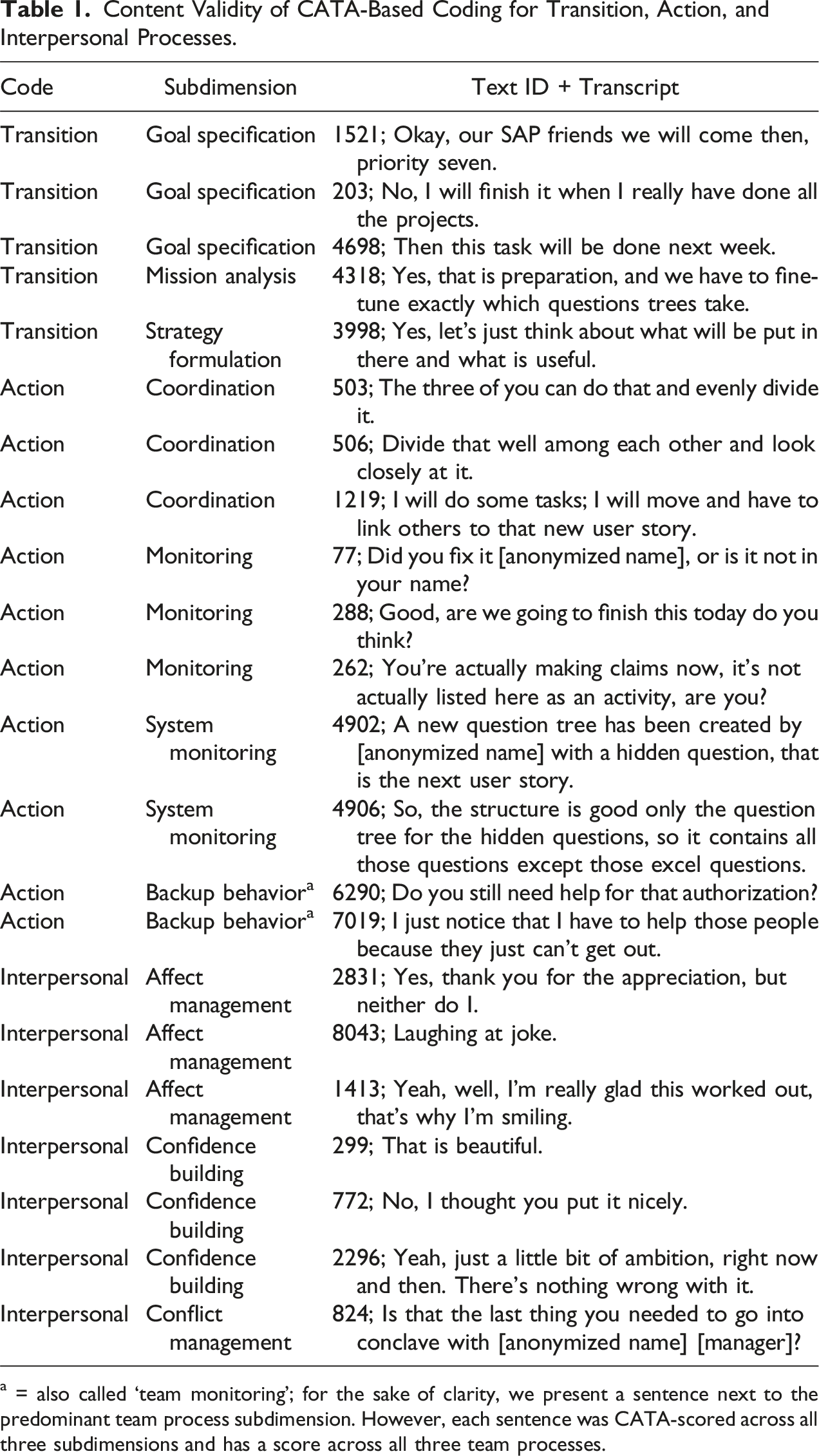
a = also called ‘team monitoring’; for the sake of clarity, we present a sentence next to the predominant team process subdimension. However, each sentence was CATA-scored across all three subdimensions and has a score across all three team processes.
Following the same procedure as Mathieu et al., we aggregated the lower-order scores per higher-order dimension to form higher-order composites. Notably, these also included scores for the words used as direct indicators of the second-order dimensions. Because count data are not presumed to yield parallel indicators of a given domain (i.e., tau-equivalent measures), we estimated the internal consistencies of these nonparallel (i.e., congeneric) measures (McDonald, 1999) using omega which were as follows: (a) transition (4 indicators) ω = .91; (b) action (5 indicators) ω = .96; and (c) interpersonal (4 indicators) ω = .34.
Time Sampling: Project Cycles (Macroscale) and Events (Microscale Time Span)
For the project cycle perspective (macroscale time lens), we computed scores for transition, action, and interpersonal processes using transcripts for all meetings that occurred within each of the ten sprints (3-week time window). Each sprint indexed a distinct performance episode and the project cycle for each team involved 10 sprints. Overall, this project cycle perspective used data aggregated across a 3-week period and repeatedly sampled 10 different data points for each team.
To zoom into the microscale time lens (i.e., events perspective), we followed a methodological approach suggested by Meinecke et al. (2016) and Amrhein et al. (2003) that allowed us to repeatedly sample team processes across the microscale time span. In their studies, these authors divided their process data into 10 equidistant parts, so-called ‘deciles’ (Amrhein et al., 2003; Meinecke et al., 2016). This approach is now relatively common practice in psychotherapy process research (e.g., Borsari et al., 2018), but still remains under-utilized in organisational behaviour research. Using this approach, we computed scores for transition, action, and interpersonal processes for ten equidistant time intervals within each stand-up meeting. Each meeting had an average duration of 13 minutes, that is, we sampled team processes over a 1.3-min interval which allowed us to understand how transition, action and interpersonal processes fluctuate across these brief events.
Performance
Performance in each sprint was calculated as a percentage based on the number of story points planned by the team at the beginning of the sprint and the number of story points the team actually achieved at the end of the sprint, which was determined via a team consensus process. The term ‘story points’ is used in agile methodologies to refer to units of a measure to express an estimate of how much overall effort is required by the team to complete a piece of work. The teams themselves assign story points to the parts of the features that they need to work on for that particular sprint, depending on its complexity, amount of work, and associated risk. By assigning story points, the team can better understand how much work they have to allocate and commit to which allows better tracking of their performance and their deliverables after each sprint, instead of solely looking at the end product. For example, 100% means that a team had done all the work that was planned for that sprint, while 75% means that the team had realized 75% of the work that was planned for that sprint - indicating lower performance. The organization used a range of 90%–110% as the norm within which teams should be performing. Anything under that range was considered poor performance, sprints within that range were considered average (expected) performance, and sprints above that range were considered strong performance. Across sprints, performance had an average value of M = 0.94 (SD = 0.24; Min = 0.50, Max = 1.40).
Analytical Procedure
Our study adopts a mixed-method approach which implies using methods that include both quantitative and qualitative data and/or analyses (Gibson et al., 2017). Here, we start by using quantitative analyses (CATA) to capture the temporal pattern of team processes across two different time spans and by using some rudimentary statistical analyses. That is, we tested whether the extent of a team process subdimension changed from one sprint to the subsequent one with repeated contrasts and/or whether it was different from the average level across time points with deviation contrasts. These analyses allowed us to answer if there was a temporal change or variation of a specific team process dimension over the respective time spans.
Based on differences identified in the quantitative results, we then used a qualitative approach to explore some of the patterns that we uncovered in the quantitative analyses. The qualitative exploration allowed us to dig deeper and unpack some of our results.
Results
Macroscale Time Span Perspective: Project-Cycle
To answer our first research question 1a “How do transition, action, and interpersonal processes change over the macroscale time span (i.e., a team’s project cycle of 30 weeks)?”, we analyzed the trajectories of the three higher-order team processes across the 10 performance sprints of the project cycles.
Figure 2(a) shows the project cycle trajectories of these team processes (see Appendix 1 for descriptives) and highlights significant differences over time identified for each process subdimension. Macroscale time lens: (a) transition, action, and interpersonal processes and (b) performance over ten performance sprints of the project cycle (30 weeks). (a) Temporal variation of team processes over project cycle. (b) Temporal variation of sprint performance. Note. 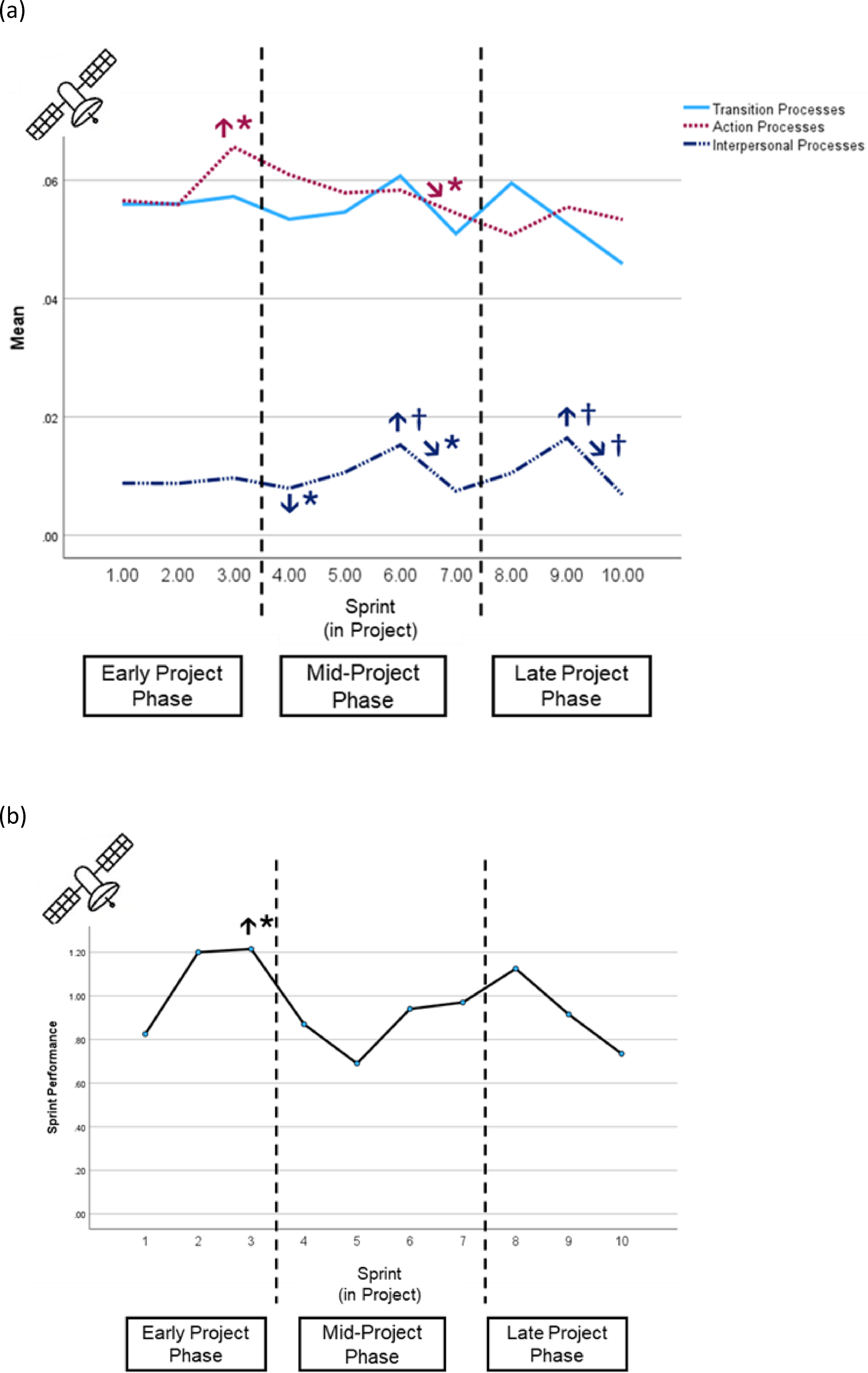
For orientation, we marked sprint number 1–3 as early project cycle periods, sprint number 4–7 as mid-project cycle, and sprint number 8–10 as late project cycle periods at the bottom of the Figure.
With respect to
With respect to
With respect to
To summarize the answer to our first research question (1a): Transition processes showed no significant temporal variation across the project cycle. However, action processes peaked in the early phase of the project (at sprint 3) and showed a drop around the mid-project cycle (from sprint 6–7). Finally, interpersonal processes showed some small peaks in the mid-project period (sprint 6) and towards the end of the project (sprint 9).
Macroscale Time Span Perspective: Project-Cycle and Performance
Research question 1b “How do macroscale temporal changes in transition, action, and interpersonal processes over a project cycle relate to performance?” is answered using the performance score that teams achieved in every sprint.
To understand whether temporal changes in the team process dimensions were associated with changes in the sprint performance, we also explored significant temporal changes in the sprint performance measure (Figure 2(b)). Indeed, the level of sprint performance at sprint 3 was significantly higher than the average level of performance over the project cycle (F (1, 1) = 186.77, p = .046, η 2 = .995, β = .716, see also Figure 2(b)). Note that we also observed a significant increase in action processes in the third sprint (i.e., in the early-project cycle), which suggests that an increase in action processes in the early project cycle is associated with the increase in performance.
To answer our second research question (1b) which is about understanding what changes in team processes across the project cycle relate to performance, we find that an increase in action processes in the early project time coincided with a significant increase in sprint performance around the same time. This suggests that an early engagement in action processes in a project cycle is conducive to performance.
Microscale Time Span: Event Perspective
Our research question 2a was: “How do transition, action, and interpersonal processes change over the microscale time span (i.e., brief stand-up meetings)?”. To answer this question, we analyzed the trajectories of the three higher-order team processes over ten deciles of the stand-up meeting (aggregating over 40 meetings) 1 .
In our statistical analyses, we tested whether the level of a team process subdimension changed from one decile to the subsequent decile (i.e., repeated contrasts) and whether it was different from the average level across the ten deciles (i.e., deviation contrasts). This allowed us to answer if there was a temporal change or variation of a specific team process dimension over a short time.
Figure 3 shows the three higher-order processes over the course of the stand-up meetings and also highlights significant differences (see Appendix 2 for descriptives). Microscale time lens: transition, action, and interpersonal processes over ten deciles of (15 min.) stand-up meetings. Note. 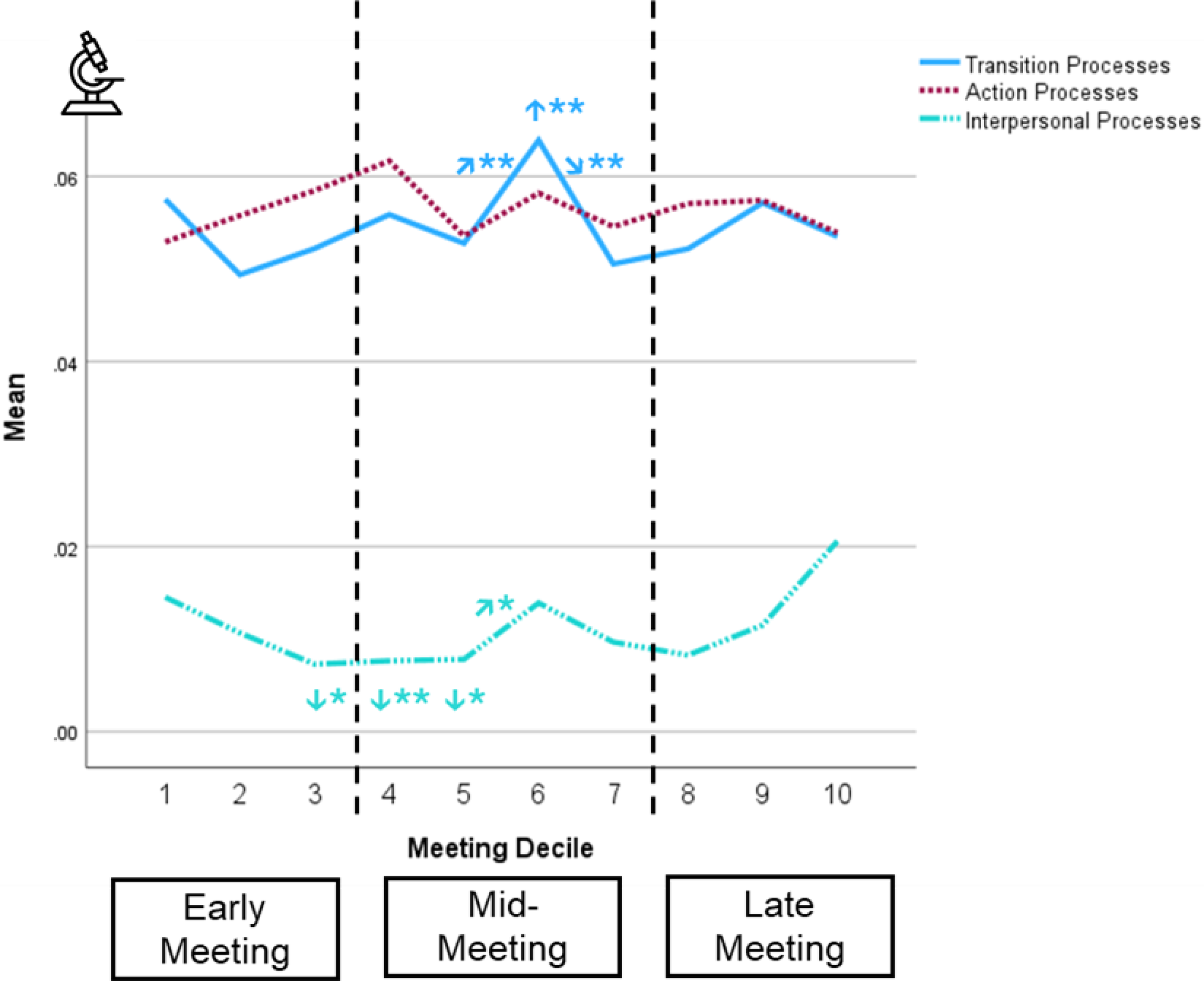
For orientation, we marked decile numbers 1–3 as early meeting periods, deciles 4–7 as mid-meeting periods, and decile numbers 8–10 as late meeting periods.
With respect to
With respect to
With respect to
To answer our research question 2a: Transition processes showed temporal variations, particularly, a peak (i.e., a brief increase) of transition processes around the midpoint of the stand-up meetings. In contrast, action processes showed no significant temporal variation, indicating that teams engaged in action processes in a relative stable fashion over time throughout the stand-up meetings. Finally, teams showed the lowest level of interpersonal processes towards the end of the early-meeting phase and then increased interpersonal processes around the meeting midpoint, which is around the same time period during which we observed an increase in transition processes.
Microscale Time Span: Event Perspective and Performance
Next, we turn to research question 2b: “How do microscale temporal changes in transition, action, and interpersonal processes over brief events (i.e., stand-up meetings) relate to performance?”. We compared trajectories for low-versus high-performance sprints (see Figure 4, Appendix 3). Based on the median split (cut-off score of 0.915), each meeting was categorized as either being part of a low- or high-performing sprint. Microscale time lens: transition, action, and interpersonal processes for low versus high-performance over ten deciles of (15 min.) stand-up meetings. Note. 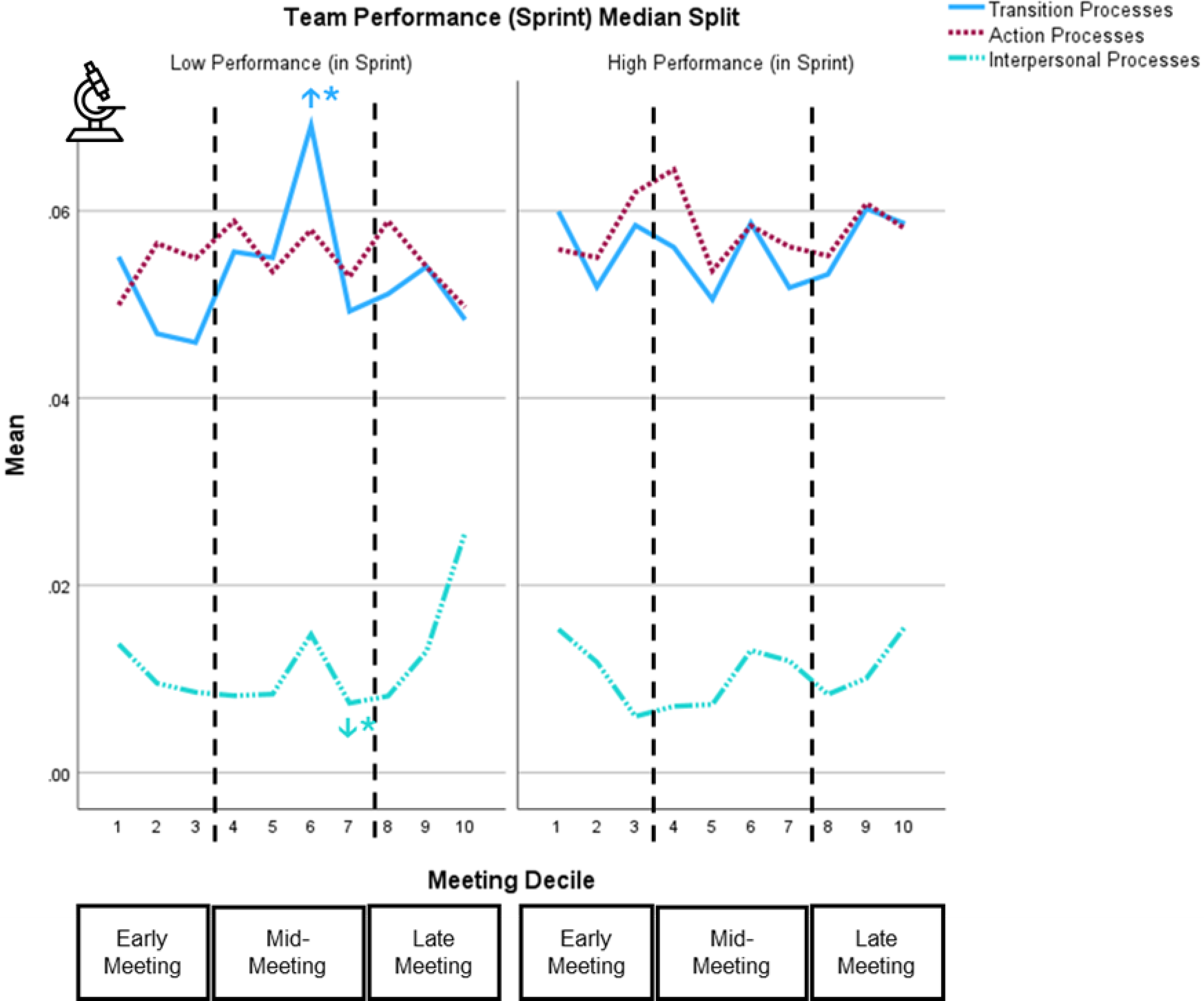
We first explored the descriptive differences based on Figure 4. Following this, we also ran statistical analyses, testing whether a team process subdimension changed over time by comparing the low-versus high-performance sprints using repeated and deviation from the mean contrasts. This analysis allowed us to answer if there was a temporal change or variation of a specific team process dimension over event time for low-versus high-performance sprints.
Figure 4 shows the trajectories of the three higher-order processes over the course of the stand-up meetings for low-versus high-performance sprints. On a descriptive level (based on Figure 4), we observe that for high-performance sprints, action and transition processes are visibly more ‘in sync’, that is, both action and transition processes increase and decrease at similar time points (except for decile 1).
Next, we compared whether any of the three team processes showed significant variations over time using GLM analyses with the categorical team performance score (low vs. high) as a between factor.
For
For
For
To answer our second research question 2b: We only find changes in transition processes around the mid-meeting periods being associated with sprint performance with an increase in transition processes being negatively associated with performance. Further, our results indicate that temporal variation of interpersonal processes around the mid-meeting period distinguishes between low and high-performance sprints. Interestingly, this happens around the same meeting phase during which we see performance-relevant changes in transition processes. In the next section, we explored the changes in transition and interpersonal processes using an in-depth qualitative analyses.
Supplemental Qualitative Analyses: What Happens Around the Mid-meeting Periods?
Given the importance of the mid-meeting periods, we qualitatively explored the meeting transcripts and original recordings around the meeting midpoints.
To do so, we specifically focused on these key phases to qualitatively explore the different team process dynamics that occurred between low-versus high-performance meetings. Therefore, based on the meeting transcripts, we first wrote short summaries (approx. 300–500 words) of what happened during all 40 meetings. The author who was physically present at these meetings wrote these summaries directly after the meetings took place as field notes, without considering the CATA team process coding. Because the quantitative examination of the meetings using CATA happened at a later timepoint, we ensured that the same author read their original transcripts again and listened to the specific parts of the audio recordings to recall the situation (e.g., the meeting mid-points) and then wrote a second version of meeting summary with a focus on interpreting the content of the discussion, and focusing on team process dynamics. This relistening, for instance, gave a better understanding of the underlying emotions of the interactions (e.g., the frustration/excitement of team members), the silences, the speaker’s tone of voice, and the humoristic or sarcastic interpretation of jokes.
Next, we thematically coded meetings that showed peaks of transition and interpersonal processes around the midpoint – as they appeared to be crucial in the quantitative results - to uncover how these two team processes unfolded. We systematically created first-order codes based on what individual team members said in the meeting transcript and added a contextual understanding to these codes. The next step involved coding the team processes from Marks et al.’s (2001) team process framework and relevant contextual concepts. By reviewing concrete excerpts of these meetings, we could identify recurring themes in the team interactions, for instance, re-establishing coordination, prioritizing team goals, or using a positive tone to encourage each other to perform well. By reading the transcripts before and after these meeting midpoints and listening to the audio recordings to hear who is saying what (we use pseudonyms in the findings to refer to team members), we could better understand whether the team processes were more or less effectively discussed by the team in the specific meeting deciles.
Once we understood the recurring themes, we dug deeper into them and distinguished between meetings that occurred during the first or last week of the sprint and whether or not the meeting took place in a sprint that was considered to have a high or low performance. This enabled us to better grasp what happened during the low versus high-performing meetings (i.e., microscale lens) and across the project (i.e., macroscale lens). Based on these distinctions, we analyzed and coded the content of the transcripts and the qualitative meeting notes to unravel recurring patterns of why there was a peak in these team processes at the meeting midpoints. In short, we encountered that the main differences in the team process interactions and their content were mostly based on the team’s performance in that sprint and to a lesser extent on the respective team or sprint, as we will further discuss below. We then used the meeting summaries and contextual notes to verify and triangulate the themes and patterns that emerged from the data. Throughout this process, three of the authors were involved in frequently discussing the summaries, coding, and emerging themes to come to an agreement, challenge each other, and solve disagreements. In sum, the in-depth thematic coding and analysis of the excerpts, in combination with the summaries and the researcher’s knowledge of the team context, allowed us to identify recurring patterns in why certain team processes peaked or dipped.
In what follows, we describe key differences in the quality of team interactions from these mid-meeting periods. For clarity of presentation, we present our insights separately for the low-versus high-performing sprint meetings.
Qualitative Insights from Low-Performance Team Meetings
In the low-performance sprints, teams often discussed foreseeable problems or existing impediments around the mid-meeting period which required them to (re)plan and strategize their work together (i.e., transition processes). These discussions were often accompanied by managing interpersonal issues (affective or motivational issues). The following excerpt (Team B; last meeting of sprint 1; 6th decile) illustrates how the team struggled to discuss a contingency plan for their potential work delay as they were cooperative in assisting each other when they needed to integrate their work efforts: Mark [annoyed tone]: “If I start putting the test cases in the testing tool, then the creation of the claims will come to a standstill [causing a delay]. So, then somebody has to say ‘Ok, I will put the test cases in the testing tool’ so that I can continue moving on with creating the claims.” Remi: “Who can put the test cases in the testing tool?” [all remain silent]. Mark [sarcastically joking]: “Ha, what a surprise.” [No one laughs]. Noah: “It is useful to plan the implementation in advance, because if we find defects, we can fix them in time. If we don't find out until Monday, it might be too late.” Remi: “Who can help with entering the test cases in the testing tool?” Justin: “Tom can do that.”
In this situation, we note Noah’s effort to prepare a contingency plan which gets ignored in the discussion. Justin then assigns an extra task to Tom without involving him in the decision. Thus, even though the team engages in planning and strategizing of work (i.e., transition processes), there is a lack of active engagement and agency in how tasks get assigned.
In comparable situations, teams are joking about task-related problems but without solving these issues (“You really seem to trust my judgment again.” In response: “Yes, you are a year older, haha” (Team A; last meeting of sprint 6; 6th decile) or doubting whether tasks could be finished on time. In one situation, team member Tom is questioned whether he can finish an additional task by the end of the day, to which he hesitantly replies that “completing [the task] really depends on whether or not we find defects”.
Another observation is that teams in the low performance sprint meetings discuss many work delays due to coordination issues (i.e., team members waiting for one another before being able to start work). These discussions required the replanning of work for the remaining sprint to deal with delays. Some of these discussions entailed tensions between members (i.e., members doubting others about their completion of assigned tasks). That is, team members assumed that others had not finished their task (“I don’t think you have built that yet because I saw line 7 of the email, which is also not used anywhere in the codes.” (Team B; Meeting in the last week of sprint 10; 6th decile). In other situations, team members voiced insecurity about client task completion, which affected the overall planning (Team B; Meeting in the last week of sprint 4; 5th decile): Noah: “Yes, sort of. I think this [task] is kind of finished because we have done the things we initially had to do for that user story.” Bob: “But we also have to look at how we can tackle things [tasks] that still pop up and that we cannot put in a user story.” Remi [frustrated; raises his voice]: “We have an argument about this every time…” Stella: “Noah will put that in [the sprint planning] - when to do those tasks.” Remi: “Then he [Noah] means eventually doing the tasks in the next sprint.” Bob: “I'll discuss this again in a later meeting.” Remi: “Ok, Glassportal discussion finished.”
This excerpt shows some of the interpersonal processes (team members bickering about the lack of clarity regarding the team’s goals and when they should be accomplished) occurring around the mid-meeting periods in the low-performance sprint meetings.
The lack of a shared understanding beyond the clearly identified main tasks was a recurring topic in these meetings. It hindered the teams from developing work plans for uncertain situations and specifying their work sequence. Oftentimes, these types of controversies remained unresolved, and the discussion moved on to avoid an escalation. However, these issues still incurred delays for the next sprint. For example, Bob remained unhappy about the lower sprint performance and reminded the rest of the team “that’s two [story] points less, that’s a shame guys, two points”.
A key observation is that team processes appeared less synchronized in the low-performing sprint meetings. For example, members expressed confusion (“I find it strange that for this user story-do we also have to make a technical design again?” (Team B; final meeting, sprint 9; 6th decile), misunderstanding (“I don’t quite understand what you mean. We should discuss this after the meeting.” (Team A; final meeting, sprint 7; 5th decile), or expressed concerns about potentially more defects (“I think, we are going to complete the output today, but we can only finish it if we don’t find any defects…” (Team B; final meeting; sprint 1; 6th decile). In response to these concerns, others either make sarcastic jokes or remain silent to avoid heating up the discussion. In some cases, team members expressed lacking motivation to deal with problems or they had to replan work around pertinent issues.
Qualitative Insights from High-Performance Team Meetings
In the high-performance meeting sprints, we observed a more proactive discussion of how the team (re)planned their work and/or order of tasks to avoid coordination issues with one another. For example, when it was noted that they were falling behind sprint goals, discussions focused on avoiding future coordination issues from arising in the first place, which allowed to speed up work processes (Team A; first meeting of sprint 2; 6th decile): Thomas: “Only now we discover that we are still stuck in priority three, while if we launch the component live immediately, we must have submitted those question trees correctly before we deal with the product-specific questions. For the email and for the call back appointment. And we only have two weeks to test that. So, I think that from tomorrow onwards we will just have to get started full speed with that call-back appointment because otherwise we simply won't make it. Because we are now stuck in the first few priorities and- Then things are not going well. Harry: “And we're still going live [with that component] early March?” Thomas: “After this sprint, we go live. And if we start using the question tree two weeks later, we will have to do a deployment again because we have not finished the stuff yet.” George: “Agree, so we have to make sure we get that in order. It will soon also be deployed in a stable version.”
In terms of planning and goal setting, we identified two different discussion types that were absent in the low-performance sprint meetings. First, team members tried to push and encourage one another to set ambitious goals to get their work finished quicker and to get more client work finished in this sprint (“Yes, finish that [task] this afternoon, just be ambitious every now and then, that’s more than normal.” (Team A; first meeting; sprint 3; 6th decile). Second, we find reprioritization of specific tasks to ensure that others do not have to wait around while ‘waiting’ on the contributions of their team members (“I think it is better for you to just work on the production problem, and for George to continue with getting the test work instead, to keep things going.” (Team A; first meeting; sprint 9; 6th decile). Relatedly, around the meeting midpoint of high-performance sprints, team members engaged in clarification of their planning to each other to ensure that the team is (still) on the same page and to check whether their planning is still attainable, as indicated by the following excerpt (Team B; last meeting of sprint 7; 5th decile): Stella: “Is there still building work to be done?” Justin: “Maybe I should change some data points here and there.” Stella: “I don’t know for sure what he’s going to do now.” Noah: “So you still need to do a unit test or at least run a test?” Justin: “Yes.” Noah: “But the building work is finished?” Justin: “Yes, yes, sort of, but yes, it has been built, but something small can still come out of it.” Stella: “So, the building work is done but you still need to do the testing?” Justin: “Yes.” Stella: “And then we just have to sort it all out today so that we are still on track.”
In the high-performance sprint meetings, we also observed more functional interpersonal processes, with the teams being more supportive, particularly around the mid-meeting period. Jokes are made to lighten the atmosphere (“He has nothing to do, he said this morning. He already cleaned out his closet and he even got me coffee haha, I’m sure he has plenty of time to help.”: Team B; first meeting of sprint 3; 5th decile). Team members praise each other’s contributions (“That’s really good work! Just let me know when you’re finished so that I can start the testing.”: Team A; first meeting of sprint 8; 5th decile), and express confidence that they can rely on one another to achieve their goals (“Today we will yield results together, I’m grateful.”: Team A; last meeting of sprint 3; 6th decile). Overall, in the high-performing sprint meetings, team members are more in-sync with one another.
In summary, our qualitative analyses further highlighted distinctions in team process interactions during the meeting midterm periods between the low versus high-performance sprints. The key difference between low- and high-performance was that planning processes in the high-performance meetings were proactive, encouraging, and better synchronized with the action processes. In other words, we see proactive planning for foreseeable work delays and then reassignment of tasks to others, so that work can be done more smoothly. During meeting midpoints of high-performance sprints, we also find more functional interpersonal issues (e.g., a more positive tone, and high confidence to finish tasks and meet goals) relative to the low-performance meetings.
Discussion
Given the complexity of theorizing and studying dynamic team processes (Cronin et al., 2011; Leenders et al., 2016), our goal was to better understand temporal changes in team transition, action, and interpersonal processes over time. In particular, we used two temporal lenses, a macroscale project cycle lens and a microscale perspective focusing on brief events, to understand how temporal changes in team processes relate to performance. We find that — depending on whether we take a macroscale or microscale time lens — different team process subdimensions were associated with performance over time. From the macroscale project cycle lens, our results highlight the importance of team action processes during the early project cycles for performance. From a microscale time lens, when teams showed a peak of transition processes around the meeting-midpoint, this was negatively related to performance. The peak in transition processes also coincided with interpersonal processes which made us further explore what is happening during these mid-meeting periods. Our in-depth qualitative analyses of low-performance meetings showed that transition processes co-occurred with more dysfunctional interpersonal processes. Further, planning processes around the meeting midpoint happened more reactively, with teams often dealing with interpersonal or motivational issues at the same time which overlayered work progress and thus hampered sprint performance.
Theoretical Implications
Our study has important implications for theory. First, our exploratory study implies that, from a macroscale time span perspective, early action processes are more important than existing theory would suggest (Marks et al., 2001). This finding challenges the recurring phase model which proposes that transition processes serve to prepare teams for future work, but also to review and reflect on what they have done (Marks et al., 2001). That is, the model places transition processes at the beginning and end of teamwork activities (i.e., assuming variations over time). According to this model, we would expect to see teams engage in transition processes, particularly in the early and late periods of their project cycle (i.e., some U-shaped form over the project cycle for transition processes). Conversely, we would expect to see more action processes (task execution activities) in the mid-team project cycle periods (i.e., an inverted U-shaped for action processes). However, empirically, our results indicate that action processes mattered more in early project phases than transition processes for team performance than was previously assumed (Mathieu et al., 2022). This is also an important insight with respect to developing a better temporal understanding of team processes. Leenders et al. (2016) pointed out that the key problem is that our field typically relies on theories that suggest static relationships (e.g., the more action processes, X, the higher the performance, Y), but do not “specify whether the effect of X on Y is constant throughout the team’s performance episode or whether some systematic evolution or fluctuation should be expected.” (p. 95). A meta-analysis focusing on the team process-performance relationship (LePine et al., 2008) reported for all three team processes the same effect size with performance (r = .29 for transition, action, and interpersonal processes), but these authors also acknowledged that a time-based research design would “produce less uniform process-related correlations” (p. 297) as they do not collapse variance over time. Some quantitative studies have responded to this by sampling team processes over three time points with results suggesting linear growth of action and interpersonal processes to be performance-conducive (Larson et al., 2020). However, by sampling team processes over more time points, our study indicates that team processes display more complex temporal variations over time (both over micro and macro time spans). For example, we find that early action processes are associated with performance, as they help teams to engage in immediate task performance (Mathieu et al., 2022; Zijlstra et al., 2012).
Second, our study contributes to a better understanding of team processes over different time spans (i.e., macroscale time lens of project cycle vs. a microscale time lens of brief stand-up meetings). Although scholars have acknowledged different time perspectives focusing either on project cycle (e.g., Knight, 2015; Larson et al., 2020) versus brief episodes (e.g., Mathieu et al., 2022; Schmutz et al., 2018), no research has investigated team process dynamics in relation to both time perspectives in combination. Our study contributes to the literature on temporal team processes by acknowledging these different time frames and highlighting which team processes matter most within each temporal lens. This is important because understanding team processes requires an understanding of a phenomenon’s time span, that is, pinpointing when a process change is most likely to emerge and when it is critical for team effectiveness (Klonek et al., 2019). Following calls for research to study multiple performance episodes (e.g., Larson et al., 2020), our results showed that early action processes were important from a macroscale project cycle perspective. However, when zooming into the microscale time lens, we uncover that the timing of transition processes at the midpoint mattered for performance; a result which aligns with Gersick’s early qualitative studies (1988, 1989) who highlighted that midpoints are critical markers for group performance.
Thus, an interesting insight from our study is that transition and action processes mattered differently when zooming in and out to different time spans. The key processes to happen over the course of a project cycle were action processes: when teams focused on the actual actions and getting things done, we see an increase in performance as well. On the micro-scale time span, we see that an overemphasis on planning and re-strategizing at the midpoint was associated with low performance. Our focus on the microscale time span also indicates that team action processes did not differentiate between low and high performance. Hence, our research contributes to the literature by highlighting that team process subdimensions matter most for performance when they match the predominant goal of what needs to happen in the specific phenomenon time span. Our qualitative analyses of the meeting transcripts and recordings further suggested that a proactive planning approach with more functional interpersonal team processes was conducive to performance (instead of reactive planning in combination with interpersonal tensions). Our qualitative analyses also bear some similarities to Gersick’s (1989) study which reported that one of her groups was unsuccessful because the team could not close their debate and got stuck in transition processes around the midpoint.
Third, our study has important implications for theory with respect to interpersonal processes. The recurring phase model makes no specific predictions other than that these processes should occur both within transition and action processes at varying times. Team development models like Tuckman’s (1965) stage theory of group development (suggesting norming, storming, performing, and adjourning phases) would suggest that interpersonal processes play a more crucial role within the early phases of a team’s project cycle. Specifically, in the storming stage conflicts and disagreements are expected to emerge when team members start to express their opinions, ideas, and personalities more openly. That is, storming stages would require teams to engage more strongly in interpersonal processes earlier in the team’s project cycle. However, our analyses showed increases in interpersonal processes occurring after the project midpoint (sprint 6 and 9). Thus, our empirical observations suggest that interpersonal processes become more relevant as the project outcomes become more visible.
Finally, our study has implications for using novel methods to study team processes. The use of CATA (Mathieu et al., 2022; Short et al., 2018) provides novel pathways to study team collaborations in a non-invasive way and using higher sampling rates than what is possible with survey-based approaches (see also Ballard et al., 2008). Text analytic measures are unobtrusive measures, that is, ‘‘measures that do not require the cooperation of a respondent and that do not themselves contaminate the response’’ (Webb et al., 1966, p. 2). Text-based measures create little interference between researchers and the participants who are measured with this approach (Hill et al., 2014). Teams that are unaware of the measurements make less effort to manage their impressions or alter responses, leading to less reactivity and the sampling of otherwise challenging participants. All of this is critical to preserve the construct response range.
Practical Implications
First, our study is relevant to improving the agile Scrum methodology that many organisations are adopting worldwide (KPMG, 2019), particularly in software development and IT teams, but also increasingly in marketing and HR teams or project-focused teams (Taylor, 2023). That is, beyond agile Scrum contexts, our findings also provide practical implications for teamwork contexts more broadly, given our focus on team processes which have been studied in many different team types (e.g., LePine et al., 2008; Maynard et al., 2012; Maynard et al., 2021). In particular, based on our findings, we would advise teams that focusing on action processes early in a project is relevant for team performance. That is, teams should focus swiftly on action processes as this will help to make progress with product increments. Beyond Scrum teams, this practical suggestion is likely applicable to any project-related and product-development teams that work in cycles over an extended period and use meetings to discuss their work progress.
Second, from the micro-dynamics perspective, teams should be aware when they notice increases in planning or re-strategizing in their stand-up meetings, in particular when this is paired with interpersonal tensions. These micro-dynamic processes could be taken as a warning signal that might require teams to take a more proactive planning approach.
Third, from a team development and data analytics perspective, organizations could consider using CATA approaches to monitor team processes in a more automatic fashion. This might be particularly feasible for teams that are heavily relying on virtual communication tools (MS teams or Zoom) that offer automatic transcriptions of team communication. While this also requires data privacy and legal considerations, there might be value in applying CATA methods towards more technological applications that help to support team effectiveness.
Limitations
Our study has a number of limitations. First, we studied the team meeting interactions of two scrum teams for 30 weeks as we were interested in understanding temporal changes in team processes. This means that our study is limited in its ability to generalize. For example, an alternative explanation for the link between early action processes and performance, is that this Scrum approach gives very clear goals. The strict format of stand-up meetings may require less engagement in transition processes. Nonetheless, this finding still seems to align with recent studies that have highlighted the importance of the dynamic action-process-performance relationship, yet failed to find evidence for a dynamic transition-performance relationship (Larson et al., 2020; Mathieu et al., 2022). Thus, it may be that propositions of the recurring phase theory are more applicable to newly formed teams that still need to determine their goals and ways of achieving them. In practice, however, field researchers often have access to established teams, which calls for a more flexible understanding of team processes based on team maturity and team goals at the time of the study.
Second, the CATA-based lexicon used in our study adopted a bag-of-words approach, which is not very sensitive towards word order and context (Mathieu et al., 2022) and we did not adjust the CATA measures for context-specific words. Although Mathieu and colleagues followed a rigorous approach in developing these measures and provided encouraging support for their validity, future research could develop more elaborate algorithms that are more context-sensitive (Banks et al., 2018). Third, our analyses focusing on the project cycle perspective are limited in terms of statistical power and potential effects of unmeasured variables. That is, given the observational data, we cannot fully rule out that other factors may have contributed towards the observed relationships. For example, unmeasured variables (e.g., client providing more clarity in software requests in a particular sprint or task-based triggers that require adaption, Maynard et al., 2015), may have affected the early increase in action processes and team performance over the project cycle. The results from these analyses are more descriptive and non-significant results should be interpreted with caution. Fourth, we also had to make choices with respect to sampling team processes across the time horizon of the project cycles. We selected two stand-up meetings per sprint, which is a situation during which the focal construct of team processes is most likely to emerge. However, in an ideal world, team processes would need to be sampled across a full 30-week time horizon that covers all available team interactions, ideally using a continuous measure (Leenders et al., 2016). It might be possible that interpersonal team processes, such as conflict management, happen outside of the daily Scrum meetings. In a real-world context, where teams work together over multiple weeks (or even months/years), it can be challenging to sample the entire time horizon (i.e., 30 weeks) of all possible team interactions. In this study, we chose a sampling design that allowed us to focus on situations that were most likely to showcase the focal concept (i.e., stand-up meetings), and tried to capture team processes reasonably well both within and across performance sprints of the entire project cycle.
Future Research
Our study has scratched the surface of the complexities in understanding team process dynamics. Agile teamwork practices are increasingly adopted in many organisations and go beyond technology industries (Taylor, 2023). While we expect similar relationships to be observed in project teams that use similar taskwork structures (e.g., regular meetings to discuss work progress), such as marketing or product development, it might be worthwhile to explore the unfolding process dynamics in teams that work on significantly different tasks (Ishak et al., 2012; Schmutz et al., 2018). For example, action teams, such as firefighters or medical emergency teams, have taskwork phases (e.g., conducting surgery) that more exclusively highlight action processes more than transition processes (Farh & Chen, 2018; Maynard et al., 2020), which is why it is important to study the temporal relationships in this context. It may also be interesting to track the temporal unfolding of interpersonal processes in teams that are facing difficult customer service facing tasks or that work in challenging healthcare environments (Johnson et al., 2018), particularly when teams deal with disruptions requiring them to adapt (Maynard et al., 2015). These task-specific requirements but also team compositional factors like familiarity (how well team members know each other) can elicit interpersonal processes like affect and conflict management to a much stronger extent (Killumets et al., 2015). Finally, scholars have proposed that interpersonal processes in virtual teams may interact with specific features of communication technology (Gilson et al., 2015) across different periods of group development stages (Maruping & Agarwal, 2004); for example, virtual teams that deal with early relationship conflict are expected to perform better if they use technology that provides more immediate feedback. Given the rise in remote work and the need to help virtual teams perform better (Handke et al., 2020), we need more empirical research on how process dynamics interact with task-specific requirements, such as task interdependence and immersive technology (Kanse et al., 2023; Maynard et al., 2015).
More generally, research should study how team task features (including team self-management) shape team processes (Mathieu et al., 2019). Teams characterised by a lower degree of self-management have less control over deciding who needs to do what. Self-management or levels of control at the team level give rise to more self-organization between team members, but it may also create more variance in team processes over time (Magpili et al., 2017). Understanding these structural or team design factors could be a contributing factor towards a better understanding of how team processes unfold over time. These questions could also be investigated with experimental designs that allow for manipulating changes in team processes at different times. Lab and experimental designs might be better suited to control external noise and the potential impact of unmeasured variables (Podsakoff & Podsakoff, 2019).
Finally, an important methodological endeavour is to better understand sampling periods of team processes over longer time periods (such as multi-week project cycles). That is, we need to better understand the ideal time window for sampling team interactions over longer time periods. While the thin-slicing literature suggests that even thin slices of behaviour (that vary between 60 seconds and 10 minutes) have been linked to accurate judgements of workgroup effectiveness (Jung, 2016; Satterstrom et al., 2019), negotiation outcomes (Curtland & Pentland, 2007) and observer reliability (Klonek et al., 2015), we still need a better understanding of what the minimal time window looks like, to allow representative conclusions about dynamic team process changes. When focusing on teams ‘in the wild’, it might be necessary for researchers to identify the critical periods that elicit key team interactions, such as team meetings or task episodes that involve collective teamwork. This type of research also needs to recognise that macro- and microscale time spans look different for different types of teams. For example, in professional sports (like soccer or NBA), team processes like coordination could be observed on the micro-scale by focusing on interdependent behaviours that occur over the course of a game, whereas a focus on macro-scale time span would involve focusing on an entire season (e.g., Stuart & Moore, 2017; Swaab et al., 2014). In other contexts, like open-software development projects, some studies have looked at team activities unfolding in projects that only involve 10 days (Riedl & Woolley, 2017). While chat logs or transcripts are one way to index the temporal unfolding of team process interactions, there are other time-sensitive methods (e.g., coding video data or using archival metrics) that allow this type of time-sensitive research which might inspire researchers to better understand team dynamics (for a detailed review, cf., Klonek et al., 2019).
Conclusion
Although team processes are considered critical for team performance, our understanding of this inherently dynamic construct and its unfolding over brief task episodes versus longer project cycles, and the related performance-implications are still underdeveloped. By adopting novel text-analytical methods that track team processes repeatedly both across brief stand-up meetings and longer project cycles, we zoomed in and out of team process dynamics. We show that specific team processes matter more (vs. less) at different time points: In a project cycle, early engagement in action processes was associated with better team performance, whereas during short task episodes (i.e., stand-up meetings), midpoint transitions showed to be a more critical marker for performance. Our study brings a more nuanced perspective towards the team process construct and challenges existing theory.
Supplemental Material
Supplemental Material - It’s About Time! Understanding the Dynamic Team Process-performance Relationship Using Micro- and Macroscale Time Lenses
Supplemental Material for It’s About Time! Understanding the Dynamic Team Process-performance Relationship Using Micro- and Macroscale Time Lenses by Florian Klonek, Melissa Twemlow, Maria Tims, and Sharon Parker in Group & Organization Management.
Footnotes
Declaration of Conflicting Interests
The author(s) declared no potential conflicts of interest with respect to the research, authorship, and/or publication of this article.
Funding
The author(s) disclosed receipt of the following financial support for the research, authorship, and/or publication of this article: This work was supported by the Australian Research Council (FL160100033).
Associate Editor: Travis Maynard
Data Availability Statement
The quantitative data of this project can be accessed by contacting the first author ( ) which includes data, syntax and annotated output of the quantitative analyses. Due to privacy reasons, the qualitative data from this research cannot be shared.
Supplemental Material
Supplemental material for this article is available online.
Note
Author Biographies
References
Supplementary Material
Please find the following supplemental material available below.
For Open Access articles published under a Creative Commons License, all supplemental material carries the same license as the article it is associated with.
For non-Open Access articles published, all supplemental material carries a non-exclusive license, and permission requests for re-use of supplemental material or any part of supplemental material shall be sent directly to the copyright owner as specified in the copyright notice associated with the article.
