




Abstract
Volunteer involving organizations (VIOs) play a vital role in many societies. Yet, turnover among volunteers remains a persistent struggle and VIOs still do not have a good understanding of why volunteers leave. In response, we employed a mixed-methods approach to explore why volunteers consider leaving. By coding textual responses of Australian State Emergency Services and Scouting volunteers (n = 252 and 2235) on an annual engagement survey, we found seven overarching reasons to consider leaving these VIOs: Conflict, high demands and/or low resources, lack of fit, lack of inclusion, personal commitments and circumstances, poor communication and organizational practices, and poor leadership. When contrasted to the reasons that employees leave organizations for, the lack of inclusion and poor communication and organizational practices seem to be uniquely salient reasons that volunteers consider leaving for. Subsequently, guided by the Proximal Withdrawal States theory and using quantitative data from the Scouts sample, we investigated how reasons to consider turnover can predict turnover intentions and turnover behavior. First, volunteers in different withdrawal states cited different potential turnover reasons. For example, volunteers who ‘wanted to stay, but felt they had to leave’ cited personal commitments and circumstances more frequently than those in different withdrawal states. Second, we found that reasons to consider turnover explained little variance in turnover behavior one year later.
Keywords
Volunteers play an indispensable role in society, contributing to essential activities like emergency response and youth education, without expectation of reward or compensation (Snyder & Omoto, 2008). Globally, both informal and formal volunteering activities constitute the equivalent of 109 million full-time workers, surpassing the workforce of many major industries (Mukwashi et al., 2018; Salamon et al., 2018). Indeed, volunteering is particularly critical during environmental crises and catastrophes (Luksyte et al., 2021). Alarmingly, however, volunteering rates appear to be on the decline. Globally, 44% of the volunteer workforce ceased volunteering between 2018 and 2021 (Morley et al., 2021; Mukwashi et al., 2018). In Australia, our research context, adult participation in organized volunteering dropped from 36% in 2010 to 27% in 2022. This decline suggests that when volunteers leave, they may not be readily replaced (ABS, 2020; Biddle et al., 2022). In line with this trend, volunteer-involving organizations (VIOs) in Australia identify volunteer turnover as a significant hurdle (Holmes et al., 2022) to maintaining their vital service delivery (PWC, 2016). People tend to volunteer because they want to make an impact, give back to communities, and help (e.g., Clary et al., 1998), yet, their increased voluntary turnover seems to suggest that volunteers’ initial motivation may not be enough to sustain their retention. Hence, VIOs need to understand volunteers’ reasons for leaving, as it appears that for too many volunteers, initial high levels of motivation are squashed after joining an organization.
Considering the centrality of motivation for volunteers (e.g., Clary & Snyder, 1999; Gagné, 2003), our investigation applied the Proximal Withdrawal States (PWSs) theory (Hom et al., 2012) to examine various reasons for voluntary turnover among volunteers. In doing so, we broaden theoretical insights into turnover behavior in several ways. First, by surveying two representative samples, we inductively investigated all conceivable reasons for contemplating to quit a VIO. From these data we developed the first comprehensive taxonomy of the forces that drive volunteers to quit. Such an approach contrasts with traditional methods where common reasons to consider leaving are typically presented in a restrictive ‘checklist’ format, limiting the discovery of new reasons. Second, by uncovering this comprehensive set of reasons for turnover and examining the relations of these to both proximal withdrawal states, reflecting the desire for and perceived control over leaving, we glean new insights into how at-work experiences affect turnover intentions and behavior. Third, we provide a rare investigation of these phenomena in a volunteering setting, thus introducing proximal withdrawal states theory to a context where the focal workers would typically be highly motivated to join the organization, and where there are no financial incentives for them to remain. In doing so, we illustrate that, despite the absence of a financial incentive, volunteers can nonetheless feel compelled to remain, reluctantly, with their VIO.
Indeed, volunteers may particularly outline reasons influencing their perceived control over turnover decisions that do not typically pertain to regular employees. This distinction arises because most volunteers recognize the indispensable nature of their collective service to their VIO’s continuity. For instance, sports club volunteers know that without their efforts, the club would cease to exist. Similarly, volunteers for emergency services in large, thinly populated areas know that if they did not help, their local areas would have no emergency response. In organizations like Scouts, many volunteers, having enrolled their children in various programs, might feel a sense of duty to persist in volunteering, ensuring these programs remain to benefit their children.
With this research, we make two key theoretical contributions. First, we use rich datasets from two distinct VIOs, incorporating textual reasons for turnover along with quantitative information about preference for and perceived control over withdrawal. These data allow us to apply PWS theory (Hom et al., 2012) to examine volunteers’ unique reasons to contemplate volitionally quitting VIOs. Second, leveraging large representative samples of volunteers, we discuss findings on actual voluntary turnover behavior among volunteers, which allows us to examine the proximal withdrawal state theory in a volunteer setting. In doing so, we gauge the relative potency of various reasons that govern volunteers’ turnover motivation and ultimate decisions to leave VIOs, as opposed to only turnover intentions or other attitudinal factors, such as commitment, that have been shown to influence voluntary turnover (e.g., Miller et al., 1990; Silverberg et al., 2002).
This research also addresses a pressing practical problem in a context that has a direct positive impact on society (Arnold et al., 2021). Despite not receiving financial remuneration, turnover amongst volunteers imposes substantial costs on often resource deprived VIOs, such as training, safety checks, and equipment. For example, volunteer firefighters in the Netherlands must undergo a two-year long intensive training program before being fully prepared for call-outs. Understanding why volunteers contemplate quitting will help VIOs implement actionable steps and evidence-based solutions to minimize voluntary turnover of volunteers – a widespread and resource draining trend.
Theoretical Background and Research Questions
Turnover and its Drivers Amongst Volunteers
To help VIOs retain their workforce, much research has examined why people volunteer and how organizations can attract more volunteers (e.g., using the Volunteer Functions; Clary et al., 1996). In contrast, less research has investigated the factors that sustain volunteering participation (Alfes et al., 2015). Such a discrepancy is concerning because the drivers for commencing volunteering differ notably from those for sustaining it (Willems et al., 2012). Further, volunteer recruitment interventions will ultimately not promote sustainability if volunteers are liable to leave shortly after joining. Accordingly, there is a great need for research investigating volunteer turnover.
We note that studies of volunteer turnover do exist, however, this smaller body of research is limited in two critical ways. First, research on volunteer turnover often uses proximal measures of turnover (e.g., turnover intentions, commitment) rather than direct measures of turnover. A recent literature analysis by Forner et al. (2023) identified 117 quantitative studies on predictors of volunteer turnover, but only three included actual turnover (i.e., Gagné, 2003; Hyde et al., 2016; Miller et al., 1990). Notably, in non-volunteering settings, turnover intentions only explain a moderate proportion of variance in turnover behavior (Rubenstein et al., 2018), highlighting a need to move beyond using intentions as a proxy for turnover. Further, the three studies that collected actual turnover behavior used a limited set of reasons to volunteer as predictors, along with broader motivational or attitudinal variables, hence their account of reasons for volunteer turnover was not comprehensive. Second, the research on volunteer turnover lacks theoretical development (Forner et al., 2023; Kragt & Holtrop, 2019). Accordingly, given the potential range and granular nature of turnover reasons, there is a need for more in-depth analyses through a qualitative investigation.
Extending Employee Turnover to Volunteer Turnover
One speculative explanation for the lacuna of theory development concerning volunteer turnover is that employee turnover research is based on a solid theoretical framework (Hom et al., 2017). Therefore, scholars may be inclined to draw upon this body of research when investigating volunteer turnover rather than advancing theories explicitly focused on volunteers. However, it remains questionable whether theories of employee turnover, such as the PWS theory (Hom et al., 2012), would generalize to the volunteering context. For example, volunteers do not suffer financial losses when they quit an organization (Gidron, 1985), whereas loss of income is a major consideration for employees (Mobley, 1977). Instead, volunteers often incur financial costs when volunteering (e.g., Holmes, 2009). Further, volunteers are not (contractually) obligated to maintain commitment to the VIO (Boezeman & Ellemers, 2009; Pearce, 1993) and can thus sever formal ties more easily than employees (e.g., by simply failing to show up). Nonetheless, some similarities between volunteering and paid work remain. For example, both volunteering (O’Toole & Grey, 2016) and paid employment (Rosso et al., 2010) are often embedded in a worker’s social system, which helps the worker garner meaning from their contributions.
Through recognizing these key differences and similarities between volunteers and employees, we argue that, in volunteers compared to employees, (a) different pathways may exist in the turnover behavior, and/or (b) similar pathways may be more, or less, readily activated. To illustrate, consider a scenario (a) that is unlikely to occur for an employee: volunteers may leave because they feel that the financial cost to volunteer, from having to purchase their equipment to do volunteering, is no longer acceptable (Holmes, 2009). To illustrate a scenario (b) in which volunteers may more readily be prompted to leave than employees in the same circumstances, consider that humanistic concern is much more characteristic for volunteers than employees (e.g., Clary et al., 1998) and volunteers may thus leave when they are disappointed with the limited societal impact of their organization or a significant change in the organization’s focus.
Together, these considerations suggest that employee turnover theories may not account for the unique, volunteer-specific reasons that volunteers may have for quitting, but they need to be integrated with the nature of volunteering, which is different from paid employment. Therefore, we examine the extent to which (a) volunteers have unique reasons to quit their VIOs; and (b) employee turnover reasons apply to volunteers. To frame these forces behind volunteers’ turnover behavior, we integrate the PWS theory (Hom et al., 2012) with research on volunteering.
Turnover and Proximal Withdrawal States
Early research has explained employee turnover as a function of various attitudes and work characteristics, such as job dissatisfaction and perceived lack of alternatives (March & Simon, 1958), work group composition and social integration (O'Reilly III et al., 1989), firm size, performance and industry structure (Harrison et al., 1988), and performance expectations (Puffer & Weintrop, 1991). Building on this earlier work, subsequent research showed that the decision to quit is not necessarily based on work attitudes but is ontologically, socially, and dynamically complex (Morrell & Arnold, 2007). Subsequent perspectives identified many causes of turnover (e.g., Campion, 1991) and showed that turnover can unfold with different trajectories (Lee & Mitchell, 1994). Thus, research has shown that turnover reasons do not affect turnover exclusively by accumulating in lower job satisfaction, but also follow different pathways, such as affecting turnover behavior directly.
The PWS theory (Hom et al., 2012) emphasizes the role of motivational states in influencing voluntary turnover. Because motivation is central to volunteering (e.g., Clary & Snyder, 1999; Gagné, 2003), the PWS theory may be well suited to examine the various reasons for voluntary turnover among volunteers. PWS theory states that workers have different reasons for turnover, which are conceptualized along two dimensions: (1) the preference to stay versus leave, and (2) high or low perceived control of this preference. Accordingly, researchers have conceptualized four motivational states called proximal withdrawal states (Hom et al., 2012): (a) reluctant stayers – who want to leave but cannot; (b) reluctant leavers – who want to stay but have to leave, (c) enthusiastic stayers – who want to stay and can stay, and (d) enthusiastic leavers – who want to leave and can leave.
Using the PWS theory, Li et al. (2016) found that individuals who prefer leaving (reluctant stayers and enthusiastic leavers) scored lower on traditional attitudinal predictors of turnover (i.e., affective commitment, job satisfaction, and job embeddedness) than those who prefer staying (enthusiastic stayers and reluctant leavers). Further, they found that attitudinal predictors were strongly correlated with actual turnover among employees who perceived high control over their turnover preference (enthusiastic leavers and stayers), but less so for employees who perceived low control (reluctant leavers and stayers). Lastly, Li et al. (2016) showed that turnover intentions were lowest among enthusiastic stayers and highest among enthusiastic leavers, and moderate in the reluctant groups.
Taken together, the PWS theory expands the previous attitudinal conceptualization of turnover intentions to emphasize the role of perceived control in turnover behaviors (Hom et al., 2012), hence offering a nuanced approach to understanding the complexity of turnover decisions. However, only one study (Gidron, 1985) has employed a conceptualization akin to the PWSs to explain variations in volunteer turnover behavior. This study differentiated between ‘stayers’, ‘leavers by choice’ (comparable to enthusiastic leavers), and ‘leavers for objective reasons’ (comparable to reluctant leavers).
Forces Behind Proximal Withdrawal States and Turnover
Building on the major tenet of the PWSs, Hom et al. (2012) conceptualized forces that motivate employees to leave the organization, such as affective forces (e.g., job fit, attitudes towards the job, and adverse workplace shocks) and constituent forces (e.g., others leaving, bullying, and abusive supervision). Indeed, turnover intentions are the result of a complex interplay between reasons, attitudes, and beliefs, as acknowledged in other turnover models (e.g., Lee et al., 1996; Price, 2001; Westaby, 2005). In these models, turnover reasons may first accumulate through lower commitment, lower job satisfaction, and other global motives before resulting in turnover intentions and actual turnover (Westaby, 2005), or can directly affect turnover (Lee et al., 1996).
Notably, the PWS theory proposes that each proximal withdrawal state may have its own underlying forces or reasons (Hom et al., 2012). 1 This perspective aligns with Westaby (2005), who defined reasons (for turnover) as “the specific subjective factors people use to explain their behavior” that are not “optimal or objective” (p. 100). These reasons, often emerging from a cost-benefit analysis, are specific factors that shape and justify intentions and behaviors. Further, reasons capture context-specific justifications that may be unaccounted for by broader satisfaction. For instance, family responsibilities and opportunities elsewhere might directly affect workers’ turnover independent of their job attitudes or turnover intentions (Price, 2001). Owing to the addition of the decision control dimension, the conceptualization of the PWSs (Hom et al., 2012) may better capture the latter type of reason as a proximal predictor of turnover.
Addressing the complex and varied nature of turnover, Westaby (2005) advocates for the use of qualitative methods to delve into the reasons behind voluntary resignations. This approach acknowledges the nuanced and individualized factors influencing each decision. Supporting this perspective, Morrell and Arnold (2007) concluded that a quantitative questionnaire that comprehensively covers all possible reasons for quitting would be impractically lengthy. Furthermore, Morrell and Arnold (2007) showed that, compared to qualitative inquiries, a quantitative questionnaire limits the potential for understanding precisely why people quit, because respondents may indicate reasons that play a minimal role in their turnover decisions. For example, they found that respondents were less likely to report a better salary as a reason to quit in a questionnaire, compared to an interview.
Comparison Between the Dimensions of Reasons to Leave Found in this Research With Reasons to Leave Found in Previous Volunteer and Employee Research.
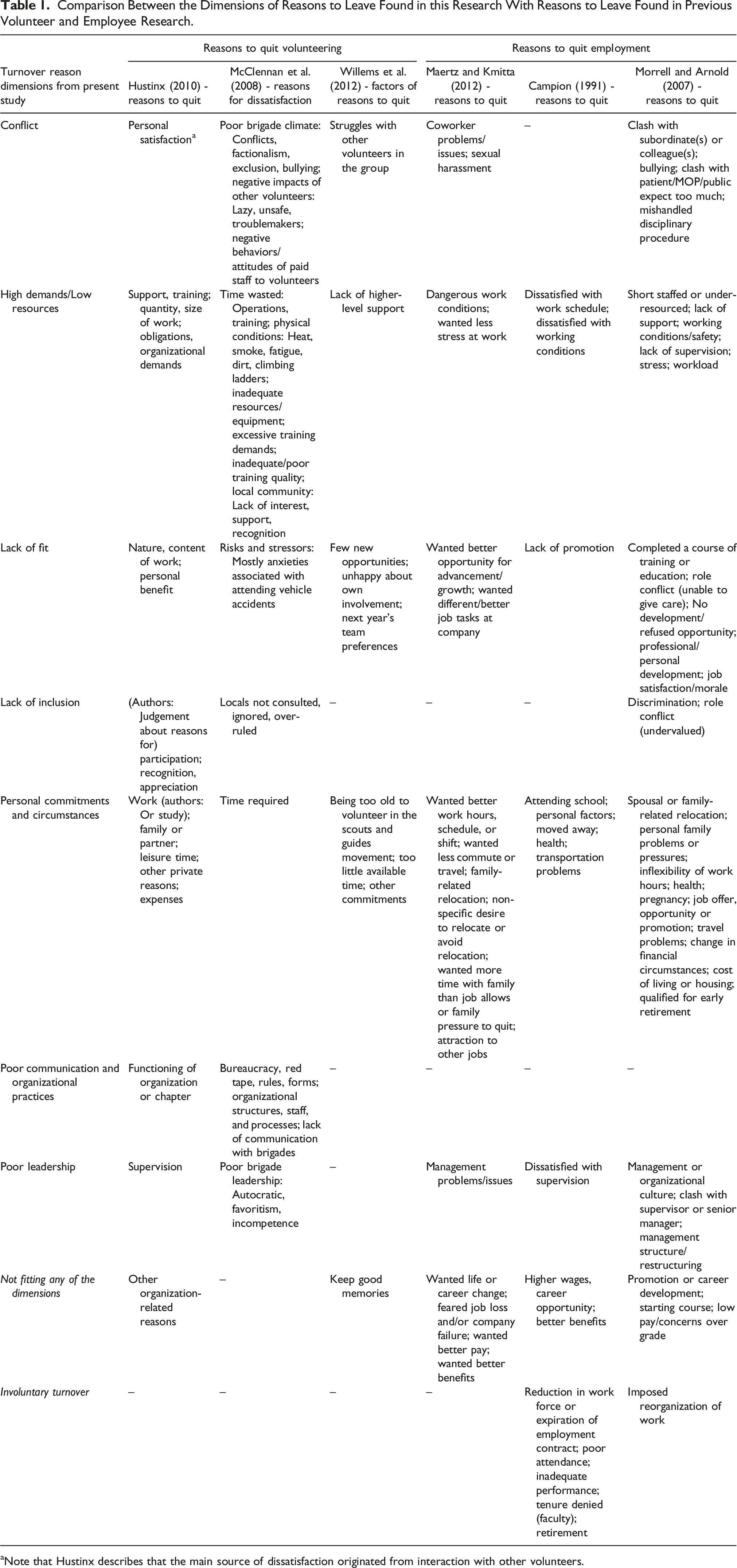
aNote that Hustinx describes that the main source of dissatisfaction originated from interaction with other volunteers.
Considering that (1) qualitative methods have been recommended to study turnover reasons prior to applying quantitative approaches, (2) reasons for employee turnover may not be readily generalizable to volunteers, and (3) reasons for volunteers’ turnover (intentions) have not been studied through qualitative inquiry, it is plausible that unique pathways for volunteers’ turnover are yet to be discovered. Consequently, we advance the following research questions:
What are major reasons explaining why volunteers consider leaving their organizations?
How are reasons to consider turnover among volunteers related to turnover intentions? Specifically, are some turnover reasons mentioned less/more frequently by groups in different proximal withdrawal states?
How are (a) reasons to consider turnover and (b) turnover intentions among volunteers related to turnover behavior? Specifically, are some mentioned less/more frequently by volunteers who quit one year later?
To investigate these research questions, we performed inductive research with content analysis. Inductive research originates from hunches and (partly) builds on existing frameworks and ideas (e.g., Spector, 2017; Woo et al., 2017). Content analysis has challenged and added to prevailing views on turnover reasons in research with employees (Morrell & Arnold, 2007), and the present research will extend this to volunteers. Lastly, content analysis allows for both qualitative and quantitative insights (Sonpar & Golden-Biddle, 2008), enabling an investigation of how reasons relate to PWSs and actual turnover behavior.
In addressing our research questions, we build on a theoretical foundation of research in employee turnover. Specifically, we examine the content and relations of concepts related to turnover among volunteers and explore the extent to which employee turnover theories extend their boundaries to explain this phenomenon. To the best of our knowledge, no prior research with volunteers has linked a comprehensive set of turnover reasons to PWSs or actual turnover behavior. Consistent with PWS theory, we go beyond studying the prevalence of turnover reasons among volunteers by investigating how each turnover reason is associated with turnover behavior and its underlying motivational states.
Though many VIOs do conduct exit surveys to understand why volunteers leave, which can provide some actionable insights into turnover prevention, some of these reasons could be addressed before volunteers leave. Therefore, asking current volunteers why they might be thinking about leaving, before they do, might provide important information to VIOs. First, it can help VIOs identify the most critical reasons that lead to actual turnover. It might help VIOs determine the salience of each reason and intervene at a local level before volunteers action their intentions. Indeed, using data from exit interviews only originates from quitters, complicating predictions of motivational states and turnover behavior especially (i.e., the former will be retrospective and the latter will contain no variance). Second, asking only those who left raises the issue of hindsight: given that the decision to leave might be the culmination of various reasons over longer period of time, the reasons volunteers provide after they leave might be different to those that actually triggered the turnover intentions, which could lead VIOs to focus retention efforts on the wrong causes. For these reasons, we asked volunteers to describe reasons why they contemplate leaving VIOs, in contrast to most research that uses retrospection.
We study the three research questions in the context of two relatively large, longstanding, and formalized VIOs, allowing us to examine the extent to which reasons for contemplating turnover are associated with proximal withdrawal states generalizes across two different settings. While these two organizations share some similarities, they provide very different types of services to the Australian community, they tend to attract volunteers from different demographic and cultural background. Finally, although both VIOs were undergoing significant changes, the changes were of a very different nature.
Methods
The first objective of this study was to create a taxonomy of reasons for which volunteers quit. To this end, we asked two large groups of volunteers to provide us with their written responses about their primary reasons to consider leaving. We then coded these responses using content analysis according to the Gioia method (Gioia et al., 2013). After developing a taxonomy that captured all volunteer turnover reasons, we used quantitative analyses to investigate how these reasons related to turnover intentions (i.e., proximal withdrawal states), and actual turnover.
For more information on the coding structures, please see this project’s Open Science Framework webpage: https://osf.io/y3jm9/. For confidentiality reasons, we have not included the textual responses of our participants.
Background of the Participants and Data Collection
We collected data from two samples of volunteers at different large Australian VIOs: The State Emergency Service (SES) in Western Australia (WA) and Scouts Australia. SES volunteers provide a wide range of services to the community to help with disasters such as emergency repairs to damaged buildings, restoration of essential services, ferrying cargo and passengers across flood waters, attending traffic accidents, and missing person searches/rescues. In addition to attending to disasters, SES volunteers train weekly. At the time the research was undertaken, the SES in WA had approximately 2000 volunteers (39% female and on average 43 years old) working in various operational, administration, and logistical roles. We collected data as part of a larger project about the SES culture and volunteer engagement. The questionnaire was promoted via newsletters, at a local conference, on social media, via phone calls and site visits. A total of 420 volunteers (∼20% response rate) completed the entire survey.
Our second sample was based on the volunteers from Scouts organization in Western Australia. Scouts is the largest provider of non-formal education around the world. At the time of the research, Scouts Australia had approximately 16,000 adult volunteers (45% female and 45 years old on average), operating in over 1350 Scout Groups. Scouts volunteers run weekly meetings and undertake various other activities (e.g., camps) with the “youth members”. 2 Before the weekly meetings, the volunteers prepare a program for the youth members. Scouts volunteers need to comply with and broadcast strict (child) safety regulations and have long-lasting relations with the recipients of their work. Data were collected as part of a volunteer engagement survey for Scouts Australia. To promote the survey, 17,919 volunteers in Scouting received personalized email invitations and up to two reminders. A total of 3321 volunteers (∼18.5% response rate) completed the entire survey. One year after the survey’s administration, we collected actual turnover data by consulting the Scouts’ volunteer registry.
These two organizations differ in the content of the volunteering work: the SES is an emergency response organization and Scouts is an educational organization. However, they also differ in many other ways. First, the SES is formally embedded in a larger government-based parent organization that also includes several other emergency services (e.g., marine rescue, firefighters) and thus, the senior leadership often originates from affiliated organizations. Second, until recently, Scouts included a religious component and members with longer tenure can still adhere to these ways, whereas the SES is largely secular. Third, at the time of this research, Scouts was undergoing a major change in their educational program, meaning that their core activities were changing substantially. The SES was not undergoing a change of this magnitude; instead, this organization is undergoing a process of professionalization and bureaucratization. Fourth, the SES is especially important in regional areas. Indeed, because Australia is such a large sparsely populated country, it is very difficult for governments to provide emergency response quickly. This means many volunteers feel somewhat obligated to contribute because the cost of them leaving the service maybe that their property or lifestyles are threatened by a future emergency.
Nonetheless, the organizations and nature of the work also share similarities. The volunteer roles at the SES and Scouts are both representative of traditional volunteering; volunteers in these roles make an ongoing commitment that requires weekly efforts. For both roles, extensive training – often longer than 3 months – is required before a volunteer can be fully operational. Both organizations have a clear chain of command and a structure for permissions and authority.
Measures
Reasons to Consider Turnover
Among SES volunteers surveyed, 315 responded to the open-ended question “Was there a moment in the past that made you consider leaving the SES? Why?” After removing uninformative responses (e.g., ‘No’ and ‘Nil’), 254 responses remained with, on average, 49.8 words (SD = 69.0). Of those who provided useable responses (i.e., our final study sample) the gender and age distribution (38.9% female and Mage = 47.11, SD = 15.38) was largely like that of the total SES demographic composition.
Among Scouts volunteers, 2534 provided a textual response to the open-ended question ‘If there have been instances in which you considered leaving Scouts, what were your primary reasons?’ After removing uninformative responses, 2235 responses remained with, on average, 28.58 words (SD = 37.26). The gender and age distribution of our final sample (45.6% female and 80.9% between 35-64 years old) was like that of the Scouts’ membership data. Of the Scouts volunteers in this sample, 1263 (57%) had one or more children enrolled in Scouting.
While some authors caution against using textual survey responses for content analysis (e.g., LaDonna et al., 2018), we contend that our approach — centered on a precise query regarding reasons to contemplate turnover rather than a generic open text box, and not analyzing these data as an addon — was designed to foster a better understanding of reasons to consider turnover. Importantly, despite the potential brevity of the responses, we found them to be considerably insightful. Compared to previous qualitative analyses of employee turnover reasons (Campion, 1991; Maertz & Kmitta, 2012; Morrell & Arnold, 2007), the length of our responses is not unusually short. To illustrate with a response of typical text length, an SES volunteer wrote in 43 words “Frustration with the time it takes [ORGANIZATION] to resolve simple issues like the provision of uniforms and PPE (authors: personal protective equipment) and the amount of administrative demands on volunteers. Also, the evident lack of knowledge of SES roles that is regularly demonstrated by [ORGANIZATION] middle management.” This response, which is representative of many we received, succinctly summarizes multiple reasons for contemplating turnover and illustrates the experience of this volunteer. While we acknowledge that none of the responses are comparable to an in-depth interview, we emphasize that we received many rich narratives extending to 371 words.
Turnover Intentions: Proximal Withdrawal States
PWSs were measured in both samples with one item adapted from Li et al. (2016): “Which of the following statements best describes your feelings about volunteering with [ORGANIZATION]?” Volunteers chose between four different responses that each described a proximal withdrawal state: “I want to leave the [ORGANIZATION] but I feel like I have to stay” (reluctant stayer); “I want to stay in the [ORGANIZATION] but I may have to leave” (reluctant leaver); “I want to stay in the [ORGANIZATION] and I can stay if I want to” (enthusiastic stayer); and “I want to leave the [ORGANIZATION] and I can leave if I want to” (enthusiastic leaver). Two SES volunteers did not respond to the PWSs item. Similar to previous studies (Li et al., 2016) the PWSs showed substantial differences in prevalence: Most volunteers were enthusiastic stayers (Sample 1: 71.2%, Sample 2: 62.6%), followed by reluctant leavers (Sample 1: 17.6%, Sample 2: 20.7%), reluctant stayers (Sample 1: 6.4%, Sample 2: 11.0%), and enthusiastic leavers (Sample 1: 4.8%, Sample 2: 5.7%).
Voluntary Turnover
In Sample 2 only (turnover was not available for sample 1), organizational turnover data were collected one year after the survey from Scouts’ database. We unfortunately could not collect turnover data for one state (N = 163), these were treated as missing data for the relevant analyses. Altogether, 12.3% of the participating volunteers had quit. The vast majority of this turnover is likely to be voluntary, similar to the turnover observed in other volunteer research (Haski-Leventhal & Bargal, 2008); indeed, Scouts corroborated that they rarely (if ever) demand people to leave.
Coding Procedure for Reasons to Consider Turnover
To transform the raw comments from the volunteers to a conceptual level, the responses to the reasons to turnover question were coded in three levels (Gioia et al., 2013; Strauss & Corbin, 1998). First order concepts were developed from the raw responses and contained narrow sets of behavior. Responses were assigned to several first order concepts if they contained more than one topic. For example, the response “Pressure of work and family bereavements” was coded as ‘Family commitments’ and ‘Work commitments’. Next, second order themes were developed to combine first order concepts in broader classifications. For example, the first order concepts ‘Workload’ and ‘Role stress’ were combined in the theme ‘High demands/Overload’. Finally, aggregate dimensions were created to summarize all responses parsimoniously. Together, these concepts and dimensions form a data structure (Figure 1) that describes all turnover reasons experienced by volunteers in the two samples. Data structure of reasons for considering turnover found in two samples of volunteers.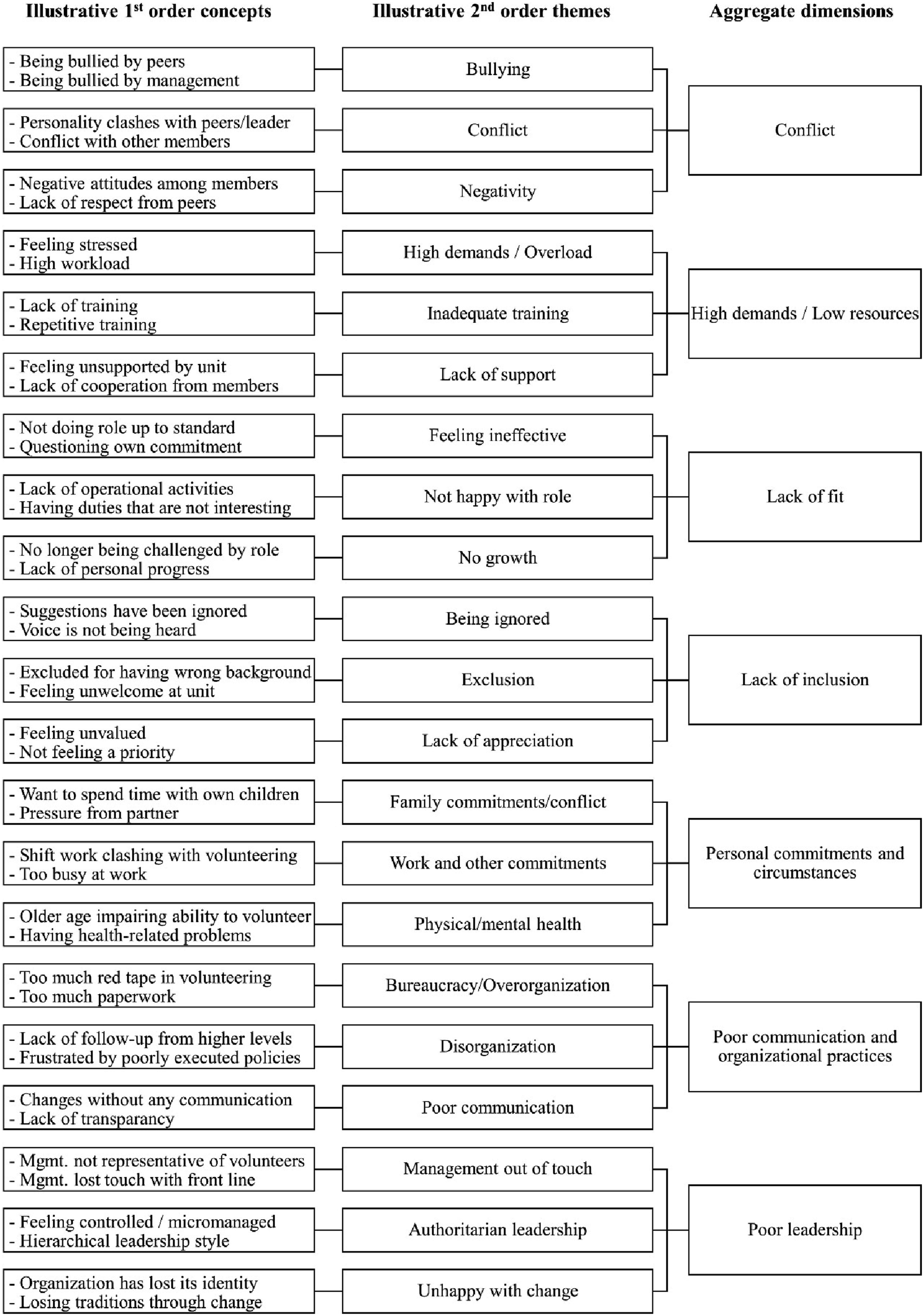
First Order Concepts
Separately in each sample, an initial list of first order concepts was developed by a research assistant trained in the qualitative coding process, but with little background knowledge about the topic or organization. To prevent cross-sample contamination of coding, in the analysis of the two samples, different research assistants worked on the different samples. Initially, the content analysis system Leximancer (Smith & Humphreys, 2006) was used to automatically identify frequently occurring patterns in the textual data; specifically, the program was used to analyze all commonly occurring word-patterns in the textual data and how these themes were related. After applying Leximancer to the data, the research assistants gradually expanded these first order concepts while manually coding the responses. In both samples, while the coding process was ongoing, the research assistants regularly met with one or more of the authors, who were knowledgeable about the organizations, to discuss the concepts and resolve any issues. Frequently, volunteers mentioned multiple reasons why they had considered leaving, and these reasons were all coded separately. The first order concepts were named in-vivo or by the researcher, who determined the label that most closely summarized its content. In Sample 1, at the end of the coding process, the research assistant had assigned all responses to one or more of 181 first order concepts. Example first order concepts include ‘Conflicts between members’, ‘Lack of connection/inclusion within unit (feeling unwelcome)’, and ‘Lack of training’. In Sample 2, the research assistant had assigned all responses to one or more of 562 first order concepts. Example first order concepts include ‘Pressure from partner’, ‘Feeling burned out’, and ‘There is/was too much red tape’.
Second Order Themes and Aggregate Dimensions
Aggregate Dimensions and all Second Order Themes in Codings of Textual Responses to the Question About Reasons to Consider Turnover.
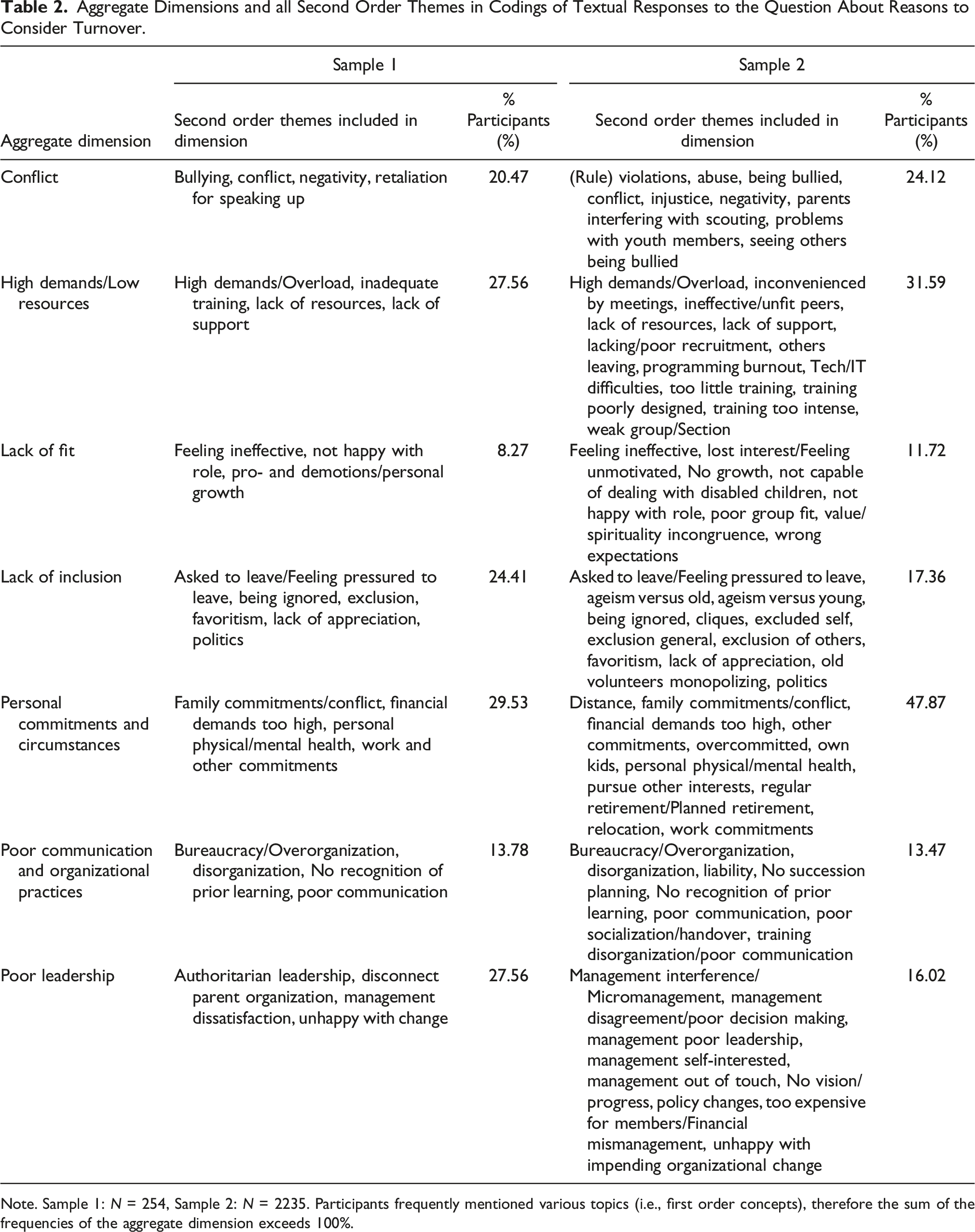
Note. Sample 1: N = 254, Sample 2: N = 2235. Participants frequently mentioned various topics (i.e., first order concepts), therefore the sum of the frequencies of the aggregate dimension exceeds 100%.
The authors then continued to develop the aggregate dimensions. During this process, we attempted to construct a comprehensive, but parsimonious data structure. Again, any differences of opinion were resolved through discussion. Upon evaluation of each independently developed data structure, we concluded that two very similar data structures had emerged. The only difference was that Sample 2 had content relating to feeling ineffective and disengaged as separate dimensions, and content related to communication and management practices in the same dimension. Upon this realization, for the sake of parsimony, we decided to apply the same data structure to both samples, with seven aggregate dimensions: (1) Conflict, (2) High demands/Low resources, (3) Lack of fit, (4) Lack of inclusion, (5) Personal commitments and circumstances, (6) Poor communication and organizational practices, and (7) Poor leadership. The relative frequency with which respondents mentioned these dimensions was similar between the two samples.
Results
RQ1: Data Structure for Reasons to Consider Turnover
In both samples, the most prominent reason for considering turning over was Personal commitments and circumstances (Sample 1: 29.5%, Sample 2: 47.9%). Many of these reasons had to do with life domains that compete with volunteering commitments, such as family and work. A smaller subset of reasons described other limiting circumstances, such as declining (mental) health and financial limitations. For example, a respondent from Sample 2 stated “Personal health and family dramas” and another “Current job changes means increased workload, increased stress and not mentally ready for Scouts - no down time or me time.” The extent to which volunteering competes with other personal commitments can be illustrated with the substantial commitment that volunteers from both samples make. Participants reported to volunteer approximately 6.87 hours per week in Sample 1 and 7.15 hours per week in Sample 2. Research has indicated that volunteering commitments can lead to family conflict and subsequent withdrawal from volunteering (Cowlishaw et al., 2014).
The second most prominent reason for considering turning over was experiencing High demands/Low resources (Sample 1: 27.6%, Sample 2: 31.6%). The job demands-resources theory (Demerouti et al., 2001) describes how the balance between physical, psychological, social, or organizational demands and resources interact in shaping a person’s mental health and job attitudes. When demands are high and resources are low, the job demands-resources theory proposes that workers feel stressed and exhausted. As such, feeling overloaded was also included in this dimension. Demands are the aspects of a job that require sustained physical or psychological (i.e., cognitive or emotional) effort (Schaufeli & Bakker, 2004). In this study, high demands originated from spending too much time on preparing activities (i.e., programming), having too many meetings, and too much compulsory training. For example, a respondent from Sample 1 stated “Workload of being part of Unit management is too great and [name parent organization] only add to it while vocally offering support without actually supporting.” Resources are the physical, psychological, social, or organizational aspects that reduce demands, help achieve goals, or stimulate growth (Schaufeli & Bakker, 2004). A perceived lack of resources was found in the lack of support from other volunteers, being part of a ‘weak’ group, and receiving inadequate training. One respondent from Sample 1 replied “lack of peer support, everyone was too busy.”
Other frequently mentioned reasons were Lack of inclusion (Sample 1: 24.4%, Sample 2: 17.4%) and Conflict (Sample 1: 20.5%, Sample 2: 24.1%). The Lack of inclusion dimension captures volunteers feeling left out or observing others being left out. Several respondents mentioned tight knit networks within the organization that were hard to break into. This dimension also includes preferential treatment and politics. Lastly, some respondents mentioned that they did not feel heard or appreciated. An example statement from a Sample 1 volunteer was “The unit is family-like and I don’t get called out when other people do.” The Conflict dimension captures negative interpersonal interactions. These interactions were with both people within the organizations and community members or the parents of the youth. Some volunteers described situations in which the interaction was one-sided, when they felt wronged, or that another had been wronged. These experiences ranged from a negative atmosphere, to getting into arguments, to bullying. A volunteer in Sample 2 stated “Bullying and excessive criticisms from parents and members of the group committee and not feeling supported in any way, which ended up causing health problems.”
When considering the content of the lack of inclusion and conflict dimensions, it is worth noting that volunteering is a social activity for both participating organizations; volunteers spend a lot of time with their peers, members of the community, and, in Sample 2, youth members. Being excluded or experiencing negativity is counter to the nature of this volunteering work and is therefore the experience of exclusion is likely to violate the expectations of the volunteering. Volunteering is typically construed as an altruistic behavior and the exposure to exclusion or negativity do not fit with that notion (Paull & Omari, 2015). It is therefore understandable that such experiences prompt volunteers to consider turnover.
Poor leadership is a dimension that describes low-quality experiences with management (Sample 1: 27.6%, Sample 2: 16.0%). For example, a respondent from Sample 1 stated: “The unit manager does not support the members or care about the welfare of the members.” This dimension covers poor management practices, such as micromanagement, disagreement with leaderships’ vision and decisions, and the belief that a leader was only looking after themselves. These experiences were evident at all managerial levels of the organizations, from specific unit leadership to upper management. In Sample 1, some volunteers mentioned that the parent organization was not attuned to the needs of the volunteers’ specific emergency service (and attended more to other services in the broader organization). Altogether, the management practices that seemed to prompt volunteers to consider leaving were controlling leadership styles: authoritarian leadership, hierarchical structures, and micromanagement. These findings are consistent with the results of Hustinx (2010), who found similar reactions to the hierarchical nature of the organization. Scholars have largely agreed that this type of leadership is not motivating for employees (e.g., Eyal & Roth, 2011; Sarros et al., 2002), and this research confirms the same for volunteers.
The dimension Poor communication and organizational practices describes experiences with inefficient processes, disorganization, bureaucratic “red tape”, or not receiving (the right) information (Sample 1: 13.8%, Sample 2: 13.5%). For example, a volunteer from Sample 2 stated: “Excess red tape and little support for up-and-coming leaders.” A substantial number of volunteers mentioned how poor communication (e.g., when events were not clearly communicated, or decisions were made without explanation) prompted them to consider leaving. Also, a select few mentioned that risks of activities were not sufficiently covered by the organization and feared personal liability. Lastly, some volunteers mentioned that they felt frustrated because specific processes were lacking, such as good socialization/handover procedures or recognition of prior training. When considering this dimension, it is worth noting that prior research (Stirling et al., 2011) has already shown that volunteers do not like to spend time on non-operational tasks because doing so does not align with their beliefs about what the volunteer work ought to involve.
Finally, some volunteers mentioned that they had considered turning over because they experienced a Lack of fit (Sample 1: 8.3%, Sample 2: 11.7%). For example, a volunteer from Sample 1 stated: “We train a lot but rarely get to put training into practice. My physical capabilities are now starting to limit my abilities to perform at my best and I feel I will soon become a hindrance.” Following the conceptualization of person-environment fit (e.g., Kristof, 1996), fit occurs when an organization provides something the employee desires (i.e., complementary fit), when they share essential characteristics (i.e., supplementary fit), or both. Two commonly studied types of complementary fit are demands-abilities fit, how well a volunteer can address the demands of their organization, and needs-supplies fit, how well the organization meets the goals and desires of a volunteer. The Lack of fit dimension comprises volunteers feeling ineffective, not experiencing enough growth, and having started with the wrong expectations. Additionally, generally feeling unmotivated or lacking commitment was included in this dimension, as it signals a lack of perceived fit with the volunteer role (Greguras & Diefendorff, 2009). Lastly, an organization-specific experience of anticipated lack of fit also became apparent. In Sample 2, some volunteers mentioned an impending organizational change, which could lead to an incongruence between the organization’s values and theirs, prompting them to consider leaving.
Quantitative Analyses
Chi-Square Tests of Turnover Reasons Crossed With Proximal Withdrawal States and Actual Turnover for Sample 2.
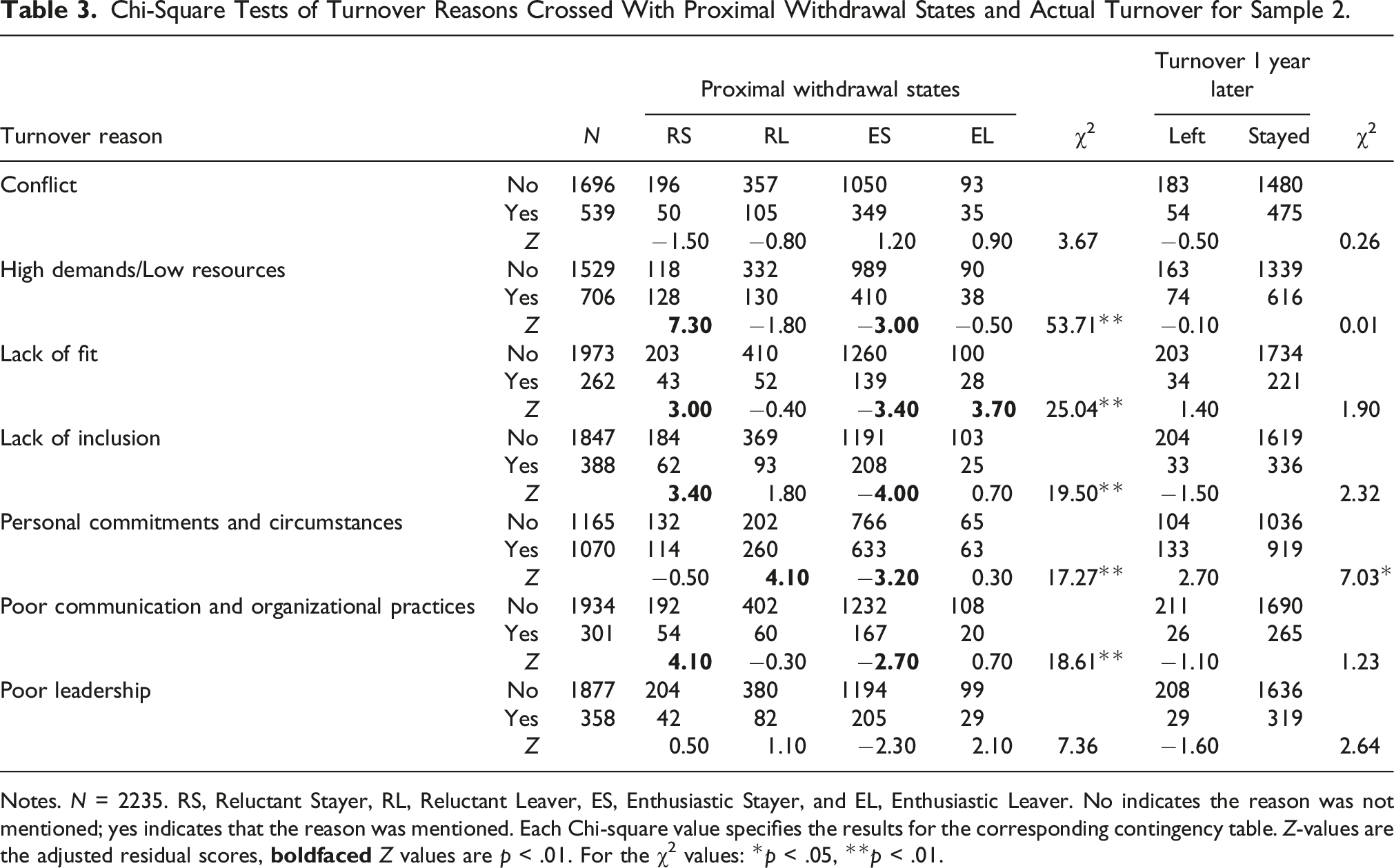
Notes. N = 2235. RS, Reluctant Stayer, RL, Reluctant Leaver, ES, Enthusiastic Stayer, and EL, Enthusiastic Leaver. No indicates the reason was not mentioned; yes indicates that the reason was mentioned. Each Chi-square value specifies the results for the corresponding contingency table. Z-values are the adjusted residual scores,
Results From a Multinomial Logistic Regression Analyses, With Turnover Reasons Predicting Membership of Proximal Withdrawal States for Sample 2.
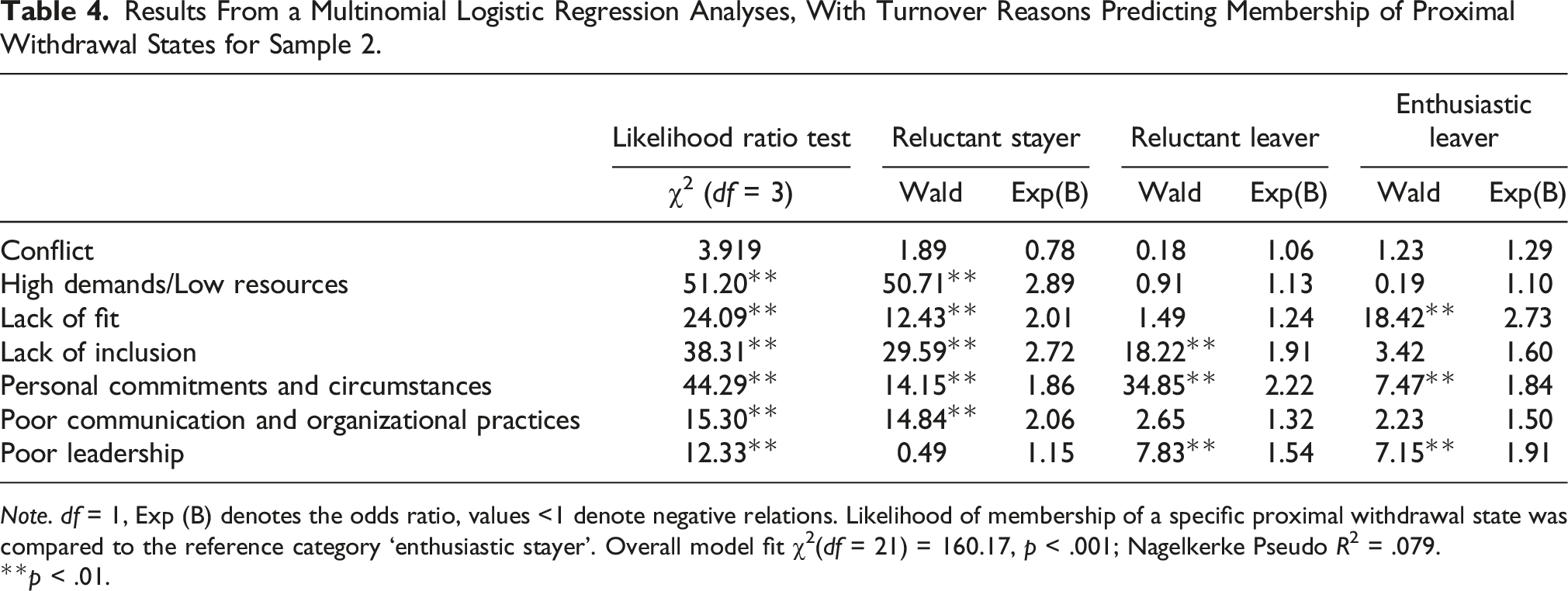
Note. df = 1, Exp (B) denotes the odds ratio, values <1 denote negative relations. Likelihood of membership of a specific proximal withdrawal state was compared to the reference category ‘enthusiastic stayer’. Overall model fit χ2(df = 21) = 160.17, p < .001; Nagelkerke Pseudo R2 = .079.
**p < .01.
The contingency tables (Table 3) essentially describe if volunteers who mentioned a specific reason to consider turnover were more likely to also report a specific PWS and/or quit one year later. To interpret the results of contingency tables that are larger than 2 × 2 (i.e., those involving the four PWSs), we turn to the adjusted residual scores (i.e., Z-values) as post-hoc tests to illustrate the differences between cells. While contingency tables offer very clear insights on the level of the relation between a single predictor (i.e., a reason) and one categorical dependent variable (i.e., PWSs), they are not informative about how reasons collectively predict PWSs. Therefore, we also conducted multinomial logistic regressions with all seven reasons as predictors of the PWSs. In these analyses, the most prominent PWS category (enthusiastic stayers) was the reference category.
We limit our statistical evaluations of the RQs to the results of Sample 2, because some reasons were underrepresented for specific PWSs in sample 1 (e.g., no SES volunteer indicated to experience a lack of fit and simultaneously be an enthusiastic leaver). When conducting chi-square tests to examine the independence of groups in contingency tables, it is recommended that the expected values of all cells contain a minimum of 5 respondents. For Sample 1, many of the contingency tables did not meet this requirement.
RQ2: Turnover Reasons and Proximal Withdrawal States
When interpreting the results of the contingency tables for sample 2, reluctant stayers showed an opposite pattern of reasons to consider turnover to that of enthusiastic stayers. The adjusted residuals showed that reluctant stayers had more frequently considered leaving because of high demands/low resources (Z = 7.30), a lack of fit (Z = 3.00), a lack of inclusion (Z = 3.40), and poor communication and organizational practices (Z = 4.10). By contrast, the enthusiastic stayers reported these reasons significantly less frequently (respectively Z = −3.00, −3.40, −4.00, −2.70) and they reported significantly less frequently to have considered turnover for personal commitments and circumstances (Z = −3.20). In contrast, reluctant leavers cited personal commitments and circumstances (Z = 4.10) significantly more frequently. Finally, only enthusiastic leavers mentioned a lack of fit (Z = 3.70) significantly more frequently than the remaining PWS groups.
To test how reasons collectively relate to volunteers’ PWSs, we conducted a multinomial logistic regression with all seven reasons as independent factors and PWSs as dependent variable. Again, we only interpret the results for sample 2. The goodness-of-fit statistic was satisfactory, Pearson χ2 (267) = 280.94, p = .27, and the specified model outperformed a null model significantly (χ2 (21) = 160.17, p < .01). The Nagelkerke adjusted pseudo-R2 was estimated at .08, suggesting that collectively, reasons only explain a limited portion of variance in PWSs. Moreover, Conflict (χ2 (3) = 3.91, p > .01) did not contribute significantly to explaining which PWS a volunteer was in, but the remaining six reasons did contribute significantly.
Table 4 shows the odds ratios for satisfaction of specific reasons for considering turnover in relation to membership of a specific PWS, relative to the reference PWS (enthusiastic stayer). Thus, an odds ratio greater than 1 occurs where having described a specific reason is associated with increased odds of being in the corresponding PWS category, relative to enthusiastic stayers. All odds ratios that were significantly different were greater than 1, showing that having reasons for turnover are associated with being in a PWS other than being an enthusiastic stayer. Similar to the contingency tables, these results illustrate that reluctant stayers are most different from enthusiastic stayers, with five out of seven reasons predicting the differences between these two PWSs with experiencing high demands and low resources predicting the greatest odds (Wald = 51.20, Exp(B) = 2.89, p < .01). The Personal commitments and circumstances reason was the strongest predictor of being a reluctant leaver (Wald = 34.85, Exp(B) = 2.22, p < .01) and a Lack of fit was the strongest predictor of being an enthusiastic leaver (Wald = 18.42, Exp(B) = 2.73, p < .01), as opposed to being an enthusiastic stayer.
RQ3: Predicting Turnover
In terms of actual turnover (RQ3a), the contingency tables (Table 3) showed that volunteers who had considered leaving because of personal commitments and circumstances voluntarily quitted more frequently than the volunteers without these reasons (Z = 2.70, χ2 = 7.029, p < .05). We also predicted turnover behavior with all reasons using a multivariate logistic regression and discovered that, collectively, reasons explained very little variance in turnover behavior (Nagelkerke adjusted pseudo-R2 = .01) and that none of the reasons predicted turnover behavior significantly at the p <.01 level, with Personal commitments and circumstances coming closest (Wald = 4.22, Exp(B) = 0.71, p = .04).
Lastly, we tested how the proximal withdrawal states were related to turnover behavior within the year following the survey (RQ3b). We found that, compared to reasons to consider turnover, the PWSs were a much better predictor of actual turnover (χ2 (3, N = 2192) = 82.93, p < .01), but the relation of PWS and turnover was modest (Cramer’s V = 0.20). The adjusted residuals showed that reluctant leavers (Z = 2.00), reluctant stayers (Z = 3.00), and enthusiastic leavers (Z = 7.40) were more likely to have quit, and enthusiastic stayers were much less likely to have quit (Z = −7.20).
Discussion
VIOs provide our societies with vital services, yet their viability is threatened by high turnover among volunteers. To better understand its causes, we asked volunteers from two VIOs about their reasons to consider quitting these VIOs. We identified seven higher-order categories of reasons and examined how these reasons were related to proximal withdrawal states (Hom et al., 2012), turnover intentions (sample 1) and actual turnover (sample 2). Below we outline the theoretical and practical implications.
Reasons for Volunteers to Consider Turnover
We contribute to the literature by investigating volunteers’ turnover reasons and discovered seven dimensions: (1) Conflict, (2) High demands/Low resources, (3) Lack of fit, (4) Lack of inclusion, (5) Personal commitments and circumstances, (6) Poor communication and organizational practices, and (7) Poor leadership. We compared this comprehensive taxonomy to the turnover reasons identified in quantitative studies with volunteers (Hustinx, 2010; McLennan et al., 2008; Willems et al., 2012) (Table 1). The set of reasons uncovered by our inductive approach is not well represented in the fixed lists of reasons to leave that comprised the quantitative investigations with volunteers. For example, Hustinx (2010) scarcely examined conflict, and Willems et al. (2012) did not discuss leadership. As such, we provided a comprehensive list of reasons for why volunteers consider leaving a VIO. We caution that one of the ‘blind spots’ of our taxonomy could be that the focal VIOs require training and regular commitment of their volunteers. Nonetheless, we think our findings will be generalizable to other smaller and less formalized VIOs.
From the Employee to the Volunteer Context
When comparing our results with employee turnover reasons (Campion, 1991; Maertz & Kmitta, 2012; Morrell & Arnold, 2007) (Table 1), we observe that taxonomies for employees’ turnover reasons do not include Lack of inclusion and Poor communication and organizational practices. It appears that these reasons are more prevalent among volunteers than employees, suggesting they play a bigger role for retention of the former. However, more recent research on employee voluntary turnover has highlighted the role of diversity climate, which captures how well employees of any demographic and cultural background feel included and respected (Holmes et al., 2020). Diversity and inclusion may only have become more salient as a turnover factor for volunteers and employees in the past decade.
Another contribution is the integration of PWS theory (Hom et al., 2012) within the context of volunteering, to examine the complexities of turnover reasons, intentions, and behavior among volunteers. PWS theory proposes many forces affect turnover intentions and behaviors. This research shows that some forces included in the PWS’ propositions apply less or more to volunteers (cf. Paid employees). For instance, the PWS theory does not include Poor communication and organizational practices as a reason. Future research could explore why this reason is central to volunteers. Perhaps volunteers interpret organizational inefficiencies as an indication that the VIO does not value their personal time. Additionally, the “jobs-as-calling” literature (Bunderson & Thompson, 2009; Schabram et al., 2023; Schabram & Maitlis, 2017) may provide another perspective regarding volunteers’ turnover reasons. People who see their work as a calling hold their organizations to a higher standard and expect the same commitment and “moral duty” to the mission (Bunderson & Thompson, 2009). Extending this to volunteers, future research could explore the role of calling in volunteer work, and how organizational inefficiencies can impact on volunteers’ turnover intentions. Finding a unique reason for volunteers’ turnover suggests that employee turnover theories may not capture all the unique experiences of volunteers.
Applying PWSs Theory to Predict Turnover Among Volunteers
We combined the richness of the open-ended responses with quantitatively measured withdrawal states, thus unpacking the diversity of volunteer turnover reasons while also exploring their associations with turnover intentions and behavior. Various turnover reasons relate differently to the proximal motivational turnover states. Volunteers who expected to stay, but differed both in desire and control, described different reasons to consider turnover; compared to enthusiastic stayers, reluctant stayers described high demands/low resources, a lack of fit, a lack of inclusion, and poor communication and organizational practices. This extends the findings of Li et al. (2016), that reluctant and enthusiastic stayers have distinctive attitudes. We also found that volunteers who wanted to stay but differed in the control over this decision (reluctant leavers), described personal reasons for leaving more often than enthusiastic stayers. This suggest that volunteers do differ in perceived control over their decision to leave and that this control is affected by personal circumstances. This is congruent with the PWS theory (Hom et al., 2012) proposing that family sacrifices affect perceived control, and hence considering the level of control over a turnover decision adds value to understanding how turnover intentions are formed for different groups of individuals.
We found that participants who had mentioned personal commitments and circumstances voluntarily left the VIO within 12 months; other turnover reasons were unrelated to turnover behavior. Notably, we only investigated volunteers who had considered turnover prior to our survey and we excluded those who had not considered turnover. This may have underestimated the importance of turnover reasons for predicting turnover behavior. The PWSs were related with actual turnover (Nagelkerke R2 = .072), yet the magnitude does not exceed correlations of previous conceptualizations of turnover intentions used in meta-analyses (resp. .56 in Rubenstein et al., 2018; .45 in Tett & Meyer, 1993). Already, in a commentary on Hom et al. (2012), Maertz (2012) cautioned against expecting a greatly increased prediction of turnover behavior with PWSs; turnover can only be predicted to a certain extent. We note that we examined the association between PWSs and actual turnover in one sample, whereas the meta-analyses drew upon employee samples.
Our research highlights that turnover reasons are distal predictors of actual turnover behavior and that their effects may flow through more proximal predictors including turnover intentions (e.g., Westaby, 2005). We also urge future scholars to collect volunteers’ actual turnover data, which VIOs rarely register accurately (Forner et al., 2022). As such, our unique contribution is that we developed a comprehensive framework of turnover antecedents and related this to actual turnover behavior.
Practical Implications
Our study provides a taxonomy of volunteer turnover reasons that could help VIOs. If VIOs keep track of these factors through regular surveys or discussions with their volunteers, they can identify volunteers who are most likely to leave and act upon these factors before turnover occurs. Building on the importance of inclusion and diversity for employee turnover (Avery et al., 2013), we demonstrate that a lack of inclusion is detrimental for volunteers’ turnover intentions. The volunteering work undertaken by our participants is both highly social and agentic, but the two VIOs also have salient informal and formal structures that volunteers report can sometimes be difficult to permeate. Volunteers interact with a demographically and culturally diverse community and yet, may encounter organizational silos and favoritism internally. This contrast in inclusivity may intensify feelings of being ignored and being excluded from decision making and participation in VIOs and communities. Hence, VIOs may take steps on creating, promoting, and fostering climate for inclusion to ensure that all volunteers irrespective of their demographic and cultural background feel accepted, valued, and supported – key factors for increasing retention among volunteers.
Another factor that underlies Lack of inclusion may be ostracism, which refers to feeling excluded (Williams, 2002). Our participants reported experiences of ostracism such as feeling left out, not heard or appreciated, not being able to break into tight-knit networks, and witnessing instances of preferential treatment. Ostracism is positively related to turnover intentions and poor wellbeing (Howard et al., 2020). Given that supervisors shape perceptions of ostracism (Howard et al., 2020), we suggest supervisors can implement gratitude interventions, which aim to “increase individuals’ attention to the positive things in their lives” (Locklear et al., 2021, p. 3). By bolstering perceived social support, these interventions not only counteract the adverse implications of ostracism but also encourage employees—who might have faced ostracism in the past—to forge fresh social ties (Maner et al., 2007).
Volunteers who considered leaving for personal reasons did so because circumstances did not permit their continued involvement, not because of dissatisfaction with their volunteering. Employees have different pathways to turnover, not all of which are associated with dissatisfaction (Lee & Mitchell, 1994; Maertz & Kmitta, 2012). The fact that reluctant leavers (which represent a larger group than the enthusiastic leavers and reluctant stayers combined, in both our samples), are still content with their role, makes them a desirable group for retention interventions. We recognize that this type of turnover may sometimes seem unavoidable for organizations with highly structured roles that require regular commitment due to inflexibility of these roles. Insights from self-determination theory may offer solutions to this problem with the use of autonomy supportive technique to help volunteers internalize the reasons for the need for strict procedures and structures, such as providing a rationale and acknowledging feelings (Slemp et al., 2018, 2021; Steingut et al., 2017). Volunteering organizations can also consider idiosyncratic deals (or i-deals; Rousseau et al., 2006), which are personalized arrangements that focus on schedule or location flexibility, and work responsibilities (Rosen et al., 2013) but as well as to ensure these i-deals are granted fairly and consistently so that there is no envy or feelings of preferential treatment that could stir experienced incivility (Howard et al., 2022). This strategy could prove useful in addressing the needs of this large group of reluctant leavers.
Limitations and Future Research Directions
We note some limitations. First, we collected the turnover reason data by asking active volunteers to think back to moments in which they had considered quitting. Given the retrospective nature of their responses, the qualitative responses may not be representative of the actual turnover reasons. The unfolding model of turnover (Lee & Mitchell, 1994) describes that some reasons accumulate over time whereas others emerge as a ‘shock to the system’. We argue that our research captured reasons that accumulate over time but may not have the resolution necessary to capture reasons that resulted in rapid exits. Shocks to the system may be better captured with a retrospective design (e.g., exit interviews or individual recalls) which can also be flawed due to memory fallacies (Campion, 1991). Further, turnover and retention reasons may change over time (Dury, 2018; Haski-Leventhal & Bargal, 2008; Lee & Mitchell, 1994). Hom et al. (2012) discussed reasons to move from one PWS to another, but these ideas must still be empirically tested. Future research could capture turnover processes and reasons in real time to establish causality (Rubenstein et al., 2018). Yet, such a design may lead to attrition because it will interfere with the core duties of active volunteers.
Second, we measured PWSs using the operationalization proposed by Hom et al. (2012), asking participants to identify one most relevant motivational state. Yet such multi-categorical nominal data are difficult to interpret as noted by Maertz (2012) and Bergman et al. (2012). They recommended measuring desire for leaving and staying, and the control over this preference, with continuous variables instead. While coding the reasons to contemplate leaving, we indeed observed volunteers experiencing conflicting desires.
Third, the set of turnover reasons developed in this study may still not cover all reasons that volunteers can possibly leave for, especially in organizations that differ substantially from Scouts and the SES. Other types of volunteering exist, such as episodic, event and spontaneous volunteering, which are affected by different turnover reasons and may have conceptually different ideas of turnover. Because we collected data at large organizations, smaller and more informal VIOs may produce more local reasons for leaving. We also discovered turnover reasons unique to our sample, suggesting specific reasons may exist in other volunteering context (e.g., elderly care, animal welfare, or environmentalism).
Finally, future research could embark on a quantitative evaluation of the framework we developed in this study, by creating questionnaires and applying these in organizations that are similar to Scouts or the SES. Collecting quantitative data could allow researchers to conduct longitudinal studies or analyze patterns in reasons to stay. It may be especially interesting to apply profile analyses to quantitative data to investigate if specific constellations of reasons are more likely to prompt turnover. Such profiles could also be very helpful for organizations to understand and act on turnover.
Conclusion
Volunteers are integral part of society and many organizations simply could not survive without volunteers. Our mixed-methods investigation examined why people have considered leaving their VIO with our findings showing that volunteers had various reasons for considering leaving a VIO. Although personal commitments and circumstances were cited as one of the primary reasons, other reasons were related to the climate and organizational structure of VIOs. Importantly, these reasons for volunteer turnover appear to partly differ from reasons for turnover among paid employees. Hence, VIOs are warned to not only copy best practices from employee turnover management and can improve the retention of their most vital resource – volunteers – by also creating and fostering climate of inclusivity, where all volunteers feel respected, and through clear communication and organization.
Footnotes
Acknowledgments
The authors are deeply grateful to Micah Grishina and Cecilia Runneboom for their efforts in coding the textual data. We are also grateful to two anonymous reviewers and action editor James Lemoine for their expert guidance to greatly improve this manuscript.
Declaration of Conflicting Interests
The author(s) declared no potential conflicts of interest with respect to the research, authorship, and/or publication of this article.
Funding
The author(s) disclosed receipt of the following financial support for the research, authorship, and/or publication of this article: This work was supported by the Australian Research Council under Grant [number LP150100417] and the Bushfire and Natural Hazards Cooperative Research Centre.
