




Abstract
Environmental sustainability is a strategic and ethical imperative for organizations, and numerous studies have investigated associations between leadership and employee pro-environmental or “green” behavior. However, these studies have typically focused on leadership styles that conflate leader behavior with its assumed antecedents or consequences. Moreover, the literature on relations between leadership and environmental sustainability constructs is fragmented and in need of systematic integration to effectively guide future research and practice. Accordingly, we pursue three goals in this conceptual paper. First, after a brief review of key insights from extant theoretical and empirical research, we define leadership in the context of environmental sustainability and leader green behavior based on established theoretical frameworks. Second, based on a systematic integration and extension of the literature, we present an integrative conceptual model of multilevel antecedents and consequences of leader green behavior. We further develop eight propositions on multiple known and novel pathways toward leader and follower green behaviors, as well as multiple known and novel pathways toward consequences related to environmental sustainability at the leader, follower, and organizational levels. Finally, based on our integrative conceptual model and propositions, we outline several recommendations for future research on leadership and environmental sustainability, including theoretical and methodological considerations.
Climate change and other severe environmental problems (e.g., depletion of natural resources, pollution, loss of biodiversity) have resulted in increased attention on environmental sustainability—the responsible interaction with the natural environment to ensure the continued quality of life on Earth—as a strategic and ethical imperative for organizations (Griep et al., 2022; Norton et al., 2015). 1 Leader and employee actions are assumed to play an important role in achieving companies’ environmental sustainability goals (Case et al., 2015; Paillé, 2018; Zacher et al., 2023). Accordingly, numerous studies have investigated relations between leadership and employee pro-environmental or “green” behavior (e.g., conserving resources, recycling materials, environmental advocacy) over the last decades (e.g., Ramus & Steger, 2000; Robertson & Barling, 2013; Tu et al., 2023). 2 Synthesizing this rapidly growing literature, a meta-analysis (Katz et al., 2022) reported positive and moderate associations between employee reports of environmentally-specific or green transformational leadership, servant leadership, and supervisory support, respectively, and employee green behavior. In addition to these bivariate associations, several primary studies have explored potential mechanisms (e.g., green human resource management; Ahmad et al., 2021) and boundary conditions (e.g., employee green identity; Wang et al., 2018) of relations between leadership and employee green behavior.
Although this research has greatly contributed to our understanding of how, why, and when different leadership constructs may be related to employee green behavior, this literature is limited in two ways that create a need for conceptual redevelopment and integration. First, most studies have focused on rather broad and positively-valenced “adjective leadership” styles (Day & Antonakis, 2013, p. 225), such as environmentally-specific transformational leadership. Leadership styles refer to patterns of behaviors that are assumed to result in certain desirable or undesirable consequences and, thus, have been criticized for conflating the content of leader behaviors with their potential antecedents or consequences (Fischer & Sitkin, 2023). Second, studies have focused on various unique combinations of leadership constructs, mediators and/or moderators at different conceptual levels (e.g., organization, leader, followers), and employee green behavior, resulting in a body of empirical knowledge that appears fragmented. Thus, the literature on leadership and environmental sustainability is in need of clear construct definitions, separation of antecedents and consequences of leader green behavior at multiple levels, and systematic integration into a comprehensive model to guide future research and practice.
Accordingly, we pursue three interrelated goals in this conceptual paper. After a brief review of key insights from extant theoretical and empirical research on the topic, our first conceptual contribution is to explain the process of leadership in the context of environmental sustainability and to define the construct of leader green behavior based on an integration of the behavioral approach to leadership (Fischer & Sitkin, 2023) and theorizing on employee green behavior (Ones et al., 2018). Subsequently, drawing from theorizing on multiple pathways between leader behavior and employee health (Wegge et al., 2014), our second conceptual contribution is to present an integrative and systemic conceptual model of multilevel antecedents and consequences of leader green behavior, including the leader, follower, and organization levels (Figure 1). Based on this model, we develop eight propositions on multiple known and novel pathways toward leader and follower green behaviors, as well as multiple known and novel pathways toward consequences related to environmental sustainability at the leader, follower, and organizational levels. We conclude the paper by outlining several recommendations for future research on leadership and environmental sustainability based on our conceptual model. Integrative conceptual model of leadership and environmental sustainability with propositions.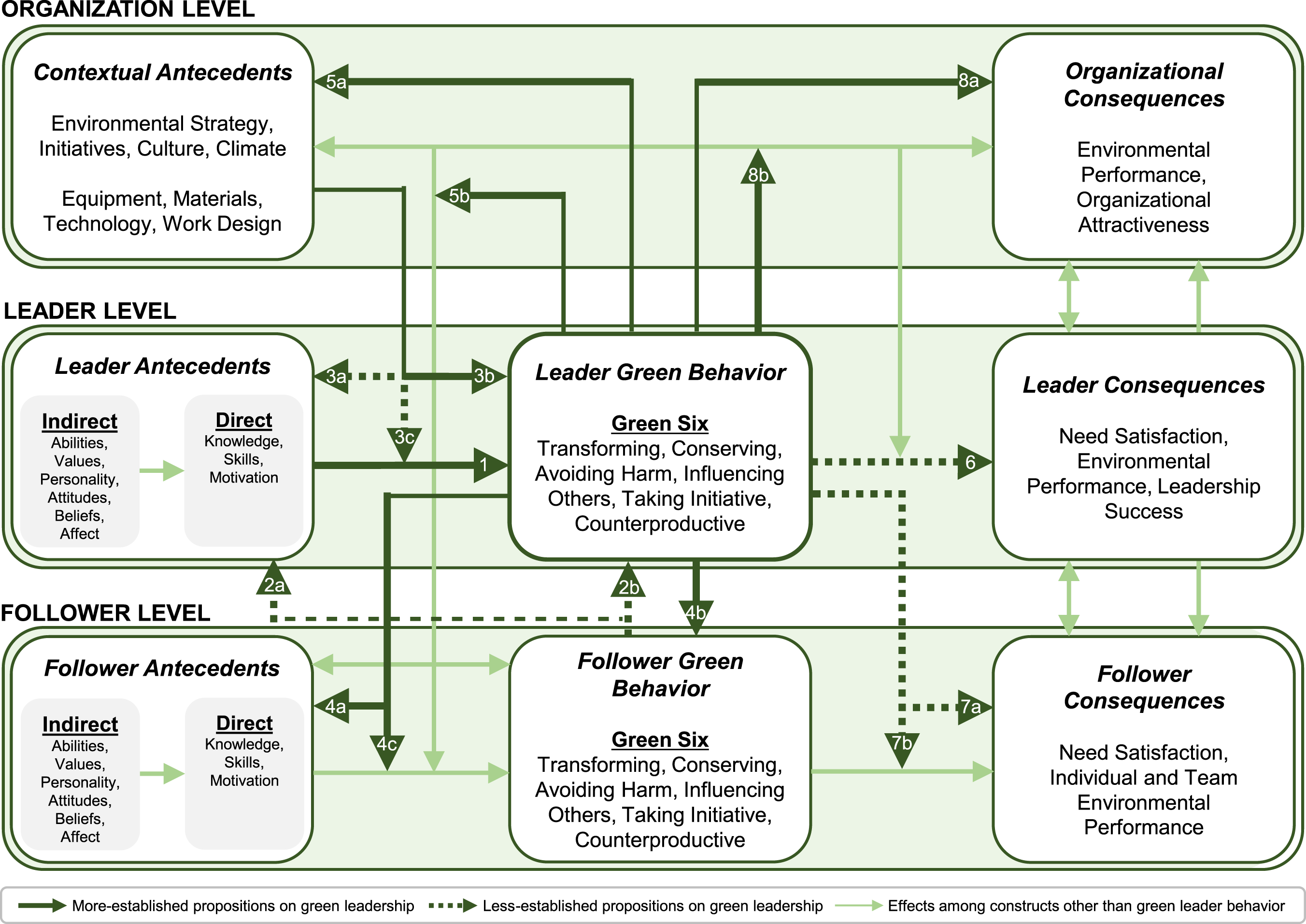
With our conceptual contributions, we advance the literature on leadership and environmental sustainability in two important ways. We expand theory and research by applying a well-established taxonomy of six distinct forms of employee green behavior to the leadership context (Ones & Dilchert, 2012; Zacher et al., 2023). This addresses calls in the leadership literature to focus on specific leader behaviors instead of broad and positively-valenced “adjective leadership” styles that conflate leader behaviors with their assumed antecedents or consequences (Day & Antonakis, 2013; Fischer & Sitkin, 2023). We further advance the literature by positioning leader green behavior as a critical link between antecedents and consequences at the leader, follower, and organization levels. Our multilevel process model (Figure 1) provides a cohesive framework that integrates the fragmented literature and has implications for the design of future research. In particular, our model calls for the increased use of multilevel and longitudinal studies to examine leadership and environmental sustainability.
Key Insights of Research on Leadership and Environmental Sustainability
The idea that leadership can play an important role in environmental sustainability is not new. Two early conceptual papers focused on the environmental leadership of organizations as a whole (e.g., organizational strategy; Dechant & Altman, 1994; Flannery & May, 1994). Another early conceptual paper suggested that various behaviors associated with a transformational leadership style, such as communicating an appealing vision, sense-making, and symbolic actions, are essential for motivating followers to address emerging environmental problems (Portugal & Yukl, 1994). Over the last two decades, leadership in the context of environmental sustainability has received substantial attention. As evidence for this growing literature, we conducted a literature search. The methodology and results of this search are described next.
Literature Search Methodology
Using Web of Science, we conducted an article title search on September 29, 2023, with the following search string: “environmental leader*” OR (environmentally-specific AND leadership) OR “leadership for the environment” OR “leadership in the context of environmental sustainability” OR “green leadership” OR “eco leadership” OR “sustainability leader*” OR (leadership AND “environmental sustainability”) OR (leader* AND “green behavio*r*”) OR (leader* AND “pro-environmental behavio*r*”) OR (leader* AND “proenvironmental behavio*r*”) OR (leading AND environment) OR (leader AND environment) OR (leadership AND environmental) OR (managerial behavio*r* AND environment) OR (manager* AND “pro-environmental behavio*r*”) OR (manager* AND “*green behavio*r*”) OR (citizenship behavio*r* AND environment) OR (supervisor* AND environmental) OR (supervisory AND green*) OR (leadership AND “green behavio*r*”).
Summary of Literature Review of Research on Leadership and Environmental Sustainability.
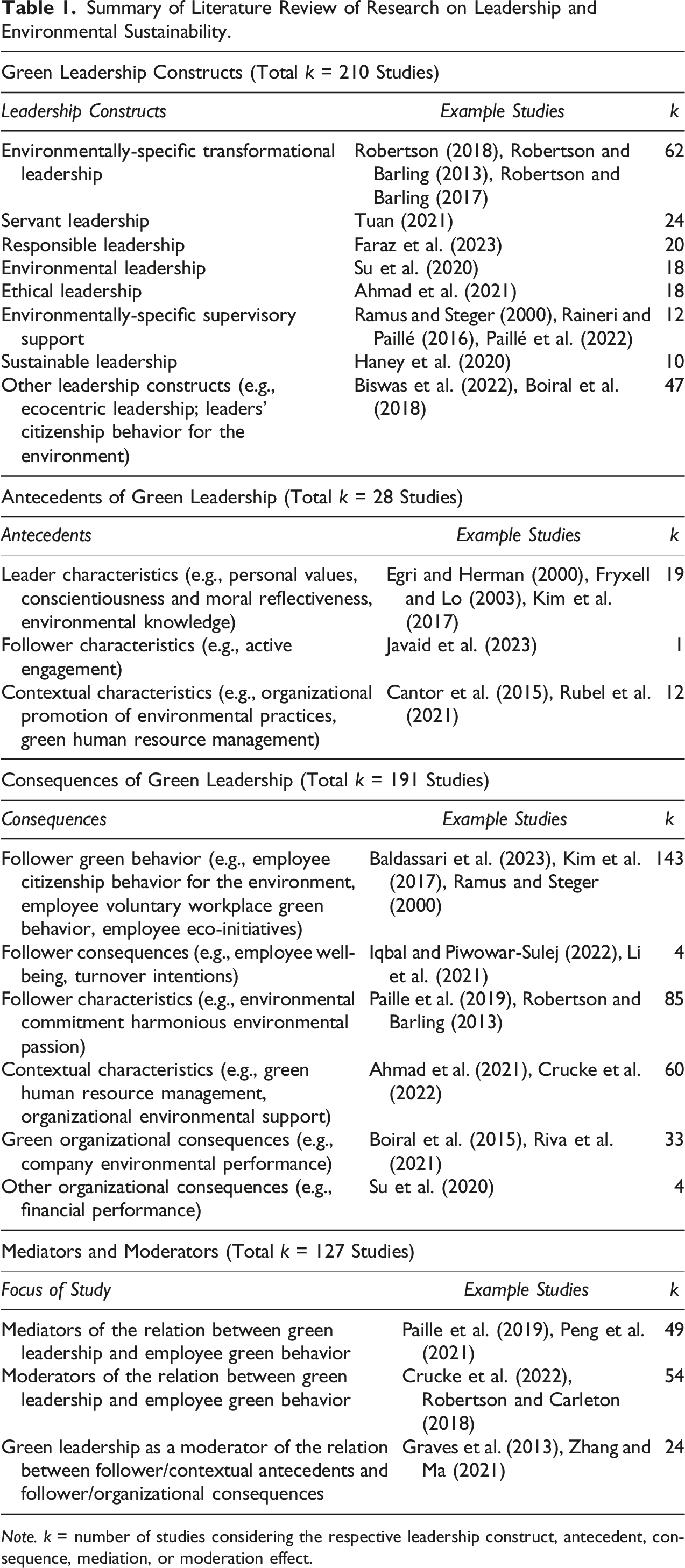
Note. k = number of studies considering the respective leadership construct, antecedent, consequence, mediation, or moderation effect.
Green Leadership Constructs
Most research has focused on green leadership styles and, similar to the leadership literature in general, the most prominent construct is environmentally-specific transformational leadership (e.g., Robertson, 2018; Robertson & Barling, 2017; see Table 1). Additional popular leadership styles investigated in relation to environmental sustainability include servant leadership (e.g., Tuan, 2021), responsible leadership (e.g., Faraz et al., 2023), environmental leadership (e.g., Su et al., 2020), ethical leadership (e.g., Ahmad et al., 2021), and sustainable leadership (e.g., Haney et al., 2020). Furthermore, several studies examined environmentally-specific supervisory support. For example, an early study examined six dimensions of environmentally-specific supervisory support, including encouragement of innovation, competence building, communication, information dissemination, rewards and recognition, and management of goals and responsibilities (Ramus & Steger, 2000). More recently, studies have shown that employee perceptions of environmentally-specific supervisory support relate positively to employee environmental commitment and behavior (Paillé et al., 2022; Raineri & Paillé, 2016). Finally, a few studies examined green leadership constructs that tap leaders’ own pro-environmental behavior. For example, Robertson and Barling (2013) measured leaders’ conservation behavior (e.g., turning off lights when not in use) and advocacy (e.g., making suggestions about environmentally friendly practices to organizational committees).
Antecedents of Green Leadership
Several studies focused on potential antecedents of green leadership (see Table 1). For example, two studies found that more advanced “stages of consciousness,” which include a long-range focus and systemic perspective, as well as leaders’ environmental attitudes, values, and perceived behavioral control positively predicted leaders’ citizenship behavior for the environment (Boiral et al., 2015, 2018). Additional individual antecedents examined in the literature include personal values (Egri & Herman, 2000), personality traits like conscientiousness and moral reflectiveness (Kim et al., 2017), and environmental knowledge (Fryxell & Lo, 2003). Only one study showed that follower characteristics (i.e., active engagement and critical thinking) were positively related to leader green behavior (Javaid et al., 2023). Finally, several studies examined contextual antecedents of green leadership. For example, organizational promotion of environmental practices (Cantor et al., 2015) and green human resource management (Rubel et al., 2021) were positively related to green leadership.
Consequences of Green Leadership
Most research has focused on the potential consequences of green leadership, especially followers’ green behavior (e.g., Baldassari et al., 2023; Kim et al., 2017; see Table 1). Synthesizing such studies, a meta-analysis (Katz et al., 2022) reported positive and moderate associations between environmentally-specific transformational leadership, servant leadership, supervisory support, respectively, and employee green behavior. Additionally, several studies reported associations between green leadership and environmentally-specific follower characteristics, such as environmental commitment (Paille et al., 2019), as well as environmentally-specific contextual characteristics, such as organizational environmental support (Crucke et al., 2022). Comparatively fewer studies examined outcomes of green leadership at the organizational level. For example, two studies reported that leaders’ citizenship behavior for the environment (Boiral et al., 2015) and environmentally-specific transformational leadership (Riva et al., 2021), respectively, were positively related to company environmental performance. Finally, a few studies examined associations between green leadership and general (i.e., not environmentally-specific) follower outcomes (e.g., well-being; Iqbal & Piwowar-Sulej, 2022) or general organizational outcomes (e.g., financial performance; Su et al., 2020).
Mediators and Moderators
Several studies examined mediators and moderators of relations between green leadership and employee green behavior (see Table 1). For example, a multi-wave study found that environmentally-specific supervisory support had a negative indirect effect on employees’ counterproductive sustainability behaviors through employee environmental commitment (Paillé et al., 2019). Another study showed that environmentally-specific transformational leadership positively predicted employee green behavior via perceived pro-environmental climate, but only among employees with a high environmental locus of control (Robertson & Carleton, 2018). Several similar studies exist with different combinations of mediators (e.g., pro-environmental goal clarity, environmental passion, green self-efficacy) and moderators (e.g., power distance, green human resource management; Peng et al., 2021; Tu et al., 2023). Finally, several studies examined green leadership as a moderator of relations between follower or contextual antecedents and follower or contextual outcomes. For example, Zhang and Ma (2021) showed that high levels of environmental leadership strengthened the positive relation between environmental management practices and company green innovation performance.
Defining Leadership in the Context of Environmental Sustainability and Leader Green Behavior
Having briefly reviewed extant research on leadership and environmental sustainability, we now turn to our first conceptual contribution. The literature has not always clearly separated leader green behavior from its assumed antecedents (e.g., leader abilities, motives) or consequences (e.g., employee green behavior, organizational environmental performance) at different conceptual levels. For example, Egri and Herman (2000) defined environmental leadership as “the ability to influence individuals and mobilize organizations to realize a vision of long-term ecological sustainability” (p. 572; italics added). Indeed, our literature review showed that most studies have focused on “adjective leadership” styles, such as environmentally-specific transformational or servant leadership, which have been criticized for conflating leader behaviors with their assumed intentions or outcomes (Fischer & Sitkin, 2023). Accordingly, our first conceptual contribution (as well as a prerequisite for our integrative conceptual model developed in the next section) is to provide clear construct definitions, based on established theoretical frameworks in the leadership and environmental sustainability literature.
Drawing from a widely accepted definition of leadership, we define leadership in the context of environmental sustainability as a process in which one or more individuals (i.e., leaders), through their actions, direct, control, or influence other individuals’ (i.e., followers’) behavior and/or the actions of their organization as a whole (e.g., by introducing of new policy) toward the attainment of environmental sustainability goals, which are more or less shared by those involved in the leadership process (Judge & Long, 2012). Environmental sustainability goals represent targets or standards at the individual, group, or organizational level regarding the responsible interaction between humans and the natural environment to ensure the continued quality of life on Earth (World Commission on Environment and Development, 1987). Examples of such goals are zero emissions, zero waste to landfill, and responsible consumption.
Based on a well-established definition of employee green behavior (Ones & Dilchert, 2012), we define leader green behavior (or “leader pro-environmental behavior”) as a meaningful set of leaders’ goal-directed and scalable (i.e., in terms of their proficiency) actions that are linked with and contribute to, or detract from, environmental sustainability. These actions are under the leaders’ control and can benefit or harm the environment either directly (e.g., recycling, wasting resources) or indirectly through changes in contextual work and organizational characteristics (e.g., creating new policies or work tasks) and/or through changes in follower behavior (e.g., via orders, inspirational motivation, behavioral modeling) or organizational behavior (e.g., influence in environmental investment decisions). Like employee green behavior, leader green behavior can be understood as a “compound performance” domain, in that such behavior cuts across multiple established leader behavior dimensions, such as task-focused, follower-focused, change-focused, or counterproductive, but has a shared focus on environmental sustainability (Campbell & Wiernik, 2015; Ciocirlan, 2017; Zacher et al., 2023).
The compound performance domain of leader green behavior can be further divided into a meaningful, theoretically grounded, and empirically supported set of dimensions using the “green six” framework (Zacher et al., 2023; see center of Figure 1). This framework includes the “green five” pro-environmental behaviors of (1) transforming, (2) conserving, (3) avoiding harm, (4) influencing others, and (5) taking initiative (Ones et al., 2018), as well as (6) counterproductive sustainability behaviors (Dilchert, 2018). The “green five” were developed based on thousands of critical incidents collected in the United States and Europe (Ones & Dilchert, 2012), and most employee green behavior constructs and corresponding measures can be assigned to one of the five dimensions (Francoeur et al., 2021). First, “transforming” involves behaviors aimed at adapting work products and processes to make them more environmentally sustainable, such as using responsible alternative materials and means. Second, “conserving” includes behaviors that aim to preserve resources and avoid wastefulness (e.g., reducing use, reusing, recycling). Third, “avoiding harm” entails avoiding and reducing negative environmental impact and mitigating or restoring environmental damage (e.g., preventing pollution, monitoring environmental impact). Fourth, “influencing others” entails promoting other people’s pro-environmental behavior, for example through educating and training; managing, facilitating, and coordinating; as well as leading, encouraging, and supporting. Fifth, “taking initiative” involves proactive and entrepreneurial behaviors with higher levels of personal risk and sacrifice, such as initiating new environmental programs, lobbying, and activism (Ones et al., 2018). Finally, Dilchert (2018) introduced the construct of counterproductive sustainability behaviors, which involves more severe negative or actively harmful behaviors that affect environmental sustainability at work (e.g., wasting resources, improper waste disposal, unnecessary business travel).
According to Ones et al. (2018), these green behaviors can be performed by individuals working at different levels of the organizational hierarchy, including individuals in leadership, supervisory, and managerial roles (e.g., Yen & Yen, 2012). Moreover, leader green behaviors may also be shown by individuals without an official supervisory or leadership role who lead environmental sustainability initiatives both within and outside of a team context (i.e., “shared leadership” or “emergent leadership”; Gallagher et al., 2020). In contrast to leadership styles, which only focus on the patterns of behaviors that leaders engage in to influence followers (Fischer & Sitkin, 2023), the green six include both direct (i.e., leaders acting themselves to benefit or harm the environment) and indirect green behaviors (i.e., leaders influencing others or the work and organizational context to attain environmental sustainability goals; Smith & O'Sullivan, 2012). Moreover, leader green behaviors can be carried out “in-role” (i.e., as part of leaders’ prescribed job duties) or “extra-role” (i.e., discretionary, as part of being an organizational citizen; Francoeur et al., 2021). Finally, leader green behavior can manifest either as low-intensity (i.e., involving less effort and lower risk, more incremental) or high-intensity (i.e., involving higher effort and risk, more radical; Ciocirlan, 2017) actions. For example, a leader using reusable cups in team meetings has a lower intensity than a leader persuading upper management to implement a new environmental sustainability policy. Having clearly defined the process of leadership in the context of environmental sustainability and the construct of leader green behavior, we next develop our integrative model.
Integrative Conceptual Model of Leadership and Environmental Sustainability
Our second conceptual contribution is an integrative model of leadership and environmental sustainability (see Figure 1), which emphasizes both processes and levels. In terms of processes, the model proposes several pathways that link various antecedents and consequences with leader green behavior. These antecedents and consequences reside at three hierarchically structured levels, including (from “higher” to “lower” levels) the organization, leaders, and followers. We next outline pathways leading from leader antecedents (Proposition 1), follower green behavior (Proposition 2), and contextual antecedents (Proposition 3) to leader green behavior; reverse pathways leading from leader green behavior to follower antecedents and behavior (Proposition 4) and contextual antecedents (Proposition 5); and pathways leading from leader green behavior to leader (Proposition 6), follower (Proposition 7), and organizational consequences (Proposition 8). The dark grey arrows in Figure 1 represent the proposed effects of, or on, our focal construct of leader green behavior, whereas the light grey arrows represent effects among constructs other than leader green behavior. The solid arrows in Figure 1 refer to more-established propositions (see literature review above and Table 1), whereas the dashed arrows refer to less-established propositions on leadership and environmental sustainability.
Antecedents of Leader Green Behavior (Propositions 1, 2, and 3)
Based on theorizing on job performance (Campbell & Wiernik, 2015), and consistent with research on employee green behavior (Ones et al., 2018; Zacher et al., 2023), we propose that leader green behavior is primarily influenced by three direct determinants, including declarative knowledge, procedural knowledge or skills, and motivation (i.e., choice behavior regarding the direction, intensity, and duration of effort; see Figure 1). Indeed, some research has shown that leader environmental knowledge and motivation positively predict leader green behavior (Fryxell & Lo, 2003; Graves et al., 2013). Moreover, various additional individual differences, including abilities, values, personality, attitudes, beliefs, and affect, may indirectly influence leader green behavior via its direct determinants (Wiernik et al., 2018). For example, research has shown that environmental attitudes, perceived norms, perceived control, and self-efficacy (Katz et al., 2022), as well as the personality traits conscientiousness and moral reflectiveness (Kim et al., 2017) are positively related to leader green behavior. Although several studies have examined associations between leader antecedents and a green leadership style or leader green behavior (see Table 1), our novel proposition regarding the effects of indirect leader antecedents on leader green behavior via leader knowledge, skills, and motivation (as direct antecedents) has so far not been empirically tested.
Leaders’ abilities, values, personality, attitudes, beliefs, and affect (i.e., indirect determinants) influence leader green behavior via leaders’ relevant knowledge, skills, and motivation (i.e., direct determinants). Leader green behavior may also be affected by follower green behavior (Figure 1). Such a “bottom-up” effect could be explained by two mechanisms suggested by research on pathways from leadership to employee health (Wegge et al., 2014). On the one hand, followers could promote or hinder leader green behavior by engaging in the “influencing others” dimension of the “green five,” which includes educating, training, persuading, and encouraging others (Ones et al., 2018). Followers could educate, persuade, or encourage their leaders to act in more environmentally sustainable ways (e.g., petitioning for hybrid work arrangements to reduce carbon emissions tied to commuting), thus enhancing leaders’ knowledge, skills, and motivation (i.e., direct leader antecedents) or leaders’ attitudes, beliefs, and affect (i.e., indirect leader antecedents). Followers may also, on the other hand, influence leader green behavior by engaging in the other “green five” behaviors or counterproductive sustainability behaviors in the workplace, and leaders may likewise observe and model these follower behaviors. Our literature search (Table 1) identified only one study that is somewhat consistent with this proposition (but did not test potential mechanisms). Specifically, Javaid et al. (2023) found that follower active engagement and critical thinking were positively related to leader green behavior.
Follower green behavior influences leader green behavior (a) indirectly via leader antecedents (“influencing others”) and (b) directly through behavioral modeling. In addition to individual differences, contextual factors are important antecedents of performance, including leader green behavior (Blumberg & Pringle, 1982; Zacher et al., 2023). In particular, contextual factors such as the organization’s environmental strategy, environmental initiatives, organizational culture and climate, but also access to work equipment, materials, technology, and work design, may physically and socially facilitate or constrain leader green behavior (Inoue & Alfaro-Barrantes, 2015; Katz et al., 2023; Yuriev et al., 2018; Figure 1). Consistently, a meta-analysis (Katz et al., 2022) reported positive relations between corporate social responsibility, green human resource management practices, perceived organizational support, green psychological climate, respectively, and green behavior. Furthermore, primary studies have shown that the existence of an organizational environmental policy is positively related to green behavior (Norton et al., 2014; Ramus & Steger, 2000). Organizations can also design green tasks, jobs, or work roles, make use of technology, and implement environmental management systems to enhance green behavior. So far, only one study has examined associations between contextual antecedents (i.e., organizational promotion of environmental practices, environmental demands from stakeholders) and leader antecedents (i.e., supervisor commitment to the environment; Cantor et al., 2015). However, our literature search identified several papers that examined the effects of contextual antecedents on green leadership styles or leader green behavior (Table 1). For example, Rubel et al. (2021) found that green human resource management was positively related to leader green behavior via green work climate. In addition to direct effects, contextual factors may also interact with leader antecedents in predicting leader green behavior (Figure 1). These interactive effects can be explained by situation strength and trait activation theories. Situation strength theory (Meyer et al., 2010) suggests that “strong situations,” or work contexts that limit employee discretion regarding environmental sustainability, constrain the impact of relevant individual differences (e.g., environmental attitudes) on leader green behavior. For example, when a clear environmental sustainability policy exists in a company, leader green behavior should depend less on leaders’ environmental motivation. In contrast, associations between leader individual differences and leader green behavior should be stronger in “weak situations,” or work contexts that allow people discretion regarding how they enact behaviors in support of environmental sustainability. Complementing situation strength theory, trait activation theory (Tett et al., 2013) suggests that contextual factors that emphasize environmental sustainability (e.g., environmental initiatives, green work design) should strengthen the associations between relevant leader individual differences and leader green behavior. For example, a green office design (Norton et al., 2021) should facilitate the translation of pro-environmental motivation into corresponding leader behavior. Our literature search identified only one cross-sectional study that reported evidence consistent with this proposition. Specifically, Akterujjaman et al. (2022) showed that the relation between perceived behavioral control and managers’ organizational citizenship behavior for the environment was stronger when subjective social norms were high.
Contextual antecedents, including an organization’s strategy, initiatives, culture, climate, equipment, materials, technology, and work design, influence leader green behavior (a) indirectly via leader antecedents and (b) directly. Contextual antecedents can also (c) influence the strength of the effects of leader antecedents on leader green behavior.
Leader Green Behavior Influences Followers and Contextual Antecedents (Propositions 4 and 5)
Leader green behavior may influence follower green behavior indirectly (via follower antecedents) or directly. In the context of pathways from leadership to employee health, these two pathways have been called “person-focused action” and “behavioral modeling,” respectively (Wegge et al., 2014). Furthermore, leader green behavior may also interact with follower characteristics in predicting follower green behavior (Figure 1). In terms of person-focused action, leaders could promote or hinder follower green behavior via the “influencing others” dimension of the “green five.” By training, instructing, persuading, and encouraging followers, leaders may enhance follower green behavior via improvements in relevant knowledge, skills, and motivation, or through changes in indirect follower antecedents (e.g., attitudes). Several studies have examined the effects of green leadership on follower characteristics (Table 1). For example, a study found that environmentally-specific transformational leadership and leader green behavior were positively related to employees’ environmental passion which, in turn, was positively related to employee green behavior (Robertson & Barling, 2013).
Leaders could also enhance follower green behavior by modeling the other “green five” behaviors or counterproductive sustainability behaviors in the workplace, such that followers could observe and copy these behaviors. In this way, leaders may serve a powerful function in role modeling such actions. Several studies in our literature review (Table 1) have examined bivariate relations between green leadership and follower green behavior (e.g., Baldassari et al., 2023), some of which were moderated by contextual factors (e.g., cultural norm of power distance; Jiang et al., 2022). Moreover, a recent cross-sectional study by Shao et al. (2023) drew from social learning theory to examine potential mechanisms of the trickle-down effect of leader green behavior on follower green behavior. Consistent with our proposition, the researchers reported that leader green role model influence and followers’ green self-efficacy sequentially mediated the relationship between leader green behavior and follower green behavior.
Finally, consistent with situation strength and trait activation theories (see Proposition 3; Meyer et al., 2010; Tett et al., 2013), leader green behavior may interact with follower antecedents in predicting follower green behavior. i.e., leader green behavior itself may create a weak or strong work situation, or a more or less trait-activating work context, that enhances or constrains effects of follower antecedents (e.g., environmental attitude) on follower green behavior, respectively. Several studies have investigated green leadership as a moderator of effects of follower antecedents on follower green behavior (Table 1). For example, Graves et al. (2013) showed that the association between employee external motivation and employee green behavior was positive when environmental transformational leadership was high, whereas the association was negative when environmental transformational leadership was low.
Leader green behavior influences follower green behavior (a) indirectly via follower antecedents and (b) directly through modeling. Leader green behavior can also (c) influence the strength of the effects of follower antecedents on follower green behavior. Leaders may also impact follower green behavior indirectly by changing and interacting with the broader organizational and work contexts (Figure 1). Leaders can modify certain contextual antecedents, such as organizational policies, practices, and work design, through the “transforming,” “avoiding harm”, and “taking initiative” dimensions of the “green five.” By changing these contextual factors, leaders can indirectly influence follower antecedents, follower green behavior, or the effects of follower antecedents on follower green behavior (see Propositions 4a, b, and c). In the context of pathways from leadership to employee health, such leader behaviors have been called “system-focused action” (Wegge et al., 2014). For example, leaders could include environmental sustainability considerations in performance management practices (Bohlmann, van den Bosch, & Zacher, 2018), which may impact follower antecedents (e.g., environmental knowledge, motivation), follower green behavior, and the extent to which follower antecedents affect follower green behavior. Moreover, leader green behavior can also strengthen or mitigate the impact of contextual antecedents on follower green behavior (i.e., a process called “moderating action” in research on pathways from leadership to employee health; Wegge et al., 2014). For example, leaders can decide whether (or not) and how to implement new performance management policies and practices that include a focus on environmental sustainability. Several studies identified in our literature search (Table 1) have examined effects of green leadership on various contextual antecedents, such as green human resource management (Ahmad et al., 2021), environmental management practices (Boiral et al., 2015), as well as environmental corporate responsibility and organizational environmental support (Crucke et al., 2022). Furthermore, several papers have focused on green leadership as a moderator of effects of contextual antecedents on follower green behavior. For example, Liu et al. (2023) reported that the positive relationships between green human resource management and green passion and employee green advocacy, respectively, were stronger when supervisory support for the environment was high.
Leader green behavior influences follower green behavior (a) indirectly via contextual antecedents. Leader green behavior also (b) influences the strength of the effects of contextual antecedents on follower green behavior.
Consequences of Leader Green Behavior (Propositions 6, 7, and 8)
We propose that leader green behavior can have positive consequences for leaders themselves, depending on the behavior being congruent with relevant leader and contextual antecedents (Figure 1). We argue that leaders with stronger environmental values are more likely to experience need satisfaction (and, subsequently, well-being) when they engage in green behavior (Zacher et al., 2023). Leader green behavior should also result in objective environmental performance of leaders, such as lower personal resource consumption and waste production. Finally, when their organization values environmental sustainability, leader green behavior should result in more favorable evaluations of leadership success (see Bohlmann, van den Bosch, & Zacher, 2018, on green behavior and performance appraisals). So far, no research has examined effects of leader green behavior on individual leader outcomes.
Leader green behavior influences individual leader consequences, including need satisfaction, environmental performance, and leadership success, depending on relevant leader and contextual antecedents. Leader green behavior should also influence follower consequences, such as need satisfaction, both directly and by interacting with follower green behavior (Figure 1). The “influencing others” and “taking initiative” dimensions of the “green five” help cultivate individual and shared (i.e., among followers; between leaders and followers) perceptions of the importance of environmental sustainability. In the context of pathways from leadership to employee health, such effects are called “climate control and identity management” (Wegge et al., 2014). Moreover, through their actions, leaders can enhance or constrain the extent to which follower green behavior results in follower consequences. For example, leaders can support and reward high levels (or penalize low levels) of follower green behavior. So far, only very few studies have examined direct effects (and none that examined interactive effects) of green leadership on follower consequences (Table 1), including a positive effect on follower well-being (Iqbal & Piwowar-Sulej, 2022) and a negative effect on turnover intentions (Li et al., 2021).
Leader green behavior influences (a) follower consequences and (b) the strength of effects of follower green behavior on follower consequences. Finally, we argue that leader green behavior affects organizational outcomes (Figure 1). Consistent with the notion of emergence (i.e., bottom-up effects on higher-level outcomes), we propose that leader green behavior contributes both directly and indirectly (i.e., through leader and follower environmental consequences; see Propositions 6 and 7), and by moderating the effects of contextual antecedents on organizational consequences, to the achievement of environmental performance goals at the organizational level. For example, leaders who enact the “green six” behaviors (including low counterproductive behavior) may contribute to outcomes, such as the successful implementation of environmental management practices or increased organizational attractiveness (Bohlmann, Krumbholz, & Zacher, 2018). Several studies have examined the direct effects of green leadership on organizational consequences (Table 1), including firms’ environmental performance (Boiral et al., 2015; Jang et al., 2017; Riva et al., 2021). Furthermore, we identified several papers on green leadership as a moderator of effects of contextual antecedents on organizational consequences. For example, Zhang and Ma (2021) showed that high levels of environmental leadership strengthened the positive relation between environmental management practices and company green innovation performance.
Leader green behavior influences (a) organizational consequences, including environmental performance and organizational attractiveness, and (b) the strength of effects of contextual antecedents on organizational consequences.
Discussion
This conceptual paper contributes to the literature on leadership and environmental sustainability in two important ways. We advance theorizing by clearly defining the process of leadership in the context of environmental sustainability and the construct of leader green behavior. To this end, we used well-established definitions of leadership and employee green behavior and addressed calls in the literature to focus on specific leader behaviors instead of broad “adjective leadership” styles. We further advance the literature by positioning leader green behavior as a critical link between antecedents and consequences at the leader, follower, and organization levels. Our multilevel process model (Figure 1) provides a cohesive and systemic framework that integrates the hitherto fragmented literature. In this final section, we offer several recommendations for future research based on our definitions, model, and propositions.
Theoretical Considerations for Future Research on Leadership and Environmental Sustainability
Consistent with our definition and model, we suggest that future theory development considers leadership as a process during which leaders directly or indirectly influence followers and the organization toward the attainment of environmental sustainability goals. Leader green behavior, like the well-established construct of employee green behavior, should be defined as encompassing concrete leader actions. The well-established and evidence-based “green six” framework (Ones et al., 2018; Zacher et al., 2023) is useful in this regard, because it not only includes an “influencing others” dimension, but also leader green behaviors that could either indirectly impact followers and organizations, for instance via changes in the organizational and work context (e.g., “transforming,” “avoiding harm”) or directly via behavioral modeling (e.g., “taking initiative,” “counterproductive sustainability behaviors”). Consistent with the broader leadership literature, we also suggest that a moratorium should be placed on the continued development and use of “adjective leadership” styles (e.g., environmentally-specific transformational leadership), to avoid the conflation of leader green behavior with its assumed antecedents (e.g., environmental motivation) or consequences (e.g., follower green behavior).
Using our model (Figure 1) as a guide, future theory development could aim for a better theoretical understanding of the micro-dynamics of leader green behavior by specifically focusing on how, why, and when leader antecedents interact with follower green behavior and contextual antecedents in influencing leader green behavior. Conceptual work on employee green behavior has suggested action regulation theory as a guiding framework for such an approach because this theory considers the sequence of goal development, orientation, planning, execution, and feedback processing in behavioral regulation, as well as the development, change, and abandonment of behavioral habits and routines (Zacher et al., 2023). Furthermore, theorizing on work performance could shed light on the hierarchical structure of different leader green behaviors, including the possibility of a higher-order leader green behavior factor and various lower-order dimensions of each of the “green six” behaviors (Ones et al., 2018).
Future theorizing could expand the current conceptual model by additionally considering the societal and culture level as well as team and within-person level processes. Societal and cultural factors, such as national regulations, traditions, and values (e.g., Schwartz’, 1994, concept of “self-transcendence,” including its “universalism” and “benevolence” dimensions linked to environmental sustainability) may influence antecedents at the organization, leader, and follower levels, as well as the effects of these factors on leader and follower green behaviors and consequences. In our model, we considered followers as units nested within leaders and implicitly assumed that all followers assigned to one leader constitute a team. Future theorizing could address the roles of phenomena such as coworker advocacy regarding environmental sustainability and team climate for environmental sustainability (Gallagher et al., 2020). Furthermore, future theorizing could develop propositions on how, why, and when leader and follower green behaviors fluctuate and change within-persons over time, possibly conditional upon factors at the organizational level, such as environmental policies (Norton et al., 2017).
Additional theorizing is necessary on the consequences of potential similarities, differences, and conflicts between leader and follower environmental knowledge, skills, and motivation, as well as green behavior. This theorizing could adopt a person-supervisor (or follower-leader) fit perspective to understand the predictors and outcomes of high versus low person-supervisor fit and misfit regarding environmental sustainability behaviors and consequences. For example, how do leaders and followers react to such perceptions of fit or misfit in terms of changes in job attitudes and behavior? How do leaders deal with followers who resist or even boycott leader and organizational efforts regarding environmental sustainability (Onkila, 2017), and how do such follower behaviors influence the quality of the leader-member or team member-member exchange relationships? To this end, research may consider how conflicting messages regarding the value of sustainability between the organization and leaders and between leaders and their followers may limit the influence of leader green behaviors.
Methodological Considerations for Future Research on Leadership and Environmental Sustainability
Future empirical research based on our conceptual model should carefully consider several methodological aspects. First, several options for assessing leader and follower green behavior exist. Objective measures such as energy savings, resource consumption, and waste production do not represent work performance, but rather the outcomes of such behavior (Campbell & Wiernik, 2015). These outcomes may not be fully under the control of individuals and, thus, represent better indicators of environmental consequences rather than green behavior. Common survey scales also do not measure actual behaviors, but leaders’ and followers’ perceptions of their own or others’ behaviors and, thus, could contain bias due to memory distortions and self-enhancement tendencies. Observational methods using video recordings may provide more accurate representations of green behavior, but entail greater resource investments (e.g., time spent recording, coding videos by trained raters) and may produce demand effects because people know they are being observed (Fischer & Sitkin, 2023). Thus, it is vital to carefully consider what one intends to measure and to recognize the limitations of each approach.
Second, research designs should make use of multiple sources of data, such as leader and follower survey ratings, observational data, and objective outcome data, which provide complementary information and avoid artificially inflated relationships due to common method bias. Moreover, antecedents, behaviors, and consequences should be measured at multiple time points (including baseline assessments of outcomes), both in longer-term longitudinal studies and in shorter-term daily or weekly diary studies, to allow conclusions about temporal precedence or changes in constructs over time. Cross-sectional designs are not suitable for examining propositions that involve causality (e.g., mediation models that examine effects of antecedents on green behaviors and, in turn, on assumed consequences thereof) or within-person variability or change over time. To draw conclusive inferences regarding causality, antecedents and behaviors need to be manipulated using experimental methods (e.g., training interventions).
Third, future studies could test our propositions using samples of leaders and followers at different hierarchical levels, including chief executive officers as well as first-line supervisors. Such multilevel research could examine “trickle-down” effects from the top of the organizational hierarchy over middle management to employees and, potentially, customers. Moreover, based on our conceptual model, research on “bottom-up” effects could investigate how employees influence their leaders’ behavior and how the leaders, in turn, initiate changes at the organizational level. Methodologies that allow for studying emergent phenomena over time in organizations might be particularly relevant in this regard (e.g., Lang et al., 2019).
Fourth, given concerns about conflation of behavior with its assumed antecedents and consequences in the leadership literature (Day & Antonakis, 2013; Fischer & Sitkin, 2023), studies should be careful to consider the influence of leader green behavior on outcomes incremental to established leadership constructs (e.g., leader-member exchange, inspirational motivation, individualized consideration). Stronger theorizing regarding the influence of leader green behavior would be facilitated by establishing its unique role for the prediction of work outcomes above-and-beyond such other forms of leader behavior and by establishing the nomological network of leader green behavior as it relates to other related leadership constructs. Research on leader green behavior should thus likewise measure such constructs, especially those related to positive interpersonal exchanges with followers and leader motivating potential.
Finally, studies on the predictors of leader green behavior should be designed to allow comparing the relative importance of, and potential interactions among, antecedents at different conceptual levels. For instance, studies should include individual-level predictors (e.g., knowledge, skills, motivation), follower green behavior, and different contextual predictors (e.g., organizational policies and practices) and examine the relative strength of their main and interactive effects on leader green behavior. Researchers could likewise consider eclectic sources of data to facilitate such studies, e.g., considering objective archival data on organization-level sustainability initiatives (e.g., purchasing carbon offsets).
Conclusion
Leadership holds much promise regarding the promotion of organizational environmental sustainability. To advance theory and empirical research in this area, this paper makes two conceptual contributions. We first provide clear definitions of leadership in the context of environmental sustainability and leader green behavior based on established theoretical frameworks. Second, we offer a conceptual model of multilevel antecedents and consequences of leader green behavior to integrate the fragmented literature. We outline eight propositions on pathways toward leader and follower green behaviors, as well as pathways toward consequences related to environmental sustainability at the leader, follower, and organizational levels. We hope that our definitions, model, and propositions are helpful to researchers and practitioners aiming to understand and foster environmental sustainability in and of organizations.
Supplemental Material
Supplemental Material - Leadership and Environmental Sustainability: An Integrative Conceptual Model of Multilevel Antecedents and Consequences of Leader Green Behavior
Supplemental Material for Leadership and Environmental Sustainability: An Integrative Conceptual Model of Multilevel Antecedents and Consequences of Leader Green Behavior by Hannes Zacher, Clara Kühner, Ian M. Katz, and Cort W. Rudolph in Group & Organization Management.
Footnotes
Declaration of Conflicting Interests
The author(s) declared no potential conflicts of interest with respect to the research, authorship, and/or publication of this article.
Funding
The author(s) received no financial support for the research, authorship, and/or publication of this article.

Supplemental Material
Supplemental material for this article is available online
Notes
Author Biographies
References
Supplementary Material
Please find the following supplemental material available below.
For Open Access articles published under a Creative Commons License, all supplemental material carries the same license as the article it is associated with.
For non-Open Access articles published, all supplemental material carries a non-exclusive license, and permission requests for re-use of supplemental material or any part of supplemental material shall be sent directly to the copyright owner as specified in the copyright notice associated with the article.
