




Abstract
This paper employs an affective governmentality approach – one that sees regimes of governmentality as working through affective as well as rational milieus – to explore how sustainability leaders experience, navigate and enact hope. These subjects operate in a highly charged affective milieu at the intersection of hope for a better world and the confronting realities of environmental crisis. Our study shows how official texts associated with organisations who shape this milieu construct hope as normative for sustainability work. Drawing on interviews with 35 sustainability leaders, it then documents the multiple and sometimes contradictory ways in which these subjects respond to and deploy an imperative to hope in their practices of governing self and others. Our contribution is twofold. First, our explicit attention to affect allows us to extend the existing literature by tracing the complexities, tensions and transgressions in the experience and the practices of subjects who are simultaneously governed and governors. Second, our critical understanding of hope as governmentality opens up new possibilities for subjects working in contexts that render hope precarious and even problematic.
Introduction
Governmentality names a form of power that does not operate directly on individuals, but seeks rather to shape the milieu in which they operate (Kantola, Seeck, & Mannevuo, 2019; Moisander, Groß, & Eräranta, 2018; Weiskopf & Munro, 2012). In the context of the increasing drive to understand how governmentalities play out in subjects’ lived experience (Mackenzie & McKinlay, 2021; Skinner, 2013), attention has turned to the affective dimension of these milieus (Fotaki, Kenny, & Vachhani, 2017; Sauer & Penz, 2017). Moving beyond the model of a rational, calculating subject, this emerging body of work explores how subjects are ‘made up’ and their conduct guided through affective as well as cognitive mechanisms. These studies demonstrate that neoliberal regimes consist not just of a set of incentives and constraints that shape subjects’ choices, but also of a series of affects (including anxiety, unease, hope and desire) associated with a situation of endless competition, precarity and individual responsibility (Kantola et al., 2019; Scharff, 2016)
Some scholars have addressed how the affects associated with neoliberal regimes guide specific groups of subjects towards an acceptance and celebration of their own precarity (Carr & Kelan, 2023; Mackenzie & McKinlay, 2021; Scharff, 2016). Others have traced the ways in which organisational actors strategically use the affective dimensions of a neoliberal milieu to guide the conduct of others (Kantola et al., 2019; Plotnikof & Pors, 2024; Sandager, 2021). By showing how governmentalities shape conduct through establishing not just ‘thinking rules’ but also ‘feeling rules’ (Carr & Kelan, 2023, p. 258), this body of work has advanced understanding of the complex and – sometimes – contradictory mechanisms through which governmentalist strategies have their effects.
Like these authors, we seek to contribute to the understanding of the affective dimensions of governmentalities. However, while the studies noted above have tended to focus either on how subjects are governed through affective means, or on how actors seek to govern others through affective means, our study builds on the observation that the self-government assumed and required by governmentality means that ‘the “governor” and the “governed” are two aspects of the same actor’ (Mackenzie and McKinlay, 2021, p. 1846, emphasis added; see also Dean, 2009). Our focus on the figure of the sustainability leader – simultaneously governed by and governing through affect – opens up consideration of how they actively respond not just to the thinking and feeling rules of an affective governmentality (Carr & Kelan, 2023) but also how they strategically display affect in their practices of managing self and others (Sieben & Wettergren, 2010).
The context for our study is the affectively charged field of sustainability at a time when environmental crises pose an existential threat to humanity (American Psychological Association [APA], 2017; Foster, 2015). Sustainability leaders operate in a milieu marked by the hopeful corporate construction of environmental issues as business challenge and opportunity (Wright & Nyberg, 2012) but also by the stark environmental realities that challenge and undermine hope (Kelsey, 2021). In this context, our research question asks: How does affect, specifically in relation to hope, shape the conduct of sustainability leaders who, as leaders, are simultaneously governed and governors?
Our study contributes to the affective governmentality literature by tracing not just the multiple ways in which actors experience and respond to the address of governmentality, but also the multiple ways in which their leadership practice participates in and reconstitutes governmentality’s rules for feeling and displaying emotion. Indeed, since affect shapes conduct in complicated and sometimes unexpected ways (Kantola et al., 2019), the affective focus of our study allows us to offer new insights into the complex and unpredictable ways in which subjects embrace and resist the address of governmentalities (Fotaki et al., 2017). Adopting and developing Biehl’s (2015, p. 69; see also Kjær, 2019) notion of a ‘governmentality of hope’, our study shows how dominant constructions of hope legitimate existing political-economic arrangements, directing attention away from socio-political change and towards small-scale individual and organisational action (Biehl, 2015; Mackenzie & McKinlay, 2021; Petersen & Wilkinson, 2015).
Our article is structured as follows. We begin by summarising the relevant extant research before explaining our approach grounded in affective governmentality. We then present our findings and finally discuss our contribution to the governmentality literature and to the theory and practice of sustainability work.
Conceptual Background
The affective dimension of governmentality
Organisational scholars often define governmentality in contrast to the ‘early Foucault’s’ supposed emphasis – symbolised in the image of the panopticon – on a centralised, disciplinary power that controls subjects through prescriptive regulation (Barratt, 2008; Weiskopf & Munro, 2012). By contrast, governmentality studies emphasise the ways in which a dispersed, multi-level form of power operates on nominally free agents to shape their behaviour and beliefs (McKinlay & Pezet, 2017; Raffnsøe, Mennicken, & Miller, 2019). This is a form of power that does not operate directly on individuals (Foucault, 2007) but seeks rather to shape their milieu (Moisander et al., 2018), defining the ‘rules of the game’ within a space of choice (Weiskopf & Munro, 2012, p. 689). Foucault proposed this indirect form of power premised on the freedom of subjects as a mode of governing characteristic of neoliberal societies (Moisander et al., 2018; Raffnsøe et al., 2019), societies where subjects are placed within a situation of endless competition, individual responsibility and pervasive uncertainty (Kantola et al., 2019).
Governmentality studies (Fotaki et al., 2017; Moisander et al., 2018) have typically imagined subjects as calculating actors responding rationally to the incentives contained in their situation. An emerging body of work, however, explicitly focuses on how the affective dimension of neoliberal regimes is involved in shaping conduct (Carr & Kelan, 2023; Dahlman, 2024; Kantola et al., 2019; Mackenzie & McKinlay, 2021; Plotnikof & Pors, 2024; Sandager, 2021). These studies show how the risks and rewards of the free market (Kantola et al., 3029) generate a series of affects, including anxiety and unease but also a desire to succeed in the face of competition and uncertainty and – potentially – excitement and pleasure in one’s successful performance (Dahlman, 2024; Kantola et al., 2019). They respond to the observation that, while affect powerfully influences people’s motivations, actions and relationships (Fotaki et al., 2017), it has not often been explored in governmentality studies (Kantola et al., 2019).
Mackenzie and McKinlay’s (2021) study of cultural workers shows how the affective dimensions of their precarious work milieu, by calling forth not just anxiety but also hope and desire, guides these workers towards willingly undertaking ‘hope labour’ (underpaid work in the present for the hope of future benefit) and accepting its exploitative implications. While their study emphasises how subjects respond to their affective milieu through cognitive measures, strategies and decisions, Carr and Kelan’s (2023) study of female ‘gig workers’ selling beauty products supplements this emphasis with attention to subjects’ affective practices. Neoliberal subjects, they argue, are governed not just by psychic ‘thinking rules’ but also by affective ‘feeling rules’, and ‘subject formation happens through individuals cultivating the expected ways of thinking . . . [and] feeling’ (Carr & Kelan, 2023, pp. 258, 261).
Other studies analyse situations where organisational actors strategically deploy affective aspects of the neoliberal milieu to govern the conduct of others (Kantola et al., 2019). Plotnikof and Pors’ (2024) study of an initiative involving a global technology company to encourage 10- to 12-year-old girls towards careers in technology elucidates deliberate attempts to use affective ‘atmospheres’ evoking fun, excitement and optimism to incite these children to adopt and embrace neoliberal attitudes and aspirations. Similarly, Sandager’s (2021) study of a mentoring programme established by a Danish trade union shows how the affective elements – including shame and (un)happiness – of mentoring relationships can lead to the normalisation of stereotypically masculine values and practices (Sandager, 2021). Most existing studies of affective governmentality within organisation and management studies, then, focus on either the experiences of the governed or the practices of the governor, leaving under-explored the experiences and the practices of subjects simultaneously governed by and governing self and others through an affective governmentality (Mackenzie & McKinlay, 2021).
By remaining close to the lived experience of individual and collective actors, studies that foreground the affective dimension of governmentalities respond to the critique that many governmentality studies have operated at an unhelpfully abstract level (Mackenzie & McKinlay, 2021; Raffnsøe et al., 2019) and have been overly deterministic, eliding agency and resistance (McKinlay et al., 2012; Skinner, 2013). Governmentality studies generally seek to define not just what a governmentality is (its precise ideational content) but how it is constructed and what it does (its effects in specific situations) (Dean, 2009; Foucault, 2002). Dean’s (2009) Analytics of Government framework demonstrates the complexities involved in the construction and operation of governmentalities, showing that they are constituted by – and shape conduct through – their naturalisation of specific (in)visibilities, knowledges, technologies and identities. A focus on the affective dimension of governmentality offers scope for new insights into these complexities. Kantola et al. (2019, pp. 765–766) suggest that affective registers tend to create attachments that are ‘ambivalent and complex’ and that ‘the unexpected and contradictory dynamics of the affective milieu’ generate ‘paradoxes’ and ‘surprises’, in contrast to the potential determinism of an emphasis on rational choices and calculations.
Studies of hope within organisation and management studies have been dominated by a psychological and functional approach that understands hope as a subjective individual experience and as a desirable and useful trait (Ludema, Wilmot, & Srivastva, 1997; Luthans & Avolio, 2003; Snyder, 2000; Snyder & Lopez, 2001). Wright and Nyberg (2012) call instead for a critical and sociological approach to the study of emotions: an analysis of how power is involved in constructing norms and rules that encourage and discourage certain thoughts, feelings and actions (Fineman, 2010; Wright & Nyberg, 2012). Adopting this language of rules, Sieben and Wettergren (2010, p. 10) show how subjects’ conduct is shaped not just by the ‘thinking rules’ and ‘feeling rules’ naturalised within their particular milieu (Carr & Kelan, 2023, p. 258) but also by the ‘display rules’ that govern ‘how emotion should be . . . expressed’.
Studies that adopt a critical-sociological perspective to hope highlight its tendency to limit critique of the existing system. Mackenzie and McKinlay (2021) show how the ‘hope labour’ of cultural workers in a situation of structural precarity directs attention and action away from the socio-political and towards the individual, and how this emphasis on individual aspirations and fears elides attention to the good of the collective. And Petersen and Wilkinson’s (2015) study of healthcare workers shows that the normalisation of hope guides individuals towards accepting the status quo and away from calls for societal transformation. This individualisation of hope limits what can and should be hoped for, in a way that has important implications for the theory and practice of sustainability leadership.
Of direct relevance to this study, Biehl’s (2015) exploration of the experiences of asylum seekers in Turkey traces how these subjects’ conduct is shaped by their affective milieu. While an ongoing situation of uncertainty and anxiety often leads asylum seekers to comply with state-imposed obligations, they may turn to various forms of ‘political mobilisation’ that threaten state interests if this uncertainty and anxiety becomes too great. Biehl’s (2015) study thus shows how the asylum process also contains elements of hope that guide asylum seekers to conduct themselves in specific ways. Biehl (2015, p. 69) refers to this dynamic as the ‘fine-grained governmentality of hope’, while Kjær (2019, p. 8) denotes it ‘the governmentality of hope and uncertainty’. Our study adopts and develops the notion of the governmentality of hope to trace the complex ways in which sustainability leaders experience, navigate and participate in the thinking, feeling and display rules that this governmentality constructs as normative in their milieu.
Methods
We approach the governmentality of hope both as a strategic formation that constructs problems and solutions in a specific manner for a specific purpose (McKinlay & Pezet, 2017) and also through its effects in specific situations and practices (Foucault, 2007; Moisander et al., 2018). As such, our study requires both the analysis of how official texts construct the affective milieu of sustainability work and the analysis of interview data to understand how sustainability leaders experience and respond to the norms constructed by that milieu (Mackenzie & McKinlay, 2021). Analyses of these data sources proceeded iteratively, in conversation with each other, to build on and reinforce each other.
Data generation
Official texts
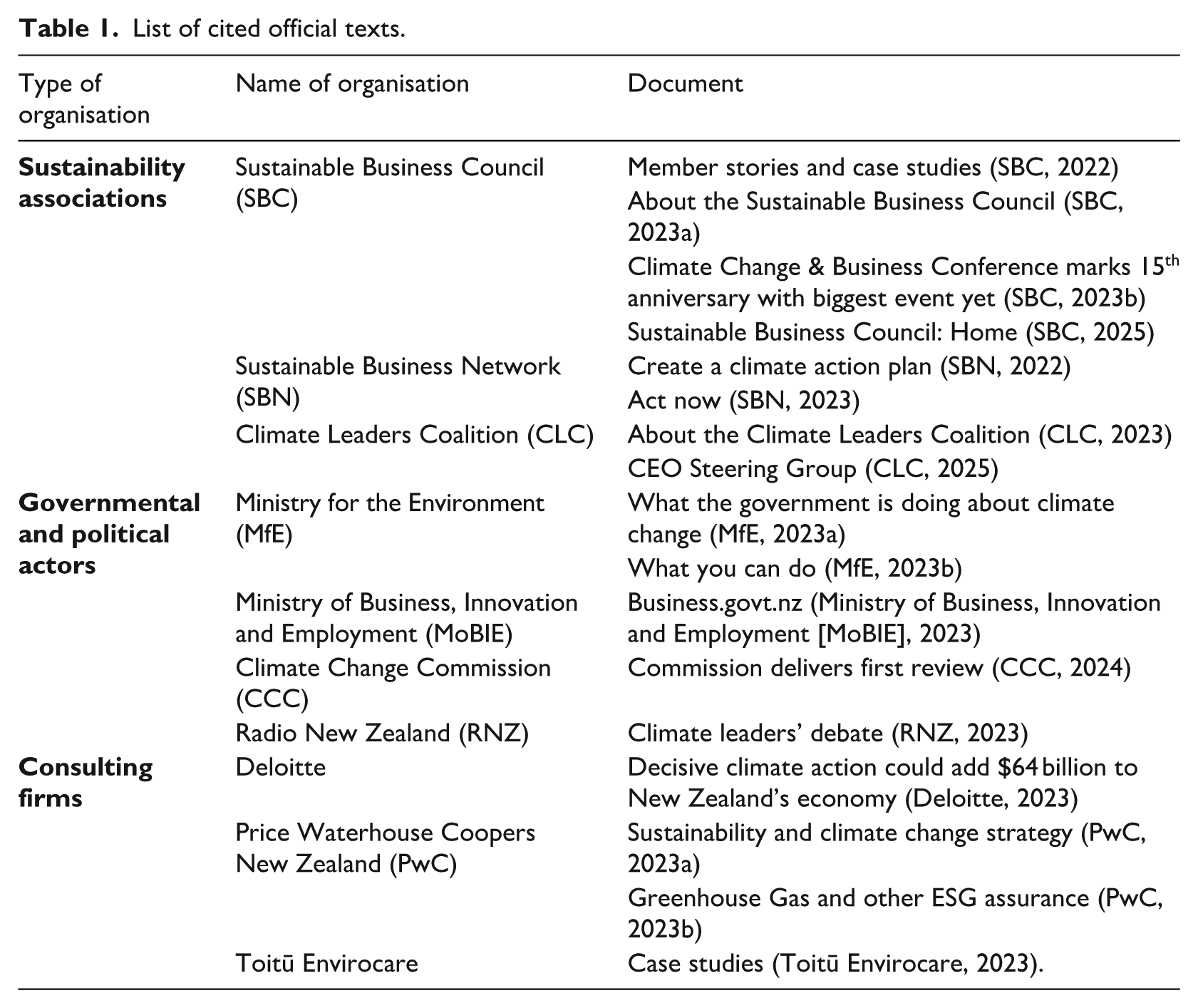
To explore the governmentality of hope as a strategic formation, we compiled a dataset of official and publicly available texts (see Table 1 below) associated with the key actors and organisations which actively shape the milieu of sustainability work in New Zealand. These included: the major sustainability umbrella associations who support corporate sustainability work and who lobby government on relevant policy issues; the governmental agencies and political actors who construct the regulations around sustainability work; and the major consulting firms who provide sustainability advice and certification. As part of our analysis, we reviewed a much larger selection of official texts, including reports, press releases and websites associated with other governmental actors, other consulting firms, business organisations and psychological associations. While it is not possible to cite every text we reviewed, these additional sources align with and support the analysis presented here.
List of cited official texts.
Interviews
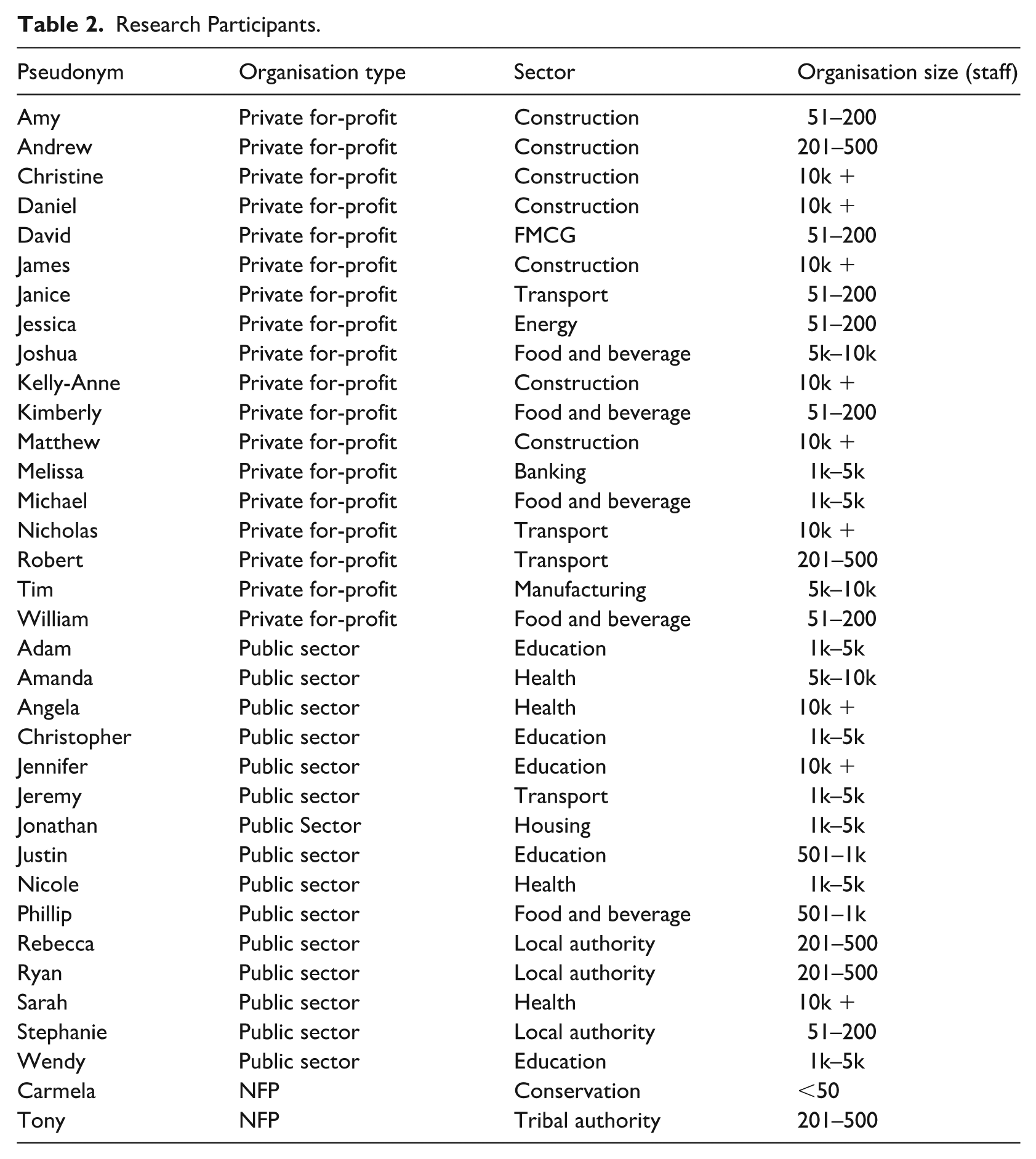
To explore how the governmentality of hope shaped the conduct of sustainability leaders, we conducted a comprehensive search of organisational websites and professional profiles to develop a list of individuals who held defined leadership roles with overall responsibility for sustainability in prominent New Zealand organisations. We emailed an invitation to each of these potential participants and conducted interviews with the 35 who accepted. Table 2 below provides relevant information about each of the 35 participants and their organisations.
Research Participants.
The interviews were semi-structured: we started each interview by asking participants to think about ‘what is happening in the world’ and ‘about [their] own leadership role’. We then presented (in random order) a list of seventeen possible affective responses to their work and the state of the world, asking them to indicate which responses resonated with them. This ‘card choice’ interview technique (Carroll, Inkson, & Ingley, 2017) allows participants to respond to the cues offered by chosen cards without being continuously guided by interviewer questions. We developed this list based on our familiarity with the theory and practice of sustainability work (Skilling, Hurd, Lips-Wiersma, & McGhee, 2023) and we invited participants to add responses they felt were missing from the list we provided. Five of the words provided (hope, doubt, certainty, anxiety, despair) can be seen as clearly related to hope, while others (e.g. guilt, joy, apathy, anger) do not have an obvious connection. In every interview, at least one of the five terms clearly related to hope was selected as salient and – alongside multiple other affective responses – became part of the conversation.
We understood our participants, in Foucauldian terms, as subjects who are themselves constituted through the research, and who are positioned through multiple discourses and thus always subject to limits on what can be thought, said and actioned (Fadyl, Nicholls, & McPherson, 2013). From such a stance we understand the interview not as a direct window into any form of reality but as offering access to ‘truth games’, and insights into how subjects manage and problematise their conduct in light of the rules that constitute their milieu (Arribas-Ayllon & Walkerdine, 2017, p. 117). This fits within a broader discursive genre of interviewing (Langley & Meziani, 2020) but is explicitly Foucauldian in its particular focus on discursive affects and practices. Apart from the first two interviews which were face-to-face and slightly longer, all interviews were conducted online and lasted approximately 60 minutes.
Data analysis
Our analysis of the governmentality of hope focused not on its precise ideational content, but on how it is constructed and on its practices and its effects (Ahl, 2007; Fadyl et al., 2013). Further, our analysis was guided by the methodological principle of problematisation (Hansen & Triantafillou, 2022): we sought to identify and de-naturalise the contingent ways in which situations are structured in the name of governing and being governed (Dean, 2009). Given this lens, we focused on the ‘assumptions, exclusions and dissenting voices’ (Ahl, 2007, p. 232) present within the official texts and the interview transcripts.
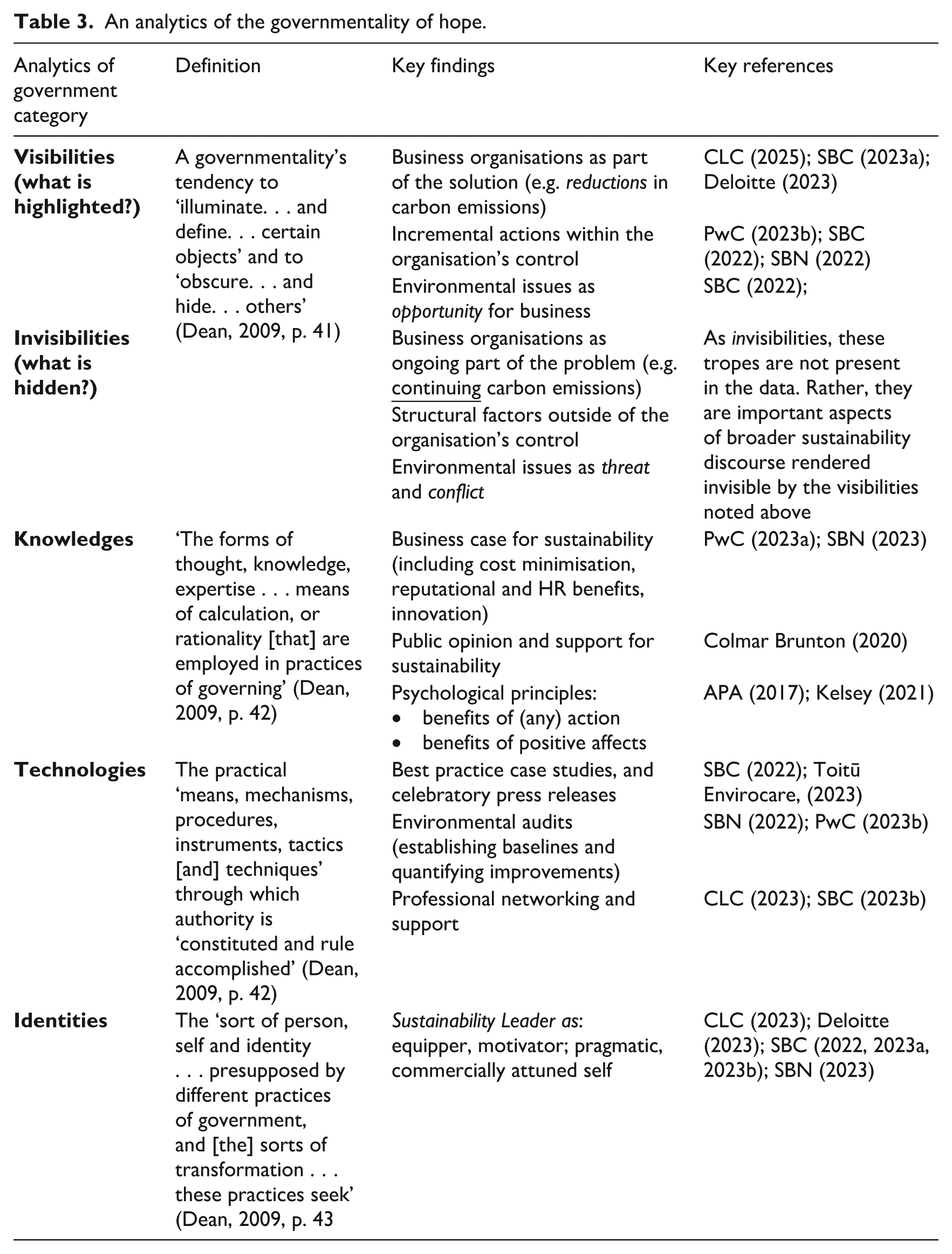
Our attention to problematisation makes Dean’s ‘analytics of government’ – which he describes as ‘an instrument of criticism’ that offers ‘a diagnostic of the present’ through ‘problematizing taken-for granted assumptions’ (Dean, 2009, p. 3) – an appropriate analytical framework. While Dean (2009, p. 5) explicitly warns about it ‘becoming a mere technique of thick empirical description’, this framework does offer a structured list of key elements to look for in the analysis of how conduct is shaped through concrete practices and objects. Specifically, it directs us to look for a governmentality’s characteristic (in)visibilities, knowledges, technologies and identities. These terms are defined and illustrated in Table 3, in the Findings section.
An analytics of the governmentality of hope.
Official texts
The textual material was analysed by applying the categories of Dean’s framework. In conversation with the other two researchers, researcher 1 worked through this material to identify textual elements that related to each of Dean’s four categories. In the Contextual Milieu section, we summarise and provide illustrative examples of the specific (in)visibilities, knowledges, technologies and identities around hope in sustainability work that we found in this analysis. Overall, our analysis shows that this specific and strategic construction of hope normalises hope as a (even the) appropriate response to sustainability challenges.
Interviews
Interview data were initially analysed by identifying the multiple and varied ways in which participants constructed hope in the context of their broader spectrum of affective responses. Our analysis of the interview data was guided by Dean’s analytics of government in conversation with other theorisations, including that of thinking, feeling and display rules (Carr & Kelan, 2023; Sieben & Wettergren, 2010) and two further points of attention congruent with a Foucauldian analysis: truth claims in relation to hope, and discursive cues, clues, frames and clusters or patterns. Two of the researchers read through each transcript identifying all references to hope including words, phrases, images, metaphors and language constructions. Our interest here was broad, encompassing references to hope’s presence, precarity and absence, as well as its effects, uses and limitations. Foucauldian analyses tend not to use strict coding that might preclude or artificially separate out discursive elements. As such, this analysis involved consideration of the whole transcript and not just the immediate hope-related utterances, since any discourse must be understood as intersecting and interdependent with others.
In this initial analysis of the interview data, we were struck by the construction and naturalisation of an ‘imperative to hope’ that aligned with our analysis of how the official texts constructed hope as normative for the milieu of sustainability work. Our commitment to a non-deterministic analysis directed us to look further for the multiple ways in which our participants expressed their agency (McKinlay et al., 2012; Skinner, 2013) through their varied responses to this imperative. Approaching the interview transcripts with an explicit problematisation lens, we looked for moments of ambivalence, resistance and dissent in how subjects managed themselves and others (Ahl, 2007; Arribas-Ayllon & Walkerdine, 2017) in relation to the imperative to hope.
From this analysis we derived three distinct and coherent sets of practices through which our participants responded to the governmentality of hope: the discourses of administering hope, performing hope and resisting hope. Subsequently, the second and third researchers constructed separate analytics tables (Tables 4–6 in the Findings section) for each discourse from further analysis of the interview data, focusing on how the effects of the governmentality of hope operated in each case. This exercise served to confirm our three discourses, and to refocus scrutiny on the affective dimensions of each.
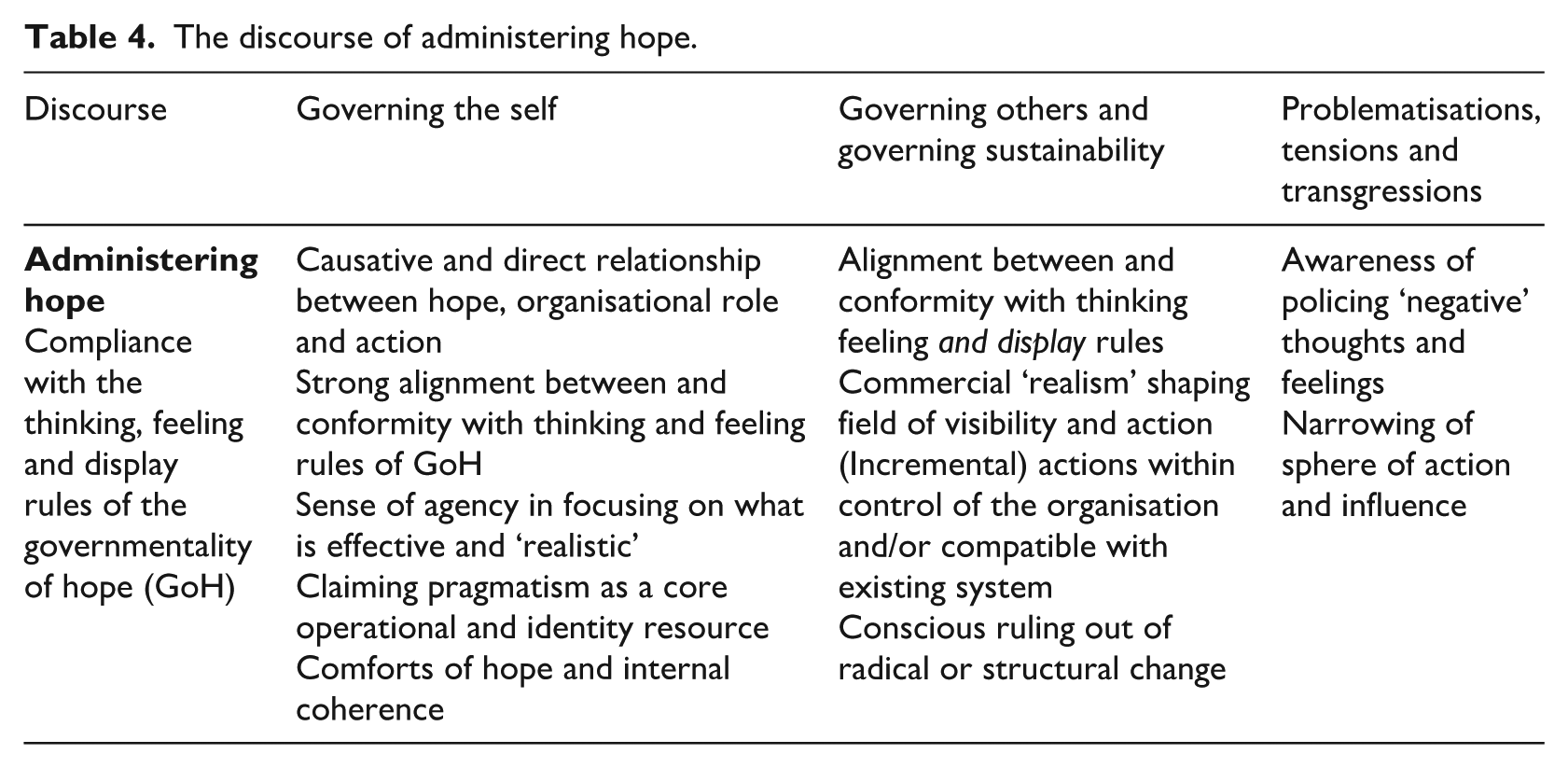
The discourse of administering hope.
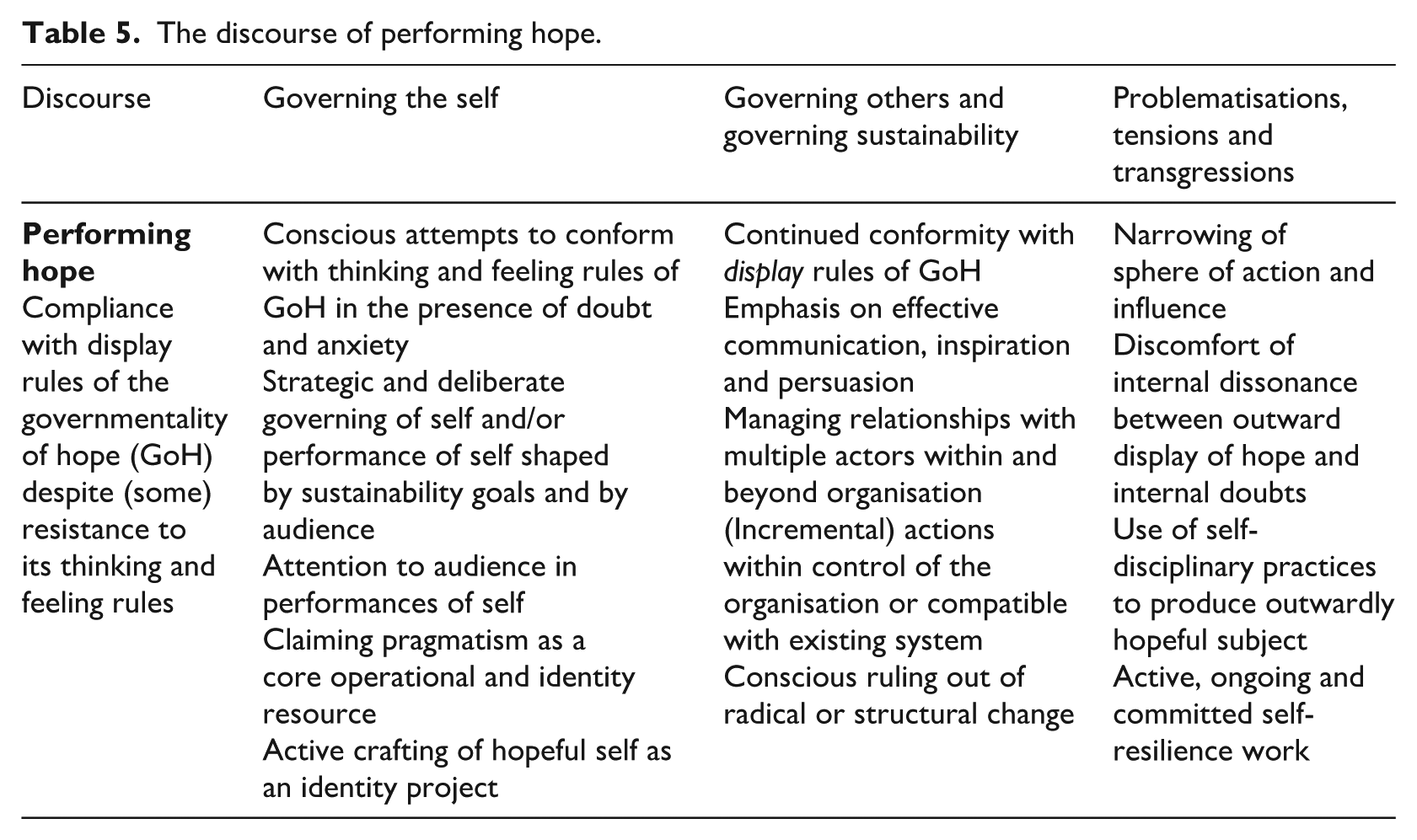
The discourse of performing hope.
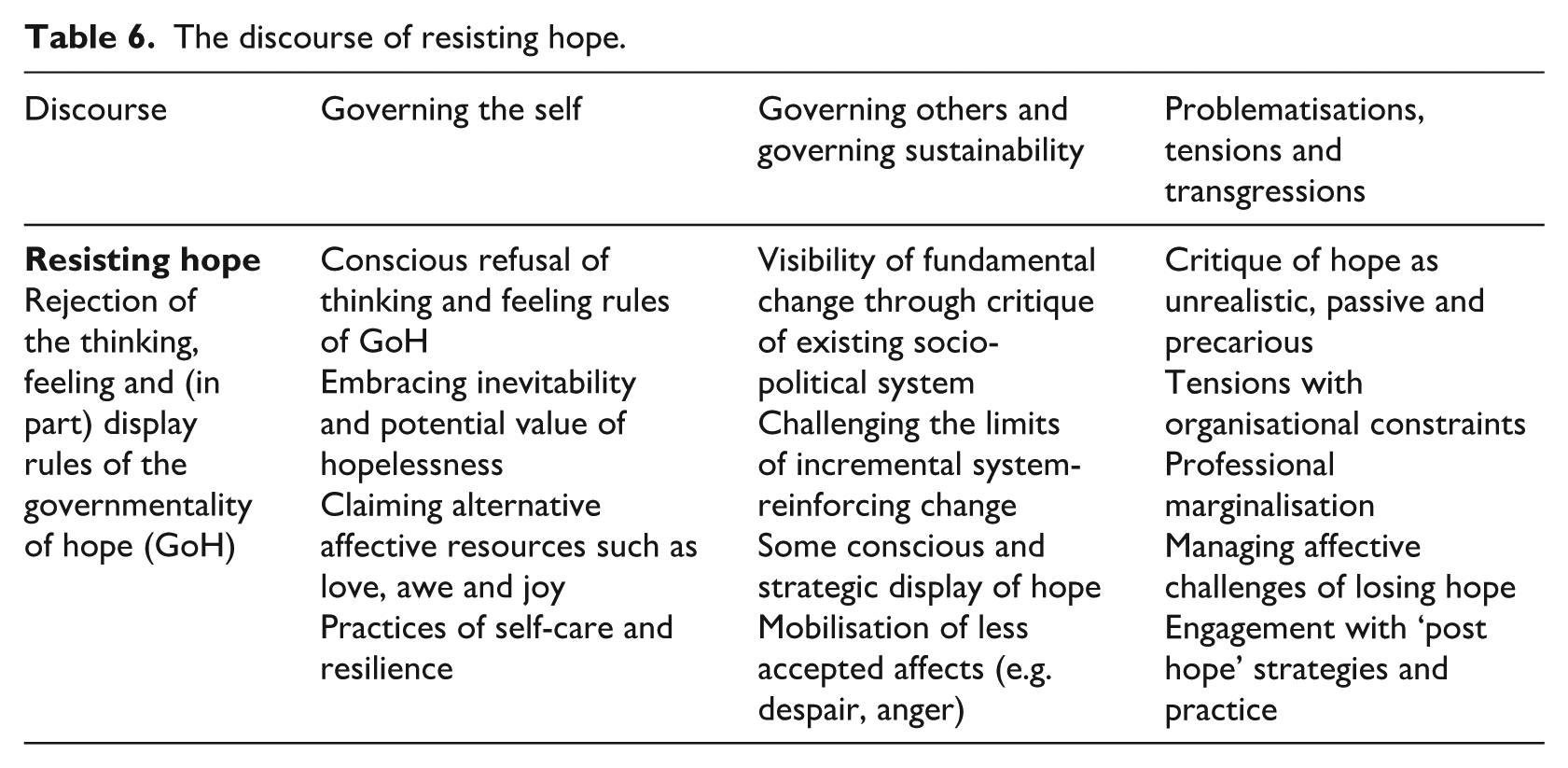
The discourse of resisting hope.
Contextual milieu: sustainability work and the imperative to hope
The prominence of environmental crises and pervasive eco-anxiety (APA, 2017; Foster, 2015) within a neoliberal political-economic system provides grounds for a critique of that system (Foster, 2015; Newton & Harte, 1997). Wright and Nyberg (2012) show how corporate actors respond to this critique by constructing climate change not as threat and conflict (evoking responses of anxiety, fear and anger) but as challenge and opportunity, a construction that calls forth ‘hope, enthusiasm and even excitement’ (Wright & Nyberg, 2012, p. 1572). Our analysis of key official texts confirms that this hopeful and enthusiastic framing of environmental challenges continues to powerfully shape the milieu of sustainability work.
These texts are marked by a series of specific visibilities that construct correlative invisibilities. They construct environmental problems in terms of the ‘enormous challenges ahead’ but also ‘the benefits that can be realised as we harness the opportunities of a zero-carbon economy’ (SBC, 2022, emphasis added). Elided here are themes of crisis, alarm and blame. The texts construct sustainability strategies as win-win solutions, creating ‘a future that is low-emission [and also] positive for our businesses and economy’ (CLC, 2025; Deloitte, 2023; SBC, 2023a), not as trade-offs between environmental, social and economic objectives, or as a cost to organisations that should be avoided or minimised. Further, they construct firms as the solution to environmental problems, central to efforts to ‘set New Zealand on the path towards an exciting future, which is prosperous, sustainable, regenerative [and] zero carbon’ (SBC, 2023a), maximising ‘positive impact for shareholders, communities and the environment’ (SBC, 2025). This visibility obscures organisations’ role in creating environmental problems, and the structural drivers of environmental crises.
As well as naturalising specific (in)visibilities, a hopeful construction of environmental crisis as business opportunity assumes and validates specific knowledges and technologies. Importantly, it foregrounds the knowledge of the ‘business case for sustainability’ (Whelan & Fink, 2016), promising firms who integrate ‘sustainability into their long-term strategic vision’ benefits including enhanced ‘innovation . . . employee engagement . . . risk resilience . . . [and] long-term growth and profitability’ (PwC, 2023a; SBN, 2023). This claim relies in turn on knowledge about positive consumer, employee and investor attitudes towards sustainability (Colmar Brunton, 2020). The hopeful construction of sustainable work foregrounds technologies that highlight the positive contributions that existing organisations are making, including the prominent use of best-case examples and inspirational leaders (SBC, 2022; Toitū Envirocare, 2023). At the firm level, environmental audits are important and prominent technologies (PwC, 2023b; SBN, 2022). The logic of such audits is to measure and highlight (incremental) improvements in emissions, waste, or energy, eliding the damage caused by continuing pollution and resource use.
Wright and Nyberg (2012, pp. 1562) argue that corporate actors articulating an enthusiastic, ‘positive and profitable’ framing of climate change can be seen as attempting to counter a broader social negative and fearful framing of environmental crisis. Our analysis shows that this positive construction has been widely – although, of course, not universally – adopted across society. Government ministers describe climate change as a ‘challenge and opportunity’ (RNZ, 2023) and government agencies focus on how the state (MfE, 2023a), firms (MoBIE, 2023) and individuals (MfE, 2023b) can respond – and are already responding – to environmental issues. As government-appointed Climate Change Commissioner Rod Carr insists, ‘It’s possible to reach a low-emissions climate resilient future in a fair, equitable and inclusive way, while still growing the economy’ (cited in CCC, 2024). Taken together, these texts construct a governmentality of hope that shapes the milieu of sustainability work. Our interviews represent an opportunity to explore how sustainability professionals co-construct this governmentality as they experience, respond to and participate in it.
Findings: The three discourses of the governmentality of hope
Administering hope
Overview
The first discourse through which our participants respond to the governmentality of hope is marked by truth claims that accept and embrace the ‘imperative to hope’. The administering hope discourse is built on the claim that hope is ‘really, really fundamentally important’ (Amy) and ‘the absolute backbone of leading change and sustainability’, because ‘we’re not going to be able to stand up without it’ (Christopher). Subjects speaking and spoken by this discourse accept that feeling and displaying hope is a prerequisite for sustainability leadership: Anybody that’s been working in this space for . . . you’ve gotta have hope, because otherwise you’re not going to last. (William) You have to have hope . . . because you’re not committed to it otherwise . . . If you don’t [have hope] then . . . how can you be putting your best self forward . . . how do you do your job? (Kimberley) If you commit to a career in sustainability . . . you have to have hope, it’s sort of a fait accompli . . . hope gives me the capacity to get up and go to work. (Janice)
Truth claims about hope’s necessity are underpinned by imperatives (‘We have to have hope that what we do is gonna make a difference’ (Angela, see also Amy and Christine)), hyperbole (the indefinite pronoun above of ‘anybody that’s been working in this space’, the inclusion of all who commit to a career in sustainability) and the professional and existential consequences of not holding hope (‘you’re not going to last’, ‘you’re not committed to it’, ‘how do you do your job?’). These claims represent the relationship between hope, role and action as causative and direct.
Governing the self
Subjects operating within this discourse recognise and actively conform to thinking rules (Carr & Kelan, 2023; Gill, 2017) established by the governmentality of hope, including the propositions that sustainability within the existing system is possible, that individual and organisational-level initiatives represent the most effective mechanism for pursuing this objective, and that sustainability initiatives can serve environmental and commercial ends simultaneously: You have to have hope . . . that the small changes you make have an impact . . . [and that] it’s better to do something than do nothing. (David) You can’t change the world completely, but you can make a contribution . . . [I] do have faith that we can, if we take the right steps, we can make a difference, small or big. (Ryan) The epiphany for me in the last 12 months has been that sustainable practices drive profit . . . good sustainable business makes your brands proven to be more valuable. (David)
These thinking rules serve to ‘rule out’ and block possible trajectories. For Jennifer, they preclude ‘thinking too broadly for too long in terms of kind of climate disaster’ or ‘trying to manage sustainability at that global scale’, since that would limit her ability to ‘have hope for what we can achieve’. This discourse foregrounds the efficacy of actions within the control of the sustainability leader and their organisation, where even small changes can make a difference, an impact and a contribution. It thus rules out thinking about more intractable issues – such as the global and structural scale of environmental problems – that would invite doubt. As Daniel notes, ‘I don’t think we can afford to have doubt’. Subjects drawing on this discourse express their agency by ‘cultivating the expected ways of thinking’ and ‘developing the right mindset’ (Carr & Kelan, 2023, p. 261): I [recognise negative perspectives] but then I always swing round that as humankind has found solutions for a whole bunch of incredible challenges to both us and the planet. (Joshua) [When I] become disheartened . . . it’s like, no, I’ve gotta hold hope to beat pessimism and . . . I have to be smart to deal with pessimism. (Christine)
For participants drawing on this discourse, maintaining the approved mindset requires developing and maintaining feelings consistent with the approved thinking rules (Carr & Kelan, 2023). Affective practices respond to what are recognised as the feeling rules of their milieu: since sustainability leaders are the organisational figures responsible for leading and championing the sustainability agenda, they must themselves be committed to monitoring and policing their feelings (Carr & Kelan, 2023) and to remaining hopeful and positive about what they and their organisations can achieve. As Christine notes, ‘hopelessness is a disabler . . . [and] as a leader I can’t think of any examples where being a disabler is a productive thing’. Jonathan agrees, stating ‘I don’t think there’s any benefit from going to despair.’
Governing others and governing sustainability
Beyond subjects’ internal psychic and affective practices, this discourse acknowledges and enacts the governmentality of hope’s strict display rules based around the expression of approved emotions. These rules direct subjects towards the external display of positivity, enthusiasm and excitement, and the policing of ‘negative’ emotions, constructing sustainability leaders as motivators, equippers and cheerleaders for others: I don’t bring a downside to work generally. I have a firm belief that your team feed off you, your emotions or your demeanour or whatever it may be. (Michael) I try and keep the negative things . . . internal as much as possible because I think that’s not going to motivate people. (Kimberley)
Situating hope within the limited set of actions consistent with the prevailing economic order, this discourse includes leadership practices that are ‘commercially’ focused (David) and that accept and speak in ‘the language of business’ understood by organisational decision makers (Amy). It highlights and justifies incremental initiatives that, while ‘not saving the world’ (David) are nonetheless ‘moving the dial . . . step by step’ (James). The constraining nature of commercial ‘realities’ on what practices are seen as possible are sometimes tacitly acknowledged, but this approach is typically presented as ‘pragmatic’ (David; Ryan) and ‘realistic’ (Christine; Jessica): the most effective means of achieving movement towards sustainability. Pragmatism thus becomes an affective resource: a ‘source of control over the experience and expression of emotion’ (Callahan, 2004, p.1433).
The discourse of administering hope thus implies a significant narrowing of sustainability leaders’ sphere of action and influence. A range of visibilities, knowledges and technologies are elided when leaders accept a form of hope based on realistic actions achievable within the existing system, since those practices render invisible the ‘bigger picture’ (Angela) and the structural drivers of ‘climate disaster’ (Jennifer). Speaking this discourse, however, must be seen as an expression of subjects’ freedom and agency, not the annihilation of it. These participants often found meaning and satisfaction in identifying as ‘pragmatic sustainability [people]’ (David) who are ‘doing something’ (Angela) to make things better, as opposed to the possible paralysis and uncertain results of focusing on intractable structural problems at the global scale. Their embrace of a realistic and pragmatic identity based on at least doing something activates the affective comforts of maintaining hope, and the cognitive consolations of believing that their practices of hope contribute to concrete improvements. Alignment with the governmentality of hope thus offers a feeling of efficacy, even as it limits the possible field of thought, feeling and action.
Problematisations, tensions and transgressions
Subjects drawing on this discourse do not problematise the governmentality of hope but rather participate in it by critiquing and problematising alternative practices and identities. Specifically, they critique the ‘fear-mongering’, ‘negativity’ (Kimberley) and fixed mindset (Robert) of environmental activism and activists: I just reject activist altogether (laughing) . . . I’d prefer to see myself as someone who influences through knowledge and example. (Christine) You have a much greater ability to influence [when] you show that you’re a more moderated voice. (Janice)
Some participants appeared able to accept and express the hopeful thinking, feeling and display rules of this discourse easily, often without comment. These subjects tended to explicitly self-identify as ‘very positive’ (Jessica) and ‘upbeat’ (Michael) people, for whom maintaining hope is an unremarkable part of their personal and professional practice. For others, as we saw above, a degree of intentional work is involved in governing their own psychic and affective states: ‘I have to be smart to deal with pessimism’ (Christine); ‘I do deliberately remain positive as well’ (Angela, emphasis added). Where participants’ awareness of the truth claims of environmental ‘doom and gloom’ (Nicholas, Stephanie) slides into an acceptance of those claims, but where they remain committed to the normalised practices of displaying hope, they may cross the porous border from administering hope to the second discourse of ‘performing hope’.
Table 4 below summarises the key ways in which the administering hope discourse expresses and responds to the governmentality of hope. At the heart of governmentality is self-conduct, self-regulation and self-guidance, where the subject joins other ‘authorities’ in seeking ‘to shape conduct by working through the desires, aspirations, interests and beliefs of various actors’ (Dean, 2009, p. 18). The ‘governing the self’ column summarises this self-regulation, while the ‘governing others and governing sustainability’ column summarises the modes of external action it constructs as normative. The ‘problematisations, tensions and transgressions’ column reflects the fact that no discourse is ever complete or seamless, and that subjects can experience doubt, rupture and unease with the truth claims, practices and subject positions of even the most dominant discourse.
Performing hope
Overview
The discourse of administering hope, then, complies with and expresses the truth claims of the governmentality of hope. In the discourse of performing hope, this compliance is disrupted by the irruption of competing truth claims, including scientific claims regarding the severity and urgency of environmental crises, and claims regarding the inadequacy of extant political responses to those crises. Subjects drawing on the discourse of performing hope thus experience the tension of being addressed by multiple discourses, and they demonstrate an intentionality in their cognitive and affective practices related to how they think, feel and display hope in their work. They recognise the expectation placed on them ‘to be positive and hopeful about what we can achieve’ but are also ‘aware that climate change is happening and [are] pessimistic about our future’ (Amanda). This creates a tension, as we shall see, between governing the self and governing others. Characteristic practices of this discourse include reflexivity (‘I’ve thought a lot about this’ (Jessica)), reserve (‘I wonder if it could be seen as being manipulative’(Justin)) and the active managing of dissonance.
Tensions are often explicitly acknowledged in this discourse, as when Amanda states that she commits to ‘doing a performance of hope, even . . . on days when I’m feeling, oh this is a waste of time’ (Amanda). Subjects’ willingness to display emotions – passion, enthusiasm, positivity – that they don’t personally experience reflects the power of ‘implicitly demonstrated, experienced and reproduced emotion rules’ (Sieben & Wettergren, 2010, p. 11). For many subjects, this language of ‘rules’ is no exaggeration: Where people [used to] ask me questions about sustainability, I would say look we’re fucked, frankly . . . the human race on the planet is gonna die out. And . . . you actually can’t say that to people. . . so I had to learn how to stop saying that and to get a bit more hope. (Amy) When I’m talking to others, I need to project that positivity. Because I’m not gonna capture anybody else’s imagination by being all doom and gloom about stuff. (Stephanie)
Governing the self
These statements express a disciplinary expectation (‘I need to’, ‘you actually can’t say that’, ‘I had to learn’) that calls forth practices of self-censure (‘stop saying that’) and a relational sensitivity and responsiveness (‘when I’m talking to others’, ‘capture anybody else’s imagination’). Tension and ambivalence are central to the practices of performing hope: expressions of belief and emotion that problematise the governmentality of hope (‘no matter what we do, we’re not gonna solve the problems’ (Ryan)) are self-policed and silenced: ‘I don’t really put my energy into thinking about power structures in the world or whatnot’ (Justin, thinking rule): ‘I had to learn how to stop saying that’ (display rule) and ‘to get a bit more hope’ (feeling rule).
The discourse of performing hope requires subjects to remain open to the ambiguity and ambivalence generated by the tension between subjects’ awareness of the ‘imperative to hope’ and their cognitive and affective doubts about hope. Our analysis finds subjects often moving quickly between acknowledging that they are ‘pessimistic about our future’ and insisting that being optimistic is ‘the only way to be’ (Amanda). These subjects accept the expectation to display the approved affects of hope and enthusiasm in their leadership practice even as they resist and problematise the thinking and feeling rules around the necessity and desirability of hope: [When] I’m presenting a project, or writing a strategy, I put the positive spin on it, but that’s not what I personally believe . . . [I] frame it in a positive way even though it’s totally lies basically . . . because [often] you can’t tell it how it truly is. (Stephanie) Every time [a colleague] speaks about his work . . . he’s passionate, enthusiastic . . . ‘we will be able to solve this’, blah blah blah. And that is a performance . . . and I know that because I know him personally and what a struggle it is. (Nicole)
These references to spin, lies and struggle express the tension and ambivalence that these subjects experience between the thinking, feeling and displaying rules of the governmentality of hope. Often, they participate in the truth claims and practices of this discourse in response to their own doubts as a way of performing hope to themselves. A juxtaposition between doubt and anxiety (‘we’ve got this ecological disaster unfolding’) and the continued insistence that ‘you have to have hope’ (Kimberley) was repeated in many interviews, as in Janice’s claim that ‘you feel you have to have hope, but you can’t help but feel despair’.
Governing others and governing sustainability
Typically, the availability and appeal of this discourse is context-specific and strategic. The communicative practices and discursive strategies of performing hope are acutely attuned to audience and shaped by ‘tactical decisions’ based on ‘who your audience is’ (Adam). Amanda reported that when she is addressing ‘an environmental advisory group’ she delivers a hopeful performance that gives them ‘room to be positive’ and to generate ‘new ways of thinking’, but that when she is addressing ‘senior management’, she tones down her focus on hope, since she wants them to accept her as a ‘logical, pragmatic, realistic person’. These moments of conscious adaptation to different audiences (for example, Nicole’s comment that ‘we need to [use] language that people understand . . . using risk language and stuff like that’) are examples of the ‘intelligent’ and deliberate ‘management of emotions’ where emotions are ‘experienced in and shaped by interactions with others’ (Sieben & Wettergren, 2010, pp. 4, 7).
The effective performance of hope thus requires subjects to self-govern their practices of displaying affect. As Nicole said, ‘we cannot show them our anger . . . we need to [keep] using positivity . . . we’re not gonna get [the necessary behaviour change] by scaring the shit out of people’. Complementing these practices of cognitive and affective self-censorship, knowledges and technologies relating to persuasive communication are central to performing hope. These included fine-grained attention to linguistic choices, tone of voice, and organisational realities. Kelly-Anne noted: Internally we have what we call . . . the tone of voice where we talk about sustainability. . . We’ll talk about the environment and hope in the same way . . . it’s straight up, it’s confident, it’s reassuring, it’s positive, it’s pragmatic and it’s focused on the future . . . even if I don’t personally feel hopeful, I should talk about things in this way.
Problematisations, tensions and transgressions
These subjects did not experience the tensions between the practices of this discourse as dishonest or inauthentic, but as an effective resource for their over-riding sustainability objectives. Indeed, performing hope opens up new possibilities for connection with ‘the people part’ (Amanda) of leadership and for supporting organisational stakeholders in ‘practical action and . . . problem solving’ (Adam). At the same time, managing these tensions can be complex and often ‘quite hard work’ (Amanda), since it requires resolving the contradiction between, on the one hand, subjects’ own feelings and rational assessments (‘I’m actually not that hopeful’ (Amanda); ‘I’m pretty convinced that we’re screwed, to be honest’ (Angela)) and, on the other, a leadership role that requires them to maintain hope ‘not just for me’ but for ‘inspiring [others] to flourish and grow’ (Sarah). Complying with the display rules of hope in the absence of feeling hope for themselves is challenging for these subjects, since they are unable to draw on their feelings ‘as internal guides’ that might help them easily ‘communicate signals that can also guide others’ (Sieben & Wettergren, 2010, p. 3). Performing hope places considerable demands on these subjects’ resilience, since it requires them to maintain energy and enthusiasm in the presence of their own angry and anxious responses to environmental realities.
Resisting hope
Overview
The third discourse – resisting hope – extends the ambivalence and tensions of performing hope into a fuller problematisation of the governmentality of hope and its truth claims regarding the desirability and necessity of hope. While the two previous discourses constructed hope as necessary for achieving sustainability ‘wins’ and as constitutive of the subject position of sustainability leader, this third discourse insists that ‘it has to be okay for leaders to lose hope’ because ‘any of us who have been working in this territory are going to’ (Carmela). Hopelessness was represented in this discourse not just as inevitable in sustainability work but also as potentially generative. Rejecting the administering hope discourse’s unequivocal truth claim that ‘hopelessness is a disabler . . . hope is an enabler’ (Christopher), the resisting hope discourse posits that a ‘sense of despair’, far from being debilitating, can be ‘quite empowering’ once it is acknowledged and articulated (Justin). Despair, said Adam, ‘can be a motive for action as much as the sense of hope can be’. These claims constitute a rejection not just of the core thinking rules of the governmentality of hope, but also of its feeling rules and (in part) its display rules.
Governing the self
In relation to thinking rules, this discourse holds that hope in the context of urgent environmental crisis is unrealistic, since it typically relies on ‘using similar thinking that caused these problems to try and solve them’ (Andrew). A hope that can only be maintained by ignoring uncomfortable environmental and political-economic realities, in other words, is no hope at all. Going further than the discourse of performing hope, this discourse claims that hope is not only unrealistic but also not strategically useful for sustainability leadership. Subjects drawing on this discourse represent hope as ‘a bit passive’ (Carmela), since it ‘doesn’t actually get anything done’. As Jonathan commented, ‘being reliant on hope, or faith, doesn’t take me anywhere necessarily’. Being contingent on outcomes that are outside of subjects’ control, hope was also represented as precarious: There’s this intangibility of this hope that I don’t have control over, hence my reluctance to kind of, to, you know maybe consciously to pin so much hope on hope. (Jonathan) I hope we’re not gonna lose any more species . . . what happens when we do? (Carmela)
Governing others and governing sustainability
Problematising the thinking rule around the positive contribution that capitalist organisations can make to sustainability objectives draws on and opens up a wider field of visibilities and a critical understanding of the status quo: in this discourse, business organisations and the system they operate in are positioned as key causes of environmental crises. Andrew’s lack of hope, for example, was related to his belief that ‘the system itself is really designed to perpetuate the current paradigm’, while Carmela’s was related to her critique of ‘large corporate or conservative kind of traditional contexts’ maintained by ‘inertia and status quo’. This discourse problematises the reliance on initiatives that could be made within the existing system. Indeed, it claims that hope based on such practices diverts attention away from a proper analysis of a ‘current [political-economic] system that restricts potential changes to those that fit within its broad parameters’ (Andrew).
This problematising of the thinking and feeling rules of the governmentality of hope, however, does not flow automatically into an outright rejection of its display rules. Participants who draw on the resisting hope discourse and represented hope as ‘problematic’ and a ‘false idol’ (Carmela) are, predictably, wary of activating or mobilising hope as part of the leadership practice. Carmela acknowledged, however, that she does sometimes ‘use hope in terms of how I influence people’. In such practices, she strategically draws on the discourse of performing hope, displaying an awareness that other people speak, and are spoken by, other discourses. Displaying hope to others is, for Carmela, a deliberate practice to communicate across discursive difference. At the same time, she claims that hope is not ‘the source of my power’ or the ‘engine of my energy’. In the absence of hope, the discourse of resisting hope offers alternative sources of energy and motivation. Responding to Carmela’s question ‘when you run out of hope, what’s the bottomless source of the energy . . . to keep doing the work?’ this discourse offers the alternatives of joy (Angela, Carmela), love and awe in the face of nature (Carmela, Jeremy) and anger. As Carmela declared, ‘I’m not gonna fucking hope anymore, I’m gonna go and use this anger and energy to try and make a difference.’
Problematisations, tensions and transgressions
Since ‘emotions are tied to and shape relations of power and interdependence’ through the ‘emotion-laden complexities of organizations and organizing’ (Sieben & Wettergren, 2010, p. 7), rejecting the construction of hope as normative in their field directs these subjects towards challenging cognitive and affective practices. Subjects who draw on this discourse understand it as marginal in their milieu and, as such, they have reflected deeply on their participation in it. They experience the truth claims and practices of resisting hope as compelling and generative, but speaking and acting them remains far from easy or glamorous. These subjects report being ‘wrecked’ by scientific reports, and as suffering extended periods of ‘deep climate grief’ (Carmela). Carmela, for example, engaged with her feelings of grief by participating in a ‘deep ecology off-site’ that included a guided ‘funeral for hope’. The difficult and deliberate work of resisting hope also includes practices of connection with nature and collegial support. Subjects drawing on this discourse often initiated and nurtured caring, supportive and therapeutic networks and relationships with others who problematised the imperative to hope.
In contrast to the previous two discourses, the discourse of resisting hope offers activist and system-challenging identities. These identities include that of ‘activist in disguise’ (Carmela) and ‘the challenger within’ (Melissa). In the context of the ongoing demands of their roles, such self-understandings require deliberate, ambivalent and difficult identity work. These participants may identify as rebels and activists – labels explicitly rejected by the other discourses – but they are still addressed by competing discourses and organisational ‘realities’. This complex milieu means that they often operate as ‘a kind of hidden activist’ and a ‘strategic change agent’ (Carmela). As Carmela noted, being ‘an activist in disguise [means that] I understand their world and I’m trying to change it’.
While speaking and being spoken by this discourse was often intensely personal, these subjects also saw it as raising crucial issues for the wider profession: ‘any of us who have been working in this territory are going to . . . lose hope’, so ‘we need to have ways of thinking about what the post-hope world looks like for us’ (Carmela). In response to her own question of how to ‘turn up every day and continue to fight irrespective of the fact that . . . we’re not turning it around’, Carmela offered the analogy of caring for a terminally ill loved one: ‘you do everything you can to prolong [their] life . . . even if you don’t have hope, because you have love’.
Discussion: Hope as Governmentality
Summary of findings
Our study posits a governmentality of hope that shapes the milieu of sustainability work, and it elaborates the multiple discourses that speak through subjects as they respond to and participate in this governmentality. We begin this Discussion section by summarising the key differences between these three discourses, before highlighting the contribution that our study makes to the affective governmentality literature, and to the practice of sustainability work. This discussion foregrounds our study’s attention to tension, ambivalence and resistance in the operation of affective governmentalities, and the generative potential of adopting a critical and sociological view of hope. Each of these elements is critical to building a full response to our research question of how hope shapes the conduct of sustainability leaders who, as leaders, are simultaneously governed and governors.
The discourse of administering hope is marked by an alignment between the thinking, feeling and display rules of the governmentality of hope. These rules work together in this discourse to produce subjects who experience hope in what they and their organisations can achieve in the pursuit of sustainability, and who use and celebrate hope in service of that goal. This discourse was the least likely to problematise the ‘rules of the game’ constructed by this governmentality, and it therefore tended to embody and express its characteristic (in)visibilities, knowledges, technologies and identities. Indeed, it actively problematised competing visibilities (such as the structural drivers of environmental crisis) and identities (such as that of the radical activist).
This alignment between thinking, feeling and display rules is disrupted in the performing hope discourse, which is marked by a tension between continued compliance with the governmentality of hope’s (external) display rules, and an ambivalence regarding its imperative to govern the self to think and feel in hopeful ways. This discourse tended to express the (in)visibilities, knowledges, technologies and identities of the governmentality of hope, but subjects speaking and spoken by it displayed a degree of unease in doing so, in the face of a degree of cognitive and affective dissonance. As such, the claims and practices of this discourse were marked by a strategic intentionality, and subjects’ thoughts, feelings and outward actions were carefully monitored and regulated.
In the resisting hope discourse, this tension extends to a rupture. The thinking and feeling rules of hope are consciously rejected, and the display rules held up to scrutiny. This discourse reclaims and makes visible the characteristic invisibilities of the governmentality of hope (the structural drivers of environmental crisis, for example) and contests its preferred knowledges, technologies and identities. The identities dimension from Dean’s framework proves significant in this discourse, which problematises the figure of the sustainability leader supposed to hope and offers instead activist and system-challenging identities.
Our analysis shows these three discourses to be distinctly porous: multiple – even contradictory – discourses are quite capable of speaking through the same actor, even if some subjects appeared more ‘captured’ by one discourse than others.
Tensions and ambivalence: affective governmentality and subjects who are both governed and governors
Previous studies of affective governmentality within organisation and management studies tend to focus on either the experiences of the governed (Carr & Kelan, 2023; Mackenzie & McKinlay, 2021) or the practices of the governor (Kantola et al., 2019; Plotnikof & Pors, 2024). Our study contributes to the literature by focusing on the experiences and the practices of sustainability leaders, Janus-faced figures simultaneously governed by and governing self and others through an affective governmentality. While Carr and Kelan (2023, p. 269) show how the thinking and feeling rules of a given milieu can be ‘intertwined and act in concert’ to produce certain kinds of subjects, our study’s attention to the claims and practices of subjects governed by and governing through an affective governmentality allows us to offer a more nuanced profile of how such a governmentality shapes conduct. Specifically, this focus allows us to elucidate not just the synergies but also the tensions and contradictions between the discourses that subjects draw on as they respond to and participate in an affective governmentality.
Governmentality studies have often been critiqued for being overly deterministic and eliding agency and resistance (McKinlay et al., 2012; Raffnsøe et al., 2019; Skinner, 2013). Our study explicitly structures its analysis around the multiple and contradictory discourses through which subjects respond to the rules established within their milieu. By foregrounding these different degrees and modes of problematisation, resistance and dissent (Ahl, 2007; Dean, 2009), our paper adds to the body of work that foregrounds ‘uncertainty, doubt, and competing and conflicting relations to self’ (Mackenzie & McKinlay, 2021, p. 1847).
While the tight alignment between the thinking, feeling and display practices of hope constructed by the administering hope discourse might appear to call forth seamless and fluid work at the subject level, our analysis shows that considerable work is often required to maintain this alignment. This work includes subjects’ self-regulation of their cognitive attention and their affective responses, and the limiting of what they feel able to hope for. Meanwhile, the performing hope discourse offers an escape and a set of resources for subjects experiencing the unease and tensions between competing discourses. The practices of this agile and strategic discourse are typically enacted by subjects who embody a tension between a bleak cognitive assessment of humanity’s future on the planet and a continued embrace of the approved external expression of hope. Further, our analysis shows that while the resisting hope discourse might be seen as subversive, oppositional and radical, the subjects spoken by this discourse maintain a deep commitment to sustainability objectives: their resistance is more narrowly to the imperative to hope and to its limitations on what can be hoped for. We understand this discourse’s relationship to the governmentality of hope not only in turns of tension and rupture, but also in terms of synergy and corrective.
Overall, our analysis shows that tension and ambivalence – often found at the intersection between discourses, and the intersections between thinking, feeling and display practices – are an integral part of the operation of affective governmentalities. While existing studies of organisational actors governing others through affective mechanisms tend to focus on the ‘discursive and material practices’ that they deploy in doing so (Plotnikof & Pors, 2024, p. 1; Kantola et al., 2019; Sandager, 2021), our explicit focus on affect allows us to highlight these crucial aspects of tension, ambivalence and unease. Indeed, since affective milieus are associated with ‘contradictions, paradoxes, flows and surprises’ (Kantola et al., 2019, p. 765), our foregrounding of affect allows for a uniquely nuanced picture of the ongoing dance between a governmentality’s shaping of conduct, and subjects exercising their freedom in response to that shaping.
Implications of problematising hope for the field of sustainability work
Through its specific and strategic construction of problems and solutions, the governmentality of hope privileges certain forms of knowledge and expertise while eliding others (McKinlay & Pezet, 2017). Applying a problematisation lens to the governmentality of hope in the field of sustainability work opens up space for critical consideration of the purposes that this construction serves. Doing so can be understood as a project of challenging ‘the familiarity of the accepted’ (Raffnsøe et al., 2019, p. 174) and, potentially, as the first step in ‘combating problematic managerial commonsense’ (Barratt, 2008, p. 516).
Our analysis views the hopeful construction of corporate sustainability work as the strategic attempt of skilled actors (Barratt, 2008; McKinlay & Pezet, 2017) to counter the possibility that contemporary environmental crises (and related affects such as anxiety and anger) might de-legitimate capitalist organisations and the broader capitalist system. By asserting that capitalist organisations are a key part of the solution to environmental crises, this strategic formation can be seen as an expression of capitalism’s flexibility and its capacity to legitimate and perpetuate itself by ‘absorbing . . . and assimilating [critique] into governmental objectives’ (Mackenzie & McKinlay, 2021, pp. 1845–1846). Crucially, the solutions that it ‘rules in’ are those consistent with and reliant on the logic of capitalist accumulation, while actions that challenge the existing system are ruled out. By focusing on the variety of responses to the governmentality of hope, our analysis points toward the generative potential of rejecting and resisting hope. While the imperative to hope and its focus on incremental changes may generate some positive environmental outcomes, it renders invisible the important structural and systemic drivers of environmental problems (Newton & Harte, 1997; Skilling et al., 2023).
Contrary to dominant trends in organisation and management studies and in leadership studies, we understand hope not as a subjective experience or as a desirable and useful individual trait (e.g. Luthans & Avolio, 2003) but rather as a socially constructed vector of power that shapes the milieu within which sustainability leaders operate (Fineman, 2010; Wright & Nyberg, 2012). One practical contribution of our critical-sociological analysis is its potential to direct ‘the desire for change away from the self [and away from individual organisations] and towards [the] socio-political’ (Mackenzie & McKinlay, 2021, p. 1858; Petersen & Wilkinson, 2015). Collinson’s (2012, p. 89) critique of the ‘excessive positivity’ of what he calls ‘Prozac leadership’ holds that the construction of hope as normative for leadership makes it harder for leaders to accept confronting news and to address serious problems. A form of positivity and hope that ignores power asymmetries, he argues, makes it harder to apprehend and address the underlying causes of important issues.
Our analysis shows that this dynamic – maintaining a form of hope by systematically limiting what can be hoped for – is present in the field of sustainability work. In our view, a hopeful construction of environmental challenges – to the extent that it does not fully engage with the fundamental changes necessary for environmental sustainability – is an example of the ‘limiting systems of thought which inhibit our capacity to imagine other possible ways of organising’ (Barratt, 2008, p. 516; Jones, Selby & Sterling, 2010; Newton & Harte, 1997). A wider range of ways of thinking, feeling and acting become available when subjects recognise the contingency of dominant constructions of social issues, and refuse to align their ‘self-conduct . . . with dominant governmental rationalities’ (Mackenzie & McKinlay, 2021, p. 1858).
The conduct of most of our participants is shaped by the governmentality of hope at least to the extent that they focus on incremental changes that do not threaten short-term organisational objectives, and to the extent that they rule out ‘activist’ identities, and knowledges and techniques that imply radical or systemic change. Some subjects, however, reject a hope based on incremental and system-reinforcing actions as misguided and counter-productive. It was the numerically marginal resisting hope discourse that was able to identify the structural drivers of sustainability problems and the limitations of system-reinforcing actions. This problematisation of the imperative to hope was an important resource for subjects who sought to live out more radical and activist practices and identities.
While our findings do not allow us to address the ultimately empirical question of which response to the governmentality of hope offers the surest route to positive environmental outcomes (or to personal self-care), the multiple modes of responding offer at least a wider range of possibilities. Acknowledging that many subjects find the rules constructed by the governmentality of hope to be professionally and psychologically useful, our study suggests that these rules limit the scope of thought, feeling and action. If hope can only be maintained by continuously minimising what it is that we hope for, there might be something generative and robust in grounding our conduct not just on hope, but also on other responses, such as love, awe or anger.
Directions for further research
While the most extreme mode of refusal (the resisting hope discourse) was the least common in the data, the practices and problematisations of this discourse provide suggestive material for further research. Its awareness of but resistance to the governmentality of hope offers insights into dynamics of self-sovereignty (Foucault, 2001) and self-creation (Raffnsøe et al., 2019; Skinner, 2013). Such practices of resistance could fruitfully be theorised as instances of parrhesia (Foucault, 2001; Raffnsøe et al., 2019): a form of fearless truth-telling that offers new possibilities for action, but that is fraught with danger. As Foucault (2010, p. 62) puts it, ‘the “parrhesiast” . . . stands up, speaks, tells the truth to a tyrant, and risks his life’. Indeed, the rejection of the imperative to hope may feel like (and, in fact, be) a form of professional death, since an inability to feel and display hope is not valued (Barratt, 2008) in a milieu shaped by the imperative to hope.
Resisting the governmentality of hope’s thinking, feeling and display rules opens new possibilities for critique and agency within sustainability leadership. As Raffnsøe et al. (2019, p. 171), note, ‘parrhesiastic acts . . . characterized by a sense of moral duty . . . may be both personally transformative’, serving even to challenge and destabilise ‘established institutional and organizational structures’. Our analysis shows, however, that the rejection of a governmentality may come at considerable cost: subjects drawing on the resisting hope discourse report affects such as grief and anger, and experience isolation. They have felt the need to leave jobs, and to develop practices of self-care and external support as part of forging new forms of leadership in a post-hope world. In a milieu where the imperative to hope is confronted by environmental crisis and eco-anxiety, there is an urgent need to better understand the self-sovereignty and self-care practices of leaders who resist affective mandates and imperatives (see Raffnsøe et al., 2019; Skinner, 2013).
Conclusion
Our aim was to critically analyse how sustainability leaders experience, navigate and perform hope in their role. We focused on how they are governed by – and how they govern with and through – hope, in a context where the grounds for their hope are constantly challenged. Our analysis showed that these subjects operate in a milieu that constructs hope as normative, and that they respond to this ‘rule of the game’ in multiple ways. The subjects in our study govern themselves and others through the filtering of hope through the pragmatic, commercially attuned discourse of administering hope, the strategic, relational and communicative discourse of performing hope and the radical and critical discourse of resisting hope. Each discourse generates specific (in)visibilities, knowledges, technologies and identities that, to varying degrees, constitute and problematise the governmentality of hope. While resistance to any governmentality is always possible and inevitable, the governmentality of hope tends to constrain the space of leadership choice and action, limiting the ways in which organisations respond to environmental challenges. While our research focused specifically on hope, given its salience to sustainability leadership in the context of environmental crisis, its findings make visible the power of affective milieus and the complex relationship between cognitive, affective and strategic practices. It thus offers insights into the theory and practice of leadership in the face of grand societal challenges.
Footnotes
Acknowledgements
We would like to record our sincere appreciation of Laure Cabantous for her gracious and insightful engagement with this article. We are also deeply grateful to our three anonymous reviewers for their constructive and helpful feedback. We have gained a lot from this review process, and our article is much stronger as a result. This article would not have been possible without the active and enthusiastic participation of 35 sustainability leaders in Aotearoa New Zealand. It’s been a joy and a privilege to work closely with these committed people who, in their various ways, are working for a better world in the face of economic, political and affective challenges.
Funding
The author(s) received no financial support for the research, authorship, and/or publication of this article.
