




Abstract
A focus on sustainable employability has recently become more prevalent in research and practice. The working population ages, and employers’ demand for work exceeds its supply, making the need for continued labour at later ages greater. Accordingly, the urgency of reducing sick leave is increasing. In this article the need for sustainable return-to-work trajectories is emphasised, as returning to work after sick leave can be challenging and often unsuccessful on the long term. I demonstrate the need for sustainable return-to-work trajectories by sketching the global issue of workplace absence and comparing how organisations in different countries respond to short-term and long-term sick leave. This comparison lays bare large gaps between theory and practice in recovery and return-to-work. Using insights from management science, industrial and organisational psychology, and occupational medicine, I reflect on ways to support a more sustainable (long-term) return-to-work, in which the emphasis is placed on sufficient time to recover and a contextualised, holistic approach to return-to-work. This approach is illustrated to be beneficial to both the employer and the employee.
The average life expectancy has been steadily increasing and people are thus living longer (Mathers et al., 2015). This increasing life expectancy, combined with economic uncertainty, rising healthcare costs, and decreasing availability of healthcare benefits, is moving governments towards raising the age of retirement and extending the working life (Angeloni & Borgonovi, 2016). However, while we do live longer, our healthy life years are not increasing correspondingly (Jagger et al., 2008). Illness thus remains more prevalent with older age, posing problems for the participation of older people in the labour force (House et al., 1990; Jagger et al., 2008). Given the overall ageing working population due to the extended working life and smaller inflow of young employees (Ilmarinen, 2006), sick leave is thus, and will continue to be, a growing problem for employers. As such, it is essential to aim to facilitate recovery from illness and a sustainable return-to-work, to ensure the sustainability and continuity of labour within organisations.
While sustainable employability and the reduction of sick leave have been receiving more attention in human resources research and practice in recent years (e.g., Van der Heijden et al., 2016; Van der Klink et al., 2016; Ybema et al., 2020), large gaps still appear to exist between theory and practice in recovery and return-to-work. As science is moving towards more longitudinal approaches in studying processes (White & Arzi, 2005), it is becoming increasingly clear that research in the direction of return-to-work should be focused on returning to work as a longer process rather than a state of being back at work in the short-term. The necessity of such a longitudinal approach in studying return-to-work and the sustainable long-term success of return-to-work trajectories is further emphasised by studies that indicate prior sick leave as one of the main predictors of future sick leave, indicating possible relapse. Furthermore, the complexity of return-to-work processes is high; employees deal with very different types of illnesses in numerous varieties of situations. Most studies regarding recovery, while highly valuable sources of information, are geared toward a certain type of illness, (e.g., cancer, depression, musculoskeletal diseases) without involving the larger context or personal situations (e.g., Corbière et al., 2022; Etuknwa et al., 2019; Butow et al., 2020).
More research in this area is thus needed to support employers in managing sick leave and return-to-work processes in a sustainable manner. Previous studies show that employer support can play a large role in this recovery process (Muijzer et al., 2011; Munir et al., 2012), and that employers furthermore stand to gain a lot from investing in sustainable return-to-work processes both financially and in the shape of the health and well-being of their employees (McLaren et al., 2017). In this research note I will sketch the global issue of work absenteeism and reflect on the ways we globally deal with short- and long-term sick leave. Furthermore, I illustrate how investing in the return-to-work of employees on sick leave, both by financial and non-financial means, is a necessity. Finally, I will provide some recommendations directed at a sustainable return-to-work, aimed not just at getting employees back to working in good health, but also at keeping them there.
The Urgency of the Sick Leave Problem
The urgency of the current sick leave problem is reflected in the continuous rise of absences from work, which in Europe steadily increased from 3% in 2008 to an average of slightly over 4% in the first quarter of 2020 (Eurostat, 2020). A similar increase was found in the US, where absenteeism due to illness rose from 2.2% in 2008 (U.S. Bureau of Labor Statistics, 2008) to 3% in 2020 (U.S. Bureau of Labor Statistics, 2020) and to 3.6% in 2022 (U.S. Bureau of Labor Statistics, 2023) which amounts to an increase of 64% between 2008 and 2022. These growing sick leave percentages are alarming, as they reflect a total of 11 million people on sick leave at any point in time (Eurostat, 2020). Given that the labour market slack will only continue to grow as the working population ages and more employees will retire (Dixon, 2003; Henkens et al., 2008), retaining healthy employees is of the utmost importance for organisations. Moreover, being able to work is very important to employees’ mental health and well-being, for instance through increased autonomy, and reduced psychological distress, anxiety, and depression, especially in the case of supportive supervision (Modini et al., 2016).
Sick Leave Protocols Across the Globe
Despite the urgency of the sick leave problem and the clear need for investment in the sustainable health and employability of employees, such investments are not ubiquitous. When it comes to being given time and resources to recover, especially from long-term illness, in some countries the outlook is bleak. Heymann et al. (2010) investigated and compared paid sick days (short-term) and paid sick leave (long-term) policies in 22 high human development index countries, using two exemplary cases of illness for direct comparison. The first case they examined, exemplary of short-term illness, was a flu that lasted up to five days. The second case, exemplary of long-term illness, was cancer treatment lasting 50 days. In their comparison of policies, they found that while most countries do have national policies on paid sick days (short-term illness), there were already clear exceptions to this; the United States, Canada, and Japan do not have such policies in place. Furthermore, the United States does not mandate paid sick leave for long-term illness.
Upon taking a closer look, the height and duration of sick day (short-term) and sick leave (long-term) payments vary greatly among countries from full wages to small percentages of regular wages. Some of these payments are employer-sponsored and others are covered by social insurance. For example, in the event of short-term illness, 11 of the compared countries (e.g., Australia, Germany, Denmark) cover full pay for the median-wage worker, whereas the other countries only covered parts of full-time equivalent pay. In Greece and the Netherlands 3.5 full time equivalent (FTE) days in sick pay are covered. Spain will provide payment for 1.2 FTE, France provides 1 FTE, followed by the UK providing payment for .4 FTE. It should be noted that the average sick day coverage for short-term illness is lower in these last three countries because there is no legal guarantee of payment for the first three days of absence. In the case of long-term sick leave the legal coverage could be ten days at 100% of the regular income (Australia), for which it should be noted that unused sick leave can be carried over to the next year, 12 months in a 3-year period at 50% of the regular income (France) or two years at 70% of the regular income (the Netherlands).
These comparative data show that even when countries do mandate some form of paid sick leave, it does not necessarily mean these payments are sufficient to fully support employees while they recover from their illness. While the legally mandated sick leave can be insufficient, a legal mandate can be viewed as a minimum requirement. Employers are free to support their employees further financially on sick leave. For example, in France it is often the case that employers negotiate additional sick leave arrangements in collective agreements with labour unions (Directorate for Legal and Administrative Information, 2022). Such additional support can be highly effective and beneficial, as offering employees sufficient paid sick leave allows them to take time to recover from their illness at its onset. This prevents employees from attempting to initially work through their illness, and oftentimes eventually having to take more time off work to fully recover from a worsened condition (Heymann et al., 2010). Moreover, withholding payment during sick leave can put employees in a harmful position in which they are unable to provide for themselves and their families (Griep et al., 2023).
The Financial Side of Sick Leave Compensation and Return-to-Work Trajectories
The benefits of offering sufficient paid sick leave go beyond the benefits for employees only. When viewing employees as human resources only in the most economic sense of that word (i.e., as costs and returns on investments for employers), paid sick leave could be viewed as a cost. Accordingly, investing in employees who are not performing at work could be viewed as a waste of valuable resources to organisations. However, offering employees sick leave pay can be financially beneficial to organisations. An extensive study into the effectivity of return-to-work programmes by McLaren et al. (2017) shows that return-to-work programmes significantly reduce time off after injury, generating positive returns for the studied organisations. Another study by Asfaw et al. (2017) concerning the potential economic benefits of paid sick leave in reducing absenteeism related to influenza-like illness, showed that providing paid sick leave could have saved United States employers .63 to 1.88 billion US dollars in absenteeism costs. Moreover, organisations that offer paid sick leave are likely to have lower absenteeism and higher levels of productivity, as well as lower turnover rates (Lovell, 2005). High turnover is often associated with lower performance levels (Kacmar et al., 2006), further making the case for retaining employees on sick leave and helping them recover rather than replacing them. The latter can also be costly in terms of recruitment and training, especially with the rising level of complexity involved in a lot of positions, leading to a higher scarcity of potential employees who possess the necessary skill to do such a job (Brougham & Haar, 2017; Horbach & Rammer, 2022).
Non-Financial Return-to-Work Support
Investing in sick leave compensation and return-to-work trajectories is thus clearly financially beneficial to employers. However, there is more to supporting employees on sick leave than just the financial investment made by employers. In some countries (e.g., the Netherlands, Belgium, Finland, and this list is not exhaustive) policies that go beyond financial support are in place to ensure that employers put in place return-to-work programmes that help employees return to work following sick leave (Ministerie van Sociale Zaken en Werkgelegenheid, 2008; Federale overheidsdienst werkgelegenheid arbeid en sociaal overleg, 2009; Halonen et al., 2016). In such systems, employers, employees, and occupational physicians work together to assess an employee’s level of work impairment and provide advice on the types of tasks that the employee could perform as they take steps to fully return to work. The effectiveness of such return-to-work programmes in reducing time off was already demonstrated (McLaren et al., 2017). So far, return-to-work trajectories made mandatory through legislation have been found to be positively related to sustainable return-to-work (Boets et al., 2022; Halonen et al., 2016), but it is still early days. More research on this type of legislation and long-term sustainable return-to-work is needed to further assess how legislation can play a role in regulating sustainable return-to-work trajectories that benefit both employers and employees. Of course, these types of non-financial steps towards aiding return-to-work can also be provided without legislation in place to ensure it; in line with putting “the people first” when it comes to sustainable employment (see also Griep et al., 2023) employers can, and are encouraged to take such steps even when they are not legally obliged to do so.
Common Principles for Successful Return to Work.
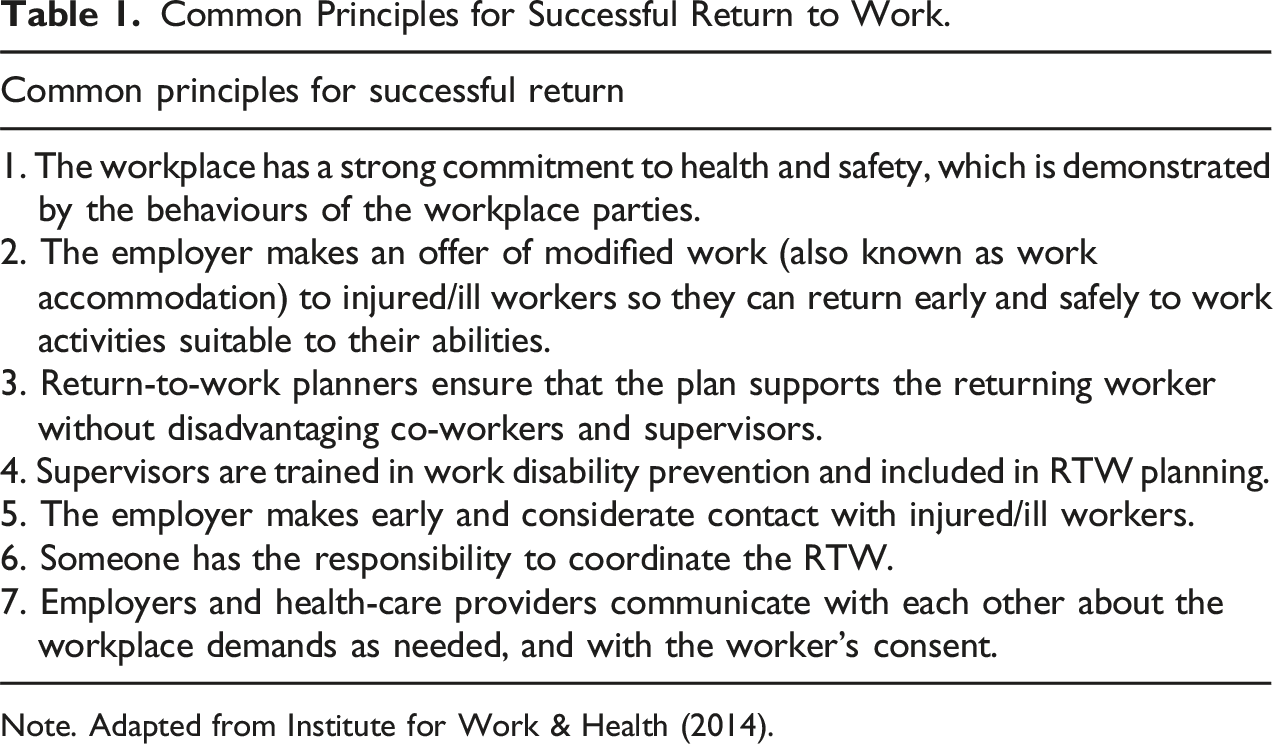
Note. Adapted from Institute for Work & Health (2014).
The Future of Studying Return-to-Work
While the previous studies are of great use in identifying important factors that can contribute to the success of return-to-work trajectories and offer some advice for employers to use to support their employees on sick leave, there are steps that can be taken towards improving the future of return-to-work trajectories. There are two main problems with previous scientific research on return-to-work trajectories and how it relates to practice. First, the key elements for return-to-work are often expressed in a generalised manner, specified only on the type of illness (e.g., common mental diseases, musculoskeletal diseases, cancer; Corbière et al., 2022; Etuknwa et al., 2019; Butow et al., 2020). However, return-to-work trajectories are incredibly diverse, and contextual factors are of great importance (Dekkers-Sanchèz et al., 2011). For example, whether a person has a support system (e.g., family) can largely affect their recovery (Bjørlykhaug et al., 2022). Similarly, their responsibilities outside of work (e.g., caretaking tasks interfering with work-life balance; Aslam et al., 2011) can influence the recovery process. A more specific or tailored approach thus seems appropriate.
Second, existing studies focus on a relatively short period of being back at work after sick leave; Etuknwa et al., 2019 included a 3-month stable return-to-work standard for their outcome measure, whereas Cancelliere et al. (2016) did not include any time standard in their synthesis of systematic reviews. As previous studies have found that one of the main predictors of future sick leave is previous (especially long-term) sick leave (Boot et al., 2017; Laaksonen et al., 2013), it is doubtful whether a short-term scope of weeks or months on return-to-work provides us with enough information on successful recovery, successful return-to-work, and possible future relapse; all the more because relapses have been shown to occur over subsequent years (Koopmans et al., 2008). Madsen (2020) for example identified nine different possible return-to-work trajectories including varying configurations of returning to work full time or returning to work part time, and successful and unsuccessful rehabilitation. These configurations (from data collected over a period of 10 years) often show multiple periods of long-term sick leave alternated by return-to-work efforts and rehabilitation. To understand and manage return-to-work, it is thus essential to view return-to-work as a process rather than a state, including multiple phases, transitions, and possible relapses. Therefore, the emphasis of return-to-work processes should be on a more long-term, sustainable return-to-work.
Concrete Steps to Take in Practice
While there is a clear need for more contexualised research on sustainable return-to-work trajectories, there is already a lot of room for improvement in practice based on what is known. Both medical and non-medical factors play a role in employees’ return-to-work, and it is an interplay between factors within the context of the employee that constitutes the cause of long-term sick leave (Dekkers-Sanchèz et al., 2011). It can therefore be helpful to take a holistic approach involving both the employee and their environment to deal with the multicausality of work disability. A first step in such an approach is to gather complete information about the work context and personal context of the sick-listed employee to be able to tackle the right obstacles (Dekkers-Sanchèz et al., 2011). Policies and interventions should thus be tailored to both the organisation and the situation of the employee. For instance, occupational physicians can provide a prognosis (of course within the bounds of medical confidentiality) and indicate whether an employee is medically able to perform any work tasks. They can also indicate which types of tasks an employee might be able to perform while gradually returning to work, based on the employee’s medical condition (Ministerie van Sociale Zaken en Werkgelegenheid, 2008). For physical conditions this might mean that an employee may not be able to do heavy lifting, but they could still perform physically lighter tasks. For mental conditions this might mean that an employee is able to start working half days but does not yet have the energy or capacity to work full days.
Dependent on the employee’s condition and situation they may also require different kinds of support. Employees who struggle with work-family conflict for example may need more social support from their workplace in their recovery (Kossek et al., 2011; Pluut et al., 2018; Schallig et al., 2021). Next, employees may have demanding responsibilities outside of work (e.g., caretaking tasks) that could affect their recovery through a higher total workload and cause additional stress (Adisa et al., 2021). Mapping these kinds of personal situations out with the employee and taking them into account when taking steps towards returning to work can help prevent overexertion. Finally, it is important to keep checking in with employees and how they progress through their return to work, keeping in mind the previous points, both before and after they start taking on their regular workload again. Having policies in place that detail who needs to act at which stage of the return-to-work trajectory can help ensure these kinds of check-ups keep happening over time. These are however just starting points, and aims for future research should be to find out more about what kind of interventions are useful for whom and in which context, and how work and the work environment can be properly modified to suit these personal contexts. Nonetheless, there is already a lot of room for improvement in the way employers provide their employees with aid in their recovery. Policymakers and organisations can use the recommendations made above to both prevent unnecessary costs that go accompanied with sick leave, and to allow employees to sufficiently recover to be able to perform well on the long-term.
Footnotes
Acknowledgement
I would like to thank Dr. Yannick Griep for his support and the interesting conversation that ultimately led to the writing of this manuscript. Moreover, I would like to thank Dr. Griep, Dr. Debby G. J. Beckers and Dr. Brigitte J. C. Claessens for their helpful comments regarding the applicability of sustainable return-to-work insights in practice, and I would like to thank Kyona Hoebe for her insights with regard to the legislative aspects of sick leave and return-to-work. Lastly, I want to thank the reviewers and the Acting Editor of Group and Organization Management for their insights that led to the improvement of the original manuscript.
Declaration of Conflicting Interests
The author(s) declared no potential conflicts of interest with respect to the research, authorship, and/or publication of this article.
Funding
The author(s) received no financial support for the research, authorship, and/or publication of this article.
Associate Editor: René Schalk and Joannes Kraak

Author Biography
Elizabeth Beekman is a PhD candidate at the Behavioural Science Institute at Radboud University, the Netherlands. She has a background in work and organisational psychology, and organisational design and development. Her research is centred around sustainable employability, occupational health and remote work.