




Abstract
Although preliminary research implies a tantalizing association between workplace gossip and interpersonal relationships, little is known about how gossip shapes relationships at work. Given that relationships are integral to employee wellbeing and to the development of social capital, it appears vital to develop a more comprehensive understanding of the psychological processes linking gossip and workplace relationships. To this end, we induce theory from qualitative evidence regarding the processes whereby workplace gossip shapes relationships in the workplace. Taking the under-researched perspective of the gossip recipient, our study draws on multi-source data to explore how recipients’ experiences of gossip incidents affect their dyadic relationships with gossipers and gossip targets. We find that recipients’ interpretations of gossipers’ intentions—prosocial, self-serving, or genuine—initiate three distinct processes that engender a range of relational outcomes, from decreased trust to the development of close interpersonal connections. In describing these nuanced processes and their associated relational outcomes, we provide insights that extend and enrich theory and challenge conventional assumptions about workplace gossip.
Workplace gossip, defined as informal and evaluative talk about another organizational member who is not present (Brady et al., 2017; Kurland & Pelled, 2000), is a pervasive yet widely misconstrued phenomenon. Although management scholars and practitioners traditionally viewed gossip as an unproductive or even deviant workplace behavior (Bennett & Robinson, 2000; Einarsen et al., 2009; Lipman, 2016), an emerging body of research suggests gossip fulfils multiple roles in organizations—some positive, others negative, and others still that defy simple classification as either positive or negative (Bai et al., 2020; Brady et al., 2017; Vaidyanathan et al., 2016). Recently, researchers have begun to explore the role of gossip in shaping workplace relationships, either directly or indirectly (Brady et al., 2017; Ellwardt, Labianca et al., 2012, 2012c; Farley et al., 2010; Farley, 2011; Grosser et al., 2010; Kuo et al., 2018; Martinescu et al., 2019). However, these preliminary efforts have produced mixed findings. For instance, while some studies indicate that gossip supports the development and maintenance of trusting relationships between coworkers (Ellwardt et al., 2012a, Ellwardt, Wittek et al., 2012; Grosser et al., 2010), others imply that gossip—especially negative gossip—undermines such relationships (Farley et al., 2010; Farley, 2011).
We propose that the mixed findings reported in extant research stem from an inadequate understanding of how gossip shapes relationships in the workplace. Stated differently, we maintain that scholars cannot explain why gossip builds relationships in some instances (e.g., Ellwardt et al., 2012a) yet undermines them in others (e.g., Farley, 2011) because we currently lack a comprehensive understanding of the psychological processes that underpin the relational outcomes of gossip. By this, we mean the mental processes that change the way recipients think or feel about gossipers and gossip targets—for example, recipients may experience increased or decreased trust and respect toward the other person as a result of a gossip incident. Revealing these processes appears vital for appreciating the full extent of gossip’s role in organizations given that interpersonal relationships are crucial to employee wellbeing (Grant et al., 2007) and form the building blocks of social capital (Methot et al., 2018; Oh et al., 2004), which translates into outcomes that enhance firm performance and competitive advantage (Barney & Wright, 1998; Chenhall & Langfield-Smith, 2007; Tsai & Ghoshal, 1998).
Accordingly, the purpose of our paper is to build and enrich theory on the processes whereby gossip shapes dyadic workplace relationships. We do so via a qualitative study that, in contrast to existing quantitative (Martinescu et al., 2019) and conceptual (Lee & Barnes, 2021) research, provides insight into how individuals experience the relational outcomes of gossip in real-world organizational contexts. Our study takes the perspective of the gossip recipient—a crucial actor in the gossip triad whose role remains under-researched. The triad consists of the gossiper, who initiates gossip, the recipient, who receives it, and the target, whom gossip is about. To date, most empirical research has examined the relational outcomes of gossip from the perspective of the gossiper (Brady et al., 2017; Grosser et al., 2010; Martinescu et al., 2019). However, we contend that the recipient’s perspective may be even more important for illuminating such outcomes because recipients’ responses to gossip shape their relationships with not only gossipers (Lee & Barnes, 2021), but also with targets. Therefore, we gather and analyze rich data from gossip recipients to address the research question: How do gossip recipients’ experiences of workplace gossip incidents affect their interpersonal relationships with gossipers and gossip targets?
Our paper makes three substantive contributions to the literature. First, we induce theory from data on how gossip shapes workplace relationships. Our qualitative, inductive study builds on and enriches extant conceptual research (e.g., Lee & Barnes, 2021) and provides insights that enable the reconciliation of mixed findings reported in large sample, quantitative studies (Ellwardt et al., 2012a, 2012c; Farley, 2011; Kuo et al., 2018). Second, we provide a comprehensive account of how workplace gossip shapes both recipient-gossiper and recipient-target relationships. This contribution is important given that prior research has focused almost exclusively on how gossip affects relationships between recipients and gossipers (Ellwardt et al., 2012a; Grosser et al., 2010; Kuo et al., 2018; Kurland & Pelled, 2000; Lee & Barnes, 2021; Martinescu et al., 2019). Third, we spotlight the role of the gossip recipient in shaping the outcomes of workplace gossip. Gossip communicates social information (Baumeister et al., 2004; Foster, 2004) and the recipient is the member of the triad who interprets and responds to that information (Lee & Barnes, 2021). However, most studies to date have examined workplace gossip from the perspective of the gossiper (e.g., Brady et al., 2017; Grosser et al., 2010; Tassiello et al., 2018) or the gossip target (e.g., Ellwardt, Steglich et al., 2012b; Wu et al., 2018).
Workplace Gossip and Relationships: An Equivocal Picture
Over the past decade, researchers have begun to explore the role of gossip in developing and maintaining workplace relationships, yet with mixed findings (Brady et al., 2017; Ellwardt et al., 2012a, 2012c; Farley et al., 2010; Farley, 2011; Grosser et al., 2010; Kuo et al., 2018). Some evidence suggests that gossip helps build and maintain trust-based interpersonal bonds between gossipers and gossip recipients (Ellwardt et al., 2012a, 2012c; Grosser et al., 2010). For example, Grosser et al. (2010) and Ellwardt et al. (2012c) found that sharing negative gossip indicated close, trust-based ties between colleagues, while Ellwardt et al. (2012a) found that gossiping together increased the likelihood of two colleagues becoming friends over time. Additionally, Kuo et al. (2018) reported that receiving positive gossip from supervisors supported the development of leader-member exchange (LMX) relationships. On the other hand, there is evidence that gossiping can damage an individual’s chances of developing close interpersonal connections at work. Farley (2011) and Farley et al. (2010) found that participants rated high-frequency negative gossipers as their least likeable coworkers, implying that such gossipers would struggle to develop close interpersonal connections with colleagues.
Taken together, extant findings paint an equivocal picture of how gossip shapes relationships in the workplace. Research shows that gossip can lead to both positive and negative relational outcomes, as demonstrated above, yet does not provide a comprehensive explanation of the psychological processes that engender such varied outcomes. Moreover, prior studies have focused almost entirely on the relational outcomes of gossip for gossiper-recipient relationships (Ellwardt et al., 2012a, 2012c; Grosser et al., 2010). Consequently, scholars have barely scratched the surface of possible knowledge regarding how gossip shapes relationships between recipients and targets. In this paper, we empirically investigate recipients’ experiences of gossip to elaborate a richer, more nuanced understanding of how gossip affects relationships across the gossip triad. We thus generate insights into why workplace gossip engenders such varied relational outcomes, contributing to several existing conversations in the gossip literature. In the brief review that follows, we divide these conversations into those that concern recipient-gossiper relationships and those that concern recipient-target relationships. We also note another conversation—on gossip valence—to which our paper contributes.
Recipient-Gossiper Relationships: The Exchange Perspective
The dominant theoretical perspective on how gossip affects recipient-gossiper relationships is the exchange perspective (Brady et al., 2017; Grosser et al., 2010; Kuo et al., 2018; Kurland & Pelled, 2000; Martinescu et al., 2019). Rooted in social exchange theory (Blau, 1964), this perspective views gossip as a social resource—a source of insider information—that coworkers exchange for influence, social support, and/or reciprocated information (Martinescu et al., 2019). Thus, the exchange perspective asserts that gossip shapes recipient-gossiper relationships by facilitating exchanges of social resources between coworkers.
Importantly, evidence supporting the exchange perspective comes largely from employees’ self-reported motivations to gossip (Brady et al., 2017; Martinescu et al., 2019). For instance, Martinescu et al. (2019) found that participants gossiped to same-level peers in the expectation of receiving information and social support in return. While such motivations undoubtedly play a role in shaping the relational outcomes of gossip, we contend that these outcomes cannot be explained solely by understanding gossipers’ motivations because motivations necessarily interact with recipients’ responses to gossip. To illustrate, an employee’s motivation to gossip may be to receive social resources from a recipient coworker (Martinescu et al., 2019), but if the recipient does not respond by providing such resources, an exchange-based relationship is unlikely to develop.
Recipient-Target Relationships: The Reputational Information Perspective
The dominant view of how gossip shapes recipient-target relationships is the reputational information perspective. Rooted in evolutionary theory (Dunbar, 2004; Enquist & Leimar, 1993), this perspective holds that individuals primarily use gossip to communicate evaluative information about other group members (Beersma & Van Kleef, 2011; Feinberg et al., 2012). Such information, in turn, influences how gossip recipients view and interact with gossip targets. For instance, negative information about a target’s previous behavior may influence the likelihood of a recipient trusting that person in a task involving cooperation (Wu, Balliet et al., 2016). While evidence from experimental simulations supports the reputational information perspective (Feinberg et al., 2012; Fonseca & Peters, 2018; Wu et al., 2016a, Wu, Wang et al., 2016), barely any empirical research has investigated how gossip shapes relationships between recipients and targets in the specific social context of the workplace (Burt & Knez, 1993).
Gossip Valence
An important focus throughout the workplace gossip literature is gossip valence—that is, whether gossip conveys positive or negative information about its target. Many scholars have focused on valence as a key variable when studying the diverse outcomes of workplace gossip (Bai et al., 2020; Brady et al., 2017; Kuo et al., 2018). However, as our review of the literature reveals, the associations between gossip valence and relational outcomes are far from straightforward. To illustrate, Kuo et al.’s (2018) finding that only positive—and not negative—gossip from supervisors supports LMX relationships contradicts the findings of other scholars, which suggest negative gossip helps maintain peer-to-peer relationships at work (Ellwardt et al., 2012c; Grosser et al., 2010). Moreover, Ellwardt et al.’s (2012a) longitudinal study, which documented gossip’s role in friendship development, did not specify whether the gossip that supported friendship development was positive or negative. Consequently, it remains unclear how valence interacts with nuanced psychological processes to shape the relational outcomes of gossip.
The Importance of the Recipient’s Perspective
As the foregoing review of the literature reveals, extant theory and research imply that recipient responses are pivotal in shaping the relational outcomes of gossip. Nonetheless, to our knowledge, only two articles have explicitly addressed the role of such responses in shaping workplace relationships (Kuo et al., 2018; Lee & Barnes, 2021). First, as already discussed, Kuo et al. (2018) examined how receiving positive versus negative gossip from supervisors affected the development of LMX relationships. They found that receiving positive (but not negative) gossip from supervisors supported the development of such relationships. Kuo et al. (2018) explained this finding using regulatory focus theory (Higgins, 1997, 1998). Specifically, they argued that receiving positive gossip from a supervisor triggered a promotion focus in subordinates, leading them to view gossip as an opportunity for LMX development, whereas receiving negative gossip triggered a prevention focus, leading subordinates to ignore the opportunity for LMX development and focus instead on the potential for losing standing in the eyes of supervisors. Second, Lee and Barnes’ (2021) conceptual paper presented a typology of workplace gossip which they linked to recipients’ attributions of gossipers’ motives. In particular, Lee and Barnes (2021) conjectured that the valence (positive or negative) and content (work-related or personal) of gossip inform how recipients construe the motives of gossipers. For example, if gossip is negative and about the target’s personal life, the recipient is likely to attribute a “derogation-based” motive to the gossiper (Lee & Barnes, 2021, p. 303). Subsequently, the recipient is less likely to trust the gossiper and more likely to socially undermine them.
While these two studies underscore the importance of the recipient’s perspective, we maintain that more research is needed to enrich and extend understanding of how recipients’ experiences of gossip shape relationships across the gossip triad. Kuo et al.’s (2018) empirical study is specific to subordinate-supervisor relationships and, therefore, cannot explain why negative gossip is associated with close peer-to-peer relationships (Ellwardt et al., 2012c; Grosser et al., 2010). Meanwhile, Lee and Barnes’ (2021) model is purely conceptual. Moreover, neither study addresses the potential of gossip to shape recipient-target relationships. As such, we contend that developing a more comprehensive understanding of how gossip shapes relationships across the gossip triad requires further empirical investigation of recipients’ experiences of workplace gossip. We further submit that such research would benefit from adopting a qualitative, inductive approach to ensure that scholars’ understanding of how recipients experience gossip, and especially how their responses to gossip shape relational outcomes, is grounded in real-world data (King, 2012; Lincoln & Guba, 1985).
Research Design and Method
Rationale and Overview
How do gossip recipients’ experiences of workplace gossip incidents affect their interpersonal relationships with gossipers and gossip targets? The purpose of our study was to build and enrich theory to address this research question. As such, we implemented a qualitative, inductive research design. Qualitative data were appropriate because they enabled us to get inside the heads of gossip recipients, furnishing rich details of their subjective thoughts and feelings (Gephart, 2018; Lincoln & Guba, 1985). For example, qualitative data provided insights into the nuanced ways in which recipients responded to positive versus negative gossip depending on their preexisting relationships with gossipers and gossip targets. Inductive analysis was suitable for building and enriching theory because it enabled us to explore gossip beyond the lens of a priori theoretical frameworks (Woo et al., 2017). We submit that some of the equivocal findings on the relational outcomes of gossip may result from an inadequate understanding of the nuanced ways in which people experience gossip in real-world organizational contexts. Thus, it was important to induce theory from real-world data rather than testing a priori theory using deductive methods (Woo et al., 2017).
Our unit of analysis was the individual gossip incident (Bott & Tourish, 2016; Flanagan, 1954). Exploring the recipient’s perspective in this way enabled the induction of theory that was firmly grounded in participants’ experiences of workplace gossip in a real-world context (Gephart, 2004; 2018). We used purposive sampling (Patton, 2002) to recruit and select participants. Purposive sampling, which is common in qualitative research and is often contrasted with representative sampling, is a technique for ensuring that participants can provide rich data of relevance to a specific research question (Patton, 2002).
Ethical Considerations and Participants
Workplace gossip is a sensitive topic and, consequently, requires a heightened awareness of the ethical implications of researching the phenomenon (Michelson et al., 2010). Gossip provides personal—and potentially damaging—information about specific individuals, their coworkers, and their organizations. As such, we designed our study to ensure the confidentiality of all these parties. In particular, we: (1) Used non-identifiable descriptors for all participants; (2) asked participants to always refer to their coworkers using pseudonyms, so we would not know the identities of these individuals; (3) did not report identifiable details about participants’ organizations in findings; and (4) provided participants with the opportunity to review transcripts and remove any details they were uncomfortable sharing before commencing analysis.
Ethical considerations also informed our purposive sampling strategy (Patton, 2002). To avoid the possibility of unintentionally divulging sensitive information to participants’ coworkers (i.e., spreading gossip within the same workplace), we drew each participant from a separate organization. We recruited participants through personal and professional networks. Specifically, we emailed study information to our personal and professional contacts and asked those individuals to distribute the information to their own coworkers, friends, and professional contacts. The study information stated that participants who completed the study would receive a voucher as a token of appreciation. Participants who were interested in the study contacted the first author via email. In turn, the first author arranged an initial phone conversation to assess the suitability of prospective participants. Rather than targeting specific industries, we selected participants based on the type of environment in which they worked (Patton, 2002). In particular, we selected participants who worked in physical environments that permitted regular informal interactions because these types of interactions are known to provide a context for both gossip (Waddington, 2005) and informal relationship development (Ashkanazy et al., 2014; Oh et al., 2004). Conversely, we declined prospective participants if they worked in overly isolated roles, such as remote management consultancies without a physical office.
Demographic and Occupational Details of Study Participants.
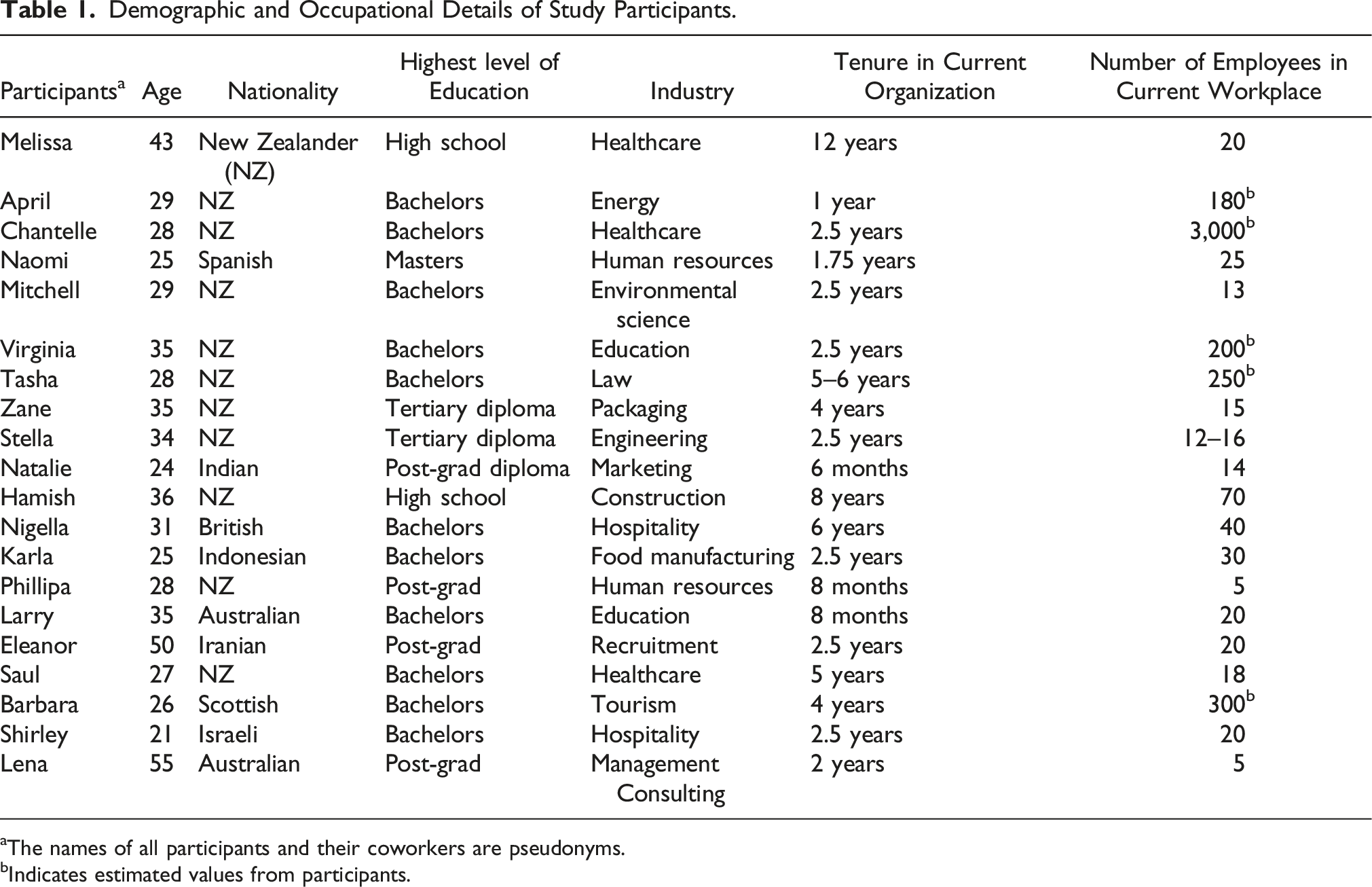
aThe names of all participants and their coworkers are pseudonyms.
bIndicates estimated values from participants.
Data Collection
Data collection took place between March 2019 and September 2020. There were two reasons for this relatively long data collection period. First, we started by collecting data from 14 participants and analyzed their data to develop initial themes. Subsequently, after a pause in data collection, we gathered data from six additional participants to ensure we had reached thematic saturation. Second, the additional round of data collection was interrupted by COVID-19 related lockdowns in New Zealand (where the study was based). We required participants to provide data on their experiences within a physical workplace, as this formed part of our original selection criteria. However, due to lockdowns (and associated working from home mandates), we could not collect further data between March 2020 and July 2020.
We collected data from each participant using two techniques: written incident reports and follow-up interviews. In combination, such qualitative data provided “thick, detailed descriptions” of how workplace gossip incidents affected interpersonal relationships from the recipient’s perspective (Gephart, 2004, p. 455).
Written Incident Reports
We asked participants to provide three written reports about workplace gossip incidents in which they were the gossip recipient. We supplied a structured reporting document for this purpose (see Appendix A in the supplementary materials). The instructions specified that one report should describe an impactful workplace gossip incident that took place at any point during the participant’s working career, while the other two incidents—one positive and one negative—were to be recorded during a period lasting approximately 2 weeks at the participant’s current workplace. Participants were instructed to record these latter incidents as soon as possible after they happened. This immediate approach to recording incidents, often used in diary studies, has been recommended by other researchers for capturing the fleeting nature of gossip (Michelson et al., 2010; Waddington, 2005).
We chose this approach to incident reporting for two reasons. First, given equivocal findings on how gossip valence affects the relational outcomes of gossiping (e.g., Kuo et al., 2018), we were interested in recipients’ experiences of both positive and negative gossip incidents. Hence, we required participants to supply at least one positive and one negative gossip incident report. Second, we wanted to ensure we did not just gather data on the relational outcomes of relatively “trivial” gossip incidents, as might be prevalent over a 2-week period. Thus, we required participants to report on an “impactful” gossip incident from any point during their careers. Furthermore, to ensure we were not presuming that negative gossip incidents would have a stronger impact on relationships than positive gossip incidents (or vice versa), we gave participants the choice of whether this “impactful” incident involved positive or negative gossip.
Follow-up Interviews
Once participants had completed written incident reports, the first author conducted follow-up interviews with them (Waddington, 2005; Waddington & Fletcher, 2005). Follow-up interviews served a threefold purpose. First, they provided an opportunity to clarify details about the workplace gossip incidents recorded in reports, thus enriching this written data. Second, interviews allowed for deeper questioning about how recipients generally perceived the effects of both positive and negative workplace gossip on their relationships with gossipers and targets. Third, interviews enhanced the credibility of findings by enabling the research team to ensure that our interpretations of written incident reports aligned with participants’ own interpretations of the same incidents (Gephart, 2018; Lincoln & Guba, 1985).
In line with the purpose of follow-up interviews, we developed the guide for each interview separately, based on what the participant had written in their incident reports (see Appendix B in the supplementary materials for indicative questions). Interviews lasted between 20 and 50 minutes and were digitally recorded. The first author transcribed all interviews verbatim and sent transcripts to participants for checking before beginning data analysis.
The final dataset consisted of 60 written incident reports and 20 interview transcripts, totaling approximately 400 pages of textual data.
Data Analysis
We analyzed data using template analysis (King, 2012). Template analysis reveals themes about how people experience phenomena in real-world contexts (King, 2012). Template analysis has been recommended by gossip researchers for studies incorporating multi-source data (Waddington, 2005; Waddington & Fletcher, 2005). In practical terms, template analysis involves the development of a coding manual, or template, which is applied iteratively to textual data (King, 2012). The researcher develops an initial coding template based on research aims, a preliminary scanning of data, and/or a priori themes from background literature. This initial template is applied to a subset of the data, revised, reapplied to another subset of the data, revised, and so on, until the template encompasses all relevant data, and no new themes emerge.
Developing the Template and Open Coding
To develop the initial template, we familiarized ourselves with the first subset of our data (approximately one-fifth of our final dataset) by reading through the incident reports and interview transcripts multiple times. This familiarization process enabled the development of an initial template based on nine broad or “open” coding categories (Saldaña, 2016), all of which reflected the gossip recipient’s perspective of gossip incidents: Relationships with gossipers, Relationships with targets, Work-related gossip, Personal gossip, Analytical responses, Intuitive responses, Behavioral responses, Effects on relationships with gossipers, and Effects on relationships with targets. These open codes in the template served to fracture the extensive data typical of qualitative studies into categories of particular significance to the research question (Creswell, 2007; Saldaña, 2016).
Starting with our nine open coding categories, we used the software program NVivo to code data in subsets, each of which consisted of written incident reports and interview transcripts from between four and six participants. We analyzed data in subsets because this practice is standard for template analysis (King, 2012) and because it permitted data collection and analysis to take place concurrently until we reached saturation (Guest et al., 2006; King, 2012). The first and second authors both participated in coding. To enhance the dependability and confirmability of our coding (Lincoln & Guba, 1985), these authors met for discussion after coding the first three subsets of the data independently. Meeting in this way enabled us to share interpretations of the data and revise our coding as necessary (King, 2012; Saldana, 2016).
Fine-Grained Coding
Evidence of how we Interpreted Raw Data to Generate Codes and Themes.
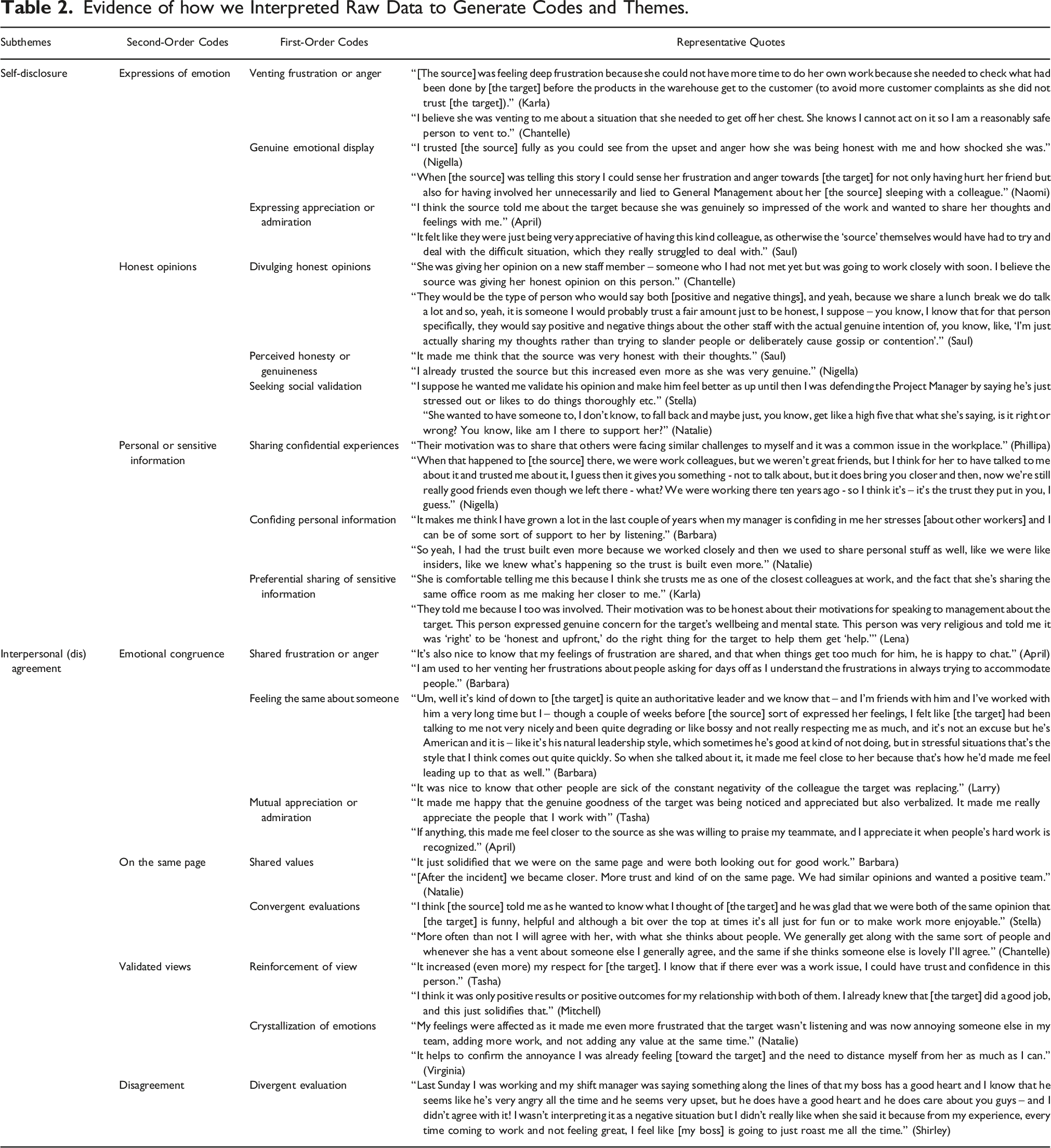
Subthemes and Themes
The next step in analysis was to explore coded data for possible themes. We began by looking for conceptual similarities among second-order codes and thus identified subthemes. The subthemes coalesced into patterns that we report as overarching themes, the highest level of abstraction from the data. To help identify overarching themes, we prepared a summary table of the 60 gossip incidents reflected in the data (available upon request from the first author). We then worked back and forth between the table and our first-order codes, second-order codes, and subthemes, seeking broad patterns that occurred across multiple incidents. Figure 1 depicts the emergence of an overarching theme via our analytical process. (Figures that illustrate the emergence of other overarching themes appear in Appendix D of the supplementary materials.) To support overarching themes further, we drew on statements participants made during interviews regarding their typical responses to workplace gossip. Illustration of the process whereby we moved from first- and second-order codes to subthemes and overarching themes.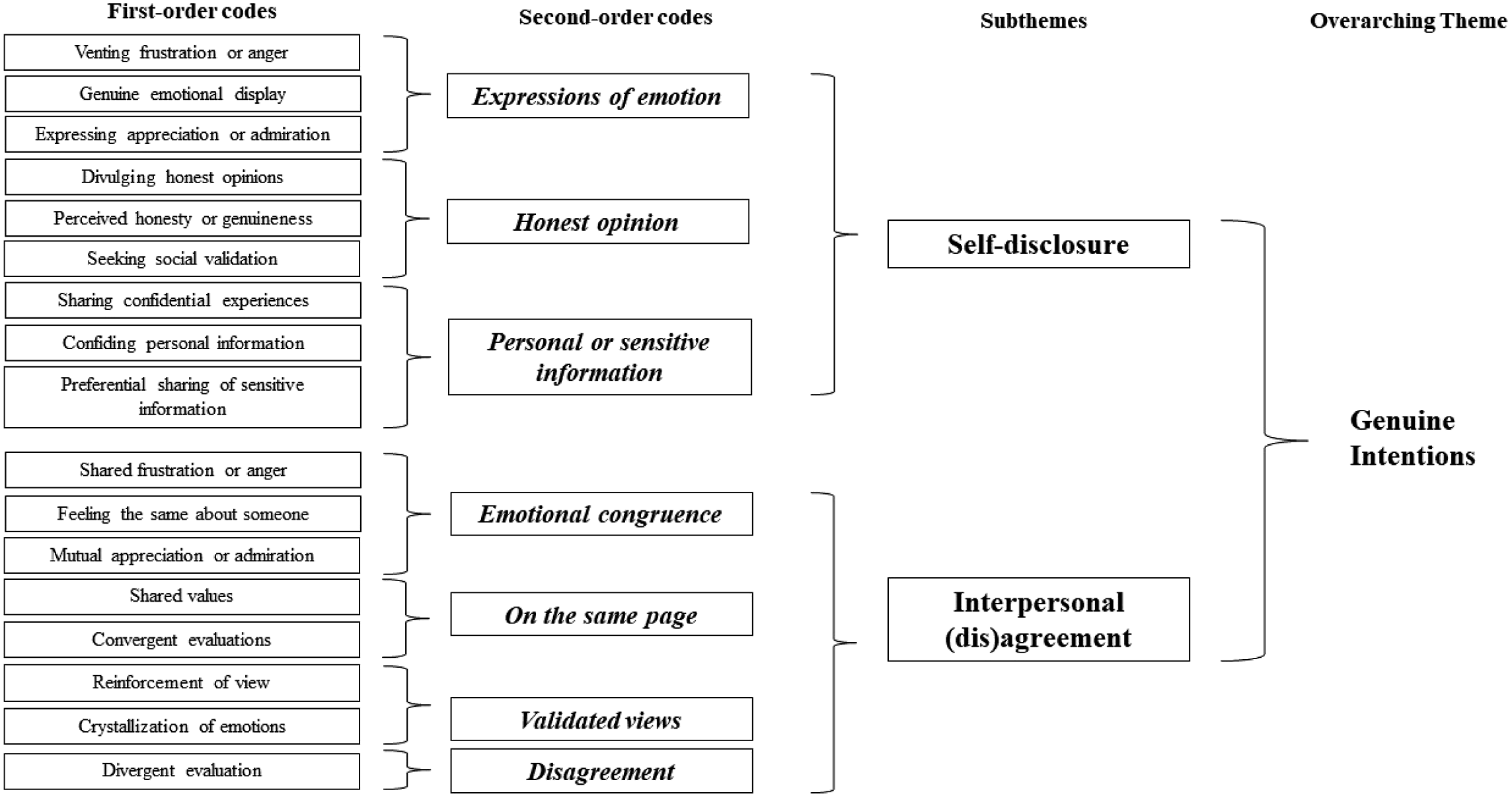
We continued both data collection and analysis until we reached saturation (Guest et al., 2006). In specific terms, saturation was the point at which adding data from one new participant added no new subthemes to our template (King, 2012). This point occurred after we had analyzed data from 14 participants; no new subthemes emerged from the final subset of data we collected and analyzed, which comprised incident reports and interview transcripts from six participants.
Findings
I think intent comes into play … I think you can pick up when people are talking about other people whether it’s for good reasons or bad reasons, and I think their intention makes a difference. You know, if they’re just there wanting to rant about that person, you’re probably going to look as to whether they’re being honest or whether they’re just making a big deal out of nothing, or if it’s for a positive reason. (Phillipa)
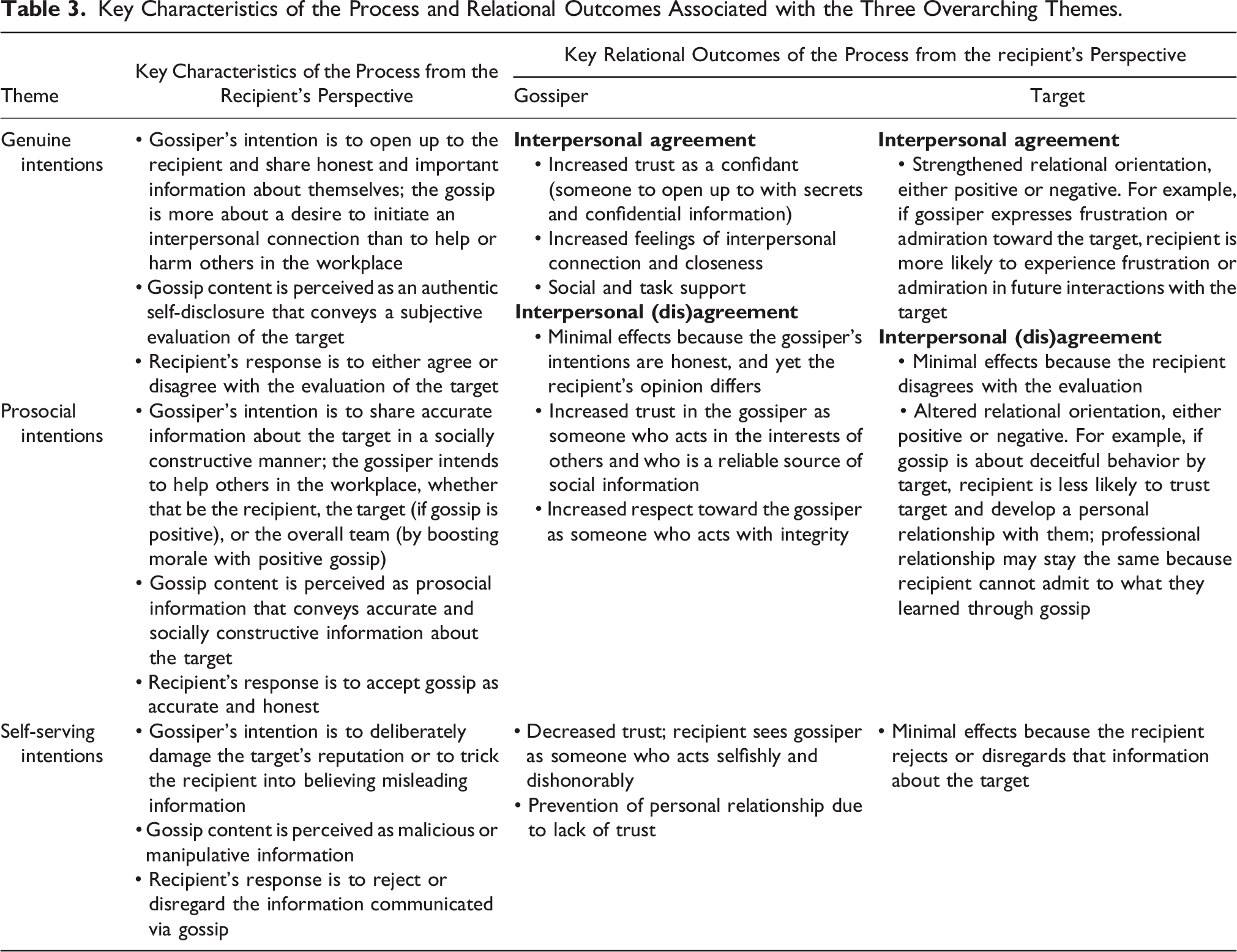
How do recipients’ experiences of workplace gossip incidents affect their interpersonal relationships with gossipers and gossip targets? As suggested by the participant quote above, our study revealed that recipients’ interpretations of gossipers’ intentions were key to addressing this research question. Analysis revealed three overarching themes that reflect such interpretations of intentions—genuine intentions, prosocial intentions, and self-serving intentions—each of which initiated a distinct process whereby gossip incidents shaped both recipient-gossiper and recipient-target relationships. Figure 2 provides a graphic depiction of the three processes, demonstrating how recipients’ interpretations of intentions influenced the relational outcomes of gossip incidents. Table 3 further illustrates and contrasts the three processes with more detailed explanation and description. How gossip incidents shape recipients’ relationships with gossipers and gossip targets. Key Characteristics of the Process and Relational Outcomes Associated with the Three Overarching Themes.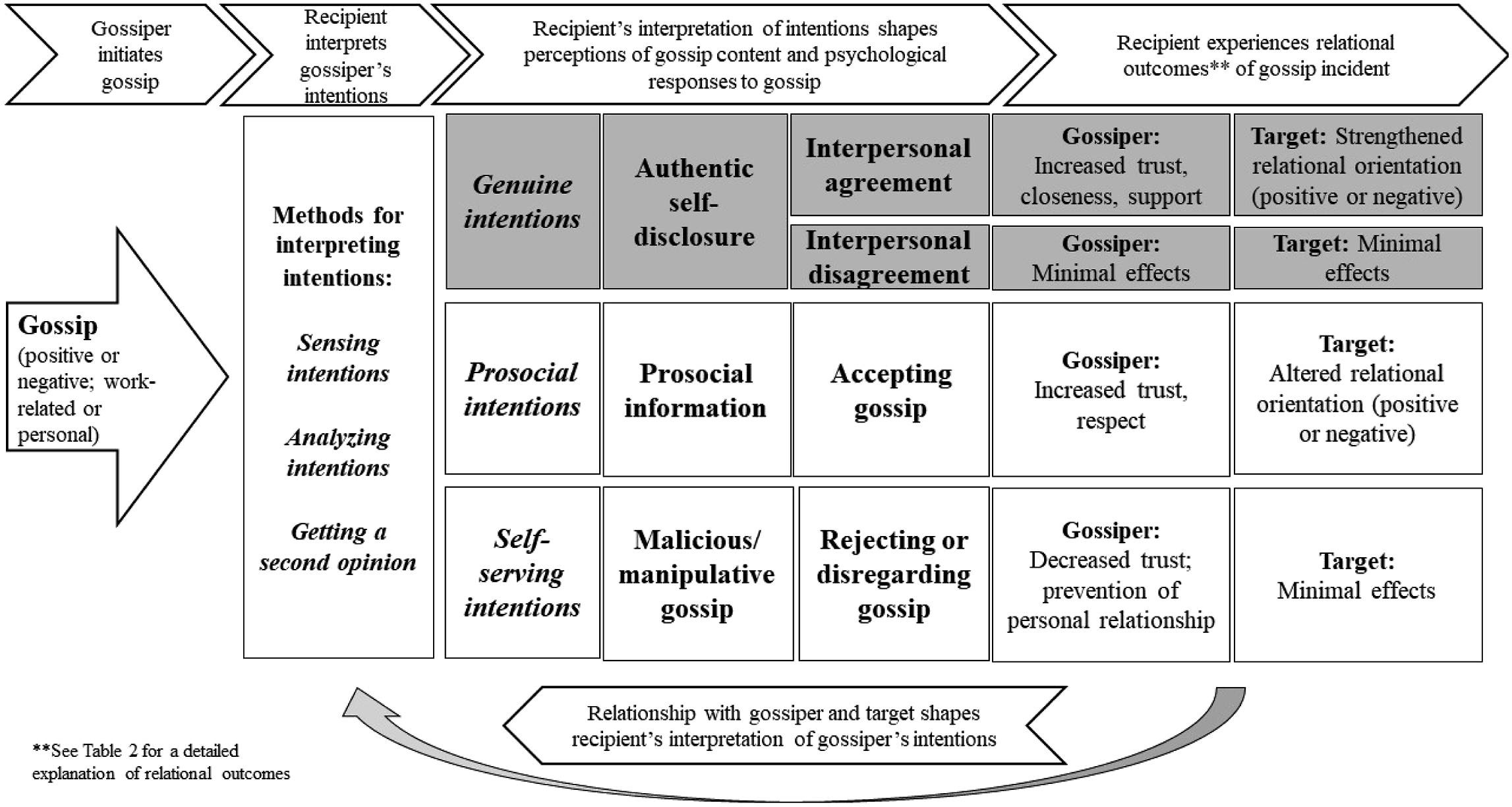
In the following subsections, we explain these processes and illustrate them with evidence from our dataset. We also provide an overview of what our data say about (a) the methods recipients used to interpret gossipers’ intentions and (b) the self-reinforcing interaction between interpretations of intentions and recipients’ relationships with gossipers and targets.
Process 1: Genuine Intentions
Recipients perceived Genuine intentions when they sensed that gossipers were motivated by an authentic desire to disclose something important about themselves to gossip recipients. Perceptions of such authentic self-disclosures set the stage for the other key recipient response in the genuine intentions process, which we label interpersonal (dis)agreement. As shown in Figure 2 and explained in the following subsections, perceptions of authentic self-disclosures and intersubjective (dis)agreement with gossip shaped relational outcomes in important ways.
Authentic Self-Disclosure
Many recipients construed gossip as a form of authentic self-disclosure from gossipers. Self-disclosures included expressions of emotion (“I believe [his motivation] was to get it off his chest, as he is getting sick and tired of the same thing happening with the target” – April), honest opinions (“I believe she was giving her honest opinion on this person” – Karla), and sensitive information based on gossipers’ experiences of gossip targets (“[The source’s] motivation? … just to share her experience with me” – Virginia). Recipients typically interpreted self-disclosures as a means for gossipers to seek social support or validate their emotions and opinions toward targets. A participant captured this notion when she said, [One of the sources] started the conversation, but she didn’t want to just criticize [the target], she wanted to share her thoughts and feelings with work peers and friends to see if they had the same problem. After the three of them realized they were in the same situation, I think they kept going because they were feeling supported and relieved, as if they suddenly got rid of heavy personal demands. They also wanted to show the other two people in the group (including myself) what the real situation was to explain why sometimes they’re overworked or stressed while managing us as well. (Naomi)
Interpersonal (dis)agreement
By disclosing their honest emotions and opinions to recipients, gossipers set the stage for the key recipient response within the genuine intentions process: interpersonal (dis)agreement. Interpersonal agreement occurred when recipients agreed with gossipers’ subjective evaluations of targets. Such agreement could be based on emotional congruence with gossipers, or on perceptions of being on the same page as gossipers. To illustrate, recipients experienced emotional congruence when they shared gossipers’ specific emotions toward targets (e.g., “my feelings of frustration are shared” – April) or their general emotional orientations toward targets (e.g., “I often feel the same as her towards [the target]” – Karla). Recipients perceived they were on the same page as gossipers when gossip indicated shared values and behavioral expectations between themselves and gossipers (e.g., “It just solidified that we were on the same page and were both looking out for good work” – Barbara) or when gossip indicated convergent evaluations of targets (e.g., “I agree with the source and think [the target] is a good person and teacher” – Larry). Conversely, interpersonal disagreement occurred when the recipient’s evaluation of the target clashed with the gossiper’s opinion (e.g., “My shift manager was saying something along the lines of that my boss has a good heart and I know that he seems like he’s very angry all the time and he seems very upset, but he does have a good heart and he does care about you guys – and I didn’t agree with it!” – Shirley)
Relational Outcomes
As shown in Figure 2, the genuine intentions process shaped both recipient-gossiper and recipient-target relationships in subtle ways, depending on whether recipients agreed with gossipers’ evaluations of targets. When recipients reached interpersonal agreement with gossip, it generally strengthened their relationships with gossipers, engendering greater levels of trust, closeness, task and social support, and interpersonal connection between the two parties. Interpersonal agreement also strengthened recipients’ relational orientations toward targets, whether those orientations were positive or negative. When recipients disagreed with gossip, in contrast, such gossip had minimal effects on their relationships with either gossipers or targets (see Table 3 for more explanation of these effects).
Our data reveal three interrelated mechanisms whereby recipients’ perceptions of genuine intentions—accompanied by interpersonal agreement—shaped relational outcomes. First, perceived self-disclosures strengthened recipient-gossiper relationships through reciprocation of trust. Typically, when recipients interpreted gossip as a form of self-disclosure, gossip incidents made them feel closer and more trusting toward gossipers. For example, one participant (Naomi) said, “I think [the gossip incident] strengthened our relationship because I was trusted with this information and the source’s feelings in a matter which was obviously quite stressful for her.” Similarly, another participant (April) reported, “[The gossip incident] made me feel closer to the source as he was able to vent and share his true feelings and frustrations with me.” Our data suggest that these perceptions of gossipers’ motivations engendered reciprocation of trust: If the gossiper was willing to share important personal information with the recipient, it implied the gossiper trusted the recipient. In return, the recipient was more inclined to trust the gossiper with their own personal information. Participants reported that this open sharing of personal information signaled the development of a close and trusting interpersonal bond between themselves and gossipers. For example, I think [my manager] told me [this negative information about the target] because she could trust me and needed to share it with someone who would understand her and support her…The fact that [my manager] felt she could trust me in sharing this incident with me made me trust her even more as well. I felt more close to her and felt like I could share more problems with her without being judged, as we had a close trusting relationship. (Naomi)
The reciprocation of trust mechanism was especially strong when self-disclosures revealed strongly negative information about gossipers’ emotional experiences of targets. For instance, one participant (April) received gossip about a “raw and vicious example” of bullying behavior that the gossiper had experienced at the hands of the target. This participant described how receiving this gossip affected her trust in the gossiper: If anything, this incident made me trust the source even more. I didn’t think that was possible as she already had my entire trust, however this [incident] revealed another layer of friendship and vulnerability to her. (April)
As this quote suggests, revealing vulnerabilities through disclosures of strongly negative emotions was particularly important for building trust and closeness. Other quotes that illustrated this pattern include: And just the fact that she was kind of vulnerable, and then came to me to kind of vent or whatever, I suppose that just naturally – it might also be a female thing, right, where we’ve shared a moment – she was pretty upset – and so then naturally you’re probably more … I mean I think then you’ve got to know someone a bit better because you’ve seen them when they’re a bit vulnerable or upset, so it’s a stronger bond than if it was just the normal everyday “G’day, how are you going?” (Stella)
Our findings thus imply that negative gossip, by revealing negative emotions and opinions, may engender stronger positive outcomes for recipient-gossiper relationships than positive gossip, provided recipients interpret gossipers’ intentions as genuine.
Second, interpersonal agreement with gossip typically strengthened recipients’ relationships with gossipers by engendering increased support and feelings of interpersonal connection. To illustrate, recipients who experienced emotional congruence with gossipers (a subtype of interpersonal agreement) subsequently felt more supported by those individuals: The people at work saw it, felt it, were there when times got tough—like they truly understand. So it’s kind of nice to have a little, um, community, for want of a better word, for when you feel like having a bitch, there are people who actually get it. (April)
On the other hand, emotional congruence also encouraged recipients to offer increased task and social support to gossipers: [Since the incident] I try to help [the source] more with her job whenever I can because I feel that she's having a hard time dealing with [the target]. I also acknowledge her effort at work and her hardworking attitude. (Karla) [After the incident] I really stepped up and actively supported [the source] more than I normally would have. For example, when she was heading to meetings with the target I would proactively make sure she was okay afterwards. The source and I would have lunch and coffee dates much more regularly together, to enable us to check in and see how each other was doing. (April)
It is worth mentioning that of all the discrete emotions that engendered emotional congruence between recipients and gossipers, frustration stood out as the most prevalent in our study. As noted earlier, many recipients interpreted gossip as a means for gossipers to “vent” their frustrations toward targets. Curiously, however, our findings suggest that when such frustrations were shared between recipients and gossipers (signaling emotional congruence), gossip served less as an outlet for frustration and more as a means of validating and therefore reinforcing this negative emotion.
Within the interpersonal (dis)agreement subtheme of the genuine intentions process, perceptions of being on the same page as gossipers strengthened recipients’ relationships with those individuals by providing a point of interpersonal connection that facilitated greater trust and cooperation. For instance, one participant (Natalie) received gossip about a target who had behaved selfishly and deceitfully toward the gossiper. This recipient could relate to the gossiper’s experience because she (the recipient) had been the victim of similar treatment from the target herself. In describing how this gossip incident affected her relationship with the gossiper, the recipient wrote, “[After the incident] we became closer. More trust and kind of on the same page. We had similar opinions and wanted a positive team” (Natalie).
Finally, as depicted in Figure 2, the genuine intentions process shaped recipients’ relationships with targets. Specifically, interpersonal agreement with gossip strengthened recipients’ positive or negative relational orientations toward targets. It did so by signaling that other members of the workplace shared recipients’ opinions of targets, thus validating recipients’ preexisting or emerging views of those individuals. To illustrate, many participants reported that evaluative information from a coworker “confirmed,” “solidified,” “reinforced,” or “strengthened” their existing opinion of a gossip target. These existing opinions could be positive—“I already knew that the target did a good job and this just solidifies that” (Mitchell)—or negative—“This incident reinforced my frustration for the target” (April). As the preceding quotations suggest, gossip frequently validated views by crystallizing emotions that recipients were already feeling toward targets. Such crystallized emotions, in turn, shaped recipients’ interactions with targets by reinforcing a negative or positive relational orientation toward those individuals. For instance, one participant (Virginia) stated, “[The gossip] doesn’t affect my trust [in the target], but it helps to confirm the annoyance I was already feeling and the need to distance myself from her as much as I can.” These findings again support the counterintuitive idea that “venting” negative emotions through gossip may reinforce such emotions, rather than providing an outlet for them to dissipate.
Importantly, the relational outcomes of interpersonal agreement were strongest when recipients had preexisting or at least emerging views of targets. A participant captured this notion when she said, The trust level [in the gossiper] goes up even more when the same thing happens to me, and if I know the [target] then it makes, like, me and my colleague we are a team and we know that - like, we have proof that the person who’s not present and whatever was said about them, like the opinion [toward that person] becomes stronger. (Natalie)
Thus, the validated views mechanism was most common in scenarios where the members of the gossip triad had preexisting or emerging relationships with one another.
Process 2: Prosocial Intentions
The second key process through which gossip shaped recipients’ relationships with gossipers and targets was prosocial intentions. Like genuine intentions, perceptions of prosocial intentions generally led to positive relational outcomes vis-à-vis gossipers, such as increased interpersonal trust and respect. The prosocial intentions process also shaped recipients’ relational orientations toward targets. Importantly, however, the psychological process whereby prosocial intentions engendered similar relational outcomes to genuine intentions was qualitatively distinct.
Prosocial Information
Recipients who interpreted gossipers’ intentions as prosocial perceived gossip as a form of prosocial information. By prosocial information, we mean information about a gossip target—whether positive or negative—that benefits people other than the gossiper. Examples of prosocial information included praise of deserving coworkers (e.g., “this conversation was more a general appreciation amongst the team of what a good person the target was and how we were lucky to have him” – Tasha) and warnings about antisocial or untrustworthy coworkers (e.g., “I think he was warning me of her as I was beginning to discover a few things she had told me which weren’t true and that had surprised me” – Chantelle). Praise constituted prosocial information because it contributed to team building, while warnings about untrustworthy individuals were prosocial because they encouraged recipients to be more cautious in their interactions with those people. Although recipients in our study interpreted both positive and negative gossip as prosocial information, they more commonly interpreted positive gossip in this way. The following quote suggests this was because recipients more readily associated positive gossip with prosocial intentions: I actually noticed that the source is the kind of guy that only really says positive things about people… That’s why I think I began to trust him: because he didn’t—because he doesn’t run people down too much. (Zane)
Relational Outcomes
Receiving prosocial information from gossipers typically strengthened recipients’ relationships with those individuals. We found that these positive relational outcomes stemmed from recipients’ perceptions that sharing prosocial information signaled a prosocial orientation. A perceived prosocial orientation suggested gossipers would be (1) trustworthy social partners and (2) reliable sources of information. First, as illustrated in the following quote, recipients saw gossipers who showed a concern for the interests of other people as trustworthy social partners: I thought it was very kind of [the source] to praise a teammate’s good work while she was not there, and it made me trust [the source] even more in that she would also recognize my successes and try to defend me if something happens, provided I work well. (Naomi)
Second, because recipients perceived prosocial information as accurate and reliable, receiving such information made them feel they could trust prosocial gossipers for the inside word on other colleagues. This pattern was evident in participant quotes such as, “I trust [the source] more and feel more comfortable asking her anything that happened around work when I am not around because I know she is telling the truth” (Karla). Being able to depend on gossipers for reliable information was particularly important for those in management positions, who were not necessarily privy to shop-floor gossip: Now in my role [as a manager], I’m a little bit more out of the loop of the more everyday sort of gossipy things. I’m not often working downstairs side-by-side with new people, so it’s hard to know [what the new people are like] sometimes, and it does take a long time to sort of build a bit of a relationship [with new people] … So I think [receiving information about those people] is certainly positive because I think it helps in some way get to know someone a wee bit better, even if it is sort of in a third person setting … I’ve worked with several of my colleagues for years, so we have that – I have that trust in the working relationship – but also on a friendship basis as well, so when it comes to what they relay to me, I kind of know that that’s reliable, coming from a reliable source, and I feel confident in what they’re telling me is right. (Melissa)
As the preceding quote suggests, the perceived accuracy and reliability of prosocial information meant that it also shaped recipients’ relationships with targets. Essentially, prosocial information about gossip targets “colored” the way recipients perceived those individuals. Such colored perceptions, in turn, shaped recipients’ relational orientations toward targets. As one would expect, positive information usually improved recipients’ perceptions of targets, engendering higher levels of trust and respect and facilitating more positive recipient-target relationships: A colleague was describing another colleague who I had not met yet as she was new to the job. [The source] described [the target] as someone you want to be around and chat to because she is very relaxed and lovely. She also thought she had common sense and could therefore be trusted in the job…[This positive evaluation] made [my] working relationship [with the target] better as I felt like I could trust her… [It also] made me more inclined to get to know her personally. (Chantelle)
Conversely, negative information that recipients perceived as prosocial had largely negative impacts on recipient-target relationships: I had no experience with either [target 1] or [target 2] really, so I couldn’t say either way [whether I trusted them or not]… [After the gossip incident] I definitely didn’t want to go out of my way to work with either [target 1] or [target 2]. I found all the information made me a little intimidated by them, actually, so I tried to stay away as much as I could. (Virginia)
Gossip colored recipients’ views of targets most strongly when recipients (a) perceived gossip as containing subjectively important information about targets and (b) had weak or nonexistent relationships with targets. To illustrate, one participant (Naomi) reported that information about a coworker’s deceptive behavior toward other staff members lowered her trust in that person “massively,” noting that after the gossip incident, “I started seeing [the target] with different eyes.” She also explained: “I have never had to deal with [the target] directly, which makes me more open to believe other sources of information toward her.”
Within the prosocial intentions process, we found that gossip valence influenced the type of recipient-target relationships that were shaped by gossip incidents. Typically, recipients reported that negatively altered perceptions of gossip targets influenced their personal (or nonprofessional) relationships with those individuals. Thus, participants stated: “[The gossip] prevented any potential personal relationship from developing [between myself the target]” (Zane) and “[The target and I] don’t have a personal relationship and this probably confirms for me that I don’t want one” (Stella). However, because recipients saw negative gossip as an unsanctioned form of communication, they felt they could not allow it to influence their professional interactions with targets. Consequently, they frequently reported maintaining expedient professional relationships with targets despite negative information about them: “I remained professional [toward the target] in work but never had a relationship outside work” (Nigella); “[Since the incident] I only act professional toward [the target] and avoid any personal conversation with him. I tend not to talk to him if I don’t need to” (Karla). When gossip conveyed positive information about targets, in contrast, it usually improved recipients’ personal and professional relationships with targets: “[Following the incident] I found it easier to deal with [the target] after looking at him more positively” (Zane); “As well as professional respect, it increased my personal respect for the target. As someone I don’t know as well, it also showed me more of the target’s personality and values” (Tasha).
Process 3: Self-serving Intentions
The final overarching pattern that emerged from our analysis was self-serving intentions. Self-serving intentions could be malicious, such as deliberately damaging a target’s reputation, or manipulative, such as advancing a hidden agenda. In contrast to the two processes reported above—genuine intentions and prosocial intentions—self-serving intentions damaged recipient-gossiper relationships and had minimal effects on recipient-target relationships.
Malicious or Manipulative Gossip
When recipients interpreted gossipers’ intentions as self-serving, it implied that gossip from those individuals was malicious and/or manipulative. Most commonly, self-serving intentions manifested as a malicious attack on the target’s reputation: “[The source said this] to damage the target’s reputation and cause drama in the workplace” (Zane); “[The source] said it out of frustration and to attempt to boost his reputation amongst staff by bringing down another colleague” (Larry); “I think the source told me this because he is jealous of the target and insecure about his job. He is spreading the word of the target being an incompetent worker out of spite” (Hamish). As the two latter quotes suggest, recipients sometimes inferred that reputational attacks were simultaneously motivated by manipulative motives, the most common being a hidden agenda. A hidden agenda could be a desire to advance the gossiper’s own reputation and status by denigrating a rival colleague (e.g., “I think the source wanted to make herself look knowledgeable and [like] someone who people ask for help” - Phillipa), or an attempt to manipulate the recipient into divulging personal opinions and information that could subsequently be used against the recipient: I have learned that even if somebody comes and says something positive to me about somebody, maybe they have a hidden agenda: They say something good [about the other person] for me to say, “Actually that person is not good,” and I open up to them and talk about negative stuff about the other person. (Eleanor)
According to written incident report data, recipients more readily associated negative gossip with hidden agendas. However, four participants stated in interviews that they sometimes also interpreted positive gossip as reflecting a hidden agenda, as illustrated by the above quote from an office manager, as well as by the following response from a construction manager, who was asked whether gossip valence was decisive in shaping his interpretation of a gossiper’s agenda: I think it can go both ways—there can be a personal agenda because, especially with my position [as a manager], I think people can come and, like, suck up to me a little bit, so they might have a positive thing to say [about a coworker] like that—and that could sound like negative thinking from me, but it definitely happens, and it’s new guys, and especially if they think that getting close to me and impressing me is going to help them keep their job. (Hamish)
Relational Outcomes
When recipients perceived gossip as being motivated by self-serving intentions, they generally rejected or disregarded its content gossip as unreliable, and it had little impact on their relationships with targets. On the other hand, perceptions of malicious and/or manipulative gossip undermined recipients’ relationships with gossipers because their underlying motives signaled a self-serving orientation. Recipients saw an orientation as an indication that gossipers were untrustworthy social partners. The following quotes illustrate this pattern: My trust towards [the source] was affected, because I could see she’s not impartial or objective in her judgments but they’re affected by her personal preferences and feelings toward other colleagues. (Naomi) This behavior [i.e., “spreading the word of the target being an incompetent worker out of spite”] has me wondering how much I can trust [the source]… I notice little things now, snarky comments he makes and just how he seems less willing to work together with people. (Hamish)
A commonly cited reason for recipients’ loss of trust in self-serving gossipers can be summarized as: What would they say about me? Stated differently, participants who perceived self-serving intentions lost trust in gossipers because they feared becoming targets of negative gossip from those individuals themselves: I thought it was really unprofessional to gossip about someone in his team to someone lower in the work hierarchy. I figured that if he was going to do that to a close colleague, what would stop him speaking ill of me to other staff. (Larry) After listening to him gossiping about another waitress, I felt very uncomfortable. I was afraid of him saying negative things about me if I make mistakes. (Shirley)
In turn, this undermining of trust made recipients hesitant to share personal information with gossipers, and their relationships never became close or personal: After this [negative gossip] incident, our overall relationship didn't change (still casual conversations), but it did make me think that [the source] wasn't a person that I wanted to open up to about personal matters at all. (Saul)
Interpretations of Intentions and Relationships: A Self-reinforcing Interaction
Our findings reveal a self-reinforcing interaction between recipients’ interpretations of gossipers’ intentions and recipients’ relationships with gossipers and gossip targets. As depicted in Figure 2, we found that recipients relied on three key methods for interpreting gossipers’ intentions: sensing intentions, analyzing intentions, and getting a second opinion. Table 4 defines these methods and illustrates them with descriptive examples and participant quotes from our dataset. Importantly, most of the responses described in Table 4 were shaped by recipients’ existing relationships—or lack of existing relationships—with the other members of the gossip triad. When sensing intentions, recipients frequently relied on their existing feelings of trust and closeness toward gossipers. This pattern was evident in statements such as: “I trust [the source] as I work many years with her, and I believe she has no intention to deliver inaccurate or wrong information to me” (Eleanor); “I believed the source as we have a close relationship and I know it takes a lot to rattle this person” (Virginia); and “If I 100% trust the source, I listen to them faster without doing my own analysis—I give them some credit for the trust that I have” (Naomi). In a related vein, participants reported that a lack of closeness made it harder to read gossipers’ intentions: I think it’s hard to know, really, but I think [the source] maybe just said it out of frustration and possibly to make himself feel more powerful or something – yeah, I guess it’s hard to know because I don’t have a close working relationship with him. (Larry) Recipients’ Methods for Interpreting Gossipers’ Intentions.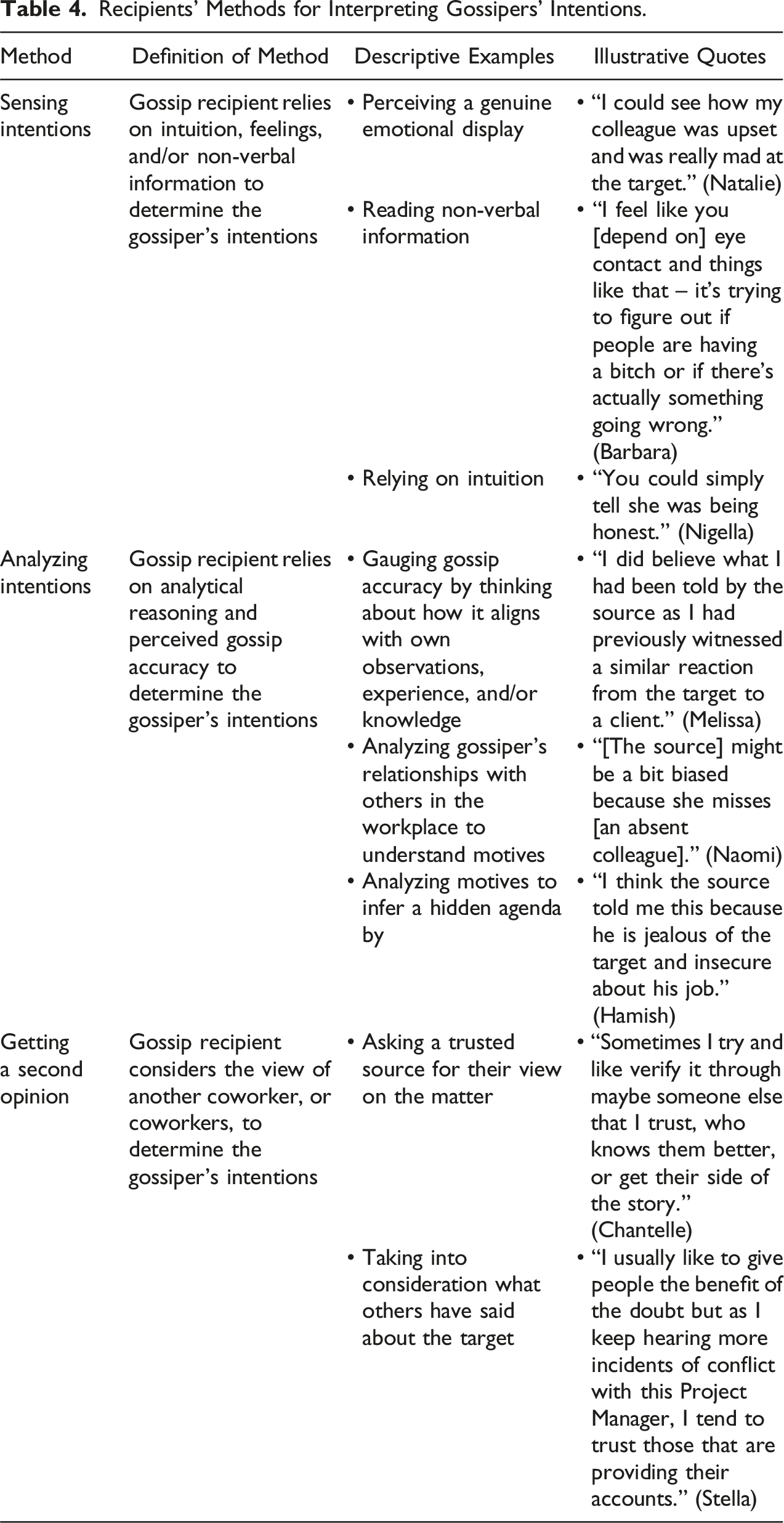
Recipients’ existing relationships with gossipers and targets also informed how they analyzed intentions. For instance, recipients who had positive relationships with targets were more likely to interpret negative gossip about those individuals as being motivated by manipulative and/or malicious intentions: During a job that I was supervising, colleague A, who was a new employee that I had only just started working with, communicated to me about colleague B, who he thought lacked the ability to do the job properly and efficiently. Basically, colleague A said colleague B was a useless worker. This immediately made me feel that I could not trust colleague A [the source]. The reason for this was I had worked with colleague B [the target] for a long period of time and I trusted him and his ability to do the job properly and efficiently. (Hamish)
Finally, when recipients did not have established relationships with either gossipers or gossip targets, they often relied on the views of trusted colleagues to gauge intentions through getting a second opinion. Participant statements that revealed this pattern included: “I spoke to close workmates that I trusted and asked if it was true because I was curious” (Zane) and “Yeah, sometimes I try and like verify [what I’ve been told] through someone else that I trust, who knows them better, or get their side of the story” (Stella).
Taken together with our findings on the relational outcomes of gossip incidents, these findings imply a self-reinforcing interaction between recipients’ interpretations of intentions and their relationships with gossipers and targets. Gossip incidents could shape both recipient-gossiper and recipient-target relationships in positive or negative ways, depending on how recipients interpreted intentions. Yet recipients’ interpretations of intentions were also shaped by their existing relationships—or lack thereof—with gossipers and gossip targets. Recipients interpersonal trust in gossipers was particularly important in this respect. If recipients already trusted gossipers, they were more likely to perceive gossipers’ intentions as genuine or prosocial, while if recipients already mistrusted gossipers, they were more likely to perceive self-serving intentions. In turn, these perceptions of intentions either increased or decreased the extent to which recipients trusted gossipers, suggesting a self-reinforcing interaction. The right-to-left arrow in Figure 2 illustrates this interaction, showing how relational outcomes of gossip incidents (especially changes to trust) feed back into interpretations of intentions.
Discussion
The purpose of this paper was to build and enrich theory on the processes whereby gossip shapes workplace relationships from the recipient’s perspective. While existing quantitative research suggests an association between gossip and relationships (Ellwardt et al., 2012a, 2012c; Farley, 2011; Grosser et al., 2010), scholars have yet to identify the psychological processes that underpin the mixed relational outcomes of workplace gossip.
Taken together, our findings help clarify the equivocal picture painted by existing research regarding how gossip affects workplace relationships (Ellwardt et al., 2012a, 2012c; Farley et al., 2010; Farley, 2011; Grosser et al., 2010; Kuo et al., 2018). Specifically, we revealed three distinct processes whereby recipients’ experiences of gossip incidents shaped their relationships with gossipers and gossip targets. The crux of each process was whether recipients interpreted gossipers’ intentions as genuine, prosocial, or self-serving. When recipients interpreted intentions as genuine or prosocial, gossip incidents had positive (yet distinct) effects on recipients’ relationships with gossipers. Conversely, perceptions of self-serving intentions engendered negative effects for these relationships. Interpretations of intentions also influenced the extent to which gossip shaped recipients’ relationships with targets. As shown in Figure 2, the three intention-based processes held true regardless of whether gossip was positive or negative and work-related or personal. In saying that, gossip valence did shape interpretations of intentions and relational outcomes in ways reported in the detailed findings above, some of which were surprising when juxtaposed to existing research and conventional wisdom. We also identified a self-reinforcing interaction between recipients’ interpretations of intentions and their relationships with gossipers and targets. The right-to-left arrow at the bottom of Figure 2 illustrates this interaction, showing how the relational outcomes of gossip incidents—especially changes in recipients’ trust toward gossipers—fed back into recipients’ interpretations of intentions. As such, our study has important implications for research on workplace gossip and relationships.
Implications for Research
Information About Gossipers
Findings on the importance that recipients attributed to gossipers’ intentions indicate that recipients’ initial response to gossip was to ask themselves: What does this gossip say about the person gossiping to me? As such, our study implies that gossip shapes relationships by not only revealing information about gossip targets, but also by revealing information about gossipers. We contend that the importance recipients ascribed to information about gossipers has implications for theory regarding how gossip affects both recipient-gossiper and recipient-target relationships.
First, this finding suggests an alternative exchange process whereby gossip builds recipient-gossiper relationships. As noted earlier, most prior research examined how gossip shapes recipient-gossiper relationships from an exchange perspective. This perspective views gossip as a source of inside information—a social resource—that coworkers exchange for influence, social support, and information (Brady et al., 2017; Grosser et al., 2010; Martinescu et al., 2019). However, prior research largely assumed that the inside information coworkers exchange through gossip was either about others in the workplace (i.e., gossip targets) (Brady et al., 2017; Martinescu et al., 2019) or about group norms (Grosser et al., 2010). In contrast, our findings imply that gossip motivated by genuine intentions builds relationships by enabling exchanges of information about oneself (i.e., about the gossiper). Recipients frequently interpreted gossip as a means whereby gossipers disclosed information about their own emotions, opinions, and experiences of gossip targets. Further, participants typically reported that receiving such information engendered increased trust and closeness toward gossipers. Consequently, future research could elaborate and test how gossip builds recipient-gossiper relationships through exchanges of information about gossipers themselves. For example, a longitudinal diary study could be used to track both gossip-based exchanges of information about the self and changes in relationships over time.
Information About Targets
The inferences recipients made about gossipers—based on gossipers’ perceived intentions—influenced the extent to which gossip from those individuals shaped recipients’ relationships with targets. Specifically, when recipients inferred gossipers had prosocial intentions, information from those individuals colored the ways recipients saw targets. In contrast, information from gossipers whose behavior betrayed a self-serving orientation was dismissed by recipients as manipulative or malicious. Consequently, such gossip had minimal effects on recipients’ relational orientations toward targets. Thus, our findings provide the basis for a richer understanding of how workplace gossip provides information about targets (Burt & Knez, 1993). Specifically, we suggest that gossip’s efficacy as a source of information about targets hinges on the extent to which recipients trust the source of that information.
Gauging Intentions and Trustworthiness
Although the ways in which recipients gauge gossipers’ intentions are nuanced and complex—depending on a range on interpersonal and contextual factors—we found that the perceived trustworthiness of the gossiper is key. Trust refers to a willingness to make oneself vulnerable to the future actions of another person (Colquitt et al., 2007). Our findings provide evidence of the subtle ways in which trust both shapes and is shaped by recipients’ interpretations of gossipers’ intentions. As we show in our Findings (see pages 29–30), if the recipient already trusts the gossiper, the recipient is more likely to assume that the gossiper will only share honest and accurate information. In turn, this assumption makes the recipient vulnerable to the gossipers’ actions (i.e., the sharing of gossip). If the gossiper shares inaccurate information and the recipient trusts that information, it is likely to have a negative impact on the recipient.
On the other hand, the recipient’s perception of the gossiper’s intentions increases or decreases the extent to which the recipient trusts the gossiper in subsequent interactions. For example, if the recipient perceives the gossiper’s intentions as prosocial, the recipient is more likely to believe that the gossiper is an honest and helpful person who acts in a socially constructive manner. Thus, the recipient’s perception of prosocial intentions increases their feelings of trust toward the gossiper, and, in turn, those feelings of trust make it more likely that the recipient will interpret the gossiper’s intentions as prosocial in future gossip incidents.
Our study reveals three methods that recipients relied on to assess the trustworthiness of gossipers: sensing intentions, analyzing intentions, and getting a second opinion. The specific methods recipients relied on depended on factors including their level of familiarity and closeness with gossipers and targets. It would also be interesting to assess how individual factors such as propensity to trust (Colquitt et al., 2007) influence interpretations of gossipers’ intentions. Thus, future research could use our exploratory findings as a starting point for investigating how recipients gauge the intentions and appraise the trustworthiness of workplace gossipers. In this respect, a quasi-experimental, vignette-style research design—in which researchers manipulate variables such as levels of familiarity and closeness, as well as propensity to trust—would be particularly suitable for testing out exploratory findings.
Gossip Valence
Our findings on the importance of perceived intentions also have implications for understanding how valence shapes the relational outcomes of workplace gossip. As we noted at the outset of the paper, extant research paints an ambiguous picture of how gossip valence affects relational outcomes (Ellwardt et al., 2012a, 2012c; Farley et al., 2010; Farley, 2011; Grosser et al., 2010; Kuo et al., 2018). Our study suggests a way of reconciling these mixed and seemingly contradictory findings. Unexpectedly, we found that both positive and negative gossip could engender positive relational outcomes, and that both positive and negative gossip could engender negative relational outcomes. The crux was how recipients interpreted gossipers’ intentions. Although valence was a factor in how recipients interpreted gossipers’ intentions, it was far from being the only factor. As detailed in Table 4 and Findings, other factors included recipients’ preexisting relationships with gossipers and targets; recipients’ construal of gossipers’ body language and tone; the received opinions of other colleagues; and the relative position of gossipers versus recipients in the work hierarchy.
Consequently, our study implies that the highly subjective, multifaceted nature of recipients’ interpretations of gossipers’ intentions may explain mixed findings on the relational outcomes of gossip valence reported in prior research (Ellwardt et al., 2012c; Farley, 2011; Grosser et al., 2010; Kuo et al., 2018). For example, the finding of Kuo et al. (2018)—that receiving positive (but not negative) gossip from supervisors supported the development of LMX relationships—may be attributable to recipients interpreting the intentions of gossipers who are organizational superiors differently than they interpret the intentions of those who are same-level peers. In illustration, one of our participants (Larry) stated, “I thought it was really unprofessional to gossip about someone in his team to someone lower in the work hierarchy” [emphasis added].
The genuine intentions process we identified also offers novel insight into the interplay between gossip valence and relational outcomes. As already noted, we found that recipients readily interpreted both positive and negative gossip as being motivated by genuine intentions. Surprisingly, however, we found that the mechanisms whereby genuine gossip engendered positive relational outcomes were strengthened when gossip was negative. Specifically, disclosing negative views of gossip targets implied a higher level of trust in recipients than did the disclosure of positive views, leading to higher levels of reciprocated trust from recipients toward gossipers. Moreover, disclosing negative emotions and negative experiences of targets (compared to positive emotions and positive experiences) encouraged higher levels of task and social support between recipients and gossipers. Thus, our findings illustrate how, in certain circumstances, negative workplace gossip builds stronger recipient-gossiper relationships than positive gossip. Future research could test this idea using experimental and quasi-experimental methods, manipulating gossip valence and other variables to identify the specific circumstances in which negative gossip can engender more positive relational outcomes than positive gossip.
Limitations and Conclusion
All research has limitations, and the present study is no exception. First, our data came from single participants reporting on how gossip shaped their relationships with others in the workplace. We implemented this design to meet the ethics requirements of the university’s institutional review board. However, the design meant that we only captured one person’s perspective on the relational outcomes of gossip incidents. Given that interpersonal relationships necessarily involve multiple individuals—and that individual perspectives on the same relationship may differ—it would be interesting to draw on paired or even network data to understand more about how different people perceive the relational outcomes of the same gossip incident. For instance, do gossipers and recipients typically perceive gossip incidents as having the same outcomes for their relationship with each other? And to what extent are targets aware of gossip about them affecting recipients’ relationships with them? Additionally, incorporating the gossiper’s perspective of gossip incidents would be useful given the importance recipients attributed to gossipers’ intentions. In particular, it would be useful to know whether gossipers’ self-reported intentions aligned with recipients’ interpretations of gossipers’ intentions.
Second, the design of our study captured recipients’ responses to gossip incidents at one point in time. While this design provided evidence reflecting a clear focus on three particular incidents of gossip, it did not allow us to isolate responses to gossip as the sole factor shaping recipients’ relationships with gossipers and targets. For instance, participants reported that gossip reflecting genuine and prosocial intentions increased their feelings of trust and closeness toward gossipers, yet they also reported that their existing feelings of trust and closeness gossipers shaped their responses to gossip from those individuals. Consequently, it is difficult to disentangle the full implications for relational outcomes of discrete gossip incidents.
In conclusion, this study reveals three processes whereby recipients’ responses to gossip shape their relationships with gossipers and gossip targets. Key to these responses were recipients’ interpretations of gossipers’ intentions—prosocial, self-serving, or genuine. Taken together, the nuanced processes we revealed provide the basis for a fine-grained understanding of how gossip shapes relationships in organizations, enabling the reconciliation of contradictory empirical findings from prior studies, and the revision, enrichment, and extension of extant theoretical perspectives.
Supplemental Material
Supplemental Material - How Workplace Gossip Shapes Interpersonal Relationships: A Qualitative Study from the Gossip Recipient’s Perspective
Supplemental Material for How Workplace Gossip Shapes Interpersonal Relationships: A Qualitative Study from the Gossip Recipient’s Perspective by James Greenslade-Yeats, Helena Cooper-Thomas, Rachel Morrison, Patricia D. Corner, in Group & Organization Management
Footnotes
Declaration of Conflicting Interests
The author(s) declared no potential conflicts of interest with respect to the research, authorship, and/or publication of this article.
Funding
The author(s) received no financial support for the research, authorship, and/or publication of this article.

Supplemental Material
Supplemental material for this article is available online.
Author Biographies
Associate Editor: Rich DeJordy
References
Supplementary Material
Please find the following supplemental material available below.
For Open Access articles published under a Creative Commons License, all supplemental material carries the same license as the article it is associated with.
For non-Open Access articles published, all supplemental material carries a non-exclusive license, and permission requests for re-use of supplemental material or any part of supplemental material shall be sent directly to the copyright owner as specified in the copyright notice associated with the article.
