




Abstract
In this study, we investigated whether and how perpetrators of bullying become targets themselves. Building on the notion of bullying as an escalation process and the Conservation of Resources Theory, we hypothesized that following enactment of bullying, people would experience increased relationship conflicts with colleagues, diminishing their sense of control and making them more likely to become exposed to bullying themselves. We tested this idea using longitudinal sequential mediated Structural Equation Modelling in a sample of 1420 Belgian workers. Our results confirmed that enactment of bullying lead to more exposure to bullying 18 months later. Relationship conflicts partially mediated this effect, meaning that bullying enactment can lead to increased tensions with others at work, increasing one’s vulnerability to bullying exposure. Although perceived control also mediated the enactment-exposure relationship, relationship conflicts did not lead to perceived loss of control, suggesting a missing link in this relationship. Furthermore, the effect from perceived control to exposure to bullying was small and did not replicate in post-hoc analyses. Our findings suggest that people may experience a backlash from others in their work environment following engagement in bullying behavior at work and invite further exploration of the processes that may account for this relationship.
Negative interpersonal interactions are an unfortunate byproduct of repeated interactions of employees who not only depend on each other for work resources (e.g., recognition by one’s supervisor, job security, and career possibilities), but who may also compete for said resources. Additionally, adverse working conditions provoking strain may put pressure on relationships at the workplace. Workplace bullying in particular is an important issue as it results in a wide array of negative consequences for employees and organizations alike (Høgh et al., 2021). For example, employees who are exposed to bullying suffer from impaired mental, emotional, and physical well-being, while also reporting a decrease in their productivity, job satisfaction, and commitment to their organization (Boudrias, Trépanier & Salin, 2021; Tepper, Mitchell, Haggard, Kwan & Park, 2015). As a result, recent estimates show that workplace bullying can cost organizations billions of UK pounds annually (Kline & Lewis, 2019).
Traditionally, authors investigating workplace bullying have focused on either targets or perpetrators of negative workplace behavior. However, we currently see a shift toward a more dynamic approach in which the interaction between the two parties is acknowledged and accounted for. In that regard, a few studies that looked at both parties simultaneously found a significant association between being a perpetrator and a target of bullying (Baillien, De Cuyper & De Witte, 2011; Balducci, Cecchin & Fraccaroli, 2012). Some scholars reasoned that, over time, perpetrators may become targets themselves (Brotheridge et al., 2012); an idea that ties in with evidence from the general mistreatment literature (e.g., Andersson & Pearson, 1999; Hershcovis, Reich, Parker & Bozeman, 2012; Leiter, 2013) and earlier observations of bullying in a sample of inmates in the UK (Ireland & Archer, 2004). However, we still lack understanding of how this process may unfold over time. Perpetrators of bullying are often considered to be individuals who hold more resources than the target (Baillien et al., 2017); a view that has been supported by previous empirical evidence (Glambek, Skogstad & Einarsen, 2016). This resource imbalance between the perpetrator and the target is said to distinguish bullying from other related constructs, such as incivility and general mistreatment (Hershcovis & Reich, 2013). So, an important question remains with regards how this resource imbalance between the perpetrator and the target may change over time.
Building on the notion of bullying as a conflict-escalation situation (Baillien et al., 2017) and the Conservation of Resources Theory (COR; Hobfoll, 1989), we argue that people engaging in bullying behavior are more likely to experience relationship conflicts with co-workers. This emergence of relationship conflicts is likely to trigger a resource loss spiral for the perpetrator, contributing to a perceived loss of control. We argue that once the perpetrator’s sense of control is diminished, they are in turn more likely to become targets themselves. We investigate this idea in a longitudinal sequential mediated Structural Equation Model over four time points, testing the mediating effect of relationship conflicts and loss of control on the association between the enactment of bullying and experiencing bullying later.
The contributions of this study are threefold. First, while previous studies have shown an association between perpetrator and target roles in bullying situations in the workplace, this study helps us to further unravel this dynamic by investigating the mechanisms that underlie the evolution from the perpetrator to the target role over time. As such, this paper adds to the calls for a better understanding into the dynamic nature of bullying and, more broadly, aggression and mistreatment at work (Branch, Ramsay & Barker, 2013; Olson-Buchanan & Boswell, 2008). Additionally, our study extends previous empirical work on consequences of workplace bullying by focusing on adverse consequences for the perpetrators, as opposed to targets (Boudrias,Trépanier & Salin, 2021). By doing so, this paper highlights that there are no winners in a bullying situation, and that even the initially more resourceful perpetrators can become victimized. Finally, this paper also has practical implications, as it highlights risks associated with enactment of bullying behavior and the potential negative spiraling effect of this behavior. Insight in these dynamics of workplace bullying may help policy makers and practitioners identify factors that may interrupt these dynamics, thus providing a strong imperative for bullying prevention strategies.
From Being a Perpetrator to becoming a Target of Workplace Bullying
Workplace bullying is a negative workplace behavior that happens repeatedly over a period of time, and it can involve personal attacks (e.g., gossip) and/or work-related negative behavior (e.g., making your work difficult) (Einarsen et al., 2020). Although bullying shares many characteristics with other types of workplace mistreatment, it is at the same time said to be a more severe form of negative interpersonal behavior (Hershcovis, 2011). A key defining feature of workplace bullying in the literature is the imbalance in resources (e.g., informal or formal power) between the perpetrator and the target (Baillien et al., 2017), with perpetrators having access to more resources (Einarsen, 2000; Leymann, 1996). However, this may not necessarily remain the same over time.
In the workplace bullying literature, a handful of authors have examined consequences for the perpetrators. In their theory paper, Samnani and Singh (2014) propose that in work contexts with zero-sum pay systems, bullies are likely to thrive by experiencing an increased productivity and relative ranking. Some empirical studies also suggest that bullying often goes unpunished by the management (Thirlwall, 2015), and that management sometimes even intentionally or unintentionally colludes with perpetrators (Jackson et al., 2002; Leymann, 1996). An important finding in this regard is the one by Glambek and colleagues (2016), who found that while targets were more likely to become ill and leave the organization following bullying, the perpetrator’s occupational status remained largely unchanged over time.
While the above findings seem to suggest that organizations often fail to act against perpetrators of bullying, this does not imply that perpetrators of bullying escape all negative consequences. A study by Jenkins and colleagues (2011) showed that when organizations do take actions against perpetrators of bullying, perpetrators experience a range of negative outcomes, including negative career outcomes (e.g., being forced to leave the organization, not getting the required support at work). In addition, several studies found that there is a high correlation between being the perpetrator and the target of bullying (Baillien et al., 2011; Hauge et al., 2009; Lee & Brotheridge, 2006). This relationship is also confirmed in studies investigating general mistreatment that find that people who are targeted by aggression sometimes start acting aggressively themselves (Hershcovis et al., 2012). Even more striking, Vranjes and colleagues (2021) demonstrated this relationship for workplace bullying longitudinally and showed that the relationship between being a target and the perpetrator of bullying can be reciprocal. These findings suggest that perpetrators may experience social sanctions from their peers, following engagement in bullying and may even become targeted themselves. In that regard, previous studies have found that colleagues tend to distance themselves from the perpetrator of workplace bullying (Chapman et al., 2008), and may even be unwilling to work with them, leading to high ratings of isolation amongst perpetrators (Coyne et al., 2004). The finding that perpetrators can become targets has also gained support in the general mistreatment literature (Ghosh et al., 2011). In the current paper, we want to gain more insight in this issue by unraveling the process through which a perpetrator becomes a target over time.
Exploring the Process in the Bully-Target Relationship
Workplace bullying as an escalated Conflict
As evident from its definition (Einarsen et al., 2020; Leymann, 1996), workplace bullying is generally committed by the person holding the most resources in a particular context. In other words, the perpetrator is the person able to take advantage of available resources (e.g., confidence, social position within the team, and formal position in the organization) and limit the target’s resources to defend themselves (Einarsen, 2000; Zapf, Knorz & Kulla, 1996). The latter may occur if the target lacks skills to manage an escalating conflict or if they have little support from other colleagues and supervisors (Zapf & Gross, 2001). However, the perpetrator of bullying behavior may not remain in this beneficial position, as the composition of resources can change over time, making it possible that the perpetrator becomes the target of bullying behavior.
An important way through which a perpetrator may become a target of bullying themselves relates to a conflict-escalation process. An initial conflict between two or more individuals may escalate over time (Baillien et al., 2017) and result in one party becoming unable to defend themselves against attacks (Einarsen, 2000; Leymann, 1996; Zapf & Gross, 2001). Interpersonal conflict reflects a dynamic process that begins when interdependent others perceive an opposition of some sort and consequently display a variety of affective, cognitive, and behavioral reactions (De Dreu et al., 1999; Wall & Callister, 1995). As the perpetrator’s bullying behavior negatively affects both its target and witnesses (Dhanani & LaPalme, 2019), different organizational members can be triggered by the perpetrator’s behavior. Specifically, the perpetrator’s engagement in bullying behavior can provoke relationship conflicts between the perpetrator and others in their immediate work environment.
First, the target of bullying will not necessarily remain submissive after being exposed to bullying (Zapf & Gross, 2001). Instead, the target of initial bullying may adapt their behavior toward the person who has mistreated them by refusing to work with the perpetrator or help them, when necessary (e.g., Chapman et al., 2008), which may create new tensions between the perpetrator and the target. Furthermore, research shows that targets sometimes respond to bullying by actively inciting support from others (Vranjes et al., 2021), which may fuel further conflict between the target and the perpetrator. Second, following their engagement in bullying behavior, the perpetrator may also start experiencing increased relationship conflicts with others in their immediate work environment. Both the perpetrator and the target are embedded within the social context of their organization and, consequently, others may witness the bullying behavior (Mulder et al., 2016). Research has established workplace bullying as a social stressor that highly affects the wider social climate and the interpersonal relationships at work (Hauge et al., 2010). Witnesses of bullying are themselves negatively affected by the bullying (Dhanani & LaPalme, 2019), and may therefore decide to act against the perpetrator (e.g., Chapman et al., 2008; Coyne et al., 2004; Kim & Shapiro, 2008). In some cases, the witnesses may also decide to act against the perpetrator out of a sense of moral obligation to defend the target (O’Reilly et al., 2016; Rupp & Bell, 2010), although this might not be the most prevalent response (Ng et al., 2020). In sum, previous evidence suggests that the perpetrator may experience increased relationship tensions between themselves and others following their bullying behavior, whether it is because of retaliatory responses from the target or self-interested or morally motivated responses from the witnesses.
Onset of a Resource Loss Spiral via Interpersonal Conflicts and Reduced Perceptions of Control
The increase in tensions and interpersonal conflicts after the perpetrator’s engagement in bullying can be considered a resource loss (i.e., loss of the resource “social support”) and may subsequently evoke further resource loss in terms of reduced perceptions of control in perpetrators. This idea can be linked to the COR theory (Hobfoll, 1989) that underscores the importance of possessing and maintaining resources as a key fuel for our well-being (Hobfoll, 2001). These resources include a variety of things, such as objects (e.g., housing), work conditions (e.g., employment), individual characteristics (e.g., confidence), interpersonal relationships (e.g., connections), and energies (e.g., wealth). Central to COR theory is that resource loss, or a threat thereof, has a negative impact on individuals and is a major contributor to the stress process. In addition, COR states that people holding fewer resources are more vulnerable to further resource loss, and initial loss of resources even begets future loss, resulting in a loss spiral (Hobfoll, 1989; 2001; Diener & Fujita, 1995).
Building on these arguments and the COR theory, we argue that an increase in interpersonal conflicts with others at work will onset a resource loss process for the initial perpetrator of bullying. A crucial resource for individuals at work is their relationships with peers, subordinates, and superiors within and outside the organization (Kanter, 1977). The more positive social connections and trust a person has, the higher their standing in the organization (Cohen & Prusak, 2001). Not only are social resources some of the most important resources at work (Chiu et al., 2017; Hobfoll et al., 1990), but they can even overrun the impact of other resources at work, such as that of formal power (Högfeldt et al., 2018). On the other hand, when social resources are absent or threatened, this is a particularly painful experience for individuals, associated with many negative outcomes, such as a decreased mental and emotional well-being (Hobfoll et al., 1990). When the perpetrator is experiencing increased relationship conflicts with others in the workplace, we argue that this highlights a loss in their social resources at work. The notion that conflicts can diminish people’s sense of social support has received support in the past (Emmons & Colby, 1995). Interpersonal conflicts threaten social support by creating rifts in the social bonds that hold groups together (Jehn, 1995). As such, interpersonal conflicts can diminish a key personal resource in the workplace. In support, previous research also conceptualized interpersonal conflicts as a resource loss, finding that it can lead to many negative outcomes for people experiencing conflict (e.g., Kundi & Badar, 2021; Somaraju et al., 2022).
The loss of resources triggered by interpersonal tensions with colleagues is likely to manifest itself in the perpetrator’s diminished sense of control (Chen et al., 2020). Perceived lack of control is defined as the belief that events that might negatively affect one’s job situation cannot be controlled by oneself (Folkman, 1984; Vander Elst et al., 2014). This notion concerns control about all kinds of events, including interpersonal events or relationships in the workplace. Relationship conflict might be conceived as a resource loss informing employees on their capabilities to deal with a threatening event. First, relationship conflicts suppress communication, information sharing, and cooperation between individuals (Baron, 1991; Jehn, 1995) and lead to less collaborative responses and to more contending and avoiding responses (De Dreu, 1997; Janssen et al., 1999). As such, the perpetrator may experience a diminished sense of control due to the realization that they do not have support from others and that they are unable to optimally perform in the organization due to the lack of cooperation and information sharing. Next, relationship conflicts involve a variety of negative behaviors which can be minor, like disagreements, but can easily escalate into something more serious like threats and aggression (Glasl, 1994). Such a slippery slope and the observation that others in the workplace are increasingly turning against you can also lead the perpetrator to feel that they are not in control of the situation. Finally, relationship conflicts threaten one’s positive identity and self-worth (Pelled, 1995). As people strive to maintain a positive self-image (Tajfel & Turner, 1979; Vignoles, 2011), such external threat can therefore diminish individuals’ sense of control over their positive identity.
From Reduced Perceptions of Control to Experience of Workplace Bullying
Finally, this loss of perceived control following relationship conflicts will make the perpetrator at risk of becoming targeted themselves (i.e., experiencing bullying). People may become targets of bullying after they have been gradually deprived of the control and ability to cope with important matters at work (Zapf & Einarsen, 2005). Indeed, low perceived control over one’s work environment influences how employees deal with stressors in their work situation (Spector, 1998). Experiencing a lack of control over events in the workplace makes individuals more vulnerable to demands and more prone to experiencing strain (de Lange, Taris, Kompier, Houtman, & Bongers, 2003). People experiencing a lack of control tend to become more anxious and helpless (Hutt & Weidner, 1993) and prone to experiencing decreased health (e.g., De Croon, et al., 2000; Taris & Feij, 2004). Additionally, they are more affected by group members, are easily influenced by external forces, and have less self-confidence (Rotter, 1975). Consequently, experiencing a lack of control may make a person more vulnerable for and an easy target of bullying behavior (cfr. Curtis, 1974). At the same time, people who experience a lack of control may also feel more targeted by others in the workplace. In line with this reasoning, Benjamin (2015) previously found that people who lacked internal locus of control perceived higher bullying exposure than employees with internal locus of control. Taken together, we argue that perpetrators of bullying can become targets themselves and that this relationship can happen through an increase in interpersonal conflicts and a loss of perceived control (see Figure 1). This ultimately leads us to the following hypotheses:
Hypothesis 1: Enactment of workplace bullying at Time 1 is positively associated with experience of workplace bullying at Time 4.
Hypothesis 2: The positive effect of enactment of workplace bullying at Time 1 on experience of workplace bullying at Time 4 is sequentially mediated by relationship conflict with colleagues at Time 2 and perceived control at Time 3.
Proposed model explaining how people who enact bullying come to experience bullying themselves over time.

M ethods
Procedure
We followed a heterogeneous sample of Belgian workers throughout a period of 18 months, from October 2012 until May 2014. Respondents were invited to participate in an online survey four times with a time lag of approximately 6 months between subsequent measurement points. The survey was set up in collaboration with a Human Resources (HR) magazine for the broader public and tapped into the general topic of changes at the workplace. Workers could enter the questionnaire by clicking on an open link on the HR magazine’s website. On the landing page, they received information about the (solely scientific) purposes of the study, the team of researchers responsible for this study, and the confidential treatment of their individual responses. Initiating the survey was therefore interpreted as informed consent. To increase response, at each measurement point, five €20 (ca. $22) vouchers for a multimedia store were raffled among respondents who completed the questionnaire.
2374 workers completed the questionnaire at Time 1. A strict data cleaning procedure was carried out, in which we firstly deleted all workers who participated in the questionnaire multiple times, which was determined based on a combination of email address, background characteristics, and IP address (n = 20). Secondly, we deleted individuals without paid employment (n = 253) and self-employed workers (n = 55) to ensure that we only included individuals who were currently employed in a traditional employment setting. Of these 2046 employees, 1774 employees provided a valid email address and could be invited to participate in the follow-up surveys at Times 2, 3, and 4. This resulted in longitudinal responses relative to Time 1 of 46.8% (n = 831) at Time 2, 44.8% (n = 795) at Time 3, and 33.0% (n = 585) at Time 4. Finally, we omitted respondents who became unemployed (n = 90) or changed jobs (n = 264) between the measurement points because those transitions may influence lagged relationships between work-related phenomena, such as the enactment and the experience of workplace bullying.
Sample
Our final sample was a heterogeneous group of employees with a mean age of 38.2 years (SD = 10.41) and 50.2% were male. They were active in the private (80.9%) and in the public sector (19.1%), representing a wide range of branches (e.g., health care and social services, education, financial services, telecommunication, and ICT). About half of the sample (56.2%) was white-collar workers, 37.7% were supervisors/managers, and only 6.1% were blue-collar workers. Most respondents worked on a full-time basis (85.7%) and had a permanent (open-ended) contract (93.3%). Finally, we conducted a logistic regression analysis to test whether dropout (coded as −1 for dropout vs. 1 for non-dropout) at Times 2, 3, and/or 4 could be predicted by (1) the above described demographic and work-related characteristics and (2) the study variables at Time 1. In terms of the focal variables in our model, this dropout analysis demonstrates that (1) respondents who perceived more relationship conflict were more likely to drop out from T1 to T2, (2) respondents who perceived more exposure to workplace bullying were less likely to drop out from T1 to T3 and from T2 to T3, and (3) respondents who perceived more control were less likely to drop out from T2 to T3. The detailed results from this dropout analysis can be found in Appendix 1.
Measurements
We adopted a full panel design, in which we measured all variables at all four measurement periods (Taris & Kompier, 2014). We used short scales or single items to ensure a reasonable length while reducing respondent fatigue (Ohly et al., 2010). We prepared all communication and surveys in Dutch and French because all our respondents were native Dutch or French speakers. We translated all surveys to Dutch and had three colleagues back-translate them to English. We discussed and resolved all inconsistencies between the translation and back-translation.
Experience of workplace bullying behaviors was measured using the Short Negative Acts Questionnaire (S-NAQ; Notelaers, Van der Heijden, Hoel, & Einarsen, 2019). Respondents were requested to indicate how often they experienced each of nine negative acts from their colleagues during the past 6 months on a scale from (1) “Never” to (5) “Always/daily.” These negative acts were either directed at the person (e.g., “gossip or rumors about you”) or at his/her work (“someone withholding necessary information so that your work gets complicated”). Reliabilities were satisfactory over time: αT1 = .89, αT2 = .90, αT3 = .89, and αT4 = .91.
Enactment of workplace bullying was measured using the S-NAQ for perpetrating workplace bullying behaviors as per the work by Baillien et al. (2011) and Escartín et al. (2012). This scale covers the same negative behaviors as the S-NAQ for experience of workplace bullying behaviors, but the items were adapted so they referred to acts instead of experience of workplace bullying (e.g., “making repeated reminders of somebody’s mistakes” instead of “repeated reminders about your mistakes”). Respondents indicated how frequently they engaged in each negative behavior during the past 6 months, using a scale from (1) “Never” to (5) “Always/daily.” Reliabilities were satisfactory over time: αT1 = .82, αT2 = .79, αT3 = .80, and αT4 = .86.
Perceived control was measured with the powerlessness subscale of Ashford, Lee, and Bobko’s (1989). This three-item scale refers to the extent employees believe they can deal with things that might negatively affect the current job situation and has been used as a measure of perceived control in previous studies (e.g., Vander Elst et al., 2014). Respondents were requested to rate the items (e.g., “In this organization, I can prevent negative things from affecting my work situation”) on a five-point scale from (1) “Totally disagree” to (5) “Totally agree.” Reliabilities were satisfactory over time: αT1 = .72, αT2 = .73, αT3 = .76, and αT4 = .79.
Interpersonal tensions were measured with two items from the intragroup conflict scale of Jehn (1995). These items derive from the subscale of relationship conflict, which “exists when there are interpersonal incompatibilities among group members, which typically includes tension, animosity, and annoyance among members within a group” (Jehn, 1995, p. 258). The selection of items was necessary to limit the time needed to fill in the questionnaire, as many concepts were surveyed. Additionally, the format of the items was adapted from questions to statements to increase the consistency of questioning throughout the survey, and “among members in your work unit” was replaced by “between me and my colleagues” so items tapped into conflicts of the respondent him/herself (e.g., “How much friction is there among members in your work unit?” was rephrased as “There are frictions between me and my colleagues”). Respondents indicated how frequently they experienced a list of situations within their team on a scale from (1) “Never” to (5) “Always/daily.” Reliabilities were satisfactory over time: αT1 = .89, αT2 = .88, αT3 = .88, and αT4 = .89.
Covariates such as gender, sector, and employment type (part-time vs. full-time contract) have been shown to influence both experience of and enactment of workplace bullying behaviors (for a meta-analysis, see Howard et al., 2020; for papers discussing an effect of sector, please see e.g., Venetoklis & Kettunen, 2016 and Zapf et al., 2003). Consequently, we controlled for these variables to make sure that observed variance in our mediators and/or outcome was not due to variance in these variables. Gender was coded as 0 for male and 1 for female. Sector was coded as 0 for the private sector and 1 for the public sector. Employment type was coded as 1 for full-time and 0 for part-time.
Analyses
Using a sequential mediated Structural Equation Model (SEM), we included the direct relationship between (1) enactment of workplace bullying at Time 1 and relationship conflict with colleagues at Time 2, (2) relationship conflict with colleagues at Time 2 and perceived control at Time 3, (3) perceived control at Time 3 and experience of workplace bullying behaviors at Time 4, and (4) enactment of workplace bullying at Time 1 and experience of workplace bullying behaviors at Time 4; as per our hypothesized model. We also estimated the sequential indirect effect from enactment of workplace bullying at Time 1 to experience of workplace bullying behaviors at Time 4 via relationship conflict with colleagues at Time 2 and perceived control at Time 3. The indirect effects were calculated as the product of the relationships constituting the chain (e.g., the indirect effect was the product of the relationship between the independent variable and the first mediator, the relationship between the two mediators, and the relationship between the second mediator and the dependent variable). We scrutinized the significance of this indirect effect by drawing 10,000 bootstrapped samples to generate 95% confidence intervals (95% CI). When zero is not part of the 95% CI, the indirect effect is significant. We estimated two sets of models: (1) a model in which we constrained the same relationships across waves to be equal (e.g., constrained the estimate of the relationship between enactment of workplace bullying at Time X and relationship conflict with colleagues at Time X + 1 to be equal to the estimate of the relationship between enactment of workplace bullying at Time X + 1 and relationship conflict with colleagues at Time X + 2), and (2) a model in which we did not constrain the same relationships across waves to be equal (i.e., allowing for the estimate of the relationship between enactment of workplace bullying at Time X and relationship conflict with colleagues at Time X + 1 and the estimate of the relationship between enactment of workplace bullying at Time X + 1 and relationship conflict with colleagues at Time X + 2 to vary freely). It is noteworthy that we included auto-regressive effects (i.e., controlled for the previous measurement point of the same variable) to model change in each variable over time.
We used the Full Information Maximum Likelihood (FIML) estimator to fully utilize the dataset (Enders, 2010) when estimating our model in Mplus version 8.3. We used the Bayesian estimator without an informed prior (Muthén & Muthén, 2013) to deal with the complexity of the model relative to the data (for a detailed discussion, see Kruschke, Aguinis, & Joo, 2012) and to deal with the traditionally skewed distribution of enactment and victimization of workplace bullying (Becker, Robertson, & Vandenberg, 2019). We assessed model fit and compared competing models using the Deviance Information Criterion (DIC; Spiegelhalter, Best, Carlin, & van der Linde, 2002). The DIC is the Bayesian variant of the Akaike information criterion and the Bayesian information criterion and depicts the likelihood of the model as a function of the actual number of parameters. The best fitting model is represented by the model with the lowest DIC value.
R esults
Descriptive Statistics
Means, Standard Deviations, and Correlations Among the Focal Variables.
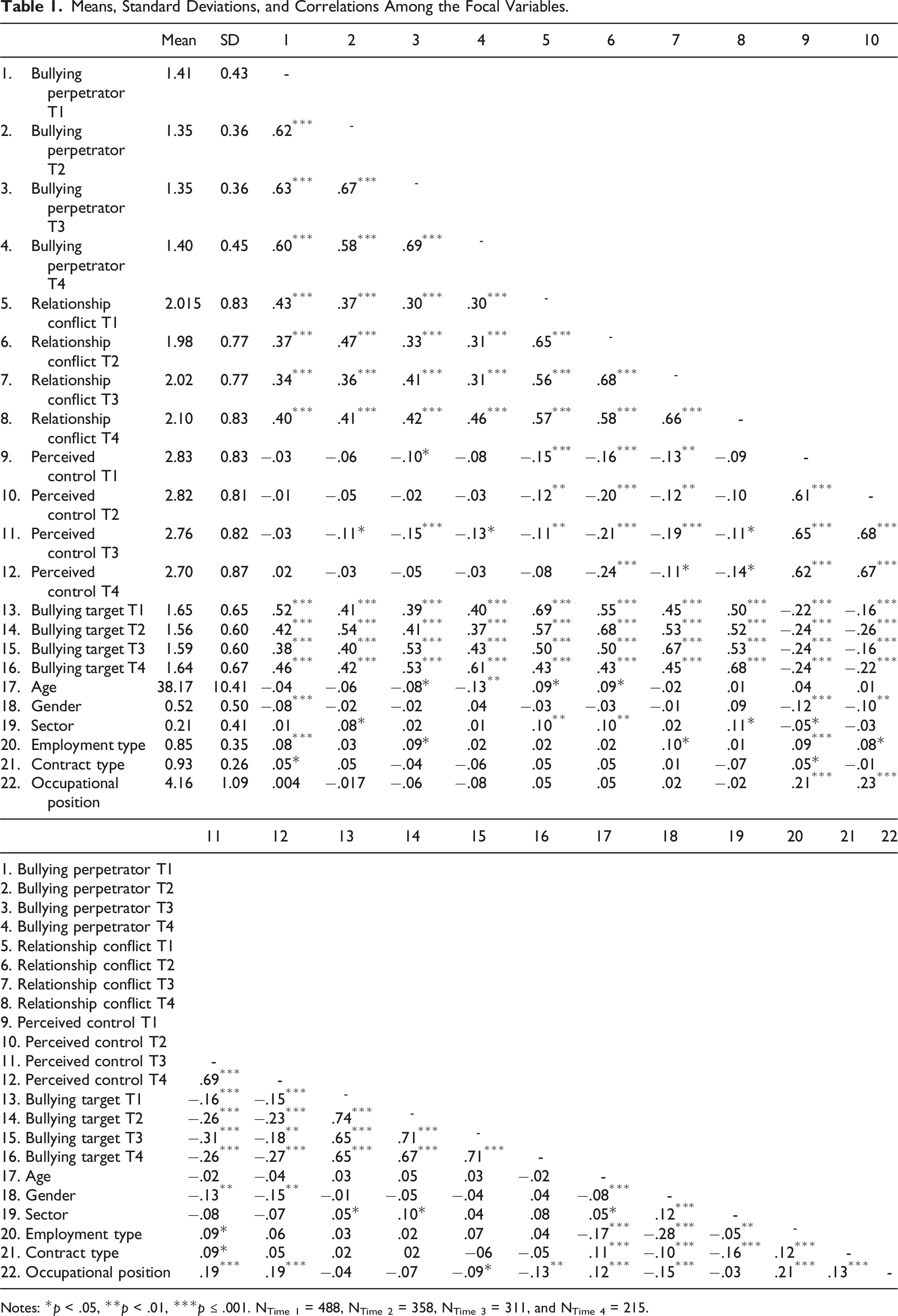
Notes: *p < .05, **p < .01, ***p ≤ .001. NTime 1 = 488, NTime 2 = 358, NTime 3 = 311, and NTime 4 = 215.
Confirmatory Factor Analysis (CFA)
CFA results for theoretical and alternative measurement models.
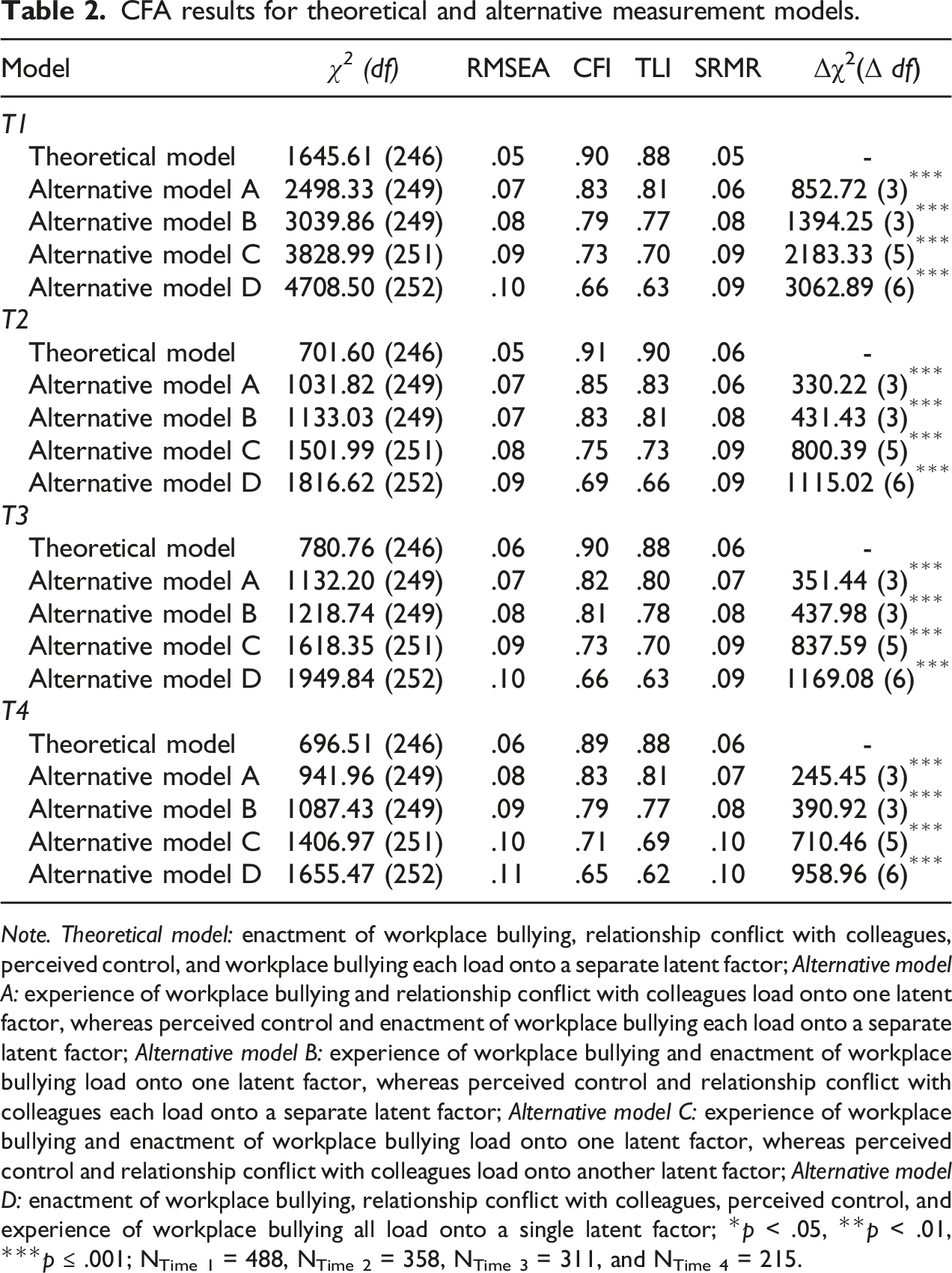
Note. Theoretical model: enactment of workplace bullying, relationship conflict with colleagues, perceived control, and workplace bullying each load onto a separate latent factor; Alternative model A: experience of workplace bullying and relationship conflict with colleagues load onto one latent factor, whereas perceived control and enactment of workplace bullying each load onto a separate latent factor; Alternative model B: experience of workplace bullying and enactment of workplace bullying load onto one latent factor, whereas perceived control and relationship conflict with colleagues each load onto a separate latent factor; Alternative model C: experience of workplace bullying and enactment of workplace bullying load onto one latent factor, whereas perceived control and relationship conflict with colleagues load onto another latent factor; Alternative model D: enactment of workplace bullying, relationship conflict with colleagues, perceived control, and experience of workplace bullying all load onto a single latent factor; *p < .05, **p < .01, ***p ≤ .001; NTime 1 = 488, NTime 2 = 358, NTime 3 = 311, and NTime 4 = 215.
Measurement Invariance
We tested whether all four proposed constructs were measurement invariant over our four waves of data collection. Hence, we compared configural, metric, and scalar invariance models. For model comparison, we used ∆CFI rather than ∆χ2 to evaluate invariance because ∆CFI is both independent of model complexity and sample size (Cheung & Rensvold, 2002; invariance when ∆CFI <.01). The results of the analysis suggested that metric invariance across the four waves of data collection can be supported. That is, all proposed constructs were defined by the same set of items and constraining the factor loadings to be the same across the four waves of data collection resulted in trivial differences in model fit (ΔCFI = .003). Scalar invariance, which further requires the indicator intercepts to be the same across all four waves of data collection was also supported (ΔCFI = .001).
Preliminary Tests
We first estimated and compared a model in which we constrained the same relationships across waves to be equal with a model in which we did not constrain the same relationships across waves to be equal. We found that the constrained model (DIC = 4711.77) fit the data better compared to the unconstrained model (DIC = 4781.01), demonstrating that the lagged effects remained stable throughout the study period. Hence, we continued testing with the constrained model.
Next, in light of the principle of parsimoniousness, we estimated and compared our hypothesized mediation model with an alternative model in which we also included the direct relationship between (1) enactment of workplace bullying at Time 1 and perceived control at Time 3 (alternative model 1), (2) relationship conflict with colleagues at Time 2 and experience of workplace bullying behaviors at Time 4 (alternative model 2), and (3) both of the previously presented additional relationships (alternative model 3), as well as a bidirectional cross-lagged model (alternative model 4). We once more compared our constrained theoretical model with the constrained alternative models using the DIC value (a smaller value indicates a better model fit). We found that the constrained theoretical model (DIC = 4711.77) fits the data better compared to constrained alternative model 1 (DIC = 4718.82), constrained alternative model 2 (DIC = 4716.26), constrained alternative model 3 (DIC = 4722.19), and constrained alternative model 4 (DIC = 4724.40). As such, all the inferential results presented below are from our theoretically proposed constrained model.
Finally, keeping with best practice recommendations (e.g., Becker et al., 2016), we also compared and contrasted a model in which we inserted gender, sector, and employment type as control variables with a model in which we did not include these demographics as control variables. We found that a model which included these control variables did not fit the data better (DIC = 15,423.87) compared to a model which did not include these covariates (DIC = 4711.77). Moreover, we only found a significant positive association between being a manager and relationship conflict with colleagues at Time 2 (estimate = .15, 95%CI [.04; .26]) and a significant positive association between being a manager and perceived control at Time 3 (estimate = .13, 95%CI [.01; .24]), but this did not alter the results of the hypothesized structural paths. In line with best practice recommendations (see Bernerth & Aguinis, 2016), we thus removed all covariates from our model; meaning that all the inferential results presented below are from the theoretically proposed constrained model without the inclusion of gender, sector, and employment type as control variables.
Inferential Results
Overview of the stability effects, standardized direct and indirect effects, and explained variance of the constrained model.
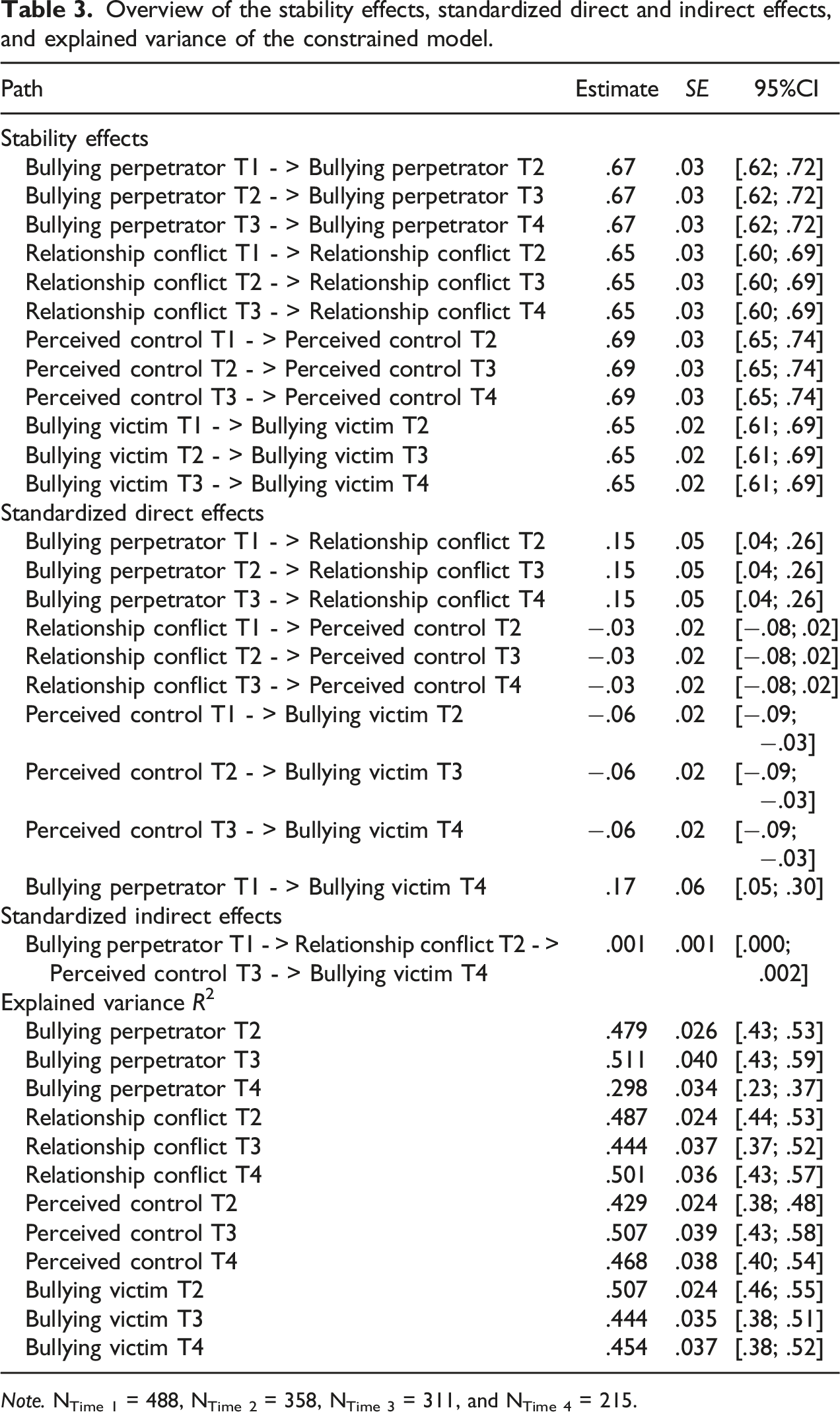
Note. NTime 1 = 488, NTime 2 = 358, NTime 3 = 311, and NTime 4 = 215.
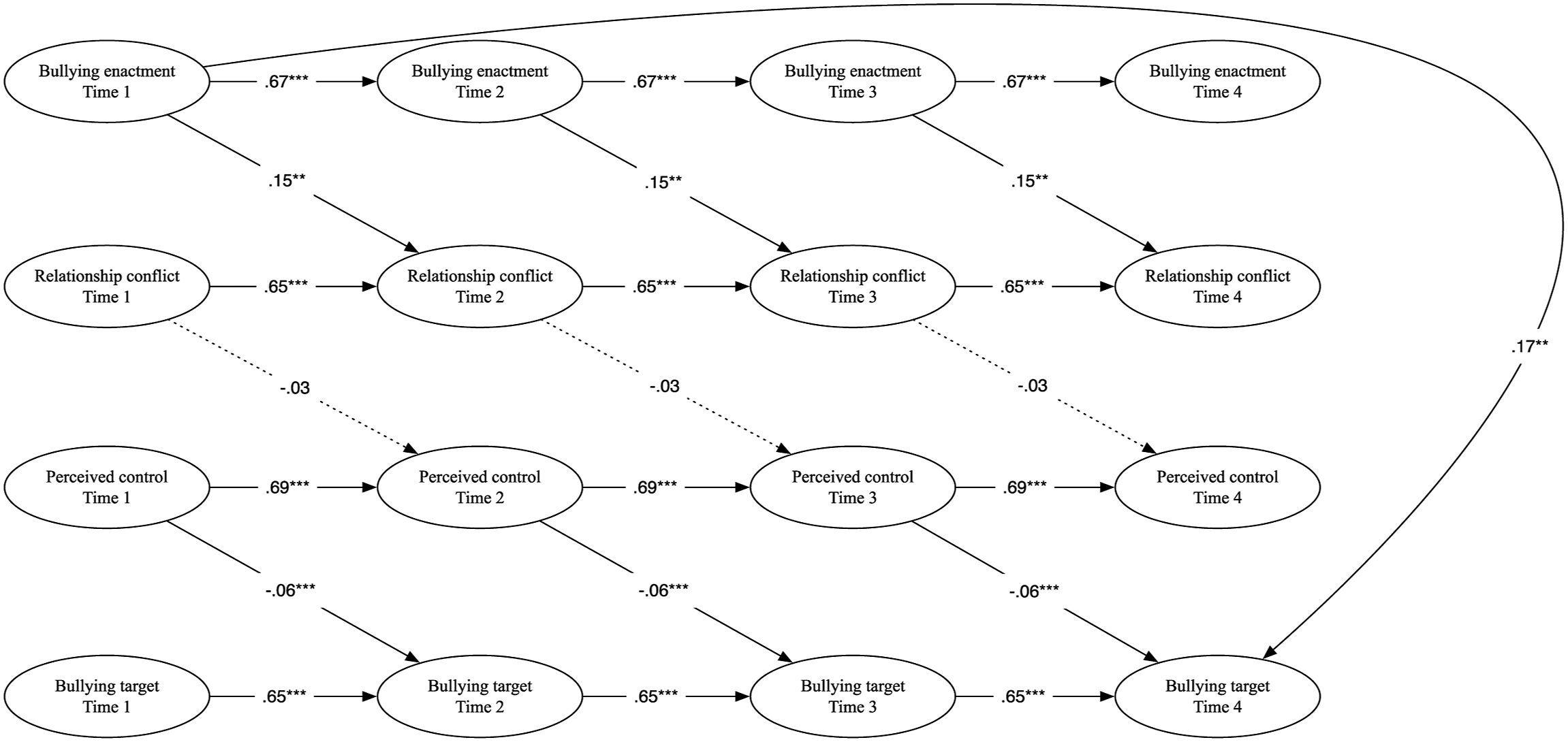
Standardized estimated paths in the constrained SEM. Notes. *: p < .05. **: p < .01. ***: p < .001. Dotted lines indicate non-significant relationships.
Post-Hoc Analyses and Results
As we did not find a significant lagged relationship between relationship conflict and perceived control, we further explored for other lagged relationships by testing five additional models using the Bayesian estimator: (1) a constrained model (Model A) in which control (Time 2) precedes interpersonal conflict (Time 3) in the relationship between enactment of workplace bullying (Time 1) and the experience of workplace bullying (Time 4); (2) a constrained model (Model B) in which control and interpersonal conflict happen concurrent (Time 2) in the relationship between enactment of workplace bullying (Time 1) and the experience of workplace bullying (Time 3); (3) a constrained model (Model C) in which enactment of workplace bullying and the experience of workplace bullying (Time 1) precede interpersonal conflict (Time 2), which in turn gives rise to the experience of workplace bullying and enactment of workplace bullying (Time 3), respectively; (4) our above-presented constrained theoretical model (Model D) but where the path between enactment of workplace bullying (Time 1) and the experience of workplace bullying (Time 4) is moderated by managerial status; and (5) a constrained model (Model E) in which enactment of workplace bullying (Time 1) precede interpersonal conflict (Time 2), which in turn gives rise to the experience of workplace bullying (Time 3) and of which the path from interpersonal conflict to the experience of workplace bullying is moderated by perceived control (Time 2).
For Model A, we found that enactment of workplace bullying at Time 1, Time 2, and Time 3 was not significantly related to perceived control at Time 2, Time 3, and Time 4, respectively, (estimate = .004, 95%CI [-.10; .11]). Moreover, we found that perceived control at Time 1, Time 2, and Time 3 was not significantly related to relationship conflict with colleagues at Time 2, Time 3, and Time 4, respectively, (estimate = -.01, 95%CI [-.05; .03]). Next, we found that relationship conflict with colleagues at Time 1, Time 2, and Time 3 was not significantly related to the experience of workplace bullying at Time 2, Time 3, and Time 4, respectively, (estimate = .01, 95%CI [-.03; .04]). However, we did find that enactment of workplace bullying at Time 1 was significantly related to the experience of workplace bullying at Time 4 (estimate = .14, 95%CI [.004; .26]). With respect to the indirect effect, we found no significant indirect effect of enactment of workplace bullying at Time 1 on the experience of workplace bullying at Time 4 via perceived control at Time 2 and relationship conflict with colleagues at Time 3 (estimate = .000, 95%CI [-.001; .000]).
For Model B, we found that enactment of workplace bullying at Time 1 and Time 2 was not significantly related to perceived control (estimate = .04, 95%CI [-.09; .17]) but was significantly related to relationship conflict with colleagues (estimate = .14, 95%CI [.02; .25]) at Time 2 and Time 3, respectively. Moreover, we found that perceived control at Time 1 and Time 2 was not significantly related to the experience of workplace bullying at Time 2 and Time 3, respectively, (estimate = -.02, 95%CI [-.06; .02]). We did find that relationship conflict with colleagues at Time 1 and Time 2 was positively significantly related to the experience of workplace bullying at Time 2 and Time 3, respectively, (estimate = .10, 95%CI [.05; .14]). Next, we found that enactment of workplace bullying at Time 1 was not significantly related to the experience of workplace bullying at Time 3 (estimate = -.05, 95%CI [-17; .06]). With respect to the indirect effects, we found no significant indirect effect of enactment of workplace bullying at Time 1 on the experience of workplace bullying at Time 3 via perceived control at Time 2 (estimate = -.001, 95%CI [-.010; .005]), but we did find a significant indirect effect of enactment of workplace bullying at Time 1 on the experience of workplace bullying at Time 3 via relationship conflict with colleagues at Time 2 (estimate = .016, 95%CI [.000; .044]).
For Model C, we found that enactment of workplace bullying (estimate = .11, 95%CI [−.03; .24]) and the experience of workplace bullying (estimate = .08, 95%CI [−.02; .19]) at Time 1 and Time 2 were not significantly related to relationship conflict with colleagues at Time 2 and Time 3, respectively. We did find that relationship conflict with colleagues at Time 1 and Time 2 was significantly related to the enactment of workplace bullying (estimate = .04, 95%CI [.009; .060]) and the experience of workplace bullying (estimate = .10, 95%CI [.05; .15]) at Time 2 and Time 3, respectively. Next, we found that enactment of workplace bullying at Time 1 was not significantly related to the experience of workplace bullying at Time 3 (estimate = −.06, 95%CI [−.17; .06]). With respect to the indirect effect, we found no significant indirect effect of enactment of workplace bullying at Time 1 on experience of workplace bullying at Time 3 via relationship conflict with colleagues at Time 2 (estimate = .001, 95%CI [-.004; .008]), nor did we find a significant indirect effect of the experience of workplace bullying at Time 1 on enactment of workplace bullying at Time 3 via relationship conflict with colleagues at Time 2 (estimate = .015, 95%CI [−.002; .049]).
For Model D, we found the same significant paths as previously presented in Table 3 and Figure 2. Moreover, we found no significant association between managerial status and the experience of workplace bullying at Time 4 (estimate = −.04, 95%CI [−.26; .18]), nor did we find a significant moderating effect of managerial status on the relationship between the enactment of workplace bullying at Time 1 and the experience of workplace bullying at Time 4 (estimate = .04, 95%CI [−.11; .18]).
Finally, for Model E, we found that enactment of workplace bullying (estimate = .16, 95%CI [.02; .29]) at Time 1 and Time 2 was significantly related to relationship conflict with colleagues at Time 2 and Time 3, respectively. We found that relationship conflict with colleagues at Time 1 and Time 2 was positively significantly related to the experience of workplace bullying at Time 2 and Time 3, respectively (estimate = .20, 95%CI [.06; .33]). Next, we found that enactment of workplace bullying at Time 1 was not significantly related to the experience of workplace bullying at Time 3 (estimate = −.08, 95%CI [−.20; .05]). Moreover, we found that perceived control at Time 1 and Time 2 was not significantly related to the experience of workplace bullying at Time 2 and Time 3, respectively, (estimate = .06, 95%CI [−.04; .16]). We also found that perceived control at Time 1 and Time 2 did not significantly moderate the relationship between relationship conflict with colleagues at Time 1 and Time 2 and the experience of workplace bullying at Time 2 and Time 3, respectively, (estimate = −.05, 95%CI [−.09; .001]). With respect to the indirect effect, we found no significant indirect effect of enactment of workplace bullying at Time 1 on the experience of workplace bullying at Time 3 via relationship conflict with colleagues at Time 2 (estimate = .002, 95%CI [−.048; .057]).
Discussion
Workplace bullying represents a negative interpersonal interaction with at least two parties involved, the target and the perpetrator. While previous research suggests that perpetrators not only possess more resources than targets but also benefit from engagement in bullying (Glambek et al., 2016), in this paper, we argue that this can sometimes change over time.
Our findings suggest that perpetrators of bullying can eventually become targets themselves. Notably, we find support for this relationship over time, in a longitudinal design, which accounts for people’s previous levels of experiencing bullying and perpetration. This first finding is in line with earlier, mostly correlational research suggesting an association between target and perpetrator roles in workplace bullying (e.g., Escartín, Ceja, Navarro, & Zapf, 2013; Hauge et al., 2009; Lee & Brotheridge, 2006), and longitudinal evidence that targets may become perpetrators when they cope actively with bullying (Vranjes et al., 2021). While the idea that perpetrators can become targets is in line with evidence from the general mistreatment literature (e.g., Andersson & Pearson, 1999; Hershcovis et al., 2012; Leiter, 2013), this idea seems to contradict one of the most important parts of the bullying definitions, namely, the resource imbalance between the target and the perpetrator (Baillien et al., 2017). According to bullying researchers, the perpetrator and the target differ in resources available to them and such disbalance characterizes the bullying dynamic. Moreover, perpetrators bully individuals perceived to be weak in comparison because it allows them to exert their power with little reprisal (Einarsen, 1999; Samnani & Singh, 2016).
When testing the alternative models, we found that although enactment of bullying predicted an increase in experience of bullying 18 months later, this direct effect was not observed after 12 months as indicated by our post-hoc tests. This is an interesting finding as it suggests that the time period in which this process occurs might be relatively long. As such, it further informs theory on workplace bullying development and helps us determine the appropriate time lag for testing such effect. Studies often fail to justify their choice of time lag (Griep et al., 2021), despite several prominent papers arguing for more sensitivity in the time-lag selection (Cole & Maxwell, 2003; Mitchell & James, 2001). Our findings suggest that if scholars want to examine how people who enact bullying become exposed to it, they might want to consider choosing longer time lags. Finally, it is important to note that we observe strong stabilities in the employees’ enactment and experience of workplace bullying, implying that employees’ experience with bullying remains rather stable over time. However, these high stabilities are likely impacted by the large proportion of employees that never report experiencing or enacting bullying behavior. Namely, in line with previous meta-analytic findings (Nielsen et al., 2010), we also observed very low rates of bullying in our sample (as can be seen from reported means in Table 3).
In this paper, building on the notion of conflict escalation and on the COR framework (Hobfoll, 1989), we focused on one particular path through which people who enact bullying may come to experience bullying themselves. Namely, we hypothesized that this could happen when perpetrators start experiencing increased relationship conflicts with others in their work environment following their enactment of bullying, leading them to experience a diminished sense of control making them vulnerable to interpersonal attacks.
The results of our hypothesized model supported the idea that enactment of bullying behavior is associated with more experience of relationship conflicts over time and relationship conflicts are associated with more exposure to bullying later on. Additionally, we also find that relationship conflicts may mediate the effect between enactment of bullying and exposure to bullying. As such, our findings correspond with the idea of a change of the resource balance between the perpetrator and the target (cfr. Hershcovis & Reich, 2013). These findings are also in line with previous work suggesting that bullying can move from one employee to another within organizations (Andersson & Pearson, 1999; Wheeler, Halbesleben, & Whitman, 2013) and that employees sometimes engage in bullying of deviant members (cfr. Social Identity Theory and the ‘black sheep effect’; Marques & Paez, 1994). Namely, observing bullying can be a source of frustration for employees and can also obstruct observers’ obtainment of goals (Dhanani & LaPalme, 2019). This frustration may consequently lead observers to aggress toward the perpetrator themselves (Andersson & Pearson, 1999; Tripp et al., 2002), an action justified and legitimized as the maintenance of social norms and appropriate management action (Zabrodska et al., 2016).
Results regarding perceived loss of control are less clear. Although the indirect effect from enactment of bullying to exposure to bullying through relationship conflicts and perceived loss of control was significant in the hypothesized model, we did not find a significant direct effect of relationship conflicts on loss in perceived control over time. These findings may suggest a missing link in the relationship between relationship conflicts and perceived loss of control. It is possible that following relationship conflicts with others an additional process occurs that reduces individuals’ feelings of control and contributes to their experience of bullying over time. For instance, other personal resources could mediate this relationship, like maladaptive coping strategies or decreased self-esteem that could be evoked by increased conflicts with others. Further research is needed to test this missing link and examine other variables that might be of importance in this process.
Notably, the direct effect of perceived control to bullying exposure was relatively small and did not always replicate in post-hoc models. As such, this casts doubt over whether perceived loss of control can be seen as a reliable predictor of bullying exposure in this hypothesized process. This is surprising considering that the notion that people become exposed to bullying when unable to defend against interpersonal attacks is key to both the definition of bullying and bullying process models. In our study, we measured the general sense of control experienced by the initial perpetrator of bullying, referring to control over all kinds of factors that might negatively affect one’s work situation. This notion could have been too broad to capture loss of perceived control related to interpersonal conflicts. Namely, previous literature highlights that there should be a congruence between the demand and the resource constructs (Karasek, 1998). Future research may therefore consider measuring a more specific type of perceived relational control.
Limitations and Future Research
Our paper highlights a process that happens over time, in which perpetrators of bullying become targeted themselves. We measured this process with four-time waves, over a time span of 18 months. Not surprisingly, we experienced some drop out of participants across the different measurement moments. This drop out was related to the bullying experience, suggesting that people who experienced most bullying were less likely to drop out, which may suggest an increased motivation of these individuals to share their experience in the survey. Considering the extremely low prevalence rates of bullying, this slight overrepresentation is unlikely to have had large effects on our results, although it might have made it more likely to observe the proposed effect from bullying enactment to bullying experience. Still, the effects found were relatively small suggesting that many more factors account for experience of bullying besides the variables tested in our model. In that regards, previous research has highlighted a plethora of person, work, and organizational factors that help us understand the occurrence of workplace bullying and mistreatment (for an overview, see Vranjes & Lyubykh, 2021).
Next, common method bias could be a concern as we used self-reported measurements. We tried to decrease the risk of common method bias by highlighting the voluntary character of the study and the anonymous treatment of the data, and by using items from internationally validated scales. Moreover, to decrease the risk of socially desirable answers, a concern when querying employees about sensitive topics such as negative acts (Uziel, 2010), data were gathered independently of the employer the employees were working for.
A relatively large portion of our sample had a higher/managerial position (37.7%) and thus held a formal position of power. This observation is particularly interesting in the light of our current study’s finding that perpetrators might become targets of workplace bullying themselves. It would be expected that a high proportion of people in roles of formal power in the sample would reduce the chance of observing the proposed relationship between bullying enactment and bullying exposure. However, our results are in line with empirical evidence that employees at any level of the organization—management, colleagues, and subordinates—can be a bully, or a target (e.g., Lian et al., 2014). It is currently yet to be determined whether and how these people in formal power positions end on the receiving end of bullying. Future studies could therefore further differentiate elements of formal (e.g., occupational position) and informal (e.g., social influence) types of power and test how they relate to becoming exposed to bullying.
Finally, we only explored one possible path through which bullying enactment can lead to bullying exposure. Additionally, the observed indirect effect was rather small. Together, this suggests that much more work is needed to explore different mechanisms through which transition from one role to another may occur. For instance, it could be that enactment of bullying helps create a climate of mistreatment, which in turn may make people observing this behavior more likely to morally disengage and start mistreating others in the workplace, including the perpetrator. This is also in line with the social learning theory (Akers, 2001) that suggests that bad behavior can be learned by observing others who misbehave. Future studies could adapt multilevel approaches, accounting for processes happening at different levels of the organization to explore this idea. Additionally, studying bullying from the target’s perspective, Zapf and Gross (2001) found that the bullying process may take many different trajectories. This suggests that studying one specific process through which perpetrators become targets may ignore the complexity of the real-life dynamics. Studying perpetrators of any type of aggression poses a unique challenge due to people’s reluctance to self-label as perpetrators. However, it might be worthwhile considering the application of qualitative approaches to further explore the perpetrator’s experiences when it comes to workplace bullying. Due to the low prevalence rates of bullying, this would possibly require broadening the scope to encompass more general aggression in addition to bullying.
Practical Implications
Besides theoretical knowledge on bullying perpetrators, the current study points at some interesting issues for practice. First, from a more general perspective, effective bullying prevention requires actions related to the entire bullying, including the significant parties involved in this situation (Hauge et al., 2009). To date, abundant research has looked at, mostly work environmental, aspects influencing being targeted with bullying. Consequently, most practice has been built around organizational interventions for targets. Our study adds to the under investigated aspect of the perpetrator. With this, we draw attention to this other—yet always present—party in any bullying situation and add to practical awareness that interventions should also be tailored to counteract the bullies. Second, our findings highlight the potential spiraling effect from being a perpetrator to becoming a target of bullying. A risk factor contributing to being a target is thus found in employees bullying others. From these insights, primary prevention initiatives could start from mapping factors contributing to bullying enactment within a team, department, or the company as interventions oriented at these factors may prevent both enactment and victimization. Additionally, practitioners could identify which factors interrupt the process through which a perpetrator becomes a target and that encourage a more constructive evolution out of the perpetrator’s position, for example, through conflict resolution training. In all, our study underscores the need of a practical approach combining initiatives related to both targets and perpetrators.
Conclusion
In the workplace bullying literature, authors often make the distinction between employees who enact the bullying (the “perpetrators”), and employees who undergo it (the “targets”). Past evidence has found that bullying and mistreatment are dynamic, and that such dichotomization may not always hold. In this paper, we wanted to explore one particular process through which people who enact bullying can also experience such behavior themselves over time. Using a longitudinal design, we found that perpetrators of bullying can become targets themselves and that this relationship might be partially explained by an increased experience of relationship conflicts with others following enactment of bullying behaviors. However, this process still needs to be further explored to examine the missing link explaining how relationship conflicts translate into bullying experience.
Footnotes
Declaration of Conflicting Interests
The author(s) declared no potential conflicts of interest with respect to the research, authorship, and/or publication of this article.
Funding
The author(s) received no financial support for the research, authorship, and/or publication of this article.
Data Availability Statement
The data used in this manuscript can be found on The Open Science Framework using the following DOI: 10.17605/OSF.IO/68GU3

Dropout Analysis
We conducted a logistic regression analysis to test whether dropout (coded as −1 for dropout vs. 1 for non-dropout) at Times 2, 3, and/or 4 could be predicted by (1) the above described demographic and work-related characteristics and (2) the study variables at Time 1. We found that drop out from Time 1 to Time 2 could be predicted by relationship conflict with colleagues (estimate = .159; SE = .070; p = .023; respondents with more relationship conflict were more likely to drop out), age (estimate = .025; SE = .005; p < .001; older respondents were more likely to drop out), gender (estimate = .245; SE = .102; p = .016; females were more likely to drop out), and contract type (estimate = −.307; SE = .154; p = .046; respondents with a permanent contract were less likely to drop out). Moreover, we found that drop out from Time 1 to Time 3 could be predicted by exposure to workplace bullying (estimate = −.216; SE = .104; p = .038; respondents with more exposure to workplace bullying were less likely to drop out), age (estimate = .031; SE = .005; p < .001; older respondents were more likely to drop out), and contract type (estimate = −.545; SE = .177; p = .002; respondents with a permanent contract were more likely to drop out). Next, we found that drop out from Time 1 to Time 4 could be predicted by age (estimate = .029; SE = .005; p < .001; older respondents were more likely to drop out), gender (estimate = .236; SE = .114; p = .039; females were more likely to drop out), and contract type (estimate = −.458; SE = .195; p = .019; respondents with a permanent contract were more likely to drop out). Next, we found that drop out from Time 2 to Time 3 could be predicted by exposure to workplace bullying (estimate = −.500; SE = .190; p = .009; respondents with more exposure to workplace bullying were less likely to drop out), perceived control (estimate = −.283; SE = .113; p = .012; respondents with more perceived control were less likely to drop out), and age (estimate = .023; SE = .008; p = .004; older respondents were more likely to drop out). Next, we found that drop out from Time 2 to Time 4 could be predicted by age (estimate = .023; SE = .008; p = .003; older respondents were more likely to drop out).
Author Biographies
Ivana Vranjes is an Assistant Professor at the Tilburg School of Social and Behavioral Sciences, the Netherlands. She investigates workplace aggression and harassment, and digital wellbeing of employees. She loves writing conceptual papers and is most proficient in quantitative methods of research.
Tinne Vander Elst is an Assistant Professor at the Tilburg School of Social and Behavioral Sciences, the Netherlands, but she also works at the Knowledge, Information and Research Centre at IDEWE, Belgium. Her research interests include job insecurity and organizational change, employee well-being, informational and procedural justice, and hybrid ways of working (e.g., telework, new ways of working), using quantitative approaches. She is also passionate about prevention and applied research.
Yannick Griep is an Associate Professor at the Behavioural Science Institute at Radboud University, the Netherlands and an affiliated faculty member at the Stress Research Institute at Stockholm University, Sweden. Perhaps the best one-liner capturing Yannick’s career is “the rationale and line of argumentation in this manuscript is severely limited by my lack of understanding of what I am doing”
Hans De Witte is a full professor at the O2L Department of KU Leuven, Belgium and is also affiliated to the Optentia Research Unit of the North-West University in South Africa. He is an expert in the topics of job insecurity, temporary work, work stress, engagement, and bullying.
Elfi Baillien is an Associate Professor at the WOS department of KU Leuven, Belgium. Her research focuses on the topics of workplace bullying, work stress, conflicts and digital wellbeing.
Associate Editor: Mindy Shoss