




Abstract
Network centrality is vital for employees to attain superior performance or desired outcomes and yet we still know little of what makes employees develop central positions. A major challenge is that employees feel discomfort forming networks for opportunistic purposes that benefit them directly. This challenge can be overcome once we focus on the requirements raised by jobs. This paper posits that employees will be motivated to form networks in order to acquire the information capacity needed to satisfy the information requirements raised by the characteristics of their jobs. The study explores how the five enriching job characteristics influence the central position an employee occupies in the organizational network. Interestingly, not all job characteristics benefit networks. Evidence shows that task autonomy, task variety and task significance exercise a positive effect on network centrality but task identity and feedback from the job exercise a negative effect. Network centrality then mediates the relationship between job characteristics and performance. While dispositional determinants explain only between 3% and 5% of variance in network centrality, the model presented explains up to 32% of variance, thereby offering a solid answer to the core question of what determines network centrality.
Social network theorists claimed that the central position an employee occupies in the network of relationships influences important outcomes, such as career (Seibert, Kraimer and Liden, 2001), recruitment (Fernandez, Castilla, & Moore, 2000), turnover (Mossholder, Settoon, & Henagan, 2005), and performance (Mehra, Kilduff, & Brass, 2001). Centrality in the social network of relationships enables execution efforts, thereby making employees succeed in organizations (Brass, Galaskiewicz, Greve, & Tsai, 2004).
If network centrality is so important for success, it becomes essential to understand its antecedents. Network theorists initially gained interest in the management field because they explored the informal side of organizations, showed how formal and informal relations differ, and examined the constellation of coalitions and subgroups inside organizations (Kilduff & Brass, 2010b; Kilduff & Tsai, 2003). As they were studying the effects of networks on employees, evidence started cumulating that being central in the network would prove beneficial (Brass et al., 2004). However, if we know that networks are advantageous but cannot tell what drives their formation, the potential gain for organizations remains underexploited. Thus, understanding the antecedents of network centrality becomes necessary to advance research.
Unfortunately, previous research has found limited empirical evidence on antecedents of network centrality. Previous scholars primarily focused on individual dispositions. Fang et al. (2015) provided meta-analytic evidence that all dispositional antecedents combined explain only between 3% and 5% of total variance in network centrality. Another stream of investigation examined how similarity, or homophily, predicts networks (Ibarra, 1992; McPherson, Smith-Lovin, & Cook, 2001). Similarity is itself a relational concept (Brass et al., 2004), which allows compelling explanations of dyadic or group networks while showing limitations when it comes to explaining variance in individual scores of centrality. Thus, the question on the antecedents of network centrality remains open.
A reason why previous research might have failed to identify solid predictors of network centrality is that consciously forming networks appears prohibitive for employees and often relationships form serendipitously, outside of the employees’ control (Kilduff & Tsai, 2003). Paradoxically, forming networks is challenging right because networks are expected to be beneficial. Since networks directly benefit them, employees feel reluctant and uncomfortable to instrumentally develop relationships in the workplace because they perceive doing so would look selfish or opportunistic (Casciaro, Gino, & Kouchaki, 2014).
Yet, this reluctance could disappear if employees find a justification to build networks that is unrelated to their selfish benefit (Casciaro et al., 2014). If employees develop relationships not because it opportunistically benefits them but because it is their job tasks that require them, they can find motivation to seek for relationships. Jobs, with their task characteristics, motivate employees to develop relationships in search for the required information to execute their tasks (Grant, 2007; Langfred & Moye, 2004; Morgeson & Humphrey, 2006). For this reason, the characteristics of jobs stand out as potentially relevant antecedents of network centrality.
In light of this premise, this paper investigates the predictive role of job characteristics on network centrality, proposing that they could offer a solid answer to the unsolved question on the determinants of network centrality. Hackman and Oldham (1975) with their Job Characteristics Model identified the five job characteristics that best describe variance in task structure among jobs. They are the most comprehensive and studied set of variables to describe the desirable features of jobs (Humphrey, Nahrgang & Morgeson, 2007) and are shown to significantly affect change in workplace behaviors (Marinova, Peng, Lorinkova, Van Dyne, & Chiaburu, 2015). The job characteristics are associated with the need for acquiring information through interaction with others (Humphrey et al., 2007; Langfred & Moye, 2004; Morgeson & Humphrey, 2006). They could therefore offer a strong predictor set to investigate the antecedents of network centrality.
The predictive role of the five job characteristics on network centrality has yet to be examined. Previous authors have only studied how task interdependence affects networks (Sosa, 2014). Elaborating on the work of Hackman and Lawler (1971), scholars have identified social job characteristics (Morgeson & Humphrey, 2006). Yet, these are not independent from networks and cannot be effectively studied as their antecedents. Kilduff and Brass (2010a) proposed that networks affect perceptions of job characteristics but have not stipulated any predictive role of job characteristics on centrality. Brass (1981) focused on how formal workflow networks affect perceptions of job characteristics without seeing job characteristics as determinants of network centrality. In sum, although previous authors suggest that job characteristics and networks are related, none has yet tested their predictive role on centrality.
Understanding how job characteristics determine network centrality offers a set of key contributions. First, the paper advances our understanding of how individuals with their jobs are intertwined with social relationships (Kilduff & Brass, 2010a). Individual network positions are embedded in a larger system configuration of social relationships and jobs are embedded in the larger flow of work activities integrated in the organization. The paper explores this interplay between individual-level and systemic-level phenomena. Second, the paper contributes to practice identifying a set of network determinants that can be directly influenced by managers through job restructuring. Third, the paper contributes to research in job design by better disentangling new implications of job characteristics. Although Hackman and Oldham (1975) hypothesized that the five job characteristics exercise convergent positive effects on performance behaviors, authors have identified trade-offs (Morgeson & Campion, 2002) and meta-analyses show weak cumulative results (Humphrey, Nahrgang, & Morgeson, 2007). Lack of cumulative evidence suggests the existence of unexplored mediating mechanisms that interplay in the relationship between job characteristics and performance behaviors. This study identifies in networks the unexplored social mechanism that transfers the effect of job characteristics on behaviors. To provide evidence of this claim, the last hypothesis will examine whether network centrality, as caused by job characteristics, will transfer a final effect onto performance.
Job characteristics and the formation of network centrality
Kilduff and Tsai (2003) identified two ways in which employees form network positions in organizations. The first is serendipitous networking, which occurs spontaneously as people interact and discover similarities or compatibility. Individuals might serendipitously come to occupy a central position because of the relationship building behavior by other employees in an organically growing overall network. In this case, people have limited control on their network position. Networks tend to form serendipitously because employees might feel uncomfortable purposefully pursuing networking to derive personal benefit (Casciaro et al., 2014). Serendipitous networking can also occur because people do not want to engage in active networking as they perceive it futile or unnecessary (Kuwabara, Hildebrand, & Zou, 2018).
However, according to Kilduff and Tsai (2003), there is a second way in which employees form networks in organizations: goal-directed networking. In this case, employees have control, at least partial, on their networks and consciously pursue action to form the relationships they need, increasing their likelihood of occupying central positions. Employees engage in goal-directed networking because they perceive they have an active need that can be satisfied through information seeking and relationship building (Kilduff & Tsai, 2003). If people form networks not because it opportunistically benefits their career but because they have a need for them to accomplish their work tasks, they will find the self-justification to form relationships and will not feel uncomfortable (Casciaro et al., 2014). Forming relationships will not be seen as futile if it is perceived as responding to a need for executing work activities, thereby motivating conscious networking action (Kuwabara et al. 2018).
On these premises, it is theorized that job characteristics, describing the structure of work tasks, motivate goal-directed networking behaviors, resulting in individuals becoming more likely to occupy central positions. More specifically, it is stipulated that job characteristics raise information requirements, which motivate employees to acquire the information capacity provided by networks, stimulating them to build relationships, which will result in the formation of central positions.
This argument is broken down into three distinct points. First, job characteristics raise information requirements. Previous works suggested that job characteristics activate different information needs (Grant, 2007; Grant & Sonnentag, 2010; Morgeson & Humphrey, 2006). The structure of tasks determines the information required for their proper execution (Langfred & Moye, 2004; Morgeson & Humphrey, 2006). Tasks need information to be executed and their structure regulates the amount of information required (Humphrey et al., 2007).
Second, network centrality provides information capacity, intended as the amount of information that can be accessed. To better capture information capacity, this paper focuses on work-related communication ties, in which employees exchange information instrumental to execute work tasks. Centrality is the network variable that has been mostly associated with access to large amount of information (Burt, Kilduff, & Tasselli, 2013; Fang et al., 2015; Kilduff & Brass, 2010b). Different forms of network centrality uniquely provide information capacity. Degree centrality captures the number of connections an individual has. The more connections an employee has, the more sources of information he or she can access. Then, Burt (1992) noticed that contacts who are themselves connected to each other tend to have redundant information. Thus, a second centrality indicator that captures information capacity is effective size, which considers the number of ties with unconnected others. Having ties with many unconnected others will give access to larger amount of information because the information each contact brings does not overlap. Although effective size has the potential disadvantage of contradictory information and expectations (Burt, 2005), meta-analytic evidence suggests that benefits prevail in determining the overall informational advantage of having many non-redundant contacts (Fang et al., 2015). Furthermore, contacts who are themselves connected to many others will be a repository of larger information than contacts who only have few ties (Bonacich, 2007). Thus, a third centrality indicator uniquely captures information capacity: eigenvector centrality. Eigenvector centrality considers the ties one has, but it weighs each contact as a function of how many connections he or she has (Bonacich, 2007). Mehra, Dixon, Brass, and Robertson (2006) acknowledge that eigenvector centrality is a good indicator of the amount of information available. These three indicators, in different and unique ways, all capture the information capacity provided by network centrality.
Third, employees will be motivated to engage in goal-directed networking behavior to satisfy the information requirements raised by their job characteristics with the information capacity provided by networks, becoming therefore more likely to occupy central positions. The expectation to receive information provided by networks will motivate people to engage in network formation behaviors to satisfy their job requirements (Nebus, 2006). The requirements of the jobs motivate individuals to form relationships (Wrzesniewski & Dutton, 2001). Job characteristics determine demands that motivate employees to interact with others to acquire information and execute task responsibilities (Grant, 2007; 2008; Kilduff & Brass, 2010a).
Employees will be motivated to form relationships with multiple actors, affecting degree centrality, because they expect that connections with more people will bring access to more information. Employees will be motivated to seek for relationships with actors in unconnected groups because they might expect they could gain access to more information, given those groups might know different things. This will affect effective size. Employees will be motivated to form relationships with prestigious and popular employees, because they expect they might be repository of larger information, given they themselves know many others. This will affect eigenvector centrality. Indeed, while employees have more control on the formation of degree centrality than on the formation of effective size and, most importantly, eigenvector centrality, they can still purposefully form relationships affecting all three forms of centrality. The next section will detail how each job characteristics uniquely triggers information requirements, motivating employees to form central positions.
Hypothesis Development
The first dimension of the Job Characteristics Model is task autonomy. Task autonomy relates to the amount of decision-making discretion on how to carry out work assignments (Hackman & Oldham, 1975). If individuals have autonomy in making decisions, they assume responsibility for the outcomes of their decisions (Morgeson & Humprehy, 2006). Autonomy holds people accountable for their decisions (Langfred & Moye, 2004). Individuals enjoy responsibility and giving authority over task decisions makes them feel gratified (Hackman & Oldham, 1975).
Task autonomy is likely to trigger the need to form relationships and acquire a central position because it raises information requirements. Since autonomy increases decision-making responsibility, it expands information needs (Langfred & Moye, 2004). Autonomy raises informational needs because, since individuals have to rely on themselves to make decisions, it requires them to spend more resources for decision-making (Langfred & Moye, 2004). Individuals with jobs having high autonomy need access to large information to build connections between divergent ideas (Liu, Chen, & Yao, 2011). Morgeson, Delaney-Klinger, and Hemingway (2005) argued that autonomy requires the acquisition of a wide range of information necessary to perform the job. Autonomy induces crafting behaviors, such as forming new relationships at work (Rudolph, Katz, Lavigne, & Zacher, 2017). The information requirements raised by task autonomy will motivate goal-directed networking behaviors that influence the different dimensions of centrality. Task autonomy is thus hypothesized to predict network centrality.
Hypothesis 1: Task autonomy is positively associated with network centrality
The second dimension of the Job Characteristics Model is task variety. Task variety is the degree to which a job requires employees to perform a wide and diversified range of tasks (Morgeson & Humphrey, 2006). In Hackman and Oldham’s (1976) view, individuals are supposed to enjoy doing many and diverse tasks. The authors developed the argument as a critique to the early theorizations on efficiency in task design, which proposed individuals had to perform the same repetitive task all day long to minimize errors and gain efficiency in execution, eventually compromising their work motivation.
Task variety is likely to trigger the need to form relationships and acquire a central position because it raises information requirements. Diverse tasks are more likely to require more information than repetitive tasks. Diverse activities require wide access to information from multiple individuals who have different forms of knowledge or experience in different areas (McPherson & Smith-Lovin, 1987). For example, a software developer who only performs programming activities will be capable of satisfying all his or her information requirements interacting with few other developers. The more varied the activities are, the higher need individuals have to acquire multiple pieces of information to cope with the increasingly complex decisions they have to make (Xie & Johns, 1995). According to Morgeson and Campion (2002), when individuals perform repetitive tasks, they become efficient at performing them and do not need to acquire much information from others. For these reasons, it is hypothesized that task variety will raise information requirements prompting employees to engage in goal-directed networking that will affect network centrality in its main forms.
Hypothesis 2: Task variety is positively associated with network centrality
The third dimension of the Job Characteristics Model is task significance. Task significance is the degree to which a job has a substantial impact on the lives or work of others, whether inside or outside the organization (Hackman & Oldham, 1975). The beneficial mechanism activated by task significance is somehow similar to that activated by autonomy but with a specific difference. In both cases, the job creates a sense of responsibility (Hackman & Oldham, 1975). However, autonomy focuses on the impact that the decision has on the self (Langfred & Moye, 2004). Task significance, differently, makes individuals feel responsible not for themselves, but for others (Grant, 2008).
Task significance is likely to trigger the need to form new relationships and acquire a central position because it raises information requirements. If an employee feels responsible for others, he or she will need to acquire information from multiple constituencies to ensure that his or her actions have positive impact on them. The responsibility from highly significant jobs raises the need for devoting more efforts to decision-making and information processing, right because decisions are likely to have an impact on others (Bunderson & Thompson, 2009). If individuals want to exercise a positive impact on others, they will need contact with the beneficiaries of their actions to ensure these actions have good prosocial impact (Grant, 2007). When people perceive to have impact on other employees, they need to interact with them and acquire from others multiple perspectives that are necessary to satisfy job requirements (Grant & Berry, 2011). When people impact the life of others, they will need to consider information from multiple viewpoints and process large social information from and about others in the organization (De Dreu, 2006). Task significance triggers the need to relate to others to acquire relevant information necessary to effectively comply with the responsibility over others that a significant job entails (Grant, 2008). For these reasons, task significance is expected to positive influence network centrality.
Hypothesis 3: Task significance is positively associated with network centrality
The fourth dimension of the Job Characteristics Model is task identity. Task identity is the extent to which a job requires the completion of a whole, identifiable and non-fragmented piece of work followed from the beginning to the end (Jiang, Di Milia, Jiang, & Jiang, 2020; Morgeson & Humphrey, 2006). Task identity is similar and yet different from task interdependence. The former is about fragmentation versus unity and the latter is about dependence. Morgeson and Humphrey (2006) claim that with low task identity people do not finish the work they begin, while with high task interdependence, unless people finish their job, other jobs cannot be done. Interdependent tasks depend on one another and yet may be completely distinct and identifiable, with clear individual accountability. Task identity is different because fragments of tasks are given to someone, but workflow progress does not necessarily depend on his or her contribution. If the individual does not complete the task fragment, someone else might. Hackman and Oldham (1976) explain that a job has low identity when the results of the person’s activities cannot be seen in the final outcomes of the work, product, or service.
Paradoxically, task identity is likely to reduce the need to form relationships and acquire a central position because it lowers information requirements. Individuals whose job has low task identity may require access to greater information in order to perform assigned tasks. In fact, Hackman and Oldham (1976) explain that the person’s activities cannot be seen in the final work because the person’s contribution is confounded with those of others. Individuals with jobs having low task identity begin a job and then have to transfer it to someone else or take the job started by others and continue it without being able to show their contribution as distinct from the one of others (Morgeson & Humphrey, 2006). If others start, continue, or complete one’s tasks there will be need for exchanging information with others. If someone receives a task from others, he or she will need information from others to continue executing it. If someone passes on a task to someone else, he or she must need to provide information for the other party to continue the job. When individuals have fragmented and discontinuous tasks, they constantly need to interact with others (Mintzberg, 2009). With low task identity, the boundaries of tasks are intertwined with those of others (Hackman & Oldham, 1980), entailing the need to acquire information from others in order to satisfy task responsibilities. People feel a strong need to acquire information from others when their job lacks identity (Anseel, Beatty, Shen, Lievens, & Sackett, 2015). Furthermore, when there is an identifiable job outcome, employees develop a clear purpose for their behaviors, resulting in more focused action and lower need of exploratory interpersonal behaviors, such as social network building (Grant & Ashford, 2008). For these reasons, task identity is hypothesized to negatively affect network centrality.
Hypothesis 4: Task identity is negatively associated with network centrality
The fifth dimension of the Job Characteristics Model is feedback from the job. Feedback from the job is the extent to which the job provides direct and clear information about the effectiveness of performance (Hackman & Oldham, 1976). Individuals with high feedback from the job have a clear understanding of what they should do and how they should do it to perform well (Hackman & Oldham, 1976). Feedback from the job provides knowledge of result making employees aware of whether they are executing activities well or not (Humphrey et al., 2007).
Even feedback from the job may negatively affect centrality because it raises lower information requirements. When individuals have an occupation with high feedback from the job they can tell on their own whether they are doing a good job or not executing tasks. Low feedback from the job, on the contrary, entails that people are unaware of whether they are doing a good job or not (Hackman & Oldham, 1976). For example, a salesperson knows well from weekly visits and number of closed deals whether he or she has been performing well. A product manager needs more effort to figure out whether he or she is doing a good job. When employees do not know whether they are doing a good job or not, they will perceive strong need for acquiring information from others in order to find confirmation of whether they are executing activities as expected (Sherf & Morrison, 2020). When the job provides clear expectations on how to perform activities, individuals may not need to receive information from others to gather multiple perspectives and develop clear expectations (Anseel et al., 2015). When individuals have uncertain expectations on how to perform tasks, information from others becomes essential (Salancik & Pfeffer, 1978). When individuals have a clear understanding of whether they are doing their job well or not, they do not need to acquire information from others and prefer focusing on the execution of tasks (Bergeron, 2007; Ibarra & Hunter, 2007).
Furthermore, feedback from the job entails that colleagues will be less aware of whether the individual is doing a good job or not. When employees are uncertain of the results of their work, they feel the need to communicate to many others to reduce their uncertainty and ensure others are aware of the efforts and activities they are doing (Morrison, 2002). Communicating is a mean to exercise a good impression on others and convince them of the good job done (Morrison, & Bies, 1991). Employees are also motivated to communicate with others when there is uncertainty on the quality of their work to signal that they are striving to acquire information from multiple constituencies in order to do what is expected of them (De Stobbeleir, Ashford, & Zhang, 2020). For these reasons, it is hypothesized that feedback from the job be negatively associated with network centrality.
Hypothesis 5: Feedback from the job is negatively associated with network centrality
Performance implications: The network mechanism
After establishing how job characteristics influence networks, there could be one last hypothesis to examine final outcomes of job characteristics via network centrality. Research has already established that network centrality significantly influences employee performance because relationships offer support, opportunity, and resources that allow better task execution (Mehra et al., 2001). More specifically, the different forms of centrality provide unique benefits. Degree centrality has been associated with popularity, prominence, power, social and psychological support, which all positively affect work performance (Fang et al., 2015). Eigenvector centrality allows employees to acquire prestige, popularity and reputation, which can be leveraged for the attainment of desirable outcomes (Podolny, 2001). Performance in organizations is not merely about getting work done but it is about exercising influence, which depends on the prominence granted by eigenvector centrality (Mehra et al., 2006). Ties to many unconnected others, as captured by effective size, have been associated with benefits of control and arbitrage that influence performance (Burt et al., 2013). People linking unconnected others can benefit from acting as conduit of knowledge or can keep people separate playing one off the other to derive personal gain (Obstfeld, Borgatti, & Davis, 2014). Network centrality could represent an unexplored mediating factor that transfers the effect of job characteristics on performance.
Research has established that job characteristics influence performance (Hackman & Oldham, 1976). Studies have traditionally hypothesized that the reason for the significant effect lies in their motivational mechanism (Morgeson & Humphrey, 2006). However, authors have argued that the motivational mechanism may not be the only mediating factor responsible for linking job characteristics to performance (Humphrey et al., 2007).
Social relations could represent another outcome of job characteristics that may transfer an effect to individual performance (Humphrey et al., 2007; Langfred & Moye, 2004; Morgeson & Humphrey, 2006). Network centrality could capture the social mechanism that transfers the effect of job characteristics on behavior. Combining the arguments developed by research in social networks with the hypotheses developed above, a last hypothesis can be stipulated suggesting a mediating path between job characteristics and performance via network centrality.
Hypothesis 6: Network centrality mediates the relationship between job characteristics and performance.
Methodology
Sample
Empirical data were collected from 290 employees in two distinct organizations. Organization 1 is an organization involved in the manufacturing and sale of pharmaceuticals. It is composed of 151 total employees and usable answers were obtained for 138 of them (a response rate of 91%). Organization 2 is an independent division of a videogame multinational company. This organization has 191 employees and viable answers for 152 of them (response rate 80%) were collected. The pharmaceutical company is a mechanistic organization, with clear hierarchical reports and defined work processes. The videogame company is an organic organization with more dynamic work processes. The typical employee sampled is male (33% F; 67% M), has 39 years of age, a bachelor university degree, and tenure of nearly 8 years. The difference across organizations allows capturing a wide range of diverse jobs. In total, there were 153 different job titles across the two firms.
Measurement
In order to better establish causal relations between job characteristics and network centrality and to minimize the concern for reverse causation a multimethod design was implemented. Job characteristics and network centrality were measured through multiple indicators. The analyses also relied on a comprehensive set of controls, including workflow controls, which are necessary to clearly establish causality and to minimize the concern for reverse causation.
Job Characteristics. I collected data on job characteristics from three different sources: employee self-report, supervisor, and job description coding. There are trade-offs in job design research associated with the use of different sources for the evaluation of job characteristics (Algera, 1983; Hackman & Lawler, 1971; Spector & Jex, 1991). Different measures capture different aspects of the job structure and offer a more comprehensive measurement of the jobs. Jobs are composed of a set of tasks. The majority are prescribed tasks, which are encompassed in the job description and mostly designed by management. Some are crafted tasks, which are not considered in the job description and come from the initiative of individuals, who alter tasks on their own. Self-report data measures capture all prescribed and crafted tasks. Supervisory measures capture all prescribed tasks and some crafted tasks—only the ones the supervisor is aware of. Job description measures only capture prescribed tasks.
The three measures differ also in the extent to which jobs are compared to one another to infer job characteristics. In fact, people tend to compare their job to that of others to develop an understanding of their job characteristics (Salancik & Pfeffer, 1978). With self-report measures, the employee only compares himself/herself to the surrounding jobs known. Supervisory measures are derived from managers comparing jobs in the part of the organization they are familiar with. Job description coding is derived comparing all jobs in the organization. Since all measures have pros and cons and no measure clearly emerges as the strongest, adopting multiple measures allows tackling multiple facets of jobs, assessing robustness of the findings and replicability across different methods.
The first measure is derived from employee self-report data through questionnaire survey. I collected data on job characteristics using the Work Design Questionnaire (Morgeson & Humphrey, 2006). This questionnaire employs three-four items per job characteristic variable, rated on an agreement-based and five-point Likert scale. The employed measures in the whole sample have high reliability: decision-making autonomy (α = .86), task variety (α = .91), task significance (α = .87), task identity (α = .90), and feedback from the job (α = .90).
The second measure for job characteristics is derived from supervisory ratings. Data were collected from the managers directly involved in the formal job design procedures implemented by the human resource department and had substantial information on the nature of jobs. Judgments were collected on a 5-point basis ranging from “considerably below” to “considerably above” the average. As in Brass (1981), I could not collect multiple items with management assessments because the procedure would have been lengthy and because managers had to assess multiple jobs. However, data were collected through the support of personal and face-to-face interviews in which the researcher was present while the managers were evaluating jobs and could provide detailed explanation of the measured constructs, ensuring the understanding of the respondent. Managers assessed the sets of jobs they had appropriate information to judge.
The third measure coded job characteristics from the confidential HR job descriptions. Job coding by external judges has often complemented self-report ratings in job design literature (Dierdorff & Wilson, 2003). I gained access to the documents of the formal job analyses performed by the human resource department of each organization and coded 5-point Likert indicators for each of the job characteristics. The job analysis process in each organization was highly accurate and involved a team of qualified specialists, who meticulously defined task requirements for the specific jobs. The organizations allowed me to have access to the confidential job descriptions and task competence requirements. Each organization identified core competencies, task requirements and task specifications associated with job positions.
Analyses are run at the individual level. Self-report measures of jobs vary across individuals while supervisory and job-coded measures vary across jobs. However, all analyses are run at the individual level consistently with the multimethod approach to job design followed by previous authors (e.g. Spector & Jex, 1991) because controls, networks and performance are expressed at the individual level. As limitation, it must be noted that job data sources that vary across job titles do not allow the explanation of variance in centrality within groups having the same job title and prevent the eventual detection of frog-pond effects.
Social Networks. Employees of both organizations were administered two network name generator surveys in which they were asked to name the employees with whom they regularly communicated, exchanging information about work-related issues at least once a week. Respondents were given the option to specify whether the ties they currently had were formed at least 6 months before the date of the survey administration or within the most recent 6 months. To compute the dependent variables of network centrality all current ties were considered. However, newly formed ties were accounted for to provide additional evidence on the interplay between job characteristics and networks. Information on the frequency of exchange was collected as well, allowing individuals to specify whether they communicated more frequently than once a week. Yet, as this manuscript focuses on the prediction of networks, I preferred considering all network ties formed and not focus solely on ties with a certain threshold of intensity. I constructed adjacency matrices “individual by individual” for each organization in order to compute the network measures.
Consistently with the choice of other authors (e.g. Brass, 1984), I focused on undirected communication and not directed information flow. I measured whether A and B communicate about work-related issues and not whether A requests or gives specific information to B. The underlying assumption is that most work-related communication involves information exchanges that flow between both partners and not only in one direction (Hansen, 1999). Albeit it would be meritorious to stipulate hypotheses on directed relationships, it remains much insightful to predict centrality in communication networks.
Ties were symmetrized by maximum value. A tie was considered as existent if either respondent identified the communication. In case of undirected communication ties, symmetrizing by maximum value is an appropriate option as followed by previous authors (Brass, 1984) and it is likely to reduce error. While employees can recall long-term interactions, they might fail to recall specific interactions (Freeman & Romney, 1987). The tie reciprocation rate was 42% for one company and 39% for the other. Such rates are aligned with those in other network studies (e.g. Ibarra, 1993). The average number of ties received (indegree) and ties sent (outdegree) by respondent is 8, comparatively to 11 when we combine received and sent ties.
Network Indicators. Three network centrality indicators were measured. Degree centrality is simply operationalized as the number of contacts each employee has. Effective Size adjusts degree centrality by removing redundant contacts. Effective size is calculated on the ego-network, which considers both the ties of the focal individual—the ego—with his or her contacts and the ties among these contacts. Effective size considers the degree centrality minus the network’s redundancy. A contact is considered redundant depending on the extent to which he or she is tied to the other contacts of the ego. Eigenvector Centrality offers an indicator of the overall position an individual occupies in the whole organizational network. The variable is another modification of degree centrality. It considers the number of contacts an employee has but contacts are weighted as a function of their own centrality in the organizational network.
As additional network measure, I considered the new ties developed by the employee in the last 6 months. Note that new ties do not measure network centrality and are not to be considered as core dependent variable to test the hypotheses. However, forming ties is the core process through which employees develop central positions. Employees become central by forming relationships with others, with unconnected others and with others having many connections. Evidence on new ties formed can therefore offer an additional source of empirical evidence to complement evidence on network centrality. It has the benefit of further minimizing reverse causality concerns, although it does not capture information capacity as effectively as centrality indicators. Thus, it should only be considered as complementary information.
Performance. Performance was measured through the immediate supervisors’ ratings, assessed on a five-point Likert scale asking to compare employees (1 = much below the average; 3 = average; 5 = much above the average). The two organizations, given their strong dissimilarity, have distinct criteria for assessing performance, and the same dimensions would not allow a meaningful comparison of employees. Organization-specific dimensions were used, following the recommendations of management. For the pharmaceutical company, I employed three general indicators (effort, quality of work, and quantity of work) used to measure performance in Brass (1981). In this organization, performance evaluations were included in the supervisory questionnaire. In the videogame organization, management identified a set of six core dimensions. These core dimensions included efficiency, determination, market-orientation, creativity, innovation, and collaboration. In this organization, management independently collected ratings from supervisors and distributed the results to the research team.
Controls. I controlled for gender (M = 1; F = 2), age, education (1 = high school; 2 = bachelor; 3 = master; 4 = PhD) and tenure in the organization (in years). I controlled for the organization with a dummy variable. I controlled for the perceptions of task environment of the group in which individuals work, with the individual perception of unit autonomy measured though the three-item scale by Campion, Medsker, and Higgs (1993). I controlled for satisfaction with the unit, operationalized with a single item capturing the extent to which individuals are satisfied to work in their organizational unit. The reason why I controlled for the degree of satisfaction to work in the unit is because it reflects the attitude towards the proximal social work context, possibly predicting the motivation to form relationships with colleagues.
The most important set of controls regards workflow networks, which capture interdependence. Controlling for the workflow network is fundamental to rule out possible confounding effects. In fact, formal networks predict both informal networks (McEvily, Soda, & Tortoriello, 2014) and job characteristics (Brass, 1981) being a potentially dangerous confound. Brass (1981) found that positions in the workflow networks explain individual perceptions of job characteristics, possibly confounding the relationship with self-report job measures. Managers provided the measures of workflow networks. I personally met with managers and asked them to identify the workflow relations among jobs in the organization. Different managers with authority over separate units of the organizations provided assessment of workflow networks. The conceptualization of workflow networks followed that of Brass (1981). In order to develop a strong set of controls I developed three measures, which reflect the three centrality measures used as independent variables: workflow degree centrality, workflow effective size and workflow eigenvector centrality. However, since workflow degree and workflow effective size correlate .91, creating multicollinarity, workflow effective size was dropped from the analyses.
Analysis
To help the interpretation of the data, the graphs of the whole networks of the two studied organizations are shown in Figure 1. There are some similarities and differences across the two whole networks. Both are relatively dense networks, with a significant number of overall connections. Organization 2—the organic structure—appears somewhat denser than Organization 1—the mechanistic structure. Organization 1 is also more clustered with an area having denser networks than the other. Organization 2 is more homogeneous, with a denser core of individuals having a lot of relationships and a periphery of individuals with fewer relationships. Organization 2 is more centralized than Organization 1. Both organizations have appropriate variance conditions in all network centrality measures with individuals in Organization 2 having somehow higher degree centralities (17 vs. 12) and effective sizes (9 vs. 7) although there is not much difference in average and dispersion of eigenvector centralities across the two organizations. Mean and variance conditions in job characteristics across the two organizations are somewhat different but not substantially so. Whole networks of the two organizations.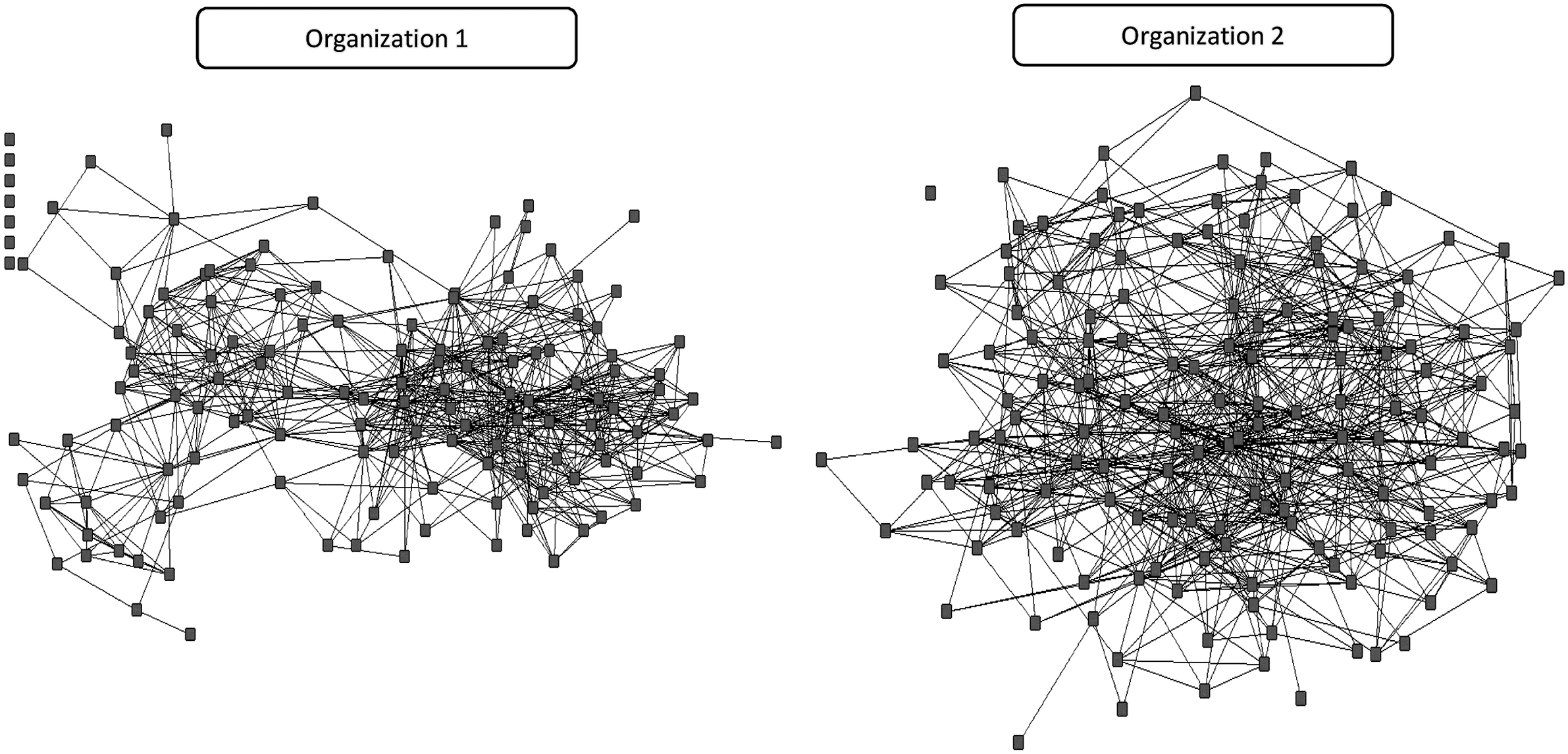
Descriptives and Zero-Order Correlations.
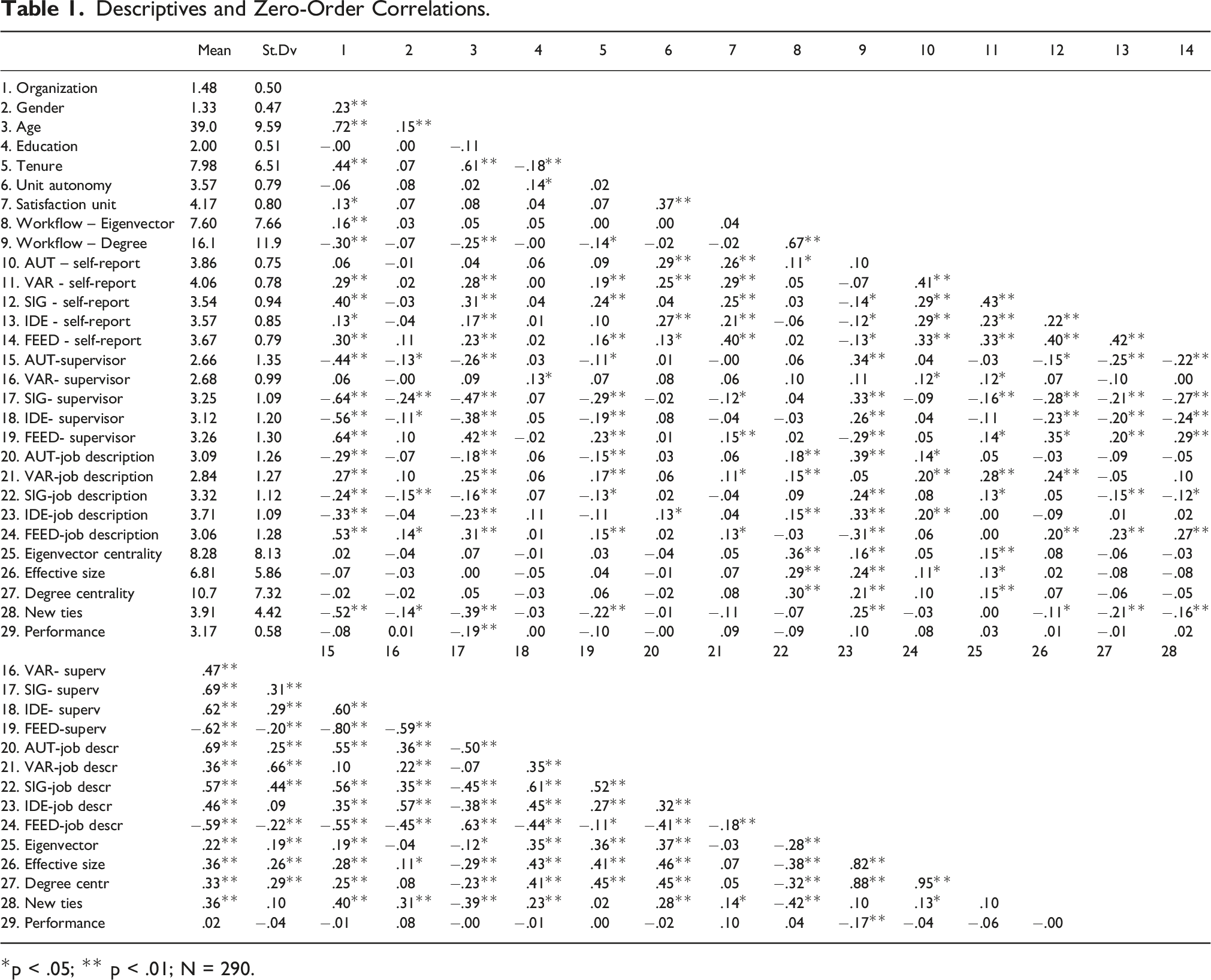
*p < .05; ** p < .01; N = 290.
Unstandardized Regression Analyses for the Prediction of Degree Centrality and Effective Size.
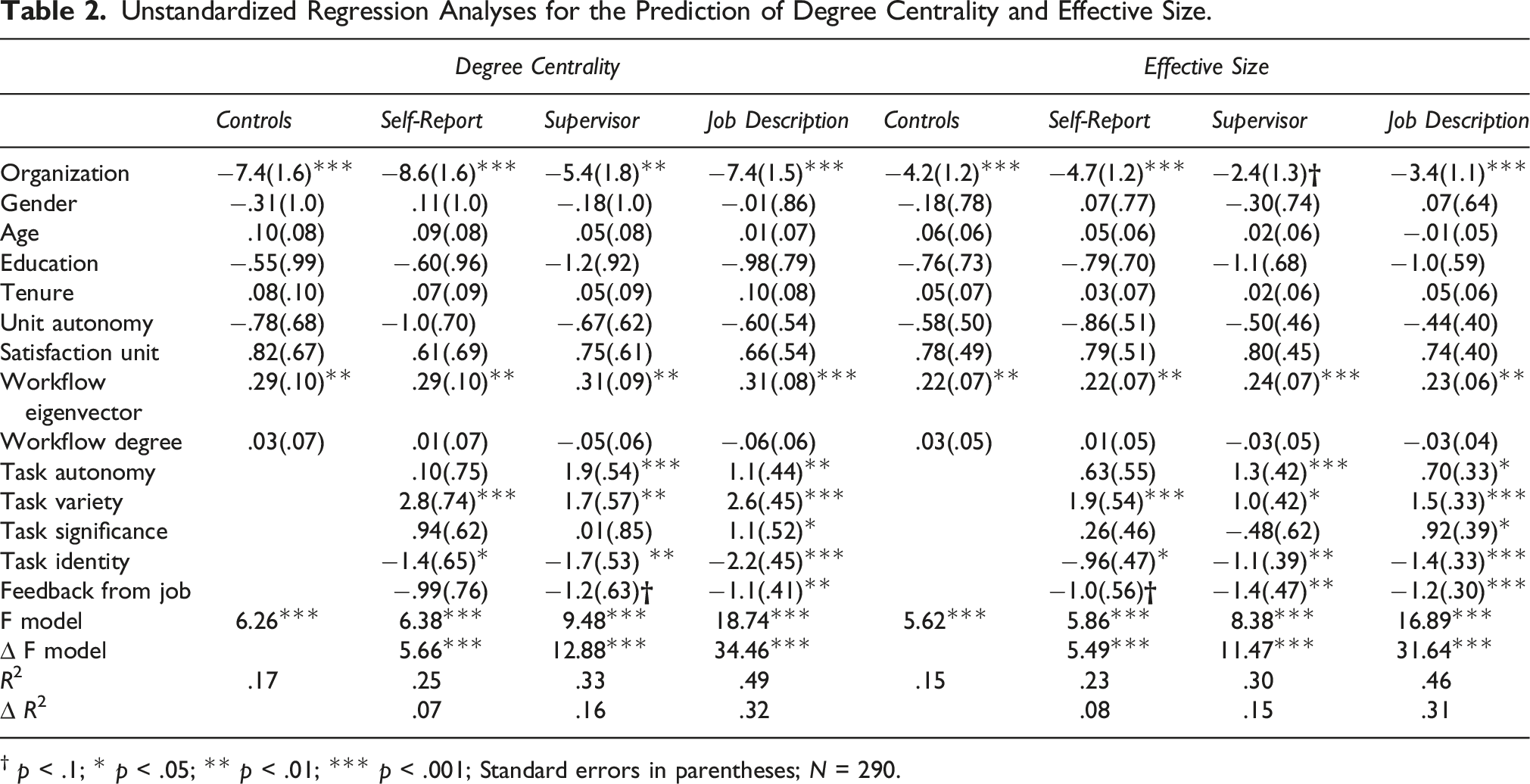
† p < .1; * p < .05; ** p < .01; *
The columns on the right of Table 2 report the findings of the regression analyses predicting effective size. In general, the findings show slightly stronger support. The model with self-report measures shows the significant effect of variety (β = 1.9; p < .001), identity (β = −.96; p < .05), and feedback from the job (β = −1.0; p < .1). The model with supervisory measures shows significant relationships for autonomy (β = 1.3; p < .001), variety (β = 1.0; p < .05), identity (β = −1.1; p < .01), and feedback from the job (β = −1.4; p < .01). Last, the model with job-coded measures shows significant relationships for autonomy (β = .70; p < .05), variety (β = 1.5; p < .001), significance (β = .92; p < .05), identity (β = −1.4; p < .001), and feedback from the job (β = −1.2; p < .001). All hypotheses find support.
Unstandardized Regression Analyses for the Prediction of Eigenvector Centrality.
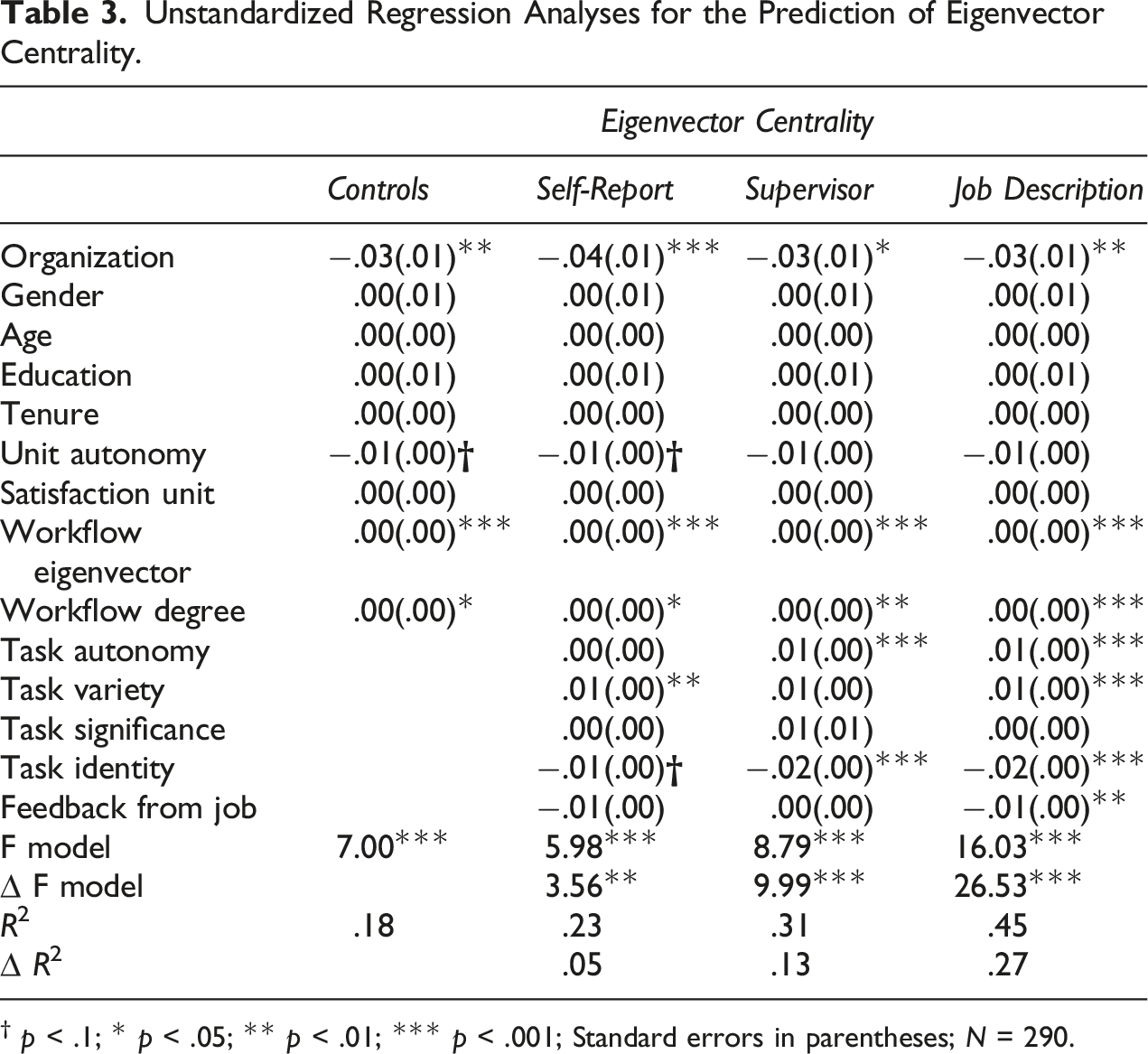
† p < .1; * p < .05; ** p < .01; *
To provide additional evidence, I ran all analyses with new ties as dependent variable. The model with self-report ratings supports the hypotheses on variety (β = 1.2; p < .001) and identity (β = −.94; p < .01). The model with supervisory ratings provides modest support for autonomy (β = .48; p < .1) and variety (β = .48; p < .1). The model with job-coded measures supports the effects of task variety (β = .64; p < .05) and identity (β = −.49; p < .05). As explained, while new ties minimize the risk of reverse causation, they are not as good of an indicator of information capacity as network centrality, but offer complementary evidence that helps interpret findings.
In order to provide evidence of generalizability, I examined the replication of findings across the two different organizations, running regression analyses for each organizational sub-sample. The separate samples have lower statistical power which, given the correlations among job characteristics, sometimes does not allow results to reach the threshold of significance, even if β values are similar to those of the aggregate sample. There is some evidence for the replication of findings. In the videogame company, 68% of the significant findings in Tables 2 and 3 are also significant and in the pharmaceutical company 24% of the significant findings in Tables 2 and 3 are replicated. I reran all analyses standardizing the centrality scores by organization. Results replicate, with minor differences, although they appear weaker.
To confirm that the results are not specific to ties symmetrization, I rerun all analyses with asymmetric data, calculating indegree and outdegree centrality. Indegree centrality captures all ties received by a node, while outdegree centrality captures all ties reported by a node. Results are replicated regardless of the direction of the ties considered. With self-report and job-coded measures, all results are replicated both with indegree and outdegree centrality. With supervisory measures, all results are replicated with stronger significance for indegree centrality, while they are not replicated only for feedback from the job for outdegree centrality. Asymmetric analyses were not run for effective size and eigenvector centralities because results on directed networks for these variables are less meaningful in the context of this study.
To prove that results are robust, I also reran all analyses at the job level. All results were generally replicated for all three forms of centrality. With effective size, results were stronger for supervisory measures, with all five job characteristics finding support. Results were all confirmed except for task autonomy with job-coded measures.
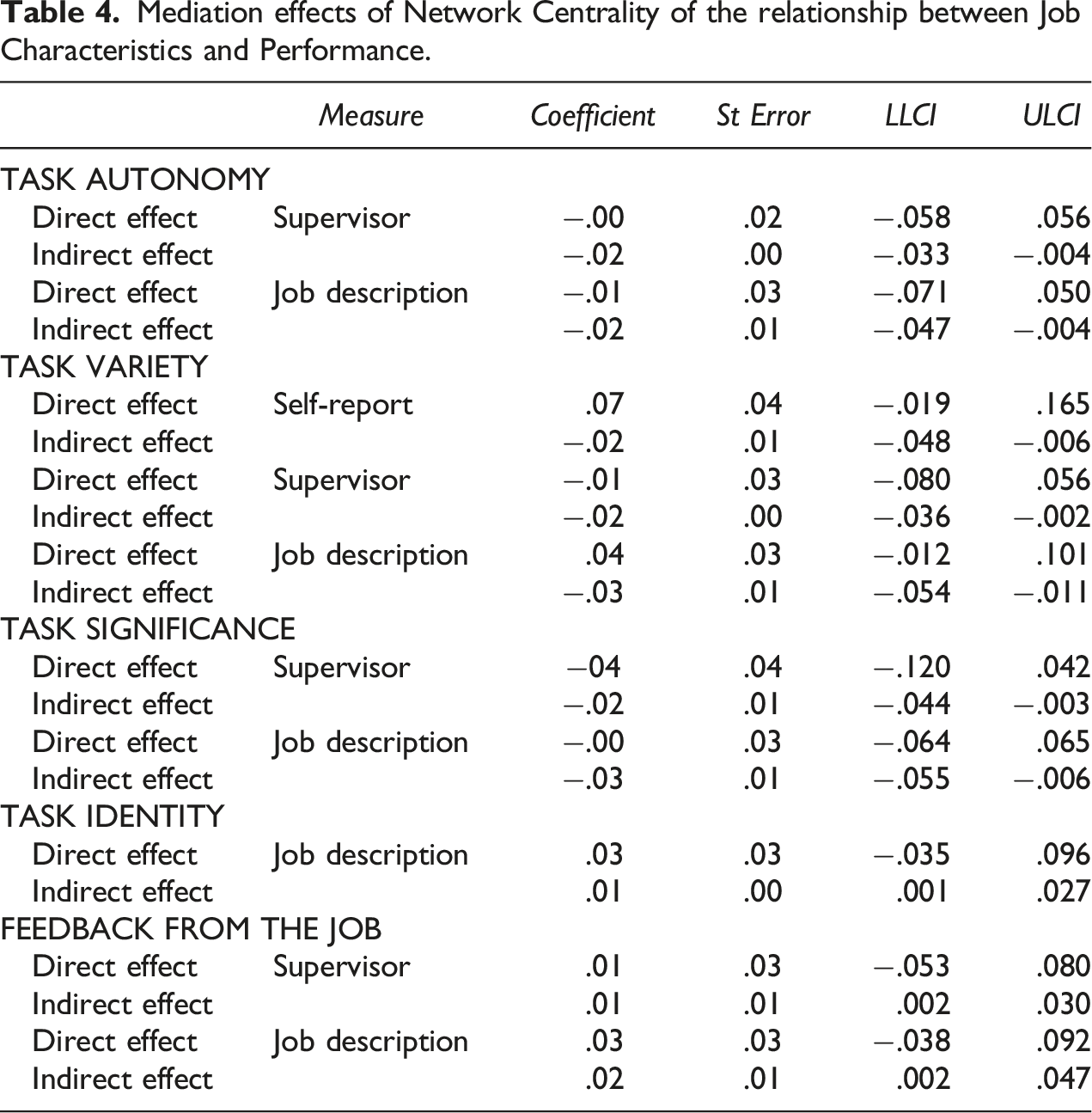
Mediation effects of Network Centrality of the relationship between Job Characteristics and Performance.
Discussion
This paper developed and tested a theory exploring how job characteristics affect network centrality. Findings show that job characteristics explain a considerable portion of variance in network centrality and exercise divergent predictive effects: autonomy, variety and significance are positively related to centrality while identity and feedback from the job are negatively related to centrality. Findings partially replicate across different measures of job characteristics and different indicators of network centrality, although some differences are noticeable. Evidence partially replicates across the two distinct organizations.
Interestingly enough, findings support the mediation hypothesis for all job characteristics but the relationship between centrality and performance appears to be negative, differently from what originally anticipated. Evidence found in this single paper should not alone discount the cumulative findings on the multiple benefits of network centrality (Kilduff & Brass, 2010b). Yet, this is a surprising finding and one that invites scholars to better investigate the different effects of centrality on performance. Scholars have already found that different indicators of centrality could have opposite effects on performance (e.g. Mehra et al., 2001).
Eigenvector centrality is the only variable for which mediation effects were detected. This result is not due to the higher correlation between job characteristics and eigenvector centrality. In fact, the predictive role of job characteristics appears weaker for eigenvector centrality, in alignment with the premise that employees have lower control over the formation of eigenvector centrality comparatively to degree centrality or even effective size. The mediation result is only ascribable to the fact that degree centrality and effective size, in the studied sample, are uncorrelated with performance. Although evidence from this paper should not challenge established cumulative findings, it supports some authors’ claim that measures capturing the position in the whole network might be more relevant in explaining performance behaviors than measures capturing the position in the local network (Mehra et al., 2001, 2006).
Mediation is observed even if job characteristics do not correlate with performance. PROCESS (Hayes, 2017) is just the name of the SAS macro but results are based on a typical bootstrapping method with ordinary least squares estimates. The traditional argument by Baron and Kenny (1986) that the independent variables must correlate with the dependent variable for mediation to occur has been challenged by several authors (Fiedler, Schott, & Meiser, 2011; Hayes, 2017; Rucker, Preacher, Tormala, & Petty, 2011; Zhao, Lynch, & Chen, 2010). The opposite effects in the relationships between the independent variable and the mediator and between the mediator and the dependent variable, in case of rather similar magnitudes, might explain the lacking correlation. This could plausibly occur for three out of five job characteristics. The other explanation is the existence of unobserved variables that might cause a false negative. Indeed, authors have found that it is fairly common to find significant indirect effects while the direct and even total effects are non-significant, and, still, the conclusion should be in support of mediation (MacKinnon, 2012).
Of the job characteristics, the one that appears to have lowest impact on centrality is task significance. A possible reason for this finding is that some particular jobs with high task significance might not require much information from networks inside the organization. Since social impact can also focus on outside constituencies, information requirements could be satisfied through interactions with external stakeholders, such as customers or suppliers. Another interesting finding is that results from job descriptions tend to be stronger than those of self-report. One possible key to interpret these findings is that, as mentioned, self-report scores encompass both prescribed and crafted tasks, while job description scores only reflect prescribed task. It is reasonable to speculate that requests to provide information for prescribed, formally required tasks might be more effective, thereby better predicting centrality. Self-report scores could be more affected by measurement error, as employees with lower level of education might not be as accurate in scoring their own jobs, or as some employees might have experienced survey fatigue after filling two network name generator surveys.
At the macro level, we can observe that the two organizations have different whole networks. The organization with an organic structure tends to be denser without clearly identifiable regions, while the organization with a mechanistic structure has fewer connections and identifiable regions. These findings might be explained by Tichy, Tushman, & Fombrun’s (1979) argument that in mechanistic structures connections are fewer and tend to mirror formal interdependencies, while in organic structures relations are denser and more easily cut across units. Despite differences across organizations, within-organization variance conditions in all network centrality indicators and in all job characteristics are good for both organizations, allowing proper hypothesis testing. In the mechanistic organization, formal interdependencies, which are controlled for in this study, might be the core factor driving network formation. As per Tichy et al. (1979), in mechanistic structures employees might have lower discretion in choosing who to connect with, and this could be a possible reason why findings are weaker for this organization.
The paper offers a significant contribution to research in job design. The divergent effect of job characteristics is surprising and new, given that Hackman and Oldham (1975) originally theorized convergent and positive effects. Authors argued that, although most previous research has assumed that job characteristics affect behavioral outcomes through motivational mechanisms, the characteristics of jobs also trigger distinct mechanisms that need to be examined (Humphrey et al. 2007; Langfred & Moye, 2004; Morgeson & Humphrey, 2006). The paper illustrates that job characteristics can exercise unique and divergent effects once we consider outcomes previously unexplored, such as the social structure.
The study advances the debate on goal-directed versus serendipitous networking. The work structure influences goal-directed networking of those who request information while it might indirectly influence serendipitous networking of the ones providing it. Networking action can influence both centrality scores of those who ask and those who provide. Nonetheless, employees with a work structure that enables goal-directed networking will have higher centrality than the others. Those requiring more information end up becoming repository of larger information, which can then be given to others needing it. Those who only give information asked will have lower centrality than those who both ask and give a lot. In alignment with the findings, goal-directed networking is more likely pronounced for degree centrality and effective size, which are more under the control of individuals than eigenvector centrality, and for the organic videogame organization, in which information might be more important to task execution and, therefore, information requests are more likely to be heard and satisfied.
This paper offers significant implications for practice. Not all jobs should be designed to encourage employee efforts to build relations. If all jobs are enriched and everyone develops more ties, individual degree centrality augments, but so does whole network density, resulting in lower effective size and lower variability in eigenvector centrality. The argument developed in this paper only allows inferring why variance in job characteristics within the organization explains variance in network centrality. It should not be inferred from the evidence that organizations will reap benefits if they alter the job characteristics of all their employees. The proper managerial recommendation is selective intervention. If there are parts in the organization in which networks need to be reinforced, management could intervene redesigning jobs of specific individuals to empower their networks. Workflow technology could offer opportunity to leverage information systems to design sequences of tasks, allocate tasks to individuals and monitor timely execution of activities (Ellis, 1999). Job design interventions could be implemented through departmentalization, which starts from the macro work processes and breaks them down into micro tasks assigned to units then individuals. Managers could embrace a bottom-up approach to work design, starting from the individual job and enriching its characteristics, or a top-down approach, starting from organizational-level requirements and breaking them down until tasks are assigned to individuals (Hornung, Rousseau, Glaser, Angerer, & Weigl, 2010).
The present work is qualified by some limitations. Each measure of job characteristic captures different aspects of jobs. However, results are meaningful as predictions are replicated considering different measures. The paper does not measure the explanatory mechanisms hypothesized to link the variables. However, the use of multiple hypotheses that consistently elaborate on information requirement and provide divergent causal effects depending on the job characteristics offers suggestive evidence to propose that the underlying explanatory mechanism drives the findings illustrated. The paper only measures task-related communication ties and findings shall not be extended to other types of ties, such as expressive, power or influence ties. However, the theorization is specific to task-related ties. Evidence could be affected by reverse causality. Yet, the supervisory and coded measures of job characteristics are unlikely the result of the individual networking. The evidence on newly formed ties is likely immune to reverse causality. Last, the set of controls on workflow networks allows better establishing causality.
In conclusion, the present investigation explored the interplay between jobs and networks. The paper contributes to research in social networks, illustrating the origin of centrality, and research in job design, disentangling new and conflicting mechanisms activated by job characteristics. The paper helps practitioners understand how they could design jobs to empower social relations and reinforces the need to consider the social context of job design (Grant & Parker, 2009). The paper merges a stream of research in need of resurgence, job design, with the growing stream of research in social networks, enriching both streams.
Footnotes
Declaration of Conflicting Interests
The author(s) declared no potential conflicts of interest with respect to the research, authorship, and/or publication of this article.
Funding
The author(s) received no financial support for the research, authorship, and/or publication of this article.

Associate Editor: Thomas Zagenczyk