



Abstract
Teams with shared leadership arrangements are ubiquitous in twenty-first century organizations. Although transitions in leadership are a common and key feature of such teams, there is little insight into how and when leadership arrangements transition over time. Bridging the shared leadership and team adaptation literatures, we present a model of Leadership Transitions in Teams to describe the adaptive process through which teams intentionally modify the existing leadership arrangement. The basic assumption underlying this model is that leadership transitions occur when there is a mismatch between the team’s needs and its current leadership arrangement. Such a mismatch results from an anticipated or observed change. If it is anticipated, team members can democratically discuss and try out a new leadership arrangement, preventing mismatch and thus lowered team effectiveness. In contrast, if the mismatch has already occurred, teams are more likely to adopt a less democratic process—either a coalition-based or intervening-based process—to change the leadership arrangement in their team to counteract faltering team effectiveness. We propose that the ways in which leadership transition episodes can unfold and relate to team effectiveness will depend on the type (determined by the timing of the leadership transition episode in relation to the change), approach (determined by the extent to which there is consensus on if and how to change the leadership transition episode), and boundary conditions of leadership transition episodes. We advance an agenda for research on leadership transitions in teams and outline practical implications for teams with shared leadership structures.
Keywords
The primary function of leadership in teams is to take care of whatever needs to be done to allow the team to accomplish its objectives (McGrath, 1962; Morgeson, DeRue, Karam, 2010). To that end, teams with shared leadership structures frequently adjust their leadership arrangement (i.e., who is leading in what capacity at a given point in time). Shared leadership is an emergent process through which the leadership role is taken and performed by several team members (Carson, Tesluk, Marrone, 2007; Zhu, Liao, Yam, Johnson, 2018). For example, in surgical teams, senior surgeons assign leadership roles to junior surgeons for specific procedures (Klein, Ziegert, Knight, Xiao, 2006); in multinational consultancy teams, team members take on leadership roles to coordinate specific assignments (DeRue, Nahrgang, Ashford, 2015); and in Antarctic wintering teams, who is leading depends on the fit between team members’ expertise and mission phase and team needs (Burke et al., 2018).
Despite the ubiquity of leadership transitions in teams with shared leadership arrangements (e.g., Carson et al., 2007; Lorinkova & Bartol, 2021; Siangchokyoo & Klinger, 2021), little is known about how the timing of leadership transitions shapes the leadership transition process itself, and how the timing and process of leadership transitions relate to team effectiveness (e.g., DeRue & Ashford, 2010; D’Innocenzo et al., 2021). Research has shown that leadership arrangements enable team adaptation—“a change in team performance, in response to a salient cue or cue stream, that leads to a functional outcome for the entire team” (Burke et al., 2006, p. 1190)—in the face of uncertainty (e.g., Sanchez-Manzanares et al., 2020; Zaccaro et al., 2001). However, the shared leadership and the team adaptation literatures have yet to consider how teams with shared leadership respond to changes that result in a mismatch between the team needs and their leadership arrangement (e.g., Kennedy & Maynard, 2017). Therefore, it is critical to develop theory on how teams modify leadership arrangements in response to changing team needs.
In this paper, we address these gaps by advancing a model of Leadership Transitions in Teams to describe when leadership arrangements are changed, and how the timing and process of leadership transitions shape team effectiveness. Our core assumption is that teams with shared leadership alter their leadership structure to adapt to emerging team needs, such as changing between project phases or prioritizing new goals (Burke et al., 2003; DeRue & Ashford, 2010). Central to our model are leadership transition episodes, which we conceptualize as a team adaptation process to adjust to changing needs through the claiming and granting of leadership roles (Burke et al., 2003; DeRue & Ashford, 2010; Morgeson et al., 2010). We argue that leadership transition episodes are initiated when team members who anticipate or observe changing team needs and a (potential) mismatch with the current leadership arrangement propose a change in leadership. We conceptualize multiple ways in which leadership transition episodes can unfold and relate to team effectiveness, depending on the type of leadership transition episode (determined by the timing of the leadership transition episode in relation to the change), the approach to leadership transition episodes (determined by the extent to which there is consensus on if and how to change the leadership transition episode), and the boundary conditions we envision being most relevant (i.e., trigger sharedness, time, and subgroups).
Our main contribution is that we provide a first integration of the shared leadership and team adaptation literatures by creating a temporal framework that advances knowledge on when and how teams with shared leadership change their leadership arrangement. In arguing that changing team needs are a major antecedent of changes in the leadership arrangements of teams with shared leadership, we help unpack the black box of the shared leadership processes by theorizing on when and how teams modify their leadership arrangements (Priem et al., 1999; Zhu et al., 2018). Furthermore, we respond to recent calls for identifying new forms of team adaptation (Baard et al., 2014; Christian et al., 2017) by recognizing changes in leadership arrangements as a form of team adaptation. We further address the call to identify mechanisms that link team adaptation to team effectiveness (Baard et al., 2014; Santos et al., 2021) by showing how the timing and process of changes in leadership arrangements relate to team effectiveness.
In the following, we first review and integrate insights into leadership transitions in teams from the shared leadership and the team adaptation literatures (e.g., Burke et al., 2003; Carson et al., 2007; Maynard et al., 2015). We subsequently develop our model of Leadership Transitions in Teams to clarify the conditions that dictate when changes are made to leadership arrangements, and how the timing and process of changes in leadership arrangements shape team effectiveness. Finally, we describe the different types in which and approaches by which leadership transitions may happen, and set an agenda for testing and further developing our model.
Theoretical Background
Leadership Transitions in Teams
Team leadership is a process that unfolds over time and can be exerted by a single member, shared by multiple members, or satisfied by situational substitutions (Carson et al., 2007; McGrath, 1962). Critical to the leadership role is the ability to satisfy anticipated and emerging team needs along the team performance cycle (Kozlowski et al., 2009). Team needs are collective tensions that are shared by team members and that shape the direction, intensity, and persistence of team activity over time (Park et al., 2013). For example, newly formed teams tend to have initial socialization needs before they can focus on task mastery (Kozlowski et al., 2009). To the extent that any team member addresses a need properly or has the capacity to do so, s/he is a potential source of leadership influence at that time (e.g., Klein et al., 2006).
Because team needs and team members’ ability and propensity to address such needs can change over time, leadership research is increasingly shifting from a leader-centric approach to a group-centric approach where the leadership role is shared by multiple individuals (Carson et al., 2007; Ensley et al., 2006; Hazy & Uhl-Bien, 2015). Shared leadership in particular, which captures an influence process among team members that is dynamic and interactive (Pearce & Conger, 2003) and is “characterized by ‘serial emergence’ of official as well as unofficial leaders” (Pearce, 2004, p. 48), is well established as an antecedent to team effectiveness, which refers to the products, outputs, and results of member interaction such as team performance and team viability (Mathieu et al., 2019). Indeed, leadership research has shown that shared leadership predicts the performance of teams such as new venture top management teams (Ensley et al., 2006) and consultancy teams (Carson et al., 2007), and that the shared leadership—team performance link is stronger when teams perform complex tasks (Wang et al., 2014). What is more, shared views of leadership suggest that positive outcomes can be expected when leadership is network-like and adopts a collective form (DeRue et al., 2015; Kozlowski et al., 2009; Wallace et al., 2021). Shared leadership results from teams having various individuals who are recognized as competent in their role and who can coordinate goal setting, planning, resource delegation, and feedback activities (D’Innocenzo et al., 2016). Thus, shared leadership is not the formal centralization of leadership in one single individual, nor refers to a team where any one can lead. Shared leadership can be observed in any team and context where team members have the motivation, competence, and autonomy to share the leadership role across performance episodes (Locke et al., 2007; Pearce & Conger, 2002). Importantly, shared leadership theory does not postulate that everyone in the team should lead, as that might be detrimental for teams (Grille et al., 2015). In addition, shared leadership can be observed at any hierarchical level of the organization, and in any work context, if there are conditions for shared leadership to happen (Locke et al., 2007; Pearce & Conger, 2002).
The accumulated knowledge on the drivers of shared leadership and effective teamwork highlights the importance of recognized competence and expertise as key elements in effective claiming and granting of leadership, which underlie leadership transitions (e.g., DeRue & Ashford, 2010; Kukenberger & D’Innocenzo, 2020). Indeed, De Souza and Klein (1995) showed that leadership emergence is related to individual task ability and commitment to the assigned team goal. Later, Carte et al. (2006) also found that high-performing teams share leadership to address relevant task needs, and their members can identify and rely on the most qualified individuals to step forward and assume leadership responsibilities when team needs change. We therefore argue that changes in leadership arrangements reflect a team adaptation process, defined as a change in team behaviors to increase the fit between the current leadership arrangement and situational needs that emerge during the team performance cycle (cf. Maynard et al., 2015).
Conceptualizing changes in leadership arrangements as a team adaptation process supports suggestions in the literature that shared leadership has implications for team adaptation (e.g., Burke et al., 2006; Lorinkova & Bartol, 2021; Rousseau & Aubé, 2020). Shared leadership is likely to foster team adaptation as a dynamic response to emerging new needs, where leadership transitions within the team happen in response to new demands being imposed on the team (Burke et al., 2003). Researchers have also proposed that having the autonomy to define and implement new strategies independently from external supervision, including changing the team leadership structure, can enable team adaptation (Bedwell et al., 2012; Burke et al., 2006; Curral et al., 2016; Guastello, 2010). Additionally, team adaptation research highlights (a) the importance that teams have the skills and autonomy to modify existing structures or create new ones to accommodate changes in team roles (Christian et al., 2017; LePine, 2003, 2005) and (b) that more adaptive teams have flatter, more loosely coupled network structures with high reciprocity in terms of communication and decision-making interactions (Barth et al., 2015; Salwei et al., 2019).
Hence, we propose that teams with shared leadership arrangements tend to rotate leadership roles across performance episodes as a strategy to ensure team adaptation in dynamic task environments where (un)anticipated changes happen frequently (e.g., Bechky & Okhuysen, 2011), like in the creative industry (e.g., Serban & Roberts, 2016) or the military (e.g., Çakıroğlu et al., 2021). In the following, we build on this insight to develop theory into how and when leadership arrangements are modified. We start with presenting the concept of leadership transition episode to describe how leadership arrangements are changed, after which we integrate this concept within the model of Leadership Transitions in Teams, thus delineating when leadership arrangements are modified and the boundary conditions that define it.
Leadership Transition Episodes
In this paper, we regard leadership transitions as a four-stage team adaptation process derived from the steps underlying team adaptive responses more generally (Burke et al., 2006; Georganta et al., 2021). Team adaptive responses have been argued and shown to include four phases: situation assessment (when team members identify relevant cues for adaptation and ascribe them meaning), plan formulation (when team members define goals and formulate a plan to address relevant cues for adaptation), plan execution (when team members coordinate and support each other towards goal accomplishment), and team learning (when the team reflects on the lessons learned and evaluates if the situation has been adequately addressed, or not).
Accordingly, in the specific case of adapting by modifying leadership arrangements, we argue that leadership transition episodes include four stages (Figure 1): proposal (i.e., team members identify which team needs need to be addressed and propose tentative leadership changes to address those needs), discussion (i.e., team members consider the adequacy of the proposed changes), trial period (i.e., the newly appointed team leaders are given an experimental period to show the ability to satisfy team needs), and evaluation (i.e., team members evaluate the candidate’s leadership performance after the trial period). If the new leadership arrangement is accepted, the leadership transition episode ends. If not, the leadership transition episode will either repeat until a suitable leadership arrangement is found and accepted, or the team will revert to the previous leadership arrangement. A Leadership Transition Episode. Note. The a, b, c, and d dashed arrows highlight other pathways by which leadership transition episodes unfold. Path a represents the start of a new leadership transition episode, to replace a former one. Path b represents what happens when, during the evaluation stage, the team agrees that the proposed leadership arrangement is not adequate. Path c happens when a coalition approach is adopted to implement a new leadership arrangement. Path d happens when an intervening approach is adopted to implement a new leadership arrangement.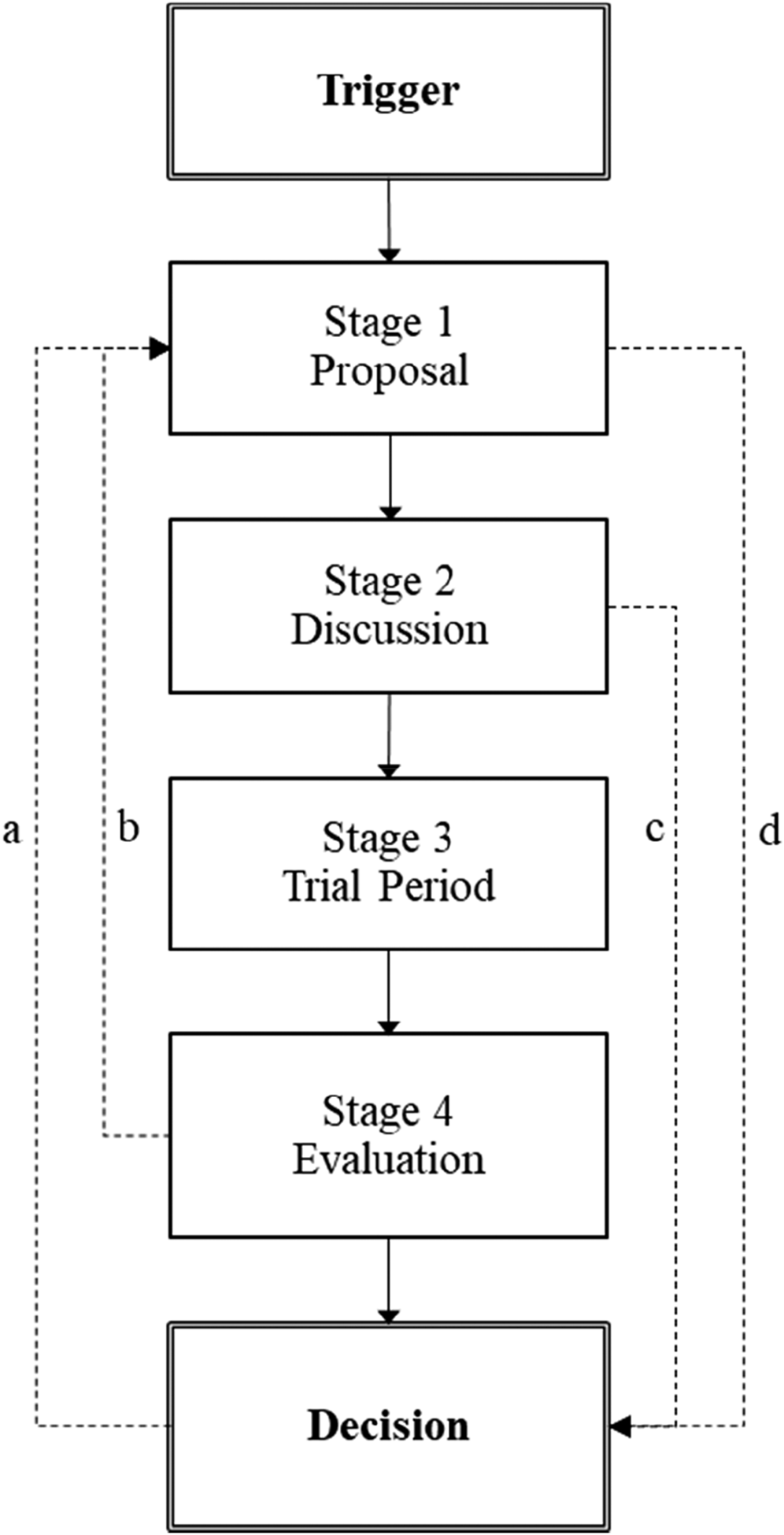
Approaches to Leadership Transition Episodes
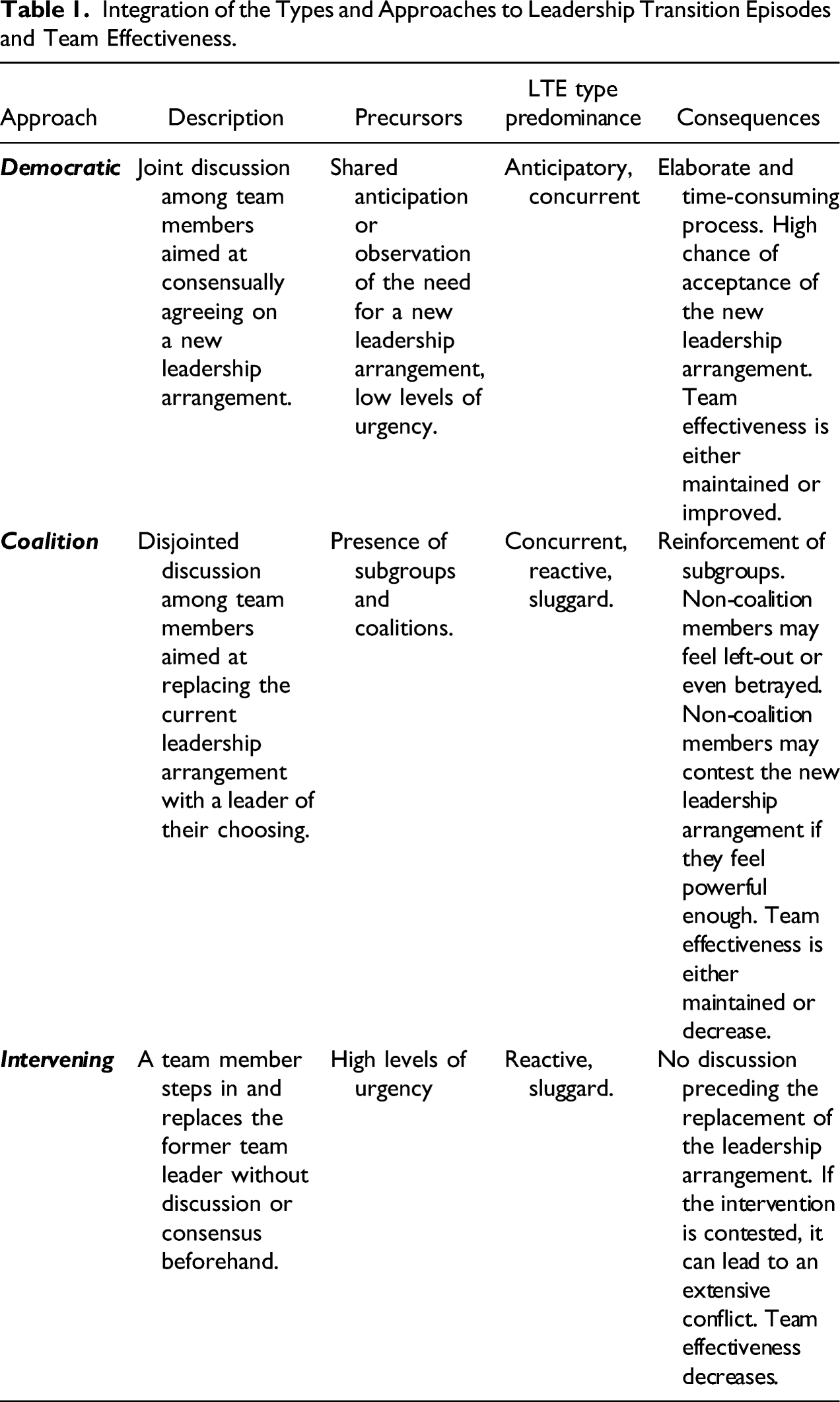
Integration of the Types and Approaches to Leadership Transition Episodes and Team Effectiveness.
Importantly, whereas these four stages of leadership transition episodes form a specific sequence, there are conditions under which it is likely that not all four stages take place. For example, under conditions of time urgency, teams may not have the time to follow all stages (e.g., Georganta et al., 2021). Since teams can have varying levels of agreement about who is the most adequate person in the team to take on leadership (Burke et al., 2003; McIntyre & Foti, 2013; Nyberg et al., 2021), team members may or may not have overlapping perceptions of each other’s role expertise (Levesque et al., 2001). The extent to which there is an overlap might even be triggered by other factors like power and information asymmetries (Smith et al., 2006; Bergh et al., 2019). All these factors can make that teams may not always involve all team members in a discussion to decide, and decisions may even be taken without any discussion at all (Kerr & Tindale, 2004).
Therefore, as alternatives to the democratic approach to proposing a new leadership arrangement, we propose two additional approaches: coalition and intervening. In a coalition approach, a team member proposes a new leadership transition episode to only one or few other team members (O’Leary & Mortensen, 2010). For example, a team member can try to negotiate with the current team leader without informing the other team members that s/he seeks to become the new team leader. Team members can also propose a new leadership transition episode by subverting the team leader to overthrow or replace her/him (Ocker et al., 2011). In such cases, the subsequent discussion will not take place centrally, but only among the coalition members involved. It is also possible that the current leader selects and appoints a new leader without consulting or discussing it with other team members (O’Leary & Mortensen, 2010). Given the potentially contested nature of such approaches, we argue that coalitions are less likely to incorporate a trial period and evaluation moment for the new leadership arrangement to avoid non-coalition members challenging the new leadership arrangement (as indicated by the dashed lines in Figure 1).
In an intervening approach to leadership transition episodes, single team members immediately assume the lead. Hence, a new leadership arrangement is directly enacted rather than proposed and discussed. For example, if a team member spots a mistake that the team leader is making that needs to be solved urgently, the team member may determine that it is more effective or less costly to immediately step in than to point out the mistake. When confronted with such an intervention, the team and team leader can either push back and challenge the intervention or accept it (cf. DeRue & Ashford, 2010). If the intervention is accepted, all the intermediate stages in the leadership transition episode process (i.e., discussion, trial period, and evaluation) are skipped. However, it may be that, after the intervention, the new leader hands the leadership back to the former leader. Consider, for instance, a flight captain letting a co-pilot fly, but temporarily intervening when there is an emergency. After the emergency is over, the captain may give the control back to the co-pilot again (Ginnett, 2019).
Boundary Conditions of Leadership Transition Episodes
Building on shared leadership and team adaptation research, we propose that three main factors play a role in which leadership transition episode approaches are likelier to take place: temporal urgency (e.g., Lorinkova & Bartol, 2021), subgroups (e.g., Kukenberger & D’Innocenzo, 2020), and trigger sharedness (e.g., Burke et al., 2003). Temporal urgency relates to the passage of time, and how such passage relates with the task (McGrath, 1991). The shorter the deadline to accomplish a certain task with varying complexity, the more urgent the task becomes (Waller et al., 2001). Previous work on how time shapes team functioning has shown that the passage of time influences group functioning, especially around mid-point transitions where team members experience temporal urgency and often tend to make changes in group functioning, including in team plans, strategies, and leadership roles (e.g., Gersick, 1989). Lorinkova and Bartol (2021) have also found that the sharing of leadership in teams with shared leadership arrangements is sensitive to the mid-point transitions, much like in Gersick’s (1991) punctuated equilibrium model. This suggests that teams modify their leadership arrangement across their performance cycle, with most leadership arrangement modifications probably taking place around the mid-point transitions given a heightened sense of temporal urgency (Lorinkova & Bartol, 2021). We anticipate that the higher the sense of temporal urgency, the more likely it is that members will propose a new leadership arrangement and use an intervening approach. In contrast, when team members perceive there is enough time to propose and implement a new leadership arrangement, either a democratic or coalition approach is more likely to happen.
The formation of subgroups in teams is a process that may emerge from (perceived) differences among members (Homan et al., 2020). Such differences can divide the team and trigger dysfunctional team processes such as inter-group conflict and polarization (van Dijk et al., 2017). The more that subgroups are present in the team, the more likely it is that a coalition approach is taken in which favoritism plays a role in determining who will be the new leader (cf. Kukenberger & D’Innocenzo, 2020). When there are no subgroups, changes in leadership arrangements are likely to be due to either democratic or intervening approaches. Eventually, it can happen that when there are no subgroups and there is low temporal urgency, a democratic approach is the likeliest to be taken. Differently, when there are at least two subgroups and temporal urgency increases, an intervening approach is likelier to happen.
Regarding trigger sharedness, we suggest that the more that team members share the perception and assessment of the changing team needs, the more democratic the leadership transition episode is likely to be because there will be fewer differences in relevant shared knowledge (Burke et al., 2003; Sanchez-Manzanares et al., 2020; Small & Rentsch, 2010). In the case of a democratic approach, trigger sharedness enhances the extent to which team members will jointly propose and agree on a new leadership arrangement. Likewise, in case of a coalition approach, trigger sharedness enhances the chance that non-coalition members will agree with the new leadership arrangement; and in case of an intervening approach, heightened trigger sharedness increases the chance that the team and the previous leader accept the intervention and the new team leader. In contrast, when trigger sharedness is low, teams are less likely to adopt a democratic approach, whereas a coalition or intervening approach is more likely to occur. When sharedness is low, it is also possible that unfolding leadership transition episodes are characterized by greater tension between coalition and non-coalition team members, or the self-appointed team leader and everyone else (e.g., Mohammed et al., 2021). Such tension might delay the ending of the leadership transition process and harm team effectiveness (De Wit et al., 2012).
A Model of Leadership Transitions in Teams
So far, we have explained the general leadership transition episode process, the different approaches that may be taken to a leadership transition episode, and how boundary conditions help in determining the likeliest approaches to be taken. In the following we further develop a model on how the timing of a leadership transition episode in relation to the actual change in team needs relates to the approach that is taken, the boundary conditions, and team effectiveness. Figure 2 shows our model of Leadership Transitions in Teams. Types and Approaches to Leadership Transition Episodes. Note. LTE = leadership transition episode. LA = leadership arrangement. The figure describes the four types of leadership transition episodes that can happen in response to a single moment of change (signaled by the star in the time continuum), the leadership transition episode approaches that often go with each of the four types (although all combinations of leadership transition episode types and approaches are possible), the anticipated effect on team effectiveness. The star signaling the moment of change signals the time frame (time = 0) of the event in reference to which the leadership transition episode is enacted. Only one out of four leadership transition episodes may happen per moment of change.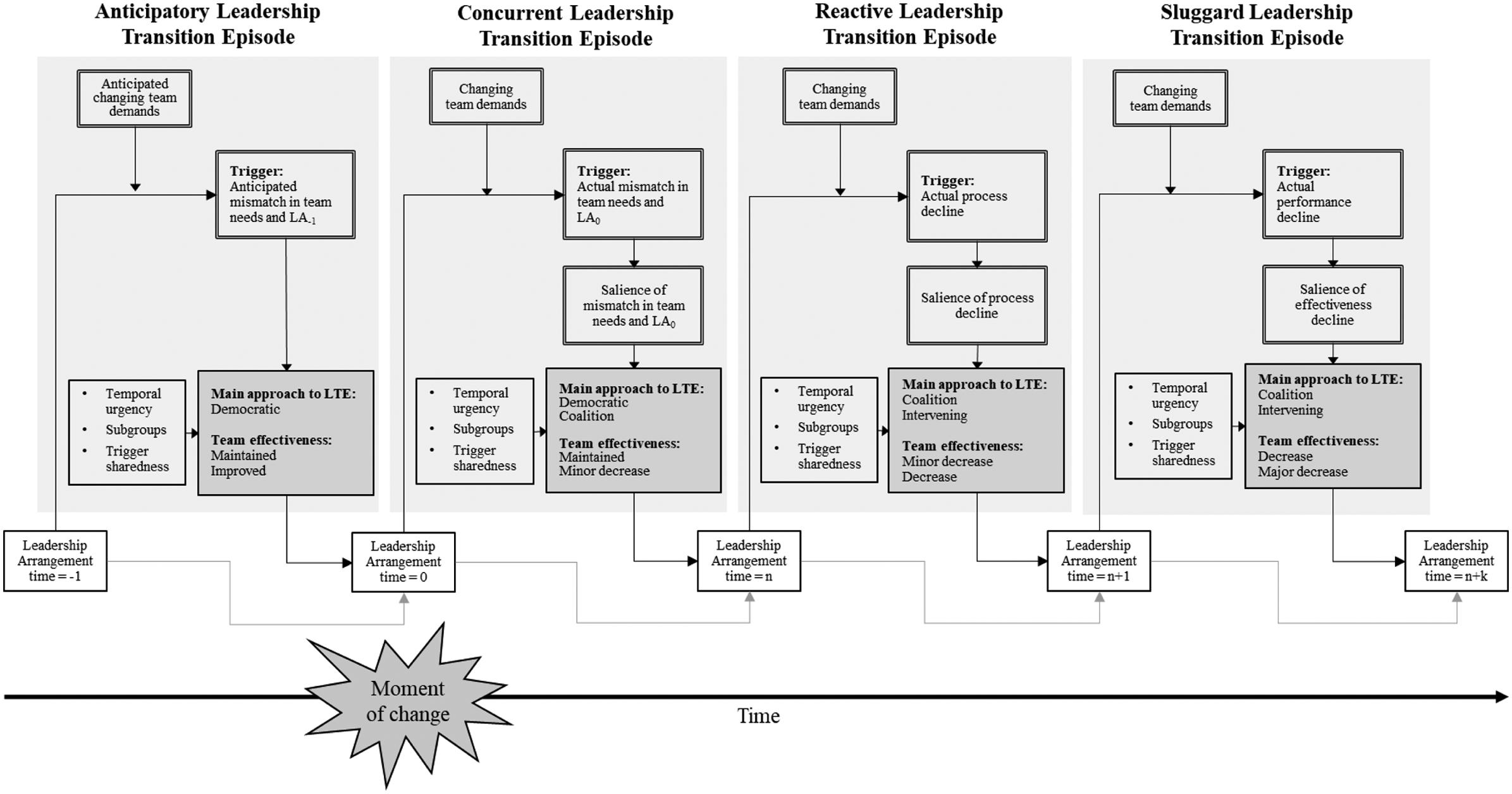
Drawing on the team adaptation literature, we distinguish between four different types of leadership transition episodes: anticipatory, concurrent, reactive, and sluggard (see Figure 2). These leadership transition episodes differ in the nature of the trigger that sets them off, and the triggers differ according to the relative timing of a change in team needs and the team’s response to the change. Specifically, in anticipatory leadership transition episodes, the anticipation of the change is the trigger. The trigger for concurrent leadership transition episodes is an actual change as it emerges. Reactive leadership transition episodes are triggered by declines in team processes that occur because a change has gone unaddressed. Finally, effectiveness declines that result from unaddressed declines in team processes (ultimately due to a change going unaddressed for even longer) are the trigger in a sluggard leadership transition episode.
In support of this conceptualization of leadership transition episode types, the team adaptation literature has differentiated between various time-based forms of adaptation, including preemptive (adaptive actions planned in advance of when they will be executed), improvised (adaptive actions that are determined and executed more or less simultaneously), transition (adaptation that occurs immediately after a change and minimizes effectiveness declines), and reacquisition (recovering from effectiveness losses after a change) adaptation (Abrantes et al., 2018; Lang & Bliese, 2009; Uitdewilligen et al., 2018). Until now, however, these different types of adaptive responses have not been integrated and linked to the specific case of leadership transitions. We argue that these time-based leadership transition episode types are critical to the outcomes of the leadership transition episodes (McGrath, 1991; Roe et al., 2012).
Preemptive adaptation (e.g., Abrantes et al., 2018) happens in anticipation to a threatening event or situation that has not occurred yet. Team members detect early warning signals and engage in team and contingency planning. In team preemptive adaptation, planning precedes action (Abrantes et al., 2018; Burke et al., 2006). Hence, we propose that anticipatory leadership transition episodes take place when there is an anticipated change in team demands that causes an anticipated mismatch between the future team needs and the current leadership arrangement. Hence, an anticipatory leadership transition episode is motivated by the intention to ensure that the anticipated change will not result in a decline in team effectiveness (Burke et al., 2006; Weitzel & Jonsson, 1989). Such a change can be internal (e.g., a team member who is leaving) and/or external (e.g., a different work stage that is approaching). Not all changes may (be anticipated to) result in a mismatch between team needs and the current leadership arrangement. However, when a mismatch is anticipated, this may function as a trigger to preemptively propose a new leadership arrangement before the change has occurred (Burke et al., 2006). Discussions, trials, evaluations, and decisions about what would be a suitable new leadership arrangement can then also be held so that the new leadership arrangement takes effect if the change occurs (e.g., Nyberg et al., 2021). Given that an anticipated change generally means that there is time to openly discuss the potential consequences of the upcoming changes (e.g., O’Neil & Salas, 2018), we propose that for anticipatory leadership transition episodes, democratic approaches are the most common. Finally, since optimal decisions are reached when all team members participate in the decision-making process (O’Neil & Salas, 2018), the adoption of a democratic approach to perform an anticipatory leadership transition episode should have the highest positive relationship with team effectiveness.
There are also times when teams are blind to early warning signals that provide relevant cues for proactive adaptation processes such as anticipatory leadership transition episodes (e.g., Burke et al., 2006; Nyberg et al., 2021; Weitzel & Jonsson, 1989). In such cases, the second most effective response is engaging in improvised adaptation, a team adaptation process in which planning and execution merge in time, and which happens concurrently with the occurrence of the event or situation that triggers the need for adaptation (Abrantes et al., 2018). Such a concurrent leadership transition episode where the leadership arrangement is modified when team demands change, or immediately after those have changed (Abrantes et al., 2018), minimizes the time in which there is an actual mismatch between the leadership arrangement and the team needs.
The more that team demands are changing and that those changes create a mismatch between team needs and the current leadership arrangement, the greater the salience of the mismatch between team needs and the current leadership arrangement. This in turn increases the probability that one or more team members will initiate a concurrent leadership transition episode. Hence, declines in team effectiveness in concurrent leadership transition episodes are therefore likely to be small or even non-existent because teams can address relevant team needs before effectiveness declines become too pronounced (Abrantes et al., 2018; Kennedy & Maynard, 2017; Weitzel & Jonsson, 1989). We therefore argue that anticipatory and concurrent leadership transition episodes have a positive relationship with team effectiveness, since they allow teams to prepare their responses to change in team needs in a way that there is zero to minimum delay in the modification of the leadership arrangement (Burke et al., 2006; Kennedy & Maynard, 2017).
However, when there are two or more subgroups and trigger sharedness is low, the leadership transition episode might be delayed because different subgroups might have to build shared knowledge and persuade each other regarding who is the most suitable candidate to take on team leadership. Such slowing of the leadership transition episode by boundary conditions might result in teams shifting from a democratic to a coalition or intervening approach, in an attempt to end the transition. Additionally, the longer the leadership transition episode lasts, the more probable that teams will inadvertently drift from an anticipatory towards a concurrent or reactive leadership transition episode, and effectiveness will falter.
Like anticipatory leadership transition episodes, we argue that democratic approaches are most likely to be used in concurrent leadership transition episodes given that there may be enough time to discuss what would be a proper new leadership arrangement. In cases when changes are already ongoing, for concurrent leadership transition episodes team members may also opt for a coalition approach in which they only discuss the matter with a select group of people, given that such an approach may be quicker. However, if leadership transitions are not immediate or take too long to happen, even when a change is anticipated or concurrent, either because coalitions take too long to identify a new leadership arrangement or because the existing leader is resistant to give away the role, then team effectiveness might suffer as well (Kennedy & Maynard, 2017).
We submit that if there is a prolonged mismatch between the leadership arrangement and the changing team needs because teams did not engage in either anticipatory or concurrent leadership transition episodes to adapt to changing team demands, then over time teams will experience process and, eventually, effectiveness declines (Burke et al., 2006; Kennedy & Maynard, 2017; Lang & Bliese, 2009; Uitdewilligen et al., 2018; Weitzel & Jonsson, 1989). When teams engage in a leadership transition episode following an actual process decline (a reactive leadership transition episode), we argue that losses in team effectiveness will be moderate. A reactive leadership transition episode is not directly triggered by a change in team demands itself (because those have already changed), but instead by the salience of process decline which results from a change in team demands going unaddressed. Process declines such as disruptions in team coordination do not necessarily have an immediate impact on team effectiveness, and losses can still be minimized if teams take on corrective actions swiftly (e.g., Henrickson Parker, Schmutz, & Manser, 2018; Weitzel & Jonsson, 1989). As an example, coordination is faltering because the leader is not providing timely feedback, or the team leader is unable to provide emotional support after a traumatic event. Eventually, teams might not notice the process decline and team effectiveness should start dropping (Weitzel & Jonsson, 1989) to the point when the only leadership transition episode that might still be enacted is a sluggard leadership transition episode.
Because processes are already declining, we argue that a coalition approach is more likely to be adopted in reactive leadership transition episodes compared to democratic leadership transition episodes. Due to the noticeable process declines, team members are likely to experience some dissatisfaction with the current leadership arrangement, which can be exacerbated by existing subgroups who are formed, for example, between those who are loyal to the current leadership arrangement versus those who are not (Shamir, 1992). Moreover, because the process or effectiveness decline is ongoing, team members are likely to experience a sense of temporal urgency and may thus aim for changing the leadership arrangement as soon as possible. Alternatively, team members can also perceive the process declines to be so problematic or urgent that they intervene and step in, and thus adopt an intervening approach.
Like reactive leadership transition episodes (e.g., Burke et al., 2006; Uitdewilligen et al., 2018), we suggest that the trigger of a sluggard leadership transition episode is not the change itself, but the salience of effectiveness declines that result from unaddressed process declines following a change in team demands. For example, if changed team demands have not resulted in a new leadership arrangement despite a mismatch between the new team needs and the current leadership arrangement, then such a mismatch, when sustained, results in actual effectiveness declines. This is like what happens in other occasions, when adaptation is required but teams are unbale to change relevant team processes to do so (D’Innocenzo et al., 2021; Kennedy & Maynard, 2017; Maynard et al., 2015; Weitzel & Jonsson, 1989). The stronger the effectiveness decline, the more likely that effectiveness decline will become salient and that, therefore, one or more team members will initiate a sluggard leadership transition episode. By performing a leadership transition episode and changing the leadership arrangement, a further decline in team effectiveness is halted, provided that the new leadership arrangement is better suited to address the team’s needs (Nyberg et al., 2021; Weitzel & Jonsson, 1989).
As in sluggard leadership transition episodes effectiveness decline is salient, team members are more likely to consider a change in the leadership arrangement to be long overdue. Therefore, they may believe that there is no time for discussing an alternative leadership arrangement. We therefore argue that an intervening approach is most likely to be taken, followed by a coalition approach in a sluggard leadership transition episode, compared to other leadership transition episode types. Alternatively, team members may only discuss the situation with a limited number of other team members to speed up the adaptation process, and thus adopt a coalition approach.
Because reactive and sluggard leadership transition episodes are more likely to involve a coalition or intervening approach and thus preclude a consensual discussion, trial period, and/or evaluation, we argue that leadership transition episodes that take place at later stages of a mismatch between a leadership arrangement and team needs are less likely to be agreed upon and/or legitimated, and therefore have higher probabilities of failure (DeRue & Ashford, 2010; Ryan et al., 2016). Moreover, because reactive and sluggard leadership transition episodes happen when team processes and team effectiveness are faltering, conflict is more likely to arise (Keller et al., 2019; O’Neill & Salas, 2018). We therefore argue that, over time, teams undergoing reactive and sluggard leadership transition episodes are likely to continue to face process and/or effectiveness declines. In contrast, anticipatory and concurrent leadership transition episodes happen before process and effectiveness losses take place. As such, there is time to engage in a more democratic approach that involves functional team processes such as reflexivity (O’Neill & Salas, 2018), which increases the likelihood that a new leadership arrangement is chosen and accepted that facilitates team processes and effectiveness over time.
Finally, as noted earlier, even those teams with shared leadership arrangements can be subject to some degree of formal supervision. Although an in-depth discussion is beyond the scope of the current manuscript, such supervision might be critical, especially for those teams undertaking a reactive or sluggard leadership transition episode and entail a direct intervention to resume leadership transitions, change the team structure (e.g., by adding and removing team members), enable sensemaking, or provide support (Morgeson et al., 2010).
Discussion
In this paper, we advanced a model of Leadership Transitions in Teams to describe how and when teams with shared leadership arrangements adapt to changing team demands by altering who is leading the team. In this model, our overview of the steps involved and approaches to leadership transition episodes highlight how leadership arrangements are changed, whereas our classification of the types of leadership transition episodes indicates when leadership arrangements are likely to take place. In addition, we built theory on how the different types of leadership transition episodes relate to the different approaches of leadership transition episodes as well as to team effectiveness. In the following, we discuss how our model integrates and advances theory and research on shared leadership and team adaptation, provide directions for future research, and outline the practical implications of our model.
Implications for Theory
The main theoretical implications of our model of Leadership Transitions in Teams are fourfold. First, this conceptual paper contributes to the intersection of the shared leadership and team adaptation literatures as it proposes modifications to shared leadership arrangements as a team adaptation process that is triggered by a mismatch between team needs and the current leadership arrangement. Specifically, our model of Leadership Transitions in Teams proposes that (a) teams change leadership arrangements because team members perceive a mismatch between the team’s needs and the current leadership arrangement; (b) the modification of the leadership arrangements can occur at any time during the team performance cycle; and (c) team members enact these modifications using a democratic, coalition, or intervening approach. By doing so, we respond to recent calls for identifying new forms of team adaptation (Baard et al., 2014; Christian et al., 2017). Moreover, in focusing on actual behavior over time and team adaptation, we respond to the calls to look beyond formal and centralized leadership arrangements (Alvesson, 2020; Marks et al., 2001; Sanchez-Manzanares et al., 2020). Furthermore, we help unpack the black box of the shared leadership processes by theorizing on when and how teams modify their leadership arrangements (Priem et al., 1999; Zhu et al., 2018).
Second, we contribute to the team adaptation and shared leadership literature separately. We contribute to the team adaptation literature by postulating that teams may adapt their shared leadership arrangements to respond to changes that (may) compromise effectiveness, and pointing out when and how teams may do that. This is particularly relevant as nowadays teams work in dynamic team environments where (unexpected) changes are increasingly likely (e.g., Kennedy & Maynard, 2017). Whereas theoretical models have recognized leaders’ role in facilitating team adaptation (Burke et al., 2006; Maynard et al., 2015; Kozlowski et al., 2009), actual adjustments in team leadership have not previously been conceptualized as a team adaptation process. Regarding the shared leadership literature, in conceptualizing team leadership as a dynamic process (cf. Kozlowski et al., 2009), we go beyond still domineering static views of leadership (Avolio et al., 2009). Traditional approaches to team leadership fail to capture a substantial amount of the leadership influence within a team because they focus on single sources of leadership influence (e.g., either individual or collective leadership) or they focus on static or short-term conceptualizations of leadership. For example, emergent leadership theory typically does not capture cycles of leadership reemergence, when the same team member shifts between the leadership and followership roles (Avolio et al., 2009). We clarify that leadership changes in teams are made in response to actual or anticipated threats to team effectiveness due to changes that are likely to happen in dynamic and complex team environments (Klein et al., 2006). Thus, in seeking to explain how team members influence the team’s goal-directed efforts it is important to consider the distribution and coordination of a team’s leadership influence and how it is repeatedly redistributed and re-coordinated over time.
Third, our model incorporates the role of time in both shared leadership and team adaptation literatures by specifying that the timing of when changes in team needs are anticipated or noted influences in which way modifications of leadership arrangements occur. Specifically, we argued that the later teams identify such a change in team needs, process or even effectiveness declines may be more prominent, making modifications in the team’s leadership arrangement more urgent. As such, we respond to repeated calls in the team literature to incorporate the role of time in theory and models (Leenders et al., 2016; Mohammed et al., 2008; Roe et al., 2012). In addition, we consider the temporal dynamics of distributing and redistributing leadership within teams, as we recognize shared leadership as a time-varying construct and contribute to conceptualizing how the leadership role is transferred from one team member to another (Burke et al., 2003; DeRue & Ashford, 2010; D’Innocenzo et al., 2021).
Finally, by clarifying the complex interplay of leadership transition episode types and approaches, and their relationships with team processes and effectiveness, our model offers various avenues for future research that, as we hope, will promote leadership transitions as a separate sub-domain of leadership research and practice in the future.
Future Directions
We envision four research pathways that could be used to test and extend our model of Leadership Transitions in Teams. First, the four stages of a leadership transition episode (see Figure 1), as well as the boundary conditions that influence the adoption of the three approaches to leadership transitions (see Figures 1 and 2) could be revisited and refined by adopting a qualitative approach. The members of teams with shared leadership arrangements could be invited to take on individual semi-structured interviews, asking them about the way the leadership role is shared within the team. For instance, team members could be asked questions such as “how does the team decide who is the right person to lead?” and “what factors are most critical in influencing the decision process?” Through semi-structured interviews, it is also possible to explore aspects of teams’ reality that might contain valuable information to further understand leadership transitions, and thus helping in expanding our model. Researchers might ask about team dynamics characteristics like “does your team have different subgroups of people that like working together, and/or spend time together after hours?” Interviewers should encourage the sharing of rich examples and remain open to unexpected stories that might provide in-depth descriptions of leadership transition episodes. Through this approach, researchers could adopt thematic content analysis (Braun & Clarke, 2012) to explore the occurrence of specific combinations of leadership transition episode types and leadership transition episode approaches. For example, when an anticipatory leadership transition episode occurs in teams with a strong presence of subgroups, is a coalition approach more likely? And if yes, how does it look like when teams are using coalition to change who is in charge? When teams are aware of the need to engage in reflection in times of crises, might such teams resist the tendency to jump to action based on the temporal urgency and instead adopt a democratic approach for a sluggard leadership transition episode? A qualitative based approach could address these and related questions.
Second, our model of Leadership Transition in Teams is conceptualized within a temporal framework because it assumes time as a critical element in shared leadership, and shared leadership as a team adaptation process. Therefore, the adoption of thematic trajectory analysis (Spencer et al., 2021) to describe leadership transition episodes along teams’ performance cycles could also provide a rich empirical characterization of leadership transition episodes in teams. This could be achieved by interviewing team members on regular occasions (e.g., once a week or once a month, depending on the nature, and duration of projects), and combining the data from such interviews with conversational data such as the emails, memos, meeting transcripts, and messages that were shared by team members along the performance cycle. A thematic trajectory analysis allows addressing key questions such as when leadership transitions were most frequent (when), how the transition process was (how), what factors drove those transitions (why), and what was the impact on team functioning and team (qualitative) outcomes.
Whereas qualitative methods allow researchers to obtain a rich, in-depth characterization of leadership transition episodes across many work contexts, quantitative methods enable the empirical testing of some of our conceptual model assumptions. As an example, our model of Leadership Transitions in Teams postulates that democratic and anticipatory leadership transition episodes have the most positive relationship with team effectiveness, whereas intervening and sluggard transition episodes have the most negative relationship with team effectiveness. To test such assumptions, researchers could use behavioral interaction-based methods to study team members’ interactions in real time, or in video (Lehmann-Willenbrock & Allen, 2018). Researchers could determine the approach being taken to leadership transition episodes, for instance, by examining if all team members agree on who is to lead (democratic approach), only part of the team agrees on who is to lead (coalition approach), or someone unexpectedly and explicitly takes control of the team (intervening approach). Researchers could also determine the type of leadership transition episode that is happening by matching the occurrence of a leadership transition episode against change in team needs. As an example, if a team changes the leadership structure in anticipation to a change in team needs the leadership transition episode will be an anticipatory one. If a team changes the leadership structure in response to a process decrease, the leadership transition episode will be a reactive one. The structural attributes of the leadership network, as well as the temporal transformations in those attributes could then be used to predict team effectiveness at the end of the performance cycle (e.g., Lungeanu et al., 2022). Overall, this could be applied to unpack the temporal dynamics of the sharing of leadership in a simulation environment, and in natural settings (e.g., Georganta et al., 2021; Lungeanu et al., 2022). This way, other relevant factors that might play a role as boundary conditions to leadership transitions, such as team composition (e.g., Hoch & Dulebohn, 2017) or context (e.g., Johns, 2006), could be further incorporated into our model.
Fourth, for the sake of parsimony and given the complexity of the different elements in our model, we did not incorporate additional factors that may also affect leadership transitions in teams and their consequences. We have proposed three boundary conditions to the unfolding of a leadership transition episode based on their shown importance in relevant literature (e.g., Christian et al., 2017; D’Innocenzo et al., 2016), but there may be other individual (e.g., personality), collective (e.g., team culture), and contextual (e.g., type of organization) factors that play a role as antecedents or boundary conditions to effective leadership transition episodes. On this regard, two points deserve particular attention. The first is that in our conceptual model we did not consider that interventions may be imposed from management when a team faces serious process or performance declines. The second is that vertical and shared leadership arrangements can co-exist, with great benefit to the team and the organization (Carson et al., 2007; Ensley et al., 2006).
In addition, team adaptation is not always functional as teams can also maladapt in the sense that whatever modifications are made, the outcomes of adaptation processes are negative (Kennedy & Maynard, 2017). Maladaptation might even be the trigger for formal managerial intervention. To address these aspects in our model, and aid in the development of a richer conceptualization of leadership transitions in teams, the qualitative and quantitative approaches described in the previous paragraphs could be adopted.
Implications for Practice
Leadership transitions in teams can be enabled if team members are trained in the anticipating or early recognizing of shifts in team needs (e.g., Entin & Serfati, 1999), and the identification of the most suitable candidate to take on the leadership role (e.g., Nyberg et al., 2021). The training can be further enhanced if teams are sensitized to the importance of such anticipation, as well as the fact that delays can be costly in terms of process and effectiveness declines (Weitzel & Jonsson, 1989), so teams should look out for changes in team needs, and once they are noticed, immediately start discussing the implications for their current leadership arrangement (Burke et al., 2003).
Leadership transitions in teams can also be enabled if organizations provide team coaches or facilitators, tasked with facilitating leadership transitions (Morgeson et al., 2010). As an example, there are different approaches to leadership transitions, and democratic approaches are more likely to be sustainable, so whenever possible, teams should be encouraged to pursue those. However, under specific conditions other approaches could be useful, and under time urgency, an intervening approach may be needed. However, intervening approaches can also be disruptive and for that reason coaches can manage possible tensions that will arise within the team, as well as help team members being cognizant of the need and context of changing team needs and the urgency to change the leadership arrangement.
Conclusion
The increasing complexity of todays’ workplace calls for teams that are capable of flexible and autonomous actions. Teams with shared leadership have the potential to provide that. Creating the conditions that will enable successful leadership transitions in teams during various types of performance cycles requires a clearer understanding of how teams shift between leadership arrangements when team needs change due to changes in the environment. The model of Leadership Transitions in Teams clarifies how and when team members rotate leadership roles and portrays such rotation as a team adaptation process that maximizes team effectiveness. Hence, we hope that our model of Leadership Transitions in Teams functions as a trigger for new studies that unpack the temporal dynamics of how leadership is transferred across team members, and the impact of such transference on team effectiveness.
Footnotes
Acknowledgments
The first author wishes to acknowledge that the William James Center for Research is financed by Fundação para a Ciência e a Tecnologia (ref. UIDB/04810/2020).
Declaration of Conflicting Interests
The author(s) declared no potential conflicts of interest with respect to the research, authorship, and/or publication of this article.
