



Abstract
We focus on the implications of flexibility i-deals, that is, individually negotiated employment conditions regarding when, where and/or how to work, for i-dealers’ coworkers. Drawing on social comparison theory, we examine how coworkers’ attributions regarding the basis for flexibility i-deals (i.e., needs or performance) and perceptions of procedural fairness concerning the allocation of flexibility i-deals predict the display of organizational citizenship behavior (OCB) via feelings of competence. The results, based on two independent and complementary studies (n 1 =260; n 2 =211), are consistent with our hypothesized moderated-mediation model. Whereas need attributions are positively related to competence feelings and subsequent OCB, performance attributions are negatively related to these variables. The effects are more pronounced at high than at low levels of procedural fairness. This suggests that fair procedures do not always benefit coworker reactions as they can enlarge the negative impact of performance attributions on feelings of competence and subsequent OCB. Furthermore, we provide evidence for the explanatory mechanisms by revealing that the attribution (needs vs. performance) drives opposing social comparisons (downward vs. upward, respectively) and that procedural fairness can increase coworkers’ felt personal accountability for these comparisons, thereby triggering a matching emotional response. Our results show that flexibility i-deals can have a bright side, but also a dark side, depending upon the basis and fairness of the allocation. As such, they enrich the academic conversation about the effectiveness of flexibility i-deals and guide practitioners.
Keywords
The global shift toward greater individualism has sparked employees’ desire for a customized employment relationship (Bal, 2018). I-deals are personalized work arrangements and employment conditions that are negotiated exclusively between individual employees (i.e., i-dealers) and employers with the purpose to benefit them both (Rousseau, 2005). Although i-deals can manifest in various forms (e.g., development opportunities, task and work responsibilities, financial incentives; Rosen, Slater, Chang, & Johnson, 2013), they most commonly relate to flexibility (Hornung, Glaser, & Rousseau, 2018), allowing employees to perform better in their professional as well as private life (Yang, 2020). Therefore, we focus on flexibility i-deals which grant employees personal discretion regarding when, where, and/or how to work.
As flexibility i-deals are tailored to fit individual employees, they create unequal outcomes for similar jobholders. Moreover, they might cause externalities (e.g., negative consequences in terms of workload) for coworkers, thereby raising the likelihood of adverse reactions that could eventually jeopardize the effectiveness of i-deals (Lai, Rousseau, & Chang, 2009). Nonetheless, the literature has largely overlooked the potential disadvantages of flexibility i-deals for coworkers (Yang, 2020). Furthermore, the few studies touching upon this topic show mixed results. Whereas Marescaux et al. (2013, 2019b) highlight the dark side, by showing that flexibility i-deals are considered distributively more unfair by coworkers than workload i-deals, and lead to voice behavior or less coworkers’ commitment, Zhang et al. (2020) emphasize the bright side by concluding that flexibility i-deals enhance coworkers’ perceptions of obtaining future i-deals and subsequent acceptance of the flexibility i-deals.
All of the aforementioned empirical studies as well as more recent conceptual work on i-deals (Garg & Fulmer, 2017; Marescaux, De Winne, & Rofcanin, 2019) refer to social comparison processes (Greenberg, Ashton-James, & Ashkanasy, 2007) to understand and explain coworkers’ reactions. More specifically, flexibility i-deals are seen as a salient standard of comparison in the workplace that provides a symbolic message to coworkers about their own abilities and social standing, with such self-evaluations subsequently predicting behavioral responses. Building upon this work, we argue that social comparison theory is a useful framework to further explore and explain coworkers’ reactions to flexibility i-deals, as well as to determine boundary conditions explaining under which circumstances flexibility i-deals have a bright or a dark side.
To that end, we consider coworkers’ organizational citizenship behavior (OCB) and competence feelings as two relevant reactions. OCB has great value for organizations (Podsakoff, MacKenzie, & Podsakoff, 2018), and serves as a specific sign of coworkers’ constructive motivational engagement with the main parties that are involved in an i-deal negotiation process, namely the i-dealer and direct supervisor. Consistent with prior research on the role of self-evaluations (e.g., Vogel & Mitchell, 2017), we expect that coworkers’ OCB tendencies can be explained by the competence feelings that emerge via social comparisons with i-dealers.
Next, we highlight the role of two novel predictors of coworkers’ reactions that were identified by integrating theory on attributions (e.g., Heider, 1958; Weiner, 2008) and justice (e.g., Thibault & Walker, 1975), and that might explain coworkers’ self-evaluations and subsequent OCB reactions. A first predictor is the basis to which a coworker attributes an i-deal: the i-dealer’s needs or performance. Whereas coworkers can easily observe the inequality of flexibility in their workgroup, they are often not privy to information about the underlying basis or allocation process behind an i-deal (Rousseau, 2005). Hence, they must come up with an explanation themselves. By juxtaposing need-based and performance-based attributions, we connect the main arguments used to request or grant more flexibility (i.e., to accommodate for a certain need such as a difficult home situation or to reward excellent contributions to the workgroup; Bal, 2018) to two plausible assumptions made by coworkers. Although both motives lend legitimacy to i-deals from a distributive-justice perspective, coworkers appear to be more accepting of need-based inequalities (Marescaux & De Winne, 2015). Similarly, we propose that attributing a flexibility i-deal to an i-dealer’s needs, opposed to performance, results in more positive coworker reactions. After all, measuring the self against an i-dealer’s acknowledged needs versus recognized performance may tell something else through initiating a different social comparison direction.
As a second predictor, we study coworkers’ judgements about how a flexibility i-deal was allocated. In general, employees respond better to unequal outcomes resulting from a fair decision-making process than from an unfair one. Yet, when it comes to self-evaluative judgements such as competence feelings, this does not always hold (e.g., Brockner, Wiesenfeld, & Diekmann, 2009). When confronted with an unfavorable outcome, an unfair procedure may serve as a convenient scapegoat, while a fair procedure would increase one’s personal accountability for the outcome, thereby thwarting the need to feel good about oneself especially in contexts characterized by high independence or individualism (Holmvall & Bobocel, 2008). As the favorability of making sense out of an i-dealer’s flexibility is inherent to the attribution that is made (e.g., feeling inferior to an i-dealer whose performance is recognized vs. superior to an i-dealer with acknowledged needs), we argue that fair procedures may harm the competence feelings and subsequent OCB of coworkers who make a performance-based attribution, as they might judge themselves to be inferior.
Throughout the next sections, we develop several hypotheses about how different beliefs of coworkers regarding why (i.e., i-deal attribution) and how (i.e., perceived procedural fairness) flexibility i-deals are granted interact to predict their competence feelings and OCB tendencies. We then test our conceptual research model (Figure 1) and further explore the underlying justice-based social comparison mechanisms (i.e., social comparison direction and personal accountability) in a second and independent replication study. Conceptual research model. Note. The top part of the model that is indicated by solid boxes and arrows reflects the hypotheses that are tested in Study 1. The bottom part of the model that is indicated by dotted boxes and arrows reflect the underlying theoretical assumptions regarding justice-based social comparison mechanisms that are tested in Study 2.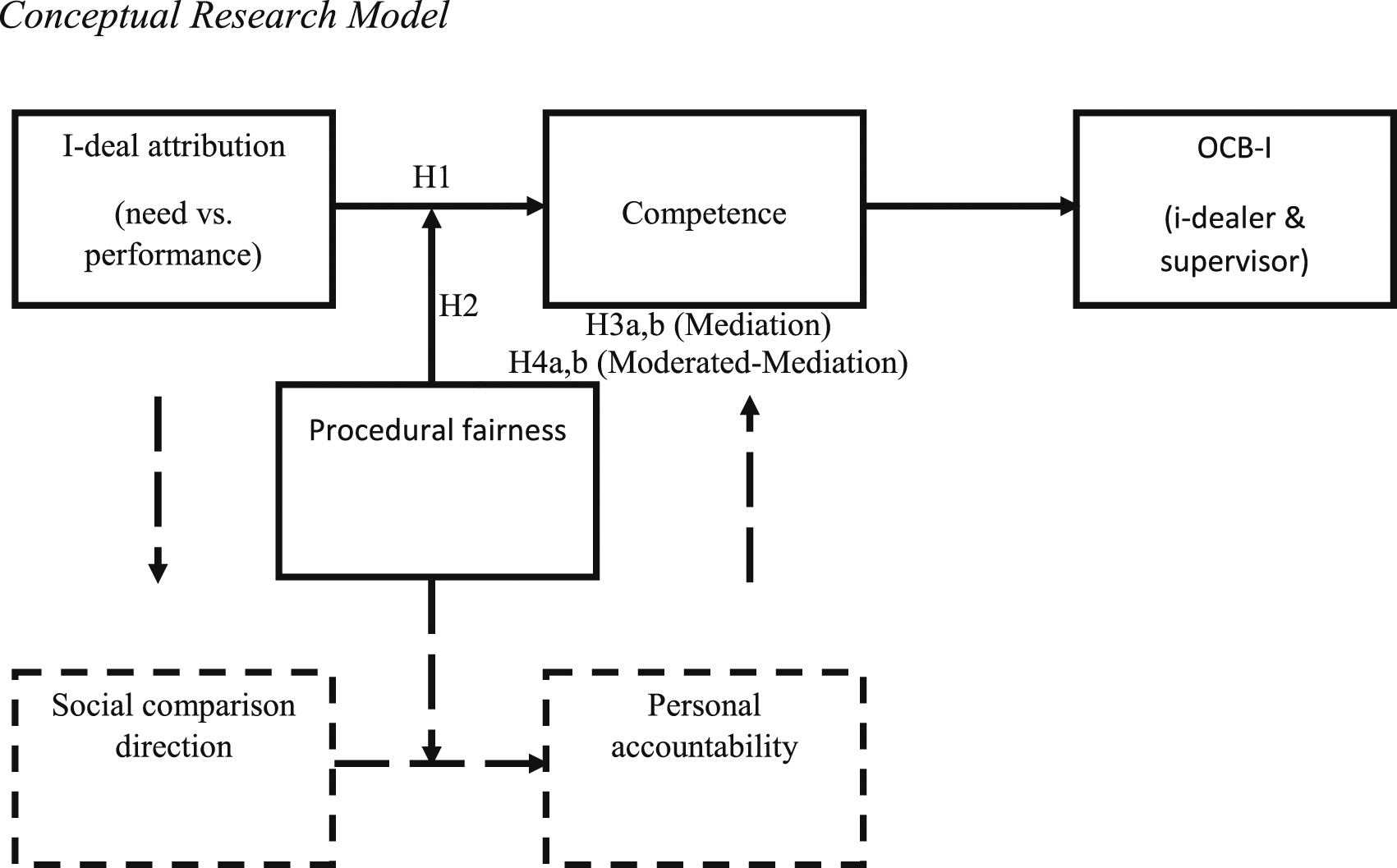
Theory and Hypotheses
Prior work on i-deals mainly focused on identifying the positive outcomes of granting i-deals, including improved work-life balance, job satisfaction, affective organizational commitment, work motivation, extra-role behavior, and retention (for an overview, see Liao, Wayne, & Rousseau, 2016). Despite ample evidence that these benefits accrue via favorable social exchanges between i-dealers and the persons granting them (Conway & Coyle-Shapiro, 2015), this dyadic perspective is not suitable to gather insights into coworkers’ reactions to i-deals. To understand how i-deals implicate others, we draw on social comparison theory (Greenberg et al., 2007), together with work on attribution mechanisms (e.g., Heider, 1958; Weiner, 2008) and specific justice-based reactions (e.g., Brockner et al., 2003, 2009).
A Social Comparison Perspective on Coworker Reactions to Flexibility I-deals
When coworkers notice that an i-dealer is treated differently, they are triggered to evaluate themselves against this comparable other (e.g., Marescaux, De Winne, & Rofcanin, 2019; Vidyarthi et al., 2016). Feeling worse off than the i-dealer may result in envy (Ng, 2017), higher levels of emotional exhaustion (Kong, Ho, & Garg, 2020) and even activate coworkers to seek i-deals for themselves (e.g., Ng, & Lucianetti, 2016), to voice their complaints about the arrangement and/or to request some other form of compensation (e.g., Marescaux, De Winne, & Sels, 2019). Yet, beliefs about future i-deal opportunities may alleviate dysfunctional reactions. Coworkers are more likely to accept an i-deal when they expect an i-deal of their own in the future (Lai et al., 2009) and even to display more helping behaviors at work in anticipation of it (Huo, Luo, & Tam, 2014). Although these results refer to i-deal research in general, the few studies on coworkers’ reactions to flexibility i-deals point in the same direction (Marescaux, De Winne, & Sels, 2013; 2019; Zhang et al., 2020). Hence, this emerging research suggests that coworker reactions to a flexibility i-deal closely mirror how they position themselves vis-à-vis the i-dealer. However, what has remained underdeveloped, is the understanding of the direction of the social comparison (i.e., upward and downward) and the subsequent self-evaluations and behaviors (i.e. negative or positive). Yet, understanding these mechanisms can increase our insights in the boundary conditions that determine whether i-deals have a bright or a dark side. As depicted in Figure 1, we examine how attributions (i.e., a coworker’s beliefs about why the i-dealer was granted a flexibility deal) and the procedural fairness of flexibility i-deals predict coworkers’ feelings of competence and subsequent OCB.
Attributions of Flexibility I-deals and Competence Feelings
Individuals make attributions rather automatically to figure out what is happening around them (e.g., Heider, 1958). Through a lens of social comparison (Greenberg et al., 2007), we argue that attributing another’s flexibility i-deal to higher needs or to better performance affects how coworkers perceive and evaluate their own competence. Competence refers to feeling effective to interact with the environment and to successfully tackle challenges or obtain desirable outcomes (Van den Broeck, Vansteenkiste, De Witte, & Lens, 2008).
I-deals are generally regarded as effective when they either address needs or reward expectations of employees (Rousseau, 2005). Need-based flexibility i-deals can create a return on investment through resolving practical issues at work and/or home (Bal & Jansen, 2016). Parallel to this, granting flexibility as a performance-based reward can help employers to attract, motivate and retain valuable employees (Liao et al., 2016). In practice, i-deal requests are indeed mostly formulated as arguments about how improved conditions should help to streamline private and work lives (cf. needs) or, alternatively, as claims of entitlement whereby i-dealers consider themselves as high performers that deserve more beneficial work conditions (Bal, 2018). Based on these commonalities in why i-deals are requested and granted, it is reasonable to assume that coworkers’ attributions align with this, such that they ascribe another’s i-deal either to greater needs or to better performance. However, in a comparison context, the type of attribution may have a fundamentally different impact on coworker’s self-appraisals such as their competence feelings. This follows directly from the main tenets of attribution theory (e.g., Weiner, 2008) that posits that attributions tend to be self-serving by explaining events and behaviors in such a manner that they protect or enhance self-esteem. To this end, attributing another’s flexibility advantage to an external and uncontrollable factor such as needs should be less threatening to the self than attributing it to an internal and controllable factor such as performance. Moreover, coworkers who attribute a flexibility i-deal to the recipient’s needs will probably not experience competition with the i-dealer and might even consider the i-dealer to be worse off (i.e., a downward social comparison) due to an acknowledged need. However, when the same i-deal is attributed to performance, it may be perceived as a reflection of the other’s merits (i.e., an upward social comparison) and signal that the own abilities fell short or were not recognized.
To summarize, the opposing social comparison directions that are initiated by the type of the i-deal attribution should implicate competence feelings in corresponding ways. This idea connects with robust findings in research on self-evaluations that link upward social comparisons to sentiments that the own competence pales in contrast relative to the comparison-other (e.g., Tesser, 2000). Accordingly, we hypothesize as follows:
Coworkers who attribute a flexibility i-deal to the needs of the i-dealer feel more competent, relatively to coworkers who attribute it to the performance of the i-dealer.
The Role of Procedural Fairness of the Allocation of Flexibility I-deals
Since Thibaut and Walker’s (1975) seminal work on procedural justice, scholars narrate the adage that employees do not merely react to what the organization does but also to how it is done. This is particularly scrutinized in the face of unfavorable outcomes (Folger & Cropanzano, 1998). Evidentially, scholars emphasize that a fair i-deal decision process is critical to reduce inequality concerns of coworkers (Hornung et al., 2018). Ironically though, prior work on justice suggests that there is a dark side to high levels of procedural fairness.
Inspired by Brockner and Wiesenfeld’s (1996) landmark study on the negative side of fair procedures, the reversion of procedural fairness benefits is the most illustrative in the work of van den Bos et al. (1999) and Brockner’s subsequent studies (Brockner et al., 2003, 2009). This work shows that the favorability of a given outcome and procedural fairness interactively predict self-evaluations. This effect implies that when individuals are confronted with an unfavorable outcome, fair procedures can actually diminish positive self-evaluations by forcing individuals to hold themselves accountable for it. This personal accountability, however, vanishes when procedures are perceived to be unfair because it pushes forward the idea that the unfavorable outcome was the result of a flawed decision-making process. Khan et al. (2014) reported this effect in a social comparison context. Their work suggests that high levels of procedural fairness can lead to more envious and counterproductive reactions to an upward social comparison, because then the own inferior position is interpreted in terms of lacking ability and not by the excuse of a bad procedure.
Building on this, we argue that the perceived procedural fairness of the allocation of a flexibility i-deal interacts with i-deal attributions to predict competence feelings by affecting the extent that coworkers consider themselves accountable for their social position (i.e., superior or inferior) relative to the i-dealer. For coworkers who attributed a flexibility i-deal to another’s existing need, a fairly perceived procedure merely indicates that there actually was a high need for the i-dealer. This unlikely promotes doubts about the own efforts or accomplishments. Rather, a fair procedure should magnify a downward social comparison and benefit self-perceived competence while an unfair procedure would temper any superiority feelings by, for example, making the i-dealer’s needs appear as more questionable in nature. For coworkers who attributed the flexibility i-deal to excellent performance, we can expect opposite effects. A fair procedure may reinforce the idea that the i-dealer could cut a special deal by outperforming the rest, thereby reducing self-perceived competence. In contrast, an unfair procedure may disable the tendency for ascribing the felt inferiority to oneself by putting the unfair process or procedure forward as the more obvious and preferred explanation for why someone else was granted more flexibility. Here, a seemingly flawed procedure may surpass any personal accountability and be reassuring for coworkers’ competence feelings. Accordingly, we hypothesize as follows:
The perceived procedural fairness of a flexibility i-deal allocation moderates the impact of different i-deal attributions on competence feelings, such that high, relatively to low, procedural fairness relates to higher feelings of competence in the case of a need attribution but to lower feelings of competence in the case of a performance attribution.
Coworkers’ Organizational Citizenship Behaviors
Having discussed how the interplay between attributions and procedural fairness relates to competence feelings, we now discuss how this may subsequently affect OCB. OCB refers to discretionary behavior that promotes organizational effectiveness but is not directly or explicitly recognized by the formal reward system (Organ, 1988). This can be directed at the organization (e.g., by defending the organization against criticism), or at specific individuals in the organization (e.g., by helping the supervisor or coworker; Williams & Anderson, 1991). Consistent with the interpersonal character of i-deal negotiations, we focus on OCB directed at the i-dealer and at the supervisor.
Employees who feel competent also feel better and function more optimal at work (Van den Broeck, Vansteenkiste, De Witte, Soenens, & Lens, 2010). This is partly signaled by the link between feelings of competence and OCB. Meta-analytic evidence shows that employees are more motivated and willing to go above and beyond their in-role responsibilities when their competence feelings are fostered (Van den Broeck, Ferris, Chang, & Rosen, 2016). When such feelings are absent, employees can become frustrated (e.g., Baumeister, Smart, & Boden, 1996) and motivated to improve or restore their self-esteem by engaging in defensive or even counterproductive behaviors (e.g., Vogel & Mitchell, 2017). Moreover, prior work on self-evaluations shows that uncomfortable cognitions trigger various dysfunctional reactions to target those who are assumed to be responsible for feeling bad (e.g., Cohen-Charash, 2009), with such reactions at least manifesting through less willingness to display OCB. Altogether with the prediction of coworkers’ emotional reactions to i-deals (i.e., Hypothesis 1) and the moderating role of procedural fairness (i.e., Hypothesis 2), the above reasoning can be embedded into a moderated-mediation model where competence feelings are positioned as a mediator of the effects of coworker i-deal attribution on OCB and procedural fairness perceptions as a moderator of such effects. This results in the two final hypotheses:
Coworkers’ competence feelings mediate the relationships between their attributions of i-deals and OCB directed at the i-dealer (Hypothesis 3a) and the supervisor (Hypothesis 3b).
Coworkers’ procedural justice judgements about flexibility i-deals moderate the indirect effects of the type of i-deal attribution on OCB directed at the i-dealer (Hypothesis 4a) and the supervisor (Hypothesis 4b).
The Present Research
We conducted two complementary vignette experiments to evaluate coworker reactions to flexibility i-deals. An experimental vignette methodology allows the assessment of undesirable workplace experiences and extreme conditions that would be difficult or unethical to test in real field situations and is suitable to test causal assumptions while minimizing impression management in the responses (e.g., Aguinis & Bradley, 2014). Based on the assumption that different attributions steer different social comparisons, Study 1 tests whether the type of i-deal attribution predicts coworkers’ feelings of competence (Hypothesis 1) and through this their OCB tendencies toward the i-dealer and supervisor (Hypotheses 3a and 3b). Based on the assumption that high procedural fairness increases one’s personal accountability for the made comparison, Study 1 further assesses whether the procedural fairness of the i-deal allocation moderates these effects (Hypotheses 2, 4a and 4b). In Study 2, the focus lies on testing the underlying mechanisms (i.e., social comparison direction and personal accountability) that are presumed to explain the findings of Study 1.
Study 1
Study 1 focuses on the hypotheses that are represented by the top part of our conceptual research model (Figure 1). To this end, we manipulated the type of i-deal attribution and the level of procedural fairness of an i-deal decision to test its interactive effect on feelings of competence and subsequent intent to display OCB.
Method
Participants
The data were gathered in December 2019 and came from a professional online research panel, Qualtrics, comprised of 260 Flemish employees (i.e., from the Dutch speaking part of Belgium). This approach is considered to be as reliable as more traditional data-collection methods (Buhrmester, Kwang, & Gosling, 2016). To be eligible to take part in the study, participants had to hold a full-time job with at least one year of professional tenure. We specified that both sexes had to be represented equally and that the distribution of age, employment contract, educational background, and function level should be congruent with the overall Flemish working population.
Fifty-one percent of the respondents is male and the average age at the time of the survey was 42.24 (SD = 10.93). The average tenure with the current employer was 12.46 years (SD = 10.57) and 20.48 years (SD = 12.02) across different employers. The majority was employed in the private sector (81%). More than half of the participants had continued their education after secondary school, with 39% having obtained a bachelor degree and 19% a master degree. They worked at several function levels, being operational staff (41%), administrative/supportive staff (29%), professionals (16%), and middle management (11%).
Procedure
The participants were randomly assigned to one condition of a 2 × 2 between-subjects factorial design in which the type of i-deal attribution (the i-dealer’s need vs. performance) and the procedural fairness of an i-deal allocation (low vs. high) were manipulated to assess their impact on self-reported feelings of competence and OCB. Beforehand, participants were instructed to imagine and empathize with a described work situation (i.e., a vignette) to the best of their abilities. We informed that participation was anonymous, voluntary and could be withdrawn at all times. Participants had to agree with an informed consent box before they could begin with the study.
In line with prior work on coworker reactions to i-deals (e.g., Marescaux, De Winne, & Sels, 2019), the first paragraph of all vignettes provided the same contextual information about a hypothetical colleague’s i-deal that was exemplified as an arrangement regarding more flexibility in choosing when, where and how to work. Based on Rousseau’s (2005) conceptualization of i-deals, we underscored that the arrangement exclusively applied to the i-dealer and was negotiated with the supervisor. In the second paragraph, we manipulated the type of i-deal attribution. In the conditions that aimed to induce a need (vs. performance) attribution of the i-deal, participants read as follows:
When you wonder about why this arrangement was made, you know that your colleague does not perform above average (versus does not have a personal need for more flexibility). Therefore, you suspect that your colleague negotiated this arrangement on the basis of a personal need for more flexibility (versus an above average performance).
Next, the procedural fairness of the i-deal allocation was manipulated. Adopted from Leventhal’s (1980) theory of procedural justice, we considered the allocation decision to be fair when the supervisor acted ethical, unprejudiced, consistent, and made careful decisions by using complete and accurate information. Participants in the low (vs. high) procedural fairness conditions read the following text:
Following conversations with others and your own daily observations, you know that your supervisor generally acts in an unethical (versus ethical) and prejudiced (versus unprejudiced) fashion. Typically, the decisions made by your supervisor are not careful (versus careful) and are based on inaccurate (versus accurate) information. Moreover, your supervisor does not always (versus always) comply with the rules of the organization, causing you and your colleagues to be often (versus rarely) surprised by certain decisions.
After reading the vignette, participants were explicitly instructed to carefully think about how they would actually feel and respond when the given scenario occurred in real life and to complete the measures that followed accordingly (listed in Appendix).
Measures
Results
Manipulation Checks
The two manipulations appeared to be successful. First, all participants made the intended inference about why the colleague described in the vignette received an i-deal. Second, participants who had read a vignette in which the procedural fairness of the i-deal allocation was intended to be low also rated procedural fairness lower (M = 2.43) than when it was intended to be high (M = 3.70), F(1, 259) = 87.15, p < .001.
Tests of Hypotheses
Descriptive statistics, correlations and Cronbach’s alphas.
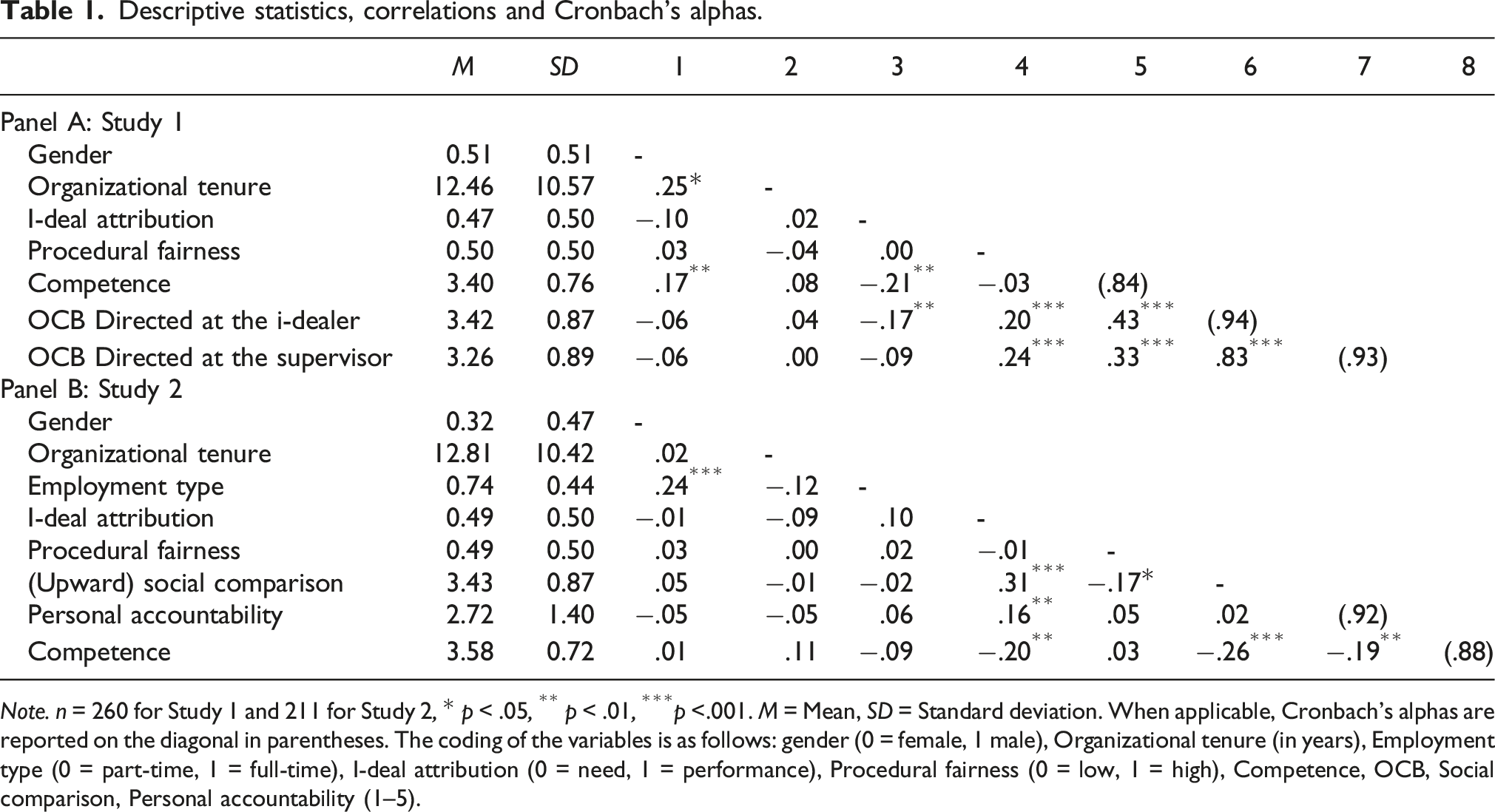
Note. n = 260 for Study 1 and 211 for Study 2, * p < .05, ** p < .01, ***p <.001. M = Mean, SD = Standard deviation. When applicable, Cronbach’s alphas are reported on the diagonal in parentheses. The coding of the variables is as follows: gender (0 = female, 1 male), Organizational tenure (in years), Employment type (0 = part-time, 1 = full-time), I-deal attribution (0 = need, 1 = performance), Procedural fairness (0 = low, 1 = high), Competence, OCB, Social comparison, Personal accountability (1–5).
To evaluate the hypotheses, we followed Breitsohl’s (2019) recommendations on analyzing experimental data and used a Structural Equation Modeling (SEM) technique. This allowed us to take measurement error into account and to simultaneously evaluate multiple dependent variables while also adjusting the effects of interest for control variables. According to Hu and Bentler’s (1999) stringent criteria, a well-fitting model is indicated by a chi-square (χ 2 )/degrees of freedom (df) ratio lower than 3, scores on goodness-of-fit indices (e.g., comparative fit index, CFI and Tucker–Lewis index, TLI) close to .95 and scores on badness-of-fit indices (e.g., root mean square error of approximation, RMSEA and standardized root mean square residual, SRMR) equal to or smaller than .06 and .08, respectively. We used the Lavaan package in R (Rosseel, 2012) to tabulate the results and report the Satorra–Bentler chi-square difference test (TRd) that adjusts for non-normality with ordinal data (Satorra & Bentler, 2001) to compare different models.
In a first step, we conducted a confirmatory factor analysis (CFA) with maximum likelihood estimation with robust standard errors on the 22 items that measured the three latent factors: feelings of competence, OCB directed at the i-dealer and OCB directed at the supervisor. Because OCB was measured twice by the same 8 items with different referents, we allowed the residual variances of matching items to be correlated. The hypothesized measurement model fitted well to the data, χ 2 = 344.18, p < .001, χ 2 /df = 1.74, CFI = .96, TLI = .95, RMSEA = .05, SRMR = .06. Because the factor loading of the first item of feelings of competence was lower than .50 (i.e., .37), it had to be removed from subsequent analyses (Tabachnick & Fidell, 2007). Doing so significantly improved the model fit (TRd(20) = 72.37, p < .001), which was χ 2 = 276.22, p < .001, χ 2 /df = 1.55, CFI = .97, TLI = .97, RMSEA = .05, SRMR = .05. The congeneric reliabilities of feelings of competence, OCB directed at the i-dealer and at the supervisor were very good, with values of .86, .93 and .93, respectively.
In a next step, we performed SEM to estimate three models. In each model, we regressed the control variables on feelings of competence and both types of OCB. A first mediation model tested the independent effect of the i-deal attribution (0 = needs, 1 = performance) on OCB via feelings of competence (Hypotheses 1, 3a and 3b), the second model added the procedural fairness of an i-deal allocation (0 =low, 1 = high) and its interaction with the i-deal attribution on competence feelings (Hypotheses 2, 4a and 4b), and a third model constrained this interaction effect to zero, representing the null hypothesis.
The mediation model yielded a good fit, χ 2 = 351.60, p < .001, χ 2 /df = 1.50, CFI = .97, TLI = .96, RMSEA = .04, SRMR = .05. In line with Hypothesis 1, the unstandardized path estimates showed that attributing an i-deal to performance related to lower feelings of competence relative to the participants who attributed it to needs (β = −.33, SE = .10, p < .01). In turn, competence feelings were positively related to OCB directed at the i-dealer (β = .55, SE = .09, p < .001) and the supervisor (β = .45, SE = .10, p < .001), thereby providing initial support for Hypothesis 3a and 3b.
Figure 2 presents the hypothesized moderated-mediation model. This model exhibited a good fit (χ
2
= 421.68, p < .001, χ
2
/df = 1.54, CFI = .96, TLI = .96, RMSEA = .05, SRMR = .06). For the purpose of clarity, the estimates of control variables are not depicted but reported as a note if they were significant. The paths between competence feelings and both types of OCB were identical to those of the mediation model and, thus, were positive and significant. The effect of the interaction between i-deal attributions and the procedural fairness of an i-deal allocation on feelings of competence was significant (β = −.58, SE = .21, p < .01). Moreover, the R
2
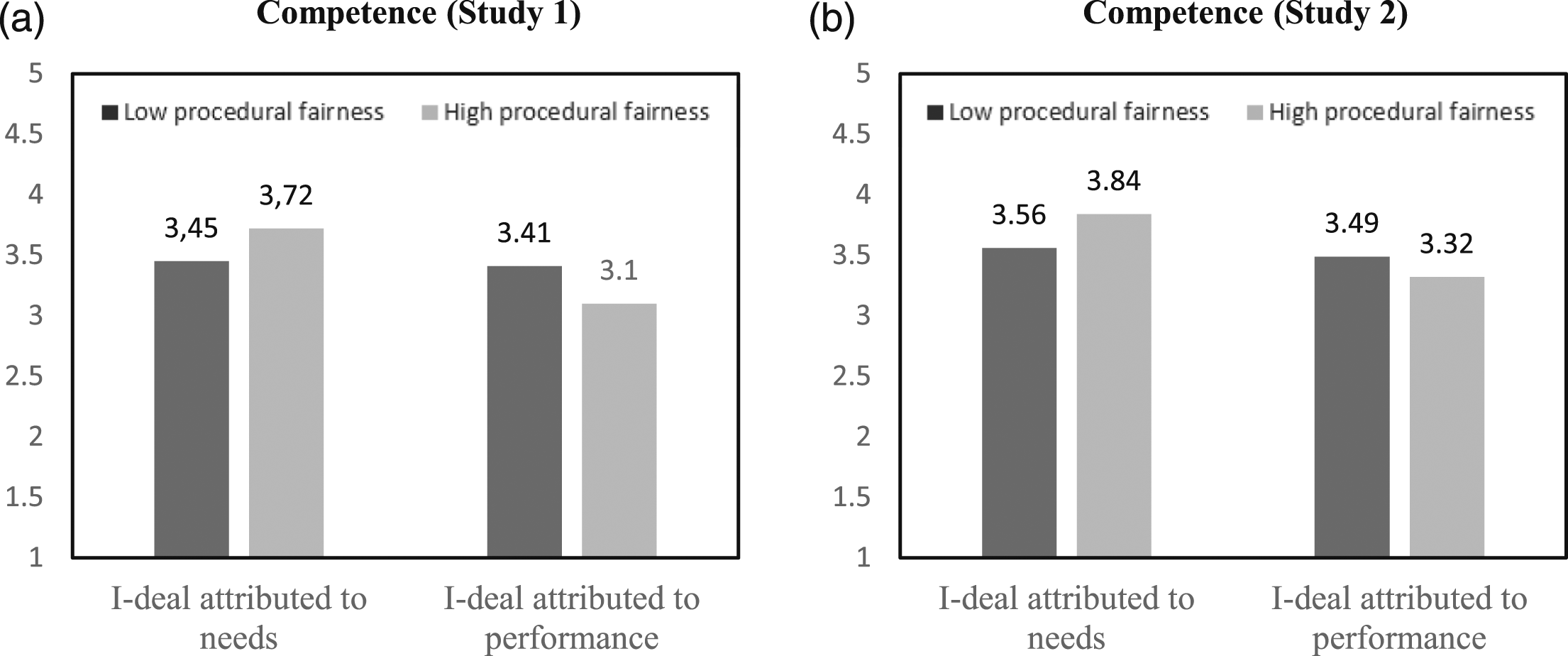
values suggest that the effect sizes range from medium for feelings of competence (i.e., 9%) to considerably larger for both types of OCB (i.e., 27% and 16%). Comparing this model to a third model that constrained the interaction effect to zero deteriorated fit (TRd(1) = 7.39, p = .006), thereby further supporting the presence of the interaction effect. To visualize the interaction, we used the estimated intercept of feelings of competence and the corresponding regression equation to calculate the means of each condition. Figure 3a demonstrates that the interaction effect is in line with Hypothesis 2. As can be seen, at high levels of procedural fairness, participants who made a need attribution reported more feelings of competence than those at low levels. The participants who made a performance attribution, however, appear to have felt less competent when procedural fairness was high rather than low. Results of the hypothesized structural equation model (Study 1). Note. n = 260. **p <.01, ***p <.05, n.s.p > .05. The fit indices of the model were χ
2
= 421.68, p < .001, χ
2
/df = 1.54, CFI = .96, TLI = .96, RMSEA = .05, SRMR = .06. For clarity purposes, the factor loadings of latent variables and unstandardized path estimates (standard errors) for control variables are not shown but are available upon request from the corresponding author. Gender (0=female; 1=male) was negatively related to OCB directed at the i-dealer, −.22*(.10). The interactive effects of the type of I-Deal attribution and procedural fairness on competence.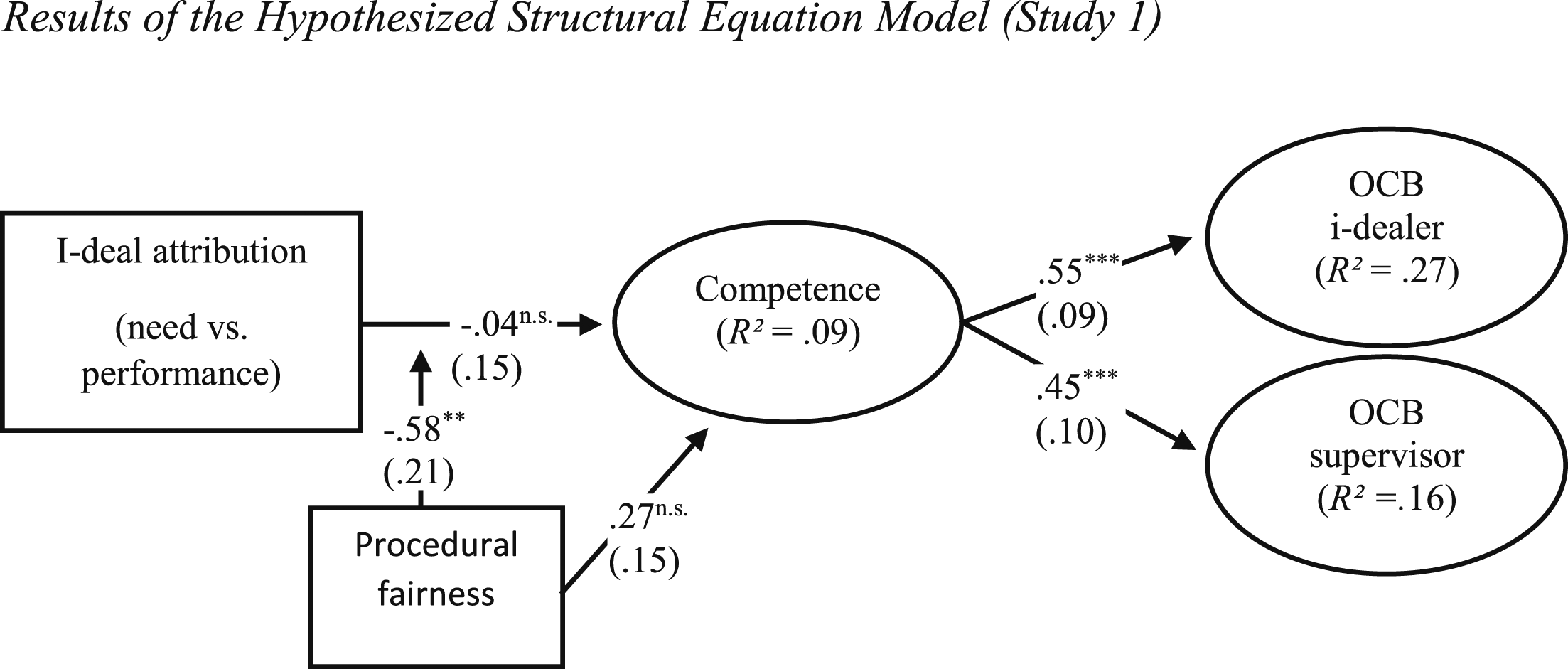
To further evaluate Hypotheses 3a, 3b, 4a, and 4b, we computed the conditional indirect effects of i-deal attributions using Hayes’ (2018) technique that calculates the unstandardized indirect effects and SE’s for each of 10,000 bootstrapped samples and their 95% confidence intervals (CIs). The results revealed that i-deal attributions relate to both types of OCB via feelings of competence (Hypotheses 3a and 3b) and that these indirect effects are conditional upon the level of procedural fairness (Hypotheses 4a and 4b). The moderated-mediation index regarding the prediction of OCB directed at the i-dealer (−.25, SE = .10, CI = −45 to −0.07) and at the supervisor (−.20, SE = .09, CI = −38 to −0.05) were significant. The conditional indirect effects show that when procedural fairness was high, the type of i-deal attribution had a significant effect – via competence – on both OCB directed at the i-dealer (−0.26, SE = .08, CI = −0.43 to −0.13) and at the supervisor (−0.21, SE = .07, CI (−0.36 to −0.09). When procedural fairness was low, however, both indirect effects were not significant. This signals that the indirect effects vary across levels of procedural fairness.
In sum, Study 1 suggests that coworkers who attribute a flexibility i-deal to the performance of the i-dealer display less OCB than coworkers who attribute an i-deal to the needs of the i-dealer. This can be explained by the different impact of need and performance attributions on coworkers’ competence, with need attributions resulting in more felt competence than performance attributions. Moreover, these effects were found to be conditional upon the perceived procedural fairness of supervisors’ i-deal allocation decisions. While feelings of competence (and OCB) seem to benefit from high levels of procedural fairness for coworkers who attributed the flexibility i-deal to the recipient’s needs, the opposite is true for coworkers who attributed it to the recipient’s performance.
Study 2
A first aim of Study 2 was to replicate Study 1’s findings. To this end, we collected additional data to examine the independent effect of the type of i-deal attribution (Hypothesis 1) and its interaction effect with procedural fairness (Hypothesis 2) on feelings of competence. A second aim was to extend Study 1 by exploring the underlying mechanisms of the interaction effect as mentioned in the underpinning of the hypotheses (depicted on the bottom part of Figure 1). In doing so, we assessed whether the type of i-deal attribution implied a different social comparison direction (i.e., upward or downward), which then interacts with procedural fairness to predict the personal accountability for the made comparison and explains subsequent competence feelings.
Method
Participants
In March 2020, we recruited 211 employees to participate in an online study that was similar to Study 1. The inclusion criteria regarding location and language (Dutch speaking Belgian employees) and prior working experience (at least 1 year) remained the same. Having used a probability sample technique in Study 1, we used a convenience sampling approach through social media to collect the data because we were less concerned with the possibility of under-representation of subgroups. Furthermore, by randomly assigning vignette texts to participants, the potential differences between them can be assumed to be distributed equally across all conditions (e.g., Field & Hole, 2003).
The sample was comprised of well-educated employees, with 41% reporting to hold a bachelor’s degree and 37% a master’s. Most participants worked for small-and medium sized enterprises (40%, less than 250 employees) or for organizations employing more than 1000 employees (37%). Forty-seven percent worked in the quaternary sector, 34% in the tertiary sector. The majority is female (68%) and the average age at the time of the survey was 43.42 years (SD = 11.32). The average tenure with the current organization was 12.81 years (SD = 10.42) and amounted to 20.18 years of total work experience (SD = 11.52). Around 73% of the sample was employed full-time and 87% held a permanent job contract. The respondents worked at several function levels (operational: 33%, middle management: 21%, professional: 20% and administrative/supportive: 19%). To assess sampling bias, we tested for significant differences in terms of these characteristics across the four experimental conditions but could not find any.
Procedure
We used the same 2 × 2 between-subjects factorial design of Study 1, but now solicited participants’ responses to measures of social comparison direction and personal accountability instead of OCB (see Appendix for the full list of items).
Measures
Results
Manipulation Checks
The results show that the two manipulations succeeded as all participants reported the intended i-deal attribution (need or performance) and procedural fairness was significantly lower in the low procedural fairness conditions (M = 1.98, SD = 0.53) than in the high procedural fairness conditions (M = 3.86, SD = 0.63; F(1, 210) = 547,60, p < .001).
Tests of Hypotheses
The summary statistics (see Panel B of Table 1) suggest that attributing a flexibility i-deal to performance is associated with lower levels of felt competence than attributing it to needs. The type of i-deal attribution was also correlated with social comparison and personal accountability in the directions predicted. Moreover, these two variables revealed a negative correlation with competence, suggesting that an upward social comparison (i.e., feeling inferior) and feeling personally accountable for it are associated with feeling less competent.
To be consistent with Study 1, we first conducted a CFA on the 8 items that measured personal accountability and feelings of competence. Considering that RMSEA values can be artificially larger for small sample sizes and low df models (Kenny, Kaniskan, & McCoach, 2015), the model fitted reasonable (χ 2 = 53.92, p < .001, χ 2 /df = 2.84, CFI = .95, TLI = .93, RMSEA = .11, SRMR = .05). All factor loadings were significant (p < .001) and loaded highly on their intended construct. The congeneric reliabilities of personal accountability (.92) and feelings of competence (.88) were very good. While these results provided confidence in the psychometric properties of our multi-item scales, it could also be expected that continuing with SEM to fit a more complex model would only deteriorate model fit to the extent of becoming untrustworthy (Breitsohl, 2019). Instead, we analyzed the covariance (i.e., ANCOVA), which allowed us to detect whether differences in the means of feelings of competence could be attributed to the manipulations, whilst controlling for gender, organizational tenure and employment type, and further applied Hayes’ (2018) conditional process analysis technique that—consistent with Study 1—used bootstrapping to obtain 95% CI for the estimated effects.
In line with Hypothesis 1, the ANCOVA results revealed that there was a significant difference in the reported level of competence feelings between participants who made a need versus performance attribution, F(1, 195) = 8.34, p < .01). The estimated marginal means were significantly (p = .004) lower in the performance attribution conditions (M = 3.40, SE = .07, 95% CI: 3.26–3.55) compared to the need attribution conditions (M = 3.70, SE = .07, 95% CI: 3.56–3.84). The partial Eta Squared value indicates a small effect size of 4.2%. There was no significant main effect of procedural fairness nor of any of the covariates. The interaction effect between the two manipulated factors on feelings of competence was significant, F(1, 195) = 4.89, p < .05) with a partial Eta Squared value of 2.5%. This interaction effect confirms Hypothesis 2 and is visualized in Figure 3b. The estimated marginal means mirror the same pattern of Study 1’s results, indicating that the effects of the i-deal attribution on competence are more pronounced when procedural fairness is high. Levene’s test of equality of error variances that checks the homogeneity of variance assumption was not significant (F (3,191), 2.07, p = .11) and suggests that the variances across the conditions were not different, thereby endorsing the aforementioned results.
Conditional process analysis predicting personal accountability and competence (Study 2).
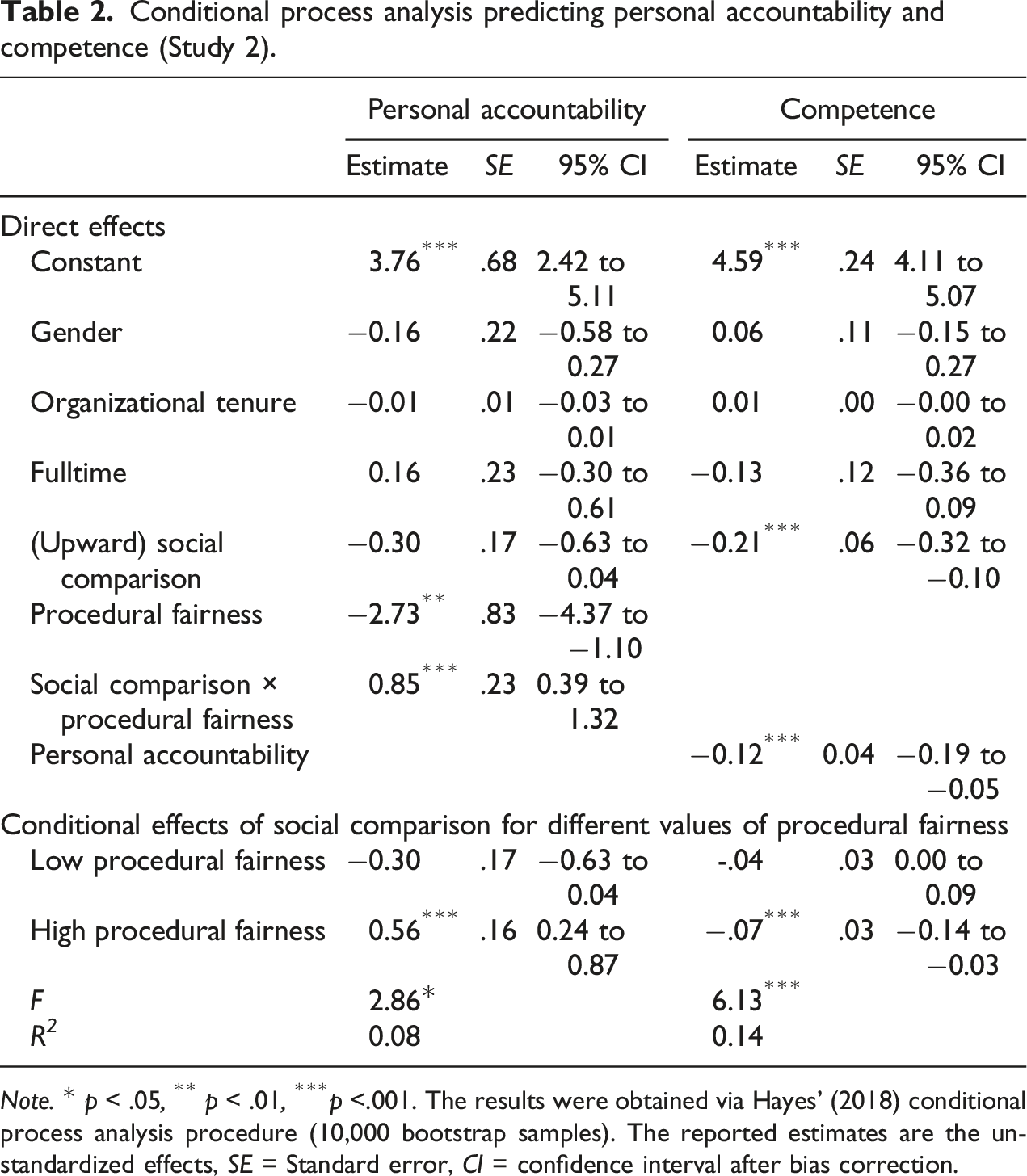
Note. * p < .05, ** p < .01, ***p <.001. The results were obtained via Hayes’ (2018) conditional process analysis procedure (10,000 bootstrap samples). The reported estimates are the unstandardized effects, SE = Standard error, CI = confidence interval after bias correction.
Discussion
This study makes a novel contribution in understanding i-deal implications for coworkers by theorizing and testing how the interaction of two cognitions about flexibility i-deals account for significant differences in important coworker reactions to i-deals.
We provide evidence that coworkers who develop need attributions (vs. performance attributions) about another’s flexibility i-deal feel more (vs. less) competent and that this effect is more pronounced when procedural fairness is high. In turn, the competence feelings derived from these cognitions appear to affect the willingness to display OCB directed to the i-dealer and the supervisor. Beyond demonstrating the robustness of the interactive effect of i-deal attributions and procedural fairness on competence, we further explain this effect through social comparison and the extent to which fair procedures influence one’s personal accountability for the made comparison.
Theoretical Implications
Consistent with previous empirical work (Marescaux, De Winne, & Sels, 2013; 2019; Zhang et al., 2020) and recent conceptual work (Marescaux, De Winne, & Rofcanin, 2019) on coworkers’ reactions to (flexibility) i-deals, our results show that coworkers compare themselves to the i-dealer. Adding to this, our research suggests that i-deal attributions predict whether coworkers will engage in an upward or downward social comparison, and exhibit matching responses. Particularly, Study 2 shows that coworkers who attribute a flexibility i-deal to needs tend to evaluate themselves as better off than the i-dealer, while coworkers who attribute an i-deal to excellent performance rather evaluate the other as such. These initial self- and other-oriented beliefs that emerge via attributing an i-deal (e.g., inferior self/superior other beliefs for a performance attribution) initiate divergent, yet corresponding emotional and behavioral reactions. More specifically, need attributions appear to result in feeling more competent and more willingly to display OCB directed at the i-dealer than performance attributions. These findings connect with Marescaux and De Winne’s (2015) study that shows that although coworkers respond positive to both need and equity-driven i-deal allocations, they prefer need-based arguments to allocate i-deals.
By linking i-deal attributions to social comparison processes, we strengthen the understanding of organizational justice in the i-deal literature. When it comes down to treating employees differently in a work context, both need (e.g., Armstrong-Stassen & Ursel, 2009) and performance-based (e.g., Lepak & Snell, 1999; Collings & Mellahi, 2009) motives are considered as valid grounds. In this sense, prior research shows that decisions based on these grounds effectively reduce perceived discrimination, mistrust and lack of cohesion (Marescaux, De Winne, & Sels, 2013) and generally improve coworker reactions to i-deals (e.g., Marescaux, De Winne, & Sels, 2019). Our research further refines this work by showing that the valence and intensity of how coworkers respond to flexibility i-deals depends on the used distributive-justice norm of an i-deal decision as varying beliefs in this regard may have different effects. When flexibility i-deals are believed to be allocated based on needs and not on performance, coworkers tend to respond better to them as signaled by their higher levels of competence feelings and OCB. This can be explained by attribution theory (Weiner, 2008) and the phenomenon of self-serving bias more specifically. This bias implies that individuals respond better to the success of others when it was obtained via external and/or uncontrollable factors such as those caused by specific circumstances (e.g., needs) rather than based on internal and/or controllable factors such as the own merits (e.g., performance).
The examination of procedural fairness has theoretical implications that may advance the current thinking on the role of organizational justice in making i-deal decisions as well. We found that high levels of perceived procedural fairness do not automatically benefit coworkers’ self-evaluations and their subsequent action tendencies. In both studies, we found evidence that under high levels of procedural fairness, a flexibility i-deal that is attributed to needs results in better competence feelings than when an unfair procedure is used. However, when a performance-based i-deal attribution is made, high levels of procedural fairness was shown to contribute to lower levels of felt competence. Study 1 further supported the idea that this interaction also explains the relationship between different types of i-deal attributions and OCB via its effect on feelings of competence. For example, a performance-based i-deal attribution related to lower levels of OCB via diminishing feelings of competence, but only when procedural fairness was perceived to be high. Hence, this suggests that experiencing a high level of procedural fairness of an i-deal decision can have an adverse impact on coworkers direct emotional responses to witnessing an i-deal. Though this does not contest the well-ingrained belief that emphasizing procedural fairness is crucial in an i-deal context (e.g., Rousseau, 2005), our results do corroborate Brockner et al.’s (2003, 2009) work by showing that procedural fairness can diminish self-evaluations by increasing one’s felt accountability for an unfavorable outcome. In Study 2, we explicate this finding by first linking the type of i-deal attribution to the direction of social comparison to show that different attributions imply a different favorability (e.g., a need attribution represents a more favorable outcome for coworkers, as signaled by their tendency to make a downward social comparison). The results then suggest that when a need-based attribution is made, a fair procedure does not only magnify the belief that the i-dealer’s existing needs are responsible for this person’s improved work arrangements, but also limits the extent to which the i-deal will be explained in the face of the own efforts or accomplishments. Vice versa, when a performance-based attribution is made, a fair procedure also reinforces coworkers’ initial belief about the distinct factor between themselves and the i-dealer, but now, however, it may force coworkers to acknowledge that not an external factor such as needs, but a controllable and internal factor such as performance underlies the decision to award flexibility. The salience of the i-dealer’s performance may direct coworkers’ outlook more inwardly and increase their personal accountability, thereby resulting in feeling less competent themselves.
Practical Implications
In an era in which an individualized approach to HRM (also called HR differentiation) receives increasing attention (Marescaux, De Winne, & Brebels, 2021; Rofcanin et al., 2019), it is important for supervisors to acknowledge that negotiating i-deals has implications beyond those for the i-dealer and the employer, and that i-deals can trigger unintended coworker reactions. The results of this study show that the latter depends upon the perceived basis and fairness of the allocation of i-deals, and can guide and inform practitioners on how to best approach flexibility i-deals in such a way that it triggers positive coworker reactions towards the main parties involved. Supervisors may appreciate to know that justifying inequality via fair procedures and ensuring that coworkers maintain positive self-evaluations is a balancing act. On the one hand, and in line with Rousseau’s (2005) work, we advocate that high procedural fairness is imperative to avoid favoritism concerns regarding i-deals. On the other hand, when i-deals are considered as a token to reward performance, fair procedures may create negative sentiments among coworkers about their own competence which may result at least in passive retaliatory reactions such as less OCB. Two practical solutions for supervisors to avoid a potential dark side of flexibility i-deals are to draw less on equity-driven motives in favor of need-based motives, or alternatively, to considerately communicate that an i-deal does not imply that others are ineligible to make such a deal. This should enhance coworkers’ perceptions that they can receive similar opportunities in the future and result in more support for—and acceptance of—the i-deal (e.g., Huo et al., 2014; Lai et al., 2009; Zhang et al., 2020).
Limitations and Directions for Future Research
This study is bound to conceptual and methodological limitations that readers should be aware of but that could also initiate new avenues for research. First, it makes sense to focus on need and performance-based i-deal attributions because i-deals are conceptually considered to be legitimate (e.g., Rousseau, 2005). And also in practice, i-dealers and supervisors indeed negotiate i-deals on the basis of high needs and excellent performance (Bal, 2018). Nevertheless, resources, such as flexibility obtained from i-deals, can be distributed in many just ways (based on equality, equity, needs, power or responsibility; Folger & Cropanzano, 1998) that could still be perceived as illegitimate, for example, resulting from political motives or a better personal relationship, in the eyes of an unaware coworker. Although we took two hypothetical conditions where procedural fairness was low into account and can therefore provide some initial insights into coworker reactions to perceived unfair deals, it may be worthwhile to explicitly explore the effects of perceived shady i-deals, by, for example, assessing the effects of favoritism attributions.
Another potential limitation concerns the focus on flexibility i-deals. Although this choice is valuable given the ubiquitous nature of flexibility work arrangements in the workplace (Hornung et al., 2018), i-deals can involve other job-related resources (e.g., autonomy, job content, financial incentives) as well (e.g., Rosen et al., 2013) that are not always manifested as visible. Financial dispersion, for example, is much easier to hide (e.g., Colella, Paetzold, Zardkoohi, & Wesson, 2007) and may cause coworkers to be more responsive to justice-based i-deal judgements. Therefore, to further advance the knowledge of coworker judgements of—and reactions to—i-deals, it would be interesting to explore the cognitions and reactions that originate from less salient i-deals.
Finally, while the use of two independent samples provides us high levels of confidence regarding the validity, there are caveats that should be discussed. We relied on self-report measures to capture coworker reactions to flexibility i-deals. Yet, self-evaluations such as feelings of competence have also been shown to operate at more implicit levels without conscious control (e.g., Johnson & Saboe, 2011). Although we presented very specific situations to the participants and solicited their state-based competence feelings, there is some scope left to figure out how these feelings relate to behavioral reactions in the field and over time. This requires a time-lagged paradigm to further inform us about the broader impact of i-deals on third-parties.
Conclusion
Flexibility i-deals create noticeable unequal employment conditions within workgroups that may induce social comparisons. Our results revealed that the two main i-deal attributions made by coworkers initiate opposing social comparison processes that predict important differences in the emotional and behavioral reactions to flexibility i-deals. Based on two studies, we can support the idea that coworkers who attribute a flexibility i-deal to the recipient’s needs feel more competent than those who make performance attributions. Moreover, high levels of procedural fairness pronounce this effect, suggesting that more fairness does not benefit those coworkers who made a performance attribution, but rather reduces their felt competence. In turn, coworkers’ competence feelings predict their willingness to display OCB directed to the i-dealer and the supervisor.
Footnotes
Appendix
OCB Directed at the I-dealer (Supervisor)
1. I would help my colleague (supervisor) after being absent 2. I would willingly give time to help my colleague (supervisor) with work-related problems 3. I would adjust my work schedule to accommodate my colleague’s (supervisor’s) request for time off 4. I would go out of the way to make my colleague (supervisor) feel welcome in the workgroup 5. I would show genuine concern and courtesy toward my colleague (supervisor), even under the most trying business or personal situations 6. I would give up time to help my colleague (supervisor) with work or nonwork problems 7. I would assist my colleague (supervisor) with their duties 8. I would share personal property with my colleague (supervisor) to help their work
Personal Accountability
1. My own efforts contributed to this situation. 2. My own abilities contributed to this situation.
Note: (R), Reversed scored item. Feelings of competence were measured in Study 1 and 2. OCB Directed at the I-dealer and Supervisor were measured in Study 1 by administering the same items twice, but with adapted referents. Personal accountability was measured exclusively in Study 2.
Declaration of Conflicting Interests
The author(s) declared no potential conflicts of interest with respect to the research, authorship, and/or publication of this article.
Funding
The author(s) disclosed receipt of the following financial support for the research, authorship, and/or publication of this article: This research has been funded by the Fund for Scientific Research (FWO; G.0697.16N).

Author Biographies
Associate Editor: Sara Chaudhry