




Abstract
Traditionally, scientific- and practitioner-oriented publications tend to categorize employees in groups of either “good” or “bad” employees, thereby omitting that one category of employees might engage in organizational citizenship behavior (OCB-O) and counterproductive work behavior (CWB-O). In this study, we concurrently examine the mediating role of moral credits and credentials, as well as the moderating role of subjective temporal focus. Specifically, we argue that when employees enact OCB-O, they obtain moral credits and credentials, which in turn might make employees more likely to enact CWB-O. Moreover, we argue that the latter relationships depend on an employee’s subjective temporal focus, resulting in an OCB-O—CWB-O relationship that is (1) positive for a past temporal focus, (2) negative for a future temporal focus, and (3) non-significant for a present temporal focus. We examined these hypotheses by means of a multilevel weekly survey study and largely found support for our hypotheses, especially with regard to the role of moral credentials as the mediating mechanism and the aggravating versus attenuating effect of past versus future temporal focus, respectively. We end with a discussion on implications, suggestions for future research, and recommendations for practice.
Keywords
Organizational behavior and management scholars have increasingly drawn upon moral licensing theory (Merrit, Effron & Monin, 2010; Miller & Effron, 2010) to explain how the enactment of organizational citizenship behavior (OCB-O—beneficial behaviors that promote organizational functioning and effectiveness; LePine, Erez & Johnson, 2002; Organ, 1997) may trigger future enactment of counterproductive work behavior (CWB-O—harmful and dysfunctional behaviors that are not in line with the legitimate interest of the organization; Sackett & DeVore, 2001) toward the organization. In particular, an increasing number of theoretical (e.g., Bolino & Klotz, 2015; Klotz & Bolino, 2013; Spector & Fox, 2010), experimental (e.g., Kouchaki, 2011; Vincent, Emich & Goncalo, 2013), and empirical (e.g., Lin, Ma & Johnson, 2016; Loi, Kuhn, Sahaym, Butterfield & Tripp, 2020; Yam, Klotz, He & Reynolds, 2017) studies have argued, and found, that employees who engage in OCB-O may feel morally justified—in the form of moral credits (i.e., having moral capital due to past behavior that can be spent to compensate for any immoral behavior, thus keeping a positive moral balance) and moral credentials (i.e., having such a strong moral self-regard due to past behavior that any immoral behavior will be downplayed or neglected, leaving the moral self-regard intact)—and therefore may engage in CWB-O.
Notwithstanding the important contributions made by these studies, several scholars have highlighted some key paradoxical findings with respect to the moral licensing effect in the relationship between the enactment of OCB-O and CWB-O. For example, Conway and Peetz (2012) found differences in the outcome of moral licensing depending on the recency of the recollected moral behavior (i.e., more recent past behavior elicits compensatory immoral behavior). Moral licensing constitutes a combination of recollection of past moral behavior (Effron, Miller & Monin, 2012) and the influence of future moral acts that license current immoral behavior (Cascio & Plant, 2015; Kouchaki, 2011). Therefore, one’s subjective time perceptions (i.e., the extent to which one focusses on the past, present, or future; Shipp, Edwards & Lambert, 2009) is likely an important boundary condition that might aggravate or mitigate the moral licensing effect on future enactment of CWB-O. Hence, we examine how one’s temporal focus may dissuade employees from engaging in CWB-O, even when they feel morally entitled—through the accumulated moral credits or credentials—to do so.
The importance of focusing on one’s temporal focus can be substantiated by the argument that employees differ in the extent to which they perceive, understand, and interact with the concept of time (Ancona, Okhuysen & Perlow, 2001), meaning that they can differ in, and alternate between, their temporal focus by either (1) looking back to the past, (2) focusing on the momentary present, or (3) looking ahead to the future (Shipp et al., 2009). This ability to focus on either the past, the present, or the future may have important implications for the founding premise of moral licensing theory (Merrit et al., 2010; Miller & Effron, 2010; Jordan, Mullen & Murnighan, 2011) that one’s enactment of moral behavior in the past (i.e., OCB-O) may result in the acquisition of moral credits or credentials which in turn may trigger future enactment of immoral behavior (i.e., CWB-O).
Specifically, we argue—based on the moral licensing theory (Merritt et al., 2012; Miller & Effron, 2010) and the work on subjective time perceptions (Shipp et al., 2009)—that employees who focus on the past are more likely to recall previously enacted moral behavior (i.e., OCB-O). In doing so, they primarily devote attention to their moral license (moral credits or credentials) acquired through that past moral behavior, which guides and justifies the enactment of future immoral behavior such as CWB-O while overlooking any potential negative consequences (Holman & Silver, 1998; Zimbardo & Boyd, 1999), ultimately leading to engage in future CWB-O. In contrast, individuals characterized by a future temporal focus are more likely to focus on future consequences of their actions. As a consequence, they might anticipate if, and how, using their moral credits and/or credentials might result in potential negative consequences associated with the enactment of CWB-O (Levasseur, Shipp, Fried, Rousseau & Zimbardo, 2020; Miller & Effron, 2010; Monin & Jordan, 2009; Zimbardo & Boyd, 1999), ultimately leading them to refrain from future CWB-O. Finally, individuals with a present temporal focus concentrate on relevant information in the here and now. As a consequence, they are expected to ignore the moral licensing effect that may have ensued from previous enactment of OCB-O, as well as potential negative consequences of future enactment of CWB-O (Shipp et al., 2009; Zimbardo & Boyd, 1999), ultimately leading to a nonsignificant effect.
Our research offers an important theoretical and practical contribution. First, at the theoretical level, we focus on the role of subjective time perceptions as an important boundary condition to offer important theoretical and practical insights into how and when (under which temporal focus; past, present, or future) the acquired moral credits and credentials—following the enactment of previous OCB-O—are likely to trigger future enactment of CWB-O. By integrating temporal focus into the discussion of moral licensing effects in the relationship between OCB-O and CWB-O, scholars are able to define the direction and magnitude of the relationship and its changing nature over time with reference to subjective time perceptions, a key element of “good” time-sensitive theory and research (see Griep & Zacher, 2020). Specifically, by incorporating the role of temporal focus into moral licensing theory, we are able to make more specific predictions with respect to the conditions under which the moral licensing effect is expected to occur; the moral licensing effect would be positive for employees who are focused on the past, negative for employees who are focused on the future, and nonexisting for employees who focus on the present. Second, there are also practical benefits to this study. That is, shifting focus to a future temporal focus (rather than a past temporal focus) may prevent enactment of CWB-O when employees feel morally licensed, thereby providing a way for organizations to continue to promote and incentivize the enactment of OCB-O without the potential negative consequences of its associated moral credits and/or credentials. Indeed, in the practical implications section of this article, we provide guidelines for organizations to support OCB-O in a more cautious, future-oriented, and nuanced way to maximize the benefits associated with OCB-O and minimize the likelihood of CWB-O from occurring.
We begin by reviewing the relevant literature with the objective of generating hypotheses linking enactment of OCB-O to enactment of CWB-O through moral credentials and moral credits (in line with previous arguments and empirical studies; Bolino & Klotz, 2015; Klotz & Bolino, 2013; Kouchaki, 2011; Lin et al., 2016; Loi et al., 2020; Spector & Fox, 2010; Vincent et al., 2013; Yam et al., 2017), akin to generating hypotheses about the moderating role of one’s temporal focus. The hypotheses are tested in a repeated measurement design with a time lag of 1 week between each of the three measurement points to (1) get a comprehensive picture of how processes evolve over time (Maertz & Boyar, 2011), (2) examine whether moral credits and credentials extend beyond the period of a day (see Lin et al., 2016), and (3) avoid the risk of common method bias (Podsakoff, Holtz & Bliese, 2012). We conclude with a discussion of implications for theory and future research, as well as formulate advice to practitioners.
Literature Review and Hypotheses
OCB-O and CWB-O: The Mediating Role of Moral Licensing
Recently, moral licensing (Miller & Effron, 2010) has been proposed as a theoretical lens through which incongruities regarding the nature of the OCB-O–CWB-O relationship can be further understood (Bolino & Klotz, 2015; Koltz & Bolino, 2013). Moral licensing theory proposes that an employee’s past behavior may influence his/her current behavior (Merritt et al., 2010). That is, one’s behavior is not an isolated entity that takes place in the present, but rather depends on behaviors that have taken place in the past (see also editorial of Kozlowski, 2009 on the interconnectedness of past, present, and future behavior). An employee who engaged in morally desirable behaviors in the past (e.g., OCB-O) may feel licensed to engage in socially and ethically questionable acts (e.g., CWB-O) in the future because these acts are less likely to send the signal that the employee is morally discredited (Miller & Effron, 2010). A recent meta-analysis confirmed the licensing effect in different domains (Blanken, van de Ven & Zeelenberg, 2015) such as actual (Jordan et al., 2011) versus imagined (Khan & Dhar, 2007) moral behavior and an individual’s moral in-group association (Kouchaki, 2011).
Scholars postulated two pathways through which moral licensing could take place, namely moral credits and moral credentials (Miller & Effron, 2010). The moral credits model is derived from the moral balance model (Nisan, 1990; 1991) stating that employees are willing to behave less ethical and deviate from their moral ideal because they do not consider their moral self as directly tied to a single behavior. Rather, the employee’s moral credits accrued from prior enactment of moral behaviors will license subsequent immoral behavior (Nisan, 1991). That is, employees evaluate their fluctuating moral standing at a specific point in time (i.e., moral self-regard; Monin & Jordan, 2009) and the average of many moral, as well as immoral, acts across time (i.e., moral equilibrium; Miller & Effron, 2010). Employees faced with an ethical decision will consider their current moral self-regard in relation to their moral equilibrium to subsequently make a decision that will reduce the discrepancy between the two. Therefore, employees will balance between “good” (i.e., OCB-O) and “bad” (i.e., CWB-O) behaviors to achieve consistence between their moral self-regard and moral equilibrium (Klotz & Bolino, 2013; Nisan, 1991). When employees’ moral self-regard and equilibrium are consistent, engaging in a moral act—such as OCB-O—will accumulate moral credits by moving their moral self-regard above their moral equilibrium. Consequently, employees’ favorable moral self-regard perception and positive moral credit balance will instigate their feelings of being morally licensed to engage in less moral behaviors (i.e., CWB-O; Klotz & Bolino, 2013: Miller & Effron, 2010). Prior experimental and empirical studies found support for moral behavior eliciting compensatory immoral behaviors based on employees’ surplus of moral credits and attempt to balance one’s moral equilibrium (e.g., Jordan et al., 2011; Zhong, Ku, Lount & Murnighan, 2010). Recent studies found support for the proposition that individuals earn moral credits at work through engaging in ethical behaviors and spent those credits by engaging in immoral deviant behavior (e.g., Lin et al., 2016).
The moral credentials model states that the enactment of past moral behavior alters the meaning of current morally questionable behavior (Miller & Effron, 2010). Specifically, moral credentials exert moral licensing by changing the interpretation of a current immoral behavior as not transgressing norms and expectations in light of prior moral behaviors. Past moral enactments construe a moral self-regard and establish moral credentials, thereby licensing and disambiguating subsequent immoral behavior in line with their prior moral behaviors (Miller & Effron, 2010). The ambiguous immoral behavior is legitimatized by moral construal that alters the meaning of immoral behavior as benign (Merritt et al., 2012). Prior research found that individuals who anticipated the enactment of immoral behavior want to avoid being seen as a transgressor and therefore reinterpret past behavior as morally credentialing (Effron, 2014), regardless of the underlying motive of that behavior (e.g., impression management and external pressure; Effron & Conway, 2015; Yam et al., 2017). Moreover, morally licensed individuals engage in more disrespectful (Campbell, Bonacci, Shelton, Exline & Bushman, 2004) acts toward others. Overall, obtaining moral credits and/or moral credentials operate in similar ways by past moral behavior licensing the enactment of current immoral behavior. To that end, we propose that employees who engage in OCB-O feel morally licensed, through increased moral credits and credentials, to engage in morally discrediting CWB-O.
Moral Licensing and CWB-O: The Moderating Role of Temporal Focus
Employees differ in the way they perceive and understand time as well as how they interact with it (Ancona et al., 2001). For instance, employees differ in temporal focus, which refers to the extent to which an employee focuses on the past, present, or future (Shipp et al., 2009). Thinking about the past, present, or future is likely to affect an employee’s momentary attitudes, perceptions, and behaviors (Shipp et al., 2009). Although objective clock time runs from the past through the present to the future, employees can alternate their subjective temporal focus to look back on the past, focus on the momentary present, or look ahead to the future. Individuals’ time perspective is part of one’s temporal personality (Ancona et al., 2001), which has a stable component (i.e., dominant temporal focus) as well as a fluctuating component (i.e., events dependent). As such, at one point in time an employee typically defers to one dominant temporal focus situated in a single temporal dimension (i.e., past, present, or future; Zimbardo & Boyd, 1999). However, prior research pointed out the importance of taking the fluctuating state of temporal focus into account. That is, an employee can shift between the different temporal foci depending on the situation (Rush & Grouzet, 2012). Moreover, some studies found moderate correlations between different temporal foci, thereby implying that an individual can hold multiple temporal foci at the same point in time (e.g., present and future focus by thinking of the current disadvantages of smoking with children in the house and future health issues). We will examine whether an employee’s momentary temporal focus alters the nature of the moral licensing CWB-O relationship.
The influence of moral credits and credentials on subsequent behavior is often framed in the light of prior (im)moral behaviors (Miller & Effron, 2010). Specifically, scholars postulated that an individual who engaged in a moral act in the past acquired a moral license (moral credits or credentials) to subsequently engage in less moral behavior (e.g., Jordan et al., 2011). An employee who focuses on the past (i.e., past temporal focus) is more likely to recall past moral behavior, thereby primarily devoting attention to the acquired moral credits or credentials (Merritt et al., 2012), when justifying enactment of immoral behavior. In line with moral licensing theory, recalling past moral behavior and analyzing the relevance of these behaviors to guide behaviors in the present (Holman & Silver, 1998) denotes a past temporal focus. The past focused employee might be more prone to enact immoral behavior due to the weight put on the acquired moral credits and credentials which prevent conveying the signal that one is immoral, and by overlooking the future (negative) consequences of immoral acts (Zimbardo & Boyd, 1999).
Conversely, individuals who focus on the future (i.e., future temporal focus) will take future consequences into account (e.g., Levasseur et al., 2020; Shipp et al., 2009). Prior research found that individuals who anticipate future consequences refrain from negative behavior in favor of positive work-related behaviors and attitudes (e.g., altruism, conscientiousness, courtesy, long-term planning, and OCB; Foo, Uy & Baron, 2009; Levasseur et al., 2020; Shipp et al., 2009; Strobel, Tumasjan, Spörrle & Welpe, 2013) as well as positive nonwork-related behaviors and attitudes (e.g., increased safety skills and fewer traffic violations; increased sustainable behavior; ; Eastman, Modi & Gordon-Wilson, 2019; Tekeş, Özdemir & Özkanc, 2020). Furthermore, Baltes, Wynne, Sirabian, Krenn, and De Lange (2014) proposed that future time perspective triggers a goal orientation with promotion focus. Morally licensed individuals who are future focused might, therefore, anticipate if and how using their moral credit or credentials might result in being seen as transgressive and/or immoral (Miller & Effron, 2010; Monin & Jordan, 2009; Zimbardo & Boyd, 1999). As such, their focus on potential future consequences might lead them to refrain from enacting negative behavior to avoid any negative perceptions from others later on.
Finally, for employees who focus on the present (i.e., present temporal focus), the theoretical expectation is that these individuals neither focus on the previously obtained moral credits or credentials when justifying enactment of immoral behavior (i.e., past temporal focus), nor anticipate how using their moral credit or credentials might result in being seen as an immoral person (i.e., future temporal focus), resulting in the assumption that present temporal focus may not significantly moderate the relationship between moral credits and credentials at one point in time and CWB-O at the next point in time. This idea is based on the argument that present focused employees tend to concentrate on relevant information in the present and may, therefore, ignore the moral credits or credentials obtained from past experiences as well as the future consequences of immoral behavior (Zimbardo & Boyd, 1999). In addition, prior research found that a present temporal focus is positively correlated with both risk-taking as well as with conscientiousness (Shipp et al., 2009). Combined, a focus on momentary experiences (i.e., present temporal focus) will neglect the acquired moral credits or credentials in the past as well as the potential negative consequences of immoral behavior in the future and as such depend on one’s current experience, feelings, and cognitions. Hence, we hypothesize the following:
Method
Research Method and Design
To investigate our research questions and test our hypotheses, we employed a repeated measurement design with three measurement points, separated by a time lag of 1 week. We specifically used three weekly surveys so that we were able to examine whether moral credits and credentials extend beyond the period of a day (see Lin et al., 2016) when mediating the relationship between CWB-O and OCB-O over time. An additional benefit of having this repeated measurement design is to reduce risks potentially owing to common method bias (Podsakoff et al., 2012) because it allows us to estimate the effect of, for example, OCB-O at Time 1 on moral credits and credentials at Time 2 rather than focusing on the synchronous relationships at the same point in time. A final advantage of this research design pertains to the inclusion of autoregressive effects (i.e., effect of variable X at time 1 on itself at Time 2); by including this effect, we can model actual change in a variable over time which boosts our confidence that a significant association is due to the independent variable predicting a significant proportion of the variance in the dependent variable (e.g., once you engage in CWB-O, you are more likely to feel morally licensed over time) rather than to the self-sustaining nature of the dependent variable over time (e.g., once you feel morally licensed at one point in time, you are more likely to feel morally licensed at any later point in time as well). At this point, it is also important to note that these weekly measures were frequent enough to capture meaningful changes, but not so frequent that respondents were likely to drop out (Ohly, Sonnentag, Niessen & Zapf, 2010). Furthermore, individuals can reflect accurately upon, and make assessments of, work-related experiences over the course of 1 week (Bakker & Bal, 2010).
For this study, we used a simple random sampling method in which each individual—within the organizations that were willing to participate—had an equal chance of taking part in our study. Based on the most recent available labor force statistics from the US Bureau of Labor Statistics (i.e., mean age, percentage of men vs. women employed, percentage of full-time and permanent contracts, mean tenure, and percentage of employees who work 35 hours per week or more), we were able to compare our sample relative to these numbers when describing our sample (see section below).
The study was approved by the appropriate institutional research ethics committee of the first author’s university. Respondents—who were interested in participating in this study—were first presented with a consent form that provided detailed information on the purpose of the study and its design, the type of information that would be collected from them, and the potential risks associated with this study (i.e., no foreseeable risks apart from mild fatigue from completing the repeated surveys). The consent form moreover explained that participation was voluntary, that they could withdraw from the study at any given time, and that they could contact the principal investigator at any time (all contact details were listed on the consent form) with questions, concerns, and/or remarks. Finally, we requested respondents who—after having read the consent form—were willing to participate in this study, to electronically sign the informed consent by selecting “I have read and understood the information presented to me on the consent form and I agree to participate in this study and to the use of my data for research purposes and publication.”
Procedure
The current study was conducted among English-speaking employees from nine different organizations, with whom the authors already had a preexisting relationship, working in the following industries: information technology (20.50%), customer service (14.70%), retail (13.80%), financial and banking (9.80%), manufacturing (9.40%), education (8.50%), health care (7.30%), research (2.00%), and other (14.00%). We recruited our respondents via email and asked them to complete a single survey prior to completing three consecutive weekly surveys. Participants received a US$1 Amazon gift certificate for each completed survey. We emphasized that participation was voluntary and that responses would be treated confidentially. We sent weekly surveys every Friday at 11 a.m. with a due date of Sunday at 11 a.m. of the same week. We coded responses as missing data when respondents failed to (timely) complete the survey.
Participants
We contacted 750 employees, of whom 449 respondents completed the general online survey (response rate = 59.870%), 371 respondents completed the first weekly survey (longitudinal response rate = 82.63%), 198 respondents completed the second weekly survey (longitudinal response rate = 44.10%), and 152 respondents completed the third weekly survey (longitudinal response rate = 33.85%). Following the best practice recommendations by Huang, Liu, and Bowling (2015), we removed 29 respondents from the first weekly survey, 9 respondents from the second weekly survey, and 9 respondents from the third weekly survey because they either (1) failed one or more attention checks (e.g., this is an attention check item, please select “agree”) embedded in the regular survey items, (2) completed the surveys 2.5 SDs faster or slower than the average respondent, and (3) demonstrated careless responding as indicated by answering most (if not all) items with the same response (e.g., “agree” to all statements). As a consequence, our effective sample size contained 674 observations (respondents x completed weekly surveys). This sample size exceeds the minimum required Level 2 sample size of 30 respondents (Maas & Hox, 2005) needed to make accurate estimates of standard errors in multilevel research.
A substantial benefit of the analytical approach we used (see section “Analyses”) is its ability to handle missing data between our three waves (Hox, 2010; Ployhart, Holtz & Bliese, 2002). Following the advice in the literature and a recent similar approach by Hülsheger, van Gils, and Walkowiak (2020), we have not removed respondents due to missing data on one of the weekly diary surveys. In other words, every respondent with at least one weekly diary entry was included in the analysis. This choice was made based on the fact that missing data patterns rarely happen at random; scholars have hence recommended to retain all respondents, even those with extreme forms of missing data for the type of analysis as conducted in this study when using the maximum likelihood estimator (see for example Hox, 2010; Raudenbush & Bryk, 2002; Singer & Willett, 2003; Wang et al., 2017).
Our respondents were, on average, 33.78 years old (SD = 12.83), 64.30% were men, 77.80% obtained a higher educational degree, 46.40% had managerial responsibilities, 68.20% had a full-time permanent contract, the average tenure was 7.56 years (SD = 11.12), and the average number of working hours per week was 35.94 (SD = 12.31). Relative to the available labor force statistics from the US Bureau of Labor Statistics, our sample comprised younger respondents (42.3 years old in our sample vs. 33.78 years old in the current labor force; p < .001), more men (64.30% in our sample vs. 53% in the current labor force; p < .001), less employees with a full-time permanent contract (68.20% in our sample vs. 90.06% in the current labor force; p < .001), and employees with a longer tenure (7.56 years in our sample vs. 4.30 years in the current labor force; p < .001). In terms of the average number of hours one works per week, respondents in our sample worked on average 35.94 hours per week, which seems to correspond to the fact that 77.87% of the current labor force works 35 hours or more per week.
Finally, we conducted a logistic regression analysis to estimate differences between our final sample and dropouts (coded as −1 for dropout vs. 1 for non-dropout) at any point in time could be predicted by (1) the above described demographic and work-related characteristics and (2) the study variables. We found that none of these demographic and work-related characteristics or focal variables was significantly related to dropout throughout the study.
Measures
General survey measures
We used the general online survey to collect demographic information on respondents’ age (in year), gender (women, men, or neither applies to me), educational background (highest level of formal education), occupational status (managerial responsibilities or not), contract type (full-time vs. part-time), tenure (in years), and working hours (number of hours worked per week).
Weekly survey measures
To reduce response fatigue, to limit dropout, and to ensure a reasonable survey length, we used shortened validated scales to measures our concepts of interest. Moreover, we also counterbalanced scales to rule out potential order effects. Next, we reworded all items such that they (1) included “during the past week,” (2) used the past tense, and (3) made direct reference to the context of work. Finally, although several scholars have called for other party ratings of OCB-O and CWB-O in order to reduce social desirability and same source bias concerns, we follow the advice of Berry et al. (2012) and Carpenter et al. (2014). In their meta-analytical comparison of other and self-ratings of CWB and OCB, they found that self- and other ratings of CWB and OCB were (1) moderately to strongly correlated and (2) exhibit very similar patterns and magnitudes of relationships with outcomes. Moreover, they found that (1) when asked to rate the enactment of CWB and OCB, self-ratings capture a much broader set of behaviors than other ratings, and (2) that other ratings of CWB and OCB account for negligible incremental variance in the common correlates beyond self-reports of CWB and OCB. Combined, these four meta-analytical findings suggest that self-ratings of CWB and OCB are a viable and empirically sound alternative to other ratings. We have presented all items used in this study in Appendix 1.
OCB-O was measured with six items (Dalal, Lam, Weiss, Welch & Hulin, 2009). An example item of OCB-O is as follows: “During the past week, I volunteered for additional work tasks.” Respondents rated the extent to which they engaged in these behaviors on a 7-point Likert scale ranging from (1) “minimally or not at all” to (7) “to a very great extent.” The level-specific within- (ω = .70) and between-person (ω = .97) omega reliability (Geldhof, Preacher & Zyphur, 2014) was significant and thus satisfactory.
Moral credits were measured with a 5-item scale by Lin et al. (2016). An example item is as follows: “During the past week, I earned credit for performing a moral laudable behavior at work.” Respondents rated these items on a 7-point Likert scale ranging from (1) “strongly disagree” to (7) “strongly agree.” The level-specific within- (ω = .86) and between-person (ω = .99) omega reliability (Geldhof et al., 2014) was significant and thus satisfactory.
Moral credentials were measured with a 5-item scale by Lin and colleagues (2016). Participants reported the extent to which they embody a set of ethical characteristics (e.g., fair, generous, honest, etc.) on a 7-point Likert scale ranging from (1) “strongly disagree” to (7) “strongly agree.” An example item is as follows: “During the past week, being someone who has these characteristics was an important part of who I am at work.” The level-specific within- (ω = .57) and between-person (ω = .92) omega reliability (Geldhof et al., 2014) was significant and thus satisfactory.
CWB-O was measured with six items each (Dalal et al., 2009). An example item of CWB-O is as follows: “During the past week, I did not work to the best of my ability.” Respondents rated the extent to which they engaged in these behaviors on a 7-point Likert scale ranging from (1) “minimally or not at all” to (7) “to a very great extent.” The level-specific within- (ω = .73) and between-person (ω = .99) omega reliability (Geldhof et al., 2014) was significant and thus satisfactory.
Temporal focus was measured with a 12-item scale by Shipp et al. (2009). Because the items by Shipp et al. (2009) make no reference to time and/or context, we changed the instructions to ensure that respondents only reported about (1) the extent to which the temporal focus items matched with their behavior during that specific week and (2) work-related acts. An example item of the 4-item past focus is as follows: “During the past week, I thought about my work from the past week,”1 and an example item of the 4-item future focus is as follows: “During the past week, I focused on my future at work.” Although we focused on past and future focus, we also included present focus in the analyses in order to measure the full spectrum of temporal focus. An example item of the 4-item present focus is as follows: “During the past week, I focused on what is currently happening at work.” Respondents rated the frequency with which they thought about the time frame indicated by the item on a 7-point Likert scale ranging from (1) “never” to (7) “constantly.” The level-specific within- (ω = .67, ω = .65, and ω = .71, respectively) and between-person (ω = .99, ω = .94, and ω = .98, respectively) omega reliability (Geldhof et al., 2014) was significant and thus satisfactory.
Control variables: Because some scholars have argued and demonstrated (Lin et al., 2016) that the enactment of OCB-O may trigger ego depletion—defined as impaired self-control as a consequence of depleted mental resources that have been invested in other areas of life (Baumeister, Bratslavsky, Muraven & Tice, 1998)—we added ego depletion as a control variable to rule out this potential alternative explanation. We measured ego depletion with a 5-item scale by Christian and Ellis (2011). An example item is as follows: “During the past week, I felt like my willpower was gone.” Respondents rated these items on a 7-point Likert scale ranging from (1) “very unlikely” to (7) “very likely.” The level-specific within- (ω = .95) and between-person (ω = .98) omega reliability (Geldhof et al., 2014) was significant and thus satisfactory.
Analyses
We started by estimating intraclass correlation coefficients (ICCs) of OCB-O, moral credits, moral credentials, past temporal focus, present temporal focus, future temporal focus, CWB-O, and ego depletion because our data had a nested structure (i.e., weekly surveys nested within individuals nested within nine different organizations). Upon examining three-level ICCs (i.e., estimated ICC for all variables as nested within individuals and estimated ICC for all variables as nested within organizations), we noticed that the largest proportion of the variance in these variables (.76, .79, .89, .65, .53, .60, .87, and .52, respectively) could be attributed to within-person differences, whereas the proportion of variance that could be attributed to within-organization differences was nihil and negligible (.03, .01, .001, .01, .03, .01, .03, and .001, respectively); hence, we estimated a 2-level time-lagged moderated mediation model that partitions within- and between-subject variance using Mplus version 7.4 (Hox, 2010; Muthén & Muthén, 2013).
In this 2-level time-lagged moderated mediation model, the moderation effects were tested by including an interaction effect between moral credits and credentials (at Time 2) and past, present, or future temporal focus (at Time 2) when determining the moderating role of past, present, or future temporal focus (at Time 2) on the relationship between moral credits and credentials (at Time 2) and CWB-O (at Time 3). To interpret these moderation relationships, we used the regions of significance approach or the Johnson–Neyman technique (Preacher, Curran & Bauer, 2006) instead of the traditional simple slope method. Despite its broad usefulness, the simple slope method has an important limitation that largely hampers our ability to meaningfully interpret the interaction: the choices of the conditional values are ultimately arbitrary (i.e., traditionally -1SD, mean, +1SD).
The Johnson–Neyman technique essentially works backward and identifies the full range of the moderator for which the interaction is significant; temporal focus moderates the relationship between moral credits and credentials and CWB-O for all values of past, present, and/or future temporal focus where the 95% confidence bands do not include zero. While the upper line in such plots indicates the upper region boundaries of significance (the higher 2.5%), the lower line indicates the lower region boundaries of significance (the lower 2.5%). The magnitude of the interaction effect is depicted by the narrowness of the confidence bands: the narrower these bands, the stronger the effect, whereas the broader these bands, the weaker the effect (Preacher et al., 2006). The middle line indicates the direction (i.e., positive or negative) of the relationship. For readers who are more familiar with the traditional simple slope method, we have also included a simple slope depiction of low (-1SD), medium (mean), and high (+1SD) levels of temporal focus and explicitly mention whether the simple slope analysis indicated whether the slopes were significantly different from one another.
In the abovementioned 2-level time-lagged moderated mediation model, the mediation effects were tested using the product of coefficients approach, and their significance was scrutinized by means of 10,000 bootstrap samples 95% bias-corrected confidence intervals (CIs)—hereafter simply referred to as 95%CI—thereby exceeding the minimal of 5000 bootstrap samples. Specifically, we linked the regression coefficients linking OCB-O (at Time 1) to moral credits and credentials (at Time 2), and the type of temporal focus, moral credits and credentials, and their interaction term (also at Time 2) to CWB-O (at Time 3). In order to model change in each variable over time, we included autoregressive effects (i.e., controlled for the previous measurement point of the same variable).
Results
Descriptive Statistics
Means, standard deviations, zero-order, and person-centered correlations among the focal variables.
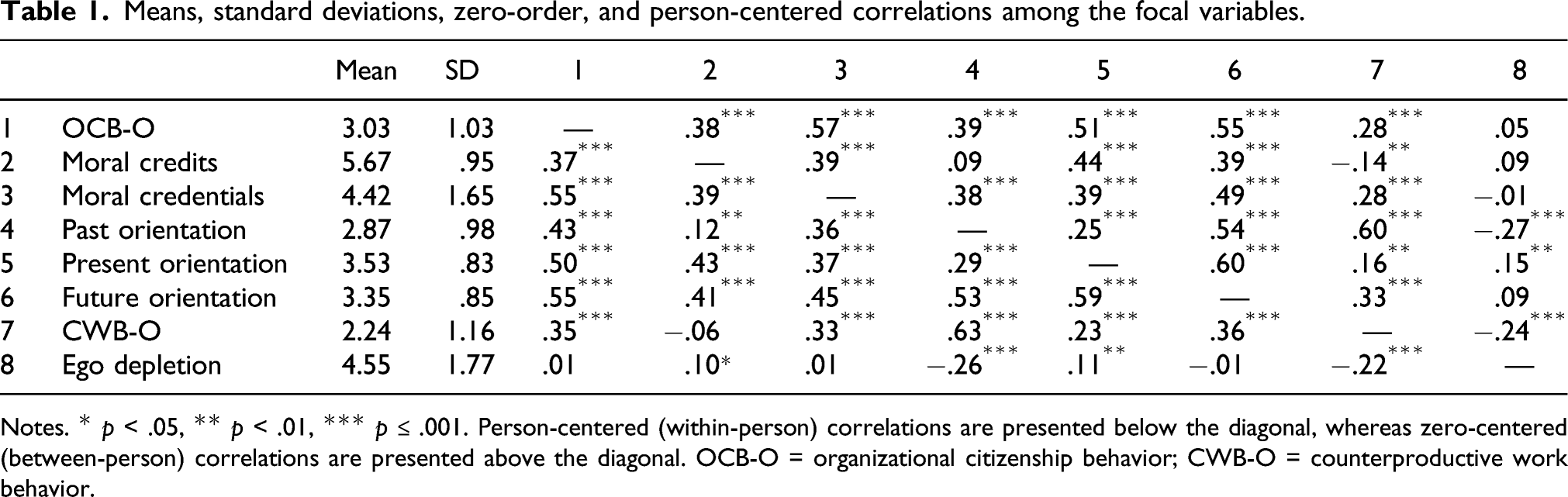
Notes. * p < .05, ** p < .01, *** p ≤ .001. Person-centered (within-person) correlations are presented below the diagonal, whereas zero-centered (between-person) correlations are presented above the diagonal. OCB-O = organizational citizenship behavior; CWB-O = counterproductive work behavior.
Multilevel Confirmatory Factor Analysis
Multilevel confirmatory factor analyses results.
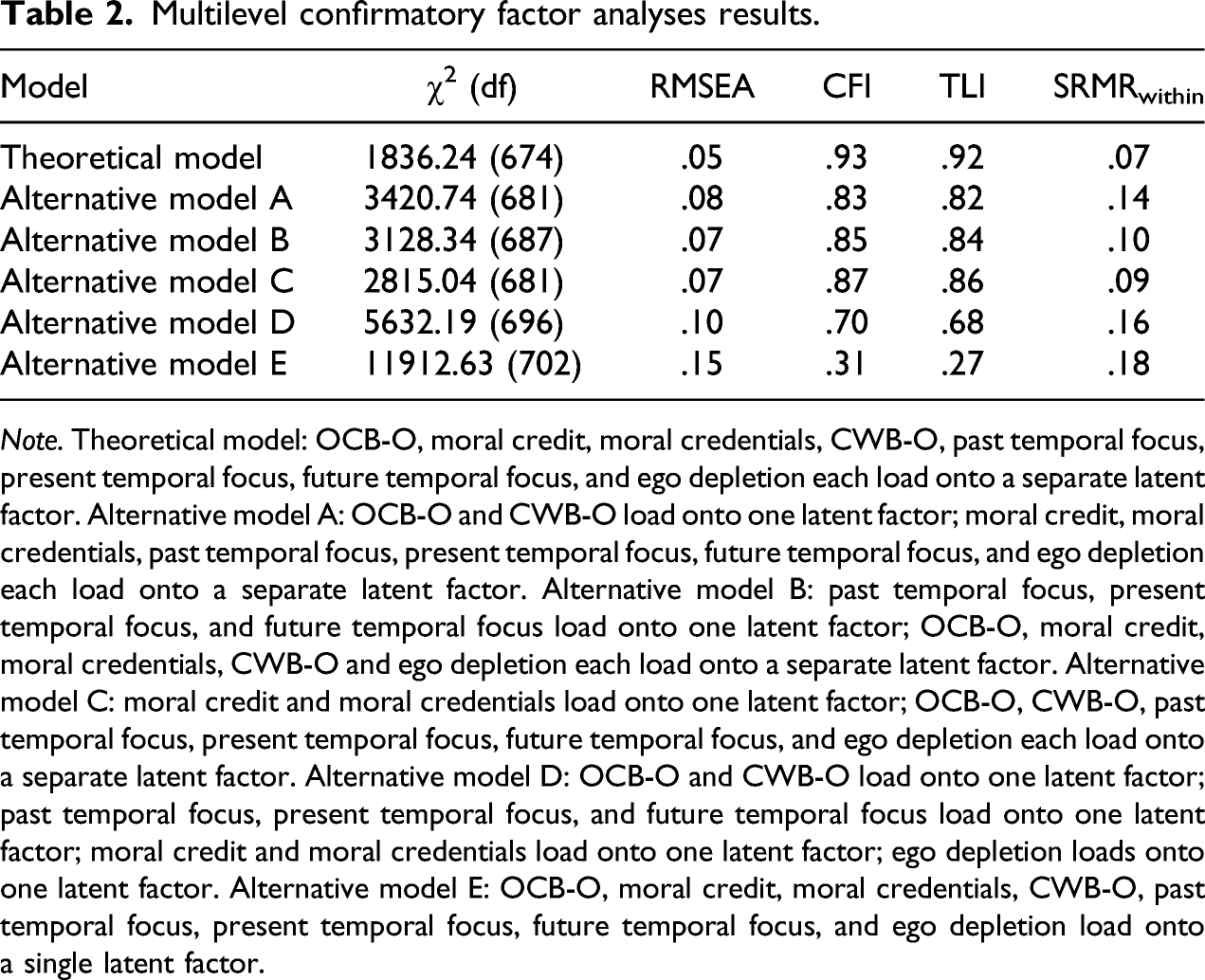
Note. Theoretical model: OCB-O, moral credit, moral credentials, CWB-O, past temporal focus, present temporal focus, future temporal focus, and ego depletion each load onto a separate latent factor. Alternative model A: OCB-O and CWB-O load onto one latent factor; moral credit, moral credentials, past temporal focus, present temporal focus, future temporal focus, and ego depletion each load onto a separate latent factor. Alternative model B: past temporal focus, present temporal focus, and future temporal focus load onto one latent factor; OCB-O, moral credit, moral credentials, CWB-O and ego depletion each load onto a separate latent factor. Alternative model C: moral credit and moral credentials load onto one latent factor; OCB-O, CWB-O, past temporal focus, present temporal focus, future temporal focus, and ego depletion each load onto a separate latent factor. Alternative model D: OCB-O and CWB-O load onto one latent factor; past temporal focus, present temporal focus, and future temporal focus load onto one latent factor; moral credit and moral credentials load onto one latent factor; ego depletion loads onto one latent factor. Alternative model E: OCB-O, moral credit, moral credentials, CWB-O, past temporal focus, present temporal focus, future temporal focus, and ego depletion load onto a single latent factor.
Preliminary Tests
We first estimated and compared, light of the principle of parsimoniousness, a full 2-level time-lagged mediation model2 with a full 2-level time-lagged moderated mediation model to determine (1) whether the inclusion of our moderators provided a better fit to the data and (2) to ascertain whether the same direct and indirect paths were significant in both models. We compared models using a chi-square difference test as well as the sample size-adjusted BIC value and found that full 2-level time-lagged moderated mediation model (sample size-adjusted BIC = 1822.18) fits the data significantly better (Δχ2(7) = 2985.84, p < .001) than the full 2-level time-lagged mediation model (sample size-adjusted BIC = 11,276.37). We, moreover, found (1) that moral credits at Time 2 were not significantly related to enactment of CWB-O Time 3 and (2) a nonsignificant indirect effect from the enactment of OCB-O at Time 1 to the enactment of CWB-O at Time 3 via moral credits at Time 2 in both the full 2-level time-lagged mediation model and the full 2-level time-lagged moderated mediation model; indicating that the same structure of relationships exists in both models but that the inclusion of the moderation effects offers a better fit to the data. As such, all (including the mediation effects) of the below presented results are from the full 2-level time-lagged moderated mediation model.
Next, keeping with best practice recommendations (e.g., Becker et al., 2016), we also compared and contrasted a model in which we included ego depletion as a control variable with a model in which we did not include ego depletion as a control variable. We found that the inclusion of ego depletion did not significantly improve model fit (Δχ2(24) = 104.85, p < .001). Hence, it should come as no surprise that the enactment of OCB-O at one point in time was not significantly related to the experience of ego depletion at the next point in time (estimate = .017; SE = .046; p = .706). The experience of ego depletion at one point in time was, moreover, not significantly related to the enactment of CWB-O at the next point in time (estimate = .038; SE = .024; p = .117). In line with best practice recommendations by, among others, Bernerth and Aguinis (2016), we thus removed ego depletion from our model, meaning that all of the below presented results are from the full 2-level time-lagged moderated mediation model without the inclusion of ego depletion as a control variable.
Inferential Results
Figure 1 displays the standardized estimated paths in the full 2-level time-lagged model after having included autoregressive effects. Being cognizant of the interpretability of the figure, and because it was not part of our formal hypotheses, we did not include the direct paths from temporal focus to CWB-O (note that these paths were included in the model estimation). Results showed that enactment of OCB-O at Time 1 was positively related to moral credentials (estimate = .245; SE = .041; p < .001) and moral credits (estimate = .085; SE = .036; p = .020) at Time 2, after having controlled for moral credentials and credits at Time 1. Next, we found that moral credentials at Time 2 were positively related to enactment of CWB-O at Time 3 (estimate = .064; SE = .024; p = .008), after having controlled for enactment of CWB-O at Time 2. In contrast, we found that moral credits at Time 2 were not significantly related to enactment of CWB-O Time 3 (estimate = −.003; SE = .031; p = .912), after having controlled for enactment of CWB-O at Time 2. When interpreting the time-lagged indirect effects, we found a significant positive time-lagged indirect effect of enactment of OCB-O at Time 1 on enactment of CWB-O at Time 3 via moral credentials at Time 2 (estimate = .004; 95%CI = [.001; .008]), after having controlled for enactment of CWB-O at Time 2 and moral credentials at Time 1. In contrast, we found no significant positive time-lagged indirect effect of enactment of OCB-O at Time 1 on enactment of CWB-O at Time 3 via moral credits at Time 2 (estimate = .001; 95%CI = [-.001; .001]), after having controlled for enactment of CWB-O at Time 2 and moral credits at Time 1. Combined, these findings support Hypothesis 1b but do not support Hypothesis 1a. Standardized estimated paths in the longitudinal autoregressive moderated mediation model. Note. *: p < .05. **: p < .01. ***: p < .001. Dotted lines indicate nonsignificant relationships. Double arrowed lines indicate correlations. Results indicate change in each variable by including the autoregressive effect between a variable and the same variable at the previous point in time.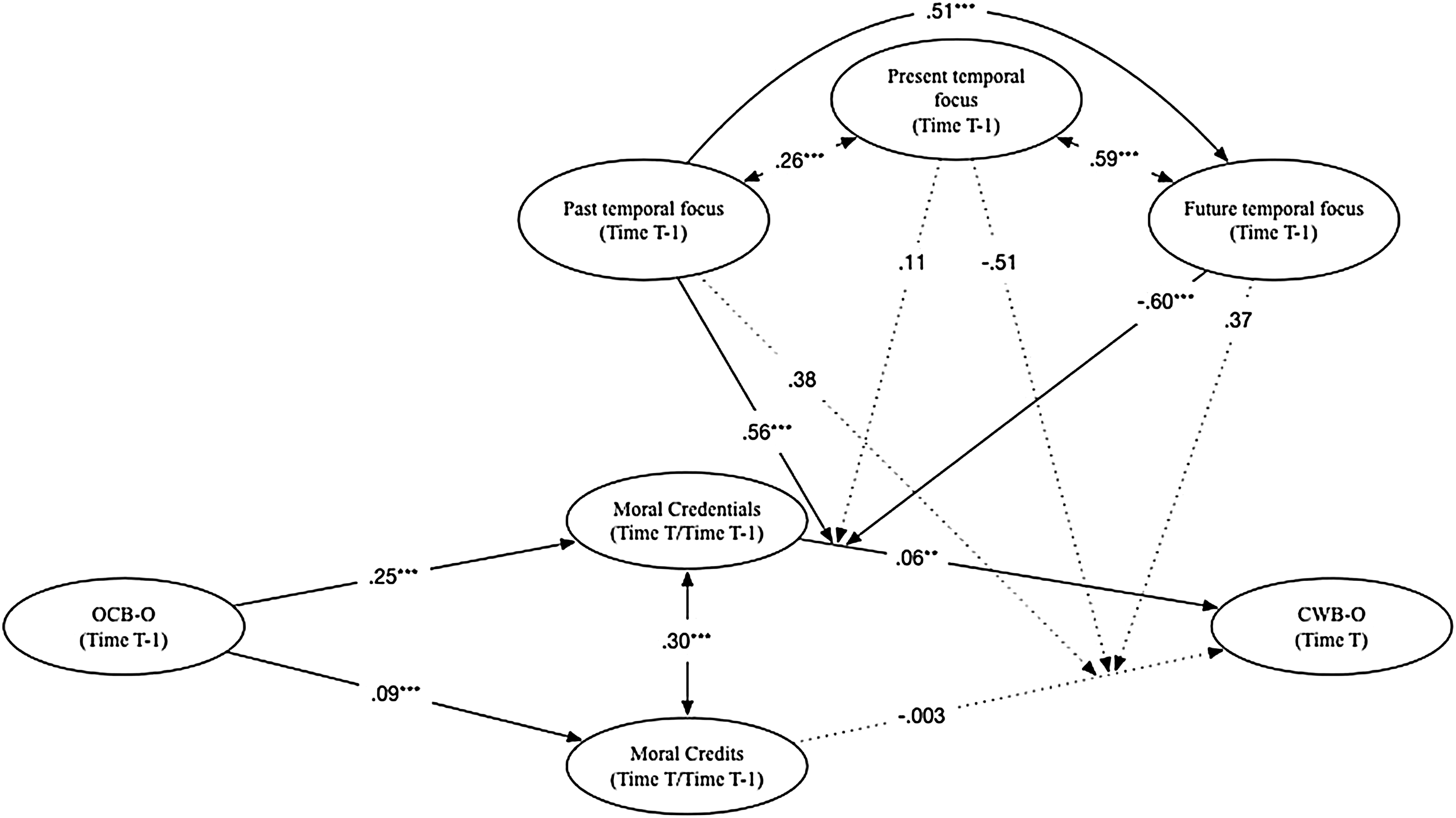
Next, Figure 2 shows the plotted confidence bands for the moderating role of past temporal focus (Time 2) on the relationship between moral credentials (Time 2) and enactment of CWB-O (Time 3), after having controlled for moral credentials at Time 1 and the enactment of CWB-O at Time 2. The simple slopes for the moderating role of moral credentials were significant outside the −.60 and −.29 region, implying that the effect of moral credentials on CWB-O was significant for past temporal focus as of the lowest possible observable value of 1.00 (positive relationship as values of past temporal focus move away from the lowest possible observable value of 1.00). In simple slope terms, this means that for low (t = 19.39, p < .001), medium (t = 19.89, p < .001), and high levels (t = 19.89, p < .001) of past temporal focus, a positive relationship exists between moral credentials and enactment of CWB-O, supporting hypothesis 2a. It is noteworthy that the simple slope analysis revealed that the difference specifically resided between low and medium levels of past temporal focus (there was no significant difference between medium and high levels of past temporal focus). Johnson–Neyman plot for the moderating role of past temporal focus in the relationship between moral credentials and counterproductive work behavior. Note. that the first symbol (circle) corresponds to low levels of past temporal focus (-1SD), the second symbol (triangle) corresponds to mean levels of past temporal focus (mean), and the third symbol (square) corresponds to high levels of past temporal focus (+1SD). In the Johnson–Neyman plot, the relationship between moral credits and counterproductive work behavior (is significant for any value of past temporal focus.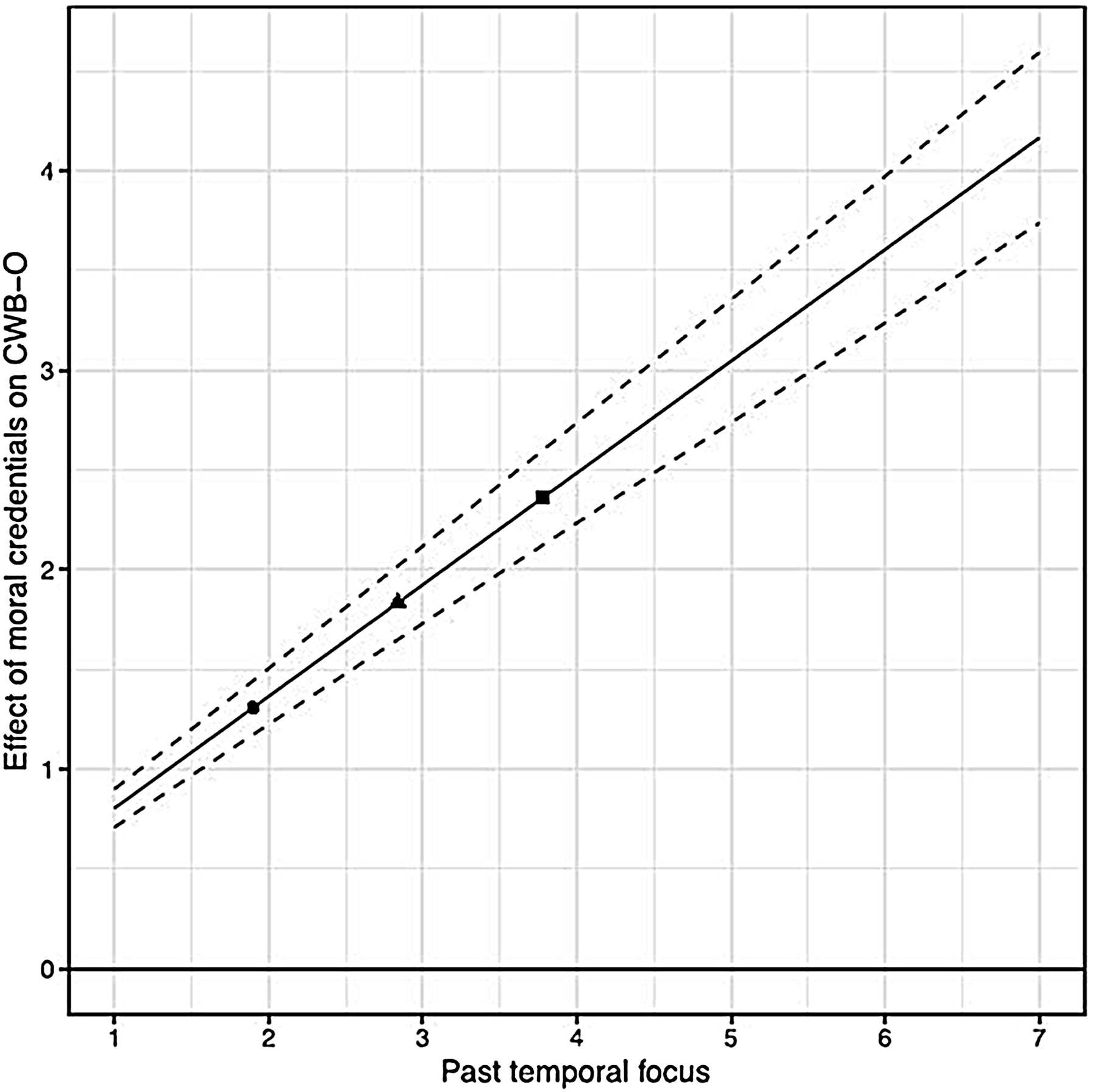
Next, Figure 3 shows the plotted confidence bands for the moderating role of future temporal focus (Time 2) on the relationship between moral credentials (Time 2) and enactment of CWB-O (Time 3), after having controlled for moral credentials at Time 1 and the enactment of CWB-O at Time 2. The simple slopes of this relationship were significant outside the .14 and .68 region, implying that the effect of moral credentials on CWB-O was significant for future temporal focus as of the lowest possible observable value of 1.00 (increasingly negative relationship as values of future temporal focus move further away from the lowest possible observable value of 1.00). In simple slope terms, this means that for low (t =-8.90, p < .001), medium (t = −9.66, p < .001), and high levels (t = −10.11, p < .001) of future temporal focus, a negative relationship exists between moral credentials and enactment of CWB-O, supporting hypothesis 2b. It is noteworthy that the simple slopes are significantly different between (1) low and medium levels of future temporal focus, (2) medium and high levels of future temporal focus, and (3) between low and high levels of future temporal focus. This suggests that an increasing negative relationship exists between moral credentials and enactment of CWB-O. Johnson–Neyman plot for the moderating role of future temporal focus in the relationship between moral credentials and counterproductive work behavior. Note. that the first symbol (circle) corresponds to low levels of future temporal focus (-1SD), the second symbol (triangle) corresponds to mean levels of future temporal focus (mean), and the third symbol (square) corresponds to high levels of future temporal focus (+1SD). In the Johnson–Neyman plot, the relationship between moral credentials and counterproductive work behavior is significant for any value of future temporal focus.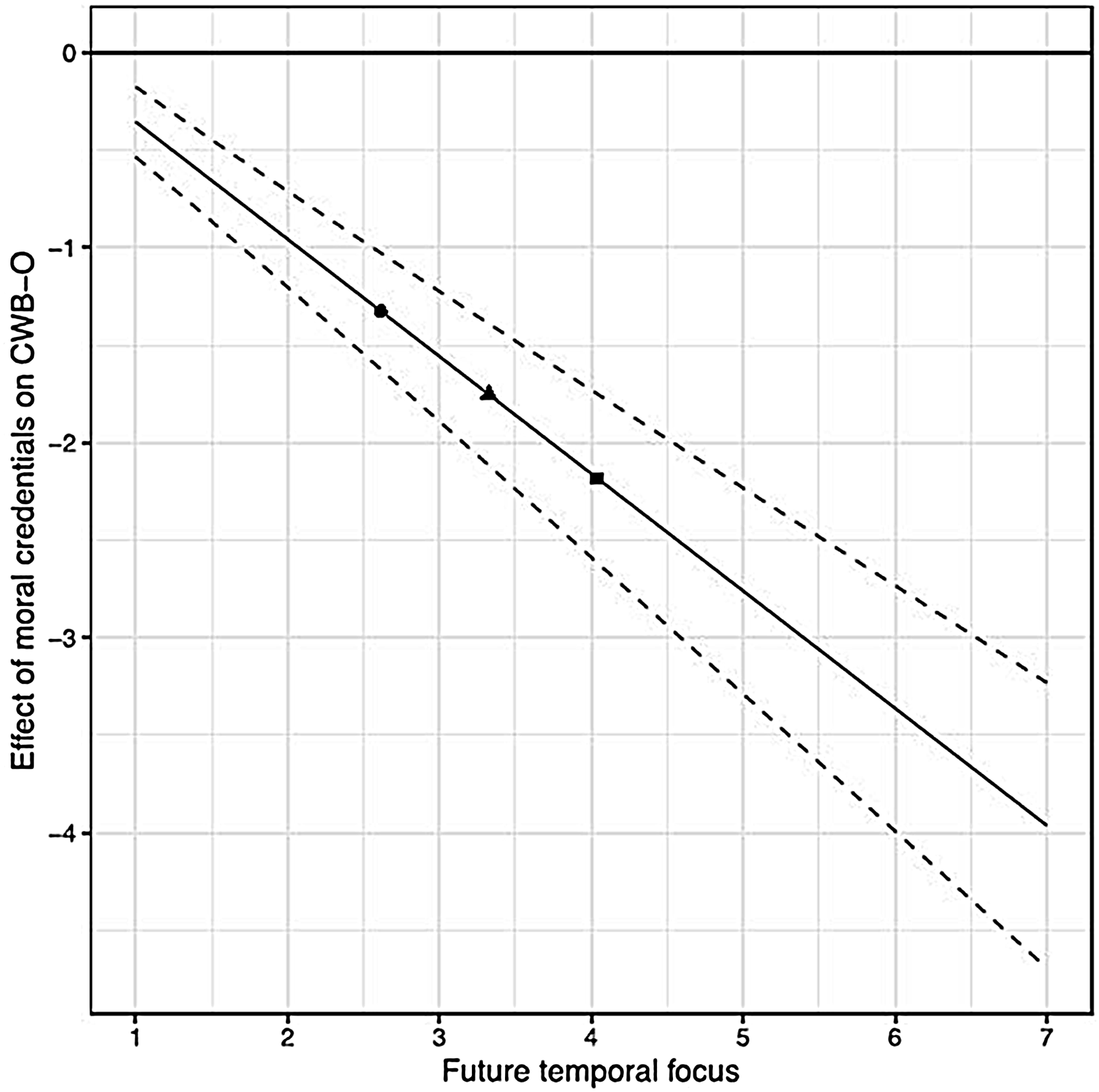
Finally, we found no significant interaction between moral credits or moral credentials (at Time 2) and present temporal focus (at Time 2) when predicting enactment of CWB-O (at Time 3), after having controlled for moral credentials and credits at Time 1 and the enactment of CWB-O at Time 2, indicating that present temporal focus indeed does not moderate the relationship between moral credits or moral credentials and CWB-O over time, supporting hypothesis 2c.
Supplementary Analysis
To rule out arguments about reverse causation (e.g., employees engage in CWB-O which triggers low moral credits or credentials, which in turn triggers a desire to engage in OCB-O to boost moral beliefs about themselves; Spector & Fox, 2010), we also tested a 2-level time-lagged moderated mediation model in which we linked the regression coefficients linking CWB-O to moral credits and credentials, and the type of temporal focus (past, present, or future), moral credits and credentials, and their interaction term to OCB-O. We found that our hypothesized model (sample size-adjusted BIC = 10,442.79) fits the data better than this alternative reverse causation model (sample size-adjusted BIC = 10,495.94). Moreover, enactment of CWB-O at one point in time was not significantly related to moral credits (estimate = −.023; SE = .031; p = .471) or moral credentials (estimate = .029; SE = .035; p = .397). Moral credits at one point in time were moreover not significantly related to enactment of OCB-O at the next point in time (estimate = .011; SE = .031; p = .715), whereas moral credentials at one point in time were positively related to enactment of OCB-O at the next point in time (estimate =.104; SE = .037; p = .005). Notwithstanding this one significant association, we found that the overall reverse model fit the data worse than our hypothesized order of effects.
Discussion
The insights of our three-wave study advance the existing work examining moral licensing as an explanatory factor linking OCB-O and CWB-O by incorporating subjective time perceptions (i.e., temporal focus). Specifically, our study provides insights into how subjective temporal focus acts as a boundary condition on the relationship between moral licensing and CWB-O such that it alters the relationship from positive to negative depending on whether one focuses on the past or future, respectively. More specifically, we have demonstrated that once an employee has obtained a moral license through moral credentials, the magnitude of that licensing effect is affected by the temporal focus in which this employee holds his/her moral credentials. We found support for the moderating effect of past temporal focus on the relation between moral credentials and CWB-O; past temporal focus will strengthen the positive relation between moral credentials and CWB-O. In contrast, we found support for the mitigating effect of future temporal focus on the relationship between moral credentials and CWB-O; this effect becomes increasingly strong as one has higher (i.e., moves from -1SD to mean to +1SD) levels of future temporal focus. Finally, we found that a present temporal focus did not alter the relation between moral credentials and CWB-O. Furthermore, our findings have important practical implications in the sense that a future time orientation mitigated the otherwise positive relationship between moral credentials and the enactment of CWB-O, thereby opening up numerous avenues for organizations to intervene and reap the positive benefits from OCB-O, while reducing the likelihood that these employees will feel morally entitled to engage in CWB-O.
Theoretical Implications
Overall, our research contributes to the development of a more complete understanding of the potential negative consequences of OCB-O enactment by incorporating an understudied contextual factor, subjective time perceptions, to offer important theoretical and practical insights into how and when the acquired moral credits and credentials are likely to trigger the enactment of CWB-O. In doing so, our study offers important theoretical insights into how and when the acquired moral credentials are likely to trigger enactment of CWB-O by examining an employee’s temporal focus as a boundary condition on the OCB-O–CWB-O relationship via moral credentials.
With respect to the role of one’s past temporal focus and congruent with the differentiating effects of past temporal focus depending on the level of focus (Shipp et al., 2009), past temporal focus elicits contrast effects. That is, employees with a past temporal focus might be more prone to rethink and pay attention to the good deeds that led to the acquired moral credentials and might, therefore, focus on balancing out the accumulated surplus by engaging in CWB-O (see also Monin & Miller, 2001). However, it is important to note that this effect seems to mainly reside between low (-1SD) and medium (mean) levels of past temporal focus (as indicated by the simple slope analysis) and seems to tamper off as levels of past temporal focus continue to increase. This might imply that there appears to be a “sweet spot” when it comes to one’s past temporal focus when paying attention to one’s previous good deeds (previously enacted OCB-O) in relation to using one’s acquired moral credentials to engage in CBW-O. Once they have exceeded this “sweet spot” of past temporal focus (i.e., +1SD), its moderating effect seems to tamper off (despite still being significant but not different from mean levels of past temporal focus). This could potentially be explained by the fact that one cannot engage in unlimited acts of CWB-O without potentially risking penalization (see Griep & Vantilborgh, 2018). As a corollary, despite the high (+1SD) past temporal focus, one will not continue to increase one’s enactment of CWB-O as a way to balance out the accumulated surplus in moral credentials.
With respect to the role of one’s future temporal focus, we note that with an increased orientation toward the future, comes an increased likelihood to balance out the accumulated surplus in moral credentials by engaging in CWB-O. This finding can be positioned in light of the earlier work by Trope and Liberman (2010) in the sense that they found that moral credentials are established by engaging in abstract behavior and license abstract organizational behavior, instead of concrete interpersonal acts which might rely more on the positive and negative balance of moral credits.
With respect to the role of one’s future temporal focus, the lack of a significant moderating effect of one’s present temporal focus is in line with the argument that present focused employees tend to concentrate on relevant information in the present and may, therefore, ignore the moral credits or credentials obtained from past experiences as well as the future consequences of immoral behavior (Zimbardo & Boyd, 1999). In addition, prior research found a positive association between one’s present temporal focus and risk-taking and conscientiousness (Shipp et al., 2009). Combined, a focus on momentary experiences will neglect the acquired moral credentials in the past as well as the potential negative consequences of immoral behavior in the future.
Second, and more briefly, our study also contributes to the growing understanding of how employees who engage in acts of OCB-O may feel morally justified—in the form of moral credits and credentials—and therefore may engage in acts of CWB-O (; Kouchaki, 2011; Lin et al., 2016; Loi et al., 2020; Vincent et al., 2013; Yam et al., 2017). While our finding is in line with moral licensing theory and the moral credentials model (Miller & Effron, 2010), they deviate from two empirical studies that found support for the mediating role of moral credits—but not credentials—in the relationship between OCB and CWB. Specifically, Lin et al. (2016)—in their daily diary study—found that only moral credits mediate the relationship between leader’s ethical and abusive behavior.
We believe that there are two potential explanations for (some of) these differences in results. First, it seems that moral credentials and credits operate under different time frames with moral credits being highly volatile (fluctuating on a daily level) and moral credentials being slightly less volatile (fluctuating on a weekly level). This argument is supported by the moral credits and credentials model (Miller & Effron, 2010) because this model argues that moral credits are more volatile and moral credentials are less volatile. Moreover, Yam et al. (2017) found empirical support for the idea that moral credentials might develop over longer periods of time, further bolstering the confidence in our findings. Second, it seems that the differences in results can be (partially) explained by differences in the blatancy of the deviant behavior with moral credentials—due to its focus on a strong moral self-regard—being more ideally positioned to downplay consequences of deviant behavior. In contrast, moral credits—due to its more delicate focus on maintaining a positive moral balance—are not sufficient to license behaviors that have an obvious intention to harm the organization. Our argument seems to align with similar points raised by the authors of moral licensing theory (Effron & Monin, 2010; Miller & Effron, 2010) when stating that moral violations (i.e., CWB-O) are generally blatant transgressions of norms and values (i.e., per the definition of CWB-O) which are more easily engaged in by employees with a strong moral self-regard (i.e., moral credentials) than by employees with a more fragile positive moral balance (i.e., moral credits).
Practical Implications
This research also makes two contributions to practice. First, organizations should be aware of the potential drawbacks of OCB-O enactment, given that employees might feel morally licensed, because of their strong moral self-image, to engage in future acts of CWB-O. This implies that organizations should also monitor employees who actively engage in OCB-O instead of only monitoring those employees who did not actively engage in OCB-O. If organizations approach employees who engage in OCB-O as the “good employees,” then they might develop a blind spot in which those “good employees” could potentially engage in CWB-O without the organization being able to understand where this sudden shift in behavior is coming from. If the moral self-image remains unchallenged, employees with high perceptions of moral credentials could potentially continuously switch between the enactment of OCB-O and CWB-O. A possible way to tackle these potential blind spots and cycles of OCB–CWB enactment pertains to the inclusion of both counterproductive and beneficial contextual behavior as part of an employee evaluation system. Doing so would assure that supervisors monitor a wider scope of employee behavior and are better able to challenge one’s moral self-image upon the enactment of OCB-O, thus preventing the potential switch from beneficial to adverse behavior.
Second, organizations might benefit from a better understanding and utilization of an employee’s temporal focus. Specifically, organizations might attempt to reduce employees’ focus on the past in HR processes such as performance appraisal, which are typically conducted on a (semi-) annual basis and typically focus on the past. As a consequence, traditional performance appraisal interviews might even boost an employee’s focus on the past, which in turn might amplify perceptions of moral credentials and thus the enactment of CWB-O. That is, when employees are applauded for walking the extra mile (i.e., OCB-O), our result suggest that they might feel strengthened in their perceptions of moral credentials, potentially leading to a period following the performance appraisal interview that might be characterized by an increase in the enactment of CWB-O as (1) the validation of being a “good employee” is very recent, and (2) the long time window between the current and the next performance appraisal interview leaves sufficient time to “do good” so as to keep the label of being a “good employee” at the next round of appraisals. We would, therefore, argue to (1) reduce the time between subsequent performance appraisal interviews and (2) opt for a more continuous (e.g., bi-monthly) evaluation system in order to potentially reduce the past temporal focus of employees. Along the same lines, organizations could also promote a more long-term perspective among employees by designing career development programs that span across longer periods of time or career stages instead of focusing on just 6 months to 1 year. In doing so, the (semi-) annual performance appraisal interview becomes just one moment out of many moments that can be placed in a forward-looking multiyear planning (i.e., promoting a future temporal focus, and thus a potential negative relationship between OCB-O and CWB-O) in which being a “good employee” becomes a continuous goal rather than something that can be easily acquired by focusing on the enactment of OCB-O.
Limitations
Like all studies, our research has limitations that deserve further attention. First, we collected all variables at the same point in time by means of repeated self-reported weekly surveys. This might raise concerns with common method variance at each time point (Podsakoff et al., 2012). However, we deemed employees to be the most informed source to assess their weekly behavioral, psychological, and attitudinal experiences. In addition, meta-analytic findings support the convergence between self- and other-rated data for OCB-O and CWB-O (Berry, Carpenter,& Barratt, 2012; Carpenter, Berry & Houston, 2014). Further, we reduced risks owing to common method bias by using weekly time lags between our independent and mediator variables, and between our mediator and dependent variables. In addition, we presented all scales in a random order, both within and between blocks. In order to minimize measurement artifacts, we followed the recommendation of Spector, Bauer, and Fox (2010) to avoid using antithetical worded items and to use self-reported frequency ratings to measure CWB-O and OCB-O by relying on the measure of Dalal et al. (2009). Finally, Siemsen, Roth and Oliveira (2010) argued that common method bias cannot distort interactions effects. Hence, the presence of our interactions helps to strengthen our argument that the observed relations are a function of the studied constructs and relationships rather than methodological artifacts.
Second, the significant effect size of the indirect lagged effect of OCB-O on CWB-O via moral credentials was small by conventional standards. However, small effect sizes are not necessarily indicative of weak relationships. Specifically, effect sizes tend to be smaller when scholars examine indirect effects based on individual perceptions (Cortina & Landis, 2009), as was done in this study. Moreover, effect sizes tend to be smaller when scholars examine time-lagged relationships. Regardless of the size, these significant effect sizes are compelling empirical evidence as any departure from zero in explained variance (Cortina & Landis, 2009). Small effect sizes can be ascribed to high stability of the research variables or the length of the time lags. Note that we modeled change by controlling for stability of the variables (i.e., autoregressive effects). Potentially the time lag of one week underestimates the true indirect effect and future research might benefit from using shorter time lags.
Suggestions for Future Research
As a first suggestion for future research, we would suggest scholars to focus on different aspects of subjective time perceptions. Although we have demonstrated that incorporating temporal focus into the study of OCB-O–CWB-O relationship provides a fruitful avenue to better understand the direction of the OCB-O–CWB-O relationship, we are aware of the fact that subjective time perceptions encompass more than just differences in temporal focus. Two other prominent aspects of subjective time perceptions are (1) time duration and (2) time aggregation.
First, time duration refers to the interval in which a phenomenon exists in an unaltered state (George & Jones, 2000). With regard to moral credentials as a mediator of the OCB-O–CWB-O relationship, time duration would reflect the magnitude of the effect over time (clock time in this respect). In other words, we would advise scholars to study how moral credentials are sustained over time until one either engages in CWB-O or until the effect of moral credentials simply dissolves over time. Although our results indicate that the enactment of OCB-O provides employees with a moral license to engage in CWB-O at a later point in time, the extent to which this licensing effect is stable over time may vary across different time durations (e.g., 1 day vs. 1 week vs. 1 month). Moreover, Yam et al. (2017) found support for the between-person mediation of psychological entitlement—as proxy of moral credentials—in the OCB-O–CWB-O relationship, suggesting that moral credentials might develop over longer periods of time. It thus remains an open question whether the moral licensing effect holds across longer periods of time or whether the effect dissolves after a specific amount of clock time has passed during which the individual had no chance to engage in a subsequent act of CWB.
Second, time aggregation has been defined as being akin to a bracketing process, where events occur over time leading a person to bracket some period of time into an episode for exploration and reflection (George & Jones, 2000). George and Jones (2000) further argue that a person’s psychological state depends on the way (s)he brackets experiences to give meaning to a phenomenon in question. In other words, how an employee chooses to aggregate past and future behaviors may affect the OCB-O–CWB-O relationship; whereas one employee may refer to acts of OCB-O in the morning as the source of the moral license to engage in CWB-O during the afternoon; another employee may aggregate acts of OCB-O over the most recent week when perceiving that (s)he is morally licensed to engage in CWB-O during the next week. As such, both employees are likely to have a different OCB-O–CWB-O relationship, depending on the objective time frame that is being used to study this relationship.
As a second suggestion for future research, we advise the inclusion of measures of moral attentiveness (the extent to which an individual chronically perceives and considers morality and moral elements in his or her experiences; Reynolds, 2008) and moral courage (a moral character strength that provides the fortitude to engage in moral actions by overcoming internal resistance and external threats when facing moral dilemmas, including those caused by one’s own immoral behaviors) as potential important control mechanisms (or even moderating effects; Sekerka, Bagozzi, & Charnigo, 2009) when it comes to one’s ability to transfer one’s moral credits or credentials into future enactment of CWB-O. That is, the behavioral ethics literature suggest—and recent findings by Liao, Yam, Johnson, Johnson, and (2018) support the idea—that individuals who are higher on moral attentiveness and moral courage are more likely to experience guilt and report a greater loss of moral credits and/or credentials, which in turn may trigger a greater consideration and initiation of compensatory and corrective behaviors (e.g., potentially more future enactment of OCB) rather than enactment of destructive behaviors such as CWB. In other words, when one is characterized by a higher score on moral attentiveness and/or moral courage, one is expected to initiate more effortful and reparative, rather than potentially destructive, actions as the primary strategy to assuage their felt guilt and perceived loss of moral credits and/or credentials, which may further reduce one’s enactment of CWB-O in response to accumulated moral credits and/or credentials.
As a final suggestion for future research, scholars could also include motives for enactment of OCB-O to further our understanding of how motivation for engaging in OCB-O may further differentiate the relationship between OCB-O, moral licensing, and CWB-O; Kloz and Bolino (2013) found that when the motivation to engage in OCB (e.g., a strong relational identity orientation) aligns with the enactment of OCB (e.g., helping the organization), the association between OCB and moral licensing is weakened. Through this reduced effect on moral licensing, we would expect a weaker (or even negative) association between OCB-O and CWB-O.
Conclusions
Our findings further our understanding of the nature of the OCB-O–CWB-O relationship by demonstrating the crucial role of moral licensing (i.e., moral credentials) and the moderating role of one’s temporal focus. We sought to build, and empirically test, a conceptual model which suggests that when an employee holds moral credits and moral credentials, different temporal foci may determine the extent to which these are translated to subsequent CWB-Os. We are hopeful that our findings, along with our advanced methodologies, will stimulate many novel and exciting avenues of research.
Footnotes
APPENDIX 1
Organizational citizenship behavior was measured with the following six items by Dalal et al. (2009): Volunteered for additional work task. Went above and beyond what was required for the work task. Defended organizational policies. Chose to work rather than take a break. Persisted enthusiastically in completing a task. Spoke highly about my organization to others.
Moral credits were measured with the following five items by Lin et al. (2016): I earned credit for performing a morally laudable behavior. My previous good deeds earned me credit as a moral person. Acting good built up my account of moral credits. Each good deed I performed added to my moral credit. Acting in an ethical manner gave me a surplus of credit.
Moral credentials were measured with the following five items by Lin et al. (2016): I feel good to be a person who has these characteristics (i.e., caring, compassionate, fair, friendly, generous, helpful, hardworking, honest, and kind). These characteristics (i.e., caring, compassionate, fair, friendly, generous, helpful, hardworking, honest, and kind) generally reflect how I see myself. I am actively involved in activities that communicate to others that I have these characteristics (i.e., caring, compassionate, fair, friendly, generous, helpful, hardworking, honest, and kind). I strongly desire to have these characteristics (i.e., caring, compassionate, fair, friendly, generous, helpful, hardworking, honest, and kind). I feel it is important to be someone who has these characteristics (i.e., caring, compassionate, fair, friendly, generous, helpful, hardworking, honest, and kind).
Counterproductive work behavior was measured with the following six items by Dalal et al. (2009): Did not work to the best of my ability. Spent time of tasks unrelated to work. Criticized organizational policies. Took an unnecessary break. Worked slower than necessary. Spoke poorly about my organization to others.
Past temporal focus was measured with the following four items by Shipp et al. (2009): I replay memories of the past in my mind. I think back to my earlier days. I think about things from my past. I reflect on what has happened in my life.
Present temporal focus was measured with the following four items by Shipp et al. (2009): I think about where I am today. My mind is on the here and now. I live my life in the present. I focus on what is currently happening in my life.
Future temporal focus was measured with the following four items by Shipp et al. (2009): I think about what my future has in store. I imagine what tomorrow will bring for me. I focus on my future. I think about times to come.
Ego depletion was measured with the following five items by Christian and Ellis (2011) I feel drained. My mind feels unfocused. It would take a lot of effort for me to concentrate on something. My mental energy is running low. I feel like my willpower is gone.
Acknowledgments
We would like to thank MSc. Samantha Jones and Dr. Ivana Vranjes for providing us with feedback and proofreading previous versions of this manuscript. Moreover, we would also like to thank three anonymous reviewers and the Editor (Thomas Zagenczyk) who handled our manuscript for their suggestions to further improve our manuscript.
Declaration of Conflicting Interests
The author(s) declared no potential conflicts of interest with respect to the research, authorship, and/or publication of this article.
Funding
The author(s) disclosed receipt of the following financial support for the research, authorship, and/or publication of this article: This research was supported by Social Sciences and Humanities Research Council of Canada (grant 435-2018-0633).
Data Availability Statement
The data and syntax used in this study can be found on Open Science Framework using the following DOI 10.17605/OSF.IO/BG8E6.
Associate Editor: Thomas J. Zagenczyk
