




Abstract
The purpose of this research is to provide a systematic review and integrative framework of the antecedents of knowledge withholding. A systematic literature review led to a selection of 42 empirical research papers that collected data from 16,649 respondents. The included papers identified 93 antecedents that showed a high degree of theoretical variety. We used the theories of interdependence, social exchange, and social identity to construct a framework that integrates and explains why people withhold their knowledge. We developed propositions of the antecedents of knowledge withholding, which we compare against the SLR. We propose and find that (a) negative interdependence increases knowledge withholding behaviors, but (b) positive versus negative social exchanges may respectively decrease or increase withholding in situations where the default may be positive interdependence. We also propose and find that actors who strongly identify with their immediate team will less likely withhold knowledge from them. In contrast, actors who strongly identify with a different identity will more likely withhold knowledge from their team. The integrative framework provides a strong theoretical foundation for future study and identifies many valuable new research questions
Knowledge has become an essential commodity in modern society as, over the decades, the speed with which groups and organizations produce and utilize knowledge has continuously increased (Castells, 2011; Powell & Snellman, 2004). Accordingly, questions on how actors such as individuals, groups, and organizations handle knowledge in their interactions with other actors have sparked research attention from various disciplines (Hansen, 2002; Hu & Randel, 2014; Jerit, Barabas, & Bolsen, 2006; Tuan, 2019). Actors may share knowledge and may withhold knowledge. Sharing and withholding are distinct theoretical dimensions (Kang, 2016; Pan & Zhang, 2018) as, for example, a low degree of sharing could be caused by having no knowledge, whereas withholding entails having knowledge.
Sharing and withholding each hold advantages and disadvantages (Lin, 2010; Richey & Nokes-Malach, 2013; Ritala, Olander, Michailova, & Husted, 2015). An illustration of this is seen in the coronavirus crisis. Medical experts sharing knowledge helps solve the crisis as effectively as possible. However, governments withholding knowledge may prevent public panic. More generally, sharing tends to promote effective collaboration and good relationships (Hu & Randel, 2014; Lin, 2010). However, sharing is a process that costs time and mental resources (Ahmad, 2017; Widén-Wulff & Suomi, 2007). Withholding knowledge may save time and resources, but it may also prevent unnecessary misunderstanding (Husted & Michailova, 2002; Michailova & Husted, 2003). However, withholding may negatively impact relationships and collaboration effectiveness (Wang, Han, Xiang, & Hampson et al., 2019; Zhang & Min, 2019).
Given the value of knowledge to groups’ and organizations’ functioning, a high priority question is why actors share or withhold knowledge. Understanding causes and drivers may enable groups and organizations to manage and design antecedents that promote behaviors and outcomes they desire. Importantly, a constructive orientation and a belief in the benefits of knowledge sharing have led scholars to focus on sharing, but this has come at the neglect of understanding withholding. Moreover, antecedents of sharing are relatively well understood (Van Den Hooff & De Leeuw Van Weenen, 2004; Witherspoon, Bergner, Cockrell, & Stone, 2013), whereas the advancement of a fundamental yet integrative understanding of the antecedents of knowledge withholding has only very recently come into focus.
Anand and colleagues (2020) made an important initial contribution to a more systematic understanding of knowledge withholding by identifying myriad knowledge withholding events and categorizing these in terms of the behavior drivers. However, the categorization of these events into broad drivers, in our view, did not succeed in providing a theoretical causal understanding of how knowledge-withholding behavior arises from the relationship between the knowledge holder and the knowledge (non-)recipient and the organizational reality in which it plays out. In contrast, we systematically develop a set of causal explanations into an integrative framework that explains why people withhold knowledge. We, thereby, draw on the three core relational elements to understand the nature of a relationship within an organizational setting. These three relational theoretical elements refer to (a) the outcome interdependence among the actors, (b) the social exchange relationship, and (c) the (social) identities of the actors. As a result, the framework’s key contribution is that it provides a comprehensive understanding of the knowledge-withholding antecedents and, accordingly, enables groups and organizations to promote behaviors and outcomes they desire. In turn, this integrative analysis contributes by providing a clear roadmap for future research in this area. After describing our review approach, we articulate our integrative theoretical framework through several overarching propositions and discuss how our systematic review of the literature (SLR; Booth, Sutton, & Papaioannou, 2013) aligns with our propositions. Last, we use the framework to identify critical research gaps and articulate an agenda for future theory and empirical investigation.
Overview of the SLR Approach
In this review, we treat knowledge withholding as one broad concept, but it should be acknowledged that the literature uses the three terms knowledge withholding, hiding, and hoarding. Although authors in the literature disagree on these concepts’ definitions, we kept the labels used by various authors. However, our SLR does not provide sufficient evidence to integrate a conceptual distinction between these three terms. In contrast, while we believe that the concepts are distinct, we return to this matter in the section Integration and Research Agenda. The three terms all refer to human behavioral instances in which an actor possesses knowledge but does not effortfully give the knowledge to another actor in a social context (Connelly, Zweig, Webster, & Trougakos, 2012; Evans et al., 2015; Lin & Huang, 2010). Taking all terms together, the not-giving of the knowledge to the other actor may be intentional or unintentional and may occur in situations where the other actor requested the knowledge or did not request the knowledge. Hence, we take a broad view of these closely related behaviors.
We applied Booth et al. (2013) SLR approach and conducted our systematic search in December 2019–February 2020 using the four databases: Business Source Complete, SocINDEX, ERIC, and PsycInfo. While using the search engine EBSCO Business Source Complete, we also enabled searches in the engine “SocINDEX with full text.” We abbreviate this combination of search engines to EBSCO to enhance readability. Besides the default settings, we applied the features “apply related words,” “apply equivalent subjects,” and “scholarly (peer-reviewed) journals.” Second, during our searches in the engine ERIC, we used the default settings and enabled the feature “peer-reviewed only.” Third, the engine PsycInfo was used with default settings plus the additional selection features of “empirical evidence” in the methodology box and “peer-reviewed journals.”
Furthermore, the terms that were used in the four search engines are “knowledge hoarding,” “knowledge hiding,” and “knowledge withholding.” We intended to search for these search terms in the abstracts, but this was only possible in the engines EBSCO and PsycInfo. The other two engines generated results with the search terms in full text. Furthermore, we did not narrow the literature search by a time frame because of the review’s exploratory nature and the limited number of empirical studies in this research area.
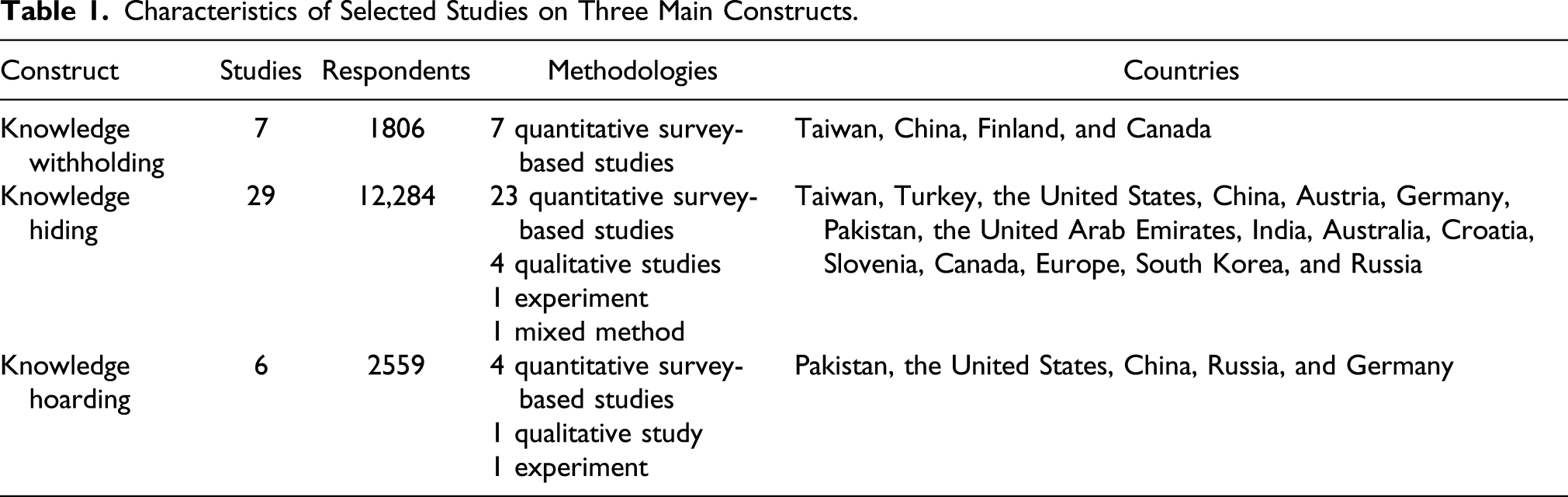
Next, we selected studies that met three criteria. First, the studies describe the antecedents of knowledge withholding, knowledge hiding, or knowledge hoarding. We thus excluded studies that did not meet the criteria of studying an antecedent. Second, the studies offer empirical evidence, and third, they are written in the English language. This search resulted in 107 included studies (Figure 1, Step 1). However, the use of four search engines resulted in duplicates per construct and between constructs. We first eliminated the duplicates per construct (Figure 1, Step 2) and, subsequently, eliminated duplicates between constructs (Step 4). The search and selection identified 42 empirical research studies. The articles included in our final review have been marked with an asterisk in the reference list. Number of Studies per Construct in the Systematic Literature Review.
Characteristics of Selected Studies on Three Main Constructs.
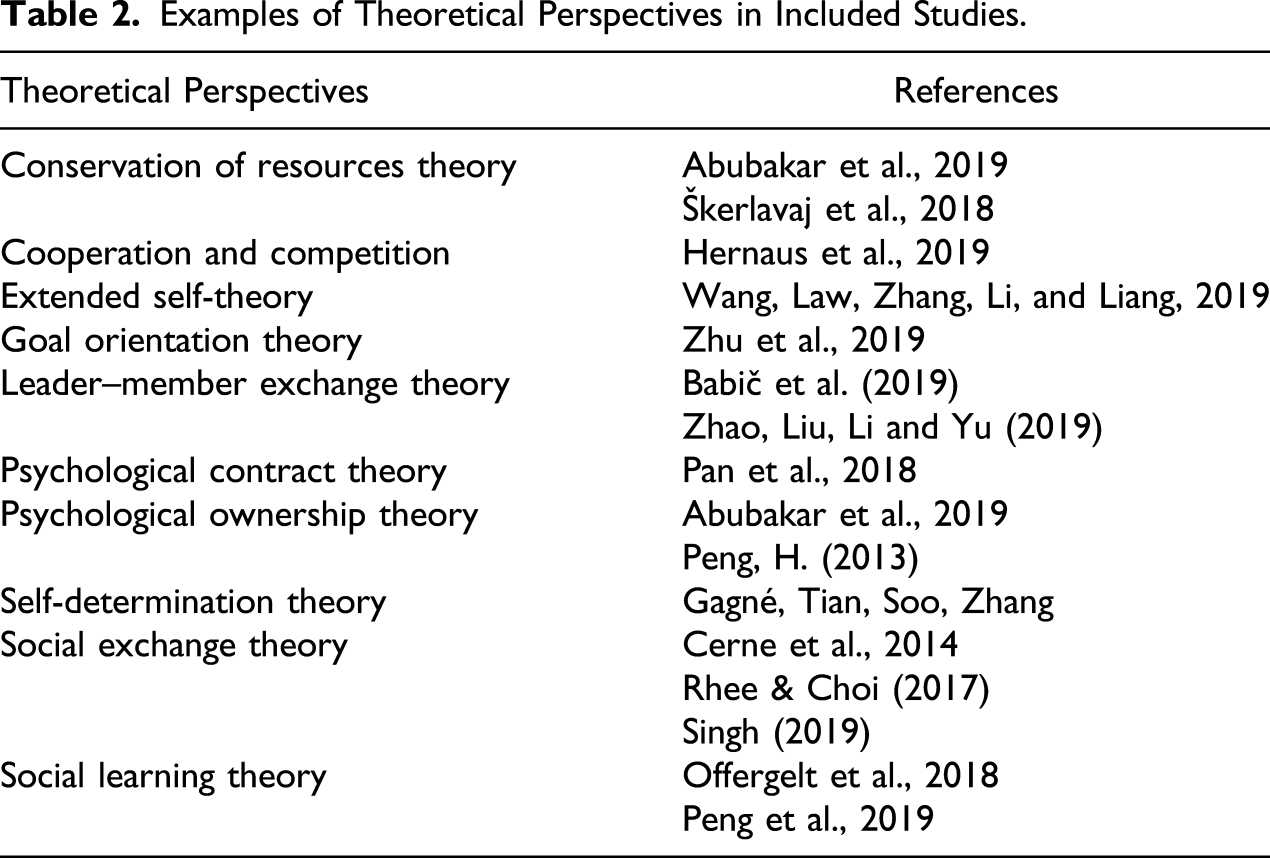
Examples of Theoretical Perspectives in Included Studies.
Empirical Review and Integrative Framework
We assume that, for both the actor who hoards, hides, or withholds knowledge and for the potential recipient, knowledge is useful for their goals. This assumption shows two key elements that are present in all instances of knowledge-withholding behavior. First, these instances are “relational,” and second, knowledge is a (sometimes scarce) “commodity.” However, the actors’ interests and goals are also undergirded by various possible identities that they hold. Therefore, we suggest that our framework must be built on a basic understanding of the interrelations of people’s goals, interests, and identities in organizations, as well as the expectations that people have of their exchange partners.
First, we use interdependence theory to account for the covariance of people’s interests. A fundamental characteristic of all instances of knowledge withholding, hiding, or hoarding is that the different parties stand in some type and degree of interdependence with each other. Interdependence reflects the objective or subjective structural features of the situation in terms of how outcomes of different parties are related to each other. In other words, interdependence is fundamentally about the goals that people have and how those goals relate to other people’s goals and behaviors (Thibaut & Kelley, 1959).
Second, we need to apply social exchange theory to understand further and predict knowledge-withholding behavior because interdependence only reflects the (perceived) structural features of the relational situation. Within a given outcome interdependence structure, the exchange nature of the relationship can differ significantly. In other words, relationships with identical degrees of outcome interdependence may nonetheless vary in terms of the trust or reciprocity between the individuals (e.g., Cropanzano & Mitchell, 2016).
Interdependence and exchange theoretical perspectives provide the basic building blocks for understanding the relational contexts in which knowledge-withholding behaviors occur. However, because we focus on explaining and predicting individual behavior in groups and organizations, these theories alone do not provide a sufficient set of explanations. This is because various possible identities undergird the actors’ interests and goals in organizations. As will become clear, different identities have opposite effects on employees’ knowledge-withholding behavior. Therefore, we also integrate self-categorization and social identity theory into the framework (Tajfel & Turner, 1986; Turner, 1978).
As our review and framework illustrate, we argue that these three elements are necessary and sufficient to understand and predict knowledge-withholding behavior. Taken together, this means that these elements provide a complete fundamental understanding of the behavior, but that the behavior cannot be fully understood without taking all three into account. As our framework illustrates (Figure 2), we will propose that negative interdependence tends to increase knowledge withholding, while the effect of positive interdependence on knowledge withholding pivots on the exchange relationship. Furthermore, we will propose that employees’ identities tend to affect from whom they withhold knowledge. For example, they tend to withhold knowledge more from out-group members and less from in-group members. The Integrative Framework.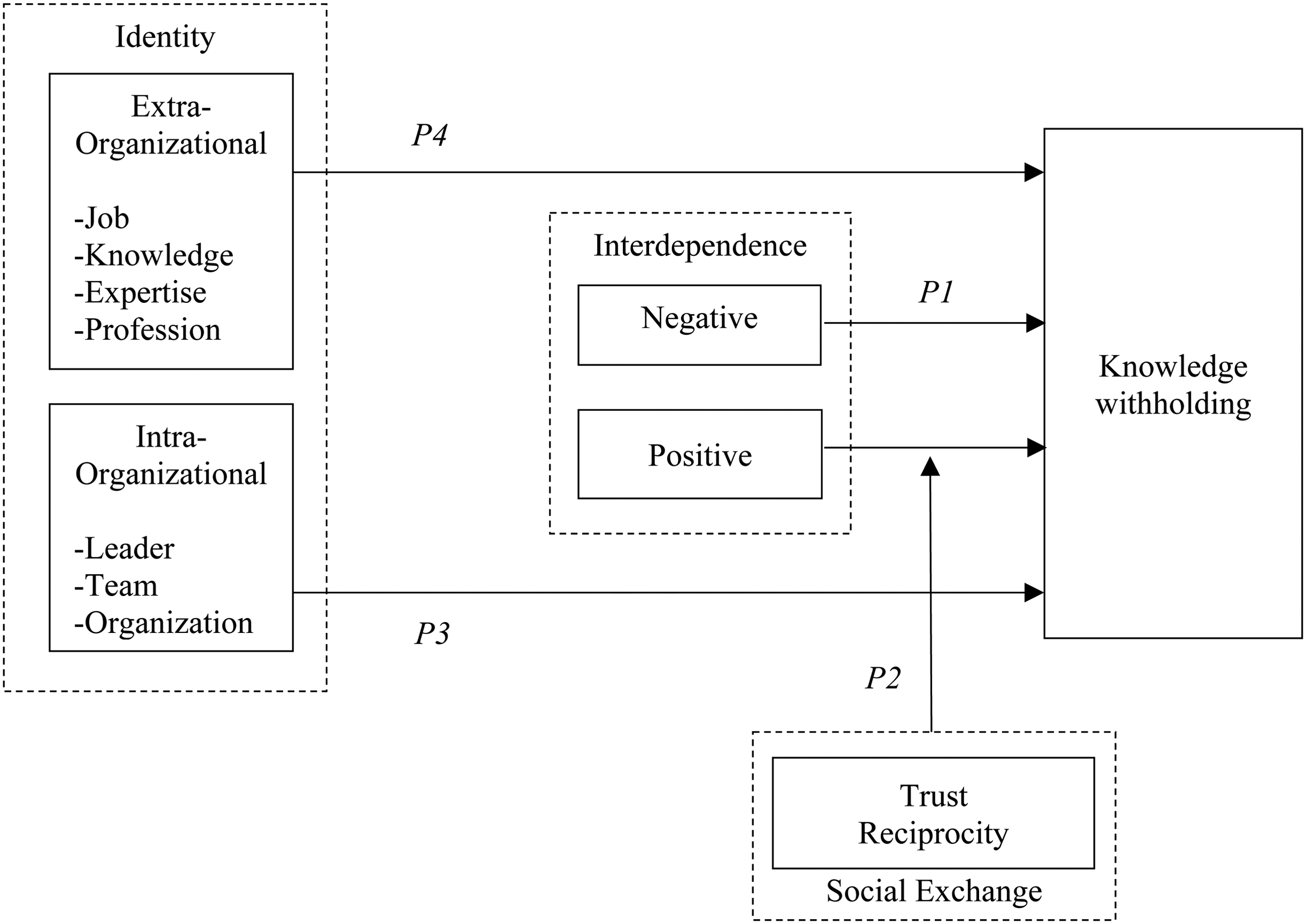
Negative Outcome Interdependence
Outcome interdependence is negative when one actor’s attainment of an outcome detrimentally affects the other actor’s attainment. In other words, in situations that are (perceived to be) structured in a negatively interdependent way, the successful outcome of one person entails the other person’s unsuccessful outcome. As a result, when a knowledge holder considers sharing or withholding their knowledge with someone with whom they perceive to be negatively outcome interdependent, withholding is likely. This is because the knowledge could function as a means to success that may be useful to both actors, but it would be irrational to share this knowledge if doing so would help the other actor attain their goal (Poortvliet & Darnon, 2010). In other words, negative interdependence may be a consistent predictor of knowledge-withholding behaviors.
Our review showed many examples of this. For the sake of the clarity, we believe it is useful to separate them into two sections, one that encompasses variables that directly or indirectly reflect (perceived) competition in the workplace and another that encompasses variables that they reflect scarcity or uncertainty.
First, competition occurs when people see each other as rivals, pursuing the same outcome that cannot be attained by both. Perceptions of competitiveness in the workplace were found to predict knowledge withholding among 233 US salespeople toward their immediate colleagues (Anaza & Nowlin, 2017), and competitiveness as an individual difference predicted knowledge withholding among 211 Croatian academics (Hernaus, Cerne, Connelly, Poloski Vokic, & Škerlavaj, 2019) and among 20 respondents in buying and supplying companies in the United Arab Emirates (Butt & Ahmad, 2019). Similarly, the individual difference variable performance goal orientation or “prove” orientation—which refers to the dispositional motivation to outperform others (Button et al., 1996)—was related to knowledge withholding among 214 South Korean students (Rhee & Choi, 2017) and among 725 Chinese employees from various organizations (Zhu, Chen, Wang, Jin, & Wang, 2019). Other person variables such as the dark triad of Machiavellianism, narcissism, and psychopathy also imply competitiveness. People with these traits want to control others, be superior. They seem to approach other people with a zero-sum game mindset. Among 150 IT employees, Machiavellianism was positively related to knowledge hiding (Chawla & Gupta, 2019), and among 251 automotive and electronics workers in China, all three dark traits positively predicted knowledge hiding. Researching another individual characteristic that reflects a desire to use knowledge to one’s advantage and to have superior outcomes compared with others, Demirkasimoglu (2016) found a positive correlation between psychoticism and knowledge hiding among 386 Turkish academics. Last, organizational factors may also contribute to competitiveness perceptions. For example, Zhu et al. (2019) found that feedback provides social comparison information that can strengthen the effects of competitiveness on knowledge hiding. Relatedly, Ray, Neugebauer, Sassenberg, Buder, and Hesse (2013), among 76 students in Germany, argue that social comparison information prompts self-evaluation processes that subsequently create negative interdependence. Indeed, they found that social comparison information leads to knowledge hoarding.
Second, when an employee views resources as scarce, threatened, or uncertain, they believe that not all employees can have the resource. When resources are scarce, uncertain, or threatened, knowledge is a means to obtain those resources, and withholding knowledge is the rational choice. One example of a scarce commodity is job insecurity. Insecure jobs represent a scarce resource that people may perceive not all of them can have simultaneously.
Indeed, job insecurity was found to predict knowledge withholding among 695 Canadian and US Credit Union workers (Serenko and Bontis (2016)), among 19 Indian R&D employees (Kumar Jha and Varkkey (2018)), among 26 respondents in Russian–Western firms (Michailova & Husted, 2003), and among 20 respondents in buying and supplying firms in the United Arab Emirates (Butt & Ahmad, 2019). The latter researchers also found that employees who feel indispensable hide their knowledge. They argue that knowledge sharing would lessen their indispensability and, thereby, raise uncertainty. Kumar Jha and Varkkey (2018) argue something similar and describe that people who have a low knowledge efficacy will hide their knowledge to prevent others from passing them on the career track. Their data from 19 R&D professionals in India found that a lack of confidence in their knowledge increased knowledge hiding. Similarly, Michailova and Husted (2003), in their study among 26 employees in Russian–Western firms, found that uncertainty about knowledge in the form of avoidance of exposure increased knowledge hoarding. Relatedly, in their study of US salespeople, Anaza and Nowlin (2017) studied the trait neuroticism. This means that people worry about threats to their interests and about what losing their knowledge would entail. They found neuroticism positively related to knowledge hiding, a finding that Demirkasimoglu (2016) also observed among 386 respondents at a Turkish university and Pan and Zhang (2018) also replicated among 214 employees in software development teams. While most studies found a positive relationship, Wang, Lin, Li, and Lin (2014) found a negative relationship with knowledge withholding in a study of 365 Taiwanese students.
Organizational factors may also create scarcity. Examples are the effects of the (lack of) incentives. A lack of incentives for a behavior may make that behavior costly to the individual; executing the behavior would then have a negative impact on their own interests. Anaza and Nowlin (2017) find that a lack of knowledge sharing rewards increased knowledge hoarding. Labafi (2017) studied 20 software engineers and reported the same. Similarly, Kumar Jha and Varkkey’s (2018) study of 22 Indian research and development professionals found that a lack of recognition for sharing increases knowledge hiding. However, the presence of rewards could also increase withholding. For example, Wang et al. (2014) studied 365 Taiwanese students; they found that expected rewards for knowledge sharing seem to improve knowledge sharing and increase knowledge withholding. It is likely that the respondents tactically withhold information from some peers to maintain its value toward getting the reward in a context when the person who provides the rewards will be able to see the behavior.
Scarcity also plays a role in the costs associated with the act of communicating knowledge. For example, Zhao and Xia (2019) studied 640 Chinese healthcare employees. They explained that nurses who deal with aggressive patients experience high-stress levels and do not want to wait to discuss knowledge about the patients with the next shift. So, helping a colleague would harm one’s interests. The authors found that such situations drive negative affective states which positively relate to knowledge hiding. Relatedly, Škerlavaj, Connelly, Cerne, and Dysvik, 2018 found that, in data collected from 342 students and insurance employees in Europe, time pressure increases knowledge hiding. Also, Shen, Li., Sun, Chen, and Wang, 2019 found in a Chinese study of 480 respondents that people may withhold knowledge while attributing their behavior to external factors. Similarly, characteristics of the knowledge itself and the potential recipient may relate to knowledge withholding. Hernaus et al. (2019) collected data from 211 respondents at universities in Croatia and found that academics hide more tacit than explicit knowledge. In their study among 20 software engineers, Labafi (2017) found that knowledge complexity increased knowledge hiding.
In sum, our SLR identified many findings that support the proposition that negative interdependence, be it in the form of competition or scarcity, tends to increase knowledge-withholding behaviors. Our next proposition involves, in contrast, positive interdependence situations but particularly considers how social exchange processes play a role.
Positive Outcome Interdependence and Social Exchange
Positive outcome interdependence entails that one actor’s outcomes are positively interlinked with another actor’s outcomes or behaviors, so in situations that are (perceived to be) structured in a positively interdependent way, one actor’s success is helped by another actor’s efforts or another actor’s success. Since these actors can help each other, it may be tempting to assume that positive outcome interdependence leads to decreases in knowledge withholding. Yet, positive outcome interdependence does not unequivocally lead to the opposite effect of negative interdependence. The effect of positive outcome interdependence pivotally depends on the nature of the exchange relationship between the knowledge holder and the potential (non-)recipient. Moreover, interdependencies occur in different forms. First, positive outcome interdependence implies two or more parties’ interests are not just aligned but depend on each other. This means that when one party accomplishes their goals, the other party may as well or maybe helped by the first party’s success. Second, positively interdependent relationships may occur in situations where the parties’ outcomes do not directly depend on each other. This means a first person’s outcomes may be helped by a second person’s behavior, while the behavior neither helped nor harmed the second person’s interest. In other words, this form refers to people who believe that others might help them and vice versa. These forms of positive interdependences tend to co-occur but do not necessarily do so.
Importantly, we assume that positive outcome interdependencies such as described above may often be the default situation in a workplace because people (e.g., in teams) need to collaborate to attain their goals. In fact, almost no employee works in total isolation from others, and almost all workers need to ask for advice, help, or information from others at some point. Hence, this is why we assume that positive interdependence is a default in the workplace. Particularly, when employees reciprocate and learn that others can be trusted to help them pursue their own goals, withholding knowledge from each other is not an effective means to attaining their own goal and is, in fact, counterproductive. In contrast, when employees believe that other colleagues cannot be trusted or will not reciprocate their help, employees will quickly learn that it is not useful for them to engage in helpful behavior such as sharing their knowledge. In this case, the knowledge holder’s sharing would help the knowledge recipient, while the knowledge holder may neither be harmed nor helped necessarily. However, what is important to keep in mind is that in positively interdependent situations, employees still depend on others’ behavior or performance for their success even when they do not trust each other. In these situations, knowledge is likely to be used as a tool or a form of influence and employees may likely withhold knowledge as leverage to get the knowledge they need from the other party. Hence, in addition to positive interdependence, the nature of the exchange relationship (Cropanzano & Mitchell, 2016) plays a pivotal role in knowledge-withholding behavior. Stated simply, the key issue here is whether individuals expect positive exchanges—do they trust the other party, do they expect reciprocity, and so forth. We propose that the effect of positive outcome interdependence will pivot on whether people also perceive a positive reciprocal, trusting relationship.
Since positive interdependence may be the default in the workplace, there are not many knowledge withholding studies that directly address this element. However, assuming that it is to some extent the default, variables reflecting social exchange theory processes can provide evidence for our proposition. For the first part of Proposition 2, we found various studies and variables that support the effect of positive social exchange variables in decreasing knowledge withholding. For example, Lin and Huang (2010) studied 162 software developers and found various relevant effects. First, participants who expected that their knowledge would help the team perform showed lower withholding. This is an indicator of a basic effect of positive outcome interdependence. Second, participants showed less withholding when they expected that colleagues would reciprocate their knowledge in some way. Third, trust (positive expectancy) was negatively related to knowledge hiding. Labafi (2017) also found that software engineers’ trust decreases knowledge hiding. Another example is a climate of collaboration, in which people work together and help each other. Indeed, Chawla and Gupta (2019), in their study among 153 IT employees, found that a collaborative organizational climate was negatively related to knowledge hiding.
Furthermore, the trait agreeableness reflects a person’s view of being positively interdependent with others. Agreeable individuals tend to be cooperative and comply with others’ interests (Chawla & Gupta, 2019). In their study of 153 IT professionals, Chawla and Gupta (2019) found that agreeableness is negatively related to knowledge hiding. They also found that the personality trait openness to experience negatively relates to knowledge hiding. They describe that people with high openness to new experiences are independent and liberal. Wang et al. (2014) found a similar relationship with knowledge withholding in a study of 365 Taiwanese students. Interestingly, their research also provides some explicit indication for our proposition that exchange may act as a moderator since they found that people’s expected associations moderated (decreased) effects of other variables on knowledge-withholding intention. Another variable that Chawla and Gupta (2019) found to be negatively related to knowledge hiding is organizational citizenship behavior. Those who score high on this behavior contribute to the good of the organization or their colleagues. This effort may even go beyond what is expected of them formally. Hence, these individuals likely view their outcomes as positively interrelated with others’ outcomes and the organization.
For the second part of Proposition 2, various studies support the effect of negative social exchange variables in increasing knowledge-withholding behavior. For example, in Michailova and Husted (2003) study, a respondent explained that they do not want to be perceived in public as more knowledgeable than their superiors as doing so may hamper their promotion. Moreover, Shen et al. (2019) found in a Chinese study of 480 respondents that people withhold knowledge when they predict a negative outcome of knowledge sharing. In a similar vein, Demirkasimoglu (2016) examined 386 academics in Turkey and found that lower-ranked employees, namely, research assistants, hide more knowledge than assistant professors. Another example comes from Butt and Ahmad (2019), who collected data from 20 respondents buying and supplying firms in the United Arab Emirates. They found a positive relationship between a lack of personal relationships and knowledge hiding. Similarly, Labafi (2017) collected data from 20 software engineers and found a negative relationship between a level of personal contacts and knowledge hiding. A more specific process that may play a role is the fear of experiencing negative fallout. For example, Butt and Ahmad (2019) found that participants felt accountable for their knowledge to the extent that they expected negative evaluations or fallouts if a junior colleague used the communicated knowledge improperly.
Other examples come from studies on negative behaviors from coworkers and managers. Among 1650 respondents, behavior such as bullying led to distrust and subsequently increased knowledge hoarding (Holten, Robert Hancock, Persson, Marie Hansen, & Høgh, 2016). Distrust similarly led to knowledge hiding among 345 Canadian finance professionals, students, and an online panel (Connelly et al., 2012) and among 19 R&D professionals in a pharmaceutical company in India (Kumar Jha & Varkkey, 2018). Other negative experiences such as coworker opportunistic behaviors also increased knowledge hoarding (Anaza & Nowlin, 2017), as did the experience of negative interpersonal conflicts, which were studied among 560 respondents from software development and banking in Turkey (Boz Semerci, 2019). As another example, Serenko and Bontis (2016) collected data from 693 employees of the credit union in Canada and the United States on reciprocity “loops.” The authors find that a lack of reciprocity of one person could lead to knowledge hiding of another who, in turn, negatively reciprocates by also hiding. Such reciprocity loops were also found among 336 students and employees in Slovenia (Cerne, Nerstad, Dysvik, & Skerlavaj, 2014). As a final set of examples of negative behaviors, various supervisory behaviors were found influential: abusive supervision predicted knowledge hiding in a sample of 364 Pakistani telecommunications employees (Jahanzeb, Fatima, Bouckenooghe, & Bashir, 2019), despotic leadership was associated with knowledge hoarding in a sample of 334 Pakistani telecom employees (Sarwar, Khan, & Mujtaba, 2017), and in a range of Austrian and German companies, it was found that leaders’ actively tolerating or even showing hiding behavior prompted employee knowledge withholding among 2331 respondents (Offergelt, Spörrle, Moser, & Shaw, 2018).
Organizational climates or norms may also create unpleasant social experiences that install negative exchanges. Among 316 employees at Pakistani universities, Malik et al. (2019) found that employees in highly political organizations hide more knowledge. Relatedly, according to Aljawarneh and Atan (2018), organizations sometimes tolerate uncivil behaviors. As a result, the victims become cynical about their colleagues’ intentions and may start to believe that others will misuse the knowledge they share. This is indeed what the authors found studying 329 hospitality employees in Jordan. Furthermore, Butt and Ahmad (2019) collected data from 20 buying and supplying employees from the United Arab Emirates and found that hiding norms positively relate to knowledge hiding. Moreover, they also found a positive relationship between the restrictions of senior management and knowledge hiding. Interestingly, a few studies directly compare positive outcome interdependence situations where people perceive trust and reciprocity versus those who do not. For example, Labafi (2017) found that participants will hide their knowledge except when more powerful people ask for it. In this case, the knowledge holder shares knowledge when they anticipate that the knowledge recipient will do something for them in return. Still, they will hide knowledge when they do not anticipate reciprocation.
Other evidence for the pivotal role of social exchange comes from studies on justice and injustice. On the one hand, injustice perceptions reflect a lack of trust in the organization’s fair treatment (Abubakar, Behravesh, Rezapouraghdam, & Yildiz, 2019). Indeed, in their study of 152 banking employees in Turkey, they found that organizational injustice perceptions positively related to knowledge hiding. A similar effect can be observed among colleagues who do not anticipate that others will reciprocate their knowledge. Kumar Jha and Varkkey (2018) studied 19 employees in R&D in India and found that a lack of reciprocity increased knowledge hiding (see also Butt and Ahmad (2019) who found the same). On the other hand, overall justice perceptions reflect the employee’s view that the organization will treat them fairly. Pan and Zhang (2018) collected data from 214 employees in software development teams and found a negative relation between overall justice and knowledge hiding. Moreover, Pan and Zhang (2018) find evidence that explicitly supports a moderating effect of exchange, as they find overall justice moderates the effect of conscientiousness and neuroticism on knowledge withholding. Furthermore, Lin and Huang (2010) studied 162 software developers and found a negative relationship between distributive justice and knowledge hiding (Lin and Huang, 2010). In short, when injustice occurs in a positive outcome interdependent situation, it reflects negative expectations regarding trust and reciprocity and thus increases knowledge-withholding behaviors. In contrast, organizational justice reflects positive expectations regarding trust and reciprocity and decreases knowledge withholding.
Considering both interdependence and exchange in the relationship between knowledge holder and potential recipient may go a long way toward explaining most knowledge withholding. However, exclusively focusing on these principles as explanatory factors would imply that actors withhold knowledge only out of concern for their individual interests. Yet, actors will often engage in these behaviors even when doing so is not in their self-interest. Conversely, they may stop withholding knowledge even when it is bad for them individually, but when it is good for their social group.
The Effects of Identity
According to social identity theory (Tajfel & Turner, 1986), people derive their self-worth from their important group memberships. The groups with which people may identify can be manifold. Examples are their country, work organization, team, profession, or brand identities. The key to identification is that people believe in a strong overlap between their identity and the essence of the social category. Social identity theory was conceived, at least in part, to account for the fact that people sometimes act against their self-interest when helping an in-group with which they strongly identify (Turner, 1978). Social identity theory would thus predict that people will work and even sacrifice for the good of the group with which they identify. For knowledge withholding, this means that when individuals identify with their organization, group, work unit, and so forth, they should be less inclined to withhold knowledge from individuals who are part of the in-group.
While studying 153 IT employees, Chawla and Gupta (2019) found that organizational commitment negatively relates to knowledge hiding because commitment implies an emotional connection to the organization. Similarly, Tsay, Lin, Yoon, and Huang (2014), in their study of 227 Taiwanese workers, found that affective bonding to the organization negatively relates to knowledge withholding. Along a similar line, Serenko and Bontis (2016) studied organizational knowledge culture among 693 employees of a credit union in Canada and the United States. The authors argue for two mechanisms that closely relate to how identification works. First, they argue that a positive organizational knowledge culture increases commitment to a collective goal. Second, this culture creates an ethical obligation to contribute to the collective organization. They indeed found that positive organizational knowledge culture decreases knowledge withholding. While it may seem less closely related, the trait conscientiousness decreases knowledge withholding for the same reason. Conscientious people tend to be dutiful; they follow social rules and work for the collective’s good. Pan and Zhang (2018) studied this relation in software development teams among 214 respondents. Chawla and Gupta (2019) also investigated this relation in the IT sector among 152 respondents, while Wang et al. (2014) examined 365 Taiwanese students. All these studies found conscientiousness decreased knowledge hiding.
Furthermore, employees who experience a good relationship with their immediate supervisor will also develop a stronger identification with the organization. In a study of 565 respondents in consulting and large diversified companies in China, Zhao, Liu, Li, and Yu (2019) found support for this negative relation between leader–member exchange quality and knowledge hiding. Also, Babič, Černe, Connelly, Dysvik, and Škerlavaj (2019) found a negative relationship between social leader–member exchange and knowledge hiding in a study of 683 respondents in the insurance industry in Eastern Europe. These researchers also found that a high social leader–member exchange reduced knowledge hiding in situations of low prosocial motivation. This indicates that even for people who say that they do not view groups as very important, identification with a particular group can still reduce knowledge hiding.
Social identification is very similar to feelings of organization-based ownership because both imply that people regard the organization as part of themselves. Peng and Pierce (2015) studied 158 employees working in human resources in China and found that organization-based psychological ownership has a negative relation with knowledge withholding. In addition, a closely related variable is identified motivation, which means that people have internalized the goals of the organization. Among 200 public service employees in Finland, Stenius, Hankonen, Ravaja, and Haukkala (2016) indeed found that identified motivation is negatively related to knowledge withholding. Gagné and colleagues found the same effect in a study of 589 employees of, for instance, accountancy and legal firms in Australia.
Last, the potential of social identification to reduce knowledge-withholding behaviors is so strong that it may even moderate and override the effects of negative interdependence that may be instilled by other factors. As mentioned earlier, Malik et al. (2019) showed that organizational politics increase knowledge withholding. However, the authors also found that professional commitment moderated this effect. Those who were committed to their profession choose to withhold knowledge less despite the potential political disadvantages. These participants were academics. Their identification or commitment to their profession is relevant to their direct colleagues who are also academics. Hence, their professional and team identity overlaps in this research which may explain the effect of professional commitment.
In sum, a strong social identification with a team or organization reduces people’s knowledge withholding toward colleagues. Essentially, this implies that social identification can align a person’s interests with those of the group. In other words, social identification focuses a person on positive interdependence between the person and the group. However, people do not always identify with the in-group of their immediate colleagues. They may simply not identify with that group, but they may also identify with a completely different group. In the former case, the person is not likely to be motivated to work for the interests of the (immediate colleagues) group. In the latter case, the person may be more likely to consider their interests as negatively interdependent with those of the (immediate colleagues) group. Under these conditions, we propose that employees will be more inclined to withhold knowledge from their colleagues, who are, in that sense, an out-group.
While many employees socially identify with their immediate team or organization, they might also identify with and feel ownership over for example, their job or their profession. When the latter identification is relatively stronger than the first, employees may withhold their knowledge from colleagues. This could be the case, for example, with a lawyer who strongly identifies with her profession as a lawyer, but who is the only lawyer working in a military organization. Several studies examined people’s association to identities/categories based on people’s ownership feelings that are not directed to the organization or immediate colleagues. Wang, Law, Zhang, Li, and Liang (2019) argue that people can feel that their job or profession is part of who they are as a person. This identity may represent a different, even conflicting identity than the identity of immediate colleagues, the team, or the organization. A study of 479 employees in pharmaceutical and electronics companies found a positive relationship between job-based psychological ownership and knowledge hiding. Moreover, employees who created knowledge may also feel a sense of knowledge-based psychological ownership. In a study among 190 IT professionals in China, Peng (2013) found that this type of ownership enhances knowledge hiding. In a similar vein, territoriality refers to a protective sense of ownership over matters such as knowledge. Implicit in this is that not keeping the knowledge to oneself somehow decreases the (symbolic) value of that knowledge. Huo, Cai, Luo, Men, and Jia (2016) collected data from employees of research institutions and universities in China, and Singh (2019) studied insurance employees in the United Arab Emirates. Both studies found that territoriality positively relates to knowledge hiding. Another factor that could contribute to people’s sense of identity is the level of autonomy in their job, which makes their job and their tasks their own. In a study of 214 respondents from software development teams, Pan and Zhang (2018) found a positive relationship between job autonomy and knowledge hiding.
Furthermore, some employees may be excluded from their colleagues’ group. Indeed, studies found that workplace ostracism increases knowledge hiding and hoarding. For example, Sarwar et al. (2017) collected data from 334 respondents in the Pakistani telecom companies, whereas Zhao and Xia (2017) studied 240 employees in Chinese manufacturing, R&D, and logistics companies. Zhao, Xia, He, Sheard, and Wan (2016) examined 253 hospitality workers in China. The latter researchers also found two moderators. First, excluded people may morally disengage from their coworkers to cope with the ostracism. Second, excluded people may have negative reciprocity beliefs, which means that they treat people negatively who treat them negatively. So, the more employees are excluded, the more they need to rely on knowledge as a resource, and the more they hide their knowledge.
Last, some variables can relate to both a person’s desire for social associations and a desire to be distinct. For example, the trait extraversion reflects both ambition/dominance and sociability/gregariousness. Indeed, in their sample of 386 Turkish academics, Demirkasimoglu (2016) found a positive correlation between extraversion and knowledge hiding. However, Wang et al. (2014) found that extraversion tended to decrease knowledge withholding and found this effect to be mediated by social identification.
Integration and Research Agenda
As Figure 2 indicates, we proposed that processes of interdependence, exchange, and identity all influence knowledge-withholding behaviors. As we observed earlier, the literature that we reviewed shows a rather scattered picture of antecedents of knowledge-withholding behavior and of theoretical perspectives to explain their role (Table 2). A systematically developed set of causal explanations for knowledge withholding has been missing so far. Moreover, through our review, we have identified theoretical and methodological gaps and issues that research needs to address to sophisticate this important area of scientific inquiry.
Theoretical Sophistication
A first key question concerns the effects of identities. Besides the effect of identity articulated in Proposition 3, we suggest that intraorganizational identifications lead to a feeling of positive interdependence with immediate colleagues as connecting to a social identity means caring about the group’s interests. In turn, this positive interdependence may decrease knowledge withholding. Conversely, besides the direct effect of other identifications (extra-organizational ones) articulated in Proposition 4, we believe that this identification results in a feeling of negative interdependence toward immediate colleagues because this situation might enhance the actor’s favoritism toward that group versus the colleagues’ group. As a result, the negative interdependence might increase knowledge withholding from teammates. We thus believe it is an important extension of the literature to examine whether identities drive knowledge withholding via interdependencies.
Additional questions about the role of identities arise from our model and review, which we believe are all important to consider. For instance, identity can also function as an overarching purpose that can bring people together and lead them to put their different interests aside. Peng, Wang, and Chen, 2019 provide such an indication. While they found a positive relation between self-serving leadership and knowledge hiding, they also argue that a high task interdependence between team members weakens this relationship. This suggests that a high task interdependence can bring people together despite a force toward negative interdependence at a different level. Hence, a question is whether identification might be able to moderate the impact of negative interdependence on knowledge withholding within groups. We would suggest that it may do so by changing people’s view of the interdependence structure in the situation: team mates who do not identify with the team may act as competitors when they perceive negative interdependence, but identification would highlight the common interests and would change their view to one of positive interdependence. Another important question about identities concerns the effects of multiple identifications that employees may hold, especially when these represent conflicting interests. Having such conflicting interests implies that withholding knowledge is detrimental for one group but may be beneficial for the other group. In sum, considering the effect of identities and considering the possibility that identities influence behavior by affecting the interdependencies that people experience opens important and interesting questions for future research.
A second key question, which we believe has high priority, concerns the possible differences and different causes of knowledge withholding versus hiding versus hoarding. As we have noted, the literature sometimes distinguishes these three albeit not in a highly consistent manner. It may be useful to examine these three labels more systematically in terms of the different behaviors and causes that they imply. In this regard, knowledge withholding may generally refer to instances in which an actor possesses knowledge but does not effortfully give the knowledge to another actor (Lin & Huang, 2010). Considered as such, the term knowledge withholding does not prescribe whether the behavior was intentional or unintentional and whether the actor, from whom the knowledge is withheld, did or did not request the knowledge. In contrast, knowledge hiding and hoarding are often considered intentional. Also, knowledge hiding often refers to instances in which another actor requested the knowledge, whereas knowledge hoarding often regards instances of unrequested knowledge (Connelly et al., 2012). However, knowledge hoarding is defined by Evans et al. (2015, p. 495) as “an individual’s deliberate and strategic concealment of knowledge and information or the fact that they may possess relevant knowledge or information.” They note that knowledge hoarding covers (un)requested knowledge, which results in a conceptual overlap with knowledge hiding. Hence, there is an overlap between the labels’ scopes, and there appears not to be a consistent application of different terms.
Nonetheless, it may be useful to consider a sharper distinction among different types of knowledge-withholding behaviors and to examine different antecedents of such different behaviors in light of our theoretical model. That is, considering these three labels, there appear to be differences in terms of whether the behavior was intentional and whether the other party requested the knowledge or not. In general, we believe it would contribute clarity to the field if researchers consider these differences. First, we believe it is important to distinguish between intentionally and unintentionally withheld knowledge. It stands to reason that intentionally withholding knowledge is more likely to be caused by situations of direct competition and negative interdependence, whereas unintentionally withholding knowledge may be more driven by less direct factors such as characteristics of the work and the knowledge itself. What this also points out is that while interdependence is a useful concept for understanding all of these behaviors, it may operate in different ways, some very direct and others quite indirect. Second, within intentional forms labelled hiding and hoarding, we offer the suggestive advice that it may be productive to follow the distinct usage of the terms (Connelly et al., 2012) and utilize knowledge hiding when referring to requested knowledge and using knowledge hoarding when referring to unrequested knowledge. In short, we suggest that it could be good practice to apply more precise and more distinct definitions.
Considered as such, when we assume that hoarding and hiding are intentional, we can see that (direct) positive and negative covariance of interests is likely to be most relevant to hiding and hoarding. As such, it is important to note that, in our review, the studies’ distribution per label/construct indicates an empirical gap. For example, knowledge hiding (29 studies) received far more research attention than knowledge withholding (7 studies) or knowledge hoarding (6 studies). Hence, there is a clear need for research on knowledge hoarding and considering the distinction we propose researchers to use consistently, various questions arise. For example, the difference between hoarding and hiding becomes relevant in situations with varying levels of awareness of the existence of knowledge. This is because one cannot request knowledge that one does not know exists. We suggest that hoarding is more likely when people do not work closely together or have little overlap in their expertise and knowledge. In contrast, hiding is intuitively more likely when there is some degree of existing overlap in knowledge and expertise. Various new questions arise as key organizational factors may be relevant in understanding hiding and hoarding and their differences. Factors such as power differences and distance working situations affect awareness of knowledge and may therefore be relevant in understanding hoarding.
Methodological Sophistication
A first methodological area that requires attention is the design and operationalization of knowledge-withholding studies. From the review, we observed a cluster of design opportunities that could dramatically improve the validity of research in this area. The SLR synthesized 42 studies, of which 24 were based on quantitative methods. Specifically, these studies collected self-reported questionnaire data. Also, two studies contained experiments, and five studies involved qualitative methodologies. We believe qualitative studies may be necessary to understand better the various forms of knowledge withholding and their antecedents. As we observed earlier, the set of theoretical explanations of knowledge withholding has been very scattered and lacks a unifying theoretical framework. Our work makes one step in that direction, but we could not answer questions regarding the differences between hoarding and hiding for example. Another major issue in this literature also appears to be causality, affected by various specific issues. First, it is difficult to assess withholding behaviors in a way other than self-reports, yet for a more valid understanding of the behaviors, we believe efforts need to be made to employ other methods as well. Qualitative and quantitative studies that have an observational component in them are necessary. This may be challenging, but considering quite specific study contexts, researchers may be able to identify valid and reliable sources for measurement of knowledge-withholding behaviors.
Second, an issue in measuring knowledge-withholding behaviors is that it is often not specified who the non-recipient is. Fully understanding this behavior requires knowing who the other party is and, specifically, what group or identity that person represents. Our interpretation of the literature and our argumentation for identity effects made a distinction between in-group members and out-group members from whom knowledge holders might withhold their knowledge. In all reviewed studies, it could be implicitly seen that (non-)recipients were immediate colleagues, so when knowledge holders identify with their work unit or organization, the default would be that immediate colleagues are in-group members. In contrast, when knowledge holders identify with a different social unit such as their profession, immediate colleagues become out-group members. Hence, research should specify more clearly and empirically determine who are the targets in an instance of knowledge withholding and should expand their scope in this sense, because only considering immediate colleagues is likely to leave out many important instances of knowledge withholding.
Third, the designs of the studies we reviewed leave questions open regarding reversed causality or more complex patterns. The model we proposed is simple, but an important question for future research is how experienced and enacted knowledge withholding shapes the three key elements of our model, interdependence perceptions, identities, and exchange relationships. Perceptions and behaviors in this model likely develop in a cyclical pattern over time, and research studying such patterns would be highly valuable.
A fourth important matter for research to consider is context, such as national culture. For example, none of the empirical evidence was specifically collected in South and Latin America, and only one of the included studies was based on data collection in Oceania (Gagné, Tian, Soo, Zhang, & Hosszu, 2019), while eight out of 29 studies on knowledge hiding were conducted in China. National cultural differences such as individualism and collectivism are closely aligned with identification and group-based behavior. In contrast, cultural dimensions such as power distance and uncertainty avoidance are connected with individual motivations and thus outcome interdependencies. A question for future research might be whether identities are stronger drivers of behavior in some cultures, whereas interdependences are stronger drivers in other cultures. A similar argument could be made for organizational culture. For example, Cerne et al. (2014) found that motivational climates play an essential role in knowledge hiding. On the one hand, a performance climate increases social comparison and competition. People in such a climate do not seem to identify with the social group and perceive a negative interdependence with other members. On the other hand, a mastery climate focuses on cooperation and valuing people’s contribution, people having a shared fate and interests. In this climate, people seem to identify with a social group and perceive a positive interdependence with other members. Currently, because no studies combine these two key elements, they are confounded with culture.
Conclusion
In this study, we provided a systematic review that showed 93 antecedents of knowledge-withholding behavior. We integrated these in a framework by using the theories of interdependence, social exchange, and social identity. In short, negative interdependence increases employees’ knowledge-withholding behaviors, while positive and negative exchange mechanisms are key in positive interdependence situations. Also, identifying with a social unit (group, team, or organization) tends to decrease knowledge withholding from coworkers. In contrast, knowledge withholding from coworkers tends to increase when people identify with a different group or have a negative relation to the work unit.
Footnotes
Declaration of conflicting interests
The author(s) declared no potential conflicts of interest with respect to the research, authorship, and/or publication of this article.
Funding
The author(s) received no financial support for the research, authorship, and/or publication of this article.

Associate Editor: Lucy Gilson