




Abstract
Wearable technology enables collecting continuous in situ data from multiple people in various modalities, which can enhance team research and support, as the dynamic coupling of signals between interacting individuals (i.e., team coordination dynamics) is believed to reflect underlying processes and states of team functioning and performance. We conducted a systematic review on existing literature to evaluate the prospective use of wearable technology in research and practice. Using the IMOI framework as an organizing tool, our review revealed considerable support linking team coordination dynamics in different modalities to team functioning and performance, but also explicated the field’s nascent status.
Keywords
Teams play a central role in our society. Many of humankind’s most notable achievements, such as landing on the moon or developing disease eradicating vaccines, are a direct result of successful teamwork. At the same time, many teams struggle to function effectively and achieve their objectives, which may have severe consequences, especially in high-stakes contexts (e.g., medical emergencies). Effective team functioning involves individuals interacting dynamically across time and contexts, aligning to environmentally driven task demands through processes of team dynamics (Kozlowski & Ilgen, 2006). Team dynamics incorporate a combination of interrelated attitudes (e.g., beliefs), behaviors (e.g., communication), and cognitions (e.g., knowledge exchange) that are embedded within processes of team performance (Kozlowski & Chao, 2018). Team performance is a realization of a shared objective assessed along one of three dimensions: the team’s productive output on at least one of many possible dimensions (e.g., quantity, quality, timeliness, creativity), members’ capability of performing collaborative work in the future (i.e., team viability), or the positive contribution to team members’ learning or well-being (Hackman & Wageman, 2005).
Traditionally, the assessment of team dynamics takes place through perception-based measurement tools, such as self-reports or observation-based reports (Andersson et al., 2017; Boet et al., 2019; Kozlowski & Chao, 2018). Although self-reported surveys remain the primary tool to assess team dynamics, Delice et al. (2019) indicated a trend toward using objective assessments derived from physiological or behavioral data (Kazi et al., 2021). These data can provide rapid in situ information from multiple agents simultaneously, are not prone to (self-)report bias, and their collection does not interfere with emergent team states and processes (Kozlowski et al., 2013). At the individual level, physiological and behavioral signals can provide valuable information on an individual’s states. For example, elevated heart rate might indicate high cognitive load (Ahmad et al., 2020; Ferreira et al., 2014) and increased skin conductance levels can indicate experienced stress (Christopoulos et al., 2019). At the team level, the coupling of these signals across interacting individuals (previously referred to as team coordination dynamics, Gorman et al., 2010), has been shown to provide important insight into underlying processes of team functioning (Gorman et al., 2020; Palumbo et al., 2017) and social phenomena in general (e.g., Kapcak et al., 2019; Müller et al., 2018). A team’s heart rate coordination, for example, has been shown to be an indicator of a team’s cognitive state (e.g., Dias et al., 2019). Consequently, wearable technology is increasingly being recognized as a valuable tool to assess team functioning in real-time, thereby decreasing problems arising from traditional methods (i.e., bias and resource intensity; Klonek et al., 2019), while at the same time enabling (almost) immediate feedback to support team effectiveness (Wiltshire et al., 2020).
Currently, the use of wearable technology for monitoring and managing team effectiveness is hampered by a lack of consensus regarding how team coordination dynamics in different modalities correspond to the different team processes and states underlying team effectiveness. Team coordination dynamics have been studied across different contexts and related to various interpersonal processes, such as social attraction (Kapcak et al., 2019), but many of these studies have focused on dyads (Palumbo et al., 2017). While work on dyads is fundamental and serves as a basis for team research, team interaction by definition involves more than two individuals creating more complex interaction patterns (Moreland, 2010) that require more sophisticated or different coordination assessment methods (Amon et al., 2019). This warrants an examination of coordination dynamics research that has been conducted in the context of teams specifically and to evaluate the potential use of wearable technology for supporting teams, especially those that struggle to sustain effective team performance in dynamic environments (Driskell et al., 2018; Stachowski et al., 2009). Despite a growing number of coordination dynamics studies being conducted, a systematic or coherent integration of findings obtained in the team context is currently lacking.
For this reason, we conducted a systematic review of team coordination dynamics research focusing on studies that have been conducted with teams, specifically teams of at least three people. The goal of this review is to provide an overview of current research that examined team coordination dynamics (in various modalities measurable with wearable devices) in relation to team functioning and team performance. We reach this aim through our systematic review of prior studies that have examined team coordination dynamics with wearable devices. We also consider coordination dynamics in modalities beyond the physiological signals, thereby presenting discrepancies across modalities. Further, we included studies that used data that could be collected with wearable devices, now or in the foreseeable future, to fully explore the potential of wearables in research. Moreover, we use the Input Mediator Output Input (IMOI) framework (Ilgen et al., 2005) to organize findings from these studies of team coordination dynamics relating to aspects of team functioning and team performance. As such, our review extends research on associations between physiological dynamics and team constructs (for a review, see Kazi et al., 2021) and offers valuable insight into the state of the art of team coordination dynamics research and the potential for utilizing wearable technology for measuring, monitoring, and managing team functioning and team performance.
Theoretical Background
Teams as Dynamic Systems: The Input Mediator Output Input Framework
Teams are complex dynamic systems, where members interact across time and contexts to achieve one or more common goals (Kozlowski & Ilgen, 2006). In doing so, team members exhibit interdependencies regarding teamwork as teams evolve and adapt to situational demands. Driskel et al. (2018) refer to teamwork as a process where team members work together to achieve a goal by translating team inputs (e.g., expertise, task demands) to team outputs (e.g., effectiveness, satisfaction). To reflect this process of effective team functioning, Ilgen et al. (2005) introduced the Input Mediator Output Input (IMOI) model, advancing the pre-existing Input-Process-Output (I-P-O) model (McGrath, 1964) to one that better captures teams as a complex or adaptive system.
The IMOI framework describes and explains dynamic team processes, emergent states, and team outcomes by identifying team constructs (i.e., team inputs, mediators, and outputs) and their linkages. Team inputs are attributes of teams, their tasks, and contexts, that are relatively stable. Examples are team composition, time limitations, or ambiguity in role division. Team mediators represent a wide range of variables that explain how team inputs affect team performance. This includes process behaviors (e.g., interpersonal processes), cognitive (e.g., shared mental models) and affective (e.g., stress) emergent states that shift throughout a team’s performance episode. Team outputs, then, are defined as the outcomes of team interaction, which can be defined in general terms, such as team effectiveness, team learning, and member satisfaction, or can reflect more task-specific indicators, such as time to complete a task or ratio of correct to wrong answers (Mathieu et al., 2008). The cyclical nature of the model suggests nonlinear or conditional relationships, allowing for the dynamic interaction between inputs, mediators, and outputs.
Team Coordination Dynamics: Form and Function
The processes delineated in the IMOI framework are highly complex, involving multiple agents interacting dynamically through time. These dynamics are reflected in coordination processes spanning multiple modalities (e.g., physiology, speech, motion; Cooke et al., 2013; Gorman et al., 2010). We refer to team coordination dynamics as ways in which at least two or more team processes or elements change in relation to each other across time and conditions (Gorman et al., 2010). Examples of team coordination dynamics include synchrony or alignment of heartbeats across individuals during an interaction (e.g., Butner et al., 2014; Luciano et al., 2018). Coordination patterns may change over time and exhibit varying degrees of stability (Dodel et al., 2020; Kelso, 2021; Tognoli et al., 2020).
To comprehend how team coordination dynamics relate to team functioning and team performance, it is important to distinguish between their form and their function. The form refers to the fact that coordination can take many forms, such as regularity, complementarity, and synchrony (see Butler, 2011) that are captured with corresponding measures (e.g., correlation-based synchrony methods measuring the degree of similarity in members’ signals over time, c.f., Gordon et al., 2020). The function refers to the fact that a multitude of studies have found an association between forms of coordination and specific states and processes underlying effective team functioning (for a review, see Palumbo et al., 2017).
In general, coordination forms may appear in various modalities (e.g., physiology, behavior, communication). There is a range of wearable devices (e.g., rings, wristbands, smart watches) that allow for the continuous measurement and recording of behavioral and/or physiological data. In general, behavioral measures include recordings of motion and audio. Modern technology offers a range of possibilities next to traditional video cameras for capturing motion, such as wearables with a built-in accelerometer and eye trackers (e.g., Pagnotta et al., 2020). Assessments of body movements, limb and head positioning, facial expressions, and eye movements can be used to assess movement complementarity (e.g., Kapcak et al., 2019), synchrony (e.g., Prochazkova et al., 2022), and social proximity between people (e.g., with sociometric batches; Bernstein & Turban, 2018). Other types of behavioral data, specifically data extracted from audio recordings, allow for analysis of communication patterns, such as measuring speech turn-taking and speech interruptions (Zhou et al., 2020), as well as the use of non-verbal cues and speech fillers (e.g., Cassell et al., 2007).
Physiological measures emerge from different parts of the nervous system (i.e., central and peripheral nervous systems). From the central nervous system, it is possible to record information on which part of the brain is being activated during a task. These types of data can be collected from individuals with measures detecting the blood oxygenation level in the brain, such as the functional magnetic resonance imaging (fMRI) or functional near-infrared spectroscopy (fNIRS). By applying hyperscanning methods, it is possible to depict neurophysiological synchrony in the central nervous system of interacting partners (Montague et al., 2002). Data sourced from the peripheral nervous system includes measures of the cardiovascular system, such as heart rate variability (HRV), 1 Inter-Beat-Interval (IBI), 2 or Respiratory Sinus Arrhythmia (RSA). 3 These measures of cardiovascular activity can be used to assess joint arousal levels or teams’ cognitive load (e.g., Dias et al., 2019). Moreover, electromyography (EMG) 4 can be used to assess coordination of muscle activity across individuals, such as the use of the zygomaticus major muscle which is activated when smiling (Cacioppo et al., 2019).
With respect to the function of coordination, research with dyads has shown that coordination of signals derived from the cardiovascular system reflects social presence (Ekman et al., 2012) and predicts future performance (Henning et al., 2001). Concurrently, studies revealed links between team coordination dynamics and various indicators of effective team functioning (i.e., team processes and states) and team performance (e.g., Henning et al., 2009; Reinero et al., 2021; Stevens & Galloway, 2014). For example, team coordination dynamics have been positively related to collaboration quality and learning gains (Dich et al., 2018). However, synchrony might not always be desirable as some tasks require complementary actions resulting in better performance (Abney et al., 2015; Vink et al., 2017). Moreover, Henning et al. (2009) also reported negative associations of speech compliance with team members’ ratings of team productivity, quality of communication, and ability to work together. In short, the extant research on teams suggests that team coordination dynamics are tied to team functioning and team performance and could serve as an indicator of such. However, their relationship is not yet fully understood, warranting further investigation.
Integrating Team Coordination Dynamics Research and the IMOI Framework
To organize the research findings, we classified the reviewed studies along the input, mediator, and output categories of the IMOI model to provide a comprehensive overview of links between team coordination dynamics and other team constructs (see Figure 1). The IMOI framework is a widely adopted model of team dynamics and is suitably broad to allow for categorizing any variable investigated in the reviewed studies. For example, coordination dynamics might be impacted by team inputs such as team size or task type. Coordination dynamics may also be influenced by or serve as indicators of mediating team processes and emergent states, such as team communication or affect. Finally, coordination dynamics can also predict or indicate team performance, including performance behavior (i.e., actions needed to achieve a goal) or performance outcomes (i.e., results of the performance behaviors; Beal et al., 2003).
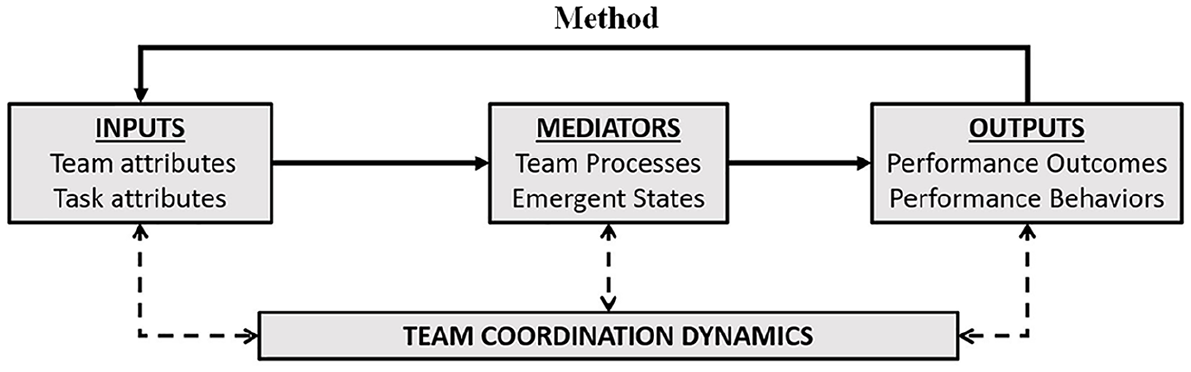
Theoretical framework used to categorize studies and analyze connections between team coordination dynamics, team functioning, and team performance.
Method
Literature Search
The systematic review was conducted following the guidelines described by Crocetti (2016). In order to identify relevant articles, we used the following search terms: group dynamics and physiolog* synchron* or interpersonal synchron* or behavioral synchron* or physiolog* coordination or interpersonal coordination or behavioral coordination or physiolog* covariation or interpersonal covariation or behavioral covariation. Following the initial search, we noticed some publications used different terminology, so we performed a second search using the following search terms: team* and physiolog* synchron* or interpersonal synchron* or behavioral synchron* or physiolog* coordination or interpersonal coordination or behavioral coordination or physiolog* covariation or interpersonal covariation or behavioral covariation. With the purpose of covering the majority of relevant journals, we searched in three databases: PsychINFO, Web of Science, and Medline, which together cover over 40,000 peer-reviewed journals worldwide in multiple fields, including psychology and life science. Additionally, these databases allow for searching dissertations, conference proceedings, and grey literature (non-peer-reviewed articles), although ultimately, our sample included only articles published in peer-reviewed journals, covering topics in psychology, human behavior, and social science (see reference list).
Eligibility
To ensure a high-quality review, the inclusion criteria allowing a study to be considered for the review were: (1) published in English, (2) empirical research, (3) data gathered from at least one team (three or more team members) simultaneously, (4) assessment of team coordination dynamics, (5) assessment of team performance (where participants were aware of the shared goal), (6) measurement of physiological and/or behavioral data with a wearable device (or that could be collected with a wearable device). The exclusion criteria disqualifying a study from the review were: (1) dyadic study, (2) examining remote/virtual teams, (3) lacking the assessment of team performance.
Study Selection
Given that we conducted two searches and used three different databases, we removed duplicates, after which three researchers screened the remaining titles for relevance, such that titles not in line with our research (e.g., on group dynamics of bird behavior) were removed. In case a researcher was not able to decide whether a title was relevant, the others were consulted, and a joint decision was made. Next, abstracts from selected articles were screened according to the eligibility criteria. The abstract screening procedure followed the same protocol as the title screening. Lastly, the remaining articles were fully read and assessed on the eligibility criteria. A detailed overview of the process is depicted in Figure 2.
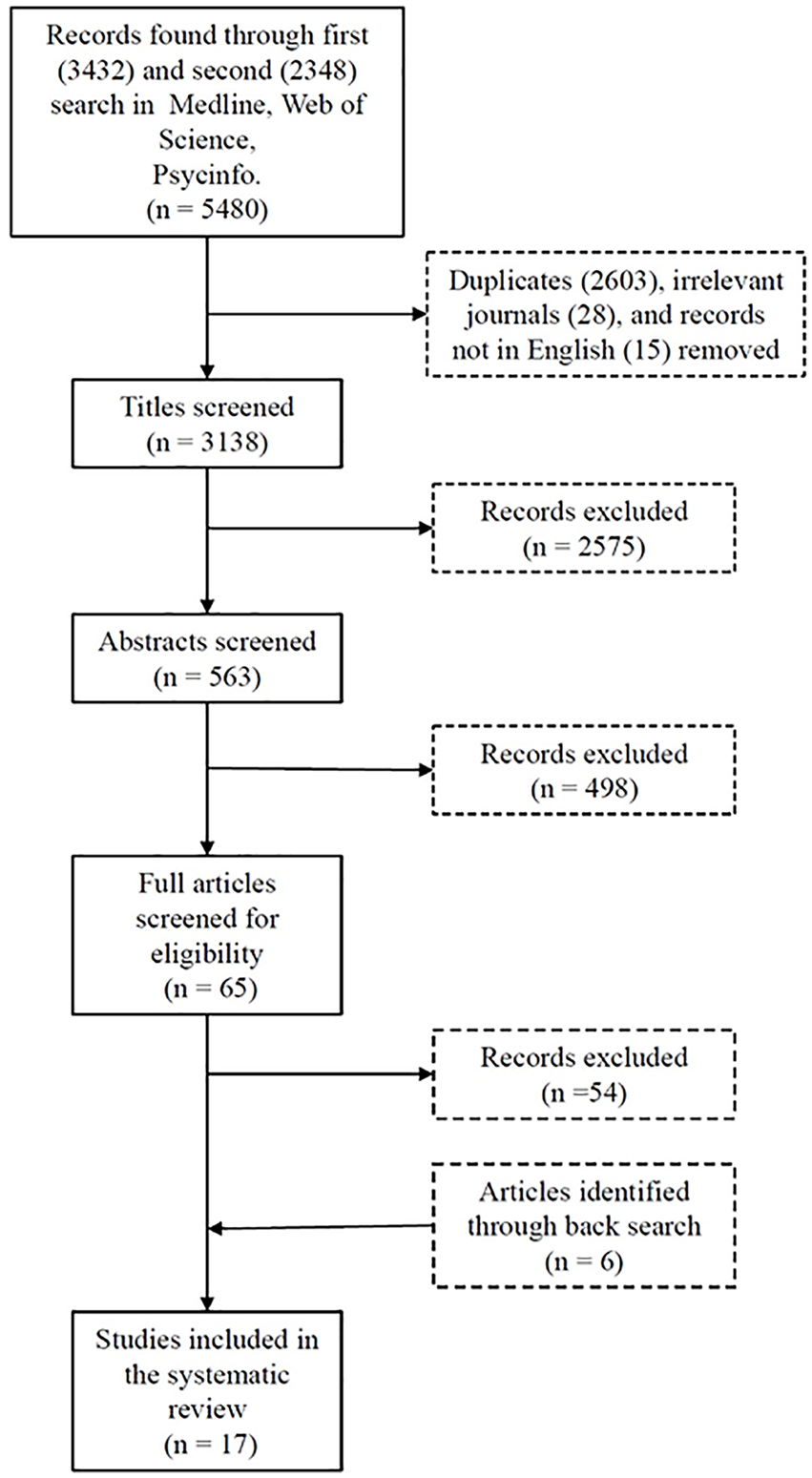
Article search strategy.
We conducted an additional backward search of the literature by screening the reference lists of the selected articles using the exclusion and inclusion criteria. This resulted in the addition of four more articles. Then, two additional relevant articles were published during the duration of the present project and were added into to our analysis, resulting in a total number of 17 articles reviewed, published from 2009 to 2021.
Data Extraction
To establish a coding protocol that guided information extraction, one training article was coded following the guidelines in Cooper (2016). Specifically, the first two authors extracted information on research questions or hypotheses, theoretical background, methods, and results. Next, the researchers discussed their results and agreed on a coding protocol that was applied to the rest of the articles. The protocol was set to include number of teams, size of the teams, performance measures, modalities used to assess coordination, method used for the analysis of coordination, and context of measurement including team’s tasks, settings, and timing. Researchers also collected data such as the year of publication, authorship, study settings, and hypotheses tested. Each article was coded by one researcher and then reviewed by other members of the research group.
Following the initial protocol, data for a meta-analysis were extracted. However, due to a large variation in reporting of results, methodological differences, and dissimilar tasks or manipulations, the coded data were not reliably comparable. Consequently, we decided against conducting a meta-analysis.
We followed guidelines in Mathieu et al. (2008) and Beal et al. (2003) to classify the studies, such that if a team construct of the IMOI model (i.e., input, mediator, output) is addressed in the study, the study is classified into the corresponding category. Since one of the inclusion criteria was that the article must include a team performance measure, all studies were classified into the output category. Then, based on the extracted information, we also determined whether other IMOI aspects were addressed in the article. Thus, at least one coding category can be applied to one article. For example, when both team size and performance outcomes were the focus of an article, the article was coded in the input and output categories.
Results
We first provide a descriptive summary detailing the key dimensions of the reviewed articles to contextualize our findings. Next, we organize these results in terms of how the coordination dynamics map to the team constructs based on the IMOI framework.
Descriptive Summaries
First, we present the descriptive summaries of the articles reviewed (N = 17), consecutively describing the team attributes, task types, time frames, modalities, and coordination dynamics measures (see Table 1 for more detailed information).
Descriptive Overview of Studies Included in the Review.
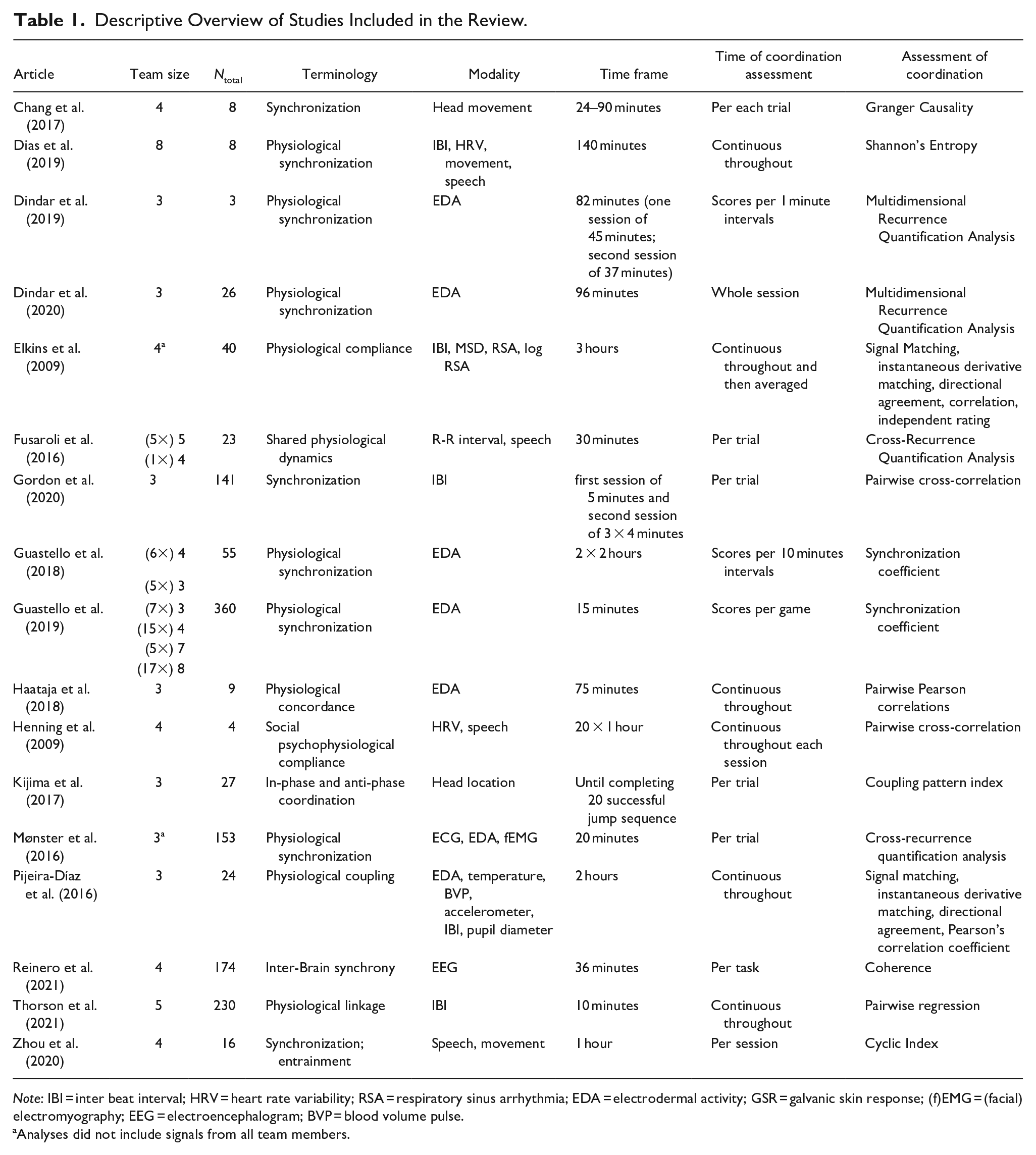
Note: IBI = inter beat interval; HRV = heart rate variability; RSA = respiratory sinus arrhythmia; EDA = electrodermal activity; GSR = galvanic skin response; (f)EMG = (facial) electromyography; EEG = electroencephalogram; BVP = blood volume pulse.
ªAnalyses did not include signals from all team members.
Team attributes
Team size varied across the studies. The smallest teams comprised three people (N = 7) and the larger ones included four (N = 5), five (N = 1), and eight (N = 1) subjects. Some articles examined multiple team sizes (N = 3). The majority of studies collected data from all team members (N = 15), whereas some examined only a part of the team (N = 2).
The majority of the studies recruited lay participants that were not familiar with the task beforehand or with each other (N = 9). A number of studies observed teams of acquainted professionals, such as musicians (N = 1), medical staff (N = 1), and researchers (N = 1). Four studies observed teams of familiar students in a classroom or during a collaborative task. Furthermore, a small number of studies assigned participants to specific roles (N = 1).
Task types
As indicated above, three studies involved professional workers completing a task related to their expertise. Among these three studies, one study took place in the operating room and involved doctors and medical students performing a coronary artery bypass surgery. Another study observed a team of researchers during their biweekly research meetings. The other study involved professional musicians performing a piece of music. Three studies examined students during various collaborative learning tasks, such as performing a group project or collective writing. Three studies used simulations involving a paramilitary task shooting terrorists or running a tailoring company to augment the company’s capital. Three studies examined participants working collaboratively to come up with a product design, such as a meal plan or a new device. Another two studies used a competitive board game as a simulation requiring participants to work together against a common enemy. Two studies used a physical activity, specifically a jumping task and a drumming task. One study asked participants to complete a creative project.
Time frames
Most studies examined teams during one single observational session (N = 15). These single session studies included short sessions lasting from 10 to 30 minutes in total (N = 7), or longer sessions lasting from 35 to 160 minutes (N = 10). Two studies examined teams throughout multiple long sessions spanning multiple weeks (N = 2), either three times a week (each session lasting 75 minutes) for 18 weeks or once every 2 weeks for 20 weeks (each session lasting 60 minutes). One study collected data from a single team over three 15-minute sessions, and the other study did not include a specified time frame and stated that it lasted until the task was completed.
Modalities
A variety of modalities were examined in the reviewed studies including neuro- and physiological signals as well as behavioral and speech-related data. In total, 10 studies examined only one modality. These included one study that examined measures of neurophysiological signals from the central nervous system recorded with EEG devices. Other studies involved signals from the autonomic nervous system, namely measures of electrodermal activity (EDA) (N = 5) or Inter-Beat-Interval (IBI) (N = 2). Two other studies used behavioral data based on head movement, recorded either with a video or an accelerometer. Other than the 10 studies that focused on one modality, seven studies examined multiple modalities, for example using behavioral data collected with an accelerometer and cardiovascular system data using R-R 5 Intervals and Respiratory Sinus Arrhythmia.
Team coordination dynamics measures
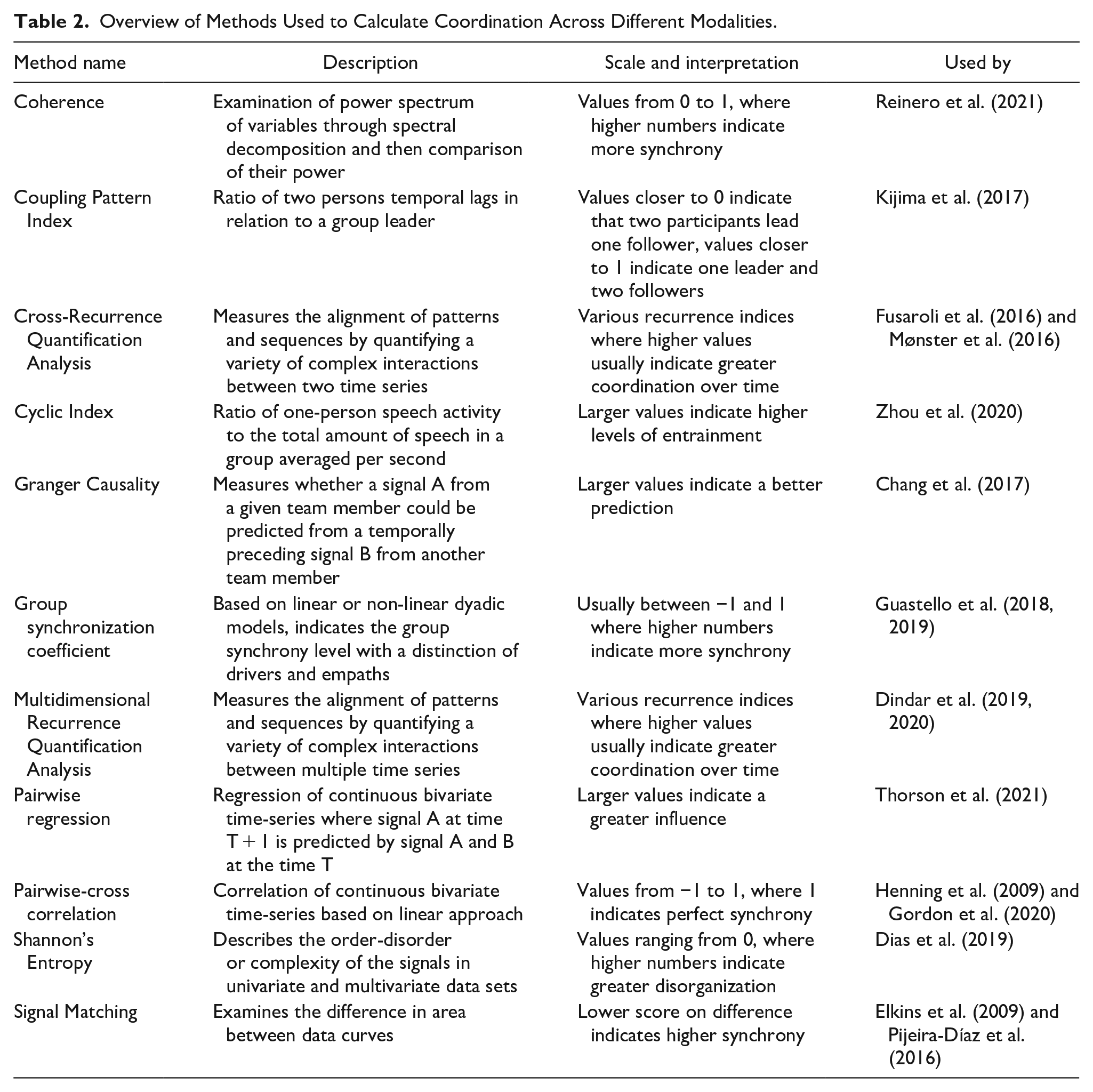
The reviewed studies represented several ways to calculate the level of coordination from the individual team member’s data. The majority of articles reported synchrony-based measures describing the degree of spatio-temporal similarity between signals derived from team members (N = 6). The methods used in these articles were pairwise-cross correlation (N = 2), pairwise regression (N = 1), group synchronization coefficient (N = 2), Pearson’s correlation (N = 1). Other methods used to calculate coordination included Coherence (N = 1), Granger Causality (N = 1), Shannon’s Entropy (N = 1), Cross-Recurrence Quantification Analysis (N = 2), Multidimensional Recurrence Quantification Analysis (N = 2), Signal Matching (N = 2), Coupling Pattern Index (N = 1), and Cyclic Index (N = 1). For a more in-depth explanation of the coordination assessment methods, see Table 2.
Overview of Methods Used to Calculate Coordination Across Different Modalities.
In terms of measurement duration, some (N = 5) of the studies assessed coordination by measuring the continuous level of the coordination across the full length of the interaction, whereas eight studies examined the mean coordination level per task or per trial. In addition, one study examined mean synchrony level for every 10-minute interval across three sessions of 2 hours each. Another study examined coordination dynamics in 15-minute intervals over one-hour interactions, whereas another study used three blocks of 5-minute intervals per one session of 15 minutes over the total of 45 minutes. Yet another study used a dyadic-based regression analysis to calculate the mean score of the coordination for each 30 seconds of the interaction from a 10-minute session.
Relating Coordination Dynamics to Team Functioning and Team Performance Using the IMOI Framework
In the subsections that follow, we review the studies using the IMOI framework. Table 3 presents the relationships between each part of the IMOI framework and the coordination measures. In Figure 3, a visual overview of the results shows how research findings on team coordination dynamics are associated with each part of the IMOI model.
Papers Coded by Its Relationship to the IMOI Framework and Its Relationship to the Coordination Measures.
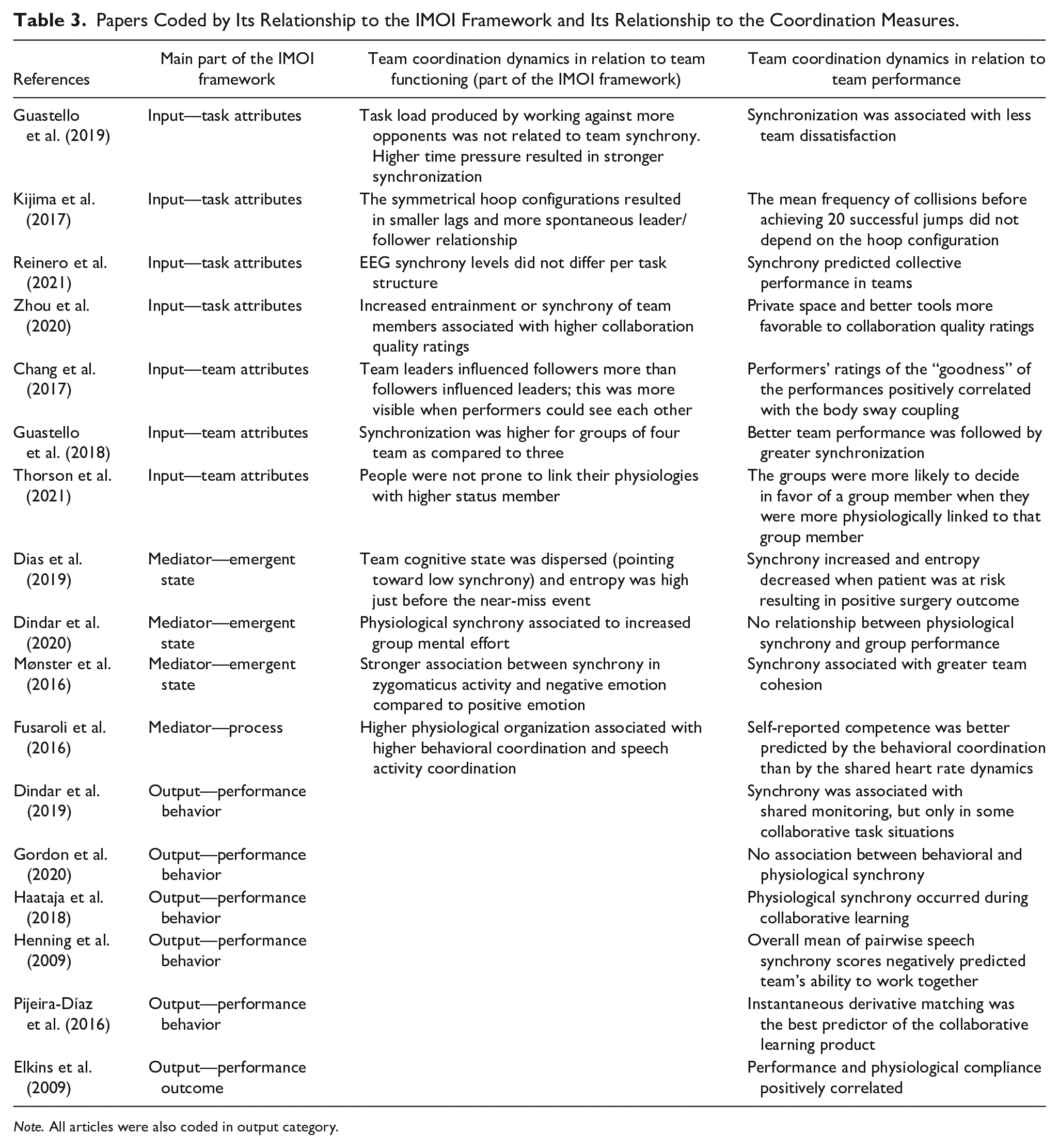
Note. All articles were also coded in output category.
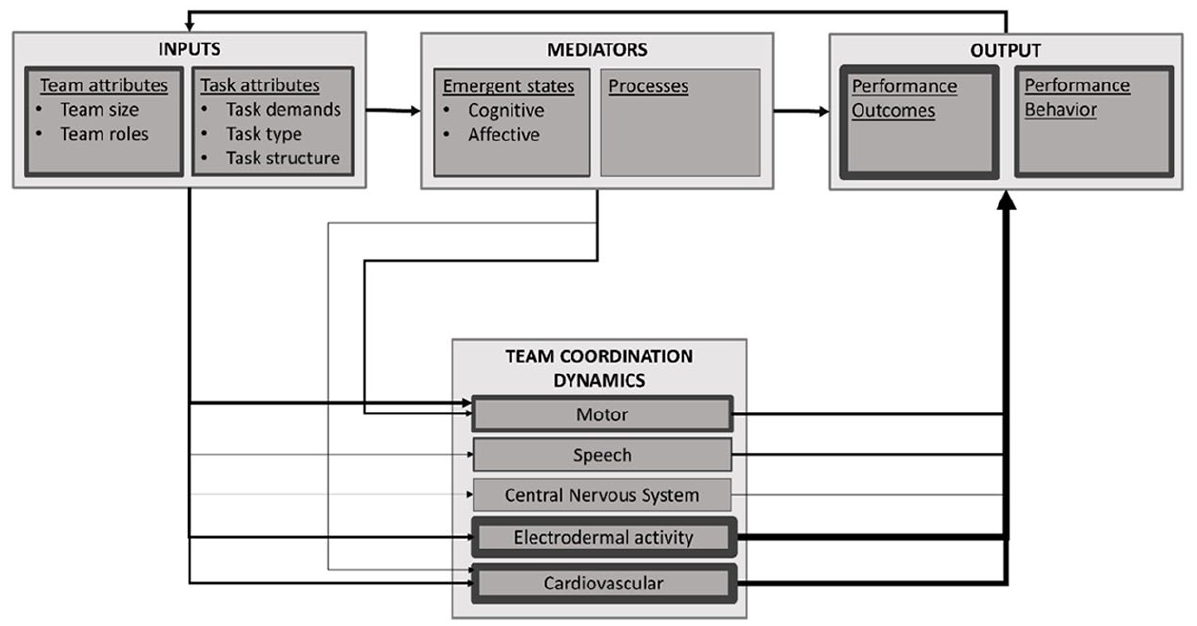
Integrated representation of the identified relationships in the review according to the IMOI framework.
Inputs
Seven articles addressed the impact of team inputs on team coordination dynamics, including team attributes (i.e., team composition in terms of team roles, team co-presence, and team size) and task attributes (i.e., task demands, task type, task structure).
Four articles examined team attributes, specifically team roles (Chang et al., 2017; Thorson et al., 2021), team co-presence (Fusaroli et al., 2016), and team sizes (Guastello et al., 2018). In order to study the impact of team member roles on physiological linkage, Thorson et al. (2021) assigned each participant to either a low, medium, or high artificial leadership status. In general, each group’s task was to select the best of five executive firms, while the high and low-status participants were told that their specific task was to convince the group to hire one particular firm. Thorson et al. (2021) reported that IBI physiological linkage was not associated with the fellow group members’ status, meaning that sharing the same status did not induce higher coordination between team members (Thorson et al., 2021). Chang et al. (2017) manipulated team roles among musicians playing a musical piece together by assigning leadership roles to either one, all, or none of them, while also manipulating the visibility of the other performers. The researchers concluded that body sway coordination was more strongly influenced by the leading performers than by the followers, but only when participants could see each other.
Fusaroli et al. (2016) examined the impact of team co-presence on coordination dynamics. They assigned participants (teams of five or four) to either a collective or an individual LEGO construction task in which participants had to create a representation of a word, for example “justice”, with LEGO blocks. Results showed that the stability of shared heart rate dynamics was significantly higher for real dyads in the collective trials compared to virtual dyads made up from individuals working independently.
Lasty, Guastello et al. (2018) examined coordination dynamics for various team sizes during a board game task. They found that teams of four members displayed higher skin conductance synchrony levels compared to teams with three members. The authors suggested this was due to the critical number of people needed to produce a group synchronization effect.
Among the four articles that focused on task attributes, task demands were the topic of one study (Guastello et al., 2019), in which researchers manipulated the task load by adjusting the number of opponents the team faced in a board game task. They found that the averaged self-reported cognitive workloads were not related to team synchrony in skin conductance signals (Guastello et al., 2019). However, they also found that when they increased time pressure, teams exhibited stronger synchrony.
Task type was the topic of another article (Kijima et al., 2017), where participants had to physically jump around in different hoop configurations without bumping into each other. By applying the coupling pattern index from the leader-follower timing, they found that symmetrical hoop configurations were associated with smaller overall movement lags and a more spontaneous, interchangeable leader-follower relationship between participants as compared to asymmetrical hoop configurations.
Task conditions was manipulated in one study (Zhou et al., 2020), where participants completed a collaborative design task in either a public or a private environment. Participants were also divided into two groups, one using a tablet and the other one using pen and paper. In general, Zhou et al. (2020) reported that increased speech synchrony of team members was associated with higher collaboration quality ratings, and private space and better tools also increased the collaboration quality ratings. However, the association between task condition and speech synchrony was not examined specifically. Additionally, in another study, the goal of the team task was manipulated by assigning teams to either a collaborative or competitive condition in a public goods game, where researchers found that the EEG synchrony levels did not differ per task condition (Reinero et al., 2021).
To sum up, research on the relation between team inputs and team coordination dynamics, calculated from various modalities, focused mostly on team attributes such as team roles and team composition. Based on the reviewed studies, we conclude that evidence suggests that team coordination dynamics are influenced by team inputs, including team sizes, task demands, and task structures.
Mediators
In our review, we distinguish two types of mediators: team emergent states, either affective (N = 1) or cognitive (N = 2) and team processes (N = 1). The work on affective emergent states examined how the group’s affective state during teamwork influenced team coordination, as indicated by psychophysiological measures (Mønster et al., 2016). Researchers primed teams with either negative or positive emotions while they were working together at an assembly line to construct origami boats. It was found that there was higher synchrony in zygomaticus muscle activity between team members when negative emotions were induced compared to when positive emotions were induced (Mønster et al., 2016).
Two studies examined team coordination dynamics as cognitive emergent states (Dias et al., 2019; Dindar et al., 2020). Dias et al. (2019) measured a medical team’s cognitive state during surgery. They observed that low synchrony in team cognitive state and high entropy in heart rate signal immediately preceded a near miss event putting a patient at risk (Dias et al., 2019). More specifically, they found that high entropy in the heart rate signals of the surgical team members was a precursor to a medical mistake. Dindar et al. (2020) examined teams during a complex problem-solving simulation at a shirt production company. Researchers found that the maximum period of uninterrupted skin conductance synchrony indicated increased group mental effort in the collaborative problem-solving task.
Lastly, Fusaroli et al. (2016) investigated team processes, particularly team creative processes. As aforementioned, participants in this study were asked to build a LEGO construction depicting an abstract word (e.g., justice). Fusaroli et al. (2016) found that behavioral coordination, as represented by shared LEGO building activity, alongside with speech activity, predicted self-reported group competence and group relatedness. They also found that the level and stability of behavioral coordination predicted shared heart rate dynamics in the collective trials, meaning that behavioral coordination was the driver of both physiological coordination and collective experience.
To summarize, whereas relatively few studies focused on the relationship between mediators and team coordination dynamics, findings suggest that team coordination dynamics are related to or reflect teams’ cognitive and affective emergent states or team processes during various tasks.
Outputs
As mentioned in the methods section, given the selection criteria, all the studies included in the review addressed team performance, including performance behaviors (collaborative learning, shared monitoring) and performance outcomes (task scores). A total of six studies directly examined team coordination dynamics in relation to some measure of team outputs.
Considering the studies that directly examined links with performance behaviors, Haataja et al. (2018) examined whether monitoring (i.e., part of collaborative learning) co-occurred with skin conductance physiological synchrony. Based on video recordings of the interactions, researchers concluded that the strongest connection between synchrony and monitoring existed when all forms of monitoring (affective, cognitive, and behavioral) were considered. Similarly, in a study where student triads had to design an appropriate breakfast for an athlete, Pijeira-Díaz et al. (2016) found that skin conductance coupling was associated with higher ratings of the collaborative learning product, specifically students’ final report. Correspondingly, Dindar et al. (2019) examined how shared monitoring behavior during a collaborative learning task correlated with skin conductance synchrony. They found that students’ physiological synchrony was significantly correlated with monitoring events in an essay writing task, but no such relationship was found between synchrony and monitoring in an experiment conducting task. Consequently, Dindar et al. (2019) suggested that the relationship between synchrony and monitoring might be task dependent. Next, examining collaboration in a longitudinal study among a group of researchers, Henning et al. (2009) reported that the overall mean of pairwise sequences speech synchrony scores negatively predicted the team’s ability to work together during research meetings. Lastly, Gordon et al. (2020) described how Inter-Beat-Interval physiological synchrony early in the group process preceded increased behavioral coordination while drumming in a subsequent improvisation task.
Only one study directly tested the relationship between coordination dynamics and performance outcome. Elkins et al. (2009) reported that dyadic heart rate synchrony correlated positively with team performance, calculated based on team velocity and the number of correctly identified and neutralized objects in a simulation task where four-person teams had to correctly identify a threat and neutralize it.
The remainder of studies established indirect links between team coordination dynamics and team outputs based on association with team inputs and mediators.
The link between team functioning, team coordination dynamics and performance behaviors was established by Guastello et al. (2019) where they found that time pressured task conditions instigated higher synchrony levels, which were associated with lower self-reported team dissatisfaction. Next, Mønster et al. (2016) observed that higher synchrony in the facial muscle associated with smiling was linked to positive emotions as well as greater team cohesion. Lastly, Fusaroli et al. (2016) reported that behavioral coordination in speech and movement was linked with the self-reported competence as well as group relatedness.
Regarding studies that examined the association between team functioning, team coordination dynamics, and performance outcomes, Chang et al. (2017) found that team roles related to body sway coupling, which in turn was correlated with higher self-reported performance. Similarly, in a study where group members were assigned higher and lower levels of leadership status, Thorson et al. (2021) reported that groups were more inclined to vote in favor of a group member when they were more physiologically coordinated. Guastello et al. (2018) established a link between team sizes, coordination, and performance outcomes as they found that larger teams of four, as compared to teams of three, presented higher skin conductance synchrony levels, which was associated with higher team performance on an Emergency Response board game task. Further, investigating task attributes, Reinero et al. (2021) showed that EEG inter-brain synchrony was associated with objective team performance on various problem-solving tasks regardless of the task conditions. Similarly, Zhou et al. (2020) described how task conditions influenced performance. More specifically, teams working in a private room and with modern technology reported better collaboration quality compared to teams working in a public space. They also reported that higher speech synchrony, measured with values of the cyclic indices (implying higher entrainment between the speakers), was associated with higher collaboration quality ratings. Lastly, Dias et al. (2019), reported that a period of high entropy and low heart rate synchrony preceded a near miss event in the operating room. However, once synchrony increased and entropy decreased, the team performance rose to a higher level, ultimately resulting in a positive surgery outcome. In a contrasting view, Dindar et al. (2020), found that higher skin conductance synchrony was associated with higher group mental effort, but a relationship with performance was not found.
In summary, based on the reviewed articles, we can conclude that associations between team coordination dynamics and team outputs have clearly been established, and that these have generally been positive, although also subject to other factors, such as team co-presence and task type.
Discussion
There is an increasing interest in using wearable technology for assessing team coordination dynamics with data from multiple modalities, including physiology, motor, and speech data (e.g., Kazi et al., 2021; Zhou et al., 2020), which may contribute to a better understanding of team functioning and performance (e.g., Elkins, 2009). Moreover, wearable devices have multiple advantages: they allow for collecting continuous in situ information sourced from various modalities and multiple agents at the same time, are not prone to (self-)report bias, and enable data collection that does not interfere with emergent team states and processes (Kozlowski et al., 2013). To this end, the use of wearable technology presents opportunities to provide teams with real-time feedback on their coordination level (Wiltshire & Fiore, 2014; Wiltshire et al., 2020). Particularly for teams working in high-stakes environments, for which sustaining effective team performance is challenging (Driskell et al., 2018; Stachowski et al., 2009), real-time performance feedback could provide major advances in supporting effective team functioning (Wiltshire et al., 2020). However, the use of wearable technology is hampered due to a lack of insight regarding how team coordination dynamics in different modalities correspond to team functioning and performance.
As a means of overcoming this hindrance, the goal of our review was to provide an overview of extant research that has examined team coordination dynamics (in various modalities measurable with wearable devices) in relation to team functioning and team performance. We focused exclusively on team research with at least three people interacting, thereby directing our framework beyond dyadic studies (e.g., Kazi et al., 2021) without assuming that findings from dyads translate to teams with three or more members. Our review has revealed that the majority of studies involved coordination in the peripheral nervous system, for example, with measures of skin conductance or measures of cardiovascular activity, such as heart rate variability. Further, several studies were conducted to examine coordination in behavioral data, such as movement of music performers. Also, coordination in speech between team members was studied, usually in contexts where teams had to work collaboratively, for example, during a surgery or while working on a creative task. When multiple modalities were assessed, studies usually combined a measure of the autonomic nervous system, such as skin conductance or cardiovascular parameter, with a measure of speech or motion. The use of modalities outside the autonomous nervous system was rare and only one study used a combination of speech and movement data to assess team coordination dynamics. Among studies that included multiple modalities, results in relation to the team coordination dynamics calculated from the different modalities were often inconsistent, such that usually the coordination level in only one modality would be associated with team functioning or team performance.
Next, our review revealed considerable evidence that team coordination dynamics can reflect aspects of team functioning and team performance. Notably, our results showed that coordination dynamics can be valuable indicators of the interpersonal functioning of teams. More specifically, there is evidence that coordination dynamics are influenced by team inputs, such as that teams of four are more likely to show synchrony in skin conductance than teams of three, resulting in better performance outcomes (Guastello et al., 2018), and that co-presence during tasks facilitates behavioral coordination (Fusaroli et al., 2016). Although only a few articles examined team coordination’s relationship with team mediators, the findings showed that coordination dynamics are associated with affective or could serve as an indicator of cognitive team states (e.g., Dindar et al., 2019; Mønster et al., 2016), and are also related to team processes, such as creative processes (Fusaroli et al., 2016). Lastly, we described the relationship between team coordination dynamics and team outputs. Our results show that coordination dynamics are related to team performance, both in terms of behavioral outcomes such as learning and team viability (e.g., Dindar et al., 2019) and in terms of performance outcomes such as task accomplishments (e.g., Pijeira-Díaz et al., 2016). Based on the reviewed studies, the most prominent relationships with team performance are team coordination dynamics measured with signals from the cardiovascular system and skin conductance. Similarly, we found that indicators of team functioning, such as team monitoring behaviors and team cognitive states, are best represented with team coordination dynamics measured with signals from speech, the cardiovascular system and skin conductance. Additionally, we found evidence that team inputs, such as team co-presence and task structure, have the potential to influence team coordination dynamics. Together, these findings suggest that links exist between team coordination dynamics and team functioning and performance, although subject to various input factors. Our findings therefore indicate there is a promising route for further development toward the use of wearable devices for direct in situ assessment and support of team effectiveness.
Our research has several important implications. First, our review corroborates with and extends findings from Kazi et al. (2021), and generally confirms the promising future of using wearable devices to measure team coordination dynamics to assess team functioning and team performance. There is considerable evidence that different modalities relate to various aspects of team functioning and team performance. In our review, coordination in signals from the autonomic nervous system surfaced as the strongest predictors of team processes and emergent states, although this may simply reflect the fact that they have been researched most often. Considering that, in multiple studies, findings of different modalities were often inconsistent in relation to team performance, perhaps due to the influence of contextual factors (Danyluck & Page-Gould, 2019), researchers and practitioners are advised to consider including multiple modalities when assessing team coordination dynamics. Additionally, since analytical methods applied to physiological and behavioral data varied widely among the studies included in our review, and the specific methods used for calculating coordination (e.g., overall strength of the synchrony or frequency of synchrony during the interaction) may represent different team phenomena (cf. Schoenherr et al., 2019), our findings should be interpreted with caution.
Second, we contend that researchers should not rely solely on research with dyads to draw conclusions about the use of wearable technology in team contexts (cf. Kazi et al., 2021). Since team size can influence team coordination dynamics (Guastello et al., 2018), insights obtained in research with dyads may not translate directly to larger collectives. For instance, speech patterns are different for dyads and teams, because the number of people interacting influences the number of turns and communication patterns (David & Schraagen, 2018; van den Oever & Schraagen, 2021). Thus, when dyadic methods are used to assess team coordination dynamics, it is important to recognize that interaction dynamics in dyads are different from those in teams (Moreland, 2010). This also suggests that more research with teams of various sizes is needed to allow for generalizing conclusions across team constellations.
Further, despite the appeal of wearable technology and its increased use by team researchers, we see that research has not taken the full advantage of the possibilities of continuous data collection provided by wearable technology. As such, the studies included in the present review mostly focused on the mean level of coordination in signals across an interaction (e.g., Dindar et al., 2020) or session (e.g., Henning et al., 2009), which might not be the most adequate measure to predict a team’s future performance or functioning (Likens & Wiltshire, 2021). Specifically, given that coordination is a dynamic process and changes over time, the mean synchrony level across an interaction might not be sensitive enough to validly reflect crucial episodes in the team’s functioning that determine its final performance. In other words, synchrony during certain phases of teamwork might be more influential on team performance, and these may not be sufficiently represented in an overall mean score (Dindar et al., 2019, 2020). Thus, while our review can provide insights about the relationships between overall coordination measures, the time varying properties of team coordination await further research, especially given that these aspects are important for practical applications.
To sum up, although limited in size, the current body of work is encouraging and warrants the rising interest among researchers in measures provided by wearable technology to advance research dedicated to team coordination dynamics. This would contribute greatly to establishing a solid body of evidence regarding which modalities and what methods can best indicate and assess team functioning, and the prospect of developing a real-time support system with team feedback, allowing for improving team performance at the time of interaction. Currently, feedback opportunities for teams operating in high stakes environments are largely limited to after-act debriefings that typically take place in training rather than real-world settings, sometimes using video recordings (e.g., Knobel et al., 2018). Although, technically, video recordings could also be used to capture physiology (Zhan et al., 2020) as well as speech and motion (Cao et al., 2017), wearable technology strikes as a much more efficient and flexible tool for real-time monitoring of team functioning, particularly in dynamic real-world environments (i.e., outside the research lab). Wearable technology does not restrict its users to a fixed area or predesignated location, and input could be processed (near) real-time from various modalities simultaneously. Given the speed of technological development, such as EEG devices, even fairly unobtrusive neurophysiological measurements of team coordination dynamics in the central nervous system might become feasible in the near future (e.g., Waldman et al., 2015).
Study Limitations
Considering the relatively low number of studies examining team coordination dynamics in relation to team functioning and team performance, we recognize that our review may not provide definitive directions for augmenting team effectiveness with wearable technology. Also, although some studies examined multiple teams, others were based on one single team, an issue that was not addressed in our analysis given that we did not perform a meta-analysis. Moreover, even though we included grey literature in our review process, we may have overlooked literature that would fit into our framework but was not available in the databases where we collected articles. Additionally, we acknowledge that our coding method, although consistent with that in Beal et al. (2003) and yielded reliable findings, may not be comprehensive, such as classifying learning as performance behavior. However, our review yielded fairly consistent results, and therefore it is highly unlikely that an alternative coding would have strongly impacted the conclusions to be drawn.
Future Research
In the future, we envision a need for multi-modal empirical research into the links between team coordination dynamics, team functioning, and team performance. More specifically, using at least one modality from the parasympathetic as well as the sympathetic nervous system would be especially valuable given that the coordination in these systems might respond to contextual factors differently (Danyluck & Page-Gould, 2019). A similar approach was described by Fusaroli et al. (2016) as they compared results from the shared heart rate dynamics and behavioral synchrony measures and Amon et al. (2019), where movement, speech, and task information were incorporated into a single coordination analysis. Moreover, the analysis of multiple signals from the same system would be insightful as it can provide more information on context dependability. More generally, casting a wider net not just in terms of multi-modal coordination dynamics, but investigating how coordination dynamics are related in a variety of task types and dimensions is warranted. Our review provides scholars with further insights into links between team coordination dynamics, team functioning, and team performance.
Additionally, there is a need for future research to provide insight and improve matters related to internal and external validity. For one, it is important to compare team coordination dynamics measures against traditional measures to establish construct and criterion validity. This may entail employing traditional quantitative as well as qualitative instruments to capture and validate how team coordination dynamics link with team functioning and performance (Klonek et al., 2019). Next, future research should assess the level of synchrony needed for specific tasks, as collaborative tasks may require more coordination in comparison to problem solving tasks where less coordination might be beneficial (Guastello & Peressini, 2017). Additionally, in order to provide reliable real-time feedback, future research should establish the duration over which the level of coordination should be calculated. Specifically, the time period should be long enough to provide correct measures, but at the same it should be short enough to be relevant to the current team state. Most importantly, to truly understand the forces that shape teamwork, there is an increasing need to move research from survey-based laboratory experiments into the operational field (Hackman & Katz, 2010). True-to-life studies can provide more ecological validity for supporting teamwork in real teams and consequently help to build a better society.
Next, future research using continuous physiological or behavioral data might find it challenging to decide on temporal granularity of recordings. Specifically, determining frequencies of data collection is difficult as currently there is no consensus, standardization, or recommendation to follow. A general advice for researchers is to consider the modality of the measure, the pace of the physiological or behavioral process, the time scale of the task, and the available recording devices. Lastly, future research will benefit from developing a novel robust method that can reliably assess the coordination levels across modalities regardless of team size (e.g., Hudson et al., 2021), which would also be valuable for other fields besides team research (Delaherche et al., 2012). Ideally, these methods should not rely on dyadic models as they are computationally arduous, especially for larger teams. Nor should they be restrictive to one type of data to allow for input data that do not meet the assumptions of parametric statistics.
Conclusion
Overall, our review presents how team coordination dynamics measured or measurable with modalities derived from wearable devices are influenced by team and task features and are indicators of or associated with team functioning and, ultimately, team performance. We used the IMOI framework (Ilgen et al., 2005) to assign each study to the Input, Mediator, and/or Output category depending on the parameters it studied. Our findings indicate a promising field of research on team coordination dynamics in relation to team functioning and team performance using data collected with wearable technology, despite its nascent stage of development. Importantly, our review highlights the importance of team size with the implication that findings in dyadic research should not be generalized to team research. Also, our findings indicate that the full advantages of continuous data collection have not yet been explored or exploited sufficiently to provide concrete directions for using wearable technology to support teams.
Footnotes
Declaration of Conflicting Interests
The author(s) declared no potential conflicts of interest with respect to the research, authorship, and/or publication of this article.
Funding
The author(s) disclosed receipt of the following financial support for the research, authorship, and/or publication of this article: This project is partially funded by the Dutch Research Council (NWO) as part of the NWO Complexity and Creativity Initiative: Grip on Transitions and Resilience program with project number 645.003.003.
