




Abstract
The omnipresence of workplace gossip makes understanding gossip processes imperative to understand social life in organizations. Although gossip research has recently increased across the social sciences, gossip is conceptualized in disparate ways in the scientific literature. This conceptual confusion impedes theoretical integration and providing practical advice. To resolve this, we systematically reviewed 6114 scientific articles on gossip and identified 324 articles that define gossip. From these definitions, we extracted two essential characteristics of gossip on which there seems to be agreement within the literature, namely, (1) that gossip is communication between humans involving a sender, a receiver, and a target, and (2) that the target is absent or unaware of the communicated content. These two characteristics formed the basis of a broad, integrative definition of gossip: a sender communicating to a receiver about a target who is absent or unaware of the content. Furthermore, some definitions include characteristics on which there is less agreement: gossip valence (from negative to neutral to positive) and formality (from informal to intermediate to formal). We incorporate these characteristics in a dimensional scaling framework that can guide future research. Our broad, integrative definition of gossip and the dimensional scaling framework provide the building blocks for a systematic, integrated knowledge base on the role of gossip in human social life in general as well as in organizations. This can foster future theory development and hypothesis testing, ultimately helping organizations to manage gossip.
Gossip is a ubiquitous characteristic of human life (Dunbar, 2004; Emler, 2019), which is observed across cultures and in various types of social organizations, ranging from groups of hunter-gatherers to teams in modern organizations (Besnier, 2019; Mills, 2010).
Gossip comprises a large share of people’s conversations (Emler, 1990; Robbins & Karan, 2019), and the workplace is no exception: Research shows that 90% of people engage in gossip at the workplace (Grosser, Lopez-Kidwell, Labianca, & Ellwardt, 2012). For example, team members discuss their supervisor’s behavior, talk about alleged relationships between coworkers, or discuss whether a coworker provides adequate input for a task.
Among organizational researchers, the topic of gossip has strongly gained momentum (see, e.g., Giardini & Wittek, 2019a). Gossip has recently been featured in top management journals such as Journal of Management (Wu, Birtch, Chiang, & Zhang, 2018) and Journal of Applied Psychology (Brady, Brown, & Liang, 2017), a guest editorial was dedicated to gossip in Group and Organization Management (Michelson, Van Iterson, & Waddington, 2010b), and gossip was covered in outlets aimed at practical management advice, such as Harvard Business Review (e.g., Davey, 2016; Riegel, 2018). The growing research interest in gossip can also be observed across the social sciences more broadly, including organization science, social psychology, evolutionary biology, behavioral economics, and anthropology. Figure 1 illustrates that the number of articles including “gossip” or “third-party information”
1
in the title, abstract, or keywords has more than doubled in the last 10 years. Number of articles with gossip in title, abstract, or keywords (excluding the term algorithm) across different academic databases. Note. The term “algorithm” was excluded from all search strings to focus the search on social science research and exclude articles from computer science and related disciplines that focus on communication between nonhuman actors.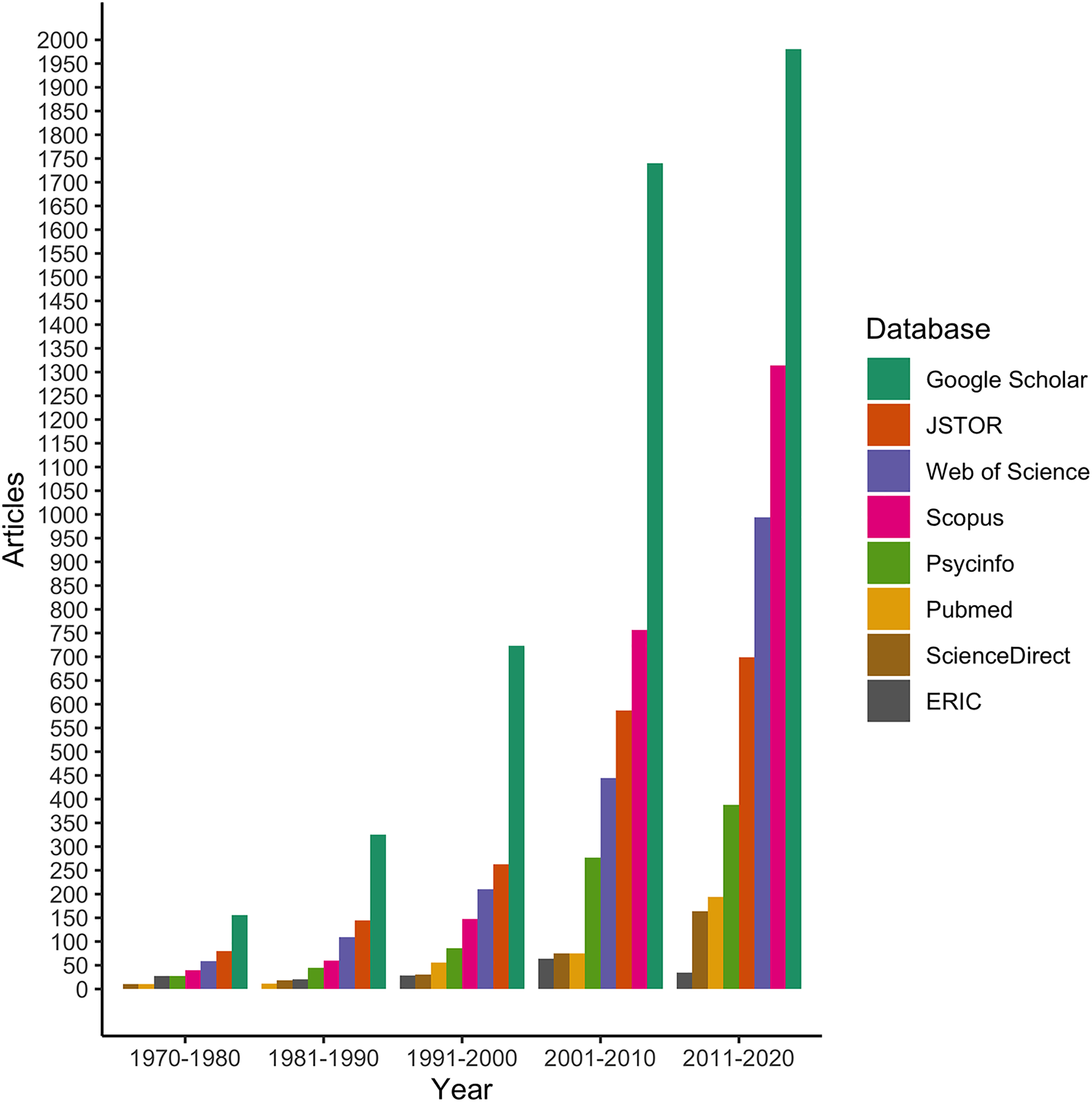
One general conclusion that can be drawn from this previous research is that gossip affects all actors involved in the “gossip triad,” comprised people who send it (gossip senders), people who receive it (gossip receivers), and people who become its target (Anderson, Siegel, Bliss-Moreau, & Barrett, 2011; Dores Cruz, Beersma, Dijkstra, & Bechtoldt, 2019; Farley, 2011; Feinberg, Willer, & Schultz, 2014; Feinberg, Willer, Stellar, & Keltner, 2012; Giardini & Wittek, 2019a; Martinescu, Janssen, & Nijstad, 2014; Michelson, Van Iterson, & Waddington, 2010a; Sommerfeld, Krambeck, Semmann, & Milinski, 2007). Moreover, gossip does not only have consequences for individuals but also for teams and organizations (Grosser, Lopez-Kidwell, & Labianca, 2010; Kniffin & Wilson, 2005, 2010; Mills, 2010; Wittek & Wielers, 1998).
However, a closer look reveals that the conclusions we can draw from gossip research regarding the (dys)functionality of gossip are conflicting. While some researchers conclude that gossip entails positive consequences, others conclude that gossip has negative consequences (see also Dores Cruz et al., 2019, Dores Cruz, Beersma, Dijkstra, & Bechtoldt, 2019). This makes it difficult, if not impossible, for gossip research to guide practitioners on how to deal with gossip (i.e., whether to promote or hinder gossip at the workplace). This is aptly illustrated by how gossip is discussed on popular management websites. Mirroring conflicting conclusions drawn in scientific research, some argue that “[gossip] results in low employee morale and a toxic culture” and correspondingly advise to eliminate workplace gossip (Heathfield, 2019), while others argue that “gossip can be good for business,” and “[gossip] makes us feel closer together and helps us build and maintain social bonds” (Tobin, 2010). Confronted with such conflicting perspectives and associated recommendations regarding gossip, it is understandable that managers might feel helpless when it comes to managing gossip. Therefore, integrating the different perspectives on gossip is necessary to guide managers and policy makers about when, why, and for whom gossip leads to (dys)functional consequences at the workplace.
However, the gossip research field is currently far from being able to integrate different conclusions because it lacks conceptual clarity. This means that there is no unified understanding of what gossip is. Even very impactful articles on gossip (i.e., articles with more than 50 citations on Web of Science) have either used vastly different definitions or did not define gossip at all (e.g., Anderson et al., 2011). To illustrate, Bosson et al. (2006, p. 136) define gossip as “an exchange of personal information about absent third parties that can be either evaluatively positive or negative”, Mesoudi, Whiten, and Dunbar (2006, p. 408) as “information about intense third-party social relationships”, Kurland and Pelled (2000, p. 429) as “informal and evaluative talk in an organization, usually among no more than a few individuals, about another member of that organization who is not present”, and Noon & Delbridge, (1993, p. 25) as “the process of informally communicating value-laden information about members of a social setting”, (for a complete overview, see Table 1 in the Supplementary Material).
This pervasive lack of consensus on how to define gossip is detrimental to the development of the gossip research field. Without agreement on what gossip is, it is difficult to compare and connect findings across studies. This lack of conceptual clarity makes it difficult for studies to build onto one another, impossible to run meta-analyses, or to integrate findings in theoretical models and across disciplines. This severely limits researchers’ ability to theorize about gossip and to help organizations understand the (dys)functionality of gossip, leaving practitioners without clear advice on how to manage gossip.
Reviewing studies on the consequences of gossip for individuals, teams, and organizations reveals that the use of different conceptualizations of gossip across research lines seems systematically related to conclusions about gossip. To demonstrate, within one line of research, studies have conceptualized gossip as negative and concluded that gossip largely leads to negative consequences. To illustrate in an organizational setting, Georganta et al. (2014) defined gossip as negative communication and concluded that perceived gossip in organizations is related to emotional exhaustion, low job engagement, and low performance. Likewise, studies point to a negative relationship between gossip conceptualized as negative talk and targets' positive behavior toward colleagues and the organization, due to the negative effects of such gossip on group-related self-views and emotions (Kong, 2018; Wu, Birtch, Chiang, & Zhang, 2018; Wu, Kwan, Wu, & Ma, 2018; Ye, Zhu, Deng, & Mu, 2019; see also Dores Cruz, Beersma, Dijkstra, & Bechtoldt, 2019; Martinescu, Janssen, & Nijstad, 2019; Xie, Huang, Wang, & Shen, 2019b, Xie, Huang, Wang, & Shen, 2019a). Research conceptualizing gossip as negative talk also showed that people use gossip to harm someone else’s reputation or status, whether justified or unjustified, and thus as an indirect form of aggression toward targets (Archer & Coyne, 2005; Ingram, 2014), as shown by the use of gossip to aggress against others, such as professional or romantic rivals (Crothers, Lipinski, & Minutolo, 2009; Jeuken, Beersma, ten Velden, & Dijkstra, 2015; Wyckoff, Asao, & Buss, 2019). Therefore, these studies lead to the conclusion that gossip leads to negative consequences that can be detrimental in the workplace.
In stark contrast, another line of research has conceptualized gossip more broadly (not just negative talk), viewing it as a means to foster social bonds or to promote cooperation, which highlights gossip’s positive consequences. Research conceptualizing gossip broadly argued and demonstrated that gossip allows spreading information about those who adhere to group norms (or not), and therefore functions as an efficient and effective way to communicate how people ought to behave, to indirectly punish norm violators, and to guide cooperative individuals to assort with each other (Baumeister, Zhang, & Vohs, 2004; Dunbar, 2004; Feinberg, Willer, Stellar, & Keltner, 2012; Feinberg et al., 2014; Nowak & Sigmund, 2005). Positive gossip about norm adhering targets has also been shown to elevate their reputation and can thus potentially lead to benefits (e.g., Dores Cruz et al., 2020; Nowak & Sigmund, 2005). As such, gossip has been found to increase cooperation across the lab and the field (Beersma & Van Kleef, 2011; Dores Cruz et al.,2020; Giardini & Conte, 2011; Kniffin & Wilson, 2010; Molho, Tybur, Van Lange, & Balliet, 2020; Piazza & Bering, 2008; Sommerfeld et al., 2007; Wu, Balliet, & Van Lange, 2016a). Furthermore, gossip has been shown to enable building and maintaining social bonds between gossip senders and receivers: It helps to build friendships in the workplace and forges bonds between strangers and friends alike (Boehm, 2019; Bosson, Johnson, Niederhoffer, & Swann Jr, 2006; Dunbar, 2004; Ellwardt, Wittek, & Wielers, 2012; Peters, Jetten, Radova, & Austin, 2017). To illustrate in an organizational setting, Brady et al. (2017) defined gossip as either positive or negative and concluded that workplace gossip, when positive, related to increased job-related well-being, increased interpersonal citizenship behaviors, reduced turnover intentions, and reduced job ambiguity. Taken together, the above overview shows that broader conceptualizations of gossip lead to the conclusion that gossip can lead to positive consequences that can be beneficial for many organizational outcomes.
To summarize, currently, the gossip literature is characterized by conflicting conclusions and advice for managers. One important reason for this could be that there is a lack of consensus on how gossip should be defined. 2 This lack of consensus makes it impossible for researchers to connect their findings and build onto previous studies, leading to scattered theorizing and lack of integration in the field.
A first imperative step toward the integration of the literature on gossip is, therefore, to establish conceptual clarity. To accomplish this, we systematically reviewed the gossip literature to identify all gossip definitions in the published literature and their essential characteristics. Based on the core characteristics of gossip on which there is the most consensus in the literature, we provide a unified definition that can be used by all scholars in the cross-disciplinary field of gossip research to achieve better comparability and integration of future studies. Furthermore, based on other characteristics of gossip that are included in some, but not all, definitions, we provide an overarching framework to consistently classify and study gossip instances to guide future research.
A Systematic Review of Different Gossip Definitions
We searched for published peer-reviewed articles (i.e., not books or book chapters) in English about gossip in humans (i.e., not in animals or algorithms 3 ) on the databases Web of Science, PsycInfo, and Scopus by searching for the keywords “gossip” or “third-party information,” excluding the keyword “algorithm.” We also performed forward and backward searches based on key articles cited over 50 times on Web of Science in April 2019 (Anderson et al., 2011; Bosson et al., 2006; Feinberg, Cheng, & Willer, 2012; Feinberg, Willer, Stellar, & Keltner, 2012; 2014; Piazza and Bering 2008; Sommerfeld et al., 2007). Through this search, we identified 6114 articles of which 4621 were retained after 1493 duplicates were removed (see the Prisma chart in the Supplementary Materials for an overview of the literature search). 4 Following the initial search, we screened whether articles met our inclusion criteria: (1) studying gossip in humans (i.e., includes gossip in the title or abstract), (2) published in a peer-reviewed journal, 5 and (3) published in English. For the 655 articles that met the inclusion criteria, we read the full article to establish whether it defined gossip. We identified 324 articles from which we could extract a definition of gossip. The remaining articles (N = 331; 51%) did not define gossip.
Summary of the Systematic Review of Gossip Definitions and Example Definition Per Set of Characteristics.
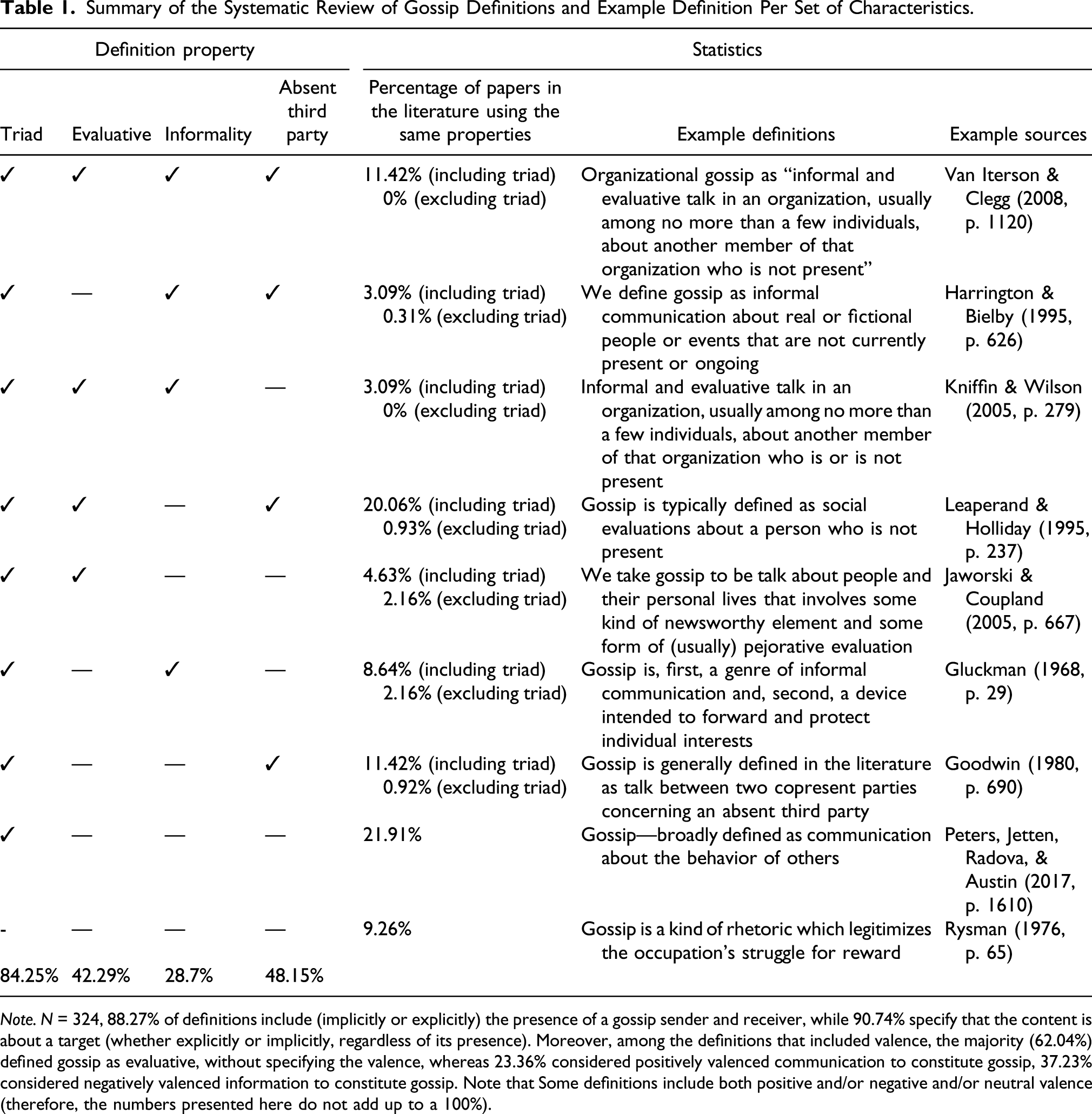
Note. N = 324, 88.27% of definitions include (implicitly or explicitly) the presence of a gossip sender and receiver, while 90.74% specify that the content is about a target (whether explicitly or implicitly, regardless of its presence). Moreover, among the definitions that included valence, the majority (62.04%) defined gossip as evaluative, without specifying the valence, whereas 23.36% considered positively valenced communication to constitute gossip, 37.23% considered negatively valenced information to constitute gossip. Note that Some definitions include both positive and/or negative and/or neutral valence (therefore, the numbers presented here do not add up to a 100%).
Within these definitions, we identified four characteristics that reoccurred frequently, in order of most to least frequent: (1) whether the definition refers, implicitly or explicitly, to the gossip triad, comprised of a sender, a receiver, and a target (i.e., the person(s) the information is about), (2) whether the target of the gossip is absent (i.e., physically absent or not able to access the communicated content at the time of communication), (3) whether the content of gossip is evaluative (i.e., whether the valence of the content of gossip is positive or negative but not neutral), and (4) whether the information sending takes place informally (i.e., outside the scope of formal communication norms). Each definition was subsequently coded based on these four characteristics.
Table 1 depicts the frequency of different possible combinations of these four characteristics as well as some examples of definitions, showing that the four characteristics have been combined in various ways within definitions. Most definitions include at least one of the identified characteristics (90.74% of gossip definitions). More than half of the definitions included at least two characteristics (65.59%), and definitions rarely included three (37.66%) or all characteristics (11.42%). This indicates that there is some consensus, but at the same time, the four characteristics of gossip are a major source of the current conceptual disparity since there is disagreement on which of them is essential to capture gossip. Scholars seem to have selected from the set of characteristics to form idiosyncratic definitions of gossip, thus obscuring its conceptualization. Therefore, to answer calls for precision when studying gossip (Michelson et al., 2010a), it is important to take a closer look at the characteristics of gossip as reflected in the various gossip definitions.
Criterion 1: The Gossip Triad
Our analysis showed that 88.27% of the scientific definitions implicitly or explicitly mention the involvement of a sender and receiver of the communication (we coded inclusions of “communication” or “talk” as implying a sender and receiver; Shannon & Weaver, 1949). Moreover, 90.74% of the definitions (explicitly or implicitly) refer to a target of gossip, which is a person or group of persons about which gossip is communicated. Most definitions (84.25%) refer to the full “gossip triad” (see Figure 2) or imply it, which is in line with theoretical arguments that the most basic depiction of gossip’s structure is a triad of a sender, a receiver, and a target (Giardini & Wittek, 2019a; Hannerz, 1967; Michelson et al., 2010a). The target of gossip is not the sender nor receiver of the gossip themselves, thus excluding cases more aptly described as self-disclosure or public disclosure (see Foster, 2004). Gossip triad (see, e.g., Giardini & Wittek, 2019a, 2019b; Michelson et al., 2010a). Note. Each “actor” in the gossip triad (sender, target, or receiver) can consist of multiple people.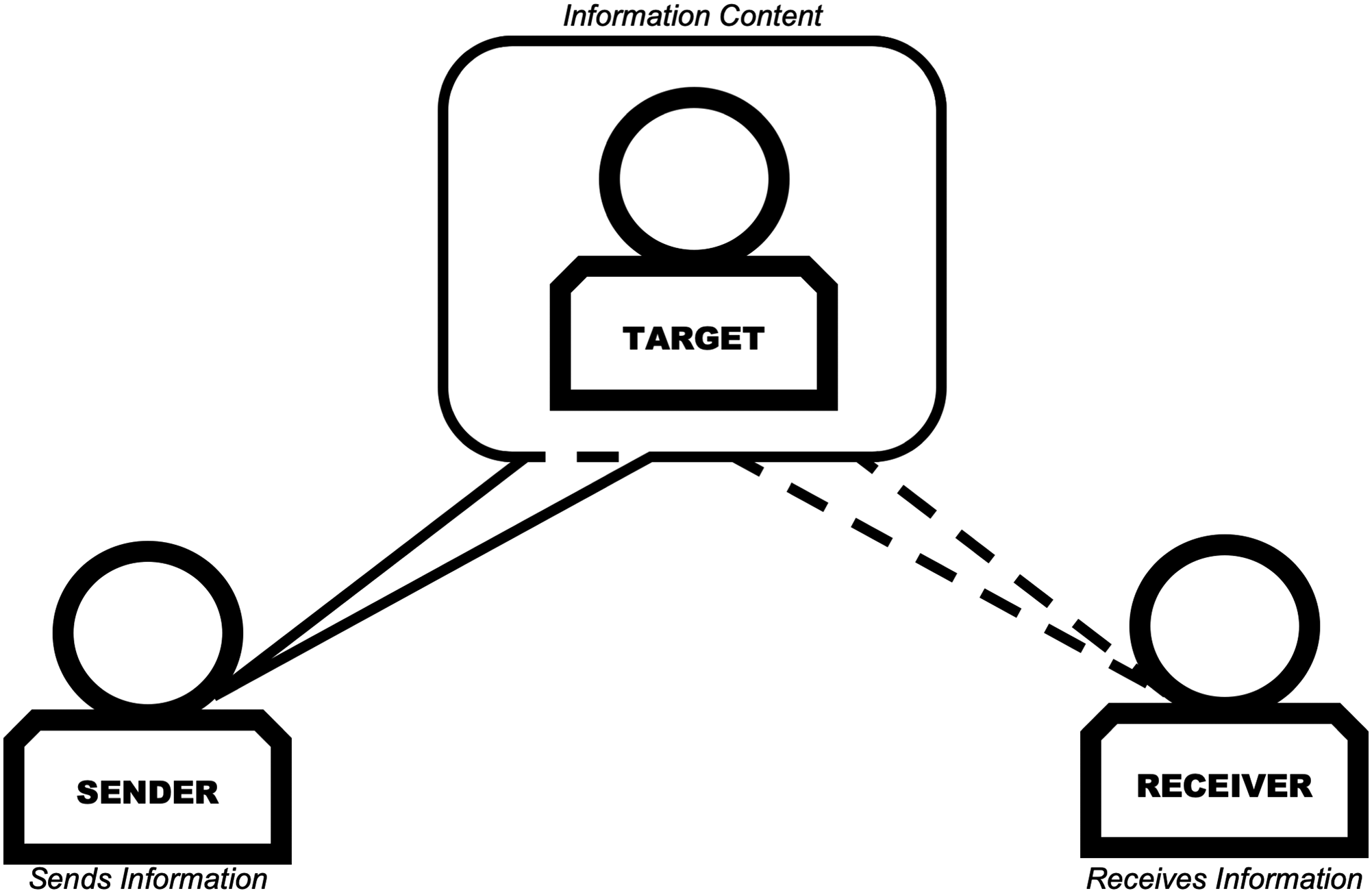
Criterion 2: The Absence of the Target of Gossip
Table 1 shows that almost half (48.15%) of the reviewed definitions include the absence of the target as a core characteristic. Therefore, there is a relatively high agreement in the literature that the absence of the target is a necessary, if not sufficient, requirement to define gossip. This is in line with previous reviews on gossip and lay conceptions of gossip as communication that takes place “behind one’s back” (e.g., Foster, 2004; Michelson et al., 2010a). Targets are not included in a gossip conversation, at least as believed by the sender and receiver, by either being physically absent during the conversation or otherwise unaware of the communicated content at the time it occurs (e.g., they are not included in online chats, they cannot physically hear the gossip, or it is in a foreign language). 6 In sum, the absence of the target implies that the target is unaware of the communicated information.
Furthermore, it is sensible theoretically that targets’ absence is considered essential for defining gossip: People who are not included in conversations about themselves cannot control what is said. Thus, gossip offers a unique possibility to spread information about targets that affects their reputation, and at the same time, it reduces the chance that targets retaliate. These aspects have been argued to be essential to capture gossip (Dunbar, 2004; Feinberg, Willer, Stellar, & Keltner, 2012) as in the target’s presence, the communication may not occur, or the message may be different (e.g., Giardini & Wittek, 2019b). Given the importance and ubiquity of the absence of the target in the literature and its theoretical relevance, we propose that the absence of the target should be central to defining gossip.
Criterion 3: The Evaluative Valence of Gossip
Furthermore, our overview of definitions shows that the literature is also divided on whether the content of gossip must be evaluative (i.e., have a positive or a negative valence; 42.29% of definitions). There seems to be disagreement among scholars that specify gossip as evaluative in their definitions: 23.36% include positive valence, 37.23% include negative valence, while most definitions (62.04%) do not specify whether the valence has to be negative or positive. Thus, even when definitions include evaluation as an important characteristic, researchers do not agree with regards to whether “evaluative” is limited to only negative valence or whether it can also be positive.
Recent empirical research demonstrates that people share positive, negative, and neutral information about absent others. For example, an experience sampling study of gossip in daily life shows that senders and receivers report gossip with positive, negative, and neutral valence, and each represents roughly a third of the gossip instances (Dores Cruz et al., 2020). Another recent study recording everyday gossip shows that the majority of information sent about absent others is neutral (Robbins & Karan, 2019). Thus, information about absent third parties often seems to be neutral, suggesting that in everyday life, gossip information can be considered important regardless of its valence, at least important enough to share.
On the one hand, there could be advantages to including evaluative valence in the definition of gossip (i.e., gossip content must be positive or negative). First, defining gossip as having either positive or negative valence allows research to go beyond focusing solely on negative content (cf. Hofman, 2014; McAndrew, 2019) which can moralize gossip and bias findings. Second, it allows excluding idle talk that some consider to be trivial information that is not valuable or relevant (Giardini & Wittek, 2019c; Noon & Delbridge, 1993).
On the other hand, there are also important disadvantages to including evaluative valence in the definition of gossip. First, it is difficult to operationalize and measure evaluative valence. Gossip receivers might attach a different evaluative meaning to statements from what senders intended to convey. For example, a sender can share information that they consider neutral such as telling a colleague that another colleague is on holiday. Yet, the receiver can interpret this as either positive (i.e., “the target is taking good care of themselves, more people should do that”), or negative (i.e., “the target is neglecting responsibilities”). Moreover, the statement can acquire valence at a later time when additional information becomes available. Second, senders might use subtle cues (i.e., voice tone or body language) to convey valence, but these are difficult to capture in gossip measures. So, for a given statement, it is difficult to ascertain if it is evaluative or not. As such, if evaluative valence was part of the definition of gossip, this would imply that determining whether a statement is gossip would become equally difficult. Therefore, we argue that valence should not be seen as a defining aspect of gossip, and that gossip can include content with negative, neutral, and positive valence.
Criterion 4: Informality of Gossip
With regard to the informality of gossip, the literature is also divided. Only 28.70% of definitions included that gossip must represent informal communication. Specifying gossip as informal is especially relevant for organizational contexts, where formal and informal communication coexist. A common assertion is that gossip circulates via “the grapevine,” an informal word-of-mouth communication network between employees (Mills, 2010). Some researchers refer to gossip as a substitute for formal information (e.g., Houmanfar & Johnson, 2004) or as an informal sanction for targets (e.g., Vaidyanathan, Khalsa, & Ecklund, 2016). Compared to informal communication, formal communication is regulated by norms that determine the chain of command, departmentalization, and centralization. These norms specify how, with whom, and about what people should communicate to perform their duties (Johnson, Donohue, Atkin, & Johnson, 1994; Keyton, 2017). Furthermore, formalization determines to what extent rules, procedures, and communications are written down (Pugh, Hickson, Hinings, & Turner, 1968) and allows organizations to control the flow of information. As such, formal communication is more legitimate (i.e., the sender’s formal role justifies sharing the message with the chosen receiver, e.g., a supervisor talking about their trainees’ progress) and more easily verifiable than informal communication, making the sender accountable (Gómez & Dailey, 2017).
Recent empirical research shows that people gossip both formally and informally in daily life. To illustrate, gossip with colleagues/supervisors was rated as formal (i.e., part of a formal role/duty) by senders/receivers in approximately half of the gossip reported. In contrast, gossip with others (e.g., friends and family) was rated as formal in roughly a fourth of the gossip reported, which is lower, yet nontrivial (Dores Cruz et al., 2020).
An argument for defining gossip as “informal” is that gossip is considered to fall outside the scope of formal communication norms. It is transmitted spontaneously (at the discretion of the sender) and is not bound by formally pre-defined organizational roles (e.g., anyone could chat with the CEO in the elevator), channels of communication (e.g., using work email or social media), social setting (e.g., a formal meeting or a bar), or topics of conversation (e.g., a colleague’s performance or romantic life).
However, these examples also highlight that informality can be operationalized based on various criteria, such as the channel of communication, the context, and discussing topics within the scope of one’s formal role. This also becomes evident in the definitions incorporating “informality”: Some capture informality by defining gossip as “idle chat” (Kuo, Chang, Quinton, Lu, & Lee, 2015), others as occurring in “a context of congeniality” (Foster, 2004), as “trivial and nonessential” (Fine & Rosnow, 1978), or as “unrestrained talk” (Massar, Buunk, & Rempt, 2012). Thus, including informality as a defining characteristic of gossip presents operationalization and measurement problems. For example, talking to a colleague about a client at the coffee counter during a break would be characterized as informal according to the setting, but as formal based on one’s role requirement to care for the client. Furthermore, formal and informal communication often overlap (e.g., supervisors discuss employee’s progress outside of a formal context and proceed with the more formal task of filling in a report about them), and people often switch between formal and informal communication (e.g., by signaling during a meeting that one would like to state something “off the record,” or by having a “meeting after the meeting,” where people share their opinions with trusted others). Therefore, we propose that gossip occurs in situations varying in (in)formality and that this should be systematically examined rather than seen as a fixed aspect of gossip.
An Integrative Definition for Describing Gossip
Our review showed that gossip has been defined in disparate ways. From the overview of definitions (see Table 1), we first concluded that scientific definitions converge on gossip involving a sender who communicates information to a receiver about a target (see Figure 2) as an essential characteristic of gossip. Second, we found three frequently reoccurring characteristics of gossip and registered their inclusion across definitions. The most frequently included defining characteristic was that the gossip target must be unaware of the communication or absent. Based on theoretical considerations (absence/unawareness of the target distinguishes gossip from other types of communication involving the target), we argued that the absence of the target is an essential characteristic of gossip. Taken together, we propose that a broad, integrative definition of gossip should capture the first two criteria that we reviewed, on which most definitions converge, and on which gossip does not seem to vary. Therefore, the definition we propose is a sender communicating to a receiver about a target who is absent or unaware of the content. Future researchers can use this definition to identify whether what is studied can be classified as gossip, to identify forms of communication that can be classified as gossip but were not classified as such before, and to contrast gossip to adjacent communication forms.
Applying the Integrative Definition to Identify Gossip
In lay definitions, gossip has a negative connotation, referring to malicious or idle talk. For example, the Cambridge Dictionary (2020) defines gossip as “conversation or reports about other people’s private lives that might be unkind, disapproving, or not true.” Likewise, religious texts condemn gossip (e.g., Proverbs 20:19: “Gossip betrays a confidence; so, avoid anyone who talks too much” and Qur’an 104:2: “The wicked love to gossip”). Many lay definitions moralize gossip because it conveys negative content, it is idle (i.e., unproductive), illegitimate (about private lives), unreliable (contains lies or half-truths), and not verifiable (obscure/unaccountable source). Furthermore, lay definitions often refer to malicious motives for gossip (slander/aggression) or to enjoy oneself (Beersma & Van Kleef, 2012; Foster, 2004). In contrast, the definitions of gossip in the scientific literature we reviewed provide more objective descriptions because they are more likely to define gossip without moralizing its content or attributing it to specific motives. Integrating previous definitions, our unified definition applies to gossip of any valence (i.e., positive, negative, or neutral), any type of content (e.g., collaboration in a team, situations in personal life, or one’s character in general), and does not attribute gossip to specific motives (selfish or altruistic).
Many people associate gossip with gossip magazines that disseminate the private lives of celebrities. Although gossip magazines fulfill the criteria of a sender (the magazine) communicating to a receiver (the reader), the target can be aware of the content at the time of communication (i.e., read the magazine upon release). While gossip targets cannot directly intervene (the information is already in print), they can nonetheless react to it (they are aware of the content and can make a public counter statement). Therefore, according to our definition, gossip magazines, while a salient lay depiction of gossip, are not considered gossip. The same logic applies to social media posts that do not include privacy settings as well as online reviews such as on Airbnb or eBay, where reviewers’ (senders) experiences with sellers (targets) are openly shared (to receivers and targets).
In addition, gossip is often used interchangeably with rumor, which can be generally defined as unverified information (DiFonzo, Bordia, & Rosnow,1994; Rosnow, 1980). Some researchers distinguished gossip from rumor, whereas other researchers argued that gossip and rumor are interchangeable (e.g., Brady et al., 2017; Michelson et al., 2010a). Our unified definition clarifies the distinction: While gossip and rumor can overlap, there are two essential aspects that distinguish them. First, gossip is always about a target (person or group). Rumor, in contrast, primarily concerns events or claims, yet can include persons (DiFonzo & Bordia, 2007; Foster, 2004; Houmanfar & Johnson, 2004). Second, gossip content can range from verified to unverified and from true to false, while rumor is unverified by definition; if verified, it stops being rumor (DiFonzo & Bordia, 2007). Similarly, storytelling and urban legends typically consist of larger information that can overlap with gossip in content, verifiability, and veracity (Guerin & Miyazaki, 2006; Michelson et al., 2010a) when they contain information about nonfictional persons. In sum, defining gossip as a sender communicating information to a receiver about a target (absent person or group), that can be verified but does not need to be, distinguishes gossip from rumor, stories, and urban legends.
The integrative definition also sheds light on forms of communication that are not widely regarded as gossip, yet completely fit our definition. An example is the provision of a character reference, which is a personal statement with regards to another person’s character and/or behavior in clinical judgments, the reporting of crimes, anonymous testimonies, or job applications. In these examples, the person who is being evaluated is not present when the statement is provided nor knows its content. Therefore, the criteria of a sender (referee) communicating about an absent or unaware target (subject) to a receiver are all fulfilled. Although providing a character reference may not be considered gossip among the general public, it does constitute gossip under our definition. Similar arguments apply to providing an anonymous testimony or whistleblowing where the person testifying communicates information about the target to authorities, or when teachers provide parents with reports about their children, and other reviews of an individual’s (or group’s) performance.
A Dimensional Scaling Framework for Studying Gossip Instances
Whereas our integrative definition includes the three parties in the gossip triad and the absence of the target as essential characteristics of gossip, it does not include the two other frequently reoccurring characteristics of gossip mentioned in the definitions we reviewed (i.e., valence and informality). Our review showed that these characteristics were included in some definitions, but there was weak consensus in the literature for including them in the definition of gossip. Moreover, reviewing definitions that do include these characteristics revealed problems with the operationalization and measurement of gossip as conceptualized in these definitions. This led us to conclude that evaluative valence and informality of communication should not be included in the definition.
However, this does not mean these two characteristics do not play an important role in determining the antecedents and consequences of gossip. Their exact role currently remains obscure because differences within these characteristics have remained implicit as researchers employed different gossip definitions. Yet, gossip content can differ in valence from negative to neutral to positive, and gossip communication can vary in degree of formality, and both characteristics may represent critical theoretical and empirical differentiators when comparing gossip instances. In order to capture these differences with regards to valence or formality, we have developed a dimensional scaling framework. As shown in Figure 3, the horizontal axis represents valence, ranging from negative to neutral to positive, and the vertical axis represents (in)formality, ranging from informal to intermediate to formal. Dimensional scaling framework with valence and (in)formality as dimensions including examples of gossip ranging in valence and (in)formality. Note. Absent indicates that the target is physically absent or otherwise unaware of the content.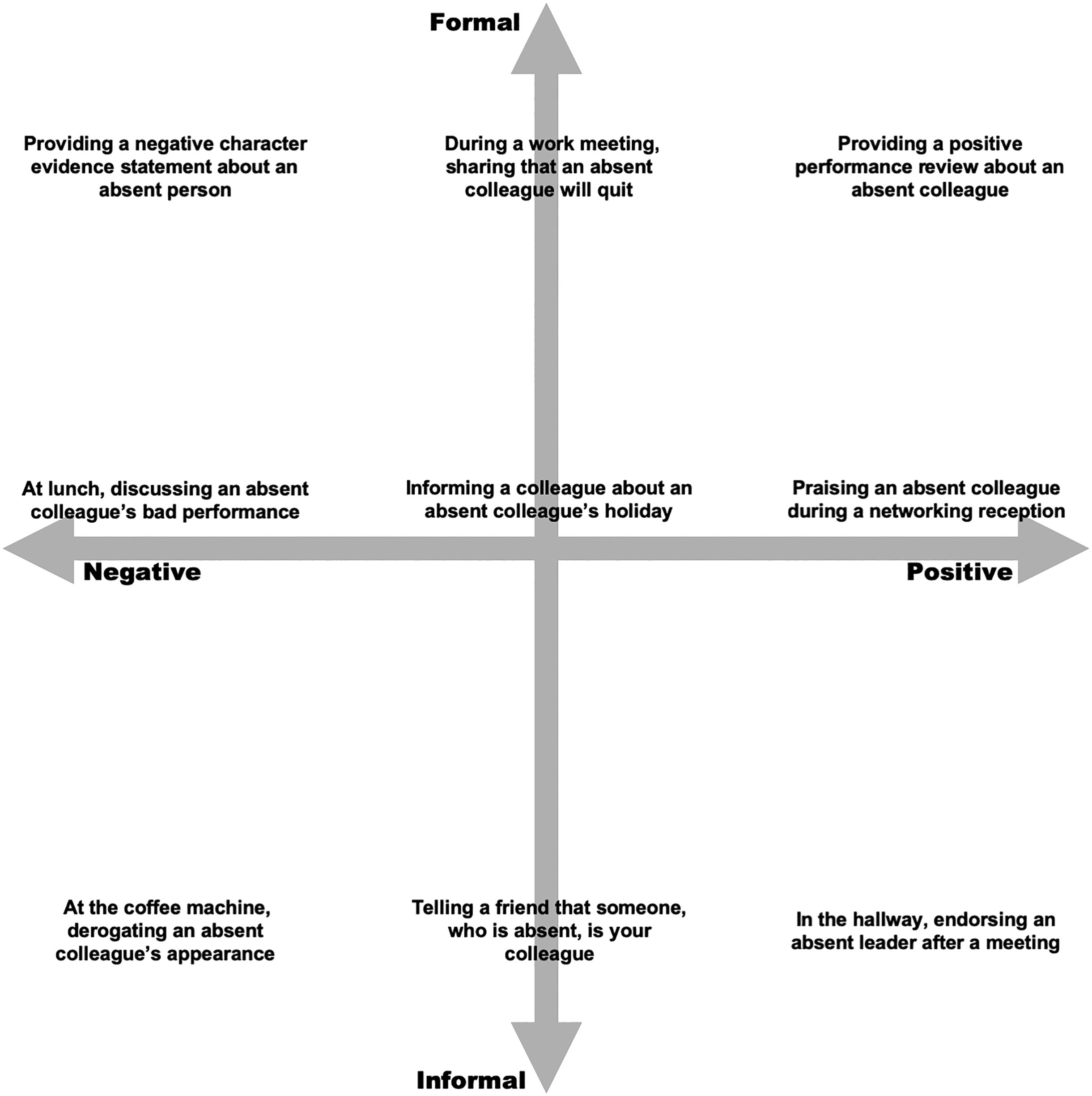
In Figure 3, we provide examples of gossip instances that vary along the axes of each dimension. For example, a manager (the sender) providing a performance review containing positive statements about an employee (the target) to their superiors (the receiver) is an example of formal, positive gossip. First, looking at the (in)formality axis, the information was communicated in a setting that involves formal communication channels for reviewing performance (filing an official review). The communication occurs in a formal setting dictated by norms following from the manager’s role requirements that govern by whom, to whom, and how information is to be communicated. Thus, this example is on the formal end of the (in)formality axis. Second, looking at the valence axis, the review contained positive information and not negative nor neutral information. Thus, this example is on the positive end of the valence axis. For more examples varying along each of the axes, see Figure 3.
An advantage of the dimensional scaling approach is that characteristics previously obscured because they were captured only by some definitions are now brought to the forefront to enable systematically examining them. Notably, valence and informality are not necessary to define communication as gossip but can help in contextualizing and differentiating specific gossip instances, and thus clarify the scope of conclusions that can be drawn about specific types of gossip. Thus, researchers can use the dimensional scaling framework to identify where their research resides on the dimensions of valence and formality, which can help to compare and contrast findings. Moreover, our dimensional scaling framework enables systematic studies of the impact of gossip valence and formality.
Applying the Dimensional Scaling Framework in Future Research
Studying Gossip along the Range of Valence
Previously, some gossip scholars have argued that gossip valence is important in differentiating gossip and could impact the outcomes of gossip for all individuals in the gossip triad (senders, targets, and receivers) and groups (Kurland & Pelled, 2000; Michelson et al., 2010a; Wu, Balliet, & Van Lange, 2016b). However, incompatibility among gossip definitions used currently precludes building systematic knowledge on the effects of gossip valence. In this section, we review previous literature related to gossip valence and discuss how our framework can be used to build on this to investigate how gossip valence impacts and gossip’s outcomes and antecedents in organizations.
First, Kurland and Pelled (2000) have argued that senders of negative gossip are perceived as having high coercive power, whereas senders of positive gossip are perceived as having high reward power. In line with this idea, Farley (2011) found that senders of negative gossip are perceived as unlikeable, whereas senders of positive gossip are perceived as likable. Future studies could explore whether engaging in differently valenced gossip could influence evaluations of senders’ power legitimacy. People who engage in more positive gossip could be perceived as having more legitimate power and could be rated better (e.g., more likable) than people gossiping more negatively. This could be examined by systematically comparing gossip that ranges in valence, from positive to negative.
Second, targets of negative gossip usually suffer from reputational harm, whereas targets of positive gossip usually improve their reputation (e.g., Kurland & Pelled, 2000; Sommerfeld et al., 2007; Wu et al., 2016b, 2016a). Using our framework, research could investigate how differently valenced gossip may influence negotiations and decision-making. For example, studies could compare how gossip about clients' positive and negative behavior and characteristics influences negotiation outcomes or decisions about resource allocation.
Third, receivers of negative gossip may use this information to decide whether to cooperate with targets, but it could also remind them of the possibility of engaging in negative behavior (e.g., violating norms and non-cooperation) or of themselves being monitored and evaluated, whereas positive gossip could also function to condition gossip receivers’ cooperation but, at the same time, it may remind them of examples of cooperation to emulate (Martinescu et al., 2014; Nowak & Sigmund, 2005; Wu et al., 2016b). Thus, positive gossip could serve many of the same functions thus far ascribed to negative gossip, such as spreading information on which to build reputations and identify cooperators, without the drawbacks of negative gossip for all involved parties (i.e., damaged reputations for targets and senders, reminders to receivers that negative behavior can occur, or that becoming a negative target is easy). This possibility could be explored in the context of organizational citizenship behaviors, which represent discretionary, unmonitored contributions by group members (Organ & Ryan, 1995). Positive gossip could encourage citizenship behaviors as people are reminded of cooperative others, whereas negative gossip could decrease citizenship behaviors because it signals to receivers that non-cooperative behavior is also an option, or because it might lead to fear of being judged and decreased psychological safety.
Another direction for future research suggested by our dimensional scaling framework relates to the impact of neutral gossip. Statements with neutral valence have been largely excluded in previous gossip research. Neutral statements can, nonetheless, be important to understand gossip: While not containing an evaluation of the target by the gossip sender, they may still present valuable information for receivers or may affect the target. For example, Baum et al. (2020) showed that neutral information can impact receivers’ perceptions of targets positively. It would be interesting to examine how, when, and why gossip senders use neutral gossip. This could be achieved by having participants or independent coders rate the valence of gossip statements (e.g., Feinberg, Willer, Stellar, & Keltner, 2012) and by including “neutral gossip” conditions in experiments (e.g., Shank et al., 2019). One direction for future research would be to investigate if senders strategically use neutral gossip to achieve similar outcomes as negative gossip but avoid costs associated with negative gossip such as being disliked (Farley, 2011). In this way, neutral gossip could be particularly important for new members of organizations to establish themselves in groups without incurring costs associated with valenced gossip (Dores Cruz et al., 2020; Giardini & Conte, 2011).
Furthermore, whereas senders could consider gossip to be neutral, this does not mean receivers interpret the gossip as neutral. Previous research on the interpretation of information indicates that individual differences in attitudes or group-based identity play a role in interpreting information and can bias perceptions (Feinberg, 2013; Robbins & Krueger, 2005). Such differences could be important in unraveling the impact of neutral gossip as the receiver is the one interpreting the statement. For example, people might attribute valence to neutral information based on their own dispositions, such as social value orientation (cf. Pletzer et al., 2018). If somebody has a prosocial disposition, they could be more inclined to interpret neutral information as reflecting prosocial intentions on the part of the sender, while a person with a proself disposition might rather interpret the same information as reflecting proself intentions. Future research could examine receivers’ ratings of gossip valence and compare these to senders’, independent coders', and algorithmic ratings to identify whether communicated and interpreted evaluations match (Dores Cruz et al., 2020; Feinberg, Willer, Stellar, & Keltner, 2012). Furthermore, assessing nonverbal cues such as voice tone or body language, that are important in communication and person perception (e.g., Mehrabian, 2017) and strategically used in gossip (Besnier, 2009; Engelmann, Herrmann, & Tomasello, 2016), could be especially relevant to understand how receivers perceive gossip valence. Cues such as voice pitch (higher pitch could serve to signal urgency; Besnier, 2009) or emotion expressions (which could intensify or weaken content; Lee & Wagner, 2002) could be influential in ascribing meaning to neutral gossip as well as strengthen or weaken receivers' perceptions of gossip valence. Moreover, these cues could be studied to better understand potential differences in how gossip shapes and is shaped by the interaction setting being face-to-face or online (i.e., via text, voice, or video; Michelson & Mouly, 2002).
Whereas above, we focused on how valence could affect gossip’s consequences, our dimensional scaling framework also provides research directions for the antecedents of gossip. People might have different motives for sending negative, neutral, or positive gossip that can be examined in future studies. For example, negative information could be connected more to motives to protect the group from free-riders (warning group members about targets) or negative influence motives (discrediting targets) or emotion venting motives (sharing emotionally evocative experiences involving targets), neutral gossip might be mainly linked to information gathering and validation motives (comparing information and gaining further information), and positive information could be associated more with social enjoyment (sharing information that senders and receivers enjoy; Beersma & Van Kleef, 2012; Dores Cruz et al., 2019; Farley, 2011).
Studying Gossip along the Range of (In)Formality
Further investigating gossip ranging in (in)formality could help to better understand its impact (cf. Foster, 2004; Kurland & Pelled, 2000; Michelson et al., 2010a). Including informality as a defining characteristic in some, but not all, definitions of gossip has stood in the way of systematically examining how differences in communication (in)formality might affect the consequences and antecedents of gossip. In this section, we review literature related to (in)formality and discuss how our framework can be used to build on this.
First, Kurland and Pelled (2000) argued that work-related gossip positively influences perceptions of senders’ expert, reward, and coercive power. This implies that formal gossip could benefit the sender and more effectively communicate and enforce norms more than informal gossip (Martinescu, Janssen, & Nijstad, 2019). However, gossip to gain referent power (e.g., power based on shared identity) may not benefit from being work-related. This could indicate that formal gossip may not always be more effective, but its functionality depends on the domain (i.e., developing social relationships versus achieving work-related goals). Systematically studying this could provide insights into how gossip can impact power perceptions. When situations mainly involve affective interpersonal relations, employees could ascribe higher power to colleagues sharing more informal gossip, while in situations mainly involving functional relations they could ascribe higher power to colleagues sharing more formal gossip.
Second, Kurland and Pelled (2000) argued that the organizational culture in terms of the level of formalization can impact the tendency to gossip. If informal communication is discouraged, people may be restricted in the possibility to gossip informally and instead turn to formal channels. It is possible that under these circumstances, gossip does not disappear, but rather moves to formal channels or become more selective (i.e., choosing more trusted receivers) as people are especially attuned to gossip and find it rewarding and useful (Alicart, Cucurell, & Marco-Pallarés, 2020; Dunbar, 2004). Moreover, informal channels could provide ways to communicate faster, whereas formal communication is slower but may be weighed more strongly and therefore have more impact (Gómez & Dailey, 2017; Michelson et al., 2010a). Thus, gossipers could use communication ranging between formal and informal to achieve certain goals effectively or to find a midway between costs and benefits of (in)formality.
Third, research could investigate how formal and informal gossip impacts important organizational processes, such as voice and citizenship behaviors (Morrison, 2011; Organ & Ryan, 1995). For example, future research could investigate whether the extent to which people formally voice their concerns is affected by whether they have an opportunity to gossip (or when they have recently received gossip) and in which situations this can lead to beneficial or detrimental outcomes for organizations. Similarly, future research could study which type of gossip facilitates citizenship behavior. Via informal gossip, employees may more frankly mention interpersonal challenges and request help through extra-role assistance from others more easily, whereas the threshold to criticize others or ask for help via formal gossip might be higher. Yet, formal gossip might more efficiently resolve in-role challenges.
Fourth, so far, especially in organizational contexts, research has neglected that formal communication can also constitute gossip. Hence, while assessing informal gossip processes can be difficult, the nature of formal gossip could make it easier for scholars and managers to access the communicated content (e.g., formal communications are more often recorded). Theories on gossip could provide insights into understanding formal organizational processes such as hiring and selection. Future research could study the effects of different forms of formal gossip (e.g., performance reviews and character evidence, see Colarelli, Hechanova-Alampay, & Canali, 2002; Hunt & Budesheim, 2004) as well as formal communication channels (e.g., work email, see Mitra & Gilbert, 2012) on performance outcomes, such as success or productivity, and psychological outcomes, such as bias or (negative) emotions. For example, research on candidate recruitment could investigate the role of formal gossip (typically references), compared to informal gossip (between the employer and an acquaintance the employer has in common with the candidate). Future research could investigate the role of gossip about potential managers, colleagues, and clients in the decision to apply for and accept a new job. Moreover, since networking activities often contain gossip, future research could investigate how gossip ranging from formal to informal is related to successful network building and career progression. In human societies, gossip seems to have been institutionalized through formal channels that likely influence behavior over and above informal gossip, due to its higher legitimacy. As such, future research should investigate the role of gossip in settings where, until now, it has not been seen as impactful.
Fifth, when sampling gossip events in both workplace settings and daily life, researchers should include formal situations (see Figure 3 for examples, for more examples see also, e.g., Dores Cruz et al., 2020). Vignette studies could include formal gossip situations, and experimental studies could offer different communication channels ranging in (in)formality to examine when and why people opt for more formal or informal gossip, for example, as a function of role or power differences (Jeuken et al., 2015; Martinescu et al., 2019a; Molho, Balliet, & Wu,2019; Shank et al., 2019; Wu et al., 2016a). This could provide insights into the dynamics between leaders and subordinates, which could be characterized by gossip on the more formal end of the (in)formality axis. Similarly, this could apply to teams characterized by different levels of hierarchy. Steeper hierarchies might produce more formal gossip, while flatter hierarchies might produce more informal gossip. Furthermore, our framework could facilitate understanding of how gossip impacts the integration of newcomers within organizations. For example, new employees may feel a stronger connection with others and more commitment to organizations when they engage in informal gossip but may learn more quickly through formal gossip.
An especially interesting aspect of formal gossip is that the targets are often aware that information is, or may be, exchanged about them, yet they remain unaware of the content. As recent research has shown, perceptions of (negative) workplace gossip can influence psychological factors such as lower self-esteem and emotional exhaustion (e.g., Xie et al., 2019a; 2019b). Future research could investigate whether these effects extend to more formal gossip and whether the inferred and actual content influence these effects. This could further our understanding of how perceptions of communications such as performance reviews could detrimentally influence employees' psychological well-being and productivity.
Finally, we consider gossip antecedents. Linking (in)formality to gossip motives, duty-related, and group protection motives (i.e., feeling responsible for others' well-being) might relate more strongly to formal gossip, whereas motives to harm targets’ reputation (Beersma & Van Kleef, 2012; Farley, 2011) might relate more strongly to informal gossip. In order to test this, future research could experimentally manipulate motives (Beersma & Van Kleef, 2012; Dores Cruz et al.,2019, Dores Cruz, Beersma, Dijkstra, & Bechtoldt, 2019; Fernandes, Kapoor, & Karandikar, 2017) and study whether (in)formality of gossip is related to these motives.
Using the Dimensional Framework across Research Methodologies
Research methods such as surveys, social network analyses, and participant observation (see, e.g., Dores Cruz et al.,2020; Grosser et al., 2010; Kniffin & Wilson, 2005) could be used to collect rich data that can describe gossip along the specified dimensions in our dimensional scaling framework. While these methods can help identify the interrelations between gossip varying along the dimensions in the framework and different outcome variables, they do not allow causal inferences. Experiments (see, e.g., Beersma & Van Kleef, 2012; Feinberg, Willer, Stellar, & Keltner, 2012; Wu et al., 2016a), which arguably provide less rich data, do enable precise manipulations (e.g., in economic games or workplace vignettes) of variables along the dimensional scaling framework to test specific (causal) hypotheses. For example, in experiments, researchers could manipulate gossip’s formality, comparing more informal to more formal gossip, and test whether and how the range of (in)formality impacts the outcomes of gossip.
Another approach is the use of agent-based modeling, where gossip is modeled by virtual agents sharing information in different settings, varying the relationships between agents, and how information is shared and processed (Andrighetto, Brandts, Conte, Sabater-Mir, Solaz, & Villatoro, 2013; Boero, Bravo, Castellani, & Squazzoni, 2010; Giardini & Conte, 2011; Nowak & Sigmund, 2005). Parameters that depict the dimensions in our framework could be included and explored to test whether variations in these dimensions influence the consequences of gossip. For example, one could investigate how both the valence as well as the (in)formality of gossip instances impact the model outcomes. An especially interesting application of agent-based modeling for organizational researchers is the opportunity to model large organizations and complex dynamics between colleagues (e.g., Andrighetto et al., 2013).
Thus, each methodology uniquely contributes to the understanding of the complex phenomenon of gossip, both in the workplace and beyond. Our integrative definition and dimensional scaling framework provide researchers with the tools to organize the knowledge on gossip, enable comparing different research conclusions, and should, therefore, ultimately facilitate formulating clear advice to organizations.
Conclusion
We systematically reviewed all definitions of gossip currently available in the scientific literature and identified a wide variety of gossip definitions, which we coded with respect to four characteristics. Definitions varied on whether they included one or several of the four characteristics. Building on the characteristics on which there was the strongest agreement in the literature, we proposed a broad, integrative definition of gossip: a sender communicating to a receiver about a target who is absent or unaware of the content.
Furthermore, we suggested that the two remaining characteristics, included in only some of the definitions and for which we signaled operationalization problems, should not be included in the definition of gossip but rather form the basis of a dimensional scaling framework. This framework encompasses gossip that ranges on valence and (in)formality and can be used as a guide to systematically study the impact of different types of gossip. Specifically, our framework invites researchers to systematically investigate the influence of valence and (in)formality on gossip’s antecedents and consequences. An advantage is that if research should identify other dimensions on which gossip may vary, these could be included.
The integrative definition and dimensional scaling framework provided here can enable researchers to draw on insights across disciplines, to systematically build on each other’s findings, and to work toward a comprehensive understanding of the impact of gossip in human social life. Moreover, our overview and publicly accessible data summarizing the gossip literature can be used to jumpstart future integrative work. For example, reviewing and (meta-)analyzing the impact of different gossip operationalizations. Finally, we hope that the building blocks provided here will ultimately contribute to providing guidance on how gossip in organizations should be managed.
Supplemental Material
sj-pdf-1-gom-10.1177_1059601121992887 – Supplemental Material for An Integrative Definition and Framework to Study Gossip
Supplemental Material, sj-pdf-1-gom-10.1177_1059601121992887 for An Integrative Definition and Framework to Study Gossip by Terence D. Dores Cruz, Annika S. Nieper, Martina Testori, Elena Martinescu and Bianca Beersma in Group & Organization Management
Footnotes
Acknowledgments
The authors would like to thank Daniel Balliet for his helpful comments on the manuscript. The authors would like to thank Joelle Tieks, Ouissam Abattouy, and especially Alberto Lo Iacono for their help in coding the definitions.
Declaration of Conflicting Interests
The author(s) declared no potential conflicts of interest with respect to the research, authorship, and/or publication of this article.
Funding
The author(s) disclosed receipt of the following financial support for the research, authorship, and/or publication of this article: This paper was supported by an ERC Consolidator Grant (#771391) awarded to Bianca Beersma.

Supplement Material
Supplement material for this article is available online.
Notes
Associate Editor: Lucy Gilson
Author Biographies
References
Supplementary Material
Please find the following supplemental material available below.
For Open Access articles published under a Creative Commons License, all supplemental material carries the same license as the article it is associated with.
For non-Open Access articles published, all supplemental material carries a non-exclusive license, and permission requests for re-use of supplemental material or any part of supplemental material shall be sent directly to the copyright owner as specified in the copyright notice associated with the article.
