




Abstract
Positivity has been heralded for its individual benefits. However, how positivity dynamically unfolds within the temporal flow of team interactions remains unclear. This is an important oversight, as positivity can be key to team problem solving and performance. In this study, we examine how team micro-processes affect the likelihood of positivity occurring within dynamic team interactions. In doing so, we build on and expand previous work on individual positivity and integrate theory on temporal team processes, interaction rituals, and team problem solving. We analyze 43,139 utterances during the meetings of 43 problem-solving teams in two organizations. First, we find that the observed overall frequency of positivity behavior in a team is positively related to managerial ratings of team performance. Second, using statistical discourse analysis, we show that solution-focused behavior and previous positivity within the team interaction process increase the likelihood of subsequent positivity expressions, whereas positivity is less likely after problem-focused behavior. Dynamic speaker switches moderate these effects, such that interaction instances involving more speakers increase the facilitating effects of solutions and earlier positivity for subsequent positivity within team interactions. We discuss the theoretical and managerial implications of micro-level team positivity and its performance benefits.
Keywords
Positivity—being optimistic, confident, constructive, or hopeful—has been heralded for its individual benefits (e.g., Fredrickson, 2000, 2001). At the individual level, positivity broadens attention and thinking and builds personal resources such as mindfulness, resilience, self-efficacy, and mental health (e.g., Fredrickson & Branigan, 2005; Rowe, Hirsh, & Anderson, 2007; Schutte, 2014; Vacharkulksemsuk & Fredrickson, 2014). Previous research has primarily considered positivity in terms of fixed or static affective states (West, Patera, & Carsten, 2009), individual positive psychological capacities (e.g., F. Luthans, Avolio, Avey, & Norman, 2007), or individual dispositions (Livi, Alessandri, Caprara, & Pierro, 2015). However, we know much less about the social, interactive nature of positivity and the pathways through which it unfolds during dynamic social interactions in real time, particularly in the context of team interactions (Walter & Bruch, 2008). This is an important oversight, as contemporary organizations increasingly rely on teams to accomplish demanding tasks and solve complex problems (e.g., Hung, 2013; Kozlowski & Ilgen, 2006), and injecting an optimistic, positive attitude and outlook at work can be key to team effectiveness (cf. Knight & Eisenkraft, 2015). To address this research gap, this study aims to increase our understanding how positivity emerges, unfolds, and is sustained in team interactions.
Both positive and negative emotions of team members tend to converge, and moods can spread among individuals (e.g., Barsade, 2002; Bartel & Saavedra, 2000; Hareli & Rafaeli, 2008; Hatfield, Cacioppo, & Rapson, 1994; Totterdell, 2000). Implicit in this work is the assumption that positivity will somehow “infect” people in a group over the course of their interactions. In accordance with this idea, findings from an experimental study of self-managing groups highlight the temporal emergence of mood contagion between leaders and followers (Sy & Choi, 2013). Similarly, a previous field study emphasizes the important role of team interaction processes for emergent group mood (Lehmann-Willenbrock, Meyers, Kauffeld, Neininger, & Henschel, 2011). Yet previous work that directly investigated group emotions (Barsade, 2002; Bartel & Saavedra, 2000; Totterdell, 2000) has tended to focus on the extent to which group emotions converge, which does not speak to the question how specific interaction dynamics can encourage or discourage the occurrence of positivity in teams. A recent review concludes that “real-time, process-oriented research is needed on the ebb and flow of affect, moods, and emotions within groups and teams over time” (Barsade & Knight, 2015, p. 38). We view our study as a timely response to this call, as we develop a model of positivity within team interactions that captures both the micro-context (i.e., preceding utterances/behaviors within a team’s interaction stream) and the meso-time context (i.e., the surrounding time period, such as earlier or later phases within a team meeting; for an overview, see Chiu & Khoo, 2005).
Our research goal to examine positivity as a dynamic, socially embedded phenomenon in team interactions requires a temporal lens. Previous work suggests that the moment-to-moment dynamics of team interactions help create mutual focus and elicit shared emotions (e.g., Lehmann-Willenbrock et al., 2011; Metiu & Rothbard, 2013). This notion has recently been described as interaction flow, in terms of “an optimal, intensified, and synergetic mode of the conversational interaction within a small group” (Van Oortmerssen, Van Woerkum, & Aarts, 2014, p. 23). Team interactions can be more or less dynamic, and the “flow” may build or ebb at different time points of a team communication (e.g., a meeting).
The extent to which a team interaction is dynamic hinges upon the extent to which team members are involved and quickly build on each other’s contributions—in other words, dynamic instances of team interactions will involve frequent speaker switches. In this article, we draw from interaction ritual theory (IR theory; Collins, 2004), previous work on participation shifts (Gibson, 2003, 2005), and team interaction flow (Van Oortmerssen et al., 2014) to highlight the role of speaker switches for facilitating collective positivity during team problem-solving interactions.
In sum, we conceptualize team positivity as a subtle micro-process, a positive “spark” that happens in the moment-to-moment dynamics of team interactions. To understand how positivity unfolds as a dynamic, collective phenomenon in teams, we account for conversational features in the specific context of team problem-solving interactions (i.e., whether a team conversation is momentarily focused on problems or solutions). By uncovering the temporal processes of how positivity is triggered and sustained in team interactions, we contribute to a more comprehensive and realistic depiction of team processes and emotional life in the following ways. First, we build on and extend previous work on individual positivity by examining how positivity unfolds in the moment-to-moment dynamics that characterize complex team interactions. Second, we integrate the literatures on temporal dynamics and group affect to develop a dynamic account of positivity in teams, paying particular attention to prevalent micro-processes, interaction features, and individual positivity acts at the utterance level as the critical level of analysis. Third, we observe real-time team meetings in organizations and code the fine-grained verbal behavioral sequences that constitute their interactions. Using statistical discourse analysis (SDA; Chiu, 2008; Chiu & Khoo, 2005), we demonstrate how the behavioral micro-context and features of the team interaction process influence positivity expressions during dynamic team interactions, and we show how overall positivity ultimately relates to team performance.
Theoretical Background and Hypotheses
Drawing from emotion research (Fredrickson, 1998, 2000, 2004; Walter & Bruch, 2008), we define positivity as an individual’s observable acts or verbal statements that express or imply optimism, enthusiasm, or effervescence, and that are constructive, supportive, and affirmative in intention and attitude. Consistent with previous work on positive affect (Watson, Clark, & Tellegen, 1988), zest (Miller & Stiver, 1997), and feedback positivity in teams (Kahai, Huang, & Jestice, 2012), we suggest that positivity occurring during team interactions, such as showing enthusiasm for new ideas, clearly has an affective component.
Our proposition that positivity is embedded within dynamic team interaction processes aligns with theoretical perspectives regarding the interactional nature and social embeddedness of positive employee experiences in the workplace (e.g., Dutton, Workman, & Hardin, 2014; Spreitzer, Sutcliffe, Dutton, Sonenshein, & Grant, 2005). We posit that positivity occurrences are not isolated incidents that occur at one point in time during the course of teamwork. Rather, they are informed, cultivated, and constrained by the buildup of moment-to-moment interaction patterns and team micro-processes (e.g., Lehmann-Willenbrock & Allen, 2014; Lehmann-Willenbrock et al., 2011; Metiu & Rothbard, 2013).
Positivity and Team Performance
Our study focus is on problem-solving teams in organizations. For the teams included in our sample—and in fact, for the majority of industrial organizational teams in contemporary organizations (e.g., Imai, 2012)—problem-solving meetings are an important part of teamwork. Previous research has shown that the communicative behaviors which teams exhibit during their regular meetings are meaningfully linked not only to proximal meeting outcomes (i.e., meeting satisfaction and perceived meeting effectiveness) but also to more distal team performance outcomes (i.e., team productivity beyond the meeting context; Kauffeld & Lehmann-Willenbrock, 2012). These previous findings suggest that team interactions during meetings are a reflection of a team’s everyday collaborative actions beyond the meeting context. As such, team meetings provide a window into team dynamics and a salient team interaction setting for observing team positivity (Meinecke & Lehmann-Willenbrock, 2015).
Individual positivity has been linked to performance outcomes in diverse organizational settings (e.g., Avey, Avolio, & Luthans, 2011; Gooty, Gavin, Johnson, Frazier, & Snow, 2009; F. Luthans et al., 2007; K. W. Luthans, Lebsack, & Lebsack, 2008; Peterson, Luthans, Avolio, Walumbwa, & Zhang, 2011). Individual dispositions for positivity have also been connected to individual performance in the context of teamwork (Livi et al., 2015). At the team level, indicators of a team’s state positivity (e.g., optimism) have been linked to better team outcomes such as coordination and cooperation (West et al., 2009). Although West and colleagues (2009) referred to the context of student teams, and their conceptualization of positivity was more static compared with our approach in the present study, these earlier findings suggest positive outcomes of positivity during problem-solving team interactions. Hence, we expect a link between the overall amount of positivity expressed during dynamic team interactions and team performance.
Beyond establishing linkages between overall positivity and performance, we are particularly interested in what triggers positivity within team interaction processes. Because our study focus is on problem-solving teams in organizations, we specifically investigate how momentary shifts in problem-solving activities during team interactions may promote or diminish the likelihood of positivity occurrences. To understand these relationships, we adopt a temporal approach to team processes.
Analyzing Temporal Team Processes
Team members’ behaviors during a discussion are not simply a list of their actions. Instead, most behaviors respond to another team member’s recent behavior and invite future behaviors by other team members (i.e., temporal sequences of behavior). As the behaviors within a temporal sequence are often related to one another, analyses of team processes should examine how recent behaviors affect the likelihood of a target behavior (in our case, positivity) at each moment in time. The sequence of utterances that immediately precede positivity expressions at any given point in time constitutes the micro-time context, and the utterances in the same time period form the meso-time context. Statistically identified time periods enable researchers to test whether target behaviors differ across time periods and whether relationships between independent and dependent variables differ across time (Chiu, 2008). Moreover, the time period (or meso-time context) at the beginning of a team meeting might differ from that at the end of the meeting. Pivotal moments can radically change interactions for an extended period of time. For example, the clear articulation of a problem can be a pivotal moment that elevates the discussion, whereas an insult can be a pivotal moment that drives the discussion into the ground. Because pivotal moments can divide a team conversation into distinct and substantially different time periods, a comprehensive analysis of positivity embedded in team interaction processes should model whether target behaviors (i.e., positivity) and their antecedents differ across time periods. By implementing SDA (e.g., Chiu, 2008), we can address this issue. Based on these temporal considerations, we next elaborate how specific problem-solving behaviors (problem- or solution-focused statements) as well as conversational dynamics (speaker switches) form the micro-time context surrounding positivity occurrences during team interactions.
Team Problem-Solving Processes
Problem-solving activities are inherent in almost any team collaborative context (Hinsz, Tindale, & Vollrath, 1997; McGrath, 1984), and they are a fundamental purpose for which participating teams in our study were originally created. Problem solving can be defined as “identifying and diagnosing task-related problems, carefully using a team’s combined expertise to analyze problems, and arriving at effective solutions” (Hiller, Day, & Vance, 2006). A successful problem-solving process entails a thorough definition and analysis of the problem (e.g., Wittenbaum et al., 2004), and a lack of problem analysis deems a team likely to fail (Mitroff & Featheringham, 1974). Moreover, any complex problem can lead to several possible solutions (Dörner, 1996; cf. Funke, 2010), which again emphasizes the value of a thorough problem analysis.
Typically, teams engage in specific types of problem-solving actions, such as identifying and clarifying a problem, proposing solutions, and evaluating proposals to find a viable solution (Ellis & Fisher, 1994). The distinction between problem orientation and solution orientation during team interactions is also grounded in previous research on sequential team problem-solving interactions (e.g., Pelz, 1985) and on team interaction behaviors in real organizational teams (Kauffeld & Lehmann-Willenbrock, 2012). Problem-focused behaviors and solution-focused behaviors can represent distinctly different conversational contexts, and as such should have different effects on the likelihood of positivity occurrences within team conversations.
Solution-Focused Statements and Positivity
There are several reasons for expecting a positive link between solution-focused statements and the likelihood of subsequent positivity. First, solution-focused statements often yield potential solutions which raise hope or optimism, allow for task advancement and likely help teams to experience positivity. For example, imagine that Anna builds upon an idea that Ben and Kate have suggested and proposes a new idea (“Great start. How about we update the inventory database and do it again”). As discussions of solutions focus on possible successes rather than deficits, they help team members focus on their shared purpose, potency, and efficacy, which can inspire confidence and initiatives to propose and elaborate solutions (e.g., Gully, Incalcaterra, Joshi, & Beaubien, 2002; Hackman & Wageman, 2005; Peelle, 2006).
Second, solution-related discussions can shift the conversational focus away from the root causes of problems. As such, focusing on solutions can move a team conversation out of negative loops (Kauffeld & Meyers, 2009). Moreover, possible solutions can alleviate blame or potential blame for a person who was responsible for the problem. Thus, a momentary focus on solutions rather than problems can create a more collaborative spirit and help move the team forward (Tjosvold, Yu, & Hui, 2004), all of which can increase the likelihood of subsequent positivity. Solutions can also rectify potential harm and have positive consequences for the organization, a core reason for implementing teams to find and solve problems (e.g., Imai, 2012).
Third, solutions may convey a sense of autonomy and possibility for action. For example, Di Virgilio and Ludema (2009) suggest that leaders should focus the conversation on autonomy and competence to generate solutions and positive energy for action. Moreover, research on regulatory focus suggests that an emphasis on accomplishments and action tendencies (which applies to a momentary solution focus in team interactions) is linked to positive mood states (e.g., Higgins, 2006), which again suggests a positive link between solution statements and the likelihood of subsequent positivity within team interactions. Stated formally, we hypothesize the following:
Problem-Focused Behaviors and Positivity
Compared with solution-focused statements, problem-focused statements create a different momentary conversational context, with implications for the likelihood of positivity following that conversational moment. First, although identifying and articulating problems is often the first step in effective team problem solving (e.g., Orlitzky & Hirokawa, 2001), it also often highlights a flaw in the current situation. Focusing on difficult problems may momentarily diminish team members’ collective confidence in their ability to perform and succeed (cf. group potency; for example, de Jong, de Ruyter, & Wetzels, 2005). Importantly, we refer to a momentary focus on problems here, and momentary feelings of confidence and efficacy that go along with it. In other words, we do not intend to imply that problem identification and analysis decrease group potency in general; on the contrary, they constitute important functions for team adaptation and learning (e.g., Burke, Stagl, Salas, Pierce, & Kendall, 2006). Instead, when focusing on moment-to-moment shifts in team conversations, we consider the linkage between problem statements and subsequent positivity behavior at the utterance level of analysis.
Second, a clear solution might not be obvious for many problems, or there may not be a solution. When facing a difficult problem and feeling that further discussion may not yield a suitable solution, team members may become frustrated. Indeed, previous research suggests that extensive rumination about or a strong emphasis on problems can resemble negative affective experiences, such as feeling helpless and overwhelmed if there are many or severe problems that are difficult to resolve (Watkins & Moulds, 2005).
As we investigate the role of problems and solutions at the micro-level of utterances within dynamic team interactions rather than more macro-level team processes, we do not judge problems as good or bad per se; rather, we argue that talking about problems implies a momentary focus on difficulties, challenges, or obstacles. When team members articulate and discuss a problem, they focus on inadequacies. Although we agree with previous work contending that problem identification is an important and necessary step in team problem solving (e.g., Orlitzky & Hirokawa, 2001), problem statements imply a momentary focus on deficits (Moberly & Watkins, 2010) and thus are not likely to spark positivity. Hence, we expect the following:
Self-Sustaining Positivity Patterns
People recognize, inevitably react to, and “catch” one another’s emotional expressions during social interactions (e.g., Barsade, 2002). Based on the notion of emotional contagion during social interactions, we propose that positivity can substantiate itself in dynamic team conversations. This proposition is centrally derived from emotional cycle theory, according to which the “original emotion of an agent may arise from external conditions or individual dispositions, but the ensuing emotions will be a product of the interpersonal emotion cycle” (Hareli & Rafaeli, 2008, p. 41). In line with previous experimental findings on the temporal dynamics of mood contagion (e.g., Sy & Choi, 2013), we argue that the temporal, dynamic nature of human emotions and social interactions is central to how positivity is sustained in team interactions. Consider a team member expressing enthusiasm and confidence in initiating a new approach to a project at a given point in the team interaction flow. Through emotional contagion, this positivity may elicit another member’s positivity, which in turn can invite positivity by other team members. As this example demonstrates, earlier instances of positivity may increase the likelihood of subsequent positivity. In other words, we suggest that positivity has a self-sustaining function and can occur in a recursive manner.
The self-sustaining nature of emotionally charged behavior such as positivity during team interactions is not a completely new idea. Insights from emotional contagion research (e.g., Barsade, 2002; Barsade & Knight, 2015) and IR theory (Collins, 2004) suggest that individuals observe and mimic each other’s emotions during social interactions. Collins uses shared laughter as a micro-process example: “Once laughter begins, it can feed upon itself” (Collins, 2004, p. 65). A field study of organizational teams similarly found that humor and laughter form self-sustaining patterns within team conversations (Lehmann-Willenbrock & Allen, 2014). Related research on affective dynamics during team interaction processes shows that emotionally charged verbal behaviors occur in a recursive manner (Kauffeld & Meyers, 2009; Lehmann-Willenbrock et al., 2011; see also Lei & Lehmann-Willenbrock, 2015). We expect that this might apply to positivity during team interactions in a similar manner. That is, initial positivity at a particular time point within team conversation processes likely has a temporal effect on subsequent positivity, forming positive upward spirals in the team (Fredrickson & Joiner, 2002). Considering these dynamics at the utterance level, we hypothesize the following:
Speaker Switches as a Boundary Condition
Collective problem solving often entails building on one another’s contributions, which can intensify the synergy of team interactions (Van Oortmerssen et al., 2014). Alternating speaking turns within the flow of team conversations (termed speaker switches hereafter) capture some of this dynamic, intensified synergy within the interaction flow (Collins, 2004; Van Oortmerssen et al., 2014). Consider the cumulative impact of dynamisms that people demonstrate in social conversations when they repeatedly move between the positions of speaker and non-speaker (dialogic pattern). When one team member states his or her opinions, a different member asks questions, the third member elaborates one another’s points and extends the opinions of others, and so forth. These cumulative dynamisms, represented by frequent speaker switches, can intensify team interactions because participants demonstrate heightened involvement in the conversation and build on one another’s contributions through reflective reframing, mutual understanding, and rapport (Metiu & Rothbard, 2013; Van Oortmerssen et al., 2014). In contrast, infrequent speaker switches reflect a monologic pattern in which one team member dominates the conversation (Collins, 2004). In monologic conversations, a dominant team member may discourage others from participating in many ways (e.g., no invitation for others to speak, interrupting others, disparaging others’ ideas), or other team members may refrain from contributing to the conversation for fear of appearing incompetent or rude. In either case, others would feel less engaged or energized.
Based on the idea that conversational contexts and interaction rituals cue monologic versus dialogic interaction patterns that influence their collaboration (Collins, 2004; Gibson, 2003, 2005), we propose a moderating role of speaker switches for amplifying experienced positivity during team problem-solving interactions. According to IR theory, speaker switches are a micro contextual feature that can intensify or inhibit team members’ information exchange, engagement, and affective experiences during social interactions (Collins, 2004; Gibson, 2003, 2005; Metiu & Rothbard, 2013). When team members take turns expressing understanding, esteem, or support, they help create a positive atmosphere, generate a sense of connection between team members, and thus sustain positive spirals in the team. Therefore, we expect a strengthened positive relationship between earlier positivity and subsequent positivity when there are frequent speaker switches. We propose the following:
We also expect amplifying effects of speaker switches on the relationships between micro-processes (i.e., problem- vs. solution-focused behavior) and subsequent positivity within team interactions. Because dynamic interactions, characterized by frequent speaker switches, often intensify group interactions and emotional energy (Collins, 2004), we expect that speaker switches can amplify both the positive effects of solution-focused behaviors and the negative effect of problem-focused behaviors on the likelihood of subsequent positivity within team interactions.
When the momentary focus of a team conversation lies on generating solutions, dynamisms characterized by frequent speaker switches create an energizing conversational context in which team members not only relate to and build on each other’s ideas but also share heightened mutual focus of attention and positive emotions (Collins, 2004; Metiu & Rothbard, 2013). As such, solution-focused discussions that involve frequent speaker switches can foster subsequent positivity. In contrast, when team conversations momentarily center on problems, frequent speaker switches suggest a different kind of conversational context. Team members may echo each other’s concerns, identify more problems and issues, or become distracted by less relevant problems. Hence, a momentary conversational focus on problems, rather than solutions, may intensify discussions of problems, complexity and uncertainty, highlight a challenging or even negative team outlook, and trigger momentary experiences of stress, anxiety, or frustration. Although identifying problems is a prerequisite to their solution, participants are less likely to contribute positivity following problems. As such, a problem-focused discussion that involves frequent speaker switches might further inhibit the likelihood of subsequent positivity. Taken together, we expect speaker switches to moderate the relationships between team problem-solving behaviors and subsequent positivity as follows:
In sum, we argue that micro-level problem-solving activities and conversation patterns can interact with each other to affect the likelihood of positivity within dynamic team interactions. Figure 1 displays our conceptual model of how these different variables are related to the occurrence of positivity within the team interaction process.
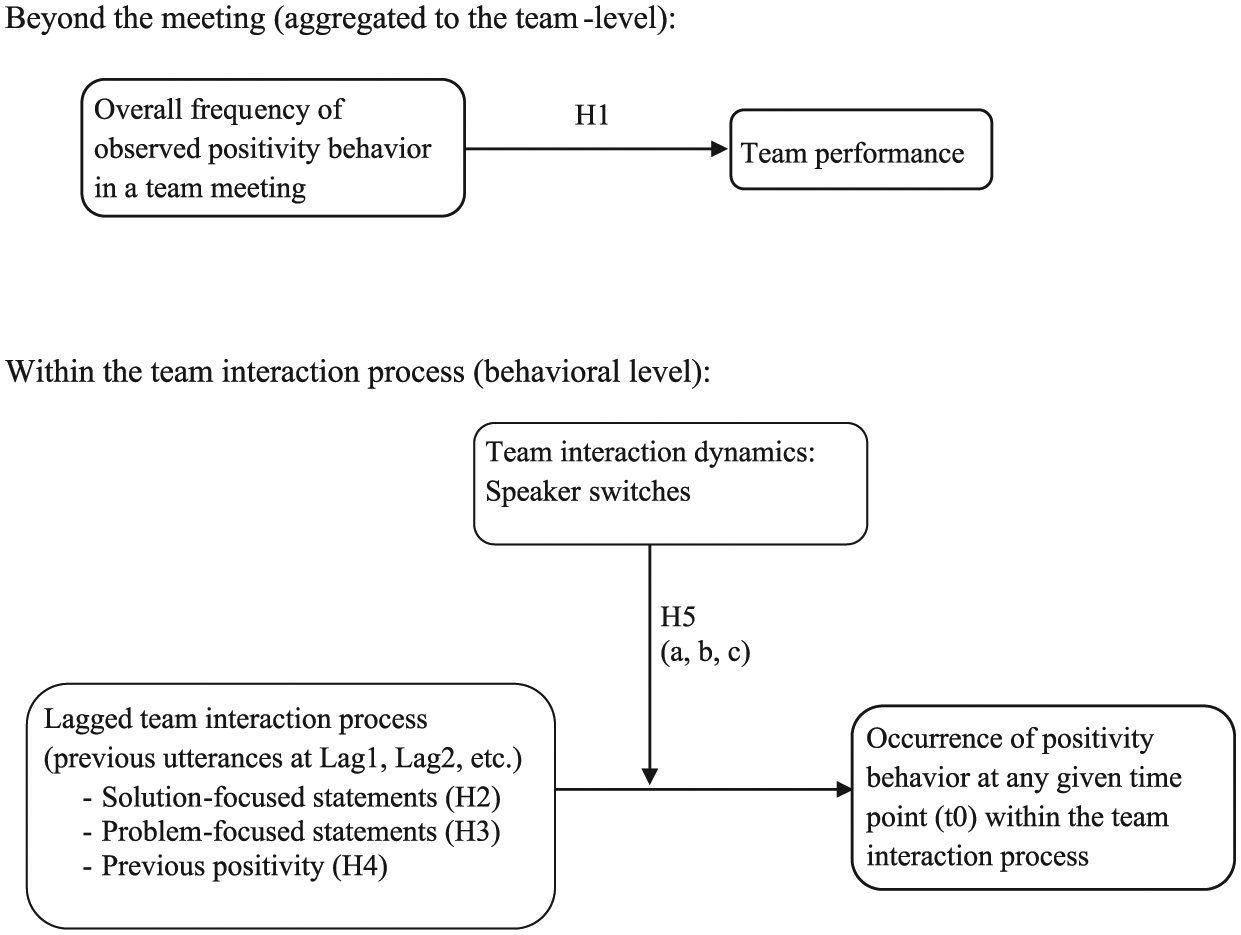
Summary of hypothesized main and moderating effects. The upper section shows the hypothesized link between overall positivity and performance beyond the team interaction process (Hypothesis 1). The lower section of the figure depicts hypothesized relationships within the team interaction process (Hypotheses 2-5).
Method
Participants
Data were drawn from a multi-study longitudinal research program designed to examine team interaction processes and team effectiveness. Participants were 259 line technicians from 43 problem-solving teams in two medium-sized companies in Germany. There were 28 teams from one company in the electrical industry and 15 teams from a second company belonging to the automotive supply industry. On average, 13 employees formed one team. Prior to our data gathering, both companies had implemented teamwork as part of their respective continuous improvement process (CIP; for example, Imai, 2012), in which the teams held regular meetings (at least once a month). The meetings were attended by team members who worked together regularly during their production or assembly tasks. On average, six team members were present during the meetings (M = 6.19, SD = .97), due to the nature of shift work. Ninety percentage of the team members were male, which is typical for these fields of factory work. Employees’ ages ranged from 17 to 62 years (M = 35.99, SD = 1.21). Participants’ organizational tenure varied between 2.5 months and 42 years (M = 11.32, SD = 8.96), and the average team tenure was 6.86 years (range = 4 months to 42 years, SD = 6.27).
Procedure
Our data included both survey responses and videos of meetings. All demographic data were obtained via self-report surveys prior to the recorded CIP meetings. Behavioral variables were obtained by videotaping regular team meetings. After the team meetings, all supervisors of the participating teams completed a survey assessing team characteristics (e.g., size, tenure) and team performance outside the CIP meetings. Supervisors did not attend team meetings, and all participants were at the same level of the company hierarchy.
Meeting discussions (40-70 min long) focused on CIP topics such as improved frontline operations and processes. They sought better solutions to problems, such as developing new work processes (e.g., reorganizing the layout of work stations to improve workflow) and solving complex quality control and client problems (e.g., generating ideas to reduce complaints by internal or external customers). These topics required team members to pool their expertise, come up with new ideas, and build on each other’s inputs, such that the meeting resembled the interdependency of their work.
Participants were advised to ignore the videotaping and to discuss the topic as they would under normal circumstances. As CIP team members were familiar with the research team who recorded their meeting, the videotaping was less likely to influence their social interactions (Wicklund, 1975). Also, these teams were highly engaged in their demanding and pressing tasks of solving realistic problems at work, so they showed no visible signs of being influenced by the videotaping. Indeed, after the team meeting, participants’ questionnaire responses described the meetings as typical.
Data Coding and Variables
We coded the 43 videotaped team meeting interactions, comprising a total of 43,139 utterances. We used a subset of the act4teams coding scheme for team meeting interaction, a procedure shown to be valid and reliable (e.g., Kauffeld & Lehmann-Willenbrock, 2012). To preserve the temporal order of the individual utterances within the meeting conversation, we used INTERACT software (Mangold, 2010). We cut each team’s entire meeting conversation into individual utterances, or so-called sense units (Bales, 1950) and assigned a behavioral code from the act4teams scheme (e.g., problem, solution, or positivity behavior) to each sense unit. To do so, we intensively trained a pool of five coders with the act4teams coding scheme, but kept them unaware of the purpose of the study. To calculate inter-rater reliability, a subset of the videos was coded twice. We followed a procedure proposed by Fleiss (1971), which allows the measurement of agreement among several raters. Fleiss’ kappa coefficient can reach values from 0 (indicating complete disagreement or discrepancy) to 1 (indicating perfect agreement). Discrepancies between the raters for our sample were rather infrequent, as indicated by our obtained inter-rater reliability (Fleiss’ κ = .81). Any discrepancies between the coders were resolved by discussions.
Based on the coding rules of the act4teams coding scheme (e.g., Kauffeld & Lehmann-Willenbrock, 2012), positivity was operationalized as an utterance (sense unit) that was constructive in intention or attitude, showing optimism and confidence. Sample statements include “This sounds great,” “This could really work,” or “I’m really looking forward to this.” Statements about identifying, describing, and explaining problems were coded as problem-focused behavior (e.g., “We have communication issues when people come back from vacation and don’t know what’s been going on”). Statements that suggest a new idea or solution to a problem, endorse a solution, or explain advantages or consequences of implementing a solution were coded as solution-focused behavior (e.g., “One thing we could do is use some kind of log, to document what’s going on” or “We could use that log to write down any incidents that occur, so people can get informed quickly when they come back”). A positivity statement following this solution might be, “That sounds like a good plan.”
A speaker switch was coded whenever adjacent utterances were spoken by different speakers (e.g., a person described a problem and a different team member followed with a solution). In contrast, if a person stated a problem and immediately offered a solution, there was no speaker switch. As questions were raised frequently during the conversations and were by-products of problem solving, we also coded question utterances and included them in our analysis.
Team performance data were gathered from the survey responses of each team’s supervisor. We adapted four survey items from Kirkman and Rosen (1999) to measure team performance on a 7-point scale, ranging from 1 (completely disagree) to 7 (completely agree). The items were as follows: “The team reaches its quantitative target performance,” “The team produces high quality products/service,” “The team exceeds its qualitative target performance,” and “The team continuously improves its productivity.” We calculated the average across these four items to obtain a team performance score. Cronbach’s alpha for this scale was .65. In addition, we performed a confirmatory factor analysis using Mplus and found that a unidimensional model for team performance showed good model fit (χ2 = 2.25; df = 2; root mean square error approximation [RMSEA] = .05; comparative fit index [CFI] = .99; standardized root mean square residual [SRMR] = .05).
Control Variables
In addition to the variables included in our hypotheses, we added control variables to our statistical model to reduce the potential for omitted variable bias (Kennedy, 2008). Based on previous research on positivity and on team interaction patterns during meetings (Avey, Wernsing, & Luthans, 2008; Lehmann-Willenbrock & Allen, 2014; K. W. Luthans et al., 2008), we included the following variables that might be significantly related to the outcome variable positivity: individual demographics (e.g., age, gender), company (coded as 1 or 2 for the two companies in our sample), team size, average organizational tenure, number of women in the team, total utterances per team meeting, and total utterances by each person.
Analysis
Statistically analyzing temporal interaction processes requires addressing difficulties involving both dependent and independent variables. Difficulties involving dependent variables (i.e., positivity) include time, nested data, discrete dependent variables, and infrequent dependent variables. As positivity can differ across time, it requires modeling of time period differences and recent utterances (Chiu, 2008). Failure to account for similarities in utterances within the same time period or in adjacent utterances (serial correlation) can underestimate the standard errors (Kennedy, 2008). As our data were nested (utterances within time periods and individuals within teams), failure to account for similar actions from the same person or team could have biased the results (Goldstein, 2011). For dichotomous dependent variables (e.g., positivity vs. no positivity, in this study), ordinary least squares regressions can generally bias the standard errors. Furthermore, infrequent outcomes (<25% occurrence) can bias the results of a Logit regression (King & Zeng, 2001).
Independent variable issues include sequences, indirect effects, false positives, and robustness. As preceding utterances might influence the current utterance, the analysis must model previous sequences of utterances (Kennedy, 2008). As people have limited short-term memory, they are more likely to remember and act on recent information (recency effect; for example, Greene, 1986), especially in problem-solving situations that focus on the external environment rather than oneself. This recency effect is stronger for auditory than visual information (Beaman & Morton, 2000), which is especially relevant for discussions during team meetings. Because past studies (Molenaar & Chiu, 2014) had shown significant results of recent actions up to six lags ago, we tested for six lags in our data.
We also tested for indirect effects (e.g., problem → solution→ positivity; X → Μ → Y). Although single-level mediation tests can detect indirect effects, applying these tests to nested (multilevel) data can bias results. Testing many hypotheses (e.g., more than 10 in this study) also increases the risk of false positives (Benjamini, Krieger, & Yekutieli, 2006). Finally, results from one analysis may not be robust.
SDA
SDA (Chiu, 2008) addresses dependent variable issues (time, nested data, discrete, infrequent) with breakpoint analysis, I2 index of Q statistics, multilevel cross-classification, Logit, and Logit bias estimation. Breakpoint analysis statistically identifies the pivotal moments that divide each group’s data into distinct time periods (Chiu & Khoo, 2005). An I2 index of Q statistics tests all teams for serial correlation of residuals in adjacent utterances (Huedo-Medina, Sanchez-Meca, Marin-Martinez, & Botella, 2006). If the I2 index shows serial correlation for positivity, adding lagged variables in the previous utterance (Positivity [−1]) as an independent variable may remove the serial correlation (Chiu & Khoo, 2005). SDA models nest data across time with a multilevel cross-classification (Goldstein, 2011). To model dichotomous outcomes, a Logit regression (Kennedy, 2008) can be applied. For infrequent outcomes, the Logit bias can be estimated and removed (King & Zeng, 2001).
SDA addresses independent variable issues (sequences, indirect effects, false positives) with a vector auto-regression (VAR), multilevel random effects, multilevel M-tests, and the two-stage step-up procedure. A VAR (Kennedy, 2008) tests whether characteristics of sequences of recent utterances (micro-time context) influence the current utterance (e.g., the likelihood of positivity). To test whether independent variables show indirect effects through intermediate variables properly, SDA uses multilevel M-tests (MacKinnon, Lockwood, & Williams, 2004). Also, the two-stage linear step-up procedure reduces false positives more effectively than 13 other methods, according to computer simulations (Benjamini et al., 2006). Thus, SDA can account for dynamic relationships among process variables across different time periods.
Identifying breakpoints and time periods
As failure to account for similarities in utterances within the same time period can underestimate the standard errors, SDA models time period differences by statistically identifying breakpoints that dividing the data into different distinct time periods (i.e., interaction episodes) and applying multilevel analysis. Conceptually, a breakpoint is a pivotal moment in the time-series data in which the likelihood of the dependent variable differs substantially before the pivotal moment versus after it.
To this end, we first identified the number and locations of breakpoints that divide a conversation into different time periods. As team conversations are highly dynamic events and we had limited a priori information regarding distinct time periods, we used SDA to statistically identify pivotal moments (breakpoints) that separated each meeting into distinct discussion segments based on the likelihood of positivity behaviors (i.e., high vs. low likelihood). For example, within a sequence of statements by team members, positivity might be lower at the start when the team is trying to understand the problem than at the end when they have better understanding—or a potential solution. After statistically identifying these time periods, we tested whether of the effect size of each independent variable differed across time periods (Chiu, 2008). For the mathematical details of our breakpoint analysis, see Appendix A, Chiu and Khoo (2005), and Chiu (2008).
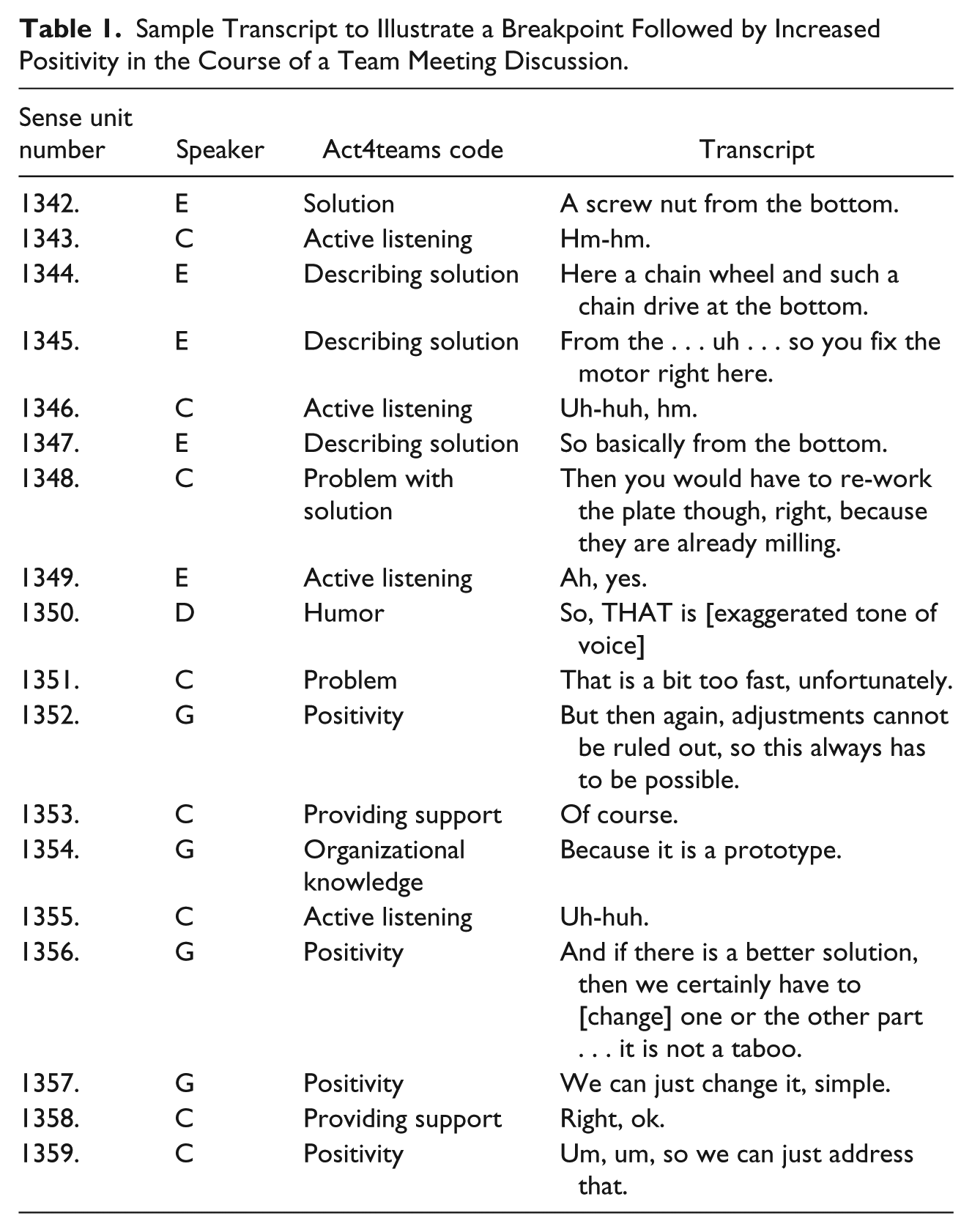
To illustrate what a breakpoint looked like, Table 1 shows a transcript excerpt from one of the teams. This team has been discussing ways to optimize the location of a motor within a chain drive. The breakpoint in this case occurred at sense unit number 1351. Before this breakpoint, there was very little positivity in this team (two utterances in total up to this point); after, there are several positivity occurrences in a row as well as at several points later on in their discussion.
Sample Transcript to Illustrate a Breakpoint Followed by Increased Positivity in the Course of a Team Meeting Discussion.
These teams had 0 to 2 breakpoints, yielding 1 to 3 time periods. The mean number of breakpoints in a team was less than 1 (0.91). As each team had too few time periods (less than 2 time periods per team), a time period level could not be included in the multilevel analysis. Instead, we added them as independent dummy variables: Later Time Period 1 and Later Time Period 2, with a value of 1 within the specified period and 0 otherwise (reference baseline = earliest time period). We also tested interaction terms with these time period variables.
Positivity and team performance
To test Hypothesis 1, we ran an ordinary least squares regression. We used the overall amount of positivity behavior observed in a team (per 1-hr period, to account for differing lengths of the meetings) to predict team performance rated by the supervisors.
Modeling positivity
We modeled positivity during the team meetings with a multilevel cross-classification model: utterance, time period, and individual (Goldstein, 2011). The following equation was used to estimate the probability of positivity behavior within the team interaction process:

The probability that Positivityi(jt)k occurs at utterance i, cross-classified by individual j and time period t (indicated by parentheses around subscripts i and j), all within team k is the expected value of Positivityi(jt)k via the Logit link function (F) of the overall mean β, and the unexplained individual-, time-period-, team-, and utterance-level components (residuals f jk , g tk , h k , ei(jt)k). We then added independent variables at the following four levels: context, time period, individual, and utterance level.

First, we entered a vector of u context variables that included company, team size, number of women in the team, and total utterances per team meeting. During multilevel analysis of binary dependent variables, likelihood ratio tests are generally not reliable, so we used a Wald test to determine whether each set of predictors was significant (Goldstein, 2011). Afterward, we entered time period variables: Later Time Period 1 and Later Time Period 2 (Time_period). Then, we entered a vector of w individual variables: gender, age, team tenure, and total individual number of utterances (Individual).
Problems, solutions, positivity, and speaker switches
To test our hypotheses, we added a VAR of previous speaker variables (Kennedy, 2008). More recent actions might have stronger effects (Slavin, 2005), so previous speaker variables were added in reverse order, first at lag1 (previous utterance): speaker switches (−1), solution-focused utterances (−1), problem-focused utterances (−1), questions (−1), and positivity (−1) (Lag1_Speaker). Specifically, we tested Hypothesis 2 by adding solution-focused utterances (−1), Hypothesis 3 by adding problem-focused utterances (−1), and Hypothesis 4 by adding positivity (−1).
Next, we test Hypothesis 5 with interaction terms involving speaker switches (−1). Specifically, we tested Hypothesis 5a by adding speaker switch (−1) × positivity (−1), Hypothesis 5b by adding speaker switch (−1) × solution-focused utterances (−1), and Hypothesis 5c by adding speaker switch (−1) × problem-focused utterances (−1).
Then, we applied the above procedures involving Lag1_Speaker to the same variables at lag2 (Lag2_Speaker), and so on until the last lag had no significant variables as our stop criterion. As each additional lag requires removing data (e.g., a team’s fourth utterance cannot have a lag 5 independent variable), we used this stop criterion to maximize the degrees of freedom and explanatory power in the most parsimonious manner.
If the regression coefficient of an independent variable (e.g., βx(jt)k = β x + f xjk + gxtk + h xk ) differed significantly across individuals (f xjk ≠ 0?), time periods (g xtk ≠ 0?), or across teams (h xk ≠ 0?), then a cross-level moderation (interaction) effect was possible. In that case, the regression coefficient was modeled with individual, time period, or team-level variables (e.g., βx(jt)k = β x + β xjk Individual jk + β xtk Time_period tk + β xk Context k ). Finally, the odds ratio of each variable’s total effect (direct plus indirect) was reported as the increase or decrease (+X% or −X%) in the outcome variable (Kennedy, 2008). To reduce multi-collinearity, we removed non-significant variables, using a .05 alpha level. To control for Type I errors, we used the two-stage linear step-up procedure (Benjamini et al., 2006).
Results
Table 2 provides the means, standard deviations, intercorrelations, variances, and covariances of all variables at the utterance level.
Means, Standard Deviations, and Intercorrelations of All Variables Included in the Study at the Utterance Level.
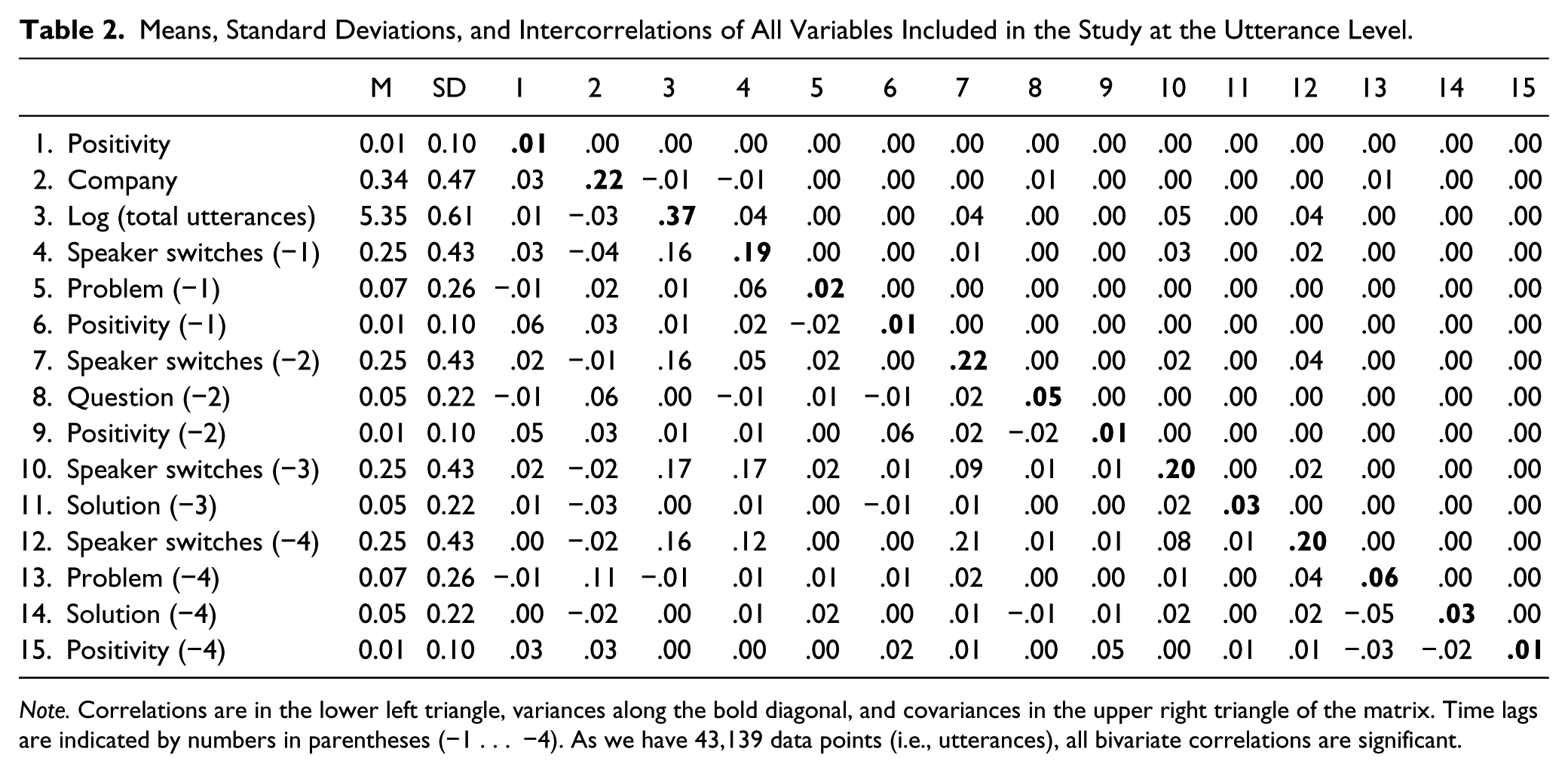
Note. Correlations are in the lower left triangle, variances along the bold diagonal, and covariances in the upper right triangle of the matrix. Time lags are indicated by numbers in parentheses (−1 . . . −4). As we have 43,139 data points (i.e., utterances), all bivariate correlations are significant.
Overall Positivity and Team Performance
To test our Hypothesis 1, we used the overall amount of positivity behavior observed in a team (per 1-hr period, to account for differing lengths of the meetings) to predict team performance rated by the supervisors. Lending support to Hypothesis 1, the link between the overall frequency of positivity in a team and supervisor ratings of team performance was positive (β = .29; R2 = .08; p = .05). Moreover, we explored whether the link between the frequency of positivity and team performance differed in earlier versus later time periods during the meeting. As each team conversation contained at least 201 turns of talk, we tested whether the likelihood of positivity in the first 100 turns of talk was positively correlated with positivity in the last 100 turns of talk. They were weakly but not significantly correlated (r = .10, n.s.). A t test across all teams showed that positivity significantly increased when comparing the first 100 utterances and the last 100 utterances of each interaction (t = −3.58, p < .01). Additional regression analyses showed that positivity within the first 100 turns of talk did not significantly predict positivity in the last 100 turns of talk of each team (β = .10, n.s.). Concerning performance linkages, these additional analyses revealed a significant link between later positivity (in the last 100 utterances) and team performance (β = .44, p < .01), but no significant link between earlier positivity (in the first 100 utterances) and team performance (β = −.04, n.s.). Taken together, these findings suggest that positivity becomes more frequent in later stages of team conversations. Moreover, the identified link between overall positivity and team performance should be viewed in light of our finding that positivity was more likely later on in the team conversation process.
Modeling Positivity With Control Variables
Likelihood of positivity differed much more across time within groups (66%) rather than across groups (34%). Table 3 shows the regression coefficients of three-level cross-classification logit regression models predicting positivity within the team interaction process. Independent variables in the first column of Table 3 are the different predictor variables of positivity at any given moment in the team interaction process. As shown in Table 3, company and total utterances by a participant were linked to positivity. Participants in Company 1 showed 13% more positivity than those in Company 2 (β = .86, p < .01; see Table 3, Model 1). Note that 13% is the odds ratio computed from the regression coefficient (cf. Kennedy, 2008). Meanwhile, participants who showed 10% more overall involvement in the meeting were 2% more likely to show positivity (Table 3, Model 2). Together, these variables accounted for 8% of the variance of positivity in these utterances.
Regression Coefficients of Three-Level Logit Regression Models Predicting Positivity.
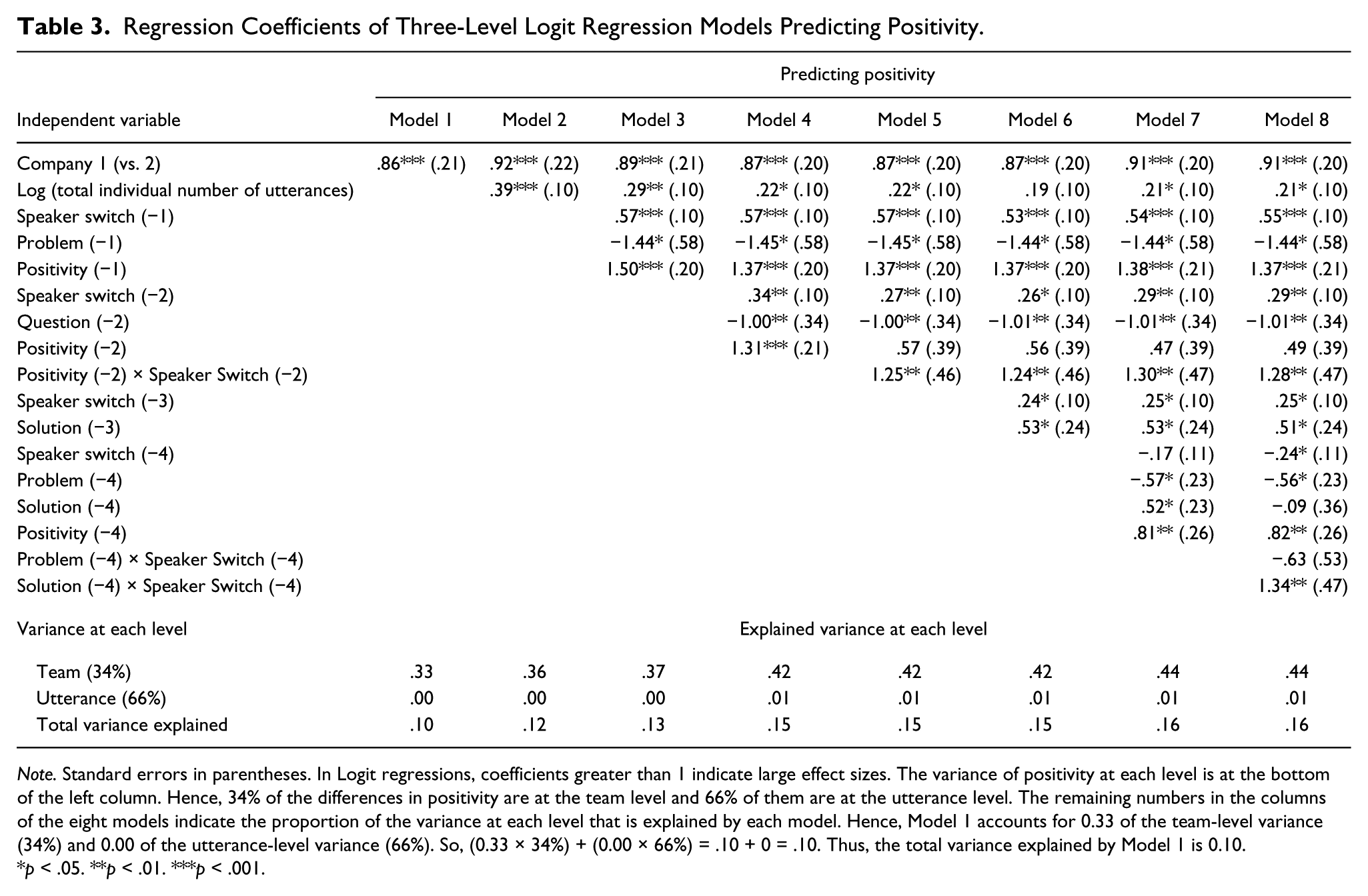
Note. Standard errors in parentheses. In Logit regressions, coefficients greater than 1 indicate large effect sizes. The variance of positivity at each level is at the bottom of the left column. Hence, 34% of the differences in positivity are at the team level and 66% of them are at the utterance level. The remaining numbers in the columns of the eight models indicate the proportion of the variance at each level that is explained by each model. Hence, Model 1 accounts for 0.33 of the team-level variance (34%) and 0.00 of the utterance-level variance (66%). So, (0.33 × 34%) + (0.00 × 66%) = .10 + 0 = .10. Thus, the total variance explained by Model 1 is 0.10.
p < .05. **p < .01. ***p < .001.
Positivity and Problems Versus Solutions
Solution-focused behavior and problem-focused behavior were both related to subsequent positivity. After a team member identified a solution three utterances ago (Solution [−3]), the speaker was 8% more likely to show positivity (β = .53, p < .05; Table 3, Model 6). In addition, a solution-oriented statement four utterances ago (Solution [−4]) was linked to increased positivity by 8% (β = .52, p < .05; see Model 7 in Table 3). All of these results remained significant in our final model (Table 3, Model 8). Hence, the results support Hypothesis 2.
In contrast, problem-focused behavior was linked to less subsequent positivity. After a team member identified a problem (Problem [−1]), the next speaker was 33% less likely to show positivity (β = −1.44, p < .05; Table 3, Model 3). Similarly, after a problem statement four utterances ago (Problem [−4]), positivity was 12% less likely (β = −.57, p < .05; Table 3, Model 7). A further examination of the data showed that after a person identified a problem, teammates proposed solutions 35% of the time, which reduced the negative effect of problem identification. These results support Hypothesis 3.
Earlier and Later Positivity
Recent positivity was also linked to subsequent positivity. Specifically, after positivity in the previous utterance (Positivity [−1]), the likelihood of positivity in the current utterance was higher (β = 1.50, p < .01; see Model 3 in Table 3; regression coefficients greater than one indicate large effect sizes). In terms of odds ratios, after a team member showed positivity, the next speaker was 17% more likely to show positivity than otherwise. Positivity two utterances ago (Positivity [−2]) also significantly increased the likelihood of positivity in the current utterance by 8% (β = 1.37, p < .01; see Table 3, Model 4). Similarly, Positivity (−4) increased the likelihood of positivity in the current utterance by 12% (β = 1.37, p < .01). In the final model with all independent variables (Table 3, Model 8), Positivity (−1) and Positivity (−4) remained significant positive predictors of later positivity (β = .1.37, p < .001, and β = .82, p < .01, respectively). These findings support Hypothesis 4.
Speaker Switches and Positivity
After dynamic interactions, characterized by speaker switches, positivity was more likely across several utterances. Immediately after a switch between speakers (Speaker switch [−1]), positivity was 9% more likely (β = .57, p < .001; Table 3, Model 3). If a speaker switch occurred two utterances ago (Speaker switch [−2]), team members were 5% more likely to show positivity (β = .34, p < .01; Table 3, Model 4). If a speaker switch occurred three utterances ago (Speaker switch [−3]), positivity was 4% more likely (β = .24, p < .05; Table 3, Model 6). These effects remained significant in our final model (Table 3, Model 8). Note that the small negative effect of speaker switches at lag4 (four utterances ago; β = −.24, p < .05 in our final Model 8 in Table 3) is an artifact of the much larger regression coefficient of the interaction term, Speaker Switch (−4) × Solution (−4). Appendix B provides a sample transcript that illustrates how problems, solutions, and speaker switches related to positivity within the team interaction process.
Interaction Effects
As depicted in Figure 2, there were significant interaction effects between verbal behaviors and speaker switches at lag 2 and lag 4. When both a speaker switch and positivity occurred two utterances ago, positivity was significantly more likely (β = 1.25, p < .01; see Model 5 in Table 3). Two utterances ago, if a new speaker rather than an old speaker showed positivity, the current speaker was 16% more likely to show positivity. This interaction effect remained significant in our final model, thus supporting Hypothesis 5a.
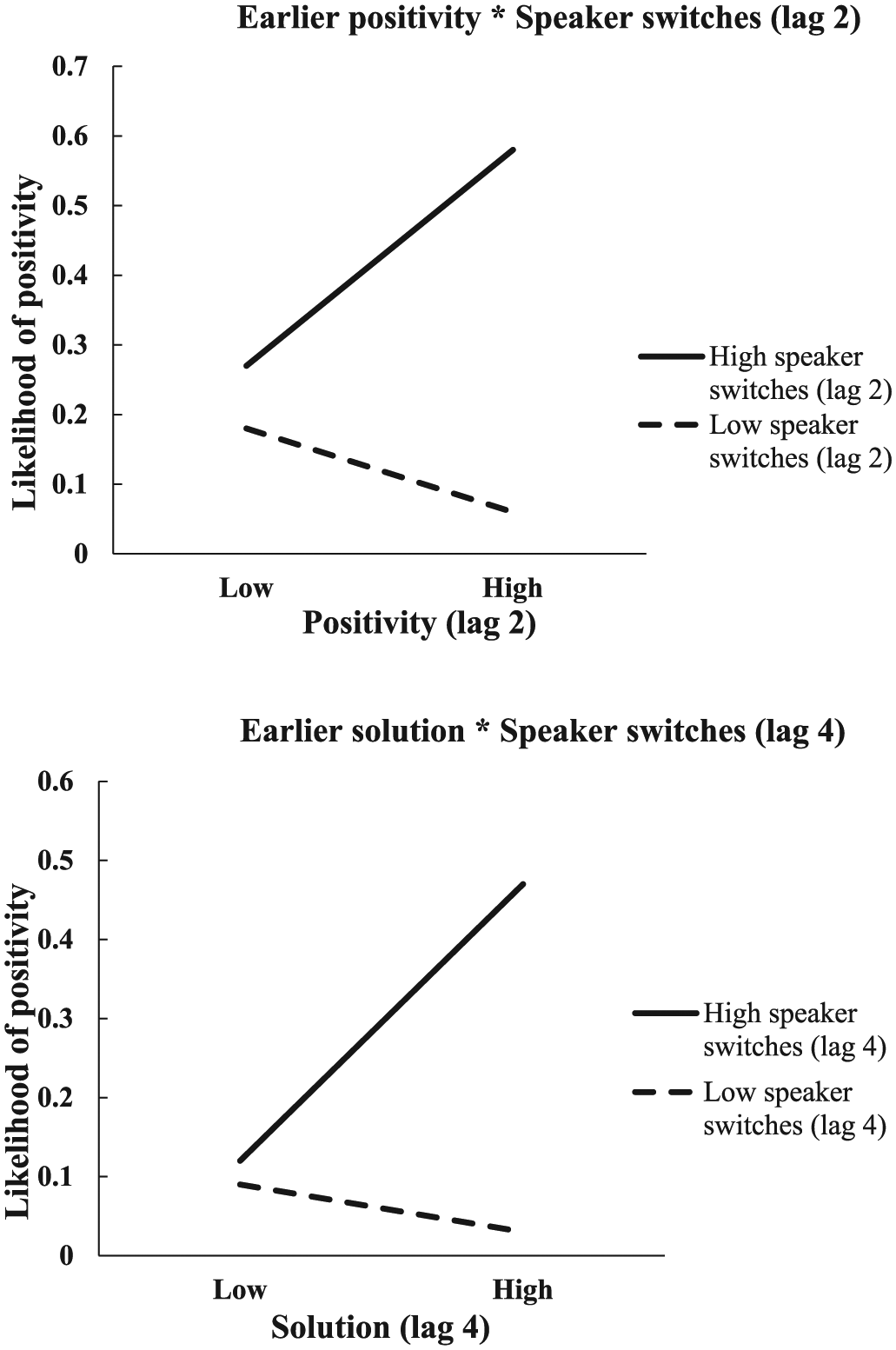
Interaction effects of speaker switches on the likelihood of positivity occurrence within the team interaction process. Numbers in parentheses show the respective lags within the interaction process (e.g., Lag2 means two utterances ago).
Some speaker switches’ interactions with solution-focused utterances were significant, but those with problem-focused utterances were not, partially supporting Hypothesis 5b but not Hypothesis 5c. Specifically, if a speaker switch and a solution endorsement both occurred four utterances ago, positivity was 17% more likely in the current utterance (β = 1.34, p < .01; see Figure 2b; Table 3, Model 8).
Discussion
This study examined how behavioral expressions of positivity naturally occur and dynamically unfold during regular team meetings in two organizations. Behavioral team interaction coding (Kauffeld & Lehmann-Willenbrock, 2012) and SDA (Chiu & Khoo, 2005) allowed us to pinpoint specific triggers and boundary conditions for positivity in team interactions. Moreover, we established a relationship between overall positivity occurrences and team performance. Our findings have several implications for theory and for managerial practice.
Theoretical Implications
Drawing from IR theory (Collins, 2004), we conceptualized positivity as a dynamically emerging behavioral construct embedded in team interactions. Accordingly, we focused on the micro-processes that trigger and sustain positivity during team interactions and conducted our analysis at the behavioral utterance level. In doing so, we departed from traditional approaches that viewed positivity as an individual trait or static psychological capital concept. Our findings contribute to the literature on team positivity and team emotional life in several ways.
First, we found that specific team micro-processes had different effects on the likelihood of positivity during dynamic team interactions, with problem-focused utterances inhibiting subsequent positivity and solution-focused utterances promoting subsequent positivity. Previous research on dynamic team interactions has grouped problem and solution utterances under a general conceptual umbrella (e.g., Kauffeld & Lehmann-Willenbrock, 2012; Lehmann-Willenbrock, Allen, & Meinecke, 2014). Instead, our findings suggest that problems and solutions have differential effects on positivity, and thus should be distinguished both conceptually and methodologically. By showing how distinct conversational micro-contexts, such as a momentary focus on solutions or on problems, tap into different affective components of team interactions, our research points to the complexity of catching positive upward spirals (Walter & Bruch, 2008).
Importantly, our results do not suggest that problem analysis is negative per se or should be reduced in any manner. Rather, problem and solution communication go hand in hand (Harvey, 2014) and are critical functions for successful group problem-solving (e.g., Ellis & Fisher, 1994; Chiu, 2008). Without sufficient problem analysis, solution generation will lack substance (e.g., Wittenbaum et al., 2004). Beyond capturing the nuances of team problem-solving micro-processes, our results highlight the importance of timing these processes as possible leverage for positivity and performance gains. It is possible that a conversational focus on problems is critical especially early on in a team meeting, as problems need to be analyzed and root causes should be clarified prior to generating ideas. Indeed, excessive positivity in the face of an incomplete problem analysis likely would not aid team functioning and performance. Yet a focus on solutions may be preferable in certain temporal team interaction contexts. For example, at the moment when a particular problem has been thoroughly analyzed, a team may be ready to move on to generate ideas and solutions, preferably fueled with inspiration to tackle the problems and achieve their goals. At any rate, our results show that behavioral expressions of positivity evolve within the complex, cyclic dynamics of team interactions, suggesting the need for a more nuanced model of micro-processes and temporal team interaction dynamics in general (Cronin, Weingart, & Todorova, 2011) and of positivity in particular.
Second, our findings illustrate how the differential impacts of micro-processes on subsequent positivity depend on different types of interaction patterns. Specifically, we found that speaker switches reinforced the positive relationships between solution-focused utterances and positivity, and between earlier positivity and later positivity within the team interaction process. These results suggest an instrumental or enabling effect of speaker switches, which is consistent with IR theory (Collins, 2004; Gibson, 2005). Team members use the conversation floor to readdress each other as a way of showing support, building affiliation, and sharing mutual focus; positive energy is thus enacted and elevated through the course of dynamic interactions. However, we did not find support for the amplifying effect of speaker switches on the negative relationship between problem-focused behavior and subsequent positivity. This result suggests that speaker switches may be a boundary condition for some micro interaction processes (e.g., solution-focused behavior), but not for others (e.g., problem-focused behavior). That said, we acknowledge that a focus on speaker switches may miss some of the social and psychological components of conversational interactions (e.g., the content, speaker characteristics, etc.). However, who speaks when and how often, captured by speaker switches, marks a defining feature of verbal interactions (Collins, 2004; Gibson, 2003, 2005) and as such provided a good starting point for our exploration of positivity in team interactions.
Third, our study approach answers recent calls for a more dynamic perspective on positive affective states in groups and teams (e.g., Barsade & Knight, 2015). Our dynamic approach may lead to new insights and reinterpretations of findings in positivity research (e.g., F. Luthans et al., 2007). For example, past research has usually argued that the group affective context may critically shape positivity (e.g., Kelly & Barsade, 2001; Walter & Bruch, 2008). A dynamic perspective offers a different interpretation: A specific contextual factor may not lead to positivity per se but instead facilitate moment-to-moment micro-processes as mechanisms to encourage or hinder positivity. Furthermore, our findings suggest that the spark of positivity from one person to another can affect the unfolding of interactions between them over time. For example, team members’ earlier positive emotions can ignite others’ positivity through multiple emotion cycles or lags, generating positive upward spirals (De Rivera, 1992; Gordon, 1989; Walter & Bruch, 2008).
Finally, our finding that overall behavioral positivity was meaningfully linked to team performance underscores the need to examine and understand positivity as it occurs in real organizational teams. As such, our results follow up on earlier work by West and colleagues (2009), who linked team-level state positivity to satisfaction and coordination outcomes in student project teams and called for future studies to examine team positivity effects in the workplace. However, the cross-sectional nature of the relationship between positivity and team performance established in our study does not permit any causal inferences. In fact, team positivity may not only aid performance, but the opposite direction may apply as well (i.e., high-performing teams experiencing more positivity). Moreover, while organizations often aim to promote a happy, positive team atmosphere, these well-meant intentions may become a case of “too much of a good thing” or cause groupthink (Janis, 1972), yielding suboptimal team performance. Decision-making techniques such as devil’s advocacy and dialectical inquiry, seemingly negative in nature, remain relevant and helpful. To resolve these concerns, future research could benefit from the collection of longitudinal, team-level data on positivity and performance and from exploring the profound effects of positivity in the context of team performance over time. Nevertheless, our findings help extend the intrapersonal and social benefits of positivity to the area of team performance.
Managerial Implications
Our investigation of dynamic positivity has implications for both managers and work teams. First, managers and team members should recognize the performance benefits of positivity for teams and find ways to leverage them. If team leaders and/or team members themselves can coordinate their interaction processes to increase their own and others’ positive energy, they might also increase efforts in subsequent team activities. Such upward spirals might lead not only to improved team performance but also to team members’ greater well-being (e.g., Fredrickson & Branigan, 2005; Sommer, Howell, & Hadley, 2016).
Second, because experiences of positivity are linked not only to team performance but also to positive relationships among team members (Tse & Dasborough, 2008), team leaders should actively encourage positivity expressions in their teams. Some organizational cultures, notably sales cultures, use positive emotions as a conscious corporate strategy. For example, AMWAY Corporation’s positive programming constantly exhorts its members to stay positive and to transfer that positivity to others (Pratt, 2000). Our findings suggest that this positive transfer is not just a corporate strategy but an everyday team phenomenon that can be actively fostered during regular team interactions.
Third, group dynamics can present a key managerial challenge. To address this challenge, our results suggest that team leaders should carefully design their team interactions depending on the momentary problem or solution focus of the team. For teams trying to solve problems, having an in-depth discussion of what went wrong is often vital, though it may not generate positivity. During these times, team members and leaders should particularly attend to negative emotions that the team might experience. In contrast, when a team’s momentary focus is on solutions, team members are more likely to experience positive emotional experiences that should be encouraged and cherished to move the team forward.
Finally, our finding that the synergistic effects of team positivity seem to operate through speaker turn-taking also has managerial implications. If a team conversation is already focused on solutions and positivity, team leaders can sustain and prolong these positive experiences by eliciting participation from other team members and thus encouraging speaker changes.
Limitations and Future Directions
As any empirical investigation, this study has several limitations. First, our sample consisted of relatively homogeneous production teams with respect to gender, tasks, status, training, and educational background. Future research should investigate whether the results of this study generalize to different types of teams, gender distributions (Toegel, Anand, & Kilduff, 2007), organizations, or cultural settings. Moreover, our analysis was based on only one meeting interaction per team, and not all team members were present due to the nature of shift work in this sample. Future research should examine whether our results hold when examining several meetings from the same team, and should aim to include all members of an organizational team.
Second, the videotaping might have influenced team members’ social interactions (Wicklund, 1975). However, there was evidence suggesting that participants were highly engaged in their task of solving realistic problems without being affected by the videotaping. For example, team members openly criticized (absent) supervisors or had noisy side conversations, suggesting that they were not overly preoccupied with the videotaping and that their behavioral conduct during the observed meeting was representative of the way they would typically behave in everyday team life. Previous research using this methodological approach has yielded similar observations (e.g., Kauffeld & Lehmann-Willenbrock, 2012).
Third, our study focused on the roles of specific interaction features in affecting how positivity dynamically occurs and unfolds in work teams. In particular, we examined the moderating function of speaker switches for positivity occurrences in team interactions. Despite the evidence supporting their effects in our study, speaker switches alone do not take into account many other features such as individual characteristics of specific speakers, which would allow for a more comprehensive understanding of positivity in dynamic interactions. Therefore, future research is needed to explore other enabling conditions of positivity during team interactions in addition to speaker switches, especially conditions under which other factors may be more important. For example, future research can explore how the interplay between individual team members’ social status and speaker switches influence the occurrence of positivity during team interactions. Future research could also explore to what extent dispositional traits of team members can influence team interaction patterns that trigger positivity, including individual differences in trait affect as well as trait affective presence (i.e., individual tendencies to elicit specific emotions in others; Eisenkraft & Elfenbein, 2010), other individual variables such as psychological capital, and additional team contextual factors.
Finally, although we found that positivity was beneficial for overall team performance, there may be contingencies. In particular, excessive positivity—regardless of the problem-solving process, or when a thorough problem analysis is lacking—may diminish rather than promote team functioning, an idea that future research on dynamic team interactions could explore further. Moreover, the stereotype content model suggests that only individuals perceived as warm and competent elicit positivity in others (e.g., Fiske, Cuddy, & Glick, 2007). Although our current findings show that earlier positivity begets later positivity regardless of specific individual characteristics, we did not explicitly measure perceived individual competence. Future research might address this by measuring advice networks (e.g., Klein, Lim, Saltz, & Mayer, 2004) in addition to team interaction processes to examine whether individual positivity behavior within the team process relates to competence as perceived by other team members.
Conclusion
This study advances our understanding of positivity in teams by moving this concept from the individual level and from static attributes to a dynamically unfolding team process. Using behavioral interaction data from real organizational teams, we showed that positivity is embedded in team interaction patterns and triggered by momentary task micro-processes and conversational dynamics. Our findings underscore the importance of including a temporal perspective when studying affective experiences in teams. Managers should develop an awareness of how the moment-to-moment conversational dynamics in team interactions contribute to positivity spirals and ultimately to team performance.
Footnotes
Appendix A
Appendix B
Authors’ note
At the time of this research, the author, Zhike Lei was affiliated to European School of Management and Technology, Berlin, Germany. Now the author is associated with Georgetown University.
Declaration of Conflicting Interests
The author(s) declared no potential conflicts of interest with respect to the research, authorship, and/or publication of this article.
Funding
The author(s) disclosed receipt of the following financial support for the research, authorship, and/or publication of this article: This research was partially supported by a grant from the German Research Foundation (DFG), which is gratefully acknowledged.
Associate Editor: Jin Nam Choi