We show how prospect theory uncovers critical decision-making insights in the design of sequential experiences by formulating a general framework and applying it to three experience design settings. First, we study the problem of releasing a piece of good news versus bad news, where a firm may incrementally reveal the news over a preemptive period. We characterize the optimal release strategy for both types of news and show that when the ultimate news is good (resp., bad) and the audience is sufficiently gain-seeking, it is optimal first to release information of a negative (resp., positive) sentiment. Second, we consider the problem of organizing an event such as a concert with performances of known valuations, where an event organizer needs to arrange the sequence of all performances. We show that for both loss-averse and gain-seeking audiences, interior peaks can be optimal, where pleasant and aversive performances are arranged to alternate throughout the event. Lastly, we investigate the problem of simultaneous versus sequential release of a series, such as songs or TV episodes, where a content provider does not know a priori the audience’s exact valuation of each item. We show that if the audience’s sensitivity to losses is sufficiently small (resp., large), the optimal strategy is to release all items in the series sequentially (resp., simultaneously). Across all of the settings, we show that the audience’s sensitivity to losses relative to a reference point is a critical factor that governs how to design and manage the audience’s evolving experience dynamics.
The framework of prospect theory is a natural setting for the study of experience design. From TV shows to concert lineups, audiences and performers can derive pleasant or disagreeable feelings from their experiences, depending on any previous expectations they may have. As these experiences generate up-and-down feelings over time, they impact satisfaction levels and future behavior. Hence, it is important to design various experiences with these ups and downs in mind.
Prospect theory is the most commonly used framework that explores how people’s decisions and choices could be affected by past experiences (Kahneman and Tversky, 1979). This framework has also been adopted by operations management researchers to investigate issues such as empirically observed irrational inventory decisions (see, e.g., Long and Nasiry, 2015) and to derive optimal markdown pricing schemes when strategic consumers display behavioral motives (see, e.g., Özer and Zheng, 2016). Despite the range of managerial insights that prospect theory helps uncover when addressing service problems, extant literature does not showcase how greatly the framework matters when describing how people’s sentiments are affected by their experiences.
In this article, we create a general formulation for the design of sequential experiences and highlight this importance by exploring three specific scenarios. In each one, we make canonical assumptions that describe individuals’ behavior and psychological reactions to new experiences. First, we focus on how to release a single piece of news. For example, we consider a pharmaceutical firm that needs to update the public with news regarding the development of a specific drug, where the firm knows whether the ultimate news is good or bad. Consistent with business practice, the firm may slowly reveal the news or a different sentiment over several preemptive periods before the ultimate revelation. Our results describe the information release policy that gives the audience the most pleasant experience depending on the ultimate news. We show that when the public is sufficiently gain-seeking, it is optimal to first release information of the opposite sentiment (relative to the initial expectation) before the ultimate news, regardless of whether it is good or bad. For example, if the drug trials went badly, it may be optimal for the firm to first release positive news about other medications. On the other hand, when the public is sufficiently loss-averse, it is optimal to reveal the news as soon as possible, regardless of its sentiment. We provide guidelines for news media to better manage the public’s experience through the application of prospect theory.
Second, we investigate the problem setting of organizing an event (e.g., a concert or show) comprised of a series of performances. Here, we take the role of an event organizer who has to sequence those performances. The audience would find each performance to be either weak or strong, and the event organizer can separate the strong performances from the weak ones. We show that regardless of whether the audience is loss-averse or gain-seeking, it can be optimal for the event organizer to adopt alternating ups and downs, where the audience is presented with a repeating pattern of strong performances followed by weak ones (or vice versa) throughout the show. Our findings are consistent with the existing research in service design and common practices in music-festival lineup sequencing, showing that in many settings, it is optimal to “save the best for last” or “start strong and finish strong,” but also show that the application of prospect theory gives rise to un-intuitive and novel optimal performance sequences that alternate multiple times between experiences that are strongly pleasant and strongly aversive for the audience.
Lastly, we investigate the problem of how to release a series of content, such as songs or TV episodes. In this setting, we find that when a content provider is unsure about the audience’s valuation for each item in the series, the audience’s sensitivity to losses critically determines the optimal release strategy. Specifically, we show that when the audience tends to be gain-seeking (resp., loss-averse), it is optimal for the content provider to release all items in the series sequentially (resp., simultaneously). As a practical implication, content providers may benefit from releasing some series in a periodic fashion and others in a simultaneous binge release, a choice which has been implemented by large streaming services such as Disney (Moore, 2022).
Our general framework applies prospect theory to describe the impact of experiences and sentiments on decision-making in a variety of practical settings. We first formulate the general sequential experience design problem and structure the remainder of our paper as a combination of three short ones, each with its own relevant literature, model description, and results. Nevertheless, next, we review the literature that resembles the theme of our general framework and its three applications.
Literature Review
Our general framework, and the three use cases we apply it to, all explore the effect that changing expectations can have on people’s experiences. In this subsection, we describe the overarching literature that touches on this theme and investigates similar problems.
The tools and methods we utilize in our investigation of sequential experiences are consistent with several seminal papers in prospect theory and mental accounting, such as Kahneman and Tversky (1979) and Thaler (1985). These studies of behavioral tendencies have more recently given rise to novel characterizations of managerial problems, a thorough review of which can be found by Donohue et al. (2020). Research such as Baucells and Sarin (2013) extends upon these methodologies and lays the groundwork upon which our analysis of experiential services is built.
Similar papers to ours apply prospect theory to various settings and study the effect that individuals’ expectations have on managerial decision-making. For example, Wathieu (2004), Popescu and Wu (2007), Nasiry and Popescu (2011), and Aflaki and Popescu (2014) consider firms that must make pricing and service-level decisions when consumers’ utility includes a perceived gain or loss, depending on past references. These past expectations induce changes in consumption, impacting revenues, and consumer lifetime value. While these papers focus on the steady-state analysis of repeated consumption choices, we show that applying the same framework to experience-management problems that focus on short-run and finite-time-horizon settings also yields practical insights. Moreover, the goal in pricing settings is to extract as much surplus as possible from the consumers, while our study is centered around creating as much surplus as possible for consumers.
Nonetheless, extant research has considered aligning decision-making with the firm’s long-term objective of retaining consumers. Specifically, the problem of sequencing experiences has been studied in a variety of contexts. For example, a field experiment on designing the layout of a museum has shown how rearranging artworks can improve visitor engagement (Aouad et al., 2022). In the context of music festivals, this problem of optimizing the musical lineup is of great interest to festival organizers (Lopez and Leenders, 2019). Existing research has also shown how festival organizers choose bands to include in their lineup (see, e.g., Hiller, 2016). Our general framework can be used as a theoretical guide in designing such presentations.
When applying prospect theory to the setting of inventory management, Long and Nasiry (2015) show that irrational decisions can be explained by accounting for individuals’ dependence on internal references and past experiences. We similarly show that accounting for individuals’ expectations in three specific settings can explain common practices and produce novel insights and prescriptions that are more aligned with individuals’ behavior.
A setting similar to the problems presented in this paper is investigated by Roels and Su (2014), who study the problem of setting reference points in the presence of social comparisons. The authors consider decision planners who can improve their objectives by exploiting individuals’ desire to outperform their peers. By choosing the information that is revealed to individuals, planners affect the subsequent level of performance. We investigate similar settings but focus on how to improve the experience for those who undergo it rather than for the decision-makers who design it.
Theoretical work in experience design is also complemented by a stream of empirical studies into consumers’ behavioral tendencies. One such study of strategic news releases by firms was conducted by Edmans et al. (2018), where the authors show that CEOs are induced to make discretionary news releases during equity months. A thorough empirical study of sequential product releases is conducted by Deshmane and Martinez-de Albeniz (2022), in which the authors describe how product differentiation affects the audience’s experience. In our work, rather than describing observed behaviors, we focus on prescribing decisions that maximize the audience’s experience.
Our showcase of how prospect theory can help us understand the effect of experiences on sentiments and outcomes is structured in a fashion that resembles the past literature. Tong and Feiler (2017) consider 10 different empirically observed phenomena and show, for each one, the importance of accounting for behavioral elements of forecasting. Although we do not consider forecasting but rather focus on designing experiential services, we show how decision-making in three specific settings critically depends on individuals’ expectations and past references.
The Experience Design Framework
We first develop a framework to formulate the problem of designing sequential experiences. We consider an audience that has to undergo a sequence of experiences, where each item in the sequence has a valuation , . A relatively high (resp., low) valuation implies that the experience is pleasant (resp., disagreeable). Prior to any experience, the audience has an initial reference point , which represents its expectation for the valuation of the first experience.
The audience’s reference after each experience in the sequence, , depends on the previous expectations, , and the valuations of previously undergone experiences, . Following a standard approach in the literature on prospect theory (see, e.g., Nasiry and Popescu, 2011; Tereyagoglu et al., 2018; Chen and Nasiry, 2020), we assume that the audience’s reference point before the -th event, denoted as , is an exponential smoothing of its previous reference point, , and the valuation of the last event, :
where is a memory parameter that captures how strongly the audience anchors on the past. Specifically, a lower indicates that the agent is very forgetful of previous experiences and relies more on the most recent event to form their reference point (i.e., expectation) for a future event, whereas a greater indicates that the audience relies more on previous experiences to form their reference point. In particular, if , the audience’s reference point for every element in the sequence is its initial expectation. Such a scenario may be characteristic of a binge-watching setting where all items in the sequence are undergone together as a singular experience. We note that other approaches to modeling reference effects exist and can be used as an alternative to (1). Depending on the nature of the problem, the choice of the reference structure may either significantly alter decision-making or not impact the results at all. We further discuss the choice of the reference structure and describe how it affects experience design in E-Companion G.
The audience’s perceived difference between the valuation of an event and the reference point prior to it, , determines the experienced psychological payoff for the event, . Commonly adopted in the literature (see, e.g., Nasiry and Popescu, 2011; Yang et al., 2014; Long and Nasiry, 2015; Long et al., 2020), we assume a piecewise-linear form for the payoff component:
Note that captures the strength of the reference effect; a greater implies that the agent is more sensitive to the deviation from the reference point. Moreover, describes the agent’s sensitivity to losses compared to gains. In particular, if , the agent is gain-seeking, which means that if an event exceeds its expectation by , they would experience a greater gain than the loss had the event fallen short by the same amount (i.e., ); if , the agent is gain-loss neutral and experiences the same utility in the absolute term for equally sized gains and losses (i.e., ); if , the agent is loss-averse, which means that if an event falls short of its expectation by , they would experience a greater loss than the gain had the event exceeded its expectation by the same amount (i.e., ). Many papers in the literature focus only on the agent’s loss-averse behavior (see, e.g., Thaler, 1985; Baucells and Sarin, 2010), and few papers consider all three types of the agent’s sensitivities (see, e.g., Popescu and Wu, 2007). In our study, we allow for a more general characterization of the agent and do not restrict our attention to the loss-averse settings. Consistent with the existing operations management literature that adopts the prospect theory framework (see, e.g., Long and Nasiry, 2015; Hu and Nasiry, 2018; Kirshner and Ovchinnikov, 2019), we then assume that the agent’s experienced utility for an event is the sum of (i) the valuation of that event, , and (ii) the experienced psychological payoff, .
The Problem. The experience design problem faced by a firm is that of deciding which sequence of events, , results in the most favorable outcome. Depending on the context of the problem, this outcome may take many forms. For example, in pricing settings (see, e.g., Popescu and Wu, 2007), the audience experiences a sequence of prices and makes purchases accordingly, with the firm’s decision-making and outcome being measured by long-term profit. We focus our analysis and examples on settings where the firm’s utility follows a strict customer obsession approach. That is, the firm’s goal is to create the best possible experience for the audience, given the problem parameters such as the sensitivity to loss and initial expectations. To model this objective, we let the firm’s utility be the sum of all valuation and psychological payoffs experienced by the audience, as commonly used in the literature (see, e.g., Roels, 2019):
In the design of experiential services, this objective may be more justified than others where the audience and firm’s interests are not aligned. For a concrete example, consider a firm that must release a sequence of songs in the form of an album or a playlist and is interested in maximizing its own short-term profit by pricing its service as high as possible. The firm would be able to charge higher prices as the audience’s total utility from the album or playlist increases. Therefore, the firm and the audience’s interests are aligned in the eyes of the firm. Alternatively, a firm that organizes longer or seasonal experiences in the form of festivals or conferences may be interested in maximizing long-term profitability. In such a setting, the audience will be more likely to make repeated purchases and experience the event regularly if its experienced utility is as large as it can be. Hence, the interests of the firm and audience are aligned again. Otherwise, if a firm’s interests are to maintain a positive image or leave goodwill to its audience, we can see that designing its services to give the audience the greatest possible total utility will also serve its own interests.
Information Structure. In the design of many experiential services, the firm and audience may or may not have perfect knowledge of the valuation of each experience in the sequence. For example, a new or experimental musician with an upcoming album may have very little knowledge of how a general audience will find each of their songs. At the same time, the audience knows neither the strength of any song nor the order in which they will be presented, both of which affect their experienced utility. Alternatively, both a festival organizer and the audience may know which bands in their lineup will give more pleasant performances than others, but the audience still may not know the order in which these will be presented. The information available to the firm and the audience, therefore, affects how pleasant the entire experience will be.
We assume that the audience has no information about the possible valuation of any experience in the sequence, except for their initial reference . However, the firm’s confidence in how the audience will react to each experience could be described by one of two general cases:
The firm has full information and knows exactly how pleasant or unpleasant the audience will find each experience in the sequence.
The firm does not know how the audiences will react to any element, which could be, with equal probability, very pleasant or very unpleasant.
In the first scenario, the firm is able to decide exactly what valuation to provide the audience with every experience. This could not be the case in the second scenario, where the firm must make decisions on other aspects of the problem, such as possibly batching multiple experiences in order to reduce the variance of their total valuation.
Contextual Restrictions. The firm’s decisions may also be restricted by the nature of the audience and how the sequence of experiences is undergone. These restrictions may be as specific as necessary for the context of the problem. For example, it could be that all experiences must have different valuations, which would be appropriate for settings where the firm must reveal information over time. Alternatively, the firm may be able to provide any valuations from a continuous range for any experience, while in other contexts, the firm must choose from a finite set of possible values.
Releasing News: Sooner Versus Later
We first apply our general framework to study the optimal way to release news to the public. Large firms and public officials must regularly relay and reveal information to their audience. With the abundance of news in modern media outlets, there are many pitfalls to dropping a press release (Densham, 2021), requiring careful consideration and planning. From the public’s perspective, the manner in which the information is revealed can produce different experiences and expectations for the future. A firm may thus be interested in knowing what the optimal information release strategy can be and what factors determine its structure.
Extant research has studied how to release information optimally but under specific settings and assumptions. For example, Gratton et al. (2017) consider an audience that has a prior belief and study when, during a finite timeline, an agent should strategically release information. The authors assume that the agent may release the information at any point with the objective of maximizing its own utility, while we focus on providing the most pleasant experience to the audience.
Also similar to our study, Ely et al. (2015) and Roels (2019) considered the setting where the audience generates utility based on how their belief changes over time. Specifically, the authors study what information policy maximizes the audience’s suspense, which increases with the variance in each period’s belief, and what policy maximizes surprise, which increases with the difference between consecutive periods’ beliefs. Instead, we study what information policy gives the audience the most pleasant overall experience, assuming that an increase (resp., decrease) in the audience’s expectations is a perceived gain (resp., loss). Although our analysis focuses on different characterizations of the audience and utility functions, we show that accounting for a wider variety of audience characteristics can generate new insights.
In relation to the previously mentioned literature on applying consumers’ references to pricing strategies (see, e.g., Popescu and Wu, 2007; Nasiry and Popescu, 2011), we may think of changing prices over time as releasing information. Our setting would then describe the novel case where the firm may not be able to dynamically decide on the ultimate price that is to be revealed to the consumer since the news, unlike the prices, may not be varied at will. However, the firm can control how to release information over multiple periods in the lead-up to this ultimate truth, which can be thought of as the “spin” created around the news (Hennig-Thurau et al., 2002). Additionally, unlike the dynamic pricing problem, we do not assume the existence of a demand function. That is, regardless of how disagreeable the news is, the audience must still experience it.
To illustrate the problem, we consider a pharmaceutical firm that intends to release a piece of good (resp., bad) news about recent trials of a particular drug. We assume that the good (resp., bad) news of the drug trials will bring a valuation of (resp., ) to the audience. The audience may hold an initial expectation, , regarding the sentiment of the news. In this setting, a loss-averse audience with a high could represent a large group of shareholders in the firm who are less interested in hearing good news than they are hopeful of avoiding hearing any bad news. A low audience could alternatively describe the general public, for instance, who have no stake in the firm and are simply hoping to hear positive developments and are not discouraged by bad news. The firm is concerned about updating the audience about the drug trials, but it may choose to reveal the update slowly over a sequence of time epochs.
In the context of our experience design framework, the firm has perfect control over the sentiment revealed at any point in time, while the audience has no information regarding the sentiment of any upcoming update. The experiences capture the discretized revelation feature, where the firm can choose how much information, , to reveal in each period . In this sense, is the level of valuation in period . Furthermore, we have and for . The firm can choose to release any new information at any period but is restricted in that it must release the drug trial news by the last period. That is, it must be that (resp., ) if the news is good (resp., bad). For either case of good or bad news, we assume that the audience does not know , , or , so the firm can progressively reveal the ultimate news without the audience knowing how truly good or bad it is. Although this monotone policy is restrictive, our goal in this first investigation is to understand the optimal strategies when interior peaks are not allowed, and the audience cannot be repeatedly shown information of opposing sentiment, and so further contextual restrictions are required. Specifically, if the drug trials went well (resp., badly), then at any preemptive period, the news cannot have a better (resp., worse) sentiment than the ultimate news, and (resp., ) for all . Additionally, for the good (resp., bad) news, any preemptive period must have a better (resp., worse) sentiment than its predecessor, meaning (resp., ) for all . In essence, the preemptive information allows the firm to reveal the ultimate good (resp., bad) news in (weak) increments (resp., decrements). The audience will experience the information released (or not released) in every period and update their reference point accordingly until the news is revealed in the final period or possibly earlier during the preemptive period. With the information available to the audience and firm described above, as well as the contextual restrictions faced by the firm, we next specify the firm’s experience design problem for the cases of good and bad news separately. In both cases, the firm must decide what information to release at every point in time (i.e., for ) to maximize the audience’s experienced utility.
How to Release Good News
We first consider the problem of releasing a piece of good news. In each time period, the firm needs to release (weakly) more information about the good news than in the previous period (i.e., for all ). In particular, indicates that there is no information update in period , and indicates that the firm releases more information about the good news in period . In the last period, all information about the good news must be fully released (i.e., ). Prior to this period, the audience’s reference point in period , , is updated based on the reference point in the last period, , and the level of valuation in the last period, ; we assume is updated following (1). In period , the audience compares the level of valuation and the current reference point and obtains an experienced utility following (2) (note that can be positive or negative or zero). The total utility of the audience is composed of two parts: (i) the valuation of the good news, , and (ii) the sum of the experienced utility in all periods. Thus, the audience’s total utility can be written as .
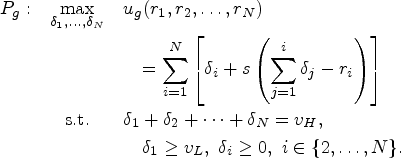
In accordance with the customer obsession objective in our general framework, the firm must solve the following optimization problem when releasing a piece of good news:
The following proposition summarizes the optimal strategy to release a piece of good news.
(How to Release Good News)
There exists a threshold (where and its characterization is given in E-Companion C.1) and such that
if , it is optimal to release bad news in the first period and then release all information about the good news at once in the -th period (i.e., , , and for any );
if , it is optimal to release all information about the good news at once in the first period (i.e., , and for any ).
Proposition 1 shows that the optimal release of the good news critically depends on the audience’s sensitivity to gains and losses, . When the audience is sufficiently gain-seeking (i.e., ), it is optimal first to lower the audience’s expectation, maintain a low impression for several periods, and then abruptly release all the information about the good news. In this case, although the initial lowering of expectations will lead to an experienced negative utility in the first periods, it will be compensated by the significantly large positive utility brought by the release of the good news in the subsequent periods. Since the gain-seeking audience prefers one large gain to a sequence of several small ones, the greatest total gain over the final periods is achieved by releasing the good news all at once rather than in small increments. Figure EC.1(a) in the E-Companion illustrates the optimal information release strategy for this scenario, where the audience is made to experience losses induced by disagreeable preemptive news for periods but is significantly pleased by the final gain in the -th period when the good news is ultimately revealed. We also characterize in the following corollary how the revelation period, , changes for different audiences.
(Sensitivity Analysis of)
We have that the revelation period is increasing in and but decreasing in and .
Corollary 1 shows that the firm should delay the revelation of the news when the audience’s initial expectations, measured by , more closely match the true sentiment of the news since the delay will allow the audience’s expectations to decrease significantly and result in a much more pleasant ultimate revelation. The same effect occurs when the firm has more periods to reduce the audiences’ expectations under greater . However, as the audience becomes more relatively loss averse under greater , the firm should expedite the news revelation. This is because the audience will be displeased during the preemptive periods, so releasing the good news earlier would avoid multiple unpleasant experiences. Moreover, as the audience’s expectations are less impacted by recent experiences, as is under greater values, similarly decreases, and expediting the good news is optimal as well. As the preemptive periods of bad news do not significantly reduce the audience’s expectations in such cases, the ultimate revelation of the news induces a smaller experiential gain, which can be offset by revealing the news earlier and converting what would have been unpleasant preemptive bad news into positive ones. We recall that this only holds for a sufficiently gain-seeking audience, which, in practice, we can think of as one that consumes the information for leisure purposes and does not have any stake in the implications of negative developments for the firm.
By contrast, when the audience is sufficiently loss-averse (i.e., ), any experienced negative utility is far more significant than the pleasure gained by the eventual release of the good news. As a result, lowering the audience’s expectations in the preemptive periods is no longer optimal, and instead, the good news should be released as early as possible. Such an optimal release strategy is illustrated in Figure EC.1(b) in the E-Companion. The immediate release of the good news at the onset of the preemptive period ensures that the loss-averse audience never experiences any losses. We can think of this sufficiently loss-averse audience as one that has a serious stake in the firm’s development and would find unfortunate news seriously troubling, much more than any psychological gains derived from learning the pleasant information.
We also consider a more restricted context of the formulation, where the firm is not allowed to prompt the audience with information that is deceivingly grim. That is, we assume that the firm knows the audience’s initial expectation and, since the news is good, cannot initially reveal any information that is more unpleasant than this initial reference.
(How to Release Good News Without Deceiving)
If deceiving is not allowed (i.e., ), it is optimal to release all information about the good news at once in the first period (i.e., , and for any ).
Corollary 2 shows that when the firm cannot preempt the audience with unpleasant information in order to accentuate the ultimate good news, the audience’s sensitivity to gains and losses no longer plays a role in the optimal decision, and the same release strategy of immediately releasing the news gives all audiences an optimally pleasant experience. Effectively, when deception is not allowed, the optimal decision is always case (b) in Proposition 1, and the firm must treat all audiences as if they are sufficiently loss-averse. Furthermore, as shown in E-Companion F, if the audience’s psychological payoff in (2) is concave, partially revealing the good news over time without deceiving may be optimal under some conditions (see Corollary EC.1(b)). In such a case, the concavity of the payoff function would reduce the gain that the audiences extract from the good news, making a sequence of small positive experiences more pleasant than one large positive experience. Moreover, in the case of bad news that we will discuss next, the concavity of the payoff function does not change this optimal revelation strategy (see Corollary EC.2).
How to Release Bad News
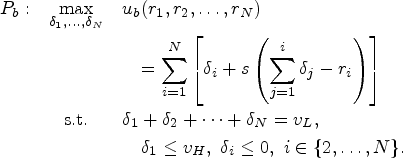
We next consider the case of releasing a piece of bad news. The setting is similar to that previously described, but with the distinction that the sentiment of the ultimate news is now disagreeable. In each period, the firm needs to release (weakly) more information about the bad news than in the previous period (i.e., ). In the last period, all information about the bad news must be fully released (i.e., ). As a result, the audience’s total utility can be written as follows . Hence, the firm must solve the following optimization problem when releasing a piece of bad news:
The following proposition summarizes the optimal strategy to release a piece of bad news.
(How to Release Bad News)
If , it is optimal to release good news in the first periods and then release all information about the bad news at once in the last period (i.e., , for any , and );
If , it is optimal to release no information about the bad news until the last period (i.e., , for any , and ).
Proposition 2 shows that regardless of the audience’s sensitivity to losses (relative to its sensitivity to gains), it is never optimal to reveal the bad news before the final period. This is in stark contrast to Proposition 1, which shows that it can be optimal to reveal the good news before the final period. This is because the bad news represents the most disagreeable level of the information, so its revelation is the most unpleasant experience possible for any given level of expectation. To combat this inevitable displeasure, the preemptive periods can be used to reveal more pleasant information, reducing the total aversion to the experience. Moreover, we further find that the optimal level of information that should be revealed before the bad news depends on .
If the audience is sufficiently gain-seeking (i.e., ), as illustrated in Figure EC.2(a) in the E-Companion, it is optimal to initially increase their expectations by misguiding them and signaling the most positive sentiment, , in the first preemptive periods. This will not only provide the audience with as many experienced gains as possible, but each gain will also bring the greatest possible utility given the audience’s current level of expectation. Regardless of the audience’s expectation prior to any preemptive period , the most pleasant experience occurs when is revealed, bringing a psychological utility of . Revealing such pleasant information in all preemptive periods produces a sequence of experienced gains that brings significant pleasure to the gain-seeking audience. However, experiencing in preemptive period also increases the audience’s future expectations , which increases the gap between reality and the final expectation, , and worsens the displeasure caused by the eventual revelation of the bad news, . Nonetheless, although this loss may be significant, the sufficiently gain-seeking audience enjoys the pleasant preemptive information to a far greater extent, so the loss associated with the ultimate revelation of the bad news can be dominated.
This result indicates a similarity between Propositions 1(a) and 2(a). In either case of good or bad news, the preemptive period is used to “misguide” a sufficiently gain-seeking audience. Such an audience could represent an audience that is observing the news for leisure and does not find bad news very disagreeable. In this case, if the firm is not constrained by the law or effects on its reputation to release misleading news, the audience would prefer to be initially misguided by information that is not consistent with the true sentiment of the final piece of news.
Alternatively, if the audience is sufficiently loss-averse (i.e., ), the ultimate experienced loss caused by the revelation of the bad news brings significant displeasure. The strategy of misguiding the audience by revealing the most positive sentiment throughout the first preemptive periods is no longer optimal. This is because the audience’s aversion towards the ultimate negative sentiment, , worsens when is inflated by pleasant preemptive information. For the sufficiently loss-averse audience, such a great disappointment outweighs the sum of relatively insignificant gains caused by pleasant preemptive information. Instead, as illustrated in Figure EC.2(b) in the E-Companion, it is optimal to reveal no information about the bad news at all and keep the audience’s expectation unchanged by sustaining their initial reference point throughout the preemptive period, which can assure . In this way, the preemptive periods do not produce gains or losses for the audience but rather a sequence of neutral experiences. Although this strategy results in potentially significant displeasure when the ultimate news is revealed, as could be very negative, the alternative of revealing the bad news in decrements with a sequence of smaller losses, such that for any , would produce more losses throughout the preemptive periods. According to the weighted-average smoothing in (1), this alternative of decrements would reduce expectations over time such that . As a result, , and the audience experiences a negative psychological utility, , for all . The sufficiently loss-averse audience would find this sequence of smaller losses much worse than a sequence of neutral experiences followed by a greater loss: . As a result, the negative utility of the ultimate bad news revelation is best experienced abruptly without being revealed in decrements. We note that the loss-aversion of the audience does not directly imply the optimal release strategy, as it is possible that , and the loss-averse audience should be treated the same as a gain-seeking one as long as . Although the two types of audiences are vastly different in their behavior, this result shows that they may be indistinguishable in the eyes of the firm.
We once more consider the setting where deception is not allowed, and the firm cannot reveal any information that is more pleasant than the audience’s initial reference.
(How to Release Bad News Without Deceiving)
If deceiving is not allowed (i.e., ), it is optimal to release no information about the bad news until the last period (i.e., , for any , and ).
Corollary 3 shows that in this context, the firm once again must treat all audiences as if they are sufficiently loss-averse, which in the case of bad news equates to delaying the news as much as possible without revealing any information beforehand. This result is also the case when the audience’s psychological payoff in (2) is concave instead of linear, as shown in E-Companion F.
Organizing an Event: Ups Versus Downs
In this section, we use our framework to study the problem of organizing an event consisting of several single-attribute experiences. Once again, the decision-maker must order them in a sequence that gives the audience the greatest total experienced utility, with the knowledge of the value that the audience will generate from each experience. Such an order is only known to the decision-maker, and hence, the audience does not know the valuation of any upcoming experience.
Some papers have investigated this optimal sequence design problem from a behavioral perspective and show that the optimal sequence of experiences may actually be decreasing (see, e.g., Wathieu, 1997). Across all possible audience behaviors, such a decreasing sequence would be optimal when the utility of future experiences is highly discounted. However, other papers (see, e.g., Das Gupta et al., 2016; Roels, 2019) show that in the presence of memory decay, it is always optimal to either sequence them in a crescendo (i.e., the service level of every experience in the event is greater than the one preceding it) or U-shaped (i.e., the service level of consecutive experiences may decrease at the event’s beginning, but increases in the event’s final experiences) fashion, contrasting the prescription of a decreasing sequence. In a more general context, the optimality of interior peaks (i.e., service levels increase and decrease throughout the experience) has theoretical support in a few instances (see, e.g., Guillaume, 2020; Yifu et al., 2023). Given such competing theories, the possibility of disparate optimal design strategies indicates that event organizers who are unsure of their audience’s characteristics could very easily decide on a suboptimal sequence of events, providing an unpleasant experience. In this section, we use the general level of audience sensitivity to gains and losses in our framework to unify many of these types of optimal schedules and give a wider variety of optimal sequencing decisions.
The cyclic structure of interior peaks is also reminiscent of extant research in sequential pricing such as Chen and Nasiry (2020), which considers a segmented customer base, where one class of consumers has a higher willingness to pay than another. However, our general framework focuses on a homogeneous audience that must consume all experiences. Moreover, Chen and Nasiry (2020) assume that the firm may endogenously set any price at any time period. In contrast, we assume that the number of weak and strong performances is fixed. Despite these differences, the objective of maximizing revenues can be thought of as equivalent to that of maximizing the audience’s pleasure from the event. While empirical evidence such as by Homburg et al. (2005) shows that the specific design of a transaction does not strongly impact willingness-to-pay, our analysis focuses on creating better experiences for audiences, independent of their effect on revenues. Nonetheless, in both revenue-maximizing and experience-utility-maximizing settings, we see the optimality of the cyclic structure for different reasons. The key reason for this result by Chen and Nasiry (2020) is the segmentation of the customer base, where one class of customers has a higher willingness to pay than another. Using our general framework, a gain-seeking audience may derive significant pleasure when experiencing gains (analogous to price decreases), so much so that experienced losses (analogous to price increases) are not as aversive. Therefore, repeatedly causing these aversive experiences may be optimal so long as they are compensated for by pleasant experiences.
Cycles in service levels are also focused on by papers such as Lei et al. (2023). There, the authors consider the specific problem of choosing how often to provide a product with the goal of maximizing long-run average profit for an audience that is not captive and may not consume the product even when it is offered. Based on the product and consumer characteristics, the authors find the optimal frequency at which the product should be offered. In our context, we restrict our audience to be captive and assume a finite horizon, but we do not require cycles in the service level to occur. Instead, we characterize the instances in which they are optimal.
The repetition of high and low service levels can also be optimal for firms aiming to maximize customer lifetime value, as shown by Aflaki and Popescu (2014). In such settings, customers’ inclination toward experienced gains increases their utility when service alternates between high and low levels. However, the authors consider a service provider who chooses what service levels to provide consumers over an infinite time horizon. We do not assume that the event organizer has this crucial freedom, and consider the context where the organizer is restricted by the service levels it can provide to the audience. Most importantly, the authors only show when cyclic behavior occurs in the long run and do not analytically describe when it occurs for a finite time horizon. Our investigation focuses on this specific short-term problem. Considering this setting, we analytically show when cycles in service levels give the greatest pleasure to the audience.
Model Setup
Let the experiences in our general framework represent a set of performances in an event such as a festival or concert. Consistent with practice, we assume that performances differ in their valuation. That is, the audience may find some performances more pleasant than others. We assume that each performance belongs to one of the two groups, high- and low-type acts and that the event organizer, having researched and booked the lineup of performers, knows which act belongs to which group. It may not necessarily be the case that low-type acts give weak performances, but the organizer knows the audience will not find them as pleasant as the high-type ones. Specifically, we restrict the context of the problem so that the audience has a valuation for a high-type performance and a valuation for a low-type performance. The number of high-type and low-type performances are and , respectively, where . This fixed number of weak and strong performances represents the reality that some of the performances will be less ideal to the audience and only serve as “fillers” between the event’s highlights. The weak and strong performances can also be extended to allow for multiple performance types by assuming that each performance’s valuation must be chosen from a finite set of no more than values.
The problem faced by the event organizer is to sequence the performances while considering the audience’s complete experience, from the first performance to the very last. The audience’s experienced utility for an individual performance is determined by not only the valuation of that performance but also the audience’s reference point before watching that performance, , which is given by (1). For example, immediately after watching a low-type performance, an audience may be pleasantly surprised by seeing a high-type one, resulting in a perceived gain. In this context, we assume that the audience obtains utility after watching performance , where represents the valuation of performance , and is the experienced utility given by (2). Returning to our experience design framework, the organizer knows the exact type of every performer in the sequence and so has full information on how the audience will find each performance, while the audience only knows that any performer will be either low or high type. The experienced utility for any performance in the sequence would depend on , which is low for a gain-seeking audience who are not as disheartened by weak performances as they are enchanted by strong ones. This could describe the audiences of cruise entertainment, who consider nightly shows and performances as an accompaniment to their vacation and are not strongly averse to underwhelming experiences. A loss-averse audience with a high may alternatively describe the attendants of a music festival with popular headliners. Not knowing the sequence of performances, such spectators may be biased fans of the festival’s headliners and consider observing any other performer as an aversive pastime and a wasted opportunity to watch their favorite band or singer. Lastly, represents the audience’s initial reference point before watching any performance, and the total utility obtained by the audience after watching the entire event is then
Once again, assuming the goal of customer obsession, the event organizer aims to find what sequence of the performances maximizes this quantity.
Optimal performance sequencing for an event.
H L L H L H
H L L H L H L H
H L H L L H L H L H
L H L L H H
L H L L H L H H
H L L H L L H L H H
L L L H H H
L L L L H H H H
L L H L L L H H H H
Optimal Performance Sequencing
We first describe the structure of the optimal performance sequencing policy by defining two sub-patterns of performances. In particular, we define a crescendo pattern as a sequence of performances that begins with any number of low-type performances that are followed by any number of high-type performances. We define the second sub-pattern as a U-shaped pattern, which is a sequence that begins with any number of high-type performances that are followed by a crescendo pattern. We note that these types of patterns can be defined for any set of valuations , where a crescendo is such that the sequence of valuations increases, while a U-shaped pattern is such that valuations initially decrease and then increase. The following proposition summarizes the optimal sequencing policy.
(Optimal Performance Sequencing)
For any and , there exist two thresholds and (where and the characterizations of and are given in E-Companion C.2) such that
if , it is optimal to begin the event with a U-shaped pattern, which is followed by several crescendo patterns;
if , it is optimal to arrange the performances in a combination of crescendo patterns.
Proposition 3 shows that the optimal sequencing policy critically depends on the audience’s sensitivity to gains and losses , which can be thought of as how strongly the audience dislikes weak performers in comparison to strong ones. Moreover, our results further show that the event should always end with a crescendo pattern, which means that the final performance should always be a high note,1 irrespective of which only affects the structure of the optimal sequence up to this final performance. Specifically, when the audience is gain-seeking (i.e., ), a combination of U-shaped and crescendo patterns can be the optimal sequencing for the event. In this case, an initial U-shaped pattern is optimal. In this case, the audience will find the initial high-type performances pleasant but only be disappointed by the consecutive losses due to the following low-type performances. However, the audience’s reference point will decrease with each low-type performance and end with a significant ultimate gain resulting from the tail of the U-shape and its additional high-type performances. This sequencing is optimal because experiencing the losses due to a U-shaped pattern of performances does not affect the audience as negatively as the gain produced by an eventual high-type performance. This cycle repeats as the audience experiences any succeeding crescendo patterns,2 which repeatedly reduce their expectations initially in order to provide significant gains afterward. This strategy is somewhat analogous to the markdown cycle that is shown to be optimal by Chen and Nasiry (2020), where consumers face repeating cycles of increasing prices that are seasonally reduced. An example of when this strategy may be optimal and relevant could be for an audience of music platforms, such as Spotify users, who listen to playlists for leisure. The platform may use its knowledge of users’ preferences or sensitivity to songs of different sentiments, such as fast and slow songs, to construct an optimally pleasant playlist.
However, when the audience’s sensitivity to losses is sufficiently high as gains tend not to be as pleasant to experience (i.e., ), a combination of crescendo patterns will be the optimal sequence. In this case, each cycle will begin with consecutive low-type performances but will end with several high types. As the initial performances maintain low expectations from the audience, the gain produced by the crescendo will offset any perceived losses generated by the low-type performances due to a potentially high initial reference point from the previous cycle. It may also be optimal to sequence several cycles of crescendo patterns that chain crescendos one after another. Similar to the previous case, where arranging the event in a combination of patterns is optimal, a sequence of crescendo cycles will reduce the audience’s expectations with low-type performances but eventually produce an experienced gain with high-type performances. However, the audience’s sufficiently high sensitivity to losses, , makes it so that the “markdown” policy is no longer optimal. Instead, the audience first experiences a sequence of disagreeable experiences that is ultimately sweetened by pleasant ones. This can be thought of as a “markup” policy (or cycles of such a policy) different from the optimal one presented by Chen and Nasiry (2020), where consumers face decreasing prices that are seasonally increased. An example of when this strategy may be optimal could be in curating entertainment in a resort, where nightly shows comprise a part of the experience. Such an audience who expects very pleasant experiences during their vacation should be presented initially with several low-type shows and a final highlight to cap off their stay.
Numerical Examples
We next illustrate our results by considering different scenarios where various patterns are optimal. Let , , , and . Table 1 shows the optimal sequence of performances for an event under parameters and . Note that, as mentioned previously, it is never optimal to end the event with a low-type performance. This is because low-type performances are best used to reduce the audience’s expectations and should be eventually followed by a high-type performance to produce an experienced gain. Table 1 also shows that for a sufficiently low , it is optimal to begin with a U-shaped pattern and couple it with a sequence of crescendo patterns, regardless of the total number of performances.
For a greater , Table 1 shows that beginning with either U-shaped or crescendo patterns can be optimal, depending on the number of performances. When and , the organizer only has a small number of high-performances to sequence, and so it is suboptimal to begin the event with a high performance. Instead, the organizer should save these for later use to serve as a crescendo. However, when , the organizer has enough low-type performances to sufficiently reduce the audience’s expectations after beginning with a U-shaped pattern and produce significant experienced gains with the remaining high-type performances in the succeeding crescendo patterns.
Finally, when , the audience is sufficiently sensitive to losses, and starting the event with a U-shaped pattern is never optimal, as shown in Table 1. In this case, the organizer maximizes the audience’s experienced utility by only producing crescendos. However, given enough performances, such as in the case, organizing several crescendos throughout the event can be optimal. The resort example mentioned earlier may be a practical setting for this scenario, where the audience is loss-averse, and the organizer would, therefore, want to provide low-type performances to the audience initially but always top them off with a spectacle at the end of their stay. If the stay is sufficiently long, placing a spectacle in the middle of the stay can be optimal.
The Special Case of
We note that Proposition 3 only describes the general structure of the optimal performance sequencing policy for any value of . The following proposition describes the optimal performance sequencing policy for a special case of .
(Optimal U-shaped and Crescendo Policies)
For and any , there exists a threshold (its characterization is given in E-Companion C.2) such that
if , it is optimal to arrange the performances in a U-shaped pattern: the event begins and ends with a high-type performance, with all low-type performances ordered between these two;
if , it is optimal to arrange the performances in one or two crescendo patterns: the event begins with a low-type performance and ends with a high-type one, between which is the other high-type. Moreover, the number of low-types preceding the first high-type increases in .
Proposition 4 shows that the optimal performance sequencing policy can be fully determined for the special case of . Moreover, the results show that the optimal performance sequencing policy depends on the audience’s sensitivity to losses, . When the audience is sufficiently gain-seeking (i.e., ), the U-shaped pattern is optimal, where the event begins and ends with the high-type performances. In this case, the initial loss produced by the U-shaped pattern is offset by the eventual gain provided by the final high-type performance. It is optimal to consecutively sequence all low-type performances together since maintaining the audience’s expectation as low as possible will eventually allow them to experience the biggest possible gain.
However, if the audience is more sensitive to losses (i.e., ), the U-shaped pattern becomes disagreeable, and the organizer should offer a cycle of crescendo patterns, beginning with low-type performances. Once the audience’s expectation is low enough, a high-type performance can serve as a highly pleasant experience in the middle of the event. However, if this crescendo is followed by more low-type performances leading up to another crescendo, the audience will experience a loss in the middle of the event. As grows, this experienced loss becomes more and more disagreeable, implying that the audience’s reference should be low enough prior to the mid-event crescendo for the experienced gain to be worth the loss following it. This can only be done by moving more low-type performances to the beginning of the event and further deflating the audience’s expectations prior to the mid-event crescendo. Once is sufficiently large, it will never be optimal for the audience to experience any loss, and there will be no low-type performances between the two high-type ones.
The possible U-shaped pattern of the optimal sequence of performances is consistent with the existing research such as Das Gupta et al. (2016) and Roels (2019). However, by accounting for a greater range of audience sensitivities to gains and losses, this application of our general framework shows that a much wider variety of optimal policies can be possible. Moreover, Das Gupta et al. (2016) and Roels (2019) showed that a crescendo pattern may be optimal as well, while our results indicate that cycles of multiple crescendos may be preferable if the audience is sufficiently gain-seeking and does not find experienced losses too disagreeable.
Figure EC.3 in the E-Companion illustrates when the optimal sequence follows a U-shaped pattern and when it is a cycle of crescendos for this scenario. For fixed , , , and , the optimal sequence changes for different values of and . At a high value of , cycles of consecutive crescendo patterns are more likely to be optimal since, in this case, it would be beneficial to decrease the audience’s initial expectation immediately and produce a crescendo after some initial low-type performances. This also holds for a higher value of since more loss-averse audiences would find a U-shaped pattern disagreeable. However, a U-shaped pattern would give the best-experienced utility if both and are sufficiently low. This is because either the audience is sufficiently gain-seeking and therefore unaffected by a decreasing trend in the initial performances, or a strong initial performance would sufficiently exceed its initial expectation so that the gain caused by the first performance exceeds the losses caused by the subsequent weak performances.
We note that even though the two possible patterns define a unique and well-described optimal sequence, they are only applicable to the scenario where . For more general settings where , the exact optimal performance sequence is very difficult to characterize. As a result, the general structure shown in Proposition 3 only covers a part of the features that partially characterize the optimal sequence for an arbitrarily large number of high-type performances.
Experiencing a Series: Simultaneous Versus Sequential Release
In this section, we apply our general framework to study how to optimally release a series of media (such as episodes of television shows, songs, or book chapters), where a content provider can allow the audience to consume all items as a singular experience or as multiple delayed experiences. In practice, artists and publishers have long had to tackle the decision of whether to distribute content in a singular publication or a split-up fashion. Modern media companies such as Netflix have pioneered the binge-watching experience by releasing full seasons of television shows at once (Tassi, 2019). However, the popularity of this strategy has not stopped other entertainment content providers like Apple TV from releasing its shows on a weekly basis, with one episode available at a time (Adalian, 2021). Moreover, the music industry is seeing a shift from album launches to roll-outs of individual singles (Leight, 2018), yet optimizing the consumer experience of listening to an album in its entirety remains high in artists’ agendas (Shakhovskoy and Toulson, 2015). The rising popularity of streaming services raises even bigger questions on how platforms can provide audiences with a pleasant listening experience (Hagen, 2015), which could be done by suggesting individual songs in a sequential fashion or curating entire playlists at once.
From the audience’s perspective, the two types of release strategies can create vastly different experiences. For example, releasing episodes of a television series weekly allows audience members to discuss the details of each release, adding anticipation for the next episode. In contrast, binge-watching the show lets the audience consume an entire season as a whole, as they are less likely to distinguish between individual episodes and build anticipation from one to the next. Therefore, the audience’s expectations from one episode to the next depend on whether the release is sequential or simultaneous. In this section, we use our general framework to quantify the audience’s experienced utility for either release option. Media companies may capitalize on these alternatives by choosing the strategy that gives the audience the most favorable experience and, as a result, enlarges the companies’ customer base and improves their revenue over the long run.
To the best of our knowledge, no extant literature examines this question theoretically. Thaler (1985, 1999) are the only two papers that study a related but different question of how to release two outcomes to maximize consumers’ utility. Although we investigate this objective as well, our general framework allows us to focus on the case where the experienced utility of the outcomes is uncertain, which can affect the optimal release decisions. It is also worth noticing that Thaler (1985, 1999) only focus on loss-averse consumers. In contrast, our general framework also allows for gain-seeking and loss-neutral audiences and prescribes the optimal release strategy accordingly.
Other papers such as Baucells and Sarin (2007) do consider uncertainty, though in the context of income streams rather than experience valuations. Such future income streams can be thought of as an upcoming experience of unknown utility. In this sense, Baucells and Sarin (2007) propose different ways of evaluating unknown experiences and compare these methods, while our general framework focuses on prescribing the optimal release. Moreover, we do not consider in our general framework the pricing and revenue aspect of the problem and instead focus on how releasing decisions should be made when the audience’s utility is the only performance measure of interest.
Model Setup
Although this application of our general framework and its results apply to any content manager who intends to release a piece of media, we focus on a specific context for ease of understanding. We consider a musician who intends to release a series of songs while facing uncertainty regarding its audience’s valuation for each song. The musician can release the songs either simultaneously as an album or sequentially in the form of singles. In relation to our framework, the contextual restriction of these release strategies reduces the number of possible decisions to two, as the musician would be committing to a release option without the possibility of reverting to the other. Prior to the release of song , the audience’s valuation of each song, , is unknown to the musician. We assume that this value falls into two levels according to the following two-point distribution:
The musician, therefore, has no information about how pleasant the audience will find each song. The audience similarly only realizes their valuation of each song once it is released and holds an initial reference point prior to the release of any song, while their psychological utility for any song release follows (2). Under the sequential release strategy, the audience’s expectations change with every song release according to (1), as the audience has sufficient time to form and share opinions and update its reference point. Accordingly, they obtain an experienced utility of for the release of the -th song, where is the realized valuation of the -th individual song and follows the distribution specified by (5). In this case, the audience’s total expected utility of the songs is .
However, the experience would be vastly different if the audience were to consume all songs as one experience. Clearly, if expectations were to update with each song, then the simultaneous release would be equivalent to the sequential one. Instead, we assume that under the simultaneous release strategy, the audience’s initial reference point, , will not be updated with each song and can be regarded as the expectation against which the audience compares the valuation of any released song, . We make this assumption because the simultaneous release strategy removes any anticipation that would otherwise grow from one single to the next. By binge-listening to all songs at once, the audience has no or little time to update its reference point. A simultaneous release in this setting can be thought of as an experience that resembles that of listening to a vinyl record, where it is more difficult for the audience to pause and resume during playback, making the entire record a singular item rather than a divisible series of many smaller ones. Therefore, under the simultaneous release strategy, where all songs are consumed as a singular experience, the audience’s total expected utility prior to the release can be expressed as . As long as the audience updates their reference point less frequently in the binge consumption than in the sequential release, our results would still apply. For instance, consider the case where the audience can update their reference point every songs where . Then, we can treat every batch of songs as an independent set of experiences and apply our general framework to see whether the songs in each batch should be released simultaneously or sequentially.
The decision of which release strategy to use may depend on , which describes how strongly the audience knows the musician. A “one-hit-wonder” musician may be seen by the audience as having an established style and an audience that hopes to hear the same style again. The musician may, therefore, face a loss-averse audience with a large . Such an audience may find that their disappointment with a song of an alternative style is much more powerful than the joy they would have received from a song resembling the musician’s established style, in anticipation of which the “one-hit wonders” may fail to innovate to become hitmakers (Berg, 2022). Alternatively, a lesser-known musician may find that the audience is more gain-seeking and not terribly disappointed by a weak song but rather delighted by finding a very enjoyable song from this new musician.
Optimal Release Strategy
By comparing the audience’s total expected utility under the two strategies, we can obtain the musician’s optimal release strategy, which we find critically depends on the audience’s sensitivity to losses (relative to its sensitivity to gains). The following proposition summarizes the results.
(Simultaneously or Sequentially)
There exists a threshold (where the characterization of is given in E-Companion C.3) such that
if , it is optimal to release the songs sequentially;
if , it is optimal to release the songs simultaneously.
When the audience’s sensitivity to losses (relative to its sensitivity to gains) is below a certain threshold (i.e., ), the musician should release the songs sequentially. When , the audience is clearly gain-seeking. Otherwise, when , the audience would be loss-averse but can still experience a sufficiently large positive utility if the realized valuation of a release is above their reference point. Thus, to maximize the audience’s total experienced utility, it is important for the musician to pleasantly surprise the audience as many times as possible so that the audience will experience the significant positive utility provided by high-valuation songs. In fact, when the songs are released sequentially as different singles, the audience’s expectation for a single will be changed by their valuation of previous singles. As a result, the audience’s expectations will be reduced if they experience a bad song. Even if this may lead to a negative utility, the reduced expectation will make the audience even more pleasantly surprised if they later experience a song that is very good, resulting in a significantly improved positive utility. In this way, the musician can maximize the audience’s satisfaction. Therefore, it is optimal for the musician to adopt the sequential release strategy when the audience tends to be gain-seeking. We can interpret this dependence on as a guideline for the musician based on how the audience perceives disappointing songs. Some audiences may consider a disappointing song as more of an experiment by the artist rather than a failure, such as dedicated fans who seek to enjoy the good songs, unlike casual fans who perceive such a song as a lost opportunity to hear a different, more pleasant one.
When the audience’s sensitivity to losses (relative to its sensitivity to gains) exceeds a certain threshold (i.e., ), the musician should release the songs simultaneously. In this case, the audience is likely to be loss-averse. This means that they can easily experience a significantly large negative utility if the realized valuation of a release is below their reference point, as opposed to the relatively small positive experienced utility if the realized valuation of a release is above their reference point. Thus, to maximize the audience’s total experienced utility, it is important for the musician to dissatisfy the audience as few times as possible so that the audience would not experience a large negative utility due to disappointment. In fact, when the songs are released simultaneously as an album, the audience’s expectation for each song in the album stays invariant at the level of the initial reference point, as they experience all songs at once in a binge fashion. This indicates that the audience’s expectations will not be improved even if they experience a song that is realized to be very good. Correspondingly, if they later experience a song that is realized to be bad, the audience will not be disappointed to a greater extent. In this way, the musician can minimize the audience’s dissatisfaction. Therefore, it is optimal for the musician to adopt the simultaneous release strategy when the audience tends to be loss-averse.
Moreover, our finding indicates that it is still possible for the sequential release strategy to be optimal when facing a loss-averse audience. This result is in stark contrast to that by Thaler (1985), which shows that pleasant and disagreeable experiences should always be integrated together when facing loss-averse individuals. Such a comparison demonstrates that the presence of valuation uncertainty indeed plays a role in determining which release strategy is optimal. In this context, the musician should be cautious about the characteristics of the audience she or he faces (e.g., the audience’s sensitivity to losses) because otherwise, a suboptimal release decision may be made.
(Initial Expectations Matter)
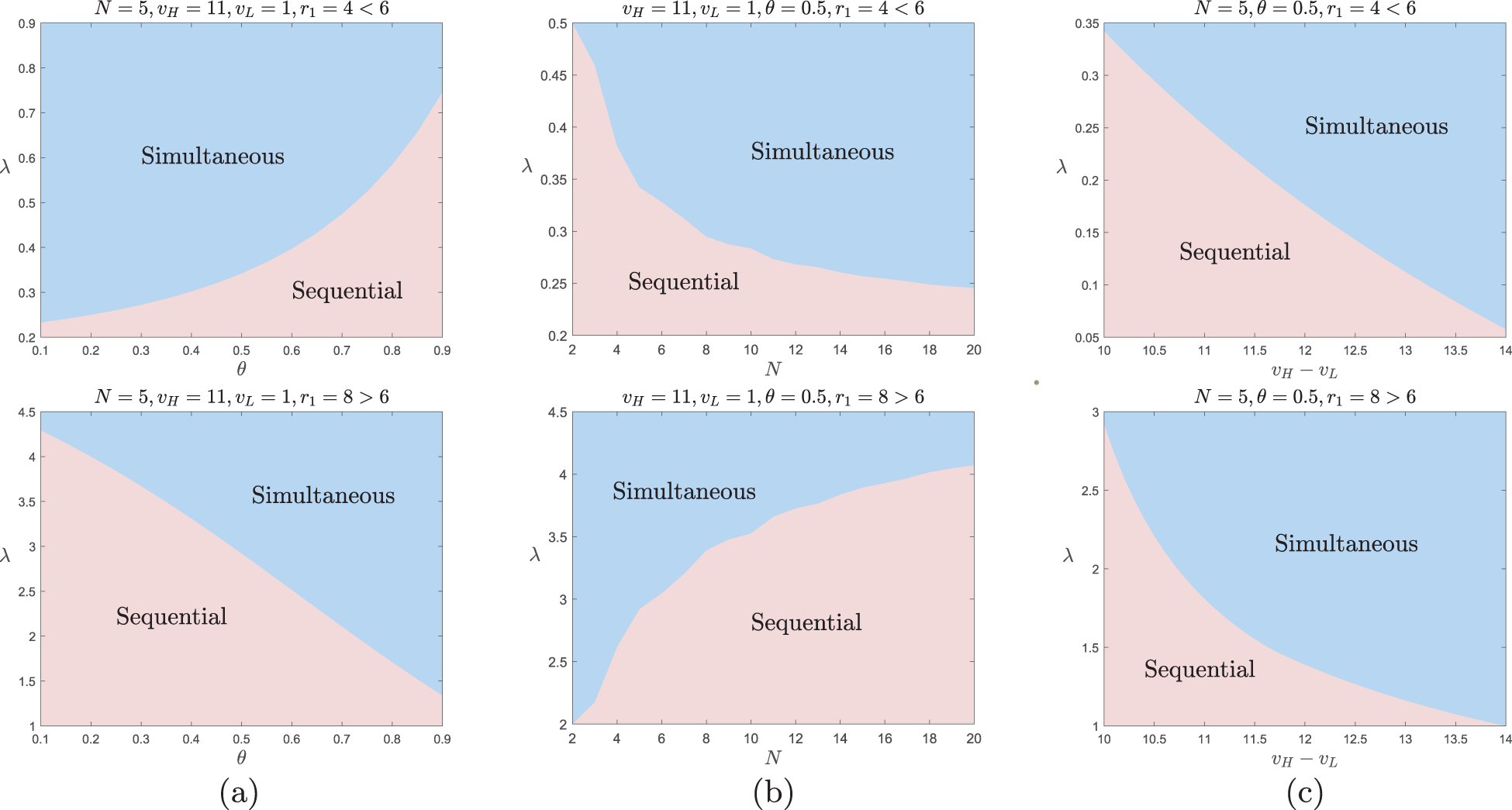
is increasing in . Moreover, if , ; otherwise, .
As shown in Corollary 4, the threshold that governs the optimal release strategy, , is always increasing in the audience’s initial anticipation level, . This indicates that as the audience holds a higher initial expectation for the songs to be released, it is more likely for the sequential release strategy to be optimal and less likely for the simultaneous release strategy to be optimal. Moreover, we also find from Corollary 4 that when the audience’s initial reference point is lower than the average valuation (i.e., ), the threshold is smaller than one. This indicates that a simultaneous release of all songs can be optimal for the musician even if the audience is gain-seeking (in the range of ). This is because a sufficiently lower initial reference point makes it less likely for the audience to be disappointed by a future release (as it is more likely for the realized valuation of a future song to be higher than the initial reference point). In this case, it is important for the musician to maintain the audience’s reference point at their initial low level so that the audience is very likely to be pleasantly surprised and experience the corresponding positive utility. Because the audience’s reference point does not change under a simultaneous album release, it is, therefore, the optimal release strategy when the audience’s initial expectation is low. When compared with common release strategies, this result is consistent with some industry practices. For example, a majority of Disney series are released in a weekly fashion, yet the platform still releases lesser-known projects simultaneously (Moore, 2022). The audience is more likely to have low expectations of these projects, implying a low in the context of our general framework and correspondingly a simultaneous release as the optimal decision, agreeing with the actual practice.
By contrast, when the audience’s initial reference point is higher than the average valuation (i.e., ), the threshold is greater than one. This indicates that it can be optimal for the musician to release the songs sequentially even if the audience is loss-averse (in the range of ). This is because a sufficiently high initial reference point makes it more likely for the audience to be disappointed by a future release (as it is more likely for the realized valuation of a future song to be lower than the initial reference point). In this case, it is important for the musician to deliberately decrease the audience’s reference points. If its expectations otherwise remain relatively high, the audience will often experience negative utility due to disappointing songs. Since the audience’s reference point can be decreased under a sequential single release, it is the optimal release strategy when the audience’s initial expectation is high. For this reason, contemporary musicians may be veering towards the release of individual singles rather than comprehensive albums, as a modern audience may have higher expectations. Streaming services make high-quality music easy to access and consumable, increasing audiences’ expectations as a result. This may induce musicians to release singles over time, lower expectations, and make the rest of their catalog more enjoyable.
(The Memory Effect)
If , is increasing in ; otherwise, is decreasing in .
Corollary 5 shows that the memory parameter can affect the threshold that governs the optimal release strategy, , in different ways. Recall that represents how strongly the audience remembers past experiences when building expectations for the future. In particular, when the audience’s initial reference point is lower than the average valuation (i.e., ), the threshold is increasing in . This indicates that it is more likely for the sequential release strategy to be optimal as increases. When is small, the audience anchors more on the most recent experience to form a new expectation. Thus, when the audience holds a low initial reference point, it is very likely for their reference point to increase significantly over time under the sequential release strategy. Correspondingly, the musician would be more afraid to disappoint the audience in the final releases, and thus, the sequential release strategy would not be optimal. In contrast, when is large, the audience anchors more on its past reference point to form a new expectation, and their reference point will be increased only to a smaller extent. Hence, the musician would be less worried about disappointing the audience in the final releases and can benefit from surprising the audience in the early stage. As a result, the sequential release strategy would be optimal.
Impact of parameters on optimal release strategy: (a) impact of ; (b) impact of ; and (c) impact of .
When the audience’s initial reference point is higher than the average valuation (i.e., ), the threshold is decreasing in , and the opposite effect is observed. This indicates that it is more likely for the simultaneous release strategy to be optimal as increases. When is small, the audience anchors more on the most recent experience to form a new expectation. A high initial reference point makes it very likely for their reference point to decrease significantly over time under the sequential release strategy. Correspondingly, the musician would benefit from surprising the audience in the final releases, making the sequential release the optimal strategy. In contrast, when is large, the audience anchors on all past experiences, and their reference point will decrease only to a small extent over sequential releases. Hence, the musician would not benefit from surprising the audience in the final releases. As a result, the sequential release strategy would not be optimal, and instead, the simultaneous release strategy would become optimal.
The results of Corollaries 4 and 5 are illustrated in Figure 1(a). We also show comparative statics regarding the effect that the number of songs, , can have on the optimal release strategy. Figure 1(b) shows that the threshold is decreasing in when is low and increasing in when is high. When the audience holds a low initial expectation, a sequential release would increase this expectation over time and reduce the gain generated by future songs, making the simultaneous album release strategy more likely preferable as the number of songs to be released becomes larger. In contrast, when the audience holds a high initial expectation, a sequential release would decrease this expectation over time, making it more likely for the sequential singles release strategy to be optimal as the number of songs to be released becomes larger. Furthermore, we also examine how valuation uncertainty, , can impact the optimal release strategy. Figure 1(c) shows that decreases in regardless of whether is low or high. This indicates that as the uncertainty in valuation increases, it is always more likely for the simultaneous release strategy to be optimal.
Conclusion
In this article, we formulate a general framework for designing sequential experiences and investigate how the change in expectations would affect optimal decision-making in three different settings. In all settings, we show that the sensitivity to losses (relative to its sensitivity to gains) is a critical factor that governs how to design and manage different experiences better. In the first setting, we investigate the problem of releasing a piece of news to the public over multiple periods and show that the optimal strategy to release good news would be different from that of releasing bad news. In particular, as illustrated in Figure EC.4 of the E-Companion, it is always optimal to delay the release of the bad news, but the optimal time to release the good news depends on the audience’s sensitivity to losses. Next, we study the problem of organizing an event, such as a concert, where the valuation of each performance is known. We illustrate the possible sequence structures that could give the audience the most pleasant experience in Figure EC.5 of the E-Companion, which shows that the optimal performance sequence could follow a crescendo or U-shaped pattern, as well as a combination of these two patterns where the audience goes through cycles of repeating ups and downs with alternating pleasant and aversive performances. We lastly study the problem of releasing a series, such as TV episodes, where the content provider may not know the audience’s valuation for each item. We show that the audience’s sensitivity to losses determines whether a simultaneous or a sequential release of all episodes provides a more pleasant overall experience to the audience. In Figure EC.6 of the E-Companion, we illustrate this result using a simplified mapping from audience characteristics to the optimal release strategy.
Our work shows that considering changing expectations can help decipher empirically observed decisions and provide recommendations that account for the audience’s behavior. We present explicit guidelines on how expectations can be influenced using different strategies.
Our framework can be applied to a variety of problems and settings and can be further developed to describe individuals’ behavior and expectations in a more general way. For example, we treat the audience to be homogeneous in their sensitivities to gains and losses, which may be heterogeneous in the population. In addition to the technical assumptions made in our models, investigating the problems in experiential-service design under frameworks other than prospect theory could also be fruitful, as it may bring about other insightful results that account for a different aspect of the audience’s behavior. Furthermore, in Sections 4 and 5, we restrict experience valuations to fall into two discrete categories, while granular ranges of valuations may be more appropriate.
Finally, we note that our paper only considers committed policies of experience design, specifically for backward-looking audiences. A wider variety of contingent policies would allow for more nuanced control and could reveal pertinent managerial insights into more complex problems. For example, if we consider the pharmaceutical firm’s problem in Section 3 and assume that new information could arise while the drug trial news is revealed or that the audience could deduce the sentiment of upcoming sentiment information based on past observations, how would the firm’s information-release decisions change? If the firm had unpleasant news to reveal but a positive development occurred during the preemptive period, how would information-release decisions be affected? Moreover, if we let the event organizer in Section 4 contingently decide what performance to present next and introduce some randomness by assuming that a strong performance could flop according to some ex-ante belief, how would such a realization affect the choice of the next performance in the sequence design? In addition, if the artist in Section 5 could improve the audience’s experienced utility by contingently choosing whether to release all remaining songs at once as a smaller extended play, how would its release strategy change? Lastly, on the demand side, if the audience could choose to contingently abandon after any release and not experience any future songs, what release strategy would result in the most pleasant experience? How does initial binge-listening affect engagement in a subsequent sequential release of singles? Does loss aversion play a role in this engagement? We leave these questions as potential directions for future research.
Supplemental Material
sj-pdf-1-pao-10.1177_10591478241265645 - Supplemental material for Ups and Downs in Experience Design
Supplemental material, sj-pdf-1-pao-10.1177_10591478241265645 for Ups and Downs in Experience Design by Hongqiao Chen, Ming Hu, Jingchen Liu and Yaniv Ravid in Production and Operations Management
Footnotes
Acknowledgments
The authors thank the Departmental Editor, Professor Gary Bolton, the Senior Editor, and two anonymous reviewers for valuable comments and suggestions on the manuscript throughout the whole review process.
Declaration of Conflicting Interests
The author(s) declared no potential conflicts of interest with respect to the research, authorship, and/or publication of this article.
Funding
The authors disclosed receipt of the following financial support for the research, authorship, and/or publication of this article: Hongqiao Chen was supported by the National Natural Science Foundation of China [Grant 72201124] and the Youth Project of the Humanities and Social Science Foundation of the Ministry of Education of China [Grant 22YJC630006]. Ming Hu was supported by the Natural Sciences and Engineering Research Council of Canada [RGPIN-2021-04295]. Jingchen Liu was supported by the National Natural Science Foundation of China [Grant 72101110].
ORCID iDs
Ming Hu
Jingchen Liu
Supplemental Material
Supplemental material for this article is available online ().
Notes
How to cite this article
Chen H, Hu M, Liu J and Ravid Y (2024) Ups and Downs in Experience Design. Production and Operations Management 33(9): 1895–1911.
AflakiSPopescuI (2014) Managing retention in service relationships. Management Science60(2): 415–433.
3.
AouadADeshmaneAMartinez-de AlbenizV (2022) Designing layouts for sequential experiences: Application to cultural institutions. SSRN. Available at: https://ssrn.com/abstract=4158587.
4.
BaucellsMSarinRK (2007) Evaluating time streams of income: Discounting what?Theory and Decision63: 95–120.
5.
BaucellsMSarinRK (2010) Predicting utility under satiation and habit formation. Management Science56(2): 286–301.
6.
BaucellsMSarinRK (2013) Determinants of experienced utility: Laws and implications. Decision Analysis10(2): 135–151.
7.
BergJM (2022) One-hit wonders versus hit makers: Sustaining success in creative industries. Administrative Science Quarterly67(3): 630–673.
8.
ChenNNasiryJ (2020) Does loss aversion preclude price variation?Manufacturing & Service Operations Management22(2): 383–395.
9.
Das GuptaAKarmarkarUSRoelsG (2016) The design of experiential services with acclimation and memory decay: Optimal sequence and duration. Management Science62(5): 1278–1296.
DeshmaneAMartinez-de AlbenizV (2022) Play it again, sam? Product differentiation and success in the music industry. SSRN. Available at: https://ssrn.com/abstract=3888525.
12.
DonohueKÖzerÖZhengY (2020) Behavioral operations: Past, present, and future. Manufacturing & Service Operations Management22(1): 191–202.
13.
EdmansAGoncalves-PintoLGroen-XuMWangY (2018) Strategic news releases in equity vesting months. The Review of Financial Studies31(11): 4099–4141.
14.
ElyJFrankelAKamenicaE (2015) Suspense and surprise. Journal of Political Economy123(1): 215–260.
15.
GrattonGHoldenRKolotilinA (2017) When to drop a bombshell. The Review of Economic Studies85(4): 2139–2172.
16.
GuillaumeR (2020) High-performance practice processes. Management Science66(4): 1509–1526.
17.
HagenAN (2015) The playlist experience: Personal playlists in music streaming services. Popular Music and Society38(5): 625–645.
18.
Hennig-ThurauTGwinnerKPGremlerDD (2002) Understanding relationship marketing outcomes: An integration of relational benefits and relationship quality. Journal of Service Research4(3): 230–247.
19.
HillerRS (2016) The importance of quality: How music festivals achieved commercial success. Journal of Cultural Economics40(3): 309–334.
20.
HomburgCKoschateNHoyerWD (2005) Do satisfied customers really pay more? A study of the relationship between customer satisfaction and willingness to pay. Journal of Marketing69(2): 84–96.
21.
HuZNasiryJ (2018) Are markets with loss-averse consumers more sensitive to losses?Management Science64(3): 1384–1395.
22.
KahnemanDTverskyA (1979) Prospect theory: An analysis of decision under risk. Econometrica47(2): 263–292.
23.
KirshnerSNOvchinnikovA (2019) Heterogeneity of reference effects in the competitive newsvendor problem. Manufacturing & Service Operations Management21(3): 571–581.
LongXNasiryJ (2015) Prospect theory explains newsvendor behavior: The role of reference points. Management Science61(12): 3009–3012.
27.
LongXNasiryJWuY (2020) A behavioral study on abandonment decisions in multistage projects. Management Science66(5): 1999–2016.
28.
LopezCLeendersMAAM (2019) Building a local identity through sellout crowds: The impact of brand popularity, brand similarity, and brand diversity of music festivals. Journal of Strategic Marketing27(5): 435–450.
TereyagogluNFaderPVeeraraghavanS (2018) Multiattribute loss aversion and reference dependence: Evidence from the performing arts industry. Management Science64(1): 421–436.
38.
ThalerRH (1985) Mental accounting and consumer choice. Marketing Science4(3): 199–214.
Please find the following supplemental material available below.
For Open Access articles published under a Creative Commons License, all supplemental material carries the same license as the article it is associated with.
For non-Open Access articles published, all supplemental material carries a non-exclusive license, and permission requests for re-use of supplemental material or any part of supplemental material shall be sent directly to the copyright owner as specified in the copyright notice associated with the article.