




Abstract
How will peer pressure among sellers affect their operations in an online marketplace? Motivated by online platforms’ marketplace designs that prompt sellers to compare their performances, in this paper, we develop and study a price competition model in which sellers account for both profits and peer comparison outcomes. In our model, two sellers offer substitutable products, and each of them sets a price ex ante to maximize their expected total utility, which is the sum of one’s profit and the payoff from peer comparison. In particular, peer comparison takes place ex post based on sellers’ realized sales. It results in a penalty for one’s underperformance (i.e., sellers are behind-averse) or a reward for outperformance (i.e., sellers are ahead-seeking) relative to the other seller. Contrary to what extant research on social comparison would predict, we find that peer comparison is not always pro-competitive. Indeed, while the behind-aversion aspect of peer comparison fosters competition, the ahead-seeking aspect can be anti-competitive when the market uncertainty is sufficiently large. This is because market uncertainty causes a greater variation in sellers’ performance disparity ex post (uncertainty effect), which can have a more salient impact on sellers than the expectation of their performance gap (comparison effect); While sellers’ behind-aversion further aggravates the uncertainty effect and encourages them to take more aggressive actions, their ahead-seeking counterbalances the tension by absorbing part of it into the comparison effect and moderating the marginal disutility of lagging behind. Overall, we find that peer comparison can intensify sellers’ price competition, which lowers the expected profits and utilities for both sellers, benefits the consumers, and reduces the hosting platform’s profit. Our main insights are robust in a number of extensions, including general demand specifications, seller asymmetry, sellers’ misperceptions of market uncertainties, and consumers’ reference-dependent decision-making. They highlight the importance of sellers’ behavioral regularities in online platforms’ daily operations and shed light on marketplace designs regarding algorithmic transparency, information sharing, and so forth.
Introduction
Platforms companies such as Amazon, TikTok, and Uber offer the infrastructure for millions of individuals to run their businesses online (see, e.g., Burtch et al., 2018; Li et al., 2023), and they constantly develop and deploy marketplace algorithms to influence the operations of those small business owners (“sellers” thereafter). Notably, platforms would inform sellers of their relative performances to other sellers and reward (punish, respectively [resp.]) their outperformance (underperformance, resp.). For example, Amazon would rank and display products to consumers based on sellers’ total sales, 1 ratings, likelihood of matching consumers’ preferences, etc. A top-placed seller typically attracts enough eyeballs, whereas a bottom seller receives far less consumer attention (see, e.g., Ursu, 2018). 2 Top-performing sellers may also be prioritized by platforms in certain seller services (e.g., inventory management, AI-driven consulting; see, e.g., Connolly, 2022; Yang, 2024). Similarly, content creators’ popularity is a crucial factor when social media platforms decide what content to show viewers. Moreover, TikTok would hold live stream sessions for content creators to “battle” against each other and see who is more popular among viewers (Hallanan, 2019). In online labor markets, platforms like Uber and Lyft use performance feedback to boost “gig” workers’ incentives 3 to work and compete among themselves (see, e.g., Mason, 2018); See Figure 1. 4
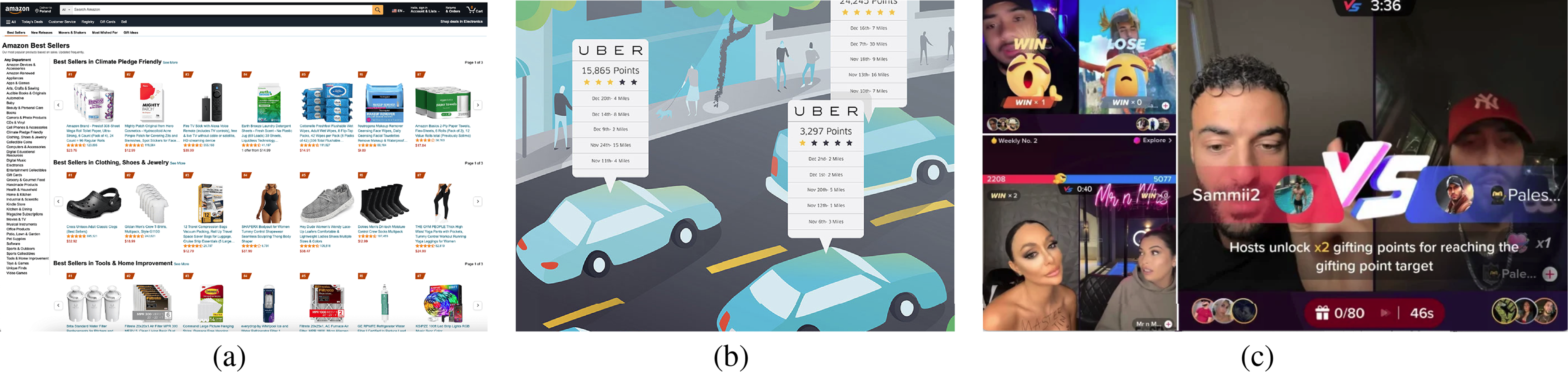
Seller comparison examples. (a) Amazon best sellers display. (b) Gig economy gamification. (c) Tik Tok “Battles”.
It is not an easy task for any seller to consistently outperform his or her competitors. One main challenge comes from the enormous uncertainty in market dynamics. On the one hand, consumer preferences and behaviors have been evolving ever more rapidly; traditional marketing approaches to predict consumer demand are outpaced (Lellouche et al., 2020), while more effective AI-based analytics tools can be very costly for small sellers to deploy (Castellanos and Shah, 2019). On the other hand, platforms’ algorithms add extra complexity to sellers’ operations. Besides sellers’ historical performances, platforms typically consider a swath of other factors when deciding how to allocate the consumer traffic (see, e.g., Farronato et al., 2023); they use highly sophisticated machine learning models to generate final allocation schemes (see, e.g., Smith, 2021), and update and develop new algorithms on a highly frequent basis (Ye et al., 2023). It is thus incredibly challenging for sellers to obtain precise forecasts about future consumer traffic.
Then, how would a seller navigate a marketplace with a fair amount of peer pressure and market uncertainty? The classic social comparison theory might predict that sellers take more aggressive actions than when they are solely profit-maximizing to either gain the utility of outperforming other sellers or avoid the disutility due to lagging behind their peers. However, market uncertainty garbles the payoff of any decision made by a seller and moisturizes their incentives to act aggressively. On the one hand, market downswings ex post can seriously undermine sellers’ efforts to close performance gaps. On the other hand, though, a demand windfall can significantly boost sellers’ sales, allowing sellers to take less aggressive actions against peers but at the same time still achieve a decent performance margin. Then, how will sellers adjust their decisions under different levels of market uncertainty? What will their reactions be to the heightened pressure of peer comparison? What are the implications of sellers’ behaviors for consumers and platforms?
To answer our research questions and pursue a better understanding of modern online marketplaces, we employ the workhorse model of price competition with two additional ingredients: sellers’ peer comparison and market uncertainty. We consider two sellers offering substitutable products. Each of them faces a random market size and sets prices ex ante to maximize his or her expected total utility, the sum of profit and a social utility of peer comparison. In particular, the peer comparison takes place ex post based on sellers’ realized sales. It results in a linear penalty for one’s underperformance (i.e., sellers are behind-averse) or a linear reward for outperformance (i.e., sellers are ahead-seeking) relative to the other seller.
Our analysis unfolds the following insights. First, unlike what the classic social comparison theory would predict, we find that peer comparison is not always pro-competitive. Indeed, while the behind-aversion aspect of peer comparison intensifies competition and reduces sellers’ prices, the ahead-seeking aspect will be anti-competitive and push up the prices if the market uncertainty is sufficiently large.
To unpack the intuition behind this finding, we propose two channels through which peer comparison affects sellers’ decision-making in an uncertain environment—a comparison effect and an uncertainty effect. The comparison effect captures how any seller will handle the expectation of their performance gap or, in other words, how they would behave in a completely deterministic environment. This effect is independent of market uncertainty and plays the classic pro-competitive role of social comparison. Both behind-aversion and ahead-seeking will enhance the comparison effect and intensify the price compeittion between sellers. The uncertainty effect, on the other hand, reflects how sellers will react to the variation in their performance gap, and it becomes more accentuated as the uncertainty builds up. Specifically, when setting prices ex ante, in anticipation of a negative market shock, the focal seller may wish to close the performance gap with the competitor by lowering the price, and a higher degree of market uncertainty adds extra downward pressure on the price as “harsher” shocks become more likely. In contrast, a positive market shock allows any seller to loosen the tight control of price, and market uncertainty helps further soften the price race as both sellers expect a higher chance of being hit by windfalls.
Regarding the uncertainty effect, sellers’ behind-aversion reinforces its pro-competitive aspect, while their ahead-seeking enhances its anti-competitive potential. Putting the comparison and the uncertainty effects together, if market uncertainty is sufficiently large, the uncertainty effect amplifies and dominates the comparison effect, and sellers will be encouraged to raise prices as ahead-seeking strengthens; Otherwise, the uncertainty effect will be dominated by the comparison effect, and sellers will lower prices. On the other hand, behind-aversion is consistently pro-competitive through both the comparison and the uncertainty channels and therefore pushes down sellers’ prices no matter what amount of uncertainty the market inherits.
Second, given the social comparison literature’s premise that behind-aversion intensity-wise dominates ahead-seeking, we find that sellers’ peer comparison will foster their competition, which leads to lower prices and reduces sellers’ profits and utilities in equilibrium. Furthermore, a higher degree of market uncertainty will amplify such negative impacts. If ahead-seeking instead prevails over behind-aversion, then peer comparison can be anti-competitive and raise sellers’ prices, profits, and utilities.
Third, following our results on sellers, we verify that sellers’ peer comparison in an online marketplace enhances consumers’ welfare but hurts the platform as sellers’ aggressive pricing reduces the amount of revenue it can collect through sales commissions. The negative effect on the platform aggravates as sellers become increasingly behind-averse, while the positive effect on consumers tapers off as sellers grow more ahead-seeking in a sufficiently volatile market. Managerially, our result suggests that platforms should carefully design their algorithms and maintain sellers’ peer comparison at an appropriate level.
In short, in this paper, we take a fresh perspective of sellers’ peer comparison to study their operations in an online marketplace. We develop a parsimonious model of price competition, offer insights into the uncertainty-dependent impacts of peer comparison, and demonstrate the robustness of our key findings in several extensions. Our findings highlight the importance of considering sellers’ behavioral regularities for platforms’ operations and also provide managerial prescriptions to improve their marketplace designs.
Our work first relates to the literature on online marketplaces. See, e.g., Chen et al. (2020) and Belleflamme and Peitz (2021) for reviews. A particularly relevant research sub-stream in this literature studies sellers’ strategic interactions under platforms’ intermediations. In e-commerce settings, researchers have investigated how sellers compete over prices, quantities, etc. when platforms strategically match them with consumers (see, e.g., Dinerstein et al., 2018; Hagiu and Wright, 2020; Li et al., 2018; Long and Liu, 2024; Yu et al., 2023). Regarding the gig economy and online labor markets, ongoing research topics include how gig workers decide their working hours, service quality, and strategies for deal searching given platforms’ prices, wages, worker-consumer matching policies, and service supervisions (see, e.g., Allon et al., 2023; Castillo, 2020; Knight et al., 2022). Similarly, for social media platforms (e.g., YouTube and TikTok), researchers have recently studied strategic labor inputs from independent content creators and platforms’ revenue sharing, partnership management, and so forth (see, e.g., Bhargava, 2022; Cong and Li, 2023; Jain and Qian, 2021). We contribute to the ongoing discussions by incorporating sellers’ peer comparison, an important yet understudied perspective, into the marketplace analysis, clarifying its implications for different stakeholders in online marketplaces, and offering several fresh insights into platform designs.
Speaking of platform designs, there has been a recent literature that studies the impacts of “gamification,” a practice of using game-like features to engage individuals, on consumers’ behaviors on online platforms (Liu et al., 2017). By analyzing a dataset from an online fitting platform, Bojd et al. (2022) show that leaderboards, which publicly rank users’ performances for exercise and diet challenges, can help users better achieve their goals for weight loss but are not very effective in stimulating the adoption of healthy diets. Hydari et al. (2023) discover that leaderboards can surprisingly hurt active users’ incentives for participation while encouraging sedentary users to do more physical exercises. Liu et al. (2024) find that virtual races on an online platform can boost users’ engagement with the platform and cultivate healthy lifestyles. In an online learning setting, Leung et al. (2023) find that social (personal, respectively) comparison benefits users with strong “mastery” (“performance-avoidance”, respectively) goal orientations. Zhou et al. (2021) find empirical evidence that leaderboards can bolster users’ online learning, particularly when the difficulty of getting on a leaderboard is moderate. Chen and Roels (2024) deploy an information design approach to study the optimal level of information granularity when providing participants with feedback on their performances. Our work complements these papers by theoretically examining the implications of such comparison-stimulating designs for agents on the other side of a marketplace, i.e., sellers. We will study how the impacts are twisted by market uncertainty as well as how consumers and platforms will be affected.
Our paper also relates to the operations management literature on social comparisons. An important research topic in this literature is the strategic interactions among companies/organizations. In the supply chain setting, Loch and Wu (2008) find that social preferences, such as status seeking and reciprocation, systematically affect economic decisions, and Cui et al. (2007) show that with fairness concerns, a single wholesale price contract may coordinate the supply chain. Avcı et al. (2014) reveal how social comparisons can distort vendors’ quantity decisions away from the optimal newsvendor level in a competitive environment. Ho et al. (2014) study how distributional and peer-induced fairness might influence the design of wholesale price contracts, and Pavlov et al. (2022) investigate the impacts of private preferences for fairness on the optimal contract design. Wang et al. (2023) show that a small manufacturer’s distributive comparison behavior may encourage his supplier to invest in corporate social responsibility. Another research area focuses on individuals within an organization. Roels and Su (2014) investigate the optimal strategy to set reference groups and reference points from a social planner perspective. Song et al. (2018) find that the public disclosure of workers’ relative performances and the best practices can improve the productivity of social-comparing workers. Tan and Netessine (2019) and Niewoehner and Staats (2022) corroborate such positive impacts of performance feedback in different service settings. Long and Nasiry (2020) show that social comparisons will not necessarily reduce collaboration among sales agents. Pierce et al. (2021) attribute women’s under-compensation to their prosocial behavior and weaker bargaining power than their male counterparts. Chen et al. (2023) study the implications of pay transparency for teams with heterogeneously capable agents. They show that pay transparency will benefit (can hurt, resp.) both the principal and the agents if the agents are eyeing the disparity in their incomes (utilities, resp.) while the impact is more nuanced if the agents instead care about the difference in their income-to-effort ratios.
In particular, a few papers mentioned above similarly consider market uncertainty in their frameworks. Avcı et al. (2014) investigate the ordering decisions of two social comparing newsvendors under different demand correlation structures. Instead, we focus on how the magnitude of market uncertainty affects sellers’ decisions. Roels and Su (2014) show that if the ahead-seeking aspect of social comparison prevails, the average level of agents’ outputs (which consistently measures the amount of their effort) can be stable as the environment becomes increasingly noisy. We, on the other hand, find that agents’ efforts (embodied by their price reduction) may decrease as market uncertainty grows; if, instead, the behind-aversion dominates ahead-seeking, then their efforts will increase in uncertainty. Long and Nasiry (2020) discover that demand uncertainty generally has a negative impact on agents’ utilities (and their incentives for participation) via social comparison and thus makes it more costly for an organization to use an individual-based compensation scheme (which stimulates comparison). Our work echoes such a result but also complements it by uncovering the anti-competitive and utility-improving potentials of social comparison in sufficiently volatile markets. Fan et al. (2023) show that an overconfident player will exert more effort as the market uncertainty increases, whereas an underconfident player will retract. We, in contrast, demonstrate that even without any cognitive biases, both sellers may behave less competitively when the environment becomes sufficiently uncertain. Also note that, in these papers, agents’ decisions do not directly affect each others’ payoffs in a non-comparison environment; in other words, agents are only comparing but not competing. Instead, we consider both comparison and competition and reveal how these forces interact with each other.
Finally, in the revenue management literature and the service operations literature, researchers have studied firms’ pricing and service designs in light of customers’ behavioral regularity (see, e.g., Baron et al., 2015; Guda et al., 2023; Liu and Shum, 2013; Momot et al., 2020; Popescu and Wu, 2007; Su, 2007; Yang et al., 2018). We contribute to the scant discussions on firms’ competition (see, e.g., Adida and Özer, 2019; Yang et al., 2014) and particularly focus on the implications of sellers (rather than consumers) being behavioral.
The Model
Consider two sellers offering substitutable products on an online platform. The demand function of seller

For each product unit sold on the platform, seller


For a pair of market size shocks
A few remarks on the model are in order. We start with the key ingredients of the model, sellers’ peer comparison, and the associated utility. First, why is it important to consider the comparison among sellers and factor that into their competition in the first place? As we discussed in Section 2, a handful of research papers have demonstrated how marketplace designs deployed by online platforms significantly stimulate the rivalry among sellers and distort their decision-making (e.g., Dinerstein et al., 2018). A majority of these papers have focused on one particular type of marketplace design, product/seller ranking, and assumed that sellers know the details of platforms’ ranking algorithms. In reality, however, there are many other mechanisms platforms can implement to stir sellers’ rivalry (e.g., gamification), and it is typically impossible for sellers to figure out the exact rules of the games. In this regard, our work complements the previous papers by developing a more general framework based on the social comparison theory to understand the competitive landscape of modern online marketplaces. In particular, the online marketplace setting injects fresh implications into the classic formulation of social comparison utility: Since sellers who are favored by platforms’ marketplace algorithms tend to receive more consumer traffic in the future, the behind penalty
Second, on the formulation of sellers’ peer comparison utilities. Right now the formulation presumes that sellers are comparing their sales performances directly with each other and that their perceptions of peer comparison outcomes are linear in the performance gap. Both are admittedly simplifications of reality. In particular, platforms are unlikely to share the exact information (e.g., monthly sales) about competitors with any single seller but may instead aggregate sellers’ information and disclose some performance benchmarks (e.g., the median sales among all sellers 5 ). That said, interestingly, our formulation (2) is equivalent to the case where the platform only informs sellers of their average sales or any convex combination of their sales, 6 and therefore all of our main findings will continue to hold. Our key insights shall also extend to other informational schemes such as when sellers are only informed of their performance percentiles. 7 , 8
It is also worthwhile to expatiate on a few other aspects of the model. First, we choose to study sellers’ competition over the price not only for its academic value but also because of its prevalence in online marketplaces (see, e.g., Lu, 2023). We do acknowledge, though, in reality, rivalries may also take place over other operational levers, including quality (e.g., Jain and Qian, 2021), quantity/inventory level (e.g., Yu et al., 2023) and so forth. Second, we follow the online platform literature (e.g., Dinerstein et al., 2018) and consider the simultaneous pricing game between sellers. The dynamic game can be an interesting direction for future research. Third, we have assumed that sellers are symmetric in their peer comparison behaviors and market uncertainties and are mutually aware of the symmetry. This shall be a reasonable approximation to the reality given that small merchants oftentimes face similar challenges and opportunities in an online marketplace (see, e.g., McKinsey & Co, 2023) and where sellers would share their experiences through online communities such as Reddit 9 . See Sections 6.2 for robustness checks with asymmetric sellers.
Next, we discuss several regularity assumptions and concepts that are useful for the theoretical analysis.
The upper bound,
Assumption (R) ensures that the ex post demand
In the following, we are going to introduce a few notions associated with market uncertainty.
(Partial Order of Randomness)
We consider a partially ordered set

Note that the partial order defined as (3) is a sufficient condition for
For any
For simplicity, we may refer to
Given any
By Lemma 1,
We will now move on to analyze our model.
In this section, we will unfold the strategic interactions between sellers. We will first study the standalone effects of peer comparison and market uncertainty and then the equilibrium when both forces are at play.
Standalone Effects of Social Comparison and Market Uncertainty
Peer Comparison
We first consider the case when there is peer comparison but no market uncertainty. The following lemma characterizes the market outcomes, where the “
(Without Market Uncertainty: Pro-Competitive Effect of Sellers’ Peer Comparison)
If
The lemma confirms that in a deterministic world, both behind-aversion and ahead-seeking are pro-competitive, which is consistent with the classical social comparison theory.
To see the intuition here, let us start with the alternative equilibrium in which sellers are pure profit maximizers. Now, both sellers decide to “reward” (“punish”, respectively [resp.]) themselves for outperforming (lagging behind, resp.) their competitor, i.e., sellers start social comparing. Because sellers are offering substitutable products, a natural reaction for any seller would be to undercut the competitor by lowering the price by at least a small amount. By doing so, although the focal seller will have a lower profit margin, he or she will be able to increase his or her own market size and reduce that of the competitor. Overall, the negative impact on one’s own profit (due to margin shrinkage) is minor compared with that on his or her competitor because the base price, resulting from pure profit maximization, ensures that any small price change will only trigger some second-order variation in one’s own profit, 11 which makes the focal seller prevail. Discovering this, the upset competitor will lower its price as well to close the profit gap. But then, the focal seller will again try to undercut the competitor and get on top, which in turn triggers further retaliation from the competitor. On and on, such a “race-to-the-bottom” drives the prices (and thus sellers’ profits and utilities) down to a new equilibrium.
It is worthwhile to note that, unlike previous research on social comparison in the operations management literature that has considered only the comparison but not the competition among/between agents, in our model, agents are also competing with each other in the sense that one’s decision directly affects his or her competitor payoff in a non-comparison setting. Specifically, as we just mentioned, any focal seller’s price reduction will grab away a slice of market demand from his or her competitor and thus hurt the seller’s profit (which benefits the focal seller in the peer comparison), and vice versa. As such, agents in our work will have more incentives to take aggressive measures against each other. In other words, sellers’ competition complements their comparison, and comparison, in turn, further intensifies the competition.
In addition, as a technical note, Lemma 2 shows that the price equilibrium may not be unique in the deterministic model. The monotonicity of the Nash equilibria with respect to sellers’ peer comparison parameters
Market Uncertainty
We now look at the case with market uncertainty but no peer comparison. The following lemma characterizes the equilibrium.
(Without Sellers’ Peer Comparison: Uncertainty-Independent Market Equilibrium)
If
From the lemma, one can see that without sellers’ peer comparison, the equilibrium market outcomes are independent of the degree of market uncertainty. This naturally follows the premise that both sellers now only care about their own profits and that both are risk-neutral. When strategically setting the prices ex ante, the sellers expect that positive and negative market size shocks ex post will cancel out; as such, the sellers behave as if they were in a deterministic market.
Combined Effects of Social Comparison and Demand Uncertainty
We now allow sellers’ peer comparison and market uncertainty to coexist and study how they affect sellers’ decisions. We will show that market uncertainty adds an anti-competitive face to peer comparison. In the meanwhile, with peer comparison, the impact of market uncertainty becomes non-trivial.
For any
Lemma 4 shows that given any market shock realization
The price competition game in the presence of peer comparison and market-size uncertainty has a unique pure Nash equilibrium:

Recall that according to Lemma 2, without market uncertainty, there exist multiple symmetric price equilibria between two sellers. Interestingly, here, Proposition 1 implies that a nontrivial amount of market uncertainties will fine-prune the equilibrium set into a unique equilibrium price pair. The intuition is that when there is no market uncertainty, sellers’ relative performances entirely hinge on their prices; so starting from any equilibrium, if a seller’s price is disturbed by a small amount, his or her competitor would immediately price match so as not to lag behind (if not fare ahead), and this leads to a new (symmetric) price equilibrium. Hence, the price equilibrium cannot be unique. In contrast, market uncertainty creates a sufficient amount of performance disparity ex post regardless of whether sellers charge identical prices. Then the competitor no longer has an adequate incentive to price match when the focal seller deviates since the performance disparity is not going to be eradicated whatsoever. As such, sellers’ best price responses will not follow the diagonal response trajectory (i.e., price matching as in the case without market uncertainty) anymore; Any small drift away from a symmetric equilibrium will eventually be pulled back to the same equilibrium by the (non-diagonal) best response dynamics. The uniqueness of equilibrium thus ensues.
With this fully characterized price equilibrium, we will next analyze the impacts of sellers’ peer comparison on market outcomes.
In equilibrium, we have:
Proposition 2 says that ceteris paribus, the more behind-averse sellers are, the more intense price competition will be. Moreover, it is intriguing that when market uncertainty is large enough, ceteris paribus, the more ahead-seeking sellers are, the less intense price competition will be. In other words, sellers’ ahead-seeking behavior alleviates price competition in a market with sufficiently high market uncertainty, while their behind-aversion behavior always intensifies price competition. See Figures 2 and 3 for illustration.
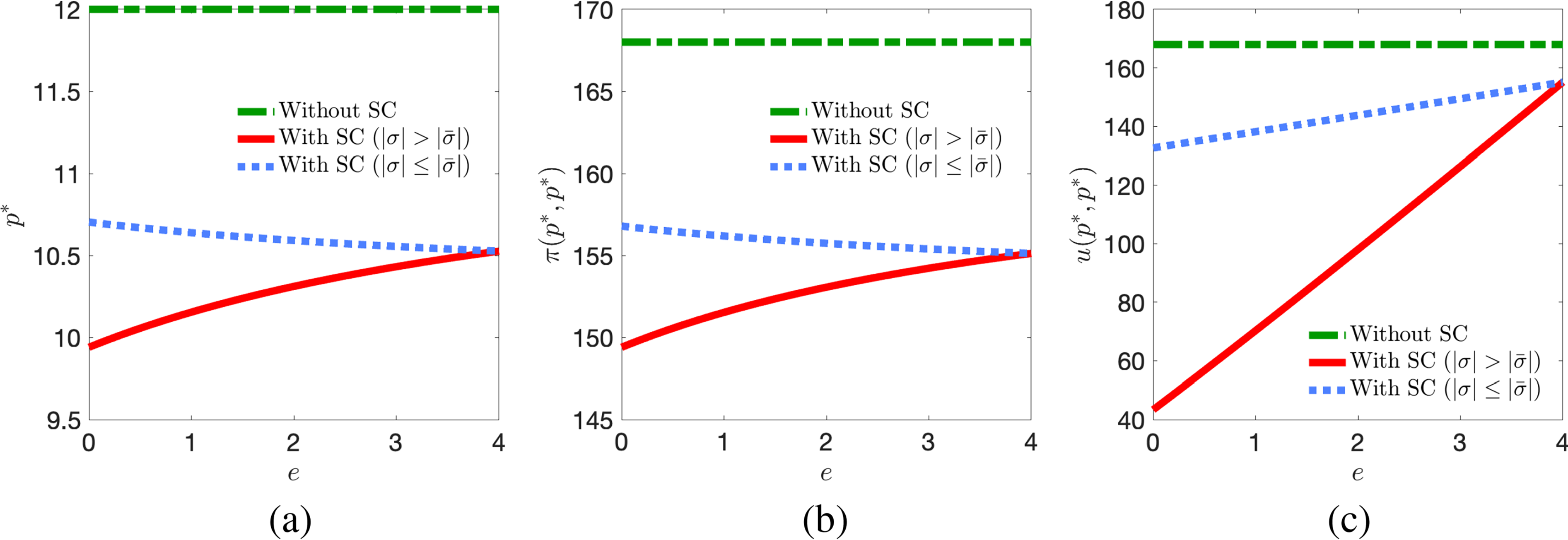
Implications of sellers’ peer comparison (SC) - Ahead-Seeking (
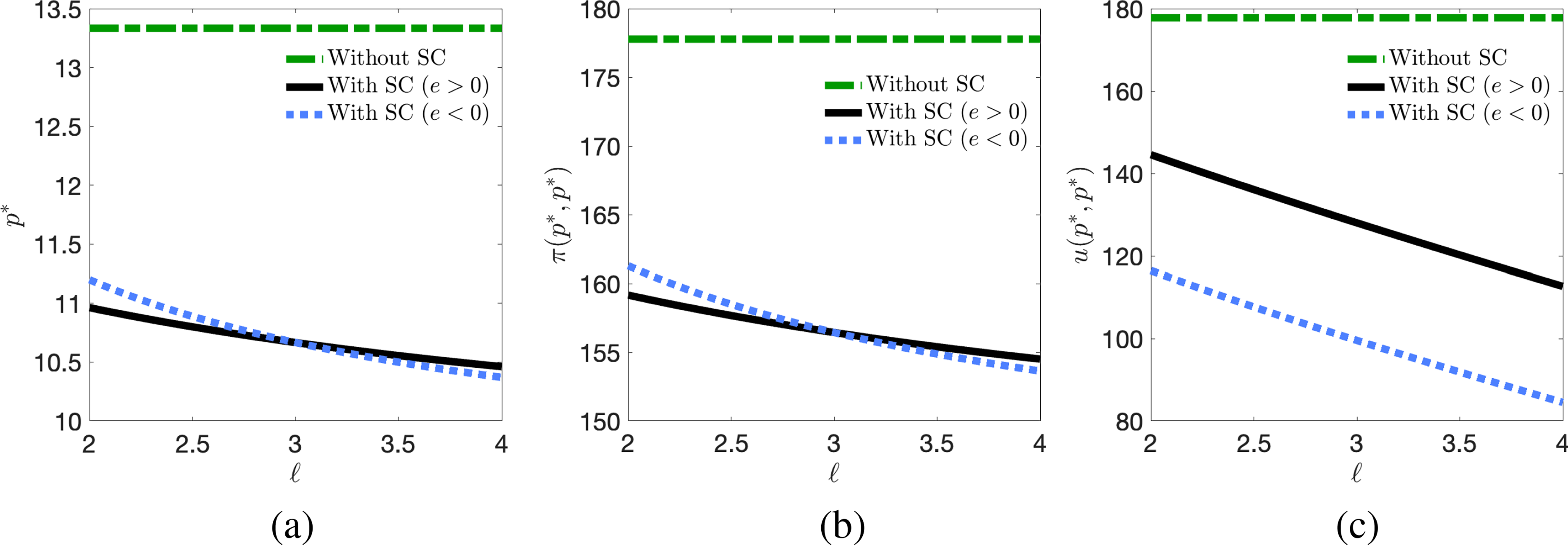
Implications of sellers’ peer comparison (SC) - Behind-Aversion (
To understand the twists here, we look closely at sellers’ peer comparison utility and examine how exactly behind-aversion and ahead-seeking influence competitive behavior under market uncertainty. By (2), for any seller
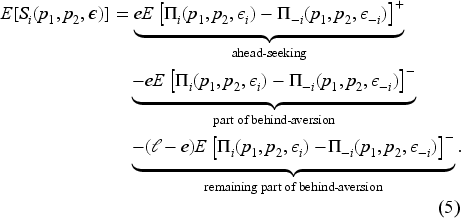
Although all three terms in (5) depend on market uncertainty, we note that the uncertainty pertaining to the first two terms (i.e., the complete ahead-seeking effect and part of the behind-aversion effect) is washed away on expectation; specifically, we have
Now, the last term in (5) captures the part of behind-aversion not yet incorporated by the comparison effect. Because sellers operate in uncertain markets, only looking at the gap between their expected performances is not enough; they shall also account for variations in their performance gap given all possible market size realizations, particularly those “harsh” ones that lead to various degrees of underperformance vis-a-vis the competitor. We coin this as the uncertainty effect. As we mentioned earlier, when struck by a negative demand shock and ending up with a lower market size than the competitor, a seller would be inclined to reduce the price to stimulate the demand and close the performance gap with the competitor. Since the previous comparison effect has absorbed part of the sellers’ behind-aversion, this remaining portion of behind-aversion here is weighted by a discount rate of
We now put the comparison effect and the uncertainty effect together as follows,

Note that, in the social comparison literature,
Following this line of thinking,
We have shown how the market equilibrium changes in response to behind-aversion and ahead-seeking separately. Yet it is not clear from Proposition 2 whether price competition is more or less competitive for a market with sellers engaged in peer comparison compared to one with no such behaviors. Indeed, what would be the aggregate impacts of the pro-competitive behind-aversion and the potentially anti-competitive ahead-seeking? The following proposition answers such an inquiry.
The equilibrium price, profit, and utility are lower with sellers’ peer comparison than without.
Proposition 3 says that, ultimately, sellers’ peer comparison will intensify the competition between sellers and make both of them worse off than in a non-comparison environment. This implies that the potential anti-competitiveness of ahead-seeking will be dominated by the pro-competitive behind-aversion in equilibrium.
The driving force here, clearly, is that sellers put more weight on each unit of loss than on each unit of gain (i.e.,
Our results in Proposition 3 echo the increasingly rampant competition among sellers in online marketplaces (Lui et al., 2021). Apart from technological explanations such as sellers’ data-driven operations or consumers’ lowered search costs, we offer an alternative perspective of sellers’ peer comparison under platforms’ algorithmic marketplace controls. Part of this competitive landscape, however, is twisted by sellers’ sometimes less competitive behaviors (e.g., charging high prices; see Senate Banking, Housing and Urban Affairs Committee, 2024). While such “anomalies” have been rationalized by factors like sellers’ dynamic pricing and platforms’ anti-competitive practices, our analysis implies yet another hypothesis: that is, sellers expect a decent amount of rewards from platforms for their outstanding performances (in the sense of, e.g., extra future consumer traffic) such that they worry less about softening their decisions and potentially lagging behind in a highly uncertain market.
We now turn to the role played by market uncertainty and investigate how it intervenes in the strategic interactions between sellers. Recall that in Lemma 3, we have shown that without sellers’ peer comparison, the equilibrium outcomes are uncertainty-independent. The proposition below shows that market uncertainty is no longer such a trivial matter after the peer comparison weighs in.
(Negative Impact of Uncertainty)
In equilibrium, the price
Proposition 4 says that market uncertainty is essentially amplifying the overall impacts of peer comparison, as a higher degree of uncertainty would further intensify the price competition between sellers and reduce their equilibrium profits and utilities. Note that, there is evidence showing that market uncertainty can escalate the risk of price wars among sellers (see, e.g., Langkamp et al., 2023). We numerically illustrate such negative impacts in Figure 4.
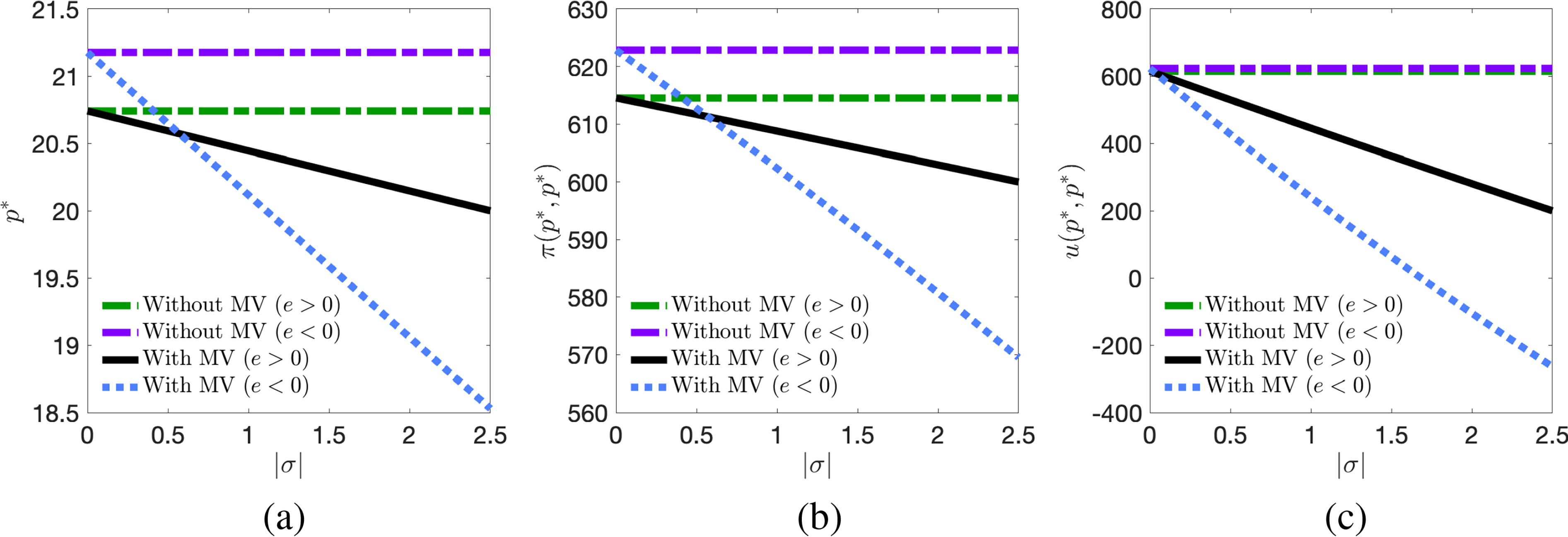
Implications of market uncertainty (MV) (
To understand these results, note that market uncertainty affects sellers’ competition and their utilities in two ways. First, as we discussed earlier, a higher degree of uncertainty will aggravate the negative uncertainty effect of peer comparison, which directly reduces sellers’ expected utility.
Moreover, an extra amount of market uncertainty pushes sellers to lower their prices further, which will indirectly hurt sellers’ profits and utilities. The intuition is that to counteract the increasingly negative uncertainty effect, sellers have to stimulate their expected market demand by offering lower prices. As Proposition 3 would imply, the equilibrium price
We discussed in the Introduction that there are two sources for market uncertainty: The ever-evolving consumer preferences and platforms’ marketplace control algorithms. Platform-induced uncertainty will clearly grow as platforms’ algorithms become more complicated and/or are updated on a more frequent basis. Consumer-induced uncertainty is more likely to be high if sellers’ offerings are more innovative and/or consumers’ preferences exhibit a higher degree of volatility. Note, though, under these conditions that scale up consumer-induced uncertainty, the influence of peer comparison can be modest according to our previous discussions; that is, market uncertainty and peer comparison may work in opposite directions: while the former reinforces the impacts of the latter, the latter partially counteracts itself. Interestingly, there is evidence that sellers may either price aggressively or less aggressively in markets with innovative products (e.g., electronics) and/or varying consumers’ preferences (see, e.g., Hoffmann et al., 2012).
We shall note that as market uncertainty grows, sellers’ expected utility decreases and may become negative and remain so thereafter. Since a negative utility no longer offers any incentive for sellers to remain in the market, we omit the analysis of market uncertainty for simplicity. Also, similarly, as we have commented earlier, if the marginal utility from faring ahead (i.e.,
To close this section, we have seen how sellers’ competition and peer comparison are shaped by market uncertainty. On the one hand, market uncertainty gives rise to this surprisingly anti-competitive potential of peer comparison (specifically, of ahead-seeking). On the other hand, though, it reinforces the overall pro-competitiveness of peer comparison, which lowers sellers’ prices and reduces their utilities to operate in the marketplace. In the next section, we will discuss what these results mean for other marketplace stakeholders, namely consumers and the platform. We will show that sellers’ lower prices benefit consumers but can hurt the platform, and we will analyze the implications for the platform’s marketplace design strategies.
We now examine how the strategic interactions between sellers will affect consumers and the platform.
On Consumer Welfare
Notice that in our model, sellers’ peer comparison influences consumers’ welfare only indirectly via their prices. That is, neither does comparison parameter
As we mentioned, in reality, peer comparison may also influence sellers’ decision-making over other operational levers such as quantity and quality, which complicate the analysis for consumers’ welfare. For example, gig platforms such as Uber gamify the workplaces to entice workers to work more hours (i.e., increase supply), which helps provide more responsive services to consumers. Also, sellers’ rankings on e-commerce platforms like Taobao encourage sellers to compete not only in prices but also their product page designs, consumer services, etc., which benefits consumers as well. For a negative instance, think about content creators mimicking those star creators’ production. While such isomorphic behaviors might boost creators’ viewership or even make their work go viral in the short run, the overall diversity and creativity of content degrade over time, which can limit consumers’ choices and reduce their welfare.
The impacts of market uncertainty are more subtle. Recall that a major source of uncertainty happens to be the ever-evolving consumer preferences (Lellouche et al., 2020), which is, however, an essential determinant of consumers’ welfare; in other words, it is inappropriate to treat or analyze market uncertainty as yet another cause of any variations in consumer welfare. Rather, market uncertainty is a direct manifestation of the varying consumer welfare (and similarly the other way around), as these two objects are rooted in the same microeconomic foundation, i.e., consumer preferences and their corresponding utilities.
That said, we shall remind the readers that platforms’ algorithmic marketplace controls are yet another culprit for increased market uncertainty. In terms of its potential impacts, first up, they clearly go through the indirect channel of sellers’ peer comparison and price competition. Our Proposition 4 implies that a higher degree of uncertainty benefits consumers by resulting in lower prices. On the other hand, because platform-induced upswings and downswings in market sizes will cancel out on average, no direct impacts of market uncertainty (on market sizes and thus on consumer welfare) shall exist. 17
On Platform Design
To evaluate the impacts on the platform, recall that for each transaction, any seller
(Implications for the Platform)
Regarding the platform’s profit
Somewhat ironically, Proposition 5 implies that those marketplace design tools used by platforms can backfire and reduce platforms’ own profits. On the one hand, those tools throw sellers into a harsher arena of peer comparison and push them to price more aggressively, which reduces the amount of revenue the platform can collect from sellers (though lower prices also expand the expected market demand). On the other hand, as we discussed in the Introduction, due to the opacity of their underlying algorithms, marketplace design tools add an extra layer of market uncertainty for sellers’ daily operations, yet this makes the negative impacts of sellers’ peer comparison even more significant.
It is worthwhile to point out a few caveats for such a takeaway. First of all, if sellers are already peer comparing in the status quo, then clearly platforms may benefit from deploying their marketplace design tools and stimulating sellers’ ahead-seeking behaviors in particular. Moreover, recall that platforms’ marketplace algorithms create extra market uncertainty; our theories predict that platforms would indeed obscure and frequently update their algorithms so that the market remains sufficiently uncertain and sellers, driven by a stronger ahead-seeking mindset, tend to raise their prices and thus thicken platforms’ revenue streams.
Second, as we mentioned earlier, in practice, marketplace design tools may also influence sellers’ decisions along other dimensions. Tools that encourage sellers to scale up supply, improve quality, etc., can counterbalance the negative consequences of lower prices and even boost platforms’ profits.
One may have noticed that in our current framework, the interests of sellers and the platform are more aligned but run at odds with that of consumers. Indeed, whenever sellers and the platform are hurt by intensified peer comparison between them and/or more market uncertainty, consumers are better off, and vice versa. As such, our framework does not immediately offer operational prescriptions that can Pareto improve the entire marketplace. That said, we should once again remind the readers that sellers also compare and compete over other dimensions such as quantity and quality. Marketplace designs that can encourage sellers to make more socially beneficial decisions along those dimensions should be promoted. On another matter, if the intensified competition between sellers is so significant that sellers’ and platforms’ losses have outweighed consumers’ welfare gains, then platforms shall guard closely or frequently update their design algorithms so that the market uncertainty will be high enough to tame the downward spirals of market prices. This counters the information-sharing prescription in the extant literature (e.g., Liu et al., 2021).
Extensions
In this section, we will demonstrate the robustness of our main insights in a number of important extensions. See also Section OA1 in the e-companion for additional robustness checks with more general assumptions on the distributional behavior of market uncertainty.
Multiplicative Uncertainty Formulation
In the base model, the uncertainty takes the form of an additive shock to the market size. Here, we will instead study a multiplicative form of uncertainty. Compared with an additive shock, a multiplicative shock makes the market more uncertain in the sense that not only the market size but also consumers’ sensitivity to price will be subject to random variations. 19
Consider the following demand function for any seller

As in the base model, we can similarly define the ex post profit function

The following proposition describes how the peer comparison parameters
In equilibrium, we have, for substitutable products with multiplicative demand shocks:
Proposition 6 confirms that the results on the impact of peer comparison obtained under the additive demand shocks (see Proposition 2) are robust. In particular, behind-aversion still intensifies sellers’ competition, while the impact of ahead-seeking is again uncertainty-dependent: it will be anti-competitive if and only if the market uncertainty is sufficiently high.
With multiplicative demand shocks, the equilibrium price
What Proposition 7 presents is consistent with Proposition 4; that is, market uncertainty only amplifies the overall negative impacts of peer comparison and can make both sellers worse off.
The results above can be explained similarly by the comparison effect and the uncertainty effect introduced in Section 4. The key reason for our main insights to carry over is that as in (6), one can still break down sellers’ comparison utility into two parts, one independent of and one hinging on the market uncertainty, and the latter of which is enhanced as the uncertainty grows. As such, the analysis of sellers’ pricing decisions still anchors on how comparison parameters and market uncertainty shuffle the relative magnitude of these different utility parts.
Asymmetric Sellers
We now examine our key insights with asymmetric sellers. First up, we consider sellers who are asymmetric in their peer comparison parameters and marginal costs of production. We will then study sellers who face asymmetric market sizes and distributions of market uncertainty. Note that any form of seller asymmetry will render the equilibrium prices asymmetric; it is, therefore, no longer possible to fully characterize the equilibrium outcomes in closed form. As such, we will proceed mainly numerically.
We start with the case in which sellers are differentiated in their peer comparison parameters
Figures 5, 6 and 7 illustrate how market outcomes vary when the behind-aversion parameter
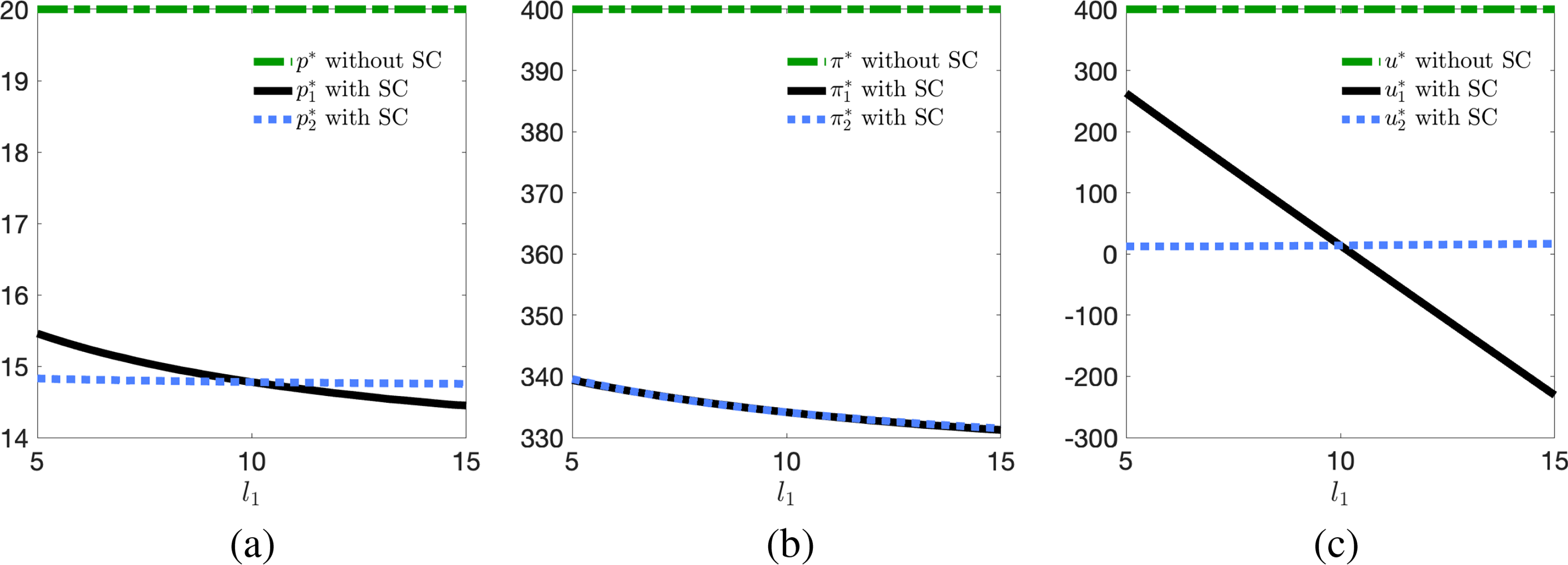
Implications of sellers’ peer comparison (SC) under asymmetric Behind-Aversion (
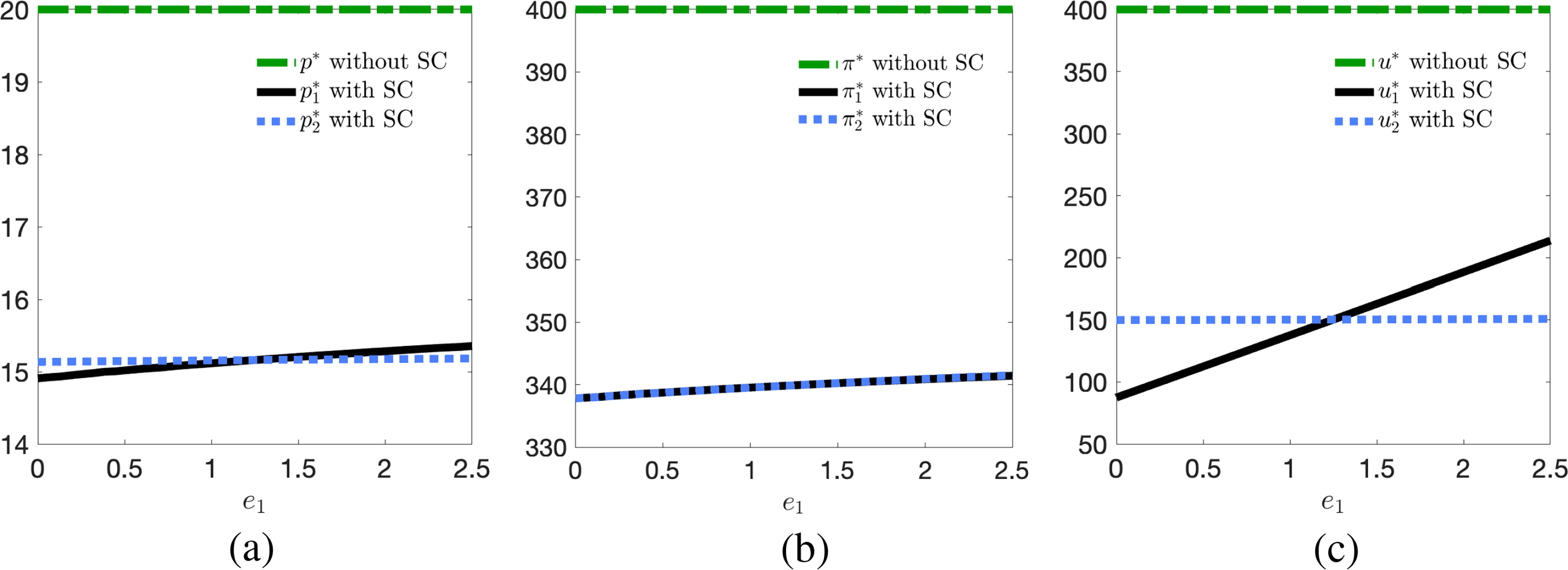
Implications of sellers’ peer comparison (SC) under asymmetric Ahead-Seeking and high uncertainty (
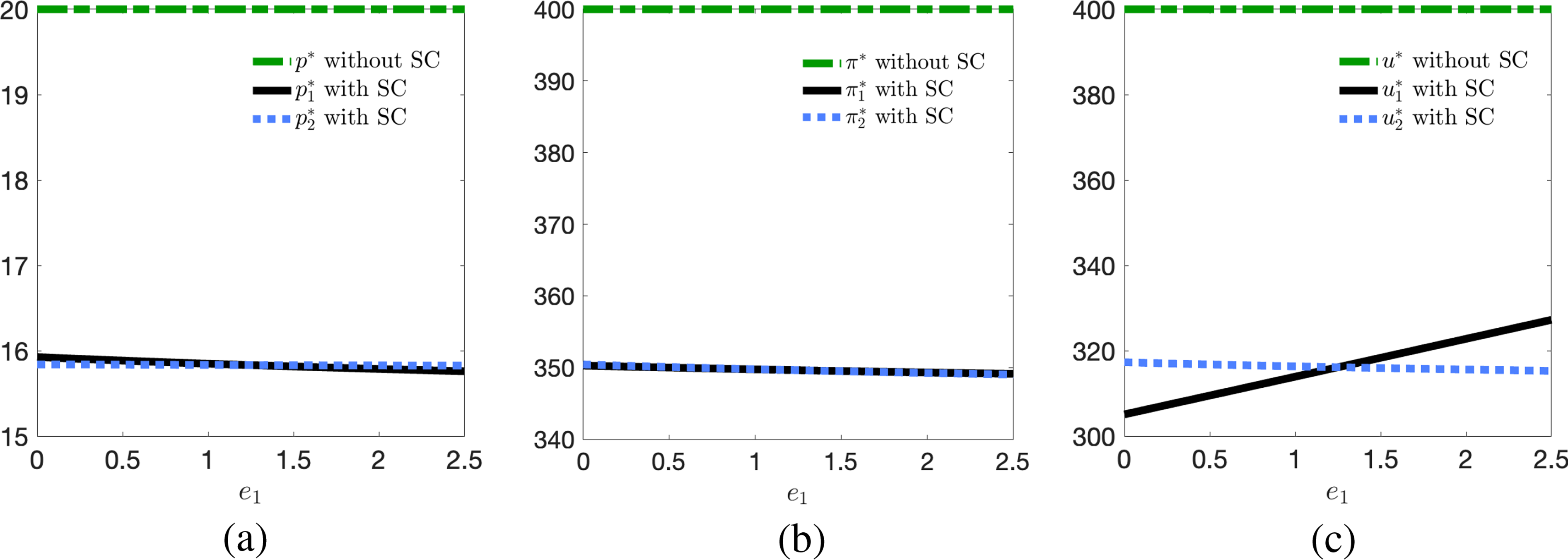
Implications of sellers’ peer comparison (SC) under asymmetric Ahead-Seeking and low uncertainty (
We shall also note that, though seller 1’s peer comparison parameters
Next, we study the asymmetry in sellers’ marginal costs. Figures OA.6 and OA.7 in the Appendix and Figure 8 show that again our key insights extend. One interesting observation is under peer comparison, the seller with a higher marginal cost may actually charge a lower price than his or her competitor; see Figure 8(a) for an example. To intuit, without peer comparison, a high-cost seller naturally charges a higher price than a low-cost seller. Indeed, the high-cost seller’s price can be so high that his or her demand is seriously squeezed, and the profit lags far behind the competitor. As such, peer comparison may give the high-cost seller a much stronger incentive than the low-cost seller to lower the price.
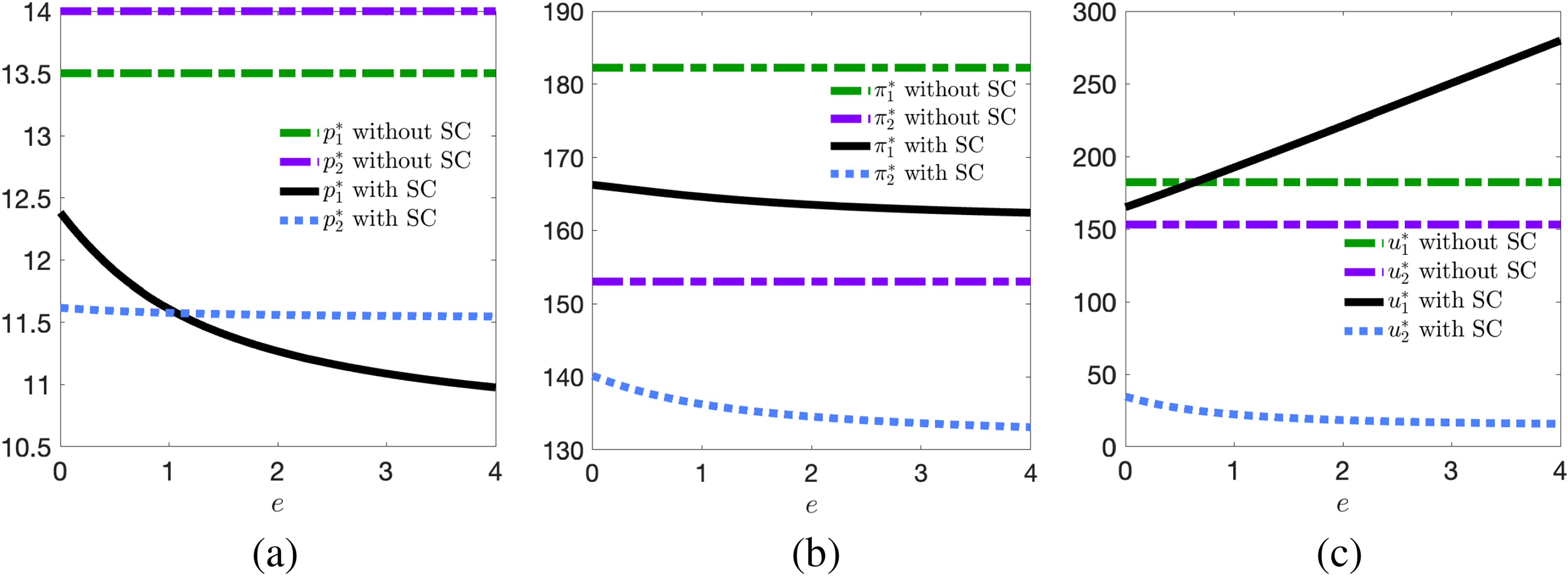
Implications of sellers’ peer comparison (SC) under asymmetric marginal costs and low uncertainty (
Third, we consider the asymmetry in sellers’ market sizes (i.e.,
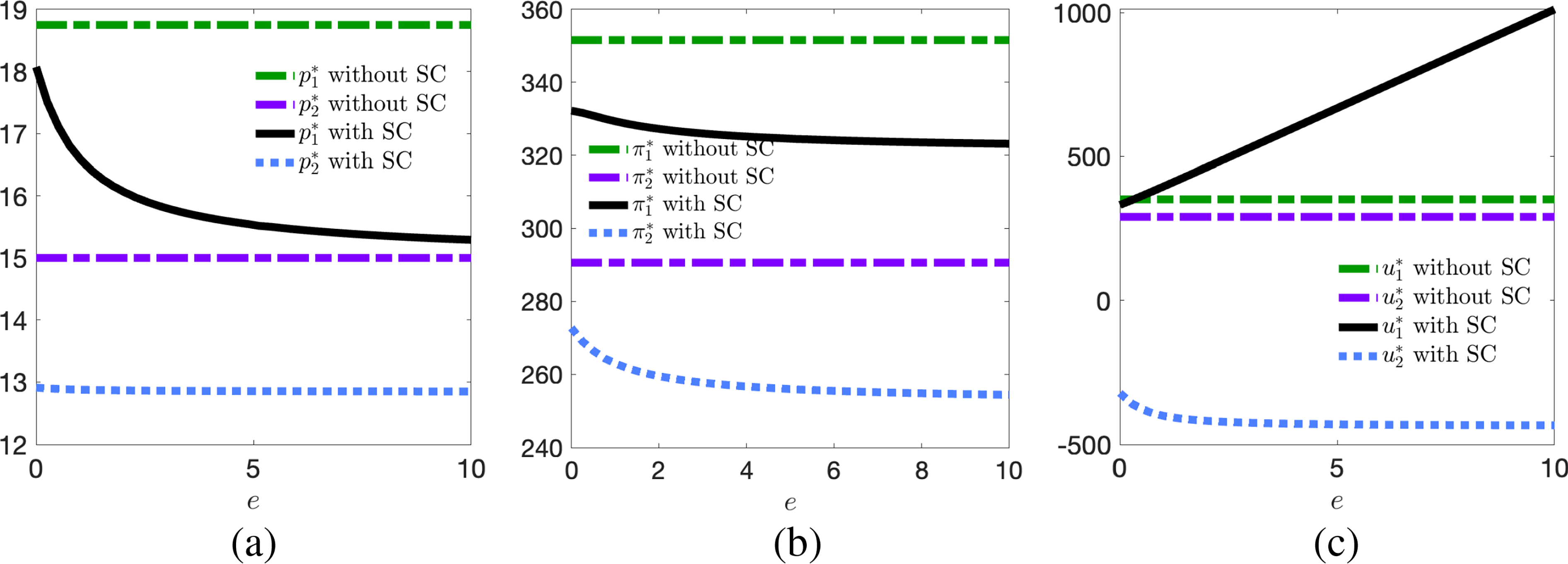
Implications of Ahead-Seeking under asymmetric market sizes and low uncertainty (
Finally, we consider the asymmetry in market size shock distributions. Figures OA.10 and 10 illustrate an example where one seller (seller 1) is facing a smaller amount of uncertainty than his or her competitor (seller 2). One new finding is that unlike in the symmetric equilibrium (see Proposition 2(ii)), here the seller with less market uncertainty (seller 1) will also end up with higher profit and utility as the ahead-seeking parameter
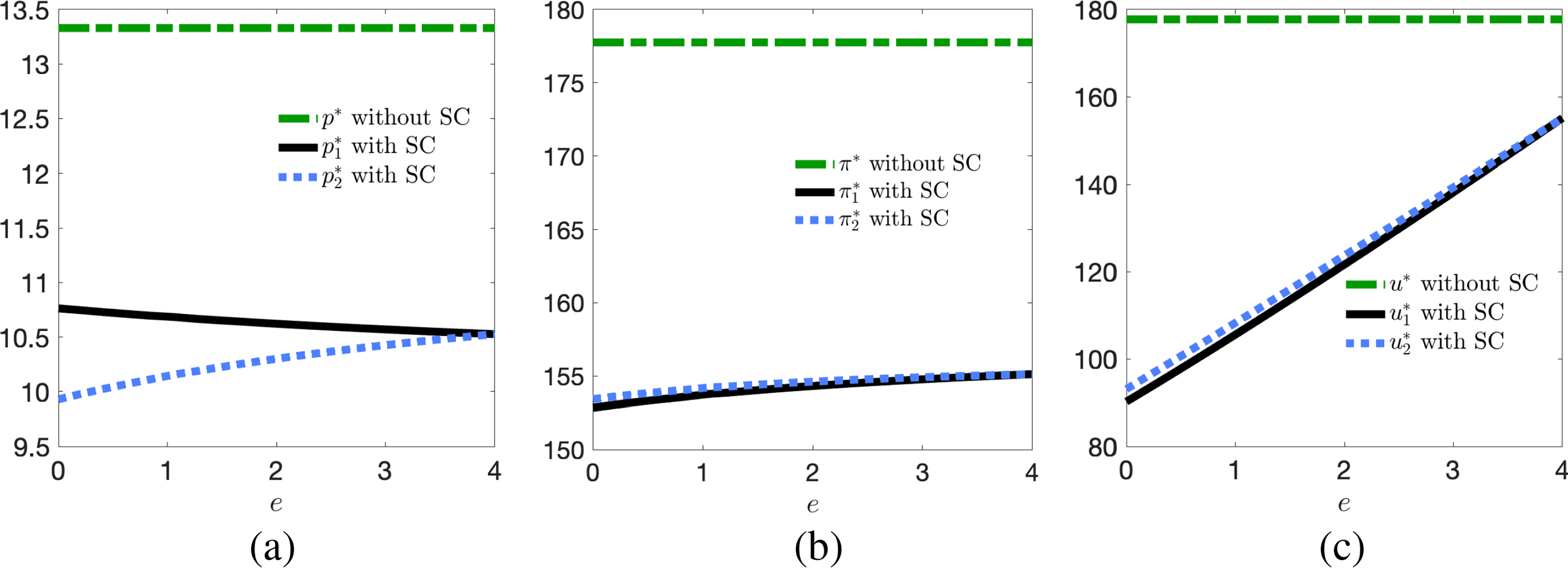
Implications of sellers’ peer comparison (SC) under asymmetric demand shock distributions (
To account for the possibility that sellers know more about their own operations than their competitors’, here we study an extension in which sellers may underestimate or overestimate each other’s market uncertainty but hold unbiased beliefs toward their own. This is consistent with the naive realism approach adopted in the literature (see, e.g., Fan et al., 2023; Li et al., 2017).
Suppose both sellers still face an identical amount of uncertainty,
We can verify that the sellers’ expected utility function is still concave. Following similar arguments for the base model, we can derive the equilibrium price as

The terms If the density functions of
The following result shows how a seller’s own market uncertainty and the perceived competitor’s uncertainty affect the equilibrium price, expected profit, and expected utility.
In equilibrium:
The price If the density functions
Proposition 8(i) implies that the price competition will be relaxed as both sellers tend to overestimate their competitor’s market uncertainty. To intuit, first consider how sellers’ biased beliefs about their competitor’s uncertainty affect the outcomes of peer comparison. When a seller is caught by a negative demand shock, he or she is likely to lag behind if the competitor either receives a positive shock or is hit by a milder negative shock. However, as the perceived competitor’s uncertainty increases, the focal seller would expect that the competitor is more likely to encounter rather extreme negative shocks. As a result, the seller becomes slightly more optimistic, 21 and this helps relieve the pressure for him or her to lower the price.
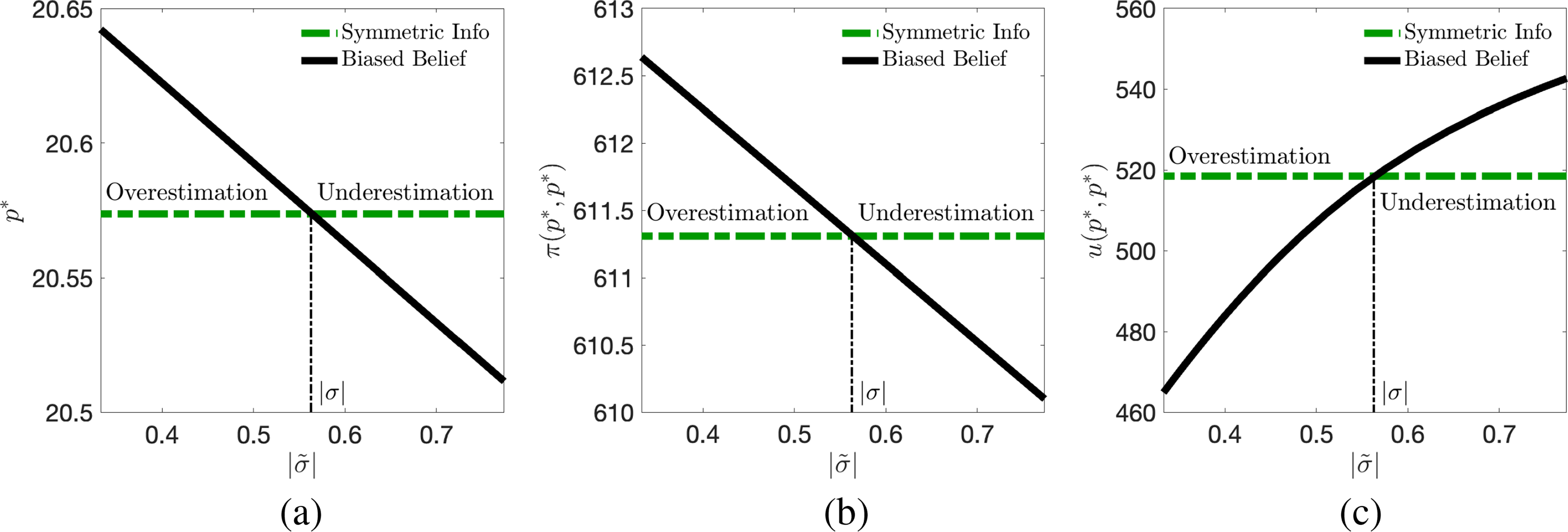
Implications of biased uncertainty belief (
When the focal seller experiences a positive demand shock, opposite to what we have just discussed, he or she may anticipate a higher chance of lagging behind in light of a more unpredictable market for the competitor since it is also more likely that the competitor will receive rather extreme positive shocks. Interestingly, though, the focal seller may instead raise the price to close the performance gap because a positive shock has fallen upon the seller, and it is better to tap into that already expanded market demand. Combining both scenarios (the focal seller experiencing a negative shock and a positive shock ex post), we see that sellers’ overestimation of their competitor’s uncertainty can indeed increase the equilibrium price (Figure 11).
Also note that, at first glance of Proposition 8(ii), the result seems to suggest that sellers should intentionally underestimate the uncertainty faced by their competitors to improve utilities. Yet no sellers may wish to do so unilaterally; our analysis in Section 4 implies that if the competitor is unbiased and has set the price as
That said, Proposition 8(ii) does offer a behavioral account for why sellers may not have the incentives to acquire too much information about their competitors. Consider a case where sellers tend to underestimate the uncertainty of their competitor. Suppose at some point in time they realize this fact of underestimation and also the possibility to (partially) correct such biases via, e.g., consulting market experts. Then, according to Proposition 8(ii), sellers may not even bother to take such an extra step since more precise knowledge about the competitor only hurts their utilities, not to say that the process of information acquisition is itself costly. This negative value of market information has been studied in various contexts (see, e.g., Wang and Hu 2014: §4.3, for a possible negative value of information about the competitor’s inventory level).
Finally, we examine the case where consumers are comparing sellers’ offerings while sellers themselves are not comparing with each other; That is, we attempt to understand how the market will unravel when the sellers’ comparison takes place indirectly through the mental accounting of their reference-dependent consumers. Based on the framework in Zhou (2011), we develop the following consumer demand model:
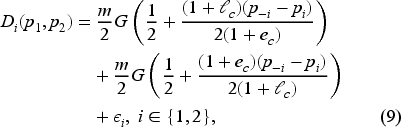
Suppose consumers’ tastes are uniformly distributed (i.e.,
In this paper, we take a behavioral perspective to study small sellers’ operations in modern online marketplaces. Motivated by the observation that online platforms’ marketplace design tools have stimulated the peer comparison among sellers, we develop and analyze a model of price competition in which sellers not only care about their own profitability but also factor in their relative performances ex post against each other. Countering the common beliefs, we find that peer comparison is not always pro-competitive. Indeed, we show that while the behind-aversion aspect of peer comparison fosters competition, the ahead-seeking aspect can be anti-competitive when the market uncertainty is sufficiently large. Overall, peer comparison can intensify the competition between sellers, and such a negative effect will be amplified as market uncertainty aggravates. We examine the implications of sellers’ peer comparison for consumers and an online platform, reveal the tension between consumers’ welfare and sellers and the platform’s profits, and discuss how an online platform should fine-tune its marketplace design algorithms (regarding information sharing, etc.) to maximize the total surplus of the ecosystem.
As we have mentioned throughout, in reality, sellers’ competition also takes place over quantity and quality. Our main insights can be applied there as well. In particular, from a technical point of view, we can similarly characterize the equilibrium as long as sellers’ utility functions preserve quasi-concavity, and the comparative statics of equilibrium outcomes with respect to peer comparison and market uncertainty shall behave similarly to what we have analyzed in this paper.
We offer a parsimonious framework to study the strategic interactions among small sellers in modern online marketplaces. Many other directions are worthy of further exploration. One is to investigate more complex games between sellers, such as competitive price discriminations (e.g., Cohen et al., 2023). Another promising direction is to investigate the scenario of a general number of sellers with potentially heterogeneous pairwise peer comparison. It will be interesting to explore how market outcomes depend on the total number of sellers as well as the network structure of peer comparison (i.e., strong and weak links of comparison between any two sellers). Moreover, one may study the coordination between sellers over their peer comparison behavior. We may introduce stage 0 to our model and let the sellers coordinate by themselves whether to let the profitability information circulate ex post. Though Proposition 3 in our paper implies that sellers shall become better off without the peer comparison, the caveat is that preventing the leakage of profitability information between sellers can be costly in reality (e.g., sellers might need to update their internal codes of conduct, retrain their employees, etc.); as a result, it is not clear a priori whether sellers will coordinate effectively, and thus the question merits further investigation.
We have discussed platforms’ marketplace designs at a rather high level in Section 5.2. Future research may consider more specific operational problems faced by online platforms and incorporate sellers’ behavioral regularities into platforms’ marketplace designs. For a concrete example, both Taobao and eBay would reward sellers with animated badges for their overall operational progress (see, e.g., Zhong, 2022), which is essentially a discretized fashion to display sellers’ performances. We have touched upon the issue of informational granularity when introducing the model in Section 3. Researchers may further investigate whether a more (or less) granular performance indicator, e.g., sellers’ total revenue (or whether they are among the top 1000 sellers), could better orchestrate sellers’ interactions and ultimately boost marketplace efficiency.
Supplemental Material
sj-pdf-1-pao-10.1177_10591478251325541 - Supplemental material for Sellers’ Peer Comparison Under Uncertainty in Online Marketplace
Supplemental material, sj-pdf-1-pao-10.1177_10591478251325541 for Sellers’ Peer Comparison Under Uncertainty in Online Marketplace by Yun Zhou, Zhoupeng (Jack) Zhang, Ming Hu and Haitao (Tony) Cui in Production and Operations Management
Footnotes
Acknowledgments
The authors thank the Departmental Editor, Professor Haresh Gurnani, the Senior Editor, and two anonymous reviewers for valuable comments and suggestions throughout the whole review process.
Declaration of Conflicting Interests
The authors declared no potential conflicts of interest with respect to the research, authorship, and/or publication of this article.
Funding
The authors disclosed receipt of the following financial support for the research: Yun Zhou was supported by the Natural Sciences and Engineering Research Council of Canada [RGPIN-2019-07050]. Ming Hu was supported by the Natural Sciences and Engineering Research Council of Canada [RGPIN-2015-06757, RGPIN-2021-04295].

Notes
How to cite this article
Zhou Y, Zhang Z(J), Hu M and Cui H(T) (2025) Sellers’ Peer Comparison Under Uncertainty in Online Marketplace. Production and Operations Management 34(9): 2679–2699.
References
Supplementary Material
Please find the following supplemental material available below.
For Open Access articles published under a Creative Commons License, all supplemental material carries the same license as the article it is associated with.
For non-Open Access articles published, all supplemental material carries a non-exclusive license, and permission requests for re-use of supplemental material or any part of supplemental material shall be sent directly to the copyright owner as specified in the copyright notice associated with the article.
