



Abstract
Once autonomous vehicles (AVs) are deployed for ride-hailing platforms, human drivers will compete with AVs until AV costs decrease enough to eliminate human drivers entirely. We examine a ride-hailing platform’s strategy to recruit human drivers while operating a private AV fleet. Using a game-theoretic model, we analyze how the platform sets the human-driver wage and the size of its AV fleet. We show that setting a higher wage can surprisingly lead to less human-driver participation. Moreover, we show that having the option to augment its AV fleet after observing human participation levels can, counterintuitively, hurt the platform’s bottom line. Our findings emphasize the need for ride-hailing platforms to carefully navigate the complex interactions between their roles as supply providers (of AV-served rides) and supply seekers (of human drivers), as failure to do so can be costly.
Introduction
As the ride-hailing market has grown and self-driving technology has advanced rapidly in recent years, speculation has mounted about the future of autonomous vehicles (AVs) in this market. Indeed, such a future looms closer than ever. For example, Waymo One, 1 a pioneering AV-operated ride-hailing service in Phoenix and San Francisco with planned expansion to Los Angeles and Austin, has even dispensed with human safety drivers (although as of early 2024, Waymo’s AVs were just beginning to be tested on highways: see Hawkins, 2024). However, while multiple firms are testing AVs, the race to full autonomy for ride-hailing and automobility in general has not been without challenges. Several fatal accidents have been reported, including one on GM’s autonomous ride-hailing service Cruise 2 in late 2023 that led it to lose its permit to test AVs in California. The incident created turmoil at the company, prompting leadership changes and a “pause” of Cruise’s AV operations throughout the United States (Kolodny and Wayland, 2023) that was ongoing as of January 2024. “Level 5” autonomy (when humans will not be needed for any driving tasks) has been called “one of the hardest problems we have.” 3 Indeed, high-profile early proponents of AV-operated ride-hailing services, including Uber 4 and Ford, 5 have abandoned their attempts to commercialize the technology due to out-of-control costs. These challenges raise the question of whether and how ride-hailing platforms can benefit from AV technology during the long journey toward a future with no human-driven vehicles.
Although it is widely accepted that eventually all cars will be driven by software, human-driven vehicles still dominate the road at present. Moreover, the transition between these extremes will not happen overnight. A recent New York Times article described the small-scale fully-driverless ride-hailing experiment operated by GM’s Cruise in San Francisco (Metz, 2022). The article also describes the currently high costs of AVs: “The development costs, back-end computing infrastructure and technicians needed to support these cars increase costs by hundreds of millions of dollars—at least for now.” Accordingly, although the long-run value proposition for AVs revolves around lower costs achieved by removing humans from the equation, this promise is unlikely to be realized in the near-term future, not even once the AV roll-out starts to scale up (see Nunes and Hernandez, 2019, 2020).
In addition, platforms must plan for a new form of competition on the supply side of their marketplaces: human versus machine. It is not clear how gig-economy workers will react to AVs joining the market, or how ride-hailing platforms should best balance the two sources of supply. We consider the problem of how a platform should manage its ride-hailing marketplace to simultaneously leverage a private AV fleet and successfully recruit human-driven vehicles. Since AV technology is still expensive, the question may reasonably be asked why AVs are yet needed, if rides could be served more cheaply with human drivers. First, as evidenced by their heavy investments in AV technology and initial deployments of it discussed above, ride-hailing firms indeed see value in serving rides with AVs, even though costs are still quite high as the technology is in active development. Second, as usually happens with emerging technology (e.g., the original “horseless carriage,” personal computers, etc.), AVs will need to be perfected over time in order for the technology to decrease in cost and achieve full market penetration. During this process, platforms can and should aim for the best mix of AV- and human-served rides. We find that even with AVs that are relatively expensive, an AV fleet can benefit a platform if the fleet is appropriately sized. However, we also identify some critical problems that can arise due to the interaction between a platform’s AV acquisition decisions and its ability to recruit human drivers.
A platform with a mixed fleet must manage several tradeoffs. One benefit of a company-owned or leased AV is that its cost is known and fixed. By contrast, a human driver must be recruited to join the platform, and hence, the wages and earning rate offered must satisfy an individual rationality constraint. The cost of a human-served ride is thus endogenous, and increasing human-driver participation may require higher wages, since the more drivers join the platform, the greater the competition among them for rides (they also must compete with AVs, as discussed below). On the other hand, human drivers only earn money from the platform while with a passenger, so they offer a hedge against demand variability, protecting the platform against both underage and overage costs. However, knowing that the platform may prefer to serve demand with AVs, human drivers may not join the platform because they cannot rely on being matched with fares. As noted by Jiang and Tian (2018) and Guda and Subramanian (2019), the two-sided marketplace of ride-hailing involves “customers” on both sides of the market in the sense that both passengers and drivers freely choose whether to use the platform’s service based on its value. As such, the new element of AVs competing for rides necessarily affects the platform’s strategy for recruiting human drivers. This novel supply-side competition motivates our two main research questions: (i) how should a ride-hailing platform set the human-driver wages and AV quantity to exploit its AV fleet while simultaneously recruiting enough human drivers (at an affordable wage) to create an effective demand hedge, and (ii) in the presence of AVs, what effect do the self-interested joining decisions of human drivers have on the platform’s bottom line?
To address these questions, we consider a ride-hailing platform with two supply sources: (i) a platform-operated fleet of AVs, and (ii) a population of human drivers that make strategic joining decisions. To help motivate our model setup, consider the following real-world example. In May 2023, Waymo and Uber announced a partnership to list Waymo’s fleet of AVs on Uber’s platform to serve rides in Phoenix, AZ 6 (Waymo, 2023a). The partnership went live in October 2023 (Waymo, 2023b), at which point human Uber drivers began having to compete for rides against Waymo’s AVs. Having an idea of Waymo’s AV fleet size in Phoenix (Waymo has stated publicly that it “has more than 300 cars in the city”; see Bellan, 2022), prospective and existing Uber drivers could anticipate what their expected earnings were likely to be once AVs were also listed on the platform, and they could decide accordingly whether to drive for Uber in the weeks and months after AVs went live. Along similar lines to this example, in our base model, the platform first chooses an AV acquisition quantity and sets the wage rate that it will pay human drivers for each ride. 7 Then, human drivers decide whether to join the platform in equilibrium, determining the available pool of human labor. Finally, demand is realized, and the platform dispatches AVs and human drivers up to the available supply of each.
As AVs join the mainstream, a platform may exercise the option of augmenting its initial fleet. For example, separate from its Phoenix partnership with Uber, Waymo recently expanded in the San Francisco market in 2023. For this market, it stated that “Over the next few months, we’ll focus our efforts on growing ridership and increasing capacity” (Lindqwister, 2023). A forward-looking driver would anticipate the additional future AVs brought onto the platform after the initial batch and would factor this into her decision of whether to participate on the platform in the months following the AV launch. Such augmenting of the AV fleet after observing market conditions suggests a natural extension of our model to include a second AV acquisition opportunity after human drivers make their participation decisions.
Accordingly, we extend our base model with a second AV acquisition opportunity, and we solve the platform’s second-stage AV acquisition problem in quasi-closed form. The solution reveals the interaction between the human-driver wage and participation level and the optimal AV quantity. Specifically, the optimal AV quantity increases in the human-driver wage for a fixed human participation level; similar to the base model, if the platform must pay more for human labor, then this labor becomes less desirable, inducing it to acquire more AVs. Additionally, and underscoring the complex nature of the relationship, the optimal AV quantity moves in different directions with the human participation level depending on the wage: for low (high) wages, an increase in human participation causes the platform to decrease (increase) the AV quantity. The preceding discussion relates to the optimal second-stage AV quantity with the wage and human participation level fixed, which they are when the platform makes this decision. However, like the AV quantity, the wage and human participation level are also endogenously determined (at an earlier stage of the game), and the nuanced interaction between these three quantities is a key driver of equilibrium outcomes.
We then establish structural results regarding the platform’s use of the second-stage AV acquisition option and its impact on the optimal profit. First, we show that optimally the platform does not exercise the second-stage AV acquisition option at all, acquiring AVs only in the first stage. Because AVs are either cheaper or the same cost in the first stage, the platform prefers to do all of its acquisition upfront. We might expect, then, that the second-stage acquisition option is irrelevant and that outcomes are the same with or without it. Strikingly, however, this intuition turns out to be incorrect. Our second structural result reveals that the platform’s optimal profit is worse when it has access to a second acquisition opportunity than in the base model, and that the apparent flexibility provided by such an opportunity counterintuitively restricts the platform from achieving the ideal AV/human driver mix.
To resolve this apparent conflict requires a deeper understanding of human drivers’ equilibrium behavior and its consequences. Since the platform’s optimal second-stage AV quantity is increasing in the human-driver wage, the positive impact of a wage increase on human drivers’ expected earnings is dampened (possibly even negated) by the increased competition from AVs. This reflects the endogenous relationship described above that is governed by the equilibrium participation condition for human drivers and the optimality condition for the platform’s second-stage AV quantity. Perhaps counterintuitively, the equilibrium wage can actually decrease in the human joining fraction because at low joining fractions, the wage is low enough that increasing this fraction reduces the optimal AV quantity and thus increases human drivers’ matching rate. However, we also show that human participation may be intrinsically limited, due to forces that are closely related to those that we observed in the base model. As more humans join and push out AVs, eventually not many AVs are left, and the human-driver matching rate begins to decrease. The platform then must increase the wage to satisfy the equilibrium participation condition, but this makes human drivers less attractive, so it will acquire more AVs, which again increases competition and decreases the matching rate, so the wage must increase even more. The result is a feedback loop of increasing wages and increasing AV acquisition. This race to the top effectively prevents the platform from attracting more than a limited number of human drivers, and it increases the cost of attracting a given number. Interestingly, the feedback loop emerges despite the platform not actually exercising the second-stage acquisition option. Essentially, the optimality condition in the second stage determines the number of AVs that the platform will acquire, but rather than waiting until the second stage, it is cheaper to acquire these AVs upfront, which in turn reduces the optimal second-stage quantity to zero.
We then compare equilibrium decisions and optimal profits in the extended model with those for the base model. We find that because in the extended model the second-stage AV quantity is a best response to the wage and human joining fraction, the platform cannot credibly commit to a quantity that ensures human drivers a high matching rate. This leads to the feedback loop mentioned above and keeps the platform from achieving the ideal AV/human-driver mix. Indeed, the platform’s profit in the extended model can be more than 38% less than in the base model with only one AV acquisition opportunity.
To deepen our understanding of why the extended model’s added flexibility backfires, hurting the platform relative to the base model, we conduct comparative statics and also incorporate some additional considerations. First, we consider the impact of different values of the second-stage AV cost. Because the race to the top is stronger when AVs are more desirable for the platform, its optimal profit can actually be higher if the second-stage AV cost increases because a higher AV cost makes AVs less attractive. We also allow for several variations that may be relevant to practice, in particular finite supply constraints for AVs, rider preferences for human-driven vehicles, and randomness in the second-stage AV cost. As well as providing some additional insights of their own, our findings with these other considerations reinforce our key insight that the platform’s AV acquisition decision interacts with the wage in a way that negatively affects its human-driver recruitment efforts.
Overall, our findings demonstrate the importance to ride-hailing platforms of appropriately managing the introduction of AV technology. When a platform juggles multiple roles—both supply provider (of AV-served rides) and supply seeker (of human drivers)—in the marketplace, its decision in one role (AV acquisition quantity) is significantly affected by its decision in the other (human-driver wage), and both of them interact with the participation decisions of human drivers. In particular, a higher wage leads the platform to acquire more AVs, which harms the human drivers’ matching rate and thus hinders the platform’s recruiting efforts. In their strategy to introduce AVs to the marketplace, it is crucial for platforms to properly manage the endogenous interaction between wages, human participation, and AV acquisition; significant profit losses await otherwise.
Related Literature
Only a few very recent papers in the operations management literature incorporate AVs in the context of ride-hailing. In the setting of Siddiq and Taylor (2022) with competition between platforms, they assume linear demand and supply functions. By contrast, we model human drivers as strategic agents who make participation decisions based on their expected earnings given the posted wage and a rational anticipation of their matching rate. This creates a non-linear, endogenous relationship in our model between wage and human driver supply through the impact of both on the optimal AV acquisition that is not seen by Siddiq and Taylor (2022).
Lian and van Ryzin (2022) treated platforms as market-clearers and study the decisions of market participants (human drivers and AV owners). They consider two platform scenarios—common platform for AVs and human drivers or independent platforms for each—and two AV ownership scenarios—AVs owned by individuals or AVs owned by a monopolist. The combinations yield a total of four different market designs, and they analyze the resulting prices, wages, and utilization in each. The setting by Lian and van Ryzin (2022) differs from ours along several dimensions. First, in contrast to their model of ride-hailing platforms as market-clearers, we consider a profit-maximizing platform that sources rides from both humans and its own AV fleet, and we provide important insights about the platform’s human-driver recruiting strategy. Second, they assume an unlimited human labor pool; we treat this pool as finite at the outset, which is important in our setting because the competition both among human drivers and between AVs and humans depends on the labor pool size. In contrast to both Siddiq and Taylor (2022) and Lian and van Ryzin (2022), in the present work, human drivers’ rational anticipation of the platform’s best-response AV acquisition entails a unique endogenous relationship between wages, available human drivers, and AV acquisition. Our findings also highlight the impact of commitment power on the platform’s ability to recruit human drivers. Freund et al. (2022) analyzed a supply chain model involving a platform, an external AV supplier, and human drivers, and conclude that the need to maintain driver engagement may result in underutilization of AVs; however, they propose that this issue can be resolved through usage contracts or prioritization contracts. Unlike a supply chain framework, our focus is on a platform that owns its own AV fleet, allowing for more control as the platform is not required to provide a guaranteed payment to secure a certain level of AVs. According to Castro et al. (2023), the authors employ a queuing-theoretical model to demonstrate that the introduction of AVs to a platform can lead to a decrease in service level—stemming from a reduction in human drivers’ earnings due to AV prioritization. Furthermore, the authors establish that this decrease may be different across regions as lower-demand areas may experience a greater decline in service levels. Although the setting is similar to ours, our focus is not on prioritization and service levels but rather on how the interplay between wages set by the platform (which are determined in equilibrium in our model, unlike their exogenous fixed commission) and its AV acquisition decisions affects its ability to recruit human drivers. For another study that looks into the granular spatial incentives that AV deployment can produce on human vehicle repositioning, we refer the reader to Benjaafar et al. (2021), and for a study that considers a centralized firm that can be viewed as a taxi service or an AV ride-hailing firm (but does not model AVs and human drivers on a shared platform), see Noh et al. (2021). For other recent studies involving AVs, we refer the reader to Liu (2018), Mirzaeian et al. (2021), and Baron et al. (2022).
Another related stream of work concerns blended workforces composed of full-time employees (similar to our AVs) and flexible agents (similar to our human drivers). Early works on this front consider how to optimally source contingent workers from an external labor supply agency, see for example, Milner and Pinker (2001) and Pinker and Larson (2003). More recent studies, however, consider a related problem in which flexible agents are independent. For example, Hu et al. (2022) analyzed the welfare implications of uniform and hybrid worker classification in on-demand platforms. This work establishes that having full-time employees and contractors can be more beneficial for some workers, consumers and the platform than uniform classification. Lobel et al. (2023) used a similar modeling framework to ours to study the impact of wages on the labor composition; in contrast, we focus on the endogenous competition in a blended workforce and its implications for the platform’s bottom line. Dong and Ibrahim (2020), on the other hand, considered the multi-period staffing problem faced by an on-demand platform that employs a mix of full-time employees and randomly determined flexible agents. A key difference between our setting and that of Dong and Ibrahim (2020) is that the endogeneity in their flexible agents’ joining decision is stochastic and not strategic; additionally, their endogeneity is related to the number of other flexible workers while ours is related to both the human drivers that join and the AVs that the firm deploys. Chakravarty (2021) studies the viability of a blended workforce and the pricing implications of preferential rationing (employees are matched before independent drivers) in a two-stage model. While our study and that of Chakravarty (2021) are related, our modeling approach is different and our results focus on the analysis of potential equilibrium outcomes and not solely on the viability of a blended workforce.

Sequence of events in base model.
Finally, this article is also related to works that study how to incentivize independent, strategic supply units in on-demand platforms, see, for example, Besbes et al. (2021), Bimpikis et al. (2019), Cachon et al. (2017), Daniels (2017), Guda and Subramanian (2019), and Hu and Zhou (2020). In our model, supply units make their joining decision strategically given wages; however, they also consider the impact of AVs on their earnings. Also related to our paper are studies that compare contractors and full-time employees in on-demand platforms. Taylor (2018) studies how prices and wages are impacted by customers’ delay sensitivity and agents’ independence, and by uncertainty in customers’ valuations and agents’ opportunity cost. A key observation in this work is the agent participation externality which implies that equilibria with low wages and many agents can be sustained because an improved service (due to more agents) leads to larger demand, and thus better agent utilization. Interestingly, the latter effect dominates the competition effect which would lead to low utilization and higher wages. In our setting, as the platform increases the induced fraction of agents in the system, wages may decrease due not to an improved service but rather to a substitution effect. More agents in the system implies that the platform can rely less on AVs, which can improve agent utilization despite generating more competition among humans, leading to lower wages. Gurvich et al. (2019) considered a related newsvendor setting without a mixed fleet, in which supply units are self-scheduling, and they establish that higher wages are needed to induce a higher number of self-interested supply units. The latter effect occurs because demand is not affected by service but also because, in contrast to our paper, the platform does not have access to its own supply. According to Nikzad (2020), the author considers on-demand service platforms and establishes that in thin markets (small labor pool), the platform can sustain high wages because the marginal improvement in service level can outweigh the higher cost associated with those higher wages. In parallel work to Nikzad (2020), Benjaafar et al. (2022) study how different policies affect labor welfare in on-demand service platforms. They establish that nominal wages (without utilization) always decrease, albeit at a diminishing rate, in the size of the labor pool because more supply stimulates demand by decreasing delay. The latter leads to a non-monotone effective wage (nominal wage times utilization) which first increases and then decreases. In the present article, we observe the reverse due to the substitution effect between human drivers and AVs. The nominal wage can decrease in the induced fraction of supply at small values of this fraction. Then, for larger fractions of induced supply, the nominal wages can be arbitrarily large due to a feedback loop of increasing wages and increasing AV acquisition.
To summarize, our work takes a fresh perspective on the already fresh problem of operating a ride-hailing service supported by human drivers in the presence of AVs, developing an optimal strategy to manage human-driver incentives through wages and matching rates. In what follows, we reveal pitfalls that ride-hailing platforms may succumb to as they grow their AV fleets. We uncover a surprising “race to the top” of increasing wages and increasing AV acquisition that fundamentally limits human driver recruitment.
We study a ride-hailing platform that connects passengers requesting rides with AVs or human drivers. The players in our game are (i) the ride-hailing platform and (ii) a nonatomic population (of size
We suppose that the platform’s average revenue per ride is

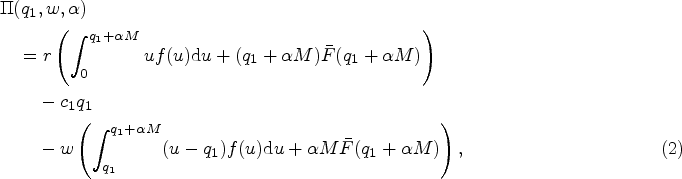


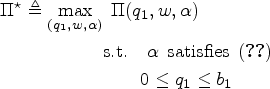
We now solve the platform’s problem, and we also reveal a counterintuitive relationship between the wage and the human participation level.
Optimal Solution
We first derive the full optimal solution to the platform’s problem.
(Platform’s Optimal Solution to
)
We have if if

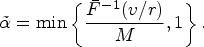
Proposition 1 provides the full solution to the platform’s optimization problem, which takes different forms depending on the values of the AV cost and the human drivers’ outside option. In all cases, the platform employs human drivers, which is consistent with the scope of our study for the medium-term future where AVs are not yet fully dominant. If AVs are inexpensive enough (part (i) of the result), then the platform adopts a blended solution with both AVs and human drivers, and the total supply is dictated by the relative values of the revenue per ride and the AV cost. On the other hand, if the AV cost is too high, then, as we might expect, the platform does not use AVs and instead relies on human labor. In this case, the exact fraction of human drivers that it recruits depends on the other parameters; for instance, as we might intuitively expect, the optimal fraction to recruit increases if either the revenue per ride increases or the human drivers’ outside option decreases.
With the platform’s optimal solution in hand, we next examine the direct and indirect effects of changes in the human-driver wage
As we have just seen, the platform’s optimal solution depends on the cost parameters
In order to investigate the effects of the wage, it is useful to consider a sub-problem of (
) for a given wage
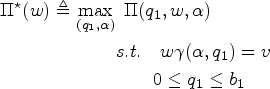
We now state our main result of this section.
If
The assumptions of Proposition 2 are needed for our analysis, as analyzing the inner problem (
) is extremely cumbersome due to the complex interactions between
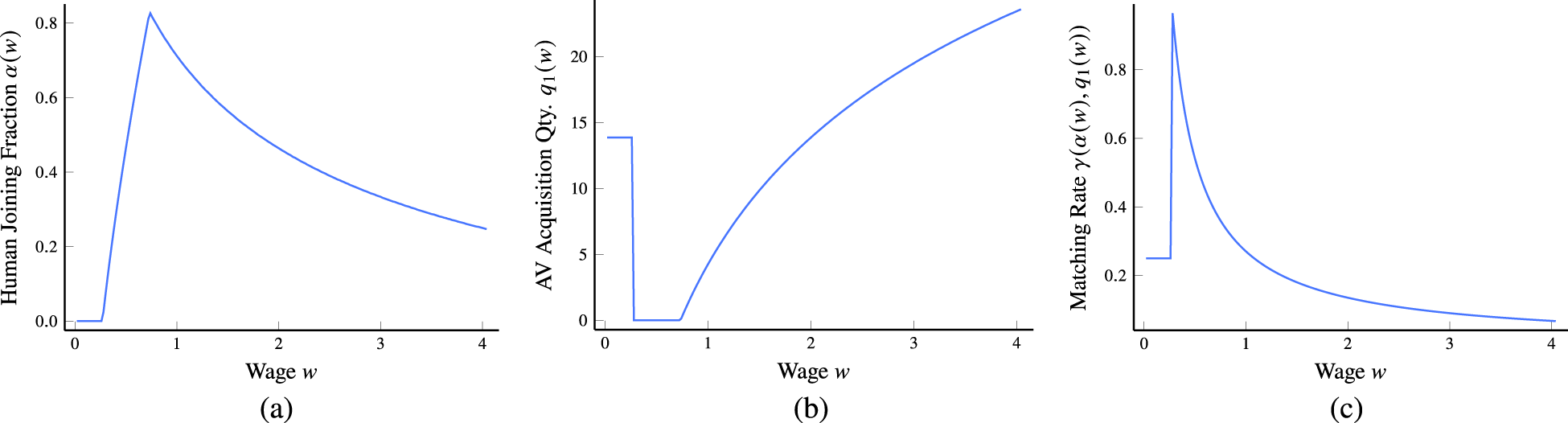
Equilibrium choices versus wage (
So, counterintuitively, a higher wage can lead to less human driver participation. Since a higher wage means more earnings per ride, the only way for driver participation to decrease is if the matching rate
Under the assumptions of Proposition 2, and for the wage
So, the reason that a higher wage can lead to lower human participation is that when the wage increases, so does the optimal AV quantity. Intuitively, as the wage increases, human-served rides become less profitable for the platform. So, the platform prefers to cover a larger percentile of the demand distribution with AVs, that is, it increases its AV acquisition. The rate of increase in
In the next proposition, we provide an exact characterization of the optimal joining fraction for the case of exponential demand, and we will later return to this case as a running example to make our results more concrete and to build intuition. For exponentially distributed demand, the cumulative distribution function
(Human Participation Lower at Higher Wage: Exponential Demand)
Consider


Proposition 3 reveals that the optimal
Figure 2 depicts this phenomenon graphically. For wages below
In short, when the platform increases the wage, it changes its own optimal decision (AV quantity) as well as the decisions of the human drivers. The interaction between the three quantities (wage, human joining fraction, and AV quantity) creates an endogenous relationship such that the platform’s attempts to increase human participation by increasing the wage can actually have the opposite result due to the knock-on effect of a wage increase on the optimal AV quantity.
Our findings in this section highlight the thorny road ahead for ride-hailing platforms in rolling out AVs in the coming years. Operating AVs requires the platform to juggle multiple roles in the marketplace (both supply-providing and supply-seeking). Thus, its adjustments of a decision in one role can lead to unexpected negative consequences due to their impact on the other. In particular, the wage and optimal AV quantity interact in a way that can hinder human driver recruitment. In Section 5, we extend our model, and, among other findings, we show that the same driving force applies to more than just the setting studied above.
Extended Model: Second AV Acquisition Opportunity
In the ensuing sections, we extend our baseline setting to one in which the platform can augment its AV fleet after observing the human drivers that joined the platform. This captures a situation in which the platform announces that it has sourced

Sequence of events in extended model.
At the beginning of the second stage, the platform observes the fraction
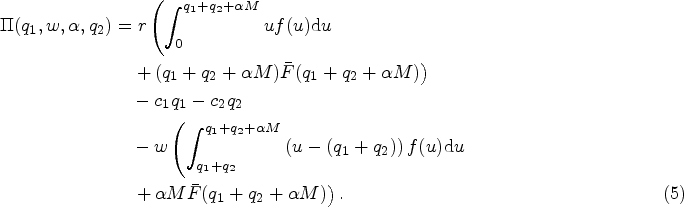
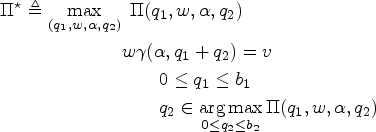

We will use
We first study the second-stage AV acquisition decision, denoted by
With no human drivers (i.e., for

For
The following result characterizes the optimal second-stage AV acquisition quantity
Let If If
Moreover,


Condition (7) is the FOC obtained from the platform’s expected profit (5). We note that in (i) there could be multiple solutions because when
In the next sections, we will rely on the implicit characterization of
If demand is exponentially distributed, then the optimal

The larger expression on the RHS of (8) is obtained by substituting the exponential CDF into the FOC (7) and isolating the unique solution. Note that for exponential demand, the FOC has a unique solution even when
We next study in detail the endogenous relationship between the wage, the human driver joining fraction, and the second-stage AV quantity, revealing a surprising phenomenon that has negative implications for the platform’s human-driver recruiting efforts and, by extension, its profits.
We start by showing the platform does not find it beneficial to acquire additional AVs after observing the human driver participation level.
(Second-Stage AV Acquisition Option Not Used)
If
So, the platform optimally does not use the second AV acquisition opportunity. Intuitively, then, we might naturally expect that this second opportunity is completely irrelevant, and that the equilibrium outcome is the same with or without it (i.e., whether
Let
(Flexibility Hurts the Platform)
Consider fixed for any feasible solution to there exists
Although part (i) of Proposition 6 has a weak inequality (
There is an apparent conflict between Propositions 5 and 6. Proposition 5 shows that the second-stage AV acquisition option is not used, but Proposition 6 shows that the optimal profit is higher when
To better understand this phenomenon, we next study human driver recruitment and the equilibrium wage in more detail. In what follows, it will be useful to define the wage
To reveal the drivers of the platform’s human-driver recruitment decisions in the second-stage acquisition setting, we use the human joining fraction
In choosing the wage
(Limited Human Driver Recruitment)
If

Proposition 7 establishes a cap on human driver recruitment, which depends on the problem parameters. For a low outside option
When the upper bound in equation (9) is less than 1, the platform cannot possibly induce all human drivers to participate and break even on human-served rides. Intuitively, to induce a very high level of human participation, the platform will have to offer higher wages to compensate for the increased competition among human drivers. However, for very high wages, the platform strongly prefers to meet demand with AVs, and the optimal
Note that

If
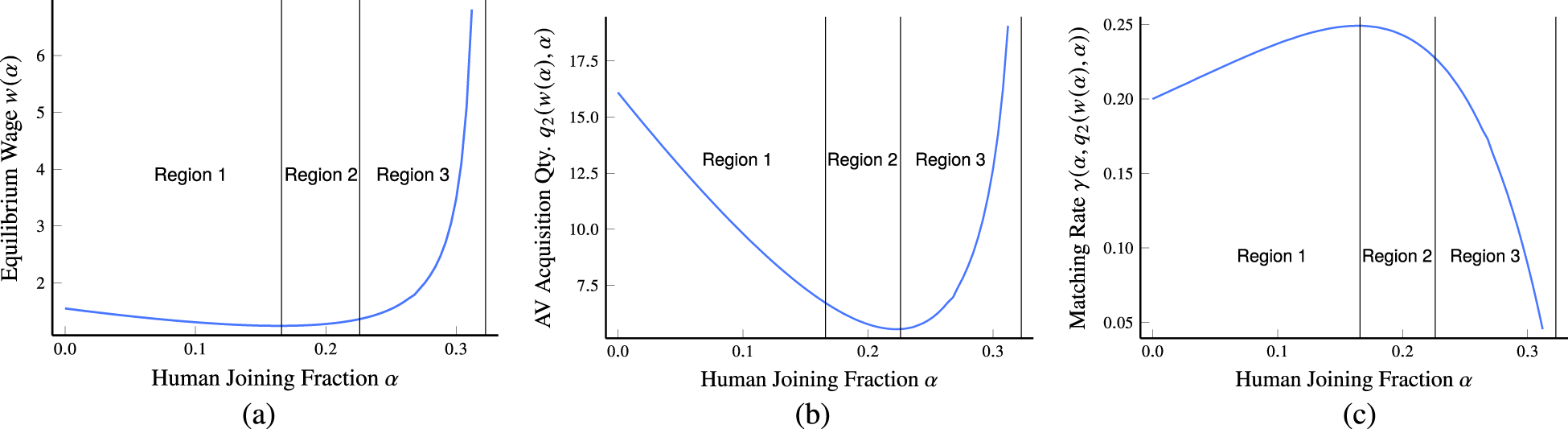
Equilibrium choices versus
Proposition 8 reveals the surprising fact that (an upper bound on) aggregate human driver earnings is actually decreasing in the wage offered to human drivers (weakly or strictly so depending on the distribution, as we will see). This result has implications for the ability of the platform to recruit human drivers. By (EQ), in equilibrium we must have
For larger human joining fractions, the platform must raise the wage to increase the joining fraction. However, more human drivers at a higher wage increases the optimal second-stage AV acquisition quantity because AVs become relatively more preferable to the platform. At high wages, human drivers anticipate intense competition from AVs and a low matching rate. So, to increase human participation, the platform must raise wages even higher, creating a race to the top with itself that thwarts recruitment as shown in Propositions 7 and 8: the feedback loop of increasing wages and increased AV acquisition means that increasing wages can actually reduce human participation, effectively capping the amount of human drivers that can be incentivized into the system. Put simply, because
As is evident from their proofs, Propositions 7 and 8 require careful analysis to establish key properties of the interaction between the platform and its human drivers. That these findings hold for a broad class of demand distributions places their structural implications on firm ground. With the structural results as a guide, for the remainder of this section we temporarily specialize to the exponential distribution, for which we can characterize all the main quantities in closed form. The precise expressions illuminate the driving forces behind the race to the top. If demand is exponential and


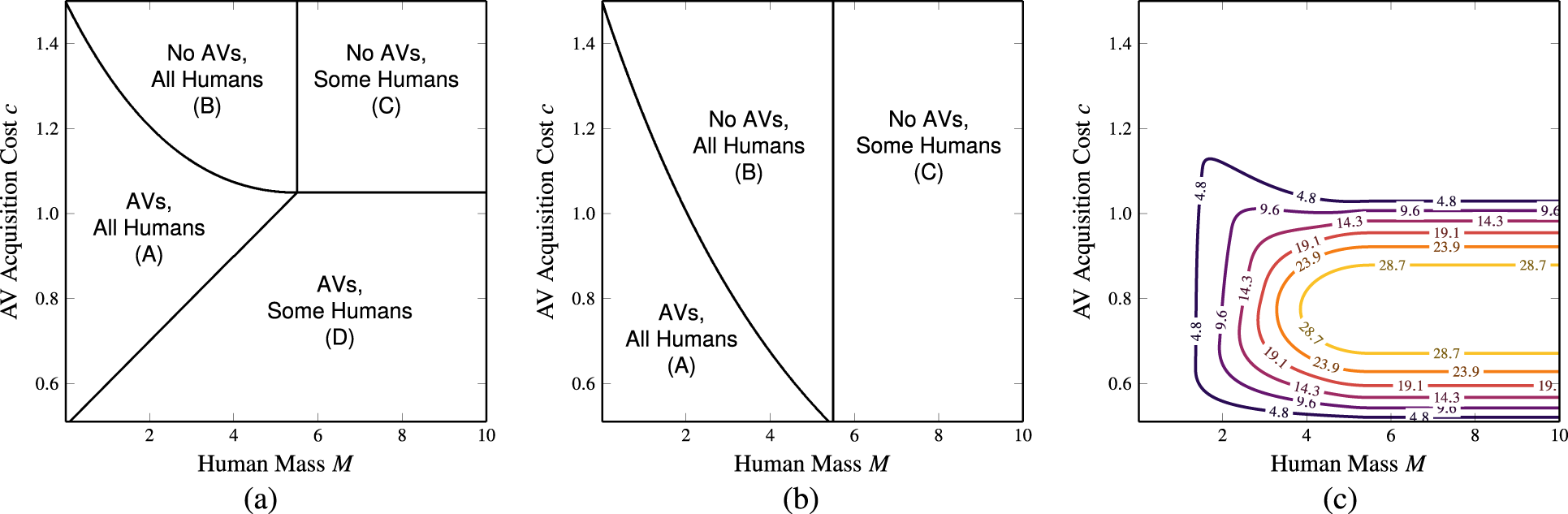
Equilibrium comparison and profit loss for
Returning our attention to Figure 4, we observe three distinct regions of
The race to the top phenomenon answers the question raised in Section 5.2 about why the flexibility of the second-stage AV acquisition option hurts the platform’s profit. Namely, the platform cannot commit to acquiring a suboptimal number of AVs in the second stage. Thus, human drivers’ anticipation of the platform’s optimal quantity leads to a feedback loop that raises the required wage to recruit a given number of human drivers, which decreases the optimal profit. In fact, as we show in Appendix A.1 in the E-companion, a higher AV cost
We now compare the optimal profit in the base model from Sections 3 and 4 with that of the extended model with a second-stage AV acquisition option. Figure 5(a) characterizes the equilibrium in the extended model with
We now demonstrate that the second-stage AV acquisition option can lead to a substantial difference in optimal profits. In Figure 5(c), the contour bands reflect the percentage decrease in the optimal profit when moving from the base model to the extended model. In regions with similar solutions in both cases, the loss is minimal. However, for other parameters, the difference in profit is nearly 30%. Particularly large profit losses occur with large
(Magnitude of Harm From Second-Stage AV Acquisition)
There exist instances of our problem for which the optimal profit
Importantly, the instance identified in the proof has
We note that the result only provides a bound on the worst-case profit ratio, and it does not rule out potentially worse instances. So, instances may exist where the profit loss from the race to the top is even more severe than the proposition identifies. However, despite searching numerically, we have not been able to identify any instances (with
Other Considerations
We briefly discuss three other considerations related to our problem, the full details for which are in Appendix C in the E-companion. First, we investigate the role of finite but positive
Conclusion
We have studied a ride-hailing platform supported by both a fleet of AVs and self-interested human drivers with their own vehicles. The platform faces a tradeoff between these sources for serving rides. AVs are fully in the platform’s control with known acquisition cost (they are also strategically valuable for the long term), but this is a fixed cost incurred before demand is realized. On the other hand, human drivers only represent a cost when matched, but the platform must manage incentives successfully to recruit them, which requires promising high enough expected earnings; indeed, the required wage is endogenous and is tightly bound to the platform’s AV decisions.
Human drivers can be a valuable hedge against demand risk because they incur no cost when not serving a passenger. However, when a ride-hailing platform serves rides with both AVs and human drivers, it must juggle multiple roles in the marketplace (supply provider of AV-served rides and supply seeker of human drivers). Hence, complicated dynamics govern the endogenous relationship between human driver wages, the human driver participation level, and the platform’s AV acquisition decisions.
In our base model, the platform sets wages and determines its AV quantity, then human drivers make joining decisions, and finally demand is realized. The interaction between the human-driver wage and the platform’s optimal AV quantity creates a surprising phenomenon: a higher wage can lead to less human-driver participation on the platform. When the wage is higher, human-served rides are less profitable for the platform, which acquires more AVs, increasing competition for rides and pushing some humans off the platform.
Then, we extend our model to incorporate a second AV acquisition opportunity for the platform after it observes human participation levels. In this extended model, for relatively low levels of human participation, the equilibrium wage can actually be decreasing in the participation level: as human participation increases, the platform optimally acquires fewer AVs, reducing the competition from AVs so that a lower wage is required to satisfy human drivers. At higher levels of human participation, eventually not many AVs remain, so the net effect on the matching rate of an increase in human participation switches from positive to negative, and hence the required wage switches from decreasing to increasing. Above this point, as human participation—and hence the required wage—increases, human-served rides become less profitable for the platform, which increases its AV quantity to compensate, similar to what we find in the base model. Increased competition from AVs negates the benefit to human drivers of increased wages, necessitating still higher wages and creating a feedback loop that leads the platform into a race to the top with itself. The feedback loop arises because the platform cannot credibly commit to a second-stage AV quantity that will be sub-optimal given the equilibrium wage and human participation level. In fact, the platform’s profit is always higher in the base model with only a single AV acquisition opportunity, and we show that the difference in profit can be more than 38%.
Overall, in planning for the shared road, a ride-hailing platform must beware the consequences of human drivers’ rational choices in light of its AV acquisition decisions. Despite the promise of this exciting technology, its introduction entails a complex marketplace in which the ride-hailing platform needs to carefully calibrate its human-driver wage decision. The platform must keep a close eye on the knock-on effects of this choice, both on its own AV acquisition decision and, by extension, on human drivers’ decisions to participate on the platform.
Supplemental Material
sj-pdf-1-pao-10.1177_10591478241264796 - Supplemental material for Getting Out of Your Own Way: Introducing Autonomous Vehicles on a Ride-Hailing Platform
Supplemental material, sj-pdf-1-pao-10.1177_10591478241264796 for Getting Out of Your Own Way: Introducing Autonomous Vehicles on a Ride-Hailing Platform by Francisco Castro and Andrew E Frazelle in Production and Operations Management
Footnotes
Acknowledgments
The authors thank department editor Michael Pinedo, as well as the senior editor and referees, for many helpful suggestions that led to a significantly improved paper.
Declaration of Conflicting Interests
The author(s) declared no potential conflicts of interest with respect to the research, authorship, and/or publication of this article.
Funding
The author(s) received no financial support for the research, authorship and/or publication of this article.

Notes
How to cite this article
Castro F and Frazelle AE (2024) Getting Out of Your Own Way: Introducing Autonomous Vehicles on a Ride-Hailing Platform. Production and Operations Management 33(10): 2014–2030.
References
Supplementary Material
Please find the following supplemental material available below.
For Open Access articles published under a Creative Commons License, all supplemental material carries the same license as the article it is associated with.
For non-Open Access articles published, all supplemental material carries a non-exclusive license, and permission requests for re-use of supplemental material or any part of supplemental material shall be sent directly to the copyright owner as specified in the copyright notice associated with the article.
