



Abstract
Three-dimensional (3D) printing technology has opened up possibilities for product design collaborations between device providers and customers. To enable an environment of cocreation, device providers are now renting 3D printers via the 3D-as-a-Service (3DaaS) model. Although prior research has examined pricing and quality issues in the traditional manufacturing setup, these studies have not analyzed such decisions in the 3D printing supply chain setting, where end users possess the ability to customize product designs. Therefore, several important questions remain unanswered from the perspective of the 3D printing device provider. For example, what is the appropriate pricing model for providing 3DaaS? How do factors such as the extent of design customization and the complexity influence the pricing strategy of the 3DaaS firm? Our analysis shows that if the customers’ impact on the product quality is relatively high or low, the pay-per-build pricing model generates a higher profit than the fixed-fee pricing model. Interestingly, we also find that if customers frequently print highly intricate product designs, the firm might choose the pay-per-build pricing model, only if the likelihood of design failure for these complex structures is low. Otherwise, the firm might opt for the fixed-fee pricing model.
Introduction
Three-dimensional (3D) printing or additive manufacturing is a technology through which a product or component is constructed layer by layer (PricewaterhouseCoopers, 2023). During the onset of the COVID-19 pandemic, a hospital in Italy urgently required ventilator valves. A start-up, with the help of a 3D printer, produced 100 valves in a day and supplied them to the hospital. These valves were immediately used to treat 10 patients (Mullainathan, 2020). The advantages of 3D printing are many: high design flexibility, no batch size requirements, lower cost per part, and lower material wastage (PricewaterhouseCoopers, 2023; Arkema, 2023). Moreover, as compared to conventional manufacturing, in 3D printing, the capital investments required to achieve scope are lower, production can be conducted at the point of use, the ability to customize a product is higher, and the lead time is lower (Deloitte, 2022; DHL, 2023). This paper analyzes a supply chain setting where a firm provides the 3D printing service that customers utilize to build products. We study the pricing strategies of the 3D printing service provider.
Problem and Motivation
Various startups and small businesses cannot own a 3D printer due to cash constraints. Therefore, they prefer to print the product and the prototypes via 3D printing services. An Ernst and Young study revealed that around one-third of the survey respondents were expected to print their requirements via 3D printers owned by service providers (Ernst and Young, 2019). As a result, various device manufacturers such as Hewlett-Packard and Carbon rent 3D printing devices to their customers as a service to help them integrate 3D printing into their digital manufacturing strategies. Such a 3D-as-a-Service (3DaaS) model makes digital manufacturing of products more accessible, scalable, and affordable for customers (Allan, 2019).
Typically, 3D printing device firms offer 3DaaS (or rent 3D printers) through two pricing models: fixed-fee and pay-per-build pricing models. In the fixed-fee pricing model, customers need to commit to using the printer for a certain period and pay a certain amount for this long-term usage contract. For example, Hewlett-Packard provides the HP Jet Fusion 340 3D printer through a fixed-fee pricing mechanism. In this pricing strategy, the customer needs to sign up for a 1-year commitment and pay a $5,000 upfront fee and $3,500 monthly fee, which amounts to a fixed-fee of $47,000 for the year (Molitch-Hou, 2023). Similarly, Carbon provides the Carbon M2 3D Printer though the fixed-fee pricing model. In this case, the customer needs to sign-up for a 3-year commitment and pay $50,000 per year, that is, the fixed-fee for the 3-year contract period is $150,000 (Carbon, 2023a). Overall, pricing is not impacted by the number of objects the customer prints during the subscription period in this model.
In the pay-per-build pricing model, the pricing is based on the actual number of builds (or products, objects, or components) printed by the customers using the 3D printing service. For example, Hewlett-Packard offers the HP Jet Fusion 5200/4200 Series and HP Jet Fusion 500 Series 3D printers through the pay-per-build pricing model. In this 3DaaS model, the company tracks the usage of the printer and charges the customer based on the number of builds (Molitch-Hou, 2023). In this paper, we study these 3DaaS pricing models as implemented by various 3D printing vendors.
In a traditional supply chain setting, customers source their requirements from a firm that designs and manufactures the final product. Unlike conventional manufacturing processes, in the 3D printing supply chain, the customer can customize product design and prepare digital models using 3D modeling software. Then, using the developed digital model and the feed material, the final product is printed on the 3D printing hardware (DHL, 2023). For example, traditionally, customers used to purchase toys designed and manufactured by firms. In recent times, certain companies have started to provide 3D printers through which children can print out their toys. The 3D printer includes software allowing customers to customize existing design templates and add various features to create the final digital files. Finally, the prepared digital files can be exported to the 3D printer. Therefore, one of the important features of the 3D printing supply chain is that the customer also bears the cost of product quality customization. This is because customers first need to customize the final product by deciding various design parameters. They also need to understand technical details such as product geometry, material guidelines, and printing technology while preparing the final design files.
One of the criteria for the selection of 3D printers by customers is the extent of customer engagement in the final design of the 3D printed object. For certain 3D printing applications, the customer efforts majorly determine the final utility of the object. These applications typically include sophisticated engineering requirements, complex dental designs, and designing and printing jewelry. There are other applications for which the customer’s impact on the final product quality is low. For several end products, the 3DaaS firm provides customers with a large number of design templates. The customers simply select these templates and make some minor modifications to print the final object; that is, the quality of the end product is mostly due to the software templates provided by the device firm. Examples of such applications include creating standard geometrical designs and simple template selection-based applications such as candy printing. In this paper, we evaluate the impact of the customer’s ability to contribute toward product design on the strategic pricing model adopted by 3DaaS firms.
Research Questions and Key Findings
Motivated by the discussion in Section 1.1, we study a stylized model with a 3DaaS provider and customers renting 3D printers. The customers are heterogeneous in the usage frequency of the 3D printer. First, the 3D printing service provider decides its pricing strategy and simultaneously determines its efforts to develop initial design file templates. Then, the customers make the product design decision (product customization efforts). In this paper, we evaluate two pricing strategies of the 3DaaS provider: (a) fixed-fee pricing, where the customer rents a 3D printer for a certain time period and pays a fixed-fee that is independent of the number of builds printed by the customer; and (b) pay-per-build pricing, where the customer pays only for the number of builds they print using the 3D printer.
While prior studies have addressed vendor–client cocreation scenarios, their primary emphasis has been on investigating effort-dependent and output-dependent contract structures within Business-to-Business (B2B) supply chain scenarios (Demirezen et al., 2016, 2020). Our contribution extends this body of work by shedding light on the effects of factors such as the extent of product design customization and product complexity on the pricing strategies of 3DaaS firms under both fixed-fee and pay-per-build pricing models. Additionally, existing research concerning pricing issues in supply chains considering quality cocreation has not factored in product design customization and product design failures due to increased design complexity (Avinadav et al., 2020; Basu and Bhaskaran, 2018). We contribute to the above literature by providing new insights into how the degree of design customization and complexity influences the payoff of 3DaaS firms under differing pricing models.
In the 3D printing supply chain setting, there is a significant level of collaboration between the upstream firm and the customer while customizing the product design quality. Hence, it is important to understand how 3DaaS firms should set the price of each build or device in these pricing models. This important issue has not yet been addressed because the extant research has not considered such product design customization in 3D printing supply chains (Arbabian and Wagner, 2020; Westerweel et al., 2018). Therefore, to gain a deeper understanding of the impact of customization on pricing strategies, we examine the following question: How does the relative ability of supply chain players to customize the product influence the unit price of the product set by a 3DaaS firm? One might expect that as the firm’s relative impact on product quality increases, due to higher product quality investment, the firm should always increase the price. However, our analysis reveals that under certain conditions, an increase in the firm’s impact on product quality might also decrease the price. Our results suggest that 3DaaS firms should charge a high price if the relative ability of any of the players to customize the product is considerably higher. However, if the players are equally responsible for the product customization, then 3DaaS firms should charge a relatively lower price.
In reality, customers tend to experience product design and printing-related failures while utilizing 3D printers to print complex designs. Therefore, we ask the following research question: How does the complexity of product design impact the 3DaaS firm’s pricing strategy? Our findings indicate that for intricate designs, the optimal strategy for the firm involves setting a relatively higher unit price (in both pricing models) when the likelihood of failure is low, and the expected use frequency of the customers is high. The above insight suggests that customers such as the design departments of large manufacturing companies, who have strong expertise in creating intricate tasks (so the probability of design failure is low) and frequently use 3DaaS for printing highly complex designs, should be offered 3DaaS at higher prices.
Since the selection of the pricing model has a significant impact on the profitability of 3DaaS firms such as HP and Carbon, we finally ask the following research question: What is the appropriate pricing model for offering 3DaaS? Our analysis reveals that if the extent of product design customization by users of 3DaaS is relatively high or low, the pay-per-build pricing model generates higher profits for the 3DaaS firm than the fixed-fee pricing model. If the extent of customization by users is in the moderate range, the fixed-fee pricing model generates higher profits for the firm. This suggests that when customers use 3D printing services for tasks such as standard product designs, where a 3DaaS firm provides ready-made design templates (so not much customization is needed), or highly sophisticated engineering jobs (requiring a high degree of customization by 3DaaS users), the pay-per-build pricing model might be implemented by firms.
Furthermore, the complexity of the product design plays an important role in how the 3DaaS firm decides on the pricing model. Specifically, if customers are really good at creating very complex product designs (so the chances of design failures are low), the 3DaaS firm may prefer implementing a pay-per-build pricing model. However, suppose customers print highly complex designs but face a high chance of failure, possibly because they are not as skilled or tend to experiment with new designs. In that case, the firm might prefer using the fixed-fee pricing model. Lastly, when the design complexity is low, the fixed-fee model generates higher profits for the firm. Overall, this insight suggests that as users become more skilled at handling highly intricate designs over time, the 3DaaS firm might lean toward using a pay-per-build model. However, for 3DaaS used in printing less complex structures, the fixed-fee pricing model could be the preferred choice.
The structure of the paper is as follows. We review the extant literature in Section 2. In Section 3, we describe our analytical model. In Section 4, we present the analysis of the main model. Then, in Section 5, we consider the design complexity and product failures in the 3D printing supply chain setup. In Section 6, we present multiple model extensions. Finally, in Section 7, we conclude the paper. All proofs are included in the E-companion to this paper (see Section EC.1).
Literature Review
Our paper is mainly related to three streams of literature: (i) pricing issues of service, (ii) collaborations in supply chains, and (iii) operational issues in the 3D printing industry. To highlight our key contributions in these three streams, in Figure EC.1 (in the E-companion), we present the research context. Next, we discuss each of the above research streams and position our work.
Pricing Issues of Service
We refer interested readers to Kumar et al. (2018) for an excellent overview of models on pricing issues in operations management and information systems literature. Mantena and Saha (2022) study unit pricing and market share-dependent pricing in the context of healthcare procurements. Unlike them, we focus on pricing issues in 3D printing supply chains under product customization. The papers in the B2C context study pricing issues in software services. Feng et al. (2018) find that the initial quality gap between competitors in the software-as-a-service offering market impacts their subscription pricing strategy. We further contribute to the above literature by studying pay-per-build and fixed-fee pricing models in 3D printing supply chains. Chellappa and Mehra (2018) study optimal pricing under versioning of information goods. They find that marginal cost and customer usage cost impact pricing and versioning strategy. Unlike us, they do not consider the fixed-fee pricing model. Our focus is to compare various pricing models in a 3D printing supply chain setting.
Recently, a set of papers studies pricing issues in cloud computing markets. Jain and Hazra (2019) and Saha et al. (2021) study pay-as-you-go pricing models under finite data center capacity. They provide insights into how available capacity, demand profile, and customer congestion sensitivity impact the pricing strategy. Chen et al. (2019) study a client’s pricing model decision when one of the vendors offers utilization-based pricing (similar to pay-as-you-go) and another vendor offers a reservation-based pricing model. They find that under high demand volatility, the client prefers the vendor offering a utilization-based pricing model. In contrast, we study the vendor’s choice of offering fixed-fee and pay-per-build pricing models.
Finally, we review a set of papers contrasting different pricing mechanisms that are closest to this work. Jain and Kannan (2002) compare subscription-based, connect-time, and search-based pricing mechanisms for databases on online servers. They show that under a high demand load, the firm may prefer a subscription-based pricing model. Cachon and Feldman (2011) study fixed-fee and pay-as-you-go pricing models under the congestion effect. They find that if customers’ disutility due to congestion is high, the firm may prefer implementing a fixed-fee pricing model. Balasubramanian et al. (2015) study usage-based and subscription-based pricing under the presence of clock-ticking effects. They show that a hybrid pricing mechanism yields the highest payoff for the firm. Li et al. (2020) study selling, subscription, and mixed pricing models of digital music. They find that advertisement revenue rate impacts the music provider’s selection of pricing models. On the other hand, we study fixed-fee and pay-per-build pricing models in the 3DaaS supply chain and find that the extent of product customization and degree of product design complexity impact the upstream firm’s selection of pricing model. Specifically, our analysis uncovers that when customers are either highly engaged or minimally involved in customizing product design, the pay-per-build model generates higher payoffs for the 3DaaS firm. Furthermore, our results demonstrate that the adoption of a pay-per-build pricing model might be favorable for the firm only in cases of highly intricate job structures characterized by low customer failure probabilities. We provide a summary in Table EC.1 (in the E-companion) to contrast our work with the most related papers in this stream.
Collaborations in Supply Chains
We refer readers to Roels (2014) for a review of analytical models on collaboration between various supply chain players. In this stream, the papers investigating the dynamics of product design customization share relevance with our research. In an empirical study, Kumar and Telang (2011) delve into the influence of product customization on a firm’s call center expenses. Their findings reveal that customers who choose a customization plan exhibit a 21% decrease in interactions with the call center, suggesting that customization could reduce call center costs. Lin et al. (2018) investigate the influence of online reputation mechanisms on clients’ vendor selection decisions for customized production in the context of online labor markets. Differing from their focus on vendor selection, our study centers on the implications of players’ customization levels on the pricing of 3D printing services offered by the upstream firm. Esenduran et al. (2022) delve into the product return policy for customized products, highlighting the potential for higher payoffs if returns are allowed. In contrast, our contribution revolves around the role of customization within the 3DaaS supply chain involving the 3DaaS provider and customer. Specifically, we contribute to this stream by finding that relatively high or low user design customization might lead the 3DaaS firm to prefer the pay-per-build pricing model over the fixed-fee pricing model.
A related body of literature addresses cocreation in B2C supply chain contexts. For instance, Basu and Bhaskaran (2018) examine customer and upstream firm collaboration to enhance product quality, shedding light on its impact on product line pricing, targeting high-value and low-value customers. Avinadav et al. (2020) explore upstream cocreation between platforms and service providers, focusing on pay-as-you-go pricing for services provided to customers. Differing from them, our study centers on cocreation between downstream customers and upstream 3DaaS service providers under pay-per-build and fixed-fee pricing models. Yang et al. (2021) delve into customer-firm cocreation, aiding customers in evaluating product value precisely; however, cocreation in our model setup enhances product quality. Moreover, the above papers on B2C supply chain setup do not compare various pricing models, which we do in our paper.
Several papers study quality cocreation in B2B supply chains. Bhaskaran and Krishnan (2009) analyze different product codevelopment mechanisms, including cost sharing and innovation sharing, where one player invests effort while the other shares costs or both collaborate in cocreation within a vendor–client supply chain. They find that when players possess distinct capabilities, innovation sharing results in high-quality investment. In contrast, we provide implications of users’ customization of product design in a 3D printing supply chain. Furthermore, our primary aim is to elucidate how product design customization influences the pricing dynamics of 3DaaS. Garg et al. (2024) explore the cocreation between an IoT platform and app developers, aiming to enhance app quality and security features under a revenue-sharing contract structure. Their findings indicate that with the introduction of a new app over the platform, efforts to improve quality and security are escalated across both existing apps and the platform. Unlike us, they do not compare various pricing models between the upstream service provider and downstream customers, which is the crux of our paper.
Beer and Qi (2024) investigate the dynamics of quality cocreation in a two-stage collaboration between a focal firm and its partner. They observe that when product value is high, both entities exert high efforts, resulting in the most efficient outcome. In their setup, the firms’ payoffs are linked to overall product output, mirroring scenarios where joint product development contracts tie revenue to final product sales. In contrast, in the 3D printing supply chain context, customer’s payoff correlates with product quality, while the 3DaaS firm’s earnings hinge on customer payments for utilizing the service. This leads us to offer new insights into the pricing dynamics of 3DaaS services and new perspectives on how product design customization and complexity impact the firm’s pricing and quality investment strategies.
Rahmani et al. (2017) explore a scenario involving client–vendor cocreation under uncertain outcomes and flexible scope. They consider a time-based payment contract and find that intense collaboration tends to concentrate close to the project deadline, especially when efforts can be verified. In contrast, our focus within the 3D printing supply chain revolves around fixed-fee and pay-per-build pricing models. Gupta et al. (2023) study collaborative value cocreation between one client and two vendors under an effort-dependent payment structure. They contribute by finding conditions under which the client may prefer to add a secondary vendor along with a primary vendor (in value cocreation). Demirezen et al. (2016) study output cocreation between a client firm and a vendor firm in an information technology (IT) project setting. They find the conditions under which a client may prefer implementing an output-dependent contract over an effort-dependent contract (or vice versa). In another paper, Demirezen et al. (2020) consider a hybrid of an an effort-dependent and output-dependent contract structure. They find that the client may prefer a hybrid contract (over effort or output-dependent) if the output sensitivity to the vendor’s effort is high. Differing from the aforementioned studies, our study centers on the collaborative enhancement of quality between the 3DaaS firm and customers within a B2C framework, marked by features such as product customization and design complexities. We delve into pricing structures such as pay-per-build and fixed-fee, prevalent within the 3DaaS supply chain, offering insights into the circumstances favoring the adoption of each pricing model. We augment the existing literature by revealing that a relatively high or low degree of product design customization by the customer could propel the 3DaaS firm toward opting for a pay-per-build pricing model. Furthermore, increased product complexity might sway the 3DaaS firm toward embracing a pay-per-build pricing model contingent on customers facing lower design failure probability. We provide a summary in Table EC.2 (in the E-companion) to contrast our work with the papers on collaboration issues in supply chains.
Operational Issues in 3D Printing Industry
We refer readers to Olsen and Tomlin (2020) for a review of emerging issues in the area of digitization of manufacturing. We also refer readers to Guha and Kumar (2018) for a discussion of big data applications in the 3D printing industry. Song and Zhang (2020) study the design of a spare part logistics system where the spare part can be stocked or 3D printed. They find that as the cost of 3D printing reduces and the printing rate increases, the value of 3D printing increases. Furthermore, they find that as the part variety increases, the value of 3D printing increases. Sethuraman et al. (2023) study product quality decisions in a 3D printing supply chain setting. Unlike us, they do not study fixed-fee and pay-per-build pricing models used by the upstream firm to offer 3DaaS, which is the crux of our paper. Moreover, we further contribute to the above stream by providing implications about the product design customization and complexity on the 3DaaS firm’s pricing strategies and the payoff.
Westerweel et al. (2018) study a setting where a firm uses a hybrid of regular production and 3D printing technology. They find that if the 3D printing design cost is high, and if the install base (volume) is large, the customer might prefer 3D printing technology. Unlike us, they do not consider the pricing of a 3D printing service. Arbabian and Wagner (2020) study the impact of 3D printing technology in a manufacturer–retailer supply chain. They find that if the 3D printing cost structure is low, then the upstream firm uses 3D printing technology. Unlike us, they do not incorporate the product quality (or design) decision by the upstream firm and downstream customers, which is one of the key features of additive manufacturing and is incorporated in our model. Furthermore, we study the pricing of 3D printing services. Moreover, we provide interesting implications about the impact of product complexity (which may impact product failures) on the 3DaaS firm’s pricing strategy. We provide a summary in Table EC.3 (in the E-companion) to contrast our work with the papers in this stream. Overall, this study contributes to the literature on additive manufacturing by focusing on the following aspects:
We study the pricing of 3DaaS by the device provider and discuss which model is most preferred by the 3DaaS firm. We characterize the quality decisions of 3DaaS firms and customers while they collaborate and decide the product quality. We offer insights into how the extent of product design customization and the complexity of product design influence the pricing strategies of the 3DaaS provider.
Model Description
We consider a firm offering 3D printing devices to multiple customers through the 3DaaS model. The customer uses the 3D printing device to design and manufacture the product. As mentioned in Section 1.1, the supply chain setting consisting of a 3D printing service provider and the customer utilizing the printing services is realistic in practice (DHL, 2023; Ben-Ner and Siemsen, 2017). In real-life practice, there is a differentiation between the offerings of 3D printing service providers such as HP and Carbon. This differentiation is due to 3D printing technology, printing speed, material, and color offerings (McKenna, 2016). Due to such differentiation in our model setup, we consider the monopolistic market structure where the customers prefer a specific 3DaaS vendor. However, later in Section 6.3, we relax this assumption and study a model setup considering market competition. In the following subsections, we describe the various features of the model setting that are considered in the paper. The 3D printing supply chain setting is presented in Figure 1.
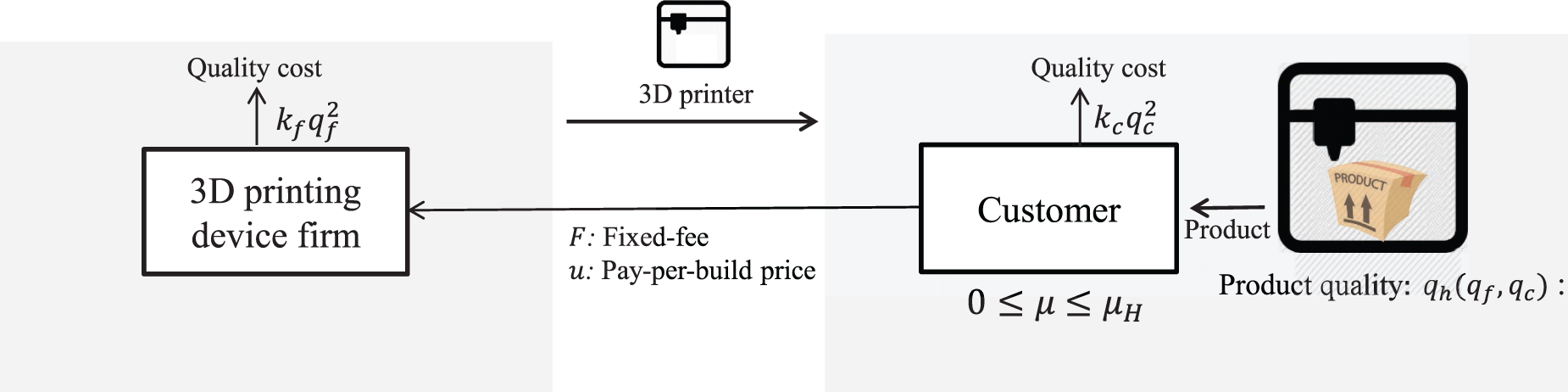
3D printing supply chain considered in the paper.
In general, customers are heterogeneous in the usage frequency of the 3D printer to produce the final products. This is because, in a particular time frame, some customers might print a large number of products using the printer, while others might print only a few products. This heterogeneity is also due to the differences in customers’ business types and business requirements. The customer base showcases a wide range of clients, including an automobile manufacturer engaging in high-frequency usage by printing numerous vehicle parts, and a medical facility with low-frequency usage, occasionally printing specific devices (Carbon, 2023b). Moreover, the customer usage heterogeneity is underscored by other examples in the design and engineering domain. This encompasses fields such as fashion and jewelry design, where the utilization of 3D printing can differ based on design cycles and fashion collections. Similarly, within the aerospace industry, usage variation arises due to distinct use cases. Certain customers employ 3DaaS for research, while others incorporate it into regular production phases. Furthermore, the spectrum of customer usage heterogeneity is vividly illustrated in the use cases such as architectural design and cultural heritage preservation. Architectural entities’ usage of 3DaaS firms varies based on the number of ongoing projects and a client’s demand. Please note that a single 3DaaS vendor may cater to various clients, consequently amplifying the usage heterogeneity. Therefore, in our model setting, for a particular period, we denote the usage frequency of customer
In general, while signing the contract with a 3D device provider, there is often a clause related to the commitment period for which the device needs to be utilized by the customer (Molitch-Hou, 2023). In our paper,
Customers’ Product Valuation
If the quality of the customized product consumed by the customer is denoted by
3D Printing-as-a-Service Pricing Models
As motivated in Section 1.1, we consider two pricing strategies used by the 3D printing device manufacturer: the fixed-fee pricing model and the pay-per-build pricing model.
Fixed-Fee Pricing Model
In the fixed-fee pricing model, the firm charges a fixed-fee, denoted by
Pay-Per-Build Pricing Model
In the pay-per-build pricing model, the firm offering the 3D printer device charges the customers based on the number of products printed by them using the device. For each product printed by the customer, the 3D printer provider charges a unit price of
Product Quality Collaboration and Quality Cost Structure
As discussed in Subsection 1.1, in various industrial settings, the provider of the 3D printer and the customer collaborate to design the final product. In such collaboration relationships, the device firm exerts efforts toward providing 3D model design templates, designing software to transform 2D sketches into 3D objects, and providing printer-specific design software (Rayna et al., 2015; Xometry, 2022). Furthermore, the customer exerts customization efforts toward preparing the final digital models using templates, design software, and other assistance provided by the device firm (DHL, 2023). This means that the design resources provided by the 3DaaS firm act as the starting point for customers to begin their design efforts and prepare the digital model. Therefore, we consider the product quality collaboration between the device provider firm and the customer.
We assume that the consumer’s product quality is given by
In this additive quality collaboration structure, the firm can substitute for the customer’s efforts and vice versa. Such a collaboration structure might make sense in 3D printing design modeling because, on one extreme, the firm may prepare and provide the 3D modeling files (i.e.,
Furthermore, the customer and firm incur the quality investment costs given by
Sequence of Events
In practice, the 3DaaS firm exerts efforts to prepare 3D modeling templates and announces its pricing strategy. For example, HP has invested upfront in 3D modeling utility software, known as HP Smart Stream 3D Build Manager (HP, 2023a). Furthermore, before the customers make the purchase decision, HP upfront posts its pricing strategy (HP, 2023a, 2023b). In response, the customer utilizes the 3D modeling utility to prepare the final design and print it using HP’s 3DaaS service. Therefore, the timeline of the game played by the 3DaaS firm, and customers is as follows:
Please note, such a sequential quality investment game structure where the follower invests after observing the quality efforts of the leader, is commonly considered (Avinadav et al., 2020). A summary of notations is provided in Table 1. In Table 1, please note that we have also included additional notations used in various model extensions. However, a detailed discussion on each of these new notations is provided while explaining the setup of the particular extension later in the corresponding section. We now present the model analysis.
Summary of key notations.
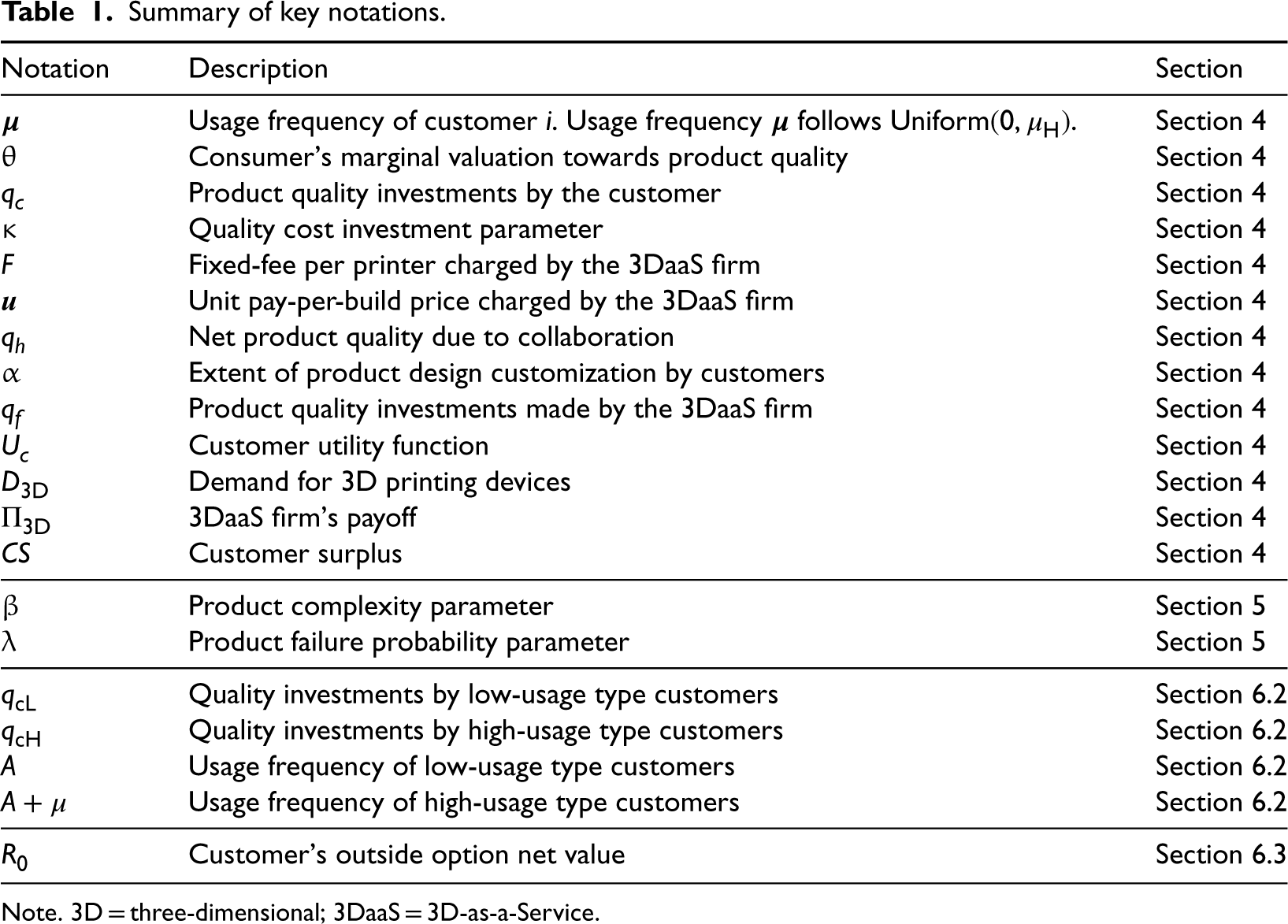
Summary of key notations.
Note. 3D = three-dimensional; 3DaaS = 3D-as-a-Service.
In this section, we present the analysis of the fixed-fee pricing model and the pay-per-build pricing model in Sections 4.1 and 4.2, respectively.
Fixed-Fee Pricing Model
In this setting, the firm charges the customer a fixed-fee 

The optimal fixed-fee 
From Lemma 1, we find that as the expected usage frequency of the 3D printing device
The following are true about the impact of the collaboration parameter As the relative impact of the customer As As
Since the impact of firm’s efforts on overall product quality decreases with increase in
Since the fixed-fee charged by the firm is high if
Interestingly, we find that as the average use frequency
Previous research in a vendor–client cocreation setup has analyzed the impact of collaboration dynamics on the effort/output-dependent payment structures (Demirezen et al., 2016, 2020). For example, Demirezen et al. (2016) find that optimal payment (dependent on overall output) is strictly decreasing in the client’s relative impact on output. In contrast, in a fixed-fee-based pricing mechanism, we find that if the customer’s relative impact is high or low, it may result in higher fixed-fee payments. Overall, we contribute to previous literature by adding new insights on firm–customer collaboration dynamics in a 3D printing supply chain under fixed-fee and pay-per-build pricing structure.
Our results have some implications for business practice. Based on our insight, the 3DaaS providers need to understand the collaborative dynamics of product design and customer use-frequency while pricing 3DaaS services. If the degree of customization by the users of 3DaaS is relatively low or high, the 3DaaS firm should charge a high price. However, based on the above discussion, they should not set a high price, when the expected printing requirements are high, even if the relative impact of the customer on the product design is high.
The customer with use frequency 

The optimal pay-per-build price 
Similar to the fixed-fee pricing model, we find that as the expected number of units printed by the customer increases, both unit price and the firm’s quality investment increase. Interestingly, we find that the firm’s quality investment is higher in the pay-per-build model compared to the fixed-fee model.
Due to the higher impact of the customer on the overall product quality, as
As discussed in Section 1.1, it is important to understand which pricing model is appropriate for 3DaaS firms such as HP and Carbon. Therefore, in Proposition 2, we compare the firm’s payoff in both pricing models.
If the product customization parameter
One may expect that since the firm charges a fixed amount under the fixed-fee model (even if customer use frequency is low), the firm’s payoff under the fixed-fee pricing model may always be higher as compared to the pay-per-build pricing model. Interestingly, this is not always the case. Specifically, we find that when the relative impact of either the customer or the firm on product quality is high (i.e.,
In the intermediate range of
The earlier literature on pricing issues in service supply chains finds that factors such as high customers’ congestion disutility (which may be prominent in the industry, such as cloud computing), low ticking meter effects (which may be present for utilities), and high demand volume may motivate customers to prefer fixed-fee pricing model (Jain and Kannan, 2002; Cachon and Feldman, 2011; Balasubramanian et al., 2015). We further contribute to the above stream by finding out that the extent of players’ customization while designing the product quality impacts the 3DaaS firm’s decision regarding the pricing model. Specifically, we find that when both the customer and the firm have a relatively similar impact on product quality, the fixed-fee pricing model results in a higher profit for the 3DaaS firm.
One of the primary challenges encountered by customers utilizing 3D printing services is the elevated failure rate of jobs with a higher degree of complexity. The intricacy of these jobs significantly heightens the likelihood of failures, prompting customers to engage in multiple attempts at designing and printing until a viable, usable version is ultimately achieved. Therefore, we modify the main model of our paper and consider a setup where customers may experience product design failures while designing complex jobs. In this setup, the customer designing a job with a level of complexity denoted by
Typically, highly complex designs tend to have sophisticated geometry, sometimes making it extremely difficult to print fully functional designs. Such complex architectures are typically printed for application areas such as automobile engineering, construction design, and biomedical engineering. A few examples of such complex designs are brake calipers, hip implants, and turbine components (AMFG, 2023). Even though highly complex jobs may have a higher probability of failure, a successful print of complex design generates higher value to customers due to better functionality and higher benefits. Therefore, to incorporate such benefits, we denote the final product quality of design with complexity
Fixed-Fee Pricing Model
The customer’s utility derived from consuming a job with complexity level
The equilibrium fixed-fee 
Similar to the main model, we find that a higher relative impact of customers
The following are true about the impact of product complexity parameter As the product complexity increases, the firm’s quality investment increases (i.e., As the product complexity parameter increases, the firm’s payoff and customer surplus increase if and only if the expected use frequency is above a threshold (i.e.,
Proposition 3 provides some insights into how a 3DaaS firm should tailor its pricing and quality investment strategy depending on the complexity of jobs printed by customers. According to Proposition 3(a), the 3DaaS firm always benefits by increasing the fixed-fee with an increase in product complexity. By making high-quality investments for highly complex jobs, the 3DaaS firm strategically stimulates customers toward purchasing its services, thereby seeking to boost market demand. On the contrary, should it opt to reduce quality investment for such intricate jobs, customers may be deterred from selecting 3DaaS due to apprehensions regarding elevated design costs and increased liability expenses associated with handling highly complex job structures.
Interestingly, the 3DaaS firm benefits by increasing the fixed-fee with an increase in product complexity as long as the customer’s expected use frequency is above a threshold (i.e.,
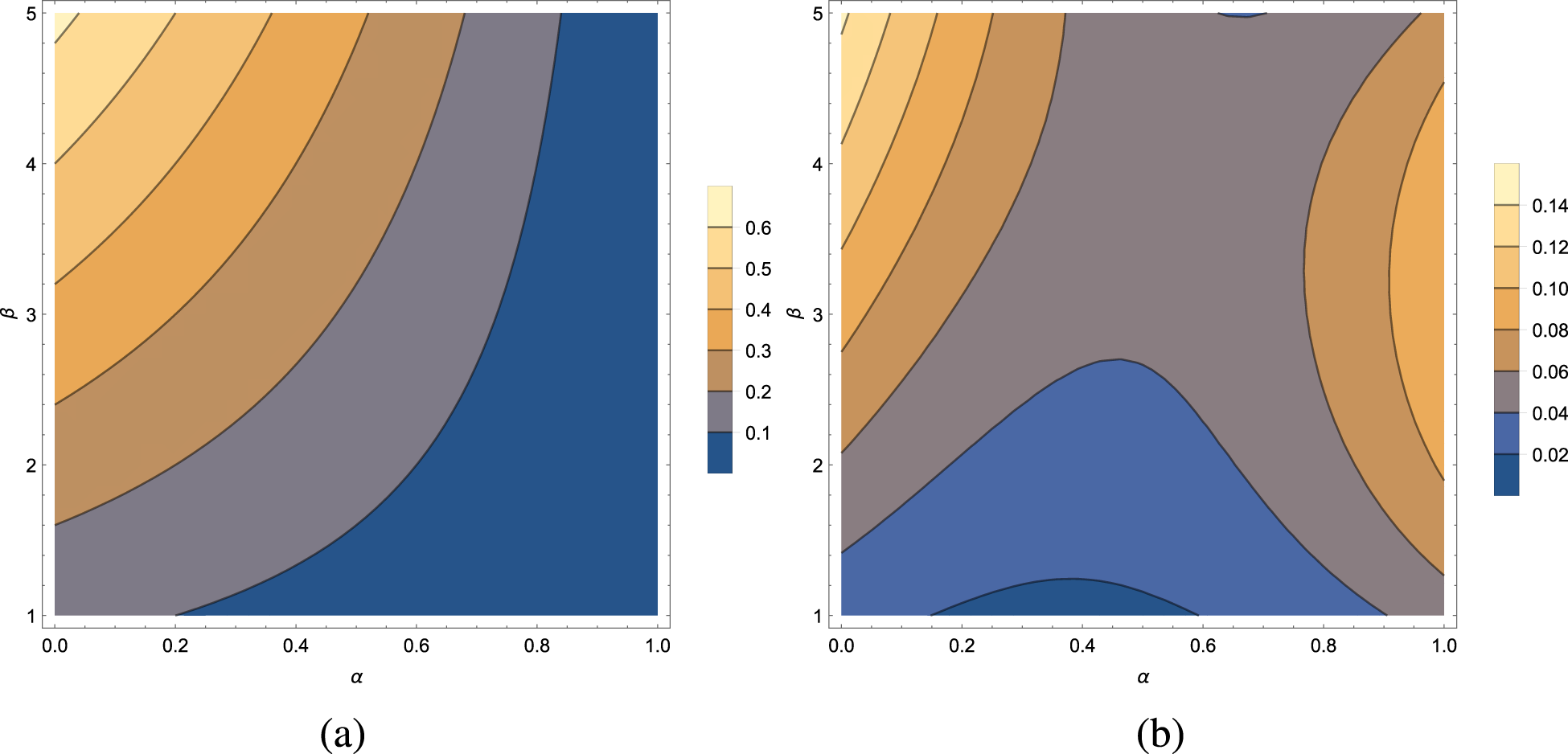
Impact of collaboration parameter
We could show that the threshold of expected use frequency is increasing in
Next, we provide a visual representation of the impact of parameters
Prior literature dealing with product complexity-related issues has mainly focused on identifying potential reasons for product failure and evaluating the impact of such failures on supply chains (Marucheck et al., 2011). For example, Mackelprang et al. (2015) empirically examine the effects of product innovativeness on product failure. Kirshner et al. (2017) study the implications of product failure on product upgrades. However, unlike us, none of the prior studies have discussed the implications of product complexity and product failure on pricing in the 3D printing supply chain.
Similar to the fixed-fee pricing model, the customer with use frequency
The equilibrium pay-per-build price 
We find that the impact of the customization parameter
The following are true about the impact of product complexity parameter As the product complexity increases, the firm’s quality investment increases (i.e., As the product complexity increases, the firm’s payoff increases if and only if Impact of
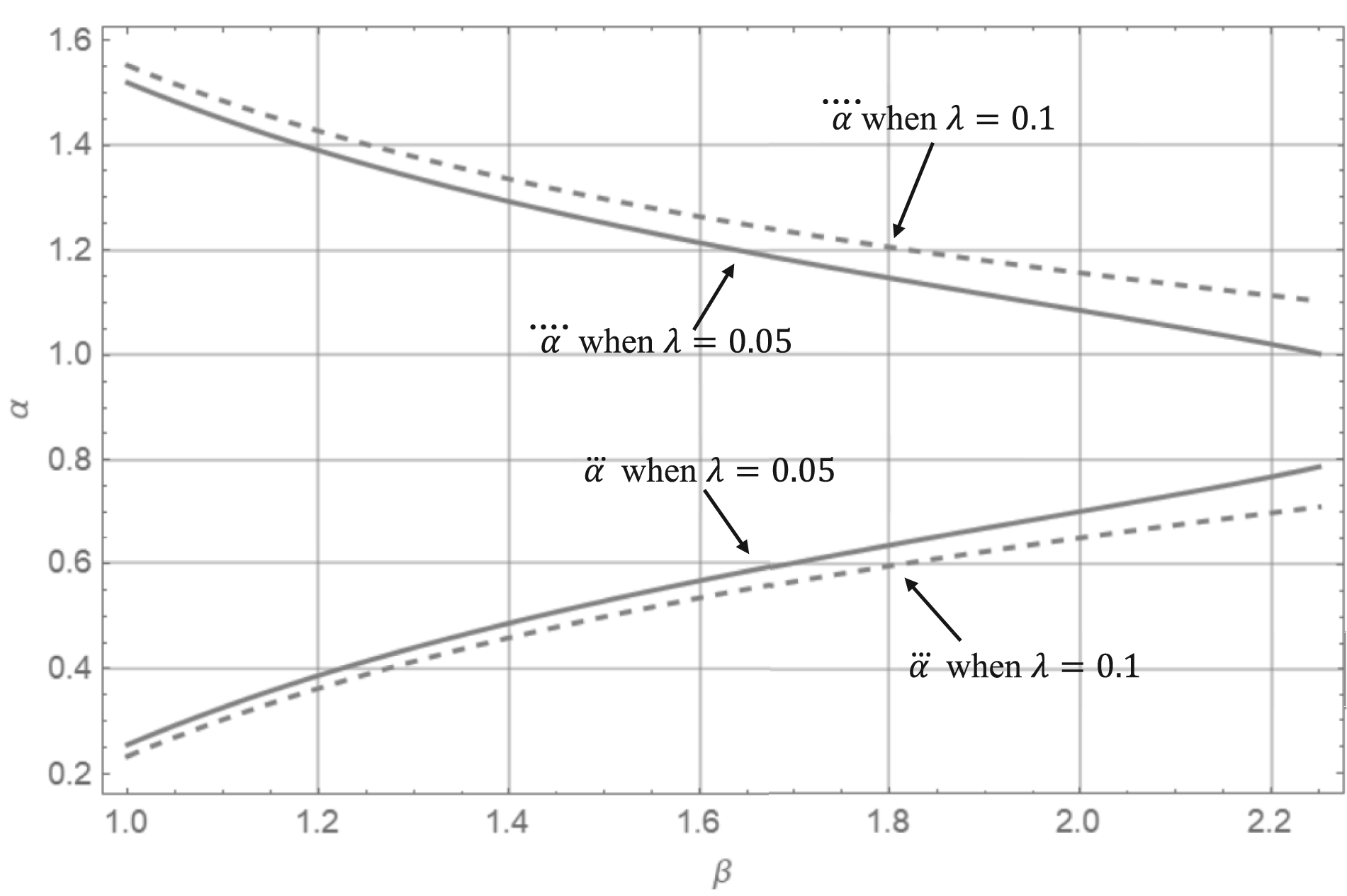
Similar to our observation from Proposition 3, we find that under the pay-per-build pricing model, high complexity faced by customers leads to an increase in the firm’s quality investment. Moreover, similar to our discussion in Proposition 3(a), we find that high product complexity
This is because, when
If the product customization parameter
Similar to the main model in Proposition 5, we find that if the extent of the product design customization by 3DaaS users is relatively high or low (i.e.,
In Figure 3, we illustrate the impact of product complexity and failure rate parameters (
We now try to understand the role of product complexity parameters on the 3DaaS firm’s choice of pricing model. We also present a visual representation of the payoff comparison across different ranges of
The reason is when the product has a low failure probability (
Interestingly, we observe that when
As mentioned in the discussion of Proposition 3, the previous research has mainly focused on understanding the implications of product failure and product complexity on various issues in product design (Mackelprang et al., 2015; Kirshner et al., 2017). However, these papers do not provide insights into the implication of product complexity on payoffs of 3DaaS firms under different pricing models, which is one of the key focuses of our work. We suggest that implementing a pay-per-build pricing model would generate relatively higher benefits for 3DaaS firms when faced with customers printing highly complex designs with a relatively low probability of failure. As the 3DaaS sector matures over time, the evolution is anticipated to lead to greater proficiency through enhanced learning-by-doing and accumulated experience in managing intricate designs. This progressive refinement may consequently contribute to a reduction in the probability of product design failures. In the broader temporal context, we could reasonably anticipate witnessing an upswing in the prevalence of firms embracing the pay-per-build model when catering to customers seeking to create highly complex products.
Our analysis further uncovers that when customers employ 3D printing devices to produce highly complex jobs accompanied by a substantial probability of failure, the fixed-fee model yields a higher payoff for the 3D printing service provider. This scenario often encompasses 3D printing services tailored to prepare intricate jobs designed for R&D purposes. Given the inherently frequent occurrence of design failures in this context, setting a high fixed-fee emerges as a strategic approach, potentially targeting customers with a high frequency of usage within this category. In contrast, for scenarios characterized by a moderate level of complexity, our recommendation continues to lean toward implementing a pay-per-build pricing model. Due to the relatively high likelihood of successful prints (attributed to the comparatively lower complexity of these jobs), 3DaaS firms are apt to set a premium unit pay-per-build price aligned with the heightened value bestowed upon customers.
Lastly, we demonstrate that 3D printing services used for tasks involving exceedingly low complexity are best suited for a fixed-fee pricing structure. Instances of such tasks encompass 3D printing services adopted by hobbyists for endeavors such as creating toys (since these applications have straightforward instructions, the designs aren’t intricate). In general, customers in this category acquire limited value from these tasks (owing to the reduced usefulness of less intricate work). Consequently, the firm sets a substantial fixed-fee for extending these services to customers who engage in frequent usage (since these customers attain a relatively high value).
We further extended our setup with product design complexity by considering a scenario where the firm incurs a liability cost structure. In this setup, the customer is only charged for successful prints under the pay-per-build pricing scenario. Due to space constraints, we provide the full detailed analysis in Section EC.5 of the E-companion of the paper. We find all our insight on the impact of product cocreation parameter
Additionally, we find that under the pay-per-build pricing model, the profit of the 3DaaS firm is the same irrespective of whether the customer or firm shares the product failure liability. This is because this mechanism can extract the entire customer surplus. Therefore, when the firm incurs liability costs, this additional cost burden gets offset by the higher surplus extracted from customers (as customers do not face any liability cost structure). Interestingly, under the fixed-fee pricing model, we observe that the firm’s profit and customer surplus are higher when the customers bear the liability cost (as compared to when the firm pays for the liability losses). The reason is, when the firm bears the liability losses, it tends to charge a high fixed-fee and invests low in quality (compared to when customers bear liability losses). The higher fixed-fee and lower quality investment reduce customer surplus, as well as, reduce the demand faced by the firm. Therefore, this leads to lower payoffs for the 3DaaS firm when it bears the liability losses. This observation may provide a possible explanation for real-life practice in the 3D printing industry where customers typically incur such liability losses.
Model Extensions
We now extend the main model to verify the robustness of our results. First, we present the analysis of the output function where efforts by both players have a synergistic influence on the overall product quality. In the second extension, we consider a different customer utility model considering uncertainty about customer use frequency. In the third extension, we consider a market structure under competition. In the fourth extension, we also consider the case when the customer is a mass manufacturer and prints multiple copies of a single design using the 3D printing service. In our paper, apart from the above robustness checks, we also consider several other model extensions. Due to space constraints, we provide a detailed discussion of these additional robustness checks in Section EC.6 in the E-companion file.
Alternate Quality Collaboration Function
In practice, there exists the possibility of quality efforts by both the 3DaaS firm and customers complementing each other, wherein a low magnitude of efforts by either player might negatively impact the overall output. Illustrations of such job structures within the context of the 3D printing industry might involve designing 3D-printed electronic circuit items, complex car engine assemblies, and biomedical implants. The reason behind such dynamics is that the availability of high-quality design template files (due to the firm’s high
Comprehensive Customer Utility Model
As discussed in Section 3.1, the variations in customers’ business requirements lead to heterogeneity in the usage frequency of 3D printing services (Carbon, 2023b). In this extension, we consider a more comprehensive model to capture the uncertainty associated with customer usage frequency. Specifically, we analyze a setup where a customer can be of the low-usage type (with use frequency equal to 


Under the pay-per-build pricing model, we find that the customer’s quality investment is given by 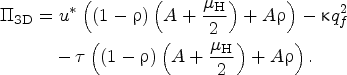
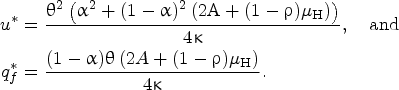
Competition Faced by 3DaaS Provider
In real-life scenarios, it is plausible that customers have the option to utilize 3D printing services from other competing providers. For instance, in business practice, 3DaaS providers such as HP may face competition from companies such as Carbon. Thus, in this section, we investigate the consequences of a customer’s outside option. We assume that each unit’s net value gained by the customer from the outside option (obtained by subtracting the unit price from the consumption utility) is denoted by 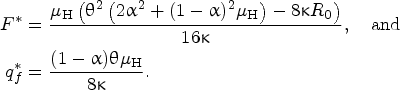

Repetitive Manufacturing Scenario
In general, the customers are heterogeneous in their design requirements while using 3D printing services. Some customers might like to design multiple products and print them (design customers). However, some customers might design one product and print multiple replicas of the design file (repetitive manufacturers). Therefore, we extended the main model to consider the scenario where the customers prepare a unique design file to print multiple product replicas. We present the detailed analysis of this extension in Section EC.7.2 of E-companion. All our insights from the main model setup are robust in this extension. Additionally, we compare the firm’s pricing strategy toward design and repetitive manufacturing customers. We find that if the relative impact of the customer on the product quality is high and the expected number of units printed is low, then 3DaaS firms should charge a higher price from the design customer as compared to the repetitive manufacturing customer (in all pricing models). Therefore, 3DaaS providers need to understand customer usage and collaboration dynamics while deciding the pricing strategy.
Conclusion
Companies such as HP and Carbon utilize diverse pricing models to offer 3DaaS. In this paper, we analyze a supply chain setting with 3D printing device providers and downstream customers who use the 3D printer to customize and print a final object. We examine the different pricing strategies used by 3DaaS firms, namely, fixed-fee and pay-per-build pricing models. We characterize the equilibrium product quality customization efforts and the optimal pricing strategy for both pricing models. To find the best pricing model from the perspective of the 3D printing device provider, we compare the payoff under different settings. Our analysis reveals that the 3DaaS firm’s choice of pricing model is primarily driven by factors such as (i) the extent of product design customization and (ii) product design complexity.
We find that an increase in the extent of customization by the 3DaaS users might not always lead to a lower price charged by the firm. Specifically, if the degree of customization by users is relatively high or low, then the fixed-fee or pay-per-build price should be high. But in the moderate range of the extent of customization, the prices should be low. Additionally, we find that if either the 3DaaS firm or the customers significantly impact the quality of the product, the 3DaaS firm earns a higher profit when it implements a pay-per-build pricing model. On the other hand, if both players have a similar effect on product quality, the 3DaaS firm finds it more advantageous to implement a fixed-fee pricing model.
The above finding indicates that 3D printing services utilized for products such as standard smartphone cases, cable holders, educational puzzles, hobbyist kits, and basic decorative items (where the 3DaaS firm provides standard design files, so the customer does not exert much product design customization efforts), can be offered using a pay-per-build pricing model. Furthermore, when customers need something unique, such as designing premium jewelry, distinctive architectural models, medical implants, or engineering designs, the firm might still choose the pay-per-build pricing model since the customers will be exerting most of the product design customization efforts.
The 3DaaS firms must be also careful about the complexity of 3D design models printed by customers. This is because highly complex designs may face a high failure rate (which may discourage customers from opting for 3DaaS); on the flip side, if printed successfully, it may generate a higher utility for the customers. Our analysis reveals that high design complexity may increase or decrease the 3DaaS firm’s unit prices (under both pricing models). Specifically, if the product design complexity is high, but the product failure rate is low, and printing use frequency is high, then the prices of 3DaaS should be high. Typically, such a customer profile may include engineering divisions of businesses, who might be printing multiple designs but have a certain level of 3D printing design experience, ensuring that the product failure rate is not drastically high.
Furthermore, when the product design is quite complex, and the chances of design failures for such complicated structures are minimal, the firm might opt for the pay-per-build pricing model for its 3DaaS services. However, in situations where the customers frequently engage in designing and printing tasks that involve either less complex or highly intricate designs (with a high likelihood of design failures), the firm could choose to utilize the fixed-fee pricing model. In practice, if a particular kind of 3D printing service is used for complex new R&D designs that carry a high chance of failure, according to our findings, these specific 3DaaS services may be provided using a fixed-fee pricing approach. Moreover, fixed-fee pricing might be also more appropriate when 3DaaS is used for tasks such as printing well-defined geometric shapes, functional components such as brackets and clips, simple fixtures, or less intricate jewelry items. It is only when serving customers who are adept at handling complex designs (and thus encounter lower chances of failure) that the firm might go with the pay-per-build pricing model. We present the summary of key insights in Table 2.
Optimal 3D printing pricing strategies.
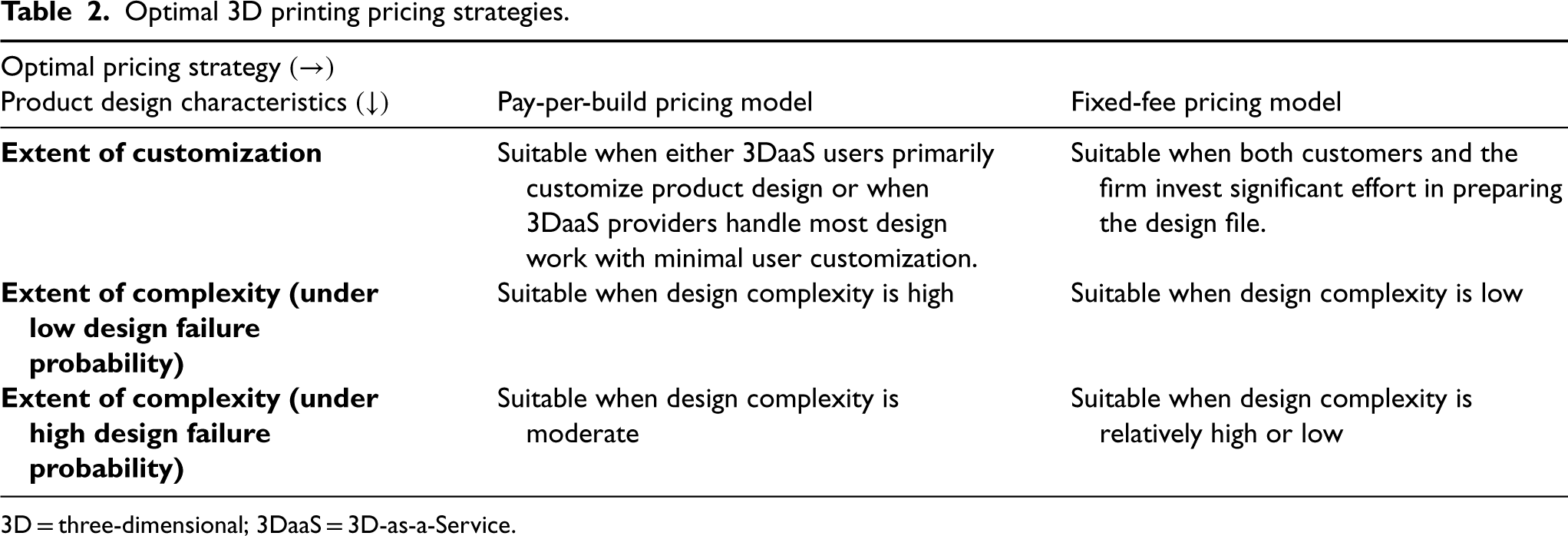
3D = three-dimensional; 3DaaS = 3D-as-a-Service.
Our study contributes to emerging research on operational issues in 3D printing supply chains, which have mainly focused on inventory-related issues in 3D printing supply (Westerweel et al., 2018; Song and Zhang, 2020; Arbabian and Wagner, 2020). We also contribute by providing insights or the implications of pricing model selection by the firm offering 3DaaS. The previous literature on collaboration issues in service supply chains has mainly focused on B2B setups with vendor–client quality collaborations under output/effort-based pricing structures (Demirezen et al., 2016, 2020). Unlike them, we focus on studying product quality collaboration between customers and 3DaaS firms under pay-per-build and fixed-fee structures. Ultimately, our contribution extends to the existing literature on pricing dynamics in service supply chains as we elucidate how elements such as the degree of product design customization and the level of product design complexity influence the decision-making process of 3DaaS firms regarding their chosen pricing model within the realm of a 3D printing supply chain.
Footnotes
Acknowledgments
We are thankful to the Departmental Editor, the Senior Editor, and the anonymous reviewers for their feedback, which has substantially improved the paper.
Declaration of Conflicting Interests
The authors declared no potential conflicts of interest with respect to the research, authorship, and/or publication of this article.
Funding
The authors disclosed receipt of the following financial support for the research, authorship, and/or publication of this article: Tarun Jain and Jishnu Hazra were supported in part by the Indian Institute of Management Bangalore under the IIMB Chair of Excellence.

How to cite this article
Jain T, Hazra J and Gopal R (2024) 3D Printing-as-a-Service: An Economic Analysis of Pricing and Cocreation. Production and Operations Management 33(7): 1437–1456.
References
Supplementary Material
Please find the following supplemental material available below.
For Open Access articles published under a Creative Commons License, all supplemental material carries the same license as the article it is associated with.
For non-Open Access articles published, all supplemental material carries a non-exclusive license, and permission requests for re-use of supplemental material or any part of supplemental material shall be sent directly to the copyright owner as specified in the copyright notice associated with the article.
