




Abstract
Diversity, equity, and inclusion (DEI) has been gaining attention in operations and supply chain management (OSCM) research but is often narrowly framed and dominated by instrumental logic. We offer three lenses that potentially broaden the scope of this scholarship: justice, paradox, and dialectical. The justice logic frames DEI as primarily a moral concern of inequality in firms and supply chains. It goes against an instrumental, performance-driven approach to establishing DEI in OSCM. To understand the persistence of tensions in DEI implementation, we present a paradox lens and link it to OSCM through four major types of organizational paradoxes: performing, organizing, learning, and belonging. We employ a dialectical perspective to resolve these tensions and combine instrumental and justice logics to explore how the latter can help firms realize DEI's (often unfulfilled) performance potential. OSCM scholars are well placed to use justice, paradox, and dialectical lenses to assess pathways for realizing DEI's transformative potential through modeling, decision support, and empirical research. Such research can help managers pursue objectives that conflict with or go beyond instrumental DEI, thus contributing to substantive DEI implementation.
Keywords
Introduction
Diversity management emerged as a managerial response to the inequalities that blight the working lives of women and minorities. However, despite decades of diversity management initiatives, many inequalities remain (e.g., Esper et al., 2020). Diversity, equity, and inclusion (DEI) efforts have developed as a more comprehensive response to these persistent problems. Diversity concerns the composition of the workforce in teams (Ely et al., 2012), the firm (Bernstein et al., 2020), and suppliers (Blount and Li, 2021; Sordi et al., 2022) and is often linked to high levels of inequality (Janssens and Zanoni, 2021). Diversity and inclusion efforts emerged in the 1990s to increase the participation of women and minorities in organizations and supply chains. Following work that highlighted the problem of inclusion on unequal terms (Kalev, 2009), the element of equity was added to create a level playing field within organizations (Bernstein et al., 2020) and eliminate the adverse effect of unjust supply chain relationships on marginalized groups (Chen et al., 2022; Narasimhan et al., 2013). DEI thus offers the potential to realize the promise of diversity management and address the inequalities and exclusion experienced by women, minorities, and marginalized suppliers (e.g., Narayanan and Terris, 2020).
Despite the promises of DEI, existing frameworks are far from coherent, and there is a lack of clarity on how DEI can be integrated into a comprehensive set of operations and supply chain management (OSCM) objectives. The relationships between the different dimensions of DEI are complex. For some, inclusion is the end goal of DEI—for example, BCG (2019) sees inclusion as the means to unlock the power of diversity. Others treat DEI as a means to an end; for example, Bernstein et al. (2020) see DEI as a way to increase equity. OSCM scholars and practitioners are becoming increasingly aware of DEI research opportunities (e.g., Aral and Van Wassenhove, 2024; Berenguer et al., 2024; Tang, 2023). However, they are often constrained by an instrumental logic that seeks to justify engagement with DEI as a way to improve performance (e.g., profit seeking) or increase stakeholder responsiveness (e.g., Shan et al., 2017; Singh and Point, 2004; Vlas et al., 2022).
The aim of our study is to broaden OSCM perspectives beyond this instrumental logic. We propose justice as an alternative to the instrumental logic of DEI. In Sections 2 and 3, we illustrate the instrumental and justice logics of DEI, which are often perceived as conflicting. In Section 4, we present a paradox lens to explore the persistent tensions in DEI implementation. Section 5 outlines a dialectical perspective that combines instrumental and justice logics to explore how the latter may help firms achieve the (often unfulfilled) performance potential of DEI. Each approach offers a conceptual resource for OSCM scholars, the appropriateness of which will depend on their research context. In Section 6, we conclude and present future research opportunities.
An Instrumental Logic of DEI
An instrumental logic treats DEI as a driver of OSCM performance (e.g., Mani et al., 2018). Instrumental approaches are often referred to as the “business case for DEI”. We prefer the term “instrumental DEI” as the term “business case” is contested (Brennan, 2023). Instrumental DEI is based on a narrow economic view of business, which assumes that management is a largely amoral practice. This approach is disputed in OSCM scholarship (Gold and Schleper, 2017).
According to this logic, experiences of inequality and exclusion have potentially problematic outcomes for businesses, for example, in the form of employee turnover, absenteeism, low task performance, lowered resilience, and stress (Colquitt et al., 2013; Mor Barak et al., 2016). DEI is seen as a way to optimize the allocation and use of human capital within firms, across supply chains, and within the economy at large (Becker, 2013; Ruel and Fritz, 2021), leading to improved team (Rock et al., 2016) and organizational performance (Bassett-Jones, 2005; Benschop, 2001).
DEI unlocks the potential of “cognitive diversity” (i.e., the different mental models, perspectives, and backgrounds of employees) through demographic diversity, helping to stimulate innovation and creativity (e.g., Ely and Thomas, 2020). However, demographic diversity does not necessarily increase cognitive diversity as age, gender, race, ethnicity, sexual orientation, socioeconomic background, etc., can produce similar cognitive styles (Glick et al., 1993). Inclusion and equity are intended to resolve this problem but often fail to do so (Oraiopoulos and Kavadias, 2021). In many cases, firms adopt policies and mandatory training to support their DEI strategies, but these cannot be effective if exclusionary practices remain unchallenged and equity is not increased (Dobbin and Kalev, 2016).
OSCM scholars should be aware that the literature is characterized by contradictory results concerning the ability of corporate management to improve performance through DEI efforts. Studies on instrumental DEI have found insignificant, mixed, or negative results regarding the effect on performance (Benschop et al., 2015; Choi and Rainey, 2010; Mamman et al., 2012; Richard, 2000). Some doubt that DEI directly leads to better organizational performance, as the hesitance in adopting DEI practices suggests doing so is not always rewarded by the market (Brennan, 2023). Does the ambiguous relationship between diversity and business performance mean that DEI is not a legitimate concern for OSCM? A negative answer would clearly be unsatisfactory for OSCM scholars and managers.
A Justice Logic of DEI
Justice-based arguments for DEI emerged from a critique of diversity management initiatives and their ineffectiveness in reducing inequalities (Janssens and Zanoni, 2021). Fundamentally, advocates of this approach object to the instrumental logic, which can undermine justice arguments and outcomes. Some fear that if DEI initiatives fail to improve OSCM performance, stakeholders may become demoralized and withdraw their support (Ely and Thomas, 2020), and women and minorities may see instrumental DEI initiatives as inauthentic (Brennan, 2023).
Instrumental arguments for DEI are predicated on managers acting according to economic imperatives (Carrillo Arciniega, 2021), but many OSCM managers are motivated by moral and performance factors (Schleper et al., 2017). In contrast, the justice logic suggests that DEI is not a means to better organizational and supply chain performance but an end in itself. According to this logic, diversity is constructed differently. DEI is not pursued to improve performance; rather, its primary concern is “stopping and correcting the problems which result from mistreating people because of their demographic identity” (Brennan, 2023: 434).
Within the justice-oriented DEI literature, the focus is on two overlapping forms of justice (Colquitt and Zipay, 2015): distributive justice, which is concerned with the fair distribution of resources, and recognitional justice (or “interactional justice”), which is concerned with the interactive processes by which individual self-esteem is produced. Recognitional justice acknowledges the importance of the identity, values, and needs of individuals (Langemeyer and Connolly, 2020). For many DEI scholars, distributive and recognitional justice cannot be understood independently; distribution cannot be fair without consideration for human dignity (Tyler, 2019).
Distributive and recognitional justice are fundamentally contested concepts (Gallie, 1956; Matthews and Silva, 2024). However, there is an egalitarian belief shared among justice-oriented scholars that equality is socially desirable (Brennan, 2023), heightening their sensitivity to distributive injustice and power inequalities. Consequently, they tend to advocate for more radical changes compared to scholarship that is more instrumentally oriented. Here, “radical change” refers to challenging the unequal power relations entrenched within OSCM processes. For example, some scholars adopting this approach promote a reorientation of supply chain governance toward workers and the principles of democratic participation in supply chain decision-making (Reinecke and Donaghey, 2021).
Justice-oriented DEI initiatives can reduce power inequalities through processes of recognitional justice. Janssens and Zanoni (2014) and Zanoni and Janssens (2007) study social purpose businesses and minority employees and show that valuing their diverse knowledge and competencies reduced disparities and led to “micro-emancipation” that is, “employees have greater scope for arranging their own schedules and working practices, albeit with the parameters (e.g., quantity and quality targets) set by others” (Alvesson and Willmott, 2002: 624). Micro-emancipation efforts can be supported by well-known OSCM approaches, for example, total quality management, which empowers and motivates employees to pursue continuous quality improvement (Spencer, 1994), and cross-functional teams, which can help overcome job segregation (Kalev, 2009). Overcoming such job segregation can, for example, also be achieved by fostering collaboration between those overrepresented in lower-status positions, such as women and minorities, and their colleagues in higher-status roles. These examples show that processes and practices focused on improving operational and supply chain performance have the potential to promote inclusion within diverse workforces.
Interestingly, micro-emancipation may be best achieved when the goal is OSCM performance rather than DEI. Dobbin and Kalev (2016) find that a focus on performance produced teams more open to including members of marginalized groups in decision-making, concluding that “some of the most effective solutions aren’t even designed with diversity in mind” (p. 54). OSCM scholars should thus be aware that processes of micro-emancipation may be achieved indirectly. This suggests that the instrumental and justice perspectives are not always opposed—an idea we return to in Section 5.
Understanding DEI Through a Paradox Perspective
An important contribution of the justice logic is that it highlights the paradoxes in implementing DEI. Paradoxes are defined as “contradictory yet interrelated elements that exist simultaneously and persist over time” (Smith and Lewis, 2011: 382). Smith and Lewis (2011) identify four types of organizational paradoxes that are useful for understanding DEI implementation: performing, organizing, learning, and belonging. We describe each of these paradoxes and their relation to OSCM scholarship and identify potential research opportunities.
Performing Paradoxes
Performing paradoxes emerge when complex systems have conflicting objectives (Smith and Lewis, 2011). In the context of DEI, performing paradoxes may emerge if OSCM performance measures overlap with structures of inequality. Zanoni (2011) provides a useful example in their study on the difficulties of managing a diverse workforce in a manufacturing company with a lean production system. Despite the company's laudable diversity goals, some workers felt excluded by the requirement for flexibility demanded by its lean operations performance management system. The idea of diversity as a lack of ability and flexibility was widely shared in the factory (Zanoni, 2011). The criterion of flexibility was used as the basis of negative assessments of women, disabled, and older workers, leading to decisions that reduced demographic diversity in the workplace. The workers’ perceived lack of flexibility—women and disabled workers were perceived as being incapable of more physically demanding tasks and older workers being less able to learn new tasks—was widely interpreted as an “unwillingness to work” (Zanoni, 2011: 116). The firm's “lean manufacturing” performance measures reinforced existing inequalities and undermined the potential for inclusion created by their commitment to diversity.
There is a long tradition in OSCM scholarship of investigating performing paradoxes and trade-offs (Matos et al., 2020), and this could be expanded to include the relationship between performance measures and DEI. Zanoni (2011) considered the operations of a single firm, but it would be worthwhile to explore the impact of OSCM performance measures on DEI across supply chains. Furthermore, it would be interesting to explore how OSCM performance measures influence DEI implementation in the first place.
Organizing Paradoxes
Organizing paradoxes emerge when complex systems create multiple processes that exist in tension with each other (Smith and Lewis, 2011). For example, if a firm's OSCM reinforces unequal power structures, it undermines DEI goals. In Zanoni's (2011) case, the perception that diversity is incompatible with lean performance requirements also informed the firm's approach to reorganizing operations. In response to cost pressures, the business outsourced the work done by women and disabled workers, and older workers retired as part of the restructuring, leaving the workforce less diverse.
Similar organizing paradoxes affect DEI implementation in global supply chains, where power inequalities can be particularly pronounced. The overlapping of inequality, insecure working arrangements (e.g., zero-hour contracts), and the exploitation of women, minorities, and vulnerable people (Kougkoulos et al., 2021; Schleper et al., 2022) creates a global economy characterized by “unequally distributed precarity” (Janssens and Zanoni, 2021: 14). While supply chains have been organized to benefit from comparative cost advantages, tensions are likely to persist in the implementation of DEI in the absence of systemic change that redresses global power inequalities (Karaosman and Marshall, 2023).
OSCM scholars have begun to propose ways to address unequal power structures and their effects on DEI (e.g., Gold and Schleper, 2017). Some researchers call for more “worker-driven supply chain governance”—that is, “democratic participation of workers and their representatives in supply chain governance” (Reinecke and Donaghey, 2021: 14). This raises the question of whether DEI will be diffused through supply chains by focal firms and existing power hierarchies (Villena, 2019) or whether it will emerge through the empowerment of decentralized, marginalized actors (Ansari et al., 2012). There are also clear opportunities for research into the links between outsourcing decisions and the success of DEI efforts, building on Zanoni's (2011) findings that “make-or-buy” decisions can be informed by bias, potentially undermining DEI commitments.
Learning Paradoxes
Learning paradoxes emerge when complex systems change, creating tension between the forces of continuity and change (Smith and Lewis, 2011). Those implementing DEI initiatives are sometimes criticized for lacking the learning orientation needed to bring about systemic change in OSCM processes (Dobbin and Kalev, 2016). For example, in the United States, sheltered workshops providing employment and training for disabled people have undermined their employability and autonomy, reproducing the very structures of discrimination they were intended to challenge (Hoffman, 2013).
In many firms, DEI has been formalized through the so-called “command-and-control” approaches that use policies and training to counter bias (Ely and Thomas, 2020). These formal approaches often fail as they leave in place structures, such as departmental and job segregation, that undermine DEI implementation (Holck, 2016). These structures may provide continuity in OSCM performance but fail to harness the cognitive diversity offered by demographically diverse workforces (Ely and Thomas, 2020). Some suggest that DEI initiatives should instead embrace the learning potential of such OSCM processes, for example, through self-managed and cross-functional teams (Dobbin and Kalev, 2016).
The indirect effects of OSCM on DEI outcomes offer another exciting research opportunity. For example, diverse teams motivated by operational performance targets may utilize their diversity to make more inclusive decisions to achieve those targets, indirectly promoting DEI (Dobbin and Kalev, 2016). OSCM research can contribute to a better understanding of the mediating processes in DEI efforts that “activate” the potential of diversity (such as collaboration among diverse team members; Bernstein et al., 2020) and the moderating role of other factors, such as entrepreneurial orientation (Richard et al., 2004). OSCM is well-positioned to address these processes, given its long tradition of researching antecedents, mediated relationships, and moderating contingency variables (Sousa and Voss, 2008). Research on DEI can also draw on the concepts of learning and capability building that contribute toward sustainable OSCM more broadly (Sauer et al., 2022; Zhang et al., 2020).
Belonging Paradoxes
Belonging paradoxes refer to incongruence between the values and goals of an individual and those of the organization they work for (Smith and Lewis, 2011). This may extend to the norms embedded in the firm's various supply networks, business ecosystems, or the broader sociopolitical and legal system (Bodrožić and Gold, 2024; Mor Barak, 2015; Wieland, 2021).
In uncertain environments, individuals may seek a sense of belonging by working with others with whom they share a particular identity, possibly undermining the potential of OSCM processes to deliver DEI outcomes (Holck, 2018). For example, in a case study of a Danish service operation, Holck (2016) shows how collaborative patterns are determined by “similarity attraction,” a process by which individuals choose to form groups with those they perceive to be similar to themselves. The service organization had a flexible, “flat” structure that supported cross-functional and self-managed teams, which potentially increased equality and inclusion in a diverse workforce (Ely and Thomas, 2020). However, due to similarity attraction, diversity in the teams tended to be low (Holck, 2016). Holck (2016) explains the similar attraction for workers in both dominant and ethnic minority groups as the result of an uncertain work environment; the company had gone through multiple restructurings, leaving the transformative potential of cross-functional and self-managed teams unrealized.
Paradoxes of belonging are useful for researching OSCM as a multilayered phenomenon that comprises individual, organizational, and supply chain levels. Future studies could consider how individuals reproduce informal, “ethnified” hierarchies (Holck, 2018) through similarity attraction (Holck, 2016) and how this may undermine the transformative potential of OSCM processes and practices. Researchers can build on work that acknowledges the problems arising as a result of simultaneous commitments to different norm systems. For example, (sub-)suppliers may respond to different norms (i.e., institutional multiplicity) through decoupling strategies establishing symbolic forms of compliance (Nath et al., 2020; Marques et al., 2024).
The ambiguities of DEI implementation evident in the literature pose problems for linear approaches to theorization based on simple antecedent-outcome logics. However, a paradox lens embraces this messiness, which reflects the reality experienced by many OSCM stakeholders with different and evolving perspectives on how DEI dimensions relate to each other. Acknowledging and exploring these tensions through a paradox lens enables the development of a more nuanced and sophisticated DEI account.
Toward a Dialectical Perspective on DEI
There are issues with both the instrumental and justice logics within DEI scholarship. Justice-oriented DEI scholarship tends to focus on the “dark side” of diversity management (Tisserant et al., 2013). This approach effectively exposes how diversity strategies can fail to deliver equity and inclusion and, in some cases, may perpetuate or exacerbate injustice and exclusion (e.g., Holck, 2016, 2018); unfortunately, this scholarship offers few practical solutions (Janssens and Zanoni, 2021). Instrumental approaches are criticized for not being sufficiently open to the learning required to fully realize DEI's performance benefits (Ely and Thomas, 2020). Thus, there have been several calls for more nuanced DEI approaches (e.g., Van Dijk et al., 2012).
Our response is to present a dialectical perspective (Hargrave and Van de Ven, 2017; Schad et al., 2016) to DEI research and theorizing. This approach resolves a paradox by taking its contradictory elements (thesis and antithesis) and merging these into new perspectives (synthesis) (Bledow et al., 2009; Hahn et al., 2015). Rather than seeing instrumental and justice logics as alternatives, a dialectical perspective accepts that the two can be synthesized in specific business contexts and particular points in time. Below, we present an example in which the thesis is based on a simplistic instrumental logic, that is, a problematic instrumental DEI that has a narrow focus on economic utility (Ely and Thomas, 2020). The antithesis is the justice logic, and the dialectical synthesis of the two in our example creates what we term a “learning orientation” toward DEI.
Most empirical work adopts either the instrumental or justice logic of DEI, with the dialectical perspective yet to emerge as a significant theoretical approach. We therefore present an elaborated example (USA Bank) that adapts Ely et al.'s (2012) study on the relationship between racial equality, learning, and performance within the US retail banking sector. 1
Simplistic instrumental logic (thesis). USA Bank made a public commitment to DEI and adopted recruitment policies to ensure a high level of ethnic diversity in its workforce. Its executives believe that diversity will lead to improved operational and financial performance, and its commitment to DEI has led to it being seen as a role model in the industry. However, the bank implemented an “add diversity and stir” approach (Ely and Thomas, 2020: 116) that focuses on diversity without addressing the need for equity and inclusion.
Justice logic (antithesis). At the branch level, there are different approaches to ethnic diversity. In some branches, “ethnic stereotyping” is prevalent: Certain ethnic groups are seen as less knowledgeable about banking operations and are less likely to be involved in problem-solving initiatives. In other branches, this stereotyping is absent: Branch staff feel that stereotyping is morally wrong, resulting in more inclusivity. Their views are consistent with what we call the “justice logic of DEI”. In these branches, the knowledge and problem-solving capabilities of all branch staff are valued. This inclusive and egalitarian approach is the antithesis of USA Bank's “add diversity and stir” approach.
Learning orientation (synthesis). USA Bank's simplistic instrumental approach to DEI increased the ethnic diversity of all branches, but operational performance was higher only in those branches where staff followed a justice logic. In these branches, there was an increase in cognitive diversity, and all staff members felt they were in a positive learning environment in which their ideas were listened to and acted upon. This led to improved operational performance as staff learned how to do their tasks more effectively, incorporating a wide range of ideas about the problems facing the branch and solutions to address these. In these branches, a “learning orientation” emerged from a synthesis of the simplistic instrumental logic of diversity-driven recruitment (thesis) and the justice logic of fair inclusion in a diverse workforce (antithesis).
The above example is inspired by Ely and Thomas (2020)'s study on the transformative “learning-and-effectiveness” approach to DEI, in which OSCM scholars interested in dialectical DEI will find a useful theoretical perspective to investigate the nuances of DEI implementation. This transformative approach involves “cultivating a learning orientation toward diversity—one in which people draw on their experiences as members of particular identity groups to reconceive tasks, products, business processes, and organizational norms—enabl[ing] companies to increase their effectiveness” (Ely and Thomas, 2020: 115). The key to the learning-and-effectiveness approach is increasing cognitive diversity by reducing the inequalities in diverse workforces that remain unchallenged by simplistic and instrumental approaches to DEI.
In sum, a dialectical approach can help operations and supply chain managers and stakeholders embrace the evolving ambiguities and messiness at the interface of the instrumental and justice logics. By leveraging a dialectical perspective, OSCM scholars could help managers pursue objectives that are potentially in conflict with or exceed instrumental DEI. This would enable managers to make a significant contribution to addressing societal challenges (Corbett et al., 2022) and advancing well-being by increasing happiness, equity, and sustainability (Corbett, 2024).
Conclusions
In this study, we presented three lenses – justice, paradox, and dialectical – through which OSCM scholars can broaden the scope of DEI research. These lenses provide a conceptual toolbox to navigate the intricacies and complexities of DEI scholarship and practical implementation. The OSCM field is indeed well-placed to use these perspectives to advance DEI from its current instrumental focus through modeling, decision support, and other empirical research (e.g., Rea et al., 2021; Sodhi and Tang, 2014; Sunar and Swaminathan, 2022; Tang, 2018; Van Wassenhove, 2019). For example, future studies could explore the tensions among instrumental and justice aspects of DEI implementation and offer normative guidance on how they can be handled. Empirical testing and elaboration of theories on the emergence and impact of DEI paradoxes could offer a strong link to organizational and supply chain practice. Modeling, decision-support, and empirical research designs are complementary approaches to analyzing the implications of DEI efforts (Melnyk et al., 2023): Empirical evidence should inform modeling research that enables scenario or simulation-based experimentation, and analytical models of paradoxes should be tested for their validity in real-world DEI contexts in operations and supply chains. Table 1 summarizes the proposed research avenues and the various lenses through which DEI can be considered.
Avenues for broadening the scope of OSCM research on DEI.
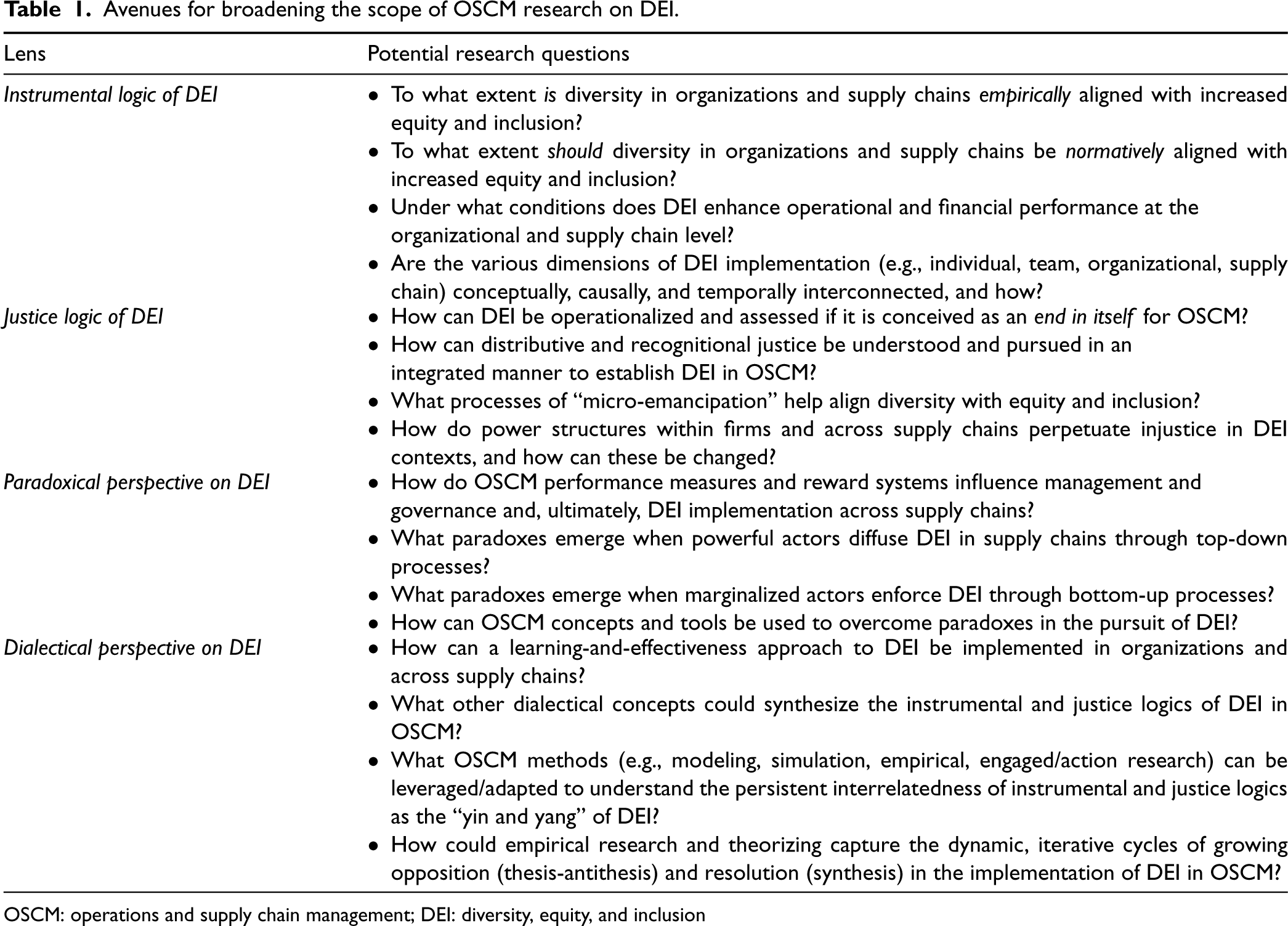
OSCM: operations and supply chain management; DEI: diversity, equity, and inclusion
Footnotes
Declaration of Conflicting Interests
The author(s) declared no potential conflicts of interest with respect to the research, authorship, and/or publication of this article.
Funding
The author(s) received no financial support for the research, authorship, and/or publication of this article.

Notes
How to cite this article
Matthews L, Gold S and Schleper MC (2024) Broadening the Scope of Operations and Supply Chain Management Scholarship on Diversity, Equity, and Inclusion: Justice, Paradox, and Dialectical Lenses. Production and Operations Management 34(4): 819–827.