



Abstract
While we have seen some encouraging examples of firms that try to drive diversity, equity, and inclusion (DEI) practices into their supply chains, progress has been frustratingly slow. We argue that a key impediment today and a potential enabler tomorrow—and thus an important subject of operations and supply chain management (OSCM) research—is the array of public policies that sets the “rules of the game” in OCSM. We differentiate three types of public policy regimes—laissez-faire, regulatory, and transformative—and analyze how each differentially affects DEI practices in OSCM. Our analysis suggests that the laissez-faire type may not offer sufficient incentives to trigger a comprehensive change in DEI practices, while the regulatory and transformative types offer more incentives but, in many instances, do not work as expected. By analyzing the effects of distinct public policy activities for DEI-related practices—for example, through comparative empirical studies or modeling and simulation—OSCM scholars can make important contributions to a more comprehensive implementation of DEI practices.
Introduction
Diversity, equity, and inclusion (DEI) should function as important guiding principles for making operations and supply chain management (OSCM) more sustainable. However, despite some encouraging developments (Sunar and Swaminathan, 2022), such as those pertaining to minority businesses (Blount and Li, 2021), poor people (Sodhi and Tang, 2014; Tang, 2018), and individuals with disabilities (Narayanan and Terris, 2020), progress toward DEI goals has been frustratingly slow (Corbett, 2018; Esper et al., 2020; Huq et al., 2016). For many firms, maintaining sufficiently high profits seems to be much more important than implementing value-based principles, such as DEI (Montabon et al., 2016). A broader and faster shift toward diverse, equitable, and inclusive operations and supply chains, we argue, requires changes in the “rules of the game”—public policy—that enable and constrain change in business practices in both the Global North and the Global South. 1 Public policy could change the priority that focal firms accord DEI principles in their decision-making (Pucker, 2022).
The scant attention devoted to the relationship between public policy regimes and DEI practices in OSCM research is surprising, given that historical turning points for the labor movement, the women's rights movement, and the civil rights movement occurred when the state became an ally for enabling and diffusing DEI practices through public policy. Therefore, the goal of this article is to overcome this gap and analyze the potential effects of distinct types of public policy regimes (laissez-faire, regulatory, 2 and transformative) on enabling DEI in OSCM. In presenting this argument, we join and build on Helper et al.'s (2021, p. 783) call for OSCM researchers to study public policy “to better understand the operations of private firms and their supply chains.”
In the following section, we introduce the distinctions between laissez-faire, regulatory, and transformative policy regimes. Then, we identify exemplary DEI-related studies and use them as a basis for analyzing the potential impact of the three types of policy regimes on DEI practices in OSCM. Finally, we offer suggestions for future research.
Three Types of Public Policy Regimes: Laissez-Faire, Regulatory, and Transformative
In the past, the OSCM field focused primarily on studying the interplay between technology and organization (Bodroži and Adler, 2018; Cooper et al., 1997). More recently, however, a growing number of studies have gone beyond this two-way interaction of technology and organization, and have shown the importance of the three-way interaction of technology, organization, and public policy (Bodroži and Adler, 2022; Helper et al., 2021; Schot and Steinmueller, 2018; Tokar and Swink, 2019). Indeed, whether technologies and organizational forms reinforce a narrow focus on profit or enable a much wider focus on value-based objectives, such as sustainable development goals or DEI, depends to a significant extent on the type of public policy regime chosen (Bodroži and Adler, 2022; Schot and Steinmueller, 2018). There are multiple competing perspectives on the appropriate role of public policy. For the present purpose, we classify them into three broad families: the laissez-faire and neoliberal public policy regimes, the regulatory public policy regime, and the transformative public policy regime (Bodroži and Adler, 2022).
Laissez-faire and neoliberal public policy regimes are characterized by trust in the self-organizing capacity of markets and the voluntary actions of firms, generally rejecting state intervention in the economy. While the proponents of a laissez-faire approach in the nineteenth century argued against state regulation and intervention, the neoliberal proponents of the twentieth century argued in favor of active deregulation and buttressing the autonomy of private-sector actors in the economic playing field. Concerned by potential government failure (Winston, 2006)—for example, through regulatory capture or administrative malfunction—advocates of both a laissez-faire and neoliberal approach argue in favor of a restrained public policy regime, aiming to ensure the autonomy of markets through the enforcement of property and contracting rights (Friedman, 1962; Hayek, 1956). In this perspective, the market should be trusted to stimulate human creativity in dealing with DEI-related problems.
A regulatory public policy regime gives the government a somewhat more active role via regulations that set and enforce social and environmental standards for firms. In contrast to proponents of the laissez-faire/neoliberal public policy regime, proponents of the regulatory public policy regime are less concerned about government failure and more concerned about market failure (Majone, 1994; Samuelson, 1947)—the failure of the market system “to stop ‘undesirable’ activities” (those which contribute to a societal problem) or “sustain ‘desirable’ activities” (those which help overcome a societal problem) (Bator, 1958, p. 351). While proponents of the regulatory public policy regime see the market as the main coordination mechanism (Samuelson, 1947), they are also in favor of finding effective carrot-and-stick remedies for market failures, for example, through offering subsidies or setting taxes. In this perspective, regulation to prevent or correct undesirable activities related to DEI, for example, by setting minimum legal standards for working conditions, would be the path forward.
A transformative public policy regime, in contrast, suggests a much more active role for government, one that includes significant investments in integrated programs (“missions”) to create new knowledge and new social and technological infrastructure (“systems”). Launching missions and building public systems are key means to help guide private industry and investment in a more desirable direction and shift the rules of the game toward desirable goals, such as sustainability or DEI. Proponents of the transformative public policy regime argue that the market is prone to producing severe social and economic problems that culminate in periods of crisis (such as the Great Depression and the extended period of economic and social instability that started with the dot-com crash, continued with the 2008 financial crash and still persists as of the time of writing this article in 2023) (Perez, 2003, 2010; Schumpeter, 1942). Regulation, they argue, could remedy market failures, but is insufficient to direct society in a desirable direction (Laplane and Mazzucato, 2020). To deal with the grand challenges that characterize periods of crisis, public policy needs to actively transform the economy in a specific direction—for example, toward decarbonization.
This perspective is most commonly encountered in neo-Schumpeterian theory (Freeman and Louça, 2001; Perez, 2003, 2010), the literature on (national) innovation systems (Edquist, 1997; Freeman, 1995; Lundvall, 2010), and the scholarship on the entrepreneurial state and the mission economy (Mazzucato, 2015, 2021). Missions, funded and coordinated by the state, mobilize national resources (people, organizations, and knowledge) to address grand challenges (Mazzucato, 2021); systems are built to provide the infrastructure for the long-term resolution of these challenges (Edquist, 1997; Spring et al., 2017). According to this approach, public policy should aim at orchestrating missions and creating systems that enable the robust and sustainable resolution of DEI-related problems. Table 1 provides an overview of each regime.
Three types of public policy regimes.
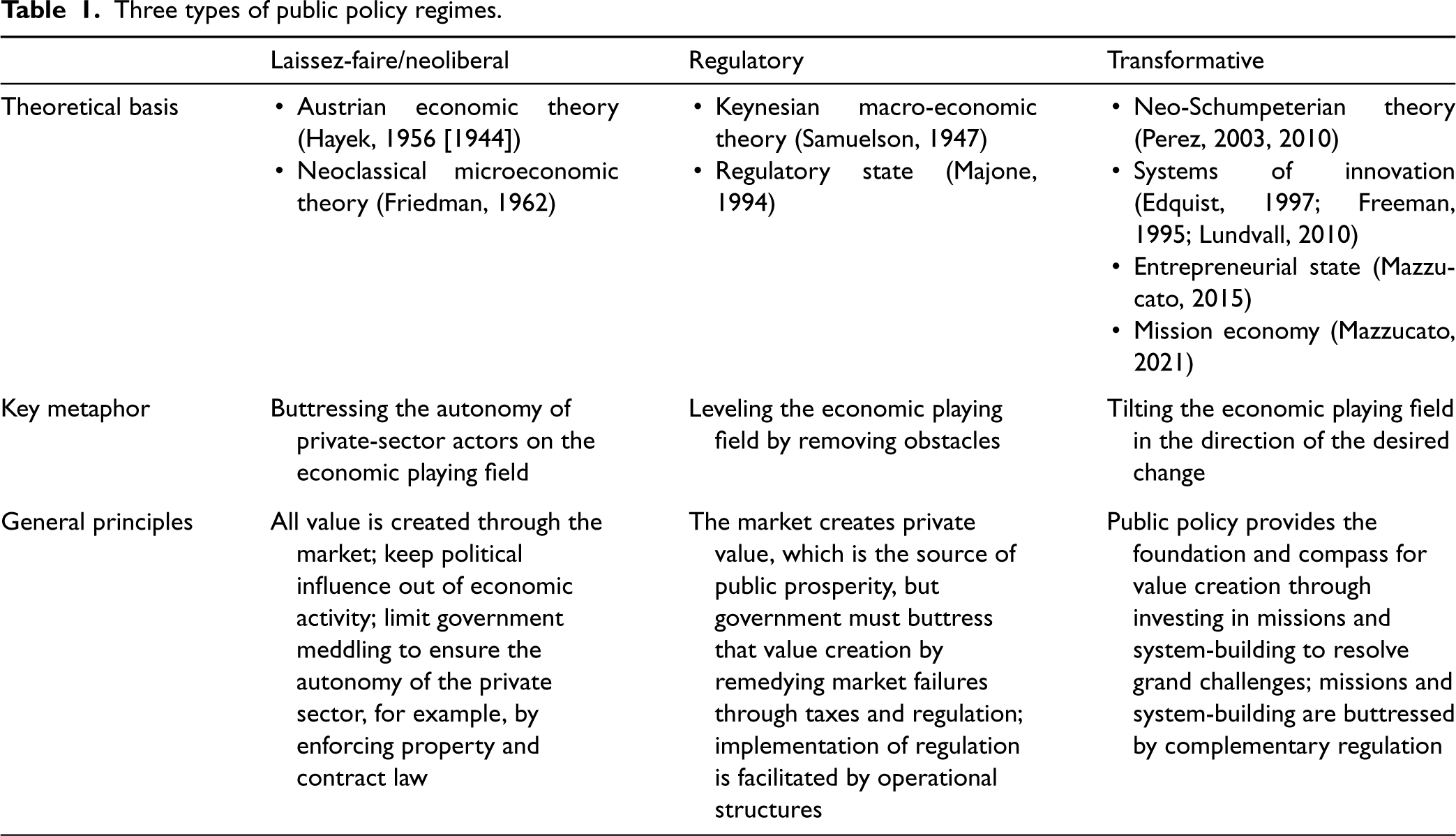
Three types of public policy regimes.
The ascendence of neoliberalism since the 1970s has considerably affected OSCM practices in many countries (Helper et al., 2021). Some OSCM studies have highlighted how the laissez-faire/neoliberal policy regimes impact DEI-related problems, such as the exploitation of dependent supply chain members (Schleper et al., 2017). Other studies, however, have failed to note this impact (Touboulic et al., 2014)—similar to fish that do not notice the water. In the latter case, it is tacitly accepted that government intervention does not play an active role in addressing DEI-related problems in OSCM. Instead, the distribution of wealth across the supply chain (Narasimhan et al., 2013) is left to the market and voluntary activities of firms (Slobodian, 2018). Firms contemplate a range of internally-determined modifications in their DEI practices in response to market changes and the associated threats or opportunities.
Threats to the brand image of firms in the form of “naming and shaming” campaigns by non-governmental organizations (NGOs) can trigger efforts to change poor DEI practices. The exploitation of dependent supply chain members (Schleper et al., 2017; Touboulic et al., 2014) and vulnerable groups (Lund-Thomsen and Lindgreen, 2014) often goes unnoticed for a long period but might suddenly catch the attention of NGOs and conscious consumers through a shock event (Kunz et al., 2023), such as the 2013 Rana Plaza disaster in the Bangladeshi garment sector (Huq et al., 2016). By flagging problematic DEI practices and insisting on “chain liability” (Hartmann and Moeller, 2014), civil society organizations aim to push businesses toward assuming responsibility for their supply chains. NGO campaigns have been particularly effective in the case of business-to-consumer firms that are highly concerned about brand damage and (gross) human rights violations (Mende and Drubel, 2020). In response to NGO pressure, focal companies have established various supplier monitoring and auditing programs (Short et al., 2016). DEI principles might eventually be diffused toward sub-suppliers through codes of conduct and shared practices (Marques et al., 2020).
Addressing DEI-related problems could also be seen as an opportunity for firms themselves to increase performance and gain a competitive advantage (see Wiengarten et al., 2021). An increasing number of companies have actively introduced diversity management programs to bolster productivity and increase employee motivation and retention. Cultivating DEI practices in firms’ operations and supply chains could add value to human resource management strategies (Wang et al., 2023), expand the pool of suppliers by supporting minority businesses (Adobor and McMullen, 2007), or contribute to adaptive supply chain resilience in times of global crises (Wieland and Durach, 2021). Nonetheless, several studies question the longer-term commitment of profit-driven firms to effectively attend to social issues, such as DEI practices (Montabon et al., 2016; Schleper et al., 2017).
Forms of public policy regimes and DEI practices in OSCM.
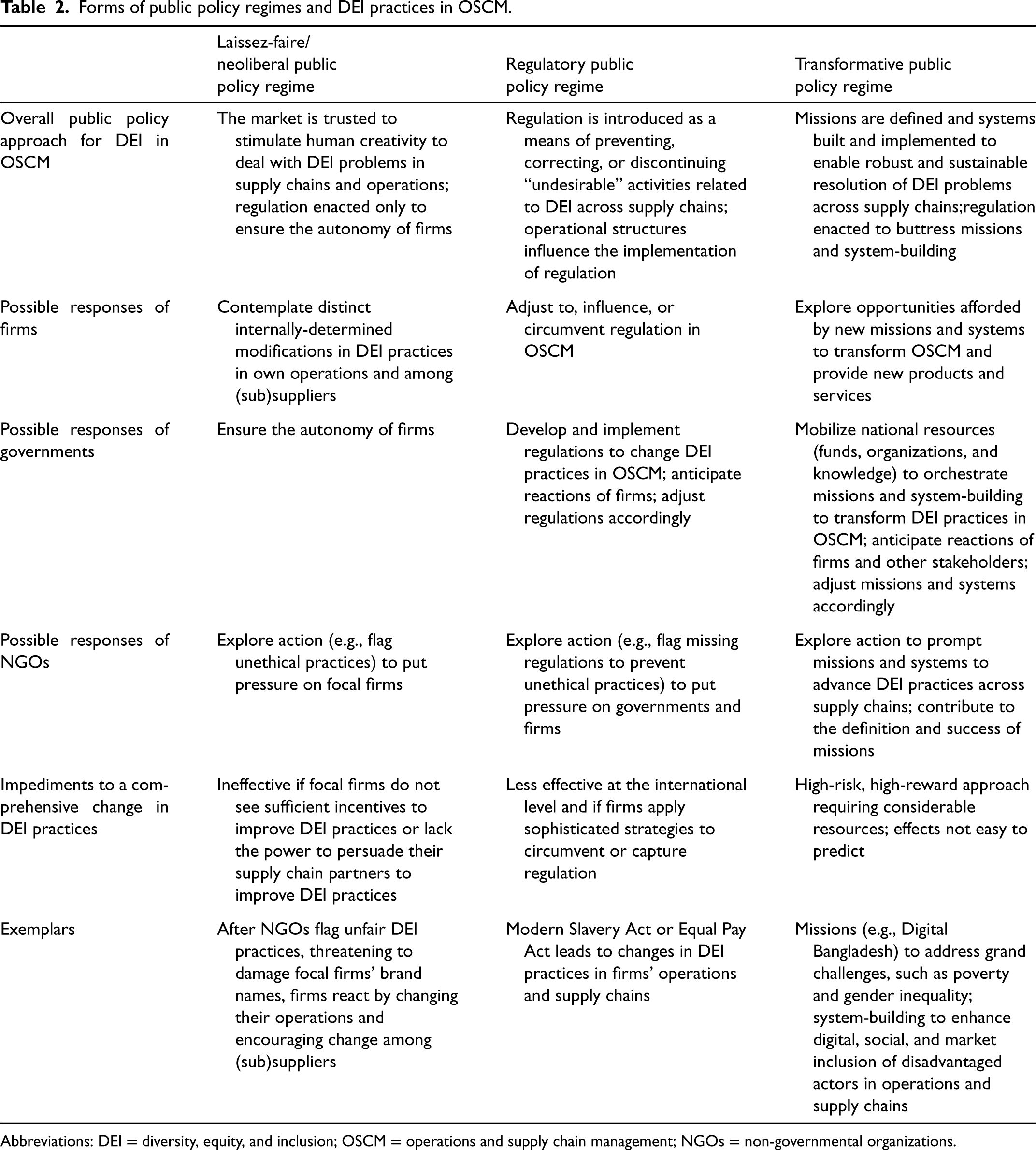
Forms of public policy regimes and DEI practices in OSCM.
Abbreviations: DEI = diversity, equity, and inclusion; OSCM = operations and supply chain management; NGOs = non-governmental organizations.
Overall, DEI-related change efforts under the aegis of a laissez-faire/neoliberal public policy regime face several challenges (see Table 2). First, not all poor DEI practices are flagged by NGOs. Second, if firms do not see sufficient incentives to improve DEI practices despite pressure from NGO campaigns, they can “decouple” external appearances from internal realities and engage in symbolic forms of compliance (Monciardini et al., 2021). Third, even if focal firms genuinely aim to convince their supply chain partners to improve their DEI practices, many lack the persuasiveness or power to do so successfully (Nath et al., 2020). More research is needed to elucidate these challenges.
In contrast to the laissez-faire regime, the regulatory public policy regime's response to significant undesirable market activities (including those related to DEI) involves the development and implementation of regulation in various forms, including defining minimum standards, setting taxes, or offering subsidies. This type of regime has often been explicitly addressed in OSCM research (for examples, see Dhanorkar and Muthulingam, 2020; Phadnis and Joglekar, 2021; Sartal et al., 2020; Scott and Nyaga, 2019; Sunar and Swaminathan, 2022).
Instructive examples of regulations are state efforts to target undesirable activities, such as unequal pay between men and women (Heymann et al., 2021) or modern slavery and other severe forms of labor exploitation in supply chains (Gold et al., 2015; New, 2015). In the case of unequal pay, the U.S. Equal Pay Act of 1963 and the U.K. Equal Pay Act of 1970 were key means to address the gender gap in earnings. Although regulation was an important trigger for change, it did not easily result in the rapid closure of gender gaps. In the United States, change triggered by the Equal Pay Act varied from state to state depending on how binding the legislation was (Bailey et al., 2022), while in the United Kingdom, change was advanced through collective bargaining and a wave of litigation (Deakin et al., 2015). These examples show that change driven by a regulatory public policy regime is not a linear process (Atasu and Van Wassenhove, 2012; Joglekar et al., 2016); firms and other key stakeholders can respond in various ways to new regulations, while governments need to anticipate firm responses when designing and implementing regulatory measures (Atasu and Van Wassenhove, 2012).
The case of the modern slavery problem, addressed by legislation such as the California Transparency in Supply Chains Act (Birkey et al., 2018) and the U.K. Modern Slavery Act (Cousins et al., 2020), provides further examples of the variety of responses to regulation. In the United Kingdom, a naming and shaming mechanism through mandatory reporting on firms’ efforts to prevent modern slavery in their business and supply chains was established (Cousins et al., 2020), thus institutionalizing the “watchdog” activities of NGOs (Hartmann and Moeller, 2014). However, many firms have opted to refrain from complying in substance with new standards and offer only symbolic forms of compliance (Monciardini et al., 2021) that do little to prevent modern slavery in supply chains (Pinnington et al., 2023). Further studies have highlighted the range of possible responses to regulatory measures (Darby et al., 2020; Phadnis and Joglekar, 2021), encompassing a spectrum from full compliance (Dhanorkar and Muthulingam, 2020) to defiance (Scott and Nyaga, 2019).
The modern slavery problem illustrates a further general limitation of the regulatory public policy regime. Given the global nature of modern supply chains, nation-states face significant challenges in addressing violations of anti-slavery laws. Law enforcement beyond the territorial boundaries of the nation-state is difficult, and existing international institutions do not appear to be sufficiently effective to fill the gap, despite some efforts by institutions such as the European Court of Human Rights (Kougkoulos et al., 2021).
Overall, the examples of the Equal Pay and Modern Slavery legislation show the potential of the regulatory policy regime to trigger changes in DEI practices—but also the challenges to ensure that regulation works as expected. Problems such as gender inequality and poverty are multifaceted and deeply institutionalized in societies, and they might differ substantially among countries. Thus, regulation must be highly sophisticated in order to contribute to the desired change in organizations and across supply chains. More research is needed to elucidate the conditions under which regulation contributes to effective changes in DEI practices in OSCM.
Transformative Public Policy Regimes: Missions and System-Building to Foster DEI
Based on the assumption that voluntary business responses and state regulation are insufficient to address grand challenges, the transformative public policy regime seeks to orchestrate missions and create public multi-actor systems that, over time, enable the robust and sustainable resolution of grand challenges. This type of regime has been addressed less frequently in OSCM research—with the notable exception of Spring et al. (2017), who highlighted the importance of industrial policy for facilitating firms’ efforts to move from technological innovation to marketable products. As DEI-related problems, such as gender inequality, can be classified as grand challenges (George et al., 2016), it is instructive to explore how state-orchestrated missions and systems might foster the emergence of novel DEI practices in OSCM.
In countries like Bangladesh and India, missions—orchestrated by the state and involving NGOs, firms, and citizens—have been launched to reduce poverty and gender inequality by creating systems and improving operations that foster “digital inclusion” (Aziz, 2020; Das et al., 2013). Specifically, in Bangladesh and India, many poor women in rural areas suffer from a lack of basic health care services. The Digital Bangladesh program seeks to fill underlying operational gaps between poor women and health care services. By developing information and communications technology (ICT) infrastructure in rural areas and establishing “human interfaces” in the form of younger, well-connected “info ladies,” the program enables poor women to receive initial diagnostic services and secure appointments with local doctors (Hussain and Brown, 2018). In India, “ICT kiosks” have been established in rural communities as low-threshold health care services for marginalized citizens, providing health education and treatments—and resulting in significant improvements in women's health. As in Bangladesh, a social factor played an important role: female “lead users” started to use the ICT kiosks’ services and helped convince other women to do the same (Venkatesh et al., 2020).
In both projects in Bangladesh and India, the state has orchestrated missions to address grand challenges of national concern, and in order to enable the operational success of these missions, new technological and social systems that cultivate digital inclusion have been established. The same grand challenges could be addressed by distinct missions and systems. For example, poverty could also be addressed by missions that focus not on digital inclusion but on “market inclusion.” A project in India and Tanzania, aiming at enhancing the “marketplace literacy” of poor citizens (Viswanathan et al., 2021, p. 114) by providing the “knowledge and skills that enable marketplace participation as both a consumer and an entrepreneur,” has resulted in more inclusive supply chains. There are also instances of systems being developed for cultivating entrepreneurship among disadvantaged groups, such as women and minorities, in the United States (Henry, 1998; Neely, 2003), a country in which there have otherwise been rather limited DEI-related system-building efforts in OSCM.
Despite these encouraging results, there is still much to be learned about the transformative public policy regime. For example, a critical evaluation of Digital Bangladesh concluded that operationally, the new system is not very effective and too technocentric, focusing overly on the development of digital infrastructure and insufficiently on improving social infrastructure; a higher priority should be given, for example, to the provision of easier access to quality education for marginalized groups (Aziz, 2020). Furthermore, transformative public policy regimes may face the same nation-state limitations as regulatory policy regimes when orchestrating missions and creating DEI-enabling systems. Analyzing public policy initiatives of supranational bodies, such as the European Union or the United Nations, may be of increasing importance in the future.
Overall, the transformative public policy regime offers a more diverse array of interventions than does the regulatory regime. While this multidimensional approach may be more effective in addressing DEI-related grand challenges in all their complexity, its set-up requires enormous resources, and its effects are even more difficult to predict than those of regulatory measures. Different firms, NGOs, and other key stakeholders can exhibit a variety of responses to missions, and governments need to develop effective strategies to engage all the relevant stakeholders during the design and implementation of such missions. As the idea of state-orchestrated missions and system-building has only recently become more prominent, there is still a lack of exemplary, thoroughly evaluated empirical cases. Further research, encompassing not only empirical studies but also the modeling and simulation of operations in new public systems, is essential to fully understand the potential benefits and challenges of this high-risk, high-reward policy regime for improving DEI practices in OSCM.
Incorporating Public Policy in Future Research on DEI in OSCM
In this article, we have introduced public policy as a factor with an important impact on DEI practices in OSCM. We have provided examples of how three distinct types of public policy regimes (laissez-faire, regulatory, and transformative) rely on different activities to incorporate DEI principles in operations and supply chains. While our examples are encouraging, they also show that many of these activities do not work as envisioned. More research is needed to elucidate the impact of different public policy regimes on DEI practices in OSCM and to provide evidence-based guidance for decision-makers in developing and implementing effective DEI-related activities.
With respect to the laissez-faire policy regime, future research could attempt to shed light on the extent to which a focus on profits is compatible with implementing social principles such as DEI in OSCM:
How do focal firms voluntarily attempt to diffuse DEI principles through their supply chains? What tensions exist between commercial and DEI-related goals in OSCM, and how are they addressed? Which mechanisms characterize the interplay between designing and implementing DEI-related regulation and the responses of key stakeholders? What are the unintended outcomes of DEI-related regulation, and how can decision-makers prevent undesirable outcomes? Which networks of actors should be involved in designing and implementing missions to reduce the risk of undesirable outcomes? What kind of methods can be used to assess and improve the effectiveness of missions and public systems?
With respect to the regulatory policy regime, future research could help us develop a better understanding of the factors that affect the responses of firms and other stakeholders to DEI-related regulation:
With respect to the transformative policy regime, future research could help us better understand the factors that affect the effectiveness of DEI-related missions and public systems:
The last of these research questions highlights the need to explore a variety of research methods to study the impact of public policy on DEI in OSCM. Such methods may include, for example, modeling, simulations, and experiments to anticipate the effects of policy interventions (see Desai, 2012; Grass et al., 2008; Webster and Sell, 2014), (comparative) empirical studies to better understand and critically evaluate policy interventions (see Tokar and Swink, 2019; Weimer and Vining, 2017), and engaged scholarship (see Van de Ven and Johnson, 2006) to facilitate the design of more effective policy interventions. As supply chain and operations scholars examine the conditions under which processes fail or work as expected (Helper et al., 2021; Tokar and Swink, 2019), they are particularly well-equipped to employ various methods to analyze the effects of distinct public policy activities and provide guidance for the implementation of DEI principles in OSCM. Incorporating public policy into our research (alongside other factors, such as technology and supply chain organization), we conclude, opens up exciting new research opportunities and can result in significant progress toward establishing diversity, equity, and inclusion in operations and supply chains.
Footnotes
Declaration of Conflicting Interests
The author(s) declared no potential conflicts of interest with respect to the research, authorship, and/or publication of this article.
Funding
The author(s) received no financial support for the research, authorship, and/or publication of this article.
Notes
How to cite this article
Bodroži Z and Gold S (2024) Building Diverse, Equitable, and Inclusive Operations and Supply Chains: Bringing Public Policy Back In. Production and Operations Management 34(4): 836–844.