




Abstract
The persistent inequities in American cities—long recognized and lived by black and Hispanic people and other minorities, the poor and working class, and others disadvantaged by urban systems—have been vaulted into the broader public consciousness over the past decade. Lessening entrenched urban inequalities is now at the top of the national policy agenda, suggesting a need and opportunity for more urban operations management. On what issues and how might this work occur? Operations management was deeply intertwined with urban planning in research and practice from the 1950s through the 1970s, at which point the fields diverged. To build a case for what perspectives and approaches a modern urban operations management agenda might employ to address inequity, I synthesize historical and contemporary planning theory with the debates among reflective operations scholars in the 1950s-1970s over work on cities. Modern operations scholars can look to planning, and especially to recent major shifts in its thinking on race and class, to address urban operations that disadvantage some city residents and overly advantage others. This urban operations agenda should be empirical, equity-oriented, and community-focused in order to best resonate with planners and the city residents they serve. In reengaging with planners to tackle the modern range of urban policy problems, operations analysts have a chance to contribute practical clarity on how cities work and can be made more livable for all residents.
Motivation
The persistent inequities in American cities—long recognized and lived by black and Hispanic people and other minorities, the poor and working class, and others disadvantaged by urban systems—have been vaulted into the broader public consciousness by police shootings, lead-contaminated water, and other wrongs since 2014 (Dunivin et al., 2022). Lessening entrenched urban inequalities is now at the top of the national policy agenda. Such public focus can stimulate research on policy questions with operational underpinnings, like how the tsunami in Indonesia lead to a “jump” in humanitarian logistics research in 2007 (Gupta et al., 2016) and the unmet global development goals give urgency to ‘bottom-of-the-pyramid’ operations work (Jónasson et al., 2022). The public focus on inequality in American cities points to an opportunity for more operations work on the urban systems that continue to reproduce disadvantage along race and class lines. How and on what issues might this work occur? This essay draws on influential, historical writings on operations and planning to suggest how modern operations scholars might reengage planners in seeking to identify and eliminate inequality in cities.
There is precedent for far-reaching work at the interface of urban planning and operations management, as I summarize in
Understanding how and why the two fields diverged is a precursor to reenergizing more work at their interface. I show in
This history has practical implications for how the operations community may craft an urban research agenda with planners and the city residents they serve, which I outline in
Literature Review
The Promise of Rational Planning: 1950s
After World War II, operations analysts who supported the war effort moved to new policy areas, including urban planning (William, 2015). They populated city agencies, planning schools, institutes like RAND, and other “beachheads for economic reasoning” (Berman, 2022). Through the 1950s, operations analysts and city planners built what became known as the ‘rational’ approach to urban planning, a cohesive set of operations management models for city policy questions that drew from innovations by John Little, Kenneth Arrow, Stafford Beer, C. West Churchman, and Russell Ackoff, among others (Friedman, 1987). 1 Rational planning promoted efficiency in policy discourse and offered powerful analysis to achieve it (Light, 2003). Through the 1950s and the 1960s, urban planning and urban operations management developed as a broad, unified area of work, with cross-pollination of people, ideas, and approaches in journals, departments, curricula, and societies. 2
Mixed Outcomes of Rational Planning: 1960s-1970s
Rational planners worked to make residents healthier, better connected, and more mobile, among other objectives. Ambulance systems were setup to triage patients quicker (Church and ReVelle, 1974; Toregas et al., 1971), mail arrived more reliably (Staats, 1965), and expressways linked metropolitan areas (Wheaton, 1963). These remain “phenomenal” accomplishments (Rittel and Webber, 1973).
But as the Civil Rights Movement gained momentum, some planners began to criticize the rational doctrine's relationship with race and class inequality and its orientation toward efficiency, especially as it was applied in city government. Planning theorist Peter Marcuse (1976) offered some examples, including a city hall analyst representing minority population growth forecasts in ways that accommodated some residents’ racist concerns and consultants designing a transit system that disproportionally favored a powerful downtown district. In classes on planning fundamentals, one long-taught case on rational planning is about an urban fire department that in 1972 used a model to close firehouses in a way that disparately impacted poorer, minority, and high-incidence areas with older housing, according to planning advocates (Wallace and Wallace, 1998). Examples like these, some to which there are other sides, are one part of how planners (came to) understand this era.
Evolving Ideas on the Rational Doctrine: 1950s-1970s
By the mid-1970s there was consensus among urban planners about the rational doctrine's promise and limitations (Light, 2003). Planners, as described in a history by John Friedman (1996), became concerned that rational planning was entrenching inequalities in power, opportunity, and welfare by prioritizing efficiency. Rational planning also concerningly cast analysis as offering apolitical, technical solutions to a public decisionmaker (Friedman, 1996). Rather, planners, working in agencies inescapably inflected by urban elites’ interests, were coming to see their analysis as unavoidably political (Yiftachel, 1998). They reasoned that analysis is not necessarily political because of the topics studied, but due to the problems, data, assumptions, approaches, solutions, and audiences privileged —and those not. In some cases rational planning missed equity aspects of some decisions or was coopeted by elites to meet their goals (e.g., Marcuse, 1976; Rittel and Webber, 1973).
At the same time, operations management was being pulled in several directions. Some urban operations analysts moved (back) to defense work (Light, 2003). Others in cities migrated from modeling to “less ambitious” services-digitization and mapping work (Batty, 1994). And yet others remained focused on city operations, working to widen their “worldview” to incorporate power and equity in ways aligned to progressive planning work (Stimson and Thompson, 1975). Part of their effort lay in examining the political implications of work. For example, E.S. Savas (1973), a prominent operations researcher and New York City official, explored the class implications of a public service analytics study. This reflective article is taught today in some planning schools. Another part of their effort was directly modeling equity concerns. For instance, research on equity in facility location decisions took off among economic geographers (McAllister, 1976; Mumphrey and Wolpert, 1973).
Despite this emerging, equity-focused iteration of rational planning, a wholesale doctrinal change was already in motion. Urban planners replaced rational planning by 1980, building from Paul Davidoff's advocacy planning (1965) and then Norman Krumholz's equity planning (1975). Advocacy planning aimed to link rational planning with “the reaction to poverty and discrimination in the 1960s” (Faludi, 1996). It required planners advocate for disadvantaged groups rather than work as “impartial” analysts. Equity planning and subsequently doctrines entirely left behind rational planning: its models, which planners had concerns with, but also its clarifying understanding of the inventory and service systems that shape city life. The post-rational doctrines – to different extents – require planners actively work to remedy power imbalances, racial and class inequity, and historical harms (Friedman, 1996).
Critical Analysis
It is more than fifty years and several academic generations since the peak of the rational planning era. Its promise, contributions, and coda are now hazy to many in the operations management community, if not unknown to most junior scholars. What can be learned for modern urban operations work from revisiting it? This section documents how planning bifurcated from operations management by 1980 in terms of topics, approach, audience, and membership. Understanding this bifurcation is key for operations analysts to successfully reengage with planning research and practice.
The prevailing account of this bifurcation is based on planners’ reflections and is generally critical of operations management. However, journals like Management Science and Journal of the Operational Research Society give another, underreported account that is nuanced and helps balance planning's account of urban operations work. I draw from the debates through the 1970s among reflective operations scholars like Martin Starr, Russell Ackoff and Jonathan Rosenhead, leveraging the continued relevance of their thinking to expand research at the planning-operations interface today (e.g., Fabusuyi and Johnson, 2022). These scholars were tracking the evolution of operations management, while giving commentary on how operations should position itself on social, and especially urban, problems.
What problems planners and urban operations analysts studied, diverged. Planning grew to concentrate on ‘distributive’ concerns, identifying and correcting unequal allocative processes and the power dynamics behind them (Young, 1990). By 1972 the national planning society even codified this distributive focus in an ethics code that required acknowledging the “social problems” of projects (Marcuse, 1976). Meanwhile, urban operations management remained focused on ‘allocation’, or efficiency, alongside ‘distributive’ concerns. One indication of how the two fields differentiated in this way is the 1970 special issue on urban issues in Management Science. For instance, an article using novel data to model school siting and funding did not consider race (Eastman and Kenneth, 1970), which contrasts with planning research on schooling that by then was zeroed in on how siting and funding perpetuated segregation (Gans et al., 1964). Doctrinal urban operations texts (e.g., Larson and Odoni, 1981) continued to offer powerful tools that advanced such efficiency work. On several policy questions the fields ended up working from different vantages (Stimson and Thompson, 1975).
How planners and operations analysts solved problems differed. Methods shape what problems are solvable and who—like residents—can contribute to and act on answers. While quantitative empiricism remained a common thread between the fields, planning came to work more with qualitative data and theoretical arguments (which were eventually critiqued as inaccessible), and operations management grew more mathematical and prescriptive. Charles Lindblom (1959) was among the first to register some drawbacks of this operations approach, e.g., the data required was sometimes not attainable. Melville Branch (1970) extended such concerns to urban planning. As the fields bifurcated, Russell Ackoff (1979) elaborated on whether operations may take forward “sophisticated” mathematical techniques, or, in alignment with post-rational planning, “contextually” appropriate methods that weighed “all stakeholders” input. The two fields generally came to embrace different methods, each suited to different problems (that is, until a conceptual operations breakthrough linked “sophisticated” with “contextually” appropriate methods (Fabusuyi and Johnson, 2022; Johnson, 2012b, 2012a; Johnson et al., 2016)).
For whom planners and operations analysts solved problems contrasted. This impacts which solutions are explored. Planning doctrine instructed learning from marginalized residents to solve problems, while operations management generally remained focused on the analytical needs of public officials making operational decisions (Friedman, 1996). However, some researchers hoped for more problem solving done with and for minority and poor Americans. Jonathan Rosenhead (1976), building on others’ similar ideas (e.g., Starr, 1969), captured this idea: “Idealist urgings [of Russel Ackoff] of the need for a more “humane society” will carry little weight, especially if the principal activity of OR workers continues to be the provision of intellectual services to management.” Broadly, the fields developed adjacent constituents: communities advocating, organizing, and fundraising, and officials writing ordinances, drafting budgets, and delivering services and infrastructure.
Who made up the nationwide cadre of planners and operations analysts evolved. This is key to shaping what research questions are seen as worthy. Planning schools followed by agencies took initial steps to diversify their ranks in the 1960s, alongside efforts to change what was taught. As planner June Manning Thomas (1996) documents, the 1960s saw an “exponential growth” in minority students, as “urban civil disorder and advocacy planning blew the old models of [rational planning] out of the water.” Operations management, with the Cold War escalating, supply chains lengthening, and the service economy growing, concentrated education efforts at crucial intersection of training, industry, and application, as captured in a special issue on education in Management Science (see, Churchman, 1970). Pressing policy and business needs over time nudged the fields’ compositions in different directions.
Implications for Operations Management
This history has three practical implications for how the operations community can build an urban research agenda with planners and for city residents disadvantaged along racial, class, and other lines.
Planners Stand to Gain from Operations Insight
While the rational doctrine definitively shaped urban policy, operations analysts have influenced urban policy less often as they have grown distant from planners, despite ample possible applications. The 1980s-1990s illustrate this. As prominent planners Fainstein and Fainstein (1995) outline, the urban agenda was built around three—still salient—questions about jobs and housing, emphasized community participation in decisions (Innes, 1995), and contained strong operations undertones.
The first policy question, as they outline, was how to create jobs (e.g., Yuan, 2019). One specific remaining problem is: how to use equity investments to give communities leverage in firm-location decisions? The second question was how to retain jobs (e.g., Davis and Renski, 2020). An unsolved puzzle is: how to make firms internalize the cost of community abandonment? The third question was how to lessen residential segregation and inequality (e.g., Brennan et al., 2022c): where should new affordable housing be sited and, holding existing stocks constant, how do rental vouchers enable residential mobility? Yet without strong connections to planning, operations analysts’ expertise in areas like incentive alignment and facility siting was and remains underutilized relative to its relevance.
Today, with comparably high-impact insight to offer, operations analysts should reconnect with planners and vice-versa (Fabusuyi and Johnson, 2022). The fields remain not necessarily so far apart. Both are normative areas of work that see the flows of goods and services as foundational. Planning organizes the economic, built, and social urban landscape in order to expand opportunity, while operations manages the economic landscape mostly to meet goals like efficiency. Both fields often train at professional schools that emphasize their respective norms but share an appreciation for learning from ‘real world’ partners. In research, both increasingly generate knowledge with techniques like causal inference and case studies. In practice, planners work from planning agencies, but also universities, advocacy groups, labor movements, civil rights law firms, and nonprofits, making them a natural entrée to cities’ operations. Operations analysts, perhaps unfamiliar with groups like housing law firms that solve unconventional production or distribution problems, also commonly work at companies. There remains ample common ground for the two fields to reconnect on. Figure 1 presents some ways how, in general, these similarities and differences manifest in empirical research in the two fields.
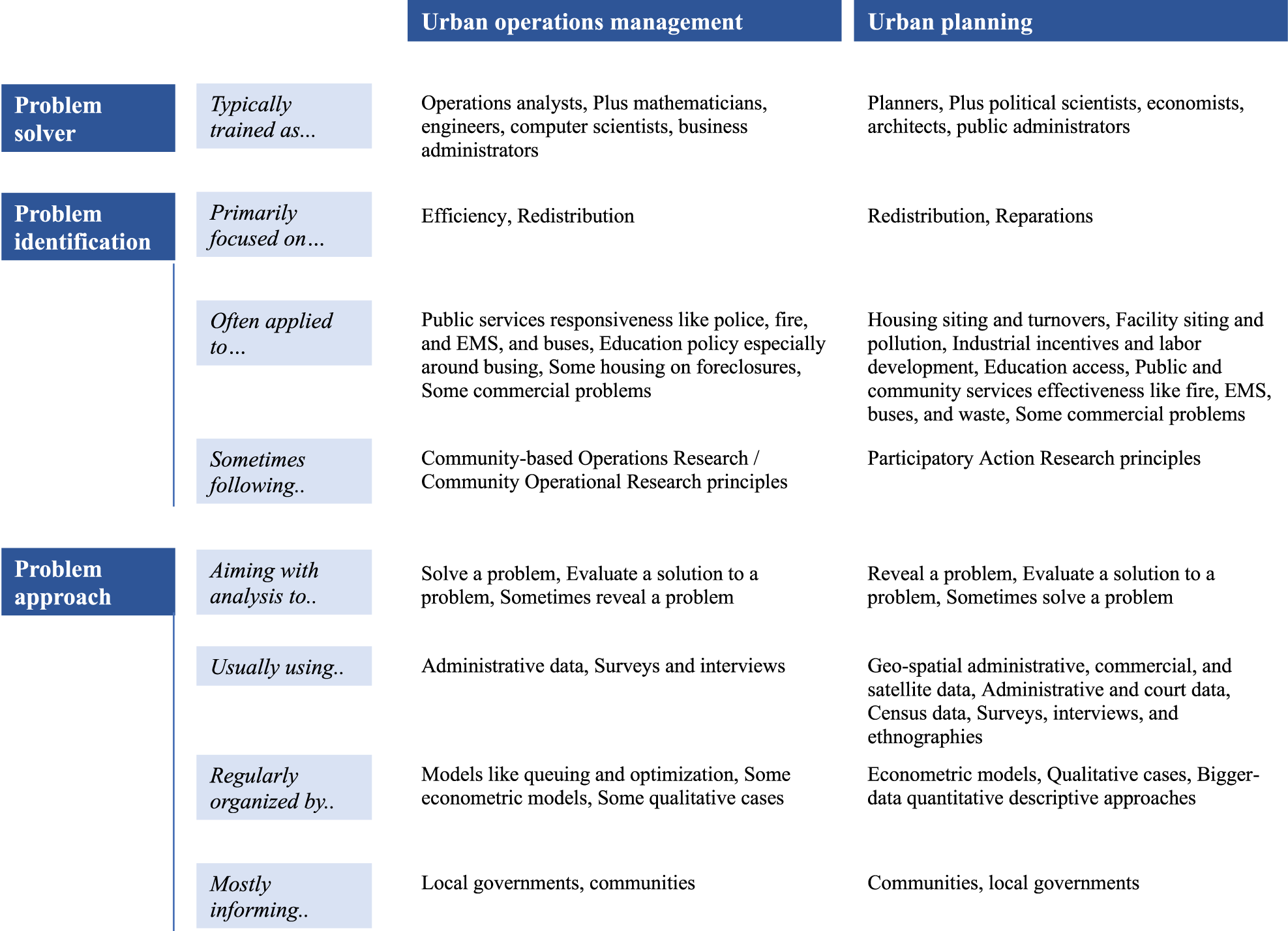
Comparing empirical research in the two fields.
To resonate with planners in schools and agencies and the city residents they serve, operations scholars should conduct analysis that is ‘distributive’, empirical, community-oriented, and inclusive. These principles might help in navigating the fact that planning, and analysis supporting it, is necessarily political, because of the power structures that shape it and that it aims to change (Yiftachel, 1998).
In the topics urban operations management engages, ‘distributive’ if not ‘reparative’ concerns are paramount. Planning doctrine unfolds in iterations. Just as the ‘distributive’ Civil Rights Movement doctrines like advocacy and equity planning superseded rational planning by 1980, reparative planning is taking shape as the new, and more radical, paradigm. If distributive planning is about who faces little or second-rate inventory and capacity, reparative planning is about who hoards more than their just share. Planners Justin Steil (2022) and Rashad Akeem Williams (2020) instruct, in operations terms, addressing deprivation stemming from policies that materially advantage white and wealthy residents. In its approach, it should be data driven—“OR is empirical science” Stafford Beer reminded government and academic skeptics in 1970 (Beer, 1970). It stands to build a descriptive and causal base of operations facts that urban decisionmakers lack using procurement information, public services records, civil court claims, satellite images, point-of-sale databases, land registries, transit schedules, among other quantitative sources (e.g., Qi and Shen, 2018; Terwiesch, 2019), and interviews, surveys, ethnographies, and documents. In its audience, this work should be done for if not also with communities. Michael Johnson and Karen Smilowitz's (2007) essay is an authoritative guide here that has been conceptualized into community-based operations research (Johnson, 2012a, 2012b) and community operational research (Johnson et al., 2018a, 2018b). This school of research entails “meaningful community engagement” that is locally, action, and justice oriented. In ways fundamentally different from “old-style rational planning” (Krizek et al., 2009), it stands to aid decision-making. With the above in mind, this work would be strengthened by an even more diverse field. This would be aided by straighter paths for the research charted above through doctoral programs and tenure committees; political economy and qualitive methods offerings in programs with urban operations training; and even ethics guidelines in operations societies and journals handling urban work that, in the spirit of the 1950s-1970s debates, elevate progressive research.
With those four principles, operations scholars can clarify how cities operate and could work better. Planners can suggest what clarity is needed, having honed for decades the practice of, and thinking behind, identifying what problems matter to disadvantaged residents. Crucially, these principles are readily operationalizable into planning-forward research because both fields are similarly oriented toward application— “action” in progressive planning (Steil, 2022), or “validation” in operations management (Gallien et al., 2016) and “intervention” specifically in community operational research (Johnson et al., 2018a, 2018b). Building on the empirical work by planners advancing today's urban agenda, I outline pressing operations questions about who needs basic goods and services and who enjoys more than their just share.
Advocacy groups are countering disproportionate pollution in minority and poor neighborhoods. One question is: where should remediation resources be allocated to spread environmental risk evenly over neighborhoods? If contamination is a defining byproduct of the twentieth century metropolitan economy, unevenly spread warehouse-noise and -traffic pollution is one of the twenty-first. Thus a similar question is (e.g., Yuan, 2021): are fulfillment centers overrepresented in disadvantaged areas? These questions, answerable with Census and land-use data, are matters of where facilities are sited. Labor organizers are creating protections for gig workers, whose risks platforms like Uber do not internalize. One key issue is: what contracts are also sensitive to drivers’ economic vulnerabilities? Responding to recent research on platforms, transport planner Jesus Barajas (2023) writes it is “incumbent on planners” to address gig worker precarity due to “operating practices,” research which has clear risk-sharing and incentive-compatibility angles. Case studies—or even ethnographies, with researchers signing up to drive—could generate fine-grained understandings of uncertainty and profit. Mutual aid societies are exploring the benefits of community paramedicine. Services like ambulance care and fire suppression that are now publicly organized were once delivered by community groups, like the first US paramedic squad run by black workers (Hazzard, 2022). One of the basic barriers to scaling alternatives to public services is: how should community groups and public agencies divvy 9-1-1 calls? Analytics of often-public 9-1-1 call data may indicate how to segment a city's ambulance system by area and call type (Brennan et al., 2023), enabling community groups to absorb some calls. Housing attorneys are holding private-equity and public companies accountable in buying up rental—senior, trailer, apartment, and single-family—inventories. Characterizing the operations of firms housing residents with “little recourse and few alternatives” is a precursor to identifying more equitable ownership structures (Lamb et al., 2023). One question that could focus legal action is: does an acquisition mean units turnover more or safety issues spike? Does commercial ownership aggravate higher unit turnover in the form of evictions after a disaster (Brennan et al., 2022b)? Exploiting the exogeneity in when acquisitions happen to causally estimate such effects, scholars could combine for one city public building ownership data with civil-court eviction and inspection agency data. Small businesses in food deserts are navigating policy reforms that shrink their lower-income customer base and markets that challenge inventory practices. Planners in a flagship urban affairs journal are making space for operations insight here in declaring “policy may need to be refocused on issues other than demand” (Graves and Zhang, 2022). One timely question is: can corner stores still stock perishable foods with fewer clients able to buy them? A broader version of this question is (e.g., Brennan et al., 2022a): how do agri-food retailers successfully serve lower-income customers? Here survey data will be key to understand any operations that are not digital.
Operations analysts and urban planners first crossed paths—often at odds with one another—during the industrial revolution (Harvey, 1973). Planning schools teach that their field originated as a check on the economic and environmental exploitation that came with industrial urbanization, fueled by manufacturing growth that operations innovations like by Frederick Taylor enabled (Foglesong, 2014). Only in the 1950s, when the rational planning doctrine brought together operations and planning, did the fields for the first time work on the same side of history, as they strove to make the ‘industrial city’ more livable. Now with the widespread recognition of long-standing inequity in American cities, planning's origin story is in flux, as it reorients in a self-critical way that offers an opportunity for the two fields to align again. Drawing on scholars like W.E.B. Dubois, Rashad Williams (2020) argues: alongside the rise of the ‘industrial city’ was also actually a ‘racial city’. In it, those in power materially deprived some residents while advantaging others along racial and class lines, especially in housing markets and public services. In reengaging planners to tackle the modern range of city problems, operations analysts have a chance to clarify how the industrial and racial cities work and can be made more livable.
Footnotes
Author's note
Mark Brennan is also affiliated with Rutgers University, School of Business, Camden, USA.
Declaration of Conflicting Interests
The author declared no potential conflicts of interest with respect to the research, authorship, and/or publication of this article.
Funding
The author received no financial support for the research, authorship, and/or publication of this article.
Notes
How to cite this article
Brennan M (2024) Revisiting Equity in Urban Operations Management 50 Years Later: What do City Planners Have to Say?. Production and Operations Management 34(4): 845–852.