



Abstract
In this essay, our analysis takes important insights on diversity and inclusion from the behavioral literature but critically contextualizes them against the reality of humanitarian operations. Humanitarian operations are characterized by system immanent diversity, particularly between local and expatriate aid workers, who not only bring valuable different perspectives to the table but also differ along multiple dimensions of diversity into a so-called diversity faultline. Such a faultline, however, provides fertile ground for continued conflict resulting in relational fractures and, ultimately, inefficient collaboration. While, in theory, inclusion could help overcome the negative effects of faultlines, in practice, the time pressure for humanitarian organizations to quickly respond to disasters makes it effectively impossible to engage in it. Against this background, we argue, humanitarian organizations should take preemptive action before disaster strikes. Specifically, we posit that the pre-disaster phase presents an opportunity to engage in inclusion in order to cultivate relational resilience between local and expatriate aid workers. Such resilience would enable them to not only better weather the inevitable relational fractures during a disaster response (and thus stay more functional throughout), but also quickly realign with each other in the post-disaster phase. We conclude with a set of concrete recommendations for practicing inclusion in the pre-disaster phase.
Introduction: Why Humanitarian Operations Need to Take Diversity Management Seriously
Humanitarian organizations (HOs) play a vital role in providing quick relief to suffering populations (Besiou and Van Wassenhove, 2020). Yet given the rising need for help around the world against tight funding constraints, HOs are increasingly called upon to become more efficient (“Transforming our world” agenda, United Nations, 2015). To achieve this objective, lately, the collaboration between humanitarian aid workers has been put center stage (Moshtari, 2016).
Field accounts, however, paint a troubling picture, with local and expatriate team members often highlighting the difficulties of collaboration in humanitarian field operations (Shevchenko and Fox, 2008: 118). Against these accounts, we adopt a behavioral perspective on humanitarian operations (cf. Ruesch et al., 2022; Salem et al., 2019, 2022). We highlight that one reason that these difficulties arise lies in the diversity of the involved aid workers. Such diversity is a double-edged sword. On the one hand, diversity can broaden the knowledge, skills, and ability pool, thereby facilitating collaborative problem-solving in the field; on the other, it can induce significant conflict among the involved parties. Such conflict can directly undermine short-term collaboration that is typically observed during disaster response (Narayanan and Altay, 2021) and, if left unaddressed, may even lead to violated relational norms and expectations that lead to deeper relational fractures (Olekalns et al., 2020) and weaker long-term collaboration that affect later recovery and mitigation (together also referred to as “development” following Tomasini and Van Wassenhove, 2009). In order to reap the positive aspects of diversity and mitigate its negative ones, HOs therefore need to seriously consider how they can (best) manage diversity in their operations.
One method is to engage in what is referred to as inclusion: practices that promote the subjective experience of feeling like one is valued for one's differences while also belonging to the group (Shore et al., 2011). While deemed effective in other contexts (Nishii et al., 2018), inclusion can be a challenge for humanitarian disaster response operations given their extreme time pressure. Thus, we argue that HOs need to invest in inclusion practices before disaster strikes. We specifically outline how a preemptive focus on inclusion in the pre-disaster preparedness phase can promote a resilient relationship between expatriate and local aid workers. This would not only help them weather the relationally difficult periods of the disaster response phase, and thereby enable continued effective collaboration, but also allow them to bounce back quicker in the post-disaster recovery phase.
Our paper is a response to calls for more attention on the preparedness phase within relief operations (preparedness and response together are also referred to as “relief” following Tomasini and Van Wassenhove, 2009), and here particularly the increased collaboration between locals and expatriates (ALNAP, 2022; OECD, 2017). In this way, we not only contribute to the humanitarian operations literature (which tends to focus on the response and recovery phases; Stumpf et al., 2023a), but also add a behavioral perspective to complement the field's dominant focus on systems and processes (Behl and Dutta, 2019). As such, we specifically develop a parallel between the supply chain resilience perspective (that seeks to buffer against supply chain shocks) and a relational resilience perspective (that seeks to buffer against relational fractures). We want to emphasize that, despite the organizational literature critically informing our thinking on the challenges of diversity and inclusion, with this essay, we recognize that the strenuous real-world context of humanitarian operations prevents a simple transfer (Hannah et al., 2009; Joshi and Roh, 2009). Instead, we offer a time-sensitive account of how diversity may be managed in the field of humanitarian operations via inclusion. As such, our perspective may also inform the behavioral literature, which has so far provided largely context-agnostic theorizing on the issues of diversity and inclusion.
Diversity in the Context of Humanitarian Operations
HOs bring together diverse people under the logic that multiple perspectives, knowledge bases, and skills are needed to effectively respond to the myriad challenges inherent in humanitarian crises, ranging from needs assessment to help provision (Tomasini and Van Wassenhove, 2009).
That said, prior organizational research has established that diversity can be a double-edged sword (Milliken and Martins, 1996), and the same looks to be true in the context of humanitarian operations (even though actual empirical research on diversity and inclusion in humanitarian operations is scant). On the positive side, anecdotal reports suggest that member diversity is a key factor in innovation and problem-solving within HOs (Humanitarian Advisory Group, 2021a), such as in the case of the Red Cross’ COVID-19 response, where more diverse teams were key for a learning culture and subsequent implementation of evidence-based practices (Humanitarian Advisory Group, 2021b). On the negative side, other anecdotes suggest that diversity can disrupt humanitarian operations’ effectiveness, such as when it facilitates structural and institutionalized discrimination, for instance, when expatriates hold a disproportionate amount of the decision-making power (Harvard Humanitarian Initiative, 2020). In such situations, the power and privilege enjoyed by certain groups can actually discourage information and idea sharing—contrary to the promise of diversity (Harper Jantuah et al., 2019).
This double-edged nature of diversity—that is, being both a path towards solving complex problems and a source of conflict within teams—is captured in the Categorization-Elaboration Model (CEM), an established theory from the field of organizational behavior that outlines the psychological processes involved (Van Knippenberg et al., 2004). The basic premise is that diversity can have positive consequences for team performance because of information elaboration among the different actors within a group. This elaboration brings forth diverse actors’ various knowledge, skills, and abilities, which can then be synergistically combined to address various challenges better than homogenous groups could. However, once a diverse group splinters into subgroups, each one may feel like the other groups pose a threat, that is, to their status, control, and competence. This experienced threat then incentivizes negative evaluations of the other groups (i.e., intergroup bias), which subsequently paves the way for intergroup conflict and impairs productive information exchange. It is unsurprising, then, that larger meta-analyses on team diversity and team performance often find inconsistent or even negative relationships between the two (Horwitz and Horwitz, 2007; Triana et al., 2021).
With this model in mind, we consider the realities of humanitarian field operations, which require collaboration between expatriate and local aid workers (Salem et al., 2019; Steets et al., 2014). The former often conduct needs assessments and coordinate with headquarters on global procurement and transportation, leveraging their technical expertise; in contrast, the latter have a more intimate knowledge of local culture, have cultivated trusting relationships within their communities, and have better access to beneficiaries, local suppliers, and transporters as well as more intimate knowledge of local government regulations (Tomasini and Van Wassenhove, 2009). Importantly, expatriates and locals often differ on various other dimensions such as education, compensation, religion, and global mobility, which can make the distinction between the two groups even more salient. Indeed, various reports (Alexander, 2022; Angermann, 2022; Carr and McWha-Hermann, 2016) indicate that, on average, expatriate workers are more often of a Global North background: They are, on average, better educated, better paid, less religious, and lead a fairly liberal and mobile lifestyle. Meanwhile, the local workers, on average, are more often from the Global South: They receive lower salaries than the expatriates and are often more religious, which can coincide with a more conservative lifestyle.
In such cases, due to the multiple dimensions of diversity that map onto the same groups, a so-called diversity “faultline” is formed between the two groups (Lau and Murnighan, 1998). A diversity faultline refers to two groups experiencing a compounding effect of the diversity dimensions that distinguish them. Each additional layer expands the rift between the two groups, making group membership (and by extension, intergroup differences) almost permanently salient.
As captured in the CEM (Van Knippenberg et al., 2004), because of the high salience of intergroup differences, diversity faultlines can facilitate conflict between members of different groups (Van Knippenberg and Schippers, 2007), which renders social integration (Rico et al., 2007) and productive information exchange less likely (Van Knippenberg et al., 2004), and ultimately hamper team coordination and performance (Thatcher and Patel, 2011). As framed by an aid worker for Doctors without Borders (MSF): “Our attitude towards our national colleagues is all too often characterized by racism and arrogance, and an extraordinary degree of ignorance” and “[o]ur attitude to all kinds of ‘local’ knowledge and expertise is not much better” (Shevchenko and Fox, 2008: 110). In short, a diversity faultline adds further disruptions to the process of disaster response.
While this dynamic is common in any setting that houses systematically different groups, the time pressure and high stakes associated with the humanitarian context make addressing these diversity faultlines even more critical. Situations like the recent disaster in South Sudan, which affected 8.8 million people (Ahmed, 2023), embody the problem: Even though local NGOs were uniquely positioned to distribute resources, they were cut out of operations in the disaster response phase by the international HOs. As a result, only 0.4% of the funding reached the local operations, with the whole response operation thereby operating under potential.
Bridging Diversity Faultlines With Inclusion to Create Relational Resilience
In order to boost the positive, and mitigate the negative, effects of diversity, it is critical to manage diversity through inclusion. If done right, inclusion can help to translate diversity into performance gains; however, if neglected or only half-heartedly executed, diversity initiatives can produce an overall negative effect on team performance, especially when diversity faultlines are involved (Homan et al., 2008).
Inclusion can be broadly divided into two categories: the experience and the practice of inclusion, where the latter sustains and reinforces the former (Shore et al., 2011). The experience of inclusion has two facets: belongingness and uniqueness. Belongingness focuses on the degree to which members feel respected and integrated into the whole; uniqueness refers to the recognition and appreciation of individual differences as an important resource. Correspondingly, inclusion practices cultivate this experience by making individuals feel that they are “treated as an insider and also allowed/encouraged to retain uniqueness within the work group” (Shore et al., 2011: 1266). Respective inclusion practices can be organized into three categories (Nishii, 2013): (1) equitable employment practices (e.g., as shown in the distribution of resources and accountability in the selection process); (2) integration of differences (e.g., openly sharing and learning from each other and appreciating unique viewpoints), and (3) inclusion in decision-making (e.g., empowering employees to make decisions on their own and seeing diverse employee input as critical to good decisions). These practices provide a bridge for the otherwise salient gap between members of different groups by creating an environment where members learn to recognize and value diversity (Nishii, 2013; Shore et al., 2011).
In short, inclusion provides the foundation for diverse groups to build relational resilience. Analogous to supply chain resilience (Tukamuhabwa et al., 2015), we define it as the capacity to withstand and improve in response to strain and disruptions. In doing so, relational resilience then serves to prevent, contain, and overcome relational fractures. In other words, when inevitable relational stress occurs, higher relational resilience helps subgroups avoid misattribution, allows for more benevolent reinterpretations, or makes it easier to realign with each other—all of which prevent further destructive escalation (Srikanth et al., 2016). Furthermore, as evidenced by a plethora of research on psychological resilience enabling post-adversity growth (Troy et al., 2023), it follows that, after facing challenges together, members in more resilient relationships, in this case fostered by inclusion, are able to more quickly realign with each other and reach better outcomes than less resilient relationships. Thus, inclusion and its effects on relational resilience hold promise beyond the disaster response phase. Of course, the relational stress in the response phase will test the subgroups’ relational resilience, but if they walk away without major relational fractures, they survive it together. We argue that any success becomes a joint success that reinforces the notion of uniqueness and belongingness. As a result, the groups will not only bounce back to pre-disaster levels, but likely even find their relationship strengthened.
Naturally, organizations need to do more than decide to adopt the aforementioned inclusion practices; they need to give said practices time to unfold and generate relational resilience. Against that background, we want to contextualize inclusion against the realities of disaster response operations, which are often marked by time pressure and other resource scarcity. In the following, we consider how inclusion can look in the context of humanitarian operations, including when (in the process) and where (i.e., location) it may be strategically pursued.
Inclusion in the Context of Humanitarian Operations
Previous conceptualizations of inclusion have largely neglected the importance of contextual factors, such as time urgency and the corresponding shifting demands and priorities that characterize humanitarian operations (Besiou and Van Wassenhove, 2020). As such, the inclusion concept is severely limited in its applicability to the humanitarian context.
The extreme time urgency in the disaster response phase (Pedraza Martinez et al., 2011), for instance, makes practicing inclusion a secondary priority behind meeting targets (such as distributing food and supplies to those in need and providing emergency shelter, medical, and rescue services). Indeed, in this phase, quick and visible beneficiary-oriented actions are not only central to providing rapid aid, but also deemed necessary for attracting further donations (Burkart et al., 2016). As a result, the response phase has a high chance for conflict between expatriate and local aid workers—the accumulation of which can lead to relational fractures that undermine any form of effective collaboration.
In the subsequent post-disaster recovery phase, the time pressure, media attention, and funding subside, while the focus shifts to restoring essential services and rebuilding damaged infrastructure. In addition, HOs seek to reduce the vulnerabilities of the affected community by training and equipping residents for improved supply chain management (Tomasini and Van Wassenhove, 2009). However, because the aforementioned somewhat inevitable relational fractures between expatriate and local aid workers have compounded by this stage, the two groups will likely find themselves alienated from each other. As such, they will lack the foundation needed for cooperation and coordination, making it very hard to co-create recovery and subsequent mitigation operations. Starting the process of inclusion from here is much harder as the damage has already been inflicted.
Against that background, we advise that HOs devote more attention and resources to inclusion in the preparedness phase. Despite its importance for localized capacity building, this phase receives little media attention (and by extension, less funding), but generally tends to have the least time pressure. As a result, it represents the best opportunity to build the basics of inclusion and forge relational resilience between expatriate and local aid workers.
Fortunately, as funders come to realize that “an ounce of prevention is worth a pound of cure,” their agenda also shifts from reactive to proactive—with a new emphasis on the preparedness phase (Stumpf et al., 2023b). That said, despite its greater time allowance (compared to the response phase), HOs still find themselves under resource constraints in this phase, due to the media's focus on disaster response and the broader funding willingness associated with that attention (see Eftekhar et al., 2017). This issue may be partly mitigated by working together in alliances (e.g., Humanitarian Logistics cooperative (Hulo)), but even then, HOs need to carefully weigh when and where to invest in preparedness (and inclusion practices).
While not every disaster can be predicted, some have a certain rhythm or trajectory. For example, with regard to natural disasters, new technologies and big data have made it possible to fairly accurately forecast events like rainfall in drought-prone areas (see Masinde, 2020). This is particularly relevant in regions that are projected to be the most affected by climate change and can expect more frequent disasters. Additionally, these events will likely have predictable downstream effects: For instance, consecutive dry spells may lead to mass migration and the possibility of civil unrest (e.g., the Horn of Africa, CAFOD and Devinit, 2023). Similarly, some man-made disasters are the result of longstanding contentious relationships between countries or among different ethnic or religious groups within a country. Likewise, governments characterized by contested elections or aging dictators have a higher probability of civil wars. These man-made conflicts can even worsen the consequences of natural disasters: For instance, the ongoing conflict in Syria severely restricted access to medical aid and basic necessities for affected populations, which made the situation after the February 2023 earthquake even more dire (United Nations, 2023). Given these issues, HOs should see their investments in inclusion during the preparedness phase as a natural complement to other proactive, operations-focused, preparation strategies at the local level. Indeed, without inclusion, locals’ proposals to address community needs may be rejected or not well understood by their expatriate counterparts, which blocks crucial resources and influence for local communities to effectively respond and sustainably recover (ALNAP, 2022). In short, any investment into supply chain planning and resilience should go hand-in-hand with investments in relational planning and resilience by way of inclusion.
Summary of inclusion practices in the context of humanitarian operations.
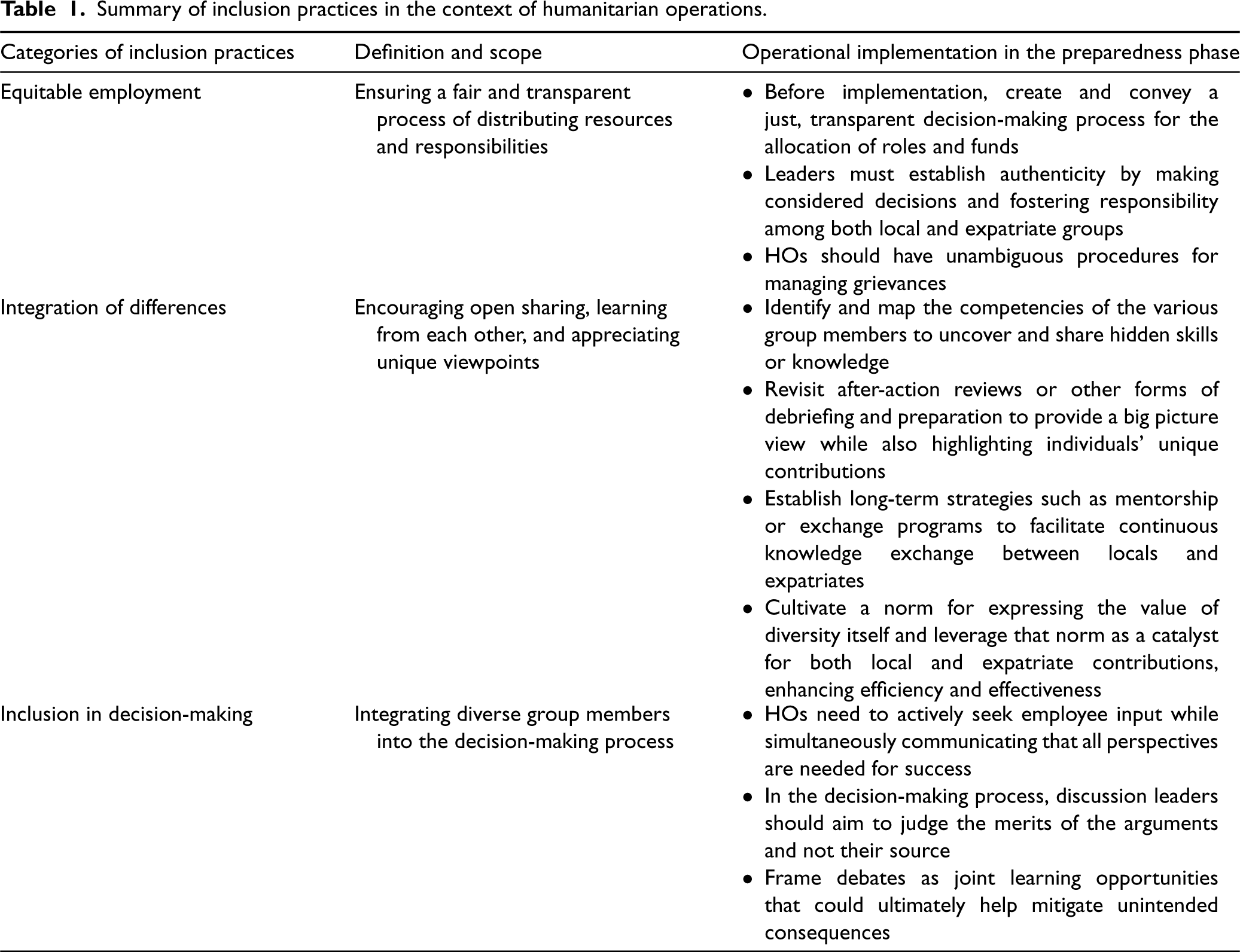
Summary of inclusion practices in the context of humanitarian operations.
While the above are valid points, we would be amiss not to mention that the realities that HOs operate in are often complex. For instance, it is extremely difficult to choose which locals to collaborate with in times of (civil) war given that HOs are expected to remain neutral (Tomasini and Van Wassenhove, 2009). Likewise, collaboration with locals may be impeded in countries where corruption is endemic (Kunz and Reiner, 2016). And in other cases, it may even be the case that humanitarian efforts are blocked by the aforementioned aging dictators or other large organizations that have an interest in keeping international influence out (see the beginning of the Syrian crisis; Sparrow, 2018). This could involve impeding access to specific regions, introducing bureaucratic hurdles, propagating negative narratives about HOs, or punishing individuals who cooperate with HOs. Therefore, while cultivating inclusion in the humanitarian context is pivotal for effective and efficient humanitarian operations, it needs to be carefully considered against a contextual reality that sometimes impedes inclusion intention to be translated into practice.
Below, we outline how HOs can implement inclusive practices along the aforementioned three categories from existing inclusion theory (i.e., equitable employment, integration of differences, inclusion in decision-making; Nishii, 2013). Specifically, we extend and contextualize the respective practices within humanitarian operations (see Table 1 for a summary).
Equitable employment. Having fair and transparent processes that provide equal opportunity to all members is essential to dispelling persistent biases and stereotypes. The corresponding practices focus on process fairness in promotions and pay, equal opportunity for development, and safe avenues for employees to express concerns (Nishii, 2013). Considered against the specific humanitarian aid context, the roles and responsibilities assigned during the preparedness phase are crucial for executing tasks and allocating funding, but they can also reinforce divisions along the faultlines between locals and expatriates. For example, in the Chechnya crisis, high-status positions were filled with central Europeans, while Russians—who had the local knowledge and ability to negotiate with important health and political officials—were repeatedly passed over for such positions and then monitored by frequently changing expatriate supervisors (Shevchenko and Fox, 2008). A more inclusive approach in the preparedness phase would require developing and communicating a fair and transparent decision-making process—ex ante—for allocating roles and funds. This would require leaders to be more thoughtful in their decisions in order to improve not only the perceived legitimacy of said decisions (Tost, 2011), but also the accountability for both groups. At best, this would also ensure more equitable representation of locals and expatriates in impactful roles or intentional professional development into these. Furthermore, when issues or disagreements arise, HOs should have clear procedures for managing grievances: for instance, by providing clear channels for feedback and complaints (e.g., installing an ombudsperson for both sides), ensuring that all team members are aware of their rights and responsibilities, and addressing issues in a timely manner (Nishii, 2013). Integration of differences. In the organizational context, the integration of differences necessitates creating an environment where employees feel like they can be their authentic selves, work-life balance as well as individual differences, are valued and effective means of conflict resolution are installed (Nishii, 2013). Against the realities of the humanitarian context, we spotlight the need to value people's differences as essential to building an inclusive work culture. With the time that the preparedness phase affords, HOs can, for instance, implement (a) skill mapping (a concept from knowledge management to make sometimes hidden skills or knowledge more visible to the collective); (b) revisiting after-action reviews from previous responses or other forms of debriefing and preparation meetings that allow for everyone to develop a big picture view, including individuals’ unique contributions to a collective mission; or (c) long-term strategies, such as mentorship or exchange programs for aid workers, such as those proposed by the European Commission (Regulation (EU) No 375/2014, 2014). Such initiatives can formalize the continuous exchange of knowledge between local and expatriate workers prior to the deployment of expatriate aid workers to field offices. Notably, it should become a norm to express value not only for people's professional contributions, but also for the diversity per se that makes such contributions possible. For instance, local aid workers may make noteworthy contributions, such as conducting current capacity assessments, providing connections with a local community, or having deep knowledge of local transport challenges. In interactions, these skills should be explicitly recognized as critical to operations and thereby develop a localized sense of leadership and ownership (USAID, 2022). But inclusion also means valuing the conditions or peculiarities that enable such contributions, which might entail engaging in seemingly inefficient communications or respecting certain lengthy traditions within communities. While these steps will help to mitigate conflict, in an inclusive environment conflict must not always be avoided because it can also provide the opportunity to deepen understanding between diverse parties. But the involved parties should feel that conflict is competently dealt with or maybe even be empowered to do so themselves. In short, the logic of inclusion demands that organizations see field workers’ unique contributions through the lens of their whole personhood and understand that interpersonal friction can be source of strength if handled competently. Inclusion in decision-making. The third pillar of inclusion practices pertains to integration in decision-making and how decisions are made by seeking and carefully considering input regardless of rank or function and effectively implementing this to improve practices and processes (Nishii, 2013). In the humanitarian context, discussion leaders should actively seek input from both locals and expats and ultimately, judge the quality of arguments and not their source. As such, debate should be framed as a joint learning opportunity that can help mitigate the unintended consequences of unilaterally-led decisions to kindle innovative thinking and problem solving. Again, this is not something to be practiced in the heat of the moment, but a routine that requires nurturing in the preparedness phase.
Taken together, these inclusive practices build a more resilient relational bridge between expatriates and locals that should be able to withstand the relationship turbulences during disasters and allow for continued operational effectiveness and generally higher efficiency (see Table 1). For instance, highlighting critical expertise that might be needed on-demand paired with installing decentralized decision-making should help contain intergroup frustration and reactance, which ultimately costs valuable time and money. Furthermore, establishing the routine of after-action reviews allows not only for the collective generation of innovation and improvement that may then be drawn upon in a next operational planning meeting, but the routine itself also reinforces a continuous learning mindset. For all of the above reasons, some international HOs like the Logistics Cluster are already realizing the importance of building such relational bridges (Ruesch et al., 2022). And especially during a disaster response, the associated time-savings can make a big difference.
That said, implementing inclusion practices will also require a shift in mindset for donors to facilitate more local-led capacity building (e.g., ALNAP, 2022)—a shift that is difficult but necessary if we want to see substantial change happening. Critically, this helps to develop shared accountability in the process and minimizes the risk of finger-pointing when things go sideways in the pressurized disaster response phase. In a nutshell, inclusion practices are intended to help all team members self-construe as complementary allies, which further facilitates relational resilience.
Of course, the above represents only a glimpse at what is possible. Given the uniqueness of the humanitarian operations context vis-à-vis others, we would advise HOs to actively explore the inclusion idea with the actual people involved, that is, the local and expatriate humanitarian aid workers. Such explorations may reveal core inclusion practices that respond to grievances that have not surfaced in the literature elsewhere.
A final note: It is advisable to monitor (a) inclusion practices implementation as well as (b) their impact. Without keeping an eye on both, HOs run the risk of inclusion failing to reach the agenda of field offices. Therefore, HOs should first establish clear guidelines, targets, and consequences prior to implementation. They must clearly communicate how inclusion practices benefit the entire organization (and not just individual groups) and the larger organizational goal of saving lives and limiting suffering (van Knippenberg et al., 2020). To that end, HOs may want to develop manuals on how to actually perform inclusion in the reality of field offices. Such changes will require active support and alignment from all levels of the organization; to add weight to the issue, leaders may even draw upon this aspect during appraisal talks and promotion decisions. Second, we advise HOs to measure the experience of inclusion in addition to other intended outcomes, such as knowledge sharing, innovations, collaboration, and, ultimately, improved operations (van Knippenberg et al., 2020). This can be done via short pulse surveys, individual in-depth interviews, or team review sessions. Such initiatives could be enhanced by coupling them with funding structures that reward contingency plans and collaborative arrangements between local and expatriate HO members (CAFOD and Devinit, 2023; Wake and Barbelet, 2019).
Shocks and crises are an expected element in supply chain and operations management. To better cope with such adversity when it arises, resilience is therefore a key issue in the design of responsive systems and processes. Building on this idea against the reality of humanitarian operations, the present essay outlines that it is high time to consider another form of resilience in order to ensure effective operations, that is, the relational resilience between expatriate and local humanitarian aid workers. Disasters will inevitably inflict extreme stress on the relationship between local and expatriate aid workers who, more often than not, are separated by a deep faultline, thereby rendering intergroup conflict more likely. And yet their collaboration and coordination must continue to help those in need. For this reason, we advise that HOs practice inclusion as a way to build relational resilience before disaster strikes in order to keep diversity faultlines from becoming an unbridgeable rift that impairs the disaster operation.
Introducing the novel application of resilience to DEI practices in fields that are characterized by varying time pressures, such as humanitarian operations, holds much promise for leveraging the benefits of diversity while mitigating the side effects. More generally, it also shows how a behavioral-operations perspective can work both ways, with both the behavioral and operations side critically inspiring each other.
Footnotes
Declaration of Conflicting Interests
The authors declared no potential conflicts of interest with respect to the research, authorship, and/or publication of this article.
Funding
The authors received no financial support for the research, authorship, and/or publication of this article.
How to cite this article
Gazdag BA, Van Quaquebeke N and Besiou M (2024) Diversity and Inclusion Under Pressure: Building Relational Resilience into Humanitarian Operations. Production and Operations Management 34(4): 626–634.