



Abstract
On-demand service platforms are interested in having gig workers use self-set, nonbinding performance goals to improve efforts and performance. To examine the effects of such self-set goal mechanisms, we build a behavioral model, derive theoretical results and testable hypotheses, and conduct a field experiment using a large gig platform for food delivery. Our model analysis finds that individual workers’ optimal self-set goals may exhibit a spectrum of difficulty levels, ranging from trivial to impossible, depending on workers’ reference-dependent utility coefficients and self-control cost. Moreover, workers’ efforts are higher with properly set goals rather than no-goals. Consistently, our experimental data show significant treatment effects of self-goal setting, and a causal tree algorithm identifies subgroups who are mostly motivated by self-set goals. Furthermore, our study compares two common types of performance metrics for goal setting: the number of completed orders and total revenue. Our model suggests different cases of effort and performance improvement for the two goal types. The experimental data suggests that both goal types improve efforts equally but lead to different attainment rates. Specifically, the goal attainment rate is lower for the revenue-goal treatment than for the order-quantity-goal treatment. Further analysis reveals that this disparity is due to workers setting excessively high revenue goals. Our study demonstrates the efficacy and limitations of self-goal-setting mechanisms and yields two important managerial implications. First, the implementation of self-goal-setting mechanisms could improve gig workers’ efforts and performance. Second, encouraging order-quantity goals instead of revenue goals could help gig workers achieve higher attainment rates.
Introduction
Over the last decade, there has been rapid growth in the gig economy and associated large population of on-demand workers. Globally, the number of workers registered on online labor platforms has reached
On-demand workers, such as food-delivery riders and ride-hailing drivers, are independent contractors or third-party suppliers. Unlike traditional full-time employes, they are usually paid by piece-rate commission after completing a task and cannot be managed by traditional human resource approaches, such as title and career promotions. From an operational perspective, how to mobilize and motivate on-demand workers is an emerging and challenging issue for platform companies. A general approach gig platforms take is to implement algorithmic monetary incentive programs, leveraging their big data analysis and artificial intelligence capabilities. For example, ride-sharing platforms use dynamic pricing (e.g., “Primetime Pricing” for Lyft and “Surge Pricing” for Uber) to increase drivers’ supply incentive (Banerjee et al., 2016), and some platforms operate gamified bonus schemes to motivate workers (Griesbach et al., 2019). Such algorithmic monetary incentive programs have been proven effective in regulating gig workers in terms of their working time and behavior; however, monetary incentive programs are very costly to platforms, and the use of algorithmic control has raised public concern regarding potential infringement on workers’ rights (Wagner et al., 2018), leading to a wave of tightening regulations in both Western countries and China (Goh, 2021).
In an alternative approach, several platforms have considered non-monetary mechanisms based on self-driven incentives that encourage gig workers to use self-set, nonbinding performance goals. For example, Lyft invites drivers to set an earnings target in the app (Lyft, 2021). In China, a ride-hailing platform and a food-delivery platform collaborated with us to conduct experiments on similar mechanisms. With such mechanisms, platforms do not reward gig workers when they achieve self-set goals, it is hoped that self-set goals can motivate workers to overcome self-control problems and yield higher output, resulting in higher regular compensation.
Self-control is an important motivational issue in the gig economy. The main challenge faced by gig workers is to self-enforce their daily work routines (Ashford et al., 2018). Unlike traditionally employed workers, gig workers suffer from self-control problems because they choose their daily schedules and production levels. Maintaining a stable work schedule often requires high cognitive control over many types of distractions that could prevent them from working. Goal setting can work as a self-regulation and self-motivation technique to mitigate gig workers’ self-control problems (Thaler and Shefrin, 1981; Latham and Locke, 1991; Jain, 2009; Hsiaw, 2013).
Although self-set goals have been used by large platform companies, there is a paucity of research on whether and how this mechanism improves gig worker performance and gains. To address this gap, two platform companies collaborated with us to conduct field experiments to examine the effects of self-goal-setting on gig workers’ daily online hours on the platform, a basic indicator of work effort on the platform. Moreover, the platform companies were interested in investigating if the two frequently used performance metrics for goal setting—completed order quantity and total order revenue—differently affect gig workers’ performance and goal attainment, to subsequently determine if either metric should be employed for goal-setting purposes.
The concerns of practitioners regarding different goal types resonate with academic interests: management literature frequently investigates and discovers the influence of different goal types on goal-setting behavior and performance (Cellar et al., 1996; Seijts and Crim, 2009; Wirth et al., 2009; Yang et al., 2015). For instance, the literature documents the different performance effects of externally imposed quantity and quality goals on performance and task interest (Cellar et al., 1996), as well as performance versus learning goals (Seijts and Crim, 2009). Goal attainment has also been found to be contingent on goal types. This is because goal attainment is not guaranteed once a goal has been established, and it depends on the effort expended in working towards the goal, a process known as goal-striving. This process is different under different types of goals, such as different performance metrics (Ryan, 2012). Goal attainment is worthy of attention because it has many positive behavioral implications: it is positively related to individuals’ satisfaction with their jobs and lives (Emmons and Diener, 1986; Elliot and Sheldon, 1997; Maier and Brunstein, 2001), self-concordance (Sheldon and Elliot, 1999; Sheldon and Houser-Marko, 2001; Koestner et al., 2002), and commitment to the program (Locke and Latham, 1990).
We develop our theory and hypotheses, building on previous research on assigned goals (i.e., managers setting goals for employes) that adopts prospect theory and models an assigned goal as a reference point (e.g., Heath et al., 1999; Wu et al., 2008) in workers’ behavioral utility function. Our model’s novelty is that a specific individual first sets a goal for themselves and then exerts self-control to maintain their effort to achieve the goal. We incorporate the two-self model proposed by Thaler and Shefrin (1981) to present individuals’ inconsistent behaviors across stages, especially “undesirable behavior” for economically rational individuals in the effort-making stage. Our theoretical model provides two major findings. First, properly self-set goals induce greater efforts than the no-goal benchmark; however, the magnitude of improvement is significant only when workers’ reference-dependent utility coefficients (i.e., when workers care more about goal attainment) and their self-control cost parameter (i.e., when workers have weaker self-control) are sufficiently large. Second, effort and performance could differ under the two types of performance metrics (i.e., daily completed order quantity and daily total revenue), depending on an individual’s goal motivation and self-control parameters.
We conducted a field experiment on a large food-delivery platform with gig workers. The experiment included two specific goal-type treatments, which invited riders to set a daily goal measured by one of the two performance metrics: order quantity or revenue. In line with prior goal-setting experiments, we included a general “do your best” group, which instructed riders to do their best without requiring the specification of a particular goal level. The control group is constructed from the matched nonparticipants who share similar characteristics with those in the treatment groups. Our findings show that the two goal-type treatments and the general “do your best” group all have statistically significant average treatment effects on workers’ effort and performance, in comparison to the control group. Nonetheless, these effects are not consistently significant across different subgroups. This result aligns with findings in the psychology literature, which generally recognize that the goal-setting effects depend on individuals’ demographic features (Locke et al., 1981). Between the two goal-type treatments, the experiment results show that they did not lead to significantly different levels of workers’ effort or performance; instead, they led to different goal behaviors. The goal attainment rate was lower in the revenue-goal treatment which happens because workers tended to set excessively high revenue goals.
The remainder of this article is organized as follows. In Section 2, we review the related literature. In Section 3, we present our theoretical model and predictions. In Section 4, we introduce the experimental design and procedure. In Section 5, we report experiment results. We discuss the managerial implications and contributions of our study in the conclusion, Section 6.
Related Literature
Researchers in psychology and economics have extensively studied the motivational effects of goals on worker performance. The relevant literature comprises two categories: exogenously imposed goals that are set by a principal, and self-set goals that are chosen by the agents themselves.
In the areas of organizational behavior and human resource management, there is substantial research on how exogenously imposed goals affect task performance (for a review, see Latham and Locke, 1991). Most of those studies used laboratory experiments or, occasionally, field experiments. In relation to production and operations, White and Flores (1987) found that companies that used goal setting in their production consistently outperformed those that did not have a goal-setting process in place. More recently, several studies have theoretically analyzed an agent’s behavior when facing a goal. Heath et al. (1999) first modeled the motivational effects of assigned goals based on prospect theory (Kahneman and Tversky, 1979) by an intrinsic value function with the assigned goal as a reference point. Wu et al. (2008) adopted the “goals as reference points” approach and theoretically explained the empirical findings in applied psychology that goal setting leads to better performance. Corgnet et al. (2015) extended the theoretical model of Wu et al. (2008) and demonstrated that assigned goals should be challenging but attainable, and monetary incentives can magnify the motivational effects of goal setting. Fan and Gómez-Miñambres (2020) examined the effects of an assigned goal on team production using a coordination game with a goal-dependent non-monetary utility.
An alternative approach to goal assignment involves allowing subordinates to participate in goal setting. A series of studies led by Latham and his colleagues, which compared the performance effects of participatively set goals versus assigned goals, indicated no significant differences in performance between the two approaches (for a comprehensive review, see Locke and Latham, 2002). However, research by Erez and her colleagues (Erez and Kanfer, 1983; Erez et al., 1985) found that participatively set goals had a more pronounced effect on performance than assigned goals. In comparison to participatively set goals, self-set goals offer workers an even higher degree of autonomy. Several studies have modeled and empirically examined self-set goals. Jain (2009) developed a dynamic model to examine how consumers set optimal goals and how those goals influence their decisions regarding how to exert effort over time. Hsiaw (2013) explored the self-control problem when a present-biased agent sets a goal and modeled the effort exertion by an optimal stopping time. When agents have hyperbolic time preferences, the self-control problem arises because they tend to undervalue the option of waiting and thus stop too early. Koch and Nafziger (2016, 2020) theoretically and experimentally examined how people set goals and evaluate outcomes under narrow bracketing (e.g., daily work goals) and broad bracketing (e.g., monthly work goals). They also modeled goals as reference points and considered present-biased individuals and found that when people face tasks with low productivity uncertainty, it is better for them to bracket narrowly rather than broadly (e.g., set a daily rather than monthly goal).
Our study fits into the category of self-set goals. We theoretically and experimentally investigate how gig workers choose their daily goals and how those goals influence their effort and performance. We focus on comparing self-set goals to a no-goal approach, as, within our context, self-set goals—rather than assigned ones—are more appropriate for autonomous gig workers. In terms of modeling, we follow previous self-goal setting models by assuming that a goal functions as a reference point for workers’ intrinsic motivation. We do not explicitly model present bias in the production stage; instead, to capture all cognitive biases that can cause time-inconsistent effort choices, we use a parsimonious two-self framework. Thaler and Shefrin (1981) first proposed the two-self framework to provide an economic theory of self-control. This framework assumes that individual inter-temporal choices are made by a farsighted planner and a myopic doer. The farsighted planner may set a long-term beneficial goal that is not in the myopic doer’s best interest, causing self-control problems and conflicting behaviors. This model is widely recognized as a fundamental theory for explaining individuals’ “inconsistent” behaviors over time. For example, Cherchye et al. (2017) used it to study self-control in food purchasing behavior. We adopt the two-self model because the self-goal setting problem we study has two features that resemble those in self-control problems. First, our problem involves decisions made in two different stages and thus involves inter-temporal interactions. Second, our problem also features temporally inconsistent behaviors, such as, failing to exert self-control and self-regulate in the second stage of effort exertion, although the goal-setting in the first stage has long-term benefits.
Our study also relates to the research on gig workers’ motivation in the field of operations management, which is rapidly expanding (for a review, see Benjaafar and Hu, 2020). Thus far, the research has mainly focused on the monetary incentive for gig workers. For instance, Cachon et al. (2017) employed a stylized model to analyze various pricing schemes on ride-hailing platforms and characterized the optimal contracts that benefit the platform by dynamically adjusting the wages to self-scheduling workers and prices to consumers. Hu and Zhou (2020) evaluated the performance of fixed commission contracts on the on-demand matching platforms, where the platform compensates independent suppliers with a portion of the price charged to customers. Chen et al. (2022) analyzed the optimal bonus-setting strategies for ride-sharing platforms to maximize capacity and profit, taking into account drivers’ income-targeting behavior, and discovered that understanding drivers’ diverse preferences is essential for creating effective incentive schemes. More recently, Benjaafar et al. (2022) examined the welfare of independent workers on on-demand service platforms and compared the efficacy of nominal and effective wage floors. Allon et al. (2023) developed an econometric model to analyze gig workers’ decisions regarding when to work, work duration, and their responses to monetary incentives, using data from an on-demand ride-hailing company in New York City, and found evidence for positive income elasticity, income-targeting, and inertia behaviors. By contrast, only a handful of studies have investigated non-monetary incentive mechanisms for motivating gig workers. For example, Chen et al. (2019) examined the value of flexible work for Uber drivers and revealed that Uber drivers can earn more than twice the surplus under flexible work compared to less-flexible arrangements. Ai et al. (2023) conducted a field experiment at a ride-sharing platform, implementing team formation and inter-team contests to examine the influence of organizational identity on driver engagement and performance. Our work contributes to this growing body of literature by both theoretically and empirically examining gig workers’ behavior in response to self-goal setting schemes within a gig economy setting. Our study also contributes to the bursting literature on online field experiments (for a review, see Chen and Konstan, 2015) that have been conducted on various types of platforms, such as media, online games, e-commerce, crowdfunding and crowdsourcing (e.g., Liu et al., 2014; Dai and Zhang, 2019), and the sharing economy (e.g., Cui et al., 2020a, 2020b; Kabra et al., 2020).
Theoretical Framework
Model
Consider a gig worker who performs a production (or service) task, her daily effort level
The individual receives monetary compensation according to their yield, creating the extrinsic utility, which we denote with
The individual incurs an effort cost
Without goal setting interventions, an individual chooses effort level
To examine how an individual sets a goal
As suggested in prior studies on goal setting, goal level
Moreover, we note that the values of
If an individual uses the same utility functions in both stages, that individual would set a trivial goal as low as possible (please see the proof of Remark 1 in the Appendices). This is inconsistent with many observations that individuals actually set high or even challenging goals for themselves in various activities (e.g., DellaVigna and Malmendier, 2006; Koehler et al., 2011).
One does not need to explicitly model self-control cost
We solve individuals’ two-stage dynamic optimization problem using standard backward induction. Given any goal level
Proposition 1 characterizes the optimal goal
There are three cases of the optimal goal level and effort level:
when when when
In all cases, the optimal effort level
The three cases in Proposition 1 correspond to the three segmentations of the population by the ratio
Proposition 1 yields two important implications which apply to both order-goal and revenue-goal scenarios. First, a proper self-set goal helps induce higher effort levels than the no-goal benchmark
Optimal effort Optimal goal level As
We discuss the intuition to the monotonic results in Corollary 1(i) and (ii). As an individual becomes more capable (i.e., higher
Corollary 1(iii) suggests that the statistical correlation of optimal choices
Finally, we compare the scenario with an order-quantity goal to that with a revenue goal. Proposition 1 suggests that the optimal effort choice depends on the model parameters
From Proposition 1(i)–(iii), we are able to characterize the individual’s optimal effort choices
If If If The optimal effort levels when self setting an order goal or a revenue goal.
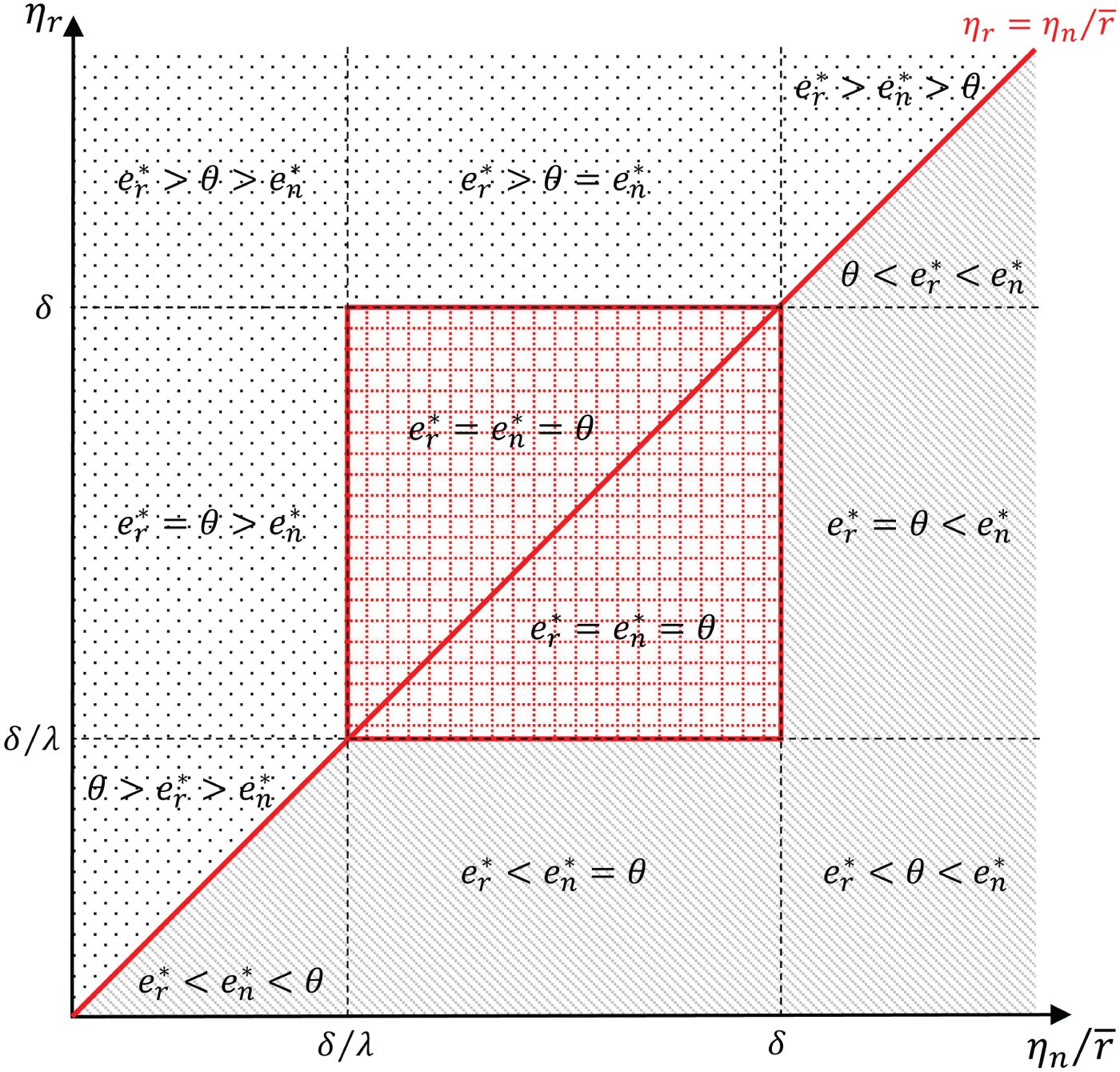
Figure 1 illustrates the cases in Proposition 2. When the intrinsic motivational parameter of the revenue goal is equal to that of the order-quantity goal scaled by the average revenue per order (i.e., the red diagonal line
Figure 1 can also provide some insights into the goal level and attainment rates under the two types of goal setting. Proposition 1 indicates that the individual’s optimal goal choice depends on parameters
We conducted a field experiment among food-delivery riders who work for one of the top two largest food-delivery platforms in China (referred to hereafter as “the platform” for anonymity). Millions of delivery riders use the platform as gig workers. With their own mobile devices and qualified health certificates, they register with the platform and are paid by piece-rate commission for each completed order. They choose when and in which region to work by logging into the platform’s mobile app on their smartphones and waiting for orders. Gig workers themselves decide online hours. The platform cannot force riders either online or offline. Riders’ online duration can be measured as a major type of effort.
The number of daily completed orders and total daily revenue are two common performance metrics for riders. In the app, they can easily review their completed orders and accumulated revenue. The riders mainly deliver food ordered from restaurants. The platform typically sets riders’ travel distance for an order within 3–5 km, so customers will not wait too long and the food will still be of good quality when delivered. The platform responds to real-time demand and assigns tasks to riders around destinations using a fair algorithm. Based on the platform’s public information, their order-delivery assignment algorithm selects riders nearby, available, and convenient for each order so as to ensure that the order is delivered on time.
Once assigned a delivery task, the rider’s abilities, such as familiarity with local roads, driving ability, and multitasking ability, affect how fast the rider can finish the task. Uncertainties due to weather and traffic conditions also influence task completion. In addition, other randomness (e.g., good luck) affects the performance. Overall, the faster the rider finishes the task, the sooner he returns to the system, receives the next assignment, and completes more orders in a working day.
Revenue earned from each order varies depending on travel distance, although it generally is in the 3–5 km range, and the price of the food. Therefore, the completed orders and revenue are highly correlated, but the latter is subject to higher uncertainty to certain extent.
The rest of Section 4 is organized as follows. Section 4.1 presents the experimental design and testable hypotheses derived from our theoretical analysis in Section 3. Section 4.2 details the experimental procedure, and Section 4.3 contains a description of the experimental data.
Experimental Design and Hypotheses
We invited the food-delivery riders who were registered in one of China’s largest cities to participate in the experiment. We designed two goal-type treatments that would induce riders to set different types of goals (i.e., an order-quantity goal or a revenue goal). We also included a “do your best” group in which riders were not asked to set a specific goal but were only told to do their best during the experiment week. Such a “do your best” group is commonly included in the goal-setting experiment literature (Locke and Latham, 2002). This is conceptualized as a “generalized goal” (Locke, 1968; Latham and Yukl, 1975), contrasting with specific goals like order or revenue goals. When individuals are instructed to do their best, they may still formulate an internal goal. However, they are not required to specify the level for a particular type of goal, as is the case with the other two goal-specific treatments. It is anticipated that this treatment might still evoke a certain degree of vague motivation but may not have as strong an effect as the two goal-specific treatments.
We formulate two hypotheses: the first hypothesis is related to Proposition 1, concerning the goal-setting treatment effects in comparison to the no-goal control (i.e., the group who are not encouraged to set a specific goal or do their best), while the second hypothesis is related to Proposition 2, addressing the comparison of treatment effects among different treatment groups.
Hypothesis 1 (Goal Motivational Effects): Individuals in the three treatment groups (i.e., the two specific goal-type treatments and the general “do your best” group) will, on average, exert more effort and achieve higher order quantities and revenue, compared to the no-goal control group.
Next, according to Proposition 2, the comparison between the two specific goal types is intricate, contingent on the values of various parameters, such as
Hypothesis 2 (Goal Type Effects):
Individuals in the revenue-goal treatment group will, on average, exert more effort and achieve higher order quantities and revenue than the order-goal treatment group.
Individuals in the order-goal or revenue-goal treatment group will, on average, exert more effort and achieve higher order quantities and revenue than the “do your best” group.
We conducted the experiment in one of the largest cities in China from January 18 to 22, 2021, for a total of 5 weekdays. Before the experiment, we collaborated with the platform to randomly select 30,000 riders from a single city and divide them into three groups, with 10,000 riders per group. On the Sunday prior to the work week, the platform sent messages to the 30,000 riders using its messaging system. The message began with an introduction: “Dear riders, do you want to manage your work better? You are invited to participate in a work-study during the coming weekdays.” This introduction was the same for all three groups. Riders interested in the experiment needed to click the confirmation button to participate in the experiment. Then, they were taken to a short survey and exposed to the treatment, which had three versions: (1) “Please set a daily goal for the number of orders you would like to complete in the next working week.” (order-goal treatment); (2) “Please set a daily goal for revenue you would like to achieve in the next working week.” (revenue-goal treatment); and (3) “Please do your best each day in the next working week” (“do your best” treatment). Participants in the goal-setting treatments submitted their self-set goal levels and participants in the “do your best” treatment clicked the “OK” button below the “do your best” sentence to complete the questionnaire.
After receiving messages, not all workers responded to our message. The response rate was
Our data included the participant riders’ self-set goal levels, all 30,000 riders’ daily online hours and daily performance reports (i.e., the number of completed orders and total revenue) from one week prior to the experiment to the end of the experiment. We obtained a limited set of rider demographics, including gender, age, work experience (i.e., the number of months since they registered on the platform), and education level from the company. We created two dummy variables: female (
Data Description
We used daily online hours to measure riders’ effort, and daily completed orders and revenue to measure performance. Figure 2 provides the box plots of the daily completed orders and the daily revenue (vertical axis) based on the data of the 5 days prior to the experiment. The horizontal axis indicates the daily online hours quantiles. Each box shows the interquartile range of the vertical axis, where the bottom line is the 25th percentile value, the middle line is the median value, and the upper line is the 75th percentile value. The plots show a large variation in completed order quantity per hour, a measure of riders’ productivity. 2 The coefficient of variation (CV) of daily online hours, order quantity, and revenue equals 0.7, 0.7, and 0.8, respectively. The variation in daily revenue is larger than that in daily order quantity, which is consistent with our intuition that the former is subject to a higher uncertainty level. 3
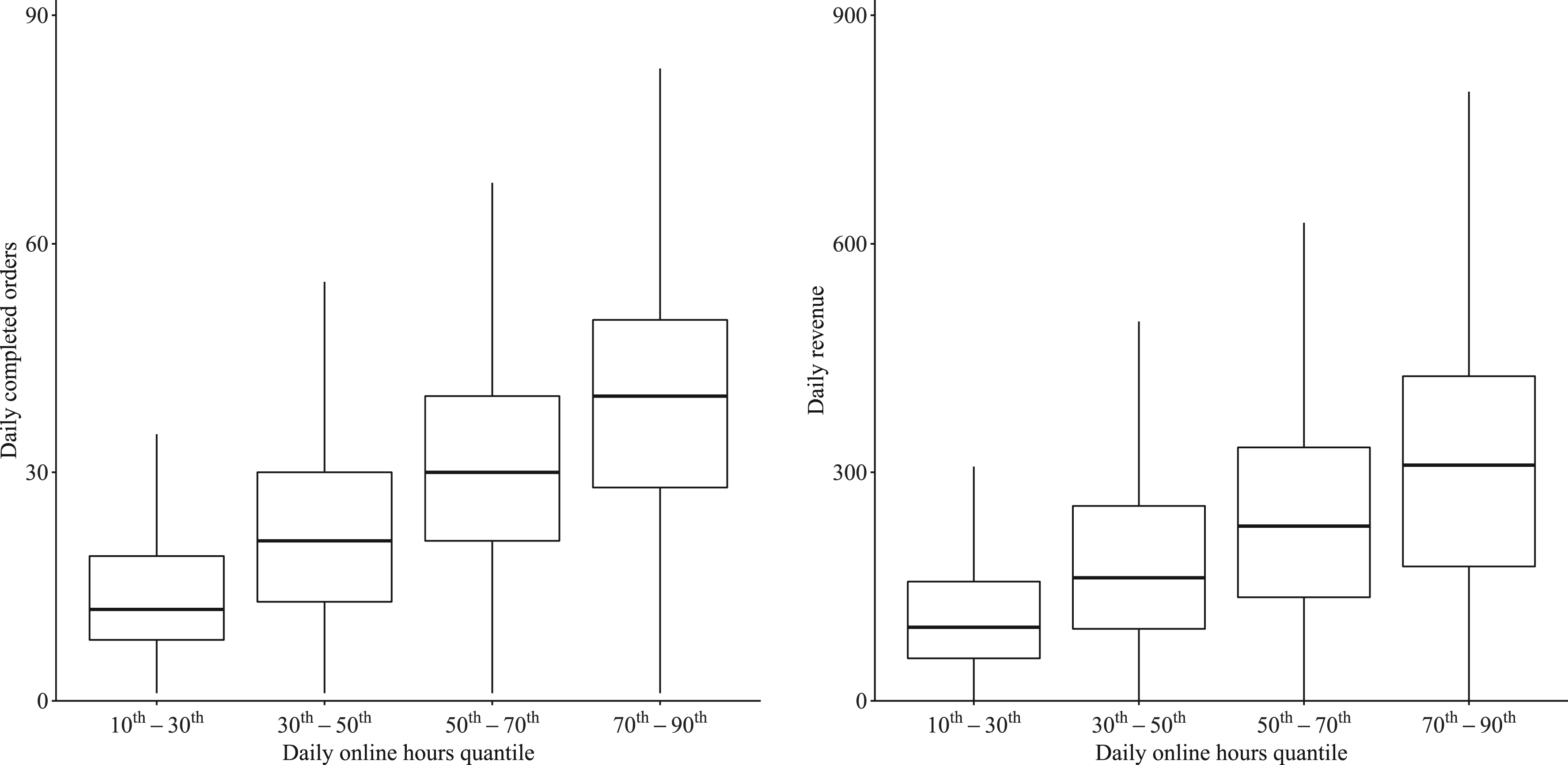
Box plots of daily completed orders and daily revenue.
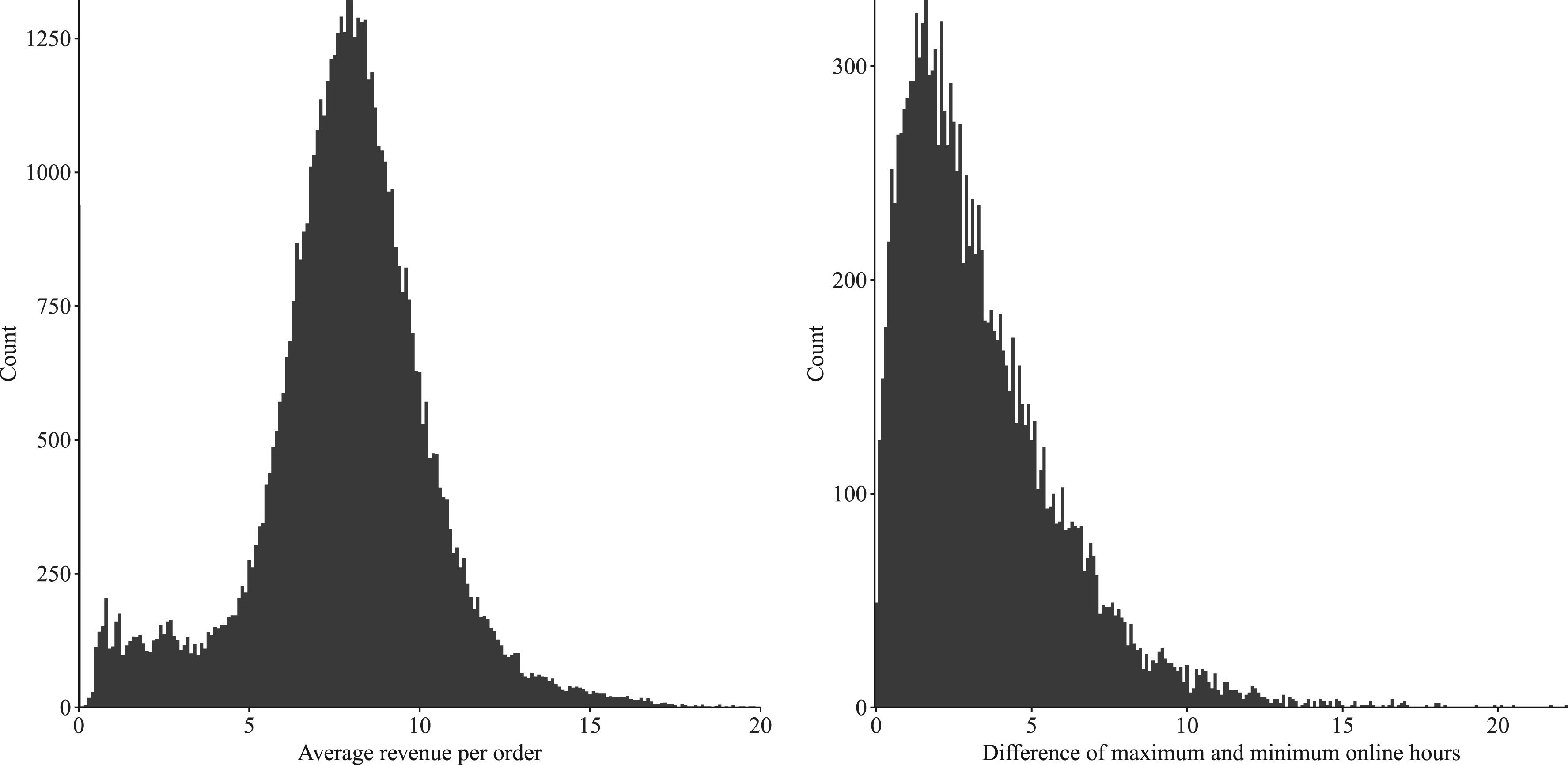
Frequency distributions of average revenue per order and difference of maximum and minimum online hours. The bin width is
Figure 3 plots the distribution of per-order revenue. To measure the within-individual variation of online hours, we calculated the difference between maximum and minimum daily online hours in the 5 days prior to the experiment for each rider, using those riders who had at least two days with positive online hours. The frequency distribution (Figure 3) demonstrates a large degree of variation. For example, for most riders, this difference was larger than 3 h. This implies that the riders have the potential to improve their efforts and may work more hours toward their maximums if they come out to work on a given day.
Overall Treatment Effects Analysis
To test Hypotheses 1 and 2, we used the difference-in-differences regression method to estimate the treatment effects of self-goal setting on the outcome variables, specified as follows:

The control group used in the regression is constructed from nonparticipants based on a matching process. This approach is necessary because of the concern that the subjects are self-selected into the experiment, causing selection bias. In the matching process, we first estimated the logit regression of participation on gender, age, work experience at the platform, education level, and average (median) performance prior to the intervention (details in Table A1 in the Appendices). Our findings indicate that the participants tend to be younger, have more work experience and a higher educational level, and demonstrate better pre-experiment performance compared to nonparticipants. In the subsequent step, we employed Propensity Score Matching and matched the treatment groups with a sample from nonparticipants, based on four demographic variables: gender, age, platform work experience, and education level, as well as average pre-experiment performance metrics such as online hours, completed orders, and revenue. 5 The summary of balance for matching reported in Appendix Table A1 confirms that through matching the treatment and control groups are now comparable in their characteristics. 6 We are, however, conscious of certain limitations, particularly the constrained number of matching variables. Due to restrictions on surveying gig workers, we relied solely on data provided by the platform. With a richer dataset on these workers, we could have constructed a more precisely matched control group, making our treatment effect estimates more robust against selection bias. 7
As shown in Columns (1)–(3) of Table 1, the estimates for the interaction terms between treatment group dummies and during were positive and significant, suggesting significant average treatment effect of goal setting on either effort or the two performance metrics for both goal-type treatments. In addition, we notice that the “do your best” treatment effect is also generally significant. Thus, Hypothesis 1 was supported.
Average treatment effects of self-goal setting.
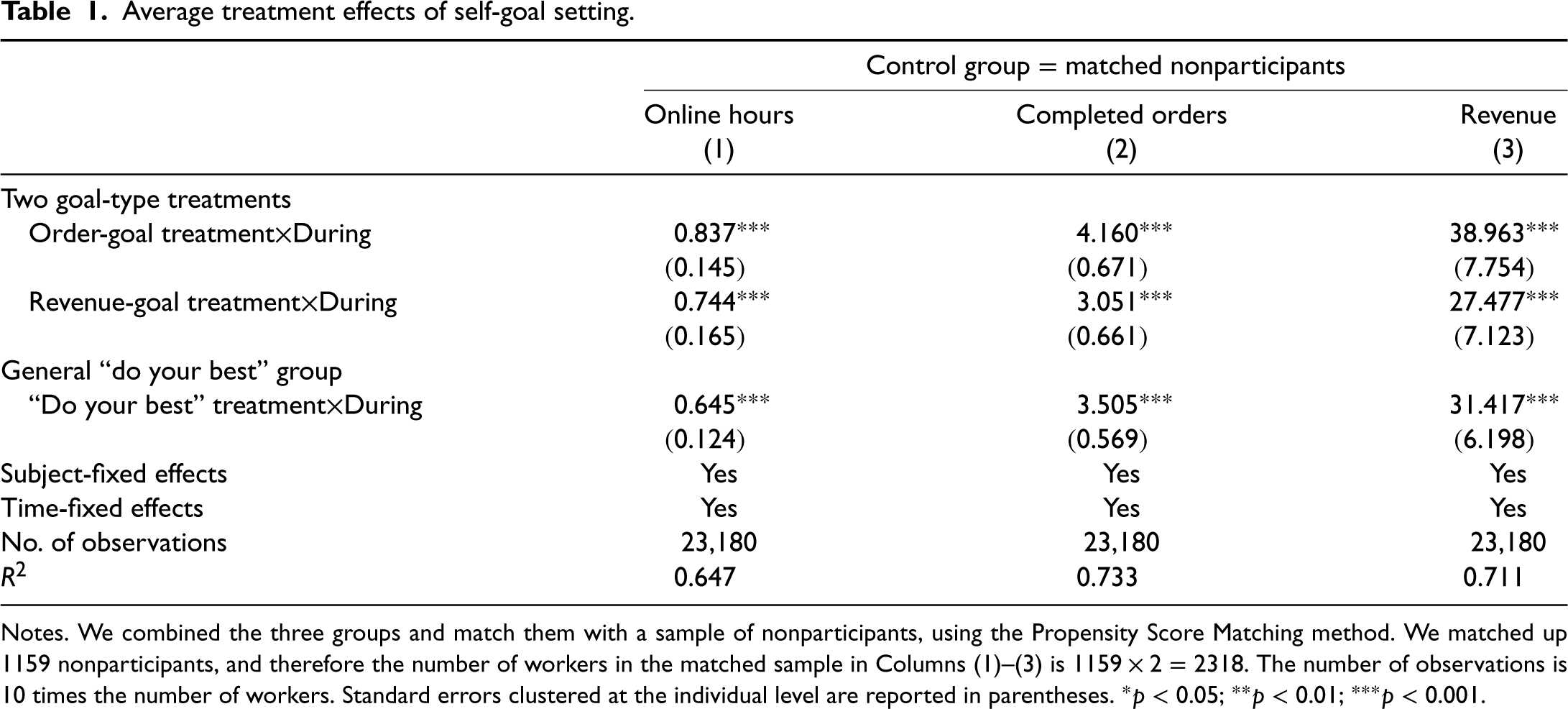
Average treatment effects of self-goal setting.
Notes. We combined the three groups and match them with a sample of nonparticipants, using the Propensity Score Matching method. We matched up
To test Hypothesis 2, we conducted the difference-in-differences analysis of goal-type effects on performance (Table 2). The sample includes participants in the two goal-setting treatments with the baseline group being the order-goal treatment. As shown in Table 2, the coefficients for the interaction term revenue-goal treatment
Difference-in-differences analysis of goal-type effects on performance.
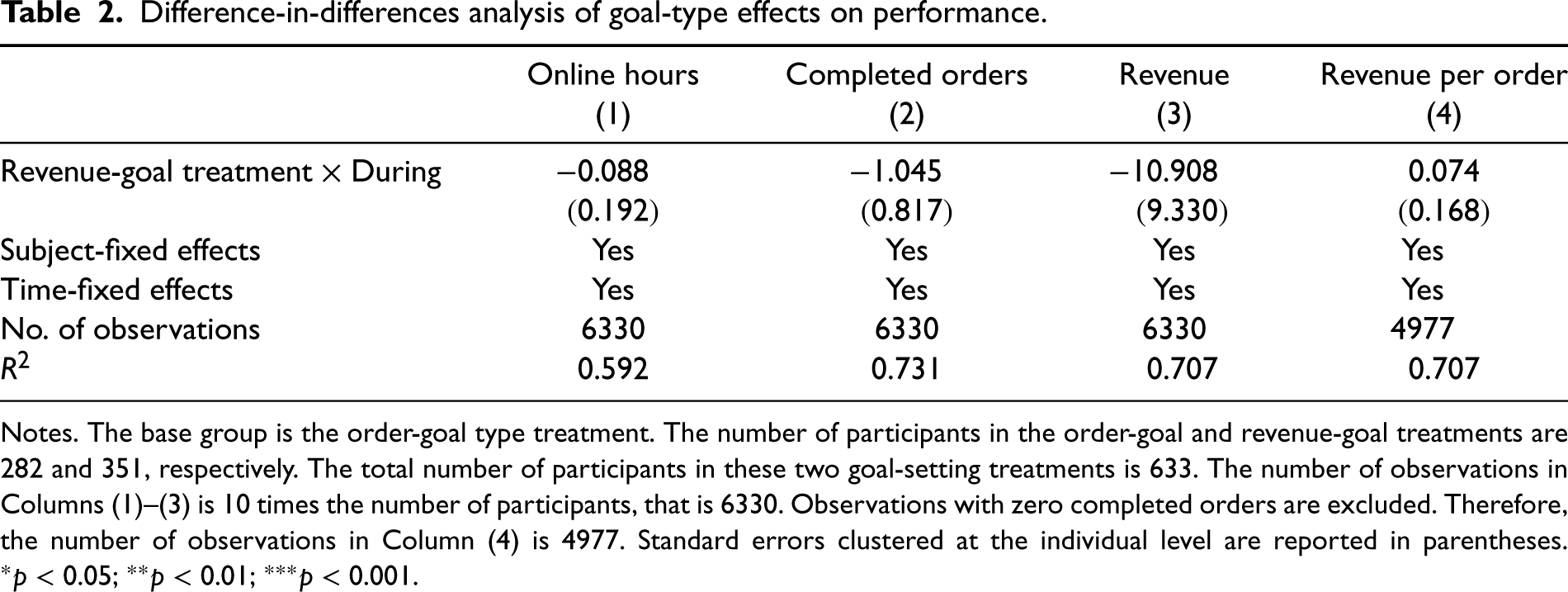
Notes. The base group is the order-goal type treatment. The number of participants in the order-goal and revenue-goal treatments are
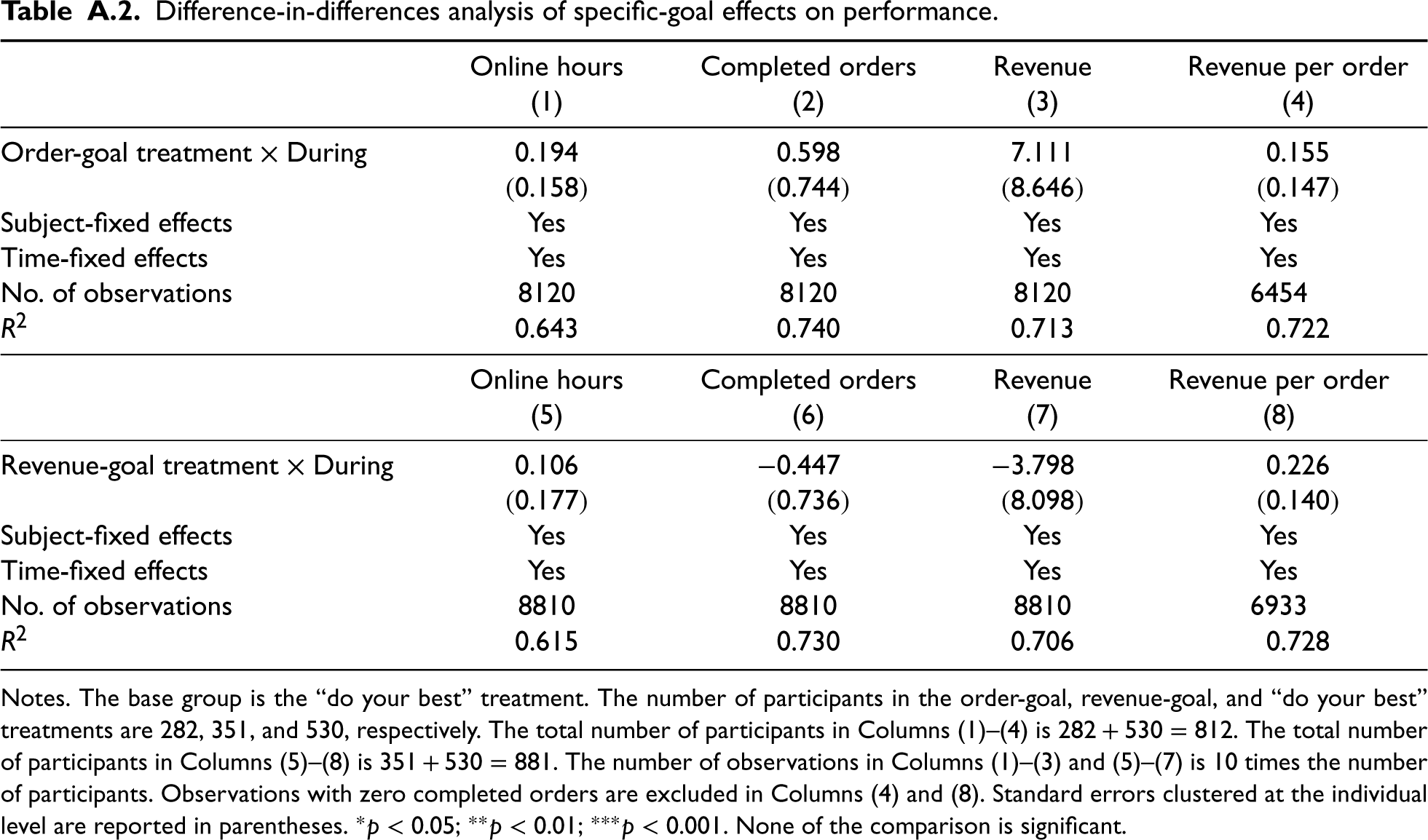
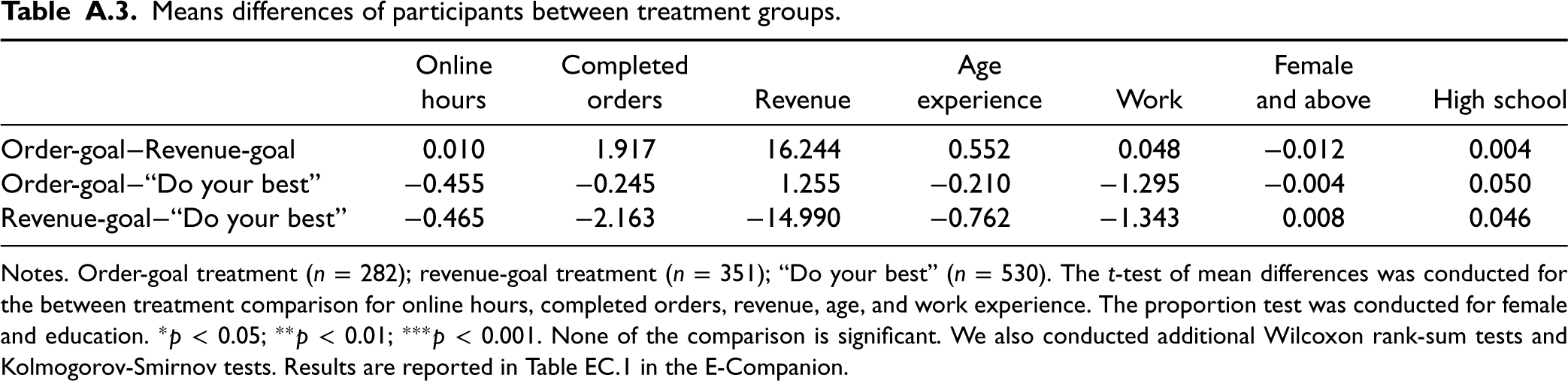
To ensure that individuals in the three treatments are comparable in characteristics, we conducted two-sample t-tests of mean differences for the four demographic variables as well as pre-experiment performance. As shown in Appendix Table A3, there are no significant differences in these characteristics between the two goal-type treatment groups, nor between these two goal-type groups and the “do your best” group.
We conducted an analysis to explore the heterogeneous treatment effects across subgroups of workers. This analysis is interesting for two reasons. First, the literature has long recognized that goal-setting effects depend on individuals’ own demographic variables (Locke et al., 1981), such as work experience and education level. It is interesting for our study to examine whether there are significant treatment effects for workers with different education levels and work experience. Second, our analysis of heterogeneous treatment effect can potentially inform the platform’s targeted operations. Platform companies nowadays commonly utilize big data and various uplift modeling methods to identify and quantify heterogeneous treatment effects for target user operations (Devriendt et al., 2018). In general, our analyses of heterogeneous self-goal setting treatment effects on gig workers’ performance follow the growing trend of precision medicine (for a review, see Hopp et al., 2018), targeted advertising on websites, such as Google and Facebook (Iyer et al., 2005; Chen and Stallaert, 2014; Venkatadri et al., 2018), and personalized recommendations on e-commerce sites, such as Taobao (Wang et al., 2018).
To avoid cherry-picking and over-fitting, we used the causal tree algorithm proposed by Athey and Imbens (2016) to find key demographic features (out of the four available attribute variables) and divided participants into subgroups.
8
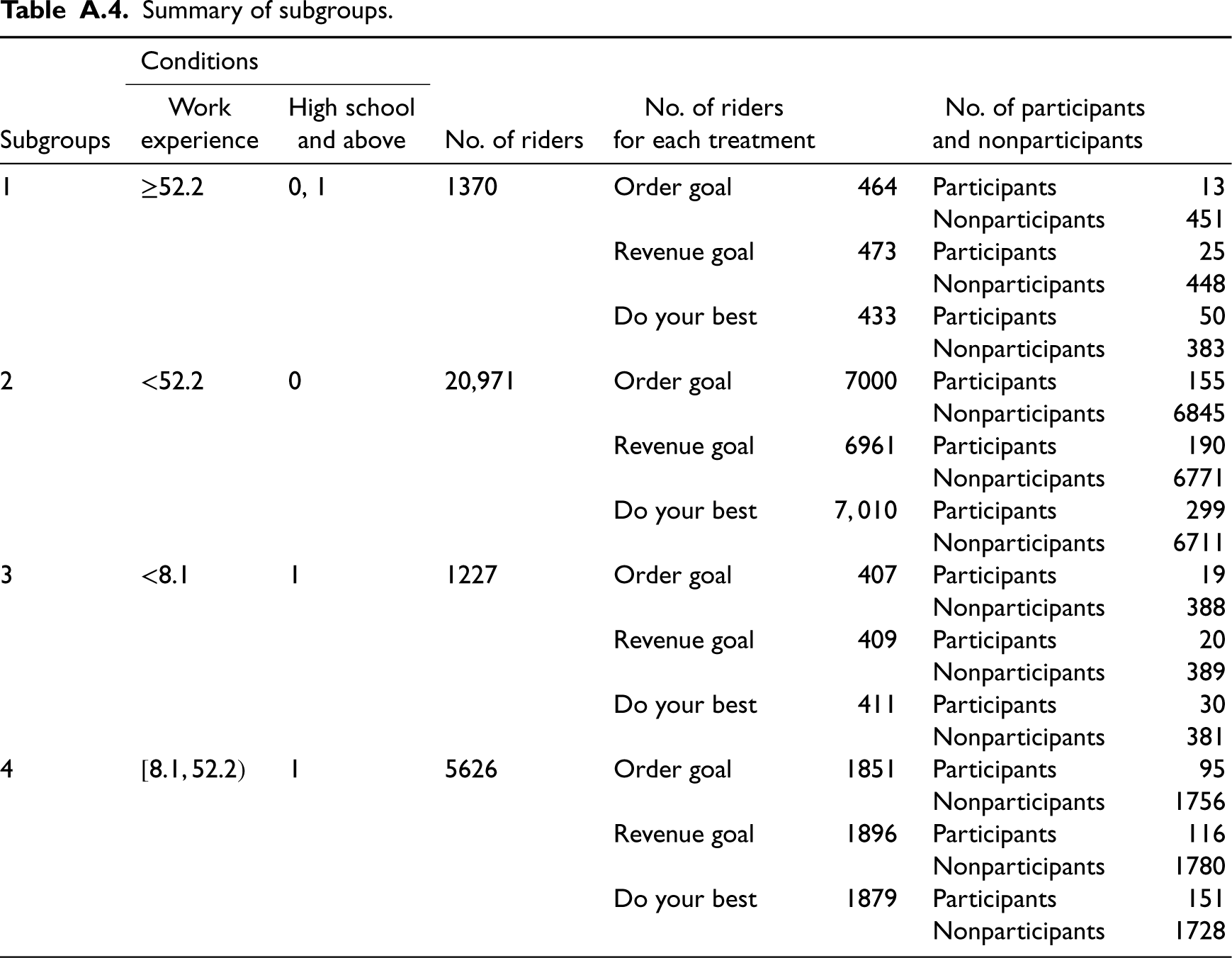
The causal tree method from the literature on machine learning is a non-parametric data-driven approach that effectively partitions participants in randomized experiments into smaller subgroups, such that the participants within each subgroup have similar characteristics and participants across subgroups differ in the magnitude of their treatment effects (Athey and Imbens, 2016). The algorithm was used to select two key attributes (work experience and education level)
9
and four subgroups were generated, as shown in Table A4. The participants in Subgroup 1 were highly experienced and had work experience longer than 52.2 months. Participants in Subgroup 2 were less educated, had received a below-high school level education, and had less than 52.2 months of work experience. Participants in Subgroup 3 were inexperienced, had less than 8.1 months of work experience, and had received an education up to high school level or above. Participants in Subgroup 4 were experienced and highly educated, had work experience between 8.1 and 52.2 months and had received education till the high school level or above. The four subgroups accounted for
For each subgroup, we estimated the treatment effect with the matched nonparticipants as the baseline. As shown in Table 3, the less educated participants (Subgroup 2) are mostly motivated by specific goals. The estimates for the interaction terms between treatment dummies and during were positive and significant for efforts and performance metrics for both the order-goal and revenue-goal treatments (Columns (4)–(6) in Table 3), suggesting that the treatment effect was significantly positive. This result is consistent with the literature that the education level can significantly influence the treatment effect of goal setting (Ivancevich and McMahon, 1977) and the less educated subjects are more motivated (Latham and Yukl, 1975). The goal-type treatment effects did not consistently show significance across the remaining three subgroups. Regarding the “do your best” group, as shown in Table 3, its effect is not consistent across the subgroups either. Notably, it appears to be least effective for Subgroup 4 (Columns (10)–(12) in Table 3), which consists of the experienced and highly educated workers.
Average treatment effects of self-goal setting for each subgroup.
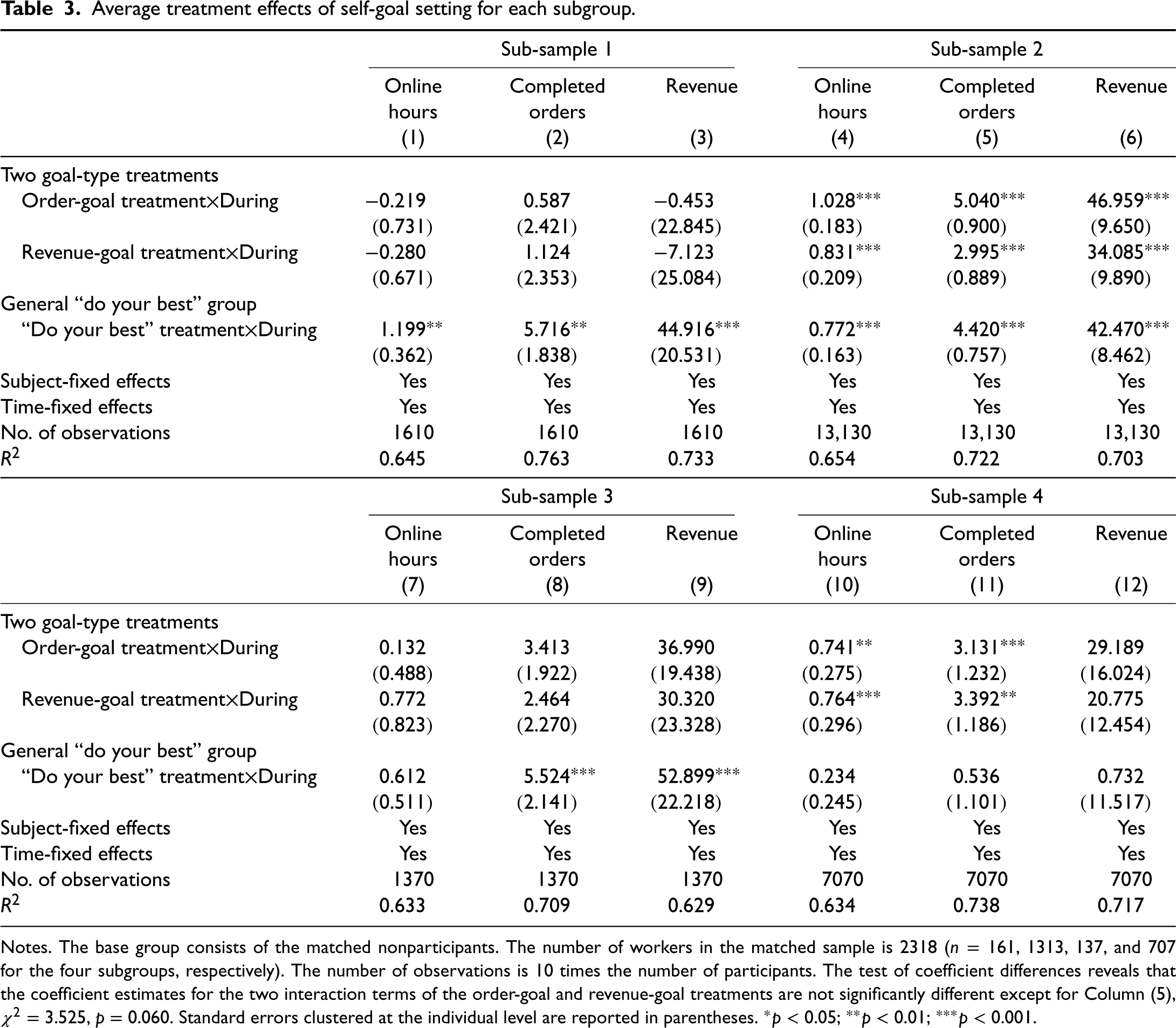
Average treatment effects of self-goal setting for each subgroup.
Notes. The base group consists of the matched nonparticipants. The number of workers in the matched sample is 2318 (
As mentioned earlier in Section 1, goal attainment is worthy of attention in the goal literature, and goal attainment has been found to be contingent on goal types (Ryan, 2012). Although we did not propose a specific hypothesis regarding the goal-type treatment effect on goal level or goal attainment, we conducted this empirical analysis to help illustrate the behavioral implications in the goal-setting experiment. The sample includes participants in the two goal-setting treatments with the baseline being the order-goal treatment. As shown in Column (1) of Table 4, the coefficient for the revenue-goal type treatment was negative and significant, suggesting that the goal attainment rate in the revenue-goal treatment group was significantly lower than in the order-goal treatment group.
Goal setting behaviors of the two goal-type treatments.
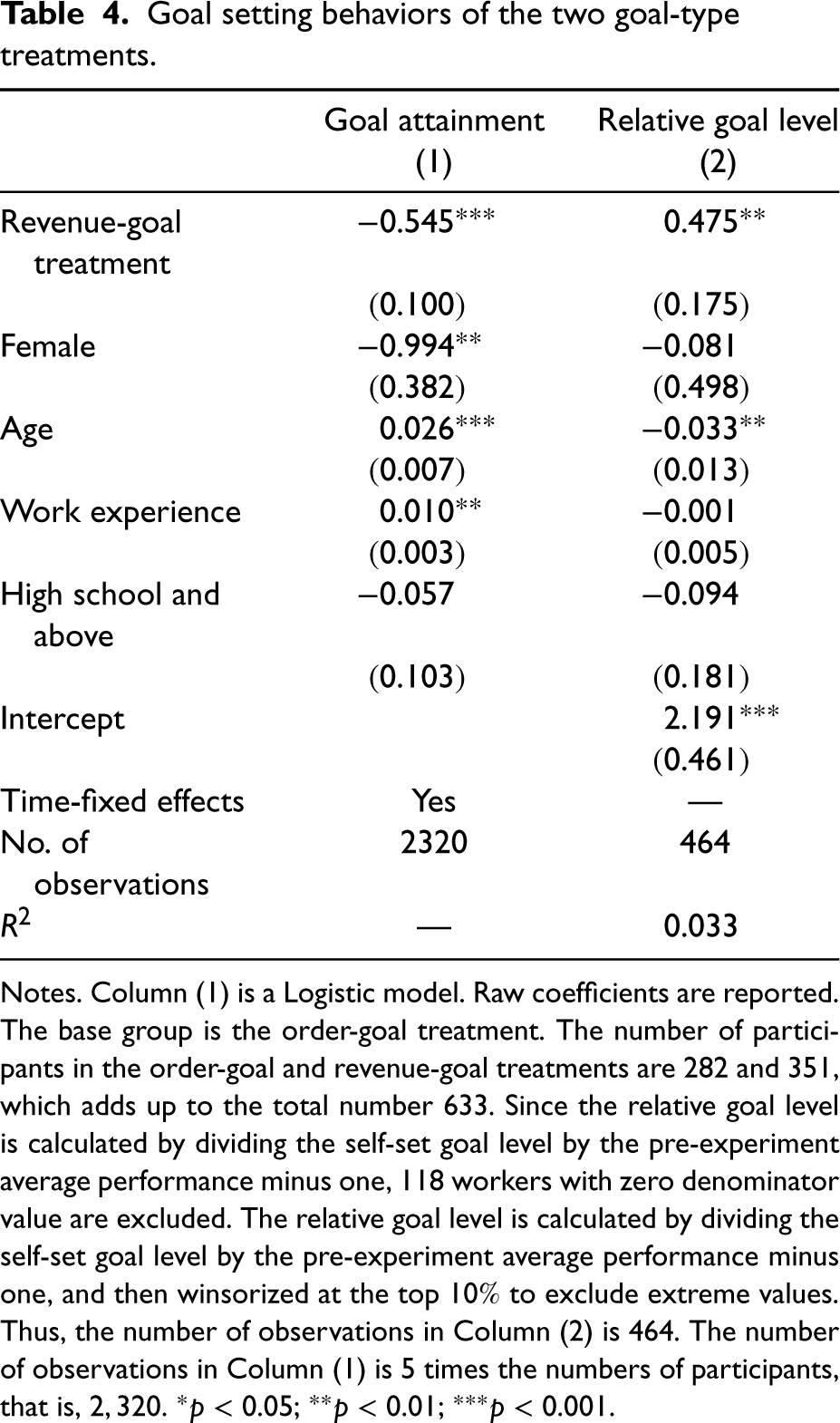
Goal setting behaviors of the two goal-type treatments.
Notes. Column (1) is a Logistic model. Raw coefficients are reported. The base group is the order-goal treatment. The number of participants in the order-goal and revenue-goal treatments are 282 and 351, which adds up to the total number 633. Since the relative goal level is calculated by dividing the self-set goal level by the pre-experiment average performance minus one, 118 workers with zero denominator value are excluded. The relative goal level is calculated by dividing the self-set goal level by the pre-experiment average performance minus one, and then winsorized at the top
As shown in Column (2) of Table 4, the coefficient for the revenue-goal type treatment was positive and significant, suggesting that the relative goal level in the revenue-goal treatment group was significantly higher than that in the order-goal treatment group. Altogether, the results suggest differences in the goal-setting behaviors between the two goal types: setting the revenue goal leads to a higher chosen goal level, however, the workers may not be able to achieve it, resulting in a lower goal attainment rate. We attempt to propose a potential behavioral explanation for this finding: Studies on judgement bias consistently demonstrate that individuals tend to be overoptimistic about the success of their chosen actions (Weinstein, 1980, 1982, 1984: and the reviews therein). Further research posits that this over-optimism bias increases with the variance of their belief distribution (Van den Steen, 2004). In our context, gig workers’ revenue is dependent on both the quantity of orders and the revenue per order they can make. While workers may have reasonable estimates of the number of orders they can obtain once they get on the platform, the amount they can earn from each order is harder to predict, which makes the belief about revenue more variable. Consequently, workers may exhibit increased overoptimism under the revenue goal, opting for a higher goal level, which could subsequently lead to a lower rate of attainment.
Before our experiment with food-delivery riders, we conducted a similar experiment among ride-hailing drivers in China. 10 We were not provided with the demographic or performance data for nonparticipants. Consequently, we were unable to construct a control group from nonparticipants, nor could we estimate the average treatment effect necessary to test Hypothesis 1. Despite this limitation, the experiment still allows the testing of Hypothesis 2(i), which pertains to the differences in performance metrics, goal attainment rates, and self-set goal levels between different goal-type treatments.
The registered drivers, similar to the food-delivery riders, were self-employed and paid by piece-rate commission per completed trip. The ride-hailing platform considered both daily work hours and daily revenue as drivers’ performance metrics. In our experiment, 12,000 drivers were randomly selected and divided into two treatment groups: one set goals for daily work hours and the other set goals for daily revenue. Drivers have more direct control over their work hours than their revenue because the commission for each completed trip depends on the trip distance and duration, while weather and traffic conditions can affect drivers’ efficiency and revenue.
We obtained daily performance data (i.e., work hours and revenue) before and during the experiment week for participants in work-hour-goal (
Conclusion
Our study contributes to the literature and related business practices by providing, to our knowledge, the first empirical evidence on the efficacy and limitations of self-goal setting mechanisms in the gig economy context. Our findings provide useful managerial insights into the self-goal setting mechanism for gig workers. First, as a non-monetary and non-binding incentive mechanism, our study demonstrated significant effects of self-goal setting on gig workers’ motivating effort and performance across all the workers. Additionally, our experimental data provides empirical evidence that the effects of specific goals such as an order-quantity or a revenue goal are heterogeneous, and the effect is predominantly strong for the subgroup characterized by a lower level of education. Importantly, this subgroup constitutes a significant proportion of our study, accounting for
Second, regarding comparisons of the two common performance metrics for goal setting (i.e., number of completed orders vs. total revenue), the experiment results suggest equal effort improvement but different goal level and attainment probabilities. Our experiment showed a lower goal attainment rate in the revenue-goal treatment group compared with the order-goal treatment group because workers tended to set excessively high revenue goals. This finding contributes to the goal-setting experimental literature by suggesting that goal type impacts goal attainment (Locke and Latham, 2002, 2006). The implication of this finding is that platforms would be better served by encouraging workers to set order goals rather than revenue goals if they suspect that higher goal attainment rates could benefit workers’ engagement and retention, which, although not monetary, are nevertheless important psychological benefits well-documented in the psychology literature on goal setting (e.g., Locke and Latham, 1990).
Third, our study provides general insights into the use of non-financial motivation mechanisms on gig platforms. We showed that the practices of encouraging gig workers to self set a goal even if it is just a vague and general “do your best” message, can help platform companies not only motivate a certain group of gig workers but also identify the most responsive and high-performing group, so that further incentive policies can be designed to target them, similar to the growing trend of targeted advertising on websites such as Google and Facebook (Chen and Stallaert, 2014; Venkatadri et al., 2018) and personalized recommendations on e-commerce sites such as Taobao (Wang et al., 2018).
To develop a tractable theoretical model to represent optimal goal decision-making, we did not include risk preferences in workers’ monetary utility function. Given that the revenue stream is random, it would be interesting to examine the impact of workers’ risk attitudes on their goal choices and performance. Future research could further explore people’s reactions to such output uncertainties. Our experiment could be extended by attaching a bonus to goal attainment to examine the joint effects of monetary and non-monetary incentives in self-goal setting, although this would require substantial financial support from the platform.
Supplemental Material
sj-pdf-1-pao-10.1177_10591478231224927 - Supplemental material for Set a Goal for Yourself? A Model and Field Experiment With Gig Workers
Supplemental material, sj-pdf-1-pao-10.1177_10591478231224927 for Set a Goal for Yourself? A Model and Field Experiment With Gig Workers by Xu Min, Wei Chi, Xing Hu and Qing Ye in Production and Operations Management
Footnotes
Appendices
In the second stage, self 2 accepts the goal and has goal-dependent intrinsic utility
If
In other cases, the optimal effort levels in the order-goal and revenue-goal scenarios are compared with Summary of propensity score matching results. Notes. The full sample including all riders in Column (1) is 29,194, which is different from 30,000 because some workers with incomplete information are excluded from the sample. The number of participants in Column (2) is 1163. The number of nonparticipants in Column (3) is 28,031. The number of matched participants and nonparticipants are 1159 in Columns (5) and (6). In Columns (4) and (7), the t-test of mean differences was conducted between participants and nonparticipants for online hours, completed orders, revenue, age, and work experience, and the proportion test was conducted for female and education. The average performance before the experiment is the median value during the week prior to the experiment. * Difference-in-differences analysis of specific-goal effects on performance. Notes. The base group is the “do your best” treatment. The number of participants in the order-goal, revenue-goal, and “do your best” treatments are Means differences of participants between treatment groups. Notes. Order-goal treatment ( Summary of subgroups.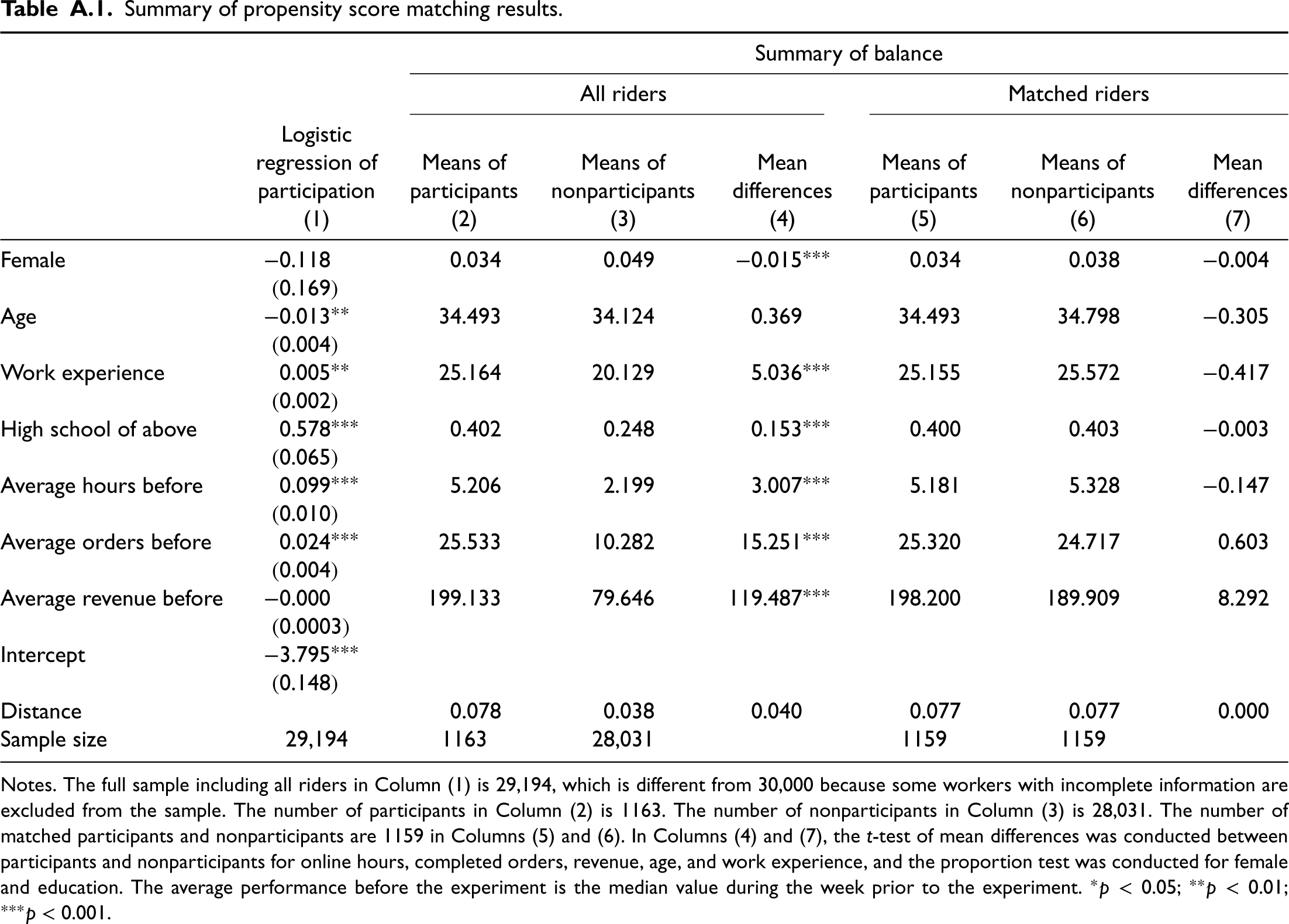
Summary of balance
All riders
Matched riders
Logistic
regression of
Means of
Means of
Mean
Means of
Means of
Mean
participation
participants
nonparticipants
differences
participants
nonparticipants
differences
(1)
(2)
(3)
(4)
(5)
(6)
(7)
Female
−0.118
0.034
0.049
−0.015***
0.034
0.038
−0.004
(0.169)
Age
−0.013**
34.493
34.124
0.369
34.493
34.798
−0.305
(0.004)
Work experience
0.005**
25.164
20.129
5.036***
25.155
25.572
−0.417
(0.002)
High school of above
0.578***
0.402
0.248
0.153***
0.400
0.403
−0.003
(0.065)
Average hours before
0.099***
5.206
2.199
3.007***
5.181
5.328
−0.147
(0.010)
Average orders before
0.024***
25.533
10.282
15.251***
25.320
24.717
0.603
(0.004)
Average revenue before
−0.000
199.133
79.646
119.487***
198.200
189.909
8.292
(0.0003)
Intercept
−3.795***
(0.148)
Distance
0.078
0.038
0.040
0.077
0.077
0.000
Sample size
29,194
1163
28,031
1159
1159
Online hours
Completed orders
Revenue
Revenue per order
(1)
(2)
(3)
(4)
Order-goal treatment
During
0.194
0.598
7.111
0.155
(0.158)
(0.744)
(8.646)
(0.147)
Subject-fixed effects
Yes
Yes
Yes
Yes
Time-fixed effects
Yes
Yes
Yes
Yes
No. of observations
8120
8120
8120
6454
0.643
0.740
0.713
0.722
Online hours
Completed orders
Revenue
Revenue per order
(5)
(6)
(7)
(8)
Revenue-goal treatment
During
0.106
−0.447
−3.798
0.226
(0.177)
(0.736)
(8.098)
(0.140)
Subject-fixed effects
Yes
Yes
Yes
Yes
Time-fixed effects
Yes
Yes
Yes
Yes
No. of observations
8810
8810
8810
6933
0.615
0.730
0.706
0.728
Online
Completed
Age
Female
hours
orders
Revenue
experience
Work
and above
High school
Order-goal
Revenue-goal
0.010
1.917
16.244
0.552
0.048
−0.012
0.004
Order-goal
“Do your best”
−0.455
−0.245
1.255
−0.210
−1.295
−0.004
0.050
Revenue-goal
“Do your best”
−0.465
−2.163
−14.990
−0.762
−1.343
0.008
0.046
Conditions
Work
High school
No. of riders
No. of participants
Subgroups
experience
and above
No. of riders
for each treatment
and nonparticipants
1
52.2
{0, 1}
1370
Order goal
464
Participants
13
Nonparticipants
451
Revenue goal
473
Participants
25
Nonparticipants
448
Do your best
433
Participants
50
Nonparticipants
383
2
<52.2
0
20,971
Order goal
7000
Participants
155
Nonparticipants
6845
Revenue goal
6961
Participants
190
Nonparticipants
6771
Do your best
7,010
Participants
299
Nonparticipants
6711
3
<8.1
1
1227
Order goal
407
Participants
19
Nonparticipants
388
Revenue goal
409
Participants
20
Nonparticipants
389
Do your best
411
Participants
30
Nonparticipants
381
4
1
5626
Order goal
1851
Participants
95
Nonparticipants
1756
Revenue goal
1896
Participants
116
Nonparticipants
1780
Do your best
1879
Participants
151
Nonparticipants
1728
Acknowledgements
The authors gratefully thank the department editor, the senior editor, and three anonymous reviewers for their valuable comments and suggestions that have greatly improved the article. Wei Chi acknowledges the support by the National Natural Science Foundation of China (Grant 72372084, 72342027).
Declaration of Conflicting Interests
The author(s) declared no potential conflicts of interest with respect to the research, authorship, and/or publication of this article.
Funding
The author(s) received no financial support for the research, authorship, and/or publication of this article.
Supplemental Material
Supplemental material for this article is available online (
Notes
How to cite this article
M Xu, Chi W, Hu X, Ye Q (2024) Set a Goal for Yourself? A Model and Field Experiment with Gig Workers. Production and Operations Management 33(1): 205–224.
References
Supplementary Material
Please find the following supplemental material available below.
For Open Access articles published under a Creative Commons License, all supplemental material carries the same license as the article it is associated with.
For non-Open Access articles published, all supplemental material carries a non-exclusive license, and permission requests for re-use of supplemental material or any part of supplemental material shall be sent directly to the copyright owner as specified in the copyright notice associated with the article.
