



Abstract
E-commerce platforms have an informational advantage over their third-party sellers, leading to the common belief that a platform's market entry would harm sellers with similar products. However, unlike traditional retail competition, the platform and its sellers have aligned incentives: the platform's commission depends on the seller's revenue, and sellers rely on the platform to strengthen their online presence. Hence, the platform has no incentive to enter the market to harm the seller's revenue severely. This paper introduces a duopoly model where the seller is the "incumbent" and the platform is the "potential entrant". Our model captures two salient features: (a) the "reputation effect" that enables the platform to obtain a higher consumer valuation than the seller, and (b) the "spillover effect" that expands the market size when an additional entity (e.g., the platform) enters the market. Our equilibrium analysis debunks the prevailing belief about platform's entry, showing that platform's entry can enable both the platform and the seller to obtain a higher profit when the unit cost is sufficiently low and the spillover effect is sufficiently high. For robustness checks, we consider three different extensions: an alternative duopoly model with reversed roles where the platform is the incumbent and the seller is the potential entrant, a scenario with an endogenously determined spillover effect, and a simultaneous market entry/exit decision-making process. We find a consistent result across all three extensions that both seller and platform entries can mutually benefit under similar market conditions, fostering a symbiotic relationship.
Introduction
Many traditional online retailers such as Amazon and JD.com transformed their online business models from retailers that sell their own products (books for Amazon or electronics for JD.com) to platforms that enable third-party sellers to sell their products online. Online E-commerce platforms (“platforms” or “online platforms” for short hereafter) such as Amazon, Alibaba, JD.com have fueled economic growth by generating value for the sellers, consumers, and the platform (Chen et al., 2020). First, online platforms can sell a vast selection of products to consumers as a marketplace for many sellers without owning inventory. By doing so, these platforms can earn commissions as a certain percentage of the seller revenues. Second, these platforms can enable sellers to establish their online sales channels, and yet they maintain control of their pricing and inventory decisions. Third, by shopping on these platforms, consumers can search for products with good quality or low prices more easily.
Online platforms like Amazon and JD.com can use the market information that they observe directly from the online sales generated by third-party sellers to analyze the market potentials of different products. By using this market intelligence and their unique positions, these platforms have the option to expand their operations as “hybrid” platforms.
Specifically, hybrid platforms can choose to sell certain products on their own platforms as sellers. In many instances, their selected products may be similar or identical to those of existing sellers. In doing so, these hybrid platforms are competing directly with those sellers who sell similar products. This hybrid model has been successful, enabling Amazon’s U.S. sales to surge to $316 billion in 2022 (Dai and Tang, 2020). 1 Besides Amazon, JD.com along with Alibaba have transformed their modus operandi as hybrid platforms over the years.
Hybrid platforms certainly offer more purchasing options for consumers, but this hybrid model has raised various fairness concerns. Because an online platform serves as an online marketplace for independent sellers, it can leverage its direct observations of all online consumer behavior to develop search algorithms to promote their own products, creating unfair competition against other sellers (Khan 2019; Zhu 2019). The U.S. Senate alleged that Amazon’s hybrid model is hurting its third-party sellers (Holland, 2021), which motivated Senator Klobuchar to propose the “American Innovation and Choice Online Act” that is pending approval (Edgerton and Birnbaum, 2022). Across the Atlantic, the European Union has raised concerns about Amazon’s hybrid model, and examined whether it has violated the European competition law by using nonpublic data it gathers from third-party complementors to unfairly compete against them (Pop and Schechner, 2020).
It is a common belief that the hybrid platform model is harmful to independent sellers. Therefore, it was intriguing to observe that some independent sellers came forward to defend the platform’s hybrid model. Indeed, some third-party sellers actually support Amazon’s hybrid model because of the “spillover effect”—they believe that the platform’s entry can enlarge the market size that can benefit third-party sellers and that “the examples of Amazon unfairly using seller information are few and far between” (Lewis, 2021).
As diverging public views over the hybrid model continue, mixed research results ensued. Currently, empirical findings are mixed: Zhu and Liu (2018) find that third-party sellers in the United States tend to decrease the number of products they offer on a platform when it enters the market; however, Dryden et al. (2020) find an opposite result using data collected in France and Germany. More recently, Deng et al. (2023) analyze data provided by JD.com and find that third-party sellers tend to adjust their price higher and even sell more after the platform’s entry. Crawford et al. (2022) find Amazon’s entry into Germany’s Marketplace’s Home & Kitchen department to be more aligned with market expansion than business stealing. Unlike traditional retailing, there is a symbiotic relationship between the platform and sellers especially when the platform’s earnings are primarily based on the commissions they obtain from the sellers. Specifically, the incentives of the platform and the seller are aligned: the platform’s commission depends on the seller’s revenue, which in turn affects the seller’s profit. As such, when a platform decides on its market entry strategy and entry price, it must take the seller’s revenue (which affects the platform’s commission) into consideration. Because of the aligned incentive, the platform is unlikely to enter the market to force the seller to exit the market. These observations cast a doubt over the belief that a platform’s entry is always detrimental to third-party sellers.
As such, the aforementioned common belief and the limited empirical research motivate us to investigate the impact of a platform’s entry on independent sellers’ pricing decisions and their resulting profits. Also, we are interested in examining if and when a platform’s entry can benefit both the platform and the sellers. To do so, we first present our main model in which the seller is the “incumbent” who has been selling a product through the platform. At the same time, the platform is the “potential entrant” who needs to decide if she should enter the market to sell the same product to compete with the seller.
To model a platform’s entry by selling a similar product, our model captures two salient features. First, because the platform has its own physical infrastructure to support its logistics services, it has a stronger brand reputation compared to other independent sellers (Shen et al., 2020). 2 We capture this “reputation effect” by assuming that the platform enjoys a higher consumer valuation than the seller.
Second, when the platform and the seller sell the same (or similar) product, the platform’s entry will enhance the visibility and create awareness of the product and the seller (Handarkho, 2020). The increased visibility generated by the platform’s entry can draw more consumers to examine the product. Consequently, it can expand the market size, which can benefit both the platform and the seller (Kang, 2017; Deng et al., 2023). To account for this “spillover effect,” we assume that the market size will increases when an additional entity (e.g., the platform) enters the market.
By examining and comparing the platform’s and the seller’s optimal price and profit in equilibrium, that correspond to the case when the platform enters the market and the case when the platform chooses not to enter, we find the following results for our main model that debunk the common belief. Specifically, we find that, when the unit cost is sufficiently low and when the spillover effect is sufficiently high, the platform’s entry is mutually beneficial. Interestingly, the platform’s entry can also enable the seller to sell more upon the platform’s entry. 3
For robustness checks about our key results obtained from our main model, we consider three different extensions. We first examine a variant of our main model by reversing the roles so that the platform is the incumbent whereas the seller is the potential entrant. Then we extend our main model to the case when the spillover effect can be endogenously determined by the platform (by exerting costly promotion efforts to enlarge the market size). Finally, we extend our main model to the case when the platform’s market entry decision and the seller’s market exit decision are made simultaneously.
By incorporating the same reputation and spillover effects, we find that the same structural results obtained from the main model continued to hold across all three extensions. Specifically, the seller’s entry in the first extension and the platform’s entry in the second and third extensions can be mutually beneficial when the cost is sufficiently low and the spillover effect is sufficiently high. Essentially, these favorable conditions foster a symbiotic relationship so that both the platform and sellers can benefit from each other’s entry.
Ultimately, our paper contributes to the platform entry literature by demonstrating the mutual benefits created by the entry. Contrary to the preconceived belief, our findings demonstrate that the platform’s entry can create value for the incumbent seller. Similarly, the seller’s entry can create value for the incumbent platform. As a result, these entries create mutual benefits without necessitating the exit of the incumbent from the market.
The structure of this article is organized as follows. The Section 2 examines the related literature and highlights our contributions. We present our model preliminaries in the Section 3. In Section 4, we analyze our main model in which the seller is the incumbent. Then we examine three extensions, including an alternative model in which the platform is the incumbent Section 5, a model that endogenizes the spillover effect Section 6, and a model when the platform and seller make simultaneous decisions Section 7. We conclude in the Section 8.
Literature Review
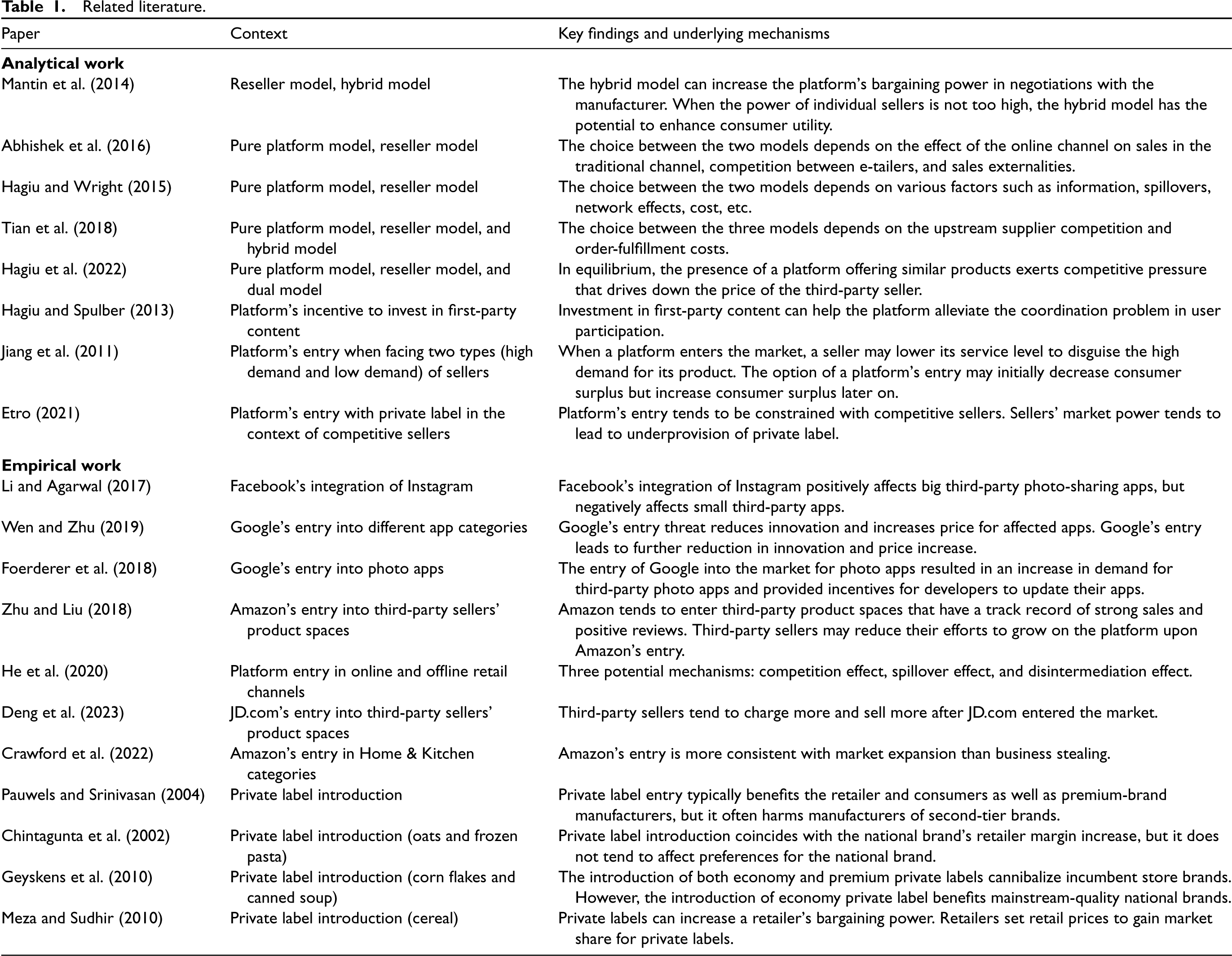
We review the recent research literature that examines various issues arising from retail platforms as summarized in Table 1.
Related literature.
Related literature.
First, we build upon existing research that examines the underlying business models of different retail platforms. Researchers have studied three types of business models empowered by retail platforms: (i) a retailer model (or reseller model) in which the platform sells directly online, (ii) a pure platform model in which the platform earns sales commissions based on a percentage of the revenue obtained by third-party sellers, and (iii) a hybrid model in which the platform sells directly and collects sales commissions from third-party sellers.
Separate research studies have analyzed the underlying trade-offs between two (or three) types of business models, and considered the effects of different factors, such as supplier competition, spillover effect, information advantage, network effects, and cost advantage. For example, Hagiu and Wright (2015) and Abhishek et al. (2016) examined the trade-offs between types (i) and (ii), that is, the online retailing model (by selling directly online) and the online (pure) platform model (by earning sales commissions based on the seller’s revenue). Mantin et al. (2014) compared (i) and (iii), that is, the online retailing model and the hybrid model (by further collecting commission from third-party sellers). Tian et al. (2018) and Hagiu et al. (2022) examined the strategic choice between (i), (ii), and (iii).
Unlike this stream of research literature, we examine the implications when a platform transitions from type (ii) to type (iii); that is, from a pure platform model in which the platform relies solely on sales commission collected from a seller to a hybrid model in which the platform generates two revenue streams by selling directly and by collecting commission from a third-party seller. We explore the strategic interactions between the seller and the platform before and after such a transition, and identify the conditions under which such a transition is mutually beneficial.
By examining the implications of platform entry, we also contribute to existing literature on platform entry. For a comprehensive review, see Zhu (2019). In this research stream, research studies consider different issues arising from different contexts such as Google’s entry into photo apps (Foerderer et al., 2018) and other app categories (Wen and Zhu, 2019), Facebook’s integration of Instagram (Li and Agarwal, 2017), and the e-commerce platform’s entry into product spaces of third-party sellers (e.g., Zhu and Liu, 2018; He et al., 2020; Deng et al., 2023; Crawford et al., 2022). To some extent, the digital platform’s entry decision is similar to the traditional retailer’s decision to introduce private labels, and thus our paper also relates to existing literature on the effects of private label introduction (e.g., Pauwels and Srinivasan, 2004; Chintagunta et al., 2002; Geyskens et al., 2010; Meza and Sudhir, 2010).
By examining the data provided by JD.com, Deng et al. (2023) find that, upon JD.com’s entry, the sales prices and the sales quantities of those sellers who sell similar products tend to increase on average. We find this empirical result to be surprising and yet it gives a plausible reason to justify why many sellers continue to co-exist after the platform’s entry. This observation motivated us to develop a parsimonious analytical model that captures the rational behavior of all parties (consumers, the seller, and the platform) as well as the underlying strategic interactions. Our goal is to identify market conditions under which the platform’s entry can benefit the seller.
Our work complements the analytical research that deals with platform entry (e.g., Jiang et al., 2011; Hagiu and Spulber, 2013; Etro, 2021). Specifically, we examine the platform’s market entry conditions and the impact of a platform’s entry on the incumbent seller’s price and profit. Also, we identify market conditions that favor the platform’s market entry as well as those that result in mutual benefits for both parties. We further consider three different extensions. In the first extension, we consider an alternative model in which the platform is the incumbent (i.e., the reseller model) and the seller may enter the market by selling on the platform. In the second extension, we consider the case when the spillover effect can be endogenously determined by the platform. Finally, in the third extension, we investigate the case when the platform’s market entry decision and the seller’s market exit decision are made simultaneously. Overall, our study offers insights into the impact of a platform’s market entry and provides plausible explanations on why and how the platform’s entry can enable the seller to increase its sales quantity.
In this article, we examine two models (see Figure 1). Our main model (top panel of Figure 1) considers the case when the seller is the “incumbent.” Our alternative model (bottom panel of Figure 1) deals with the case when the platform is the “incumbent.” The main model is commonly observed in recent years. However, the alternative model can occur when the platform (such as Amazon.com or JD.com) sells its own products (books or electronics) first before other sellers begin selling similar products on the platform.
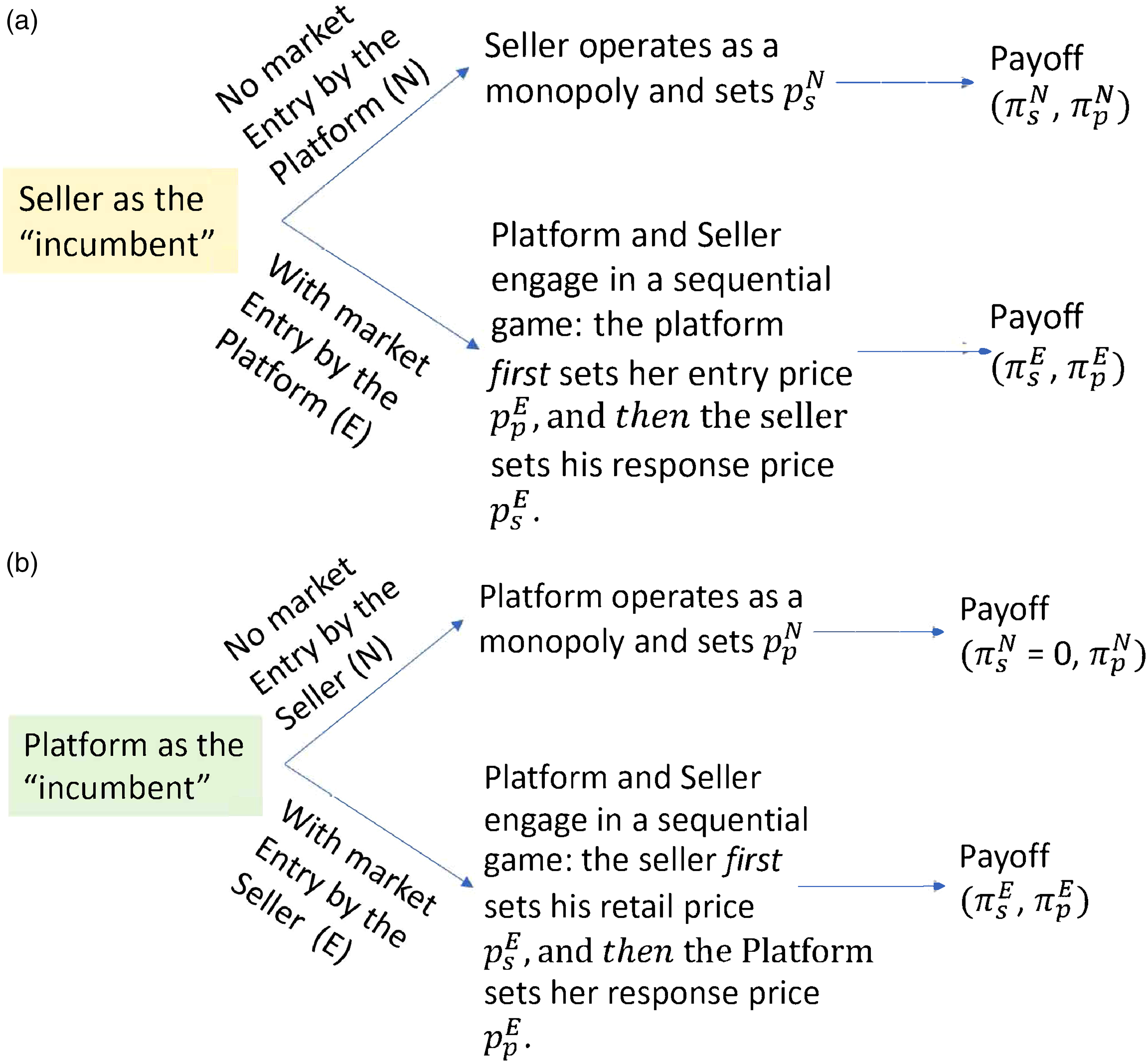
Two models: (a) main model—seller as the incumbent (top panel), and (b) alternative model—platform as the incumbent (bottom panel).
Observe from the top panel of Figure 1 that our main model is based on the case when the seller is the “incumbent” who has been selling a product on the platform for some time. Upon observing the consumer’s behavior and the success of the seller over time, the platform is the “potential entrant” who needs to decide on whether to enter the market by selling the same product to compete with the incumbent seller. 4
Given this backdrop, we consider two settings: (N) no entry by the platform; and (E) with entry by the platform.
In Section 4, we shall analyze our “main model” as depicted in the top panel of Figure 1 via backward induction. Specifically, we will use backward induction to determine the equilibrium payoffs
In Section 5, we will examine the “alternative model” as depicted in the bottom panel of Figure 1 as a robustness check. Relative to the main model, the role of the seller and the platform is “reversed” in the sense that the platform is now the “incumbent” whereas the seller is the “potential entrant.” Akin to the main model, we consider two settings: (N) no entry by the seller; and (E) with entry by the seller. We analyze the impact of the seller’s entry by solving the corresponding sequential game via backward induction.
Main Model: Consumer Utility, Demand, and Profit Functions
At the beginning, the seller (i.e., the incumbent in the main model) sells in a heterogeneous consumer market of size
Setting (N): No platform entry
We begin with setting (N) in which the platform (denoted by subscript 



When the platform enters the market to compete with the incumbent seller in setting (E), the size of the market increases from 

Given the enlarged market size 



Given the demand and profit functions for settings (N) and (E) as defined in Section 3.2, we analyze our main model by using the following approach. First, for setting (N) in which the platform chooses not to enter, the seller operates as a monopoly. We determine the optimal price for the seller
Second, for setting (E) that involves the platform’s entry, we examine the sequential game as explained in Section 3.1 via backward induction. First, given the platform entry price
Finally, by comparing these equilibrium outcomes, we determine the market conditions under which the platform will enter without causing the seller to exit (i.e.,
Main Model Analysis: When the Seller is the Incumbent
In this section, we analyze the main model in which the seller is the incumbent as depicted in the top panel of Figure 1. We proceed by following the approach as explained in Section 3.3.
Setting (N): No Platform Entry
In setting (N), the platform chooses not to enter, and yet the seller operates as a monopoly by selling through the platform. In this case, the seller aims to select his optimal price
Monopoly Price and Profits
When the platform chooses not to enter in setting (N), the seller’s optimal price 


All proofs are provided in the Appendix. To ensure that the seller’s demand
The unit cost
Observe from Proposition 1 that, when the unit cost
Setting (E): With Platform Entry
We now examine the case when the platform chooses to enter as in setting (E).
Seller’s Best Response
Using the backward induction steps as described in Section 3.3, we begin our analysis by examining the seller’s best response for any given platform’s entry price
Seller’s Best Response
When the platform enters the market in setting (E) and sells her product at a given price 



Proposition 2 reveals that the seller’s best response price
Armed with Proposition 2, we now proceed to determine the platform’s optimal price 
Through substitution, we can simplify the expressions stated in Proposition 2 by considering 



By using the auxiliary variables
Platform’s Optimal Auxiliary Price
and Retail Price
Upon platform’s entry in setting (E), her optimal auxiliary price 

By using
By comparing these equilibrium outcomes in setting (E) with the platform’s entry against the platform’s profit in setting (N) for the case without the platform’s entry, we can identify conditions under which the platform will enter the market without forcing the seller to exit; that is, when
In setting (E), when the unit cost
Lemma 1 reveals that, when the unit cost is sufficiently low, the associated auxiliary price
Suppose the unit cost
To understand Corollary 1, let us first recall from Lemma 1 that, as the platform’s reputation effect
Despite competition, the platform’s commission depends on the seller’s revenue, so the interests of the platform and the seller are somewhat aligned. As such, Lemma 1 reveals that the platform has a strong incentive to set her price
We now show how we can use Corollary 1 to identify the “co-existent” platform entry conditions; that is,
The Platform’s Entry
Suppose
Lemma 2 reveals that, as long as the unit cost is below a threshold, the platform entry is plausible (but not necessarily optimal). However, when the reputation effect
Co-existent Entry Conditions
Lemma 2 provides the prerequisite condition (i.e.,
Platform Co-existent Entry Condition
Suppose
Proposition 4 reveals that, in the presence of spillover effect
Also, Proposition 4 leads us to explore our next question: when will the platform’s entry be mutually beneficial so that both parties can attain a higher profit? (In other words, when will
Impact of Platform Entry
Suppose
The result of Corollary 2 has been observed in a recent empirical study (Deng et al., 2023). Corollary 2 specifies the conditions for the seller to sell more upon the platform’s entry by charging a lower price as shown in statement 2 of Corollary 1. By considering these results, we get:
Mutually Beneficial Platform Entry Condition
Suppose
Corollary 3 reveals that, when the unit cost is low (i.e.,
In summary, Corollary 3 presents the market conditions that can foster a mutually beneficial platform entry: both parties will earn a higher profit upon the platform’s entry. Because these market conditions are reasonable, our results offer a plausible explanation about the empirical result obtained by Deng et al. (2023) as explained in Section 1. Also, our results debunk a common belief that a platform’s entry is always detrimental to the seller.
Extension 1: When the Platform is the Incumbent
To examine the robustness of our results as shown in Corollary 3, we now extend our base model by considering an alternative model as illustrated in the bottom panel of Figure 1. In this extension, we reverse the roles of the platform and the seller, such that the platform is now the incumbent and the seller is the potential entrant. As explained in Section 3, this alternative scenario arises when the platform has been selling her own products prior to any seller entering the market. (For example, Amazon was selling books and JD.com was selling electronics directly to consumers before transitioning into platforms to allow third-party sellers to sell products to consumers.)
Like before, our intent is to identify the seller’s entry conditions so that the seller’s entry is mutually beneficial, and examine whether these conditions possess a similar structure as stated in Corollary 3 for the main model. In preparation, we modify the demand and profit functions established in Section 3.2 to capture a different dynamic arising from the reversed role of both parties.
Model: Consumer Utility, Demand, and Profit Functions
Before the seller’s entry, the platform is the incumbent who sells in a market of size





By using the same approach as explained in Section 3.2.2, the demand functions are:




Given the demand and profit functions of both parties in settings (N) and (E), we determine the monopoly price for the platform in setting (N). For setting (E) that involves the seller’s entry, we shall use the backward induction steps as explained in the “Main Model: Analysis” to solve the corresponding sequential game. Specifically, we first determine the platform’s best response price
Setting (N): No Seller Entry
When the seller chooses not to enter, the monopoly platform solves:
When the seller chooses not to enter in setting (N), the platform’s optimal price 


As we shall see later, our market conditions for facilitating a mutually beneficial seller’s entry hinge upon the following assumption that is more stringent than Assumption 1:
The unit cost
Setting (E): With Seller Entry
We examine setting (E) that entails the seller entry as depicted in the bottom panel of Figure 1.
Platform’s Best Response Price
Given seller entry price
Platform’s Best Response
When the seller chooses to enter at a given price 



Proposition 6 reveals that the platform’s best response price
Anticipating the platform’s best response price
Seller’s Optimal Price
Suppose that the cost 


Under Assumption 2 which has
To avoid repetition, we shall skip the seller’s co-existence entry conditions. Instead, we establish the market conditions in the following corollary that can ensure that the seller’s entry benefits both parties, creating a win-win situation (i.e.,
Mutually Beneficial Seller Co-existent Entry Conditions
Suppose that the cost
Considering the results obtained from both the base model and this extension, we can draw the following conclusions. First, besides the fact that the platform provides a channel for many small sellers to enter the market, the spillover effect can create value for both parties upon the platform entry. This is because the platform’s entry creates additional awareness (Handarkho, 2020), which can increase product demand for both parties (Li and Agarwal, 2017). Hence, even when the seller is the incumbent, allowing the platform to enter the market can be mutually beneficial when the market conditions are favorable as shown in Corollary 3.
Second, even with a stronger reputation effect
To conclude, we have identified favorable market conditions under which both the platform and the seller can benefit from their co-existence by allowing for entrance. These findings debunk the common belief as explained in Section 1. More importantly, our results deepen our understanding about how platform entry can create value for the incumbent seller, and vice versa. Ultimately, incumbents and entrants can be friends, and not foes.
Extension 2: When the Spillover Effect
is Endogenously Determined
As articulated in Section 3.2.2, there is empirical evidence (Handarkho, 2020) and anecdotal evidence (Lewis, 2021) supporting the existence of the spillover effect, whereby the market size increases from
To answer this question, we now extend our base model presented in Section 3 to the case when the spillover effect can be controlled by the platform. 9 In preparation, let us examine the mechanism by which the spillover effect is created, so that we can incorporate this mechanism in our model. In our context, spillover is a form of “externality,” where the action of one party (e.g., the platform’s entry) can impact a third party (e.g., through the total market size) even without directly participating. As explained in Section 1, a platform’s entry can “increase awareness” of the products sold by the platform and the seller, so that the market size expands upon the platform’s entry (Handarkho, 2020).
The spillover effect generated by the increased awareness has been examined in the context of advertising and promotion, predating the notion of platform entry. First, in a natural experiment conducted on Yahoo! homepage, Lewis and Nguyen (2015) find empirical evidence of spillover: display ads can lead to a 30%–45% increase in searches for the advertised brand, as well as a potential increase of up to 23% in searches for competitors’ brands. Hence, when one firm advertises its own product, it increases consumer awareness that may benefit its competitors. Similar spillover effects have been found in different contexts (e.g., restaurant-search websites (Sahni, 2016); search advertising on Google (Chiou and Tucker, 2012). Second, in the context of platform entry, Foerderer et al. (2018) find that, upon Google’s entry into the photo category (i.e., Google Photos), consumer demand increased for all providers who offer similar services on the Google’s Android platform. This spillover effect is due to the heightened awareness of this particular product space driven by Google’s entry, which has expanded the overall market (Li and Agarwal, 2017). Likewise, releases of Apple Health and Google Fit can potentially provide positive spillovers to health and fitness mobile apps because they educate consumers on why this category matters, which enlarges the market size (Kang and Suarez, 2023).
While empirical evidence has been established in the research literature, we are not aware of analytical models that endogenize the spillover effect associated with the platform entry. However, we can leverage this empirical evidence to examine how a platform can control the spillover effect
Upon the platform’s entry, we assume that the platform can choose her promotional effort
For any given market size 

Combining the fact that
Suppose
Hence, when the spillover effect
Recall from the top panel of Figure 1 in Section 3.1 that our main model and the analysis presented in Section 4 are based on the assumption that the seller sets his price
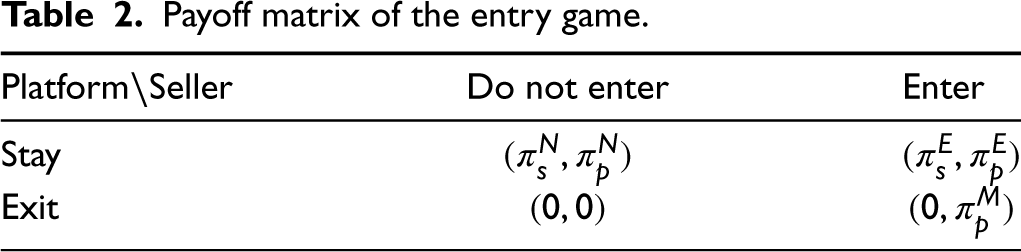
First, observe from the above table that the payoff
Payoff matrix of the entry game.
Payoff matrix of the entry game.
Our objective is to identify the conditions under which (stay, enter) is the only Nash equilibrium, where neither firm can benefit from making a unilateral move. By comparing the payoffs associated with different pairs of strategies in Table 2, we observe that (stay, enter) is the unique Nash equilibrium when the following three requirements are satisfied: (a)
In the remainder of section, we first determine the expressions for the payoff
Suppose that the platform enters while the seller stays, and suppose that both parties set their prices simultaneously. Then the seller solves:
Subgame Equilibrium Outcomes Under Strategy (Stay, Enter)
Let 




Except for the auxiliary price
Armed with the payoff
Suppose the unit cost
Suppose the unit cost
Statement 3 of Corollary 6 shows that requirement (a)
Suppose
Proposition 9 resembles Proposition 4 as stated in Section 4.3.1 (for the case when decisions are made sequentially): it reveals that, if the cost
Payoff Dominant Equilibrium Conditions
Suppose
Corollary 7 resembles Corollary 3 with similar conditions. Hence, we can conclude that when the unit cost is sufficiently low and when the spillover effect
Conclusion
It is common for online E-commerce platforms to enter the market to compete with third-party sellers operating within a particular product space. Due to their informational advantage, there is a widespread belief that the platform’s market entry will always wreck havoc on the sellers.
This article seeks to examine the impact of the platform’s entry on the sellers when the platform operates as a hybrid platform. By examining the main model (in which the seller is the incumbent) and the alternative model (in which the platform is the incumbent), we identify market conditions under which both parties can benefit from an additional entry by the platform (in the main model) or the seller (in the alternative model). These market conditions are determined by factors such as the underlying unit cost, the platform’s reputation effect, and the spillover effect created by an additional entry. These market conditions provide a plausible explanation for the empirical findings obtained by Deng et al. (2023). Our results are robust in extensions when the spillover effect can be endogenously determined by the platform, and when the platform’s market entry decision and the seller’s market exit decision are made simultaneously.
Overall, our results debunk the belief that additional entry (by the platform) is always detrimental to the seller. From this vantage point, our paper contributes to the ongoing debate on whether a platform’s entry is detrimental to the sellers. Contrary to the common belief as explained in Section 1, our findings suggest that provided that certain market conditions are met, the platform can actually be a “friend” rather than a “foe” when entering the market to compete with sellers. In addition to the context of the platform’s market entry, our model could also be relevant in other settings where one firm relies on a leading firm, and this leading firm garners a commission, which provides aligned interests between these firms.
To ensure tractability, we only consider one seller in our model. Future research can extend our main model to include asymmetric competing sellers who sell similar products on the platform. Another interesting area of study is the case where the platform enters the market by developing a private label product (e.g., Amazon Basics), which would have different valuation and cost structure and lead to different reputation and spillover effects. While private label products have been examined in the context of supermarkets (e.g., Alan et al., 2019; Nasser et al., 2013; Li et al., 2022; Zheng et al., 2022), this issue in the context of E-commerce platforms remains an opportunity to be explored in the future.
Footnotes
Appendix
To prove statement 2, observe from (22) that:
Acknowledgments
The authors would like to thank the Department Editor and the review team for their constructive comments throughout the review process. More importantly, the authors are grateful to one anonymous reviewer for checking our analysis carefully to highlight an error in the proof of our earlier version. Wei Wang would like to thank the financial support from the National Natural Science Foundation of China (Grant No. 72173019), the Chinese Ministry of Education Research Funds on Humanities and Social Sciences (Grant No. 21YJA790056), and the Fundamental Research Funds for the Central Universities in UIBE (Grant No. CXTD14-04).
Declaration of Conflicting Interests
The author(s) declared no potential conflicts of interest with respect to the research, authorship, and/or publication of this article.
Funding
National Natural Science Foundation of China (Grant No. 72173019); Chinese Ministry of Education Research Funds on Humanities and Social Sciences (Grant No. 21YJA790056); Fundamental Research Funds for the Central Universities in UIBE (Grant No. CXTD14-04).

Notes
How to cite this article
Tang CS, Deng Y, Wang W, and Yoo OS (2023) Can an E-commerce Platform and its Third-Party Sellers Benefit From Each Other's Market Entry? Production and Operations Management 33(1): 69–86.