



Abstract
Several major on-line platforms operate two channels: An agency channel in which suppliers retain control over prices and quantities and pay a portion of sales revenue to the platform, and a reselling channel in which the platform purchases goods from the supplier and resells them to consumers. These two channels run in parallel and many suppliers interact with only one of them. Although it is quite easy for a supplier to sell through a platform’s agency channel, they must typically be invited to participate in the reselling channel. We develop a model of a powerful platform that can offer a supplier a two-part contract to induce it to participate in its reselling channel instead of its agency channel. When the supplier sells through the platform’s agency channel, we find that if the competition among the traditional resellers is at least moderate and the on-line platform is a close enough substitute for traditional resale channel, then the equilibrium quantities sold through the on-line and traditional channels both exceed the first best quantities. This would not occur if the supplier sold through either the on-line or the traditional channel in isolation. Nor would it occur if the supplier sold through the platform’s reselling channel. As a consequence, we find that when competition among traditional resellers is at least moderate, and both the commission rate and the substitutability between the on-line platform and the traditional resale channel are sufficiently high, there is a Pareto improving reselling contract between the supplier and the platform.
Introduction
It is now well understood that the interactions between a supplier and a reseller(s) can be dramatically altered when the supplier can encroach upon the market served by the reseller(s) by selling directly to consumers. This understanding has been developed by Chiang et al. (2003), Hendershott and Zhang (2006), Huang and Swaminathan (2009), Cattani et al. (2006), and Arya et al. (2007), among others. With the emergence of on-line agency/marketplace platforms, such as eBay, Amazon, Craig’s List, etc., supplier encroachment has become increasingly common. Indeed, many suppliers would be unable to sell directly without using a platform’s agency channel to facilitate the transactions. Yet nearly all of the research on encroachment ignores the facilitating role that these channels play. Moreover, because several of the largest on-line platforms operate both reselling and agency channels, we investigate when and why a supplier and an on-line platform would agree to have the supplier use the platform’s reselling channel instead of selling directly through its agency channel.
We use the term agency 1 to refer to the business model in which the intermediary facilitates transactions but never takes ownership of the products. Under an agency model, suppliers retain ownership until the point of sale and control the selling price/quantity for their product, but then pay the intermediary a sales commission that is most commonly a percentage of revenue. These agency channel operations are distinct from traditional reselling where the intermediary takes ownership of the product, and controls the quantity/selling price.
Although many platforms operate solely as agencies, including Alibaba, eBay, Etsy, and Poshmark, several of the most prominent on-line platforms, such as Walmart, JD, and Amazon, operate as both agencies and resellers. The platforms often display the products from the reselling channel next to those from the agency channel, so it is not always obvious to a consumer which channel they are purchasing from. In practice, it is relatively easy for a supplier to sell through an on-line platform’s agency channel, but only a small subset of suppliers are invited to participate in its reselling channel. For example, for a non-negotiable monthly fee of $39.99 and a share of revenue, anyone can sign-up to be a third-party seller via Amazon’s agency channel 2 . However, a supplier must be invited to become a first-party seller, and sell through the reselling channel. According to Webretailer 3 , Amazon negotiates hard for reselling contracts, and may ask for significant slotting fees.
While it is commonly understood that high sales volume is a prerequisite for a supplier to participate in platform’s reselling channel, we show that this may not be the only driver of how the platform and a supplier agree to interact with one another. In particular, we focus on two key factors: The number of traditional resellers, which measures the intensity of competition among them, and the substitutability between the on-line platform and the traditional resale channel. We assume that there is no difference between the physical product that is sold through the on-line channel and the one sold through the traditional resale channel, so that the substitutability between the two channels is determined entirely by the perceived differences in the purchasing and delivery process. The on-line platform allows consumers the convenience of not having to leave home to order and receive products. However, even though most on-line platforms can now deliver in less than 24 hours, they will never match the instantaneous fulfillment of a traditional reseller, nor do they allow a consumer to experience the touch and feel of a product prior to purchase.
The extent to which these differences matter to consumers may depend on the type of product. Consider, for example, branded consumer packaged goods such as Gillette razor blades, Huggies diapers, etc. These are products that consumers purchase repeatedly, so they have little need to touch and feel prior to purchase. They also tend to be available at traditional resellers that consumers visit regularly, minimizing any inconvenience associated with purchasing in a traditional reseller. So while some consumers may have slight preference for purchasing on-line or at traditional resellers, the substitutability between the channels should be relatively high for products like these. However, for other products, the inter-channel substitutability may be weaker. For example, for a product like a set of wind-chimes, some customers may have much more desire to be able to touch and feel them prior to purchase while others may value much more highly the convenience of completing their purchase without leaving the couch. Alternatively, for a product that is available through traditional resellers only in specific geographic regions, preference between the on-line and the traditional reselling channel may vary considerably, depending on a consumer’s location. In either of these two situations, some consumers may have a strong preference for one of the two channels, so that the amount of substitutability between them is reduced.
We consider a setting in which a supplier sells through
Our contributions are as follows: First, we recognize the unique set of interactions and balance of power that may exist between an on-line platform and a supplier that also sells through a traditional reselling channel. For many manufacturers, the only practical way that they can encroach upon the market of traditional resellers is by selling through an on-line agency. In addition, several of the major platforms operate both agency and reselling channels, and while they make it easy for a supplier to participate in their agency channel, they selectively invite suppliers to participate in their reselling channel and dictate the terms of trade to those invited. We are unique in capturing the complex operational detail of these interactions in a relatively simple model that yields useful managerial insights. Second, we show that when a supplier simultaneously sells through both the platform’s agency channel and a traditional reselling channel, the dynamics can be very different from what happens when the supplier sells through either of these channels in isolation. As shown by Adida and DeMiguel (2011), when a supplier sells through only a traditional reselling channel, the equilibrium quantity sold is less than the first-best quantity, and approaches it from below only as the number of resellers becomes arbitrarily large. Similarly, when a supplier sells through only an agency channel, the equilibrium quantity sold does not exceed the first-best quantity, and is equal to it only when the marginal cost of production is zero. Yet we show that when a supplier sells through both channels simultaneously, it is possible for the quantities sold through both channels to exceed the first-best quantities. This happens when the intensity of competition among traditional resellers, cross-channel substitutability, and commission rate in the agency channel are all relatively high. Third, based on this insight, we show how the selling format in the on-line platform may depend upon the nature of the traditional reselling channel. In particular we derive the optimal Pareto improving two-part reselling contract for the platform to offer to the supplier, and show that such a contract exists at commission rates as low as 15–20% when both the intensity of competition among the traditional resellers and cross-channel substitutability are sufficiently high. To put this in perspective, according to Market Pulse 4 , the total cost of selling for Amazon’s third-party agency channel sellers, including referral, advertising, and fulfillment, can be as much as 50–60 of sales revenue which is well above the threshold above which we find that Pareto improving reselling contracts exist.
After reviewing existing literature and its relationship to our work in Section 2, we describe our model in Section 3 along with a benchmark of a vertically integrated supply chain in which a single decision maker controls all quantity/price decisions. In Section 4, we first characterize the equilibrium for the case in which the supplier uses the platform’s agency channel. Then, after solving the platform’s optimization problem for a two-part reselling contract that requires that each firm earn as much as it would when the supplier sells through the platform’s agency channel, we characterize the conditions under which the supplier and the platform can both benefit from the supplier selling through the reselling channel. In Section 5, we discuss two extensions to our basic model. Finally, in Section 6, we provide concluding remarks and directions for future research.
Literature Review
Our work is at the intersection among the literature on supplier encroachment, agency selling, and dual channels. Sibley and Weisman (1998) recognize the issue of supplier encroachment by investigating how the input prices to the firms that serve a downstream market are affected when a monopolistic supplier introduces its own direct channel. Motivated by industries such as telecommunications, electric power, and natural gas, they provide conditions for which the wholesale prices of a monopolistic supplier decrease when it introduces a direct channel.
The work of Chiang et al. (2003) and Hendershott and Zhang (2006) recognize that the introduction of such a direct channel can mitigate double marginalization and improve supply chain performance. Others, including Huang and Swaminathan (2009) and Cattani et al. (2006), focus on how different policies on pricing in the reselling channel affect the interactions with the direct channel. Although the coexistence of a direct channel creates additional competition for traditional reselling, Arya et al. (2007) find that the reseller can benefit from encroachment if the supplier’s cost premium for selling directly is sufficiently large. This benefit arises because the supplier’s ability to encroach causes her to offer a lower wholesale price. The framework from Arya et al. (2007) has been extended to allow for endogenized quality, Ha et al. (2016); investment spillovers, Yoon (2016); information asymmetry, Li et al. (2014, 2015); Huang et al. (2018); Gao et al. (2021); strategic inventory, Guan et al. (2019); competition among resellers, Liu et al. (2021); and nonexclusive reselling, Hotkar and Gilbert (2021).
Among this literature on encroachment, our work is closest to Liu et al. (2021) who show that the ability to sell directly can be harmful to a supplier when the competition among resellers is sufficiently intense. But our work is distinct from theirs in a couple of key ways. First, we recognize that the only practical way for most suppliers to sell directly is by using an on-line agency channel, and that the major ones, for example, Amazon, Walmart, and JD, are highly efficient. Thus, instead of a per-unit cost premium for direct selling, which is assumed by the vast majority of literature on encroachment, including Liu et al. (2021), we assume that the supplier must share an exogenous fraction of revenue with the platform’s agency channel. Second, we assume that the on-line platform operates both agency and reselling channels in parallel, and can invite the supplier to interact with it through its reselling channel. In an extension of their main model, Liu et al. (2021) allow for the possibility that the supplier could choose between selling directly and selling to an additional independent reseller. However, this is quite different from our setting where the on-line platform must invite the supplier to participate in its reselling channel, and the supplier’s ability to alternatively sell through the platform’s agency channel is an outside option for herself as well as for the platform.
Compared to reselling, the agency model assigns more operational control to the supplier. Jerath and Zhang (2010) were among the first to study the issue of an intermediary ceding control of operational decisions to a supplier. In the context of a traditional department store allowing suppliers to set up stores-within-store and control prices and service levels, they find that the increased demand in the store from traffic associated with service from the store-within-store can moderate inter-store competition and benefit both sides. Several other studies address the decision of an intermediary to operate as a reseller or as an agency. Hagiu and Wright (2015) demonstrate that decision rights for allocating marketing resources should be assigned to either the supplier or the intermediary, depending on who has better information. Several other papers focus more on pricing/quantity decisions. Abhishek et al. (2016) considers a single manufacturer who sells through two competing intermediaries, each of whom can choose to operate as a reseller or as an agency. They find that the equilibrium formats chosen by the intermediaries can be either agency or selling, depending upon the spillover effects upon the manufacturer’s traditional channels. Tian et al. (2018) studies a similar question but in the context of two manufacturers distributing through a single intermediary. They find that the intermediary prefers the pure agency (reselling) model when substitutability is high (low), while for moderate substitutability and moderate fulfillment costs, the intermediary may prefer hybrid mode. Tan and Carillo (2017) study the use of the agency model to distribute digital products in the media industry and the effects upon the sale of traditional physical products. Recently, Lai et al. (2022) show how the “Fulfilled by Amazon” program can help the platform to manage the price and service competition in its reselling and agency channels. Our work is distinct from this literature in considering how the supplier’s interaction with an on-line platform affects its existing interactions with traditional resellers and in acknowledging the platform’s power to dictate the terms of trade for a reselling contract.
In a setup where a supplier sells to multiple retailers, Adida and DeMiguel (2011) show that double marginalization is alleviated as the number of competing retailers increases. However, for finite retailers, the complete elimination of double marginalization remains unattainable through a wholesale price contract. Moreover, Adida and DeMiguel (2011) demonstrate that the total supply never exceeds the first-best (what they call centralized) quantity. For a dual-channel setup, Chiang et al. (2003) establish that the presence of a direct channel mitigates double marginalization. A recent study by Ha et al. (2022) shows how the flexibility of two channels successfully reduces double marginalization. While the literature has explored the mitigation of the double marginalization effect through dual-channel selling and retailer competition, the phenomenon of overproduction—characterized by sales surpassing the vertically integrated first-best quantity—has not been observed. Our study demonstrates that a combination of an agency-operated direct channel and competing retailers can induce overproduction, thereby reducing the overall profit of the supply chain.
Our work is also related to the dual-channels literature that studies settings in which a supplier sells through both traditional retailers and through on-line channels. For example, Yoo and Eunkyu (2011) study a supplier selling through two traditional retailers and an internet channel. Like Cattani et al. (2006), they allow for consumers to be differentiated in the relative inconvenience that they experience from the two channels, but they assume that the internet channel operates like a traditional reseller rather than as an agency platform. Both Shen et al. (2019) and Ha et al. (2022) study settings in which a supplier sells through both a traditional reselling channel and an agency platform. Shen et al. (2019) is similar to us in acknowledging that while the supplier can unilaterally choose a linear wholesale price for the traditional reseller, the platform has power to influence the terms of trade through both a fixed and variable component. Different from us, they do not consider competition in the traditional resale channel, and assume that the platform operates purely as an agency. Also different from us, they focus on the implications of whether the platform can unilaterally dictate both the fixed and variable components of the contract versus having to negotiate over one or both of these components. Ha et al. (2022) is similar to us in studying the interactions between a supplier and a platform that operates a reselling and an agency channel in parallel. However, their setting differs from ours in several key dimensions. First, they do not consider the supplier’s interactions with traditional resellers; second, they do allow for the platform to exert demand enhancing effort; and third, they allow the supplier to unilaterally dictate a linear wholesale price to the platform’s reselling channel. Because of the platform’s demand enhancing effort and the supplier’s ability to dictate the wholesale price, they find conditions when it is optimal for the supplier to sell through both channels simultaneously.
Model
We consider the interactions among a supplier, an arbitrary number of traditional resellers, and an on-line platform that operates both an agency and a reselling channel. Throughout the paper, we adopt the convention of referring to the supplier with female pronouns and to resellers with male pronouns. The on-line platform is referred to as it. We assume that the channels compete in quantities (Cournot), such that the market-clearing price is determined by the quantities sold through the two channels. This assumption is appropriate in settings where, due to production lead times, firms have more flexibility to adjust prices than to adjust their quantities in the short term. The per-unit costs of production and sales are normalized to zero.
We assume that there are
Let


We assume that the supplier is sufficiently powerful with respect to the traditional resellers that it can unilaterally announce a per-unit wholesale price, denoted by
To clarify the distinction between the agency and reselling channels, we assume that the supplier sells through either the platform’s agency or reselling channels, but not through both of them. In our e-companion, we confirm that, whenever there is a Pareto-improving reselling contract that prohibits the supplier from simultaneously selling through the agency’s agency channel, it would dominate a reselling contract that permits the supplier to sell through both channels.
Based on the observation that on-line platforms typically use the same commission rate for broad product categories, we assume that the commission rate
To represent the platform’s power to invite a supplier to participate in its reselling channel, we allow it to offer the supplier a two-part reselling contract, in which the supplier would sell to the platform at wholesale price,
Because the issue of whether the supplier uses the platform’s agency or its reselling channel is relatively long-term, we assume that this happens up-front. Before anything else happens, the platform decides whether to invite the supplier to participate in its reselling channels as described above. Depending upon whether the platform makes an invitation that is accepted by the supplier, there are two possible subgames.
If the platform and the supplier agree to interact in the platform’s reselling channel, then in stage 1 of this subgame, the supplier announces the wholesale price,
When inviting a supplier to participate in its reselling channel at a specific wholesale price,
Define



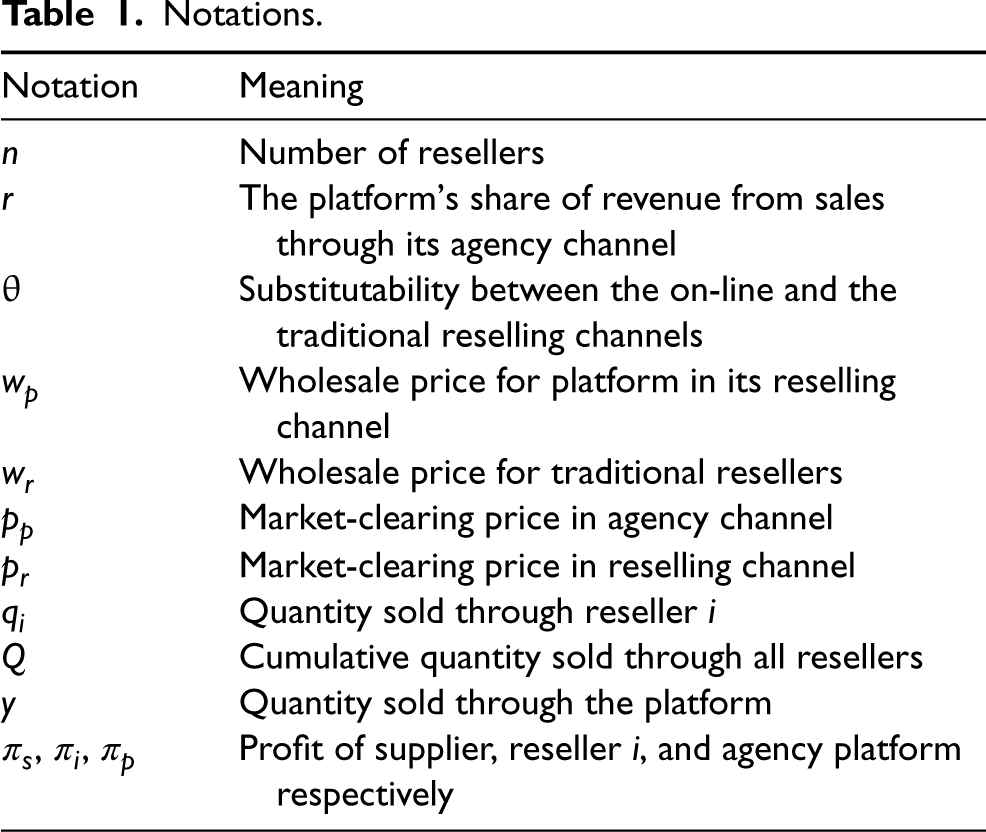
Notations.
Define 


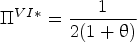
An important benchmark is the vertically integrated case in which a single firm chooses both the quantities 
Analysis of Supply Chain Interactions
We begin by considering the supply chain interactions when the supplier uses the platform’s agency channel. Subsequently, we consider these interactions when the supplier and platform instead agree to interact through the platform’s reselling channel.
Supplier uses the Platform’s Agency Channel
For a given wholesale price and commission rate, it is easy to confirm from the first-order conditions for (5) and (6) that the quantities chosen satisfy the following:


In stage 2, the supplier chooses a wholesale price to offer to the traditional resellers in anticipation of the quantities that will be chosen in response to this wholesale price.
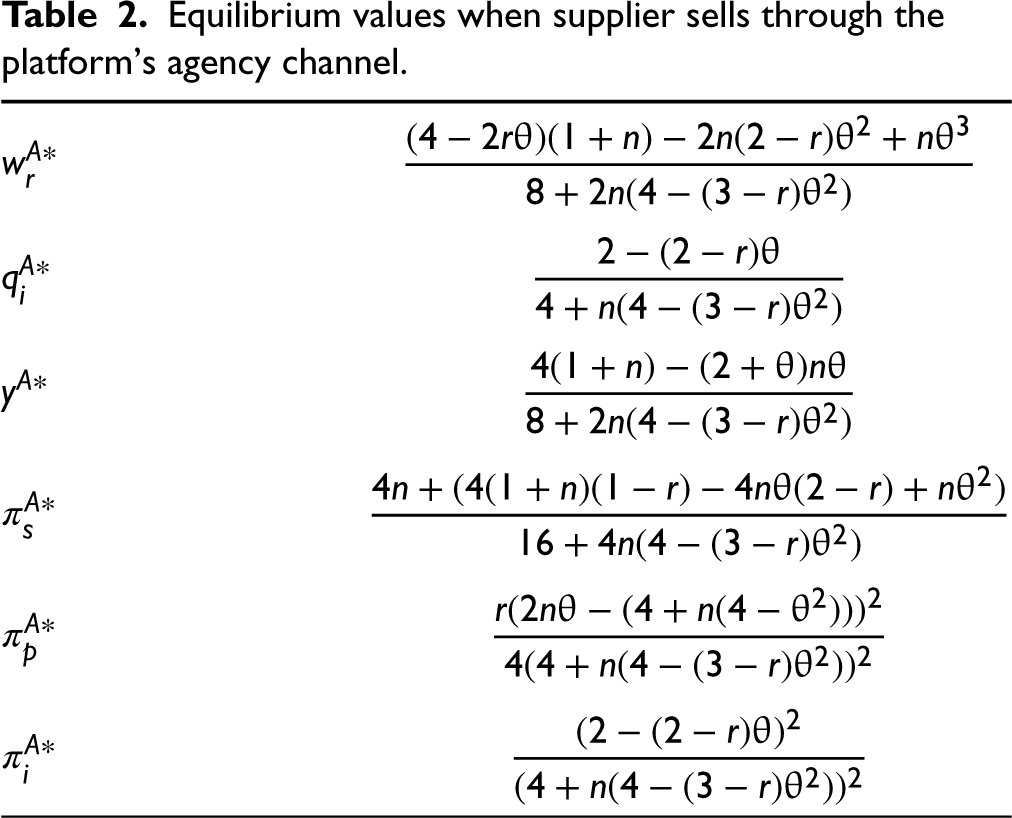
When the supplier sells through the platform’s agency channel, the wholesale price that maximizes her profits is:

where the fact that
Equilibrium values when supplier sells through the platform’s agency channel.
By taking first-derivatives of
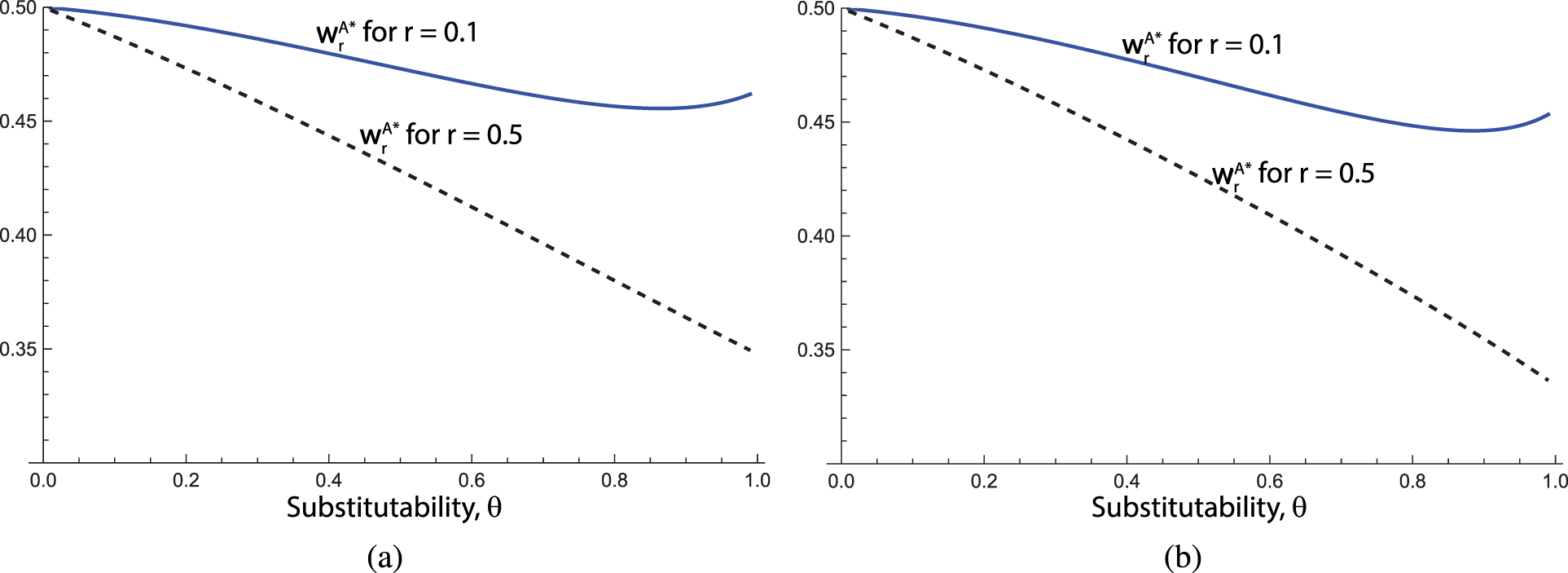
Equilibrium wholesale price for traditional resellers when supplier sells through the platform’s agency channel. (a)
It is also of interest to compare the equilibrium quantities that are sold in equilibrium when the supplier sells through the platform’s agency channel to the first-best quantities.
(i) The equilibrium quantity sold through the platform’s agency channel always exceeds the first best quantity for that channel, that is,
The above proposition shows that when a supplier sells through both traditional reselling and agency channels, the dynamics are different than when it sells exclusively through either reselling or agency channels. When the supplier sells exclusively through reselling channels, the equilibrium quantity(s) is (are) strictly less than the first-best quantity(s), approaching it (them) from below as the intensity of competition among the resellers grows large. Similarly, when a supplier sells exclusively through agency channels, regardless of the intensity of competition among the agencies, the equilibrium quantity(s) is (are) less than or equal to the first-best quantity(s), and is (are) equal to it (them) only when the marginal cost of production is zero. However, Proposition 1 shows that these relationships can be reversed when a supplier sells through both a reselling and an agency channel simultaneously, and they are at least partially substitutable, that is,
From the perspective of total supply chain profits, it is easy to confirm that, for any quantity,
If and only if
As long as the intensity of competition among the traditional resellers is weak,
The results of Proposition 1 are illustrated in Figure 2. In the left panel, where
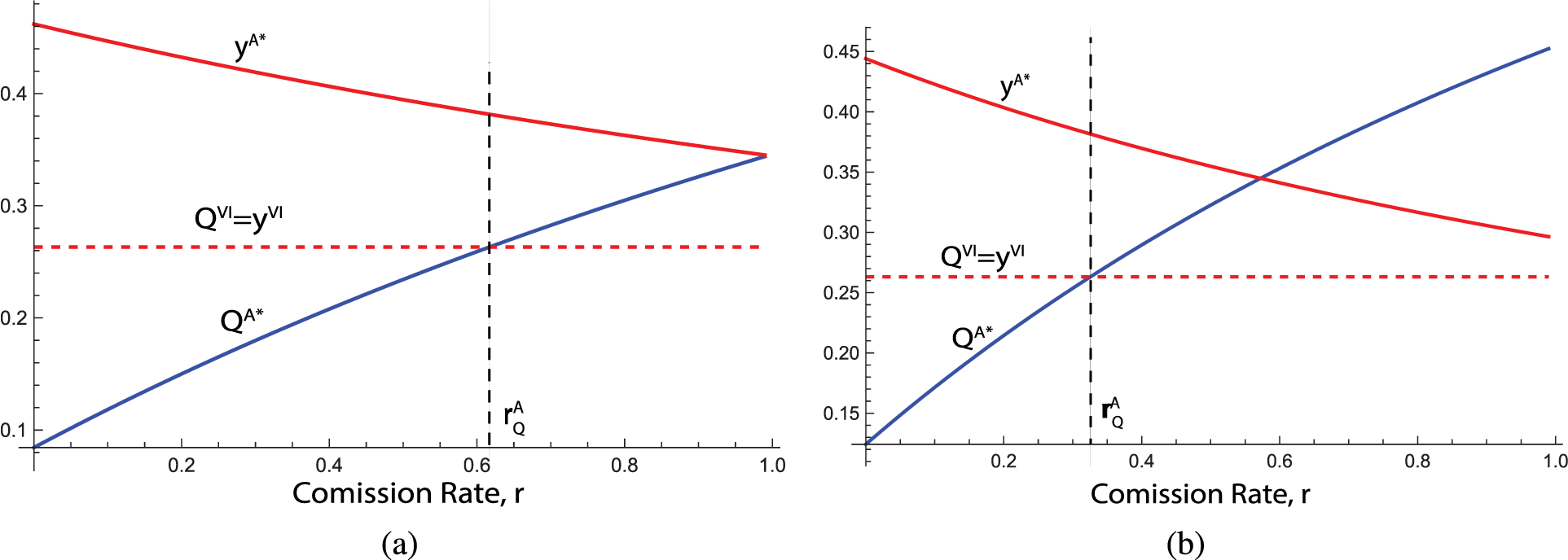
Equilibrium quantities when supplier sells through the platform’s agency channel versus first-best. (a)
While it is very easy for a supplier to sign-up to participate in an on-line platform’s agency channel, participation in the reselling channel is by invitation only. This endows the platform with considerable power to dictate the terms of interaction. We model this by allowing the platform to design a two-part contract, consisting of a fixed slotting fee,
In designing this optimal two-part contract, the platform must account for the fact that, if the supplier agrees to participate, she will subsequently choose a wholesale price for the traditional resellers that maximizes her total profits. Let 


To analyze the solution to the platform’s optimization problem above, we first need to characterize how the supplier will choose its wholesale price for the traditional resellers, contingent upon the price 

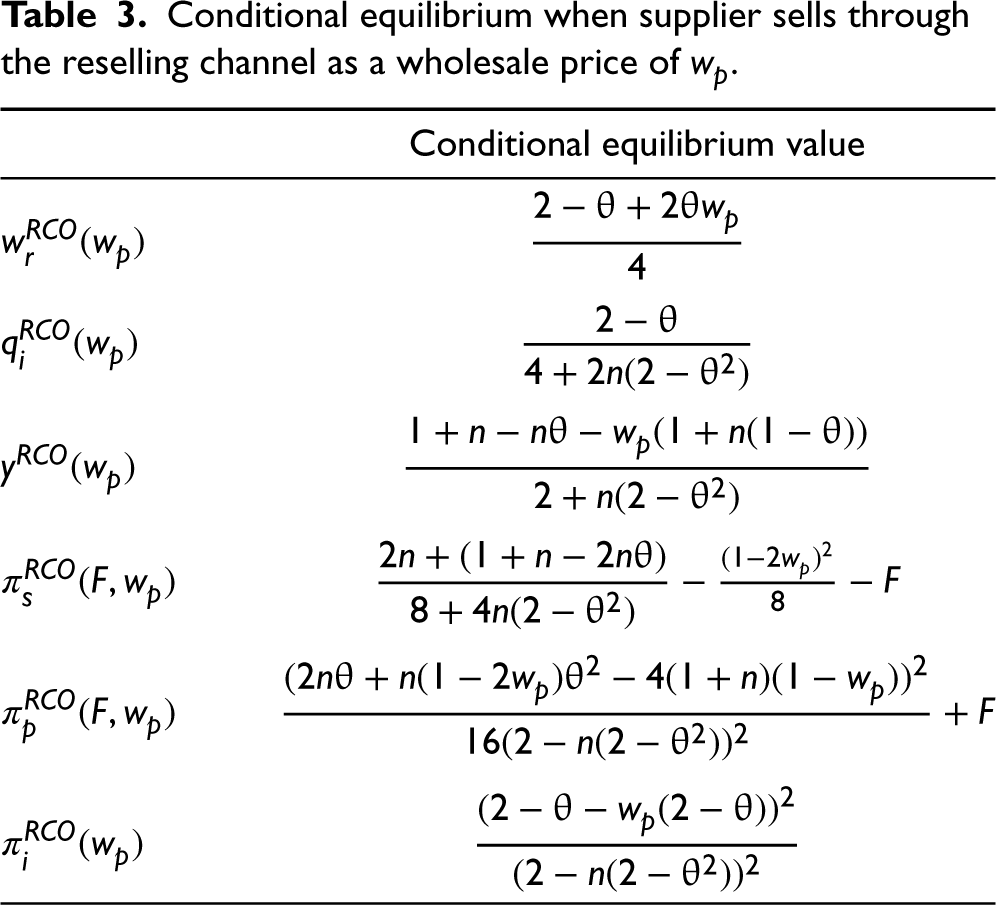
By substituting (14) and (15) into (2) we can now find the wholesale price that the supplier will set for her traditional resellers contingent upon the one at which she agrees to sell to the on-line platform.
When the supplier sells through the platform’s reselling channel at wholesale price 
Substituting this conditionally optimal wholesale price into (14) and (15) we can obtain the conditional equilibrium quantities that will be sold by each traditional reseller and by the platform respectfully given that the supplier agrees to sell to the platform at per-unit price
Conditional equilibrium when supplier sells through the reselling channel as a wholesale price of
Using the results that are shown in Table 3, the platform’s problem of designing the optimal two-part contract for interacting with the supplier via its reselling channel that was previously defined in (11) and (12) can now be restated as follows:



Before characterizing the solution to the platform’s problem of designing a reselling contract, if and when one exists, we introduce several important reference values for the per-unit wholesale price.
(i) The per-unit wholesale price that maximizes the combined profit of the supplier and the platform, 
The above result confirms that, for a given value of the fixed slotting fee,
There exist two thresholds on the commission rate, denoted
Obviously, as the commission rate
There exists a threshold on the commission rate, denoted
As long as the commission rate is not too small, that is,
(i) For 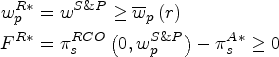
(iii) For all other values of commission rate, there does not exist a two-part contract with
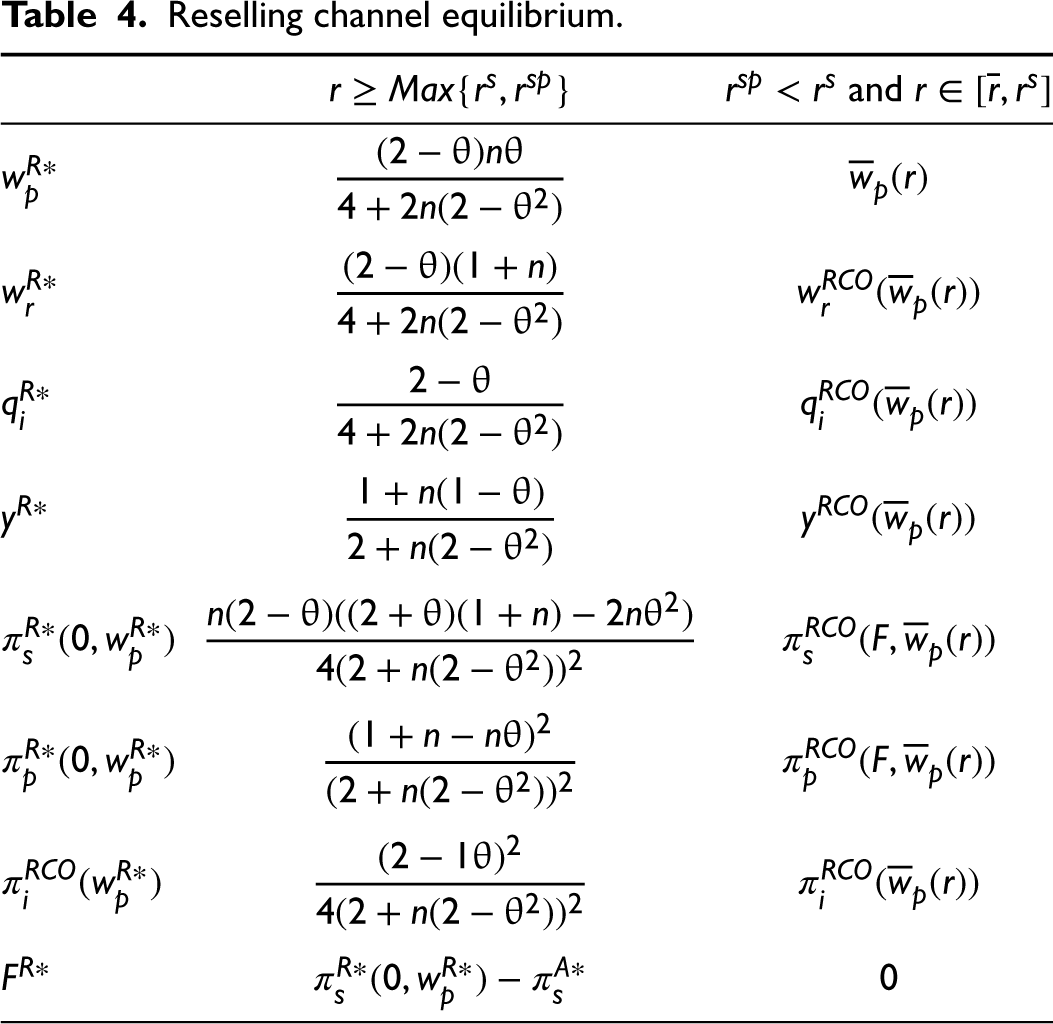
There exists a threshold,
The equilibrium wholesale prices, quantities, and prices that result from this proposition are shown in Table 4. Note that although Table 4 shows the profits of the supplier and platform before the slotting fee is paid, we can find their equilibrium profits using the facts that
Proposition 2 is illustrated in Figure 3 where we show the regions of Parameters where supplier sells through platform’s reselling channel for base model. (a) Reselling channel equilibrium.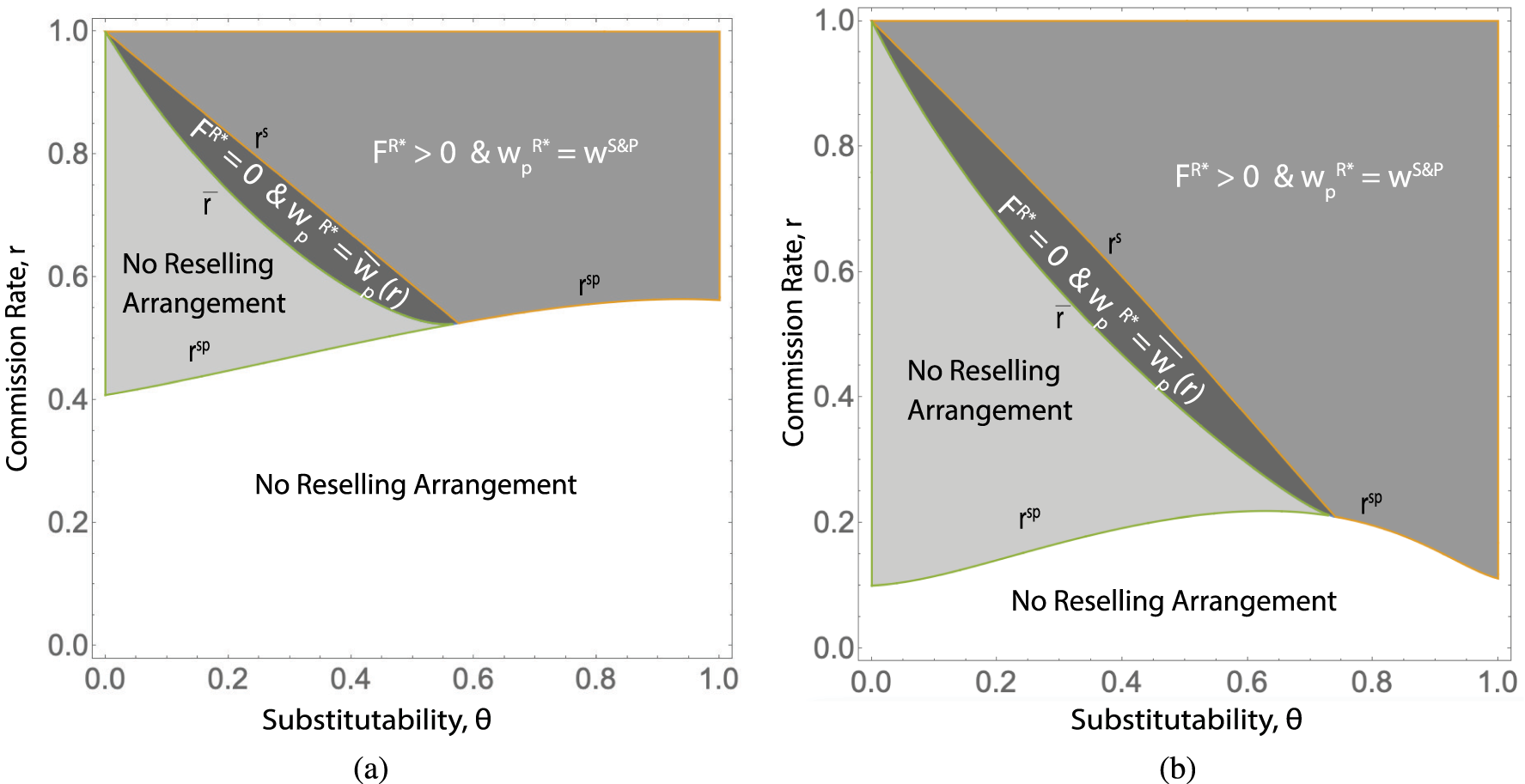
For the case where
From both the left and right plots in Figure 3, it is apparent that an arrangement in which the supplier uses the platform’s reselling channel instead of its agency channel can be Pareto improving when both the commission rate and the substitutability between the platform and traditional resellers are sufficiently high. Moreover, by comparing the left and right-hand plots, we can see that, as the intensity of competition among the traditional resellers
To gain some insight into how the supplier and platform benefit from interacting via the platform’s reselling channel instead of its agency channel, recall the results of Proposition 1 and Corollary 1. When the supplier sells through the platform’s agency channel, as long as there is at least a moderate amount of competition among the traditional resellers, that is,
When the supplier uses the platform’s reselling channel and sells to the platform at a per-unit wholesale price of
This is illustrated in Figure 4 where we compare the quantities that would be sold through the platform and through the traditional resellers with their first-best counterparts. To facilitate comparison with Figure 2, we take
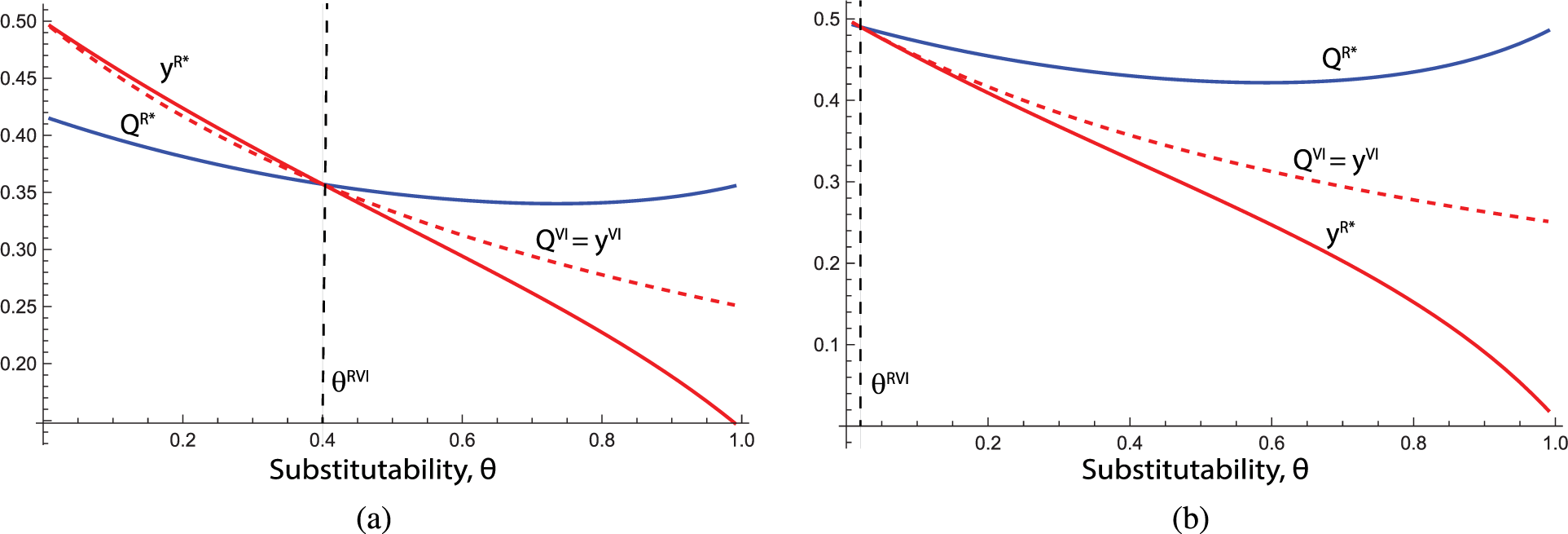
Equilibrium quantities when the supplier sells through the platform’s reselling channel at
The situations in which there exists an optimal solution to (17) subject to (18), and (19), that is, which implies that the platform and the supplier agree to interact through the platform’s reselling channel, are those in which the substitutability between the two channels is high, there is intense competition among the traditional resellers, and the platform’s commission rate is not too low. These are similar to the conditions that lead the platform and the traditional resellers to sell more than the first-best quantities when the supplier uses the platform’s agency channel, as identified in Proposition 1 and Corollary 1. From the perspective of maximizing the total supply chain profit 6 , the conditionally optimal quantity to sell in one channel is decreasing in the amount sold in the other. Therefore, it is far worse for both the platform and the traditional resale channel to sell more than the first-best quantities than if only one of them sells more while the other sells less. In these situations, if the supplier uses the platform’s reselling operations, the quantity sold through the traditional resale channel continues to exceed the first-best quantity, but the quantity sold through the platform’s reselling operations drops below the first-best quantity. This is what allows the combined profits of the supplier and platform to be larger with the supplier using the platform’s reselling operations than when she sells through its agency channel.
It is of interest to note that, when
Our results suggest that, at any given commission rate, when the competition among traditional resellers and the substitutability between the two channels are both high, the platform and the supplier both earn at least as much by interacting through the platform’s reselling channel under the platform’s optimal two-part contract as they would by interacting through its agency channel. Let us relate this to different products sold through Amazon’s reselling or agency channels. As previously discussed, for branded products that are purchased regularly and are readily available in traditional resellers that consumers visit often, the substitutability between the on-line channel and the traditional reselling channel is high. Both Gillette razor blades or Huggies diapers satisfy this criteria, and because they are available at nearly every grocery and convenience store, the competition among traditional resellers is strong for these two products. Consistent with the results of our model, both of these items are sold through Amazon’s reselling channel. In contrast, consider a product like the wind chimes sold by Sunin Yo, for which we argue the inter-channel substitutability is lower. In addition, because wind-chimes are not available in as many traditional resellers,
To avoid unnecessary complication we assume that the platform can unilaterally design the two-part contract and make a take-it or leave-it offer to the supplier. Given the market power of a platform like Amazon, this is not unreasonable, but it is not hard to see what would change if the platform and the supplier could bargain. In the region in which
Finally, it is worth commenting on the fact that our analysis assumes that the supplier sells either through the platform’s reselling channel or its agency channel, but not through both of them. This is certainly the case for many suppliers, and our results highlight the trade-off between these two modes of interaction. However, there exist examples of suppliers who sell through both of the platform’s channels. Ha et al. (2022) study the implications of dual channel selling in the context of a bilateral monopoly between a supplier and a platform that operates both agency and reselling channels. By focusing on the platform’s ability to exert demand enhancing effort and the supplier’s ability to dictate the wholesale price for the reselling channel, they identify conditions for which it is optimal for the supplier to sell through both channels. In our setting, once the supplier sells to the platform’s reselling channel, she may have an ex-post incentive to also sell through the agency channel. However, as shown in our on-line appendix, because of how this ex-post incentive would be anticipated, neither the supplier nor the platform would benefit from the supplier being able to do this. Therefore, they would willingly agree to add a clause to any reselling arrangement that would specifically prohibit the supplier from selling through both channels.
Extensions
In our base model, we make two assumptions that merit further exploration. First, to ensure that the only difference between the supplier selling through the platform’s reselling versus agency channels is whether it is the platform or the supplier who controls the quantity, we assume that all quantity decisions are made simultaneously, regardless of which of the platform’s channels the supplier uses. However, when the supplier sells through the agency channel, there would be nothing to prevent her from waiting until after receiving orders from traditional resellers before choosing the quantity to sell on the platform’s agency channel, and this would be more consistent with the assumptions that are typically made in the supplier encroachment literature.
Second, our base model takes it as given that the supplier will have the ability to sell through the agency channel if she does not enter into a reselling contract with the platform. This is based on the fact that many suppliers have no credible way to commit that they will not sell through the agency channel and the observation that there are very few products that are not available in either Amazon’s reselling or its agency channel. Nevertheless, we consider the implications of a supplier who can credibly commit to not selling through an on-line platform’s agency channel when she would benefit from such a commitment.
Alternate Sequence of Events for Selling Through the Agency Channel
In much of the literature on supplier encroachment, it is assumed that the quantity decisions are made sequentially, that is, the supplier chooses her quantity after she receives the orders from the (traditional) reseller(s). For example, see Arya et al. (2007), Ha et al. (2016), Hotkar and Gilbert (2021), and Liu et al. (2021), among others. This is typically justified on the basis that the supplier has no credible means of committing to refrain from tailoring her quantity in response to the amount ordered by the reseller(s). A similar argument could be made that, for the case in our model where the supplier sells through the platform’s agency channel, she could postpone her own quantity decision until after receiving the orders from the traditional resellers.
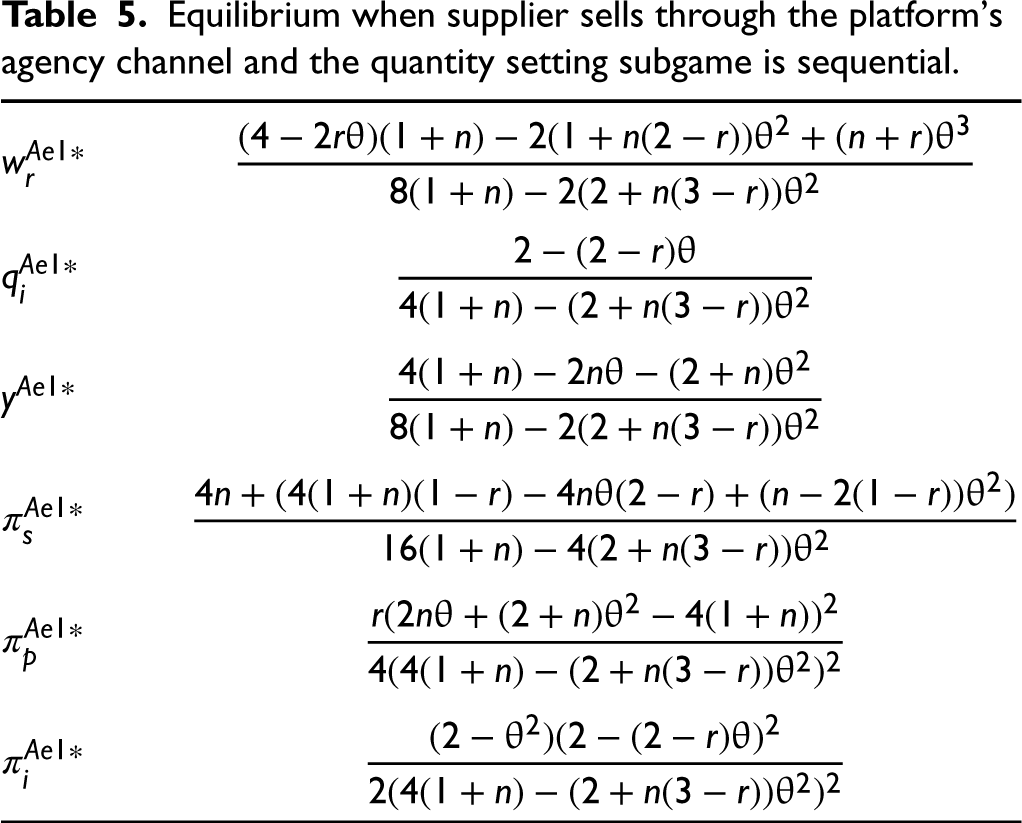
As a robustness check, we now consider the possibility that, when the supplier uses the platform’s agency channel, she postpones her quantity decision until after she receives the orders from the traditional reseller(s). Using backward induction, we first consider how the supplier would respond to the orders that it receives from the traditional resellers. For a given wholesale price and commission rate, it is easy to confirm from the first-order conditions for (5) that the supplier’s best response to any order vector 


Equilibrium when supplier sells through the platform’s agency channel and the quantity setting subgame is sequential.
In Figure 5, we use the same parameters as in Figure 2 to demonstrate that when the supplier sells through the platform’s agency channel, regardless of whether she chooses her quantity at the same time or after the traditional resellers choose their quantities, there is a wide range of commission rates for which both the total quantity sold through the platform and the quantity sold through the traditional resellers exceed the first-best quantities. In fact, the range expands when the supplier postpones her quantity decision until after receiving the orders from the traditional resellers.
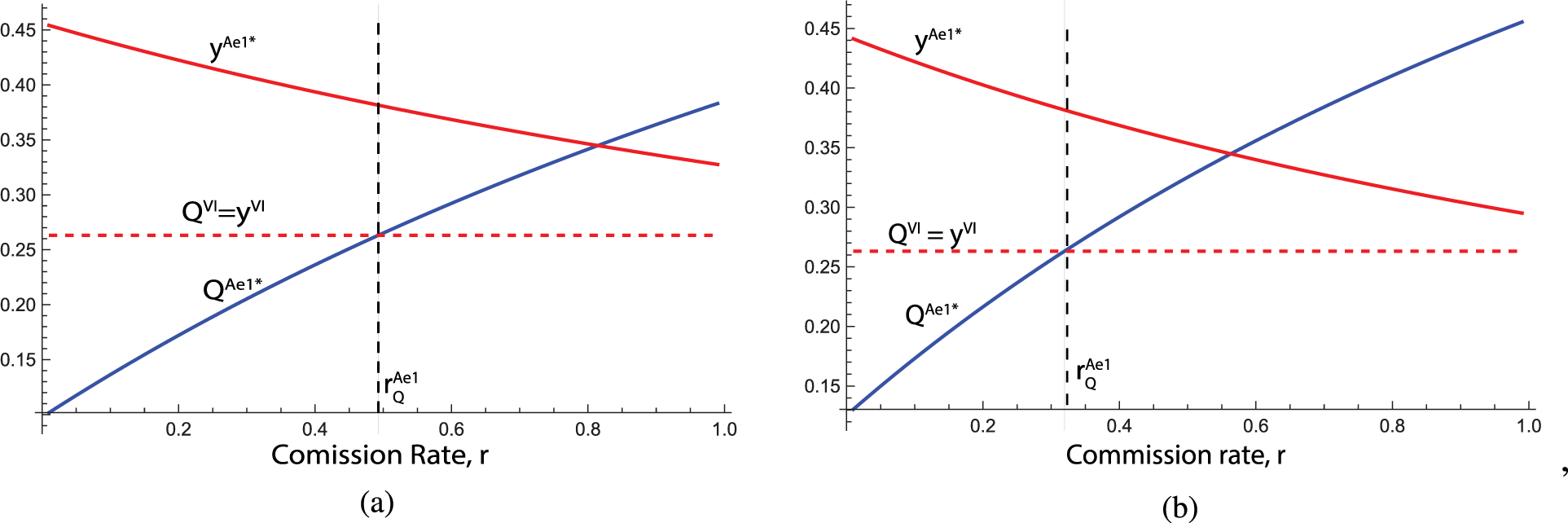
Equilibrium quantities when the supplier sells through the platform’s agency channel and chooses her quantity after receiving the orders from traditional resellers. (a)
As discussed, when the supplier uses the platform’s reselling channel, the platform would not be able to observe the orders placed by the traditional resellers, so for this case the quantity decisions would be exactly as described in Section 4.2. Consequently, neither Lemma 2 nor Lemma 3 are affected by the assumptions about what happens when the supplier sells through the platform’s agency channel. For Lemmas 4 and 5 and Proposition 2, the basic structure remains the same, but the specific values of
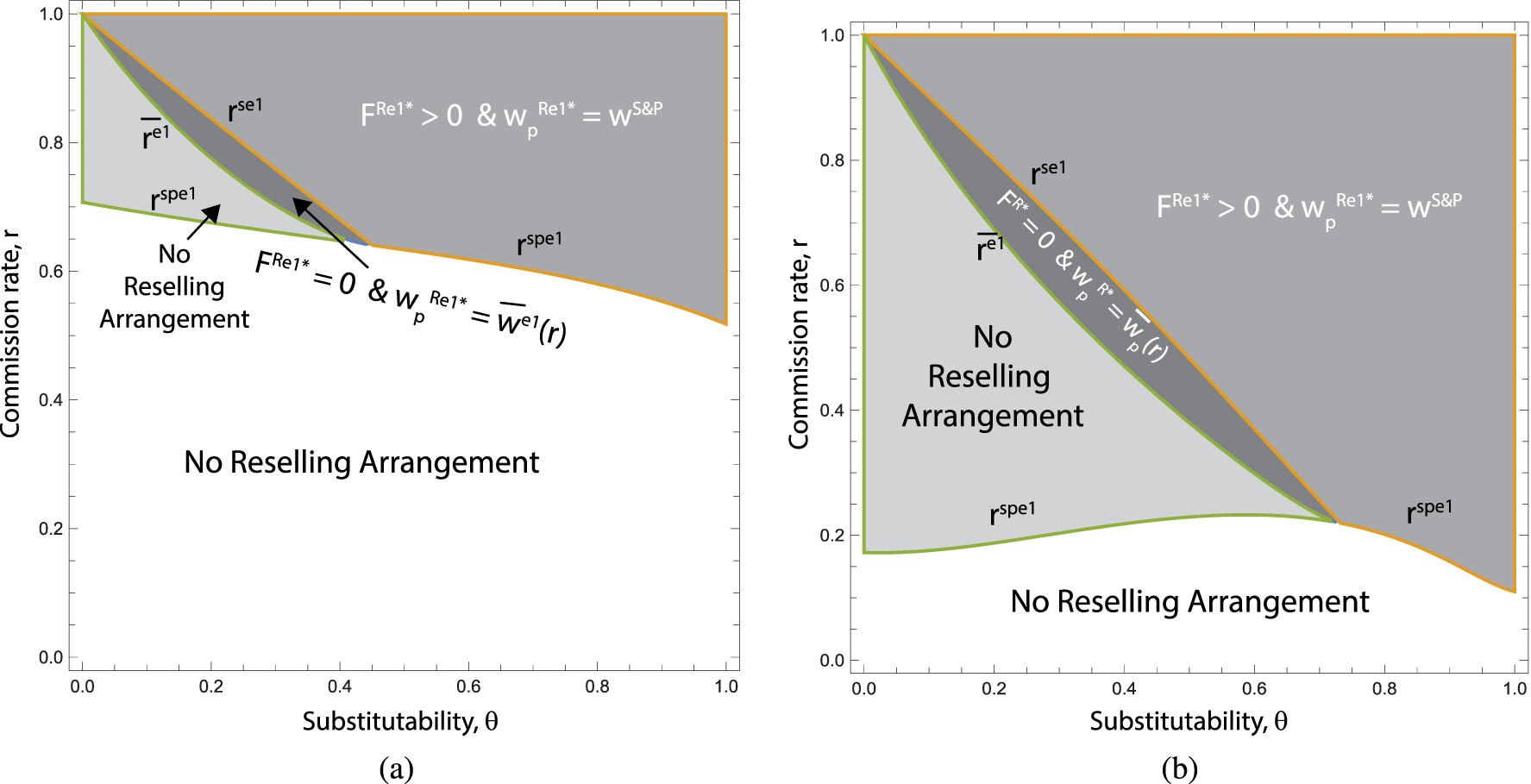
Parameters where supplier sells through platform’s reselling channel when selling through the agency channel allows postponement of the supplier’s quantity decision. (a)
By comparing Figures 3 and 6, it is apparent that allowing the supplier to postpone her ordering decision, when she sells through the platform’s agency channel, does not alter the overall structure of when the supplier and platform will agree to interact through the platform’s reselling channel. When the competition among the traditional resellers is weak, that is,
In our base model, we assume that unless the supplier reaches an arrangement with the platform to sell through its reselling channel, she has no way to credibly commit that she will not sell through its agency channel. Note that, when the commission rate, the inter-channel substitutability, and competition among traditional resellers are all high, the supplier’s ability to sell through the on-line platform’s agency channel can result in her earning less profit than she would if the platform did not exist. As long as the traditional resellers choose their quantities in anticipation that the supplier will determine the quantity that it should sell as a best response to their decisions, the supplier will end up selling a positive quantity through the platform’s agency channel in equilibrium. The fact that Amazon has 1.5–2.5 million active third-party sellers in its agency channel, and very few branded products are not available in either Amazon’s agency or reselling channel, suggests that it may be difficult for a supplier to credibly commit to not selling her product through the agency channel.
Nevertheless, it is worth exploring how our results would be affected if the supplier could make a credible commitment to not sell through the platform’s agency channel when it is in her interest to do so. In contrast to our base model, we now assume that, in the absence of an agreement between the platform and the supplier to interact through the platform’s reselling channel, the supplier has the ability to make a credible commitment to sell nothing through the platform’s agency channel. With such a commitment in place, the traditional resellers would anticipate that 

There exists a threshold commission rate, 
It is easy to confirm that
If the supplier can credibly commit to not sell through its agency channel whenever 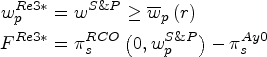
(iii) For all other values of commission rate, there does not exist a two-part contract with
In Figure 7, we show the pairs of
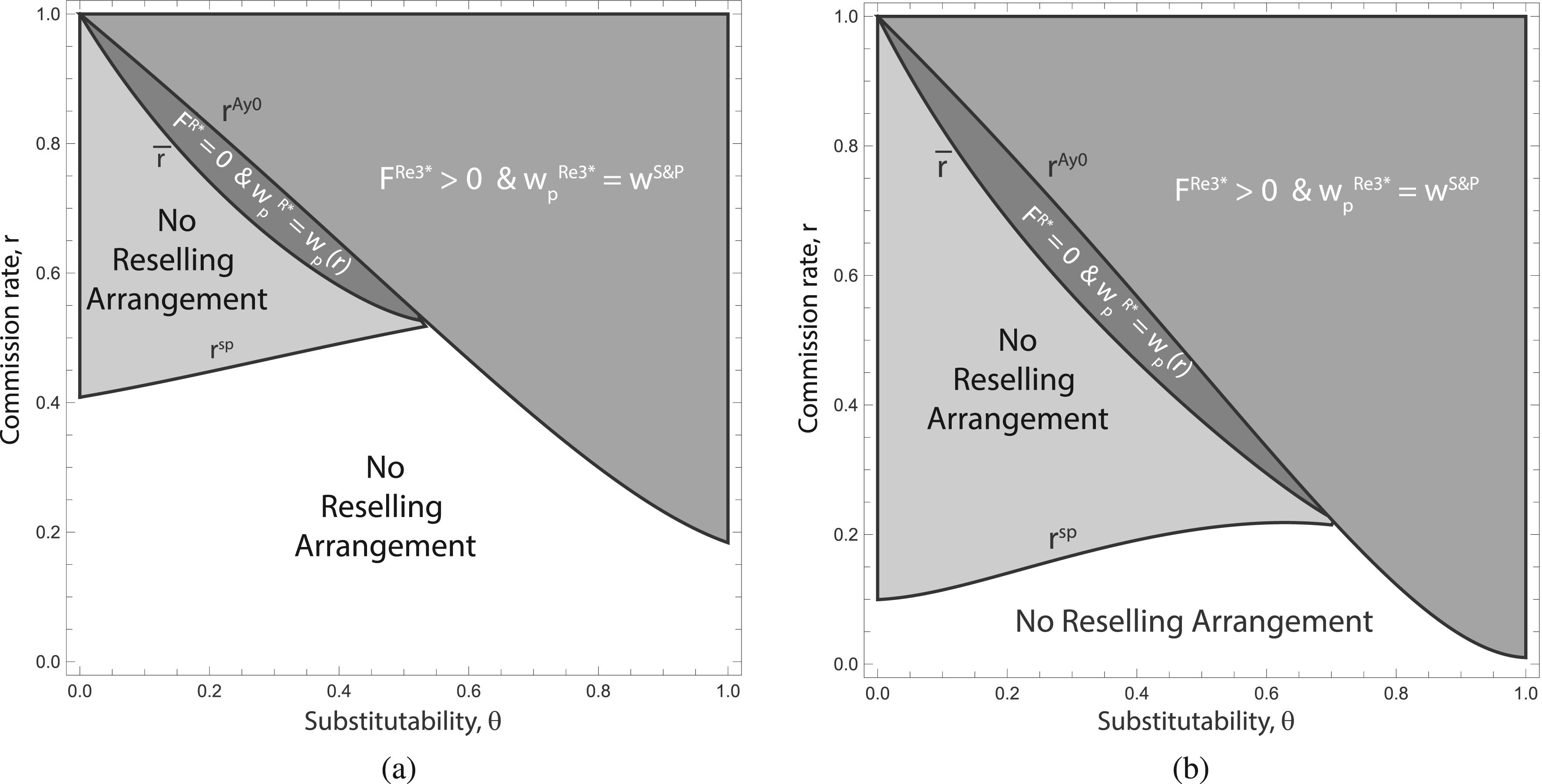
Parameters where supplier sells through the platform’s reselling channel when the supplier can credibly commit to not sell through the agency channel. (a)
While the ability to credibly commit not to sell through the platform’s agency channel would benefit the supplier at the expense of the platform, it would not alter the overall structure of our results. The platform and the supplier would still be able to agree for the supplier to sell through the reselling channel so that they both earn at least as much as they could without such an agreement when competition among the traditional resellers and the inter-channel substitutability are both high, and the commission rate is not toosmall.
Note that, we can alternatively consider the possibility that the platform could threaten to deny a supplier admission to its agency channel if she declines an offer to participate in the reselling channel. If the platform were able to do this, it would effectively get to choose whether the right-hand-side of (12), which is subsequently re-stated in (18), should be replaced with
Our work is motivated by the fact that while Amazon makes it very easy for a supplier to participate in its agency channel, participation in its reselling channel is by invitation only. Our goal is to understand when and why a reselling arrangement between a supplier and a platform can be Pareto improving relative to having the supplier sell through the platform’s agency channel. We contribute to the dual channels literature by specifically recognizing two important features of the interaction between suppliers and a powerful on-line platform like Amazon. First, we recognize that most suppliers who sell through on-line platforms also sell their products through traditional resellers. Second, we recognize that, while suppliers can often unilaterally choose a wholesale price for their traditional resellers, they typically do not have the power to do this for a powerful platform.
We find that, as long as the competition among the supplier’s traditional resellers is at least moderate, when the substitutability between the on-line platform and the traditional resale channel or the commission rate are sufficiently large, there exist reselling arrangements between the supplier and the platform that are Pareto improving relative to the supplier selling through the platform’s agency channel. This can be explained by the fact that, when a supplier sells through both a traditional resale channel and the platform’s agency channel, at large enough commission rates, the equilibrium quantities sold through both of these channels exceed the first-best quantities. In contrast, when a supplier sells through the platform’s reselling channel, either the quantity sold through traditional resale channel or the quantity sold through the platform exceeds the first-best, but they never both exceed the first-best simultaneously.
These results help to understand why branded products that are well-understood by consumers and are readily available in stores that are visited frequently are very often sold through Amazon’s reselling channel. For these products the on-line channel is a close substitute for the traditional resale channel and competition among resellers is also generally intense. On the other hand, many of the products that are available through the agency channel are products for which either there are fewer traditional resellers, or there is lower substitutability between the online and the traditional reselling channels, where lower substitutability could be caused either by greater variation among consumers’ need to “touch and feel” a product, or by geographic concentration of traditional resellers that results in variation among consumers’ ability to access the product in the traditional resale channel.
Two limitations of our study are that we have taken the platform’s commission rate as exogenous and have normalized to zero any fixed fees for participating in the agency channel. Allowing for a positive (exogenous) fixed fee for participating in the agency channel would complicate our results. But as long as the fixed fee is small enough that it does not discourage the supplier from selling through the agency channel, then adding a fixed fee for participating in the agency channel would only decrease (increase) the reservation profits of the supplier (platform). The main effect of this would be to reduce the threshold commission rate above which the supplier’s profit would be at least as large under a reselling arrangement, expanding the range of parameters for which there exists a Pareto improving reselling contract with a positive slotting fee. On the other hand, if the fixed fee in the agency channel were large enough to discourage the supplier from participating in the agency channel, then her reservation profit would be the profit that she would earn without the platform, while the platform’s reservation profit would be zero. This would be similar to what we discuss in Section 5.2 when the supplier can credibly commit to not participate in the platform’s agency channel. So, while allowing for a positive (exogenous) fixed fee for participating in the platform’s agency channel would add complexity to our results, it should not alter the main qualitative conclusions.
On the other hand, if we were to endogenize the platform’s parameters for its agency channel, either the commission rate or any fixed fees, this would raise an entirely new set of questions. As previously discussed, because the major on-line platform’s typically set their commission rates and fees for broad categories of products, it is reasonable to take these as exogenous when studying how and when there exists a Pareto improving reselling contract with a particular supplier. However, it would be of interest to investigate how a platform should choose these parameters in a setting where there are heterogeneous suppliers. Note that, changing the commission rate and or fixed fees for participating in the agency channel affect not only the profits that the platform earns from suppliers in the agency channel, but also its ability to attract suppliers to its reselling channel. Consequently, we conjecture that the platform’s choice of commission rate and any fixed fees for participating in its agency channel should depend upon the mixture of characteristics among the potential suppliers. This is beyond the scope of our study, but is worthy of future research.
Supplemental Material
sj-pdf-1-pao-10.1177_10591478241249478 - Supplemental material for Channel Choice via On-Line Platform
Supplemental material, sj-pdf-1-pao-10.1177_10591478241249478 for Channel Choice via On-Line Platform by Stephen M Gilbert, Parshuram Hotkar and Chuanjun Liu in Production and Operations Management
Footnotes
Acknowledgment
The authors are thankful to Professor Albert Ha (the Department Editor), the anonymous Senior Editor, and the anonymous reviewers. Their feedback has substantially improved the paper.
Declaration of Conflicting Interests
The authors declared no potential conflicts of interest with respect to the research, authorship, and/or publication of this article.
Funding
The authors received no financial support for the research, authorship and/or publication of this article.

Notes
How to cite this article
Gilbert SM, Hotkar P and Liu C (2024) Channel Choice via On-Line Platform. Production and Operations Management 33(6): 1373–1392.
References
Supplementary Material
Please find the following supplemental material available below.
For Open Access articles published under a Creative Commons License, all supplemental material carries the same license as the article it is associated with.
For non-Open Access articles published, all supplemental material carries a non-exclusive license, and permission requests for re-use of supplemental material or any part of supplemental material shall be sent directly to the copyright owner as specified in the copyright notice associated with the article.
