




Abstract
Numerous studies have shown that near repeat victimization of burglaries can account for a substantial minority of burglaries in urban settings. Using a method based on the distribution of potential targets to determine the size of spatial bandwidths, the presence of burglary near repeats in rural areas was examined and compared to the level of near repeats in urban areas. A significant burglary near repeat pattern was observed in rural areas, but was restricted to the spatial and temporal bands that were closest to and most recently after a previous burglary. The proportion of all burglaries that were near repeats in this nearest spatial and temporal bands was greater than that observed in urban areas. The findings lead to extending how the boost account and offender foraging principles may apply in rural settings, and the identification of crime prevention opportunities that counter near repeats in rural areas.
Introduction
Near repeat victimization is the empirically observed pattern of a person or target (e.g., a house) being a victim of crime soon after a nearby similar incident (Townsley et al., 2003). The pattern of near repeat victimization has been observed for a range of crime types, including domestic burglary (Johnson & Bowers, 2004; Johnson et al., 2007; Pease, 1998), vehicle crime (Johnson et al., 2009), robbery (de Melo et al., 2018), sex offenses (Amemiya et al., 2020), shootings (Haberman & Ratcliffe, 2012; Ratcliffe & Rengert, 2008), and homicide (Chainey & Muggah, 2020). The results from analysis of near repeat victimization have then been used to inform the design of several successful crime prevention programs (e.g., Fielding & Jones, 2012).
To date, no study has examined the presence of near repeats in rural settings. Most studies that have examined near repeat victimization have been conducted in urban environments. This is most likely because of the greater applicability in urban environments of the theoretical principles of offender foraging that are used for explaining near repeat patterns (i.e., the search for similar nearby opportunities for crime after the commission of a recent offense) and the closeness in distance between these opportunities. In rural settings, for crimes such as residential burglaries, the distances between residential properties are much greater and require the offender to apply more effort to search for other nearby opportunities for crime commission. Additionally, it is likely that the offender may need to apply more effort to travel to a rural target from their home or other anchor point from which their journey to crime commences. In measuring near repeat victimization, most studies have used short spatial bandwidths (such as 100 m in length) to identify the presence of a near repeat pattern, which in rural areas needs to be larger. However, limited guidance exists on calculating the size of spatial bandwidths to use for examining near repeats in different settings, especially when seeking to compare the extent of near repeat victimization between rural and urban environments.
In this study I conduct the first known examination of whether a near repeat victimization pattern of residential burglaries is observed in rural settings, and compare the extent of rural burglary near repeats to the presence of these events in urban settings. To compare between rural and urban settings I apply an approach that uses the distribution of potential targets (in this case, residential properties) to determine spatial bandwidths rather than using arbitrary distance measures. This approach involves using the number of potential targets within a spatial bandwidth for comparing the extent of near repeats in urban and rural settings. By doing so I examine if the presence of burglary near repeats is as apparent in rural settings as it is in urban settings and discuss the theoretical principles that may explain these observations.
In the next section I describe more fully the theoretical principles that explain the pattern of near repeat victimization and the challenge in comparing the extent of near repeats between different settings. I then describe the methods and data, present results, and discuss the findings. I also describe limitations with the measurement approach and suggest areas for further research. In the final section I provide concluding statements.
Near Repeat Victimization, Theoretical Principles, and Spatial Measurement
For urban areas, a wide range of spatial analysis techniques can be used for examining patterns of crime. This includes hot spot analysis that is used for identifying spatial concentrations of crime, with other techniques using the results of hot spot analysis to further examine the geography of crime (e.g., spatial regression—for an example see Wheeler & Waller, 2009). In rural settings, hot spot analysis (and other techniques that rely upon a large number of incidents) is usually not possible because of the lower levels of crime, larger distances between offenses, and the lack of clustering of these offenses. This means that an examination of spatial patterns of crime in rural settings is often limited. One study that has examined burglaries in rural areas is Wood (1998), who showed the value of analyzing small numbers of offenses over space and time in these settings. This analysis revealed patterns about when and where burglaries were being committed in rural areas from which a tactical plan was created that resulted in the police arresting a number of suspects. Near repeat victimization analysis is another means for examining spatial and temporal patterns of incidents from which insights about offending behavior can be determined (Chainey, 2021). To date, no known study has examined near repeat patterns of burglary in rural settings.
Near repeat victimization is the observed finding that targets near to a recent incident are at a heightened risk of being victimized, with the level of risk decreasing with distance from the original incident and over time (Johnson & Bowers, 2004; Townsley et al., 2003). The analysis of near repeat victimization requires an examination of the number of offenses that took place within a set of parameters of distance from and time after an originator offense (e.g., within 100 m and within 7 days, within 200 m and 14 days). The originator offense is the crime record that is identified as the first offense in a near repeat series. The original research that observed the patterns of near repeats was for domestic burglary (Townsley et al., 2003), with most studies that have examined near repeats also focusing on examining burglary near repeats in a variety of international settings (e.g., Chainey & da Silva, 2016; Chainey et al., 2018; Hoppe & Gerell, 2019; Johnson et al., 2007). These studies have shown that near repeat victimization patterns can often account for a substantial minority of offenses (e.g., up to a third of all burglaries within 300 m and 2 weeks of a previous burglary). Most of these studies on burglary near repeats have been for cities. In instances where a study involved a larger geographic area (e.g., a county or district), no distinctions were made between the urban, suburban, and nonurban settings in the study areas where near repeat patterns were examined.
The reason why near repeat victimization occurs can principally be explained by the boost account and optimal foraging theory. The boost account refers to an offender deciding to target nearby properties (in the case of burglary), boosted by the success of recent crime commission (Pease, 1998). Following the initial offense, the offender has likely gained familiarity of the area, other targets that the offender considers in the area are likely to be similar, the offender is likely to have gained confidence from the success in the modus operandi they used in the first offense (e.g., such as the means of breaking into a property) and how to evade capture (informed by the previous victimization against the first target). For example, the layout of the neighboring properties is likely to be similar to the property they recently burgled, the means of breaking-in is likely to be similar, and the neighbors are likely to have possessions worth stealing, similar to those stolen in the initial burglary (Chainey et al., 2018). The boost account, therefore, refers to the same offender returning to commit subsequent offenses, rather than each near repeat offense being committed by different offenders. The exception to this is when the offender passes on his experience of crime commission obtained from the first offense to other people with whom he may then cooffend, or these other people committing the near repeat offenses having been informed by the offender of their successful crime commission from the first offense. The boost account has been confirmed from offender interview accounts about the choices that offenders make (Ashton et al., 1998; Ericsson, 1995).
Optimal foraging theory provides a further means for explaining why near repeats occur (Johnson, 2014; Johnson et al., 2009). This approach likens offenders to foraging animals. As a forager, an offender makes a trade-off between the rewards of crime commission that are most obvious and immediately available (i.e., returning to commit a burglary to a property near to where they previously committed a burglary), and the effort and risks that will be expended in seeking better opportunities. Once an area has been exhausted of the best opportunities for crime commission, the offender moves on (i.e., seeking to commit a crime elsewhere). The offender is also conscious of the risks of being caught if the police begin to see a spike of incidents in a particular area, so decides to move from the area to avoid the risk of capture. Near repeats help to explain why short spates of several crimes may occur in an area.
The analysis of near repeat victimization patterns can help inform the design of crime prevention initiatives, and where these should be targeted. An example of this is in Manchester, England where an analysis of residential burglary identified that near repeats contributed substantially to the overall level of burglary. In response, the police designed an initiative to counter near repeats that involved police officers conducting door-to-door visits to neighboring houses on the day after an initial burglary. The visits involved informing residents about the recent burglary against their neighbor, asked residents to contact the police if they saw someone behaving suspiciously, and advised residents to take practical measures that could decrease their risk of burglary, such as keeping lights on when it was dark and the house was unoccupied. As a result of the intervention, burglary decreased by 42% in the areas that were targeted (Fielding & Jones, 2012). The pattern of near repeats is also often used for crime prediction purposes (Johnson et al., 2008), and can identify spatio-temporal patterns of crime that contribute to or are distinct from crime hot spots (Chainey et al., 2018).
To date, most studies of near repeat victimization have used arbitrary, albeit convenient distance metrics such as multiple bands of 100 m to examine the spatial extent of near repeat victimization. For example, in Hoppe and Gerell’s (2019) study of near repeat victimization of burglary in Malmo, Sweden, spatial bandwidths of 100 m and 10 bands (i.e., 1–100 m, 101–200 m, … 901–1,000 m) were used for examining the spatial extent of burglary near repeats. In rural settings, the analysis of near repeat victimization patterns requires the use of larger spatial bandwidths than those that have been used in previous studies of near repeats because of the greater distance between potential targets. However, little guidance exists on how to determine suitable spatial bandwidths for settings where the distribution of targets that an offender may consider committing crime against are not close to each other. Also, to compare the extent of near repeat victimization between rural and urban areas requires the size of the spatial bandwidths to be different to respect the differences in distance between potential targets in these settings, but can mean that results are not comparable. For results from an analysis of near repeat victimization to be comparable between different rural and urban settings, the spatial bandwidths to use need to be based on some comparable means that determines the size of the spatial bandwidths. A way to compare between different settings and calculate suitable spatial bandwidths for measuring near repeat victimization is to consider the spatial distribution of potential targets.
In the current study I use a target-based assessment of spatial criminal opportunity to determine the size of spatial bandwidths for measuring near repeat victimization in rural and urban settings. I hypothesize that the presence of near repeat victimization is less likely in rural settings. This is because of the greater effort that would be involved in the offender finding and selecting suitable targets and the limited availability of similar and nearby targets that an offender could select for committing crime against. Foraging is optimal when the offender observes that the rewards of crime commission are most obvious and immediately available (i.e., committing a burglary to a property that is similar and near to where they previously committed a burglary). However, this does require a trade-off against the effort and risks that will be expended in seeking better opportunities. So I hypothesize that near repeats are likely to be observed in rural settings but less than the extent of near repeats that are observed in urban settings. In summary:
Hypothesis 1: Statistically significant patterns of near repeat victimization are less likely in rural settings. Hypothesis 2: If near repeats are observed in rural settings it is likely that the extent of near repeats is less than that observed in urban settings.
Research Design
The study area was the county of Herefordshire, England. Herefordshire was chosen because of its mix of urban and rural areas, including the towns of Hereford and Leominster, villages such as Castle Frome and Bodenham, and rural areas with isolated dwellings. The UK's Office for National Statistics Rural and Urban Classification data 1 was used to define areas. These data consist of small census geographic units that classify whether an area is urban or rural. The data classifies areas as urban if the area is within a built-up area with a population of 10,000 people or more. All remaining areas are classified as rural. The rural classification is also subdivided into three settlement types: rural town and fringe (including areas allocated to towns with a population of less than 10,000), rural village (such as isolated villages with a small population), and rural hamlets and isolated dwellings. Hamlets are smaller than villages, often consisting of a small number of houses located near to each other but with few or no local services such as a Post Office or local convenience store (for further details on the definitions and creation of these classifications see ONS, 2013). Table 1 shows that just under half of the residential households in Herefordshire were located in an urban area, with the rest of the area being rural and most of these rural areas being classified as containing households in villages and hamlets or were isolated dwellings.
Household Distribution and Burglary Levels by Rural-Urban Classification, and Rural Subdivisions.
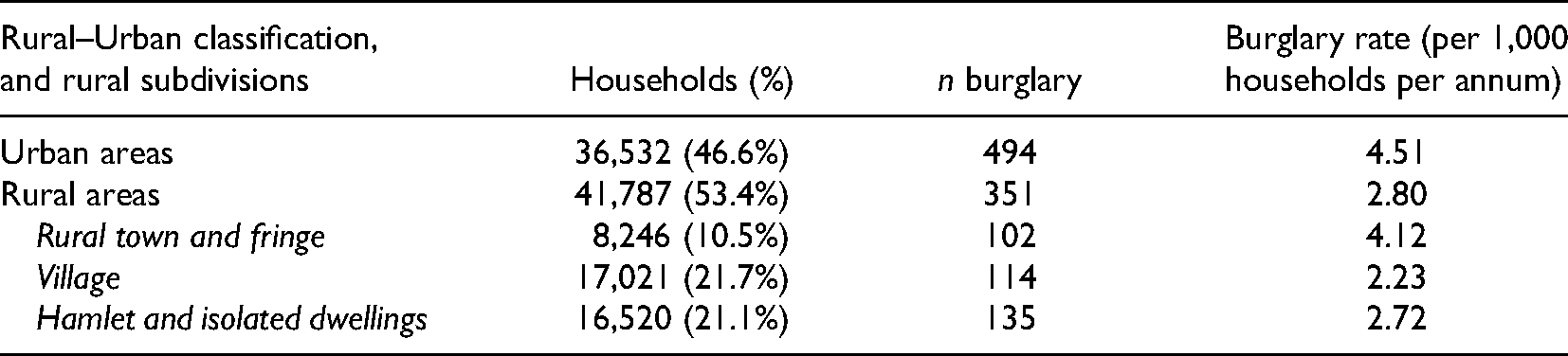
Three years of recorded residential burglary data for the period from January 2015 to December 2017 were used. These data include the geographic coordinates of the property that was burgled and the date when the burglary was committed. Checking of the data identified that 6% of burglary records contained committed from and committed to dates that spanned more than one day (i.e., where the resident was away from their home for a night, returning the next day to find that their house had been burgled). For these records, and following in practice with other studies on near repeat victimization where a date range exists in the crime record, the committed from date was used to define the date when the property was burgled 2 . Table 1 lists the number of burglaries in each rural–urban classification area and shows that the burglary rate experienced in the rural areas was lower than that (2.8 burglaries per 1,000 households) in the urban areas (4.5 burglaries per 1,000 households), and was lowest in the village areas (2.2 burglaries per 1,000 households). For the data period, there was no known burglary prevention initiatives in operation in any area in Herefordshire except for Neighborhood Watch and Rural Watch programs in some parts of the county but these were not particularly active.
Near repeat victimization analysis was performed using a revised version of the Near Repeat Calculator 3 , a tool that applies a Knox test for space-time clustering for generating observed over mean expected frequencies of near repeats (Ratcliffe, 2009). The analysis of near repeats involves selecting spatial and temporal bandwidths to examine for observations of near repeats, and determines whether these observations are statistically significant. The temporal bandwidth in the Near Repeat Calculator was set to 7 days and four bands were applied (i.e., 0–7 days, 8–14 days, 15–21 days, 22–28 days). These bandwidths were used because it is the examination of near repeats soon after a recent incident that is of most practical interest, and are comparable to those used in other studies of near repeat victimization (e.g., Chainey et al., 2018; Hoppe & Gerell, 2019). The Knox test for space-time clustering determines whether the observations within each space-time band are greater than what would be expected (and by what extent, e.g., 50 times greater) and if this observation is statistically significant (Ratcliffe, 2009).
Previous studies of near repeat victimization have used a single distance bandwidth (e.g., 100 m) and have applied multiple bands of this bandwidth (e.g., two bands would generate spatial parameters for examining near repeats within 1–100 m and 101–200 m) to identify offenses that took place near to a previous offense. In the current study I used an approach for determining spatial bandwidths that was based on the distribution of the similar number of potential targets in a rural and urban setting. First, I calculated the average number of residential properties within 100 m of each residential property in urban areas of the study area. I used 100 m because this is a spatial distance bandwidth that has been used in several other studies of near repeat victimization. From this analysis I found that a mean of 23 residential properties were located within 100 m of a property in the urban settings in the study area. I then conducted a near neighborhood analysis to calculate the mean distance between each property and its 23 nearest neighbors for each of the three rural subdivision classifications. For example, for each of the 17,021 households that were located in a village I calculated the mean distance between each of these properties and its nearest 23 neighboring properties. From this I determined that in rural town and fringe areas, 23 properties were located within a mean distance of 164 m of a property; in villages, 23 properties were located within a mean distance of 461 m of a property, and; in hamlets and isolated dwelling areas, 23 properties were located within a mean distance of 840 m of a property. I then used these measures as the spatial bandwidths for the analysis of burglary near repeat victimization for each of these rural settings (e.g., using the spatial bandwidth of 461 m to examine near repeats in areas classified as villages). Although there are some limitations to this approach that I describe in a later section, I determined that this was the best method to select the size of spatial bandwidths for the analysis of near repeat victimization that would allow me to make comparisons between the extent of burglary near repeats in rural and urban settings. I applied three bands to these spatial bandwidths.
Near repeat analysis was conducted for each of the rural subdivision classifications and not for the single classification of all rural areas because of the need to apply different spatial bandwidths in these rural subdivision areas. The crime data were organized into four sets, with each set corresponding to the burglaries recorded in each rural–urban classification area. The near repeat analysis involved inputting each crime data set in turn and measuring for the presence of near repeats in just that area of rural–urban classification. For example, crime data for village areas formed one set consisting of 114 burglaries. The analysis examined the presence of near repeats in this dataset of 114 burglaries in village areas.
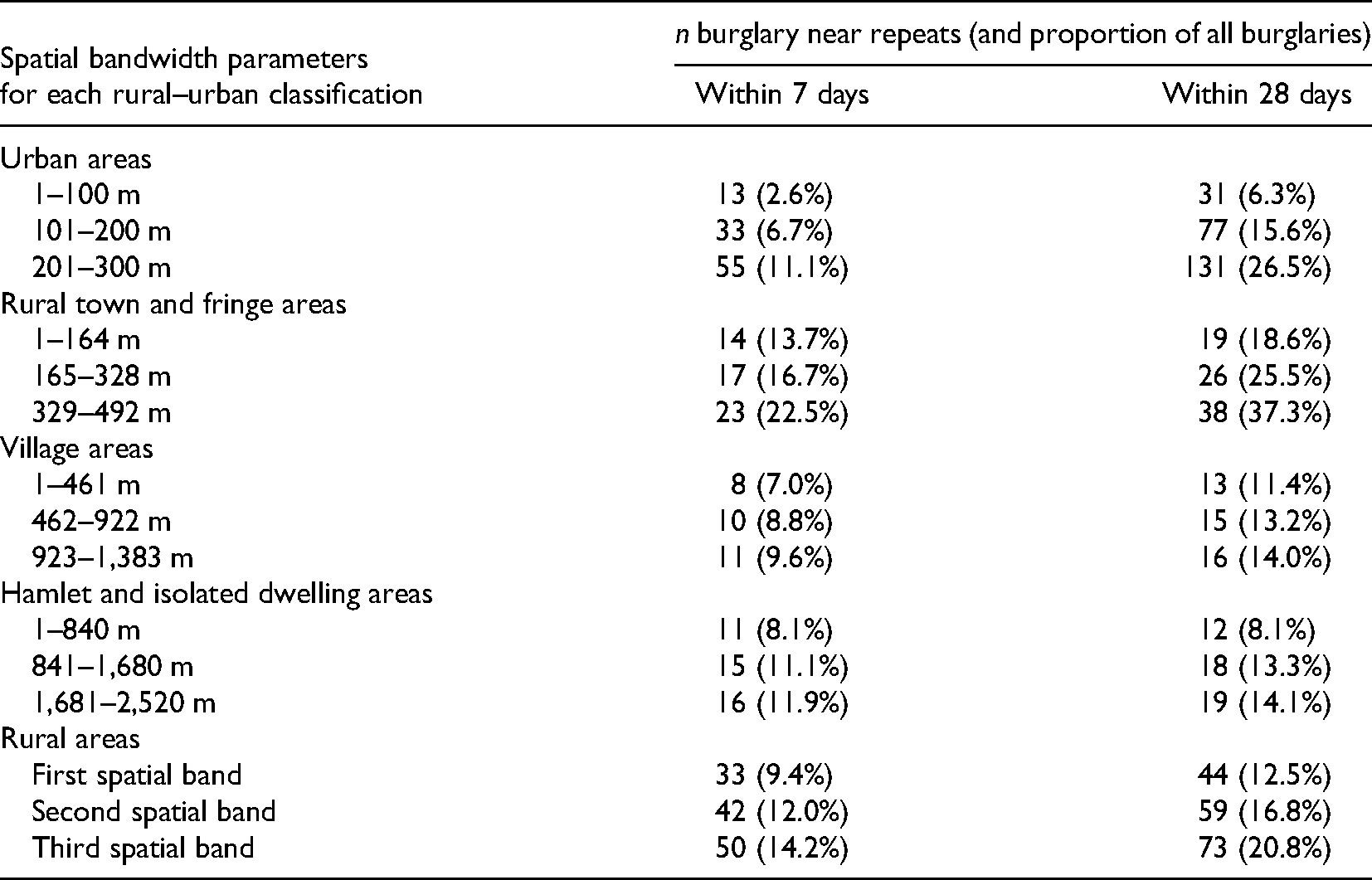
Although the Near Repeat Calculator may identify that a statistically significant pattern of near repeats is present, this result does not indicate how many incidents are categorized as near repeats. Additional analysis was conducted using the ESRI ArcGIS Crime Analysis Repeat and Near Repeat Classification tool (ESRI, 2018) to determine the number of burglary near repeats in each rural–urban classification area. Bandwidths of within one, two and three multiples of the spatial bandwidth and 7 days, and within one, two, and three multiples of the spatial bandwidth and 28 days of an originator offense were chosen following the advice provided in Chainey (2021) for calculating the numeric extent of near repeats. For example, for burglaries that took place in villages I measured the number of burglary near repeats that took place within 7 days and 461 m, within 7 days and 922 m and within 7 days and 1,383 m, and the number of burglary near repeats for these same distances and within 28 days of an originator offense. The number of burglary near repeats in each of the rural subdivision classification areas was summed to generate a total number of burglary repeats in rural areas.
Results
The first test involved examining for the statistically significant presence of burglary near repeats in each rural–urban classification area. Table 2(a) shows that a statistically significant (p < .05) pattern of burglary near repeats was observed in urban areas, with this pattern being most apparent within 7 days of a previous burglary and being present for each of the three spatial bands. The presence of this near repeat pattern was highest within 1–100 m of a previous offense, where the chance of another burglary occurring at a dwelling within 1 week of a previous burglary was 3.37 times greater than expected. The chance of a burglary near repeat occurring within 1 week decreased with distance from a previous burglary. The significant presence of near repeats was also observed within 101 and 200 m and 8–14 days and within 1 and 100 m and 15–21 days of a previous burglary but at levels lower than observed for the 1–100 m and within 7 days parameters.
The Presence of Burglary Near Repeats in (a) Urban, (b) Rural Town and Fringe, (c) Village, and (d) Hamlet and Isolated Dwelling Areas (p < .05).
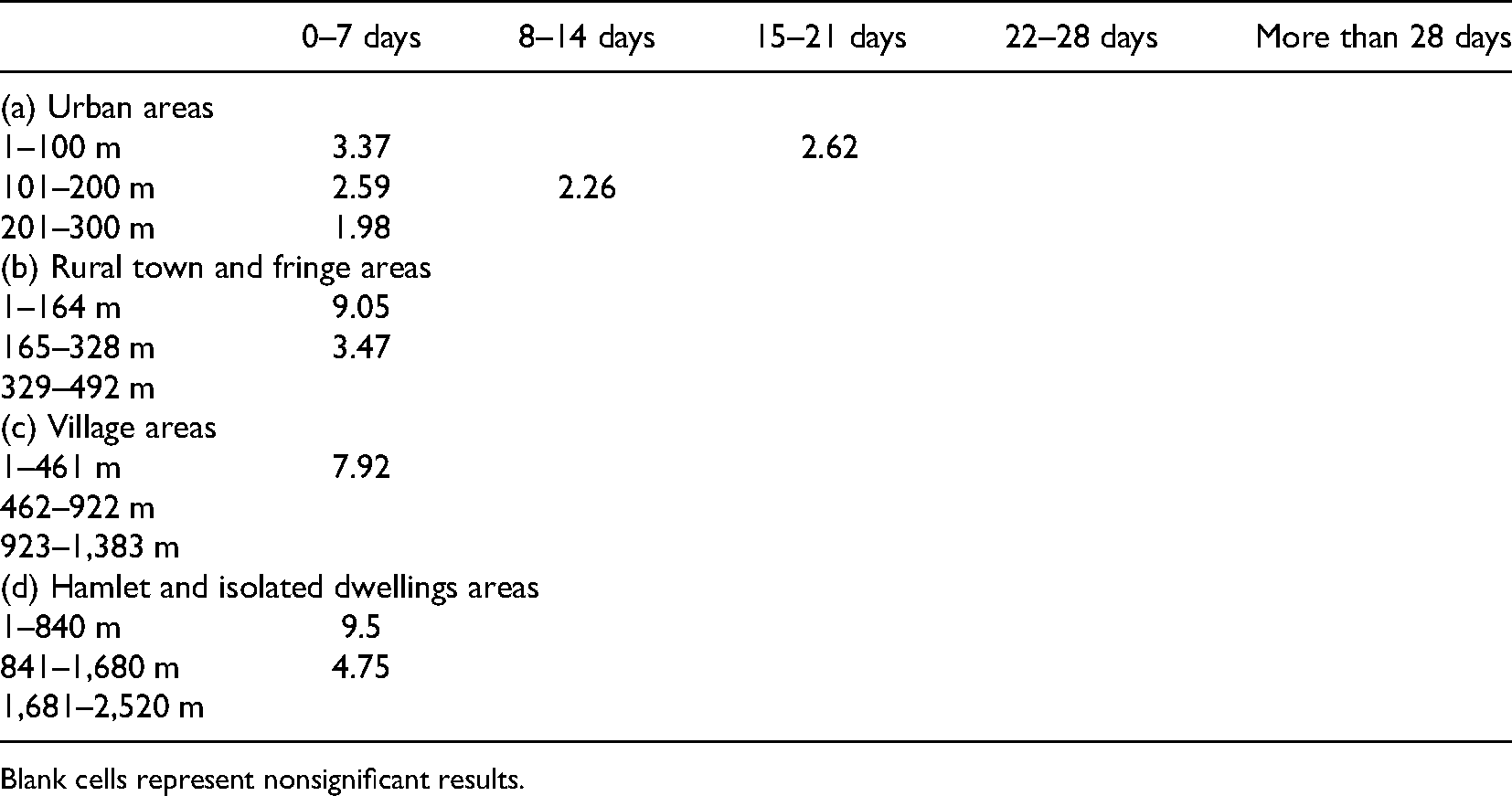
Blank cells represent nonsignificant results.
A significant near repeat pattern was observed in each of the three rural classification areas. For each rural classification area, the significant presence of burglary near repeats was only present within 7 days of a previous burglary. The chance of a near repeat occurring was greatest for the spatial bandwidth that was closest to a previous burglary in each of the rural classification areas. In each rural classification area, the chance of a near repeat was higher than that observed in the comparable parameters for urban areas. For example, in hamlet and isolated dwelling areas the chance of another burglary occurring at a dwelling within 1–840 m and 1 week of a previous burglary was 9.5 times greater than expected. In only rural town and fringe and hamlet and isolated dwelling areas, the statistically significant presence of burglary near repeats within 1 week extended to the second spatial bandwidth parameters. For each rural subdivision classification area, the significant presence of near repeats was not observed beyond 1 week of a previous burglary. These differences between the levels of near repeats in urban and rural areas are also shown in Figure 1a–1c. In each figure, the results are grouped by spatial band for comparison—for example, comparing in Figure 1a the extent of burglary near repeats between each urban–rural classification for the first spatial band that was used for measuring the presence of near repeats (i.e., within 1–100 m for urban areas, 1–164 m for rural town and fringe areas, 1–461 m for villages and 1–840 m for hamlet and isolated dwellings areas).
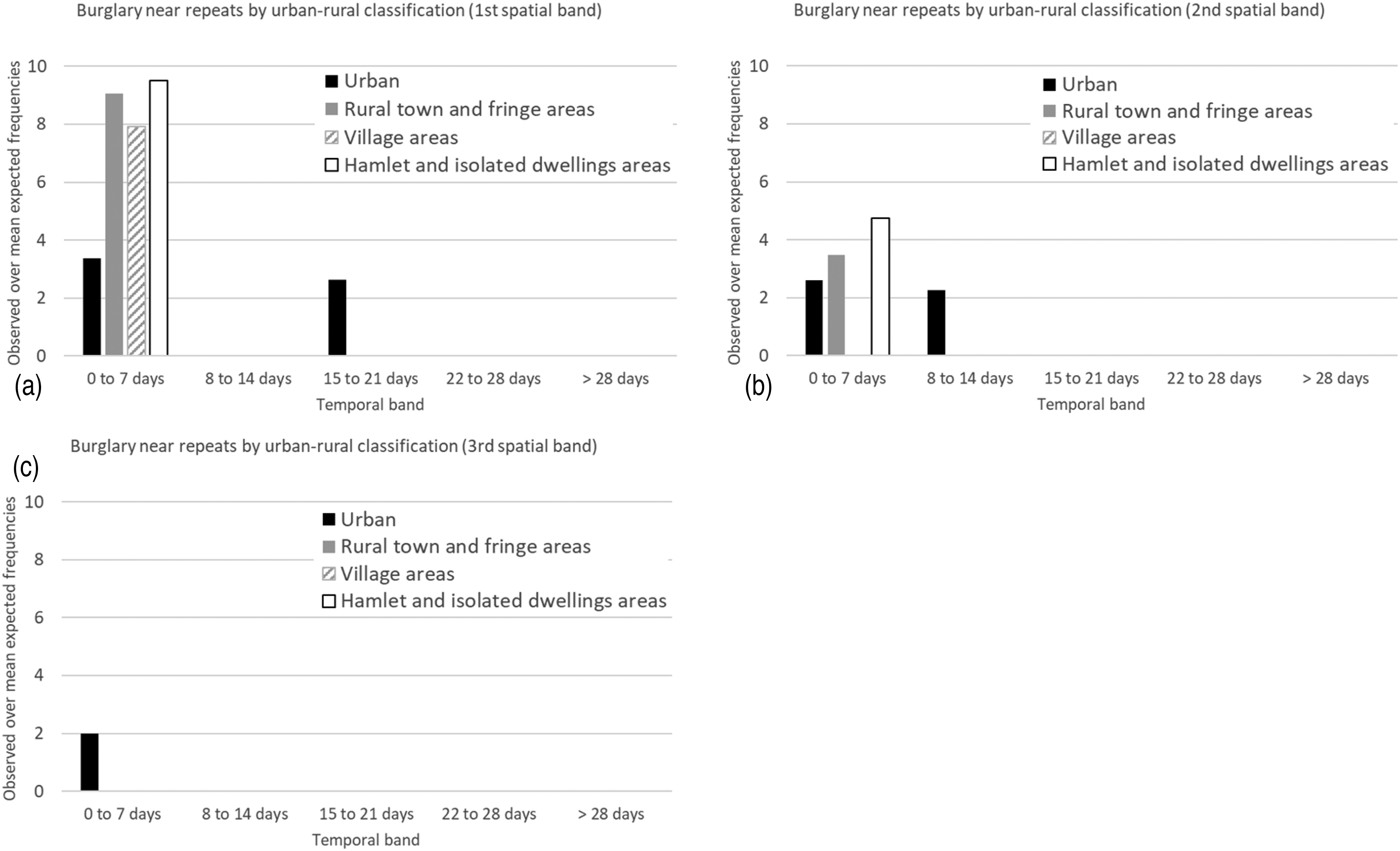
The extent of significant patterns of burglary near repeats (p < .05) by urban–rural classification and temporal bands for (a) the first spatial bands, (b) the second spatial bands, and (c) the third spatial bands.
Table 3 shows the extent of burglary near repeats in each of the rural–urban classification areas (including a total extent of burglary near repeats for all the rural areas) for six spatio-temporal bandwidth parameters. The proportion of burglaries that were near repeats was greater in rural areas (9.4%) than in urban areas (2.6%) within 7 days and within the first spatial band (i.e., a single spatial bandwidth) of a previous burglary. This greater level of burglary near repeats within a single bandwidth of a previous burglary was most apparent in rural town and fringe areas where one in seven burglaries were near repeats that took place within 1 week and 164 m of a previous burglary, compared to one in 38 burglaries within 1 week and 100 m of a previous burglary in urban areas. In both village areas and hamlet and isolated dwelling areas the proportion of burglaries that were near repeats within a single spatial bandwidth was higher than that observed in urban areas. Within 28 days and within a single spatial bandwidth of a previous burglary, the proportion of burglaries that were near repeats was also greater in rural areas (12.5% of all burglaries) than that observed in urban areas (6.3%). For the second and third spatial bands within 28 days, the proportion of burglaries that were near repeats in rural areas was similar to that observed in urban areas. The extent of near repeats in each rural subdivision classification area was noted to be higher in areas with the higher burglary rate (i.e., rural town and fringe areas).
The Extent of Burglary Near Repeats in Rural–Urban Classification Areas for Six Spatio-temporal Bands.
Discussion, Limitations, and Further Research
Several studies have identified the presence of statistically significant patterns of burglary near repeat victimization in a variety of urban settings. In the current study, I conducted the first known analysis of burglary near repeats in rural settings and compared the level of near repeats in these settings to urban areas. To effectively compare between rural and urban areas, spatial bandwidths were calculated based on the distribution of an equivalent number of potential targets for burglary in each rural–urban classification area. Although there are some limitations with this method (which I discuss below), it was considered to be the most appropriate approach for comparing the extent of near repeats because it reflects the distribution of potential targets that an offender can consider for committing crime against.
The findings from the current study showed that the presence of burglary near repeats was statistically significant in rural settings. Significant patterns of near repeats were observed for each rural classification area, and hence leading to the rejection of the first hypothesis that these patterns were less likely in rural settings. I did observe, however, that for each rural classification area, the significant presence of burglary near repeats did not extend beyond the first temporal band of 7 days and was limited to either the first and second spatial bands (i.e., closest to a previous burglary). This was different to urban settings where the statistically significant observations of burglary near repeats extended farther, both in space and time. Burglary near repeats in rural areas did, however, account for at least similar levels as those observed in urban areas, and more so for burglaries that occurred within the shorter spatio-temporal bandwidths for examining near repeats. Therefore, with regards to the second hypotheses—the extent of near repeats is less than that observed in urban settings—the findings from the current study also lead to the rejection of this hypothesis. For example, within 1 week and a single spatial bandwidth, burglary near repeats in rural areas accounted for 9.4% of all burglaries compared to 2.6% in the urban areas of the study area.
Near repeat victimization patterns are explained using boost account and foraging theory principles. The boost account suggests that an offender seeks to minimize effort in their criminal activity by committing additional offenses soon after and near to a recent incident. This is based on the confidence and experience the offender gained about committing crime in the area from the first offense and that targets nearby are likely to be more similar than targets that are farther away. Foraging theory adds to the boost account for explaining the pattern of near repeats by stating that a trade-off is made by the offender between the rewards of crime commission that are associated with other opportunities for crime that are nearby and the effort and risks involved in seeking other opportunities that are located in different places. The near repeats observed in these short spates of criminal activity can also be explained by the foraging offender taking advantage of the best but finite opportunities for crime commission, and then moving from the area to avoid being caught. These theoretical principles of the boost account and foraging theory have been developed from studies in urban settings of near repeat victimization. The presence of near patterns in rural settings, as observed in the current study, suggest the theoretical principles of the boost account and foraging theory are also apparent in these settings. However, for burglary near repeats that take place in rural settings some consideration has to be given to the effort that is required for an offender to travel to their next target after the commission of an initial offense. If the next target is not visited immediately after the initial offense (e.g., not until two days later), there is likely to be a cost in effort implication associated with travelling the distance to this next target in a rural setting that is greater than the effort that would be required for an offender boosted and foraging for other targets in an urban setting. This implies that some extra consideration of the journey to crime and offender anchor points is required, alongside considerations of offender decision-making.
The least effort principle (Zipf, 1949) applied in relation to offending behavior suggests that most offender journeys to crime are likely to be short, with this principle being supported by an extensive range of empirical studies (see Rossmo, 2000 for a review). The rational choice perspective (Clarke & Felson, 1993; Cornish & Clarke, 1986) suggests that offenders are profit maximizers, who seek to maximize benefits while seeking to minimize costs. As observed in the current study, the presence of near repeats in rural areas was only significantly observed within the first temporal band of 7 days, and were most apparent within the first spatial band. This is different to observations in urban settings where observations of burglary near repeats extend to several spatial and temporal bands (e.g., see Chainey et al., 2018; Hoppe & Gerell, 2019). I suggest from these findings that in rural areas, burglary near repeats may be restricted to the nearest spatial and temporal bands because of the greater effort that would be required by the offender in seeking out opportunities when the distance between potential targets is much greater. For example, an offender may be boosted by the success of a burglary in a rural area but can only forage for a limited number of other opportunities because of the greater distance (and effort) involved in seeking these other targets. The targets that are chosen being those closest to the first burglary. In an urban setting an offender would not need to travel far to find many potential targets, but in a rural area the same number of potential targets would be distributed over a much larger geographic area. The extra effort that is required by an offender to forage for targets that are located a much greater distance from a previous burglary in a rural setting may be greater than the opportunities that are available to the offender for committing crime in other areas. So, after a short period of foraging for potential targets that are nearest to a recent burglary, the offender may decide to move on to another area rather than widening their spatial search. Boost and foraging principles also suggest that it is the offender who committed the first offense who is likely to be the person who commits the near repeats. It was beyond the scope of the current study to examine this, but I recommend further research that examines if offenders of near repeats in rural areas are more likely to be the same offender than in comparison to near repeats committed in urban areas.
The commission of burglary in rural areas also is likely to require the offender to expend a greater cost in effort to complete their journeys to crime. This includes the journey to commit the first offense as well as the journey to commit subsequent near repeat offenses. Findings from journey to crime research show that this journey tends to be short (Rossmo, 2000). Other research shows that most offenders originate their journey to crime from home, with this home location most likely to be in an urban area (Bruinsma et al., 2013; Wiles & Costello, 2000). Offenders who commit burglary in rural areas are likely to have made additional effort to travel to these areas when other potential targets could have been located nearer to where their journey to crime commences. This may explain the pattern of burglary near repeats that were most observed in the current study, with the greatest level of near repeats in rural settings being closest to the previous burglary and within a short timeframe. That is, to minimize effort in the journey to crime the offender may commit these near repeats on the same day or within only a small number of days. The small number of burglaries within a short timeframe of each other in the rural settings of the study area (e.g., burglaries on the same day) meant it was not possible to examine with any power the statistical presence of these types of swift near repeats. I suggest further research, where the data permits, that examines if the commission of near repeats in rural settings are closer in time between offenses than in urban settings to examine for differences in offender behavior (and the application of effort) in these settings.
Although the journey to crime in most cases tends to be short, this does not mean to say that all offender journeys are short. When the rewards to be gained from crime commission are considered to be high, this can compensate the extra effort that is required for longer journeys to crime (Chainey, 2021; Rossmo, 2000). The incentive for an offender to apply greater effort and travel the longer distance to a rural area may relate to the rewards involved. If the rewards from burglary in rural areas are greater than the rewards in urban areas, this may compensate for the extra effort required to travel to these areas. Also, the incentive for an offender to apply greater effort and travel the longer distance to a rural area may relate to the effort to access a rural property. If rural properties are easier to access and break into than in urban areas, this may also compensate for the extra effort to travel. I recommend further research that examines if the value of items stolen in burglaries in rural areas is greater than that in urban areas and in particular for burglary near repeats, and if offenders select rural properties because of them being easier properties to break into.
Most journey to crime research is based on calculating the distance from the offender's home to the location of the crimes they commit. This is because the data that has been available for these studies only includes the location of each offense and home address of the offender who is known to have committed the offense (Chainey, 2021). The journey to crime may start at numerous other places, such as a place of work, or other frequented locations such as places of entertainment (e.g., bars), or the homes of family or friends they visit. To date, no known research has examined if the starting locations for offenders who commit burglaries in rural settings are different to the starting locations for offenders who commit burglaries in urban settings. Also, little is known about whether offenders who commit crime in rural areas also reside in rural areas or whether there are certain offenders who live in urban areas who are willing to travel longer distances to commit crime in rural areas. It was beyond the scope of the current study to examine these journey to crime patterns but I suggest that research that examines the starting points and distances that offenders travel to commit crime in rural settings and where these offenders reside would make worthwhile contributions to the study of crime in rural settings.
Crime prevention interventions that decrease burglary by reducing near repeats have been developed in urban areas and involve police officers making visits to neighboring properties soon after a burglary has occurred. This involves the police officer raising awareness to neighbors that a burglary has recently occurred and for these neighbors to be vigilant and take more precautions over the next few days to reduce their risk of victimization. The presence of the police in the area where a burglary has been committed may also act as a visible deterrent to the returning offender who is seeking to take advantage of other opportunities for burglary. Although the distance between neighboring properties in rural areas is greater and requires more effort for the police to visit these properties, there is logic to operating a similar type of intervention in rural areas. This would involve police officers visiting properties that are closest to where a recent burglary has been committed and asking residents to be vigilant and take more precautions. Where resources are limited, this could involve phoning residents rather than visiting them, contacting residents through a local social media group or prioritizing visits to areas where analysis has identified the greatest presence of near repeats. For example, based on the results from the current study, visits could be prioritized to properties in rural town and fringe areas because this is where the presence of burglary near repeats was observed to be greatest.
Limitations
The current study used a single county in England to examine for the presence of burglary near repeats in rural areas and compare to rural areas. Although our study contributes to the research on crime in rural areas, and research on near repeat victimization and offending behavior, I suggest further research that replicates our study in other areas to examine the generalizability of the findings. In the study area, the burglary rate for Herefordshire was lower than the mean rate for England. This lower burglary rate may have affected the results because previous studies have found that near repeats are more prevalent in areas where the burglary rate is high (Chainey et al., 2018). I recommend replication of the study in areas where the burglary rate is higher than that for my study area.
I used the calculation of potential targets (other residential properties) within a radius of each property to determine spatial bandwidths for each rural–urban setting. This approach is easy to replicate using simple nearest neighbor distance methods. To perform the calculation, I first determined the mean number of properties within 100 m of each property in an urban area (n = 23). I then used this to calculate the mean nearest neighbor distance to 23 properties in each rural subdivision area. This meant that within the first spatial bandwidth for each rural–urban classification area the number of potential targets was similar. However, I recognize that applying multiple bands to the spatial bandwidth for each classification area does not result in the same number of potential targets in the second and subsequent bandwidths. For example, in an urban area, the number of potential targets within 101 and 200 m of a previous burglary would be greater than the number of potential targets within 165–328 m of potential targets in rural town and fringe areas because of the differences in the spatial density of properties. I also recognize that in rural settings, when examining for other offenses near to an initial offense, the further the distance from this initial offense the greater the likelihood of exploring in unoccupied countryside. I attempted to limit this by only using three spatial bandwidths, however, the finding that near repeats were most observed within the first spatial bandwidth in rural settings and were not observed in almost all cases within the second and third bandwidths could be because of the search for offenses in what is unoccupied countryside.
My method was the first attempt to generate an approach for determining suitable spatial bandwidths for near repeat analysis for use in rural settings and to allow for some comparison to urban areas. The size of the study area meant that I could not simply extend the distance used for the second and third spatial bandwidths because this would mean that these would more likely overlap with other rural–urban classification areas. The approach I used means that I could have undercounted the number of near repeats within the second and third spatial bands in rural areas. However, I also recognize that extending these spatial bands to several kilometers goes against the general principle of examining offenses that occur near to a previous offense. I encourage further research that improves the method I introduce in this article for creating spatial bandwidths for near repeat victimization analysis that allows for comparisons between different rural–urban settings.
In the current study I did not examine where the offender was suspected to have originated from. Most research suggests that offenders reside in urban areas rather than rural areas, however in the commission of burglary near repeats this is untested. If a burglar lives in a rural area this minimizes their journey to commit burglaries in rural areas (if this is where they commit offenses) and could provide better conditions for offender foraging than for an offender who commits a burglary in a rural area but resides in an urban area. I recommend further research that examines the rural–urban origin of offenders who commit burglaries in rural areas.
Any rural–urban classification of areas has boundaries that separate these areas. In the measurement of near repeats, an offense that takes place in an urban area that is close to the border of a rural area (or vice versa) may be an originator to an offense that takes place soon after and close to the first offense but is over the border in the rural area. In this situation, the second offense is not classified as a near repeat. This means that the overall number of near repeats may be undercounted. I minimized this potential undercount by using small spatial bandwidths (e.g., a burglary within a rural setting would have needed to be within a maximum of 300 m of an originator burglary in an urban setting for it to be a near repeat that was not accounted for).
Conclusions
Near repeat victimization of burglaries can account for a substantial minority of offenses. Studies that have examined burglary near repeats have mainly examined these patterns in urban settings, with no known studies examining how these patterns compare to near repeat observations in rural settings. To enable a comparison between rural and urban settings I measured the distribution of potential targets to determine the spatial bandwidths for measuring and comparing levels of burglary near repeat victimization. A statistically significant burglary near repeat victimization pattern was found in rural settings, with this pattern being most apparent within the spatial and temporal bands that were closest to and most recently after a previous burglary. The proportion of all burglaries that were near repeats in these nearest spatial and temporal bands was greater than that observed in urban areas. The pattern of burglary near repeats in rural areas did not extend as far (in distance and time) to that observed in urban areas, but the overall extent of burglary near repeats for longer distance and time periods after a previous offense was comparable to that observed in urban areas. The boost account and optimal foraging theory are the key theoretical principles that are used for explaining near repeat patterns, with the results from the current study showing this type of offending behavior is likely to be just as apparent in the commission of crime in rural areas as it is in urban areas. The difference that was observed, however, was that the commission of near repeats in rural areas took place within a shorter time period and to targets closest to where a previous burglary was committed in comparison to observations in urban areas. The findings suggest there are opportunities for crime prevention which counter the presence of burglary near repeats in rural areas.
Footnotes
Declaration of Conflicting Interests
The authors declared no potential conflicts of interest with respect to the research, authorship, and/or publication of this article.
Funding
The authors received no financial support for the research, authorship, and/or publication of this article.