




Abstract
Although urban disorder has played a central role in neighborhood research, its impact may have been overstated in studies relying on the subjective perception of survey respondents only. Research on the “perception bias”—defined as the divergence between respondents’ subjective assessments and systematic observations of disorder—has revealed the ambiguous nature of disorder and opened a door to the analysis of the social construction of this environmental cognition. Using survey and observational data from 140 small neighborhoods in two German cities, we advance this research by focusing on the moderating role of residents’ interethnic contacts and attitudes. The results show that the effects of neighborhood minority concentration on the perception bias are conditional on the residents’ interethnic contacts and xenophobic attitudes. These findings highlight the subjectivity of disorder perceptions and caution against a naive understanding of Broken Windows theory.
In research on communities and crime, disorder has been a pivotal concept for many years. “Broken Windows” theory (Kelling & Wilson, 1982) and Skogan’s (1990) concept of “disorder and decline” have succeeded in popularizing in criminology and crime policy the claim that physical decay and low-level breaches of social order as littering and vandalism pave the way for more serious crimes. Even though its distinctiveness and causal role remains contested, measurements of disorder have been included in many if not most major studies on crime in urban neighborhoods since the 1980s (Skogan, 2015). Beyond criminology, disorder in close conjunction with fear is suspected to have detrimental effects on residents’ satisfaction, well-being, and health behavior in research by environmental psychologists and urban sociologists (e.g., Bjornstrom & Ralston, 2014; Cutrona et al., 2000; Foster et al., 2014; Hill et al., 2005; Latkin & Curry, 2003; Rollwagen, 2016; Ross & Mirowsky, 2009; Ross et al., 2000; Wallace et al., 2018).
Yet, given its prominence, it is surprising that the status of empirical confirmation of Broken Windows theory is, in fact, rather weak (Harcourt, 2004; Link et al., 2014; Steenbeek & Hipp, 2011). The core hypothesis that disorder increases crime has found very little empirical support nor has a consistent picture of the pathways and mechanisms by which this effect should be brought about emerged (Kubrin & Weitzer, 2003; W. Skogan, 2015). Most recently, the repercussions of the financial crisis on the U.S. housing market have been shown to effect an increase of crime in areas with many foreclosures (Chamberlain & Hipp, 2015; Wallace et al., 2018), and there is evidence for the criminogenic nature of abandoned properties strongly suggesting a causal link between some facets of disorder and crime (Larson et al., 2019; Porter et al., 2019).Yet, based predominantly on official data sources only, most foreclosure studies assume but cannot empirically show that disorder is major mechanism of crime causation.
One main reason for this unsatisfactory state is measurement: Many studies have relied on the perceptions of survey respondents only. Yet concerns grew relatively quickly about a possible overestimation of the impact of disorder on neighborhood social processes if both were based on respondents’ reports and might share error variance. This quandary has lead scholars to turn to systematic social observation (SSO) as an independent and more objective data source which “would permit discriminating impacts of actual signs of disorder from impacts of residents’ reactions to cues of disorder” (Covington & Taylor, 1991, p. 233). These studies usually found weaker associations between disorder, fear, and other community-related social cognitions (Häfele, 2013a; Hinkle & Yang, 2014; Perkins & Taylor, 1996; Skogan, 2015).
It is the combination of both types of measurement that has advanced our knowledge about the meaning of urban disorder most. While SSO data offer a more objective assessment of visible signs of urban disorder and hence more realistic estimates of their effects on neighborhood social processes, it lacks the “social meaning ascribed to disorder by community residents that may trigger the broken windows process” (Kubrin, 2008, p. 207). If incivilities are to affect residents’ neighborhood-related judgments and behaviors, this can, of course, only happen through their individual subjective perceptions (Hinkle & Weisburd, 2008, p. 507).
Viewed as “a meaningful aspect of the neighborhood environment” (Sampson, 2009, p. 24), subjective perceptions and the factors that drive them have become a focus of research in their own right. The “perception bias”—defined as the divergence between respondents’ subjective assessments and systematic observations of disorder—is not merely an issue of statistical rigor but better understood as part of cognitive and social processes, which collectively form neighborhood reputations (Skogan, 2015, p. 473). In their seminal study on Chicago neighborhoods, Sampson and Raudenbush (Sampson, 2009; Sampson & Raudenbush, 2004) found that sociodemographic composition had a profound impact on disorder perceptions above and beyond objective levels of disorder, with residents in neighborhoods with more poverty and higher shares of Black and Hispanic residents perceiving higher levels of disorder relative to objective levels. They interpreted this finding as an effect of an implicit bias leading to a “racial stigmatization” of neighborhoods. A small number of studies in other cities have confirmed the pivotal role of neighborhood ethnic composition and have added to the understanding of the perception bias, yet little is known about the mechanisms driving the “social construction” (Kubrin, 2008, p. 206) of disorder. We advance this line of research by widening the focus to individual differences that underlie subjective perceptions and contribute to these mechanisms. To our knowledge, this study for the first time shows that the effect of minority concentration on the perception bias is conditional on residents’ interethnic contacts and attitudes toward migrants. This is also one of very few studies to investigate the role of minority concentration on subjective disorder perceptions outside the United States. Our findings guard against a naive understanding of Broken Windows theory and intervention policies derived from it.
Theoretical Background and Previous Research
The Place of Disorder in Social Disorganization Theory
A prominent line of thought sees disorder as “a major engine of neighborhood change” (Skogan, 2015, p. 465) by eroding the social organization of communities and promoting urban decline. While not routinely considered by criminologists as an element of social disorganization theory (Bursik, 1988; Kubrin & Wo, 2016), the deleterious effects of disorder on the social fabric of neighborhoods are easily integrated into the “systemic model” of neighborhood crime causation, that is, as a feedback loop of antisocial behaviors on social cohesion and collective capacities for social regulation (Brunton-Smith et al., 2014; Markowitz et al., 2001; Taylor, 1997; Wickes, 2017). The expression “disorder” signifies various behaviors and their physical traces which violate formal and informal rules of “civilized” demeanor in urban spaces and among neighbors. Hunter (1978) coined the term “incivilities” in contrast to “crime” in order to emphasize the low-level character of these phenomena which however were assumed to be even more consequential because they were much more frequent, more permanent in the case of physical incivilities, and hence served as a cue for more serious but rare and hard to observe crimes (Sampson & Raudenbush, 1999). Examples of social incivilities are begging, loitering, noise and harassment, and physical incivilities include litter, graffiti, unkept front gardens, or abandoned supermarket trolleys. Hunter (1978) hypothesized that incivilities “communicate…the loss of a civil society [and] generate fear and insecurity among urban residents” (p. 7). Further elaborating this idea, Kelling and Wilson’s (Kelling, 2015; Kelling & Wilson’s, 1982) Broken Windows theory and Skogan’s (1990) concept of “disorder and decline” proposed a causal chain by which disorder increases fear which subsequently weakens informal social control. These processes are assumed to send encouraging signals to potential offenders, in turn increasing crime and ultimately resulting in downward spirals of neighborhood decay.
The disorder–fear link clearly is a cornerstone of Broken Windows and disorder and decline concepts, and studies in the United States and in Europe have repeatedly produced strong evidence of this association (Brunton-Smith et al., 2014; Drakulich, 2013; Gainey et al., 2011; Häfele, 2013a; LaGrange et al., 1992; Mellgren et al., 2010; Oberwittler, 2008; Ross & Jang, 2000; Wyant, 2008). However, very early Taylor and his colleagues pointed at the subjectivity of residents’ perceptions of disorder. In particular, they showed that within the same ecological units, respondents who were more fearful reported more disorder, hinting at a shared method variance (Lewis & Maxfield, 1980; Link et al., 2014; Perkins et al., 1992; Perkins & Taylor, 1996; Robinson et al., 2003; Ward et al., 2017). This interpretation suggests that differences in subjective perceptions may overlay potential collective neighborhood effects of disorder, questioning the causal nexus between disorder and fear or neighborhood social processes (Brunton-Smith & Sturgis, 2011; W. Skogan, 2015). Due to this correlated error, studies using the same survey data, particularly in cross-sectional analyses, for measuring both disorder and other concepts as fear or informal social control that are hypothesized to be influenced by disorder are likely to overestimate the deleterious effects of disorder. Yet the “perception bias” (defined as the deviance of respondents’ assessments of disorder from actual levels of disorder) may extend beyond individual respondents, if the subjective assessment of disorder is collectively colored by neighborhood conditions and may still affect even some of the most advanced longitudinal studies in the field that rely on survey-based measures (Brunton-Smith et al., 2014; Markowitz et al., 2001; Steenbeek & Hipp, 2011). Also, studies looking to health effects of neighborhood disorder face endogeneity problems when using respondents’ subjective perceptions of disorder (e.g., Chappell et al., 2011; Theall et al., 2013).
Only some studies were able to draw on independent, systematic measurements of disorder, with mixed results on the effects of disorder: Brunton-Smith and Sturgis (2011) using British Crime Survey data combined with independent interviewer-observed disorder as well as Hinkle and Weisburd (2008) linking survey data to SSO data found effects of disorder on fear, Sampson and Raudenbush (1999) based on survey and SSO data from Chicago reported an indirect effect of observed disorder via perceived disorder on lower collective efficacy and a direct effect on robbery. Using panel survey data and SSO data from Baltimore, Robinson et al. (2003) concluded cautiously as they did find individual-level but no street-block-level effects of observed disorder on changes in fear.
The collection of SSO data not only improved research on the consequences of disorder for community processes but also opened the door for identifying individual- and ecological-level attributes that influence residents’ neighborhood-related cognitions (Brunton-Smith & Sturgis, 2011), and by doing this, research on urban disorder has been stepping beyond the narrow focus of Broken Windows theory and moving toward a more multifaceted theory of neighborhood processes. The prime interest was initially on isolating the “actual effects” of disorder on community social organization and crime (Covington & Taylor, 1991) which and in the light of controversial Broken Windows policing strategies this remains an important task (Weisburd et al., 2015). More recently, however, the collective subjectivities of residents’ cognitions moved into the focus as scholars have become aware that perceptions—no matter how accurate or biased—can have real consequences for neighborhoods (Drakulich, 2013; Sampson, 2009), which is in line with the Thomas theorem that “if men define situations as real, they are real in their consequences” (Merton, 1948, p. 193). Perceptions of disorder can negatively impact the reputation of urban areas, with tangible effects on their future trajectories. Reputation is a “collectively shared view” (Permentier, 2012, p. 163) on the esteem and status in the social hierarchy, which may influence neighborhood satisfaction (Pais et al., 2014) and trust (Kullberg et al., 2010). A low reputation may amplify residents’ intention to move to “better” areas, further deteriorating the social mix of neighborhoods (Permentier et al., 2009). In a longitudinal analysis, Sampson (2012, p. 144) found that perceived disorder was a stronger predictor of neighborhood poverty 7 years later than objective disorder and crime. Considering the potential consequences of disorder perceptions for neighborhood development, more research is needed into the mechanisms of how and why residents form these perceptions.
The Discrepancy Between Survey- and Observation-Based Measures of Disorder and Factors Shaping the Perception Bias
The question how similar or dissimilar respondents’ perceptions and SSO data of social and physical disorder are resembles the question whether a glass is half-full or half empty. The majority of studies have found sufficiently high correlations to see “reasonable levels of overlap between the two approaches” (Skogan, 2015, p. 478); at the same time, the correlations are weak enough to emphasize discrepancies. The Baltimore community studies lead by Taylor (Perkins & Taylor, 1996; Taylor, 2001; Taylor et al., 1985) were among the first to include SSO. The correlation between respondents’ perceptions of disorder and observed disorder was r = .62 on the street block level in an early study (Taylor et al., 1985) and r = .66 for physical disorder and r = .35 for social disorder in a subsequent study (Perkins et al., 1992; Perkins & Taylor, 1996). Sampson and Raudenbush (1999, p. 623) reported nearly identical correlations between the two measurements of both social and physical disorder (r = .56 and r = .55, respectively) in the Chicago project. A study in the German city of Hamburg reported r = .61 for physical and r = .41 for social disorder (Häfele, 2013a, p. 165). However, some studies found weaker correlations, varying between r = .32 (Conley et al., 2014) and r = .10 (Drakulich, 2013). Yang et al. (2018) did not find a significant association between observed and perceived social disorder. In no study, the proportion of covariance between perceived and observed disorder exceeded 50%, leaving ample room for other influences that have increasingly found scholarly interest and led to a change of perspective toward the subjective dimensions of urban disorder.
How, then, can we conceptualize the “inherent subjectivity of disorder” (Kubrin, 2008, p. 207) and make it accessible for empirical analysis? Investigations of the sources of the perception bias usually start with identifying individual characteristics associated with perceiving more or less disorder within the same neighborhood. There is consistent evidence that female and younger respondents perceive more disorder than male and older respondents, and the same holds true for victims of violence versus nonvictims (Drakulich, 2013; Elo et al., 2009; Hipp, 2010; Sampson & Raudenbush, 2004; Wallace, 2015; Wickes et al., 2013).While some of these individual predictors as age may hint at differences in lifestyle which would explain differential exposure to the actual sights of disorder, even for residents of the same neighborhood, other effects as gender and ethnicity rather seem to reflect varying sensitivities to identical phenomena (Hipp, 2010). 1
A paramount notion is that disorder resonates with a general sense of urban dangers. Research on urban disorder and fear of crime hypothesized from the start that physical and social incivilities are “symbolic cues” (Hunter, 1978) or “signals” (Innes, 2014) to potential victimization risks which are hard to assess. The strong link between perceptions of disorder and fear of crime (see above) suggests that those who are more sensitive to crime risks due to physical, psychological, or socioeconomic vulnerabilities tend to assess visible signs of disorder as more threatening and hence to “see” more disorder. A strong body of research on the “expressive” functions of fear of crime (Jackson, 2004) showed that particularly for people who personally feel out of control and “powerless” (Ross et al., 2001; Sampson, 2009), worries about crime, and disorder are charged with broader concerns about social conditions and social change (Farrall et al., 2009; Jost et al., 2004). Jackson et al. (2018) found that the perception bias was influenced by concerns about long-term neighborhood change and crumbling moral values. Hirtenlehner and Farrall (2013, p. 17) estimated a structural equation model of perceptions of disorder and fear of crime together with various economic and social worries and concluded “that the well-established connection between worries about incivility and crime is to a large extent due to their common coloring by an overarching amorphous sense of insecurity.”
The Role of Ethnic Minority Concentration and Stereotypes/Implicit Bias
Ethnicity is a particularly salient issue connected to perceptions of neighborhood disorder and crime. On the individual level, ethnic minority respondents tend to report less disorder than majority respondents within the same neighborhoods. In U.S. studies, this has been found primarily for African Americans (Franzini et al., 2008; Drakulich, 2013; Sampson & Raudenbush, 2004; Wallace, 2015; Ward et al., 2017; but see Hinkle & Yang, 2014) or for both African Americans and Latinos (Hipp, 2010). In the very few studies carried out outside the United States, the results have been rather mixed: In an analysis of the British Crime Survey, Asian and other minority but not Black respondents reported less disorder (Jackson et al., 2018), whereas respondents’ ethnicity had no effect in Australia (Wickes et al., 2013) or had not been included in the analysis in a German study (Häfele, 2013a).
As a collective characteristic of neighborhoods, however, the concentration of ethnic minorities and economic disadvantage have proven to be strong predictors of the perception bias. In Chicago neighborhoods with higher concentrations of Black and Latino population, respondents reported higher levels of disorder relative to objective indicators of disorder and controlling for poverty which also significantly increased perceptions (Sampson & Raudenbush, 2004). In Seattle, too, Black, Latino, and Asian minority concentrations were the strongest neighborhood-level predictors of the perception bias (Drakulich, 2013). However, economic disadvantage but not ethnic composition predicted perception bias in Baltimore (Franzini et al., 2008) and England and Wales (Jackson et al., 2018), and ethnic composition was salient for biased perceptions of social but not physical disorder in Philadelphia (Elo et al., 2009). In a recent laboratory experiment in Taiwan, Yang and Pao (2015) found that images of urban streets with lower class migrants were more likely to be viewed as disorderly than the same images with native persons.
A plausible explanation that dominates current research but has rarely been tested directly is that deeply rooted ethnocentric stereotypes and prejudices form the cognitive mechanism underlying this association (Chiricos et al., 2001; Quillian & Pager, 2001; Sampson & Raudenbush, 2004). The sight of minorities evokes stereotypes of depletion, violence, and danger in all Western societies (Hooghe & De Vroome, 2016; Pickett et al., 2012; Semyonov et al., 2012).
Social psychologists differentiate between explicit and implicit attitudes: Whereas explicit attitudes are open to self-reflection and deliberation, implicit attitudes operate unconsciously and yet may be more pervasive (Akrami & Ekehammar, 2005; Dasgupta, 2013; Dovidio et al., 2016; Greenwald & Krieger, 2006; Kawakami et al., 2017; Tajfel, 1982). As implicit stereotypes are by definition hard to measure, very few studies have directly tested their impact on perceptions of disorder and crime, let alone in large community samples. Using data from an implicit association test, Drakulich (2015; cf. Greenwald et al., 2009) was able to show that implicit ethnic stereotypes had stronger effects on crime-related anxieties than explicit stereotypes which are open to social desirability response bias.
The existing variability in explicit and implicit ethnic biases found in social psychological studies suggests that the effects of neighborhood ethnic composition on disorder perceptions are not uniform but conditional on individual levels of ethnic prejudices. Few studies have yet investigated such cross-level interactions, and those that did mainly relied on proxy variables of ethnic prejudices, with conflicting results. For example, a recent study by Wickes et al. (2013) showed that respondents who overestimate the share of minorities in their neighborhood (a proxy measure for implicit ethnic bias) also perceived more disorder than other respondents. We are not aware of studies testing the effect of explicit xenophobic attitudes on disorder perceptions.
An obvious and easy-to-test question is whether respondents from ethnic majority and minority groups alike are susceptible to the effects of minority concentration in neighborhoods on disorder perceptions, assuming that prejudices are stronger among the majority population. Yet current research is ambiguous on whether individuals from ethnic minorities are immune against implicit prejudices toward their own group (Jost et al., 2004; Kawakami et al., 2017; Quillian, 2006). Sampson and Raudenbush (2004) found that both White and Black respondents’ subjective perceptions of disorder in Chicago neighborhoods were equally heightened by the concentration of Blacks, but that Latino respondents showed an even stronger bias. The uniformity of the perception bias of White and Black respondents in Chicago mirrors Correll et al.’s (2002) seminal videogame experiment showing that White and Black participants shared the same racial bias in assessing Black persons as more dangerous. In contrast, Quillian and Pager (2001) found that White compared to Black respondents were more strongly influenced in their subjective perceptions of neighborhood crime by the percentage of young Blacks in Seattle and Baltimore (but not in Chicago), and Brunton-Smith and Sturgis (2011) reported that Blacks were even less fearful in more ethnically diverse neighborhoods in England and Wales in contrast to all other respondents who showed increasing fear.
Almost no studies have investigated whether the effects of neighborhood minority concentration on the perception bias are moderated by interethnic contact. Qualitative studies have shown that residents who feel insecure about neighbors from ethnic out-groups are often unfamiliar with them, perceiving them as an anonymous group rather than individual neighbors and thus increasing the need for stereotypes in judgments (Merry, 1981; Müller & Fischer, 2015). According to the contact hypothesis (Allport, 1954), contact between members of different groups leads to a more positive image of and fewer prejudices about the other group. Majority residents’ contact with ethnic minority neighbors is expected to reinforce positive implicit associations (Blair, 2002; Dasgupta, 2013; Greenwald & Krieger, 2006) and could therefore counteract stereotypes that link ethnic minorities to disorder and crime. In a closely related research field, many recent studies have supported the hypothesis that positive interethnic contacts can guard against declines of perceived neighborhood trust and cohesion in ethnically diverse areas (Gundelach & Freitag, 2014; Laurence, 2009), while fewer studies have considered the consequences of negative interethnic encounters (Freitag & Kijewski, 2017; Hewstone, 2015; Laurence & Bentley, 2018; Laurence et al., 2018). To our knowledge, no study has yet tested the effects of interethnic contact on disorder perceptions.
To sum up the review of extant research, a few studies predominantly from U.S. cities have hinted at the pivotal role of ethnic minority concentration and social disadvantage in shaping subjective perceptions of disorder. These perceptions are highly consequential as neighborhood reputations are formed not by actual levels of disorder and crime but by collective judgments which are open to cognitive biases (Sampson, 2009). Ignoring the “inherent subjectivity” (Kubrin, 2008, p. 207) of urban disorder unduly simplifies the social processes shaping neighborhood conditions. We know particularly little about how collective perceptions are conditioned by individual residents’ interethnic attitudes and experiences.
Aims of Present Study
This article advances current research on the subjective perception of disorder in urban neighborhoods by focusing on individual residents’ attitudes and behaviors which may condition the effect of minority concentration on the perception bias. The first aim of the current study is to examine the extent to which subjective perceptions of disorder can be explained on the collective neighborhood level by the concentration of minorities, controlling for objective measures of disorder, crime, and social disadvantage. To our best knowledge, this is the first study outside the United States to investigate this research question. Considering the distinct character of “race relations” in the United States, the question whether research findings can be generalized to other developed societies deserves attention. We assume in favor of generalizability that the concentration of minorities in neighborhoods will increase the perception bias (Hypothesis 1).
Second, we will test four hypotheses on cross-level interactions between the neighborhood concentration of minorities and individual characteristics of individual respondents, namely, their ethnicity, their social contacts with neighbors in general and with minority neighbors in particular, and finally their xenophobic attitudes.
In the light of conflicting evidence and assuming that implicit stereotypes about ethnic minorities are stronger among the majority population, we hypothesize that the effect of neighborhood concentration of minorities on the perception bias will be weaker for ethnic minority residents (Hypothesis 2).
Social contacts in the neighborhood might be instrumental in reducing bias in disorder perceptions (Hypothesis 3). People with stronger local ties are expected to have more firsthand knowledge of neighborhood conditions and to rely less on circumstantial information (Wallace, 2015). Contact with ethnic minority neighbors in particular should play an important role in reducing the perception bias of native residents as interethnic contacts are assumed to reduce ethnic prejudices (Hypothesis 4).
Although implicit and explicit attitudes are not necessarily related (e.g., Gawronski & Bodenhausen, 2006), individuals who have stronger explicit xenophobic attitudes are expected to also have stronger implicit negative attitudes toward ethnic minorities (Hypothesis 5). Thus, we expect a reinforcing effect of xenophobic attitudes on the perception bias. However, individuals who report weaker xenophobic attitudes could still have an implicit bias against ethnic minorities or could downplay their xenophobic attitudes due to social desirability concerns (Dasgupta, 2013). Thus, for individuals who reported positive rather than negative attitudes toward minorities, we expect the ethnic composition of the neighborhood to have at least some impact on the perception bias, as a reflection of implicit ethnic prejudices.
Data and Analytical Approach
Research Sites
Data used in the following analyses come from a research project on crime and safety perceptions in urban neighborhoods in Cologne and Essen, two large cities in the Northwestern part of Germany. In the 2011 census, Cologne had a population of 1 million and a 32% share of migrants (including descendants of migrants), and Essen had a population of around 500,000 and a 25% share of migrants. Migration and citizenship status are used as indicators of ethnic minority status in the absence of direct information on ethnicity in the German context. 2 Of these non-German citizens, one third in both cities are citizens of European Union (EU) member states, and two thirds are citizens of non-EU member states, with Turkey as the largest single group of origin. The migrant population in Germany, and particularly the Turkish and other non-EU minorities, are considerably more likely to be lower class and to live in disadvantaged neighborhoods. Both cities are major urban centers in the most densely populated and industrialized part of Germany, and both cities have above-average rates of unemployment and crime. Research on German cities has in the past demonstrated that theoretical concepts as social disorganization theory stemming from the United States: Tradition of urban sociology and criminology can be fruitfully applied to non-U.S. contexts (Friedrichs & Oberwittler, 2007; Häfele, 2013b; Lüdemann, 2006; Oberwittler, 2004), as have rare cross-national comparative studies (Sampson & Wikström, 2008).
Community Survey Data
The following analyses use data from a survey conducted in 2014 and 2015. For the study, a random sample (with an oversampling of disadvantaged neighborhoods) of 140 neighborhoods was drawn, using small administrative units with a mean area size of 0.56 km2 (SD = 0.55) and a mean population of 2,900 (SD = 2,100). Administrative units in both cities reflect geographically and historically distinct urban areas. Within these neighborhoods, a random sample of residents aged between 25 and 89 years was drawn from the population register with an oversampling of the age-group 60–89 due to the project’s special focus on older residents. In anticipation of varying response rates by levels of neighborhood disadvantage, the numbers of addresses used in the sampling were adjusted upward or downward according to the concentration of welfare recipients (cf. Oberwittler & Wikström, 2009). The survey was administered as a postal survey following the Tailored Design Method (Dillman, 1978) with two reminder letters but without incentives. The survey had a panel design consisting of two waves 18 months apart, but in the current analysis, we use data only from the first wave, cross-sectionally, except for the disorder scale which is taken from both waves (see below). The overall response rate in the first wave (T1) in spring 2014 was 41%, and in the second wave in autumn 2015 was 57% of T1 participants. In absolute numbers, the data set comprises 6,565 respondents in T1 and 3,401 respondents in T2. The mean number of respondents per neighborhood is 47, with a minimum of 23 and a maximum of 221.
Survey Measures
Perceived disorder
We asked the respondents about the frequency of 7 items of physical and 5 items of social incivilities (see Table A1 in Appendix). The list of items was generated based on previous research (Häfele, 2013b; Sampson & Raudenbush, 1999) and aligned to the SSO of disorder. Many surveys have used the standard question of “how much of a problem” disorder is in a neighborhood, implicitly not only asking for a frequency measure but also evoking an evaluation of the seriousness and consequences of disorder (Jang & Johnson, 2001). In the present study, in contrast, two different questions were posed for each type of incivility: First, respondents were asked “how bad do you personally find this” (with four answer categories ranging from very bad to not bad at all), and secondly, “how often do you observe this in your neighborhood,” using a 4-point scale ranging from never to very often. The respondents were given the instruction to think about the area that they can reach within 10 min by foot. Whereas Sampson and Raudenbush (2004) reported a correlation of r = .95 between two sets of questions asking about the “perceived volume” of disorder and about how much it is “a problem,” the correlation between the two questions in the present study is only r = .31, indicating that they indeed measure different dimensions. As the aim of the present study is to examine the residents’ subjective bias in perceiving disorder relative to an objective measurement, and not the residents’ evaluation of disorder, we only use the frequency question in the following analyses. In order to contain questionnaire length, six disorder items were asked in the first wave and another six in the second wave. Multilevel confirmatory factor analysis with these 12 observed indicators and a one-factor structure at the person level was carried out in Mplus Version 7.4. Considering that the analysis supported only one latent dimension, respondents did not differentiate between social and physical signs of disorder (cf. Ward et al., 2017 for a 2W-1B solution). For a full list of items comprising the scale and their factor loadings, see Appendix Table A1. 3 The ecological reliability (Raudenbush & Sampson, 1999) of this scale is very high (λ = .95).
Contact with neighbors
We asked the respondents how often during the past 6 months they have done the following with people from your neighborhood “had a cup of coffee or tea together,” “did some leisure activities together,” “did small favors (e.g., watering flowers, buy something) or borrowed/lent something (e.g., tool, book, or DVD),” “discussed personal matters (e.g., family, job issues).” The answering categories ranged from 0 (never) to 2 (more than once). Cronbach’s α of the scale is .77.
Contact with foreign neighbors
We combined the previous “Contact with Neighbors” scale with a follow-up item asking how many of these persons were of foreign origin. Answering categories ranged from 0 ([almost] all) to 4 ([almost] none). The item was reversed so that a higher score indicated more persons of ethnic origin, prior to multiplying it with the score on contact with neighbors. Our measure of interethnic contact thus concentrates on positive encounters which have been shown in previous research to mitigate ethnic prejudice and omits the possibility of negative experiences.
Xenophobic attitudes
We asked the respondents the extent to which they agree with the following statements about migrants: “it is an advantage for Cologne/Essen that people from different countries and cultures live here,” “immigrants from poorer countries are a strain on the social net in Germany,” “immigration has led to an aggravation of crime in Cologne/Essen,” and “the Muslim community in Cologne/Essen has a right to build a mosque including minarets.” Answering categories ranged from 0 (strongly agree) to 3 (strongly disagree). Higher values of this scale indicate stronger xenophobic attitudes. Cronbach’s α of the scale is .72.
Sociodemographic variables
Most sociodemographic variables are self-explaining. Economic status is a factor score including three questions on the subjective income evaluation and on receiving public income support. These questions were: “How do your household make ends meet considering your monthly income?” “If you were facing an unexpected bill, for example, 500€ for the repair of your washing machine or car, would you be able to pay it?” and a question on receiving different kinds of social benefit transfers.
Victimization
Property victimization is defined as having been the victim of (attempted) burglary, personal theft, and property damage during the last 2 years. Violent victimization includes both physical and sexual harassment or assault during the same period. The victimization instrument differentiates between incidences happening in the respondents’ neighborhood or elsewhere, and only the former are included in the analyses.
SSO of Disorder
SSO of physical and social disorder was carried out by trained undergraduate students during May and November 2015 in all 140 neighborhoods between 1 p.m. and 10 p.m. during daylight hours in order to facilitate the observations of physical disorder. The downside is that some social disorders that tend to occur during nighttime may be underobserved. In each neighborhood, three street crossings were randomly selected as “nodes” of small networks of all street segments in a 200-m buffer around this starting point. In very small neighborhoods, the number of selected nodes was reduced to two, and in very large neighborhoods increased to four. This resulted in the observation of a mean number of 34 face blocks (one side of a street segment) per neighborhood representing circa 40% of all existing face blocks. Two different observers went to each neighborhood independently to reduce bias. For each face block, the observers assessed the frequency of 17 different types of physical and 17 different types of social incivilities in most cases by counting. The list of incivilities was based on previous studies (Häfele, 2013; Sampson & Raudenbush, 1999) and pretesting. Among these 34 items of physical and social disorder, 31 items were based on the actual counts (0, 1, 2,…) of occurrences, and 3 items (cigarette butts, broken glass, and pieces of litter) used categories of estimated frequencies (0–5, 6–10, 11–15,…), which were the replaced by midpoints (2.5, 7.5, 12.5,…) before including them into the sum index. The observers completed an observation checklist on a GPS-enabled tablet. The items were summed up to indices of physical and social incivilities, standardized by the length of observed face blocks and log-transformed to account for the highly skewed distribution.
To access interrater reliability, 5% of small networks of face blocks were double-coded by two different observers. The indices of all 17 physical and social incivilities aggregated to these spatial units were correlated by r = .71 and .60 between observers, respectively, and for comparison, the index of mixed land use was correlated by r = .96. As an indication of the ecological reliability of observational data, the intraclass correlation (ICC) of physical disorder of face blocks nested in neighborhoods was .32 for physical disorder and .07 for social disorder.
Administrative Data
We used official, register-based statistics on the sociodemographic composition of neighborhoods. 4 Concentrated disadvantage was measured by the percentage of residents receiving welfare benefits; income data are not available. Population density is the number of residents per square kilometer.
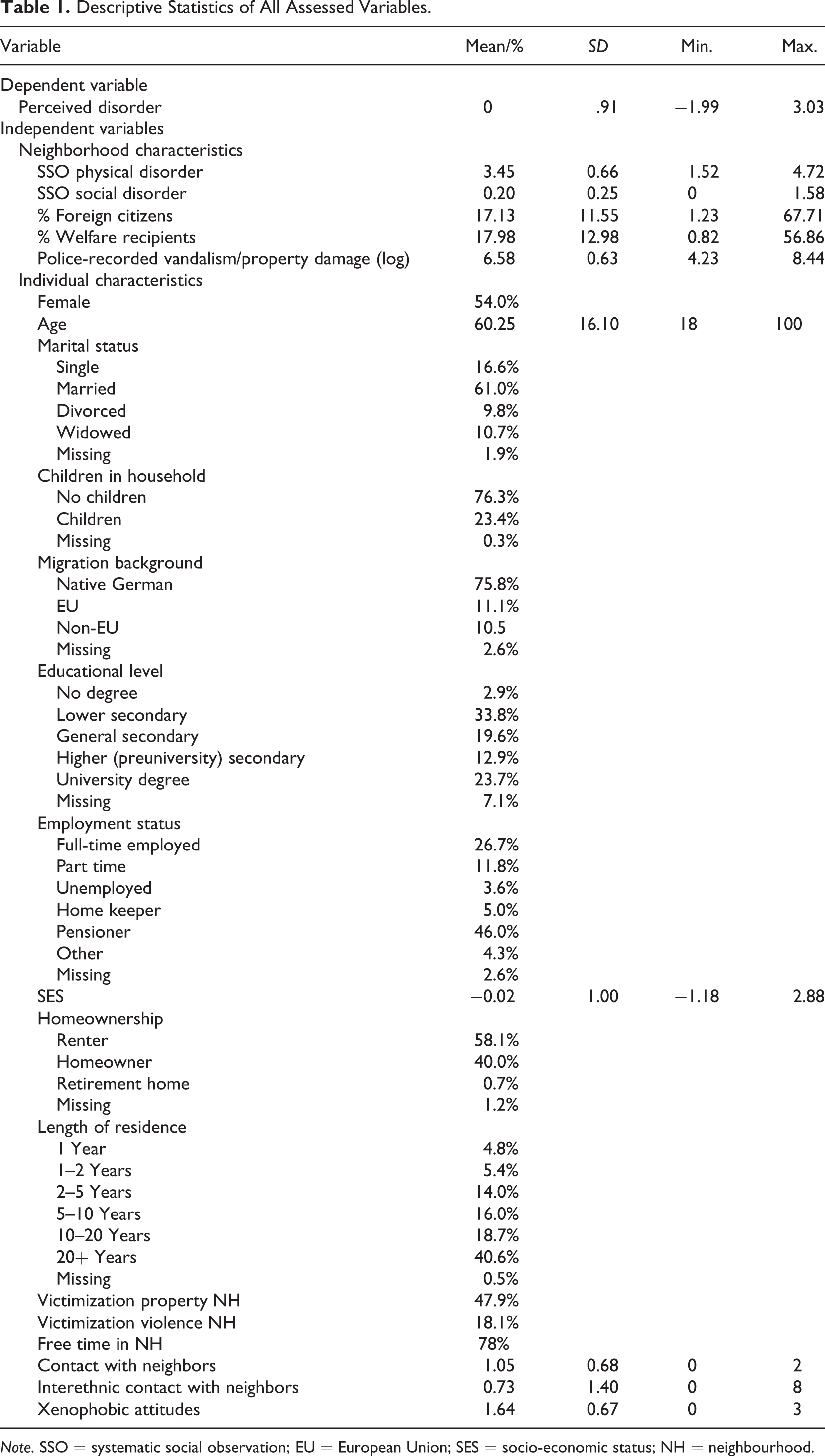
Police data on reported crimes were geocoded and aggregated to population-based rates on the neighborhood level for property damage and vandalism. As for the disorder observations, we used the log-transformed variable. Descriptive statistics of all variables are reported in Table 1.
Descriptive Statistics of All Assessed Variables.
Note. SSO = systematic social observation; EU = European Union; SES = socio-economic status; NH = neighbourhood.
Analytical Approach
Our analytical models were designed to explain the disorder perception bias, that is, the deviation of respondents’ subjective perception of the frequency of incivilities from the independent and systematic observation of the frequency of incivilities on the neighborhood level. In order to examine how strongly the residents’ subjective perception of disorder diverges from the systematic observation of disorder, and whether the resulting perception bias can be explained by the ethnic composition of neighborhoods and its cross-level interaction with individual contact with and attitudes toward migrants, linear multilevel regression analyses with respondent-level perceived disorder as the dependent variable were carried out using Stata Version 14 (mixed command). A series of nested multilevel models was estimated starting with the null model to establish the variance components of perceived disorder.
Our first main multilevel model is
where the outcome
Following a stepwise modeling approach, the neighborhood-level variance component
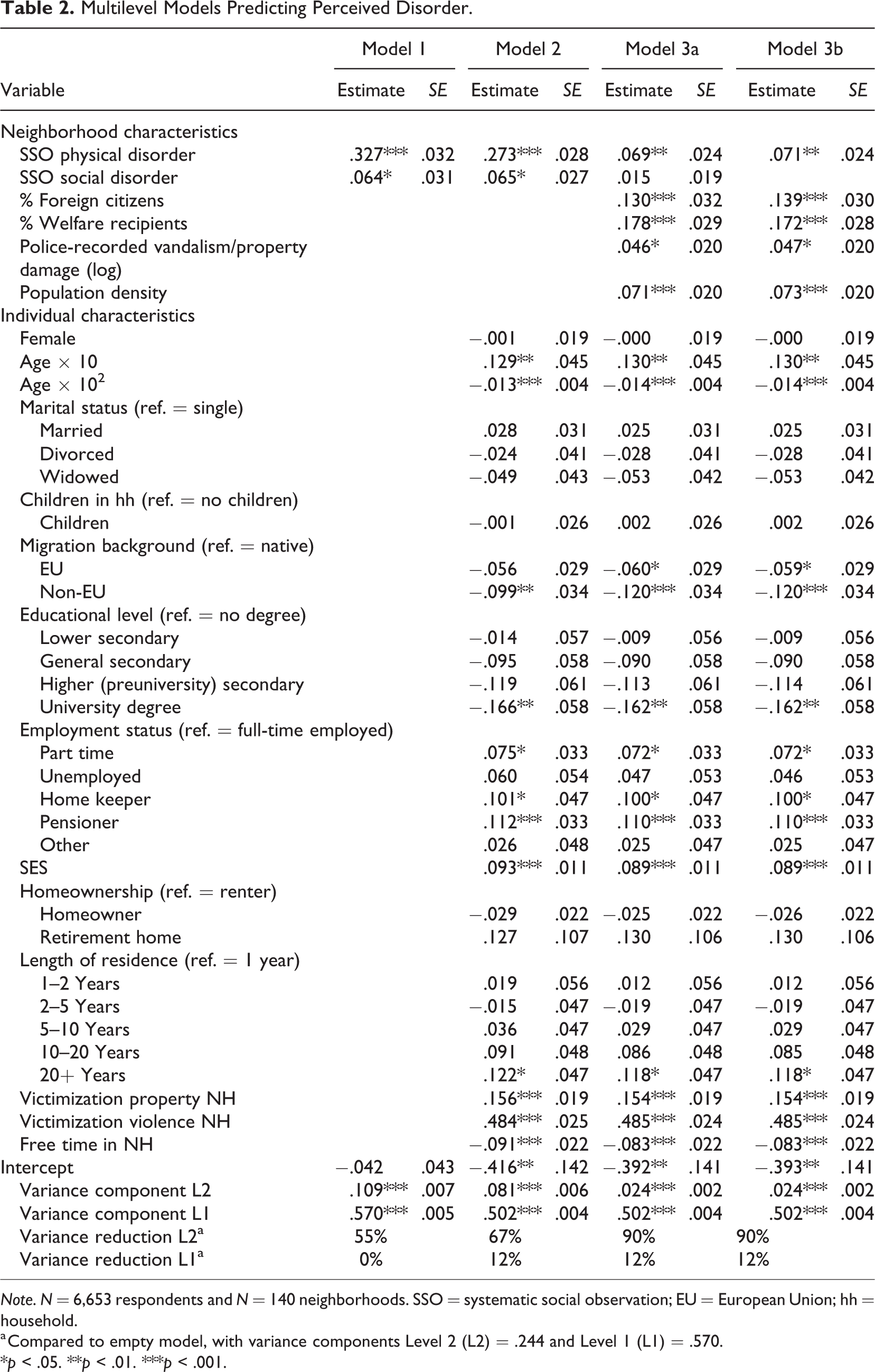
Multilevel Models Predicting Perceived Disorder.
Note. N = 6,653 respondents and N = 140 neighborhoods. SSO = systematic social observation; EU = European Union; hh = household.
a Compared to empty model, with variance components Level 2 (L2) = .244 and Level 1 (L1) = .570.
*p < .05. **p < .01. ***p < .001.
As the focal interest is the potential bias caused by the presence of ethnic minorities, in the next step (Model 3), we add the neighborhood percentage of foreign citizens
The second main multilevel model extents the analysis to cross-level interactions. Looking at the attitudinal dimension, Equation 2

adds the coefficient
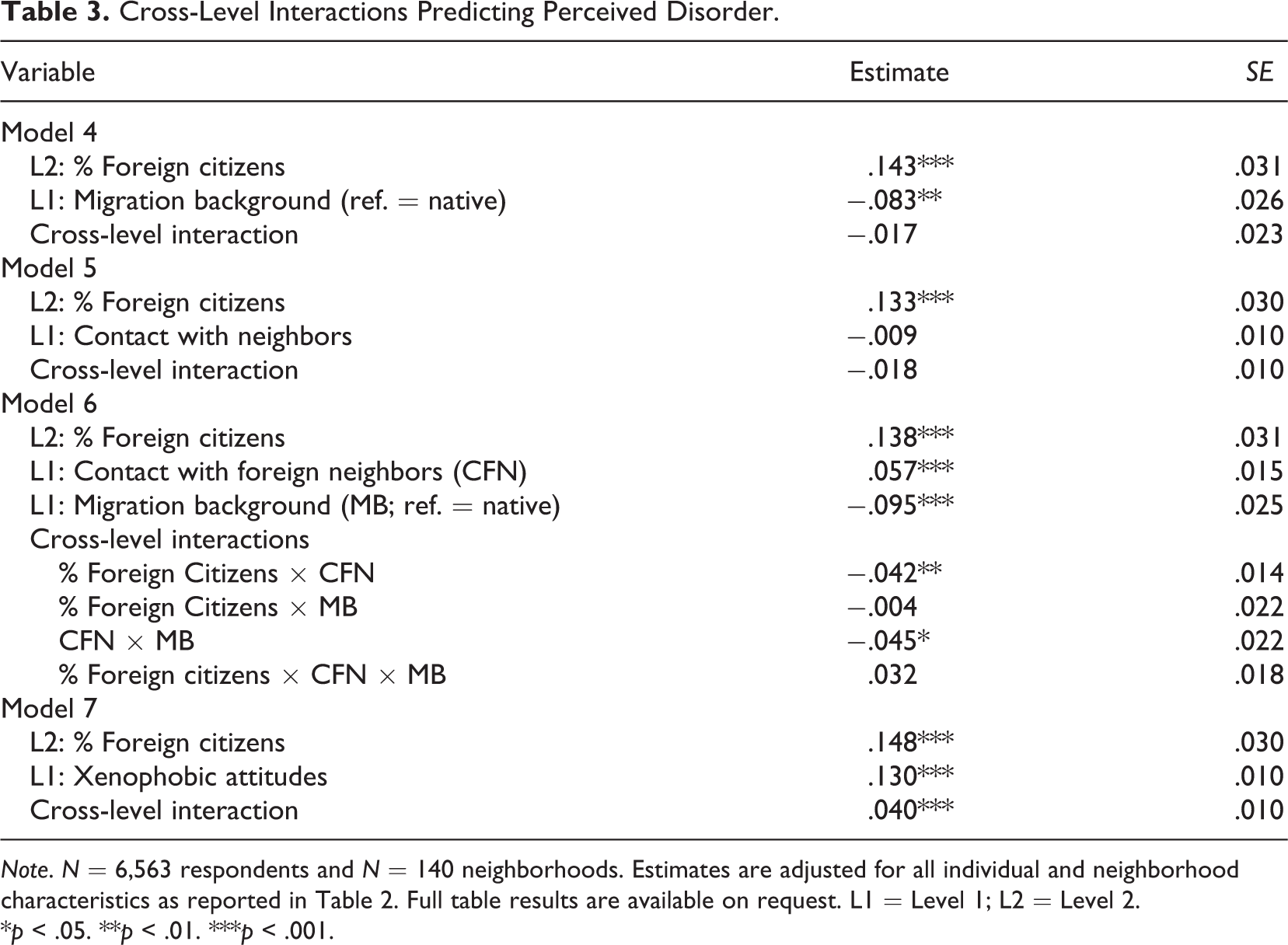
Cross-Level Interactions Predicting Perceived Disorder.
Note. N = 6,563 respondents and N = 140 neighborhoods. Estimates are adjusted for all individual and neighborhood characteristics as reported in Table 2. Full table results are available on request. L1 = Level 1; L2 = Level 2.
*p < .05. **p < .01. ***p < .001.
All other interval-scaled variables were standardized. The multilevel structure consists of n = 6,563 individuals (L1) nested in n = 140 neighborhoods (L2). The number of complete cases in our data is 5,324 (81%), and the percentage of missing values per variable used in our models ranged from 0.35% (children in household) to 7.71% (educational level). There are a number of procedures for dealing with missing data of which multiple imputation is the current gold standard (Rubin, 1987). Multiple imputation was carried out producing 20 random imputations using the chained equations algorithm implemented in Stata by Royston (2011). 5 We did not apply weighting following the recommendations by Winship and Radbill (1994).
Results
Individual- and Neighborhood-Level Predictors of Perceptions of Disorder
As a first descriptive result, the bivariate neighborhood-level correlation between perceived disorder (combined) and observed physical and social disorder is r = .72 and r = .41, respectively. Thus, the association between residents’ perceptions and SSOs is slightly stronger than that reported in previous studies (see above). The variance decomposition in the null model (not in Table 2) indicates that 30% of the variance in disorder perceptions is between neighborhoods. Previous studies have reported ICCs for perceived disorder of 22% (Elo et al., 2009; census tracts) and 34% (Sampson & Raudenbush, 2004; block groups).
Results of the multilevel models are reported in Table 2. Model 1 includes the levels of SSO physical and social disorder. Both significantly predict perceived disorder but observed physical disorder around 5 times more strongly than social disorder. Together, observed physical and social disorder explain 55% of the neighborhood-level variance of perceived disorder. After controlling for levels of observed disorder, the residual variance now defines the potential perception bias of disorder which may be explained by additional predictors on both levels in the following models.
Model 2 additionally includes respondent-level predictors. Significant sociodemographic predictors are age, migration background, educational level, employment status, economic status, and length of residence. The age effect is curvilinear: Up to around age 50, respondents perceive more disorder, but older respondents perceive less and less disorder, probably reflecting their decreasing level of outdoor mobility. Respondents with a migration background from within or outside the EU perceive less disorder than native Germans. Individuals with a higher educational level, higher economic status, and who are full-time employed perceive less neighborhood disorder. A higher social status may increase the individual resilience against perceived threats of disorder in the same was as it protects against fear of crime (Brunton-Smith & Sturgis, 2011). Individuals living in the neighborhood for more than 10 years perceive higher levels of disorder.
These findings on individual effects on perceptions of disorder are all in line with the majority of previous studies (Drakulich, 2013; Elo et al., 2009; Franzini et al., 2008; Häfele, 2013a; Hipp, 2010; Sampson & Raudenbush, 2004; Wallace, 2015). We found no effect of gender, marital status, having children, or homeownership. Property and especially violent victimization in the neighborhood also contribute to higher perceptions of disorder (cf. Drakulich, 2013; Jackson et al., 2018). In fact, violent victimization is by far the strongest of all predictors, suggesting that this experience makes individuals more susceptible to disorder perceptions, but possibly also that victims of violence pursue routine activities that put them more often into situations which both increase violent risks and increase the likelihood to actually observe disorder. Spending free time in the neighborhood, however, is related to perceiving less disorder. Together, these respondent-level predictors reduce the L1 variance by 12% and increase the share of explained neighborhood-level variance from 55% to 67%.
Structural neighborhood characteristics are entered in Model 3. The two indicators of disadvantage—poverty and minority concentration—both clearly outweigh the effect of SSO disorder: The effect of observed physical disorder is now reduced by almost two thirds, and the effect of observed social disorder is no longer significant (and therefore dropped from subsequent models). The effect of the percentage of residents receiving welfare benefits is slightly stronger (B = .178) than the effect of the percentage of foreign citizens (B = .130). In addition, subjective perceptions of disorder are higher in neighborhoods with more police-reported vandalism and higher population density, but both effects are weaker than the dominating effect of concentrated disadvantage. Together, all neighborhood-level variables explain 90% of the between-neighborhood variance in disorder perceptions. For comparison, a model including the structural characteristics but excluding observed disorder would explain 85% (compared to 55% for observed disorder alone) of the between-neighborhood variance in disorder perceptions. This underlines that the social makeup of neighborhoods, and in particular the concentration of poverty and ethnic minorities, explain neighborhood differences in disorder perceptions to a much greater extent than the observed level of disorder does, supporting previous studies (Drakulich, 2013; Sampson & Raudenbush, 2004).
Respondents’ Experiences and Attitudes Conditioning the Neighborhood Impact on the Perception Bias
We are particularly interested in the sources of individual differences in neighborhood perceptions, as they contribute to the understanding of cognitive processes underlying the subjectivity of disorder perceptions. The survey data provide some measures related to interethnic experiences and attitudes which may shed light on the role of implicit ethnic stereotypes.
Table 3 reports the results for the cross-level interactions between the concentration of minorities and respondents’ ethnic background, contact with neighbors, contact with foreign neighbors, and xenophobic attitudes of respondents, respectively (Models 4–6). For reasons of parsimony, respondents with a migration background from either EU or non-EU countries are combined in these models. We adjusted for all individual- and neighborhood-level characteristics as reported in Table 2. Because of space limitations, these coefficients are not repeated in Table 3 (available on request).
Model 4 includes migration background as a moderator of the relationship between minority concentration and perceived disorder. This cross-level interaction is not significant. The degree to which the subjective perception of disorder is influenced by the ethnic composition of the neighborhood does not depend on respondents’ individual ethnicity, contrary to our Hypothesis 2. Respondents with a migration background are biased in the same way as native German respondents, confirming one of the central findings by Sampson and Raudenbush (2004).
Model 5 includes the cross-level interaction between minority concentration and the respondents’ degree of contact with neighbors. We estimated random slopes for the individual-level predictors that were involved in the cross-level interactions (full tables available on request). The results show that the level of contact with neighbors does not predict perceptions of disorder, contrary to our hypothesis (Hypothesis 3), nor does it moderate the effects of neighborhood ethnic composition. Even individuals with high levels of local contacts are susceptible to an implicit bias in perceiving neighborhood disorder.
Model 6 includes a three-way cross-level interaction between contact with foreign neighbors, respondents’ migration status, and neighborhood minority concentration, following the assumption that it is primarily the interethnic contact of the majority population what can reduce ethnic prejudices. 6 As the substantial interpretation of this complex combination of predictors is difficult, we present two model-based interaction plots showing the effects of neighborhood minority concentration on perception bias conditional on contact with foreign neighbors separately for native German and minority respondents (Figure 1). As the positive “main effect” of contact with foreign neighbors on perceptions of disorder (B = .057) together with the negative interaction with respondents’ migration background (B = −.045) indicate, native German but not minority respondents perceive higher levels of disorder in most neighborhoods if they have more contact with minority neighbors, which refutes the contact hypothesis (Hypothesis 4). However, the negative cross-level interaction between neighborhood minority concentration and individual contact with foreign neighbors (B = −.042) indicates that—again only for native German respondents—the neighborhood-level effect of minority concentration on subjective perceptions is weaker for those with more contact with foreign neighbors, in accordance with the contact hypothesis (Hypothesis 4). For minority respondents, the minority concentration in the neighborhood is related to higher levels of perceived disorder regardless of the amount of contact with foreign neighbors. The combination of a strong “main effect” and a weaker contextual gradient means that native German residents with very high level of interethnic contact perceive constantly high levels of disorder across different neighborhoods conditions and hence are less affected by an increasing minority concentration. A test of marginal effects shows that the coefficient of the minority concentration on subjective disorder perception becomes nonsignificant only for circa 5% of respondents with most intensive contact with minority neighbors (computed from a model using native German respondents only).
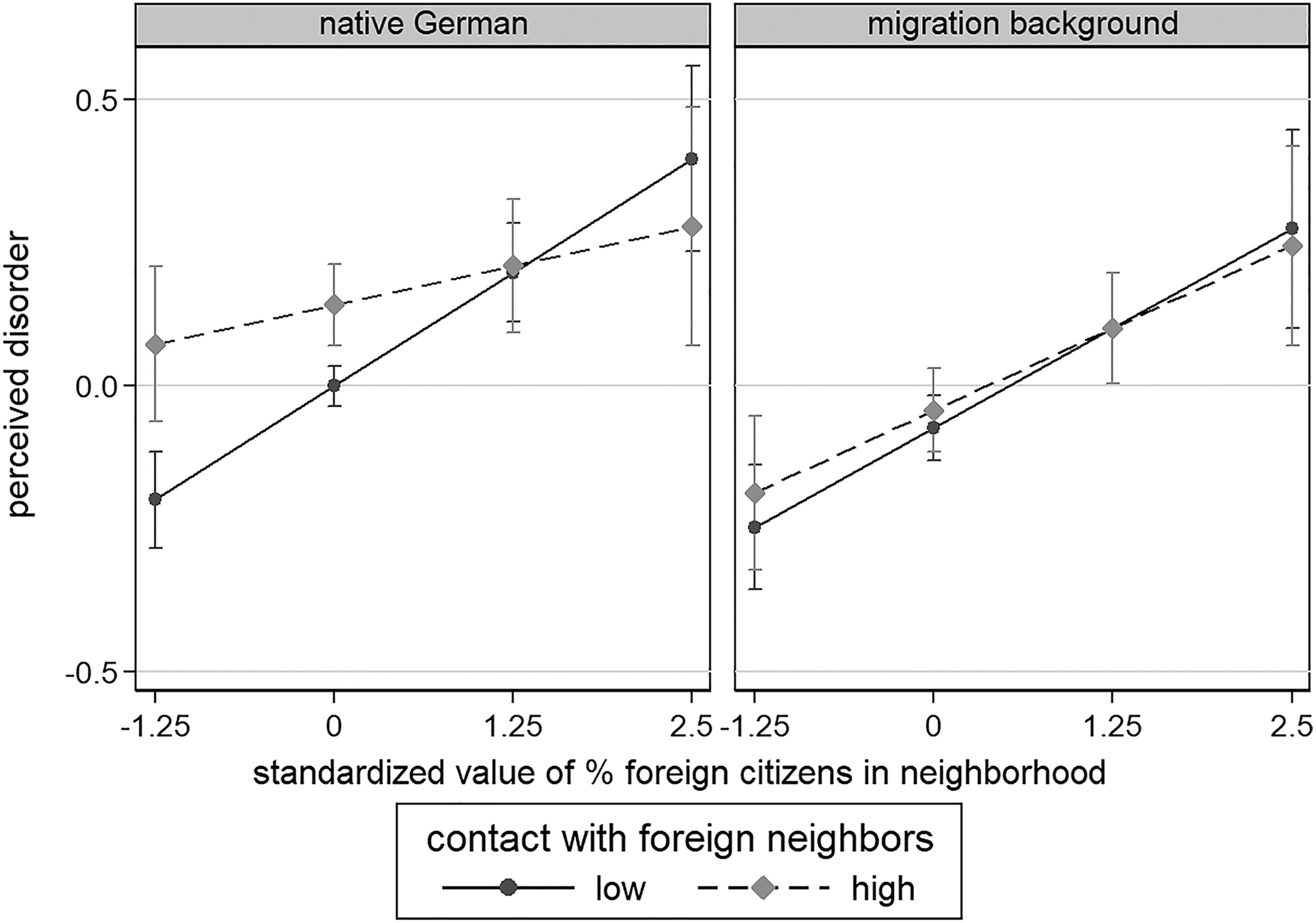
Cross-level interaction between % foreign citizens in neighborhood and contact with foreign neighbors predicting disorder perceptions for individuals with and without an migration background (Model 6).
Finally, the cross-level interaction between minority concentration and xenophobic attitudes is included in Model 7 and illustrated in Figure 2. First, individuals with stronger xenophobic attitudes perceive higher levels of disorder in any kind of neighborhood. What is more, the significant cross-level interaction indicates that the impact of minority concentration on the perception bias is stronger for individuals with more xenophobic attitudes. For respondents holding more favorable opinions about migrants, the neighborhood concentration of minorities has a weaker effect. But only a small fraction of extremely xenophile respondents are completely immune toward the bias, whereas the large majority still shows some signs of bias. These findings confirm our expectation that explicit ethnic prejudices reinforce the implicit bias and strengthen the perception bias (Hypothesis 5). They also confirm our expectation that most individuals without xenophobe tendencies (except 6% of respondents with the lowest scores) will still harbor some implicit stereotypes, which is in line with the social psychology literature on the disconnect between explicit and implicit bias (Aberson, 2010; Dovidio et al., 2002).
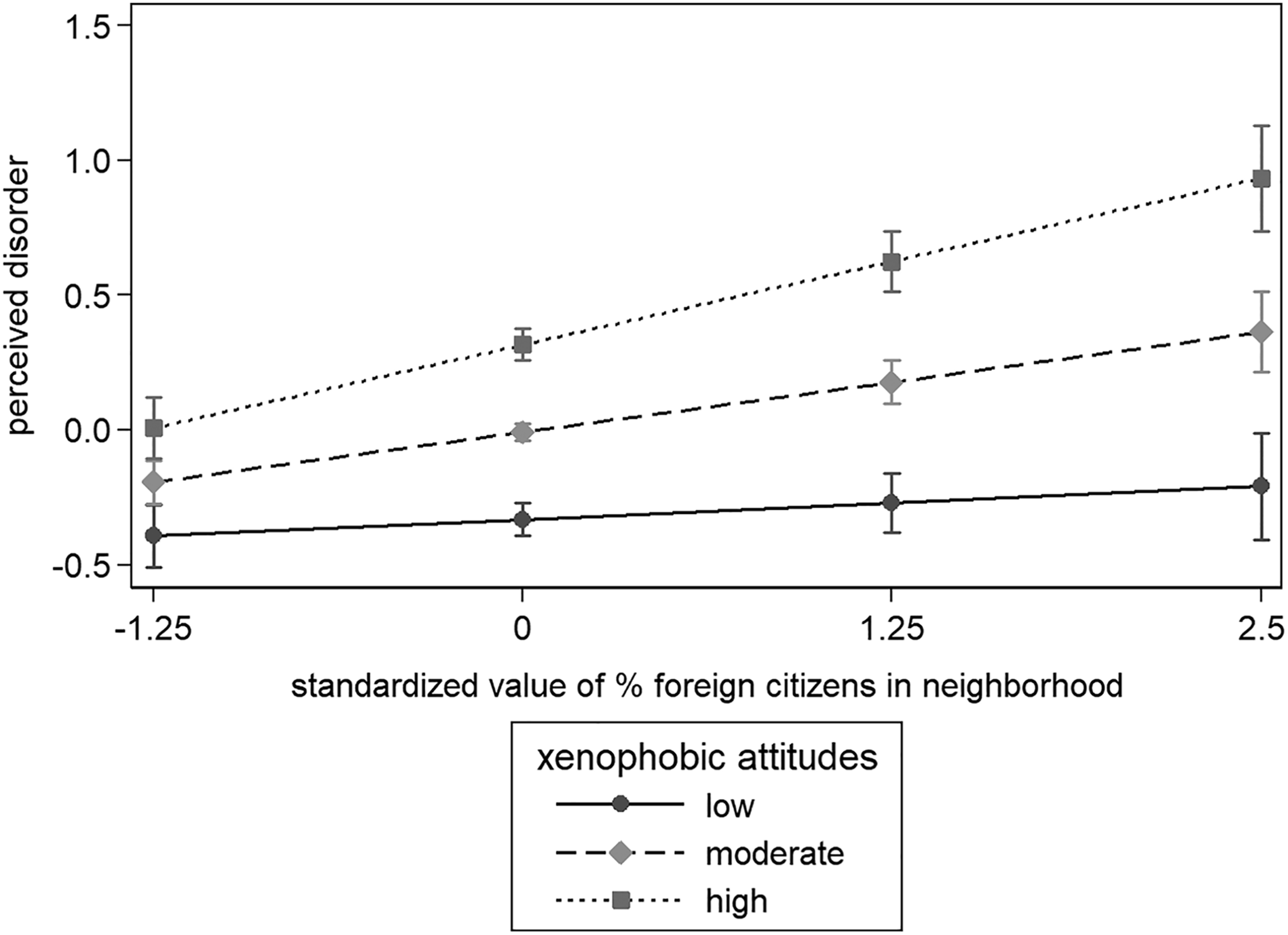
Cross-level interaction between % foreign citizens in neighborhood and xenophobic attitudes predicting disorder perceptions (Model 7).
Additional Analyses
As a robustness check, we also ran models (not shown) using two separate predictors of minority concentration distinguishing citizens from EU and non-EU member states (mainly Near/Central Eastern and African countries), the latter as a proxy for “visible” minorities which may elicit a stronger perception bias compared to foreign citizens from EU countries (cf. Hooghe & De Vroome, 2016). Multicollinearity concerns precluded full models including both minority predictors. Yet models with only the two minority predictors showed that the share of non-EU citizens had much stronger effects than the share of EU citizens, confirming theoretical expectations.
Discussion and Conclusion
Popularized by Broken Windows theory, the concept of disorder has occupied a key role in urban research, especially in relation to well-being, social cohesion, and crime. Perhaps unintentionally, the quest to identify the “actual” contribution of Broken Windows to neighborhood crime and decline with the help of SSO has shifted the research focus not toward “objective” facts but, on the contrary, toward the ambiguity and subjectivity of people’s perceptions, as the wide discrepancies between systematic observations and survey perceptions became apparent (Kubrin, 2008; Sampson, 2009). Perceptions crucially contribute to collective reputations which may be consequential for neighborhood development. The aim of the current study was (1) to examine the extent to which the concentration of disadvantage as manifested in poverty and minority status is related to perceptions of disorder in a European context, while controlling for the observable level of disorder and other relevant neighborhood- and individual-level characteristics and (2) to test whether individual interethnic attitudes and experiences condition the effects of neighborhood ethnic composition on perceptions of disorder, following assumptions about the impact of implicit ethnic biases (Sampson, 2009). Although some studies have begun to examine cross-level interactions (e.g., Wickes et al., 2013), no study has yet explored the moderating role of contact with neighbors, interethnic contact with neighbors, and xenophobic attitudes on the perception bias.
How residents “see” their local neighborhoods is strongly affected by their implicit cognitive biases, and the concentration of poverty and ethnic minorities are the most relevant structural characteristics shaping the collective reputations of neighborhoods (e.g., Elo et al., 2009; Franzini et al., 2008; Sampson & Raudenbush, 2004). The current study has again confirmed this crucial result by comparing survey and SSO data collected in 140 urban neighborhoods in Germany.
Of the structural neighborhood characteristics, social disadvantage and minority concentration had the strongest effect on the subjective perceptions of disorder, stronger than the observable cues of disorder or police recorded vandalism. As one of the few studies conducted outside the United States, this study supports the generalizability of findings on the role of ethnic minority concentration for disorder perceptions which in the United States are dominated by the special situation of African Americans.
These findings underline the existing critique of a naive understanding of Broken Windows theory. The impact of visible signals of disorder on the social cohesion of neighborhoods and on residents’ danger perceptions is likely to be much smaller than the strong correlation with subjective perceptions of disorder have suggested (Hinkle & Yang, 2014; Sampson & Raudenbush, 1999; Welsh et al., 2015). In accordance with previous studies, we found neighborhood sociodemographic composition to be a stronger predictor of subjective disorder perceptions than the “actual” levels of disorder as measured in systematic observation, and extant research has shown that concentrated disadvantage is a major detriment to many aspects of neighborhood social organization (Sampson, 2018). These findings cast doubts on one-sided strategies of urban renewal targeting the physical appearance of urban spaces and social incivilities in isolation from broader social policies addressing concentrated poverty (Bodnar, 2015; Wickes, 2017).
It seems obvious to explain the strong effect of minority presence with an implicit ethnic bias “operating beneath the radar screen” (Sampson, 2009, p. 12) on a subconscious level. This notion is supported by experimental evidence showing that visual cues of minority presence increase perceptions of disorder and danger (Correll et al., 2002; Yang & Pao, 2015). If true, this implicit bias harboring prejudices against ethnic minorities would influence the perceptions even of minority residents themselves, as this study found that minority and native German residents’ perceptions were equally influenced by the ethnic composition of neighborhoods. The previous evidence on this has been mixed (Quillian & Pager, 2001; Sampson & Raudenbush, 2004). However, one should keep in mind that all these remain indirect conclusions as long as no community study has directly measured implicit attitudes. Social psychologists who developed such tests using latency measures found some evidence for minority members’ implicit negative bias against minorities, but again the evidence has been mixed (Correll et al., 2002; Drakulich, 2015; Jost et al., 2004; Kawakami et al., 2017). More research is needed into the complex interplay between individual differences and collective factors in shaping cognitive and social processes of neighborhood perceptions.
Although we used relatively small geographical units, we cannot rule out that individual differences may in part reflect heterogeneity within neighborhoods. The level of disorder might vary from street to street within the same neighborhood (Hipp, 2010).
This study advances the current knowledge by investigating whether interethnic contacts and xenophobic attitudes moderate the strength of the disorder perception bias. Whereas contact with neighbors per se did not moderate the effect between the share of minorities and perception of disorder, interethnic contact was found to have a small decreasing effect. For native German residents, contact with minority neighbors reduced the strength of the association between minority concentration and perception bias. These results are consistent with studies on the role of interethnic friendships in in improving implicit attitudes (Aberson et al., 2004; Karpinski & Hilton, 2001). However, plotting this cross-level interaction, we found that native residents with interethnic contacts perceived more disorder than other residents without such contacts in most neighborhood contexts with low to moderate levels of minority concentration. This unexpected finding may reflect differential exposure to spatial heterogeneities within neighborhoods. Explicit ethnic prejudices moderated the association between minority concentration and subjective disorder perceptions even more strongly. Individuals who voiced xenophobic attitudes also had a stronger perceptions bias. However, most individuals with rather favorable views on migrants still were susceptible to the perception bias, indicating that they, too, were influenced by implicit bias, if to a lesser extent. In conclusion, our findings underline the salience of interethnic experiences and attitudes for residents’ perceptions of their neighborhoods, adding to the existing knowledge about the key role of ethnic diversity and attitudes toward minorities for safety perceptions and social cohesion in urban communities (Brunton-Smith et al., 2014; Hooghe & de Vroome, 2016; van der Meer & Tolsma, 2014).
Footnotes
Appendix
Acknowledgment
We thank Ian Brunton-Smith for his valuable comments on a draft of this article.
Declaration of Conflicting Interests
The authors declared no potential conflicts of interest with respect to the research, authorship, and/or publication of this article.
Funding
The authors disclosed receipt of the following financial support for the research, and/or publication of this article: This research was supported by the German Federal Ministry of Education and Research, Civil Security Research Programme (Grant 13N12980), and by the European Research Council under the European Union’s Seventh Framework Programme (FP/2007-2013)/ERC Grant Agreement no. 615159 (ERC Consolidator Grant DEPRIVEDHOODS, sociospatial inequality, deprived neighborhoods, and neighborhood effects).
