




Abstract
The purpose of this study was to gain a deeper understanding of preservice music educators’ perceptions of elementary general music (EGM), pedagogical competencies, and specialization preference. Preservice music teachers responded to a survey about perceptions of personal experiences with EGM, preparation and comfort related to EGM, and confidence in the ability to teach content and skills common in EGM curricula. Participants (n = 203) also answered questions about their preferred specialization and about factors that would influence their choice of job in the future. Most participants remembered having positive personal experiences with general music in elementary school and believe it is important for future musical success. Confidence in content and skills common in teaching EGM increases as they progress through their degree program. Most identify ensemble teaching and middle and high school grades as their future aspirations. Significant predictors of future career choice included undergraduate major and comfort teaching.
Keywords
Individuals often enter music education programs with expectations of their future career in a specific content area. Most music education students aspire to teach secondary ensembles, perhaps as a result of the impacts of high school musical experiences (Bergee et al., 2001; Rickels et al., 2013). Preservice music teachers continue to show higher levels of interest in ensemble and secondary teaching as they continue in their programs (Campbell & Thompson, 2007; Reese, 2019; Rickels et al., 2013), especially among males (Reese, 2019; Rickels et al., 2013; Roulston & Misawa, 2011).
It is not uncommon for individuals to later find themselves teaching in specializations other than what they intended during their music teacher preparation. Groulx (2016) reported nearly 83% of the 601 music educators surveyed taught outside their specialization at some point. The most common out-of-specialization assignment (reported by 72% of participants) was ensemble directors who had taught elementary general music (EGM) at some point. Incidents of instrumental ensemble directors teaching in EGM contexts have been documented by numerous researchers (e.g., Corfield-Adams, 2012; Kuebel, 2017a, 2017b, 2019; Robinson, 2010; Shouldice, 2013, 2017). Individuals may choose to teach in EGM settings due to geographic restrictions (Kuebel, 2019), influence of professors (Draves, 2021), personality fit (Draves, 2021; Robinson, 2010), a growing need for EGM teachers (National Center for Education Statistics, 2019), or broad certification in most states (May et al., 2017).
Although broad certification is common and music educators are often certified to teach in multiple content areas (e.g., band, choir, orchestra, general music), researchers have identified that individuals may not feel prepared to teach outside of their primary specialization after graduation (Conway, 2002; Greher & Tobin, 2006). This seems especially true in regard to EGM settings (Groulx, 2016; Kuebel, 2017b, 2019). As a result, individuals who end up teaching outside of their original specialization must learn “on the job” or through additional professional development (Corfield-Adams, 2012; Kuebel, 2017a, 2019).
“Tracked” music education programs in which teacher candidates gain most experiences in their main area of concentration, likely instrumental or choral instruction, may contribute to challenges with preparation and reinforce specialization identity. Broad undergraduate experiences have been suggested to increase preparation for and comfort to teach in all contexts (Conway, 2002, 2012, 2022; Greher & Tobin, 2006; Groulx, 2016; Kuebel, 2017a, 2017b) and are recommended by teacher accreditation organizations such as the National Association of Schools of Music (2022). Despite these suggestions, challenges for music teacher preparation persist and may be related to experiences that precede formal teacher preparation.
Music teacher identity development and preparation is a lifelong process (e.g., Chua & Welch, 2021; Pitts, 2012; Townshend, 2022) impacted by a wide variety of experiences beginning in childhood and continuing through secondary school, college, and into professional practice. Music educators’ retrospective accounts indicate clear connections between childhood music experiences (formal and informal) and choices for involvement in adulthood (Chua & Welch, 2021; Pitts, 2012). High school students auditioning for music education programs at various universities suggested that childhood and middle school experiences were influential, but high school experiences and teachers provided the strongest influence on career choices and professional socialization (Rickels et al., 2013). They also demonstrated a preference for ensemble teaching even before entering their degree program.
Although precollegiate experiences are influential, a variety of collegiate experiences impact preservice teachers’ specialization preference, perceptions, and preparation to teach. Hamann and Ebie (2009) found the majority of preservice music teachers (sophomore through senior college students) they surveyed identified instrumental or vocal as their area of expertise and only 16% identified their expertise as elementary or general music. Although concerns about teaching outside their specialization in the future were common, the majority were confident that methods classes would provide adequate preparation. Similarly, Reese (2019) surveyed preservice music teachers regarding their preparation for teaching EGM. Overall, the participants reported a preference for ensemble and secondary teaching over EGM; choral majors and females were more likely to indicate interest in EGM than instrumental majors and males. Findings also suggested that participants perceived their EGM methods coursework and authentic-context field experiences as adequate preparation for future experiences.
Authentic-context learning experiences including observations, fieldwork, and student teaching support the development of teacher identity and career intentions (Austin et al., 2012; Ballantyne et al., 2012; Draves, 2021; Georgii-Hemming & Westvall, 2010; Haston & Russell, 2012). In addition to preparation, general music classes and authentic-context field experiences in EGM settings have the potential to influence preservice teachers’ perceptions. In two separate studies, Shouldice (2013, 2017) found that some preservice music teachers have negative perceptions of EGM teaching and contexts. However, these studies also suggest that EGM methods courses and related authentic-context field experiences can be transformative experiences in regard to preservice teachers’ negative beliefs about EGM, misconceptions about elementary students and general music teaching, and specialization identity. Similarly, Miranda et al. (2007) found that field experiences in EGM settings provided preservice teachers with opportunities to confront misconceptions and negative biases about EGM that they developed as elementary-age learners. By comparing memories of their prior experiences to their current field experiences, the preservice teachers developed a positive perspective of EGM and began to consider it as a potential future career.
Although certification is inclusive of multiple specializations and age levels, teacher educators continue to struggle to improve preservice teachers’ preparation for general music education. With key components of preparation in place and still a lack of readiness, future research is necessary to untangle this challenging knot (Valerio et al., 2012). Preservice music teachers suggest they are confident in their preparation to teach in EGM contexts; however, inservice teachers’ reports suggest these perceptions change once they begin teaching EGM. As the qualitative research in this area is not generalizable and previous studies are limited or conflicting, more research is necessary to develop a broader understanding of preservice music teachers’ perceptions of and preparation for teaching EGM.
Therefore, the purpose of this study was to gain a deeper understanding of preservice music educators’ perceptions of EGM, pedagogical competencies for teaching general music, and specialization preference. The research questions were as follows:
What are preservice music educators’ perceptions of their personal experiences with EGM, beliefs about EGM, and perceptions of their confidence in, comfort in, and preparation for teaching EGM?
What is the preferred teaching specialization (general music or ensemble)?
What variables predict a preservice music educators’ choice of teaching specialization (general or ensemble)?
What factors influence preservice teachers’ considerations of postgraduation job choices that include EGM?
Method
Survey
The researchers modified a survey used in a previous study of preservice music teachers’ perceptions (Reese, 2019). To verify the content validity of the survey, the researchers shared the survey with three content matter experts. Beyond grammatical revisions, comments provided by experts resulted in an adjustment of wording in the confidence Likert-type scale from “great confidence” to “very confident.” Reese (2019) did not provide reliability data for the survey. Therefore, preservice music educators at Researcher 1’s university completed the survey twice: each instance 1 week apart. The researchers used SPSS to analyze the data from the 17 people who completed the survey both times. The survey was determined to be generally reliable using test–retest reliability (r = 0.60–1.00). Four items that rated below r = 0.60 were removed from the survey based on guidelines for practical and clinical significance (Cicchetti, 1994; Miksza & Elpus, 2018). After removing those four items, Likert-type items for the final survey yielded high internal consistency with a Cronbach’s alpha of 0.94.
The first section of the final survey consisted of eight demographic items including year (e.g., freshman), gender, major, primary instrument, methods courses completed, estimated hours of field teaching completed, type of university (e.g., public or private), and name of university [to determine representation across National Association for Music Education (NAfME) regions]. The second section of the final survey included 27 5-point Likert-type items informed by previous literature (Kuebel, 2017b, 2019; Miranda et al., 2007; Robinson, 2010; Shouldice, 2017) that were either confidence statements that ranged from not confident yet to very confident or agreement statements that ranged from strongly disagree to strongly agree. The questionnaire included: (a) five agreement questions regarding the perception of childhood experiences with EGM, (b) three agreement questions regarding beliefs about EGM, (c) three agreement questions about preparation and comfort related to EGM, and (d) 19 questions regarding perceptions of confidence in ability to teach content and skills common in EGM curricula (based on Frego & Abril, 2003). In addition, participants who chose general music as their preferred specialization and participants who chose ensemble as their preferred specialization but indicated they would accept a job that included EGM responded to items about factors that would influence their choice to accept a job with EGM. These questions were informed by previous research reporting beliefs regarding musicianship requirements for EGM teachers (Shouldice, 2013, 2017), personality fit for EGM positions (Draves, 2021; Kuebel, 2017b; Robinson, 2010), work/life balance (Robinson, 2010; Shouldice, 2017), and opportunities for variety in EGM contexts (Shouldice, 2017). Finally, participants who chose general music as their preferred specialization also answered an open-ended question regarding experiences and people who influenced their motivation to choose general music.
Procedure
The researchers utilized purposive sampling and their personal contacts to assemble a list of 90 universities, ensuring that all six NAfME regions were represented. After the study was approved by Author 1’s Institutional Review Board (IRB) in Fall 2021, the researchers emailed music education professors from the 90 universities to ask them to share the survey with music education students at their universities. Students from 25 universities responded resulting in a 28% institution response rate. Two hundred and three students completed the survey. Representation according to year (e.g., freshman, sophomore, junior, and senior) and major (e.g., choral/vocal and instrumental music education) was similar to previous studies of university students (e.g., Rickles et al., 2013).
Analyses
Data were analyzed using descriptive and inferential statistical analyses. For the first and second research questions, descriptive statistics were used to explore preservice music teachers’ perceptions of their personal experiences in EGM, beliefs about EGM, their preferred specialization, and perceptions of their confidence in, comfort in, and preparation for teaching EGM. For the third research question, binary logistic regression was used to measure which variables predicted a music education major’s choice of teaching specialization (e.g., general or ensemble) for the given sample. Finally, descriptive statistics were used to explore factors that influence preservice music teachers to accept a job that includes EGM. See Appendix A in the Online Supplemental Material for demographic details of the participants.
Results
Personal Experiences, Beliefs, and Perceptions
The first research question was used to investigate preservice music teachers’ perceptions of their personal EGM experiences, beliefs about EGM, and perceptions of their confidence in, and preparation for and comfort teaching EGM. The majority of participants (96%) reported having general music in elementary school and the majority of them reported that they remembered their experiences. However, when asked if they recalled a strong general music program during elementary school, more than a third were undecided or disagreed. Despite that perception, the majority reported that they enjoyed their music classes and that they had positive experiences in general music in elementary school. See Table 1 for the mean and standard deviation for perception of personal EGM experience items for all participants and also according to year.
Mean and Standard Deviation for Individual Confidence and Perception of Personal EGM Experiences Items for All Participants and According to Rank.
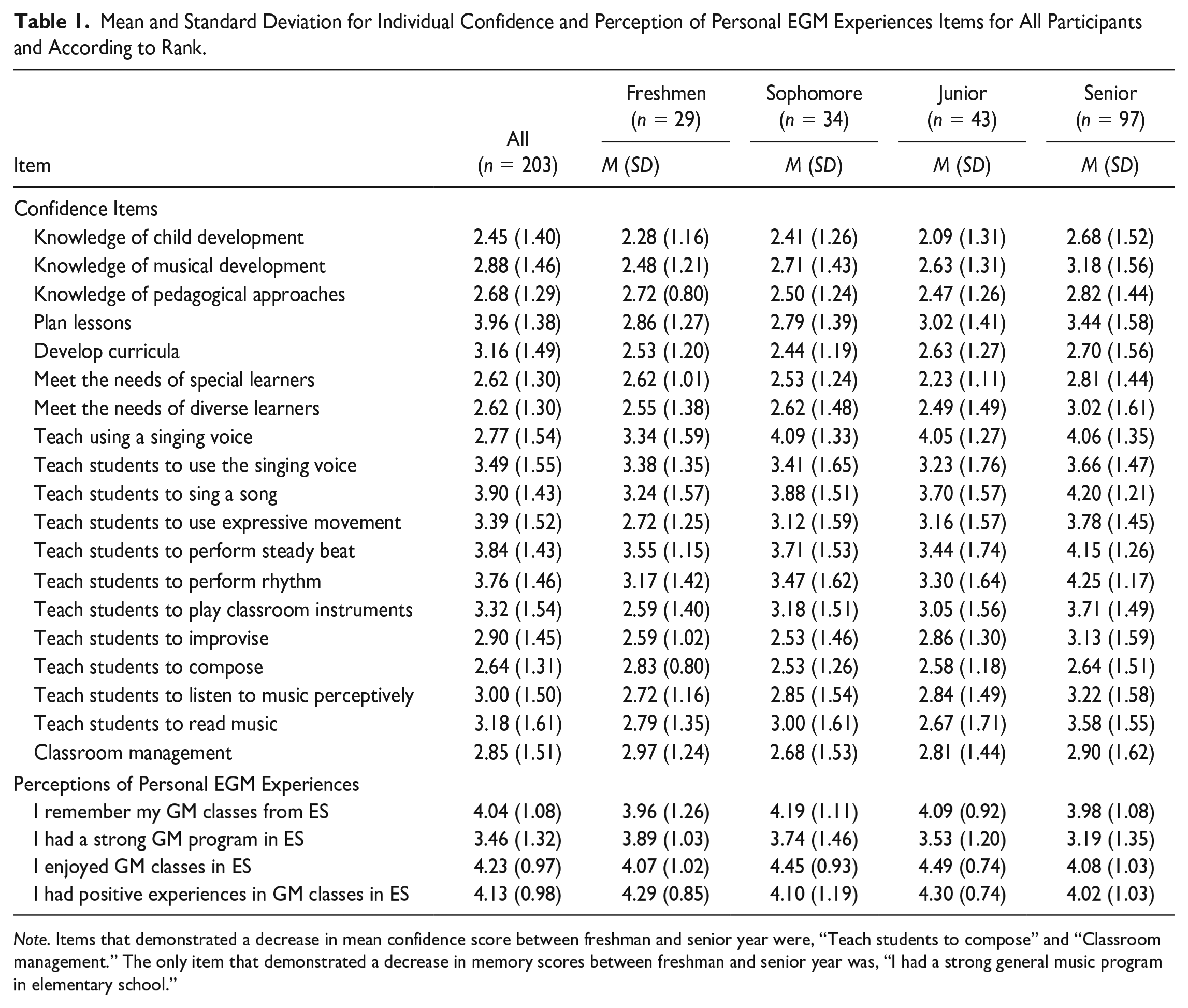
Note. Items that demonstrated a decrease in mean confidence score between freshman and senior year were, “Teach students to compose” and “Classroom management.” The only item that demonstrated a decrease in memory scores between freshman and senior year was, “I had a strong general music program in elementary school.”
Participants were asked about their beliefs regarding EGM. Most participants (99%) agreed or strongly agreed that general music was an important part of the elementary curriculum. The majority agreed that, without EGM, students might struggle to be successful in future ensembles and with lifelong musical pursuits; almost 20% were unsure or disagreed with the idea that students would struggle in the future without EGM.
Finally, participants responded to 19 items regarding their confidence in their understanding of, or ability to teach a variety of content and skills at the EGM level. The four highest ranking items across all participants were (a) planning lessons, (b) teaching students to sing a song, (c) teaching students to perform a steady beat, and (d) teaching students to perform rhythm. The four lowest ranking items across all participants were (a) general knowledge of child development, (b) meeting the needs of special learners, (c) meeting the needs of learners with various learning styles/needs and culturally diverse backgrounds, and (d) general knowledge of musical development. Mean confidence scores fluctuated between years, but the majority of confidence scores increased between freshman and senior year. However, due to sample-size limitations, differences according to year could not be investigated. See Table 1 for the mean and standard deviation for individual confidence items for all participants and also according to year. Only 25% of participants reported they believe EGM is relatively easy to teach, 65% reported they do not believe EGM is easy to teach, and 10% were unsure. The majority of participants (83%) agreed that they are comfortable interacting with elementary-age students. Many (71%) agreed that they would feel comfortable teaching in EGM settings. When considering their preparation for teaching EGM, 63% believed their courses had prepared them, 23% were unsure, and 14% did not believe their courses prepared them to teach EGM. See Appendix B in the Online Supplemental Material for frequency, percentage, and mean and standard deviation for belief items regarding difficulty, preparation, and comfort.
Preferred Specialization
The second research question was utilized to explore preservice music educators’ teaching specialization preference. Of the 200 participants who responded to two questions about preferred specialization (three participants did not answer the question), 73.5% identified ensemble as their preferred specialization and 26.5% identified general music. Participants were also asked to select their preferred grade level and specialization. High school level was selected by 59%, middle school by 21.5%, and elementary by 19.5%.
Factors Predicting Specialization
The third research question was used to examine the variables that predict a preservice music educators’ choice of teaching specialization (n = 37 general, n = 158 ensemble) using binary logistic regression. Participants who did not finish the questionnaire (N = 8) were excluded from the regression. In our analysis (N = 195), the researchers initially utilized a backward stepwise method with a likelihood ratio because the survey results yielded one categorical predictor variable and 13 continuous predictor variables for which the following assumptions were found tenable and validated for such use: independence of observations, a minimum of 15 cases per independent variable, linearity, multicollinearity, and attention to outliers. Thirteen categorical variables, including year, gender, and primary instrument, were excluded where there were fewer than 15 cases per cell (Laerd Statistics, 2017). The 14 tenable predictor variables were theoretically driven and had explanatory benefits. In addition, enabling SPSS to choose variables statistically based on model fit enabled parsimony more than a hierarchical approach for this particular dataset (Agresti & Finlay, 1986; Field, 2013; Menard, 1995). Therefore, the final analysis utilized a hierarchical stepwise, likelihood ratio method where the researchers could examine the strongest predictors (based on the backward stepwise method) more closely.
Overall, the final model predicted future career preference 83.2% of the time, χ2(7) = 71.28, p < .001, which was a statistically significant increase from the original model where the constant predicted future career preference 75.9% of the time. In addition, the final model explained 46.6% of the variance in future career selection (Nagelkerke R2). Although the researchers found a highly significant model, it is still problematic for predicting general music preference. More specifically, the model correctly classified students wanting to focus on teaching in ensemble contexts in the future 90.3% of the time and correctly classified students wanting to teach general music in the future 60.9% of the time. Therefore, the model is more accurate at predicting that a student would prefer to lead an ensemble than to teach general music.
There were two variables that were significant in predicting undergraduates’ future career goals: major (b = −1.19, p = .01) and if they were comfortable teaching EGM (b = 1.52, p < .001). The nonsignificant variables were: completed elementary/secondary ensemble methods, total confidence, believe EGM is easy, believe prepared to teach EGM, and comfortable interacting. Refer to Appendix C in the Online Supplemental Material for a summary of model coefficients.
Several statements may be made regarding odds ratios of the predictor variables: (a) the odds of someone choosing general music as a career are only 0.3 times greater if they are a choral/general music education major as an undergraduate (p = .01, 95% CI [0.12, 0.75]); (b) the odds of someone choosing general music as a career are 1.68 times greater if they are comfortable interacting with elementary-age students (PreK–fifth grade) (p = .24, 95% CI [0.71, 4]); and most notably, (c) the odds of someone choosing elementary general as a career are 4.56 times greater if they are comfortable teaching in EGM contexts (p < .001, 95% CI [1.98, 10.49]). Comfort teaching in EGM contexts was the most reliable variable, having a genuine, positive relationship with future career choice (as indicated by the CIs).
Factors Influencing EGM Job Choice
The fourth research question explored elements that influenced preservice music educators’ choice to accept an EGM job. Participants who selected EGM as their specific preferred specialization responded to questions about the following elements: variety of responsibilities, work/life balance, challenge for musicianship, prediction of success, and personality fit. Of those elements, variety of responsibilities and personality fit demonstrated the strongest agreement as influences on the decision to choose an EGM job (92% chose to agree or strongly agree for both elements). Prediction of success and work/life balance followed (73% and 72%, respectively, chose “agree” or “strongly agree”). Participants’ perceptions of musicianship challenges seemed mixed.
Responses to an open-ended question regarding experiences and people that influenced their motivation to teach EGM varied: general interest in EGM, private lesson instructors and advisors, EGM methods professors, experiences with children, personal EGM experiences and music teacher in elementary school, fieldwork in EGM settings, cooperating teachers during practicum and student teaching, family, and professional workshops and conferences.
Participants who did not choose EGM as their specific preferred specialization were asked to choose between four scenarios: (a) I would accept a job with only EGM, (b) I would accept a job with some EGM, (c) I would not accept a job with EGM, and (d) undecided. Although 15% were undecided, half responded they would not accept a job that included EGM; however, 15% responded they would accept a job with some EGM, and 20% said they would accept a job that was only EGM. They were also asked about the contribution of the following elements to their decision: economic factors, location of the job, prediction of success, and personality fit. Of those elements, economy demonstrated the strongest agreement as an influence on the decision to choose an EGM job (89% choose to agree or strongly agree), followed by location (76% choose to agree or strongly agree).
Discussion and Implications for Future Research
The purpose of this study was to gain a deeper understanding of preservice music educators’ perceptions of general music. The research questions guiding this study sought to explore preservice music educators’ perceptions of their personal EGM experiences, beliefs about EGM, and perceptions of their confidence in, comfort in, and preparation for teaching EGM. They also explored the ways in which these variables predict their preferred teaching specialization and what factors ultimately contribute to their decision to accept a position that includes EGM, regardless of preferred specialization.
Perceptions, Beliefs, and Perceptions
Although Shouldice (2017) suggested that inservice teachers either had no schema (due to a lack of memory of personal experiences) or a negative schema of EGM, the preservice teachers in this study did not report that same perception. The majority of preservice teachers in this study reported that they remembered general music classes in elementary school and recalled enjoying their music experiences. Differences in findings about memories and perceptions of and personal experiences with EGM may be related to the gender of participants: Shouldice (2013, 2017) included only male participants and the current study included both male, female, and nonbinary participants. Although the current study was unable to investigate differences based on gender, Reese (2019) found differences in preservice teachers’ perceptions of personal EGM experiences based on gender. In addition, Roulston and Misawa (2011) found that gender stereotypes influenced music teachers’ practices in their classrooms and that males were less likely to specialize in EGM based on gender roles in society. Therefore, future researchers should continue to examine the impact of gender on specialization choice as well as gender-based differences in music teachers’ personal EGM experiences. If music teacher identity development is a lifelong process, gender-stereotyped practices and perceptions encountered in elementary music classes may limit students’ music experiences as well as their future career possibilities.
Despite remembering positive experiences in EGM, preservice teachers in this study did not perceive the quality of their EGM program as strong. Other researchers have cited mixed perceptions of the quality of personal experiences in EGM classes (Shouldice, 2013, 2017; Reese, 2019). If perceptions and memories of personal experiences influence perceptions of and beliefs about EGM, as suggested by Miranda et al. (2007) and Shouldice (2013, 2017), future researchers might consider exploring preservice music teachers’ perceptions and memories of their personal EGM experiences. Further research might contribute to understanding what elements of preservice music teachers’ personal elementary music experiences are salient and memorable and what qualities contribute to their beliefs about and definitions of “strong elementary general music programs.”
Contrary to the findings of Shouldice (2013, 2017), the majority of preservice teachers in this study believed that general music was an important part of students’ elementary curriculum. Previous researchers suggest that preservice teachers’ perceptions might change over time (Reese, 2019) and that positive experiences in EGM methods courses (that include authentic-context field experiences) help preservice teachers build positive perceptions of and change the misconception about EGM (Miranda et al., 2007; Shouldice, 2013, 2017). Due to sample-size limitations, the current study was not able to investigate differences in beliefs based on year or on completion of EGM methods courses or experience in authentic-context field experiences. Therefore, future researchers should continue investigating changes in preservice teachers’ beliefs over time as well as the impact of various experiences on preservice teachers’ beliefs about EGM.
Previous studies suggested that inservice teachers feel unprepared to teach outside of their preferred specialization—especially when asked to teach in EGM settings (e.g., Conway, 2022; Groulx, 2016; Kuebel, 2017b, 2019). However, the preservice teachers in this study reported that they felt prepared by their coursework to teach in EGM contexts—further supporting similar claims by Reese (2019) and Hamann and Ebie (2009). This suggests that preservice teachers experience a change in perspective regarding their preparation once they become inservice teachers who are teaching in EGM settings. Preservice teachers may not recognize the limits of their preparation until they are in their own EGM classroom.
Preferred Specialization
Consistent with prior research (e.g., Campbell & Thompson, 2007; Reese, 2019; Rickels et al., 2013; Roulston & Misawa, 2011), the majority of participants in the present study showed higher levels of interest in teaching at the secondary level and in ensemble contexts. In addition, the current study determined that major and comfort teaching in EGM contexts were the factors that most strongly predicted the choice of general music as a specialization. The impact of major is similar to the findings of Reese (2019) and Rickels et al. (2013) who found choral majors more likely to select general music (and elementary) as a specialization. The impact of preservice teachers’ comfort in teaching EGM is unique to this study.
Although comfort teaching EGM was a strong predictor of specialization choice, total confidence was not a significant predictor. It is important to note that the constructs of comfort and confidence were not defined as part of the survey, so participants were using their own definitions when responding. However, results seem to suggest that participants do not define them similarly. So while preservice teachers may feel confident teaching EGM, their comfort teaching EGM (or lack thereof) may ultimately lead them to choose another specialization for their teaching. Confidence in one’s knowledge of and ability to teach EGM is different from comfort in teaching young children—and that difference seems to impact one’s future career choices meaningfully. Therefore, future researchers need to closely examine the differences in confidence and comfort and consider how they contribute to feelings about preparation. In addition, researchers should further explore preservice teachers’ comfort in interacting with young children and investigate the experiences that contribute to that comfort.
Past researchers suggest that year, gender, and methods classes completed may influence specialization preference (e.g., Reese, 2019; Rickels et al., 2013; Roulston & Misawa, 2011); however, sample-size limitations prevented the researchers for the current study from investigating those variables. Certain variables (e.g., year, gender, and methods classes completed) were excluded due to a lack of minimum cases per cell. Data for this study were collected via an internet-based survey during Fall of 2021. Although the institution response rate was 29% from a variety of institutions across the United States, music teacher educators and preservice music teachers may have been negatively impacted by COVID-related online and survey fatigue (e.g., Bonanomi et al., 2021; de Koning et al., 2021). This study should be replicated with the goal of collecting data from an increased number of participants. Past research suggests that gender may have an impact on specialization choice; however, the voices of transgender, nonbinary, and gender-fluid teachers are missing from the discussion of specialization preference and must be included in future research. Although unclear from this study, past studies suggest that experiences during EGM methods classes and authentic-context field experiences are influential when preservice teachers consider specialization (Conway, 2002; Miranda et al., 2007; Reese, 2019; Shouldice, 2013, 2017; Valerio et al., 2012). Unfortunately, the structure and content of general music methods classes vary widely among universities. These differences make it difficult to determine, in the context of the current study, whether or not preservice teachers have completed specific coursework and field experiences focused on EGM and difficult to determine the impact of those experiences. Because of these systemic inconsistencies, future researchers need to examine differences in how EGM is included in teacher preparation programs and how these differences impact preservice teachers’ perceptions, beliefs, preparation, and identity development.
Factors Influencing EGM Job Choice
Whether a preservice music teacher’s preferred specialization is EGM, the decision to accept a job that includes EGM in part or whole is nuanced. The present study seems to be the first to examine preservice teachers’ decision to accept a job that is not in their preferred specialization, and 50% of participants who preferred the ensemble specialization reported they would not accept a job that included EGM. However, Groulx (2016) reported that the majority of ensemble teachers have taught EGM and numerous studies describe instrumental teachers who have had jobs that include some amount of EGM (e.g., Corfield-Adams, 2012; Kuebel, 2017a, 2017b, 2019; Robinson, 2010; Shouldice, 2013, 2017). As in previous studies, practical matters like economic and geographic factors seemed to exert the strongest motivation when these preservice teachers considered accepting a job that includes EGM in the future (Corfield-Adams, 2012; Kuebel, 2019). Future researchers should consider following the career trajectory of the 50% of preservice teachers whose preferred specialization is ensemble and who are adamant they would not accept a job that included any EGM. Do they end up finding their dream jobs, do they choose jobs outside of the traditional PK to 12 pathway, do they pursue jobs in higher education or outside of education?
With the influence of secondary ensemble directors and experiences on the career aspirations of students choosing music education majors, it may be important to consider how individuals come to perceive themselves as EGM educators. Future researchers might consider investigating what factors influence preservice music teachers whose initial preferred specialization is general music and more specifically EGM. Furthermore, researchers like Shouldice (2013, 2017) and Kuebel (2017a, 2017b, 2019, 2021) have shared the experiences of instrumentalists who have found success teaching outside of their initially preferred specialization. Researchers might also consider investigating the career trajectory of teachers who initially find themselves teaching outside of their preferred specialization and who do not find success.
The present study found that personality fit and the variety of responsibilities inherent in teaching EGM contribute strongly to the motivation of preservice teachers who would prefer an EGM teaching job. These findings are similar to Reese (2019) and Kuebel (2019) who found that personality fit was important to career choice, or “goodness of fit” as Robinson (2010) described. However, more research is necessary to understand how preservice and inservice teachers define “goodness of fit,” what elements of EGM seem like a “good fit,” and for whom are they a good fit.
In open-ended responses, preservice teachers who chose EMG as their preferred specialization suggested a wide variety of personal experiences influence motivation to choose EGM. Consistent with prior research, open-ended responses included the influence of EGM methods courses, instructors and cooperating teachers, and authentic-context fieldwork in general music contexts with PreK to fifth-grade students (Kuebel, 2017b, 2019; Miranda et al., 2007; Robinson, 2010; Shouldice, 2017). However, more research is necessary to determine specific characteristics of the methods courses, professors and cooperating teachers, and authentic-context fieldwork that may be most impactful in regard to confidence and comfort. What strategies and methods can instructors and cooperating teachers use to bolster preservice teachers’ confidence and comfort during fieldwork in general music contexts with PreK to fifth-grade students?
Unique to this study was open-ended responses indicating the positive influence of personal experiences in EGM classes as children and personal experiences interacting with young children in general. As suggested previously, more research is necessary regarding preservice teachers’ personal experiences in EGM classes as children and the ways in which these experiences inform their meaning-making process during field experiences and their identity development as a music teacher. In addition, beyond investigating formal fieldwork, researchers should examine preservice teachers’ informal experiences interacting with young children in a variety of settings (beyond those required in their degree program) and the ways these experiences contribute to preservice teachers’ comfort and confidence in regard to future employment opportunities in EGM contexts.
Conclusions and Implications
Through this study, the researchers sought to gain a deeper understanding of preservice music educators’ perceptions of general music, pedagogical competencies for teaching general music, and specialization preference. The findings suggest that, overall, preservice music teachers believe music is an important part of students’ curriculum and they are primarily confident with the knowledge and skills related to teaching EGM. However, few of them consider EGM as a viable profession in the future, which may be related to a lack of comfort teaching EGM.
The current study reinforces previous findings that preservice music teachers’ preference for EGM is low. Because previous studies suggest that experience in EGM methods classes and direct experience teaching EGM can be transformative for preservice teachers’ perceptions of EGM and for their preferences to teach EGM, teacher educators should consider increasing the number and frequency of preservice teachers’ interactions with children (birth through fifth grade). Possibilities include increasing authentic-context learning experiences at child care centers and elementary schools and increasing school–university partnerships with preschools, child care centers, elementary schools, and after-school programs that include young children. The contexts for these interactions should be formal and informal. Preservice teachers could prepare and share children’s concerts (as soloists and members of small and large ensembles on primary or secondary instruments) at local schools, libraries, and child care centers. In preparing the program for the children’s concerts, the preservice teachers need to apply their knowledge about child development to create appropriate and engaging experiences that support socio-musical interactions between the children and musicians. Preservice teachers in instrumental methods courses and secondary instrument classes could visit elementary schools to model instruments of the band and orchestra, especially for upper elementary students who are considering joining the band the next year. Collegiate NAfME groups could explore service opportunities to support elementary instrumental, choral, and general music teachers in their classrooms as teachers’ assistants and at concerts and other school events. Because high school music teachers provide valuable socialization experiences and mentorship for their own students who consider majoring in music, secondary-level music teachers could create a music-buddies program in their district. Through the music buddies program, high school students in ensembles and other music classes become partners with elementary students. They could revisit the elementary music experience and support the music teachers and interact with the young musicians. These experiences provide secondary socialization experiences, help build their comfort interacting with and teaching young children in music contexts, and might even spark interest in some high school students who may not have considered music teaching as a future career.
Although many undergraduates enter music education programs with the desire to teach secondary ensembles, certification is often broad and many music educators teach in EGM positions. Preservice teachers must be ready and willing to engage students within a variety of teaching and learning contexts. If they are not adequately prepared, they may be relegated to choosing an ensemble job not due to an explicit desire or because it is the best fit but based on a lack of comfort teaching elementary general music. Without the opportunity to develop comfort in interacting with students and teaching at the elementary level, their future employment opportunities, success, and satisfaction could be limited.
Supplemental Material
sj-docx-1-jmt-10.1177_10570837231193101 – Supplemental material for Elementary General Music: Perceptions and Aspirations of Preservice Music Teachers
Supplemental material, sj-docx-1-jmt-10.1177_10570837231193101 for Elementary General Music: Perceptions and Aspirations of Preservice Music Teachers by Jill A. Reese, Christa R. Kuebel and Christina L. Svec in Journal of Music Teacher Education
Supplemental Material
sj-docx-2-jmt-10.1177_10570837231193101 – Supplemental material for Elementary General Music: Perceptions and Aspirations of Preservice Music Teachers
Supplemental material, sj-docx-2-jmt-10.1177_10570837231193101 for Elementary General Music: Perceptions and Aspirations of Preservice Music Teachers by Jill A. Reese, Christa R. Kuebel and Christina L. Svec in Journal of Music Teacher Education
Supplemental Material
sj-docx-3-jmt-10.1177_10570837231193101 – Supplemental material for Elementary General Music: Perceptions and Aspirations of Preservice Music Teachers
Supplemental material, sj-docx-3-jmt-10.1177_10570837231193101 for Elementary General Music: Perceptions and Aspirations of Preservice Music Teachers by Jill A. Reese, Christa R. Kuebel and Christina L. Svec in Journal of Music Teacher Education
Footnotes
Declaration of Conflicting Interests
The author(s) declared no potential conflicts of interest with respect to the research, authorship, and/or publication of this article.
Funding
The author(s) received no financial support for the research, authorship, and/or publication of this article.

Supplemental Material
Supplemental material for this article is available online.
References
Supplementary Material
Please find the following supplemental material available below.
For Open Access articles published under a Creative Commons License, all supplemental material carries the same license as the article it is associated with.
For non-Open Access articles published, all supplemental material carries a non-exclusive license, and permission requests for re-use of supplemental material or any part of supplemental material shall be sent directly to the copyright owner as specified in the copyright notice associated with the article.
