



Abstract
The benefits of service-learning experiences for preservice undergraduate students are well-documented. However, the perspectives of in-service teachers and their students are not commonly presented in the literature. There is a need for more research examining the impact of service-learning experiences on all stakeholders. The purpose of this qualitative study was to examine the perspectives of preservice undergraduate students, a local preschool teacher, and her preschool students as they shared musical experiences in a collaborative service-learning model. We found that the preschoolers enjoyed music lessons and were able to recall specific musical concepts. Preservice undergraduates expanded their teacher identity, confidence, and flexibility, but still did not feel like experts. The preschool teacher expanded her ability to provide musically rich experiences to her preschoolers but reported challenges with lesson planning. We conclude with implications for university supervisors and researchers interested in creating equitable service-learning opportunities.
Keywords
Service-learning is defined as an authentic “educational experience in which students participate in an organized service activity . . . in such a way as to gain further understanding of course content, a broader appreciation of the discipline, and an enhanced sense of civic responsibility” (Bringle & Hatcher, 1995, p. 112). Whereas traditional fieldwork experiences are designed to serve the needs of undergraduates, effective service-learning experiences in music education address a real need in the community and serve as a medium to accomplish curricular goals while working with or for a community partner (Rawlings, 2020). According to some definitions, all parties involved in service-learning should participate in critical reflection and receive educational benefits (Eyler & Giles, 1999; Kwak et al., 2002). However, the main focus of service-learning experiences in music education has traditionally been the preservice music teachers (PSMTs). While researchers have documented benefits to PSMTs, we questioned if more could be done to explore the experiences of school children and cooperating teachers who collaborate with universities in service-learning partnerships.
Research on service-learning in music education began in 2000 and was recently reviewed in the Oxford Handbook of Preservice Music Teacher Education in the United States (Rawlings, 2020). Service-learning in music teacher preparation programs can allow PSMTs to develop personally, socially, and intellectually (Barnes, 2002; Rawlings, 2020; Reynolds & Conway, 2003) while experiencing “teaching-in-action” (Baughman, 2020). Benefits to PSMTs have included increased teacher skills and identity, preparation, creativity, maturity, career awareness, and self-reflective practice (Bartolome, 2013). Burton and Reynolds (2009) reported that PSMTs who participated in service-learning increased in self-knowledge, teacher dispositions, and had greater success during student teaching. PSMTs have reported that service-learning experiences improved their ability to (a) build relationships and connect with P–12 students (Kenny, 2018), (b) identify personal biases and engage with students from cultures and demographics with which they were unfamiliar (Forrester, 2019), and (c) provide student-centered instruction (Sindberg, 2020). Some researchers have posited that these teacher dispositions may be more easily nurtured in service-learning experiences than through a lecture or peer-teaching experience (Forrester, 2019; Sindberg, 2020).
Preschools may provide an ideal partnership for service-learning in music education. Nardo et al. (2006) found that only 28% of exemplary preschools have a music specialist on staff and most preschool teachers felt “ill-prepared to deliver meaningful instruction” (p. 289). Researchers have advocated for more collaboration with early childhood teachers to support them in their efforts to provide educational equity in music instruction for preschoolers (Bond, 2012; Nardo et al., 2006). With this backdrop, it is somewhat surprising that there is limited research on music service-learning experiences in pre-K settings. Legette (2018) organized service-learning for 20 undergraduates at early childhood centers as part of his elementary music methods course. At the end of their experience, his students reported improved teacher identity, increased classroom management skills, and growth in lesson planning, critical thinking, communication, and understanding of the capabilities of the younger age group. He also noted a positive change in perceptions of teaching music to young children as a future career.
Although the goal of service-learning is a mutually beneficial experience, Rawlings (2020) asserted that PSMTs generally receive the most benefits from service-learning when compared with other stakeholders. Researchers have suggested that the perspectives of in-service teachers, as well as the students in their classrooms, are not well documented in the literature (Lavery et al., 2018; Sindberg, 2020). Although some researchers have collected data on cooperating teachers (Bartolome, 2013) and school principals (Burton & Reynolds, 2009; Reynolds & Conway, 2003), rarely do the researchers collect data to ascertain if the children in the study received educational benefits. Siebenaler (2005) conducted a service-learning case study as part of his music and child development class. He recommended exploring the responses and attitudes of the children, including possible long-term effects of the experience. Reynolds (2004) stated, “Clearly, there are reasons to think that children benefit whenever preservice music teachers provide music experiences for children who otherwise would not encounter music specialists. However, researchers have not substantiated that supposition or investigated the ways in which children benefit” (p. 14). Jacoby (2003) also highlighted the need for reciprocal partnerships in service-learning experiences. In our service-learning study, we desired to create more equitable benefits for the children and cooperating teacher with whom we collaborated. We held ourselves accountable to this goal by collecting data from not only the PSMTs, but from each preschool student and the preschool teacher (PT) as well.
In this study, we collaborated with a PT with no musical preparation at a Title I school who expressed a desire to provide meaningful music instruction to her preschool students. Our PSMTs prepared and taught model lessons in her classroom, participating in pre-planning and post-reflection sessions before and after teaching. They helped the PT prepare her own music lessons and gave feedback on her teaching as well. We, the university supervisors (US) provided feedback as well as learning materials and resources to both groups. Our hope was to allow both the PSMTs and PT to identify as learners and teachers throughout the project, with each sharing their specific knowledge (PT as early childhood education specialist and PSMTs as music specialists) to maximize the benefits of the service-learning model. We sought to answer the following research questions:
What benefits and challenges do all stakeholders (PSMTs, PT, and preschool children) perceive in a service-learning fieldwork experience?
How do the PSMTs and PT describe their experience in their unique role as both mentors and learners?
Methodology
A qualitative case study allows researchers to examine a complex phenomenon within a bounded case (Merriam & Tisdell, 2016). This study design was appropriate for our objective of exploring the experience of multiple stakeholders in the bounded case of a service-learning experience. In the past, music education researchers have frequently viewed the service-learning relationship as binary, usually between PSMTs and the children they teach as part of their fieldwork. In our study, we recognized and honored the relationship with the partner teacher, creating a more balanced ternary structure within our service-learning model.
Participants, Procedures, and Framework
Author 2 was at a professional development workshop when she overheard a local preschool teacher named Elizabeth (name changed) expressing a desire to bring the arts into her classroom in more meaningful ways than what she had seen in traditional preschool classrooms. When author 2 shared about the Young Musicians Academy (YMA), our university-sponsored music lab preschool conducted on Saturdays for children ages 2 to 6, Elizabeth was excited at the prospect of working together. After further discussion, we agreed that a service-learning project would be ideal to respond to the needs of Elizabeth and her students and meet the curricular needs of our students. In addition to observing the YMA, Elizabeth desired to have music lessons taught to her students while receiving instruction to teach her own music lessons by the end of the experience. Our students would fill this need by serving as music teachers in her classroom under our supervision and as music mentors to Elizabeth. We hoped that our students would benefit from an experience in a pre-K setting and from Elizabeth’s wealth of knowledge in early childhood education, making this a mutually beneficial partnership.
The PT was a White female in her 40s with a degree in Special Education and 26 years of experience teaching in preschool and special education classrooms. She taught morning and afternoon classes of 15 students each, ages 4 to 5, at a Title I preschool near the university. We were able to interview 12 of the participating preschoolers in pairs and the school provided a Spanish translator for any student that wanted one during the interviews. Two PSMTs consented to participate in the study. Brittany and Mandy (names changed) were White female general music education majors in their 20s in the junior year of their music education program at a midwestern university. These PSMTs were familiar with the guiding principles of the YMA: (a) the first 5 years of life are the most important for building a strong music foundation, (b) parents and family are the first and most important music teachers, (c) all children have music potential, and (d) young children learn best when they are free to explore and make discoveries, guided by supportive adults. The PSMTs had participated in observing and teaching in the YMA as part of their prior coursework, making them ideal candidates for a project of this nature.
In addition, we, the authors, acknowledge that we were actively involved in the study and guided both the PSMTs and PT in reflection and feedback loops throughout the study. Author 1 was the university teacher for the elementary practicum course from which the students were recruited and had 12 years of experience in public school music education. Author 2 also taught elementary music courses at the university and oversaw the YMA, in addition to teaching as an elementary music specialist in a local school district. There are power dynamics at play in many studies and when researchers are also professors of record for those in their studies, this can affect their experience. Despite assuring our PSMTs that their participation or non-participation would have no effect on their grades or our opinion of them, as an “authority figure” or “gatekeeper” in their path through our music education program, we acknowledge that our positions of power could have had an impact on what they chose to report or not report in written reflections or interview responses.
Petkus (2000) recommends using Kolb’s experiential learning cycle as a framework for the design, implementation, and evaluation of service-learning projects. Kolb (1984) proposed that the most effective learning requires a cycle of concrete experience, reflective observation, abstract conceptualization, and active experimentation. There is no designated starting point to the cycle, but students will learn the most if they go through all the parts of the cycle. We organized our study so that both the PSMTs and PT had concrete experiences (observing, teaching, planning, mentoring), reflective observation (written and verbal), abstract conceptualization (also written and verbal, supplementary readings, and resources for deeper interactions), and active experimentation (planning, teaching).
PSMTs and PT met for the first time during the Fall of 2021 to observe and unpack music lessons given at the YMA and to go over the objectives of the service-learning study together. We divided the study into four phases or tasks, as displayed in Figure 1.
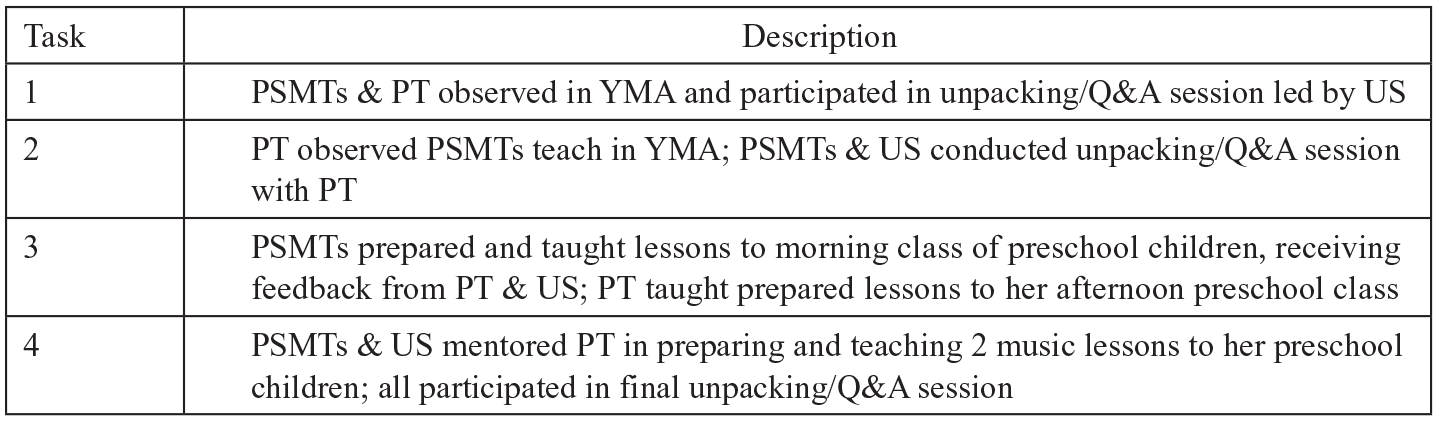
Study Tasks Completed by PSMTs and PT.
Following each task, adult participants reflected and set goals for their next teaching assignment. Throughout the experience, PSMTs and PT were given articles and other resources to help in lesson preparation, to answer questions or to help alleviate concerns. At the completion of the entire experience, all participants, including the preschool children, shared their perceptions of their experience through semi-structured interviews.
Data Collection, Analysis, and Trustworthiness
We gathered data through multiple methods. Given the importance of critical reflection in service-learning for the PSMTs and PT, we collected written reflections throughout the experience, along with transcripts from each unpacking/Q&A session and final interviews. As our goal was to prioritize the preschool child’s voice and perspective in our data collection, we interviewed the preschoolers in pairs to explore their perceptions of the experience. First, we invited the preschoolers to draw a picture depicting what they remembered from their music classes to open our conversations. As suggested in educational and psychological literature, methods such as drawings can encourage children to describe and evaluate their experiences (de Rosa & Bocci, 2013; de Rosa & Schurmans, 1990; Due et al., 2014). In addition, drawings and their linguistic associations can be more engaging than interviews and can help children remain interested during the process of data collection (Ripani, 2022). To start the interview, we asked the preschoolers open-ended questions about their drawing and other memories of their music time. Following this discussion, we presented a poster with pictures of different activities they had done with the PSMTs. Dorado and Saywitz (2001) found that visual cue cards help preschoolers recall more information. Questions and procedures used in the interviews and reflections are included in Online Appendix A.
By the end of the study, we had gathered 477 single-spaced pages of data from transcriptions of interviews and teaching reflections. We coded data in two cycles: in vivo for the first cycle of coding and focused coding for the second cycle (Saldaña, 2016). In vivo coding is especially helpful in educational settings with youth because, “the child and adolescent voices are often marginalized, and coding with their actual words enhances and deepens an adult’s understanding of their cultures and worldviews” (p. 106). Three of us, the authors of this study and a research assistant, coded data separately and then met to triangulate the larger themes. We used the data coding software NVivo 12 (Academic) to code the data. Themes and quotes to be used in this publication were sent to PSMTs and PT for the purpose of member checking and trustworthiness. In addition, we sent portions of transcripts to two expert qualitative researchers for further theme verification.
Findings
In the following sections, we summarize the themes that emerged from our three participant groups: PSMTs, PT, and preschool children.
PSMT Perceptions: Dissonances and Discoveries
Transformations
Both PSMTs shared an overall positive perception of the service-learning fieldwork in their final interview, noting that it was good to get hands-on, real-life experience before student teaching. Mandy stated, “Honestly, skills and knowledge, dispositions, they were all bettered by this experience.” They specifically revealed feelings of transformation in their abilities as teachers in a preschool setting. Mandy shared, “I think initially it was a little overwhelming, but I think by the end I was feeling confident, at least at the preschool level.” Brittany also mentioned that she saw improved flexibility in responding to student needs during her teaching. Mandy agreed and shared how she changed her plan in the middle of teaching one of her lessons to adapt to the needs of the students. She said, “I think that’s been a huge progress in my own teaching. I’m not worried about just getting through my lesson plan, and I’m trying to help the students. I think the next step for me is focusing on individual needs, like the Spanish speakers.”
In our final interview, the PSMTs shared that their perception of the preschoolers also underwent a transformation. Mandy said, “I was so impressed at how fast they pick up on patterns. I think overall, I have learned that preschoolers are smarter than we give them credit for.” Brittany had previously worked in daycare centers and admitted that her experience there made her “kind of hate preschool,” but then she shared, “This has shifted like, my whole view of younger children. Like, they can behave and they can listen, and it could be good.” Mandy agreed, “I don’t think I ever would’ve considered doing really, really young kids mainly ‘cause I didn’t know how capable they were . . . They’re capable of a lot.” She added, “I think I found a passion.” Both PSMTs seemed to have had a transformative experience in various ways through this preschool service-learning experience.
Attributions
During our final interview, the PSMTs attributed much of their success to external factors, such as the environment in the preschool and YMA, and even the demeanor of the preschoolers themselves. Brittany mentioned, “I feel like Elizabeth’s classroom was like, very under control and the kids were very involved. Like that probably made it a lot easier on us too.” Mandy agreed, highlighting the importance of Elizabeth’s teaching style, classroom management, and organization. They also brought up the importance of the YMA in preparing to teach preschool. Mandy said, “YMA is really our only exposure to preschool, really little kids . . . YMA was a very easy transfer to the preschool classroom.” When asked if they thought they could do this same service-learning experience with older grades, they were unsure. Mandy said, “I think we took so much from the YMA that it would’ve been hard for me to do it [without the YMA].”
During the final interview, both PSMTs mentioned feeling more comfortable with the preschoolers than they had felt in prior fieldwork experiences. Mandy commented, “I think I was more at ease. I was responding to students more directly. I had a lot of fun with them!” Brittany agreed, “I was so much more at ease teaching the preschool class compared to the sixth graders. I was able to form relationships with the students and interact with them more one on one.” When asked why they felt they were more at ease, they mentioned management and preschool dispositions as possible reasons. Brittany added: I think maybe one of the reasons it was easier could be that preschoolers aren’t insecure-like, they’re very open. It’s just easy to focus on how they’re doing and how they’re learning and not focus on what are they thinking of me . . . compared to like older children, when I feel like I have to be cool or something and <laugh> I’m not cool.
Although both PSMTs noted the development of teacher dispositions, they seemed to attribute this growth to external factors rather than personal achievement.
Role of Music Specialist
The PSMTs noted that this specific service-learning model differed from the fieldwork experience they had participated in previously. During the prior semester, they engaged in a more traditional fieldwork model, where they prepared lessons for students in the music classroom of an elementary music teacher. In our final interview, they noted that, in contrast to their previous fieldwork, this service-learning experience put them in the position of music specialist, which at times was a challenge. Mandy said, “Being in charge and having us be, like, the music specialist was really hard, but it’s an experience that I don’t think either of us would’ve gotten otherwise.” Brittany added, In this case, we were the music specialists coming in to teach, and Elizabeth viewed us in [that] way . . . we have the knowledge and we were coming in and helping her for the class. [In the previous experience] <laugh> we were very much not the experts.
This shift in how they viewed their role impacted how the PSMTs felt about their identity and what they gained from the experience. Brittany said, “I felt like a real teacher this time and not just a music student trying to be a teacher.” The PSMTs also commented that they learned more in this model because they had autonomy and ownership over much of the project. Mandy commented, “We did everything—we picked, we directed, we gave feedback, and it was really good.” These comments are especially compelling when I note that I never asked the PSMTs to compare this service-learning experience to their prior semester’s more traditional fieldwork. They spontaneously shared these comparisons during our interview, suggesting that they perceived a significant difference between the two fieldwork models.
Although the PSMTs both brought up the unusual experience of being the specialist or “expert,” they still had misgivings about their value to Elizabeth, and both expressed gratitude that we, the university supervisors (US), were present to help. Brittany said, “I think I gave her [the PT] useful feedback. But I guess it was nice to have you and [Author 2] there to like, reaffirm, you know, ‘cause I feel like I still don’t really know what I’m doing.” Despite our efforts to help them feel confident in their role as music specialists, we wonder if our presence in the equation perhaps undermined their confidence or gave them an out when they did not initially know an answer. Brittany noted that although she felt “useful” to the PT, “[The US] have a lot more good feedback to give” and “I definitely don’t have as much experience as [the US].” Although the PSMTs felt that they grew through meeting the demands of this service-learning experience, they still did not feel sure of themselves in the role of music specialist.
PT Perceptions: Beginnings in Music
First Steps and Obstacles
At the outset of our study, Elizabeth, the PT, told us that she didn’t see herself as a musician or music teacher. By the end, her feelings about the experience were positive, although she still lacked confidence. In our final interview together, she said that she achieved her goals of “bringing the best” to kids, feeling more comfort in teaching music, and gaining ways to “legitimize music.” However, Elizabeth still spoke about herself in terms of potential and all that she still needed to learn and practice. She said, I do see a lot more potential for me, million times more potential. Just the world has opened up to me. It’s just a matter of time and planning . . . very little planning time at all in preschool. And I’m exhausted, because it’s draining.
Planning time and resources were topics that came up frequently in our discussions. Because of Elizabeth’s inexperience with music, planning music lessons took a lot of her time and energy. She wanted more examples and more repertoire ideas that clearly identified what musical elements to teach. In one of our post-teaching sessions, she said, It is difficult to make decisions about what to do from week to week. I know the learning trajectories for literacy, math, and writing, but not music . . . How do you pick your objectives? How do I know, is there a priority? Is there something I should start with? Is there a sequence? I didn’t know if I’m breaking some rule like there’s a sequence.
In addition, for this experience, we had our PSMTs plan using backwards design (Wiggins & McTighe, 2005), selecting the objectives or outcomes they wanted for the children, and then planning the music and activities. This also seemed to be outside of Elizabeth’s comfort zone, as she was more accustomed to planning thematically. In one of our coaching sessions, she shared, “I really just do not think like this.” Her concerns and questions helped us see areas that we could have improved as coordinators of the study, which will be discussed later. The PT learned a lot through our short experience, although she was still insecure in her abilities. After she taught one of her lessons, she wrote in her reflection, “I feel like I am just barely leaving beginning. I’m just so nervous about it. But I feel more excited about it.”
Time for Transformations
During our final interview, the PT mentioned how important observations were to her throughout our experience, both at the YMA and of the PSMTs as they taught in her classroom. She noted that the important part for her was not so much learning about music, but “learning how to teach music with children.” It was imperative for her to see it in action. She said, “The model was just perfect because I needed to see it done . . . If I would’ve just seen [a lesson] on a piece of paper, I would’ve had no idea how to even approach that.” At the outset of the study, the PT’s reflections of the YMA observations included mostly comments on non-musical connections, such as self-regulation skills and social skills. However, as she continued to visit, she noticed more musical outcomes for the children. “I knew they were learning so many things, and I was writing all of those down, but then it became more musically and more specific as the time went on.” She noted that even as the PSMTs started doing lessons with her preschoolers, continuing to visit the YMA was crucial to her in clarifying ideas and answering her questions. In our final interview, she said: And to feel it and to participate with it over and over, because at the beginning, I’m just so exhausted because it’s all new and I can’t even take it all in, it’s so wonderful. And so just going so many times helped me a lot.
Elizabeth commented frequently in her reflections on how useful it was to watch the PSMTs with her students. In one reflection, she wrote, I am sad that this is the last time Brittany and Mandy will teach. Modeling good teaching with the children in my class was more powerful than I expected. If I had tried to implement this without Mandy and Brittany teaching for several weeks, I would not have had the opportunity and time to observe, experience, learn, and process how to bring music time to the classroom. I am so grateful!
Similar to the PSMTs, Elizabeth was also surprised by her students’ musical capabilities. In one of our follow-up sessions, she said, “ I didn’t know that I could expect as much as I could from children this young . . . I just didn’t think some of them could do that. And I’m noticing, just like, with everything else, there’s a range.”
Joyful and Engaging Music Learning
The PT’s position as a traditional preschool teacher revealed valuable perspectives on the importance of music for children. Her goal, as she stated it, was to “bring beauty to the children in every way, you know, artistically- visual arts, music, dance, movement.” At our final interview, when asked if she was able to accomplish her goal, she responded, “Absolutely! . . . It brought a joyful, engaging, shared learning experience for the children and for me . . . when it’s that collaborative learning and it’s joyful, I just think that was the overall benefit.” During our interview, she frequently compared the “traditional preschool way of doing music” to the way that our PSMTs modeled it in her classroom and in the YMA. Further discussion revealed that the “traditional” way was when “music is used to meet an academic goal . . . or for transitions or to get their attention . . . instead of reaping the benefits that music is giving us in and of itself.” Using music as a vehicle to support other learning objectives felt incomplete to the PT, and through her experience in this study, her perception of music’s role in the classroom changed. In her final reflection, she wrote, The largest benefit for the children is for them to experience music in multiple ways, other than the traditional preschool way of doing music. And in the past, I’ve used music to teach concepts or different things, but I knew we were missing this much of music. I knew that wasn’t really music . . . I have underestimated the power of music and feel I cannot deny children musical experiences. To do so limits their development and potential. I would like to provide musical opportunities during our playtime each day.
Along with learning to implement music in her classroom, Elizabeth also wanted evidence that would support her decision to include music in her curriculum. By the end of our study, she felt that she had gained knowledge and experience that could help her advocate for including music in her classroom. At our final interview, she reflected, I wanted it to be something so that if somebody else came in and said, ‘well, why are you doing music? Why aren’t you doing letter L today?’ I can legitimately say, “oh, this is helping this and this and this” because that is the reality.
Elizabeth also noted in her final reflection the impact music has on well-being: While learning about music is valuable and worthwhile, well-being is an unexpected benefit. Music and movement and being together is nourishment to the soul. Children are experiencing more trauma and stress and less connection with adults and other children. Music is a delightful way to lift everyone.
Preschool Children Themes
Music Makes Me Happy!
The first theme that emerged from our end of semester interviews with the preschoolers was “music makes me happy” or “¡porque me hace feliz!” Eight of our preschool students mentioned something about music being fun or making them happy. They enjoyed the play aspect of the prepared lessons and that “my friends play with me” during music time. One student even shared that he’s happy when he can “tell my brothers and sisters the songs.” When asked about their experience doing music with Ms. Brittany and Ms. Mandy, they reacted positively. One preschooler said, “They had fun with us.” Their overall positivity corroborated what we had observed during the children’s music lessons. They had appeared engaged and happy.
At the conclusion of each interview, we presented the preschool students with a “Smiley face Likert-type scale” ranging from a big frown to a big smile (included in Online Appendix A). We asked students to point to the face that matched how they felt about doing music in their class. Most picked one of the smiley faces, but there was a notable exception. One student picked a frowny face, and when asked why, she said she was sick during music one day. It seemed a common theme from the children that music was enjoyable to them.
Active Music Learning
The preschoolers remembered many of the activities we had shared together. After asking them about their drawings and giving them time to tell us what they remembered about music time, we presented a poster with pictures of a few of the manipulatives they had used or representations of some of the songs they had learned. They often demonstrated a physical action to show us what they remembered. One student pointed to the snail and said he remembered doing it “for slow.” When asked what he remembered, he moved his arm back and forth while singing “fast and slow, fast and slow.”
We interviewed the students in pairs and often a remembrance from one student would spark the memory of the other. One remembered that we did trains, and when asked if they remembered the song that went with trains, one of the students started singing, “Clickety clickety clack.” The student next to him also started singing and moving her fingers up her arm with her words, “Clickety clickety clickety clickety clickety clickety clack!” Many students remembered the tennis ball named Roger that was used for vocal play. They showed us they remembered by making their voices go up and down as we had done in class. It was notable that they not only recalled the activities or manipulatives, but also the concepts that were a focus of the teaching.
Me, the Musician
One of the most interesting observations we made as researchers was from the students’ explanations of their drawings. Most pictures were of instruments, the drums and xylophones being most common (see Figures 2 and 3). We asked them what they drew and many of them identified themselves playing an instrument. “I’m drumming on the big one.” “Me, I’m playing the xylophone.” This struck us as meaningful. In a world where there are performers and consumers, “talented” and not, these students’ interactions with music allowed them to see themselves as instrumentalists, as musicians. These students drew themselves as the center of the experience.
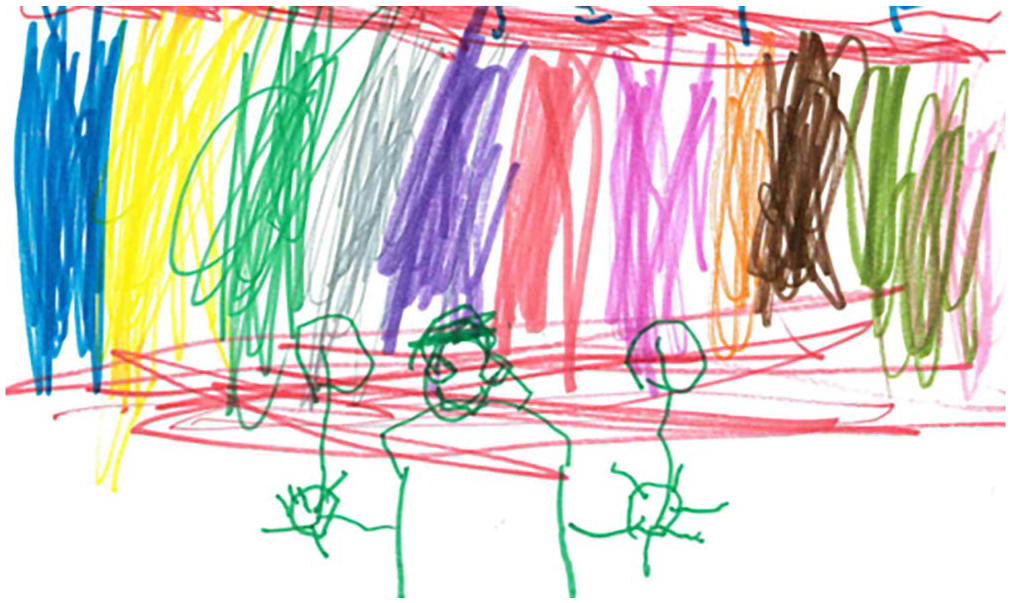
Preschool Drawing 1: “Me, I’m Playing the Xylophone”.
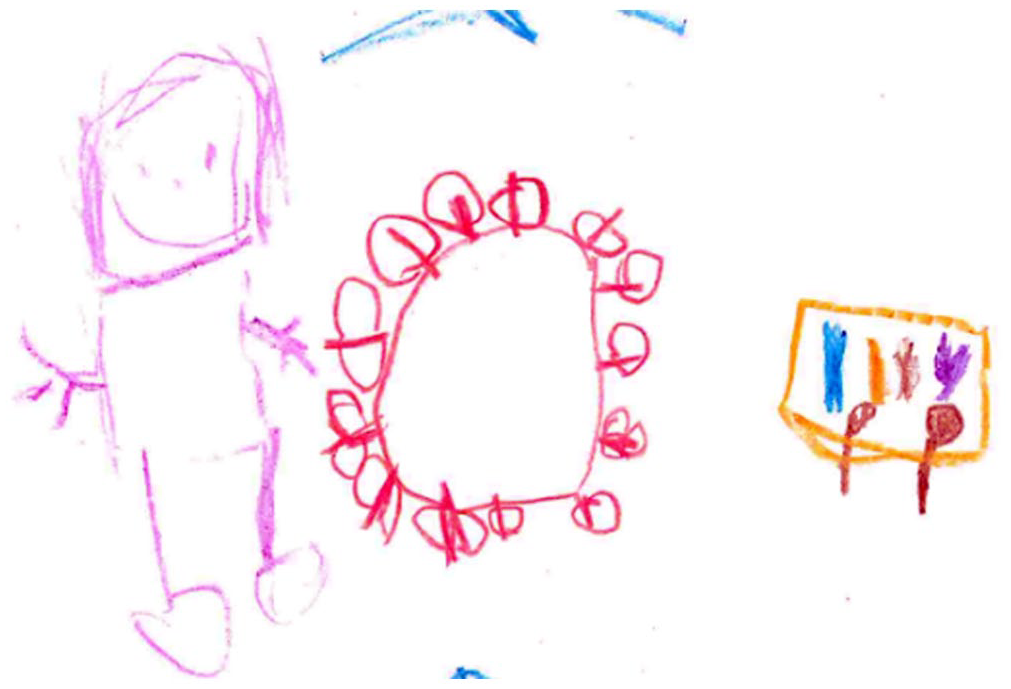
Preschool Drawing 2: “I’m Drumming on the Big One!”.
Discussion of the Findings
The benefits of this service-learning project were similar to others in our literature review; our PSMTs perceived increased ability to focus on student needs (Sindberg, 2020), improved lesson planning skills, and increased understanding of and appreciation for the capabilities of preschoolers (Legette, 2018). The PT accomplished her goal of learning to bring music to her children in a joyful, child-centered way by gaining an increased understanding of the musical elements and how she could create musical experiences in her classroom. The preschool children enjoyed their music learning and were able to share what they remembered from the lessons. We felt that we achieved our objective of providing equitable educational benefits in our service-learning model.
However, one of the most interesting observations we made was that neither the PSMTs or PT saw themselves as giving much in this service-learning experience, yet they had so much gratitude for each other and how much they had learned. When asked in our final interview if they had done a service for the PT, the PSMTs responded with “I guess so” and “what we did was pretty simple in my mind. I didn’t view it as something crazy.” But then when asked if they were served through the experience, they responded with “Yes” and “Definitely!” The PT also responded weakly about her part in the service-learning equation. “I did horrible on the mentor part <laugh> I’ll tell you right now.” This was almost humorous to us as we did the separate interviews. Each group was so sure that they hadn’t done anything remarkable for the other, while they effusively praised all that they learned from each other.
Both the PSMTs and PT noted that this service-learning model would be very challenging to replicate without the YMA experience, where they gained most of their initial experiences through observation and participation. The PSMTs noted that it was easy to transfer principles from the YMA to the preschool and attributed some of their success to what they learned in the YMA. The PT also felt that it was important for her to continue to observe in the YMA to answer her questions throughout the experience, especially after she started teaching her own music lessons to her students. The impact of the YMA lab experience for both the PSMTs and PT cannot be overstated and should be considered by anyone hoping to replicate this model. In addition, through this experience, we found that Title I preschool teachers can be ideal collaborators in forming service-learning partnerships. Title I students may also be ideal for music service-learning experiences as their families may have limited access to other music education opportunities.
The PSMTs commented that they felt comfortable preparing their lessons because the objectives for the preschoolers were simple, focusing on contrasts such as quiet and loud, fast and slow, high and low, same and different, and so on. Although thinking about teaching music elements was new for the PT, the preschoolers’ comments indicated that they were able to remember specific things in terms of these contrasts. As mentioned above, one student pointed to the snail on our poster, and said, “fast and slow, fast and slow.” Perhaps there are educational benefits to younger students in learning music through opposites or contrasting ideas.
One of the most interesting findings from each of the stakeholders was the concept of identity. The PSMTs experienced a range of identities: as students and teachers, novices and experts. The PT did not originally identify as musical, but later came to see herself as growing into a musical person with potential as an individual and as a teacher bringing music to her students. Both the PSMTs and PTs had their perception of the musical identity of the preschoolers expanded through this experience, acknowledging that they were more musical and capable than they had originally supposed. The preschoolers identified themselves as musicians in their drawings and discussions with us. Most of us would acknowledge that, in teaching, it can be difficult for students to develop and/or maintain an image of themselves as musicians as they mature. Perhaps the earlier we start nurturing this identity in our students, the easier it will be to maintain.
Challenges and Recommendations for Future Research
Our PSMTs had an overall positive experience, but we had some questions throughout the study. Our students revealed that in their fieldwork experiences overall, they never felt like they had enough time to teach. They wanted to teach longer lessons and more frequently. Compared to past studies that found time commitment was one of the greatest challenges of service-learning experiences (Bartolome, 2013; Menard & Rosen, 2016), our undergraduates seemed to want more time in the classroom. Perhaps this was because our service-learning experience was embedded as part of a required course, therefore it did not seem to be taking time away from other scholastic or personal endeavors. Our PSMTs also mentioned wanting to learn more about integration in the music classroom. Because they came in as music specialists and taught music lessons as models for Elizabeth, this was not a priority for our study. However, perhaps including integration in the lesson planning could have been an even more impactful model where both PSMTs and PT felt like equal partners in planning lessons. In addition, music and arts integration is a movement within education that PSMTs and PTs will most likely encounter. Future studies could juxtapose the experience of preparing both music integration and music stand-alone lessons and explore the value of each experience.
Our students also commented that this experience was easier because it took place at a preschool with easier content and smaller class size. We worried about their takeaway that preschool is “easier.” Early childhood music experiences are often very musically sophisticated and take great pedagogical knowledge and skill. It was clear that we could have done a better job helping the PSMTs know that teaching young children requires as much musicality, understanding, and skill as teaching older children. But perhaps this further highlights the need for more early childhood music experiences in music teacher preparation programs. We wondered if this semester-long focus on preschool augmented the educational experience of our PSMTs or took away from time that they could have been in a K-6 classroom. Our program provides a variety of fieldwork experiences over four semesters, so we did not feel that this was the case. However, if another music teacher preparation program has fewer opportunities to do fieldwork, preschool experiences may not be the first priority. We suggest conducting a similar study in other grades with larger class sizes.
Finally, both PT and PSMTs mentioned the importance of having us there as facilitators and content experts. However, we questioned if our presence there was still a reminder that neither group was the real “expert.” Would the PSMTs and PT have grown more if we weren’t there? Or was their growth increased because of our presence as facilitators? Along with critical reflection, faculty coaching is a key element to putting the “learning” in service-learning (Eyler & Giles, 1999). University supervisors can play a vital role in the success of their stakeholders as they assist them in setting goals, participating in critical reflection, and putting into practice feedback they receive. But university supervisor researchers must exercise caution in allowing power dynamics to skew or diminish the findings of the study. We had overwhelmingly positive feedback from the PSMTs and even the PT, which may suggest that they are deferring to us or seeking to “please” us in our interactions and their responses. This can further compromise the service-learning model where the goal is to come together as equal partners to respond to a need in the community.
As the study progressed, it was clear to us that we needed to give the PT multiple entry points for how to plan a music lesson. Our focus on the music elements and backwards design were so foreign to her that it weakened her confidence in her understanding and abilities. Getting to know her planning style before the PSMTs taught and modeling a lesson plan in her preferred way may have allowed her to feel more confident and be more successful. The PT mentioned that she needed more repertoire to pull from. While she had been provided song resources early on, some training for using them with planning would have been helpful, as well as additional lesson plans and activity ideas. When she would ask questions about something and we would offer an idea, she would commonly say, “I never would’ve thought of that.” Perhaps, if she had been given more examples and a variety of ways to address music curriculum writing, she would have had more confidence.
In evaluating our service-learning project, we returned to our original definition and realized that although we were successful in responding to a need in the community and creating equitable learning benefits for multiple stakeholders, we had not prioritized civic engagement as an objective of the experience. Kirlin (2002) found that this is a common failing of service-learning studies precisely for the reason we also failed: we did not explicitly address civic engagement with our participants or in our design. Although we were not trying to engender dispositions of volunteerism, we were hoping that our students would see themselves as leaders in their future schools who could assist other teachers integrate or teach music in their classrooms. However, future researchers should consider being more explicit in addressing the concept and disposition of civic engagement with their students and community partners.
Conclusion
The importance of fieldwork for preservice music teachers has been well documented. With the current model, we sought to create a service-learning experience that yielded significant benefits for three stakeholders—the preservice teachers, the classroom teacher, and the preschool students. We received enough positive feedback from all parties concerned that we feel the model is worth considering for future fieldwork endeavors. Although some aspects of the study may not be replicable or even desirable for various music teacher preparation (e.g., utilizing the music lab preschool, focusing on early childhood, etc.), we hope the ideal outcome of observable benefits for three stakeholders will inform fieldwork planning and service-learning researcher accountability in the future.
Supplemental Material
sj-docx-1-jmt-10.1177_10570837231189823 – Supplemental material for Collaborative Service-Learning: Sharing Music in a Preschool Classroom
Supplemental material, sj-docx-1-jmt-10.1177_10570837231189823 for Collaborative Service-Learning: Sharing Music in a Preschool Classroom by Erin Bailey and Emilee Knell in Journal of Music Teacher Education
Footnotes
Declaration of Conflicting Interests
The author(s) declared no potential conflicts of interest with respect to the research, authorship, and/or publication of this article.
Funding
The author(s) received no financial support for the research, authorship, and/or publication of this article.

Supplemental Material
Supplemental material for this article is available online.
References
Supplementary Material
Please find the following supplemental material available below.
For Open Access articles published under a Creative Commons License, all supplemental material carries the same license as the article it is associated with.
For non-Open Access articles published, all supplemental material carries a non-exclusive license, and permission requests for re-use of supplemental material or any part of supplemental material shall be sent directly to the copyright owner as specified in the copyright notice associated with the article.
