



Abstract
The purpose of this Self-Study of Teacher Education Practice (S-STEP) was to examine faculty and student perceptions of co-curricular experiences between an undergraduate instrumental conducting and a junior-level music education course. To help students develop their conducting and pedagogical skills simultaneously, music education and conducting faculty co-taught their courses and developed and implemented co-curricular assignments for 14 co-enrolled participants. Data were collected from faculty journals, meeting transcriptions, participant surveys, and interviews. Findings indicate that the collaboration and co-curricular experiences promoted student and faculty growth. Increased podium time and peer teaching opportunities during which students are given feedback greatly improved students’ perceived level of comfort and confidence in front of an ensemble. In addition, the co-teaching and co-curricular assignments between conducting and music education courses promoted substantial growth in students’ conducting and pedagogical skills and their ability to connect the two. Implications for music teacher education, future research, and further revision of these collaborative practices are discussed.
Keywords
Introduction and Related Literature
Undergraduate music education methods and conducting courses share a common goal of preparing preservice music educators but have different objectives within them. Although “instrumental music educators view conducting and teaching as deeply interconnected” (Noon, 2019, p. 48), they are frequently taught in a way that is “not strongly aligned” (Hart, 2019, p. 15). This leaves students to synthesize their pedagogical and conducting skills as separate entities rather than developing the skill sets simultaneously, which would be more beneficial to students (Causby, 2021; Silvey et al., 2020).
Instrumental music methods courses primarily emphasize various aspects of teaching, including curriculum and lesson planning, instrument performance skill, pedagogy, classroom management, rehearsal techniques, teaching fundamentals, and assessment (Hewitt & Koner, 2013; Wagoner & Juchniewicz, 2017). Teachout (2004) surveyed 43 instrumental music education students, revealing their appreciation for field experiences, peer teaching opportunities, and developing lesson plans for peer teaching. Peer teaching, coupled with faculty feedback, has been recognized as particularly advantageous (Grey, 2022b). Engaging in thorough score study and preparation before peer teaching enhances student confidence and effectiveness on the podium (Causby, 2021; Parker et al., 2017; Teachout, 2004). In addition, reflecting on video recordings of their teaching supports the development of teaching skills for preservice music teachers (Grey, 2022b).
Undergraduate conducting courses are typically focused on non-verbal communication, often prioritizing the development of technical skills such as conducting patterns and gestures over rehearsal skills such as diagnosing errors and providing prescriptive feedback (Hart, 2019; Silvey, 2011; Silvey & Major, 2014). Specifically, “instructors of undergraduate conducting courses find elements of fundamental conducting technique such as beat patterns, cues, fermata, facial expression, and left-hand independence to be important in teaching conducting. . . [as well as] score study, ensemble balance, and adjusting intonation” (Noon, 2019, p. 48). Conducting “instructors prioritized teaching music content knowledge and skill over pedagogical skills. . . leaving pedagogical concerns to other courses (e.g., instrumental/vocal methods”; Hart, 2019, p. 23).
While conducting study, score study, and ensemble conducting experiences allow students to realize the “complexities of conducting” (Silvey & Major, 2014, p. 75), undergraduates still struggle with error detection, interpersonal skills, and comfort on the podium. They desired more podium time, specifically opportunities to conduct an ensemble while receiving specific feedback from their instructor in a masterclass-type setting (Silvey & Major, 2014) and more opportunities to develop rehearsal techniques and error detection skills (Silvey, 2011). Similarly, Silvey et al. (2020) reported that band directors in the field (N = 141) indicated that their undergraduate conducting education focused on the development of their technical conducting skills rather than rehearsal techniques. Participants would have liked for their conducting courses to have better prepared them to demonstrate musical expression, included more rehearsal opportunities that resembled what they would ultimately experience in the classroom, and provided more instruction in rehearsal planning and error detection.
Research exploring the connection between music education methods and conducting courses is not extensive but indicates a need for an intersection between them to help students transfer skills (Noon, 2019; Silvey et al., 2020). Forrester (2018) examined music teacher knowledge and the relationship between music teaching and conducting in a multiple case study (N = 4). They found that instrumental music teaching requires integration of teaching and conducting and indicated that music teacher and conductor education courses should be multifaceted, allowing students opportunities for the integration that will ultimately be demanded of them in practice. To afford students such opportunities, extant literature suggests facilitating lab-based learning experiences, allowing students more podium time, and using a cyclical curriculum in which conducting and rehearsal techniques are integrated and woven throughout courses across multiple semesters (Causby, 2021; Grey, 2022a; Hart, 2019; Noon, 2019; Silvey, 2011; Silvey et al., 2020). These approaches were applied and examined in the current study.
Researchers’ Personal Lenses
The theoretical orientation of the researcher plays an important role in qualitative research because “the researcher’s worldview shapes the entire investigation—the design of the study, the research question, data generation, and findings” (Scheib, 2014, p. 78). As such, it is important to note the researchers’ personal lenses through which they viewed this phenomenon (Merriam & Tisdell, 2016; Scheib, 2014; Yin, 2016).
As a young teacher, I (the primary author) struggled to connect my own pedagogical and conducting skills. Although my pedagogical skills (error detection, pacing, content knowledge, providing feedback, etc.) were improving, my conducting skills (ability to respond to and impact the ensemble through gesture) were not. I heavily relied on verbal instruction, which my conducting gestures often did not match. As a result, my students resolved this dichotomy between my verbal and non-verbal instructions by not watching and responding to my conducting. Wanting to improve my conducting skills, I sought professional development and additional learning opportunities. One of my goals as a music teacher educator has been to help my students find this connection between and balance of pedagogy and conducting earlier in their careers than I did.
As music education faculty, I and my conducting faculty colleagues perceived that our undergraduate students also struggled to make this connection. They were either (a) so focused on “teaching” (e.g., providing instruction, listening to the ensemble, and providing verbal feedback) that they were not conducting at all or doing so without thought or intent, or (b) so focused on the technical “accuracy” of their conducting gestures that it seemed performative as if they were conducting a recording rather than actively listening to, assessing, responding to, or communicating musical intent to the ensemble in front of them.
My colleagues and I have experienced and observed exactly what the literature indicates: Undergraduate music education courses focused on lesson planning, pedagogy, assessment (Hewitt & Koner, 2013; Wagoner & Juchniewicz, 2017), and conducting courses focused on score study, literature, movement, and technique (Hart, 2019; Silvey, 2011; Silvey & Major, 2014; Silvey et al., 2020). We have witnessed students’ need for podium time, peer teaching opportunities with feedback, and a connection between their conducting and methods courses (Causby, 2021; Grey, 2022a, 2022b; Hart, 2019; Noon, 2019; Silvey, 2011; Silvey et al., 2020; Silvey & Major, 2014). Our collective experiences as students, teachers, and music teacher educators have shaped our teaching philosophies, inspired us to create curricular revision, conduct the current self-study to reflect on and refine our practices, and the lens through which findings are viewed.
Purpose and Research Questions
The purpose of this Self-Study of Teacher Education Practice (S-STEP; Vanassche & Kelchtermans, 2015) was to examine faculty and student perceptions of co-curricular experiences between an undergraduate instrumental conducting and a junior-level music education course. Faculty co-taught their courses, assigned co-curricular projects, and facilitated lab experiences in which students could develop their skills by rehearsing a full ensemble and receiving feedback from faculty in the moment (i.e., at times, faculty momentarily paused the student’s lesson as needed, provided feedback such as a rehearsal technique, etc., then allowed the student to resume the lesson and improve their instruction). The research questions guiding this study were:
Method
To help undergraduate music education majors develop conducting and pedagogical skills simultaneously, instrumental music education and instrumental conducting faculty developed co-curricular experiences between an Instrumental Conducting II course and an upper-level music education methods course called “Clinical Experiences.” We used a self-study method to reflect on the implementation of these co-curricular experiences. “Self-study is a form of action research . . . that places the improvement of teacher education at the center of the inquiry and specifically utilizes researcher perceptions as an integral part of data collection and analysis” (Conway, 2010, pp. 51–52). Self-study designs in education “prioritize a teacher’s unique understanding of teaching that may only be reached from the practitioner’s perspective” (Vaughan Marra, 2019, p. 10). Teacher educators frustrated with common teacher education practices began to use self-studies to examine and reform their practices when considering their impact on student learning (Berry & Loughran, 2005; Loughran, 2002, 2007a, 2007b). This branch of qualitative research has come to be known as the Self-Study of Teacher Education Practices, or S-STEP (Vanassche & Kelchtermans, 2015), and can include multiple approaches (Robbins, 2014). The use of self-study research in music teacher education specifically has become somewhat more common in recent years, used by music teacher educators and researchers as a tool for collaborative learning, reflection, growth, and improvement of practice (Conway, 2010). Kemmis and McTaggart (1988) state that self-studies have at least four steps: plan, act, observe, and reflect. The implementation of our study took place over three academic years, each with its own phase: (I) Planning, (II) Lab Implementation and Pilot Study, and (III) Full Implementation and Self-Study.
Description of Phases
Before co-enrollment of the Instrumental Conducting II and Clinical Experiences courses could occur, the music education degree required alteration. During Phase I: Planning, the degree was revised to allow for better sequencing of music education courses with a cyclical curriculum meaning that content would be presented continuously throughout the degree program in increasing difficulty, rather than topics being compartmentalized and limited to individual courses. The appropriate proposals were presented, permissions obtained, and advising and schedule adjustments made over the course of a calendar year in preparation for Phase II the following year.
In Phase II: Lab Implementation and Pilot Study, peer teaching opportunities were facilitated in all methods courses, and the Lab Ensemble was realized, in which all instrumental music education students formed an ensemble weekly, and were instructed by junior and senior level students who received live feedback from faculty. As students were grandfathered into the new course sequencing and scheduling, only three were co-enrolled in Instrumental Conducting II and Clinical Experiences during this phase, with whom Causby (2021) piloted the co-curricular experiences and self-study method. Findings informed the design and implementation Phase III: Full Implementation and Self-Study.
During this final phase, the Lab Ensemble continued to meet weekly, the co-curricular experiences between Instrumental Conducting II and Clinical Experiences occurred for 14 co-enrolled students, and the self-study was conducted. Due to special circumstances in their schedules, there were six students in the Instrumental Conducting II course that were not enrolled in the Clinical Experience course because they had previously completed it. These six students participated in all facets of the Conducting II course only. All 20 students completed the same Conducting I course with the same instructor the previous semester.
It should be noted that there was a change in undergraduate conducting faculty between Phases II and III, so different faculty taught the Instrumental Conducting II course in each of those years/phases. The previous conducting instructor (PCI) did, however, remain at the institution as graduate conducting faculty and in an administrative capacity and participated in the data collection of Phase III as an outside evaluator.
Description of Courses in Phase III
Before data collection and findings are presented, it is necessary to describe the courses and co-curricular experiences utilized in Phase III that were observed in the self-study.
Instrumental Conducting II
The Instrumental Conducting II course built on the Conducting I course from the previous semester and was instructed by one member of the conducting faculty (CF) and one doctoral graduate assistant (GA). Course goals included score study and analysis, continued development of conducting posture and gestures, increased hand independence, non-verbal communication of musical intent, and developing responsiveness to the ensemble. Students regularly completed conducting rounds by leading their classmates through assigned excerpts while receiving feedback from CF or GA. Conducting rounds were video recorded and reviewed by students who then submitted a written reflection. Students met with CF or GA for an individual conducting lesson twice during the semester for additional, individualized instruction.
Clinical Experiences
In the Clinical Experiences course, students studied the fundamental principles of music instruction as outlined in Duke’s (2007) essays on music teaching and learning. They also completed virtual and in-person observations of P-12 music settings and instructed the Lab Ensemble. Course goals were to gain an understanding of Duke’s (2007) core principles, synthesize and articulate those principles through writing and discussion, witness them during observations, further synthesize them through writing and reflection, and then ultimately apply them during teaching rounds in the Lab Ensemble. The course and Lab Ensemble were instructed by one member of the Music Education Faculty (MEF).
Students co-enrolled in Instrumental Conducting II and Clinical Experiences instructed the Lab Ensemble while receiving feedback from the MEF, allowing them to adjust their practices at the moment. While participants developed foundational pedagogical skills in previous music education courses through leading shorter, like-instrument peer teaching episodes on secondary instruments, these Lab Ensemble teaching experiences were their first opportunities to instruct a large ensemble with full instrumentation and their first opportunity to rehearse with advanced students on primary instruments as part of their coursework. All teaching rounds were video recorded and reviewed by students, who then submitted a written reflection.
Description of Co-Curricular Experiences in Phase III
Co-Teaching of Music Education and Instrumental Conducting II Courses
Throughout the semester, MEF attended the conducting course during conducting rounds to make notes of student progress and future goals. This allowed her to support and reinforce conducting instruction and objectives along with pedagogical feedback regularly provided in Lab Ensemble peer teaching episodes. She was also present to participate in class discussions and activities on days specified by CF, such as when discussing repertoire selection. During the second half of the semester, CF and/or GA joined MEF in the weekly Lab Ensembles to provide feedback as well.
Co-Curricular Midterm Project
The Conducting II midterm was a group project for which students selected a piece of standard band repertoire and gave an in-class presentation including composer biographical information, full score analysis, and interpretive, conducting, and rehearsal considerations. For the Clinical Experiences portion of this project, co-enrolled participants selected an excerpt from the same piece, used the information from their presentation preparation to inform rehearsal objectives and a lesson plan, and executed the lesson in the Lab Ensemble. Students were evaluated on presence and teacher persona, pacing, and ability to present clear objectives, assess students, and concisely provide prescriptive feedback as they were accustomed to from their previous peer teaching experiences in music education courses. Now, however, they were also evaluated on conducting elements as well, such as technical gestural communication of musical ideas and matching gestures to verbal instruction. Both MEF and CF were present to evaluate the presentations and provide feedback prior to co-enrolled students’ rehearsal of the piece. Both were also present during the Lab Ensemble rehearsal, each providing feedback related to rehearsal skills and/or conducting technique as warranted. Students enrolled in only the Conducting II course did not have the opportunity to rehearse the piece that they studied and presented because the Lab Ensemble teaching opportunities are part of the Clinical Experiences course, which they previously completed prior to the implementation of the Lab Ensemble.
Co-Curricular Final Exam
For the final exam, CF assigned students a movement of Ralph Vaughan Williams’s Folk Song Suite. Prior to the final, Co-enrolled participants completed one conducting round (in the conducting course) and one rehearsal (in the Lab Ensemble). These rounds were used to inform students’ planning and preparation for the final “exam,” which counted for both courses. During the final, co-enrolled participants were allotted 15 min total to work with the Lab Ensemble; 12 min to rehearse a section of their movement, and 3 min to do a “run through” of that section. Students were evaluated on their ability to diagnose errors, provide prescriptive feedback, and communicate musical intent through conducting gestures that matched verbal instructions.
Data Collection and Analysis in Phase III
During Phase III, the co-curricular experiences were implemented, and the self-study was conducted to evaluate their effectiveness. Data were collected through teacher educator journals, teacher educator meetings, a co-enrolled participant survey, a co-enrolled participant group interview, a PCI survey, and an interview with the PCI. All data sources were triangulated for the purposes of establishing trustworthiness (Guba & Lincoln, 1985). Qualitative data were coded in three cycles, beginning with in vivo coding in which all journals, meeting and interview transcriptions, and narrative responses from open-ended survey questions were assigned codes quoted directly from the participant or researcher’s statements. Second, pattern codes were used to categorize similar in vivo codes, revealing categories within the data. Finally, magnitude coding was used to realize the frequency of each category so that some distinction could be made in the impact or importance of each (Saldaña, 2016; Yin, 2016).
While most data were qualitative, some quantitative data were also collected. Silverman (2016) indicates that quantification within qualitative research can be used “not to ensure that observed practices are statistically representative, but rather to check observations and interpretations of them as rigorously as possible” (p. 142), as was the intent in the current study. Saldaña (2016) likewise asserts that “quantitizing qualitative data” (p. 26) can be particularly useful when observing differences between groups, as was the primary application in the current study via the PCI survey.
Teacher Educator Journals
CF, GA, and MEF kept individual journals throughout the semester in which the co-curricular experiences and self-study took place, reflecting bi-weekly. In addition, MEF also made journal entries every time she observed students conducting rounds in the Conducting II course, roughly four times a month across 3 months. Journal entries were unprompted, consisting of open self-reflection and notes about student progress and future goals.
Teacher Educator Meetings
MEF, CF, and GA met formally once a month for approximately 1 hr to plan upcoming co-curricular experiences, reflect on recent interactions and practices, and discuss student progress and goals. Teacher educator journal entries were used to prompt discussion. On occasion, a less formal, impromptu meeting would occur at the conclusion of a class where all were present; minutes were recorded as if it were a formal meeting. In the final month, weekly meetings were held to finalize the final project schedule, student survey, student group interview, and conclude our reflections after the completion of co-curricular experiences and student data collection.
PCI Survey and Interview
The PCI (now an administrator at our institution, an ensemble conductor, and graduate conducting faculty) was not involved in any part of Phase III other than the evaluation of final exam videos in which he observed the “run through” portion of all 20 conducting students’ final exams. He viewed all participant videos in random order, was unaware of which students were co-enrolled and which were in Conducting II only, and rated each student on their overall demonstration using a Likert-type scale where 1 was “Poor” and 5 was “Excellent.”
To better describe students’ specific skill sets, he assigned ratings for technical skills (clarity of movement, communication of musical intent, and ability to be proactive with gestures while also listening and responding to the ensemble) and engagement (display of confidence on the podium through eye contact, poise, and demeanor, as well as their ability to connect with the ensemble). He also provided a brief narrative response explaining each rating (Saldaña, 2016). The day after the completion of video evaluations, the PCI participated in an interview with MEF and CF. Although previously unaware of which students were co-enrolled and which were not, the PCI was informed about this at the beginning of the interview for discussion purposes. Survey responses were used to prompt discussion to solicit further detail. Descriptive statistics were run on Likert-type survey items, and the narrative responses and interview transcript were coded.
Co-Enrolled Participant Survey and Group Interview
At the conclusion of the semester, co-enrolled participants completed an anonymous survey that consisted of close-ended items using a Likert-type scale, then allowed for an open-ended narrative response to explain the rating (Saldaña, 2016). The open-ended survey responses were used to prompt discussion among the group, and teacher educators asked follow-up questions to solicit more detail. Descriptive statistics were run on survey results, and the interview transcript was coded as described.
Findings and Discussion
Faculty Perceptions of the Co-Curricular and Lab Experiences—Research Question 1
Teacher Educator Self-Study Journals and Meetings
In vivo, pattern, and magnitude coding of teacher educator journals and meeting transcriptions revealed the categories and frequencies in Table 1 (Saldaña, 2016; Yin, 2016).
Categories Revealed Through Teacher Educator Journals and Meeting Transcriptions.
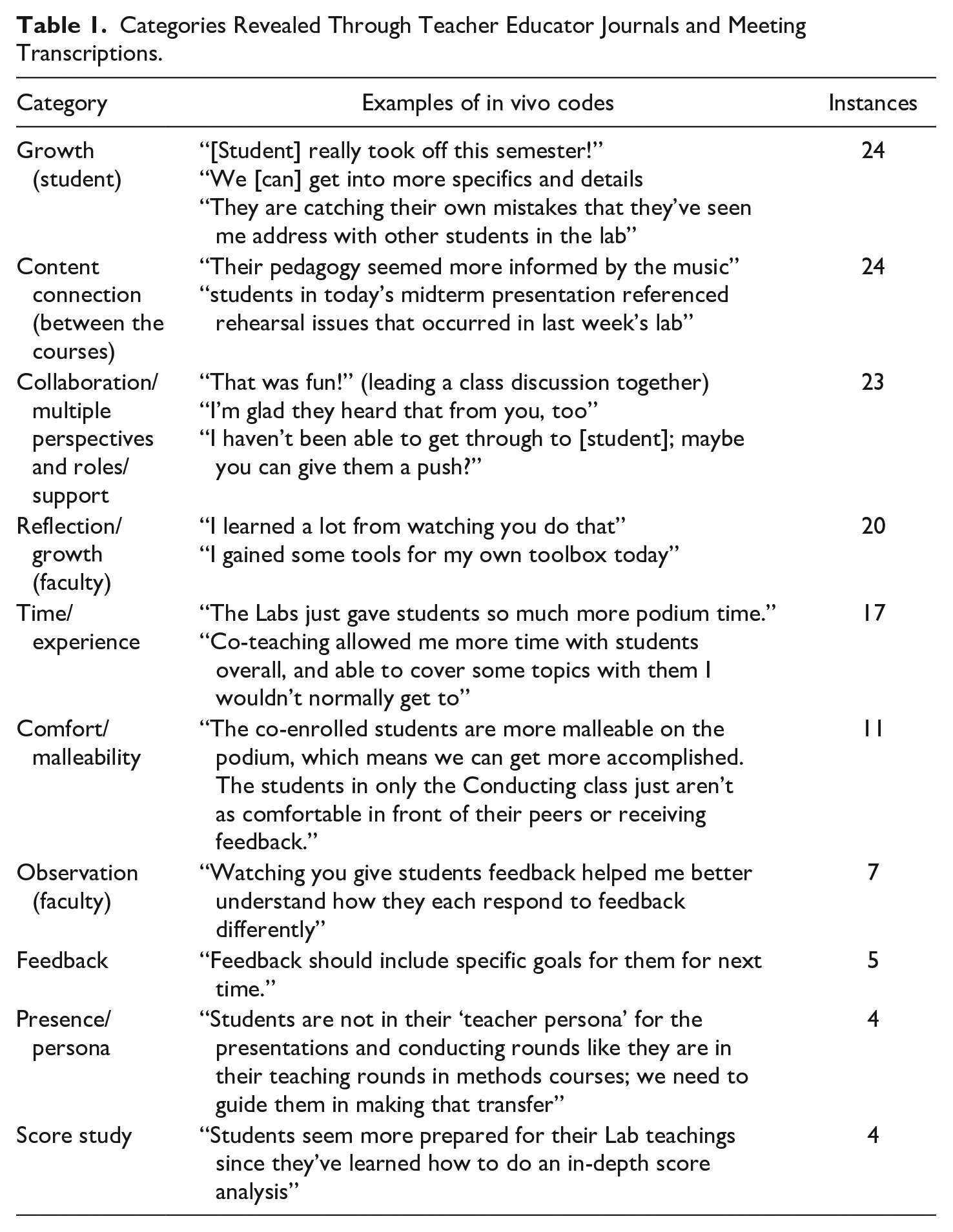
The faculty noted growth in all students’ conducting skills throughout the semester. The majority of the “Content Connection” codes, however, appeared in journal entries and meeting minutes from midterms on, after co-teaching instances increased, indicating a marked difference in the rate of growth, as well as comfort/malleability on the podium and the ability to connect conducting gesture to verbal instruction, became apparent in co-enrolled participants. It seemed that the score study and presentation midterm project in the conducting course greatly impacted students’ preparation for the midterm Lab Ensemble teaching, as students were more prepared for that teaching than in previous rounds. Once students realized the level of preparation that was necessary to achieve this level of success, they continued preparing for lessons more thoroughly, particularly the final.
After student growth and content connection, faculty collaboration and growth were two of the most prevalent themes revealed in the data. Faculty appreciated the ability to work with and support each other as well as present students with varying perspectives and help them make connections between our content areas. In addition, we enjoyed seeing students in varying roles. Conducting instructors valued their participation in the lab ensemble where they saw students in a formal, pre-professional role running rehearsals as opposed to doing “run-throughs” of conducting excerpts. They also enjoyed observing MEF guide student listening, error detection, and rehearsal strategies. When attending conducting rounds, MEF valued observing CF and GA provide feedback to students and their responses to it, allowing her to reflect on the students’ tendencies, needs, and how they responded to varied approaches. This not only informed her support of their conducting instruction but ultimately expanded her own vocabulary and approach to providing feedback. We enjoyed seeing students transition from conductors in one setting and teachers in another setting to teacher-conductors in all settings where their verbal instructions and non-verbal communication began to match.
At the end of the semester, instructors agreed that co-enrolled participants were more confident, presented a stronger teacher-conductor persona, were more in command of the material and ensemble, and better communicated verbally and non-verbally than students enrolled in the Conducting II course only; assessments that were corroborated through the PCI’s evaluation of students. This marked difference seemed to result from the increased podium time, teaching experience, and feedback that co-enrolled students experienced.
Although faculty did not anticipate this process impacting students who were not co-enrolled participants, pedagogical growth in younger students was a by-product of this process, evidenced by instances in MEF’s journal. Sophomore students in brass and woodwind methods courses made up the players in the Lab Ensemble, witnessing the faculty feedback given to their peers who were teaching. In their brass and woodwind methods courses, sophomore students’ early peer teachings were better than initial peer teachings in years past, as students often noticed and corrected some of their own teaching behaviors that they witnessed their peers receive feedback on during lab. Lab ensemble experiences with live feedback from faculty promote learning for all students in the room, not just the student instructor.
PCI’s Evaluation of Final Exams and Interview
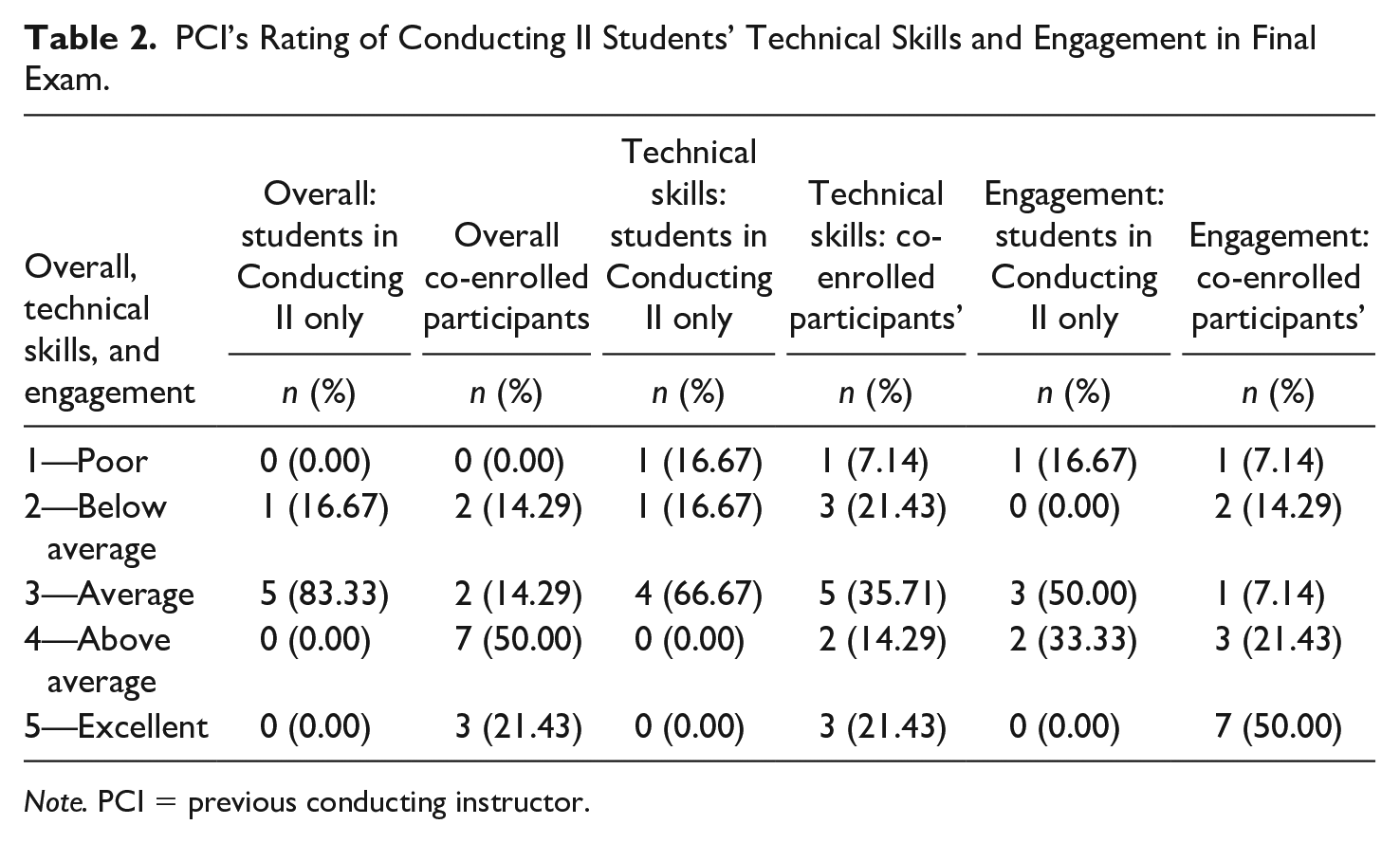
In his overall evaluation of all 20 students’ final exams, the PCI rated 10 of the 14 (71%) co-enrolled participants “Above Average” (four) or “Excellent” (five) while all six (100%) of the students enrolled in Conducting II only were rated “Average” (three) or lower. Co-enrolled participants largely received higher ratings in both technical skills and engagement than those only enrolled in Conducting II (Table 2).
PCI’s Rating of Conducting II Students’ Technical Skills and Engagement in Final Exam.
Note. PCI = previous conducting instructor.
Means of the overall ratings of those co-enrolled (M = 3.79, SD = .94, Mdn = 4) and not (M = 2.83, SD = .37, Mdn = 3) were compared with a Mann–Whitney U test. There was a null hypothesis that there was no statistical difference in the overall scores between the two groups, but the difference in means was statistically significant (U = 16, p < .05) so the null hypothesis was rejected.
When considering only technical skills, five (35.72%) of co-enrolled participants were rated “Above Average” (four) or “Excellent” (five), while none (0%) of those enrolled in only the Conducting II course were rated as such (Table 2). Means of the technical ratings of co-enrolled (M = 3.43, SD = 1.05, Mdn = 3) and control (M = 2.5, SD = .764, Mdn = 3) groups were compared through a Mann–Whitney U test, with a null hypothesis that there is no statistical difference in the technical scores between the two groups. The difference was statistically significant (U = 12, p < .05) so the null hypothesis was rejected.
Nearly all 20 Conducting II students scored higher in engagement than technical ability (Table 2). This could be because most students completed peer teaching rounds in multiple methods courses across multiple semesters that were focused on developing teacher persona and pedagogy as compared with only two semesters of Conducting courses focused on technical skill development. In looking specifically at the three co-enrolled students who were rated “Poor” (one) or “Below Average” (two), for engagement, researchers noted that all of them were transfer students who had not completed the same sequencing of methods coursework that included peer teaching at our institution that other co-enrolled participants had prior to Phase III. This aligns with MEF and CF qualitative findings and further indicates that podium time, peer teaching, and feedback significantly impact students’ ability to engage the ensemble when leading a rehearsal.
No students enrolled in only the Conducting II course were rated “Excellent” (five) in engagement, while seven (50%) of co-enrolled participants were (Table 2). A Mann Whitney test was used to compare the means of co-enrolled (M = 3.93, SD = 1.33, Mdn = 4.5) and control (M = 3.0, SD = 1.00, Mdn = 3) students’ engagement scores, with a null hypothesis that there is no statistical difference in the engagement scores between the two groups. The difference was statistically significant (U = 19, p < .05) so the null hypothesis was rejected.
Given the statistical significance of the differences in the means of the overall, technical, and engagement scores and the fact that the only additional opportunities co-enrolled participants had for the development of overall, technical, and engagement skills were the co-curricular experiences in the present study, we can infer that the co-teaching of these courses, co-curricular assignments, additional podium time, and peer teaching experiences with live feedback had a positive impact on students’ development of these skills, again corroborating the qualitative data.
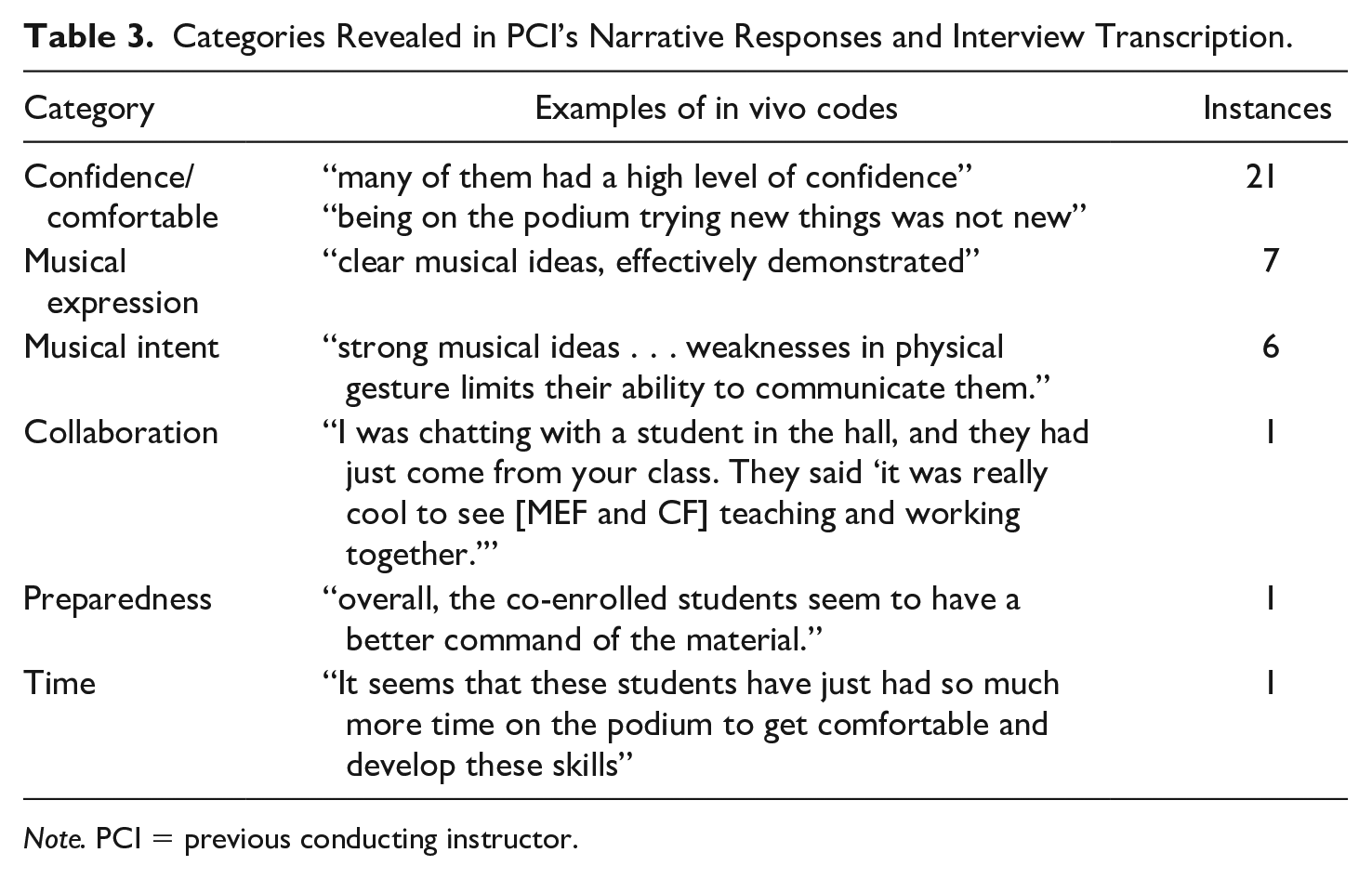
Along with the ratings assigned in close-ended survey items (Table 2), the PCI made narrative comments describing students’ strengths and weaknesses which were used to prompt interview discussion. The narrative responses and interview transcription were coded as described (Table 3).
Categories Revealed in PCI’s Narrative Responses and Interview Transcription.
Note. PCI = previous conducting instructor.
These data align with the descriptive and quantitative data from the close-ended survey responses, as well as corroborate the qualitative data from music teacher educators and students. They indicate that co-enrolled participants demonstrate greater comfort and proficiency in leading ensembles, exhibiting a command of gesture, musical intent, and expression. The PCI’s high engagement ratings (Table 2) are primarily attributed to students’ confidence levels (Table 3). Many students displayed higher confidence on the podium compared with previous cohorts, even when there was a disparity between one’s confidence level and technical ability. This improvement is attributed to the revised curriculum, which included peer teaching rounds with feedback over multiple semesters, an opportunity not available to previous cohorts under the previous curriculum.
Student Perceptions of the Co-Curricular and Lab Experiences—Research Question 2
Co-Enrolled Participant Survey and Group Interview
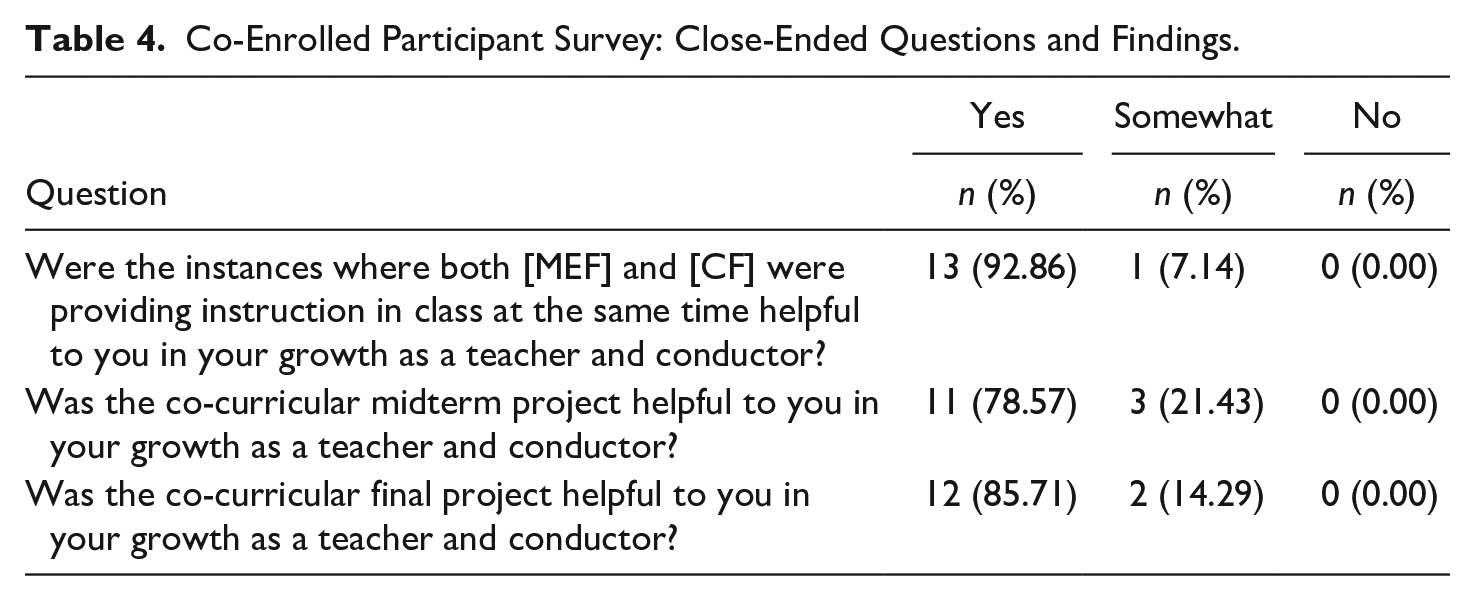
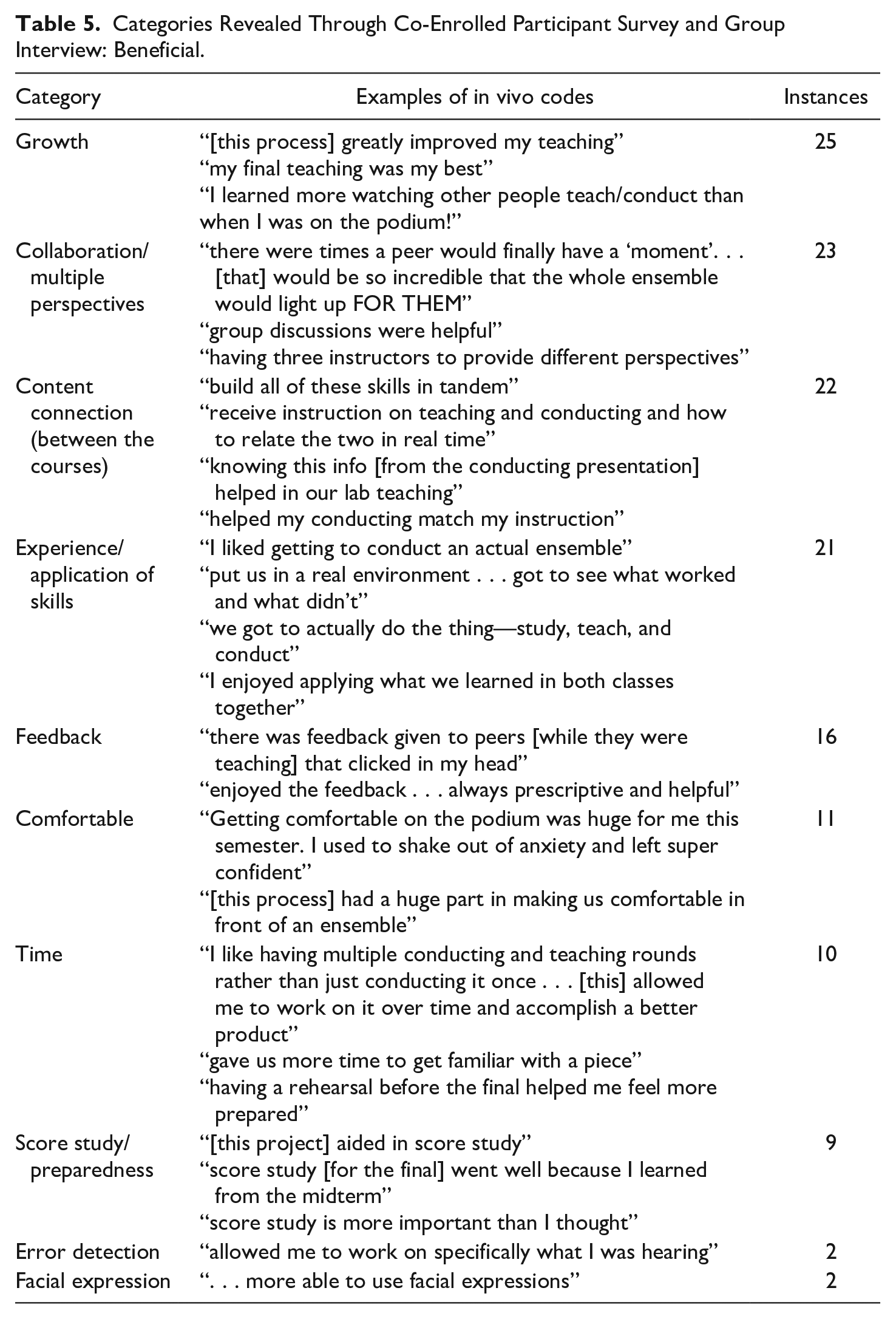
Descriptive statistics were run on close-ended responses in the survey (Table 4), and the open-ended responses and interview transcription were coded as described (Tables 5 and 6); the findings of which were overwhelmingly positive.
Co-Enrolled Participant Survey: Close-Ended Questions and Findings.
Categories Revealed Through Co-Enrolled Participant Survey and Group Interview: Beneficial.
Categories Revealed Through Co-Enrolled Participant Survey and Group Interview: Needs Improvement.
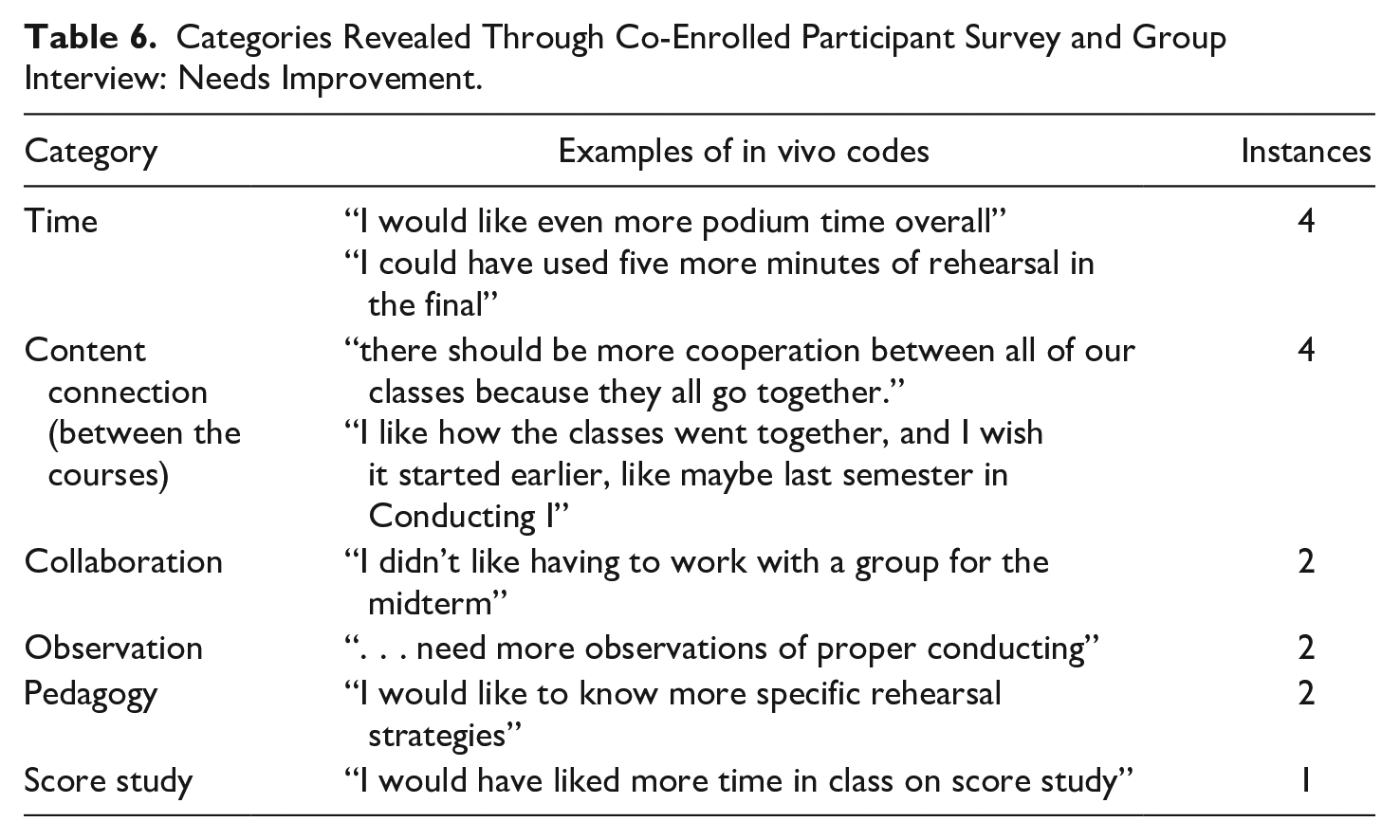
Table 4 shows that the vast majority of students considered the co-curricular and lab experiences to be positive, with no students reporting a negative experience. The three students who felt that the midterm project was only “somewhat” helpful indicated that they did not like the group aspect of the project and that they would have preferred to do it on their own but made no negative reference related to the actual content, process, or application of the project. One student stated that “I didn’t like the group project because some people procrastinated, which was stressful, but I see the value in learning how to collaborate with others even when you don’t see eye to eye.” The two students who indicated that the final was only “somewhat” helpful indicated a desire for more specific error detection skill development.
Table 5 lists the categories revealing the ways in which students felt the co-curricular experiences were beneficial to them through their open-ended survey responses and the group interview. Students recognized growth in themselves as well as their peers, with responses related to witnessing growth in their peers accounting for approximately one-third of the total instances of “growth.” One student summed it up by saying, “We are all better teachers now! I really enjoyed seeing my peers’ growth . . . their progress and improvement were evident, and truly inspiring!” Another student noted that they “learned more watching other people teach/conduct than when [they] were on the podium!” which pointed to the positive impact of the lab ensemble and peer teaching experiences involving everyone in the room, not just the student who is teaching.
Like the faculty, students appreciated the learning opportunities afforded by the collaboration in Lab experiences, group discussions, and having multiple instructors present in their courses. Their opportunities for podium time/teaching experiences in which to apply and develop their skills while receiving feedback were also highly valued, particularly in that conducting and pedagogy were addressed simultaneously. Students also recognized that the detailed score study, research, and presentation process of the midterm contributed to their growth (see in vivo codes in Table 5). When asked specifically in the survey and interview, students indicated ways they felt the process could be improved in the future (Table 6).
Although more podium time and teaching opportunities had already been afforded, some students expressed a desire for even more podium time and a readiness to study more advanced rehearsal strategies. While students participate in multiple weekly rehearsals of a large ensemble led by expert faculty conductors, their desire for “more observations of proper conducting” suggests that they are not connecting these large ensemble experiences as performers with their teaching development.
Summary
Findings indicate that the co-teaching of and co-curricular assignments between the Clinical Experiences and Conducting II courses promoted growth in students’ conducting and pedagogical skills. Given that the quantitative findings support the qualitative findings, we can say that “paradigmatic corroboration,” as defined by Saldaña (2016), has occurred when both approaches “have been used to examine the same local phenomenon or data set . . . [and] the quantitative results of a data set do not simply harmonize or complement the qualitative analysis but corroborate it” (p. 26). Students experienced significant benefits from increased peer teaching opportunities accompanied by live faculty feedback throughout their degree, resulting in high levels of engagement on the podium. The 14 co-enrolled participants, in particular, exhibited higher scores in engagement and conducting technical skills, indicating that the co-curricular experiences specifically contributed to student growth. Faculty collaboration, student collaboration, additional teaching opportunities, live feedback, reflection, score study processes, and the integration of curricula enhanced students’ confidence on the podium, error detection skills, pedagogy, ability to provide verbal feedback, and communication of musical understanding and expression through conducting gestures.
These findings align with previous studies which indicated that increased score study, peer teachings, live feedback from faculty, and video reflection benefit preservice music educators’ skill development (Causby, 2021; Grey, 2022b; Parker et al., 2017; Silvey & Major, 2014; Teachout, 2004). Extant literature pointed to a need for a cyclical undergraduate music education curriculum allowing students teaching opportunities and lab experiences over multiple semesters as well as a connection between music education and conducting curricula (Causby, 2021; Grey, 2022a; Hart, 2019; Noon, 2019; Silvey et al., 2020), and the present study indicates that these strategies are effective music teacher education practices that promote student and faculty growth.
Limitations and Future Modifications
The current study enables a comparison between co-enrolled participants and students who took the Clinical Experiences course before their conducting courses; however, it does not provide a comparison with students who took the Clinical Experience course after their conducting courses. In addition, the generalizability of the results is limited as music education course sequencing and content may vary across different institutions. If other institutions aim to modify their course sequencing, they may encounter practical challenges such as scheduling and classroom availability.
Although the focus of the study was on faculty and co-enrolled students’ perceptions of co-curricular experiences, surveying and interviewing students enrolled only in Conducting II could have enhanced the data. These students, while not leading peer teaching episodes, may have participated in the Lab Ensemble and observed their co-enrolled peers teaching and receiving live feedback. In addition, they would have experienced faculty co-teaching during MEF sessions in their Conducting II course. Their assessment of the advantages and disadvantages of their course sequencing and experiences could have provided valuable insights, as their experience differed from that of co-enrolled participants.
Throughout the study, potential changes to the co-curricular process were observed and discussed among instructors. Initially, instructors realized that providing feedback simultaneously overwhelmed some students, as noted in early journal entries and meetings. Consequently, a more balanced approach to feedback was adopted, with a “lead” instructor providing feedback and other instructors offering input as necessary. This revised approach felt more natural over time and will be implemented from the beginning in future iterations. Furthermore, in upcoming semesters, course instructors will commence co-teaching the lab ensemble earlier in the process. While MEF attended conducting course rounds throughout the semester, CF and/or GA joined the lab ensemble at midterms. It has been agreed upon that CF should participate in lab teaching sessions for the entire semester, and efforts will be made to align conducting and lab ensemble coursework and repertoire earlier in the semester. For the final project, all co-enrolled students rehearsed the same piece of music. Although they rehearsed different movements, there was still enough repetition that it became somewhat monotonous for ensemble members. In the future, multiple works will be used to eliminate or at least significantly reduce repetition in final project rehearsals.
Implications for Research and Practice
Research
Further research is required to assess the efficacy of co-curricular experiences between music education methods and conducting courses. Investigating the previously mentioned limitations and conducting qualitative self-studies using similar or diverse designs would be valuable. Quantitative data could also be informative, particularly if faculty evaluations and student self-efficacy scales are utilized to evaluate students before and after implementing co-curricular experiences, with a control group undergoing the same process. Such a study could provide insights into which specific skills are most enhanced through this approach.
There were multiple data points which suggest that faculty collaboration throughout this process was beneficial not only to students but faculty as well. Opportunities for faculty collaboration in other courses should be explored and may also be something to promote in music teacher educator preparation as well.
Music Teacher Preparation
Existing literature highlights the importance of linking music education methods and conducting courses (Causby, 2021; Grey, 2022b; Parker et al., 2017; Silvey & Major, 2014; Teachout, 2004). This study offers specific effective strategies for establishing this connection. To enhance their programs, music teacher educators should assess and incorporate co-curricular experiences between conducting and music education methods courses. Faculty collaboration opportunities should also be explored. It is recommended that students engage in peer teaching experiences accompanied by live faculty feedback and student video reflection, as demonstrated in this study (Grey, 2022b).
Footnotes
Declaration of Conflicting Interests
The author(s) declared no potential conflicts of interest with respect to the research, authorship, and/or publication of this article.
Funding
The author(s) received no financial support for the research, authorship, and/or publication of this article.
