



Abstract
This paper presents some analytical solutions for the static response of a nonlocal continuum damage mechanics (CDM) softening rod in tension. Two families of nonlocal CDM models valid for quasi-brittle materials are explored in this study: a ‘classical’ nonlocal strain-driven CDM model and a peridynamic CDM model. For both nonlocal CDM models, the elasto-damage constitutive law and the damage loading function can be affected through two independent scale-dependence kernels. It is chosen in this paper, to focus on the introduction of the nonlocality, for both CDM models, in the damage loading function. It is shown that the response of a strain-driven nonlocal damage rod may coincide with the one of a peridynamic nonlocal damage rod, for specific calibrated exponential kernels. Both nonlocal damage models, the strain-driven and the peridynamic damage models, governed by integral equations or integro-differential equations, are reformulated in a nonlocal differential framework. The propagation of the localization zone during the softening process is analytically investigated, by solving a moving damage boundary value problem. The size of the damage localization zone is shown to be loading-dependent. The strain profiles for both models are obtained and confirm the strain localization in the finite damage structural area of the homogeneous nonlocal rod in tension. The paper concludes by an analysis of the scale-dependence response of such nonlocal, strain-driven and peridynamic damage rods.
Keywords
Introduction
This paper deals with the capability of integral nonlocal damage models (including strain-driven and peridynamic nonlocal models) to predict localization in elementary structural problems. Nonlocal damage models have been shown to be efficient in the modelling of microcracking in the presence of strain softening materials such as quasi-brittle materials (rocks, concrete, etc.). Pijaudier-Cabot and Bažant (1987) first proposed a nonlocal damage theory, based on the introduction of nonlocality in damage loading function. This theory has the advantage to leave the initial elastic behaviour unaffected, for example, local, and to control a localization process in a post-peak regime. Among strongly nonlocal damage models, also called integral-based nonlocal damage models, strain-driven or damage energy release rate-driven nonlocal damage models have been first developed. More specifically, Pijaudier-Cabot and Bažant (1987) applied a nonlocal integral operator on the damage energy release rate variable in loading function. Peerlings et al. (1996) later used a strain-driven nonlocal damage model, where the nonlocal strain is introduced from a nonlocal differential operator, as used by Eringen (1983) for nonlocal elasticity. This strain-driven nonlocal damage model is also referred to as an implicit gradient model in the literature (Peerlings et al., 2001). Nonlocal damage and plasticity models have been extensively reviewed by Bažant and Jirásek (2002) or Jirásek and Bažant (2002). Analytical solutions have been obtained by Challamel et al. (2009) for a strain-driven nonlocal damage rod in tension, using a nonlocal strain measure proposed by Peerlings et al. (1996). Challamel (2010) derived alternative analytical solutions for a damage energy release rate-driven nonlocal rod, also introduced from a differential formulation (an implicit gradient damage model formulated in terms of the damage energy release rate variable). More recently, Xue et al. (2024) also investigated analytically the static response of a damage energy release rate-driven nonlocal rod, using an exponential function of the damage energy release rate in loading function.
Another family of nonlocal damage models developed later during the 21st century is the so-called peridynamic damage model (also called a displacement difference damage model). A peridynamic brittle damage model has been introduced by Silling (2000) or Silling and Askari (2005), who used elastic-brittle bonds for modelling impact and dynamic fragmentation (see also the review paper of Dorduncu et al., 2024). Gerstle et al. (2007) studied a peridynamic damage model applied to concrete modelling and used a progressive softening response instead of a brittle one. Tupek et al. (2013) computed some impact tests based on a peridynamic damage model coupled to plasticity. Bažant et al. (2016) compared peridynamic and nonlocal strain-driven elasticity models and discussed also the link with lattice elasticity models, pointing out the difficulties of peridynamics to model wave propagation properly in the elastic regime. Hattori et al. (2021) presented a review of peridynamic models applied to reinforced concrete structures, including peridynamic damage models. Bažant et al. (2022) discussed the relevance of peridynamic, phase-field and crack band models in the modelling of fracture tests, especially with respect to realistic size effects which cannot be captured in accordance with experiments with the phase field and peridynamic models considered in their study. Bazilevs et al. (2022) simulated realistic fracture tests using a microplane damage model developed in a peridynamic framework. Bazilevs et al. (2022) also discussed correspondence-based peridynamic theories which can be viewed as a discretization method to approach continuous evolution problems. Pijaudier-Cabot et al. (2024) investigated localization in a damage peridynamic rod with both a brittle and a damage-based bond relationship.
Peridynamic continuum damage mechanics (CDM) models developed in the literature (bond-based peridynamics), until now, assumed a coupling of elasticity and damage in a momentum balance equation, which means that the elasticity is also affected by some scale effects in such a framework (peridynamic elasticity theory in the absence of damage effects). A peridynamic CDM model considered in this paper differs in the sense that two independent peridynamic strain measures are used, one introduced in a momentum balance equation through a two-phase peridynamic elasto-damage model (classical peridynamic contribution), and the other in damage loading function. In the limit of a vanishing horizon in the momentum balance, the elasto-damage constitutive law can be preserved in a local state, while the damage loading function can still present a nonlocal dependence controlled by a peridynamic differential operator. For such family of peridynamic damage models, elasticity is assumed to be unaffected by scale effects, only the damage function will be controlled by a peridynamic operator. Furthermore, no exact solutions have been derived for peridynamic damage problems, even under elementary loading configurations. This is in particular due to the difficulty to derive analytical solutions for peridynamic elasticity problems. Most of the available solutions of peridynamic elastic problems have been derived for infinite media (Bažant et al., 2016; Chen et al., 2023; Eremeyev and Naumenko, 2025; Silling et al., 2003; Weckner and Abeyaratne, 2005). Analytical solutions for finite peridynamic elastic structural problems are less documented. For some specific normalized exponential kernels, Challamel and Zingales (2025a, 2025b) reformulated the integro-differential equations of two-phase peridynamic elastic structural problems in a higher-order differential form. Exact solutions have been found for the static and dynamic behaviours of finite two-phase peridynamic elastic rods or beams (see also Challamel and Aftabi-Sani, 2026 or Aftabi Sani and Challamel, 2026).
This paper is devoted to the investigation of some closed-form solutions of nonlocal peridynamic or strain-driven damage theory. Closed-form solutions of a peridynamic damage model are presented in case of uniform rod in tension. The paper also questions the possible link between peridynamic damage model and nonlocal strain-driven damage model. In elasticity, for infinite media, and provided that the displacement field is sufficiently smooth, the equivalence between nonlocal strain-driven elasticity and peridynamic elasticity has been already proven within a correspondence principle between each kernel (see Silling et al., 2003; Challamel, 2018 or more recently Challamel and Zingales, 2025a, 2025b). In case of peridynamic damage, localization appears in finite zones, and such kinds of equivalence between a strain-driven nonlocal damage model and a peridynamic damage model are expected not to be fulfilled. However, it will be shown herein that for specific kernels, it is possible to derive an equivalence between both the integral damage models, with a strict identical response, in terms of localization, strain response and scale effects. The exponential kernel used for the present peridynamic damage model is analogous to the one introduced by Challamel and Zingales (2025a) or Challamel and Zingales (2025b) for peridynamic elastic rods and beams. However, the support of the peridynamic kernel (influence domain) in the present peridynamic damage model with moving boundary is evolving during a damage propagation process. The paper also discusses the possibility to introduce separately the peridynamic dependence of mechanical problems, in both the momentum balance equation and the damage loading function.
Peridynamic damage rod
Peridynamic momentum balance equation
The tension of a homogeneous two-phase peridynamic rod is studied, as shown in Figure 1. A two-phase peridynamic elasto-damage rod of length L (x between −L/2 and L/2) is studied in the presence of axial distributed load q. This one-dimensional problem is controlled by two one-dimensional fields, the axial displacement u(x) and the damage field D(x). Damage is a positive parameter which evolves between 0 (for the undamaged state) and 1 for a fully damaged state (failure). Equilibrium reads:



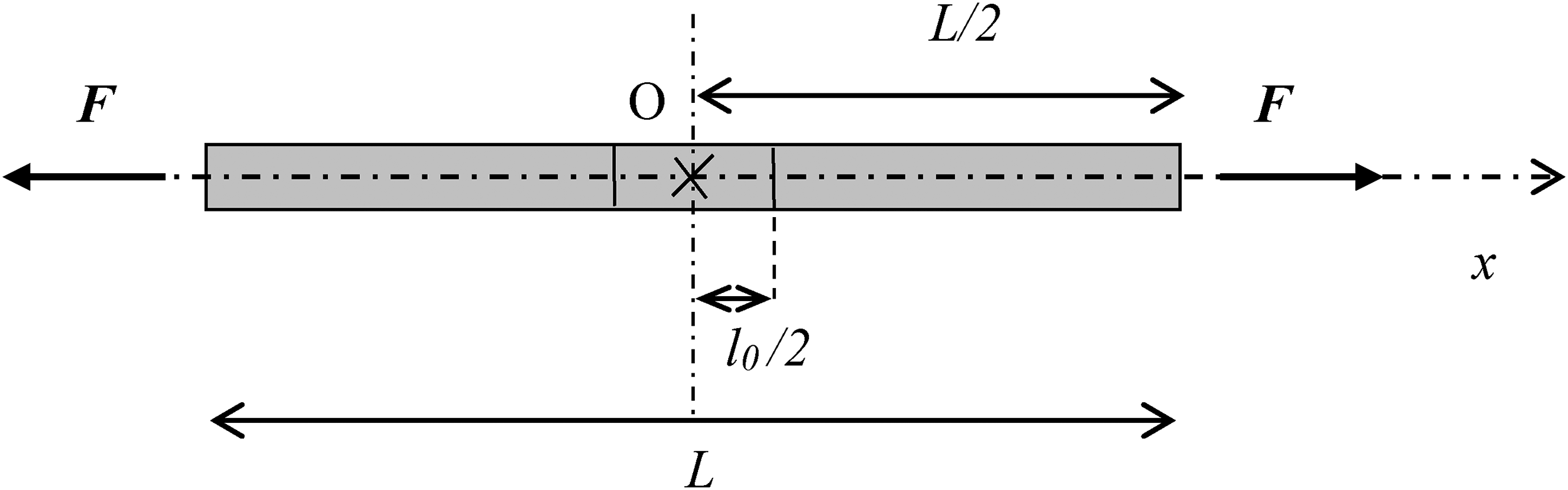
Nonlocal peridynamic CDM rod in tension. CDM: continuum damage mechanics.
One can assume a multiplicative damage rule, such as:

One can also assume an additive damage rule, such as:

It is also possible to consider some alternative damage norms such as:

In the particular case of the undamaged material D(x) = 0, one recognizes a two-phase peridynamic elastic model studied by di Paola et al. (2009) or more recently by Challamel and Zingales (2025a):

The static behaviour of the uniform two-phase elasto-damage peridynamic rod of length L under distributed tension load q and concentrated load F may be equivalently expressed from the principle of virtual work:


In the following, we will consider only the elasto-damage peridynamic rod in pure tension, without distributed load (q = 0):

By comparing equations (9) and (1), we identify the constitutive two-phase nonlocal peridynamic elasto-damage rod model:

For pure local elasto-damage phases


It is worth mentioning that another peridynamic elasto-damage generalization can be derived from the effective normal force concept as:

In the peridynamic model considered in this study, the elasto-damage response is assumed in a local form (

Peridynamic damage loading function
In the present paper, as opposed to the main existing works on peridynamic damage models, the elasto-damage constitutive law will be kept in a local form (which can be seen as a particular case of the two-phase peridynamic elasto-damage rod), and only the loading function will be affected by a peridynamic operator. It would be possible to consider formally a peridynamic operator both for the elasto-damage constitutive law and the loading function.
It is assumed that the elasto-damage rod of length L is composed of a damage part of length l0 (with l0 smaller than L) and a complementary elastic part (see also Figure 1).
The loading function, for the peridynamic damage rod investigated in this paper, is postulated in the following form:



The peridynamic kernel H(x, y) can be alternatively rewritten in a single concise form:

The following normalization criterion can be easily checked:

The loading–unloading conditions are defined by:

Analytical solution: statics of the peridynamic damage rod under pure tension
The static response of the uniform peridynamic elasto-damage rod in tension is studied. In case of uniform section

From equation (15), the damage variable can be related to the stress and the strain variables:

In the damaged zone

In this paper, the function

The softening process is controlled by the residual stress parameter
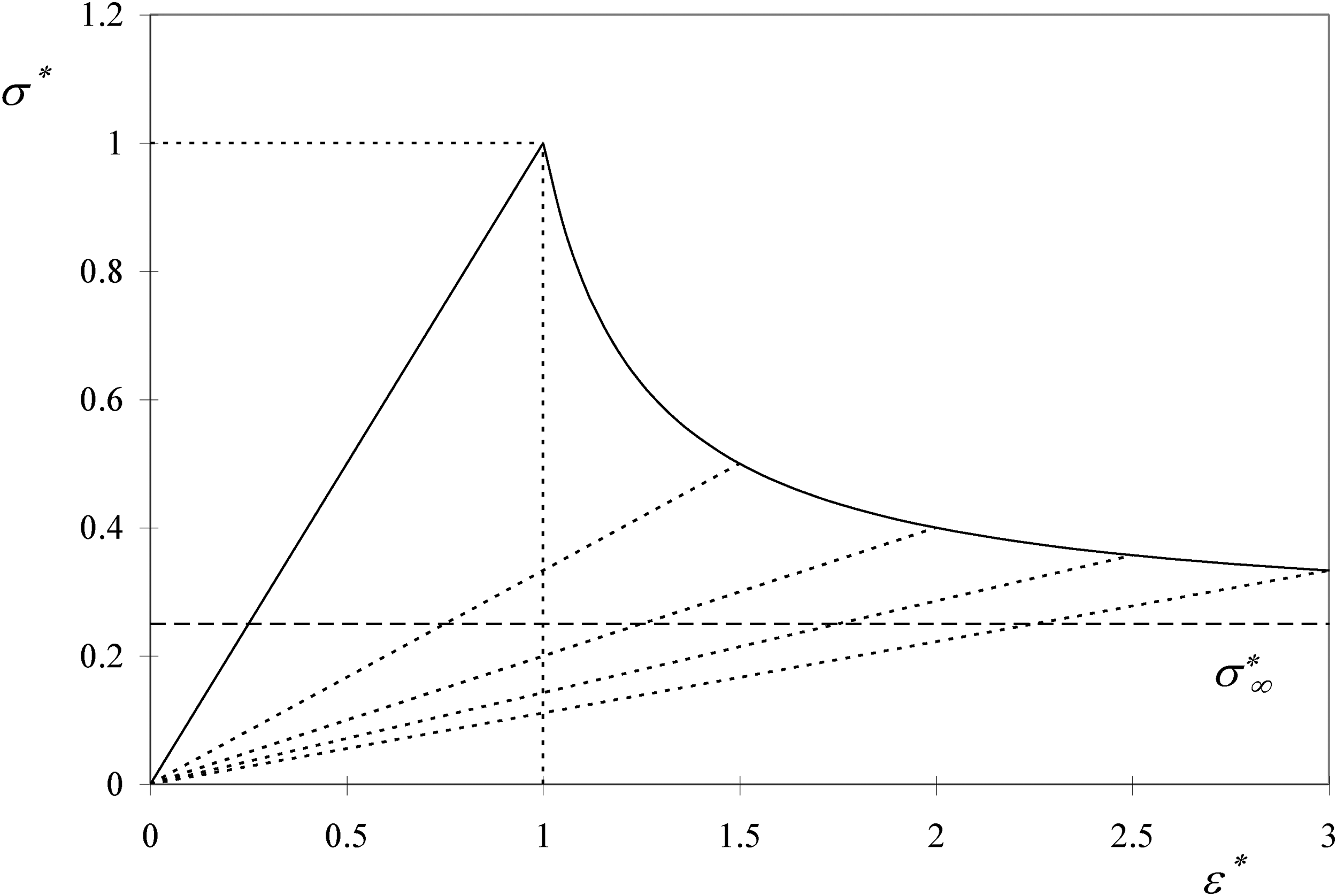
Local elasto-damage stress–strain diagram in the dimensionless space
The dimensionless variables have been chosen as:

By derivation of the nonlocal peridynamic measure, one obtains:

It is possible to introduce the equivalent strain-driven nonlocal kernel

One identifies the nonlocal strain-driven kernel, in the following form:

In particular, the kernel is vanishing at each boundary of the damage domain:

The nonlocal strain-driven kernel G(x, y) can be alternatively rewritten in a single concise form:

Equation (27) is then reformulated in the following form:

Equation (32) is equivalent to the implicit differential form:

In particular, the equivalent nonlocal strain measure vanishes at the boundary:

The same result was achieved by Challamel and Zingales (2025a, 2025b) for two-phase peridynamic elasticity, where the nonlocal peridynamic contribution, was shown to vanish at the boundaries, preserving the ‘local’ character of the boundary behaviour (surface effect).
Using equations (23), (24) and (25) gives the integro-differential equation in the damage domain:

One finally obtains, for the peridynamic field equation in the damage domain, a linear second-order differential equation in terms of nonlocal strain measure:

or equivalently:

The solution of this linear second-order differential equation with constant coefficients is easily derived in the following form:

As shown in Appendix C, the boundary conditions associated with this moving boundary value problem are expressed with the continuity condition of the damage variable (Dirichlet boundary condition) and the Neumann-type boundary condition for the peridynamic nonlocal variable:




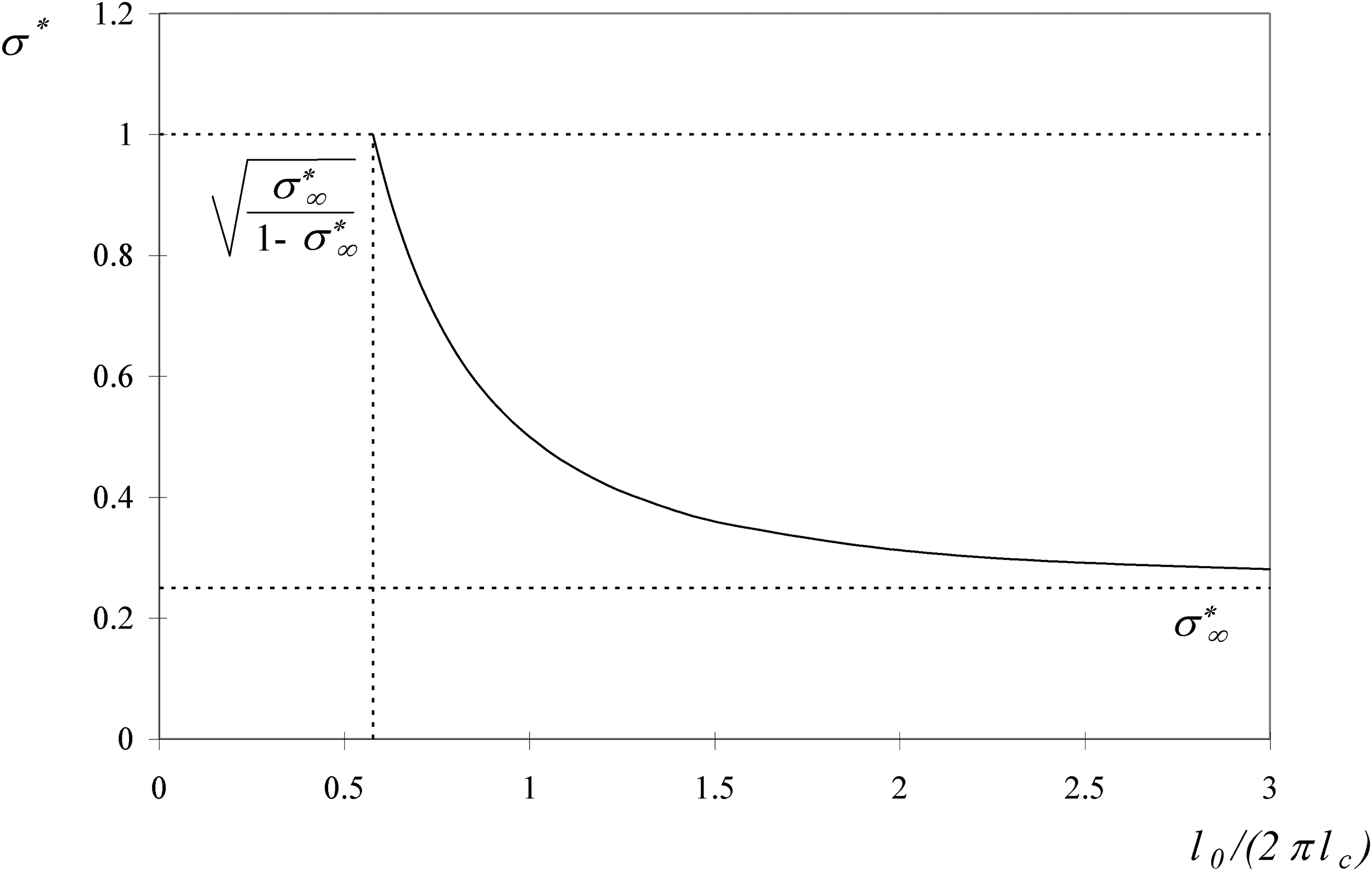
Evolution of the damage zone
The nonlocal strain variable is derived from the consideration of boundary conditions:



The normalized strain

The damage profile is obtained from the elasto-damage constitutive law:

Figure 4 shows the strain profile in the damaged zone, with an increase of the localization process controlled by the damage propagation evolution. The growth of the damage zone during the softening damage process is highlighted in Figure 5. The damage field reaches its maximum value along the symmetry axis x = 0:

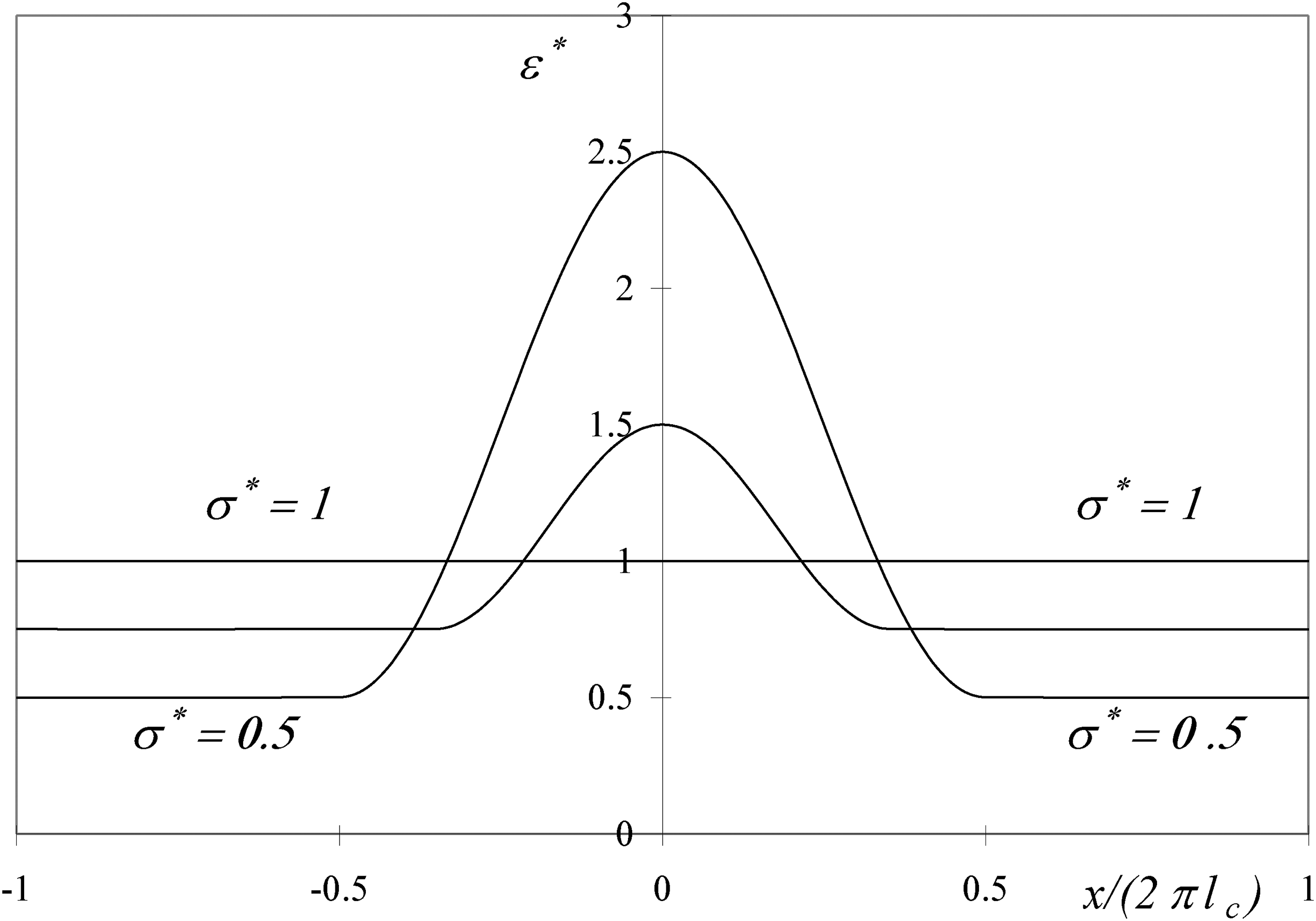
Evolution of the strain profile in the damage zone for different stress values during the softening process; nonlocal and peridynamic damage model:
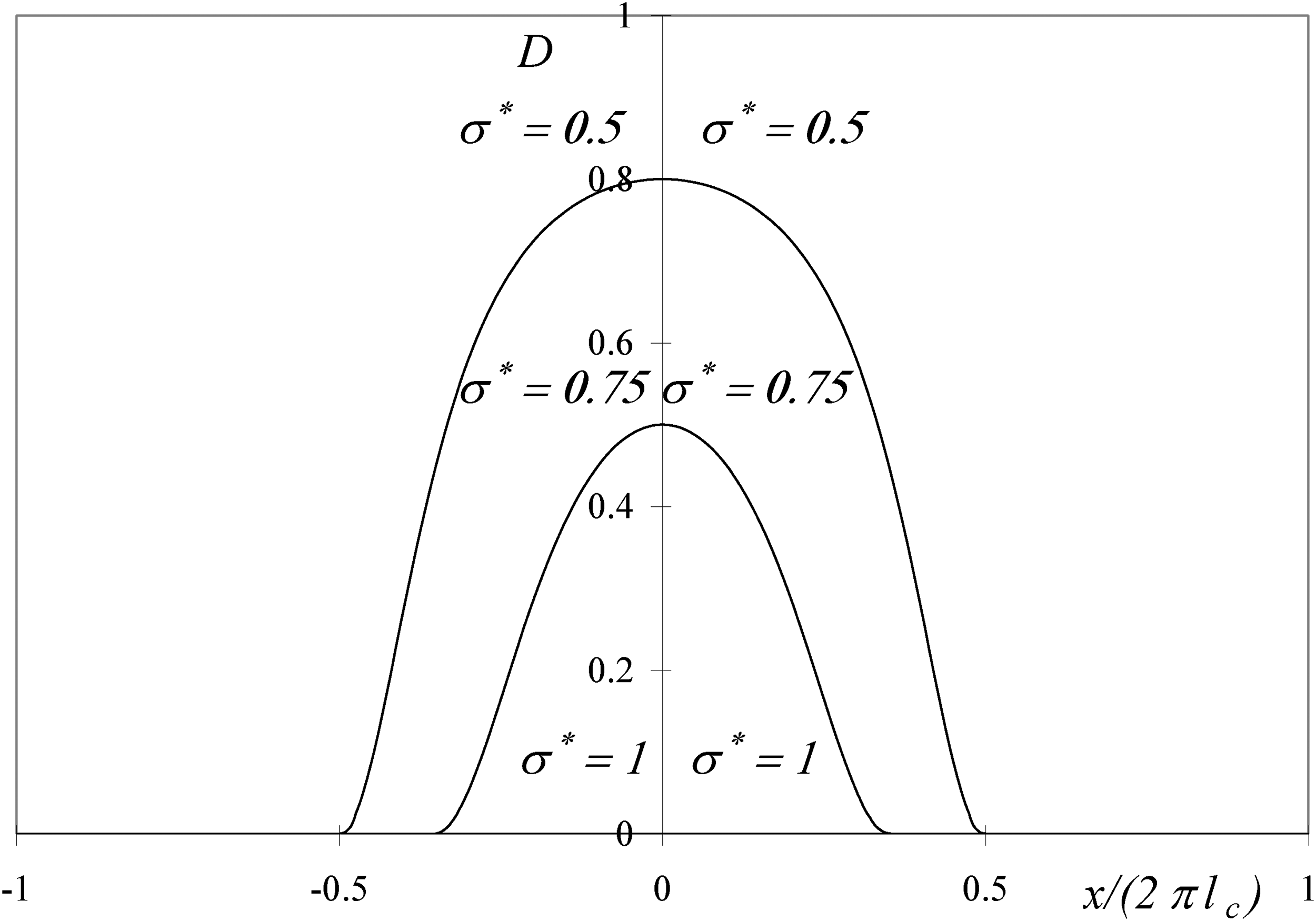
Evolution of the damage profile for different stress values during the softening process; nonlocal and peridynamic damage model:
The displacement in the damage domain is obtained by integration, using the fixed boundary condition u(0) = 0, which gives, for



The critical elastic displacement

One finally has the force–displacement relationship:

Figure 6 shows the load–displacement diagram, obtained from equation (53) with n equal to
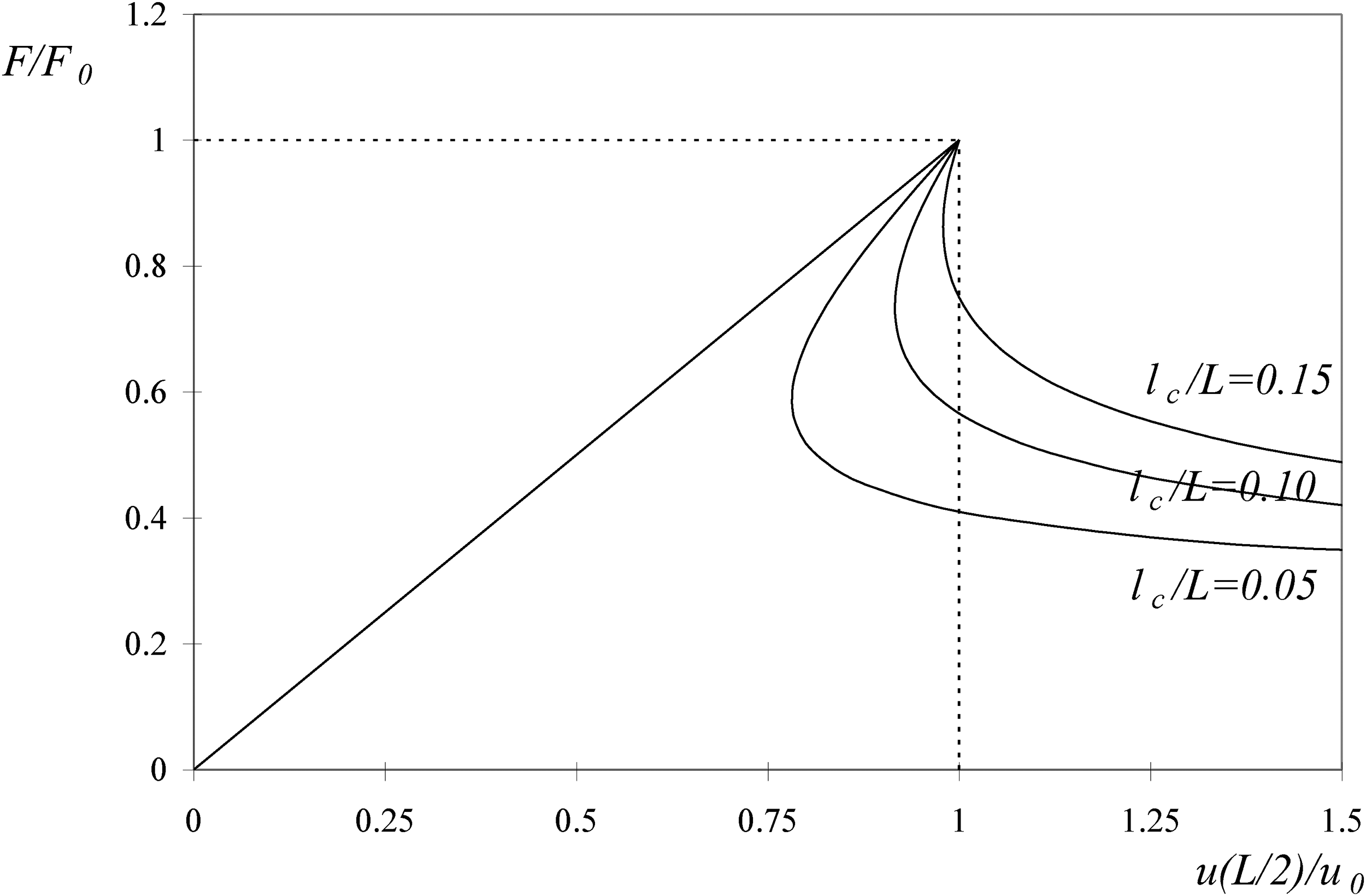
Load–displacement response of the strain-driven nonlocal or peridynamic CDM rod:
The damage zone propagates along the peridynamic elasto-damage rod up the physical boundary limit of the finite rod (the front of the moving boundary damage domain is reaching the rod extremities), that is, for:

This criterion defines a critical stress associated with the complete damage rod state, given, for n = 1, by:

Strain-driven nonlocal damage model
Closed-form solutions can also be obtained for a strain-driven nonlocal damage model, also referred to as implicit gradient damage model. In case of implicit gradient damage models, the loading function and the nonlocal strain variable


Inserting the definition of the nonlocal strain in equation (56) into equation (57) leads to the following second-order linear differential equation:

For the strain-driven nonlocal damage model (implicit gradient damage model), the boundary conditions are also obtained from the variational principle (see Appendix D):

As a consequence, the kernel of the nonlocal strain-driven damage model is explicitly obtained from the Green's function of the differential equation (56) coupled to the boundary conditions equation (59):

It is worth mentioning that the present kernel of the strain-driven damage model

The nonlocal strain-driven kernel

The nonlocal strain-driven kernel such as the one given by
Using symmetry arguments, the set of boundary conditions can be reduced to:

The solution of equation (58) can be expressed in terms of trigonometric functions:

Considering the boundary conditions gives the nonlocal strain variable in the following form (as obtained by Challamel et al., 2009):

If the lowest value of integer n is selected for the damage localization zone, the nonlocal strain field

The local strain is deduced from application of the differential law equation (56) and exactly coincides with the strain profile of the nonlocal peridynamic damage model obtained from equation (45). The localization criterion equation (41) is also valid, for both the peridynamic damage rod and the strain-driven nonlocal damage model.
For both nonlocal damage models, the damage localization zone grows during the damage evolution process. This mathematical property of a growing localization damage zone during the loading process can be debated, as the localization zone can be shown experimentally to decrease during the softening damage process. This property is probably due to the choice of the damage loading function with a residual stress which controls the softening damage process. Recall that the residual stress controls both the residual strength and the brittleness of the post-peak regime. In the limit of a vanishing value of the residual strength, the response is asymptotically brittle, as highlighted in Figure 7 (in Figure 7, the dimensionless residual stress has been chosen equal to

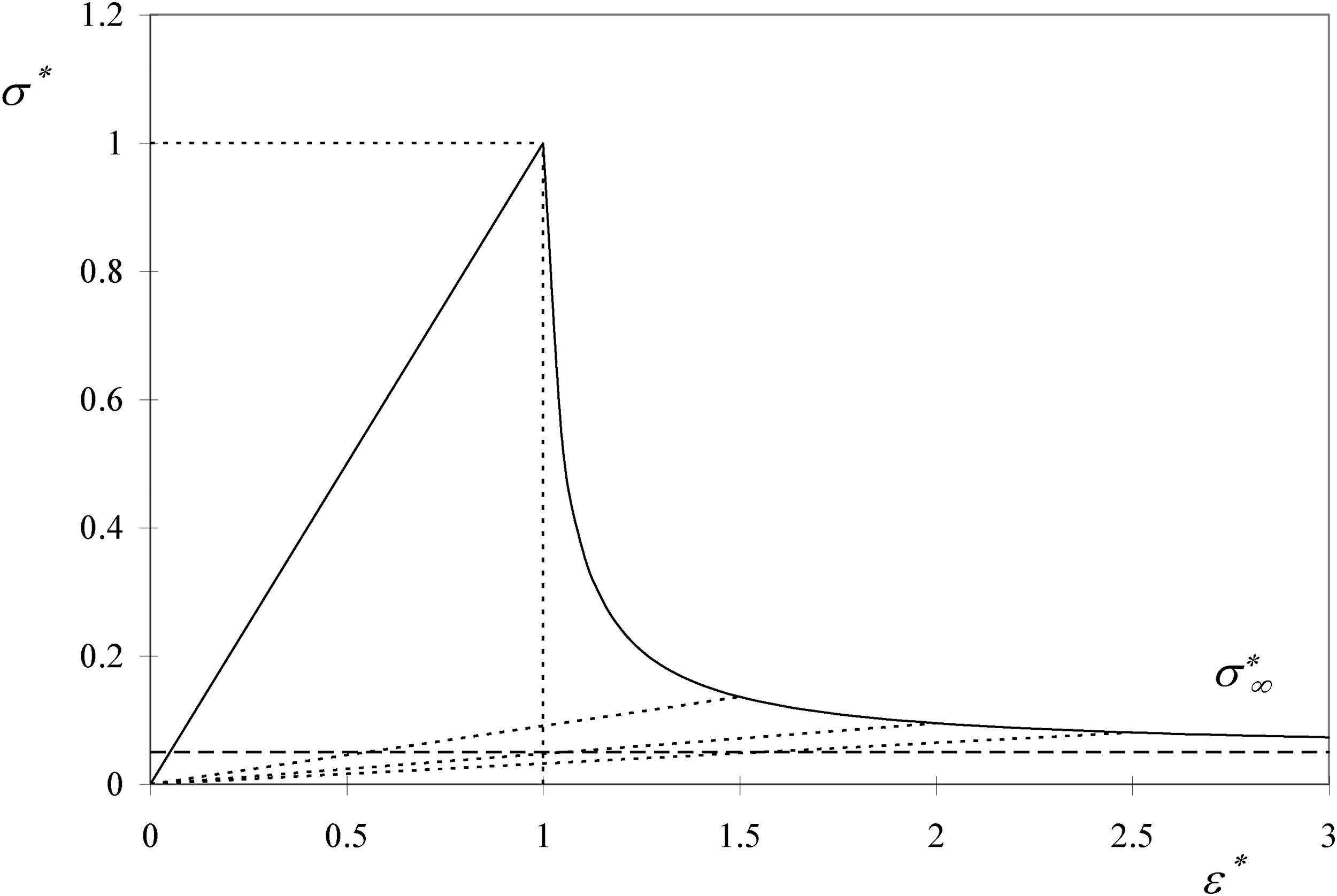
Local elasto-damage stress–strain diagram in the dimensionless space
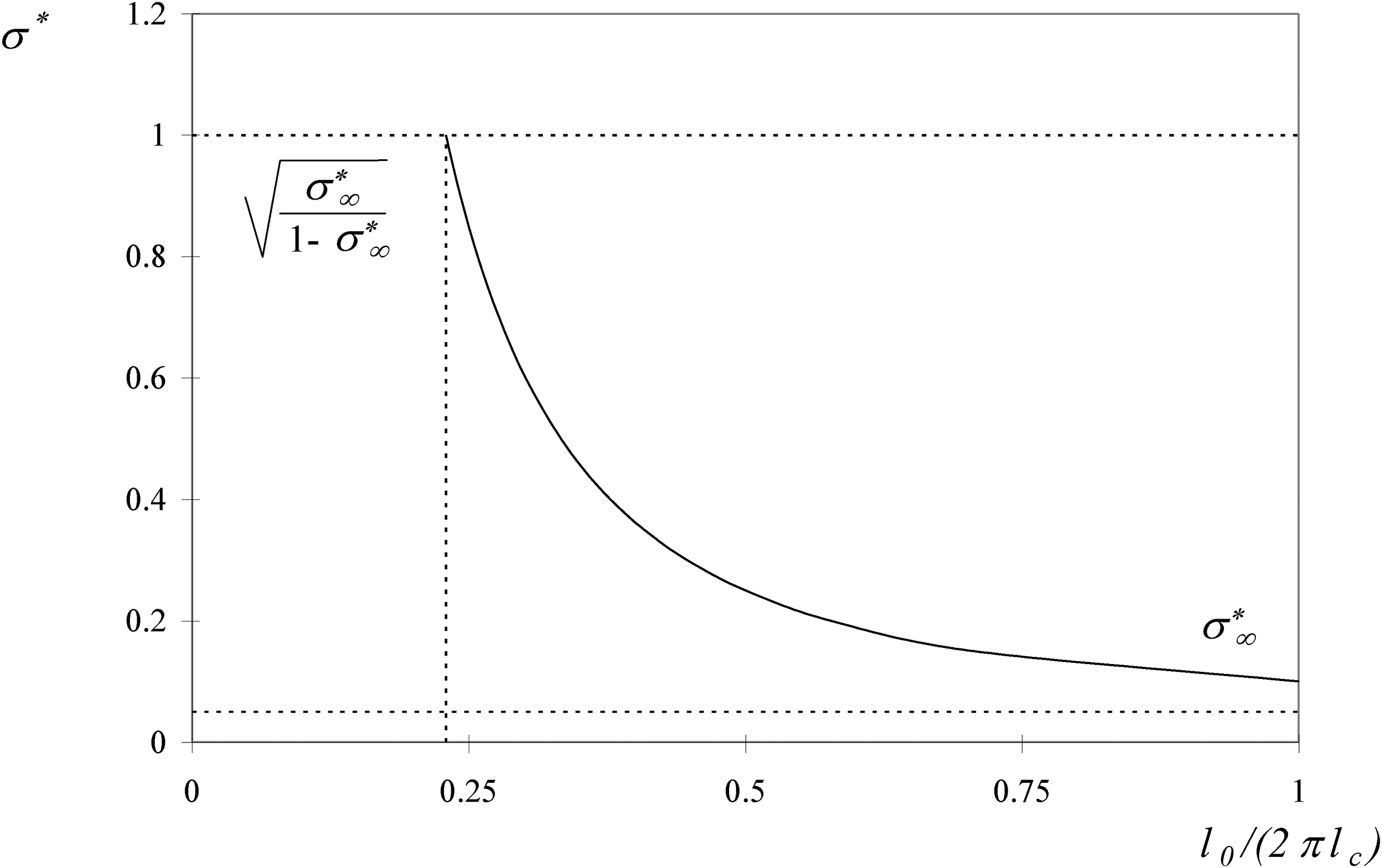
Evolution of the damage zone
At the initiation of damage, the damage length is equal to (see Figure 3 or Figure 8):

In the case of sufficiently small dimensionless residual strength (in the brittle limit), the initial damage zone is asymptotically small:

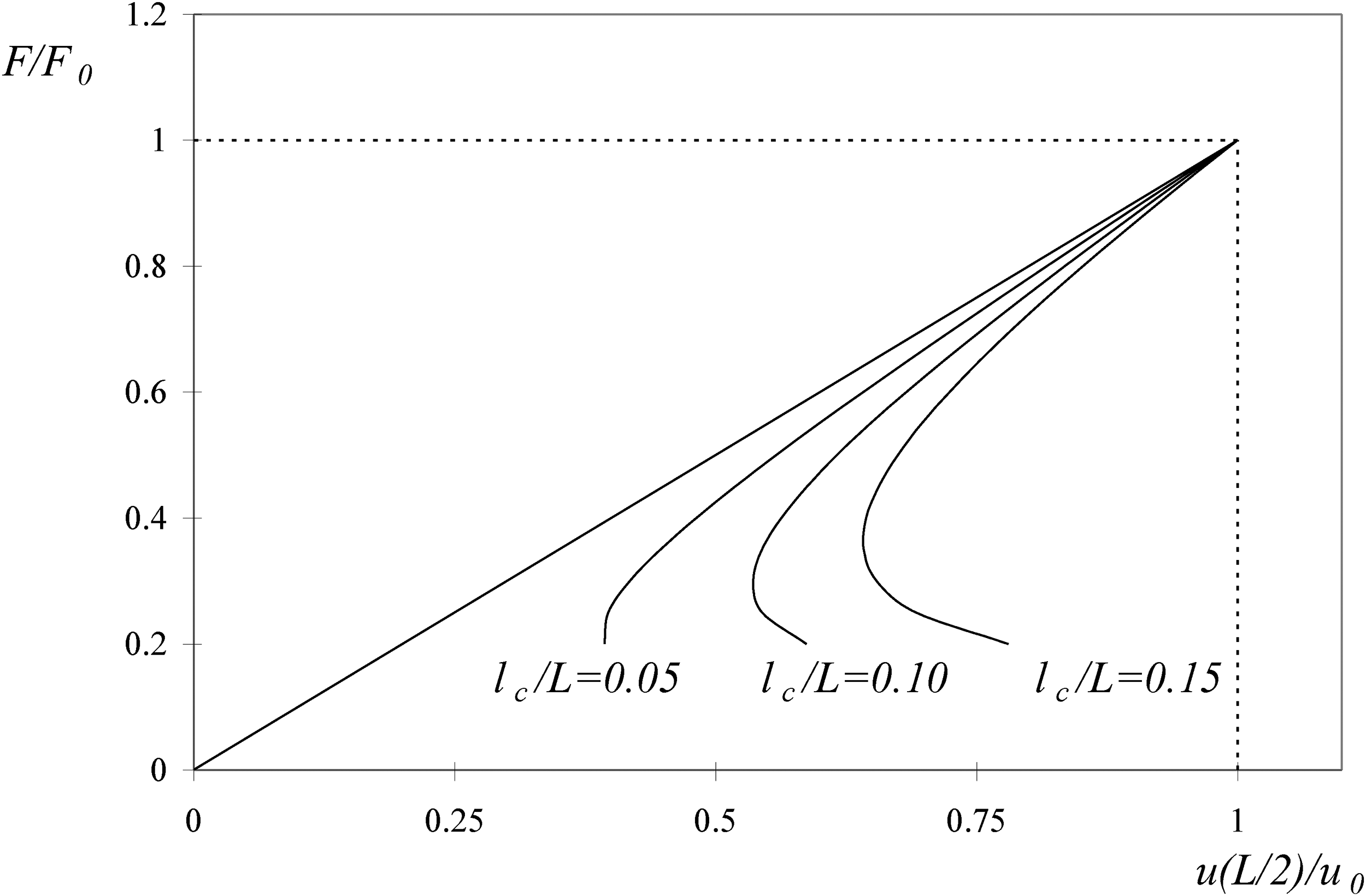
Load–displacement response of the strain-driven nonlocal or peridynamic CDM rod:
The responses of both nonlocal damage rods, the peridynamic damage rod (where the peridynamic differential operator only affects the loading function) and the strain-driven nonlocal damage rod (where the nonlocality is restricted to the damage loading function), are strictly identical, for the kernel correspondence between both nonlocal approaches. It has been possible to make coincident the two nonlocal integral damage models, from a calibration of each exponential kernel, using a correspondence principle. It is here confirmed that both integral nonlocal damage models share similar mathematical properties in terms of localization limiting capabilities, and can be eventually identical for specific calibrated kernels. The displacement field
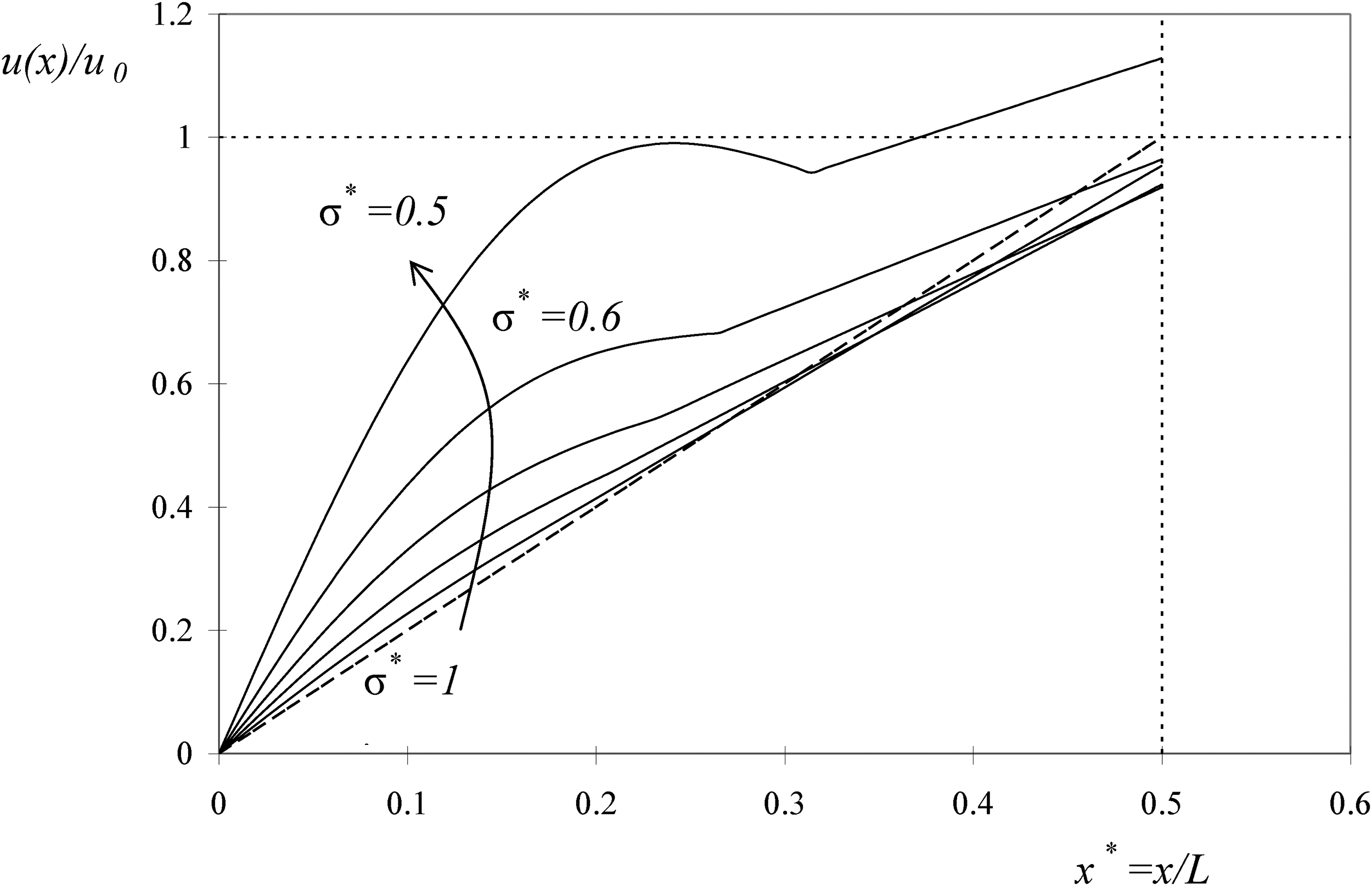
Evolution of the normalized displacement field u(x)/u0 in the peridynamic CDM rod during the propagation process:
Integro-differential eigenvalue problem of the peridynamic CDM problem
The propagation of damage along the peridynamic CDM rod is controlled by an integro-differential equation, associated with a moving boundary damage domain. By differentiating equation (35), one obtains the integro-differential equation of the peridynamic CDM model:

It can be checked that the displacement field in the damage zone, analytically derived in equation (50), is solution of this peridynamic integro-differential equation:


Injecting the solution equation (72) into the integro-differential formulation gives the necessary condition, for the solution to be admissible:

The first condition is the stress-dependent damage zone propagation law already derived in the paper:

The second condition coupled to the local strain criterion at the elasto-damage interface gives a system of two equations in A and B:


One finally obtains the coefficients A and B for the strain or the displacement field, which has been previously obtained:

The same analysis can be followed for the two associated nonlocal CDM eigenvalue problems with a moving damage boundary.
Starting again from equation (35) defines an integral equation:



The same approach can be followed as well, for the implicit gradient damage model, controlled by equation (57):




The equivalence between the integro-differential formulation of the peridynamic damage model and the two other integral equations derived from the strain-driven nonlocal damage models has been confirmed in this part. Furthermore, the integro-differential eigenvalue problem of the peridynamic damage model can be converted as a differential eigenvalue problem for the exponential kernels considered in this paper.
On the variational formulation of the peridynamic CDM problem
It has been shown that the peridynamic damage model in the evolving damage domain is governed by an integro-differential equation:

It is possible to reformulate the integro-differential problem with homogeneous boundary conditions, considering the change of variables:

The integro-differential equation of the peridynamic damage model is then reformulated, now with homogeneous boundary conditions:

The integro-differential equation can then be reformulated with linear and quadratic dependence to the stress value (which can be thought as an eigenvalue parameter):

The additional term due to the change of variable in equation (88) can be easily calculated from:

It is possible to solve the integro-differential eigenvalue problem with a variational method, starting from the associated functional:


It can be checked that the stationarity of U,
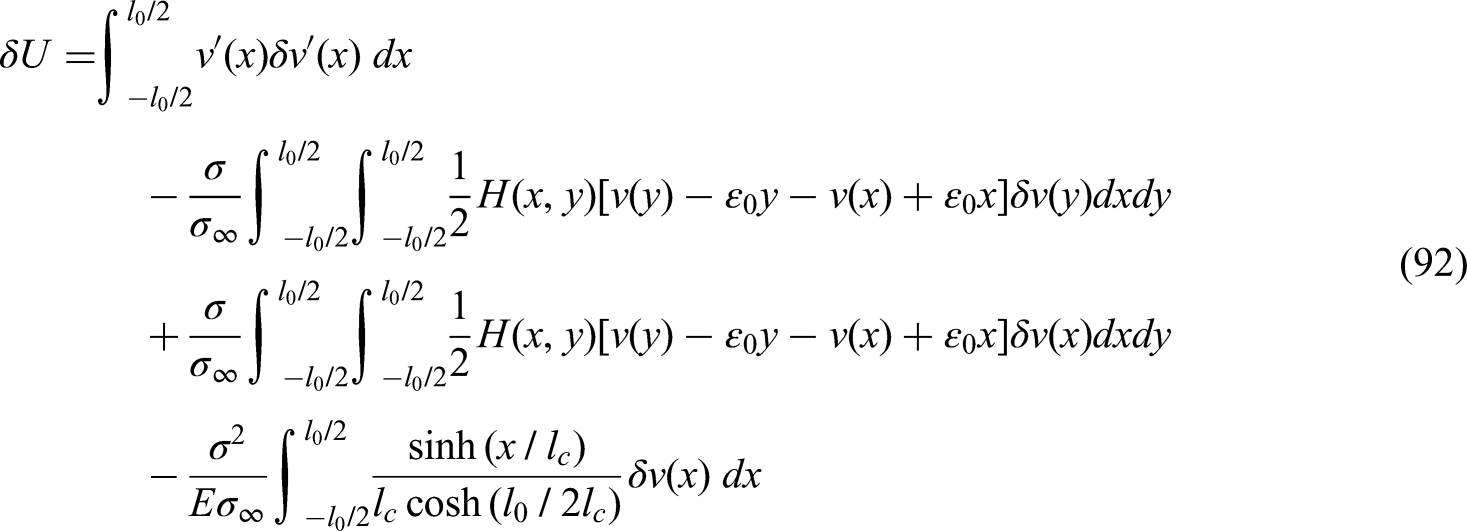
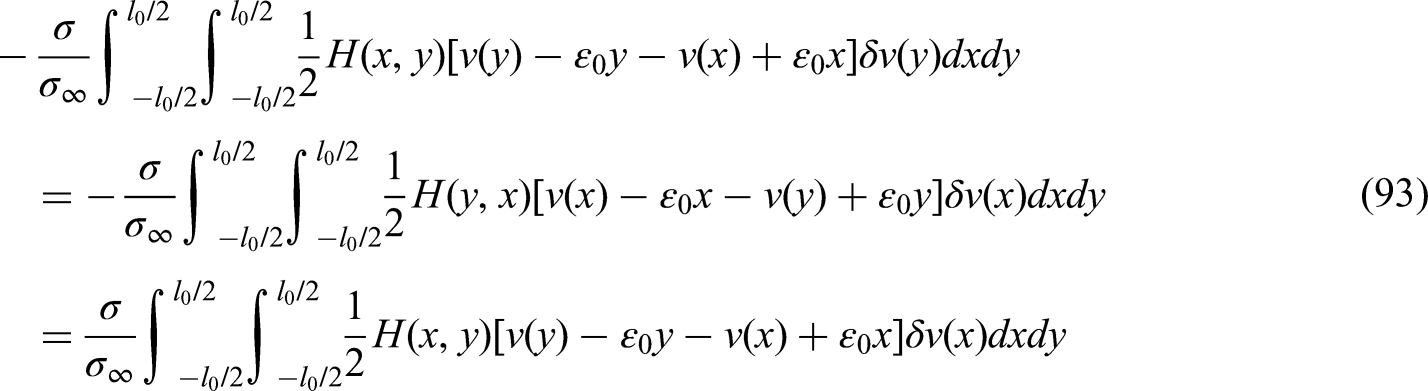
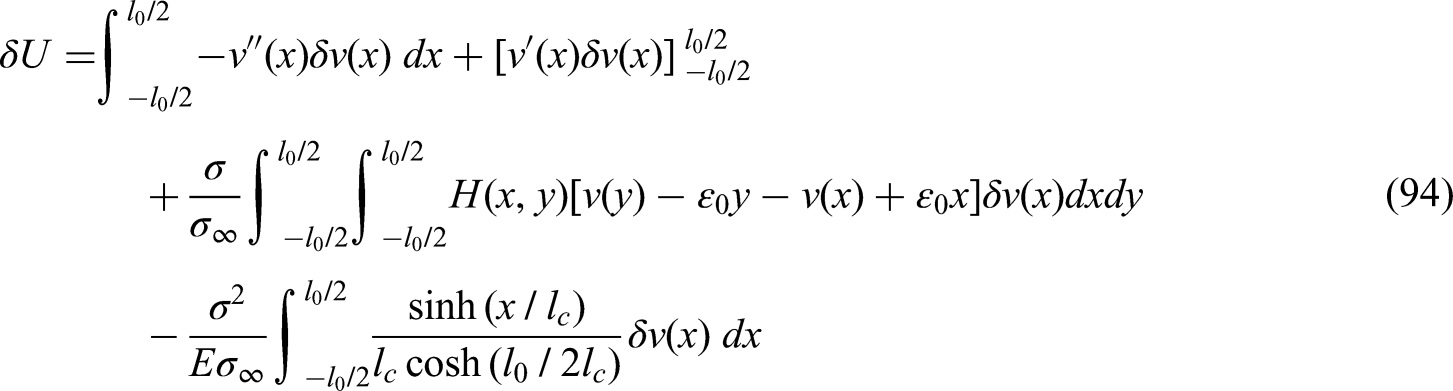

This variational framework can be used to solve the integro-differential equation using the trigonometric solution:

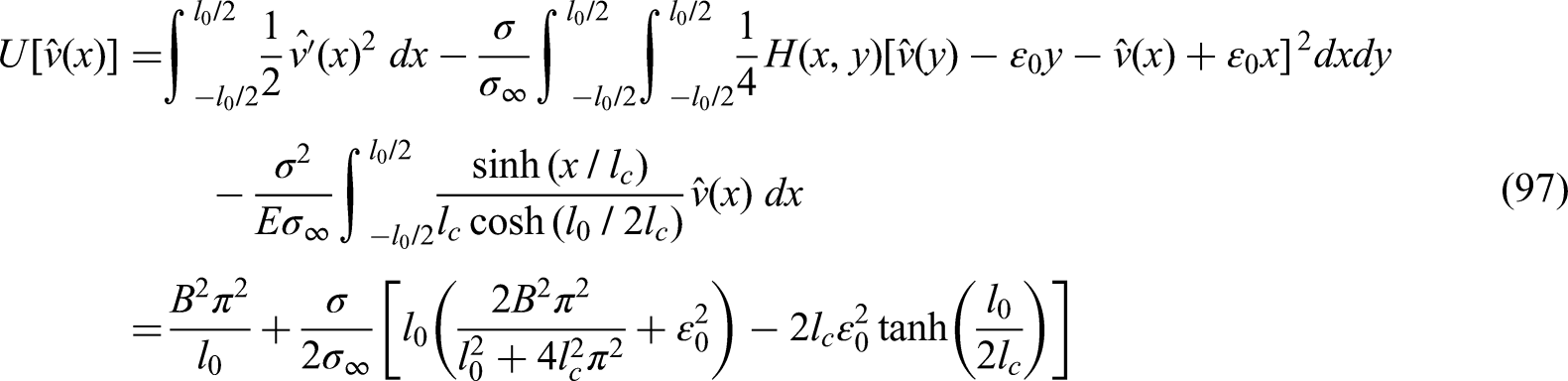
The stationarity with respect to the unknown B-parameter gives the condition:

One recognizes from this optimality condition the solution already derived in the paper for the dependence of the damage zone to the stress loading:

Conclusions
It has been shown in this paper that it is possible to build a strict correspondence between peridynamic damage models and strain-driven nonlocal damage models, based on some calibrated exponential kernels for both models. This equivalence is shown under the assumption that nonlocality is introduced exclusively through the damage loading function, and not through the elastic constitutive law or the momentum balance in a fully peridynamic sense. The strain-driven nonlocal damage model considered in this study belongs to the class of integral nonlocal damage model developed by Pijaudier-Cabot and Bažant (1987), here applied in its implicit differential form, as introduced by Peerlings et al. (1996). The new peridynamic damage model developed in the paper also can be classified as an implicit peridynamic damage model. For both softening integral nonlocal damage models, the localization zone can be explicitly derived and appears to be loading dependent. This confirms the strong intrinsic link between both integral approaches, already highlighted for finite or infinite nonlocal or peridynamic elasticity problems (see for instance Challamel and Zingales, 2025a or 2025b). It would be possible to extend this study by considering some coupling between peridynamic elasticity and peridynamic damage, within peridynamic scale dependence for both the elasticity and the damage contributions in the nonlocal constitutive law. It is expected that nonlocal effects in the elasticity range should play a secondary role with respect to the localization process, as assumed in the classical nonlocal damage model by Pijaudier-Cabot and Bažant (1987). The conclusion of the present study valid for one-dimensional nonlocal damage rods should be extended to two-dimensional or even three-dimensional nonlocal damage solids.
Footnotes

Author contributions
Noël Challamel: writing – review and editing, writing – original draft, visualization, validation, supervision, project administration, methodology, investigation, formal analysis and conceptualization. Gilles Pijaudier-Cabot: writing – review and editing, validation, methodology, investigation, and conceptualization.
Funding
The authors disclosed receipt of the following financial support for the research, authorship, and/or publication of this article: This research is funded by the French Ministry of Higher Education and Research and Space.
Declaration of conflicting interests
The authors declared no potential conflicts of interest with respect to the research, authorship, and/or publication of this article.
Data availability statement
No data was used for the research described in the article.
Appendix A: A peridynamic elasto-damage model with two independent kernels
The elasto-damage constitutive law equation (15) can be derived from the potential elasto-damage energy:
The stationarity with respect to the displacement field can be interpreted as the virtual internal work:
This local elasto-damage constitutive law can also be seen as the particular case of a two-phase peridynamic elasto-damage model, introduced from the following potential energy:
The stationarity with respect to the displacement field can be interpreted as the virtual internal work:
It can be remarked, due to the symmetry of the kernel operator
We obtain the two-phase elasto-damage peridynamic constitutive law:
For pure local elasto-damage phase
Appendix B: Properties of the exponential kernel of the peridynamic damage rod
The peridynamic kernel chosen in this paper is written for an element between x = a and x = b, as:
In the case a = 0 and b = L, one obtains the kernel function:
In the specific case of a damage domain
Appendix C: Derivation of higher-order boundary conditions for peridynamic damage rod problem
The following variation is considered for the nonlocal peridynamic damage model:
Appendix D: Derivation of higher-order boundary conditions for strain-driven nonlocal damage rod problem
The following variation is considered for the implicit gradient damage model (strain-driven nonlocal damage rod model):
It is worth mentioning that it has not been possible to construct the underlying associated functional for this strain-driven nonlocal elasto-damage rod model. The following integration by part is obtained for the last term associated with the damage variable:
The extremal condition equation (125) leads to the equilibrium equation and the yield damage condition:
These boundary conditions may be summarized as: