




Abstract
Fatigue life estimation of aero-engine turbine components under combined high and low cycle fatigue (CCF) is of significance for guaranteeing the structural reliability during operation. According to the investigations on damage evolution process, a nonlinear damage accumulation method is proposed for life prediction under CCF loadings, and the interaction effect between high cycle fatigue (HCF) and low cycle fatigue (LCF) is considered by integrating the interaction factor and stress ratio of CCF. Furthermore, experimental results of alloys and turbine blades are utilized to validate the proposed method and conduct a comparative analysis among Miner’s rule and other two typical nonlinear cumulative damage methods under combined loading conditions. Comparative results demonstrate that the developed model holds better prediction robustness and accuracy than those of others.
Keywords
Introduction
Fatigue failure is the major failure mode of aero-engine hot-end components, and it usually leads to serious consequences for the aircraft (Hu et al., 2016; Vantadori et al., 2020; Zhao et al., 2022; Zhou et al., 2022). During operation, hot-end components suffer from complicated loads, including low cycle fatigue (LCF) loads and high cycle fatigue (HCF) loads. Among them, LCF loads are induced by large-amplitude centrifugal force and thermal stress, and HCF loads are produced by the high-frequency vibrations during flight (Li et al., 2022; Liu et al., 2023a; Ma et al., 2022). Under the integration of HCF and LCF, the failure mode of hot-end components is named as the combined high and low cycle fatigue (CCF) (Patriarca et al., 2020; Zheng et al., 2013). Some existing methods, which only addressing pure HCF or LCF, cannot accurately estimate the fatigue life of components and effectively describe the fatigue behavior for the strength design (Yan et al., 2014; Yue et al., 2021a). Hence, investigations on fatigue life estimation and damage modelling in the CCF loading mode have been the prerequisite for the operational reliability of turbine components (Han et al., 2018; Liu et al., 2011).
Recently, fatigue life prediction under CCF loadings has been attached more attention. For the CCF life prediction methods, linear damage accumulation model (Miner’s rule) has achieved extensive application in practical engineering due to the simple expression. The predicted results by the typical rule, however, are always unreliable as it holds some inherent shortcomings, such as the ignored loading interaction effect and independent loading stress (Wang et al., 2022; Yue et al., 2023; Zhao et al., 2011).
In view of this, increasing fatigue life prediction models have been developed, and the predicted lives by nonlinear damage accumulation methods are supposed to be more accurate in the CCF loading mode. For instance, Trufyakov et al. (1981) performed multiple groups of CCF tests on different materials to obtain the introduced material parameter, and then a life prediction approach was built. Zhu et al. (2017) proposed a CCF life prediction model by separately quantifying the LCF damage, HCF damage as well as the coupled damage produced by the interaction among HCF/LCF. Through studying the experimental data under CCF loadings, Yue et al. (2021a) established a nonlinear cumulative damage model addressing the HCF-LCF interaction with a similar expression to Miner’s rule. Bai et al. (2021) developed a CCF life estimation method to consider coupled damage by blending a new interaction factor in the LCF damage. According to damage curve approach and linear damage rule, accounting for the HCF-LCF interaction effect, a damage accumulation model under CCF loadings was put forward for by Hou et al. (2023). Under the consideration of load interaction between HCF and LCF, Liu et al. (2023b) established a CCF life prediction approach by employing the equivalent damage principle. Ding et al. (2022) decomposed CCF loads into LCF, HCF and coupled damage to present a CCF life estimation method by using continuous damage mechanics. Through the observations of fatigue performance, Qiu et al. (2022) utilized two threshold parameters to propose a life estimation model under CCF loadings, and the comparative results demonstrated that the approach offered a higher prediction ability. Wang et al. (2023) proposed a life estimation method by investigating the experimental results under combined loading conditions. By conducting fatigue tests on titanium alloy, Zhao et al. (2021) proposed a modified CCF life prediction model based on Trufykov’s model. To estimate the CCF lifetime with higher prediction accuracy, a threshold-damage based approach was established by calculating the limit life of HCF (Yue et al., 2021b). Han et al. (2019) developed a cumulative damage method on the basis of the Kachanov-Lemaitre model, in which the nonlinear interaction among HCF/LCF was addressed.
Although lots of CCF lifetime prediction methods have been presented by scholars for satisfactory prediction accuracy under the give loadings, the dispersion of life estimation for other materials under variable loading conditions may be great since the major damage accumulation theories are not established for CCF but single LCF or HCF. Hence, the predicted results by some models extended to CCF loadings may be overestimated or underestimated. Moreover, some modified life prediction methods may introduce material parameters determined by CCF tests, which limiting the applications under various loading conditions. In this analysis, a nonlinear damage accumulation method is established by using equivalent damage concept to gain the more acceptable and robust predictions, and the HCF-LCF interaction is considered by the new interaction factor without additional fitted parameters for convenient application.
The aim of this work is to propose a nonlinear cumulative damage method for CCF life estimation, and the effect of load interaction among HCF/LCF is addressed by the developed interaction factor. The current paper is arranged as follows: in the next section, the linear and nonlinear damage accumulation methods are briefly introduced under CCF loadings, and section ‘Proposed CCF life prediction model’ proposes an improved damage accumulation method under the consideration of load interaction effect among HCF/LCF loads. In section ‘Validation of the method’, the prediction accuracy of developed approach is validated by performing a comparative study on CCF test data of materials and turbine blades. In the final section, the conclusions are provided.
Linear and nonlinear damage accumulation methods
Turbine components are subjected to the complicated loads during the actual operation, and the damage accumulation is an essential issue for researchers to predict the fatigue lifetime (Hu and Wang, 2013; Li et al., 2018; Zhu et al., 2016, 2018b). Generally, the outfield load spectrum is simplified into the typical CCF load spectrum to conduct fatigue test in laboratory, in which HCF loads represented by triangular waves are superimposed on the top stage of each LCF load denoted by trapezoidal wave (Bai et al., 2022; Dungey and Bowen, 2004; Han et al., 2021; Li et al., 2022; Wen et al., 2022), as shown in Figure 1.
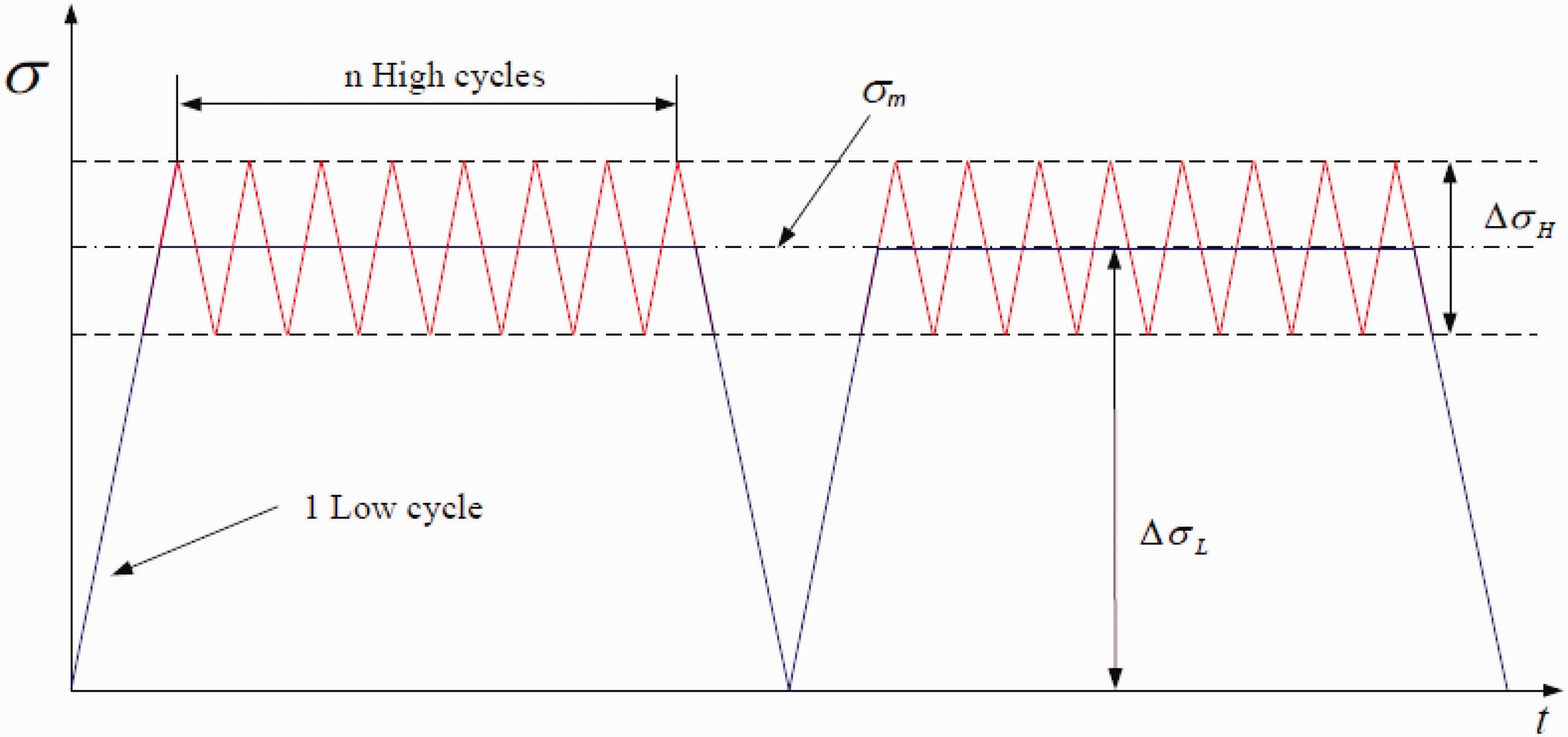
CCF load spectrum.
From Figure 1, a CCF block comprises a LCF cycle and


The stress ratio of CCF can be expressed by

For the CCF damage accumulation, Miner’s rule is the most commonly adopted method, as

The fatigue failure of materials occurs once the cumulative damage reaches its damage critical value 1. For a CCF block, there are n HCF cycles and a LCF cycle, and then the fatigue life under CCF loadings can be derived by

Miner’s rule has been frequently used in multiple fields; however, it just calculates the pure HCF and LCF damage without addressing the interaction effects between HCF and LCF, potentially leading to the overestimated fatigue lives (Yue et al., 2021a; Zhao et al., 2021; Zhu et al., 2017). To overcome the deficiency of linear cumulative damage method, lots of models have been developed for accurate life prediction under combined loading conditions.
Specially, a life prediction approach (named as T-K model) was proposed by Trufyakov and Koval’chuk (1982) through investigating the CCF tests of multiple materials under different loading conditions, and a material parameter was included to reveal the variable effect of different materials on fatigue lives, as

According to the typical damage curve principle, Manson and Halford (1981) presented a nonlinear damage accumulation method, in which a damage exponent

Similar to Miner’s rule, equation (7) can be introduced to calculated the CCF damage, and the parameter

Previous works indicated that the predicted results by equation (8) tended to be underestimated in the CCF loading mode (Yue et al., 2021b, 2024). In view of this, Yue et al. (2020) developed an improved damage accumulation approach (named as Yue model) for CCF life prediction to account for the HCF-LCF interaction by adopting damage curve concept, as

By investigating the fatigue damage of turbine blades consisting of LCF damage, HCF damage and coupled damage, Zhu et al. (2017) established a CCF life prediction method (Zhu model for short), in which the coupled damage term was integrated into the Miner’s rule to address the HCF-LCF interaction, as

Proposed CCF life prediction model
Recently, a damage model for correlating the experimental data was developed by utilizing an equivalent driving force concept. To take into account the load history effects, Zuo et al. (2015) built a fatigue damage accumulation method under variable amplitude loading by combining with the S-N curve. During fatigue process, the S-N curve is usually shown by a power function, as

As depicted on fatigue driving force by Kwofie and Rahbar (2011), it was a function of the number of loading cycles, applied loading force together with the fatigue lifetime, and fatigue driving force at each loading stress condition was written by

Especially, when the number of loading cycles increases, the force
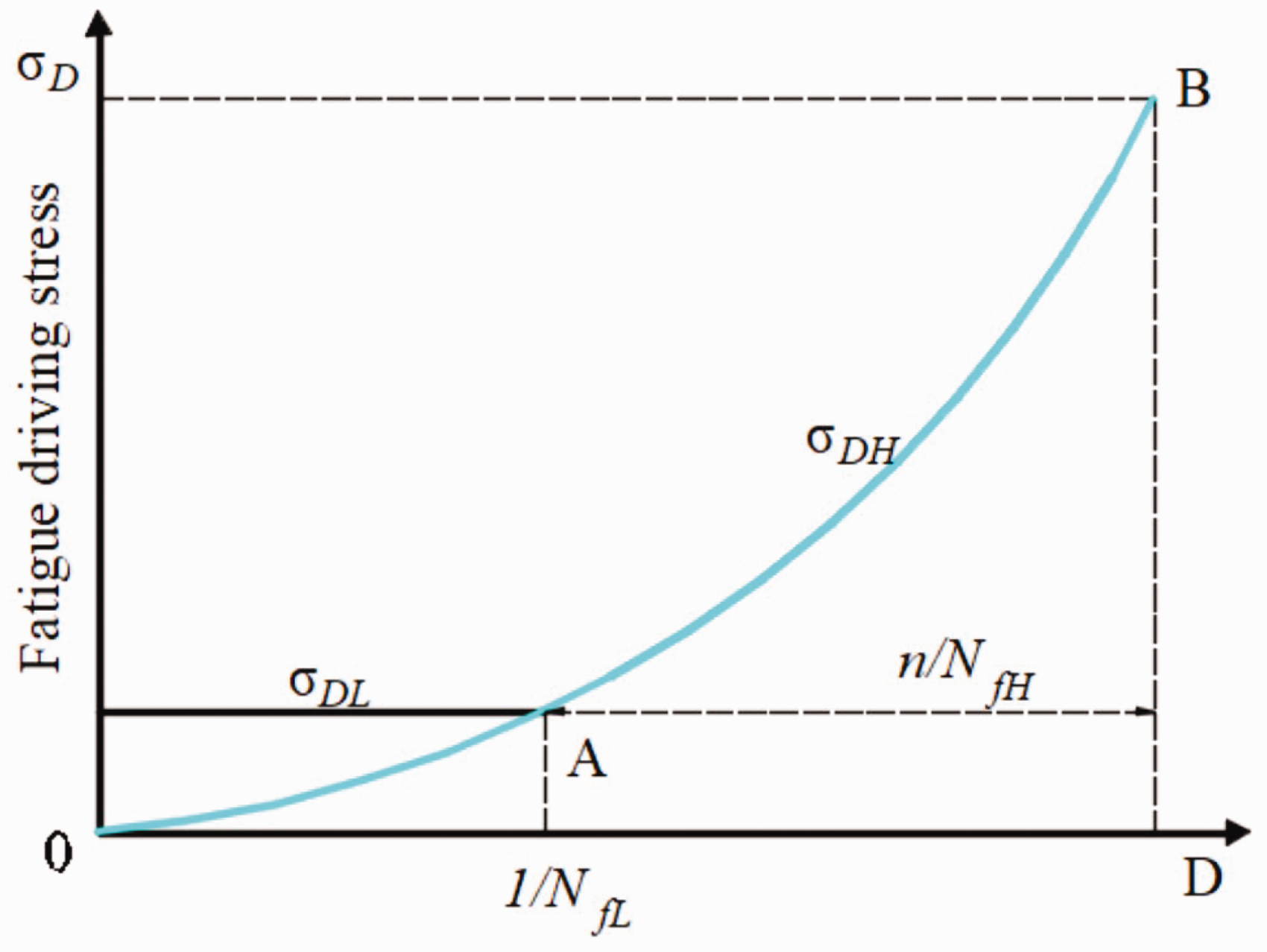
Fatigue damage evolution process under CCF loadings.
From Figure 2, the fatigue driving force grows with the cumulative damage in a combined cycle block. The curve
In this analysis, an improved nonlinear damage accumulation process with the number of combined cycle blocks

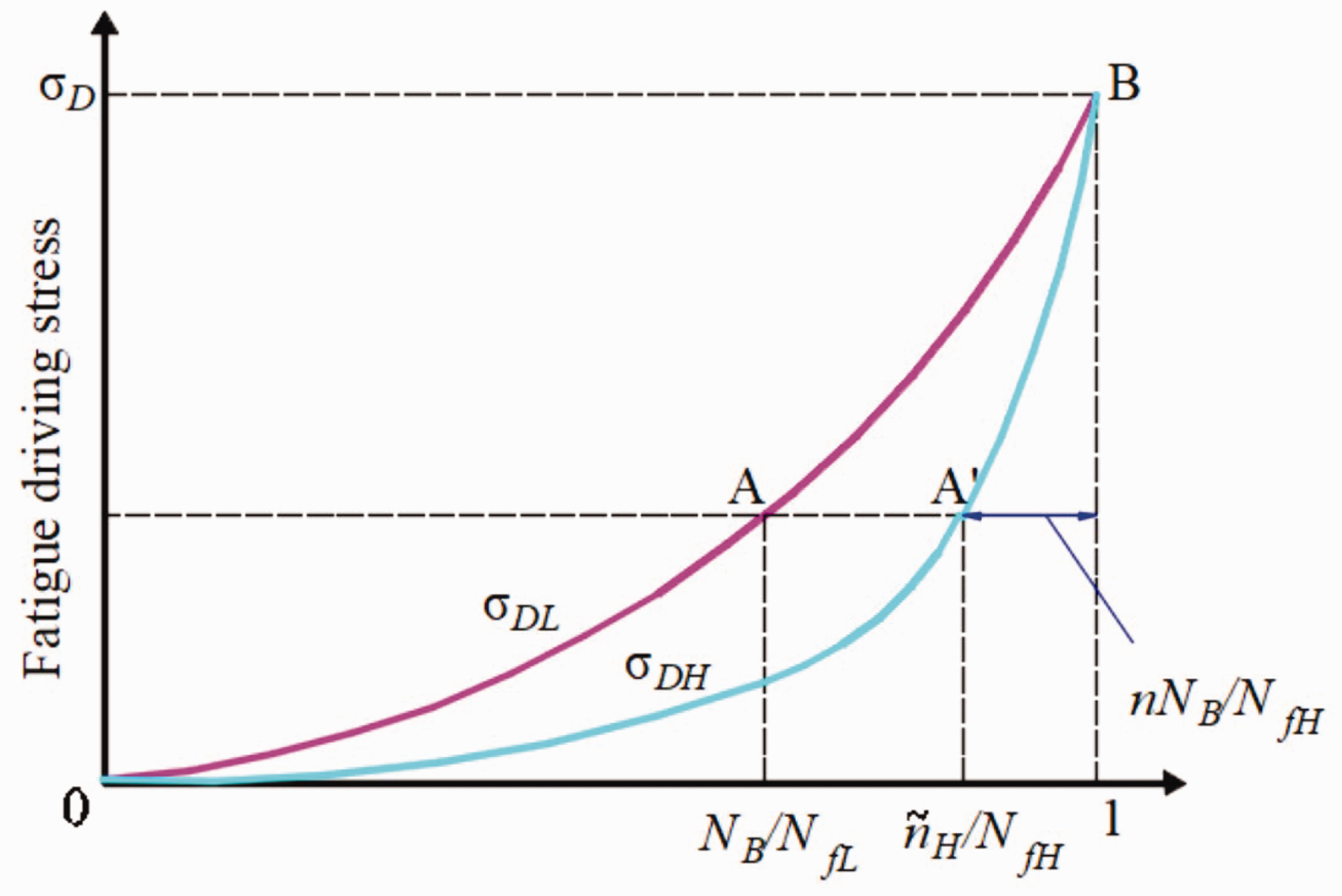
Improved nonlinear damage evolution process under CCF loadings.
The equivalent driving force under HCF loading

Based on the equivalent principle of fatigue driving force,

Assuming that

Equation (16) can be rewritten by integrating with equation (15), as

HCF driving force increases with the cumulative damage raising from 0 to

Combining with the S-N curve, equation (18) leads to

Furthermore, equation (19) can be rewritten by taking the logarithm of both sides, as

Thus, similar to Miner’s rule, the cumulative damage model can be obtained by

Note from that HCF-LCF interaction effect exerts nonnegligible influence on the CCF life (Priyanka and Andrew, 2015; Schweizer et al., 2011; Wang et al., 2023), and it can be greatly altered with the LCF damage produced by major temperature load and centrifugal force, together with the interaction factor controlled by the stress ratio of CCF. To address the load interaction effect on cumulative damage, the various interaction factors were used for fatigue life estimation under variable amplitude loadings (Gao et al., 2021; Lv et al., 2015; Zhu et al., 2018a, 2018c). In this regard, the damage accumulation model in equation (21) can be modified by introducing the LCF life and interaction factor to consider the HCF-LCF interaction effect under CCF loadings, as

Hence, the nonlinear damage accumulation model can be derived by

Furthermore, an equivalent stress range ratio

Thus, a new life prediction model, addressing the HCF-LCF interaction effect, is proposed by introducing the interaction factor determined by the equivalent stress range ratio

According to equation (25), CCF life can be calculated by the nonlinear fatigue accumulation damage method, and it describes the nonlinearity of cumulative damage as well as sufficiently considers the effect of HCF-LCF interaction under CCF loading conditions.
Validation of the method
In this section, using five experimental datasets from published CCF test results of alloys, including TC11 (Zhao et al., 2021), TC4 (Yue et al., 2021b), DZ22 (Wang and Li, 1995), LY12-CZ AL (Wang and Shao, 1998), the developed method is validated. Considering the predicted errors of Manson-Halforld model and Zhu model under small cyclic frequency ratios, Yue model yielded better prediction accuracy in the CCF loading mode (Yue et al. 2020). Accordingly, the predicted results by Miner’s rule, T-K model, Yue model are utilized to compared with those of the proposed.
The experimental data for different materials were acquired under different CCF loadings. For TC11 alloy, the LCF, HCF tests were performed to study the fatigue performance and two groups of CCF tests with the loading frequency of
According to the expression of T-K model, the material parameter
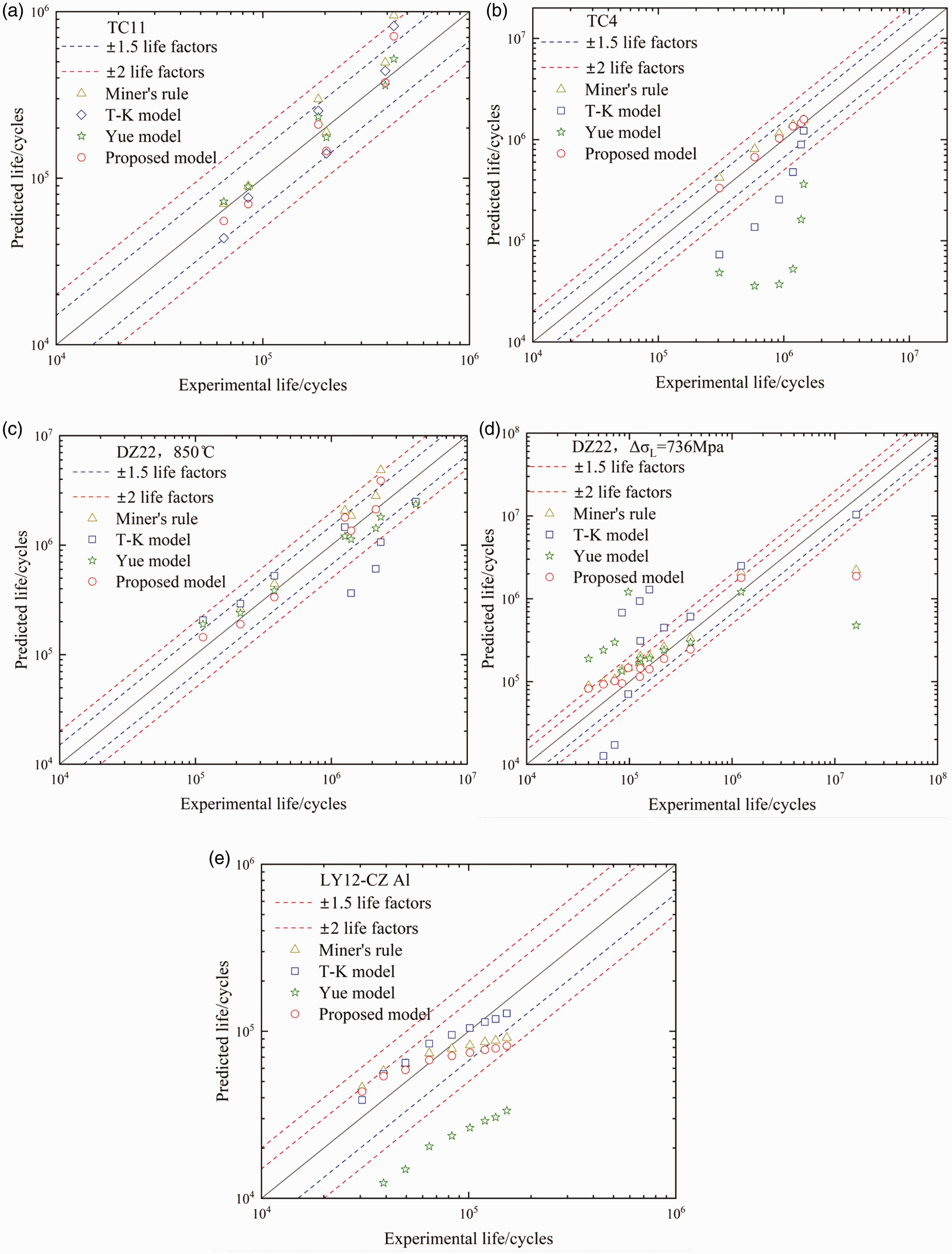
Comparison between tested data and predicted results of the four models of (a) TC1 alloy (b) TC4 alloy (c) DZ22 alloy under different LCF stress (d) DZ22 alloy under different temperature (e) LY12-CZ Al alloy.
Furthermore, aero-engine hot-end components always experience CCF loadings induced by high temperature loads and centrifugal loads as well as vibration loads. Hence, two datasets of experimental results of turbine blades (Chen and Yan, 2014; Yan et al., 2011) were introduced to validate the applicability and accuracy of the developed life prediction model in practical engineering. In the CCF loading mode of turbine blades, LCF stress caused by centrifugal force was implemented by a tensile testing device, while HCF loads produced by the vibration were applied by adopting an electromagnetic exciter. Specially, the test temperature was designed to be a constant. Additional details can be referred in Chen and Yan (2014) and Yan et al. (2011). Figure 5 presents the comparisons of turbine blades among different models.
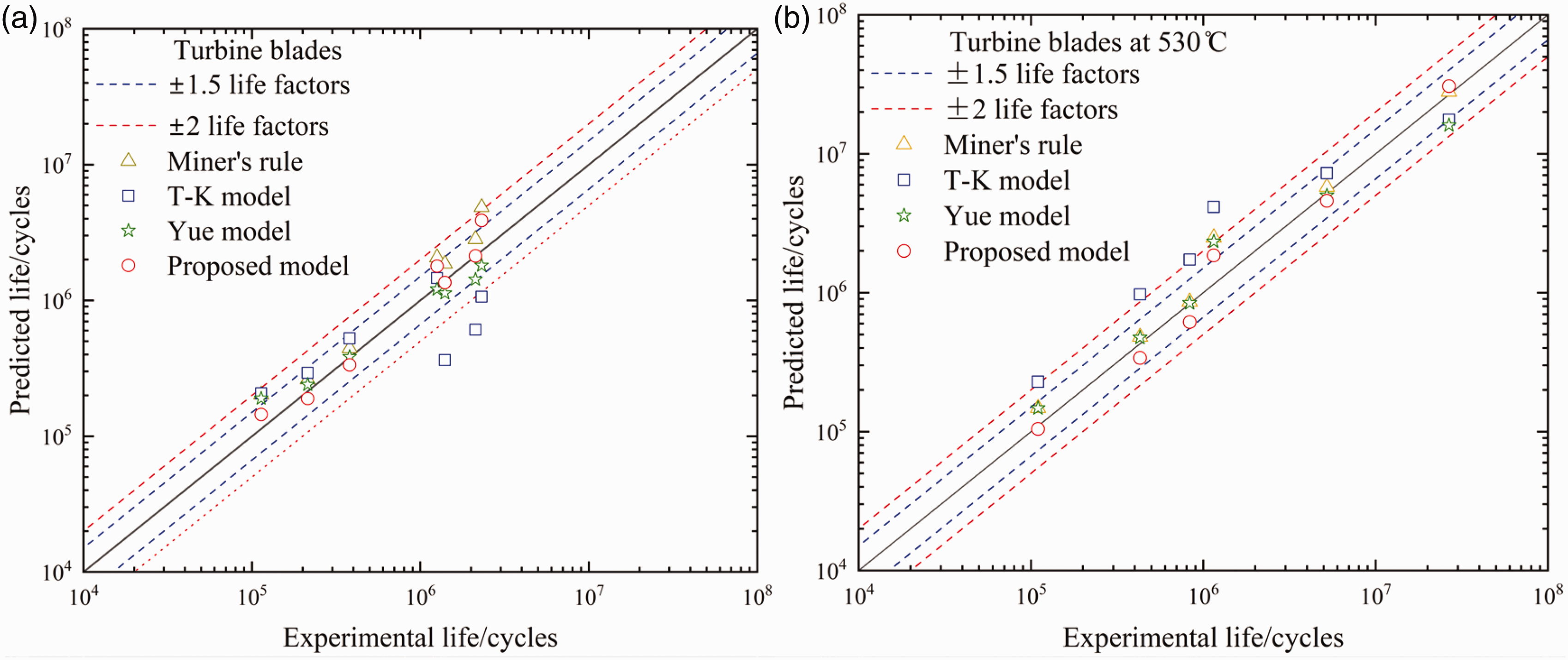
Comparison of predictions with experimental results for (a) turbine blades and (b) turbine blades at 530°C.
To reveal the prediction errors of different methods, the statistical analysis is performed via calculating the difference of logarithmic predicted life and logarithmic experimental life, and prediction errors among proposed method, Miner’s rule, T-K model and Yue model are compared, as illustrated in Figure 6.
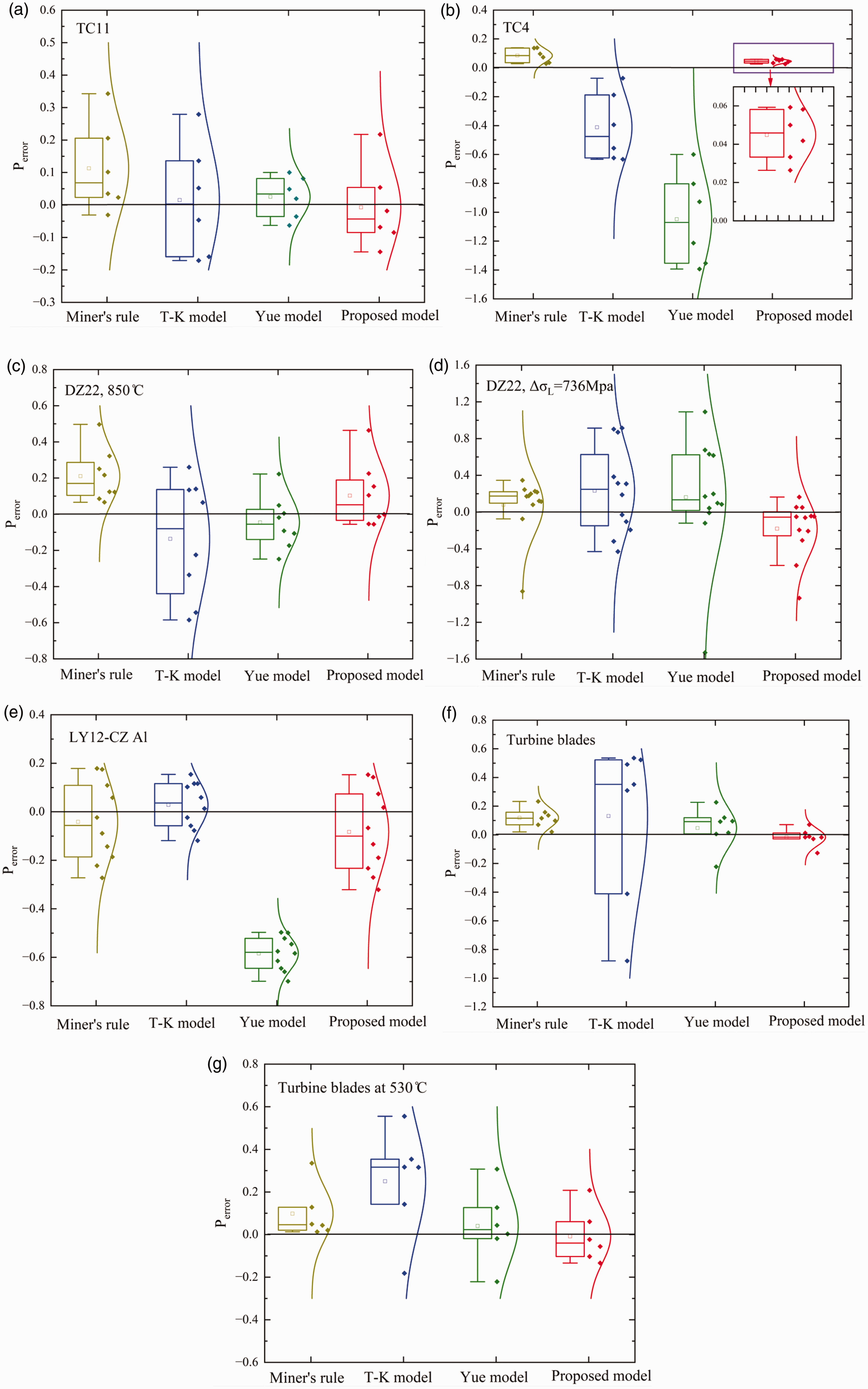
Model prediction errors for different alloys and turbine blades.
As illustrated from Figures 4 to 6, the predictions by the proposed model tend to be more consistent with the experimental results, and 52 out 53 predictions lie within two life factors. Moreover, the statistical mean error of the developed model, accounting for the overall performance, is smaller than those of others and approaches to zero with lesser dispersion. For Miner’s rule, the prediction results are more nonconservative under CCF loadings except for LY12-CZ Al alloy. For T-K model, the predictions for different alloys and turbine blades show a great dispersion due to the introduction of the material parameter
Furthermore, the relative error (MRE) of the experimental lives and the predictions is utilized to compare the estimation ability of these four methods (Li et al., 2022), as

The MRE value of different materials for the four models can be obtained by using equation (26), as illustrated in Figure 7. For the seven experimental datasets, the developed model presents a better prediction ability with smaller mean values of MRE under CCF loadings. Specially, for Yue model, the values of MRE for TC11 and DZ22 at 850°C is lesser than those of other models, while the predicted error for TC4, DZ22 at LCF stress range of 736 MPa and LY12-CZ Al are larger. Accordingly, the proposed method shows the higher prediction accuracy and estimation performance under CCF loading conditions compared to other methods.
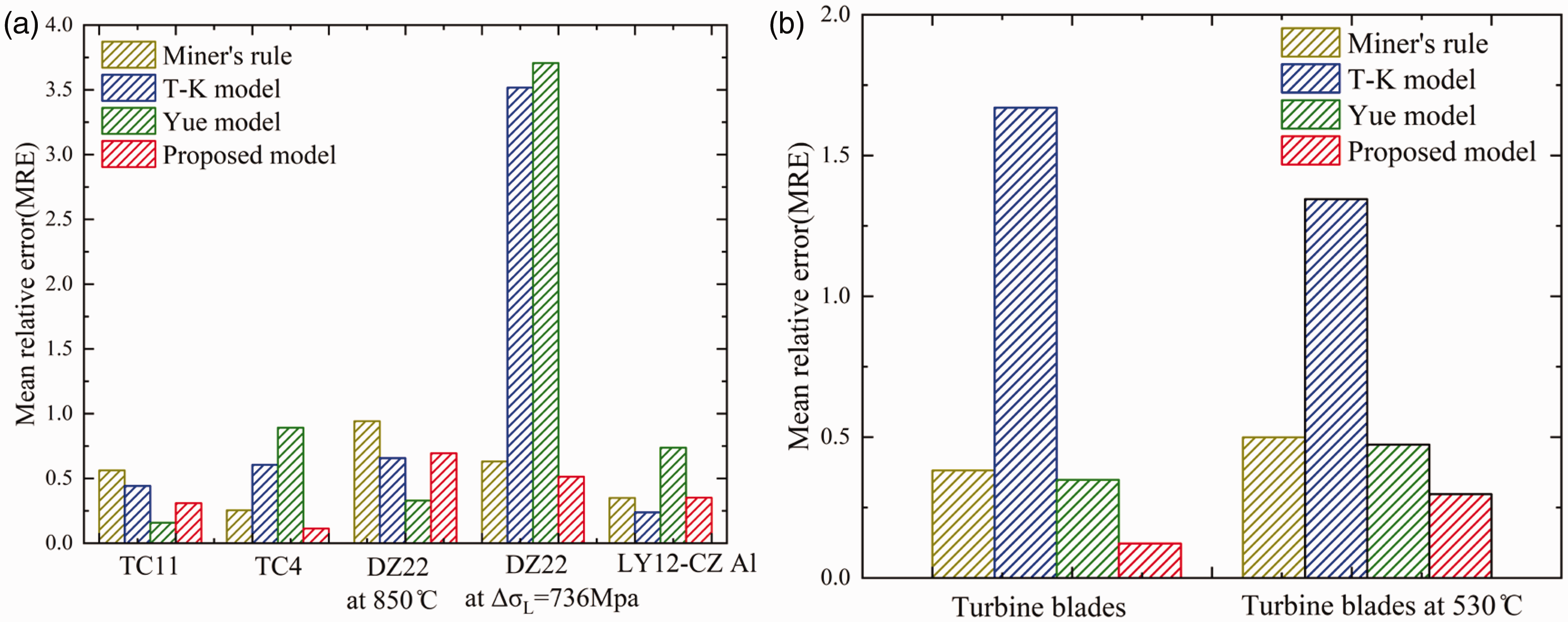
Mean relative errors by Miner’s rule, T-K model, Yue model and proposed model for different alloys and components.
Conclusion
In this study, a nonlinear damage accumulation model accounting for interaction effect between HCF and LCF loads is developed to perform a comparative analysis in the CCF loading mode. Experimental datasets of five materials and two turbine blades are utilized to compare the predictions by the Miner’s rule, T-K model, Yue model and proposed one. The main conclusions are listed as follows:
Through investigating the damage evolution process under CCF loadings, a nonlinear cumulative damage method was established for CCF life prediction, in which the interaction effect among HCF/LCF loads was fully addressed by integrating the interaction factor and stress ratio of CCF. To validate the prediction performance of developed method, seven datasets of alloys and turbine blades were employed under CCF loading conditions. Based on the comparative study, the proposed model was capable to estimate the CCF life with a satisfactory accuracy. Considering the overall prediction accuracy and robustness, the proposed model was higher than Yue model, especially for the small loading frequency in the CCF loading mode. For the Miner’s rule, the predicted results tended to be overestimated, while the application of T-K model was limited due to the introduced material parameter.
Footnotes
Declaration of conflicting interests
The author(s) declared no potential conflicts of interest with respect to the research, authorship, and/or publication of this article.
Funding
The author(s) disclosed receipt of the following financial support for the research, authorship, and/or publication of this article: The present work was supported by Natural Science Foundation of China (Grant No. 51975271) and Natural Science Foundation of China (Grant No. 12402092)
