



Abstract
Research shows that gender and sexually diverse learners face discrimination in schools; however, there is little evidence of affirming gender and sexual diversity in Namibian classrooms. This qualitative case-study investigated student teachers’ views on affirming gender and sexual diversity in the classroom. The researchers purposively selected 90 student teachers. Semistructured focus group interviews revealed that gender and sexuality were not considered as a form of diversity in the classroom. However, participants understood the importance of affirming gender and sexual diversity in the classroom. The study demonstrated a need for intense gender and sexual diversity content in the pre-service teacher curriculum.
Orientation to the Study
The Namibian population is diverse in several ways, and these forms of diversity are presented within the classroom among learners. A classroom as a social space where learners meet comprises diversity regarding language, race, religion, culture, physical ability, mental ability, behavior, emotions, family make-up, and socioeconomic status. Moreover, a classroom is composed of learners who conform to gender norms and those who do not conform to gender norms. Further, there are learners with diverse sexual identities in the classroom. Hence, diversity in the classroom is also presented in the form of gender and sexuality. As several researchers (i.e., Cardinal, 2021; Johnson, 2022; Roldán et al., 2021) maintain, it is necessary to create affirming classroom environments that promote respect and acceptance of gender and sexual diversity among learners.
Researchers such as Bešić (2020) and Bradshaw (2019) state that affirming diversity in the classroom could remove inequalities in the school and society at large. Similarly, Mayo (2022) believes that to decrease discrimination and increase participation; educators should recognize learner diversity in their classrooms. Bradshaw (2019) points out that when there is acceptance of gender and sexual diversity in the classroom, all learners feel supported. Appropriately, the Ministry of Education, Arts and Culture (MoEAC) has considered addressing diversity through curriculum, thus having included content on diversity, such as gender and sexuality, in the school curriculum (MoE, 2018).
The Namibian education system is founded on the inclusive education ideology and aims to provide quality education for all within a safe and inclusive learning environment (MoE, 2018). Within an inclusive education system, schools, as part of the social environments, play a role in learners’ conceptualization of understanding individual differences in their social settings (Bronfenbrenner, 1994). Thus, teachers are responsible for creating classroom environments that affirm all forms of learner diversity, including gender and sexuality. Unfortunately, research (Bradshaw, 2019; Lees, 2017; Haitembu & Marmaan, 2022) indicates a need for teachers to acknowledge issues of gender and sexual diversity among learners. Bradshaw (2019), Curtis (2019), and Francis et al. (2017) affirm that schools are places where learners considered belonging to minority groups, such as gender and sexually diverse learners, are at risk of experiencing bullying. Teachers and other learners frequently harass, discriminate, and marginalize gender and sexually diverse learners (Lees, 2017). Namibian schools are not an exception, as research (i.e., Brown, 2017; Haitembu & Maarman, 2022) documents that gender and sexually diverse learners are treated differently by other learners and teachers.
In Namibia, inclusion is discovered to be characterized by several challenges (Mokaleng & Möwes, 2020; Josua et al., 2022). These challenges include the practice of inclusion regarding gender and sexual diversity. The slow progress in the creation of safe and inclusive classroom environments in terms of gender and sexual diversity observed in other countries (Lawrie et al., 2017; Leijen et al., 2021; Nilholm, 2021) is also observed in Namibian schools (Brown, 2017; Haitembu, 2021). Affirming gender and sexual diversity requires teachers’ understanding and willingness to acknowledge this form of diversity. Researchers such as Garrote et al. (2020) and Souzaet et al. (2016) state that some teachers and learners were not made aware of the importance of accepting and respecting the differences presented in the classroom. Similarly, Edmunds (2016) and Leonardi and Staley (2015) point out that preservice teachers in their studies lacked proper training in supporting learners with diverse gender identities in their classrooms. Souza et al. (2016) discovered that teachers felt that they could affirm gender and sexual diversity in their classrooms once they were provided with chances to gain appropriate knowledge. In that regard, the researchers in this study hoped that, after going through training, including handling issues of gender and sexual diversity in the classroom, the student teachers who participated in this study have gained the necessary knowledge on gender and sexual diversity.
Affirming gender and sexual diversity in the classroom has several benefits to the learners, as the above discussions outline. As mentioned above, there is slow progress in creating affirming classroom environments for gender and sexually diverse learners observed in Namibian schools (Haitembu, 2021). Additionally, there is a lack of teachers’ voices at both pre-and in-service levels on how they feel about affirming gender and sexual diversity in their classroom as an inclusion practice in the Namibian education context. Thus, it is relevant to investigate the student teachers’ views on affirming gender and sexual diversity in the classroom. Hence, this study aimed to answer the following research question: How do student teachers view the concept of affirming learner gender and sexual diversity in the classroom?
Literature Review
Diversity and Inclusion in the Namibian Classroom
Classrooms are places where all forms of learner diversity are presented. Learners spend most of their childhood in the classroom; hence, they experience differences negatively and positively in the classroom than in any other place. The presence of gender and sexually diverse learners in the classroom is challenging for some teachers and learners (Haitembu, 2021). As Souza et al. (2016) point out, a classroom becomes a place where affirmation of differences could positively impact the lives of school children.
The Namibian constitution mandates providing quality education to all its citizens equitably and democratically (Government of the Republic of Namibia (GRN), 1990). To achieve this goal, schools need to practice the inclusion of all. Inclusion is not about putting learners with special needs in either special schools or mainstream schools (MoE, 2018). Inclusion goes beyond the physical placement of learners in classrooms to transforming school environments to reflect an inclusive climate and enable learners to actively participate and perform in all areas (i.e., academically, emotionally, spiritually, and socially). Therefore, schools, as places with a spectrum of diversity, need to affirm all forms of diversity (Lees, 2017). It follows that teachers should acknowledge learners’ uniqueness, including their sexual orientations, gender identities, and gender expressions. Diversity makes us who we are as human beings (Moreu et al., 2021; Possi & Milinga, 2017; Nui Sim et al., 2020); hence, all forms of diversity, including gender and sexual diversity, should be affirmed in the classroom.
The Namibian education system and schools have tried to address diversity among learners, specifically regarding disability, race, ethnicity, sociocultural background, and learning difficulties. These forms of diversity are well recognized, and guidelines and legal frameworks for protecting learners are established. Discrimination and bullying based on culture, ethnicity, race, disability, learning difficulties, and economic status are stipulated as not tolerated in Namibian schools (MoEAC, 2018). However, even though issues of sexuality are included in the school curriculum, gender and sexual diversity are neglected and less addressed by minorities within the Namibian schools (Haitembu & Maarman, 2022).
Research (Brown, 2017; Francis et al., 2017; Haitembu & Maarman, 2022) indicates that some learners experience a hostile school climate due to their different gender identities, expressions, and sexual orientation in Namibian schools. A hostile school climate could make learners feel unsafe (Lees, 2017). Consequently, learners who do not feel emotionally and physically safe at school will not only perform poorly academically but their overall well-being will be in jeopardy. Inclusion calls for responding to all learners (MoEAC, 2018); hence, schools should proactively affirm all forms of diversity among learners. Educators should understand and acknowledge differences (i.e., race, ethnicity, culture, abilities, disabilities, sexual orientation, spirituality, behaviors, and others) among learners and create classrooms that are affirming spaces for all learners. Therefore, there is a need for Namibian schools to affirm all forms of diversity.
Teachers’ Views on Gender and Sexual Diversity
The teachers’ views on gender and sexual diversity could influence how they interact with gender and sexually diverse learners. Teachers could respond and create either inclusive or hostile classroom atmospheres for gender and sexually diverse learners based on how they view these learners. Hall and Rodgers (2019) document many studies that discovered that teachers with an opposing view toward gender and sexual diversity were unwilling to support gender and sexually diverse learners. Similarly, De Witte et al. (2019), analyzing learners’ and teachers’ views on homosexuality in eight countries in Europe, found that some teachers and learners that had a negative view of homosexuality were not comfortable with the concept of homosexuality. In a study by Machado and Coelho (2017), teachers in the Azores (Portugal) were discovered to have adequate knowledge and a positive view toward gender and sexual diversity and were willing to address sexual orientation.
Naskali and Kari (2020) indicate that once teachers receive knowledge about gender and sexuality during training, they can influence learners’ understanding of gender and sexuality. Similarly, Glikman and Elkayam (2019) write that understanding gender and sexuality can lead teachers to acknowledge such issues positively. When teachers lack an understanding of gender and sexual diversity, they might not be willing to discuss issues related to this form of diversity in their classroom. Hence, knowledge of gender and sexual diversity can affect how teachers view affirming gender and sexuality in the classroom.
Edmunds (2016) indicates that preservice teachers start their careers unprepared for gender and sexual diversity issues. This lack of training could lead to a lack of understanding of gender and sexual diversity issues. A study by Jorge et al. (2020) indicates that student teachers who were exposed to information about gender and sexuality were willing to accept gender and sexual diversity in the classroom. Additionally, Meyer et al. (2015) discovered that gender and sexually diverse teachers had a better understanding and were more supportive of gender and sexually diverse learners in their classrooms.
Several studies over time have indicated that teacher training and exposure to information regarding gender and sexual diversity help teachers to have a favorable view regarding gender and sexual diversity in their classrooms. For instance, a study by Andrews (2020) presents those student teachers resisted and disrupted discussions regarding gender and sexual diversity topics. However, these student teachers were less resistant to these discussions after exposure to the effects of oppression for disadvantaged groups. Similarly, the student teachers in a study by Cantos et al. (2023) have demonstrated interest in acquiring knowledge, strategies, and tools to deal with gender and sexual diversity in their classrooms after being exposed to information about gender and sexual diversity. The teacher educators who participated in a study by Clark and Kosciw (2022) have also supported the training of student teachers to gain skills and knowledge to affirm and support gender and sexually diverse learners in classes. Similarly, De Witte et al. (2019) suggested that teachers should receive training in diversity, while learners receive better education about diversity to ensure learners have good experiences in schools. Cantos et al. (2023) are also of the opinion that training teachers in gender and sexual diversity issues could help them gain knowledge and adopt a positive view of affirming gender and sexual diversity in their classrooms.
Research (Bradshaw, 2019; Leonardi & Staley, 2015; Haitembu & Maarman, 2022) indicates that failure to affirm gender and sexual diversity in the classroom leads to discrimination and harassment of gender and sexually diverse learners. Hence, the teachers’ views on gender and sexual diversity are crucial in determining how they respond to gender and sexual diversity in their classrooms. Unfortunately, the lack of knowledge on gender and sexuality issues discovered by Haitembu and Maarman (2022) among Namibian in-service teachers could make it difficult for them to affirm gender and sexual diversity in their classrooms. Hence, the great hope is that the curriculum content of preservice teacher training modules such as Guidance and Counseling led to student teachers acquiring a wealth of knowledge needed to develop a positive view on affirming all forms of diversity in the classroom, including gender and sexual diversity.
Theoretical Framework: Intersections in the Classroom
The classroom atmosphere is fundamental to learners’ social and personal well-being, as they spend much time there. Learners in the classroom are located at the intersection of multiple identities. The systems of power and oppression, such as heterosexism, give meaning to and impact these multiple identities. Hence, learners’ identities in the classroom are defined and impacted by several factors within their classroom environments (see Figure 1). Crenshaw (1989) writes that individuals could face abuse or experience privileges based on multiple identities.
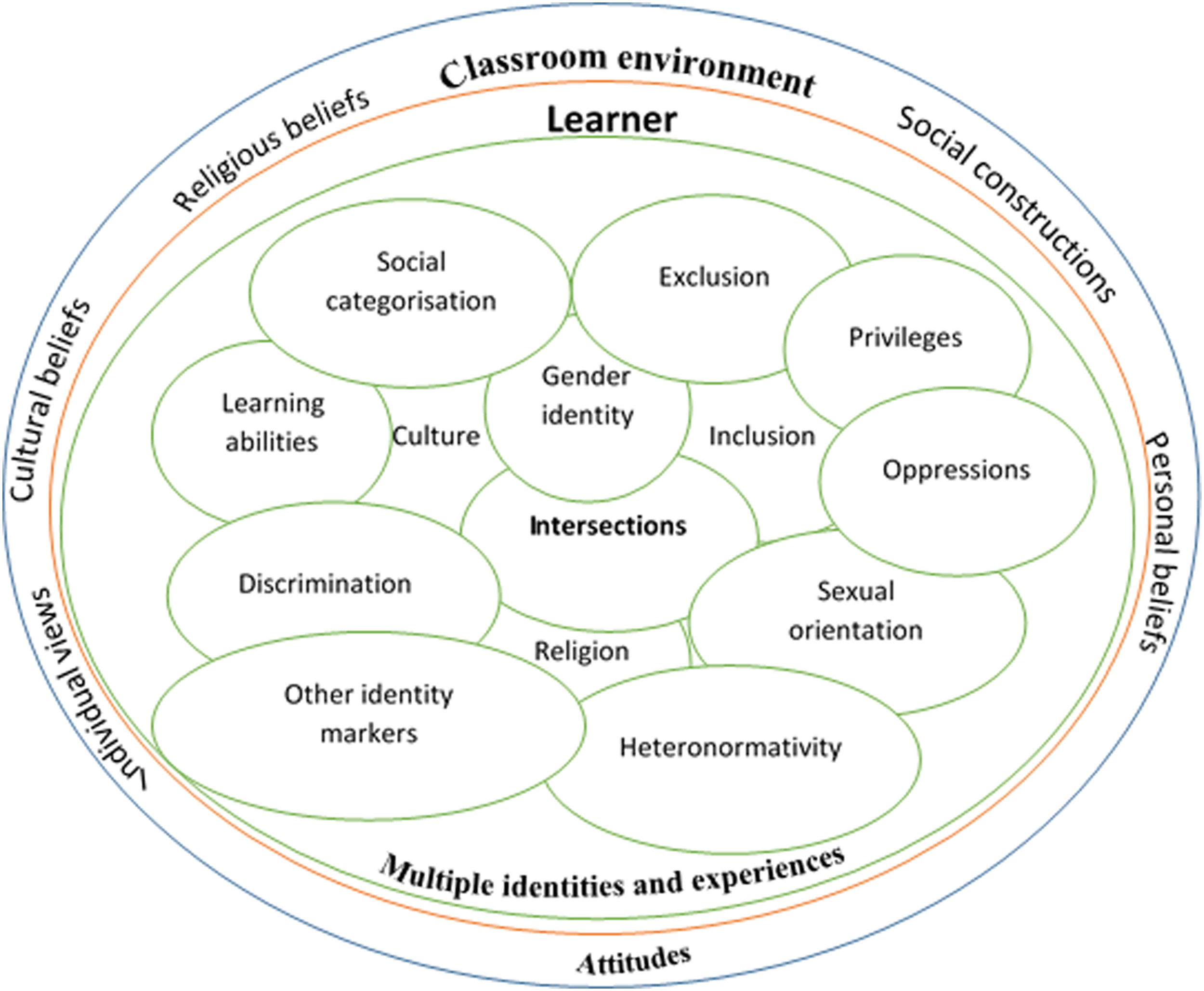
Intersecting layers of learner’s multiple identities and experiences. Note: This figure outlines how multiple identities create a complex convergence of oppressions and privileges for individual learners. It further outlines how individual learners experience these privileges and oppressions in the same classroom. Source: Authors' drawing.
Consequently, as learners negotiate their spaces in the classroom with different cultural backgrounds, sexuality, and other identities, they could face oppression or privileges due to some of these identities. Kendall and Wijeyesinghe (2017) state that most individuals, if not all, inhabit both privileges and oppressions within the locations where society places them. Hence, applying the lens of intersections to this study helped to understand that when teachers do not affirm gender and sexual diversity in the classroom, it could lead to the oppression of learners.
Intersectionality, a theory that grew from the work of black feminist scholar and activist Kimberlé Crenshaw, posits that identities such as race, gender, sexuality, and other markers of difference do intersect and overlap (Crenshaw, 1989). Scholars such as Crenshaw (1989) and Beal (2008) write that these intersections happen at the individual level to reflect systems of privilege and oppression at the social–structural level. Hence, these intersections and overlaps reflect the social structures of oppression and privileges such as discrimination, heteronormativity, and others (see Figure 1). Individuals experience these privileges and oppressions differently. Thus, in the classroom, each learner experiences these complex convergences of privileges and oppressions differently (Crenshaw, 1989).
The classroom atmospheres created by the teachers and other learners become crucial in how gender and sexually diverse learners experience these settings. Gender and sexually diverse learners could experience inclusion and social justice or discrimination in the classroom depending on the created atmosphere. Inclusion aims to address challenges faced by learners, such as discrimination (Bradshaw). When schools address these challenges, they promote social justice for all learners (MoE, 2018). Thus, the school environments should transform to achieve social justice for all within schools. Transformation of school environments requires active interventions that can take schools from places where learners are discriminated against to affirming places.
The intersections of multiple identities of learners call for educators to understand that gender and sexually diverse learners will not have the same life experiences and perspectives as heterosexual learners even though they might come from the same social background. Moreover, two gender and sexually diverse learners may not experience life similarly (see Figure 1). Society embraces heteronormativity, leading to the oppression of people with different gender and sexual identity (Brown, 2017; Haitembu & Maarman, 2022). This oppression calls for educators to recognize how classroom differences can affect learners. Failure to understand the intersection of learners’ diverse identities can lead to several learners experiencing exclusion in the classroom.
Learner diversity calls for teachers to make schools and classrooms affirming spaces for all learners. Hence, Intersectionality helps to bring up an understanding of how a lack of affirming atmospheres in the classroom could lead to mistreatment in schools toward learners with diverse gender and sexual identities (Crenshaw, 1989). Therefore, applying intersectionality theory in this study could help educators to understand how the intersections of gender and sexual diversity and other diverse identities could lead to either learner discrimination or acceptance in the classroom (see Figure 1). Hence, the need for affirming gender and sexual diversity is to increase social justice and change.
Applying the Intersectionality theory's tenets to this inclusion study is to fight social inequality and promote equity in the classroom to achieve social justice. Moreover, the intersectional lens in an inclusion study helps to identify the intersections of multiple identities and how these intersections could impact the learners’ overall performance in the classroom (see Figure 1).
Methodology
Research Design
The study adopted a qualitative case-study approach to research. This method helped to provide an in-depth understanding (Cohen et al., 2018) of the student teachers’ views on affirming gender and sexual diversity in the classroom. The nature of the exploratory qualitative approach provided the researchers with an opportunity to discover the student teachers’ views of social realities regarding gender and sexual diversity (Creswell, 2016). Moreover, a qualitative approach helped the study to gain new knowledge by allowing student teachers to express their views and feelings toward affirming gender and sexual diversity in the classroom (Mills & Gay, 2016).
Population and Sampling
The population of the study comprises student teachers. The target population was the Secondary Education third-year student teachers enrolled in Guidance and Counseling 1 module. There were 90 student teachers enrolled for a Guidance and Counseling 1 module. A purposive sampling was applied (Creswell & Plano Clark, 2017) to all 90 student teachers. Through purposive sampling, the researchers could identify and select the student teachers who are exceptionally knowledgeable about affirming diversity in the classroom. These student teachers were able to give an in-depth view on affirming gender and sexual diversity in the classroom.
The Guidance and Counseling module content exposed these students to information about the importance of affirming diversity, the current issues acting as barriers to learning in schools, and the effects of discrimination on learners. Moreover, these student teachers were exposed to information on providing psychosocial support and teaching life skills to learners. Hence, the researchers hoped that the student teachers were in a position to give a true reflection of their views on affirming gender and sexual diversity in the classroom. Additionally, the student teachers who participated in the study were accessible to the researchers and willing to participate. They also demonstrated an ability to communicate their opinions in an articulate, expressive, and reflective manner (Mills & Gay, 2016).
Instruments
A semistructured and exploratory interview schedule consisting of open-ended questions was used to gather data for this study. Creswell and Plano Clark (2017) write that an interview is a purposeful interaction in which one person obtains information from the other. Focus group interviews helped researchers to obtain in-depth views on the subject under study by giving the student teachers a chance to describe detailed personal views on affirming gender and sexual diversity in the classroom (Cohen et al., 2018).
Additionally, through focus interviews, the researchers gathered information directly from the knowledgeable participants. As Gay et al. (2012) write, the interview approach allowed the researchers and the student teachers to diverge in order to pursue the student teachers’ understanding of diversity in more detail. Diverging provided the researchers a chance to clarify and make follow-up questions. This clarification yielded useful information, and the researchers gained more insight into the student teachers’ understanding and views on affirming gender and sexual diversity.
Data Collection
The researchers engaged the student teachers in four focus group interviews to gain insight (Cohen et al., 2018) into how they think about affirming gender and sexual diversity in the classroom. The focus group interview schedules with semistructured questions enabled the researchers to obtain candid verbal views of student teachers on affirming gender and sexual diversity in the classroom (Creswell & Plano Clark, 2017). The data were intentionally collected at the end of the semester when the student teachers had completed the course and gained knowledge on inclusion issues in the classroom, specifically on affirming diversity. The interviews took place at the time and place of the student teachers’ choosing. The interviews were audiorecorded with the permission of the student teachers (Creswell & Plano Clark, 2017) and lasted about 30 min. No name or personal identifying information is included in the audio records to protect the student teachers’ privacy (Mills & Gay, 2016).
Data Analysis
The recorded data from the focus group interviews were analyzed using a thematic analysis following Mills and Gay's (2016) advice. Firstly, the researchers familiarized themselves with the data set by transcribing the audio recordings and reading the text to get a general view of the data. Secondly, the researchers coded the data and highlighted expressed ideas on affirming gender and sexual diversity. Thirdly, the researchers identified the patterns and combined the codes to generate themes (Mills & Gay, 2016). Finally, the researchers reviewed the generated themes, refined them, and came up with two main themes: (1) the student teachers’ understanding of diversity in the classroom and (2) the student teachers’ views on affirming gender and sexual diversity. This is followed by the writing up, where researchers discuss the findings with appropriate quotes supported by relevant literature.
Ethical Considerations
The research was granted ethical approval by the institution of higher learning to which the students and researchers are affiliated. The researchers provided the student teachers with information on the study's nature, purpose, and potential benefits for realizing social change and promoting learner well-being in schools. The researchers emphasized the student teachers’ rights to refuse and withdraw from the study if they so wish without incurring any negative consequences (Cohen et al., 2018). The researchers have also ensured the student teachers’ confidentiality and protection of their identity, as Mills and Gay (2016) advise. Thus, the researchers referred to the student teachers as Student Teacher A, B, and so forth in transcripts and data reporting instead of using their names. Moreover, the researchers used the data collected exclusively for this study. The student teachers gave consent through a signed consent form to participate in the study and to the recording of the discussions. The recordings of the collected data will be kept for 5 years in a lockable cabinet accessible to the researchers only.
Findings
The Student Teachers’ Understanding of Diversity in the Classroom
These findings demonstrate that student teachers seem to understand diversity in terms of cultural differences, gender binary, ethnicity, disabilities, and academic abilities. All the student teachers who participated in the study did not mention gender and sexuality as a form of diversity in the classroom, as demonstrated by the following verbatims: Researchers: Learners in the classroom are all different in several ways. How do you understand learner diversity/differences in the classroom? Student teacher A indicated: Diversity to me means that there are learners who are from different cultural backgrounds and different tribes; some are female, and some are male. They also have different colors and disability; some have albinism, and so. Similarly, Student Teacher Z said: Diversity in the classroom refers to ethnicity and tribes where these children are coming from. Some belong to this culture, and others belong to the other cultures and tribes too. These cultures and tribes where the learners come from differ, making the learners in the classroom different too. Student Teacher C responded: Diversity in the classroom refers to differences in learners’ performance. Some learners are fast learners that understand things fast, and you will have slow learners who understand things very slowly, so they perform differently. Student Teacher T was of the view that maybe because they come from different houses, some do not have all the things they need for school, like books, pens, school uniforms, and lunch boxes, while others have everything like school uniforms, books, lunch boxes and all.
The Student Teachers’ Views on Affirming Gender and Sexual Diversity in the Classroom
The student teachers believed that affirming gender and sexual diversity in the classroom is essential, as it will help the learners feel welcomed and conformable enough to concentrate on learning. Moreover, the student teachers felt that awareness should be raised regarding gender and sexual diversity in the classroom. The following verbatims demonstrate these views: Researchers: During the Guidance and Counseling module lectures, we discussed different forms of learner diversity in the classroom, including gender identities and sexual orientations. What are your views on gender and sexual diversity presented by these learners in the classroom? Student Teacher K: Teachers should not focus on gender in class. You do not give activities and divide children into male and female groups. What about the learner whose physical (biological) appearance is of a female but deep down identifies as a male? This child will feel discriminated against. Some teachers will say, boys, this side, girls, this side. It is not suitable for some learners. Student Teacher D: We should not discriminate against learners because they do not behave as men or women. Some boys talk like girls, but we need to accept them and make activities that all of them can do. Not just for some learners because the other one is gay or so. Student Teacher F: If we discriminate against children, they will perform worse and drop out of school because of how they are treated in the class. We should treat them equally and introduce activities to raise awareness that these children are human beings. Awareness should start in the classroom. Student Teacher E: These learners are just ordinary people with brilliant ideas. Let us say I am gay, and we have to do a group activity. Why do you have to be bothered by me because I am gay while I am the one to contribute more to the group? They are just like all other learners, other learners should respect that, and we should teach them to see others as human beings with something to contribute but not see the sexual identity of others instead of seeing the person as a human being. As teachers, we should also see learners, not their gender and sexual identity. Student Teacher J: As teachers, we should not initiate bullying as some teachers tease the learners, and then learners start bullying each other. We as teachers should not do that. You are not there to point out learners’ sexual and gender identities. Let it go. Just teach your subjects. Student Teacher K: Learners love to be shown love. Show them that you accept them and that you care for them. They are just learners like others, and we should not look at them as different just because they have different gender identities or because they are dating this one and not this one. We should make them feel loved.
Discussions
Teachers’ views on diversity issues impact how they affirm all forms of diversity in the classroom. The student teachers in this study understood diversity in the classroom in terms of cultural differences, gender binary, ethnicity, physical disabilities, and academic abilities. This understanding of diversity presents a knowledge gap regarding previously unrecognized forms of diversity, such as gender and sexuality, which teachers should address to achieve social change in the education systems. The findings of this study agree with the conclusions drawn by Haitembu and Maarman (2022) that some teachers failed to recognize gender and sexually diverse learners in their classrooms. Mayo (2022) believes that to decrease discrimination and increase participation, educators should recognize learner diversity in their classrooms.
The Intersectionality theory has demonstrated how multiple identities could create intersections at which learners experience the classroom environments differently. To alleviate oppression and discrimination created by these intersections, educators have a crucial role in increasing the visibility of previously marginalized identities such as gender and sexuality. In the context of inclusion in education, oppression, and discrimination are alleviated by recognizing all forms of diversity (MoE, 2018). Thus, educators must recognize all forms of differences among learners to include all learners successfully. This responsibility empowers educators to create a more inclusive learning environment.
As the literature indicates, diversity among learners, except for gender and sexual diversity, is well recognized, and guidelines and legal frameworks for protecting learners are established in Namibia (MoEAC, 2018). The student teachers’ failure to recognize gender and sexuality as a form of diversity in the classroom is of concern. In line with the tenets of the Intersectionality theory, this study argues that when educators privilege other forms of diversity over gender and sexual diversity, discrimination, and oppression of gender and sexually diverse learners could occur in the classrooms. Recognizing differences regarding gender and sexuality as a form of diversity to be addressed in the classroom is not just important, it is urgent. It could be instrumental in achieving social justice in the classroom. As Bradshaw (2019) emphasizes, gender and sexual diversity should be recognized and accepted in schools for all learners to feel welcome. It is, therefore, clear that these student teachers’ understanding of diversity could hinder inclusion in the classroom in terms of gender and sexual diversity.
In order for teachers to affirm gender and sexual diversity in their classroom, they must gain an understanding that gender and sexuality are also a form of diversity in the classroom. This form of diversity should also be addressed to attain inclusion in the classroom. Literature shows how the intersecting layers of multiple identities of individual learners could impact how they experience the classroom environments (Crenshaw, 1989). Therefore, educators must recognize previously marginalized identities such as gender and sexuality to affirm this diversity in the classroom. Affirming gender and sexual diversity could help learners feel and perform better while learning within accepting and welcoming environments.
Even though the student teachers did not recognize gender and sexuality as a form of diversity in the classroom, they presented an optimistic view regarding affirming gender and sexual diversity. In agreement with Haitembu & Maarman (2022), the student teachers felt that affirming gender and sexual diversity in the classroom will help learners feel comfortable, accepted, and included. As Lees (2017) indicates, schools as places with a spectrum of diversity need to affirm all forms of diversity. The current study discovered that affirming gender and sexual diversity is believed to help children to learn better. Research (e.g., Brown, 2017; Francis et al., 2017; Haitembu & Maarman, 2022) indicates that some learners experience a hostile school climate due to gender expression and orientation in Namibian schools. As the Intersectionality theory posits, different learners could experience the same classroom environment differently due to their multiple identities; hence, teachers should create welcoming classroom environments. Therefore, it is hoped that the student teachers’ progressive view discovered in this study could be transferred to actual inclusion practices of affirming gender and sexual diversity in the classroom.
In relation to the Intersectionality framework used in this study, the current study highlights that sensitivity to gender and sexually diverse learners could enhance social change (Crenshaw, 1991). The current study indicates that affirming gender and sexual diversity in the classroom could address the discrimination that learners might experience from the intersections of multiple identities. Therefore, it is hoped that even though these student teachers did not recognize gender and sexual diversity as part of classroom diversity, their view on affirming gender and sexual diversity indicates that they could affirm this form of diversity in their classrooms.
Limitations of the Study
The study focused on the student teachers’ views; therefore, the voices of teachers currently in service are missing from this study. Moreover, the study focused on one group of student teachers in a third-year module. However, the researchers consider the voices of these student teachers worthwhile. Another limitation was that the researchers were lecturers for the student teachers who participated in the study; hence, this relationship might have influenced how the student teachers expressed their views on affirming gender and sexual diversity in the classroom. As a result, the researchers advise that the interpretations of this study's findings should consider these limitations.
Implications and Conclusions
This study aimed to determine the student teachers’ views on affirming gender and sexual diversity in the classroom. While previous research explored the inclusion of gender and sexually diverse learners in education systems, there seem to be lack of studies focusing on affirming gender and sexual diversity in the classroom, specifically in Namibia. Thus, the findings of this study have important implications for research and practice in the field of inclusion, specifically the inclusion of gender and sexually diverse learners in Namibia and beyond its borders. The researchers argue that educators need to understand the different forms of diversity among learners in the classroom. They need to understand the importance of creating affirming environments for all learners in the classroom.
Learners need to experience school positively to help them succeed in their school lives. Moreover, learners need to be prepared for a world of diversity that they will face beyond school. Therefore, it is essential to affirm gender and sexual diversity in the classroom and to nurture learners’ identities. Accordingly, this study highlights the importance of incorporating gender and sexual diversity content into the preservice teacher education curriculum. Thus, higher education institutions need to gradually incorporate content on gender and sexual diversity into teacher education curricula, such as the Guidance and Counseling module.
Footnotes
Declaration of Conflicting Interests
The author(s) declared no potential conflicts of interest with respect to the research, authorship, and/or publication of this article.
Funding
The author(s) received no financial support for the research, authorship, and/or publication of this article.
