




Abstract
This short report presents recommendations to promote health and well-being relating to sexuality and gender diversity in autistic individuals. The recommendations were developed based on the latest available scientific knowledge coupled with a community-driven approach. An international group of autistic and non-autistic experts in the fields of autism, sexuality, and gender diversity and autistic advocates worked together to develop the initial recommendations; these recommendations were subsequently checked within the wider community through an online survey. Out of the original 11 recommendations, eight were rated above a consensus threshold. The final recommendations cover three themes: (1) providing education and information on sexuality, relationships, and gender diversity to autistic individuals and their families; (2) improving expertise in and accessibility to healthcare for sexuality, relationships, and gender-related questions, with specific attention to prevention of and support after sexual victimization; and (3) meaningful inclusion of the autism community in future research that addresses well-being related to sexuality, relationships, and gender diversity. The recommendations emphasize the need for additional awareness and offer cues to parents, professionals, and policymakers to promote sexual health and well-being of autistic individuals.
Lay Abstract
In this article, we propose recommendations on what we can do to promote that autistic people can enjoy their sexuality and gender identity, because that contributes to overall well-being.
First, we briefly summarize the existing research on sexuality and gender diversity in autistic individuals.
Next, we propose recommendations for how to promote sexual and gender diversity-related health and well-being. Based on what is known about sexuality, gender diversity, and relationships in autistic adolescents and adults, we convened an international group of autistic and non-autistic researchers, advocates, parents, and professionals to develop recommendations to promote sexual and gender health in autistic people.
The resulting recommendations were checked through an online survey distributed to autistic people across the world. The online participants endorsed the importance of eight final recommendations related to:
1. Providing education and information on sexuality, relationships, and gender diversity to autistic individuals and their families;
2. Improving expertise in and accessibility to healthcare for sexuality, relationships, and gender-related questions, with specific attention to prevention of and support after sexual victimization; and
3. Meaningfully including the autism community in future research that addresses well-being relating to sexuality, relationships, and gender diversity.
These community-driven recommendations aim to promote sexual health and well-being in autistic individuals internationally.
Introduction
Policy recommendations to promote sexual and gender diversity-related health and well-being in autistic 1 youth and adults are lacking. This study developed recommendations based on the latest scientific evidence through an iterative, inclusive, community-driven approach to promote sexual rights and well-being of autistic youth and adults across various cultural and socio-economic backgrounds, information processing and communication styles.
Sexuality is “a central aspect of being human throughout life (that) encompasses sex, gender identities and roles, sexual orientation, eroticism, pleasure, intimacy, and reproduction (. . .)” (World Health Organization (WHO), 2006, p. 5). Gender can refer to a range of experiences including identities, gender-related expressions, and culturally driven associations, such as gender roles. Sexual health and well-being are closely related to overall health and well-being of individuals, partners, and families, and to the social and economic development of communities and countries (WHO, 2022). Therefore, people must have access to accurate and comprehensive information about gender and sexuality, to sexual healthcare and environments that support and promote sexual health. Human rights apply to sexual and gender diversity rights, including the right to freedom of thought and expression, equality, non-discrimination, privacy, autonomy, integrity, information, education, and health.
Views on autism, sexuality and gender have changed over the years (Dewinter et al., 2013, 2020; Bertilsdotter Rosqvist, 2014), from (1) ignoring the sexuality of autistic people; to (2) focusing on possible “sexual problems,” “inappropriate behaviors,” or assumptions that autistic people are “confused” regarding their experience of sexual orientation or gender diversity; and more recently, (3) a shift toward recognition that sexuality and gender development are part of being human for autistic and non-autistic adolescents and adults alike, and include a wide range of expressions and identities. However, for many autistic people, human, sexual, and gender diversity–related rights have not been realized.
Autism, sexuality, and gender diversity: summarizing the evidence base
Over the past four decades, the number of studies on sexuality and sexual and gender identity in autistic individuals has increased rapidly. Approximately 300 peer-reviewed scientific articles on this topic have been published in English. Most studies have been conducted in Western Europe, the United Kingdom, and North America (United States and Canada) and have primarily included participants with Western cultural backgrounds without intellectual disability. Notwithstanding the diversity in gender identities in autistic people (see below), sex and gender identity are often conflated in autism research (Strang et al., 2020). In this section, we refer to individuals in accordance with reported study results, which may or may not have reported participants’ gender identity versus their assigned sex at birth. However, we affirm that people can experience a variety of gender identities outside the gender binary model, which may or may not align with one’s assigned sex at birth, and this should be a part of research reporting moving forward.
Sexual development
In general, pubertal timing does not differ between autistic and non-autistic adolescents (Corbett et al., 2020; May et al., 2017). Most autistic adolescents have an interest in sexuality and relationships and gain experience with solo and partnered sexual behaviors at the same age as non-autistic peers (Dewinter et al., 2015; Weir et al., 2021). However, a higher proportion of autistic compared to non-autistic individuals, especially men, start later with partnered sexual activity. Greater sexual anxiety and less interest in sexuality and sexual desire have been reported by autistic individuals with no partnered sexual experiences (Byers et al., 2013). Also, limited autism-specific information about sexuality, perceived lack of sexual experience, difficulties finding a partner, challenges communicating with partners, and managing sensory needs and preferences are themes that have been recurrently reported in the literature as hindrances for autistic people in establishing intimate relationships and enjoying sexuality (Barnett & Maticka-Tyndale, 2015; Strunz et al., 2017). Recent studies on menstruation, menopause (Groenman et al., 2022; Moseley et al., 2021), and pregnancy (Hampton et al., 2023) in autistic people revealed specific sensory and physical challenges individuals may experience. Attention to developmental milestones relevant to sexuality, relationships, and gender later in life is still lacking.
Intimate relationships
Up to three-quarters of adults with autism without intellectual disability have romantic relationship experience (Dewinter et al., 2017). Some autistic individuals report more satisfaction with their relationship if their partner is autistic as well (Strunz et al., 2017). Autistic adults have reported similar concepts regarding intimate relationship as non-autistic peers (e.g. the importance of communication and dedication to working on the relationship; Sala et al., 2020).
Sexual attraction and identities
Relatively more autistic individuals, especially those assigned female at birth, reported non-heteronormative interest and identities compared to general population peers (Dewinter et al., 2017; George & Stokes, 2018a; Weir et al., 2021). Intersecting marginalized identities (i.e. being autistic and identifying as lesbian, gay, bisexual, asexual, or any other sexual minority identity (LGB+)) may result in specific personal challenges (e.g. feeling different), adverse social dynamics (e.g. stigmatization and exclusion), and a higher risk for mental health problems compared to the neurotypical majority (George & Stokes, 2018b; Hall et al., 2020).
Sexual violence and victimization
Contrary to ongoing myths, autism does not increase the risk for sexual offense (Higgs & Carter, 2015). However, research has shown that autistic people, especially women, are more than four times as likely to experience sexual and physical violence and abuse as non-autistic individuals (Dike et al., 2022; Gibbs et al., 2021). The consequences of victimization and needs of autistic survivors may be different from those in the general population. The adverse impact of sexual victimization on autistic people might be exacerbated by previous negative experiences, social exclusion, and inadequate reactions from others when seeking support (Pearson et al., 2023).
Sexuality education
Parents have reported concerns about the sexual well-being of their autistic children and want to support their sexual development. Some parents hesitate to provide comprehensive sexuality education (CSE) and indicate the need to discuss this with professionals (Ballan, 2012; Holmes & Himle, 2014). Professionals, on the contrary, do not consistently address or support sexuality in their interactions with autistic youth and their families (Holmes et al., 2014). Practice guidelines (Hannah & Stagg, 2016) and sexuality education programs tailored to adolescents with autism are becoming available (Visser et al., 2017), but are still scarce.
Sexual and reproductive healthcare
Autistic individuals report more unmet healthcare needs, lower healthcare satisfaction, and lower rates of preventive care (e.g. cervical cancer screenings; Nicolaidis et al., 2013). The need for clear communication and information, attention to environmental features (e.g. light and sounds), knowledge about autism, and professionals’ awareness of sexual healthcare issues has been emphasized (Hampton et al., 2023).
Gender identity diversity and gender incongruence
Research has shown that compared with non-autistic people, autistic people are more likely to identify as transgender or gender diverse (i.e. identify as a gender different than their assigned sex at birth; George & Stokes, 2018a; van der Miesen et al., 2016) and more often experience gender dysphoria or incongruence (Kallitsounaki & Williams, 2023). In addition, autistic gender diverse individuals report more severe mental health challenges as compared to cisgender autistic and gender diverse non-autistic individuals (George & Stokes, 2018b). Access to attuned support and gender-affirming care is not available everywhere, and autistic individuals have reported difficulties with navigating gender-related medical and psychological care (Strang et al., 2018).
Directions for future research in this field
Based on the input from researchers, advocates, and clinicians, future research should focus on advancing insight into sexuality, gender diversity, and relationships in autistic individuals. Relevant topics include autism-related experiences across the lifespan in the areas of sexuality and gender development, relationships, LGBT+-related experiences and needs, and the intersection with intellectual disabilities. Research should focus on support and interventions to promote sexual health and satisfying relationships, and will benefit from being performed in close collaboration with the autistic community. The inclusion of the perspectives of autistic people in future research, healthcare, and the societal debate on autism and sexuality, including gender diversity, is needed (Dewinter et al., 2020).
From evidence to policy: developing recommendations based on a community-driven approach
The policy recommendations were developed by a core group of researchers, community members, and clinicians (JD, MGO, MLM, EvB, RC, AIRvdM), including three autistic and three non-autistic members, in close collaboration with a broader international expert group (N = 21) who met online in May and August 2022. The project was approved by the Ethical Review Board of the Tilburg School of Social and Behavioral Sciences, Tilburg University (TSB_RP431). Before the first meeting, the experts received an overview of research findings on autism, sexuality, and gender diversity to date (see above). During the first expert meeting, attendees divided across three small groups developed recommendations following the Nominal Group Technique guidelines, a structured method for group discussions to reach consensus (McMillan et al., 2014). The recommendations developed by these experts during the meeting were merged into a set of 11 policy recommendations by the core group and arranged into four themes: (1) education and information, (2) supportive communities, (3) healthcare, and (4) research (see Supplemental Appendix 1). Between the two expert meetings, the recommendations were evaluated through an online survey distributed globally to autistic people, their families, researchers, and professionals. A call for participation was made available in six languages (English, Spanish, French, German, Dutch, and Chinese) and distributed through the broader international group of experts, (networks of) advocacy groups, and autistic-led organizations on all continents. Despite these efforts, only a limited number of participants were reached outside Europe and the United States. Between May and July 2022, 353 autistic adults and 140 family members of autistic people, researchers, and professionals completed the survey.
Survey participants (N = 493) completed demographic questions (see Table 1) and rated the 11 policy statements on a scale ranging from 0 (“Totally not important”) to 10 (“Very important”). The consensus threshold was defined at 80% rating a recommendation 8 or higher. Participants were invited to add additional comments and recommendations or adjustments to the policy recommendations. In the second expert meeting, the final eight policy recommendations were discussed, refined, and approved.
Demographic characteristics.
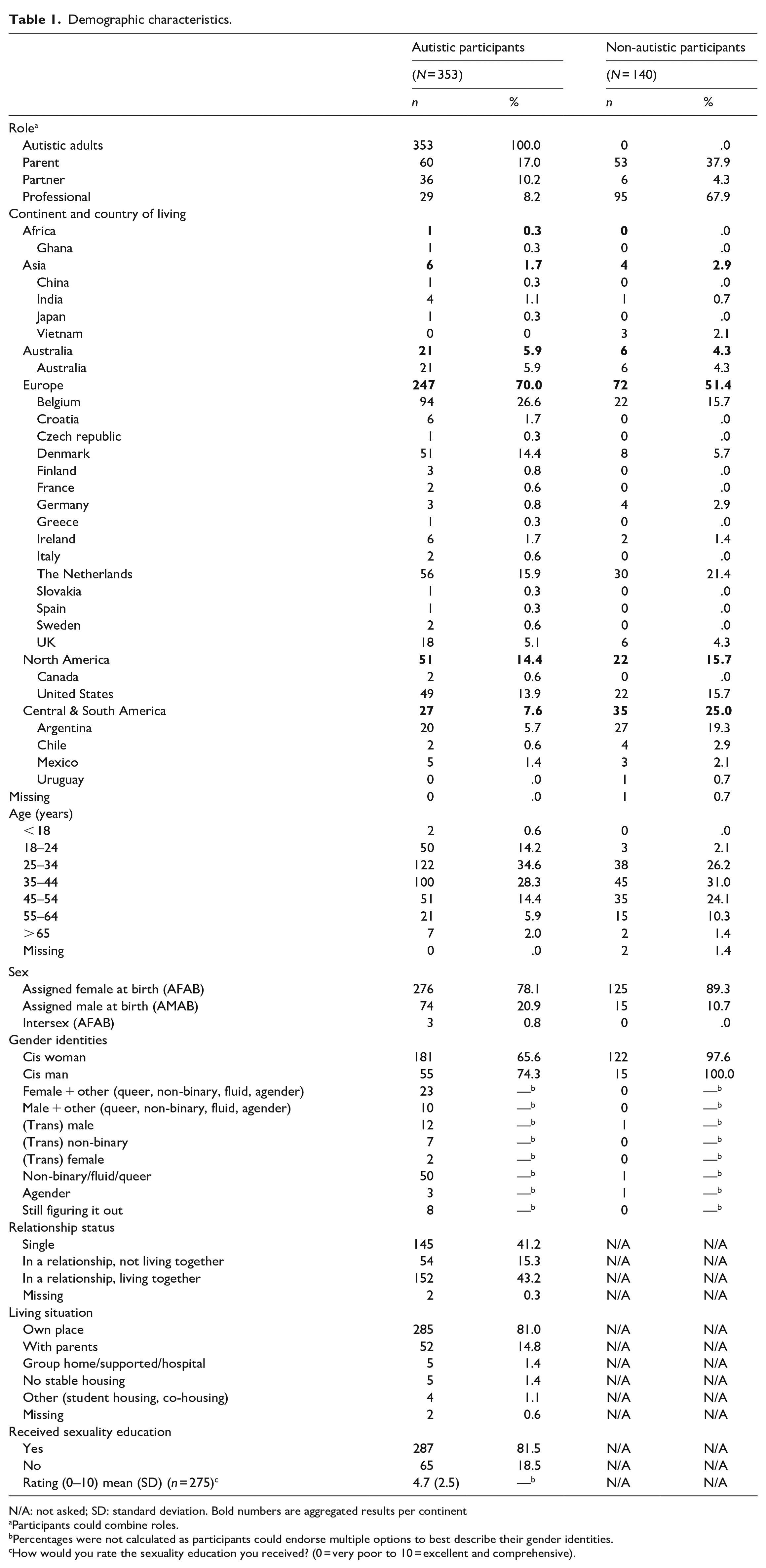
N/A: not asked; SD: standard deviation. Bold numbers are aggregated results per continent
Participants could combine roles.
Percentages were not calculated as participants could endorse multiple options to best describe their gender identities.
How would you rate the sexuality education you received? (0 = very poor to 10 = excellent and comprehensive).
Community involvement
Autistic and non-autistic researchers, self-advocates, clinicians, and parent organization representatives collaborated in applying for funding, designing and conducting the research, interpreting and reporting the data, and disseminating the results.
Policy recommendations
Eight of the 11 policy recommendations were maintained based on the ratings of the autistic survey participants. Three recommendations on supportive communities did not survive the consensus cut-offs (see Table 2). Additional comments by the autistic participants were analyzed and used to further refine the recommendations. It is beyond the scope of this study to concretize and discuss the specific implications of the recommendations on policy and daily life. However, key references are listed below each recommendation, presenting the state of the research and starting points to translate these recommendations into policy and practice.
Rating of the recommendations.
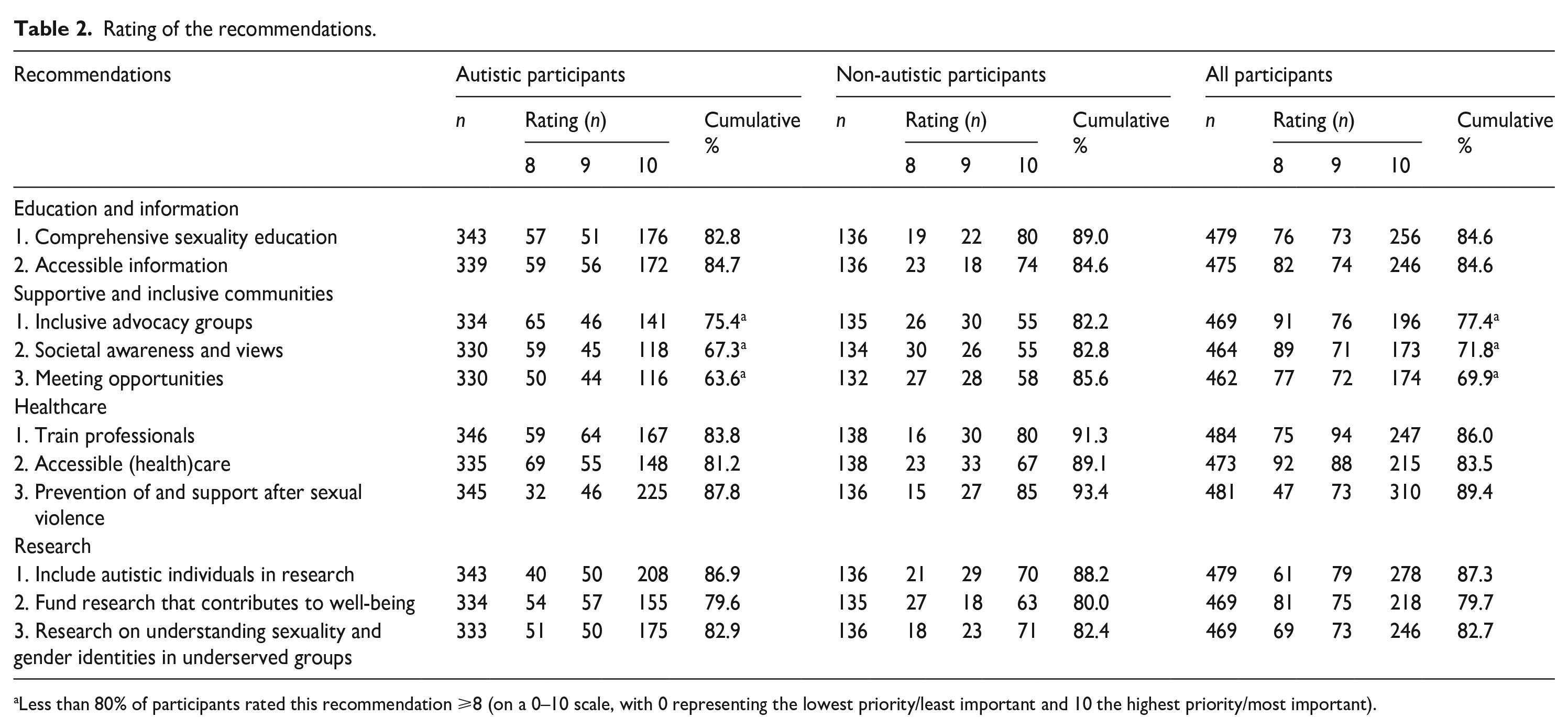
Less than 80% of participants rated this recommendation ⩾8 (on a 0–10 scale, with 0 representing the lowest priority/least important and 10 the highest priority/most important).
Theme 1: education and information
1. Provide all autistic individuals with comprehensive and accurate sex education that addresses sexuality, intimate relationships, and gender identity (diversity) from a positive perspective. Sex education can help individuals learn to understand their personal preferences, boundaries, and identities, build skills to develop healthy relationships and recognize harmful relationships.
In addition to this recommendation, autistic adults stressed the need for attention to diverse interests and experiences (e.g. specific sexual interests, asexuality, sensory experiences and preferences, masturbating to regulate stress) in CSE. Awareness about cultural differences (e.g. in some countries CSE is not yet provided in schools so other venues may be needed), the differing needs of specific groups (e.g. individuals with high IQs, people with intellectual disability), the mode in which CSE is offered (individual, in group, in schools, or otherwise), and the timing of sexuality education (e.g. early in development, attuned to the developmental level of youth, making CSE available to adults) were stressed.
Ragaglia et al. (2023) provided an overview of best practices and validated programs, recommendations regarding the content, modalities of CSE, the possible role of different actors, and caveats in the available research.
2. Make information on sexuality and relationships available and easily accessible to autistic individuals and to the people supporting them.
Autistic adults stressed the need to make accurate and comprehensive information accessible to autistic children, adolescents, and adults and their family members, caretakers, and partners. Crehan et al. (2022) explored sexuality and relationship education resources for autistic and neurotypical adults and discussed the importance of using online resources.
Theme 2: healthcare
Train professionals to understand, discuss, and respond to the diverse needs of autistic individuals regarding sexuality, intimate relationships, and gender identity.
This recommendation applies to professionals from diverse backgrounds/disciplines (e.g. teachers, mental health professionals, and medical specialists).
The WHO (2015) already strongly recommended the training of professionals in sexual health knowledge and communication skills. Attention to the specific healthcare experiences and needs of autistic people (Holmes et al., 2023) relating to gender and sexuality should be integrated into the training of professionals.
2. Provide accessible expert (health)care to address the needs of autistic individuals regarding sexuality, intimate relationships, and gender diversity across the lifespan.
Autistic adults call for specific attention to care in the areas of menstruation, pregnancy, parenthood, and menopause.
Holmes et al. (2023) identified facilitators and barriers to sexual and reproductive healthcare for autistic individuals and integrated them in a conceptual model to guide practice, future research, and policy.
3. Improve prevention and/or support services for autistic survivors of sexual violence.
Autistic survey responders pointed out the need for attention to personal expectations and boundaries, and to recognize safe relationships in CSE. In addition, the need for trauma-informed/specialized care for autistic individuals who experience sexual violence was pointed out.
Dike et al. (2022) reviewed the available research on sexual violence among autistic individuals and emphasized the importance of the development of treatment and support strategies for autistic individuals who have experienced sexual violence. Insights based on lived experience of autistic people are essential to understand how to help people who were harmed (Pearson et al., 2023).
Theme 3: research
Ensure that autistic people are included in research projects studying sexuality, gender and related health, and well-being.
The value and importance of participatory research in the field of autism has been emphasized (Fletcher-Watson et al., 2019) and guidelines for participatory autism research are available (Nicolaidis et al., 2019).
2. Promote and fund research that contributes to the well-being of autistic individuals regarding their sexuality, intimate relationships, and gender identities.
Research priorities regarding autism, sexuality, and gender identity have been published (Dewinter et al., 2020) which may have a positive impact on the daily lives of autistic people and their families.
3. Promote and develop research on how to understand and support sexuality, intimate relationships, and gender diversity-related needs in people with intersecting identities—such as autistic people of color, autistic people with limited verbal communication, and autistic people with intellectual disabilities.
The need for attention to the experiences of autistic individuals with intersecting identities has been emphasized and approaches to reducing barriers to research participation have been suggested (Lopez et al., 2022 (intersectionality); Lebenhagen, 2020 (speaking and nonspeaking individuals); Shaia et al., 2020 (Black and African-American families); Strang et al., 2020 (gender diverse individuals)).
Conclusion
These community-based recommendations for education, clinical practice, research, and policy are developed to promote well-being in autistic youth and adults through a positive approach to sexuality and gender diversity. We believe implementation of these recommendations will lead to improved well-being and quality of life of autistic individuals.
Supplemental Material
sj-docx-1-aut-10.1177_13623613231188349 – Supplemental material for Short report: Recommendations for education, clinical practice, research, and policy on promoting well-being in autistic youth and adults through a positive focus on sexuality and gender diversity
Supplemental material, sj-docx-1-aut-10.1177_13623613231188349 for Short report: Recommendations for education, clinical practice, research, and policy on promoting well-being in autistic youth and adults through a positive focus on sexuality and gender diversity by Jeroen Dewinter, Morénike Giwa Onaiwu, Maria L Massolo, Reid Caplan, Els Van Beneden, Nikki Brörmann, Eileen T Crehan, Lisa A Croen, Susan Faja, Dena L Gassner, Laura Graham Holmes, Cat Hughes, Morrigan Hunter, Monique Huysamen, Paola Jelonche, Meng-Chuan Lai, Ilse Noens, Heta Pukki, Mark A Stokes, John F Strang and Anna IR van der Miesen in Autism
Footnotes
Acknowledgements
We thank everyone who completed the survey and those who advised and supported us during the process of developing these policy recommendations. Special thanks to Annika Kooke and Ross Howard-Hildige for reviewing the available research; to Cora Coehorst, Elizabeth Graham, Ann De Keersmaecker, Ingrid Verhaegen, and Karen Wangari for their contribution in the expert meetings; and to the participants at the LAVA— Autistic Adults’ Reading and Advisory Group reading session who provided feedback on this article.
Declaration of conflicting interests
The author(s) declared no potential conflicts of interest with respect to the research, authorship, and/or publication of this article.
Funding
The author(s) disclosed receipt of the following financial support for the research, authorship, and/or publication of this article: Funds to support this research were provided by the International Society for Autism Research (INSAR). INSAR is not responsible for, nor does it endorse, the content of this report.

Supplemental material
Supplemental material for this article is available online.
Notes
References
Supplementary Material
Please find the following supplemental material available below.
For Open Access articles published under a Creative Commons License, all supplemental material carries the same license as the article it is associated with.
For non-Open Access articles published, all supplemental material carries a non-exclusive license, and permission requests for re-use of supplemental material or any part of supplemental material shall be sent directly to the copyright owner as specified in the copyright notice associated with the article.
