



Abstract
While in recent years there has been a surge of studies examining the role and contribution of the chair of the board, there is still a surprising paucity of work examining the leadership role and behaviour of the chair under specific company and environmental conditions. Specifically, not much literature examines the chair role in relation to the CEO during company turnarounds, or more generally during crisis. This study conducts elite interviews with 30 chairs and CEOs of large UK-listed companies to examine the chair role in relation to the CEO during turnaround execution. Findings from thematic analysis, characterise the chair leadership as a dynamic buffering role that insulates the CEO and management team from unwarranted performance pressures arising from shareholders and other stakeholders (e.g., market analysts), while simultaneously regulating CEO emotion, cognition and behaviour towards such pressures, thereby ensuring strategic alignment and direction during the turnaround execution.
Introduction
The purpose of this study is to examine the role of the board chair in relation to the CEO in large UK-listed companies during the execution of turnarounds. For many years, board leadership literature has focused on determining whether combined or separate CEO and Chair leadership roles are associated with superior company performance (Yu, 2023). The discussion has then moved to the relationship between the Chair and the CEO (e.g., Morais et al., 2018), the micro-chair behaviours in leading board meetings for enabling monitoring and scrutiny (Veltrop et al., 2021), the leadership role of the chair in terms of its participative and directive orientations during crisis (Krause, 2017) and, more recently, chair leadership mantras (Goyal et al., 2024). While this body of work contributed significantly to our understanding of (effective) chair leadership behaviour, these studies seem to indicate that there is some kind of ‘best practice’ approach to chair leadership, irrespective of the specific challenges being faced by the company or the company’s stage of development. The consequence of this is that a more nuanced and contextual understanding of the chair leadership behaviour and role is missed (Goyal et al., 2024). For example, while research on corporate governance recognises the important role that boards perform when their organisations are faced with a crisis (Dowell et al., 2011; Lorsch & MacIver, 1989; Schaedler et al., 2022), much less is known about chair leadership in such circumstances. Recent work has made some advances, but has remained stuck on a dichotomy between directive and participative leadership styles (Krause et al., 2024) or between collaborative and vigilant monitor chair leadership approaches (Morais et al., 2018, 2020). While the general chair leadership literature suggests that more collaborative and inclusive chair leadership approaches are more effective for non-executive Chairs (Shekshnia, 2018; Veltrop et al., 2021), the study by Krause et al. (2024) indicates that a non-executive chair directive leadership style was associated with better performance during the Covid-19 response in a sample of US boards. Such debate is likely to end up in the same place as the debate on duality: inconclusiveness. As discussed in Morais et al. (2020) how the chair behaves is contingent on the nature of the problem (crisis) faced by the company. Reducing chair leadership to a participative-directive dichotomy is missing the rich and nuanced ways in which non-executive chairs behave.
An examination of past work on the chair role (e.g., Certo et al., 2001; Hambrick et al., 2005; Krause, 2017; Lorsch & Zelleke, 2005; Roberts, 2002; Roberts & Stiles, 1999; Stewart, 1991; Withers & Fitza, 2017) and emerging work on the chair leadership role during crisis (e.g., Krause et al., 2024; Schmitt et al., 2020) indicates that chairs exhibit a range of behaviours not necessarily falling into directive/participative or monitoring/collaborative dichotomies. Furthermore, while boards of directors have been extensively studied as boundary spanners conducive to organisational adaptation and survival (Hillman et al., 1999, 2009; Zheng et al., 2015), the role of the chair during environmental discontinuities (Hoppman et al., 2019) has received less attention. Consequently, more studies that explore the chair role during specific crisis contexts and that allow for greater theoretical plurality are required.
We pose the following research question: What role(s) do board chairs play in relation to the CEO during the execution of corporate turnarounds? How is this role(s) exercised? To answer these questions, we interviewed 30 chairs and CEOs of large UK-listed businesses undergoing a process of turnaround, which originated from a combination of internal and external factors that led to a deterioration in company performance. This provides a crisis context that differs from the one used in the study by Krause et al. (2024) on COVID-19. We conduct elite interviews to obtain a more nuanced account of Chairs’ behaviour during crisis, thereby not limiting participants’ accounts by pre-determined, theoretically framed surveys. This allows chairs to express both participative and directive, as well as collaborative and monitoring behaviours, during the crisis, as well as a range of other behaviours.
We focus on the role that chairs play in relation to the CEO, leaving out of the scope of this study, broader board dynamics of how other non-executive directors (NEDs) may influence Chair and CEO behaviours. For example, Boivie et al. (2021) have shown that board directors have implicit theories of governance that construct their role as strategic partners with the CEO and the executive team. However, in exercising this strategic partner role, some directors implicitly view their primary focus as ‘protecting the shareholders’, whereas others see it as ‘supporting managers and helping them make the best strategic decisions to benefit the entire firm’ (Boivie et al., 2021, p. 1684). This underscores the idea that directors may, and often exhibit, different discourses and mindsets that serve as scripts for their boardroom behaviour, and that these different mindsets may give rise to role conflict and ambiguity (Carroll et al., 2017), which test boards cohesiveness and conflict management resources (Engbers & Khapova, 2024). These dynamics have the potential to influence the role of the chair and the relationship with the CEO.
However, research on separate board leadership structures is consensual in that the Chair–CEO relation sets the tone for board behaviour and contribution (Kakabadse et al., 2006; Leblanc & Gillies, 2005; Levrau & Van den Berghe, 2013; Zhang & Rajagopalan, 2004). While NEDs can and do exert influence over the Chair–CEO relationship, the influence that the Chair–CEO relationship exerts on NEDs is likely to be of a far greater magnitude. We therefore focus this study on the chair–CEO relations during turnaround execution, and, specifically, how Chairs and CEOs construct the chair role vis-à-vis the CEO in this context.
This paper makes several contributions. First, it contributes to the literature on board leadership by inductively surfacing the chair's buffering role during turnaround execution. Our findings identify instances where chairs exhibit regulating and insulating behaviours that help reduce uncertainty and dependence, and increase legitimacy to the CEO and the top management team in pursuing the turnaround effort. The chair emerges as performing a critical buffering role that enables external adaptation whilst maintaining internal stability and efficiency during turnaround implementation (Thompson, 1967). The paper provides tentative definitions of insulation and regulation chair roles. It contributes to resource dependence theory by showing that, in addition to board composition (Hillman et al., 1999, 2000; Zheng et al., 2015) uncertainty reduction and legitimacy can be attained by the chair's insulating and regulating activity acting as a buffer between the CEO and the senior management team, and the board and external powerful stakeholders, which are essential contributors to company external adaptive behaviour, while maintaining internal stability and efficiency in turnaround execution.
The rest of the paper is structured as follows. First, we review the literature on board leadership structure, the chair role and leadership style, with a focus on chairs’ leadership behaviours during crises. Next, we identify a research gap followed by a detailed description of the methods, including sample selection, data collection and analysis procedures. We provide a detailed account of the interview findings, followed by a discussion of the implications for theory and practice, limitations and future research directions.
Literature Review
Board Leadership Structure
The board of directors’ leadership structure has been subject to a vigorous, yet inconclusive, debate regarding which model is more effective in improving board effectiveness and company performance (Boyd, 1995; Finkelstein & Mooney, 2003; Rechner & Dalton, 1991). Stewardship theorists support the view that a combined role of CEO and chair provides the required unambiguous leadership, unity of command and collaboration (Donaldson, 1990; Lorsch & MacIver, 1989; Mace, 1971) and found some positive associations between this type of leadership structure and company performance (Donaldson & Davis, 1991; Slatter & Lovett, 1999). Agency theorists, on the other hand, argue for a separate and independent leadership structure given the necessity to monitor CEO behaviour and ensure alignment of interests between the CEO and the shareholders (Fama & Jensen, 1983; Jensen & Meckling, 1976). The chair would thus fulfil a monitoring function. Studies in this tradition have argued that a combined role paves the way for CEO unfettered power and a lack of monitoring, often leading to corporate failure (Daily & Dalton, 1993) or weakened company performance (Coles et al., 2001; Rechner & Dalton, 1991). Contingency studies found contradictory results. Boyd (1995) found that a combined role leads to a better return on investment (ROI) in companies that are resource-constrained or have higher complexity. In contrast, Haleblian and Finkelstein (1993) found that the combined leadership structure is associated with worse performance in firms experiencing turbulent environments. Mueller and Barker (1997) studied the board leadership structure and company turnaround success, finding support for both CEO duality and separate leadership roles. A third theoretical perspective, that of resource-dependence theory (Pfeffer & Salancik, 1978), also supports separate roles, as this increases the availability and provision of resources to the CEO and the board (Withers & Fitza, 2017). From this perspective, the role of the chair is to act as a boundary spanner and resource provider, including the provision of legitimacy, networks, external perspectives, complementary skills, experience and advice (Hillman et al., 2000; Pfeffer & Salancik, 1978; Withers & Fitza, 2017).
Despite the debate and inconclusive findings, regulators worldwide are moving to encourage or mandate the adoption of a separate leadership structure. The UK leads this process, with 100% of FTSE 100 and 96% of FTSE 350 companies having a separate leadership structure (Spencer Stuart, 2023). Such a move supports the agency- and resource-based views of the chair’s role, and justifies the importance of considering the role of Chair relative to the CEO.
The Chair as Leader of the Board
UK regulations, such as the Financial Reporting Council’s guidance on board effectiveness (FRC, 2018) and the UK Corporate Governance Code (FRC, 2024), place a significant emphasis on the chair as the leader of the board. In the 2018 guidance on board effectiveness, the Financial Reporting Council states that ‘Good chairmen create good boards. The chairman creates the conditions for overall board and individual director effectiveness’ (FRC, 2018, p. 2). From then on the focus is on the individual qualities and discrete tasks that chairs are expected to perform as leaders of the board, including: setting expectations relating to company culture, values and behaviours and the style and tone of board discussions; demonstrating ethical leadership; setting the board agenda; ensuring a timely flow of high-quality supporting information; succession planning and board composition; structuring and composing of board committees; promoting board evaluation; and skilfully conducting board meetings where there is sufficient challenge to major proposals and high quality of debate. The relationship with the CEO and the communication with shareholders and other stakeholders, as essential tasks of the chair, are only briefly mentioned in comparison. Academic research has also focused much more on the board chair role as the leader of the board (Banerjee et al., 2020). Studies on board composition from a resource-dependence perspective have suggested that chairs compose the board so that they can reduce uncertainty and reflect the variety of challenges presented by the external environment (Hillman et al., 2000; Parker, 1990; Pfeffer, 1972), whereas others suggested that chairs could use board composition as a signalling mechanism (Broome & Krawiec, 2008). Other studies have demonstrated the importance of chairs in promoting NEDs’ engagement with the business, enabling them to monitor and advise management more effectively (Carter & Lorsch, 2004; McCabe & Nowak, 2008; Morais et al., 2019; Pettigrew & McNulty, 1995). It is thus the chair’s responsibility to set the tone and expectations for NED engagement and contribution (Roberts et al., 2005). Chairs are also the critical connection that establishes the tone for engagement between the board and the CEO (Bailey & Peck, 2013; Leblanc & Gillies, 2005), sets the board agenda to avoid domination of this process by the CEO (McNulty et al., 2011; Pettigrew & McNulty, 1995), and oversees how board committees are structured and work (Spira & Bender, 2004). Finally, and importantly, chairs as leaders of the board are expected to conduct effective board meetings through open discussion and debate, which is a significant determinant of board effectiveness (Garratt, 1999; McNulty et al., 2011; Veltrop et al., 2021). It is for the chair to act as a conductor, manage dissent and work towards a consensual standard view, setting the tone for governance matters (Leblanc, 2004). To fulfil this role, incumbents must be acutely aware of the board climate, sensing mood changes and understanding shifting dynamics (Kakabadse et al., 2001).
Chair and CEO Relations
The Chair–CEO relationship is often described as pivotal and sacred (Kakabadse et al., 2006; Leblanc & Gillies, 2005; Levrau & Van den Berghe, 2013), or the ‘fulcrum around which directing is levered’, and it is described as being highly contextual (Pye, 2005, p. 76). Chairs can play distinct roles vis-à-vis the CEO, namely partner, executive, mentor, consultant and distant chair (Stewart, 1991). Pye (2000, p. 344) observes that the relationship between the chair and CEO has moved from a ‘distanced approach’ to one that is more ‘interdependent and dynamic’, characterised by a sense of ‘partnership, mutual respect, understanding and trust’, where issues are brought to the board only when the chair and CEO have previously agreed to do so. Other studies indicate that a complementary relationship between the chair and CEO provides ‘a context in which the CEO can think provisionally in a way that acknowledges the ambiguity and uncertainty that is the ground of decision-making’ (Roberts, 2002, p. 504). ‘Building the basis for trust’ between the two roles by enabling open communication of concerns avoids misunderstandings about each other's intentions. It requires a ‘high level of routine contact between the two’ (Roberts, 2002, p. 502). It is argued that this relationship is the building block of boardroom culture, determining how board members behave and contribute, as well as the quality of board–management relationships (Pye, 2005; Roberts, 2002; Roberts & Stiles, 1999). Effective chair and CEO working relationships require the existence of ‘personal chemistry’ and an ‘ability to interpret information and events in a mutually synergistic manner’ (Kakabadse et al., 2010, p. 144).
While there is significant research on the chair as the leader of the board and the relationship with the CEO, few studies have attempted to explore chair leadership under specific company circumstances, such as during the execution of a turnaround plan after a crisis.
The Chair Role and Leadership During Crisis: A Research Gap
Studies on the leadership role of the chair of the board have primarily been conducted in a business steady state, irrespective of the challenges facing companies. However, Withers and Fitza (2017) have shown that Chairs may explain a significant portion of company performance when the company is facing complex, uncertain and low-munificence environments. But studies of the chair leadership role during crisis or discontinuous change remain scarce. A recent study by Krause et al. (2024) surveyed 120 US company directors (representing 106 boards) to examine the chair leadership style during the COVID-19 crisis and its relationship to company performance. They have found a positive relationship between chair directive leadership style (by promoting competitive simplification) and company performance during the crisis only when chairs were not the CEO. Under CEO duality, directive chair leadership was found to have some association with lower performance. These findings suggest, contrary to other studies (Morais et al., 2018, 2020), that a chair directive style is more beneficial in separate leadership structures during crises. In large UK-listed companies, Chairs and CEOs facing significant, life-threatening strategic tensions were found to use either a CEO-led (CEO directive) or a shared leadership approach (collaborative); however, neither approach was found to be inherently superior in terms of performance (Morais et al., 2018). A subsequent study, however, showed that whether chairs or CEOs took the lead was dependent on the nature of the problems (crises) being faced (Morais et al., 2020). Chairs often take the lead in high uncertainty, wicked crises involving reputation or systemic market issues, whereas CEOs lead during turnarounds and entrepreneurial challenges (Morais et al., 2020). While contributing to our understanding of board chair leadership during crises, these studies remain somewhat limited by the theoretically driven dichotomies of collaborative or inclusive versus directive chair leadership orientations during crises. The role of the chair during a crisis goes beyond monitoring and advisory roles (Schmitt et al., 2020). Citing interviews with chairs of large listed businesses during the COVID-19 crisis, it is argued that the key chair role was (i) safeguarding the identity and mission of the organisation, by ensuring the crisis response does not jeopardise its ability to deliver the mission in the future; (ii) resolving anxiety, by actively addressing the emotional and psychological impact on their CEO and executive team; and iii) creating a safe space, by being a sounding board to the CEO, enabling alignment on strategic actions before presenting them to the full board (Schmitt et al., 2020, p. 1–4).
A review of past work on the chair role (e.g., Certo et al., 2001; Krause, 2017; Lorsch & Zelleke, 2005; Stewart, 1991; Withers & Fitza, 2017) and more recent work on the chair leadership role during crisis (e.g., Krause et al., 2024; Morais et al., 2020; Schmitt et al., 2020) indicates that chairs have an important role during crisis. For example, chairs have been depicted as playing a partner role vis-à-vis the CEO, ‘taking the flak’ on behalf of the CEO and ‘supporting the CEO through difficult situations’ (Stewart, 1991, pp. 520–521). Chairs have been shown to relieve CEOs of board duties (Krause, 2017) and some stakeholder management responsibilities, thereby allowing them to access resources for strategic change (Certo et al., 2001; Hambrick et al., 2005), enabling the CEO to focus on short-term concerns (Roberts, 2002). Board chairs can play a gate-keeping and informational role among critical stakeholders, often judging what and how information gets passed among stakeholders (Carter & Lorsch, 2004; Pfeffer & Salancik, 1978; Roberts & Stiles, 1999). Research on resource dependence theory (Hillman et al., 2009; Pfeffer, 1972; Pfeffer & Salancik, 1978) focused on the board as a resource provider (Hillman et al., 1999; Lang & Lockhart, 1990; Zheng et al., 2015), but little to no research exists that focuses on specific resource-rich directors’ behaviour (Hillman et al., 2009). For example, Hoppman et al. (2019) examined boards in the Swiss electrical sector between 2009 and 2015, which faced radical regulatory reforms amounting to discontinuous change, to highlight the board’s role in company adaptation and renewal. The study also highlights the role of the chair of the board in enabling board reconfiguration and renewal, which facilitates strategic adaptation and protects the company from excessive change promoted by management (Hoppman et al., 2019). These studies emphasise the role of the board during crisis, but the role of chair with relation to the CEO in this context remains understudied.
Research Method
Qualitative research published on corporate governance topics is sparse among the top journals. This study contributes to calls for corporate governance research to make ‘greater use of qualitative methods that explore processes and interactions in a real empirical context, and follow a more eclectic range of theoretical frameworks’ (McNulty et al., 2013, p. 184). Qualitative research enables researchers to ‘see in new ways’, but to maintain rigour, it is essential to establish the researcher's onto-epistemological assumptions (Bansal et al., 2018). This study adopts an interpretivist ontological position, employing an inductive, thematic approach to data analysis (Bailey & Peck, 2013; Goyal et al., 2024). The data collection and analytical procedure are discussed below in more detail.
Sample
This study employs a non-probability, purposive sampling method, where the selection criteria are derived primarily from the research question (Patton, 2014). As discussed in the literature review, the separation of the Chair and the CEO roles in the UK, means that the role of the chair is often defined in relation to the CEO, hence, to explore what constitutes a Chair's role and how is it enacted, we have constructed the sample so as to include both Chairs and CEOs, enabling also some triangulation between chairs perceptions of their role and CEOs observations of chair role behaviour. As a general guide, Creswell (2007) recommends 25–30 interviews be undertaken for a general qualitative study. In a recent review of qualitative work in management studies, Saunders & Townsend (2016) find that a range of 15 to 60 interviews is acceptable, subject to the nature of the research question and conventions in the area of study. Prior studies examining the roles of CEO and/or chairs and board behaviour have used sample sizes within this range (Bailey & Peck, 2013; Morais et al., 2018, 2020).
A London-based company specialising in corporate turnaround and restructuring provided the authors with access to their client base. Individuals were selected purposefully based on their substantial experience in chair and/or CEO roles on multiple boards of UK-listed companies that have undergone turnaround processes. There was an element of snowballing with some individuals suggesting others to participate in the study. Data saturation (i.e., the point in data collection where no new data emerge that modify existing conceptual categories or create new ones) (Francis et al., 2010) was reached at interview twenty-five. However, to strengthen the validity of the themes’ content and to capitalise on the unique access obtained to interview board directors, researchers continued to gather additional interviews, which served to confirm the emerging themes. The final sample consisted of 14 Chairs and 16 CEOs, 30 participants in total.
The individuals composing the final sample were truly high-profile elites among the UK business upper echelons. Many held prestigious titles, such as Lord, while others had been appointed to the Order of the British Empire in recognition of their contributions. Some had held essential roles in the British government. All of the participants had been CEOs and/or chairs of multi-billion-pound businesses in different sectors. Such a list of elite individuals made the research both highly interesting and challenging. From the 30 individuals who agreed to participate, only one was a female. Female representation in Chair and CEO roles within the FTSE 150 remains low, at 15% and 12%, respectively (Spencer Stuart, 2023). The lack of representation of women directors in the sample may be due to the existence of the ‘old boys’ networks’ – male participants recommended other male participants from their professional network to take part in the study.
Furthermore, all participants were from a white background, with 27 White British (WB) and three from Other White Background (OWB). Table 1 provides a characterisation of the sample, emphasising the roles discussed, age, gender, ethnicity and qualifications.
Sample Demographics.
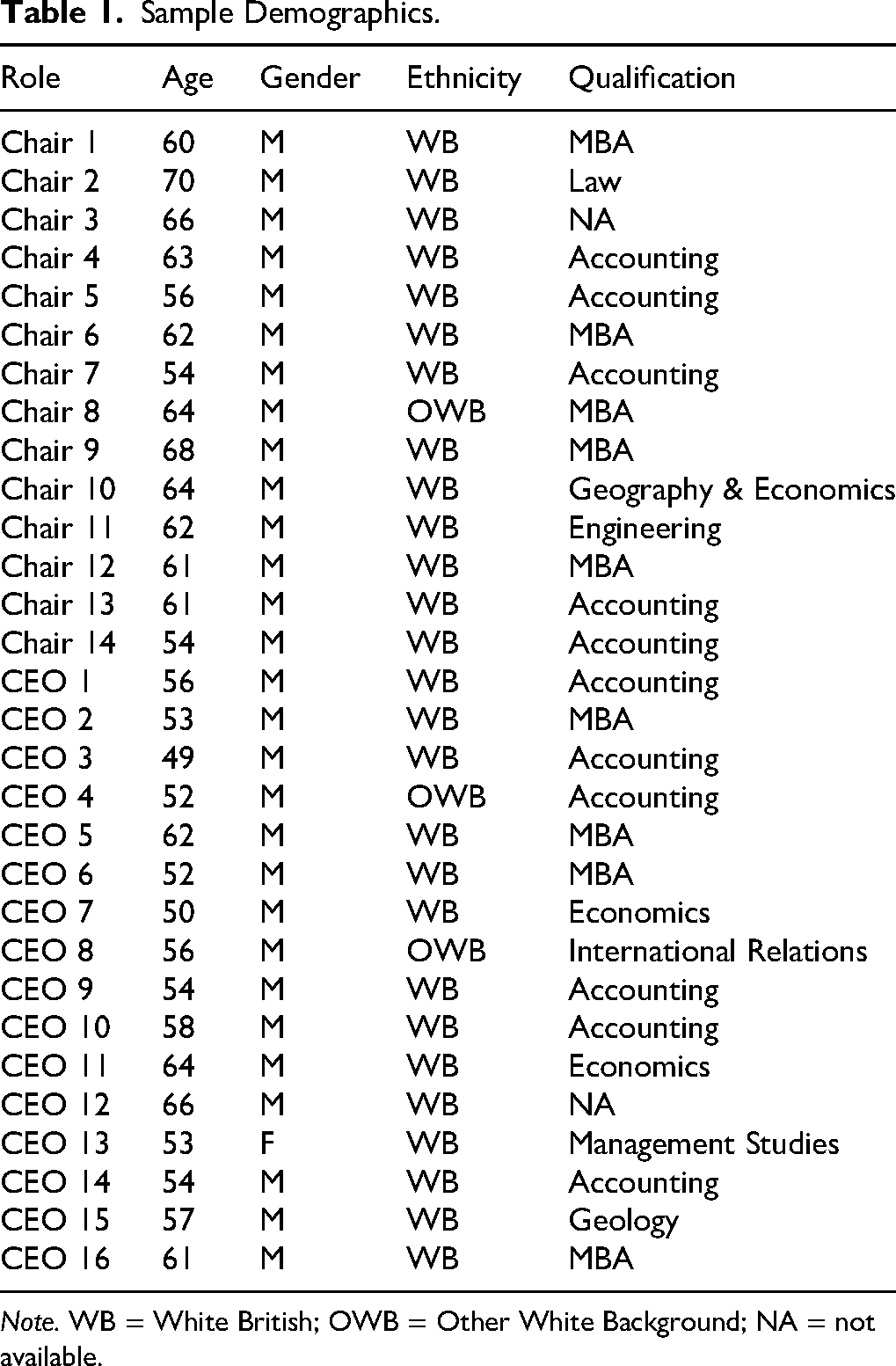
Note. WB = White British; OWB = Other White Background; NA = not available.
The age profile of the sample was also relatively homogeneous. The average age of participants was 58.7, with chairs being older on average (61.8 years) when compared with CEOs (55.6 years). Notably, the sample is also homogeneous in terms of qualifications. Out of the 30 participants, 20 (or 66.6%) were either Chartered Accountants (10 individuals) or holders of a Master of Business Administration (MBA) or a similar qualification (10 individuals). Eight participants had qualifications in a range of subjects, including economics, geology, international relations and law. For two participants, it was not possible to verify their qualifications. Table 2 shows the sectors and causes of turnaround discussed by the participants.
Participants, Company Sector and Turnaround Causes.
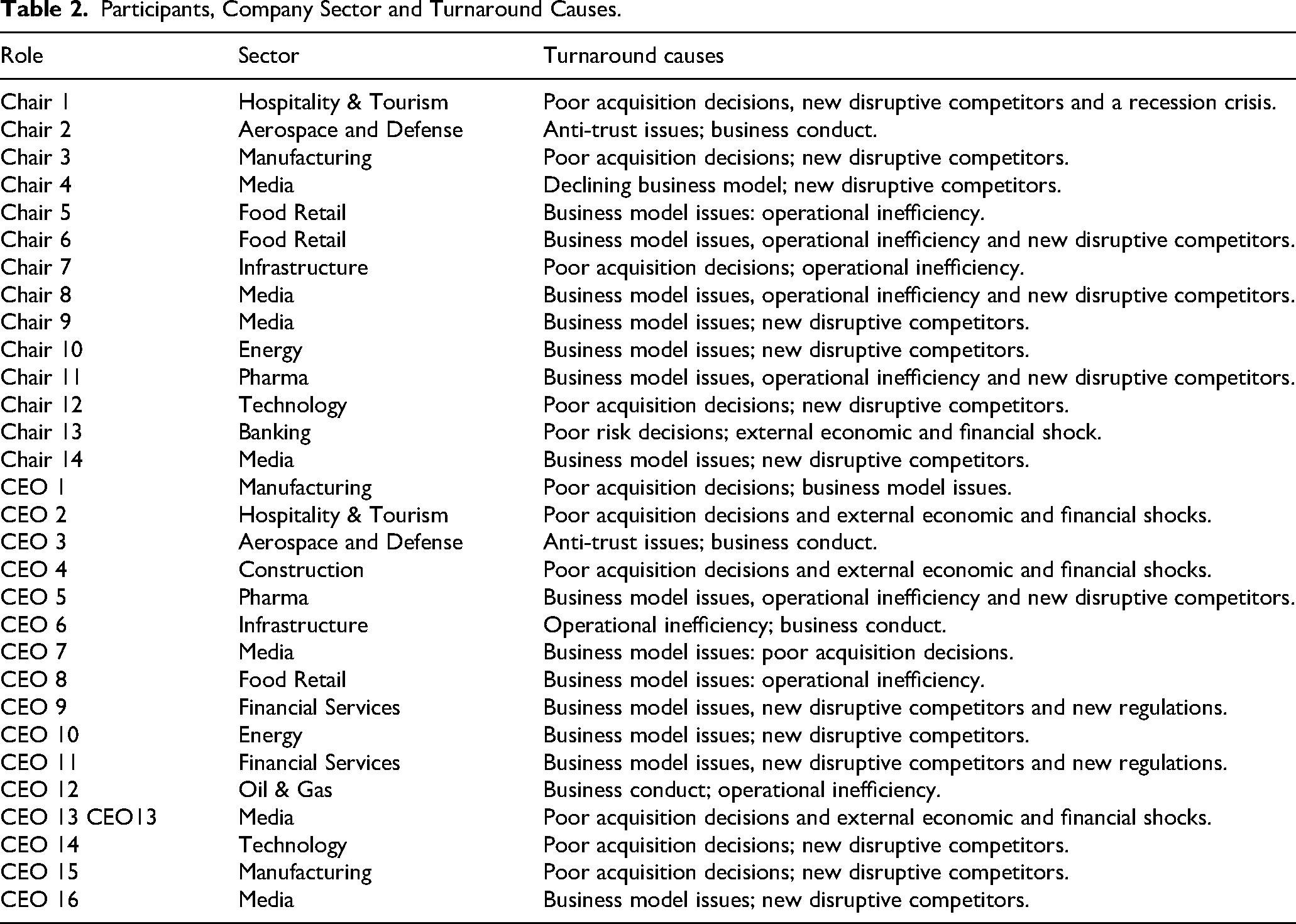
The participants discussed turnaround experiences arising from 12 different sectors, most of which had a combination of internal (i.e., poor acquisition decisions, business model issues, operational inefficiencies and poor business conduct) and external (disruptive new entrants, economic recessions and financial crises) causes of turnaround.
Data Collection
This study positions itself within the behavioural and contextual perspectives of boardroom study (Gabrielsson & Huse, 2004), aiming to examine the chair role behaviour in context, from the perspective of board chairs and CEOs (Hambrick et al., 2008). Given the obstacles in accessing the ‘black box’ and live boards in particular (Leblanc & Schwartz, 2007), interview techniques have been selected by researchers as the primary tool with which to examine the behaviour of a firm's governance roles (e.g., Leblanc & Gillies, 2005; McNulty et al., 2013).
Given the high status of the participants, a technique typical of political science – namely, elite interviewing – was employed. It has often been said that elites – business, political or otherwise – do not enjoy being, and frequently refuse to be, straightjacketed by a predetermined, sequential ordering of questions (Aberbach & Rockman, 2002; Kincaid & Bright, 1957). The use of open-ended questions is therefore characteristic of elite interviewing, specifically when: (i) there is a requirement to probe for information; (ii) there is little previous research on the topic, and; (iii) when it is essential to give interviewees maximum flexibility in elaborating their responses and engage in wide-ranging discussions (Aberbach & Rockman, 2002; Kakabadse & Louchart, 2012). In approaching the conduct of interviews in this way, there is a recognised trade-off between ‘the advantages of conversational flow and depth of response and the disadvantages of inconsistent ordering of questions’ (Aberbach & Rockman, 2002, p. 674). Such costs often come in the form of increased difficulty in producing ‘an analytical, elegant end product’, by making coding and analysis more difficult (Aberbach & Rockman, 2002, p. 674). Further, several ‘traps’ may emerge when conducting elite interviews: (i) one or more particular participants more persuasive than the rest can shape the dominant understandings of the interviewer; (ii) personal bias towards a corporate view; and (iii) exaggerated roles (Berry, 2002; McDonald & Westphal, 2010). In fact, on some occasions, it was felt that participants were partially acting as ‘corporate spokesmen’ (Kincaid & Bright, 1957). Others might have slightly exaggerated or downplayed their roles in the contexts and situations that emerged. No doubt some were more persuasive and articulate, or had more extroverted personalities, making their points very convincing. The authors addressed such situations through additional questioning (e.g., asking who else was involved and contributed) or by posing questions that the researchers knew were likely to be related (e.g., issues that emerged from previous interviews describing similar aspects or information in the public domain about the turnaround).
Reflexivity is particularly important for interpretivist research, which assumes knowledge is socially constructed. Reflexivity is here used to ‘question knowledge claims and enhance understanding by acknowledging the values and preconceptions the researcher brings to that understanding’ (Haynes, 2012, p. 74). Moreover, in participatory research, especially co-produced research between researchers and practitioners, the significance of politics, hierarchy and authority in co-production is central to reflexive understandings of the dynamics in play (Orr & Bennett, 2009). Alvesson et al. (2008) identify several reflexivity practices, of which theoretical and positioning reflexivity practices are of particular importance in the context of the present study. This enabled the researchers to question and move beyond their own theoretical and normative assumptions, which often associate the chair role with a behavioural continuum of control and collaboration vis-à-vis the CEO and the board. Of special significance to this study is also reflecting on the researcher's positionality. The reflexive practices in the context of this research draw attention to the various ‘political, cultural and institutional constraints, embedded in the academic community, in the interest of using reflexivity to reveal the role of institutional forces’ (Alvesson et al., 2008). In elite interviewing, the power imbalance that often exists between the researcher and the subject, as well as the researcher's worldview, is frequently cited as a potential influence on the construction of knowledge. The fact that the researchers are themselves senior individuals having had senior executive positions and even in some cases non-executive positions, together with the introduction by the turnaround specialist firm in London, accorded the researchers an ‘insider status’, which is suggested to enable access, rapport and impact (Hayfield & Huxley, 2015, p. 92). The researchers past roles in industry may have at times made it hard to remain in the position of researcher; however, this also played a part in establishing openness and candour from the participants.
The interviews took place at the participants’ offices in London, lasting on average 60 minutes. The interviews were tape-recorded with the individuals’ permission and subsequently transcribed by a professional agency (Bailey & Peck, 2013). We did not want to direct the conversation by asking concrete questions about the chair's role, but rather to set a context within which such a role could emerge during the interview process. Consequently, we have asked participants to discuss their experiences as chair/CEO during corporate turnaround experiences. We aimed to strike a balance between the chair’s and CEO’s experiences to compare and contrast their perceptions, experiences and expectations concerning the chair's role and behaviours during the turnaround execution effort.
Data Analysis
This qualitative inductive study employs thematic analysis to inductively identify chair behaviour in companies facing existential-threatening turnaround processes. Thematic analysis is a process utilised by qualitative researchers to encode qualitative data and identify patterns and relationships (Boyatzis, 1998). This analytical technique involves an inductive approach to data analysis, using both ‘in vivo’ and open coding (Braun & Clarke, 2006; Clarke & Braun, 2014) and progressively move to sub-themes and themes based on researcher interpretation.
Following the six-phase framework outlined by Braun and Clarke (2006), the thematic analysis began with a thorough process of data familiarisation, which involved repeated reading of interview transcripts and field notes to gain a comprehensive understanding of the content of Chair and CEOs perspectives. This was followed by the generation of initial open and ‘in vivo’ codes that captured salient and recurring features across the dataset. These codes were then systematically organised into broader sub-themes that reflected meaningful patterns in relation to the research questions (Clarke & Braun, 2014). This iterative and reflexive process enabled a progression from descriptive coding to more interpretive and conceptually rich themes, allowing for the uncovering of deeper insights embedded within the data. Chair and CEO codes were systematically compared. This process was repeated by two researchers independently, and areas of disagreement were resolved through critical discussion.
Subsequently, the sub-themes were carefully reviewed, refined and synthesised into three overarching themes that encapsulated the core narratives emerging from the dataset. Reflexivity was integral throughout the analytic process, with continual attention paid to the researchers’ positionality, assumptions and interpretive lens to ensure methodological rigour. Strategies to enhance the trustworthiness and credibility of the analysis included peer debriefing, the maintenance of detailed audit trails and critical engagement with the coding framework (Goyal et al., 2024; Lincoln & Guba, 1985; Nowell et al., 2017). These measures were adopted to ensure that the analytical process remained transparent, dependable and grounded in the data.
Similar data analysis procedures have been employed in boardroom studies looking at decision-making styles and board leadership responses to discontinuous change (Bailey & Peck, 2013; Morais et al., 2020).
Data structure shown in Figure 1 has emerged as a result of this analytical process.
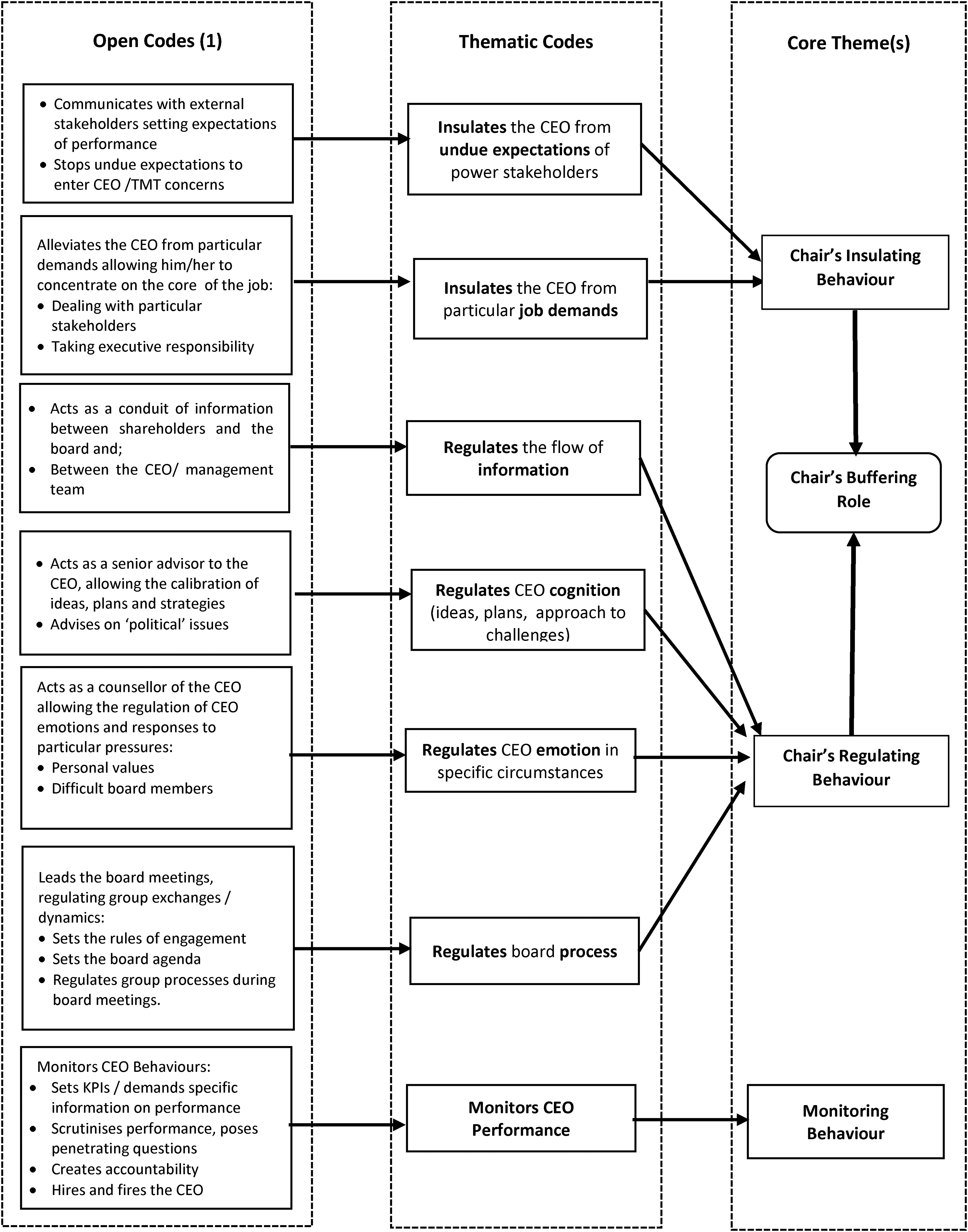
Data structure of the chair role(s) in relation to the CEO during turnaround execution. (1) In this picture, for practical reasons, we indicate a summary of the content of open codes. However, in text, we provide and discuss the original verbatim from interview material on the basis of the codes.
Findings
Thematic analysis enabled the identification of several chair behaviours related to the CEO. Although Chair behaviour influences not only the CEO but also the broader functioning and dynamics of the entire board, this study focuses on the most strategically significant dyadic relationship in the boardroom – that between the Chair and the CEO.
Chairs and CEOs in this study made sense of the chair’s role as a buffer. The findings from the thematic analysis suggest that chairs enact a fundamental role of buffering when companies are undergoing significant turnaround processes. Chairs consistently enact a buffering role during turnaround execution. This is reinforced by CEOs who expect chairs to exercise this buffering role. Our data suggest that environments characterised by uncertainty, low munificence and poor performance generate anxiety for CEOs, and it is not uncommon for them to seek this buffering support from the chair.
The chair of a large energy company (Chair 10) and CEO 3, made sense of his role as follows: So the main characteristic of a chair, I think, is you’re there, you’re like a sponge in many ways, to be able to take the brickbats and, at the end of the day, you take the crap and the executive team takes the glory. That's the way I think it needs to be. (Chair 10) … an ideal chair is one who dissipates waves, not extenuates them in either direction, the sort of people get in, it's too one way or the other, and he doesn’t, a bad chair extenuates, so if the shareholders are complaining a bit, he, a good chair understands, absorbs and gives the CEO time etc., what he doesn’t do is he doesn’t make everything work. [chair name] was a superb chair in the sense that he naturally understood that. (CEO 3)
The perspectives offered by Chair 10 and CEO 3 demonstrate a strong alignment in their interpretation of the chair's role during times of corporate turbulence, particularly in relation to buffering and absorbing external pressures. Both depict the chair as a protective intermediary who shields the executive team – especially the CEO – from destabilising influences such as shareholder dissatisfaction and market scrutiny. Chair 10's metaphor of being a ‘sponge’ who ‘takes the crap’ while the executives ‘take the glory’ foregrounds a self-sacrificial understanding of leadership, suggesting that the chair internalises tensions to maintain organisational cohesion and executive focus during high-stakes restructuring. Similarly, CEO 3's image of the ideal chair as someone who ‘dissipates waves’ rather than amplifies them reflects a parallel expectation that chairs regulate emotional and political volatility within and around the boardroom. The consistency in these views sheds light on the shared construction of chair effectiveness as being rooted not in dominance or visibility, but in stabilising influence and discretion. However, these interpretations also surface potential role tensions, whereby the chair's buffering role might mask structural power imbalances or place excessive emotional burden on the role occupant. Thus, while aligned in principle, the accounts also invite deeper inquiry into the costs and limits of such buffering behaviour, and whether this idealised chair role is sustainable or equitably shared across governance contexts.
The findings suggest a central role of the chair as a buffer during the execution of corporate turnarounds, exhibiting a range of behaviours for insulation and regulation purposes.
Chair's Insulating Behaviours
Interview data indicate that buffering is typically associated with some form of insulation or protection from external influences. In this study, we find that chairs enact two categories of insulating behaviour with relation to the CEO: (i) insulating the CEO (and the management team) from shareholder and other powerful stakeholder expectations; and (ii) insulating the CEO from particular job demands, to allow separation of efforts and focus.
Insulating the CEO From Shareholder and Other Powerful Stakeholder Expectations
During turnarounds, the CEO is often the target of multiple expectations and pressures from shareholders, the board and market analysts, for example. Our data show that it is the chair who emerges as the critical role in balancing expectations, thereby protecting the CEO from performance pressures. These pressures centre on strategic direction, particularly the timeframe required to restore the company to growth and profitability. The chair of a company in the hospitality and tourism sector and the chair of a food retail company shared the following accounts: …my thing as chair was to, then to explain to all the stakeholders, the true extent and the severity of the problem and what they could expect as a result. So the first thing is, in public companies, especially, you have to define success and you define the timetable, don’t let the market do it. People will always encourage you to say this is a problem, but we can solve it, and we’ll turn it around in a year or two, because a lot of people like to believe that. (Chair 1) but he didn’t, in terms of you calling it a vision, I don’t think he explained to the market the time you take to turn things around. I think he needed a lot more time, and a supportive chair and a supportive board would have given him the three-year, four-year target, because that's a super target. And you don’t change it round quickly, and that's why the new guys get the advantage of, I don’t know whether he’s kitchen sinking it or not, but he's certainly got the advantage to rebase expectations on the levels of profitability. (Chair 5)
The accounts provided by Chair 1 and Chair 5 illustrate a converging interpretation of the chair's role as a critical mediator of expectations, particularly in the context of organisational turnaround and strategic transformation. Both narratives point to the importance of the chair in setting and protecting a realistic timeframe for CEO-led change, particularly in publicly listed companies where market impatience can distort long-term strategy. Chair 1 positions the chair as the authoritative voice in defining success criteria and timelines, warning against the common tendency – by CEOs or boards – to conform to overly optimistic market pressures. This is echoed in Chair 5's reflection on a failed turnaround, where the absence of a supportive chair who could advocate for a more realistic time horizon contributed to the CEO's inability to succeed. In both accounts, the chair is not merely a buffer, but a sense-giver who interprets and communicates the strategic realities of turnaround to stakeholders, shaping the narrative in a way that aligns organisational capacity with external expectations.
These perspectives shed light on a subtle divergence from earlier notions of the chair as a passive absorber of tension: here, the chair is actively involved in boundary management and stakeholder sensemaking, defending the integrity of the strategic process rather than simply protecting the CEO from criticism. Importantly, this buffering is not about shielding through obfuscation; it involves honest and credible engagement with stakeholders, a point underscored in broader participant reflections that differentiate this role from mere impression management. The chair thus emerges as a guardian of strategic timeframes and narrative coherence, whose authority and judgement are vital to preserving the CEO's ability to lead meaningfully through complexity. Together, these accounts extend our understanding of chair effectiveness, portraying it as both protective and performative – anchored in transparency, resolve, and a realistic appraisal of organisational change dynamics. The chair of a food retail company emphasised the importance of honesty in managing expectations: The whole issue of managing expectations is really important, but in an honest way so they don’t think you’re sandbagging or trying to protect your figures or anything like that. (Chair 6)
The pressures on the CEO were sometimes so high that they felt compelled to make promises to the market in terms of earnings per share and other key investor metrics, which are inconsistent with a more long-term view. As the CEO is tempted to give in, chairs often have to intervene. In such circumstances, chairs have to intervene and send strong messages to the market (either informally or formally). In one media company, the chair realised that the CEO was giving in to some investors’ expectations for accelerating the restructuring; in a company that relied heavily on creative talent, such a move could compromise the more long-term objectives, which depended on retaining some of the existing key creative talent. In private conversations with these stakeholders and in public, the chair decided to mark a clear position, placating the pressures and interferences: I said, I’ve got a management team, I don’t want them bushwhacked because the market has no patience…. (Chair 4)
The data showed that insulating the CEO from the untimely demands of shareholders, analysts and other stakeholders is a critical component of how our participants make sense of the chair role. Such insulating behaviours by the chair are portrayed as essential for protecting the CEO and the management team as they execute the agreed turnaround plan.
Insulating the CEO Through Absorbing Job Demands
Chairs and CEOs’ accounts also reveal that chairs insulate the CEO from specific demands by absorbing them, allowing the CEO to focus his/her attention on other matters. These typically involved visiting and engaging with stakeholders concerned about the turnaround process, including government officials, regulators and business partners. The CEO of a manufacturing company describes these dynamics with the chair in the following terms: The chair and chief executive work as a team. In a good team you don’t all do the same thing: there's a centre-forward and a centre-back, and in a difficult situation the chair has to move into a – you could call it an executive role, but it's more of a leadership role and the chief executive – because there's so much to do – is taking a line of responsibility for the operation. (CEO 15)
The absorption of particular demands insulates the CEO and the management team from specific needs and responsibilities that can be distracting. The chair of a large entertainment business made sense of his role as being about bringing ‘a calmness’, ensuring that the CEO and the top team were not distracted and were focused on turning the company around: The senior management team weren’t distracted, they were actually getting on with it and people were able to get on with the day job instead of being pulled into meetings every single week. So I brought a calmness to that. That was a different role. (Chair 8)
When such insulation through absorption of demands fails, because the chair is too distant and not willing to take on specific needs, the consequences can be dire. One CEO of an infrastructure company suggested that s/he were not insulated adequately by the chair from the multiple stakeholder demands, which wanted them to do different things operationally. This meant that the CEO was overburdened and unable to cope with both stakeholder demands and operational trade-offs, making the turnaround effort slower and ultimately having an impact on the CEO’s well-being and health. I’m sure the chair should have helped me, spotted what was going on. We should have had a much better division of responsibilities between the stakeholder management and the executive, the operational side …. (CEO 6)
Chair's Regulating Behaviours
Prior literature on buffering is not explicit about what the regulatory side entails. However, regulation is often connoted to ensuring something operates in a proper and balanced way, adjusted to what's required. In this study, the regulating side of the chair’s buffering role emerged from participants’ accounts as a set of behaviours that regulate information flows, CEO cognition, emotion and behaviour, as well as board exchanges during meetings. These chair behaviours are next discussed.
Regulating Information
Chairs and CEOs alike in this study have emphasised regulating information as an informational and boundary spanning role. One CEO from an energy company described this chair behaviour as a regulator of information flows in the following terms: And if he has a discussion then [chair name] he is somehow containing it again and channelling it again and giving the feedback to us. (CEO 10)
This channelling of information entails regulating what data is passed to the CEO and the management team, and importantly, how it is passed. While in some examples, the chair completely insulated the CEO and management team from disgruntled shareholders and other stakeholders, in others, the chair managed the information flow subtly, providing feedback to the CEO and management team.
Regulating CEOs Cognition
CEOs in our sample have described how chairs provide advice on important matters, such as strategy, risk and governance, as well as on ‘political issues,’ helping the CEO to check assumptions and calibrate risks. The CEO of a food retail company described this in the following way: On strategic moves definitely, I take him early on board so that he sees the rationale and that he starts to challenge where he thinks that we could think further or better on aspects I have not yet taken into consideration – and there he has his experience and this is great to take profit from. (CEO 8)
However, the amount of advice the chair provides depends on the situation, the urgency of the response and critically, on the levels of trust and perceptions of boundaries between the two roles. The CEO of a manufacturing firm described this as a process of calibration of the strength of the response over time, as follows: I’d have a lot of conversations with [chair name], so in a way you’re just trying to calibrate – so this is what I think we should do: let's calibrate that. Initially, you had no time so you were basically saying, “We calibrated it crudely; we’re just going to do it,” but as time went on you were able to calibrate that more, think more, get more data and think about how you refined it. (CEO 1)
What is ‘regulated’ by the chair are the plans, assumptions and beliefs behind proposed actions by the CEO. In the above example, this meant determining the CEO’s beliefs around a large write-off and what the right amount should be. In a different example, the CEO of a company operating in the hospitality and tourism industry explained how the chair helped him strike a balance between digital sales and physical retail sales points.
Regulating CEO Emotions
During turnarounds, the pressures on the CEO increase, and this often impacts the CEO’s emotions. Participants’ accounts in this study suggest that board chairs act as counsellors to the CEO and, through dialogue, seek to maintain the CEO’s emotional stability, thereby avoiding decisions or actions based on emotions rather than evidence. Some situations directly affect the CEO’s personal beliefs and values, which can precipitate a departure, escalate conflicts, and/or lead to poor decision-making. In one case, the CEO of a manufacturing company was heavily criticised in the media for what was seen as poor decision-making and a lack of empathy for people affected by the retrenchment decisions. As the constant criticism began to affect the CEO’s emotional stability, the Chairman had to reassure the CEO often and provide emotional support. The chair described it in the following way: I’ve conveyed it very strongly to the CEO on a number of occasions that he was part of the solution, not the problem. I have reassured him I and the board had that view, because some of this stuff is emotionally very hard to take, particularly if it cuts against everything the CEO stands for and is in his DNA. (Chair 3)
This regulation of emotions helps the CEO to maintain an objective view and even personal well-being. One must only remember the case of Antonio Horta-Osorio, the CEO of the UK's Lloyds Bank, who had to step down for some time, allegedly due to overwork and pressure. The effective chair is aware of the CEO’s well-being and emotional stability and intervenes when necessary. Chairs must ensure that open dialogue is maintained and that the CEO’s emotional tensions can be aired. The chair of an infrastructure company noted how this emotional regulation process is essential: I saw the CEO regularly one-to-one obviously between board meetings. He liked to come and get stuff off his chest which was important. (Chair 7)
In another account, the chair of a bank described this role as taking the CEO to the ‘psychologist’s couch’: And I, as chair, particularly with the chief executive … he was actually on the psychologist's couch, if you can imagine this: you could’ve seen me here with my notes, him lying on the couch. I had just a massive outpouring of everything that he thought was wrong with it. So I had to do a lot of listening. All part of the trust process: if he's going to tell you his innermost secrets, you sit there and listen. (Chair 13)
Regulating Board Process
A final regulating behaviour for the chair, which emerged strongly from this study, is the more classical role as ‘leader of the board’ and includes several micro-regulating behaviours that influence how directors engage, particularly with the CEO. Chairs and CEOs agree that this is the domain of chairs par excellence. Chairs have considerable discretion regarding board composition, NED engagement, CEO-Board engagement, committee composition and functioning, board agenda development and the conduct of meetings. While all these aspects are essential, it is then crucial that the board meetings are effective places of challenge and debate. It is in their role as chair of the board meetings that the chair plays a further regulatory role: the chair regulates the group processes within the board. In effect, chairs regulate interpersonal exchanges during meetings, including the amount of tension and cognitive conflict that the board can tolerate without compromising cohesion, the utilisation of knowledge and skills, and the degree of consensus and shared understanding. Through an inclusive style, the chair maximises the use of knowledge, experience and abilities available around the board table. The chair focuses the conversation, pauses it, summarises and concludes at different points, critically regulating board dynamics. One chair of a food retail company described this regulation process in the following terms: … when you get to chair level, you need to do a lot more of: right – this is the issue; what do people think? And let the debate go, maybe direct the debate a little bit, pull people in, but try and let the debate happen. And then conclude and summarise and let the decision be a board decision rather than a chair decision. (Chair 5)
The chair ensures that controversial topics are on the board agenda and promotes vigorous discussion whilst maintaining board cohesion and unity of action. The chair regulates the amount of cognitive conflict and tension, whilst safeguarding the integrity of the board. The chair of a hospitality and tourism company portrayed this regulating process as follows: … these are the situations where there's lots of issues and lots of judgements to be made. And a good board should be one that can debate those issues openly and can manage argument successfully. The job of the chair is making sure that issues come on the table and people do collide. You would love to think the board will be as one, there will be no conflict, but actually there are issues – discuss them, otherwise you will make a wrong judgement. But the executive team need that supportive guidance, and that doesn’t just mean saying yes. (Chair 1)
The idea that chairs must ‘dose’ the levels of cognitive conflict and disagreement in the boardroom was very prevalent in this study. Consider the following chair perspective: It doesn’t mean that you should never have disagreement in the boardroom, no, but you should be careful: you should dose it because if you, either it becomes a vote of non-confidence vis-à-vis an individual. The challenge for a chair has to make sure that touchy items become a topic and not an item from the CEO. On the next board meeting we have two what I call topics, and everybody can there say draw a line or raise a flag because it's a topic. It's different versus if the CEO would say, “This is what I want to do,” because then you have to say no to the CEO or yes to the CEO. But here it's brought as to “this is a topic” and everybody just, you have a guided discussion … During the board meetings you make sure as a chairman that everybody has his point of view because you have different characters. You have some people that are very talkative. There are some people they are just saying nothing, but once they say something it is dot on. But try to make sure that at the end of an important discussion that you go round the table and ask each member their view, so they can’t hide by saying nothing. (Chair 8)
The chair’s role as leader of the board emerged in this study as serving a regulating function. The chairs regulated board processes, harnessing the variety of their knowledge and experience to confront complex challenges that arise in contexts of resource scarcity, uncertainty and complexity.
Monitoring Behaviour
Chairs and CEOs’ accounts suggest that the buffering role – which includes insulation and regulation behaviours – does not dispense the chair from a role of vigilant monitor, ensuring that the strategic direction is maintained and that strategy execution is effective. The CEO of a media company, explained: The board has challenged us a bit initially as to the dimension of the write down and the strategic direction. But after that they left us alone, and it was more about executing and reporting back to the board. (CEO 13)
The above excerpt was a constant in both chairs’ and CEOs’ narratives of their experience of the chair / their behaviour in turbulent times. Once the strategic direction is agreed upon, there is regular reporting back to the board, and the chair works behind the scenes to ensure that the CEO and their team have the right conditions to perform and succeed.
In summary, our data analysis suggests that chairs enact a buffering role during the execution of the turnaround. This role is critical to avoid unnecessary pressures, distractions, mistakes and emotional challenges that may derail management’s execution of the plan. It is about protecting the plan and the people delivering it. Data also suggested that the chair’s buffering behaviours are key in the interactions with boards and organisational dynamics, but this aspect was not the central focus on the study.
Discussion and Implications
This study set out to explore a gap in the literature regarding the role(s) performed by chairs with relation to the CEO, during crisis and discontinuities, and more specifically during turnaround execution. Our findings suggest that chairs play a role in buffering the CEO and the management team during turnaround execution.
Buffering has been defined parsimoniously by Lynn (2005) as ‘the regulation and/or insulation of organisational processes, functions, entities, or individuals from the effects of environmental uncertainty or scarcity’ (p. 38). Such a definition suggests that buffering encompasses insulation and regulation processes, which can occur at various levels, can be functional or dysfunctional, and may be either intended or unintended (Lynn, 2005). Lynn's (2005) definition also states that specific individuals or entities (such as CEOs and their teams) can be buffered through processes of insulation and regulation from the effects of environmental uncertainty. For example, while during turnaround strategy formulation it may be of interest to maximise CEO and executive team exposure to external uncertainty, during the execution phase of the turnaround, it is essential to ensure internal order and stability. In this study, we find that the chair of the board fulfils a buffering role during turnaround execution, and in doing so, the chair becomes crucial in enabling internal stability and efficiency of turnaround execution while maintaining adaptability in the external environment (Thompson, 1967). Our study finds that chairs exhibit insulating and regulating behaviours vis-à-vis the CEO and the executive team during turnaround execution. CEOs may be tempted to react to shareholder and analyst pressures to execute the turnaround and deliver results more quickly, which can be counterproductive (Barbero et al., 2020). CEOs may be over-influenced by the positions of resource providers and other market players, as companies often need to raise new capital (e.g., Dechow et al., 1996). Studies have found that analysts’ negative recommendations result in a higher probability of CEO dismissal (Wiersema & Zhang, 2011), are consequential for investors’ decisions, and have an impact on CEOs’ behaviour and corporate governance (Westphal & Graebner, 2010; Yu, 2008). Moreover, studies have found that during periods of technological change, increasingly pessimistic analyst recommendations are associated with firms reducing their level of strategic investments, thus suggesting that analysts affect the strategic direction of firms (Benner & Ranganathan, 2012). This study finds that Chairs engage in conscious insulating behaviours by protecting the CEO from untimely shareholder and other powerful stakeholder performance expectations and by absorbing specific executive demands. Therefore, we define chair insulating behaviour as ‘deliberate chair actions to shield and relieve the CEO from performance pressures arising from competing job demands and/or expectations from powerful stakeholders, to maintain strategic alignment and direction’. At the same time, our data revealed that it is unrealistic to expect chairs to insulate CEOs and their teams completely. Chairs, therefore, engage in regulating behaviours, ensuring that the CEO and executive team's responses to external and internal pressures and expectations are such that they maintain internal stability and external adaptation. Chairs digest and regulate how particular concerns and expectations from the board, shareholders and other stakeholders are communicated to the CEO and the management team. Chairs were found to regulate CEO cognition during the turnaround effort. This emerged strongly as a mechanism for the CEO to calibrate (regulate) strategies, plans and the pace and scale of change during the turnaround. Further, Chairs have also engaged in significant emotional regulation of the CEO and top management team. A crisis can be emotionally draining and produce high anxiety in the CEO and the executive team, clouding their judgment and sapping their energy. Finally, the chair regulates board process and dynamics, dosing the level of cognitive conflict in board exchanges, during the turnaround execution. These chair-regulating behaviours further ensure external adaptation and internal stability. We define chair regulating behaviour as ‘deliberate chair actions to adjust information flows, board exchanges and CEO and top team cognitive, emotional and behavioural responses to performance pressures, to maintain strategic alignment and direction’.
It is important to note that we do not find that chairs engage in insulation or regulation depending on specific contextual contingencies, at least in the context of turnaround execution. Chairs exhibit a both/and approach, engaging in both insulating and regulating behaviours that often complement each other. We sense and propose that whether and how chairs engage in insulating and regulating behaviours (i.e., buffering) with relation to the CEO might depend on (1) the chair's noticing and interpreting powerful stakeholder's expectations and (2) the chair's assessment of how the CEO and his/her team are responding or planning to respond to these.
Our study contributes to theory by providing insight into the emerging literature on non-executive chairs’ approach to governing the CEO (Krause et al., 2016; Morais et al., 2020; Oliver et al., 2018). Findings extend this literature by identifying and conceptualising specific leadership behaviours chairs engage in during the execution phase of company turnarounds. This study does not characterise the chair leadership role as a dichotomy between inclusive and directive (Krause et al., 2024) or between collaborative and monitoring approaches (Morais et al., 2020). Instead, the chair is depicted as performing a dynamic buffering role that insulates the CEO and management team from unwarranted performance pressures arising from shareholders and other stakeholders (e.g., market analysts), while simultaneously regulating CEO emotion, cognition and behaviour towards such pressures, thereby ensuring strategic alignment and direction during the turnaround execution. It depicts the chair as much more proactive in protecting the CEO and the management team from interference in the execution of the turnaround, while simultaneously ensuring the CEO and her team remain fit for the job. Characterising the chair buffering behaviour and advancing definitions of insulation and regulation processes provides a more nuanced perspective of the Chair as a resource (Krause et al., 2016). We therefore contribute to resource dependence theory and its application to the board of directors (Hillman et al., 2009; Pfeffer & Salancik, 1978). First, this study contributes to research that demonstrates the board director's role as a resource provider is particularly salient in distressed firms (Daily, 1996). Second, we extend Pfeffer and Salancik (1978) discussion on the kinds of resources that directors bring, by showing that chairs are pivotal resource providers that use advise and counsel to regulate CEO cognition, emotions and behaviours in response to shareholders, analysts and other powerful stakeholders pressures, while simultaneously insulating the CEO and management team from untimely expectations, or by absorbing specific responsibilities to enable the CEO to focus on turnaround execution. Performing this buffering role maintains strategic alignment and direction, and provides ongoing legitimacy for the CEO to continue pursuing the turnaround plan. In this way, we also contribute to relatively scarce research that examines individual directors, not just the board as a whole, as resource providers (Hillman et al., 2009). Specifically, while resource dependence literature emphasises the board and its composition as a buffering mechanism to reduce uncertainty and dependences and ensure company strategic adaptation (Hillman et al., 2000; Hoppman et al., 2019; Zheng et al., 2015) during environmental discontinuities, little emphasis has been placed on the leadership of the chair of the board in enabling company adaptation and survival during crisis. We agree with the finding by Hoppman et al. (2019) that chairs protect the company from excessive CEO-led change; however, we go further in proposing that this is attained by engaging in insulation and regulation behaviours, conducive to maintaining external adaptation and internal stability.
Literature on board leadership during turnarounds has found support for both duality and non-duality (Mueller & Barker, 1997). This study uncovers critical chair leadership behaviours associated with turnaround execution in separate leadership structures.
Finally, the results highlight essential lessons for chairs. While in difficult times such as during turnarounds, boards and chairs may feel tempted to increase scrutiny and pressure on the CEO, our study shows it is vital not to get stuck in vicious circles (Sundaramurthy & Lewis, 2003), and recognise the buffering role of the chair in enabling successful execution. During turnaround execution, many chairs may emphasise too much a monitoring role, often being a mere transmission chain of the concerns of shareholders and the board. The CEO is responsible for reporting back against the plan and justifying any deviations from it. This emphasis on control by the chair and the board only adds to the many performance pressures that the CEO faces. The chair needs to be the ultimate guarantor of the company’s long-term interests, as well as a source of stability for its strategic direction and pace of execution, creating the conditions for CEO success during turnarounds. Such conditions include (i) an adequate division of responsibilities between the chair and the CEO, with the chair absorbing shareholder and key stakeholder management responsibilities, releasing the CEO to focus on execution; (ii) regular Chair–CEO one-to-ones to discuss expectations and reactions from key stakeholders, and check on the CEO emotional state and intended responses; (iii) ensure that the CEO maintains the strategic direction and pace of the turnaround, and that any changes to the time or volume aggressiveness of the turnaround are based on evidence and not as a result of untimely external pressure. In summary, our study suggests that chairs need to be more proactively engaged in enabling successful turnaround execution.
Limitations and Future Research
Chairs and CEOs in this study have provided accounts of the chair’s role and behaviour only from the moment the new CEO has been appointed by the board to execute the turnaround and the turnaround plan had been agreed by the board. In other words, the CEO had the board’s trust to deliver on the plan. Before this, in times of crisis, chairs often have to stabilise the business, restructure the board and oversee the selection of the new CEO. During this phase, chairs tend to exhibit more vigilant monitoring, as well as executive and entrepreneurial roles (Kotter, 2007; Taylor, 2001; Westphal & Fredrickson, 2001). Our study, therefore, does not focus on the totality of the turnaround process, where chairs could play other roles. Still, the buffering role seems to be particularly emphasised in the execution of the turnaround plan, where the chair plays a critical role in avoiding unnecessary pressures, distractions, mistakes and emotional challenges that could derail management’s execution of the plan. It ' about protecting the plan and the people delivering it.
While participants referred to extensive, life-threatening turnaround experiences involving chairs and CEOs, we did not provide a specific definition of turnaround, so we acknowledge that there was some subjectivity in the causes and extent of the turnaround effort. However, given the high-profile nature of the participants and the turnarounds, we were able to verify the causes from public sources such as newspaper articles and expert commentary after the interviews.
The study sample consists of Chairs and CEOs speaking in their respective capacities about specific turnaround experiences. The inclusion of other board actors, such as NEDs, could have provided a different viewpoint regarding the chair’s behaviour, which would have allowed for greater triangulation. However, a large part of the chair’s work is outside the board, including handling stakeholders and their relationship with the CEO, and these elements are not necessarily visible to most NEDs.
We have followed the principles outlined by Bansal et al. (2018) for qualitative research. We have explicated our onto-epistemological position and how the research question, data collection and analysis are internally consistent. We have also attempted to be as complete and transparent as possible in describing the methodological choices, while striking a balance between rigorous and authentic analysis and reporting of the interview data, and enabling space for theoretical discussion and contribution (Bansal et al., 2018; Makri & Neely, 2021). While we recognise that different approaches to interpretation were possible, we have reasons to believe that the findings are credible and resonate with academics and practitioners (Makri & Neely, 2021). This is an exploratory study that aims to offer a nuanced and alternative perspective on the role of the board chair during company turnarounds. We are cognisant that some of the codes generated through thematic analysis could have been interpreted by other researchers as chair ‘advisory’ or ‘mentoring’ roles, for example. However, we believe that interpreting these as having a regulatory function provides an integrative, plausible and interesting perspective on the chair's role during turnaround execution. The definitions provided for insulation and regulatory behaviours require validation with a larger sample, using a carefully constructed survey and factor analysis for construct validity and reliability. We recommend this approach for future research. We take a risk in advancing provisional definitions, but we are also confident that fruitful lines of inquiry lie ahead. If more definitive working definitions are established, future studies could, for example, investigate whether excessive chair buffering is conducive to maladaptation, or whether different chair emphasises insulation and regulation behaviour have implications for the CEO and company performance. Chairs may also engage in more regulation or insulation depending on the CEO’s experience and development, or as previously indicated, depending on the type of crisis affecting the company (Morais et al., 2020). While this study's transferability (Makri & Neely, 2021) is limited to contexts where Chair and CEO roles are held by different individuals, the separation of the CEO-Chair role is on the increase in most jurisdictions, making its findings increasingly relevant in more contexts.
Footnotes
Acknowledgments
The authors would like to thank the turnaround specialist firm for sponsoring and providing access to their network of experienced CEOs and Chairmen, as well as all participating individuals for providing their valuable time to this research. We would also like to thank the two anonymous reviewers, especially reviewer 2 for his/her engagement with the manuscript and provision of extremely valuable feedback throughout the review process.
Authors’ Note
We dedicate this article to our co-author, Professor Andrew Kakabadse, who passed away before its publication. We are grateful for his foundational contributions to the research design and early manuscript drafting.

Ethical Considerations
The research complies with the strict research ethics policy of the University of Reading, Henley Business School.
Consent to Participate
The consent to participate was verbal.
Funding
The authors received no financial support for the research, authorship and/or publication of this article.
Declaration of Conflicting Interests
The authors declared no potential conflicts of interest with respect to the research, authorship, and/or publication of this article.
Data Availability
The interview data collected are personally and commercially sensitive and are not available.