



Abstract
This study advances the field of organisational trust repair by foregrounding a critical yet overlooked dimension: organisational space. While prior research has focused on behavioural and structural strategies – such as apologies, leadership changes or governance reforms – little attention has been paid to how space supports trust repair. Drawing on a qualitative case study of an art auction house recovering from fraud-induced bankruptcy, we explore how organisational space helps rebuild employees’ trust. We identify three spatial practices that restore credibility, legitimacy, and emotional connection. Importantly, our study helps better understand the emotional and sensory aspects of trust repair and shows that organisational space does not merely signal change; it supports healing. We demonstrate that space can act as a symbolic, material and affective resource. This study offers a novel conceptual lens and practical implications, urging scholars and practitioners to view space as an active medium in trust repair.
Keywords
Organisational trust repair has received increasing scholarly attention over the past two decades, particularly in response to high-profile scandals and crises (for a recent review of trust repair research, see Sharma et al., 2023). Trust repair is commonly defined as the deliberate set of actions undertaken by an organisation to restore trust among its employees after it has been damaged due to a perceived violation (Dirks et al., 2009; Gillespie & Dietz, 2009). While repairing a breach of organisational trust is challenging (Bachmann et al., 2015; Gillespie & Dietz, 2009), prior research has demonstrated that trust can be rebuilt through deliberate actions (Gillespie et al., 2021; Kähkönen et al., 2021). Various strategies have been explored, ranging from public apologies (Fuoli et al., 2017) to structural and systemic changes (Eberl et al., 2015; Janowicz-Panjaitan & Krishnan, 2009; see Lewicki & Brinsfield, 2017, for a discussion).
Importantly, scholars have highlighted that trust repair efforts are most effective when changes are not only implemented but also made visible to those whose trust needs to be restored. As Okhmatovskiy and Shin (2019, p. 170) argue, ‘For effective trust repair, it is important for organisations not only to make some changes in how they operate, but also to communicate these changes or make them visible for the audience whose trust needs to be repaired’. This underscores the potential of physical and material dimensions – such as organisational space – as powerful yet underexplored vehicles for rendering observable, credible and affectively resonant change.
Indeed, organisational space – defined as the physical environment in which organisations operate and with which they are identified (Berg & Kreiner, 1990) – can act as a powerful medium for signalling transparency, openness and renewal (Oyedeji et al., 2025; Yanow, 2006). Organisational space's influence on individuals in organisations is broad-ranging (see De Molli, 2019; Taylor & Spicer, 2007), with it shaping organisational dynamics such as control (Wasserman & Frenkel, 2011), teamwork (De Molli & De Paoli, 2021) and leadership (Ropo & Salovaara, 2019). Yet, the role of organisational space in trust repair remains largely unexplored, particularly after integrity-based violations that undermine an organisation's moral foundation. Importantly, research shows that organisational space influences, through various mechanisms, how individuals in organisations think, feel and behave (Oyedeji et al., 2025). This insight is crucial when considering organisational trust repair since trust itself includes cognitive, affective and behavioural components (Lewicki & Brinsfield, 2017; Rousseau et al., 1998), with recent research highlighting the important, yet misunderstood, role of emotions in trust and trust repair (Legood et al., 2023; Van Knippenberg, 2018). By influencing, for instance, how employees feel – through ambience, spatial configuration and aesthetics – organisational space may foster reassurance, credibility and a renewed sense of belonging, thereby contributing to trust repair alongside standard trust repair practices (Eberl et al., 2015; Gillespie & Dietz, 2009; Gillespie et al., 2014; Kähkönen et al., 2021). While previous studies have emphasised leadership, communication and structural reforms as mechanisms of trust restoration (e.g. Eberl et al., 2015; Gillespie & Dietz, 2009), and organisational scholars have shown how organisational spaces shape meaning, behaviour and emotion (e.g. Borch, 2009; De Molli et al., 2020; van Marrewijk, 2011), these domains have rarely been connected. Our study addresses this gap by theorising organisational space not as a passive backdrop but as an active and embodied medium through which trust repair unfolds. Building on this perspective, we argue that organisational space operates as a socio-material mechanism of trust repair: not only making change visible but also generating affective experiences that anchor employees’ sense of moral recovery. In this way, space functions simultaneously as a symbolic and experiential medium, enabling employees to both see and feel the organisation's renewed integrity. We therefore ask: How does organisational space help repair employees’ trust in the organisation after an integrity-based trust breach? To address this research question, we focus specifically on the repair of the trust that individual employees have in their organisation.
We investigate this question through an in-depth case study of an Italian art auction house, Velvet (pseudonym), that underwent bankruptcy due to fraudulent leadership – a prototypical example of an integrity violation (Lewicki & Brinsfield, 2017). 1 This study contributes to the trust repair literature by conceptualising organisational space as a symbolic, material and affective resource through which organisational trust repair processes unfold. It also adds to the literature on organisational space by showing how space can serve as a vehicle for meaning-making, emotional regulation and the reconstruction of organisational trust in post-crisis contexts. In doing so, we respond to recent calls to include materiality, aesthetics and embodiment in studies of organisational trust (Gustafsson et al., 2021) and offer a novel lens to understand how trust repair emerges not only through language and behaviour, but also through the sensory and symbolic qualities of space.
By bridging these two strands of literature – organisational trust repair and organisational space – we aim to advance a more holistic understanding of how organisations can recover from moral failure. This is particularly relevant in contemporary contexts where credibility and integrity are central to employee engagement and organisational legitimacy (Gillespie & Dietz, 2009).
This article is structured as follows. First, we review the literature on organisational trust and organisational trust repair, followed by an exploration of the role of organisational space in shaping employees’ experience. We then introduce our case study and outline our methodological approach, before presenting the findings. Subsequently, we discuss the implications of our study, the limitations and directions for future research.
Organisational Trust and Trust Repair
Trust is fundamental yet complex and dynamic. In an organisational context, trust can target individual stakeholders (e.g. employees’ trust in representatives/members of the organisation) or the organisation as an overall entity (e.g. employees’ trust in their specific organisation as a collective) (Fulmer & Gelfand, 2012). While different definitions of trust have been proposed over the years, research on organisational trust or trust in the organisation rallies around a view of organisational trust as a psychological state characterised by employees’ willingness to accept vulnerability based on positive expectations of the organisation (Fulmer & Gelfand, 2012; Lewicki & Brinsfield, 2017; Rousseau et al., 1998). As such, trust has cognitive (i.e. the expectations), affective (i.e. the willingness) and behavioural (i.e. the actual vulnerability) components (Lewicki & Brinsfield, 2017; Rousseau et al., 1998). Importantly, the positive expectations that underpin individuals’ willingness to demonstrate vulnerability are rooted in and reflected by the organisation's trustworthiness (Gillespie & Dietz, 2009; Lewicki & Brinsfield, 2017). Organisational trustworthiness comprises the ability (i.e. competencies and characteristics enabling goal and responsibility fulfilment), benevolence (i.e. care and concern) and integrity (i.e. adherence to moral principles and an acceptable code of conduct) of the organisation. These qualities are reflected in the organisation's actions and are shaped by employees’ perceptions of them (Gillespie & Dietz, 2009; Mayer et al., 1995) as well as employees’ own emotions (Schoorman et al., 2007). As Lewicki and Brinsfield (Lewicki & Brinsfield, 2017, p. 289) put it, ‘complete’ trust judgements are the product of a complex interaction between the assessments of the trustor (such as employees) making the trust judgement and the qualities of the trustee (such as the organisation) as the other displays them. Given these complex dynamics, as well as the interdependency between employees and their organisation and the fact that the organisation represents a collective of different actors, groups and institutional bodies, it is challenging to understand how organisational trust builds and, of particular importance for this research, how it breaks and gets repaired (Bachmann et al., 2015; Fulmer & Gelfand, 2012; Gillespie & Dietz, 2009; Kim et al., 2009).
Yet, consistent with the above discussion, researchers generally agree that breach of trust occurs when an organisation fails to meet employees’ expectations (Kähkönen et al., 2021; Sharma et al., 2023). Such breaches trigger negative effects and inflict harm, including emotional damage on employees (Dirks et al., 2009; Kähkönen et al., 2021; Lewicki & Brinsfield, 2017). Common breaches include fraud, financial mismanagement and unethical leadership, all of which have detrimental effects among affected stakeholders, including employees, and require intentional efforts to repair trust (Gillespie & Dietz, 2009; Gillespie et al., 2021; Kähkönen et al., 2021; Sharma et al., 2023). While a breach in employees’ trust in the organisation changes the nature of the relationship between the employees and the organisation to a negative state, the subsequent actions taken to repair trust should essentially return the relationship to a more positive state – keeping in mind that restoring trust to the pre-breach levels (i.e. in full) may not always be possible (Dirks et al., 2009; Lewicki & Brinsfield, 2017; Lewicki et al., 1998). Organisational trust repair depends on the employees partially or fully regaining positive expectations, driven by their perception of the organisation's restored trustworthiness (Dirks et al., 2009; Lewicki et al., 1998; Mayer et al., 1995). As breaches of trust are emotionally charged events (Schoorman et al., 2007), the emotional dimension may deeply undermine the foundations of the relationship between employees and the organisation (Legood et al., 2023; Lewis & Weigert, 1985; Sharma et al., 2023). Consequently, organisational trust repair involves the employees reaching a certain level of certainty about the renewed ability, benevolence and/or integrity of the repentant organisation after a trust breach, a process that inherently carriers an emotional load (Sharma et al., 2023; Tomlinson & Mryer, 2009). Likewise, the effectiveness of the trust repair efforts that follow a breach depends on, and should account for, the trustworthiness components that are involved in the breach (Lewicki & Brinsfield, 2017).
In this regard, repairing employees’ trust in the organisation is particularly difficult if the breach is due to integrity-related incidents such as fraud and manipulation, as reflected in an integrity-related breach or integrity violation (Gillespie & Dietz, 2009; Gillespie et al., 2014). Indeed, such a breach or violation leads employees to question the extent to which the organisation can keep its promises, and holds ‘some foundational moral or ethical principles and standards’ and whether its representatives tell the truth, including in their attempts to regain employees’ trust (Lewicki & Brinsfield, 2017, p. 291). An integrity-based breach also induces shame and regret among employees (Gillespie et al., 2014), while new integrity-related information about the organisation can make them fearful and vigilant (Ballinger et al., 2025). Thus, repairing employees’ trust in the organisation after an integrity-related breach requires significant transparency from the organisation (Gillespie et al., 2014). It also supposes emotion management: helping employees to collectively ‘work through’ the negative emotions triggered by the breach while also (re)building positivity around the organisation and its employees (Gillespie et al., 2014; see also Sharma et al., 2023). Concretely, it thus requires a coordinated set of interventions, substantive changes and perhaps even transformative processes, including reforms (Eberl et al., 2015; Gillespie & Dietz, 2009; Gillespie et al., 2014; Kähkönen et al., 2021), to have optimal effects. These various initiatives can, depending on the specific nature of the integrity-related breach, target organisational system components, such as structures, policies and procedures, as well as more intangible aspects of the organisation, including its culture, climate and the interaction and communication of employees with each other and with the organisation's representatives, particularly leaders (Gillespie & Dietz, 2009; Kähkönen et al., 2021). Other actions and strategies not directly targeting the source of the breached trust may also prove valuable to repair trust, especially if they contribute, in the longer term, to facilitate conflict resolution, enhance collaboration and, overall, restore and strengthen bonds, including emotional ones, between employees and their organisation (Lewicki & Brinsfield, 2017). Moreover, the organisation's public reputation is often damaged following an integrity-related breach, meaning that the trust of external stakeholders, including customers, suppliers and governments, also needs to be repaired. Since these various stakeholders are often interdependent, and strategies and initiatives aimed at repairing employees’ trust in the organisation can help repair organisational trust among external stakeholders, organisations typically benefit from adopting a holistic and rigorous approach in their trust repair efforts (Kähkönen et al., 2021).
This study investigates how organisational space, through its material, symbolic and affective qualities, contributed to employees’ perceptions of trust repair after an integrity violation. In doing so, we focus on space as one of the mechanisms through which trust repair may unfold.
Exploring How Organisational Space Shapes Meaning and Experiences
As highlighted by Oyedeji et al. (2025) in their integrative review of physical work environments, organisational space plays a critical role in shaping not only behaviours but also cognitive and emotional responses. Building on this perspective, we explore how space can also act as a lever for organisational trust repair. Organisational space, indeed, is not just a context in which organisational actions occur and can be studied (Kornberger & Clegg, 2004); rather, it actively influences employee behaviour, perceptions and interactions (Panayiotou & Kafiris, 2011; Yanow, 2006). Through its materiality and artefacts (e.g. through its furniture's materials, shape, size and colour), organisational space engages with its employees, communicates meanings and thereby influences their perceptions, emotions and behaviours. Research has shown how organisational space shapes power dynamics (Wasserman & Frenkel, 2011), social cohesion (De Molli & De Paoli, 2021) and leadership practices (Ropo & Salovaara, 2019). Some studies have investigated how organisational space influences the ways in which the employees perceive the organisation and how they relate to it (see Dale, 2005; Hancock & Spicer, 2010; Wasserman & Frenkel, 2011). Despite these insights, the potential of organisational space as a tool for trust repair remains insufficiently theorised and empirically tested. Nilsson and Mattes (2015) argue that spatiality plays a role in trust formation, yet organisational trust research has rarely considered how spatial elements – such as office layouts, transparency in design and location choices – contribute to trust repair. Importantly, space communicates meaning through its aesthetic and symbolic dimensions (Hatch, 1990; Yanow, 2006), which may be important in the context of trust repair.
The aesthetic dimension of organisational space influences emotional and cognitive responses, shaping employees’ feelings of belonging, security and engagement (Baldessarelli et al., 2022). For example, Wasserman and Frenkel's (2011) analysis of Israel's Ministry of Foreign Affairs building illustrates how the aesthetic dimension of organisational space mediates the translation of external identity hierarchies into the organisational control system. Meanwhile, the symbolic dimension of organisational space (Gagliardi, 1990; Panayiotou & Kafiris, 2011; Wasserman & Frenkel, 2011; Yanow, 2006), whilst not completely distinct from the aesthetic dimension, involves the intentional use of symbols, signs and representations within the workspace to convey the organisation's values, identity and messages. For example, the symbolic dimension conveys messages about hierarchy, openness and cultural values (Panayiotou & Kafiris, 2011; Wasserman & Frenkel, 2011). By intentionally redesigning space, organisations can non-verbally signal their commitment to transparency, inclusivity and renewal – key factors also in trust repair.
Methodology
To investigate organisational trust repair following a breach, we conducted an in-depth qualitative case study of an Italian auction house operating in the art market. The company, pseudonymised here as Velvet, had undergone bankruptcy due to fraudulent actions by its former leadership; an event classified in the literature as an integrity-based trust violation (Gillespie et al., 2014).
Our methodological strategy combined multiple qualitative sources – semi-structured interviews, non-participatory observations and secondary data analysis – collected over a period of more than 3 years. The data were analysed through an interpretive, abductive lens and in close collaboration with participants, following a participatory interpretation approach (De Molli, 2021). This enabled us to co-construct meaning and reduce the influence of researcher-driven interpretations. The following sections provide details about the case, data collection methods and analytical procedures.
Case Study
In 2021, Italy represented approximately 2% of the European art market by value (Audi, 2021), with a concentration of medium-sized auction houses in northern cities (McAndrew, 2022). Among the top 14 Italian auction houses in 2019, 10 were based in Milan, including Velvet.
Founded in the 1950s by a Milanese banker, Velvet initially gained both national and international recognition. However, the entry of large foreign competitors like Christie's and Sotheby's in the early 2000s led to a major crisis. After unsuccessful revival attempts – including the acquisition of a Venetian auction house – the company accumulated €11 million in debt by 2011. Liquidation was ordered in July of that year, and total bankruptcy was declared in March 2012. The president of the board received legal convictions for a range of offences, including fraud, tax evasion and money laundering.
In 2014, a group of investors purchased the Velvet brand and relaunched the organisation the following year. Since then, Velvet has undergone a profound transformation. Its turnover rose from €55,000 in 2015 to €28.2 million in 2021. Among the significant changes implemented after the 2014 relaunch was a gradual process of organisational renewal, which culminated in the relocation of the headquarters and the complete redesign of its organisational space, inaugurated only in 2019 (for a more detailed description of the new venue, see Appendix 1).
Although Velvet underwent bankruptcy and was subsequently relaunched by new investors, several employees from the pre-bankruptcy organisation continued to work in the new entity. More importantly, in the small and tightly knit Italian art market, collectors, gallery owners and professionals across houses were fully aware of the scandals that led to the bankruptcy. Consequently, Velvet was not perceived as entirely ‘new’: The organisation maintained its name, headquarters and reputation, which meant that the breach of trust extended across employees, clients and the broader network.
Data Collection
Data were gathered between September 2019 and December 2022 from three main sources: semi-structured interviews, direct observations and secondary materials. Most data were collected on-site in Milan, although some interviews were conducted online due to COVID-19 restrictions.
Semi-Structured Interviews
We conducted 28 interviews with individuals from various hierarchical levels, including one top manager, 19 department directors, one mid-level manager and five members of the support and administration team. In total, 26 of the 36 participants took part in the study. In addition, we interviewed two external professionals – the architect and the graphic designer – who played a central role in designing the new headquarters.
The interviews followed a protocol composed of multiple sections (see Appendix 2). After a general introduction, questions explored experiences of organisational change; perceptions of space in its material, symbolic and temporal dimensions; emotional and social dynamics; and perceived intentions behind spatial transformations. Interviews lasted between 30 and 62 min.
Interviewee selection was guided by a combination of convenience sampling – based on accessibility and willingness to participate (Etikan et al., 2016) – and theoretical sampling (Eisenhardt & Graebner, 2007). The initial round included readily available key figures (e.g. top management and department directors), providing a foundation for understanding the company's transformation. Subsequent interviews were selected purposefully to deepen theoretical insights, targeting participants involved in the daily use of the new space and individuals who could speak to specific themes (e.g. symbolism, design intentions and emotional impact). The inclusion of the architect and designer was deemed essential to grasp the intentional aesthetic and symbolic aspects of the organisational space redesign. All interviews were recorded and transcribed for detailed analysis. A full list of participants is available in Table 1; departmental affiliations and roles have been anonymised to protect privacy.
Details of Interviews.
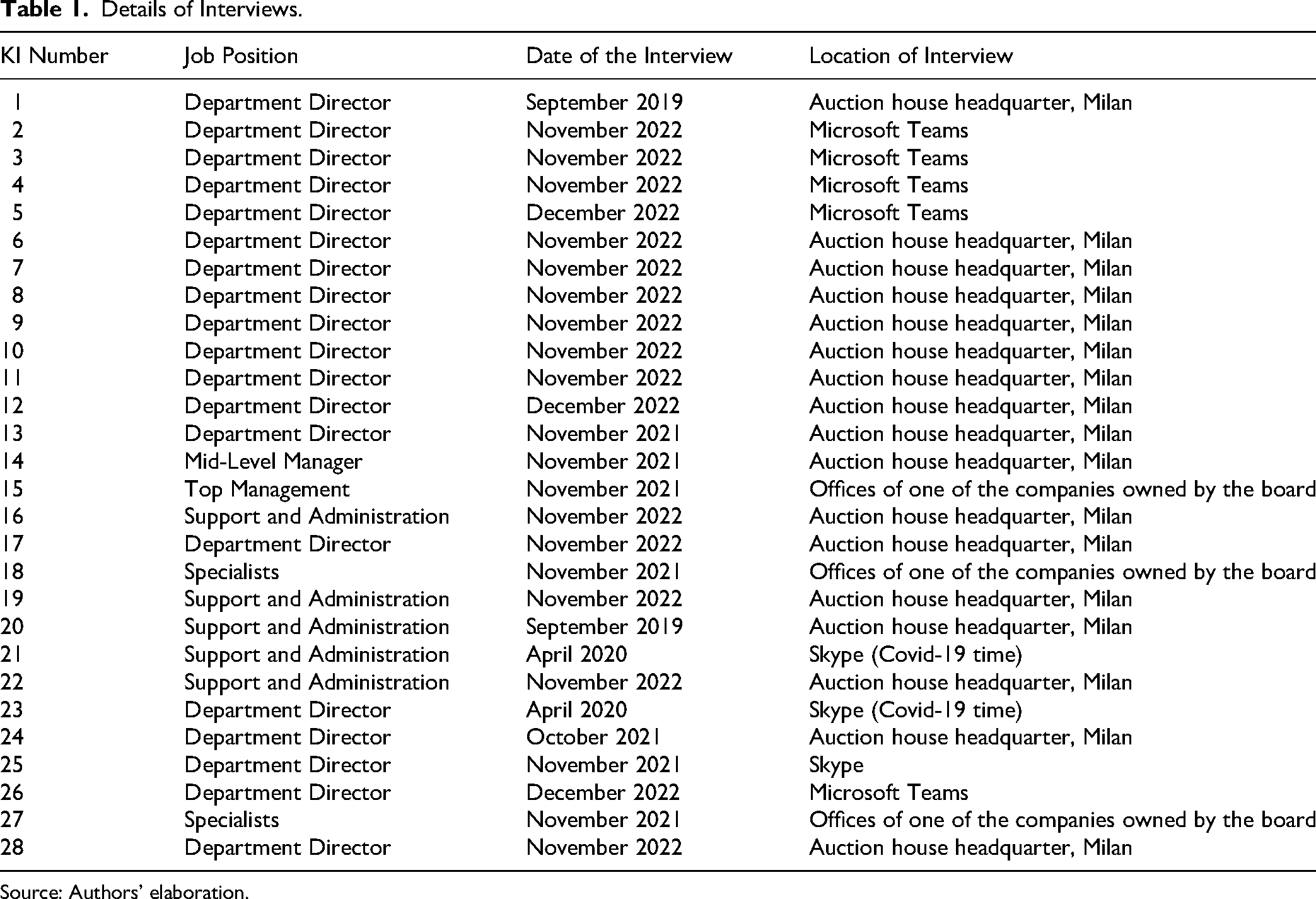
Source: Authors’ elaboration.
Direct Observations
Approximately 20 hr of non-participatory observation were carried out between October 2021 and December 2022. These focused on daily organisational routines, including exhibition setups, private sales and auctions. Field notes were taken immediately after each observation and were enriched through informal conversations with participants for clarification and contextual understanding. Interviewees also physically guided us through the space, offering interpretive commentary that contributed to a more inclusive and situated reading of the environment (De Molli, 2021).
Secondary Data
To complement the primary data, we analysed documents retrieved from the organisation (e.g. auction reports, catalogues and brochures) and relevant online sources (e.g. corporate and market websites). These materials provided insights into the organisation's history, relaunch narrative and positioning strategies, offering valuable context for understanding the spatial and symbolic shifts.
Data Analysis
Data collection and analysis were carried out iteratively, following principles of abductive theory-building and interpretive inquiry (Gioia et al., 2013; Yanow & Schwartz-Shea, 2014). The analysis was grounded in a dual focus on the material and symbolic dimensions of organisational space, tracing how design elements, artefacts and environmental features shaped participants’ experiences and perceptions.
Our analytical process followed an interpretivist grounded theory orientation (Charmaz, 2006) and unfolded in four main stages, as summarised in Table 2. First, we developed descriptive labels that stayed close to participants’ words and identified observable spatial features and employees’ interpretations of space in relation to trust repair. Second, through open coding, we translated these descriptive labels into more conceptual codes that captured how specific spatial arrangements signalled organisational change, transparency or emotional connection. For example, the descriptive label ‘Bright and glass spaces’ was open-coded as ‘spatial design reinforcing openness’ and contributed to the category Transparency, which was incorporated into the emerging theme Materialising key messages to repair organisational trust. Similarly, the descriptive label ‘The managing director stays in the office exactly like the others’ was open-coded as ‘leadership accessibility’ and ‘removing symbolic barriers’, which fed into the category Openness and the theme Strengthening organisational trust by establishing emotional connection.
Data Analysis Process.
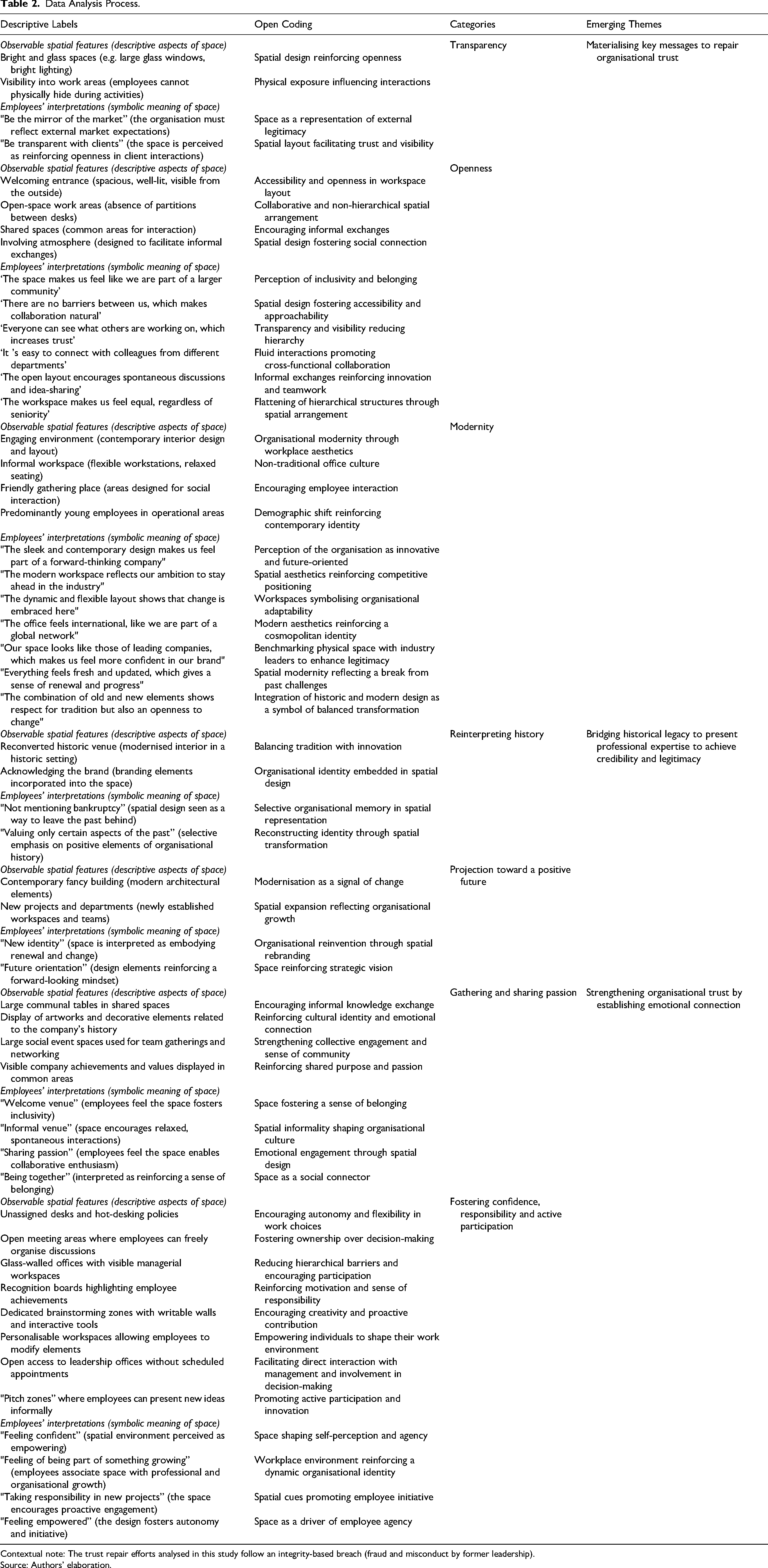
Contextual note: The trust repair efforts analysed in this study follow an integrity-based breach (fraud and misconduct by former leadership).
Source: Authors’ elaboration.
Third, we grouped these codes into broader categories reflecting recurrent patterns across data sources (e.g.,‘Transparency’, ‘Openness’ 2 ). Finally, these categories were integrated into emerging themes that theorised the role of organisational space in repairing trust (e.g. materialising key messages to repair organisational trust; bridging historical legacy with present professional expertise to achieve credibility and legitimacy; strengthening organisational trust by establishing emotional connection).
Throughout the process, we employed constant comparison across interviews, observations and secondary materials and engaged in memo-writing to document coding decisions, explore rival interpretations and refine emergent themes (Charmaz, 2006). We also systematically shared emerging interpretations with participants to validate, revise or enrich them, in line with our commitment to ‘participatory interpretation’ (De Molli, 2021). This method, which involves engaging participants in the interpretation of their own interviews, enabled us to ensure that our analyses resonated with their intended meanings.
Two strategies helped us mitigate researcher bias: (a) involving participants in the interpretive process by presenting and discussing emerging themes during follow-up interviews and (b) encouraging self-reflexivity on how spatial changes influenced their emotional and sensory experiences (De Molli, 2021). These steps allowed us to move beyond descriptive accounts toward a more dynamic understanding of organisational space as a communicative and performative force.
Findings
Our findings reveal that the organisation's design and utilisation of organisational space serve as strategic tools in its broader initiative to repair employees’ trust, following an integrity-based violation in 2012. This trust repair process is particularly notable for its departure from traditional means, such as communication tools or public apologies (Möllering, 2001). Instead, the organisation has emphasised key values – transparency, professionalism, openness, modernity and dynamism – as crucial to its efforts in restoring trust. The architecture and layout of the new headquarters have been purposefully crafted to embody and communicate these values both to employees and external stakeholders. This spatial strategy not only enhances the organisation's reputation but also fosters a more positive perception among employees. While organisational space also signalled renewal to clients and the broader art market, our analysis focuses on how employees interpreted these changes as cues for rebuilding organisational trust in the employees.
Three interrelated spatial practices underscore this intentional use of organisational space: materialising key messages to repair organisational trust, bridging historical legacy with present professional expertise to achieve credibility and legitimacy, and strengthening trust through emotional connection. Furthermore, we identified a mutually constitutive relationship between the organisation's space, its history and how individuals relate to it, indicating that organisational space serves as more than a backdrop; it is an active element in the trust repair process. Spatial interventions materialise key messages, encode temporal transitions and elicit affective resonance. While some spatial elements – such as the relocation of headquarters or the design of shared areas – recur across practices, they are mobilised differently: to communicate renewal (Spatial Practice 1), to bridge temporal identities and legitimise expertise (Spatial Practice 2) and to foster affective attachment (Spatial Practice 3). Thus, space operates holistically, shaping how trust repair is understood, enacted and felt.
Materialising Key Messages to Repair Organisational Trust
The organisation's headquarters have been deliberately redesigned to convey core values essential for trust repair: transparency, openness, professionalism and dynamism. The physical attributes of the new organisational space – such as glass walls, open-plan layouts and minimalistic design – serve as tangible representations of these values. Employees perceived these spatial cues as signals of the organisation's commitment to honesty and renewal, consistent with research on the communicative power of organisational aesthetics (Panayiotou & Kafiris, 2011; Yanow, 2006). As one interviewee noted, ‘The new building is bright and open, and everything is visible – this makes us feel there is nothing to hide’ (KI_12). Another highlighted the link between modern aesthetics and credibility: ‘It looks like the offices of a modern leading company, and this gives us more confidence in our brand’ (KI_7). At the same time, the presence of historical artworks was read as a bridge between continuity and change: ‘They kept some of the old pieces, which shows respect for our history, but in a modern setting’ (KI_9). These accounts suggest that specific spatial elements – light, transparency, contemporary design and historical references – worked as trust repair cues by signalling both renewal and continuity. In this way, the spatial narrative reinforced Velvet's efforts to restore employees’ trust after the integrity-based violation.
Moreover, the choice to relocate the headquarters from a historic yet opulent setting in Milan's Brera district to a modern and dynamic design hub in Chinatown symbolises a conscious departure from past practices. As KI_5 explains, ‘The new headquarters tells us who we are … we moved from Brera (the luxurious and central district of Milan) to Chinatown, a location in modernity, in the design district … this area of Milan is the most projected towards the future, between skyscrapers and street food … The idea is precisely to give a signal’. Participants see this move as a ‘fresh start’ and a clear message of the company's intention to rebuild trust through openness and accessibility. It underscores the organisation's intent to align its organisational space with the intentional goals of growth and transparency. As KI_20 notes, ‘Dynamism, modernity, are reflected in space … The venue wanted to be different … openness … transparency, is what this space represents’. Despite initial concerns that the new location might be perceived as peripheral or detached from Milan's traditional hubs, it ultimately became a distinctive trait of the company, allowing it to maintain its established clientele while attracting new business. As one participant put it, ‘Every time he brought collectors here to the new location, I felt proud’ (KI_27), highlighting how the space not only impressed external stakeholders but also fostered a sense of shared pride and legitimacy among staff. The decision to move into this modern district is celebrated as a ‘stroke of genius’ by participants, with one interviewee (KI_27) expressing pride in the leadership's vision.
The minimal, open design of the headquarters, with its fluid spaces and lack of rigid hierarchical structures, visually reinforces the organisation's commitment to openness and collaboration. KI_3 emphasises this connection: ‘The venue has been modernised and set up in a very minimal way to reflect this new projection towards openness and towards the future of the organisation, which (at the time of the re-opening) was trying to open up and enter the Italian market with a new position and a new relevance’. ‘It was designed with the idea of making a light, airy and incredibly modern venue. […] A beautiful, unexpected but also very welcoming place’ (KI_6). The absence of hierarchical spatial divisions – evident in the managing director working in the same open office as employees – further reinforces perceptions of transparency and accountability.
Additionally, the organisation's spatial configuration encourages informal interactions and social cohesion among employees. Common areas, such as shared dining spaces and lounges, foster informal gatherings that break down barriers between hierarchical levels. As KI_10 describes, ‘We often have lunch or after-work drinks together’. These interactions are instrumental in reshaping employee perceptions of the organisation's leadership and values, supporting the argument that organisational space can influence organisational culture and perceptions of trust, and especially integrity – by breaking barriers (Baer et al., 2018). This informality breaks down traditional hierarchical barriers and fosters openness, as evidenced by the managing director sharing the same office space as other participants. The decision to forego a closed, exclusive office space, as described by one interviewee (KI_11), contributes to a culture of trust and transparency: ‘The managing director stays in the office exactly like the others… he doesn’t have an office as if it were a red damask room… you have the perception that as soon as you speak, everything can be used against you in court’.
Furthermore, the design of the headquarters communicates a message of financial success and future growth, inspiring confidence in participants. ‘The entrance you see (indeed) is all homogenous, the staircase, the floor, the façade, which becomes one. (The space) wanted to be different… openness… transparency, what this space represents as a work’. (KI_7). Moreover, KI_18 underscores the importance of the organisational space reflecting this sense of economic achievement: ‘The venue must convey this message, make everybody think that you are financially successful and that your economic success will grow … this is crucial … so it must be a venue that inspires this sense of success’. The alignment between the organisational strategy and the organisational space is clear: ‘The main values right now are growth, development, undertaking new initiatives… and what you see as space is consistent with this’. Overall, the new headquarters, through its design and strategic location, serves not just as a workplace but as a powerful symbol of the organisation's rebirth, development and future direction.
Bridging Historical Legacy to Present Professional Expertise to Achieve Credibility and Legitimacy
While seeking to distance itself from past fraudulent practices, the organisation intentionally integrates elements of its historical legacy within the new organisational space to maintain credibility and legitimacy. Participants described the headquarters redesign as a powerful anchor for the organisation's credibility, seamlessly intertwining its historical legacy with its modern-day professionalism and expertise. This spatial narrative reinforces Velvet's efforts to repair employees’ trust in the organisation following an integrity-related violation, bridging its storied past with a renewed commitment to excellence and transparency. By leveraging history as a key asset, the organisation reinforces its legitimacy while simultaneously distancing itself from past failures, creating a fresh, forward-looking identity.
The headquarters embodies this duality: the modern, open space symbolises renewal and innovation, while curated displays of past achievements – such as auction catalogues and historic artefacts – remind participants of the firm's historical expertise. This interplay between past and present is critical in trust repair, as it allows the organisation to capitalise on its pre-bankruptcy reputation while visibly demonstrating its transformation (Brunninge, 2009). Velvet's rich history, which predates its bankruptcy and acquisition, remains a vital tool for renewing organisational credibility and rebuilding trust. While the organisation's new trajectory is emphasised, participants also leverage Velvet's historical brand to inspire confidence among customers. As one interviewee (KI_12) remarked during the inauguration of the Milan headquarters, ‘When we inaugurated the new headquarters in Milan, we saw that the brand actually still had a certain importance, a certain trust for many customers … certainly not all, but for many customers’. This enduring association with quality and excellence in the Italian art market enhances the organisation's trust, instilling pride among employees who see their organisation positively perceived by the market (KI_9, KI_12). Velvet's historical legacy, rather than being a burden, becomes an asset in rebuilding trust, aligning with Brunninge's (2009) argument that leveraging history can confer legitimacy and aid in trust repair. This process of selective remembrance and forward-looking reinterpretation is well captured by one employee's reflection: ‘Over time we have increasingly managed to erase that negative parenthesis and rebuild trust’ (KI_1), suggesting that trust was not only restored, but also reframed through a shared narrative of renewal.
However, Velvet's new identity is equally focused on distancing itself from its troubled past. Participants stress the organisation's transformation and its departure from previous failures, highlighting modernity, dynamism and openness to change. One interviewee (KI_24) emphasises this distinction, noting how employees feel a strong connection to the ‘new company’, which is markedly different from its predecessor. This dual narrative – rooted in history while emphasising renewal – helps repair Velvet's organisational trust by signalling both continuity and transformation.
The new space is also central to Velvet's resurgence, acting as a tangible representation of professionalism and a deliberate tool for repairing trust compromised by the previous crisis. The open, minimalistic design – characterised by using glass and white tones – was intentionally conceived to communicate values of transparency and openness that had been previously called into question. According to the designer and the architect involved in the project, these spatial choices aimed to materially embody the organisation's renewed commitment to integrity.
Several interviewees emphasised that the redesigned environment supported renewed relational dynamics, noting that its openness and informality facilitated interaction and collaboration. The organisational space was perceived as having a direct impact on work practices by encouraging renewed interaction, openness and collaboration – essential elements in a post-crisis context. As one interviewee (KI_24) noted, ‘Space influences the way we work … I can say that there is a lot of interaction, even encounters between colleagues … the space sometimes allows us to communicate directly’. Another highlighted the role of open layouts in breaking down barriers: ‘There are no walls between us, which makes collaboration natural and easier’ (KI_15). A further employee stressed how shared areas fostered inclusion: ‘It's easy to connect with colleagues from different departments – now we see each other every day’ (KI_18). These accounts show how the spatial design facilitated spontaneous encounters, cross-functional interactions and a sense of inclusivity. This spatial fluidity was not just functional, but instrumental in re-establishing a communicative culture after trust had been damaged – thus reinforcing collaboration and contributing to the process of restoring the relationship between employees and the organisation.
The new headquarters also enhances Velvet's reputation, creating what participants describe as a ‘wow effect’ (KI_15). The grandeur and modernity of the venue, compared to the old headquarters, impress employees and customers and strengthen their confidence in the organisation's professionalism. One employee (KI_15) noted, ‘The space has a positive impact … it creates the “wow effect”, I think it is a very interesting space for customers and the effect of saying: This is the auction house where I want to buy works!’ This positive impression contributes to trust repair among employees by positioning Velvet as a prestigious, forward-looking organisation. This company's rejuvenation is also further supported by its streamlined corporate structure and the involvement of young, dynamic professionals, a deliberate strategy to foster innovation and adaptability. As one employee (KI_5) noted, ‘Velvet internally wants to be a young, dynamic team’, and another highlighted the team's extensive professional experience: ‘We are all people with many, many years of experience’ (KI_10). This combination of youth and expertise is integral to the organisation's rapid recovery and ongoing success.
By leveraging its historical legacy while distancing itself from past failures, Velvet projects an image of both continuity and transformation. The modern design of the new headquarters, coupled with a supportive, dynamic corporate culture, reinforces the values of transparency, professionalism and innovation that are key to the company's resurgence and the repair of organisational trust.
Strengthening Organisational Trust Through Emotional Connection
Beyond rational signalling, organisational space also plays a crucial role in eliciting emotional responses that contribute to the repair of trust, especially in the aftermath of an integrity-based violation. The aesthetic and sensory experience of the new headquarters fosters feelings of belonging, safety and motivation among participants, which are crucial for repairing trust, which is especially difficult following an integrity-based violation. The organisational space of Velvet, indeed, is meticulously designed to cultivate emotional connection, fostering a sense of pride and belonging among those who inhabit it. This intentional design transforms the organisational space into a powerful conduit for trust repair on an emotional level, allowing participants to feel deeply connected to their workplace and its mission.
Participants describe the new organisational space as ‘inspiring’ and ‘uplifting’, with its bright lighting, carefully selected artwork and contemporary furnishings. These design elements create an atmosphere of prestige and professionalism, reinforcing positive emotional ties to the organisation. The ‘wow effect’ reported by participants upon entering the space contributes to a perception of success and stability, further strengthening trust repair. As KI_15 stated, ‘The space has a positive impact … it creates the “wow effect”, I think it is a very interesting space and the effect of saying: This is the auction house where I want to work!’
The organisation's spatial strategy extends beyond the physical environment to include social and relational aspects. The headquarters is not just a place of work but a communal space where participants engage in collective experiences, from informal gatherings to professional events. As KI_24 highlighted, ‘The fact that we share so many spaces together … strengthens interpersonal connections and fosters professional trust’.
These shared everyday experiences solidify a sense of community and trust, renewing participants’ belief in the organisation's integrity, long-term vision, modernity, expertise and growth, as emphasised by various stakeholders (KI_18, KI_20). Featuring open layouts, transparent walls and abundant natural light, the airy and bright venue facilitates an experiential understanding of the organisation's ethos. This architectural openness aligns with the feedback from participants who express how their lives revolve around this space, noting its fluid nature and capacity to inspire collaboration and connection (KI_13).
Our findings underscore the role of organisational space in rebuilding damaged organisational trust. By mobilising emotional connection, both among colleagues and with the organisation itself, the organisational space promotes a perception of Velvet as empathetically close, thereby fostering trust repair (Brunninge, 2009). The emotional resonance of the organisational space was particularly evident during its inauguration, where one participant remarked, ‘Seeing this beautiful venue also gives more confidence about the organisation itself’ (KI_3). This transformative atmosphere fosters an emotional bond between participants and their organisation, renewing a sense of shared purpose that is vital for trust repair.
While participants responded positively to the atmosphere of the new headquarters, we acknowledge that such perceptions may be also shaped by contextual factors such as job security or loyalty to leadership. Notwithstanding, our participatory method allowed for iterative validation of meanings: many observations as well as many interviewees explicitly attributed their emotional reengagement to emotional and sensory experiences of space (light, warmth and openness), and these associations were consistently reported across hierarchical levels.
Discussion
This study explored how organisational space contributes to organisational trust repair following an integrity-based breach. Our findings demonstrate that space is not merely a passive backdrop, but a meaningful and active medium through which organisations communicate transformation, rebuild credibility and foster emotional reattachment. Specifically, we identified three interrelated spatial practices: (a) Materialising key messages to repair organisational trust; (b) bridging historical legacy with present professional expertise to achieve credibility and legitimacy; and (c) strengthening trust through emotional connection. These practices are not sequential but operate synergistically. While new leadership was undoubtedly central in signalling integrity, spatial redesign was not a mere backdrop but a complementary intervention. Space worked in tandem with leadership and governance reforms to render visible the organisation's new orientation. In this sense, space was one among several deliberate tools of trust repair, not the sole driver. By integrating organisational trust repair and spatial perspectives, our study extends existing frameworks of trust repair, which have tended to emphasise leader-centric or procedural interventions (see Gillespie et al., 2014; Lewicki & Brinsfield, 2017). We show that spatial–symbolic practices can complement these interventions by making transformations visible, credible and emotionally resonant. Theoretically, this highlights the socio-material dimension of trust repair, opening a new line of inquiry at the intersection of organisational trust and organisational space. Understanding trust repair through the lens of organisational space thus expands current theories by showing how material and aesthetic interventions can support emotional reattachment to the organisation. In particular, our findings extend the view that trust repair has an important emotional component (Dirks et al., 2009; Kähkönen et al., 2021; Lewicki & Brinsfield, 2017) by showing how spatial–symbolic practices generate emotional attachment (Oyedeji et al., 2025), which is indispensable for repairing trust following integrity violations (Gillespie et al., 2014; see also Sharma et al., 2023). Practically, our findings suggest that leaders can intentionally mobilise spatial design as part of broader recovery strategies to shape the organisational space, rather than treating it as a merely aesthetic or operational consideration.
Materialising Key Messages to Repair Organisational Trust
Our findings show that Velvet deliberately used organisational space to embody and communicate key messages of transparency, openness and modernity. These values were expressed through architectural choices such as glass walls, open-plan layouts, communal areas and the absence of executive offices. The relocation of the headquarters to a design-forward district was itself a clear spatial statement of change. Participants consistently interpreted these spatial features as tangible signs of a new beginning and of the organisation's renewed commitment to collaboration and integrity.
Far from being perceived as merely aesthetic or cosmetic, space was understood by participants as a discursive and symbolic tool (Yanow, 2006). The spatial environment was interpreted as a deliberate expression of the organisation's values and its commitment to renewal, fostering a perception of increased transparency, credibility and trust. These interpretations align with existing literature on how physical design shapes employees’ perceptions of organisational trust and integrity (Baer et al., 2018; Gillespie & Dietz, 2009). Moreover, this literature support the idea that space plays an active role in enacting and renewing organisational narratives (Taylor & Spicer, 2007).
In this context, spatial features are more than representations of values: they are communicative acts. Velvet's use of design to materialise a commitment to ethical renewal aligns with trust research showing that organisations can signal future-oriented intentions and trust through visible changes (Gustafsson et al., 2021). Importantly, these spatial cues did not operate in isolation but were interpreted relationally, as part of a broader organisational effort to restore trust.
Bridging Historical Legacy with Present Professional Expertise to Achieve Credibility and Legitimacy
Participants also frequently reflected on the organisation's past, often contrasting it with the redesigned present. Interestingly, while the bankruptcy was seldom mentioned explicitly, the spatial transformation was understood as a symbolic rupture – ‘a way to leave the past behind’. This distancing supports previous findings on trust repair, which suggest that breaking with the past can help re-establish credibility following a breach (Suchman, 1995).
However, participants did not reject the organisation's history entirely. Instead, they selectively mobilised positive elements of Velvet's legacy – its market leadership, reputation for quality and strong brand identity – to reinforce its legitimacy in the present. This dual movement of rupture and continuity is consistent with research on identity reconstruction under threat (Ravasi & Schultz, 2006), which highlights how organisations draw on their heritage to build credible forward-facing identities.
Organisational space served as a key medium for this process. The redesign was not only a vehicle for distancing from past failures but also a platform for honouring institutional memory (Anteby & Molnár, 2012). For instance, the presence of artworks and decorations referencing the company's history, as well as displays of past achievements, allowed participants to connect with the organisation's enduring strengths. This aligns with research on how physical artefacts and spatial cues can serve as carriers of organisational memory and identity (Anteby & Molnár, 2012; Dale & Burrell, 2008). Moreover, one participant noted how ‘we moved forward, but without forgetting who we are’ (K_11), encapsulating this tension between discontinuity and legacy. This resonates with research showing how organisations under transformation mobilise selective narratives of the past to maintain a sense of continuity while embracing change (Ravasi & Schultz, 2006; Schultz & Hernes, 2013).
Thus, the new spatial configuration facilitated a narrative that combined professional expertise with symbolic continuity. It enabled participants to reinterpret the organisation's trajectory not as a break with its identity, but as an evolution – anchored in history but responsive to present challenges. This blend of heritage and transformation was crucial for re-establishing both internal credibility and external legitimacy (Florio & Sproviero, 2021; Ogden & Clarke, 2005).
Strengthening Trust Through Emotional Connection
Beyond its symbolic and cognitive functions, organisational space also played a key role in repairing affective bonds that had been weakened by the integrity-based breach. Participants described the new environment as one in which they felt ‘welcomed’, ‘empowered’ and ‘part of something growing’. These sentiments were linked to specific spatial arrangements: large communal tables, writable walls, open kitchens, event areas and hot-desking were seen as enabling informal interaction, creativity and inclusion. These perceptions align with prior work emphasising the role of embodied and relational experiences in repairing organisational trust (Kramer & Lewicki, 2010; Weibel et al., 2016). Moreover, it resonates also with Oyedeji et al. (2025), who emphasise that physical environments shape not just how individuals think and behave but also how they feel. Such affective attachments are crucial in trust repair, as they help employees move beyond rational reassurances and re-establish a felt connection with the organisation (Gillespie et al., 2014; Legood et al., 2023; Lewis & Weigert, 1985; Sharma et al., 2023). In doing so, our research contributes to a better understanding of the affective aspect of trust and trust repair, which have been, as others have argued (Van Knippenberg, 2018), not only under-investigated but also underestimated.
Importantly, participants perceived these features not simply as functional conveniences, but as emotionally resonant. The space was described as a place where they could ‘share (their) passion for work’, ‘be together’ and feel part of a meaningful collective. Several participants referred to spontaneous collaboration, shared meals and unplanned encounters as repairing a sense of trust and community. These narratives resonate with literature suggesting that trust repair is shaped not only by formal structures and policies, but by embodied and affective experiences (Gillespie et al., 2014; see also Sharma et al., 2023).
Moreover, the organisational space contributed to a perceived flattening of hierarchies and increased accessibility of leadership. Participants noted that open access to top managers and the absence of symbolic barriers – such as executive offices – made them feel trusted, responsible and more confident in their own roles. One employee commented that ‘being trusted like this makes you want to give your best’, illustrating the reciprocal dynamic of trust and empowerment. These findings echo earlier work showing that environments which signal organisational trust in employees tend to generate trust in return (Kramer & Lewicki, 2010).
The emotional experience of space also played a role in renewing identification with the organisation. Displays of shared values and achievements in common areas, as well as interactive tools and brainstorming zones, were seen as sources of inspiration and pride. These features helped translate abstract commitments to integrity and collaboration into everyday lived experiences – fostering belonging and enhancing the social fabric of the organisation. This resonates with prior research that has shown that material and symbolic aspects of organisational space can foster affective attachment and support processes of organisational re-identification (see Dale & Burrell, 2008; De Molli et al., 2020). Our study builds on and extends this theorisation by examining how spatial practices also contribute to repairing trust, thereby advancing understanding of the relational and restorative functions of space after organisational breaches.
Limitations and Future Directions
This study has some limitations that need to be acknowledged. First, it is based on a single in-depth case study within the art auction sector. While this context is particularly rich in aesthetic and symbolic cues, the findings may not be transferable to organisations operating in more functional or industrial environments. Future research should examine whether spatial strategies for trust repair operate in similar ways when material symbolism is less culturally salient.
Second, the analysis draws on retrospective accounts. Despite efforts to mitigate recall bias through data triangulation, participatory interpretation and observational evidence, we cannot fully capture how spatial meanings and trust repair unfolded in real time and to determine whether trust was fully repaired after the bankruptcy. Longitudinal studies would be better positioned to explore the temporal dynamics of trust repair and spatial interventions (Ybema et al., 2009).
Third, the study focuses primarily on employee perspectives. Spatial messages, however, also reach other stakeholders – such as customers, partners and the public – whose interpretations may diverge. A multi-stakeholder approach would provide a fuller understanding of how spatial interventions contribute to trust repair across different audiences.
Fourth, we acknowledge that trust repair in this case might have been supported by multiple factors beyond space, including leadership changes and governance reforms. Our focus here is on how space complemented these efforts. Future research could disentangle more precisely the relative weight of spatial interventions vs. other established interventions.
Fifth, not all employees had worked in the organisation prior to bankruptcy. Although the small and interconnected nature of the Italian art world meant that even newcomers were aware of the organisation's past failure, the process of trust repair likely differed between those with and without direct pre-bankruptcy experience. Therefore, our findings cannot fully capture these differences.
Finally, Velvet was not perceived as a completely new organisation but as a continuation of the previous one. This continuity made trust repair – rather than de novo trust building – the most appropriate lens. Different dynamics may emerge in contexts where such organisational continuity is weaker or absent, and future research could investigate these settings explicitly.
Future research should continue exploring the intersection of trust repair and space, especially through comparative or longitudinal designs that capture spatial practices in action. Examining other stakeholders’ interpretations – such as customers or partners – could also reveal the broader resonance of spatial signals in trust repair efforts.
Conclusions
This study has shed light on the underexplored role of organisational space in repairing trust following integrity-based breaches. Drawing on a qualitative case study of an art auction house undergoing spatial transformation after an ethical crisis, we show how organisational space can actively support trust repair – not merely as a physical backdrop, but as an embodied, affective and symbolic medium for change.
Our findings contribute to the literature on organisational trust repair (see Bachmann et al., 2015; Fulmer & Gelfand, 2012; Gillespie & Dietz, 2009; Gillespie et al., 2021; Kim et al., 2009) by identifying organisational space as a symbolic, material and affective resource that can complement and support other trust repair processes. In doing so, we highlight organisational space as a parallel and complementary channel that operates alongside established strategies such as verbal apologies, leadership accountability and structural reforms (Bachmann et al., 2015; Gillespie & Dietz, 2009; Lumineau et al., 2023). Spatial cues such as openness, light, materiality and accessibility conveyed renewed transparency, integrity and care – contributing to participants’ perception of moral recovery and renewing their sense of safety and belonging.
We also advance organisational spatial perspectives (see Burrell & Dale, 2015; Oyedeji et al., 2025) by theorising how redesigned environments act as narrative artefacts: material spaces that embody and perform organisational transformation (Baldessarelli et al., 2022). In line with recent calls to incorporate materiality, aesthetics and embodiment into organisational trust research (Gustafsson et al., 2021), we propose that trust repair extends beyond language and behaviour to include the sensory and symbolic dimensions of organisational space. At Velvet, space made abstract commitments tangible, supporting not only the credibility of change, but also the emotional reattachment of employees. Through spatial–symbolic interventions, participants moved from a closed and mistrustful atmosphere to one that encouraged openness, identification and relational strength. In doing so, our study aligns with emerging work on the emotional facet of trust processes, including trust repair (Ballinger et al., 2025; Gillespie et al., 2014; Gustafsson et al., 2021), showing that space does not just signal change – it enables healing. This challenges leader-centric and procedural models by emphasising the agency of socio-material artefacts in organisational recovery (Orlikowski, 2007). We call for a more holistic view of trust repair that includes spatial practices as integral components.
By bridging the literatures on organisational trust repair and organisational space, we aim to develop a more comprehensive and holistic understanding of how organisations recover from moral failure. This perspective is especially relevant in contemporary contexts where credibility and integrity are essential for sustaining employee engagement and organisational legitimacy (Gillespie & Dietz, 2009).
Practically, these insights urge organisations to treat organisational space not as a cosmetic or symbolic afterthought, but as central to trust restoration. When intentionally aligned with organisational values, space can foster a healthier climate, support emotional recovery and provide credible, enduring and emotionally resonant signals of change (Florio & Sproviero, 2021; Kähkönen et al., 2021). Such interventions may ultimately enhance legitimacy, resilience and relational quality.
Footnotes
Acknowledgements
We would like to thank the Track Chairs and attendees of the British Academy of Management Conference 2022's Cultural and Creative Industries Track for their constructive comments, which significantly contributed to the further development of this paper.
We are also honoured that this work was selected as the Winner of the 2022 Best Paper Award at the British Academy of Management.

Ethical Approval and Informed Consent Statements
All participants were fully informed about the objectives and scope of the research. They provided explicit consent for the collection and use of their data for research purposes. The study complies with ethical standards for research involving human participants.
Funding
The authors received no financial support for the research, authorship, and/or publication of this article.
Declaration of Conflicting Interests
The authors declared no potential conflicts of interest with respect to the research, authorship and/or publication of this article.
Data Availability Statement
The data supporting the findings of this study are available for review by the journal's reviewers upon request. However, the authors prefer not to make the dataset publicly accessible.
Notes
Appendix 1: A Closer Look at Velvet's Milan Headquarters
Velvet's new headquarters in Milan, which was originally a theatre and later a cinema, has undergone a significant transformation to accommodate the auction room, offices and warehouse. The exterior presents a warehouse-like appearance, characterised by a large metal roof and an anthracite grey sliding entrance door. The subtle auction house sign, elegantly situated by the entrance, exudes accessibility rather than intimidation.
Upon entering, visitors find themselves in a simple, white, modern waiting room with minimalist furniture, setting a tone of contemporary elegance. The main exhibition space, accessed by turning left, is a vast, bright area with white surfaces and a high ceiling. The predominantly white ambiance is punctuated by colourful artworks on the walls. A light wall separates this space from a more secluded area designed for meetings, furnished with white designer chairs around a polished table.
Ascending to the upper floor, a corridor along the perimeter hosts exhibitions of small objects, fostering intimacy between visitors and the showcased works, as explained by the architect (KI_6). The offices, formerly the cinema's control room, are situated on the first floor.
While the spatial design process was not observed during data collection, insights from interviews with the architect and designer shed light on the intentional choices made. The existing structure, a former theatre, heavily influenced the design, which was tailored to convey the auction house's core values: ‘transparency’, ‘openness’ and ‘modernity’. The use of glass, open layouts and a dominant white colour scheme serves as a tangible expression of these values.
This deliberate approach to organisational space aligns with the organisation's trust repair strategy. By making architectural changes visible and consistent with its communicated values, Velvet engages in impression management – a crucial component of trust repair, especially following an integrity-based breach where demonstrating transparency is essential.
Appendix 2: Interview Guide
Introductory note (to be shared with the interviewee)
Thank you for agreeing to participate in this interview.
This conversation is part of an academic research project that explores how people experience their workplace, especially in contexts of organisational change. We are particularly interested in how the organisational space may relate to how employees connect (or reconnect) with their organisation.
The interview will last approximately 1 hr and will be recorded to ensure accuracy. Your responses will remain fully confidential, and no identifying information will be included in any publications. Some anonymised excerpts may be used in academic outputs (such as articles, conference presentations or books), but you will not be personally identifiable.
There are no right or wrong answers; we are simply interested in your personal reflections. Your participation is voluntary, and you are free to stop the interview at any time.
Do you consent to proceed?
Interview sections and sample questions