



Abstract
Although prior research has suggested that collective actors such as industry or trade associations play an important role in advocating for their members, few studies have examined how they facilitate new market formation and growth in regulated fields. Our study shows how collective actors may be instrumental in carving out specific, favorable policies from initially vague legislation, and that they do so by creating a univocal political messaging strategy to achieve support from regulators and legislators. Our empirical context is the biodiesel market in the United States, which depended on continuing federal obligated consumption mandates to survive. Our findings contribute to the literatures on collective political action and new market emergence by delineating the political influence process through which collective actors shape the trajectory of nascent markets.
Research on new market formation has documented how favorable public policies can encourage firms to participate in new industries (Georgallis et al., 2019; Russo, 2001). Critical to this process is the role of collective actors, such as trade associations, in framing the market opportunities created by policy changes for potential entrants (Hiatt & Carlos, 2019; Sine et al., 2005). However, few studies have looked at how collective actors directly support the emergence and growth of new markets through their political influence activities. This lacuna exists in part because most empirical research on political action in markets examines firm-level tactics and focuses on mature firms which are more likely to be politically active (e.g., Hillman & Hitt, 1999; Hillman et al., 2004; Walker & Rea, 2014). A few recent studies that examine nascent markets show how firm political action is aimed at mitigating unfavorable regulation for contested product categories such as e-cigarettes (Hsu & Grodal, 2021), genetically modified organisms (Hiatt & Park, 2013), or dietary supplements (Ozcan & Gurses, 2018). Yet how new markets emerge and grow through the political activism of collective actors, like trade associations, remains underexplored.
Our study addresses this opportunity to build greater understanding of new market formation processes by showing how collective actors can shape public policy in regulated industries over time to support market emergence and growth. Prior research has documented that collective actors, such as environmental movements, can pave the way for new product markets to emerge by shaping cultural norms, cognitive frames, and regulatory structures (Sine & Lee, 2009). Yet, the process through which collective actors engage with and influence lawmakers and regulators over time to build and sustain political support for new markets has not been fully addressed (Pierson, 1993). We present an inductive, longitudinal, study of the biodiesel market in the United States. We construct this case study through interviews, observations, and archival data collected for the years 1992–2012. Our findings demonstrate how the national trade association for biodiesel not only facilitated the formation and growth of the market through its political influence activities directed at legislators, regulators, and potential consumers, but also how the trade association mobilized and consolidated diverse producer groups to establish biodiesel as a fuel product with a single, coherent identity in the market, which was critical for sustaining continued policy support over time.
This study contributes to both the collective political action and new market emergence literatures by theorizing the role of collective actors in supporting new market formation and growth processes in relation to public policy. Our analysis shows that first, collective actors play a critical role in lobbying for specific favorable legislation where initial public policy is vague or not actionable. This finding extends existing accounts that overlook the potential need for political action, and the formation of collective actors themselves, well before entrepreneurial firms populate a new market. Second, we show how collective political actors mobilize multiple constituencies to facilitate market formation, for example, by ensuring a reliable supply and demand for the new product or service. Third, we show how collective actors’ efforts to prevent fragmentation among diverse producers is important for achieving univocal political messaging, which is crucial for sustaining policy support in regulated industries. Prior studies highlight how markets vary in the extent to which firms act collectively in seeking legitimacy from important audiences (Gao & McDonald, 2022; Hiatt & Park, 2013). We contribute to a growing understanding of the importance of shared identity in new product markets and extend theory beyond the existing focus on consumers as the key audience (Lee et al., 2017).
New Market Emergence in Response to Public Policy
Government interventions create unique inflection points for new markets to emerge, as “government policy on matters ranging from the very broad—like energy—to the very particular—like safe wood for garden mulch—can influence not only the prospects but also the very shape of firms and industries” (Spillman, 2018, p. 261). Government policies can influence the size and structure of markets, for example, by establishing barriers to entry, determining levels of taxation, or offering subsidies or government contracts to serve national priorities (Keim & Baysinger, 1988; Schuler et al., 2002). Policies that offer government financial support for strategically important industries encourage new firm foundings or new firm entry through mechanisms such as feed-in tariffs or tax credits, as in the case of the European photovoltaic sector (Georgallis et al., 2019). Similarly, policies that deregulate existing industries can spur entrepreneurs to enter the market, as in the case of satellite radio firms that competed with incumbent telecommunications firms (Navis & Glynn, 2010).
Public policies can also set the terms of exchange between incumbent firms and new suppliers, by mandating that incumbents purchase a particular service or product, and thus guaranteeing a market for new entrants (Russo, 2001; Sine et al., 2005). In some markets, these obligated consumers are organized political actors with vested interests—for example, utility firms that would not buy electricity from independent power producers until the government forced them to do so (Russo, 2001). Without the government mandate regulating this exchange relationship, it is unlikely that the market for independent power would have been established.
While some studies have thus looked at how public policies can help new markets emerge, others have examined how laws and regulations shape the growth trajectory of nascent markets. In the case of e-cigarettes for example, the growth of the market in the United States was significantly affected by how the FDA decided to regulate e-cigarettes. Although e-cigarettes were initially marketed as a healthier alternative to conventional cigarettes, their association with conventional cigarettes eventually led regulators to categorize e-cigarettes as tobacco products, which invited greater scrutiny not just from the government, but also from lawmakers—though this did not necessarily halt sales growth (Hsu & Grodal, 2021). Similarly, Ozcan and Gurses (2018) show how the growth of the food supplement market was influenced by its regulatory categorization by the government. Originally categorized and regulated as “foods”, when supplements faced potential recategorization as “drugs”, therefore requiring FDA approval, supplement manufacturers engaged in grassroots lobbying to build support for a new regulatory category—the “food supplement”—that would invite less scrutiny than the drug category. Producers were able to mobilize their consumer base to speak on behalf of the industry and influence regulators, ultimately protecting their market from unfavorable regulatory recategorization (Ozcan & Gurses, 2018). While these studies illustrate how political action is an important factor in market growth, in both cases, collective action was aimed at mitigating unfavorable regulation, not proactively creating favorable legislation for a new product market.
A few recent studies have examined how new industries can attain policy support. In their study of the emergence of the European solar photovoltaic industry, Georgallis et al. (2019) find that a primary determinant of policy support for a new product market is the perceived coherence of the category in the eyes of policymakers. They found that if the market was perceived as coherent (i.e., if there were few firms coming from industries with contradictory identities such as fossil fuels), the new market was more likely to receive policy support from the government. Policy support may also be contingent on how policymakers perceive public opinion about a nascent industry. In their longitudinal study of the growth and decline of the biogas market in Germany, Markard et al. (2016) show how a loss of legitimacy in the eyes of the public eventually led to loss of policy support from the government, which led to the decline of the biogas market. Governments may also select certain growth industries for political support to increase national output, and proactively seek out collaboration with industry associations to support producers, as the case of the Korean cotton industry in the mid-twentieth century illustrates (Park, 2009).
In sum, research has long shown the importance of favorable public policy for new markets, and several recent studies have examined various antecedents of policy support for new industries. However, how collective political actors in new product markets can lobby for policy support to facilitate market emergence has not been examined in depth. While the literature on corporate political activity has documented an array of firm-level tactics that organizations use to manage their political environment (e.g., Hillman et al., 2004; Lord, 2000; Lenway et al., 2022), the focus of this research has been mature firms and industries, which are more likely to be politically active. Participants in new markets are generally assumed to lack the resources and political capabilities to engage in substantive political action, and hence have not been a focus of corporate political action (CPA) research (Aldrich & Fiol, 1994; Georgallis et al., 2019). In the following section, we discuss studies that offer important insights for understanding how markets can form and grow through collective political action in response to policy opportunities.
Collective Political Action for Market Emergence and Growth
Decades of research show that interacting with policymakers is a routine part of business (Clawson & Neustadtl, 1989; Doborantu et al., 2017; Hillman et al., 2004), with the level of industry regulation being a primary determinant of political activity by firms (Hillman & Hitt, 1999; Keim & Baysinger, 1988). As Fligstein (2018, p. 73) notes, “involving the state in regulation or protective legislation that increases the odds of survival is a normal strategy for dominant firms.” While resource-rich firms often pursue political action independently, firms also engage in collective political action when their policy interests are aligned with other actors in the market. For instance, firms may need to agree on a common technical standard or achieve formal certifications, motivating them to undertake collective action (Garud et al., 2002; Sine et al., 2007).
In many countries, firms often engage in membership-based collective political action through industry or trade associations, or through peak organizations such as the Chamber of Commerce in the United States (Barley, 2010; Barnett, 2013; Walker & Rea, 2014). Collective actors such as trade associations advocate for members’ interests through a wide array of influence strategies. The literature highlights how trade associations play a dual role: they shape firms’ access to policy information and also direct the flow of industry-relevant information to stakeholders, such as a regulators and legislators, through lobbying and agenda-setting activities (Getz, 1997; Hillman & Hitt, 1999; Jones & Baumgartner, 2005). Although it is important to note that the majority of trade associations in the United States are not politically active (Spillman, 2018), the minority of politically engaged associations report that they “mobilize organizational, informational, and network resources to set policy agendas according to members’ interests, participate in the formulation of policy alternatives, and influence policy decisions” (Spillman, 2012, p. 268). For instance, trade associations may attempt to convince policymakers that an industry should be able to self-govern (Bernstein 1995; Carpenter & Moss 2013). Trade associations also engage in political communication campaigns to defend the public image of an industry in times of crisis (Elsbach, 1994). In general, they play an important role in shaping the policy environment and managing the reputation of industry members (Lawton et al., 2018). Yet how collective actors like trade associations might engage in political action in the market emergence stage is overshadowed by research that focuses on firm-level corporate political activities, with the consequence that the role of other types of political actors is understudied (Lawton et al., 2013). Moreover, there is a dearth of process-level studies showing how such political action is carried out either by individual firms or collective actors working on their behalf (Kaynak & Barley, 2019; Lux et al., 2011).
The few studies that examine the role of trade associations in the emergence and growth of markets show how these collective actors can frame opportunities for prospective entrepreneurs, influencing their initial entry and investment decisions. Studies show, for example, how the existence of a trade association is correlated with subsequent firm foundings in the nascent market because the trade associations help to mitigate the liability of newness (Russo, 2001; Sine et al., 2005). Hiatt and Carlos (2019) show how agricultural trade associations in the biodiesel market shared technical expertise and demonstrated the viability of new production technologies to prospective entrants. Yet because they focus on entrepreneurial entry, these studies do not elaborate on the political influence activities of the trade associations in question.
A recent study of industry associations in the nascent small drone market shows that, faced with restrictions from city and county governments trying to regulate drone usage, industry associations successfully lobbied state governments to remove restrictive regulations on their growth (Yue & Wang, 2024). Once again, however, this study focuses on political activism directed at mitigating unfavorable regulations rather than on political action aimed at shaping supportive policy. More research is needed to understand how new markets can form and grow through political action undertaken by trade associations and other collective political actors, both in the United States and globally. Business historians who document the role of trade associations in particular countries and time periods show how the resources and strategies these entities have deployed to serve their members’ interests shift with both market and political forces. For example, in the United Kingdom, the trade association representing the aluminum industry gained influence as the power of major producers was challenged by globalization and the disaggregation of the industry into non-vertically integrated firms, such that the trade association represented a far greater number of firms compared to the era of its founding and played a more important role in advocating for the interests of the industry in a global market where government policy was important for ensuring competitiveness (Perchard et al., 2024).
Lee et al. (2017, p. 449) note that “most extant research on market intermediaries has been conducted in the context of established markets, so our understanding of their role in facilitating market category emergence and growth is limited.” We also lack adequate insight into how trade associations form in the first place. The predominant focus on mature industries means that although the importance of trade associations, as one type of market intermediary for structuring markets, is widely acknowledged (Aldrich, 2018; Spillman, 2012), we lack accounts of how market intermediaries themselves form in response to public policy, corral producers around evolving market opportunities, and support the growth of a market through sustained political influence activities. Our study of the biodiesel industry in the United States is intended to address this gap in the literature.
Data and Methods
Research Approach and Case Selection
We adopted a qualitative case study as our methodological approach to uncover the process through which a new product market formed and grew over time through political action (Eisenhardt, 1989; Yin, 2009). Our case selection reflected a strategic approach to choosing a research context in which political action would be salient. Exploratory interviews confirmed that the biodiesel market in the United States had been shaped by concerted political action by collective actors throughout its evolution. The context also fit with our interest in the intersection of political action and new market emergence because, like many renewable energy fields, biodiesel emerged in relation to existing industries with vested interests (Russo, 2001) and this relationship was mediated by public policy.
As Mair et al. (2012, p. 821) suggest, “careful attention to the rules of the game in markets points to the relevance of the context and processes by which they emerge.” During the time period of our study, the “rules of the game” in energy markets evolved in tandem with the federal government's changing priorities related to its role in ensuring national energy security and protecting the environment by supporting renewable domestic energy production. To this end, energy policy in the United States targeted a multitude of technological fields, and each of these fields evolved in tandem with specific “rules” (e.g., tax breaks, incentives, obligated consumption mandates) that applied to both producers and consumers.
The biodiesel field in the United States is particularly reliant on favorable rules of exchange because of the underlying reliance on an existing distribution infrastructure. Unlike solar panels or wind turbines, which can be installed in a relatively disaggregated manner, biodiesel depends on an existing infrastructure for large-scale fuel distribution. Although an attempt to create an independent network of biodiesel fueling stations did achieve coverage of the continental United States, for biodiesel to achieve significant sales volume, it depended on the existing network of petroleum diesel distributors and fueling stations. Therefore, the role of government policy in mediating the relationship between the emergent technological field and incumbent interests in the petroleum industry was central to the field's prospects. Taking these boundary conditions into account, this setting offers an opportunity to generate insights into how new markets may emerge and grow in regulated sectors over time.
Data Sources
The first author collected qualitative data from multiple sources that captured the history, production activities, discourses, and political activities within the biodiesel field from 1992 to 2012. Fieldwork was conducted between 2010–2012 at trade association conferences, biofuels conferences, and biodiesel production sites. To capture the history of the biodiesel market's formation, archival data were collected to capture events from 1991 to 2012. These data sources include blog and forum posts, government documents (e.g., Senate and House bills, policy acts, regulatory guidelines) pertaining to the biodiesel field, trade publications, communications from the biodiesel trade association to its members, and industry reports from third parties. These data sources allowed us to reconstruct the industry infrastructure that emerged around the biodiesel market during the period of its formation and growth, capturing the role of a multitude of actors that contributed to the industry's early efforts to garner legitimacy and political support (Forbes & Kirsch, 2011). By collecting both primary and archival data, we were able to triangulate among sources and construct a narrative account of the development of the biodiesel market.
Initial fieldwork consisted of interviews and observations of biodiesel producers and distributors. During these interactions, the first author gained a broad sense of the structure of the biodiesel market, and acquired contact information for additional key informants. Using purposive sampling techniques informed by the national biodiesel trade association's membership list, she conducted interviews with biodiesel producers who relied on different feedstocks across the United States. These interviews pointed to the importance of trade conferences held throughout the year, and she attended four conferences related to biodiesel or biofuels during the data collection period. At these conferences, she met employees of the trade association, and arranged further in-depth interviews about their activities and role in the field.
During interviews, the first author used a semi-structured protocol designed to allow informants to discuss their experiences and raise issues that were most salient to their experience (Spradley, 1979). These interviews lasted between 30 and 100 minutes, and some were conducted over the phone, while others took place at the trade association's offices and at conference sites. In addition to recorded interviews, she engaged in informal conversations at conferences and at field sites around events like lunches, dinners, cocktail receptions, and while informants were working. In total, the first author conducted 48 formal interviews with current and former industry members. Interviewees included current and former commercial producers working at a large-scale, small-scale producers (also called B100 producers), trade association employees, and scientists and engineers who conducted research related to biodiesel and worked for regulatory agencies. Producers were located across the United States, while trade association representatives were concentrated in the Midwest.
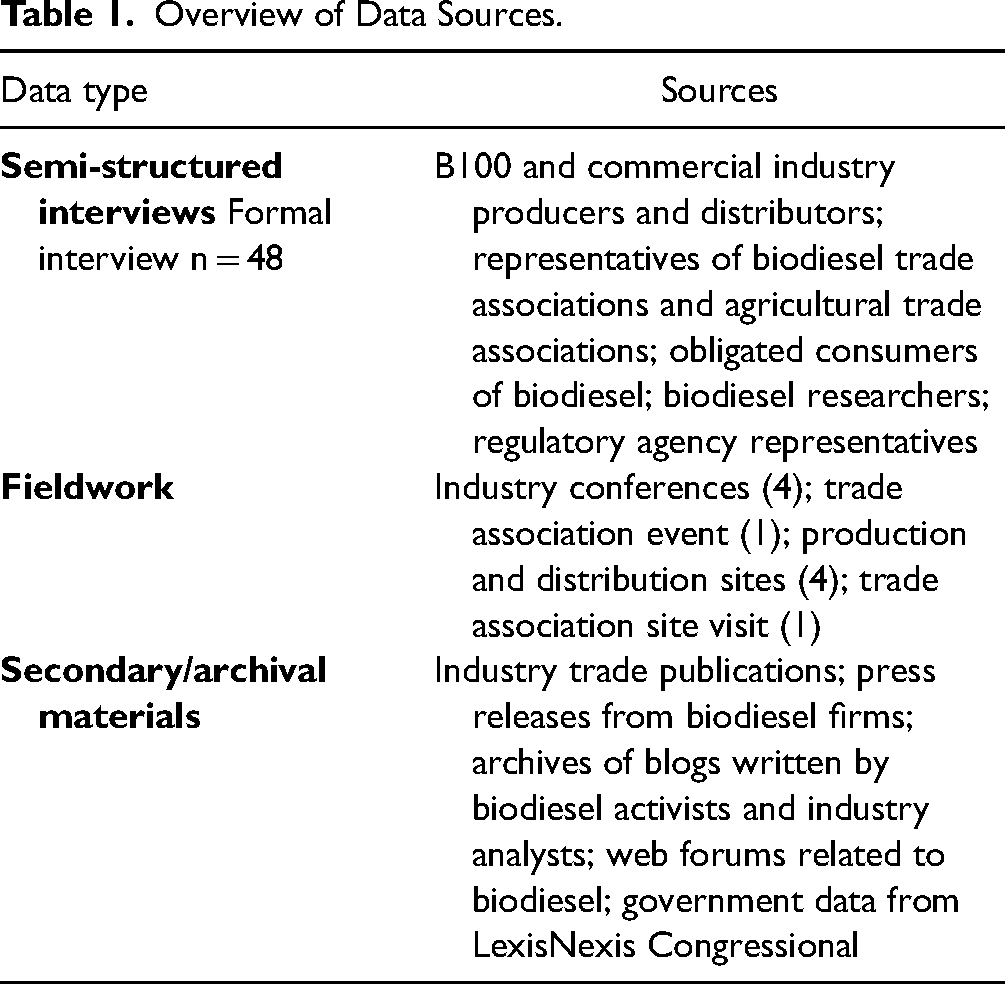
In addition, the first author collected secondary data, including materials from the archives of the national trade association, and monthly and weekly bulletins circulated among members. These bulletins documented, among other items, the political influence activities undertaken by the trade association and its supporters. With the help of a professional web scraper, she also collected blog and forum postings authored by B100 producers. These archival data were used to reconstruct a narrative account of how the biodiesel market developed. Data sources are summarized in Table 1.
Overview of Data Sources.
Analytic Process
We employed two analytic approaches that reflected the different underlying logics of the data sources. For the primary interviews and observational data, the first author adhered to the process of building grounded theory (Strauss & Corbin, 1990) and used ATLAS.ti software to code each line of the interview transcripts and field notes. She created codes that reflected repeated instances of actions, artifacts, sentiments, and attributions of cause and effect. For example, she frequently encountered references to the importance of public policy for the industry, both in interview transcripts and observational data.
In the axial round of coding, we compared codes from the first round and clustered them according to emergent themes. For example, informants named many sources of uncertainty in the biodiesel industry, ranging from US federal energy policy to the global feedstock market. We did this for as many open codes as possible, forming themes that reflected the many aspects of producing and distributing biodiesel, as well as the historical context in which this work occurred. We compared the emergent themes to the findings of prior research, and we highlighted potentially theoretically interesting and underexplored themes.
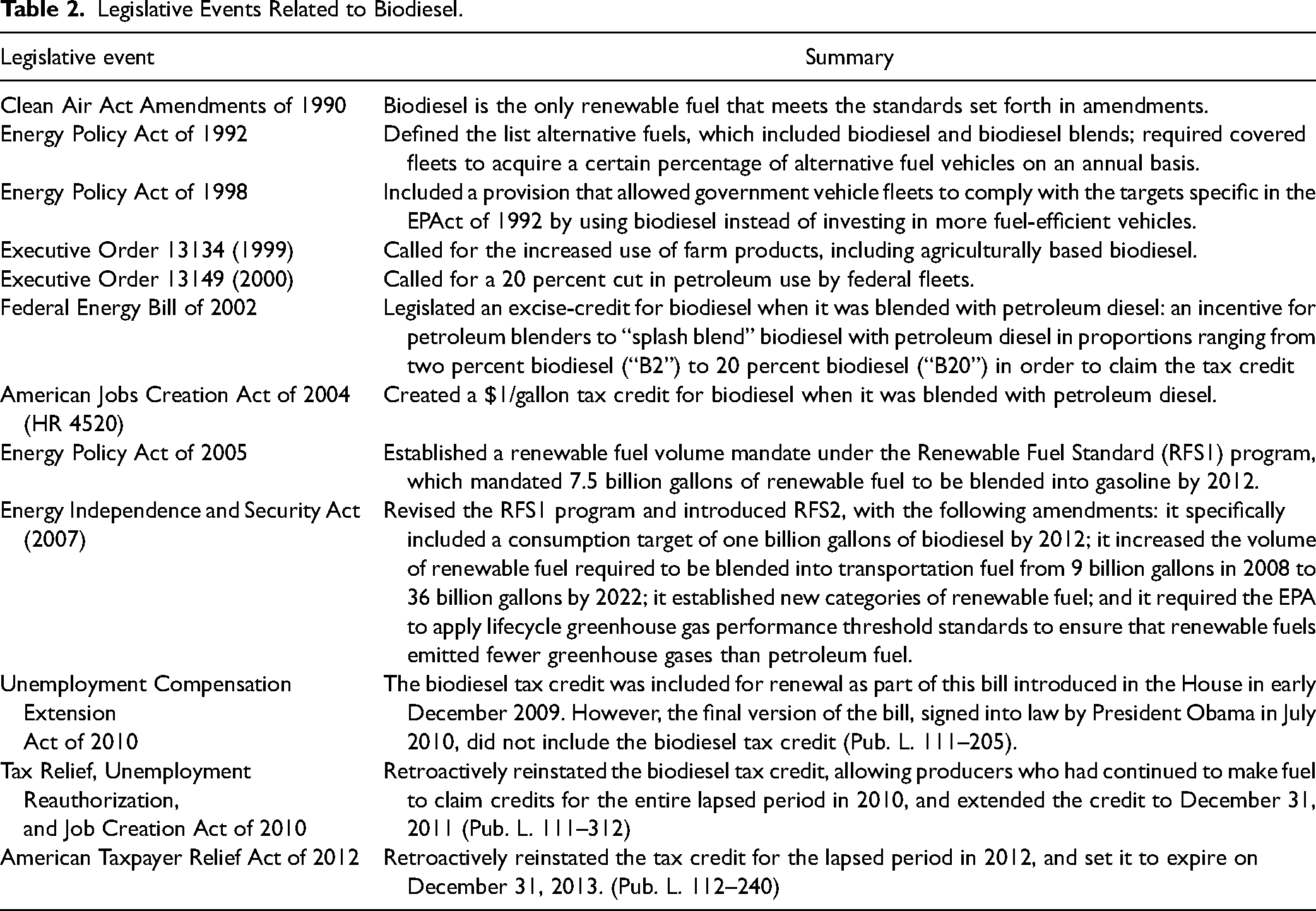
In a parallel stream of analysis, the first author organized the secondary data and analyzed these archival documents with the aim of integrating evidence into a longitudinal account of the development of the industry in relation to public policy and regulatory events. Table 2 provides an overview of policy and regulatory events. Where possible, we triangulated between multiple data sources to develop an analytic narrative that expanded on the themes gleaned from the inductive analysis of the primary data, providing specific evidence of the claims made by various informants about the interactions between the industry, regulators, legislators and other stakeholders, as well as interactions between the trade association and its current and prospective members. This analysis was organized by the logic of events in time.
Legislative Events Related to Biodiesel.
Comparing the emerging narrative from our data with the literatures on market emergence in regulated industries, and collective political action, we recognized an opportunity to develop theory about the intersection of these activities in the biodiesel context. We show that while consumers played a surprisingly small role in the market's emergence and growth, the biodiesel association expended considerable time and energy to lobby the government and biodiesel producers to shape the demand for and supply of biodiesel. We found that the trade association's successive strategies of political action marked important turning points in the formation and growth of the biodiesel market. This led us to use concepts from the political action literature to organize our empirical narrative and make sense of how the field's key actors coalesced around the objective of growing the biodiesel market through a collective political action strategy.
Findings
Period One (1992–1998): Market Formation on the Heels of New Policy Opportunity
Prior to the 1990s, a scattering of scientists in agricultural schools in the United States had conducted research to test the viability of biodiesel in a variety of use cases, from passenger vehicles to farming equipment, however, these efforts had been disconnected, experimental, and sporadic (Pahl, 2008). It was in 1992 that the Energy Policy Act (EPAct) for the first time listed biodiesel among various types of alternative fuels that the Department of Energy “encouraged” the nation to adopt, thus creating a potential yet vague market opportunity for biodiesel. 1 Importantly, being categorized as an “alternative fuel” meant that biodiesel could potentially be used by federal and state government fleets to meet government mandates concerning alternative fuel vehicles. However, there was no industry or commercial market for biodiesel at this point, and the product was not registered as a legally sellable road grade fuel in the country.
Seeding the nascent market
The potential market opportunity presented by the EPAct of 1992 was first recognized and pursued on an industrial scale by soybean farmers, represented collectively by the American Soybean Association and its associated marketing, research, and communication arm, the United Soybean Board. 2 As the largest producer and exporter of soybeans in the world, American soybean producers historically had faced the problem of having greater demand for soy meal than for its byproduct, soy oil (Pahl, 2008). The EPAct of 1992 presented them the opportunity to address this problem by promoting soy oil as a raw material, or feedstock, for biodiesel.
Due to a long history of agricultural lobbying, the American Soybean Association (ASA) had the political capabilities to undertake the task of developing and expanding a new product category in the heavily regulated market for road grade fuels. In 1992, the ASA and United Soybean Board convened the National Soydiesel Development Board, tasked with promoting a product they initially labeled “soydiesel.” In 1994, the National Soydiesel Development Board incorporated additional feedstock growers (e.g., canola farmers, rapeseed farmers) into their ranks and changed their name to the National Biodiesel Board (NBB). From 1994 onwards, the NBB became the industry association that spearheaded efforts to establish biodiesel as a new fuel category in the United States.
Generating regulatory approval for the new market
All on-road fuel must pass a battery of health and emissions testing before it can legally be sold in the United States. Between 1994 and 1998, the NBB worked with representatives from the American Society for Testing and Materials (ASTM) to develop fuel specifications for biodiesel so that the new fuel product could be registered as a road-grade fuel. The NBB coordinated emissions testing required by the Environmental Protection Agency (EPA),and carried out additional health effects testing required by the Clean Air Act amendments of 1990.
3
An industry analyst at the National Renewable Energy Laboratory explained how the NBB worked with these regulatory bodies to register biodiesel as a legally saleable fuel in the United States: There's this long, long, long list of regulatory and technical hurdles that have to be overcome in terms of registering with the EPA, and doing health effects testing for EPA, and developing ASTM standards… The NBB has really been central to the effort to make those things happen. They’ve coordinated it, they organized it, funded it, or gotten money from the federal government to fund it. And I think that is in many ways responsible for the growth of the industry.
Garnering commitments from adjacent industries
Once the EPA emissions testing and registration was finalized, the NBB turned its attention to the issue of running biodiesel in regular diesel engines. Although biodiesel is a near-perfect substitute for petroleum diesel in most use cases, it behaves differently in extreme temperatures and can create technical problems for the engine in some climate conditions. Moreover, because biodiesel was targeted for use in heavy machinery and larger vehicles (such as municipal buses) in federal and state government fleets, the cost of potential engine problems would be high both in terms of safety and in terms of disruption to business. The NBB therefore needed to obtain the support of a key adjacent industry, the original equipment manufacturers, to convince them to build and test diesel engines with biodiesel in mind. An executive at the NBB recounted the political influence work that he and his colleagues undertook over the years to obtain buy-in from original equipment manufacturers, and how this commitment was critical for the early growth of the market because it enabled biodiesel to be adopted by government fleets: We have support for biodiesel from the original equipment manufacturers. We have all of the diesel engine manufacturers supporting at least 5% biodiesel in the engines. We had a lot of the engine manufacturers saying, “Well, you know, [the biodiesel] industry may not be around for long. We’re going to spend all our money building and testing engines to make sure they run on biodiesel. So, it was a lot of effort on our part to say, yes, we’re going to be around, and with all these different feedstocks that we can use to make biodiesel. So, you need to invest and build engines that will run on biodiesel.” And that's something that everybody…producers around the country needed, so that was something that really made sense for us to pool our resources and go to the original equipment manufacturers with one consistent message that: Yes, we’re going to be a real contender. We want you to build engines that will burn our fuel.
Lobbying for amendments to new policy
While the original EPAct of 1992 mentioned biodiesel as a type of fuel product that could be used to meet the federal government's alternative fuel targets, it did not specify how this could be done in practice. In fact, the way the original legislation was written, biodiesel could not directly benefit from the policy because the EPAct required that federal, state, and public utility fleets purchase “alternative fuel vehicles”, not “alternative fuels”, to reduce their reliance on petroleum. This wording of the policy did not benefit biodiesel because biodiesel was not used in alternative fuel vehicles. Rather, it could be used in any regular diesel engine. As one trade association executive recalls, as soon as biodiesel had been successfully categorized as an on-road fuel by completing the EPA testing and registration process, the NBB believed they had grounds to lobby lawmakers to amend the EPAct to allow biodiesel to count towards the alternative fuel vehicle requirement. Government fleets would then be able to meet the EPAct requirement by using biodiesel in their existing diesel fleets, rather than purchasing alternative fuel vehicles. The trade association employee explained, We got an amendment to that law…because biodiesel is not an alternative fuel vehicle, we’re just an alternative fuel that's used in conventional vehicles. We’re really unique in that way. So, we couldn’t even participate in the one federal alternative fuel policy that we had, that was very limited to government fleets. We got an amendment that said you can get a credit for an alternative fuel vehicle to meet your requirements by simply buying certain volumes of biodiesel and using it in your conventional diesel fleet.
The NBB also coordinated an emissions testing program with the National Renewable Energy Laboratory (NREL), which is a laboratory of the US Department of Energy, to demonstrate the benefits of biodiesel. This testing program resulted in an analysis published by the NREL, the findings of which were then cited in a House Report on the Energy Conservation Reauthorization Act of 1998, laying out several arguments in favor of allowing biodiesel purchases to fulfill EPAct requirements in lieu of requiring the purchase of alternative fuel vehicles. As the House Report describes, First, [adoption of biodiesel] would reduce U.S. dependence on foreign oil. The U.S. transportation sector relies almost exclusively on petroleum, and biodiesel would replace petroleum. Second, biodiesel reduces greenhouse gas emissions. According to the NREL report, “[d]isplacing petroleum diesel with biodiesel in urban buses is an extremely effective strategy for reducing CO2 emissions.” Third, biodiesel would help reduce air pollution and related health risks. Biodiesel substantially reduces some pollutants—particulates, carbon monoxide, and sulfur dioxide. The Environmental Protection Agency targets these three emissions because they pose public health risks, especially in urban areas. Biodiesel increase hydrocarbon life cycle emissions, but lowers tailpipe emissions. Biodiesel increase NOx emissions slightly. Fourth, biodiesel benefits the domestic economy, by reducing spending on foreign oil imports. (H. Rept. 105–727, p. 9)
As these data show, the NBB, along with its members, carried out a multi-faceted political influence campaign by providing testimony, sponsoring research reports, garnering the buy-in of engine manufacturers, and doing the work of emissions testing and EPA registration to advocate for the benefits of biodiesel as a means of reducing the nation's consumption of petroleum. As a result of these efforts, the EPAct of 1998 was amended to specify how biodiesel could be used to meet alternative fuel requirements, thus transforming an initial favorable but vague regulatory categorization by the EPA into concrete growth opportunities for the biodiesel market. As we further explain in the next section of our findings, the successful EPAct amendment of 1998 established a large ‘obligated’ consumer base of government fleets. The NBB's actions between 1992 and 1997 thus supported the initial formation of the biodiesel market in the United States. During this time period, the trade association also became the de facto gatekeeper of the nascent industry because the EPA gave NBB control over all emissions testing data. The NBB's compliance work with the EPA thus allowed biodiesel to become a self-regulating industry, with the NBB acting as the overseer of fuel quality.
Period Two (1998–2008): Pursuing Market Growth by Lobbying for an Expanded Policy Mandate While Consolidating Industry Membership
Between 1998 and 2008, the NBB proactively campaigned biodiesel users and legislators to adopt significantly greater quantities of biodiesel in order to grow the market. At the same time, the NBB tried to manage the competing factions that were emerging among its increasingly diverse producer base. To do this, the NBB adopted a “one tent” strategy of consolidating diverse producers, which helped the industry retain political support over time.
Lobbying consumers to realize market growth
The EPAct of 1998 created the biodiesel industry's first set of obligated consumers, comprising state and federal government fleets. After the passage of the amended EPAct, which specified that biodiesel could be adopted in government fleets in lieu of purchasing alternative fuel vehicles, the NBB invested resources to educate fleet managers about the amendment's implications for everyday use in their fleets. As one member of the NBB executive team recounts, fleet managers were often unaware of the near-perfect substitutability of biodiesel for petroleum diesel. NBB representatives thus embarked on a campaign to educate fleet managers about adopting biodiesel in their operations. As one trade association employee recounts, When I started educating fleet managers about this, they were just like, it was too good to be true for them…“So, I don’t have to go out and spend an extra $65,000 on a natural gas vehicle or a natural gas conversion kit? I don’t need to spend $1.2 million on a natural gas fueling station? And I don’t have to worry about, you know, natural gas vehicles exploding on my drivers?”… I said, “Yeah, do you have diesel fuel tanks on your lot?” “Yeah, we’ve got a diesel fuel tank.” “Okay. Here's what you do. The next time you order, call your fuel supplier and tell him the next time he fills up your tank, deliver B20, and you have just converted your entire diesel fleet to alternative fuel.” They’re like, “No, that can’t be right!” “No, it is right, and you’ll get EPAct credits for it, and it's the cheapest and easiest way to comply with EPAct.”
This educational campaign was highly effective in increasing the demand for biodiesel. In the nine months following the amended EPAct, there was a 700 percent increase in biodiesel consumption. As the market for biodiesel grew however, so did the factions who were using different feedstocks in their production process.
Consolidating factions within the industry
From its founding, the NBB contended with feedstock diversity among biodiesel producers. That is, producers relied on feedstocks ranging from soy and other vegetable oils, to animal fats and trap grease from wastewater processing plants. Although the industry was formed initially through the efforts of soy producers, the trade association deliberately adopted what it called a “one tent” approach that advocated for a unified biodiesel category encompassing diverse producer groups. A research scientist at the USDA Agricultural Research Service commented on the NBB's decision early in the market formation process to embrace feedstock diversity among its members: Back then, when it was all soy, the National Biodiesel Board had a choice to make: We know soy works. We get a lot of our money from soy. They could have just said: Screw all those guys that are making biodiesel out of cow fat, peanut oil and canola oil. Get your own organization. But, rather [NBB leaders] were extremely out front saying: This is one tent. All feedstocks fit, and there is no discrimination between feedstocks. They designed the ASTM spec to accept any fatty acid ester, any source; it didn’t matter…if you read the ASTM spec, it doesn’t say that the biodiesel has to come from soybean oil.
The B100 community was a group of small-scale, sustainability-oriented producers who saw biodiesel as part of a proliferation of locally viable models of energy production and distribution, such as small-scale solar and wind energy. The ethos of B100 producers was to make fuel for their community's needs, using resources available in their local area, such as waste vegetable oil collected from restaurants. Initially, the B100 producer community developed independently from the NBB and was unaware of the presence of the trade association. However, starting in 2003, a scattering of B100 advocates distributed across the United States began to increase the scale of their biodiesel production, and in doing so, confronted the regulatory hurdles of making and selling road-grade fuel in the United States, specifically the need to be compliant with EPA regulations. Complying with EPA regulations required producers to access the health effects data for emissions testing that was under the control of the NBB, and which the trade association only provided to its members. However, the NBB's membership fee was not targeted to these small producers, the lowest rate being $5,000 annually plus a variable volumetric rate per year. Once these costs were taken into account, making small batches of fuel from waste vegetable oil became prohibitively expensive. As one B100 cooperative founder stated, I always had intentions to be a biodiesel producer, and then realized that with especially the way things are regulated, it's really hard to be a community-scale producer, anything under a million gallons a year. By the time you end up filling all your requirements for regulatory stuff, you’re like, ‘Well, if you’re going to do 50,000 gallons a year, it's going to cost you the same amount virtually to do a million gallons a year. There was this tension between the small-scale grassroots and the big-scale industry. Part of it, by the way, was that the NBB, they had come from the soy industry, they didn’t know about this grassroots. It sort of took them by surprise that there was this grassroots community. Their membership rates weren’t appropriate to small scale [who were] mostly scraping by. So, that angered the grassroots community quite a bit.
The NBB in turn did not want a B100 faction to branch off from mainstream producers and undermine the market's identity as producing a fuel product that could be seamlessly adopted in diesel engines regardless of feedstock or production technology.
The trade association responded to the concerns of B100 producers in several ways. In 2004, the NBB lowered the minimum price of membership from $5000 to $2500, to make it more affordable for smaller producers. The NBB also created a working group to discuss how to integrate the needs of the B100 into their activities. They also merged the annual NBB conference with the yearly meeting of the B100 producers starting in 2006. In a blog post published in 2005, one prominent B100 producer, who played a key role in negotiating with the NBB for the small producer membership category, commented on the trade association's “one tent” approach: Something you have to realize is that the NBB has a devil of a time speaking for its members. Its members are diverse, with their own agendas, and their own axes to grind, and some of them would no doubt love to live in a world in which there was no grassroots agitation [by the B100]. And something the NBB has to know about us: no one speaks for our membership. We are diverse, with our own agendas, and our own axes to grind. And some of us would love to live in a world in which we could sell fuel, unfettered by the NBB. The reality is that NBB has to put up with us. And we benefit from the existence of the NBB. We are strange bedfellows, but we are in bed just the same.
Lobbying for an expanded policy mandate to increase demand
While the amended EPAct of 1998 triggered rapid growth in biodiesel production to meet demand, compared to the overall volume of diesel fuel sold in the United States, these figures were still paltry. To further grow the biodiesel market, the NBB continued to lobby the federal government for legislation that would increase mandated consumption. To this end, the NBB successfully lobbied to include biodiesel in the Energy Policy Act of 2005, which laid out the first Renewable Fuel Standard (RFS1) program. This program established a national renewable fuel volume mandate and dramatically expanded the population of obligated consumers of biodiesel to include all producers and distributors of petroleum. A biodiesel producer based in the Midwest explained the changes that RFS1 brought to the biodiesel industry: [The RFS1] requires oil producers and distributors to blend a certain amount of renewable fuel in with their fuels, and so our markets are large oil producers and distributors. And then we also have some end users, such as truck stops and those types of facilities who will take our product and blend it with diesel fuel to be sold at their stations.
The policy victory of the EPAct of 2005 dramatically increased demand for biodiesel. At the same time that the NBB lobbied for this legislation, they also lobbied the government for a federal tax credit for producers to bolster the supply side of the market. The volumetric excise tax credit (VETC), or the “blender tax credit” as it was commonly called, was signed into law in 2004 under the subtitle, “Tax Relief for Agriculture and Small Manufacturers” under the American Jobs Creation Act of 2004 (Pub. L. 108–357). 5 Even though the impetus for the tax credit was biodiesel's promise for job creation and employment rather than its promise as a renewable energy source, this was still a crucial policy achievement for the NBB and the industry. The number of biodiesel producers and the volume of biodiesel production increased significantly after the American Jobs Creation Act of 2004. Both the NBB, and state level trade organizations worked to encourage entrepreneurial activity in the market at this time (Hiatt and Carlos, 2019). As a result of these political influence efforts, the volume of biodiesel produced in the United States increased from 112 million gallons in 2005 to nearly 700 million gallons in 2008.
Thus, this second period of market creation was marked by growth in both demand and supply of biodiesel. During this period, the NBB expanded its membership base by accounting for smaller B100 producers who operated in different local contexts. By extending discounted membership to smaller producers, the NBB was able to bring them into the fold with the goal of maintaining an unfragmented market where all types of biodiesel could trade under the auspices of the original regulatory categorization achieved by the NBB. At the same time, the NBB lobbied for policy amendments that expanded the consumer base for biodiesel. The new EPAct mandate targeted petroleum producers and distributors, thus exponentially growing the market for biodiesel.
Period Three (2008–2012): Entrenching the Biodiesel Market in the Energy Sector
Lobbying to renew the policy mandate to support the growth of the market
In 2008, the EPAct was to be renewed by policymakers, and the NBB faced doubt about whether the revised Renewable Fuel Standard program (RFS2) would categorize biodiesel produced from agricultural feedstocks such as soy oil as an “advanced biofuel.” This categorization was crucial since it determined whether biodiesel would continue to qualify for mandated consumption by petroleum distributors and producers under the revised RFS2. Concerns over biodiesel's categorization as an advanced biofuel in fact dated back to a threat to biodiesel's claim to sustainability between 2004 and 2008, when environmental movement organizations questioned the sustainability of biodiesel made from certain virgin oilseed feedstocks—one key target being soy oil (Hiatt & Carlos, 2019). In addition to questions about its sustainability, biodiesel faced a definitional problem; many policymakers thought that “advanced biofuels” should only refer to fuels produced from innovative feedstocks like algae. Thus, in this third stage of market growth, representatives for the biodiesel industry once again found themselves having to shape the regulatory categorization of their product in order to maintain critical policy support.
The NBB engaged in protracted negotiations with the EPA to resolve the status of biodiesel made from virgin oil feedstocks. A senior member of the NBB executive team recounts the efforts of the trade association during this period: At that point the [RFS2] was still in the rule-making process. There was discussion that initially biodiesel from soybean oil or from vegetable oil was not going to be included in the advanced biofuel category. So, there was a significant amount of effort on our part to get those comments, to do that grassroots effort to tell the EPA: Whoa, whoa, whoa. Wait a second. We have this data that says it should qualify. And so, I think we submitted like 400 pages of comments on the life cycle process of soy oil, demonstrating that it does have a 50 percent greenhouse gas reduction compared to petroleum. And so, that whole process, that was very significant. Ensuring that oil from…virgin oil, virgin vegetable oil could be included in the [RFS2] was very significant.
After the passing of the RFS2, the NBB's executive team launched a campaign to educate legislators about the technical qualities of biodiesel to prevent future challenges to biodiesel's definition as an advanced biofuel. The NBB thus worked to ensure that biodiesel would be included in future consumption mandates for renewable fuels. One NBB executive explained: It was key that biodiesel claim its identity as an advanced biofuel. We were defined as an advanced biofuel [in the EPAct amendment and RFS2], now we needed people to know about it. And so, that's where the project that we call the “Advanced Biofuel Initiative” started…We saw this real clear distinction in the press between this concept of first-generation and second-generation fuels, or conventional and advanced. And it became very clear that what was going to happen in D.C. or in policy generally was that there would be an up-swell of support for this new concept, this non-conventional, second-generation, better-performing, whatever that entailed.
Mobilizing diverse producers to univocally lobby for policy support
In the wake of the uncertainty created by the RFS2, the NBB, as part of its one tent approach, engaged in a constituency building strategy by calling on its broad producer base to deliver a unified message to legislators to garner support for the industry. The NBB's goal was to ensure that “all feedstocks be included in future mandates” (Fieldnotes). To obtain this encompassing regulatory support for biodiesel made from diverse sources ranging from soy oil to animal fats to trap grease, the NBB wanted to ensure that producers appealed to their elected officials with one voice. An employee of the trade association explained the importance of this lobbying campaign by highlighting the industry's dependence on federal energy policy. He said, When it comes right down to it, the biodiesel industry lives or dies based on public policy. We have to have a public policy to help get biodiesel in the market, because we can’t compete economically with petroleum, because petroleum externalizes so much of the true cost to society. So, we need a policy because even if we are successful in a few seasons producing biodiesel, all it would take OPEC is a couple years of opening the valves, flooding the market, and driving the price down and driving out our new business ventures.
To orchestrate such unified political action, the NBB provided specific statements or requests that members should make of their state representatives. A producer based in Maryland described the NBB's grassroots mobilization efforts: “[The NBB will] come to us and say, ‘Look, you guys need to reach out to your senators and congressmen—this is the message we need taken to Washington.’ And you know, I lived right outside of Washington so I could go down to the Hill anytime I wanted and knock on doors.” The NBB also funded a Washington office, and employed a professional lobbyist who commented that, “the real people from the real industry out in the country are the best lobbyists.” Although participation in policymaking at the federal level is often beyond the purview of the individual biodiesel firm, informants reported that they made time to deliver the NBB's message. For example, one producer said, “My employees literally get on the floor. And partner up with a bunch of other biodiesel companies and get on the floor and say the same message.”
On other occasions, the NBB organized member events in the Washington, D.C. area to bring producers together and orchestrate collective lobbying. One producer recounted how an NBB meeting held in Washington D.C. was followed by a series of lobbying efforts: They have a meeting in Washington. They’ll have an NBB board meeting and invite all their members and all their farmer members, producer members. And they’ll talk about the state of the industry and talk about what their lobbying priorities are. And they’ll hold a reception in one of the congressional office buildings and try to get a bunch of congressional staff to come over for free beer. And then, the next day, they will go to the Hill and all go talk to our individual congressmen and senators, or try to.
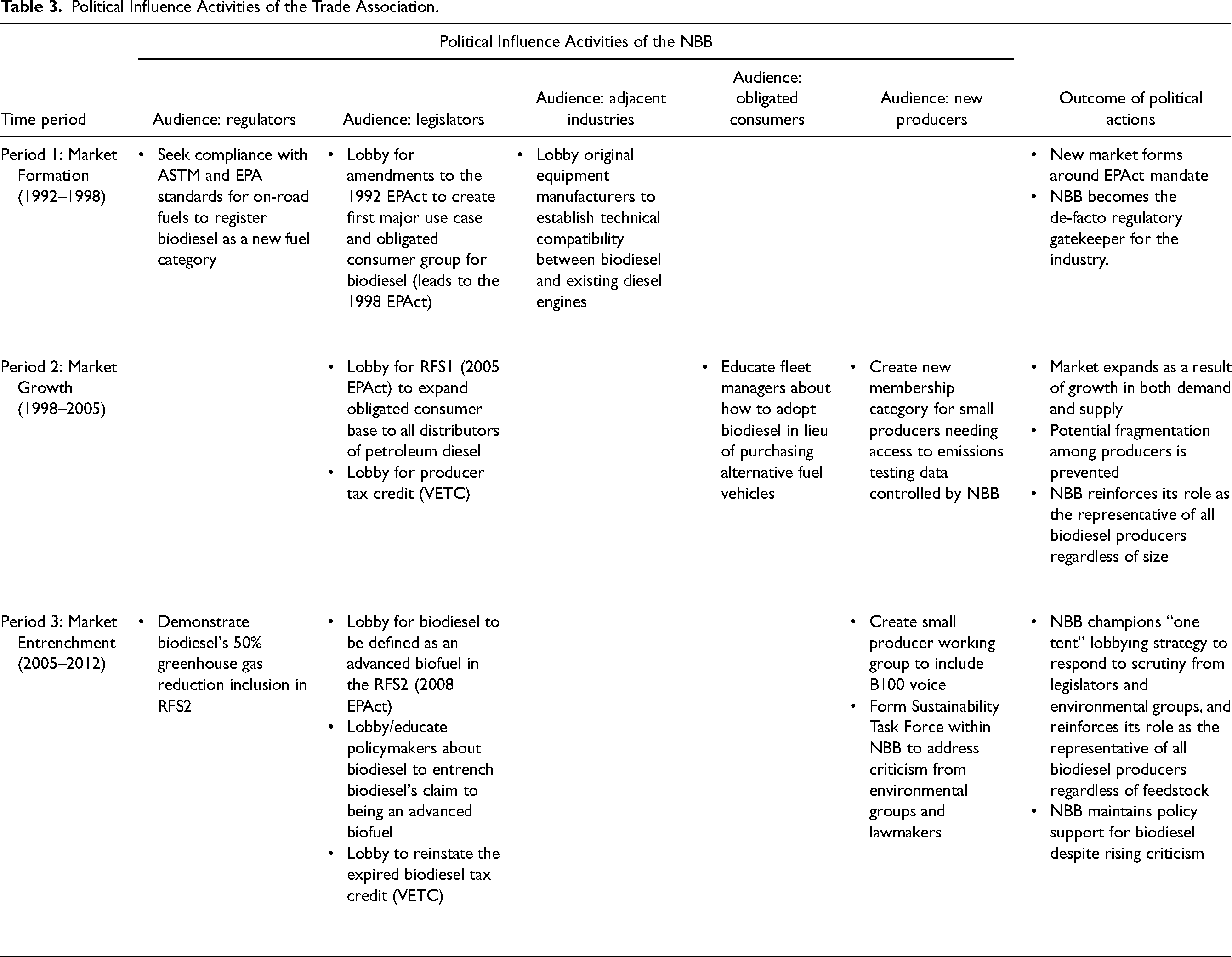
By the conclusion of the study period, biodiesel had become an established fuel in the energy sector, with petroleum distributors splash-blending fuel for sale at stations and producers continuing to refine and expand the technologies and feedstocks they used to produce more advanced types of biodiesel. That said, the uncertainty of biodiesel's status in the EPAct of 2008, more than 15 years after biodiesel first entered the policy environment, highlights the fragility of the market. Although biodiesel had enjoyed political support for over 15 years, renewed policy mandates that would continue to ensure an obligated consumer base were not guaranteed, and continuing political action by the trade association and its members was critical to maintaining the market. Table 3 summarizes the foregoing account and highlights the successive efforts of the trade association to facilitate the emergence and growth of a market for biodiesel.
Political Influence Activities of the Trade Association.
Discussion
This study makes two interrelated contributions. The first is to articulate a pathway of new market emergence and growth that has received relatively little attention: how trade associations undertake collective political action to support the development of both supply and demand for a new product in a regulated sector. The second contribution is to extend our understanding of the role of collective actors in markets more generally, specifically their ability to manage relationships with regulators and adjacent industries as a means of securing political support, and more generally how they navigate a market's dependence on fluctuating political support. Overall, the findings point to the need for more process-oriented research about markets that depend on public policy to understand how such markets emerge and stabilize over time. Although product markets dependent on policy support may constitute a small subset of industries, their role in meeting important national objectives such as energy security, sustainability, and economic growth make them an important focus of study.
Contributions to Theory About Policy Influence and New Market Emergence
One key goal of this study was to explore the role of collective actors in new market formation, especially in regulated industries. From the perspective of firms, prior research shows that the liability of belonging to new markets may be mitigated when ventures band together to seek collective legitimacy with stakeholders like the government, media, and consumers. For instance, prior research has looked at how nascent producers join industry associations (Russo, 2001), leverage frames generated by social movements (Sine & Lee, 2009), and join forces to obtain government certifications (Sine et al., 2007). However, these studies primarily focus on the identity-building and sense-giving efforts of collective actors to demarcate their nascent product-market from existing industries (Khaire & Wadhwani, 2010). The process through which new product markets emerge and grow through the ongoing political activities of collective actors over time has not been empirically examined in light of the incremental nature of legislative change (Barley, 2010; Kaynak & Barley, 2019; Lux et al., 2011; Schuler et al., 2002). This paper addresses this gap in the literature by analyzing how collective actors enact political influence strategies to manage a market's dependence on government policy support over time. To our knowledge, the findings of this study represent a novel contribution to the literature because they show how a specific policy feedback process plays out over time in one market (Pierson, 1993). Other studies have shown how collective actors can influence government policies to encourage entrepreneurial entry (e.g., Sine & Lee, 2009) but the iterative process by which producer firms and their collective actors shape multiple aspects of public policy, and subsequent policy amendments over time, is not explored in prior research.
Although prior studies have started to examine the factors that determine whether a new market receives political support, nascent theory focuses on structural factors rather than a process that unfolds over time. For example, Georgallis et al. (2019) suggest that policymakers are more likely to support a nascent industry when it is populated by firms that exclusively produce the new technology rather than firms that diversify into the new industry from adjacent industries. Other studies have looked specifically at the regulation of product categories, rather than at policy changes that support the integration of emergent markets in regulated industries (Hsu & Grodal, 2021; Ozcan & Gurses, 2018). Thus, our study contributes to the market emergence literature by highlighting a novel pathway for market emergence facilitated by collective political action aimed at creating both demand and supply for a new product.
At the same time, we show how market growth achieved through political support is inherently fragile. Unlike product markets that achieve cultural resonance with multiple audiences (Lempiälä et al., 2019), those that depend primarily on favorable policy and government action are at risk of fluctuating support from both legislators and the public. This risk is observed in other industries besides biodiesel, for example in the case of controversial technologies that gain traction for some time as a result of concerted lobbying, yet ultimately lose their political backing as a result of negative public sentiment. For example, in the case of Dutch nuclear energy, the government forged ahead with nuclear expansion policies despite negative public sentiment, until large-scale nuclear accidents in other countries confirmed the fears of the anti-nuclear movement and political actors were accused of “misuse of power” (Geels & Verhees, 2011, p. 927).
An important question we also address is, how does a trade association emerge around a political opportunity? Insights from the policy feedback literature can help us explain how a politically adept trade association such as the NBB emerged even before a market for biodiesel had come into existence. Policy feedback scholars have long observed that new legislation can trigger the growth of interest groups, such as trade associations (Walker, 1983). Our findings highlight how a new energy policy triggered the interest of soybean producers in the agricultural sector and incentivized them to enter the new market for biodiesel and build the market from the ground up, including generating a secure demand and reliable supply of the new product. In addition to successful political influence strategies, the biodiesel trade association, which was originally formed by soybean producers, carried over “conceptions of control” or operating logics from the agricultural sector into the new market for biodiesel. Conceptions of control refer to a shared worldview about how a market functions, including tactics for competition, the accepted status ordering of firms, and the role of government (Fligstein, 2018). Conceptions of control rarely arise de novo: “New markets borrow conceptions of control from nearby markets, particularly when firms from other markets choose to enter the new market. New markets are born in close social proximity to existing markets” (Fligstein, 2018, p. 78). For instance, in their account of the emergence of recycling in the United States, Lounsbury et al. (2003) depict the political struggles of environmental social movement organizations to culturally define recycling as an activity, which eventually enabled the rise of a for-profit recycling industry dominated by solid waste management conglomerates. These conglomerates moved into the recycling field from the adjacent waste management field, and carried over their existing conceptions of control, which shaped how recycling became a for-profit industry. Thus, conceptions of control may be carried over by incumbent firms in adjacent markets when they diversify into a nascent market (Apajalahti et al., 2018). Having such shared conceptions of control is key for back-stage coordination of industry members’ interpretation of issues, which is necessary for achieving coherent policy agendas (Mair & Hehenberger, 2014). We show how in the nascent biodiesel industry, actors from the established agricultural field defined the opportunity themselves, rather than waiting for consumers or social activists to create demand for biodiesel. In doing so, they anchored the nascent market in an existing logic of political influence and patronage. Thus, our findings highlight how incumbent firms in established industries may be important carriers of conceptions of control, and paying attention to their motives and resources provides insight into the possible pathways of a new market's emergence and growth.
Contributions to Research on Collective Actors and Market Emergence
Our second contribution is to identify processes through which collective actors shape the growth of markets through concerted political influence activities. Existing research on industry or trade associations has focused on their internal governance and propensity toward capture by their most powerful members (Barnett & King, 2008; Barnett, 2013). Trade associations’ ability to manage relationships with regulators, legislators, and adjacent industries in the early stages of field emergence has received less attention, though a few studies do look at their role during times of field-wide change (e.g., Hirsch, 1975; Elsbach, 1994). For example, Hirsch (1975) shows how before 1950, the American Medical Association (AMA) acted as a barrier to the pharmaceutical industry, barring it from advertising any drugs to their members that had not been approved by the AMA's own Council on Drugs, and prohibiting generic drugs from being marketed under brand names in their journals. In the early 1950s, this relationship changed when the AMA sought new sources of revenue, and consultants suggested that advertising fees paid by pharmaceutical firms could be a key revenue stream. Inferring from patterns of political activity and personnel mobility between the pharmaceutical trade association and the AMA, Hirsch concludes that the pharmaceutical industry gained access to the medical field by funding the AMA's own political mobilization to curtail the role of the federal government in the healthcare field. Specifically, revenues generated from the advertising of pharmaceutical firms’ products in medical journals was used to fund the AMA's initiative to stop the creation of national compulsory health insurance. By controlling the medical field's relationship with adjacent actors, the AMA as a collective actor helped to set the direction of both fields’ growth.
In emergent product-market domains, when the role of collective actors is considered, the focus of their work is usually on developing a distinctive market niche (Lee et al., 2017). For example, in the case of craft beer, the major industry associations, such as the Institute of Brewing Studies and the Association of Brewers, developed a classification of craft beer based on organizational form that differentiated craft brewers from conglomerates through their small size and traditional production methods (Carroll & Swaminathan, 2000). In another example, the social movement behind grass-fed beef articulated a set of moral values that clearly demarcated the animal husbandry practices in their field from those of conventional cattle ranchers (Weber et al., 2008). In both cases, collective actors were primarily focused on appealing to consumers rather than policymakers as a strategy for growth.
Our study demonstrates how a collective actor contributed to the policymaking process by shepherding both the technical work required for regulatory (re)categorization and the political work that that it took to convince policymakers of the technical merits of biodiesel. The trade association carried out various political influence activities, including demonstrating regulatory compliance, lobbying policymakers to actively shape the regulatory and legislative landscape, advocating for the benefits of biodiesel as a fuel source that could lessen the dependency of the United States on petroleum, and finally, grassroots mobilization to encourage small and large biodiesel producers to lobby their elected officials on behalf of the commercial industry. Without the trade association's long-term concerted political efforts, it is unlikely the biodiesel market would have survived beyond the experimental forays of feedstock growers. Although agricultural conglomerates recognized the market opportunity contained in the original EPAct, and invested political and financial resources to realize it, the long-term policy support the market received was the result of a much broader-based effort to transform a policy opportunity into a market with stable supply and demand relationships.
Our detailed data on the various political influence activities of the biodiesel trade association enable a more nuanced understanding of how collective actors manage producer diversity in emerging markets, and how they channel their influence into the policy feedback process. Thus, one of the contributions of this study is to highlight the significant role that trade associations may play in developing a unified policy position for a new product market. We show how in addition to managing the internal governance of the industry through a “one tent” approach aimed at resolving the differences between diverse producers, the trade association corralled its newly consolidated membership around a clear and unified political agenda. The process of consolidating and then amplifying a unified political voice enabled the trade association to exert significant influence on the policymaking process. We argue that prior research has not considered how members of a nascent product category manage their internal diversity in the face of long-term policy dependence. Our findings suggest that trade associations not only enable a sense of community among firms in a field of activity (Spillman, 2012), but may also actively bring together a diverse range of members to support the industry's political priorities. By creating a national trade association for biodiesel that included all feedstocks, the NBB pre-empted the possible fragmentation of the industry into multiple sub-groups seeking government support for their particular type of fuel (e.g., soydiesel, canola diesel, B100). Instead, the trade association embraced its role as an industry anchor by consolidating the bargaining power of the various biodiesel producers into a unified bloc. It was through this unity of voice that biodiesel producers, as a nationally distributed producer group, could argue for political patronage.
Overall, our paper demonstrates how dependence on supportive public policy and legislation may upend assumptions about policing category membership by establishing strict criteria related to production methods or organizational form for inclusion. Our findings suggest that when diverse producers share membership in a politically dependent market, they may be compelled to collapse the boundaries between the niches that emerge, and to consolidate their identities in the face of the importance of obtaining policy support from the government. This finding departs from existing accounts of how categories protect their legitimacy by policing boundaries (Grodal, 2018; Lee et al., 2017), and suggests that in markets subject to government support, organizations may pay attention to a different set of driving factors for their survival, including unity of voice.
Boundary Conditions
The features of our empirical case raises several boundary conditions for the generalizability of our findings. Our study highlights that not all industries operate according to free market dynamics and for those that do not, economic competition will be shaped significantly by non-market strategy from the very beginning of the market's evolution. This caveat means that our findings will not generalize to all settings, because in our context, demand was almost entirely supported by government mandates. While B100 producers were able to tap into a small market of local consumers who sought to use biodiesel in their diesel vehicles, this demand was negligible in the context of the petroleum diesel market's overall trading volumes. The vast majority of consumption resulted from government policies that obligated certain consumer groups (e.g., government fleets) to purchase biodiesel. However, there are other examples of how government policy obligates consumers to purchase a product or service. For example, in the United Kingdom and European Union, the General Data Protection Regulation (GDPR) adopted in 2016 has created demand for IT services because organizations must comply with this regulation by demonstrating that they are actively protecting the personal data of consumers and employees. GDPR policies across European countries have created demand for services from audit companies to ensure compliance. Other emergent industries in the energy sector, such as the microgrid industry, may initially grow because of adoption by government or public-sector consumers, such as universities (Hetzel, 2021). Thus, while our findings apply most directly to industries that are dependent on government policy, insights from our study can be used to shed light on dynamics in other regulated industries.
Another boundary condition is the representativeness of the types of political influence strategies that we observed, accounting for both the particular context of the biodiesel industry, and the broader American context of our research (Lawton et al., 2013). Our account of the actions of the biodiesel trade association on behalf of their members’ goal of securing and sustaining political support may not be indicative of the entire range of political influence tactics available to other regulated industries, nor will other settings necessarily mirror the founding story of the NBB. Our data show that biodiesel producers engaged in political influence activities in the early stages of the field formation process, and that most of these early influence activities were sponsored by soy producers. We therefore argue that the biodiesel field would likely not have developed the way it did if not for the political know-how, connections, and financial resources it inherited from the agricultural lobby. Firms normally develop political capital over time, which is reflected in the corporate political action (CPA) literature's focus on mature firms and industries (Hillman & Hitt, 1999; Schuler et al., 2002; Useem 1979; Vogel 1996). However, entering a regulated market may require entrants to deploy political capital from the onset—which then limits the number of players that can make forays into these markets. In settings in which this concentrated endowment of political capital is not evident, we would expect to see a very different approach to political influence, which may involve a much broader range of stakeholders. In addition, in other empirical contexts in which multiple trade associations compete for influence, it is unlikely that the relationship that we observed between the NBB's activities and policy amendments would necessarily occur in such a direct fashion.
Another boundary condition on our findings is the unique trajectory of the biodiesel industry's development in the United States when compared to other contexts in which a biodiesel product market formed. For example, the European Union (EU) has produced billions of gallons of biodiesel per year since the early 2000s. Similarly to the biodiesel market in the United States, the market in the EU formed in the aftermath of the petroleum shocks of the 1970s, when governments sought to reduce their reliance on petroleum imports by encouraging domestic energy production. However, in contrast to the United States, in the EU, this issue was addressed through a common policy across the trading bloc to support the replacement of surplus food crops with alternative fuel crops by setting minimum prices and earmarking land for the growth of these fuel crops (Kutas et al., 2007). On the back of this increased feedstock supply, specific mandates to encourage biofuels adoption among member states were put into effect starting in 1992, and member states independently sought to meet these targets by implementing a variety of tax incentives, exemptions, and other instruments to encourage domestic production (Bureau et al., 2010). In contrast to the United States, support for the industry was largely driven by the earlier bloc-wide political support for alternative crops to reduce the EU's trade imbalances. The question of whether biodiesel as a fuel product should be supported through government policy was uncontroversial until the early 2010s when scientific frameworks for measuring the total carbon impact of growing feedstock crops cast doubt on their status as a net carbon reducer (Van Noorden, 2013). Retrospective accounts of the early growth of the EU biodiesel industry from the late 1980s through the early 2000s suggest that producers enjoyed a munificent financial environment that reflected the bloc's emphasis on encouraging alternative fuels to petroleum diesel to meet both their energy and trade objectives. Only when the biodiesel industry faced challenges related to its overall carbon impact did industry groups come together to lobby against a cap in financial incentives for production (Van Noorden, 2013). This contrasting trajectory of industrial growth suggests that the pattern of political influence and incremental legislative support that we see in the American biodiesel market may be particular to the time and place—and that in many other countries during the same time period, biodiesel producers enjoyed greater support from their respective governments due to an initial supply-side rationale for the industry's existence.
Directions for Future Research
Future research may be able to further elaborate and clarify the mechanisms of market emergence when political intervention is crucial to establishing stable demand for a product. In sectors such as energy production, infrastructure development, and natural resource extraction, the role of the government and the waging of political influence battles is likely to remain central to how these markets evolve over time. As a long tradition of political action research illustrates, the gears of government grind out compromises and policy shifts that reflect the lobbying and influence of multiple stakeholders, with firms and their trade associations representing just one component of this polity. This paper offers an in-depth analysis of one product market, but as Fligstein (2018, p. 89) notes, “the economic sociology of capitalist societies is concerned with the construction of massive numbers of markets operating with different conceptions of control and massive numbers of fields of government connected to these markets.” Therefore, there is ample opportunity to conduct further research on the evolution of collective actors, new markets, and policy evolution.
For instance, future studies might examine how member firms shape an industry's political position over time. Because we did not collect data about the political contributions of individual member firms in the biodiesel trade association, we were not able to trace the political activities that firms individually pursued to complement the efforts of the NBB. We suggest that a more detailed understanding of the movement of money and influence would further clarify how new markets that are dependent on political patronage manage their tenuous position in times of political turmoil.
Finally, the US biodiesel market is an ongoing accomplishment in the sense that it remains to be seen how long political interventions will sustain mandated consumption by obligated parties. Cases of failure—studies of industries that do not manage to sustain their position in a market due to a lapse in political support—would reveal further mechanisms of industrial change by identifying factors that explain how these products fully entrench in the market, or not.
Footnotes
Acknowledgments
The authors thank Steve Barley, Woody Powell, Kurt Sandholtz, and Ruthanne Huising for their generative rounds of feedback on this paper.
Declaration of Conflicting Interests
The authors declared no potential conflicts of interest with respect to the research, authorship, and/or publication of this article.
Funding
The authors disclosed receipt of the following financial support for the research, authorship, and/or publication of this article: This work was supported by the Stanford University Management Science and Engineering Department.
