




Abstract
This study examines how managers and entrepreneurs in stigmatized industries use historical narratives to combat stigma. We examine two industries, the private military contractors (PMC) industry in the United States and the cannabis industry in Canada. In recent decades, the representatives of these industries have worked to reduce the level of stigmatization faced by the industries. We show that historical narratives were used rhetorically by the representatives of both industries. In both cases, these historical narratives were targeted at just one subset of the population. Our research contributes to debates about stigmatization in ideologically diverse societies, an important issue that have been overlooked by the existing literature on stigmatized industries, which tends to assume the existence of homogeneous audiences when researching the efforts of industry representatives to destigmatize their industries.
Introduction
The existing research on stigmatized industries (Barlow et al., 2018; Hampel & Tracey, 2017; Slade Shantz et al., 2019) has improved our understanding of how the representatives of such industries combat stigma. Unfortunately, stigmatization researchers have not yet drawn on the recent research in management that shows that historical narratives are a potentially powerful tool in the hands of managers and other actors (Argyres et al., 2019; Suddaby et al., 2019). Our article incorporates historical narratives into our working model of how industry destigmatization occurs. The article also helps to address another important limitation of the current literature on stigmatized industries, namely its tendency to ignore how tension between different political ideologies influences stigmatization and destigmatization. Helms et al. (2019, p. 7) observe that stigmatization researchers “tend to focus upon a single, generalized, and unspecified audience” and thus pay insufficient attention to differences of opinion within audiences. One of the problems with the approach they describe is that it obscures ideological diversity, that is the presence within a population of a high level of heterogeneity in political worldviews and ontological commitments (Narayan et al., 2020).
We argue that the representatives of stigmatized industries take ideological diversity into consideration when crafting the historical narratives they use as part of their efforts to destigmatize industries. We do so by examining the historical narratives that were used rhetorically by the representatives of two stigmatized industries, the private military company (PMC) industry in the United States and the cannabis industry in Canada. Historical narratives were part of the toolkit used by the representatives of both of these industries in their struggles to reduce stigmatization. The representatives of the Canadian cannabis industry made extensive use of historical narratives in their efforts to reduce the level of stigmatization faced by their industry, as did the representatives of the PMC industry. In both cases, these historical narratives were targeted at people on one side of the left-right political spectrum: the representatives of the Canadian cannabis industry produced historical narratives about racial injustice that were designed to resonate with left-of-centre Canadians, while the representatives of the U.S. PMC industry used historical narratives about free enterprise that were designed to appeal to conservative Americans.
Our article, which is based on a systematic qualitative study of advocacy texts produced by representatives of the two industries, shows that there is considerable variation in the types of historical narratives that the representatives of the two stigmatized industries produce. The representatives of the U.S. PMC industry produce historical narratives that are congruent with the historical metanarratives that conservatives in the United States use to understand the world. A historical metanarrative is a master narrative informed by a theory of how the world works that allows individuals to attribute meaning to a wide range of phenomena in different geographical locations and historical periods. An individual’s historical metanarrative influences whether they will believe a given historical narrative (White, 1973). The representatives of the U.S. PMC industry produced such historical narratives designed to resonate with the historical narratives used by American conservatives because the political strategy of the industry required winning the support of the political right. In contrast, the representatives of the Canadian cannabis industry produced historical narratives that are congruent with the historical metanarratives that liberals in Canada use to understand the world as the political strategy of the cannabis industry required left-wing Canadians to come to support cannabis legalization.
In the following section, we first review the theoretical literature on stigmatized industries and the literature on how managers use historical narratives for rhetorical purposes. Research on rhetorical history gives us a better understanding of how the past is used as an argument against negative evaluations by managers from stigmatized industries in ideologically diverse societies. We then discuss the empirical contexts of our two case studies and the research methods and data sets used. After the presentation of our findings, we identify the implications of our study for researchers who study stigmatized industries. We conclude by discussing boundary conditions, the limitations of this study, and directions for future research.
Literature Review
Stigmatized Industries
Stigmatization can affect product categories (Barlow et al., 2018), organizations (Piazza & Peretti, 2015), and entire industries (Helms & Patterson, 2014; Slade Shantz et al., 2019) with the latter being a form of category stigma. In an influential article, Devers et al. (2009, p. 155) define “organizational stigma as a label that evokes a collective stakeholder group-specific perception that an organization possesses a fundamental, deep-seated flaw that deindividuates and discredits the organization.” Organizational stigma results from a process whereby stakeholders associate an organization or category of organization with “values that are expressly counter” to their own (Devers et al., 2009, p. 157; Devers & Mishina, 2019). A stigmatized industry is thus a category of profit-seeking firms that stakeholders regard as incompatible with their deeply held values, although different stakeholders will hold different values and therefore not all stakeholders will share the same judgement on the stigmatization of an industry. Examples of industries that have been stigmatized in at least one cultural context include: travel agencies (Hampel & Tracey, 2017), armament makers (Vergne, 2012), mixed-martial arts leagues (Helms & Patterson, 2014), tobacco (Coraiola & Derry, 2019), and brothels (Blithe & Wolfe, 2017). Industries can become stigmatized over time and can cease to be stigmatized. Understanding how organizations and industries cope with organizational stigma is important because stigmatized organizations and industries suffer from social and economic sanctions (Grougiou et al., 2016; Lashley & Pollock, 2019). While membership of a stigmatized industry is not the only predictor of firm disapproval, it can isolate them from society, with a firm that is part of a stigmatized industry less likely to survive events that spark instances of public disapproval (Vergne, 2012).
The existing research on stigmatized industries strongly suggests that understanding the cultural-cognitive process of stigmatization requires researchers to take into account historical and cultural contexts. For instance, Hampel and Tracey (2017) show that travel agencies such as Thomas Cook Ltd were highly stigmatized in Victorian Britain because of the features of British culture in that era. Travel agencies would not be stigmatized in the context of modern British culture because the beliefs that underpinned the Victorian stigmatization of travel agencies are no longer prevalent. In their study of Nevada’s legal brothels, Blithe and Wolfe (2017, p. 729) observe that while sex work is present in all cultures and historical periods, whether such work is stigmatized is a function of “local culture, history, economics, politics, and geographic location.” Stigmatized industries research thus acknowledges that whether an industry will be stigmatized by the typical stakeholder will depend on time and place. However, prior literature has little to say about the ways in which different times and places might inform current thoughts on the stigma of organizations and industries. Specifically, we do not know much about the way industry advocates mobilize the past to mitigate the stigmatization of industries and organizations.
Similarly, the existing research usually assumes a strong social consensus on organizational stigma with little recognition of heterogeneous views among stakeholders (Durand & Vergne, 2015; Grougiou et al., 2016; Vergne, 2012). This pronounced tendency on the part of researchers who study stigmatized industries to ignore ideological diversity within the populations of stakeholders relevant to the stigmatized industries is an important oversight that needs to be accounted for. Ideological diversity, which is sometimes called viewpoint diversity, is the presence within a population of a high level of heterogeneity in political worldview and ontological commitments (Baden & Springer, 2017; Narayan et al., 2020). A population in which individuals had very similar political and religious views would be low in ideological diversity, while one that was polarized into distinctive subcultures with radically different attitudes to political and religious matters would be high in diversity. The United States in the present-day, which is characterized by political polarization in recent decades, as well as long-standing divisions based on ethnicity, region, and race (Haidt, 2012), is an example of a population of stakeholders with a high level of ideological diversity. The U.S. population is now increasingly divided into liberal and conservative factions and regions, while the level of political polarization in other democracies remains low (Kujala, 2020; Lütjen, 2020; McCarty et al., 2016).
The existing literature on stigmatized industries is grounded in the apparent assumption that attitudes toward stigmatized industries within the relevant population of stakeholders are essentially ideologically homogeneous. Such studies essentially ignore ideological diversity within the population of stakeholders relevant to an industry. In our view, this approach to the study of stigmatization is problematic for two reasons. First, as Tyler and Slater (2018) have pointed out, stigmatization is an inherently political process. Modern academic research on stigmatization is informed by the seminal work of Goffman (1963), whose work on stigma took place in the context of the American Civil Rights Movement. While much of the subsequent work on stigma ignored critical political questions about “where stigma is produced, by whom and for what purposes,” (Tyler & Slater, 2018, p. 721) stigmatization researchers in sociology are now bringing ideology back into their analysis and are exploring the relationship between stigmatization and ideological change. Siltaoja et al. (2020, p. 998) observe that the processes of stigmatization and destigmatization are often connected to “heated ideological debates.” In our view, research on stigmatized industries should also engage with such political questions.
Moreover, ignoring ideological diversity within audiences when thinking about stigmatized industries is problematic because of the evident heterogeneity of viewpoints in many modern societies. This is especially awkward when considering industries that are global and which thus must take account of stakeholders from different cultures and subcultures. An industry may be stigmatized by a sufficiently large proportion of the relevant population to warrant the designation by researchers of that industry as a stigmatized industry. However, there may nevertheless be significant numbers of stakeholders who do not feel any feelings toward this industry that correspond to the definition of stigma described earlier. In populations that are ideologically polarized, or which contain large groups who subscribe to different worldviews, attitudes toward so-called stigmatized industries may vary considerably.
Helms et al. (2019, p. 7) critiqued the existing literature in organization studies on moral legitimacy for the tendency of authors to gloss over heterogeneity of stakeholders’ perceptions by focusing “upon a single, generalized, and unspecified audience.” In our view, the existing literature on stigmatized industries and organizations also falls into the trap of assuming there is a single audience composed of individuals with roughly similar viewpoints. The degree of ideological diversity within the relevant population of stakeholders is important because this degree will likely influence how the representatives of a stigmatized industry will work to reduce that stigma. If the firm or industry is stigmatized in the eyes of all of the relevant stakeholders, and all stakeholders use the same principles to determine whether a given entity deserves to be stigmatized, then the representatives of that firm or industry will have to change public opinion as a whole. This work would involve changing the thinking of most or all of the relevant stakeholders. However, if the population of stakeholders relevant to the stigmatized firm or industry is heterogeneous and contains subpopulation with different worldviews, the representatives of the stigmatized industry or firm may be able to achieve their goals merely by changing that thinking of a subset of the population rather than of all individuals in that population. It would be only necessary to change the thinking of all individuals in the relevant population in circumstances when the industry needs to be unanimously positively regarded. Since most extant political and social systems involving large populations do not operate on the principle of unanimous consent (Romme, 2004), such circumstances would be extremely rare.
It should be stressed that research on stigmatized industries has not been entirely blind to ideological diversity. One article that anticipates our approach is Hudson and Okhuysen (2009) a study of the stigma against gay bathhouses. These authors argued that the stigma against gay bathhouses is not uniform across the United States. These researchers placed the cities in which the bathhouses they studied were located into three categories, Condemning, Tolerant and Accepting Environments. The nature of the environment in which a given gay bathhouse was situated (e.g., an accepting city such as San Francisco versus a socially conservative community in Utah) influence how the managers of the bathhouse worked to reduce stigma. In the article by Hudson and Okhuysen, the political and religious views prevailing in each community appear to have been antecedent to attitudes toward gay bathhouses. Unfortunately, the insight into the ideological heterogeneity of stakeholder’s attitudes provided by Hudson and Okhuysen (2009) has not been built upon in subsequent research on stigmatized organizations and industries. In their important article on how MMA organizations overcome the widespread stigma they once faced, Helms and Patterson (2014) distinguish supportive audience and from critical audiences that were more hostile to the category of MMA. However, these authors do not discuss whether their critical audiences were ideologically different from supportive audiences. In fact, differences in political ideologies go undiscussed in their article, which implies that attitudes that toward MMA were largely orthogonal to the left–right political spectrum in the United States. While the ideological divisions between left and right may have been of little relevance to the particular stigmatized industry they studied, there are, as we show further, other stigmatized industries in which attitudes toward the industry are indeed mediated by one’s political ideology. This article thus brings political ideology into the model used for understanding stigmatized organizations and categories.
Similarly, research on stigmatized organizations and industries has not taken advantage of the insights provided by the scholars of institutional entrepreneurship. This body of work stresses that the diversity of viewpoints and values within the populations of stakeholders collectively shapes institutional change. In a seminal study of institutional entrepreneurship in the field of HIV-AIDS advocacy, Maguire et al. (2004, p. 673), observe that in emerging fields “perceptions of legitimacy among stakeholders can diverge and conflict.” Audience heterogeneity complicates the work of the institutional entrepreneurs who institutionalize new practices “by attaching them to pre-existing organizational routines” via “alignment with stakeholder values” (Maguire et al., 2004, p. 672). Such “dynamics illustrate the potential politicality” of discourses about organizations, as such discourse “are at least partially the product of strategic action not only by elites but by a plurality of individuals involved in the production and consumption of texts” (Hardy et al., 2005, p. 61). More recent research on institutional entrepreneurship and institutional change has stressed that these processes are affected by the diversity of values that are found in the wider society (Gehman et al., 2013; Ocasio et al., 2017; Ren & Jackson, 2020). For instance, a study of anti-Mafia reformers in Sicily found that the diversity of values in contemporary Sicilian society helped the reformers to change the institutions to which they objected (Vaccaro & Palazzo, 2015). This research stream tells us that values and ideologies change, but they do not change at the same rate in all sectors of society, which has a significant impact on how institutional and values work is undertaken.
Although the research discussed in the previous paragraph strongly suggests that one should consider variables such as political conflict when thinking about stigmatization, the literature on stigmatized industries still tends to ignore ideological diversity and the tension between what Lounsbury and Wang (2020, p. 1) call “liberal as well as illiberal beliefs and practices.” After noting the evidence that tension between liberal and illiberal belief systems is increasingly in evidence, as illustrated by the rise of political authoritarianism in many countries, Lounsbury and Wang (2020) call on researchers of organizations and institutions to pay more attention to the tension between political ideologies than they have hitherto done. This article answers their call for more research in organization studies on ideological tension by drawing on the recent research in historical organization studies that show that when historical narratives are used rhetorically by managers, they are not crafted to appeal to a generic listener but are instead designed to appeal to particular types of listeners who view the world through a particular ideological lens, such as socialism or libertarianism (Smith, 2020). In the next section, we discuss the literature that is relevant to understanding how managers use historical narratives rhetorically.
Historical Narratives
In a seminal article, Suddaby et al. (2010) identified rhetorical history as an important source of competitive advantage. Building on earlier research in management on narratives (e.g., Green, 2004) and on the work on historical narratives (White, 1973), Suddaby et al. (2010) argue that by creating and disseminating historical narratives, managers can communicate more persuasively with customers, workers, and other stakeholders, thereby allowing the firm to achieve its strategic objectives. Armed with the rhetorical history construct, organization studies scholars have published extensively on how managers use the past (Maclean et al., 2014, 2018; Rowlinson et al., 2010; Rowlinson & Hassard, 2014; Suddaby et al., 2019; Wadhwani et al., 2018). Uses of the past scholars have shown that historical narratives are used rhetorically in various industries such as charity (Cailluet et al., 2018), fast food (Foster et al., 2011), wineries (Voronov et al., 2013), financial services (Basque & Langley, 2018; Decker, 2014), watchmaking (Oertel & Thommes, 2018), and aerospace (Anteby & Molnár, 2012).
The power of historical narratives is in the use of rhetorical devices. For instance, there are different forms of reasoning that may affect how sound a historical narrative is perceived. One of the rhetorical techniques that “power” historical narratives and make them persuasive is the historical fallacy (Fischer, 1970). A historical fallacy is a type of reasoning error or cognitive bias that makes a false historical narrative seem more credible to listeners than it deserves to be. When used by a speaker who is trying to “sell” a given historical narrative to an audience, historical fallacies are a useful tool. Fischer (1970) enumerated and provided examples of the most common and seductive historical fallacies employed by the creators of historical narratives. The first is the genetic fallacy, a fallacy of irrelevance that suggests that because the historical origins of a phenomenon are connected to a harmful or distasteful phenomenon, it must be rejected in the present. Fischer observed that the genetic fallacy was in widespread use in both academic writing and popular culture. Academic philosophers (Cohen & Nagel, 1934; Foster, 1917) had denounced the use of the genetic fallacy, which exhibits many similarities to the argumentum ad hominem. Nevertheless, the genetic fallacy continues to be employed in many persuasive historical narratives.
Fischer also documented that argumentum ad antiquitatem is frequently used. The underlying idea that because something is old, it must be a good thing. A subcategory of the fallacy of irrelevance, the argumentum ad antiquitatem remains extremely popular with practitioners who create historical narratives (Michaud, 2018) and appears to be particularly effective in persuading evaluators of the speaker’s case whenever the narrative evaluator has a conservative or “traditionalist” mental disposition (Schummer, 2014). This can be seen on Fischer’s (1970, p. 297) contention that “there is scarcely a corner of the world in which men do not, in some degree, bow down before absurdities inherited from their ancestors.” The argumentum ad antiquitatem involves nostalgia, the nonevidenced conviction the life was better in the past. Research by psychologists has demonstrated that nostalgia distorts individuals’ perceptions of reality and decision-making (see meta-analysis in Leunissen et al., 2020). Drawing on this scientific research, Routledge (2017) suggests that nostalgia has powered the rise of conservative populists who promise to restore a previous golden age, such as Donald Trump who promised to “make American great again.”
Fischer observed that the opposite of the argumentum ad antiquitatem is the argumentum ad novitatem, which is another fallacy of irrelevance. This fallacy holds that when a decision-maker faces a choice between something that is new and something that is traditional, the novel phenomenon will always be superior. These fallacies are important to the extent that they resonate with other common fallacies implicit to the way specific stakeholders understand history. As Fischer shows, this mode of argument, which generally appeals to impatient young radicals and those who love novelty for the sake of novelty, indiscriminately condemns whatever is old because it is old.
Methodology and Selection of Case Studies
Case-study research (Eisenhardt & Graebner, 2007; Gehman et al., 2018) is useful in the development of management theory, particularly in answering research questions related to phenomena that are important, but which are so small in number as to preclude statistical generalization (Gibbert et al., 2008; Yin, 2009). Analytical generalization via the study of a small number of exemplary cases can advance theory as it allows researchers to develop and refine analytical categories and to propose new models. The two cases we have selected for study are extreme examples of industries working to establish their legitimacy in the face of very high levels of stigmatization. The existing case study research on legitimation concerns industries whose moral legitimacy of which was never in question, such as the satellite radio industry (Navis & Glynn, 2010). In contrast, the two industries discussed in this article were characterized by their critics as inherently immoral, at least until recently. Both industries have been outlawed by international treaties and domestic laws. For this reason, they were ideal subjects for the study of how stigmatized industries use historical narratives to achieve moral legitimacy.
Data Sources
Our research methodology was informed by three recent articles on how organizations and organizational industries achieve legitimacy (Helms & Patterson, 2014; Massa et al., 2017; Voronov et al., 2013). We adopted a document-based approach similar to Hampel and Tracey (2017). Our main data set consists of two collections of advocacy texts. An advocacy text is a document in which someone was speaking on behalf of a stigmatized industry and was trying to convince others that the industry should be regarded as legitimate. The advocacy texts in our two data sets include newspaper editorials, opinion pieces in magazines, books written by entrepreneurs, parliamentary papers, and television programmes.
Our goal in assembling these data sets was to learn about the nature of the arguments that defenders of the industry used and the proportion of advocacy texts that used historical arguments. We did a systematic search for advocacy texts in electronic databases that aggregated decades’ worth of newspaper and magazine articles. In searching for advocacy texts related to the Canadian Cannabis industry, we used the following databases: Lexis-Nexis, Canadian Newsstand Major Dailies; the Toronto Globe and Mail since 1844 database, and Alt-Press Watch, a database of counter-cultural and campus newspapers. In searching for advocacy texts related to the U.S. PMC industry, we searched in Lexis-Nexis, Business Source Complete, Congressional records at Congress.gov, and The Wall Street Journal. One member of the research team was tasked with identifying all of the relevant advocacy texts that defended the Canadian cannabis industry, while another was given the task of finding all of the advocacy texts that had been produced on behalf of the U.S. PMC industry. We searched for texts related to the Canadian cannabis industry using the following keywords: “marijuana,” “cannabis,” plus equivalent words in French. We searched for texts related to the U.S. PMC industry using the following keywords: “mercenary,” “private military company (PMC),” and “Erik Prince.” We searched for texts related to the Canadian cannabis industry using the following terms: “cannabis,” “cannabis AND prohibition,” “cannabis legalization,” “marijuana,” “marijuana AND prohibition;” and “marijuana AND legalization.”
Prior to the search, the five-person research team established clear criteria for determining what constitutes an advocacy text. We decided that purely factual articles (e.g., a newspaper report of the trial of a cannabis dealer) should not be considered an advocacy text and should not be included in our dataset. Newspaper editorials in which the author advocated on behalf of the industry were clearly advocacy texts and were included in our data sets. The team members who conducted our initial search encountered a number of documents whose status as advocacy texts were ambiguous, as they blurred the lines between factual reporting and opinion pieces. These documents included newspaper stories about the prosecution of cannabis dealers that were ostensibly neutral descriptions, but which used slanted language that revealed that the reporter was more sympathetic to the accused than to the police. The discovery of such articles in the newspaper database prompted the researcher to consult with the other team members, who collectively decided that they should restrict our dataset to texts that were unambiguously advocacy texts. Using these strict definitions of an advocacy text, two members of our team searched for texts that had been produced by defenders of the Canadian cannabis industry and for texts written by defenders of the U.S. PMC industry. All of these documents were uploaded to an online folder in preparation for coding by other team members. A spreadsheet was created to track each document and facilitate coding. These searches resulted in a total of 104 advocacy texts for the PMC industry and 100 advocacy texts for the Canadian cannabis industry.
The next step in our research process involved coding the advocacy texts to determine the nature of the arguments used therein. Our coding procedures were informed by Neuendorf (2016) and Saldaña (2015). Two team members who had been uninvolved in the selection of the advocacy texts were tasked with coding each text to determine the nature of the argument used to legitimate the industry and, crucially, whether the argument was historical. In deciding whether a text presented a historical argument, the coders defined “historical argumentation” as occurring whenever an author evoked episodes, events, or individuals from the past in their argumentation. Our definition of historical argumentation is derived from the work of Ghilani et al. (2017) on historical analogies. The researchers recorded their coding decisions in identical spreadsheets, working in parallel, and did not communicate during this stage of the process. The spreadsheet contained a line for each text, a column in which the coder indicated whether a historical argument was used (1 if yes, 0 if no), and then a column in which the historical argument was briefly summarized. This process resulted in 46 of the advocacy texts for PMCs being coded as possessing a historical argument, while 39 of the advocacy texts for the Canadian cannabis industry contained historical argument.
The two coders then sent the results of their coding decisions to the lead author of the paper, who then compared the results of their coding decisions to determine the degree of intercoder agreement. In comparing the results of the first-order coding decisions of the two team members, we determined that there was a high degree of agreement in their views of whether or not a given advocacy text had used a historical argument. Krippendorff’s alpha for these coding decisions shows that the two coders arrived at very similar decisions about whether a given text should be coded as being an advocacy text. Krippendorff’s alpha for the decisions about whether a pro-cannabis industry advocacy text should be considered as presenting a historical argument was high (0.867). Krippendorf’s alpha for the coding decisions about whether the pro-PMC advocacy texts used history was somewhat lower (0.751), but still within the range that suggests a degree of intercoder agreement that is consistent with best practice (Saldaña, 2015).
Our second-order coding involved looking at the specific historical arguments used in each text to see whether it corresponded to any of the historical fallacies identified by Fischer (1970). The second-order coding was done by different members of the team than had done the first order coding. We found that many, but certainly not all, of the historical arguments used in the two sets of advocacy texts contained historical fallacies of the type identified by Fischer. Since a historical argument can be wrong even if it does not include a historical fallacy, our decision to code a text as not containing a historical fallacy should not be construed as implying that we think the argument used is valid. Tables 2 and 3 present information about the nature of the historical arguments used in the advocacy texts to destigmatize the two industries. The pattern we found was that a historical argument on behalf of the industry would be presented in an advocacy text and would then be copied, without attribution, by other people who were writing to argue on behalf of the industry. By ordering the documents in our data set in chronological order, we were usually able to identify the first individual to use a particular historical argument and then trace how usage of that argument propagated over time.
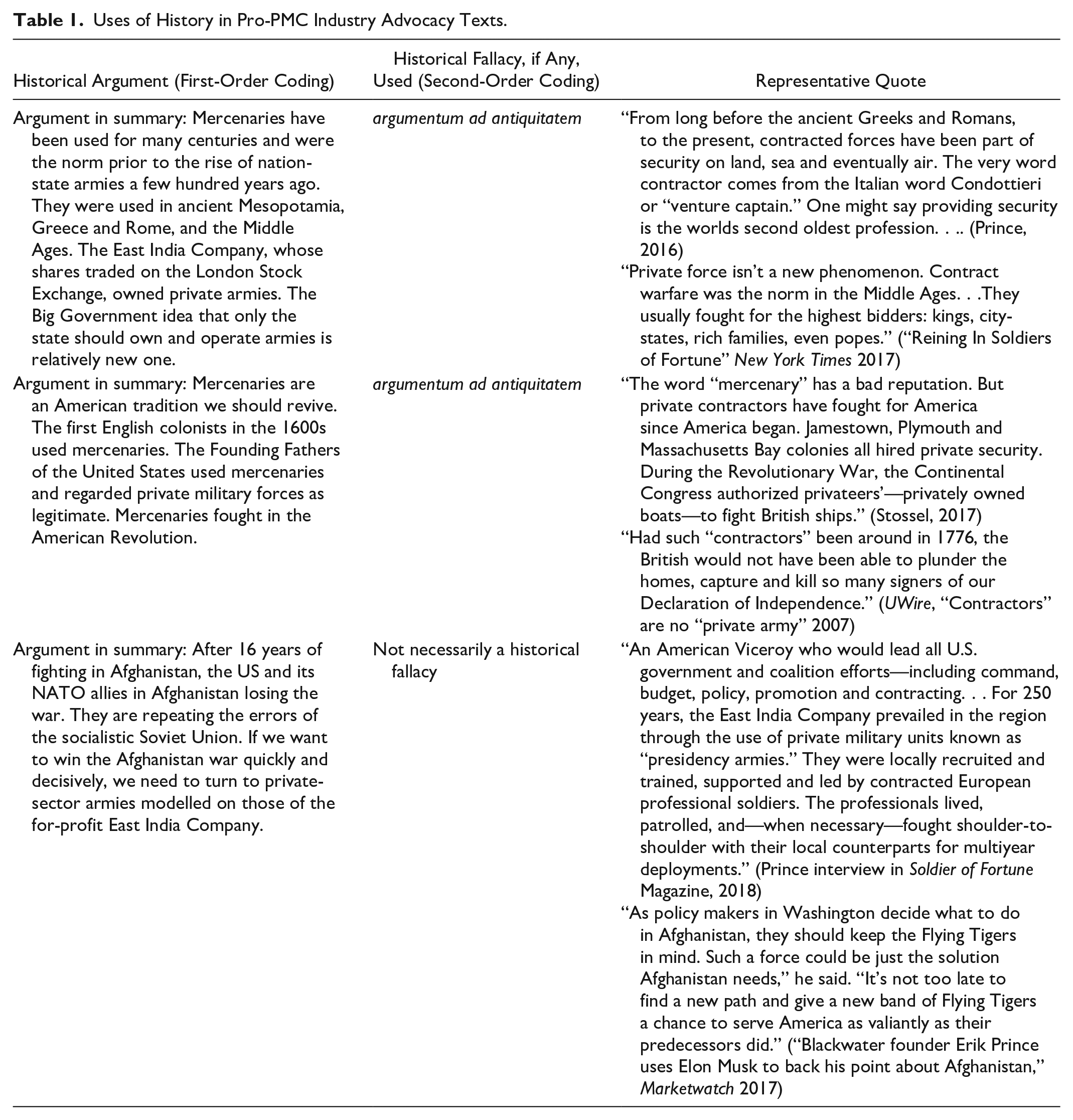
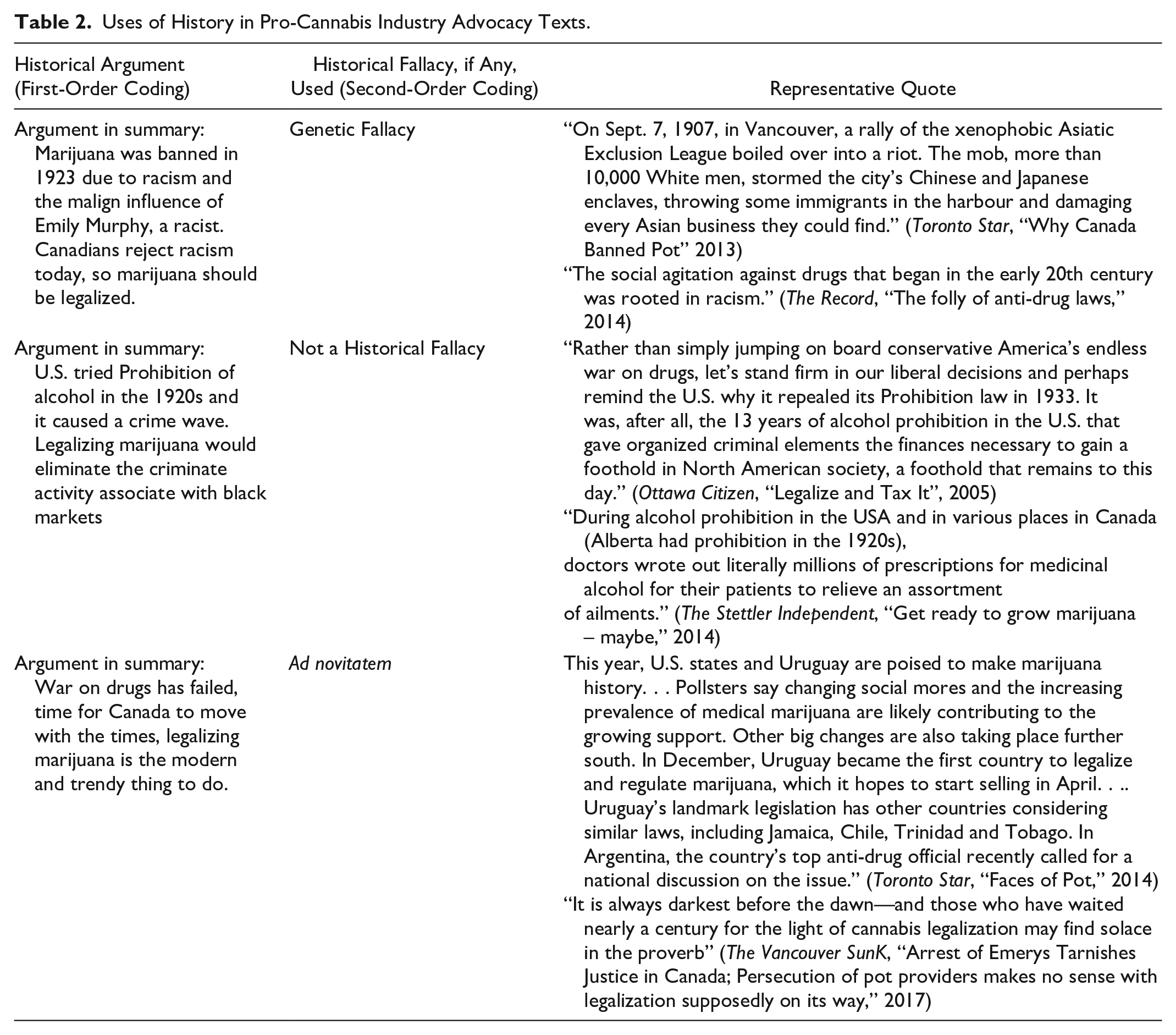
Table 1 shows the historical arguments used by advocates of the U.S. PMC industry, while Table 2 presents the historical arguments used by the advocates of the Canadian cannabis industry. In the first column of each table, we paraphrase and summarize the historical argument used, thus presenting the results of our first-order coding decisions. The second column identifies the historical fallacy, if any, used and thus shows our second-order coding decision. In the third and final column, we provide readers were representative quotations from the primary sources.
Uses of History in Pro-PMC Industry Advocacy Texts.
Uses of History in Pro-Cannabis Industry Advocacy Texts.
Research Contexts
Our case studies take place in two North American countries. Researchers have documented that North American countries have high levels of heterogeneity in political beliefs and have connected this diversity to the ethnic diversity associated with successive waves of free and unfree migration, and profound differences in values and beliefs manifest when one compares different regions of these countries (Béland & Lecours, 2019; Kirkland, 2014; Levendusky & Pope, 2010; Lieberman, 2011). Political scientists (Boxell et al., 2020) have found that while the level of ideological polarization in some other Western countries (such as the United Kingdom) has fallen since the 1980s, Canada and, especially, the United States have experienced the opposite trend. According to political science research, the level of ideological polarization and division between left and right in the United States are now at extremely high levels. The two main political parties in the United States are increasingly ideological homogenous with the result that left-wing and right-wing Americans increasingly inhabit different mental universes, although researchers caution that some liberal Republicans and conservative Democrats continue to exist and complicate the two-party system (Kujala, 2020; Lütjen, 2020; McCarty et al., 2016).
North America is thus an ideal site for exploring how ideological diversity in audiences of stakeholders affects efforts to destigmatize industries. The United States, the site of our first case study, has experienced extensive ideological polarization in recent decades (Haidt, 2012; McCarty et al., 2016; Westfall et al., 2015). The probable consequences of ideological polarization for social capital and cohesion continue to be debated by Americans (Denton & Voth, 2017). Ideological polarization means that Americans from different political subcultures now employ radically different ideological lenses to evaluate the historical narratives produced by the representatives of stigmatized industries. It should be noted that even before the trend toward ideological polarization began in the 1990s, social scientists had documented profound differences in mentality between American regions. For instance, research in social psychology found that the culture of the former Confederate states produced different attitudes toward honor and violence than did the cultures of other American regions (Cohen & Nisbett, 1994).
In Canada, the location of our second case study, the population appears to be less ideologically polarized than in the United States (Adams, 2017). Social scientists have long debated the reasons why Canada’s culture differs considerably from that of the United States in that it is more supportive of the welfare state, places a higher value on consensus, has lower rates of both political and nonpolitical violence, and is generally considered to be more European (Atlas, 2019; Lipset, 1991; Roth, 2012). While Canada has a somewhat stronger tradition of consensus politics than does its southern neighbor, there are significant ideological differences between the supporters of the three main national political parties, as well as more profound differences between the English-speaking provinces and the French-speaking Province of Québec, which has its own political spectrum. In English-speaking Canada, all of the main political parties support relatively high levels of immigration, official multiculturalism, and the celebration of racial diversity. In 1982, a commitment to multiculturalism, along with prohibitions on racial discrimination, was added to the Canadian constitution. The small group of Canadians who oppose multiculturalism and relatively high rates of immigration complain that the country’s main centre-right party, the Conservatives, has identical positions on these issues to the main centre-left political parties (Desmarais, 2018). For this reason, a Canadian speaker who is trying to destigmatize a stigmatized industry with a narrative can assume that most of their narrative evaluators will agree that multiculturalism is normative.
Case Study One: Private Military Companies
Industry Development
The period following the end of the Cold War saw the growth of the PMC industry (Brewis & Godfrey, 2017; Godfrey et al., 2013). PMCs, which are still commonly referred to as “mercenaries,” are profit-seeking firms that straddle the categories of military and commercial organizations (Ortiz, 2007). The growth of PMCs was driven in part by the increasing reluctance of Western governments to commit large numbers of public-sector soldiers to risky military operations. The rise since 1990 of the PMC industry is an example of industry re-emergence, as prior to 1800, it was common for Western governments to employ mercenary forces of military professionals who were motivated by profit. After the creation of large armies of citizen-soldiers in the wake of American and French Revolutions, a strong norm against mercenary forces developed. Subsequent international agreements banned the use of mercenaries (Percy, 2007), as did an 1893 U.S. law (Miller, 2013). The 1977 modifications to the Geneva Convention prohibit the use of mercenaries, which are defined as any soldier who is “motivated to take part in the hostilities essentially by the desire for private gain” and has been promised “material compensation substantially in excess of that promised or paid to combatants of similar ranks and functions in the armed forces” of governments. In 1989, the international community reiterated its stance against the use of mercenaries in the United Nations Mercenary Convention (United Nations, 1989).
Members of the U.S. Congress have denounced the PMCs (Kaptur, 2005), with one politician even calling their employees “professional killers” (Kucinich, 2010). The representatives of the U.S. PMC industry have attempted to counter the widespread view that it is inherently immoral. Although the industry lacks a representative body to speak on its behalf, Erik Prince has emerged since 2006 as its de facto representative. Prince, who founded the PMC Blackwater in 1997, writes newspaper editorials and gives interviews to journalists with a view to convincing Americans that the PMC industry is morally legitimate. In 2007, several employees of Blackwater Security Consulting (now Academi Inc.) were involved in the deaths of 17 Iraqi civilians in Baghdad’s Nisour Square. This incident, which resulted in an ongoing criminal case against four Blackwater employees, generated considerable negative publicity for Prince and the entire PMC industry (Simons, 2009; Singer, 2007).
In recent years, Prince has advocated a greater role for PMCs in the war on terror. Prior to being replaced by Trump in December 2018, Jim Mattis, the U.S. Secretary of Defense, has expressed scepticism about the benefits of using PMCs, declaring that “when Americans put their nation’s credibility on the line, privatizing [war] is probably not a wise idea” (Mattis quoted by Starr, 2017). Others who advise President Trump appear to be willing to consider privatizing the Afghanistan conflict along the lines Erik Prince has proposed. For instance, when John Bolton, the U.S. National Security Advisor, was asked in August 2018 about using PMCs such as Academi Inc. to fight the war in Afghanistan, he described himself as “open” to Prince’s proposal for military privatization but said that it was up to President Trump to decide whether to outsource the Afghanistan war to the private sector (Copp, 2018). At the time of writing, the question of whether the U.S. will privatize the war in Afghanistan remains unresolved.
Use of Historical Narratives in Our Data Set of Pro-PMC Industry Advocacy Texts
Using the search procedures discussed earlier, we identified 104 advocacy texts in which the author’s primary purpose was to destigmatize the PMC industry. Upon coding, we found that 46, or 44% of these advocacy texts used a historical argument. The oldest of these advocacy texts dates from 1997, but most appeared after 2005 when there was intense public scrutiny of Blackwater. The most recent advocacy text in our data set is from 2018. The historical argument took the form of a narrative, usually brief, that discussed historical phenomena followed by an explanation of how this historical narrative was relevant to understanding a contemporary policy challenge related to the U.S.’s protracted wars in Iraq and Afghanistan. The historical phenomena discussed in these advocacy texts ranged from the deeply historic, such as the use of mercenaries in the Middle Ages and in the American Revolution, to more recent episodes in military history, such as the Soviet Union’s unsuccessful war in Afghanistan. When we coded the 46 advocacy texts using a historical argument to see if they employed any historical fallacies, we found that 24 used the argumentum ad antiquitatem (Table 1). The earliest use of the argumentum ad antiquitatem by an advocate of the PMC industry was in 2004.
Since 2006, historical narratives have been an integral part of Prince’s strategy to destigmatize the industry. In a 2006 editorial in a daily newspaper that supports the Republican Party, Prince argued that private military contractors (PMC) played a crucial and positive role in early American history. He noted the role of PMC in the War of Independence itself (Q&A: Blackwater’s founder on the record, 2006). Over the next 12 years, Prince has repeatedly referred to these events in early American history. In 2016, Prince declared that “the role of the private sector has always been part of the security in any free society, both in police and military matters.” In this speech, he again mentioned the private security employed by the Massachusetts Bay colony in the 1600s (Prince, 2016). In the course of defending PMCs, Prince and his allies have also stressed that mercenaries played an important role in European history, referencing their use in classical antiquity and the Middle Ages (Table 1). In some cases, these references to non-American mercenaries appear in texts that mention historical American mercenaries, although in other cases they are not referenced in the same document. It appears that the defenders of the PMC industry adjust the historical phenomena to which they refer so as to cater to the sensibilities of their audiences, which sometimes include Europeans and other non-Americans.
In 2016, Prince and other defenders of the PMC industry, who include Congressman Dana Rohrabacher and the journalist John Stossel, began drawing on the history of the British Empire to support their case for the privatization of the war in Afghanistan (Prince, 1017a, 2017b; Rohrabacher, 2017; Stossel, 2017). In newspaper editorials, television interviews, and other venues, they began to praise the effectiveness of the armies of Britain’s East India Company. The East India Company, they explain to their readers, was the for-profit entity that ruled much of India in the 1700s and 1800s. They note that this firm, which was traded on the London Stock Exchange, frequently used private contractors to help maintain control over its territories (Prince, 2017a, 2017b). In August 2018, Erik Prince advocated the increased use of PMCs on Fox and Friends, a television program that is watched by many conservative Americans, including President Trump, who is known to be an avid viewer (Borchers, 2017). Prince there argued that privatizing the Afghanistan war would result in victory within two years.
Prince is clearly aware that his historical narratives are unlikely to be effective with left-of-centre Americans who are ideologically predisposed to dislike PMCs. In a 2013 interview, he conceded that he was unlikely to make the PMC industry legitimate in the eyes of “the 40% or so of Americans that really can’t stand the name of Blackwater, that’s fine; I’ll never really win them over anyway. And I really don’t care” (Nissenbaum, 2013). For Prince, evidently, winning the support of those Americans who self-identify as liberals is unnecessary, provided he can convince enough Republicans of the legitimacy of the PMC industry. In 2018, Prince hired a Republican lobbyist, Ron Phillips of Gavel Resources, to convince key members of Congress and of Trump’s inner circle to privatize the war in Afghanistan by turning over combat operations to PMCs. Since much of a lobbyist’s persuasion work takes place behind closed doors, we are unable to determine whether this lobbyist has reused Prince’s historical narratives when speaking to key decision-makers. At the time of writing, it is unclear whether the U.S. PMC industry will be able to establish itself as morally legitimate in the eyes of all conservative Americans.
Case Study Two: Canadian Recreational Marijuana
Industry Development
In 1923, the Canadian parliament prohibited cannabis (marijuana). Research published in scholarly journals (Carstairs, 1998, 1999) has demonstrated that the belief that Orientals were using drugs to corrupt members of the white race was among the legislators’ motives for the prohibition of cannabis. The 1960s counterculture witnessed a surge in cannabis usage in Canada. In 1972, a Canadian government commission recommended that cannabis be decriminalized. In 1979, a minority government attempted to legalize cannabis (Bryan, 1979). Between 1980 and 2001, the Canadian parliament made no changes to the legal status of cannabis. During this period, there was considerable diversity in the attitude of local police forces to the growing cannabis black market (Savas, 2001, p. 3). In some places and times, cannabis retailers and activists were subject to sanctions up to and including extradition to the United States, where they faced harsh penalties. During this era, roughly a quarter of young adults in Canada reported using cannabis. A large number of small firms emerged that operated in a legal grey area by selling cannabis growing and user equipment (Bouchard & Dion, 2009). In 2001, the Canadian government legalized the use of cannabis for the treatment of a wide range of self-reported physical and mental conditions (Hajizadeh, 2016).
In the 15 years after 2001, representatives of the country’s emerging cannabis industry campaigned for the drug’s full legalization (Fischer et al., 2003). In this period, a series of judicial decisions had the net effect of incrementally liberalizing the cannabis laws (Hill, 2016). Following an election in 2015, Canada acquired a government committed to the full legalization of recreational cannabis (Ouellet et al., 2017). Canada’s cannabis industry then changed, with firms listing on the Toronto Stock Exchange and acquiring many of the organizational features associated with other large corporations (Lee, 2018). In October 2018, the sale and consumption of cannabis for nonmedical reasons was legalized throughout Canada (Global News—Staff, 2018).
Use of Historical Narratives in Our Data Set of Pro-Marijuana Industry Advocacy Texts
Between 1979 and full legalization in 2018, a wide range of arguments were used in an attempt to convince policymakers and the public that the cannabis industry was legitimate and ought to be treated in the same fashion as the country’s established alcoholic drinks industry. Using the procedures described earlier, we searched databases of Canadian newspapers and magazines for articles in which the authorial intention was to destigmatize the cannabis industry. We found 100 advocacy texts that matched this description. The oldest dated from 1979 and the most recent was from late 2018. We coded the advocacy texts to see whether the author had used a historical argument, the nature of the historical argument used, and whether the historical argument presented in the text corresponded to any of the historical fallacies listed in Table 1. We determined that 39 of the advocacy texts presented a historical argument in the course of defending the cannabis industry. Historical arguments began to appear in these advocacy texts in 2003 and 2004. The historical phenomena referenced most frequently in the advocacy texts were Prohibition in the United States in the 1920s and Emily Murphy, an individual who had lobbied for the 1923 ban on cannabis. The results of our coding decisions are presented in Table 2.
The historical argument that existing laws against cannabis were inherently racist, which makes use of the genetic fallacy, appears to have entered the Canadian political discourse in 2004, at a time when the incumbent government was considering whether to relax the laws by decriminalizing possession of small amounts of cannabis. In February 2004, a history professor named Catherine Carstairs published an article on “The Racist Roots of Canada’s Drug Laws” in The Beaver, a mass-circulation magazine. Carstairs’s article began by contrasting present-day Canada’s relatively “liberal approach to drug policy” which had recently been criticized by the United States, with the “extremely harsh drug laws” that racist Canadian politicians had passed in 1923 (Carstairs, 2004, pp. 11–12).
After the publication in 2004 of Carstairs’s magazine article, historical narratives that associated the current ban on cannabis with the racism of 1920s Canada became widespread. This historical narrative was frequently used by the spokesperson for the country’s emerging cannabis industry, Marc Emery. Dubbed “the Prince of Pot” by journalists, Emery frequently appeared in the media and the courts to argue that cannabis should be treated the same as alcohol. Since he did much of the antistigma work on behalf of the Canadian cannabis industry, Emery is the functional equivalent of Erik Prince, the entrepreneur discussed in our PMC case study. In the course of attempting to legitimize the cannabis industry, Emery referred to the racist historical foundations of Canada’s cannabis legislation. Writing in 2006 in the country’s most influential newspaper, the Globe and Mail, he declared that the 1923 “law against cannabis was founded on racist fears. . . Cannabis was made illegal in 1923 because it was used by Mexicans and black Americans in the jazz community.” Emery added that “Marijuana was made illegal so white people would have a greater fear and risk of associating with the then emerging black music cultures and Hispanic cultures” (Emery, 2006). Emery used a similar historical argument more than a decade later, when he declared, “the war on cannabis, began as a racist and ignorant effort to eliminate Chinese people and other racial communities from Canada. That’s how it started. There’s no question about that” (Emery, 2017). Although the ethnic groups mentioned in Emery’s historical narrative had changed between 2006 and 2017, the core idea, which is that the existing ban on cannabis is racist because the original supporters of the ban were racist, has remained the same. Readers will observe that this historical argument for legalizing cannabis uses the genetic fallacy, one of the historical fallacies condemned by Fischer.
As shown in Table 2, 17 of the pro-cannabis industry advocacy texts we coded used the experience of the United States during the Prohibition Era to argue in favor of legalizing and regulating cannabis and treating the industry in much the same way as the alcoholic drinks industry. This argument generally went as follows: prior to the U.S. experiment with the Prohibition of alcohol in the 1920s, the manufacturing and sale of alcohol had been a respectable and peaceful business. Driving this trade underground caused a crime wave, which eventually prompted the United States to repeal Prohibition and make alcohol a legitimate industry once again. This historical analogy shows that legalizing cannabis would eliminate the criminal activity associate with the current black market in cannabis. Although reasonable people can certainly debate whether this historical argument in favor of cannabis legalization is truly accurate, it does not use any of the historical fallacies identified by Fischer (1970).
The third historical argument used frequently in the pro-cannabis industry advocacy texts rests on the idea that there is a worldwide trend toward cannabis legalization and that any nation that wishes to remain at the cutting-edge of progressive social policy ought to join this trend. This argument condemns Canada’s ban on cannabis on the grounds that is old-fashioned. This line of argument, which corresponds closely to the argumentum ad novitatem that Fischer (1970) condemned, first appeared in the Canadian press in 2014. At this time, the U.S. state of Colorado and the Republic of Uruguay were moving to legalize recreational cannabis, a policy reform that Canada’s ruling party, the centre-right Conservatives, announced they had no intention of following.
After we completed our analysis of the texts in our data set, we sought to determine whether any of the three lines of historical argumentation discussed in the previous paragraphs were accepted as legitimate by Canadian lawmakers. Therefore, we did a comprehensive search of speeches on cannabis policy in the Canadian parliament using Hansard, an electronic database. We found that starting in 2004, prolegalization legislators began using the first historical argument, which was centred on the racism associated with the 1923 ban. The first known instance of this historical argument being used in a Canadian parliamentary debate on marijuana policy occurred in March 2004 when a Member of Parliament (MP) attributed the 1923 decision to ban marijuana to racist sentiments. “Let me explain some of how this terrible bit of history came about,” said the MP, who told his colleagues that their predecessors had voted to ban marijuana due to the influence of “a racist, erroneous dossier on the non-existent marijuana menace in a 1922 essay penned by Emily Murphy” (Martin, 2004). This speech was delivered just one month after the publication of Carstairs’s aforementioned article in The Beaver.
Martin, the first speaker in the Canadian parliament to refer to the racist motives of the 1923 cannabis ban was a member of the New Democratic Party (NDP), the most left-wing of Canada’s three major political parties. More recently, however, speakers in the centre-left Liberal Party have begun to frame the issue of cannabis legalization by referring to the racist motivations for the 1923 ban. In October 2018, a parliamentarian from the NDP asked the Liberal Prime Minister to accelerate the process of deleting the criminal records of individuals who had convicted of marijuana offences during the years the drug was prohibited. The speaker angrily demanded that the Prime Minister “must recognize a historic injustice when it has been pointed out so clearly that the war on drugs is racist” (Dubé, 2018). The Prime Minister calmly replied that he indeed recognized the impact the ban on cannabis had had on “marginalized and racialized communities across this country” and explained that the racial bias of the marijuana law is “why we are moving forward on a pardon system that will be free and fast, in order to make sure that the stigma of a criminal record does not follow these disproportionately marginalized people for the rest of their lives” (Trudeau, 2018). This exchange in 2018 demonstrates how historical narratives earlier advanced by industry representatives such as Emery had influenced the thinking of the policymakers who were responsible for the legislation legalizing cannabis.
Summary of Findings
Both of our case studies involve stigmatized industries that operate in societies characterized by high levels of ideological diversity. As we have shown, advocates who speak on behalf of the industry use history rhetorically to try to convince others that the industry should be considered legitimate. However, the nature of the historical arguments used by these advocates differs considerably. The historical narrative used most frequently by Erik Prince and his allies to legitimate the PMC industry called for the return of a practice that had once been widespread in the United States, but which had gone into disuse. These advocates are thus using the fallacy argumentum ad antiquitatem. Expressed in colloquial language, the argumentum ad antiquitatem is a call for “a return to the good old days.” In contrast, Canadian advocates of cannabis decriminalization used the genetic fallacy, which rests on the problematic assumption that the distant origins of a phenomenon should determine how it is viewed in the present. Their argument was that since the people who banned cannabis in the 1920s were racist, it should be unbanned today. Some of the pro-cannabis industry advocacy texts we coded also used the fallacy argumentum ad novitatem. Fischer (1970) observed that the argumentum ad novitatem is generally used by people on the left of the political spectrum, while the argumentum ad antiquitatem is preferred by people on the political right. Our findings are thus consistent with this observation.
In the second of our case studies, the Canadian cannabis industry, the genetic fallacy is the historical fallacy that was used most extensively by the sector’s representatives as part of their legitimation work. The second of our case studies reveals that to be effective in legitimating a stigmatized industry, a historical argument does not need to be factually accurate or grounded in extensive reading of scholarly works. Readers will have observed that while Emery repeatedly referred to the racist origins of Canada’s 1923 cannabis ban, he appears to have been confused about which particular racial minorities were the targets of the individuals who pushed to prohibit cannabis. In 2006, Emery attributed the 1923 ban to racist animus against Mexicans and people of African descent, while in 2017 he attributed the 1923 ban to anti-Chinese racism. While Emery’s grasp of historical details appears to have been limited, the historical argument he voiced appears to have resonated with policymakers, since some of the MPs who voted to legalize cannabis appear to have accepted the broad outlines of the argument.
Similarly, Erik Prince displayed authorial creativity in selecting which historical phenomena to reference in the course of defending the PMC industry. In writing for a U.S. domestic audience, Prince frequently referenced the role of mercenaries in winning the War of Independence, the country’s struggle to be free of British rule (Q&A: Blackwater’s founder on the record, 2006), but in a 2016 speech to the Mont Pelerin Society, a gathering of libertarians and classical liberals from around the world he also praised the army that the British-owned East India Company had used to “pacify regions” and “ensure security” (Prince, 2016). This statement implies that British colonial rule, at least in India, had been normative. These apparent inconsistencies in Prince’s way of viewing history, which would immediately be noticed by an academic historian who compared these two texts, do not appear to have been commented on by any of the policymakers who were the targets of Prince’s argument.
Analysis
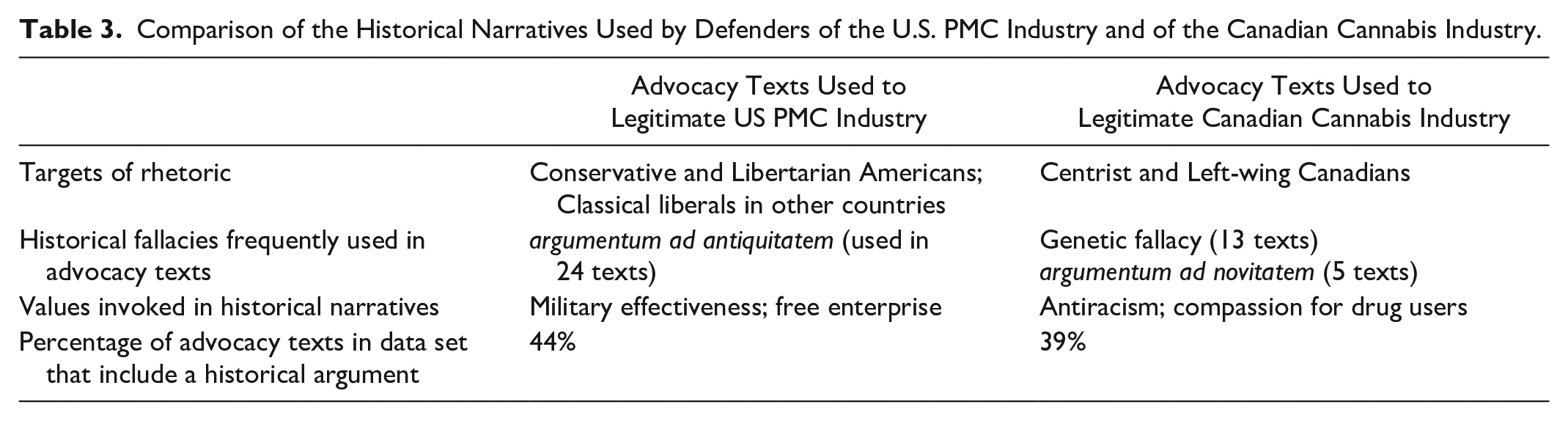
The patterns revealed in Table 3 suggest that the nature of the historical fallacies used by the representative of a stigmatized industry will likely vary according to the political orientation of their target audience. When a speaker is trying to convince fellow conservatives of the legitimacy of a given industry, the fallacy of argumentum ad antiquitatem is most likely to be used, as arguments based on tradition tend to be effective with conservatives. However, if the political strategy of an industry’s representative requires them to win over people on the left of the political spectrum, they will likely construct a historical narrative that uses the genetic fallacy to link the industry’s opponents to historical practices that are anathema to modern progressive values. We would also expect that the fallacy of argumentum ad novitatem would be used here.
Comparison of the Historical Narratives Used by Defenders of the U.S. PMC Industry and of the Canadian Cannabis Industry.
In societies in which viewpoints are clustered at the two ends of a left-right political spectrum, which is the case in both Canada and the United States, one would expect to see industries that are stigmatized more by one element of the population than the other. For instance, left-wing Canadians might regard the cannabis industry with none of the negative emotions we associate in stakeholder views of stigmatized industries, but the industry would still be disliked by enough conservatives to warrant describing the industry as a stigmatized industry. Similarly, the U.S. firearms industry, which is generally hated by left-wing Americans and is liked by right-wing Americans, would also be disliked by a large enough proportion of the relevant population for researchers to deem that industry stigmatized. Some industries, such as murder-for-hire organizations, are universally stigmatized, while others, such as the firms that make entirely inoffensive products such as bread, are entirely free to stigma.
In Figure 1, we suggest a conceptualization of industry stigmatization based on our observations of the transformation of the two industries we studied and the older literature on stigmatized industries. We believe that this way of categorizing stigmatized industries may be useful to other researchers. In the top row, we have Universally Stigmatized Industries, which are industries that regarded with disfavor by all individuals in the population regardless of their position on the left-right political spectrum. At the left-most extreme of the middle row, we have industries that are subject to intense stigmatization in the right-wing subset of the population and which are regarded as wholly unobjectionable by people on the political left. We call these stigmatized industries Respected-by-the-Left Industries. At the other end of this row, we have Respected-by-the-Right Industries, which are industries that subject to intense stigmatization in the left-wing subsets of the population and which are regarded as wholly unobjectionable by people on the right. In between, we have two categories of industries: industries that people on the right regard as anathema to their values but which people on the left condemn only mildly (Industries Softly Stigmatized by the Left) and industries that are people on the left regard as totally incompatible with their values, but which are only mildly condemned by people on the right (Industries Softly Stigmatized by the Right). In the bottom row, are the industries that are Industries Totally Free of Stigma.
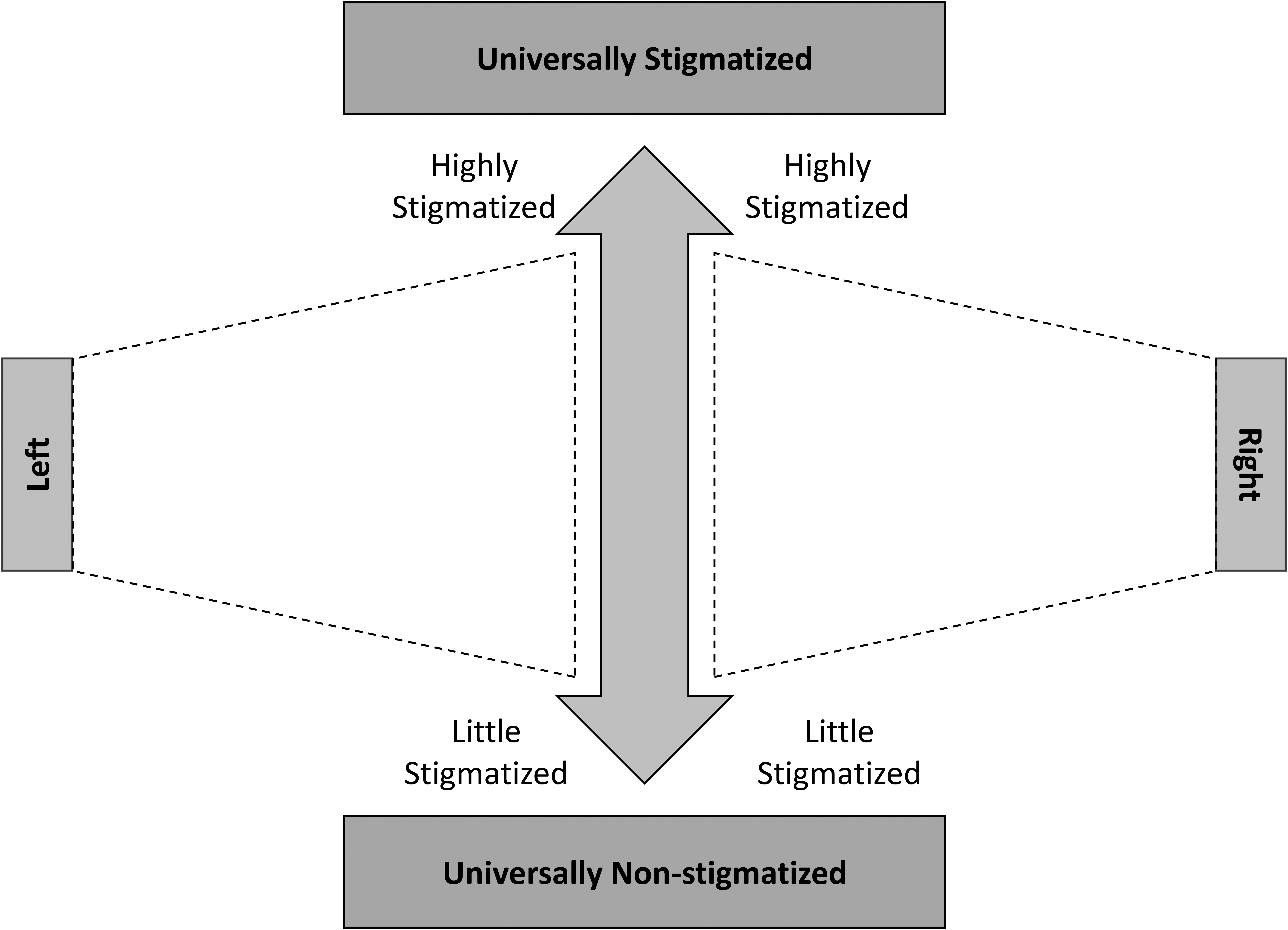
Types of stigmatized industries.
As we discussed earlier, the PMC industry, otherwise known as mercenaries, were condemned by all Americans, regardless of political party affiliation, from the 19th century to the late 20th century. The industry was the subject of intense stigmatization, although the old laws against its existence were not enforced by the U.S. government. In 1990, it clearly fell into the category of a universally stigmatized industry. Erik Prince and the other representatives of the PMC industry that emerged after the end of the Cold War were, in our view, not attempting the transform the PMC industry from a universally stigmatized industry to one that is totally free of stigma. The remarks aforequoted by Prince suggest that he recognized he would be unlikely to convince all Americans, Democrats as well as Republicans, that the PMC industry is a wholesome industry that never should have been stigmatized in the first place. Instead, he used historical narratives to try to transform the PMC industry from one that was universally stigmatized to one that was no longer stigmatized by people on the right of the political spectrum. He disseminated historical narratives in which the PMCs that had played a positive role in early American history had been unfairly stigmatized during the period in which Big Government had emerged. In effect, he was calling for a return to the good old days. By 2018, the U.S. PMC industry had moved into the Respected-by-the-Right category, for while it was still stigmatized by individuals on the left of the political spectrum, it was no longer stigmatized by Americans on the right.
In contrast, the representatives of the Canadian cannabis industry (e.g., Marc Emery) used historical narratives to convince Canadians from across that country’s political spectrum that their industry should never have been stigmatized and outlawed and should instead be treated as any other industry is treated. To help change attitudes toward this highly stigmatized industry, they used historical narratives that associated the individuals in the 1920s who had stigmatized and then banned the industry with racism. They thus used the genetic fallacy to link opposition to cannabis in the present day with racist attitudes that are anathema to multiculturalism, a value that is supported by all of the major political parties in Canada. The progressive legalization of cannabis in Canada by governments of the centrist Liberal Party has now been accepted by Canadians of all political viewpoints. In 1990, the Canadian cannabis industry was softly stigmatized by everyone. By 2018, it had moved into the category of the nonstigmatized industry.
Implications of Our Findings for Researchers
Our findings have important implications for researchers who study stigmatized industries. First, they imply that such researchers must move away from conceptualizing the stakeholders who pass judgements on stigmatized industries as monolithic groups of individuals who view the world with similar ideological lenses. The stigmatized industry studied by Helms and Patterson (2014) does not appear to have been stigmatized more by Americans at one end of the political spectrum than by those at the other. There are likely other universally stigmatized industries. The representatives of such universally stigmatized organization and industries will need to craft narratives that are designed to resonate with all stakeholders. However, there are other industries that are more stigmatized by liberals than by conservatives, or vice versa, as our study has shown. The representatives of such stigmatized industries will likely produce historical narratives that are designed to resonate with particular ideologies. Future research on stigmatized industries and organizations will likely have to take ideological diversity into account.
If only a handful of individuals in a population of stakeholders regard an industry as incompatible with their values, then it would be difficult for us to justify deeming this industry as stigmatized, since the vast majority of stakeholders regard this industry as entirely legitimate. Consider a meat-processing firm that operates in a single country. The stakeholders who are relevant to this industry include consumers and voters in that country. If one percent of the country’s population have adopted veganism for ethical reasons and have come to hate the meat industry, we would hesitate to say that this industry is stigmatized in that time and place. However, if the proportion of ethical vegans in the population increases dramatically, we would get to a point where researchers could reasonably deem the industry to be widely stigmatized. Rather than trying to establish a precise statistical threshold of disapproval for determining whether an industry is locally stigmatized, we would argue that the degree to which an industry can be classified as stigmatized is connected to the proportion of the population who regard it as antithetical to their values.
Another implication for researchers who study stigmatization is that they should pay attention to how historical narratives and historical fallacies are used to destigmatize stigmatized categories and organizations. The existing research in organization studies on stigmatization pays little attention to how historical narratives are used rhetorically. By showing that the representatives of stigmatized industries use historical narratives that are designed to resonate with the historical metanarratives that a particular group of listeners use to understand the world, our article suggests that thinking of the stakeholders who study historical narratives is deeply historical. Stakeholders draw on their interpretations of history to evaluate the rival claims made by the representatives of stigmatized industries and the claims made by critics. Future research on organizational stigma should acknowledge the historical nature of social perceptions.
In the literature review, we cited some work on changes in values and ideologies and institutional entrepreneurship (Gehman et al., 2013; Ocasio et al., 2017; Ren & Jackson, 2020). For scholars of institutional entrepreneurship (Battilana et al., 2009; Greenwood & Suddaby, 2006), the main lesson that should be drawn from our article is historical narratives are a tool used by at least some institutional entrepreneurs. Readers will observe that the industry representatives discussed in our article, such as Erik Prince and George Emery, were attempting to change the institutions in which they and their organizations were embedded. They will also observe that their historical narratives were crafted to resonate with individuals on particular parts of the ideological spectrums in their societies. Future researchers who study institutional entrepreneurship may wish to pay more attention to the role of historical narrative, the historical fallacies that increase the rhetorical power of such narratives, and the interaction of historical narratives and political ideologies.
Limitations
One limitation of this study is that the nature of our data does not allow us to examine how the historical narratives were received by the target audience nor could we measure whether the historical narratives used by these industry representatives were rhetorically effective. However, we hypothesize the historical narratives used by an industry’s representatives would not need to be scholarly, factually accurate, or logically consistent in order to be effective at convincing narrative evaluators that the industry has been falsely stigmatized. As long as the historical narratives are not obviously false to the narrative evaluators, the historical narratives used by the defenders of stigmatized industries do not have to respect the standards of evidence and careful analysis promoted by academic historians such as Fischer. We theorize that narratives that contain historical fallacies will be more effective and will be used more frequently by representatives of stigmatized industries than will historical narratives that do not contain historical fallacies. We call for additional research to test the hypothesis presented in the previous paragraph. Such research might involve either laboratory experiments or field experiments.
Conclusion
We live in a period in which the long-held assumptions that have structured how stakeholders judge industries are being challenged. Industries that were once regarded as legitimate, such as the meat industry and fossil fuels, are now increasingly subject to stigmatization, at least in the eyes of vegans and climate change activists, respectively. At the same time, industries that were once highly stigmatized, such as pornography, have been considerably destigmatized. The present can thus be viewed as an era of stigma instability that offers both risks and potential rewards for managers. Our term stigma instability, which includes both stigma erosion and its opposite, denotes change in what is stigmatized that is both rapid and difficult for observers to predict. During periods of stigma instability there is a high level of uncertainty about what will soon become stigmatized and what will soon cease to be the subject of widespread stigma. When values are in flux, managers will have an increasing need to construct convincing narratives to help convince observers that their industries should not be stigmatized. Our study has demonstrated how historical narratives can be effective in changing perceptions and thus in creating opportunities. For managers operating in an environment characterized by high levels of stigma instability, learning more about how to craft narratives that can appeal to identifiable subsets of the population is important.
Footnotes
Declaration of Conflicting Interests
The authors declared no potential conflicts of interest with respect to the research, authorship, and/or publication of this article.
Funding
The authors received no financial support for the research, authorship, and/or publication of this article.
